10 Nov 2018

US multinationals dodge $180 billion in taxes on foreign profits per year

Barry Grey

US multinational corporations are plundering the populations of the United States and the world to the tune of trillions of dollars by driving down and evading taxes on profits booked overseas. This is the conclusion that emerges from a recent study by University of California at Berkeley economist Gabriel Zucman and British economist Thomas Wright.
Their paper, titled “The Exorbitant Tax Privilege,” points to the use of US military violence to drive down taxes on American oil multinationals by oil-producing states and a massive expansion of non-oil US firms booking their overseas profits in tax haven countries to generate huge tax savings and increased profits. The statistics the authors provide translate into $180 billion a year in tax savings on US multinationals' overseas operations.
This is money diverted from government revenues in the US and around the world and funneled into the bank accounts and stock portfolios of the global financial oligarchy. In what amounts to an international extortion racket and swindling operation, the US government and both big business parties function as the enforcers of the American corporate elite.
Zucman and Wright note that oil-producing states in the Middle East and elsewhere slashed their tax rates on US oil companies from an average of 70 percent between 1966 and 1990 to an average of 45 percent following the first US-led Gulf War in 1990-1991.
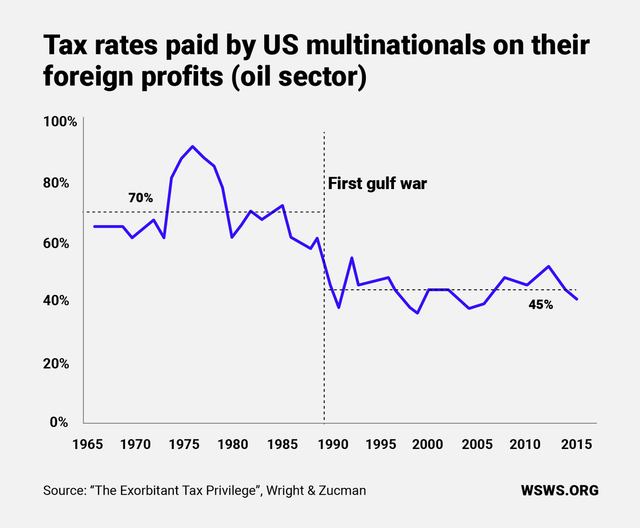
They write: “The foreign tax rates of US oil multinationals fell significantly after the first Gulf War, during which the United States (and a number of other countries with significant investments in oil) intervened to protect Kuwait, a major oil producer.
“Although it is not possible to know for sure what caused this decline, a possible interpretation of the fall in the taxes collected by oil-producing countries… is that they reflect a return on military protection granted by the United States to oil-producing States.”
This is diplomatic language to suggest that the United States used its destruction of Iraq through military violence and deadly sanctions to extort foreign governments to lower their tax rates on American multinationals. To put it more bluntly, the super-profits obtained by ExxonMobil and other mega-monopolies are based in significant part on the blood and bones of millions of men, women and children killed and injured in Iraq, Libya and other Middle Eastern oil-producing countries, as well as tens of thousands of US soldiers.
Non-oil US multinationals have effected a dramatic reduction in taxes paid on overseas investments primarily by accelerating the shift of profit bookings to tax haven countries. Zucman and Wright report that American multinationals’ profits booked in offshore tax havens increased from 20 percent of total US overseas profits in the first half of the1990s to 50 percent today.
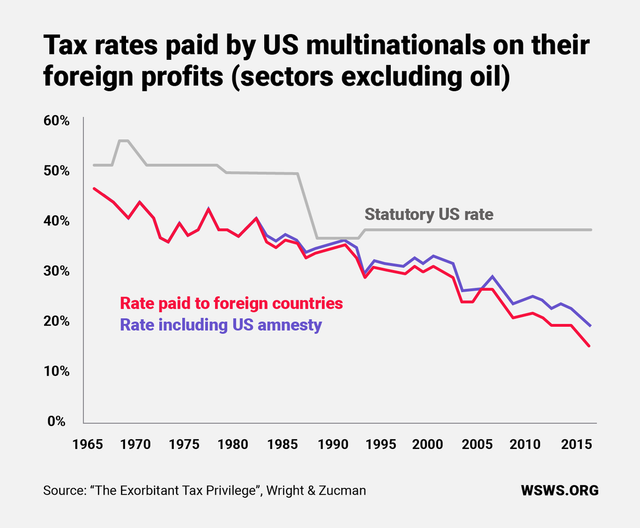
The write: “The effective foreign tax rate of US multinationals in sectors other than oil has collapsed since the mid-1990s. While part of this decline is due to the fall of corporate tax rates abroad, by our estimates almost half of it owes to the rise of profit shifting to tax havens.” These havens include countries such as Ireland, Luxemburg, the Netherlands, Switzerland, Singapore, Bermuda and Caribbean tax havens.
The authors note that US multinationals face effective corporate tax rates in non-haven countries of 27 percent as compared to 7 percent in haven countries. Since the late 1990s, the effective overseas tax rate for US non-oil multinationals has fallen by nearly half, from about 35 percent to 20 percent.
The sharp increase in the shift of overseas profit bookings to tax haven countries began with the removal in 1996 of US Treasury restrictions on tax avoidance by such means. The fact that the change took place under the Democratic Bill Clinton administration underscores the bipartisan character of the systematic reworking of tax laws to effect an ever-greater transfer of wealth from the working class to the financial elite.
Zucman and Wright point out that US multinationals use tax havens far more than multinationals based in other countries. They estimate that half of all global profits booked in tax havens are shifted by US multinationals. The practice is considerably less widespread in other major economies that comprise the Organization for Economic Cooperation and Development (OECD), where anti-tax avoidance laws remain in place. About 25 percent of profits from tax havens go to European Union countries, 10 percent to the rest of the OECD, and 15 percent to developing countries.
The $1.5 trillion tax cut signed into law last December by President Trump, the benefits of which go overwhelmingly to corporations and the rich, provides additional windfalls for US multinationals that have parked trillions of dollars in profits in foreign tax havens to evade US taxes. Besides cutting the legal corporate tax rate from 35 percent to 21 percent (the real, or “effective,” rate is much lower), the law allows companies such as Apple and Google to repatriate their overseas profits at a discounted tax rate of 8 percent to 15 percent, depending on the nature of the assets.
That law has already sharply reduced the amount of taxes being collected by the federal government from major corporations, leaving their rich shareholders wealthier and the government deeper in debt. Just between January and June of this year, government revenues from corporate taxes dropped by almost $50 billion from the previous year, a decline of one-third.
The cynical claim that corporations would use their tax savings to create more decent-paying jobs has already been exposed by record rates of corporate stock buy-backs and dividend increases. US big business is using its tax boondoggle to reward the bankers, big investors and CEOs with billions in additional wealth—to buy more and bigger yachts, private islands and personal jets—while squandering more resources produced by the labor of the working class on parasitic financial operations.
The estimated $180 billion a year in reduced taxes on foreign earnings by US multinationals is five times the $30 billion per year needed to eradicate world hunger.
These statistics shatter the lie, constantly recited to justify cuts in social programs and workers’ wages and benefits, that “there is no money” to pay for such things. They underscore the fact that no progress can be made in meeting elementary social needs without a frontal attack by the working class on the fortunes of the US and international oligarchs.

9 Nov 2018

VLIR-UOS Masters (ICP) and Training Scholarships 2019/2020 by Belgium Government for African/Developing Countries

Application Deadline: Application Deadlines depend on candidate’s chosen programme (See’How to Apply’ link below); deadlines generally between November 2018 – March 2019

Offered annually? Yes

Eligible Countries
  • Africa: Benin, Burkina Faso, Burundi, DR Congo, Ethiopia, Guinea, Cameroon, Kenya, Madagascar, Mali, Morocco, Mozambique, Rwanda, Senegal, Tanzania, Uganda, Zimbabwe, South Africa, Niger
  • Asia: Cambodia, Philippines, Indonesia, Palestinian Territories, Vietnam
  • Latin America: Bolivia, Cuba, Ecuador, Guatemala, Haiti, Nicaragua, Peru
To be taken at (country): Belgium

Accepted Subject Areas: Only the following English taught courses at Belgian Flemish universities or university colleges are eligible for scholarships:
  • Master of Human Settlements – Deadline for applications: 1 February 2019
  • Master of Development Evaluation and Management – Deadline for applications: 1 February 2019
  • Master of Governance and Development – Deadline for applications: 1 February 2019
  • Master of Globalization and Development – Deadline for applications: 1 February 2019
  • Master of Cultural Anthropology and Development Studies – Deadline for applications: 1 February 2019
Two-year programmes
  • Master of Science in Food Technology – Deadline for applications: 1 February 2019
  • Master of Science in Marine and Lacustrine Science and Management (Oceans and Lakes) – Deadline for applications: 28 February 2019
  • Master of Aquaculture (IMAQUA) – Deadline for applications: 1 March 2019
  • Master of Epidemiology – Deadline for applications: 15 February 2019
  • Master of Agro-and Environmental Nematology – Deadline for pre-academic admission: 3 January 2019. Please note you have to send a hard copy of your application and all requested documents to the programme coordinator before 15 January 2019!
  • Master of Rural Development – Deadline for applications: 1 March 2019
  • Master of Statistics – Deadline for applications: 1 February 2019
  • Master of Water Resources Engineering – Deadline for applications: 1 February 2019
  • Master of Sustainable Territorial Development – Deadline for applications: 1 February 2019
  • Master of Transportation Sciences and Road Safety in Low & Middle Income Countries – Deadline for applications: 1 March 2019
Training programmes (14-90 days)
  • International Module for Spatial Development Planning: deadline for applications is 23/11/2018 
About the Award: VLIR-UOS awards scholarships to students from developing countries to study for a master or training programme in Flanders, Belgium. VLIR-UOS funds and facilitates academic cooperation and exchange between higher education institutions in Flanders (Belgium) and those in developing countries, which aims at building capacity, knowledge and experience for a sustainable development.
The master programmes focus on specific problems of developing countries. These are designed to enable graduates to share and apply acquired knowledge in the home institution and country. In the shorter training programmes the focus is on transferring skills rather than knowledge, thus creating opportunities for cooperation and networking.

Selection Criteria: The following criteria will be taken into account for the selection of candidates for a scholarship:
  • Motivation. The candidate who is not able to convincingly motivate his application, is unlikely to be selected for a scholarship.
  • Professional experience: Preference will be given to candidates who can demonstrate a higher possibility of implementing and/or transferring the newly gained knowledge upon return to the home country.
  • Gender. In case of two equally qualified candidates of different sexes, preference will be given to the female candidate.
  • Regional balance. The selection commission tries to ensure that 50% of a programme’s scholarships are granted to candidates from Sub-Saharan Africa, provided there is a sufficient number of qualifying candidates from this region.
  • Social background. In case of two equally qualified candidates, preference will be given to candidates who can demonstrate that they belong to a disadvantaged group or area within their country or an ethnic or social minority group, especially when these candidates can provide proof of leadership potential.
  • Previously awarded scholarships: Preference will be given to candidates who have never received a scholarship to study in a developed country (bachelor or master).
Eligibility: You can only apply for a scholarship if you meet the following requisites.
  1. Fungibility with other VLIR-UOS funding: A scholarship within the VLIR-UOS scholarship programme is not compatible with financial support within an IUC- or TEAM-project. Candidates working in a university where such projects are being organized, should submit a declaration of the project leader stating that the department where the candidate is employed is not involved in the project.
  2. Age: The maximum age for an ICP candidate is 35 years for an initial masters and 40 years for an advanced masters. The maximum age for an ITP candidate is 45 years. The candidate cannot succeed this age on January 1 of the intake year.
  3. Nationality and Country of Residence: A candidate should be a national and resident of one of the 31 countries of the VLIR-UOS country list for scholarships (not necessarily the same country) at the time of application.
  4. Professional background and experience: VLIR-UOS gives priority to candidates who are employed in academic institutions, research institutes, governments, social economy or NGO’s, or aim a career in one of these sectors. However, also candidates employed in the profit sector (ICP and ITP) or newly graduated candidates without any work experience (ICP) can be eligible for the scholarship. The ITP candidate should have relevant professional experience and a support letter confirming (re)integration in a professional context where the acquired knowledge and skills will be immediately applicable.
  5. Former VLIR-UOS scholarship applications and previously awarded scholarships: A candidate can only submit one VLIR-UOS scholarship application per year, irrespectively of the scholarship type. As a consequence, a candidate can only be selected for one VLIR-UOS scholarship per year.
  6. The ICP candidate has never received a scholarship from the Belgian government to attend a master programme or equivalent or was never enrolled in a Flemish higher education institution to attend a master programme or equivalent before January 1 of the intake year
Number of Awardees: VLIR-UOS will award up to 180 scholarships to first-year master students and 70 scholarships to training participants.

Value of Scholarship: The scholarship covers ALL related expenses (full cost).

Duration of Scholarship: The master programmes will last for one or two academic years while the shorter training programmes will last 14 to 90 days.

How to Apply: 
  • To apply for a scholarship, you first need to apply for the training or Master programme.
  • To apply for a training or Master programme, visit the website of the training or Master programme of your interest. Follow the guidelines for application for the programme as mentioned on its website.
  • In the programme application, you can mention whether you wish to apply for a scholarship. In case you do,  the programme coordinator forwards your application to VLIR-UOS.
  • Applications submitted by the candidates to VLIR-UOS directly will not be considered!
Visit Scholarship Webpage for more details

Sponsors: The Flemish Interuniversity Council (VLIR) responsible actor for the Belgian government

The Queen’s Commonwealth Essay Competition 2019 Now Open

Application Deadline: 1st June 2019;

Offered annually? Yes

Eligible Countries: all Commonwealth countries and territories.

Theme: The Royal Commonwealth Society is pleased to announce the theme for The Queen’s Commonwealth Essay Competition 2019 – A Connected Commonwealth.

Building on the 2018 theme of Towards a Common Future, this year’s topics ask young writers to explore the shared values, interests and experiences across the network, and how they can use this to make positive change. It calls on young people to consider the potential of the Commonwealth in strengthening the cast and varied links between citizens.

Senior Category: Born between 2 June 2000 and 1 June 2005 (14-18 years of age)
  1. ‘You are the most optimistic, connected generation the world has ever known.’ HRH The Duke of Sussex. How can you use Commonwealth connections for positive change?
  2. Connected by the oceans; can we work together to protect the environment?
  3. ‘We are all now connected by the Internet’ – Stephen Hawking. What does the future hold for humankind?
  4. Family, Community, Nation, Commonwealth. What are the opportunities for shared, sustainable growth?
Junior Category: Born on or after 2 June 2005 (under 14 years of age)
  1. My cultural connections.
  2. An overseas visitor is coming to your town for the first time.  How would you connect with them?
  3. A place I feel connected to.
  4. The Commonwealth connects people across borders – what can we learn from our neighbours?
Judges described entries to the competition in 2018 as ‘‘fantastically imaginative’, ‘hopeful’, ‘quite exceptional’ and ‘passionate’. We expect a similarly high calibre of writing for 2019.

About The Award: For 2019, we want to hear from all young people, regardless of schooling, education or region.  All stories and voices are important.
The competition is open to all citizens and residents of the Commonwealth aged 18 and under and runs from Monday 5 November until 1 June 2019. All entrants receive a Certificate of Participation and one Winner and Runner-up from the Senior and Junior categories will win a trip to London for a week of educational and cultural events.

Offered Since: 1883

Eligibility: Entries will be disqualified if they fail to meet any of the following requirements:
  1. The competition is open to nationals or residents of all Commonwealth countries and territoriesas well as residents of the Maldives and Zimbabwe. Residents of non-Commonwealth countries whose entries are submitted through their local RCS branch are also eligible.
  2. Entrants must select a Senior or Junior topic depending on their age on 1st June 2019. Senior entrants must be born between 2nd June 2000 and 1st June 2005 (14-18) and Junior entrants must be born after 2 June 2005 (under 14 years of age).
  3. The maximum word counts are 1,500 words for Senior entries and 750 words for Junior entries. These word limits apply to all topics and all formats (essay, poem, letter, etc). Exceeding the word count will result in automatic disqualification.
  4. Entries must be written in English.
  5. Only one entry per participant is allowed. Once an essay is submitted, students/teachers will nothave the opportunity to revise it. Please carefully check and improve your writing before submitting the final copy, and also ensure that all supplementary information is filled in correctly (name, contact details, topic number, etc.)
  6. Plagiarism is not accepted in the competition. Every year a number of students are disqualified because they are suspected of plagiarism. Please see our guide to plagiarism before submitting.
  7. Final documents should not include the entrants personal details including name, age, school or country. This information should be inputted upon entry.
  8. The final copy submitted for the competition must be the entrant’s own work, and cannot be excessively corrected or improved by another person. This does not rule out input or assistance from others but does exclude group entries.
  9. By entering the competition, you agree that your personal details including full name, gender, email, school and essay may be sent to your local RCS branch and any Essay Competition partners.
  10. Essays can only be uploaded as a Microsoft Word document (.doc or .docx) or in PDF format (.pdf). The online platform does not accept Google Docs (.gdoc), Pages documents (.pages) or other word processor formats. Note: if we are unable to find or open your essay file (either through an incorrect format or upload error), your entry may not be counted in the competition.
  11. All online entries must be submitted before midnight (GMT) on 1st June 2019; any offline entries must arrive at RCS London by 1st May 2019
  12. All entrants retain the copyright rights that they have for the pieces they submit, but by entering The Queen’s Commonwealth Essay Competition, each contestant consents to the use of his/her name, and/or pieces or parts thereof in any advertisements, educational materials, corpus research or media and publicity carried out or produced by the Royal Commonwealth Society and its local branches without further notice or compensation. The Royal Commonwealth Society can publish or decline to publish; use or decline to use, any submitted pieces at the Royal Commonwealth Society’s sole discretion.
  13. The RCS suggests that entrants retain a copy of their original work as regretfully we are unable to return or provide copies of submissions.
  14. The RCS retains the right to change the prize of the competition if circumstances make this necessary.
  15. The RCS will only be able to publish on our website and in our literature content that is appropriate for a wide and diverse audience, in line with our own policies. Entrants are encouraged to consider this in relation to their use of language when entering the competition.
Value of Award: Prizes have traditionally been awarded only to the first prize winners in the Senior and Junior categories and also vary year by year. All entrants receive a Certificate of Participation and one Winner and Runner-up from the Senior and Junior categories will win a trip to London for a week-long series of educational and cultural events.

How to Enter: The Royal Commonwealth Society is building a new online platform that will be much easier to use and accessible on all devices, but it’s not quite ready yet. We encourage young people to begin writing their pieces and will open the new platform for submissions in early 2019. Please note: we do not accept essays sent by email.
Please visit the ‘Terms and Conditions’ page and Competition Webpage before submitting your entry.

Visit Competition Webpage for details

Provider: The Royal Commonwealth Society

Open Society Fellowship 2019 for International Scholars

Application Deadline: 4th February 2019

Offered annually? Yes

Eligible Countries: All

About the Award: The Open Society Fellowship was founded in 2008 to support individuals pursuing innovative and unconventional approaches to fundamental open society challenges. The fellowship funds work that will enrich public understanding of those challenges and stimulate far-reaching and probing conversations within the Open Society Foundations and in the world. The fellowship funds work that will enrich public understanding of those challenges and stimulate far-reaching and probing conversations within the Open Society Foundations and in the world.
For the current application round, applicants for the Open Society Fellowship are invited to address the following proposition:
New and radical forms of ownership, governance, entrepreneurship, and financialization are needed to fight pervasive economic inequality.
This proposition is intended as a provocation—to stimulate productive controversy and debate—and does not necessarily represent the views of the Open Society Foundations. Applicants are invited to dispute, substantiate, or otherwise engage with the proposition in their submissions. Though the proposition deals with economic issues, those without an economics or business background are welcome to apply, provided they have a relevant project in mind.

Offered Since: 2008

Type: Fellowship

Eligibility:
  • Ideal fellows are specialists who can see beyond the parochialisms of their field and possess the tenacity to complete a project of exceptional merit.
  • Proposals will be accepted from anywhere in the world, although demonstrable proficiency in spoken and written English is required.
  • Applicants should possess and demonstrate a deep understanding of the major themes embedded within the statement for which they wish to apply and be willing to serve in a cohort of fellows with diverse occupational, geographic, and ideological profiles.
  • Successful applicants should be eager to exploit the many resources offered by the Open Society Foundations and be prepared to engage constructively with our global network.
Selection: The fellowship seeks “idea entrepreneurs” from across the world who are ready to challenge conventional wisdom.
Letters of inquiry should address the following questions:
  • What is the central argument of your proposed project as it relates to the statement?
  • How does your project advance or challenge current thinking?
  • Who is/are the intended audience/s?
  • What are the potential work products?
Number of Awardees: Not specified

Value of Scholarship: 
  • One year fellows will receive a stipend of $80,000 or $100,000, depending on work experience, seniority, and current income. Stipends will be prorated for shorter term fellows. The stipend does not necessarily equal the applicant’s current salary. In certain cases, fellows will receive additional financial support to enable them to meet the residency expectation.
  • Open Society fellows produce work outputs of their own choosing, such as a book, journalistic or academic articles, art projects, a series of convenings, etc. In addition, fellowship cohorts may develop a joint work product of some sort. Fellowship staff will assist cohorts in brainstorming possible outputs if needed.
  • In addition to the stipend, fellows will receive a project budget. That budget may include expenses such as travel (including airfare and hotel), visa costs, part-time research assistance, conference fees and health insurance.
Duration of Fellowship: Fellowships are granted for one year, six months, and, in a small number of cases, for three months.

How to Apply: Applicants are asked to submit a letter of inquiry online through our grants portal by February 4, 2019. Any questions may be directed to osfellows@opensocietyfoundations.org. Complete guidelines are available in the Download Files section on this page.

Visit Fellowship Webpage for details

Award Provider: Open Society Fellowship

Important Notes: 
  • The fellowship does not fund enrollment for degree or nondegree study at academic institutions, including dissertation research.
  • This is a fellowship for individuals only; proposals from organizations or individuals acting on behalf of organizations will not be accepted.

Reuters Journalism Training Programme 2019 for Early-career & Professional Journalists in Europe, Middle East and Africa

Application Deadline: 30th November 2018 at midday (UK time).

Eligible Countries: Countries in Europe, the Middle East and Africa (EMEA)

To be taken at (country): Reuters Offices in London, UK; and EMEA countries

About the Award: The Reuters Journalism Programme is an opportunity for recent graduates, early career reporters, or professionals with 2-3 years’ experience who are looking to switch careers into journalism. The programme in 2019 will consist of 9 months of formal and on-the-job journalism training, initially for one month in London, followed by one of our other main reporting newsrooms or bureaus across Europe, the Middle East and Africa.

Type: Internship, Training

Eligibility:
  • Clear commitment to a career in journalism
  • Drive to build sources, break news and deliver deeply reported stories
  • Strong interest in issues that affect companies, markets and economies
  • Ability to generate original, relevant story ideas
  • Ambition to deliver journalism with real impact
  • Fluency in written English
  • Fluency in a second language beneficial but not compulsory
  • An international outlook
Other desired skills (not prerequisites)
  • Knowledge or expertise in a relevant field such as banking, financial analysis, accounting, law or computer science
  • Up to 3 years of professional journalism experience
  • Proven ability to generate exclusive and agenda-setting stories
  • Experience in multi-media story-telling
  • Expertise in data analysis or data-driven journalism
  • Understanding of how to use social media to report and find sources
Visa Requirements
You must have the legal right to work in either Europe, Middle East or Africa to be considered for this programme

Number of Awards:

Value of Award: The Reuters Journalism Programme offers an opportunity to fast-track your journalism career and develop your skills across a variety of subjects and media. Successful applicants will predominantly report in text, but visual reporting skills and story-telling ideas will be welcome.

Key elements
  • Competitive pay
  • Placements in a bureau in EMEA
  • Fast-paced reporting on top news stories of the day
  • Opportunity to develop journalism skills
  • Participants who excel may be considered for other opportunities
Duration of Programme: 
  • Nine-month scheme including intensive training and reporting assignments
  • Placement in the London newsroom or a major bureau in EMEA
  • Application due by Friday 30th November 2018
  • Programme begins September 2019
How to Apply: 
  • Please ensure that your CV is no more than two pages long and written in English.
  • All applications must be supported by a Cover Letter
Visit Programme Webpage for Details

Erasmus Mundus MaMaSELF Joint Masters Scholarships 2019/2020 for International Students

Application Deadline: 12th February 2019.

To be taken at (Universities): 
  • University of Rennes 1-UR1, France
  • University of Torino-TO, Italy
  • Technical University of Munich-TUM, Germany
  • Ludwig Maximiillan University of Munich-LMU, Germany
  • University of Montpellier-UM, France
About the Award: MaMaSELF is a 2 year ERASMUS MUNDUS Master Course in Materials Science Exploring Large Scale Facilities (MAMASELF). It deals with material characterization using neutron and synchrotron radiation with strong synergies between universities, industrial partners and research centres. In an international environment, it offers excellent academic and industrial opportunities to Master Students.

Type: Masters

Eligibility: Students must have
  • A Bachelor (180 ECTS)  in Materials Science or related disciplines : Chemistry, Physics, Geo-science,…
  • Proof of good English competencies, e.g.  TOEFL  CBT 230 and PBT  550 IBT 80 / IELTS 6.5 or equivalent, except for applicants native from English speaking countries and for students having been educated in English at secondary or/and university. Students who intend to have a mobility at TUM  must have following level for admission at TUM : TOEFL IBT 88, CBT 234/ PBT 605
  • Students coming from main background : civil engineering, medicine, pharmacy, architecture, accounting, law will not be accepted unless they have a minimum background in Chemistry or Physics (at Bachelor level).
Number of Awardees: Not specified

Value of Scholarship: The Erasmus Mundus scholarship covers tuition fees and allows to cover all expenses that non eu students normally face during their studies.

Duration of Scholarship: 2 years

How to Apply: 
  • Bachelor degree (with certified English translation)
  • Transcripts (with translation)
  • English competencies certificate
  • Reference letters
  • Passport
Create your account and start your application

Visit Scholarship Webpage for details

Fracking in the UK

Graham Peebles

Burning fossil fuels is a major cause of greenhouse gas emissions (GGE), and, greenhouse gas emissions (water vapor (H2O), carbon dioxide (CO2), methane (CH4), nitrous oxide (N2O)) are the principle cause of man-made climate change. Given this fact, governments throughout the world should be moving away from fossil fuels and investing in, and designing policies that encourage development of, renewable sources of energy. But the British Conservative government, despite public opinion to the contrary, has all but banned the construction of onshore wind turbines and is encouraging fracking in England. The Tories are the only UK political party to offer support for this regressive form of energy production, Labour, the Liberal Democrats and the Greens having all promised fracking bans should they gain political office at the next general election.
Hydraulic fracking is the process of releasing gas and oil from shale rock: huge quantities of water, proppant (usually sand) and chemicals are injected at high-pressure into hydrocarbon-bearing rocks, rocks that can be up to a mile down and were once thought to be impermeable. This process of fracturing (or cracking) forces the rocks to crack open, and gas held inside is released and allowed to flow to the surface.
Shale gas is a fossil fuel, and when combusted produces GGE, albeit at around 50% less than coal or oil, but GGE nevertheless. The leading fracking company in Britain is the energy firm Cuadrilla. An organization that according to its website, aims “to be a model company for exploring and developing shale gas in the UK,” they state that they are “acutely aware of the responsibilities this brings, particularly with regard to safety, environmental protection and working with local communities.” Really?
After protests by the local community and various court cases (Lancashire County Council had refused drilling rights, but the Secretary of State ignored community voices and approved the company’s request on appeal), Cuadrilla recently commenced fracking at its Preston New Road site in Lancashire. However, as in 2011 when the company was forced to abandon drilling, work was suspended for two days out of four because of earthquakes. Tremors measured 0.5 on the Richter scale, which breached the seismic threshold established following the 2011 earth tremors. Instead of abandoning the project as the local community and environmental groups are demanding, the firm’s chief executive, Francis Egan, wants the Government to raise the threshold.
Another Regressive Step
America is home to hydraulic fracturing, where it’s been taking place for decades. Greenpeace state that as of 2012 the “fracking industry [in USA] has drilled around 1.2 million wells and is slated to add at least 35,000 new wells every year.” Fracking has led to US oil production increasing faster than anytime in its history, resulting in lower domestic gas prices. The US Energy Information Administration record that around two thirds of gas is now produced by fracking and almost half the countries crude oil.
Shale gas is spoken of as a positive alternative to coal, but it’s just another filthy fossil fuel that is adding to GGE, which in turn are driving climate change. Fracking has a substantive impact on the natural environment and the health of those living within the surrounding area. Earthquakes, air pollution, soil pollution, carcinogenic chemical leakage and contaminated groundwater are the primary risks.
An enormous amount of water, which needs to be transported to the site incurring significant environmental costs, is required in the fracking process. The amount of water used varies per well: between 1.5 and 10 million gallons is required every time a well is fractured. Greenpeace relate that, “in 2010, the U.S. Environmental Protection Agency estimated that 70 to 140 billion gallons of water were used to fracture just 35,000 wells in the United States.” The water is mixed with various chemicals to make fracking fluid, a toxic cocktail that can be further contaminated by “heavy metals and radioactive elements that exist naturally in the shale.” A significant portion of the frack fluid returns to the surface, “where it can spill or be dumped into rivers and streams…fracking fluids and waste have made their way into our drinking water and aquifers. Groundwater can be contaminated through fracking fluid and methane leakage and the energy companies have “no idea what to do with the massive amount of contaminated water it’s creating,”
In addition to water and soil pollution, fracking adds to existing levels of air pollution as methane gas is released into the atmosphere through leaks and venting, a study conducted by Cornell University found that “over a wells lifetime, 3.6 to 7.9 percent of methane gas escapes” in this way. Unlike CO2, which sits in the atmosphere for centuries or millennia, methane only lasts for decades, but the Intergovernmental Panel on Climate Change asserts that it warms the planet by 86 times as much as CO2 before then degrading to become CO2.
Many countries recognize the retrogressive nature of fracking and have rejected it; France, Cantabria in Spain, Germany and Bulgaria have banned it, England is the only country in the UK where it is allowed. More than 100 fracking licenses have been awarded by the government, but in order to start fracking they need permission from the local council. Fracking is universally unpopular amongst the communities where sites are located or proposed; on 13th October the Gasdown-Frackdown action saw thousands of people from six continents take to the streets demanding an end to fracking and calling for long-term investment in renewable sources of energy. Fracking is not an environmentally sane way to meet the energy needs of a country, it is part of the problem not the solution and it should be rejected totally. What is required is a global energy strategy rooted in environmental sustainability. As Friends of the Earth rightly say, “a 21st Century energy revolution based on efficiency and renewables, not more fossil fuels that will add to climate change.”

The Zika Scare: a Political and Commercial Maneuver of the Chemical Poisons Industry

Evaggelos Vallianatos

Researchers discovered the Zika virus in the Zika forest of Uganda – in 1947. It is a virus not much different than the viruses causing dengue, yellow fever, Japanese encephalitis, West Nile fever, and St. Luis encephalitis. The Zika virus eventually spread throughout most of the world. Mosquitoes carry and spread the Zika virus. But for decades the Zika disease afflicting humans was free of brain deform or the shrinking of the infant’s brain  known as microcephaly (a Greek term meaning tiny brain-head).
The 2016 Olympics in Rio De Janeiro, Brazil
I heard the name Zika for the first time in 2016 during the Summer Olympics in Rio De Janeiro, Brazil. Reporting on the PBS Newshour offered warnings for those going to Brazil. Other large media went almost berserk. They were shouting that women near the Olympics site were giving birth to babies with tiny brains. They blamed Zika virus. They blamed the mosquitoes for the malformation of the brain of the babies. The Olympics should be delayed or moved to another country. Brazil was dangerous.
Imagine hundreds of athletes and hundreds of thousands of tourists returning to Europe and the  United States with this dreadful Zika disease, especially pregnant women likely giving birth to deformed babies.
Astonishing as these unverified news stories were, government agencies rushed to give them credence. I heard representatives of the Centers for Disease Control and Prevention repeating the questionable newspaper and TV stories about the Zika virus. In addition, CDC keeps saying that fighting Zika virus-carrying mosquitoes in Brazil and Florida with a neurotoxin named “naled” is harmless. After all, farmers and mosquito controllers have been spraying naled for more than fifty years in the United States.
CDC said nothing about the deleterious effects of naled: that this chemical is an organophosphate compound linked to chemical warfare agents: targeting and harming the central nervous system and the brain of man and beast, of birds and insects and fish, of all wild animals.
So, what caused the tiny brains of Brazilian babies during the 2016 Summer Olympics? The Zika virus-infected mosquitoes or pesticides sprayed intensely in the environment, including in the drinking water of the urban slum mothers afflicted by the Zika virus?
Poverty and Poisons
A Berkeley team of scientists published a 2017 study in which they said: “Zika is, and will continue to be, a disease of the urban poor.” A group of physicians from Argentina and Brazil had already explained why.
In a February 2016 report, they argued that the Zika disease in Brazil, and other tropical countries, is not simply a disease of infected mosquitoes stinging pregnant women. They saw the Zika disease as a symptom of a much larger pathology: that of deforestation, the destruction of flora and fauna, massive pesticide sprayings of the natural world and cities, ecological imbalance, global warming and inequality.
Furthermore, these physicians say the massive air spraying of toxic pesticides against mosquitoes is “criminal” and “useless”: nothing but a political and a commercial maneuver of the chemical poisons industry.
They reported that there are countries like Colombia where the Zika virus causes disease but not microcephaly. In Brazil, however, the population that suffers from the Zika virus disease and, potentially, from microcephaly, has been drinking water intentionally treated with pyriproxyfen. This is a potent teratogen that causes monstrous changes in the development of the mosquito, foreclosing its chance of growing normally.
Pyriproxyfen: Insect and Human Growth Regulator?
Experts describe pyriproxyfen as an “insect growth regulator” – an apt name for a chemical made up of insect parts and chemicals formulated into a biological bomb: destroying the insect from within: wrecking the insect’s embryogenesis and metamorphosis to adult.
This powerful biological weapon — that annihilates mosquitoes or other insects – is not benign to humans drinking it in their water or exposed to it in any other way like in spraying it against mosquitoes. In fact, it harms human blood and the liver.
The real danger of pyriproxyfen, however, comes from what it does to developing mosquitoes: giving them malformations, which cause “death or incapacity.” The developing mosquito can’t grow wings or mature external genitalia. It moves to death through its disrupted evolution to a nymph or larva. Pyriproxyfen makes it impossible for the developing mosquito to become an adult.
The physicians from Argentina and Brazil urge us to get off our horse of hubris and think in biological terms. About 60 percent of our genes are identical to the genes of insects like the Aedes aegypti mosquitoes that potentially carry the Zika virus. In addition, they emphasize our evolution – going from the zygote to embryo to fetus to newborn — is not that much different than the development process of the mosquito: larva-pupa-adult.
The implications of this biology, including the effects of pyriproxyfen on mosquitoes, are frightening. It is not out of the question that, under certain conditions, like massive and chronic sprayings of the environment, pyriproxyfen could probably do to people what it does to mosquitoes. It has the potential of becoming a “human growth regulator.” Is microcephaly one of the deadly consequences of that potential?
Environmental and Political Origins of Teratogens
“Malformations detected in thousands of children from pregnant women living in areas where the Brazilian state added pyriproxyfen to drinking water is not a coincidence, even though the Ministry of Health places a direct blame on Zika virus for this damage, while trying to ignore its responsibility and ruling out the hypothesis of direct and cumulative chemical damage caused by years of endocrine and immunological disruption of the affected population,” wrote the physicians from Argentina and Brazil.
What these scientists are saying is that Brazil, like the Unites States, is hooked on toxic sprays, used all over the country for decades. In about five years, vector control is projected to approach $ 20 billion per year earnings for the poisons industry.
Like America, Brazil, Argentina and other Latin American countries hire experts from the industry to run their mosquito spraying programs. These experts have been occupying key positions in ministries of health.
Second, the World Health Organization and the Pan American Health Organization have vector control committees that decide what chemical should be sprayed in what country. The Argentinian and Brazilian physicians accuse these pesticide committees of “imperial” policies. They say the “hegemonic strategies” they advocate for “diseases spread by mosquitoes and multiplied by poverty” avoid the threats from bad sanitation, lack of safe drinking water, and responsible health policies. Instead, such programs rely entirely on the spraying of chemicals.
Such practices “demobilize the population” because they leave the people out of decisions, relying instead on the killing of mosquitoes. However, the sprays also affect the population, making people sick and weak. In addition, the sprays kill the natural predators of mosquitoes, which necessitate additional spraying, the only winners being the poisons industry.
Many of the chemicals targeting mosquitoes are endocrine disruptors, weakening the immune system of the exposed population. So, adding pyriproxyfen to that soup of chemicals and adding it to the drinking water and intimate environment of impoverished slum dwellers, you are asking for big trouble: the birth of babies with tiny brains.
“The governments of Mercosur [Mercado Comun del Sur – Southern Common Market of countries of South America] are causing alarm with the threat of Zika and microcephaly, proposing ‘more of the same.’ The agribusiness is offering the services of the ‘Soya Air Force’ to be used for spraying over cities and villages…. To social inequality, these epidemics will add health inequalities, and governments with their chemical attacks will generate environmental inequality,” wrote the physicians from Argentina and Brazil.
These inequalities are increasing ecological damage and the schism between the rulers and the ruled: the vast majority of the people. The rulers cover up the harms with the prestige of international health organizations, universities, business, experts – and the media. Brazil enforced its Zika policies with soldiers.

Religion, Reformation, and Modernity

Nyla Ali Khan

It is extremely important for educated Muslims to argue for a rational Islam and to seek to reconcile Islamic teachings and democracy. We cannot afford to disavow the space of religion for fundamentalists to do whatever they like with it. To keep fundamentalist forces at bay, educated and rational people must endeavor to bring about a reformation, so that religion can be perpetuated in a modern age as a liberal force. We can try to combine the concepts of an Islamic state with the principles of a socialist state, advocating social equality and economic and political democratization. We need to keep in mind that communities can grow historically within the framework created by the combined forces of modern national and transnational developments.
I agree that the politics of religion as a monolith is hostile to pluralism and evolution, because it insists on the uniform application of rights and collective goals. Such uniformity is oblivious to the aspirations of distinct societies and to variations in laws from one cultural context to another.
For fundamentalist organizations, religion is meant to be a hostile and vindictive force that ignores art and tradition. For instance, impassioned appeals of the clergy to the outdated concept of Islam have bred rancorous hate against “outsiders” and exploited the pitiful poverty and illiteracy of the majority of Muslims in the subcontinent, who are unable to study progressive concepts of the religion for themselves. This strategy of fortifying fundamentalism has created a bridge between the “believers” and “non-believers,” which, I would argue, is rooted in contemporary politics. The ideology propounded by the ruling fundamentalist order reflects and reproduces the interests of the mullahcracy. Mullahs justify repression of the poor and dispossessed classes, subjugation of women, and honor killings with the language of culture and religion. Such practices have led to regrettable ruptures of the Indian subcontinent and to a denial of science, technology, and historical understanding of the precepts of Islam. I am highly critical of the kind of nationalist logic in theocratic countries in which an image of the non-Islamic world as chaotic valorizes the dominance of the fundamentalist order.
Here is my concrete example of social equality, economic and political democratization, and empowerment of minorities in a predominantly Muslim society:
Historical foundations for pluralist democracy in my State, Jammu and Kashmir, which is predominantly Muslim, were established by revolutionary actions during the 1950s to keep the forces of religious fundamentalism at bay. Land was taken from exploitative landlords without compensation and distributed to formerly indentured tillers of the land. This metamorphosis of the agrarian economy had groundbreaking political consequences in a previously feudal economy. With landlord rule abolished and land distributed to peasants who formed cooperative guilds, the economy started working better for all those who cultivated the land and made livings from the forests, orchards, and fish-filled waters. Mineral wealth was reserved for the betterment of the entire populace, while tillers were assured of the right to work on the land without incurring the wrath of creditors and were newly guaranteed rights to basic social and health benefits. These measures signaled the end of the chapter of peasant exploitation and subservience and opened a new chapter of peasant emancipation.
Building on the earlier gains, a pluralistic government ensured further economic, social, and educational gains for women and marginalized groups.
The “Women’s Charter” in the “Naya Kashmir Manifesto” accorded equal rights to women with men in all fields of national life – economic, cultural, political, and in government services. Women had the right to work in every line of employment for terms and wages equal to those for men. Women would be assured of equality with men in education, social insurance and job conditions, though the law should also give special protections to mothers and children.
The convergence of religion with social and economic democratization increases my faith in camaraderie, humanity, and the resilience of the human spirit.

Safety questions emerge after 189 people die in Indonesian plane crash

Oscar Grenfell 

Since a Lion Air flight crashed into Indonesia’s Java Sea on October 29, killing all 189 passengers and crew members on board, information has emerged indicating that mechanical faults may have contributed to the aviation disaster, the country’s worst in over two decades.
The plane reportedly fell out of radio contact some 13 minutes after taking off from Jakarta on a routine flight to Pangkal Pinang, the capital of the Bangka Belitung Islands province. Witnesses reported seeing it nosedive as it plunged into the sea.
Over the past week, rescuers have combed the area near the crash site, searching for the remains of those who perished. Tragically, on November 2, Syachrul Anto, a 48-year-old member of the rescue team, died while recovering material from the plane.
The plane’s black box, containing flight information, was recovered on November 1. A second black box, with audio from the cockpit, has yet to be discovered. Indonesian aviation authorities are expected to release a preliminary report at the end of November, while the findings of a full investigation will not likely be made public for several months.
Already, however, major questions have emerged about whether the plane should have been in use at the time of the accident. The crash has again drawn attention to issues of maintenance and safety in the Indonesian and global airline industry. There is continuous cost-cutting and a relentless drive by every carrier to win market share amid a rapid growth in the number of low-cost carriers.
On Thursday, the plane’s manufacturer, Boeing, issued a bulletin instructing crews to review an existing safety procedure in the event that Angle of Attack (AOA) sensors failed to provide accurate information. It stated that Indonesia’s “National Transportation Safety Committee (NTSC) has indicated that Lion Air flight 610 experienced erroneous input from one of its AOA sensors.”
The news has sparked fears of other potential dangers around the world. The Lion plane was a Boeing 737-Max 8, one of the company’s newest models, which has been rolled out internationally. According to the company, the United States Federal Aviation Administration ordered domestic US carriers to follow its bulletin on AOA failures, and would “take further appropriate actions depending on the results of the investigation.”
AOA sensors feed information about the angle of wind passing over the wings of a plane, and how much lift it is getting. Such data can be decisive in stopping a plane from stalling—an outcome that would be consistent with reports that the Lion Air flight nose-dived.
On Monday, NTSC head Soerjanto Tjahjono and Nurcahyo Utomo, who is investigating the crash, confirmed that black box data revealed issues with the plane’s airspeed indicator on the four flights prior to the crash. On the last flight before the disaster, the right and left AOA sensors had given indications that diverged by about 20 degrees from one another.
The discrepancy reportedly resulted in a sudden dive, but the pilots were able to recover altitude. They completed the flight, from Bali to Jakarta, at a lower than usual height in a bid to avoid more powerful wind gusts associated with high altitudes. An anonymous pilot told Reuters that the captain had requested to return to Bali, a claim later denied by airport authorities.
Gerry Soejatman, an aviation analyst, told the Guardian that the problems encountered by the plane in the days before the disaster “may be wider than initially believed.” He said the combined issues with airspeed indications and the AOA sensors could indicate flaws in the air data reference unit.
That key unit provides data from indicators for temperature, AOA, airspeed and altitude to the pilots’ electronic flight instrument system. If it is malfunctioning, pilots may be fed incorrect information.
Boeing is one of the largest aircraft manufacturers in the world and the biggest US exporter by dollar value. Last year, it had a net income of over $8 billion. The company, along with aviation authorities, will inevitably seek to ensure that any safety concerns do not affect its profitability.
The revelations sparked an angry response from relatives of those who died. Bambang Sukandar, whose son was killed, told Reuters: “Lion Air said the problem was fixed. Is it true the problem was cleared? If not, technicians in charge must be responsible.”
The father of Shandy Johan Ramadhan, another passenger, said Lion Air had “failed” the victims’ families. “Since the time of the crisis, I was never contacted by Lion Air,” he said. “We lost our child, but there was no empathy that Lion Air showed to us.”
Indonesia has a long history of airplane disasters. Lion Air, a cut-price carrier, has had 12 recorded accidents since it began operations in 2000. Some of the incidents pointed to lax safety and maintenance procedures.
In February 2016, a Lion Air flight overshot the runway at Surabaya’s Juanda International Airport. The NTSC found that the incident, which did not lead to any fatalities, was a product of poor crew resource management, resulting in incorrect landing procedures.
In April 2017, one of the company’s planes spilt 300 litres of fuel on the tarmac of Juanda International Airport, forcing the plane’s emergency evacuation. An initial statement by a Lion Air official indicated that the accident resulted from a non-functioning safety valve and overflow detector.
A host of accidents, including serious incidents involving the national carrier, Garuda Indonesia, have left Indonesia with a poor aviation reputation. In 2007, the European Union banned all Indonesian airlines from flying into the continent. The ban was subsequently lifted, but the latest disaster has led to speculation of possible similar restrictions.
The aviation issues are part of a broader crisis of public transportation. Ferries, carrying hundreds of people across the archipelago, are frequently unseaworthy. In one of the latest incidents, more than 193 people were killed in June after a wooden vessel capsized on Lake Tabo, in northern Sumatra. Despite its legal capacity of 43 people, it had almost 200 passengers on board.