11 Nov 2018

Imelda Marcos convicted on seven counts of graft in the Philippines

Joseph Santolan

On Friday November 9, a Philippine court found the 89-year-old Imelda Marcos guilty of seven counts of graft stemming from the 1970s when she held power as first lady and joint dictator of the country alongside her husband Ferdinand Marcos. The case against Imelda Marcos was filed at the beginning of the 1990s, shortly after her husband's death in 1989. The ruling that has been handed down against Marcos after three decades of protracted delays is an expression of the sharp crisis of political rule in the Philippines under President Rodrigo Duterte.
Marcos was sentenced to up to 77 years in jail and a warrant was issued for her arrest, but she has been allowed to remain free on bail pending what is likely to be an endless series of appeals. Marcos was convicted of the theft of $US200 million during her rule as Governor of Metro Manila and minister of Human Settlements during the martial law regime of her husband. There is overwhelming evidence that both she and her husband opened a number of Swiss bank accounts in the names of a variety of front organizations where they salted away the wealth they pilfered over the course of their decade and half of rule. The $US200 million, which she was convicted of stealing, is likely but a fraction of this plunder.
The Marcoses oversaw a brutal dictatorship which lasted from 1972 to their ouster in 1986. They maintained their hold on power through an apparatus of police and military repression, which killed thousands of workers and peasants and arrested and tortured tens of thousands. Washington was responsible for creating and maintaining this dictatorship. Every American president, Democrat and Republican alike, from Nixon to Reagan, backed the regime, arming it, funding it, and ensuring that its leading military figures received training from the CIA.
The martial law regime served the interests of the Philippine bourgeoisie, suppressing the explosive unrest of the time through its crackdown on the working class. The Marcoses used their power as well to enrich themselves with corruption on a scale unprecedented in the country’s history. Imelda's million dollar foreign shopping sprees and her vast collection of shoes became legendary.
Imelda Marcos was more than a profligate parasite, however; she was also an equal partner with her husband, a conjugal dictator, in the apparatus of repression. More than any other political figure she shaped Philippine foreign policy, and, as governor of Metro Manila, she oversaw the policing and control of the sprawling capital. She met and negotiated repeatedly with Johnson, Nixon, Kissinger, Reagan, Mao, Castro, and Gaddafi, among a great many others. Her trips to the United States involved visits to both the Pentagon and Tiffany's.
A majority of the Marcoses’ ill-gotten wealth was acquired through crony capitalism, skimming off the top from state-run corporations, some of which they had 'nationalized' from their political rivals. For the various sections of the elite opposition to Marcos, the oligarchs who were excluded from state power over the course of the dictatorship, this was the great crime of the Marcos regime.
The Marcos dictatorship was overthrown in an upheaval in February 1986, marked by both a military coup plotted by elements of the Marcos regime looking to control a new junta without the ailing dictator, and a mass movement of millions in the streets demanding the ouster of Marcos. The Reagan White House supported the dictator until the last possible minute before providing him exile in Hawaii and supporting his political opponent, Corazon Aquino, a member of one of the wealthiest landowning families in the country.
Aquino rapidly implemented many of the same repressive measures the Marcos dictatorship had perfected. She funded paramilitary death squads trained by the CIA, and had her troops open fire on protesters. The section of the capitalist class now in power focused all of its ire on the corruption of the Marcos regime and not on its brutality, which they were, in fact, continuing.
Imelda Marcos, her entire family, and all of the leading architects of martial law were rehabilitated in Philippine politics in the early 1990s. Imelda ran for President unsuccessfully before becoming a three-term congresswoman. Her son Ferdinand Marcos Jr, became a Senator, and her daughter, Imelda 'Imee' Marcos, became governor of Ilocos Norte. This has often been attributed in journalistic accounts to the supposed forgetfulness of the masses or to the vagaries of democracy. This is a slander against the working class. The rehabilitation of the Marcoses was the direct product of the machinations of the elite who, from 1990 onward, formed alliances with them, joined parties with them, and campaigned with them.
The Marcos family and its influential political apparatus was particularly close to the presidencies of Joseph Estrada, the second term of Gloria Macapagal Arroyo, and now, above all, to the Rodrigo Duterte administration. During these periods, the bourgeois opposition has attempted to use corruption charges against Imelda Marcos as a weapon against their political rivals.
The Philippines is currently entering a midterm election, an election riven by a deep-seated political crisis which has found sharp expression in the rule of the fascistic populist Duterte. Imee Marcos has announced that she is running for senate and Imelda announced that she would run for governor to replace her daughter's vacated post.
Immediately after the official announcements of these campaigns, the Sandiganbayan Fifth District Court issued a ruling which had been pending for nearly three decades, finding Marcos guilty of graft. If upheld the ruling will prevent her from holding office. Commission on Elections (Comelec) Spokesperson James Jimenez declared over the weekend that Imelda Marcos can continue her bid for governor as long as her appeal is pending.
The intense political crisis in the Philippines is the product of both geopolitical and social tensions. Washington's drive against China, marked by military encirclement, political machinations, and trade war measures, has placed Manila on the front lines of a possible world war. At the same time, staggering levels of social inequality, poverty and exploitation have produced an explosive level of social anger.
These crises have led to the rise of Duterte, paralleling the rise of the far right around the world. Duterte has sought to reorient Philippine diplomatic and economic ties toward China, and to consolidate an apparatus of police state rule by means of his murderous war on drugs. According to official government statistics, more people have already been killed by the police and vigilantes under the Duterte administration than were killed during the decade and a half of the Marcos dictatorship.
Duterte has sought and secured the experienced support of the Marcos family and their cronies to bolster his administration. Ferdinand Marcos Jr was narrowly defeated for the Vice Presidency in 2016, and Duterte has openly declared his support for an election appeal which Marcos has filed. Duterte arranged to give a state funeral to the dictator, Ferdinand Marcos, whose corpse Imelda had kept on refrigerated display for two decades.
The situation in the Philippines is becoming increasingly sharp. Duterte's popularity has plummeted and social anger is mounting at skyrocketing food prices, long lines to buy rice, and a death toll of nearly 50 people a day from the 'war on drugs.'
The opposition to the president has formed an alliance centered on the Liberal Party of former President Benigno Aquino III, son of Corazon Aquino. President Aquino during his term in office served as a leading proxy of Washington in its drive against China, filing a court case against Beijing's territorial claim in the South China Sea, and signing a deal for the return of US military bases to the country. The Liberal Party and its allies have sought to channel mass outrage against Duterte on the grounds that he is a "puppet" of China, and not against his dictatorial maneuvers.
In the early 1970s, as Marcos made his final preparations for dictatorship, his elite opponents sought to use mass outrage to remove the president from office and install themselves in power. Ninoy Aquino, leader of the opposition to Marcos and husband and father of the later presidents, informed the US embassy in September 1972 that he might attempt to seize power in a revolution, but that Washington need not worry, for he intended to impose a military dictatorship and execute dissidents. There was no section of the bourgeoisie, not the Marcoses nor their opponents, who were opposed to dictatorship.
The historical parallels are stark. Duterte's preparations for police state rule are far advanced but the bourgeois opposition is not engaged in a fight against dictatorship. They are looking to secure state power for themselves by whatever means.

Ukrainian politician dies after fascist acid attack

Jason Melanovski

On Monday, November 5, Ukrainian activist and politician Kateryna Handziuk died from injuries suffered during a horrific acid attack carried out by members of the fascist Right Sector Volunteer Corps last July in the city of Kherson. Handziuk, 33, suffered burns on 40 percent of her body and had been hospitalized since the attack. She had undergone numerous surgeries in an attempt to save her life prior to her death.
Despite reports in the Western press praising her as a devoted “anticorruption activist,” Handziuk had a long history of involvement in right-wing politics and was complicit in the support of the very fascistic forces that are now carrying out blatant attacks on journalists, government officials and ethnic minorities and that ultimately ended up murdering her.
In the weeks prior to the attack, Handziuk had come into conflict with the local veterans’ organization after protests were held against an alleged corruption scheme involving illegal logging in the Kherson region bordering the Crimean peninsula. A counter-protest was led by war veterans and right-wing elements who accused the anticorruption protestors of being “pro-Russian” activists stirring up trouble.
In Facebook posts Handziuk later charged the right-wing counter protestors with protecting corrupt Kherson officials and called them “anti-Maidan.” In an online back and forth with the right-wing thugs, one of them cryptically warned Handziuk, “Sit there quietly. Your time is coming.”
Since January 2017 alone, 55 journalists or activists have been physically attacked, and six journalists have been killed in Ukraine since the 2014 coup, according to the Committee to Protect Journalists.
Despite Handziuk’s history as a supporter of the Maidan and the imperialist intervention in Ukraine, the police have been slow to bring the far-right forces responsible for the attack to justice. Kherson police first attempted to pin the attack on an individual named Nikolai Novikov, who was not even in Kherson during the attack and whom Handziuk could not identify.
Later, five individuals, Vyacheslav Vishnevsky, Victor Gorbunov, Vladimir Vasyanovich, Sergei Torbin and Nikita Grabchuk, were apprehended. All of them have ties to fascist organizations in Ukraine and are veterans of the civil war in eastern Ukraine.
Sergei Torbin, who has been identified as the ringleader of the attack, is a member of the fascist Right Sector Volunteer Corps as well as the head of Kherson’s veterans’ organization. Torbin had supposedly told his conspirators that Handziuk was a “corrupt pro-Russian” activist in order to motivate them to carry out the attack.
Vasyanovich, who is suspected to be the one who threw the liter of sulfuric acid directly on Handziuk, is a disabled war veteran who proudly sports Nazi tattoos. He had earlier appeared on television and was featured in a pro-Kiev photo exhibition called the “Winners” that appeared in the European Parliament in Brussels. Popular Ukrainian video blogger and journalist Anatoli Shariy first exposed Vasyanovich’s blatant Neo-Nazism in a video published to Youtube in which Vasyanovich is seen showing off his fascist tattoos, standing in front of Nazi flags and sieg-heiling with fellow veterans.
Rumors have also recently come to light on a Facebook page titled “Who Killed Kateryna Handziuk?” implicating officials with ties to President Petro Poroshenko in ordering the attack on Handziuk. According to those around Handziuk, the order to eliminate the activist came from Igor “Dog” Pavlovsky, who currently serves as an aide to lawmaker Mykola Palamarchuk. Palamarchuk is a member of President Poroshenko’s political party in the Ukrainian parliament.
Pavlovsky has denied the allegations, but in an interview with Ukraine’s 112 television station he admitted to being familiar with the ringleader of the attack, Sergei Torbin. Torbin and his thugs have worked for Pavlovsky for the past half-year and were allegedly paid $5,000 to carry out the attack. Palarmarchuk has since supposedly fired Pavlovsky.
Ukraine’s Prosecutor General Yuriy Lutsenko has criticized Handziuk’s supporters for releasing supposedly secret information on his investigation, most likely because such information will make a cover-up more difficult to pull off. Handziuk’s lawyers claim that Ukrainian prosecutors are refusing to classify the attack as an ordered killing so as not to be forced to reveal the direct ties between her killing and Kiev.
The New York Times’ coverage of Handziuk’s death completely whitewashed the obvious ties of the Poroshenko regime to fascist forces so as to hide the truth of Washington’s support for Neo-Nazis in Ukraine, which it saw as reliable allies in its campaign of confrontation with the Russian government. From the very beginning of the so-called Maidan in 2013-2014, the Times has played a critical role in covering up for and lying about the extent to which the protest and the Poroshenko regime relied on fascistic forces.
Handziuk began her political career in 2003 as an activist in the right-wing Fatherland Party led by former Prime Minister Yulia Tymoshenko and headed the party’s regional youth wing. Handziuk subsequently went on to serve in Kherson’s city council as a member of the Fatherland Party and served as an aide to the city’s mayor. She later left the party in solidarity with the mayor of Kherson, who had been expelled from the party for supposedly accepting bribes.
Handziuk fully supported the Maidan protests and the coup carried out by far-right forces in 2014 in coordination with the United States government. She had also previously taken part in Ukraine’s 2004 “Orange Revolution,” which had likewise been funded and supported by imperialism. Previously, she had criticized the Ukrainian government for failing to combat “pro-Russian” propaganda and implored Kiev to win the “information” war by disseminating its own state-backed propaganda.
Whatever the propaganda in the pro-imperialist media, the coup in February 2014 has brought to power a far-right regime that terrorizes the working class and brutally moves against any dissident voices, even when they are originating from its own milieu. The political assassination of Handziuk is a thinly-veiled message by far-right forces and the Poroshenko regime that even the slightest protest against their policies will not be tolerated.

Bitter US-European tensions mark centenary of World War I armistice in Paris

Alex Lantier

This weekend, heads of state from 70 countries met in Paris to mark the centenary of the end of World War I, amid rising conflicts between the great powers and growing popular anger. Despite the ritualistic criticisms of nationalism and calls for peace, it is clear that none of the “world leaders” in Paris had any plan to halt the accelerating collapse of international relations between the major powers.
Arriving in Paris to protests by thousands of people on Republic Square, Donald Trump fired off a Tweet denouncing European Union (EU) plans to build an army aimed at the United States, Russia and China. Trump wrote, “President Macron of France has just suggested that Europe build its own military in order to protect itself from the US, China and Russia. Very insulting, but perhaps Europe should first pay its fair share of NATO, which the US subsidizes greatly!”
Macron’s call last week for “a real European army” so Europeans can “protect themselves from China, Russia and even the United States” reflected a deep breakdown of the US-EU relations. After US Ambassador to NATO Kay Bailey Hutchinson’s threat to “take out” Russian missiles in Europe and Trump’s call to cancel the Intermediate-range Nuclear Forces (INF) treaty, his ability to hold on to the US Senate in the midterm elections shocked European ruling circles.
Facing the prospect of a major US nuclear arms build-up targeting Russia, and more trade war threats from the White House against hundreds of billions of dollars of European and Chinese goods, they are stepping up calls to militarize the EU.
Trump retaliated on Saturday by refusing to attend ceremonies for US war dead at the military cemetery in Belleau Wood, 50 miles from Paris. As light rain fell across the Paris metro area, the White House justified this decision by ludicrously citing “scheduling and logistical difficulties caused by the weather.”
Yesterday, the heads of state including Trump, Russian President Vladimir Putin and German Chancellor Angela Merkel came together at the Arch of Triumph in Paris to listen to a speech by Macron. International media largely present Macron’s speech as a criticism of nationalism—and so, by implication, of Trump’s “America First” nationalism.
In fact, Macron’s speech was itself an ignorant and nationalistic paean to war. While decrying its 10 million dead, 6 million maimed, 3 million widows, 6 million orphans, and millions of civilian casualties, Macron hailed the war for supposedly allowing patriotism to overcome France’s class divisions. He said it built “one united France, rural and urban; bourgeois, aristocratic and popular; of every color, where priests and anti-clericals suffered side by side; and whose heroism and pain made us.”
Implicitly rebuking Trump’s recent boast that he is a nationalist, Macron clumsily tried to argue that his own invocation of the war was not nationalist, but patriotic. He called patriotism “the exact opposite of nationalism: nationalism betrays patriotism. By saying ‘our interests first and pay the others no heed,’ one destroys the most precious thing a Nation has, what makes it live and encourages it to be great, what is most important: its moral values.”
Macron’s moralizing deserves only contempt. The reactionary content of his invocations of nationalism was exposed last week—when he prompted shock and revulsion across France by insisting that it is legitimate to honor Philippe Pétain, the fascist dictator of France’s Nazi-collaborationist Vichy regime during World War II, as a great general.
Macron’s remarks Sunday underscore that his statement of support for Pétain was not accidental, but is deeply rooted in his politics. Indeed, his hailing of war as the cement of national unity echoes the views of the fascistic groups that backed Pétain between the world wars, and then became Vichy’s social base.
In reality, across Europe and internationally, the world war was a crisis of international capitalism that escalated class tensions to the point of revolution. Under the leadership of the Bolshevik Party of Vladimir Lenin and Leon Trotsky, the working class took power in Russia in October 1917 and took Russia out of the war. This led to a wave of revolutionary struggles across Europe that toppled the German and Austrian empires, and the emergence of mass communist parties in the working class in countries across the world, including France.
A century later, none of the contradictions of capitalism that led to war and social revolution—above all, that between global economy and the nation-state system—have been resolved. With trade wars and arms races spreading between the major powers, it is clear that the same inter-imperialist struggles for profit and strategic advantage that produced two world wars in the 20th century are rapidly escalating. After the G7 summit of the main NATO powers plus Japan collapsed in June, European-American relations are on the verge of disintegration.
Yesterday afternoon, Trump skipped a “Forum for Peace” held by Macron and German Chancellor Angela Merkel and instead went to the Suresnes American Cemetery to speak. “We are gathered together at this hallowed resting place to pay tribute to the brave Americans who gave their last breath in that mighty struggle,” he said. “It is our duty to preserve the civilization they defended and to protect the peace they so nobly gave their lives to secure one century ago.”
Trump’s call to protect the peace is fatuous and absurd. US policy under successive administrations both Republican and Democratic over more than a quarter century since the Stalinist dissolution of the Soviet Union in 1991 has been relentless neocolonialist wars across the Middle East. The fact that this has now led Washington to repudiate all nuclear arms control treaties in order to step up nuclear threats against Russia in Europe, and China in Asia, is a warning of the enormous dangers posed to the working class and, indeed, all of humanity by imperialism.
The “Peace Forum” attended by Merkel and Macron was itself no less bankrupt. Merkel—whose Grand Coalition government in Berlin has played a major role in inciting nationalism and far-right politics, by constantly pushing to militarize German foreign policy and prepare for war—delivered a warning on the lessons of World War I. “One hundred years later,” she said, “we look back on this war, it makes us aware of the devastating consequences that the lack of communications and unwillingness to compromise in politics and diplomacy can have.”
Merkel did not say, however, how she intended to overcome the repeated failure to reach an acceptable compromise in the rising number of disputes between Washington and the EU.
In fact, European governments’ relentless incitement of nationalism, anti-immigrant xenophobia and militarism encourages violent far-right extremists across Europe to prepare terror attacks and assassinations.
Yesterday it emerged that while investigating Franco A., a far-right extremist who had planned terror attacks in order to blame them on refugees, German police uncovered a far larger, far-right plot. Some 200 soldiers linked to the Special Forces Command (KSK) had prepared a plan for “Day X” to murder left-wing politicians. Targets allegedly included Left Party politician Dietmar Bartsch, Green Party leader Claudia Roth, Foreign Minister Heiko Maas and ex-president Joachim Gauck. Franco A. himself was released last year.
Such plots are spreading across Europe. On November 6, six far-right supporters were arrested for plotting “violent action” against Macron. Similarly, a 63-year-old former soldier was arrested with 16 firearms in Spain, for plotting to attack social-democratic Prime Minister Pedro Sanchez.

California wildfire deadliest and most destructive in state history

David Brown

The death toll from wildfires ravaging Northern and Southern California has risen to 31. Thousands of homes and structures have been destroyed, and hundreds of thousands of people have been forced to flee from the spreading inferno.
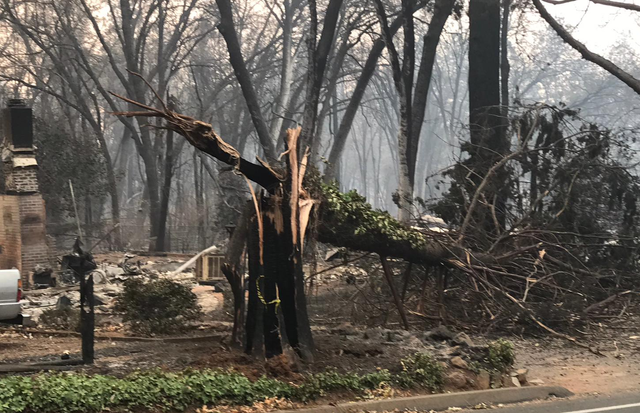
The most destructive fire is in the north—the Camp Fire, which started under the power lines at Poe Dam in Butte County. Fueled by high winds and dry weather, the blaze quickly engulfed the nearby communities of Pulga and Concow, before reaching Paradise, a town of 26,000, shortly after students were beginning their school day. The entire city was forced into a panicked and unprepared evacuation. By Friday morning, Paradise had burned to the ground.
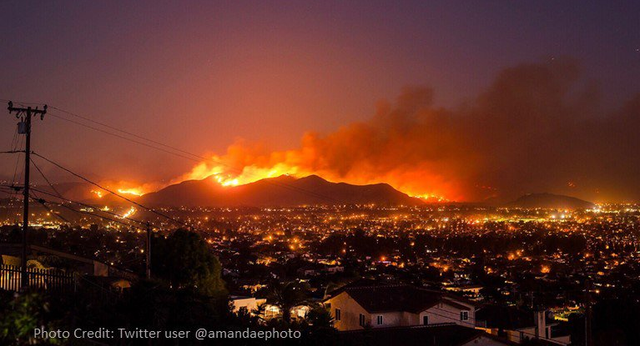
The Hill Fire in Southern California
Harrowing pictures and video have been posted on social media of cars racing to escape as walls of flame bear down on all sides. Others had to abandon their cars and try to escape the flames on foot, while some did not make it.
With the death toll at 29, it is the deadliest wildfire in state history, the number of fatalities greater than the Griffith Park blaze in Los Angeles in 1933. At least two hundred more are missing.
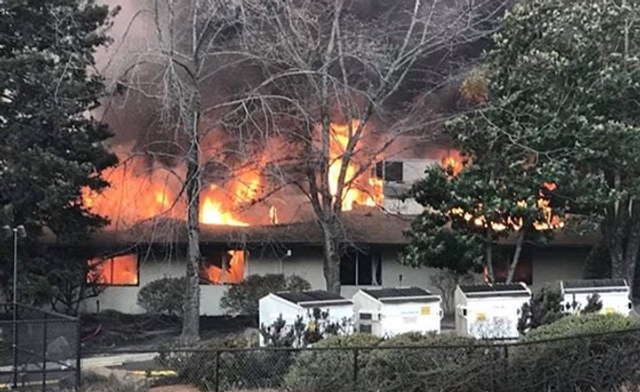
The Camp Fire is also the most destructive in state history. At least 6,453 houses have been destroyed, along with Paradise’s hospital and retirement home. Both the destruction and the death toll are expected to rise as the fire continues to burn and officials begin to sort through the wreckage.
The Camp Fire erupted on the same day as the Hill and Woolsey fires in southern California, which together have forced the evacuation of over 260,000 people. Two deaths have been attributed to the fires in the south.
President Donald Trump responded to the fires by threatening to cut off federal funding. “Billions of dollars are given each year, with so many lives lost, all because of gross mismanagement of the forests,” he declared in a tweet on Saturday. “Remedy now, or no more Fed payments!”
In fact, the destruction has again exposed the criminal indifference and negligence of the ruling class and both its political parties, Democrat and Republican. Social infrastructure, including fire departments, have been starved of funds for decades as trillions of dollars have been funneled into the bank accounts of the rich.
California has been hit by a series of devastating fires in recent years. The unfolding catastrophe follows the enormous 460,000-acre Mendocino Complex Fire in July (the largest in state history), the 280,000-acre Thomas Fire in December 2017 (the second largest), and the Tubbs Fire in October 2017, which destroyed 5,636 buildings (second only to the Camp Fire).
The levels of death and destruction from California’s fire season increasingly resemble the impact of hurricanes on the East Coast, where Hurricanes Florence and Michael killed dozens this year and Hurricane Maria killed thousands in Puerto Rico in 2017.
Each “natural” disaster follows a common pattern. Scientists and engineers have given repeated warnings that decaying infrastructure, dangerously built sprawl and global warming threaten disaster. The government carries out none of their recommendations. Then, after the inevitable catastrophe, officials organize grossly inadequate relief efforts, the media drops the story, and thousands are left to fend for themselves.
Part of the devastion in Paradise. Evacuation orders are not yet lifted
The impact of each of these disasters is the product of social conditions. Fire departments have been starved of resources, and power companies have failed to take basic safety precautions.
Two days before the recent fires broke out, the California Department of Forestry and Fire Prevention (Cal Fire) issued Red Flag warnings that 23 million people across the state were in areas where conditions were ripe for fires to rapidly grow. Winds were expected at 20 to 30 miles per hour with gusts up to 50 mph.
The Pacific Gas and Electric Company (PG&E) repeatedly told residents of Butte County that they might preemptively shut off electricity to prevent power lines downed by the high winds from sparking a wildfire, but ultimately decided not to.
When firefighters initially responded to the Camp Fire Thursday morning, they were immediately confronted by PG&E’s downed power lines. Cal Fire will be investigating whether they were the cause.
The first firefighter on the scene at 6:43 a.m. recognized the danger and ordered the evacuation of the nearby community of Pulga. Within three hours, the fire had raced 10 miles to the city of Paradise. The County Sheriff began ordering evacuations, but no Wireless Emergency Alert was issued to cell phones in the area. Many residents only discovered the extreme danger when the fire was already bearing down on them.
This was an almost exact repeat of the Tubbs Fire last year that tore through a working-class area of Santa Rosa and killed 22 people. That fire broke out at night under high winds, with firefighters responding to 10 different reports of downed power lines. In just three hours, the Tubbs Fire traveled 12 miles to edge of Santa Rosa, and only then were people systematically evacuated, far too late.
Red Flag warnings currently in effect in California
Cal Fire has not yet determined the precise cause of either the Camp or Tubbs Fires. However, in a June report they found that PG&E equipment sparked 16 wildfires last year, and that in 11 of those cases the company had violated state fire prevention codes.
Far from holding the company accountable, Democratic Governor Jerry Brown signed into law SB 901 in September, a new measure that would limit the potential damages that utilities are liable for. PG&E is potentially liable for $15 billion from the fires they caused, but regulators can now reduce assessed damages when weather exacerbates the disaster. It further allows state regulators to take the company’s “financial status” into account and limit the costs to shareholders by allowing the utilities to raise rates on the public.
The bill also allocated $1 billion over five years to Cal Fire for fire prevention. By comparison, the operating profit of PG&E in 2017 was $3 billion.
Adventist Health Feather River Hospital as it burned down [photo credit: Nichole Jolly]
Emergency measures are required to address the consequences of disasters like the California fires and prevent similar catastrophes in the future. Housing needs to be built with fire resistant materials. Cities need perimeters where brush clearance, fire breaks and controlled burns to prevent fuel from accumulating. In the event of the unforeseen, modern technology needs to be leveraged to carry out rapid evacuations, and those affected need the resources to rebuild their lives as best they can.
Every such catastrophe raises the necessity for the massive mobilization of social resources based on scientific planning and social need. The fundamental barrier to taking even the most minimal measures, however, is the capitalist system, which subordinates all social and economic life to the profit interests of the corporate and financial elite.

10 Nov 2018

United Nations Office for Outer Space Affairs (UNOOSA) DropTES Fellowship Programme 2019

Application Deadline: 31st January 2019

Eligible Countries: UN Member Nations

To Be Taken At (Country): Bremen, Germany

About the Award: The Drop Tower Experiment Series is a fellowship programme of the United Nations Office for Outer Space Affairs (UNOOSA) in which students can learn and study microgravity science by performing experiments in a drop tower. The Bremen Drop Tower in Germany is a ground-based laboratory with a drop tube of a height of 146 meters, which can enable short microgravity experiments to be performed in various scientific fields, such as fluid physics, combustion, thermodynamics, material science and biotechnology.

Type: Fellowship

Eligibility: 
  • The DropTES Fellowship Programme is open to research teams from entities that are Member States of the United Nations. Teams should consist of up to four Bachelor, Master and/or PhD students who must be endorsed by an academic supervisor.
  • It is further required that the proposed experiment be an integral part of the students’ syllabuses, that is, part of a Bachelor thesis, a Master thesis, a PhD thesis, or another form of research project associated with the applicants’ studies at the respective university.
Number of Awards: Not specified

Value of Award: The selected research team will be offered financial support exclusively for travel purposes. This may include the provision of most economical economy class round-trip air tickets between the participants’ international airport of departure and Bremen. En-route expenses or any 
changes made to the air tickets must be the responsibility of the participants.

How to Apply: The fully completed the above application form, properly endorsed by the applicant’s institution, should be emailed to hsti-droptes@un.org both in PDF format (.pdf) containing the signature page, and in MS WORD (.doc), no later than 31 January 2019.Please note that our email accounts only accept emails with a size limit of up to 10 MB.

Visit the Program Webpage for Details

Award Providers: UNOOSA

Sanger Institute Prize Competition 2019 for Undergraduate Students from Developing Countries

Application Deadline: 21st December 2018  5pm UK GMT

Eligible Countries:  Low and Middle-income countries

About the Award: The Sanger Institute Prize is an outreach competition for undergraduate students from low- and middle-income countries and gives the winner an opportunity to experience the very cutting edge of genomic research.

Type: Contest, Undergraduate

Eligibility: To be eligible to apply, applicants must:
  • Be from a low- or middle-income country (a full list of eligible countries is available below)
  • Be studying at a University/Institute in a low-/middle-income country
  • Demonstrate an active interest in research in the genomics field
  • Have a good command of English
Number of Awards: Not specified

Value of Award: The winner of the Sanger Institute Prize will be offered a three-month internship with a research group at the Wellcome Sanger Institute during 2019. Travel, living and research expenses are all covered by the award.

Duration of Programme: 3 months

How to Apply: The 2019 competition will be run as a two-stage process.

Stage one: expression of interest
First stage applicants are asked to complete a short application form and write an expression of interest detailing their scientific interests and why they want to come to the Sanger Institute. Two academic references are also required at this stage.
Only applications made via the online application system will be accepted. Entries should be submitted online by 5pm UK GMT, 21st December 2018.
www.sanger.ac.uk/form/Sanger_Prize

Stage two: essay
Selected candidates will then be asked to take part in stage two of the process, which is to write an essay with a given title.
The judges’ decision will be final and no further correspondence will be entered into.


Visit Programme Webpage for Details

Latest US-Led Air Strikes Kill At Least 80 Syrian Civilians

 Brett Wilkins

The US-led coalition against Islamic State has carried out more than 100 new air strikes targeting the militant group’s remaining strongholds in Syria’s Deir Ezzor province, killing at least 80 civilians — including dozens of women and children — in recent weeks.
US-led bombing resumed on October 24 following a particularly deadly period in which scores of Syrian men, women and children were killed in strikes on homes and mosques in and around the village of al-Sousa. On October 24, the UK-based monitor Syrian Observatory for Human Rights (SOHR) reported 16 civilians died in an air strike on the Al-Zawiya mosque in Hajin, the fourth coalition bombing of a mosque in less than a week. Local media and monitor groups said dozens more were wounded in the attack. Hajin magazine reported IS was using the mosque as a “headquarters.”
On October 27, SOHR and local media reported that a family of five civilians — a man, his wife and their three children — were killed when their home in Al Boubadran village was bombed. The following day, Baladi News reported 20 civilians, mostly women and children, died in a US-led strike on the town of Al Shaafa. As many as 24 others were wounded in the attack.
Several sources including Baladi News and Free Deir Ezzor Radio reported a total of 17 civilians, including four women and three children, died in an October 30 strike on al-Kushma. Step News Agency reported the victims were the families of IS members. That same day, local media and monitor groups said another four civilians, all from the same family, were killed by a US-led strike on Al Shafaa. A woman and a child were reportedly rescued from beneath the rubble.
On November 3, Smart News Agency and other media and monitors reported that between 14 and 21 civilians, mostly women and children, died when US-led warplanes bombed a house near Khalid bin Walid mosque in Hajin. That same day, Al Shaafa was bombed again, with Al Jazeera and other media and monitors reporting that three young children — identified as siblings Zaid, Ziyad and Aisha I’mad Mahmoud Al-Haj Al-Hussein — died when their home was hit. Another five to 10 civilians were reportedly wounded in the attack.
The US-led anti-IS coalition acknowledged carrying out over 100 air strikes in Syria between October 28 and November 3.
The UK-based journalistic monitor group Airwars estimates at least 6,716 and perhaps as many as more than 10,000 civilians have likely died in more than 30,000 air strikes in Syria and Iraq since former president Barack Obama launched the anti-IS campaign in 2014. Civilian casualties have soared during the administration of President Donald Trump, who promised to “bomb the shit out of” IS and kill their families. Trump loosened rules of engagement meant to protect civilians and in May 2017 Defense Secretary James “Mad Dog” Mattis announced that the US was shifting from a war of attrition to one of “annihilation” in Syria and Iraq. Mattis raised eyebrows and ire by adding that “civilian casualties are a fact of life” that cannot be avoided in such a war.
In the wider US-led war against terrorism, at least hundreds of thousands and likely more than a million men, women and children have died in Afghanistan, Pakistan, Iraq, Yemen, Somalia, Libya and Syria since October 2001. Since the nuclear war waged against Japan in August 1945, US forces have killed more foreign civilians than any other armed force in the world, by far.

Taliban join Moscow peace talks on Afghanistan

Abdus Sattar Ghazali 

The 19th Century British politician, Lord Palmerston was of the view that:  “Nations have no permanent friends or allies, they only have permanent interests.” Henry Kissinger rephrased it: “America has no permanent friends or enemies, only interests.”
This applies to Russia which hosted the Taliban for peace talks in Moscow attended by Afghanistan, India, Iran, China, Pakistan and five former Soviet republics in Central Asia with the US has observer.
Tellingly, the Taliban is banned from operating in Russia as it is classified as a “terrorist organization.”
The Friday talks were the second meeting of the Moscow-format consultations at the level of deputy foreign ministers and special envoys.
Neither the US nor the Afghan government wants Russia to lead such an initiative, known as the “Moscow Format”. Afghan President Ashraf Ghani, who pressed Russia to cancel a similar meeting in September, sent four senior members of his nation’s High Peace Council.
Observers do not expect quick results from the Moscow talks but the fact that the Taliban are in the same room as Afghan delegates, in Russia, with the US also in attendance is viewed as significant. It was also seen a triumph for Russian diplomacy.
Russia has challenged the U.S. by hosting the Taliban at a Moscow peace conference in the latest source of friction between the two former Cold War foes, Blumberg said adding:
“While the Moscow meeting isn’t likely to yield concrete results, Russia’s intervention is taking place as President Donald Trump’s administration has stepped up diplomatic activity, twice sending officials to meet with the Taliban in recent months and appointing a veteran envoy to advice on Afghan peace. The Taliban have said they are ready to talk to the U.S. to end the war, but not with the Afghan government they deem illegitimate.”
The U.S. sent an observer from its Moscow embassy to the meeting after it refused to attend the September talks, saying they wouldn’t help efforts to end the conflict.
The Russian foreign ministry said earlier that invitations to attend the event had been sent to participating countries – Afghanistan, India, Iran, Kazakhstan, Kyrgyzstan, China, Pakistan, Tajikistan, Turkmenistan, Uzbekistan, and the United States.
Russian Foreign Minister Sergey Lavrov
Addressing participants at the start of the conference, Russian Foreign Minister Sergey Lavrov said the meeting is meant to seek paths to national reconciliation in Afghanistan.
Russia hopes “through joint efforts to open a new page in the history of Afghanistan.” He said that the participation of both Afghan leaders and the Taliban was an “important contribution” aimed at creating “favorable conditions for the start of direct talks”.
“I am counting on you holding a serious and constructive conversation that will justify the hopes of the Afghan people,” Lavrov said before the talks continued behind closed doors.
He emphasized that Daesh terrorists are being supported by “external sponsors” which are trying to “turn Afghanistan into a stronghold of international terrorism in central Asia.”
Lavrov said that “geopolitical games” are unacceptable in order not to make Afghanistan a “rivalry field between foreign players.”
The Afghan and Taliban delegations were divided at the roundtable only by Russian Deputy Foreign Minister Igor Morgulov, presiding over the meeting on behalf of the host country.
Taliban reiterate their known stance
The Taliban delegation was headed by Deputy Chairman of High Peace Council, Hajji Din Mohammad and included Sher Mohammad Abbas Stanakzai, head of the Taliban’s political council in Qatar.
Sher Stanikzai reiterated that the Taliban does not see the current government in Kabul as legitimate.
“This government does not represent the people of Afghanistan, so we reject direct contact with them before the problem with the U.S. is solved. Therefore, we will talk with the Americans, especially about the withdrawal of troops,” he said adding:
“We met with the American side at the negotiating table and asked them to leave Afghanistan. But, of course, so far these negotiations are at a very early stage, we haven’t reached an agreement yet.”
RIA quoted Muhammad Sohail Shaheen, spokesman for the Taliban’s political office, as saying that before starting talks with the Kabul government, “the issue of the presence of external forces” needed to be addressed.
Shaheen also denied accusations by the U.S. military that Russia has supplied weapons to the Taliban, echoing a similar denial by Moscow.
This was the first time that a delegation of the Taliban’s political office in Doha, Qatar, took part in an event of this kind.
Kabul regime’s control of Afghanistan slipped in recent months
Moscow peace talks were held amid reports that the pro-US Kabul regime is losing territory to the Taliban in recent months.
Kabul’s control of Afghanistan slipped in recent months as local security forces suffered record-level casualties while making minimal or no progress against the Taliban, according to the US Special Inspector General for Afghanistan Reconstruction (SIGAR).
The New York Times reported on September 8, 2018, seventeen years into the war in Afghanistan, American officials routinely issue inflated assessments of progress that contradict what is actually happening there.
In an article titled – How the U.S. government misleads the public on Afghanistan – the paper said the U.S. government says that the Taliban controls  44% districts while the military analysts say that the Taliban controls 61% of districts of Afghanistan.
“More than 2,200 Americans have been killed in the Afghan conflict, and the United States has spent more than $840 billion fighting the Taliban insurgency and paying for relief and reconstruction. The war has become more expensive, in current dollars, than the Marshall Plan, which helped to rebuild Europe after World War II. That investment has created intense pressure for Americans to show the Taliban are losing and the country is improving,”  the New York Times said adding:
Since 2017, the Taliban have held more Afghan territory than at any time since the American invasion. In just one week last month, the insurgents killed 200 Afghan police officers and soldiers, overrunning two major Afghan bases and the city of Ghazni.
It may be recalled that powerful police chief General Abdul Raziq was among three people killed in a brazen insider attack on a high-level security meeting last month in Kandahar.
The meeting was also attended by General Scott Miller, the top US and NATO commander in Afghanistan. He escaped unhurt, but US Brigadier General Jeffrey Smiley was among 13 people wounded in the shooting, which the Taliban said had targeted Miller and Raziq.
At least 8,050 Afghan civilians were killed or wounded in the first nine months of 2018, almost half of them targeted by suicide bomb attacks and other improvised devices that may amount to war crimes, the United Nations said last month.
US ‘war on terror’ killed over half million people: Study
Meanwhile, a US study released on Friday said the so-called US “war on terrorism” has killed about half a million people in Iraq, Afghanistan and Pakistan during its 17-years, that was launched after the 9/11 attack in 2001.
The report by Brown University’s Watson Institute for International and Public Affairs shows that US-led “war on terrorism” is showing a 22 percent increase in deaths in the past two years.
The report put the death toll at between 480,000 and 507,000 people, but said the actual number is likely higher.
The death toll includes US and allied troops, civilians, local military and police forces, as well as militants, who have died from war violence.
The report said the number of indirect deaths was several times larger than deaths caused by direct war violence, bringing the total death count to well over 1 million people.
It says, fatalities in Afghanistan, as of October 2018, stood at about 147,000 people, including Afghan security forces, civilians and opposition fighters. The figure also included the deaths of 6,334 American soldiers and contractors and 1,100 allied troops.
The report said that war-related violence had killed 65,000 people in Pakistan, including 90 American contractors, nearly 9,000 local security personnel and more than 23,000 civilians. The rest of the casualties were trouble makers.
The rest of the deaths, between 268,000 and 295,000, occurred in Iraq, where the US-led military intervention began in 2003.

IBM’s purchase of Red Hat highlights growing power of technology giants

Mike Ingram

Red Hat and IBM officials announced a definitive agreement on October 28, under which IBM will acquire the open source enterprise Linux company for a cash value of $34 billion. IBM is paying $190 per share for Red Hat stock, a 63 percent premium to its closing price of $116.68 on the previous Friday. It is the largest acquisition by IBM in its 107-year history.
The acquisition is the latest case of giant corporations swallowing up previously independent open source companies and the community of developers around them as they grow ever larger and more powerful. Nowhere is this more prevalent than among companies competing in the so-called public cloud market, in which IBM trails behind Amazon, Microsoft and Google.
In the 10 years from 2007 to 2017, the number of Microsoft employees grew from 79,000 to 124,000. Google had 16,805 in 2007 compared to 57,000 in 2017. The number of employees in Amazon Web Services (AWS) is not available, but the total number of employees at Amazon grew from 17,000 in 2007 to 566,000 in 2017. IBM, the dominant tech company for much of the 20th century saw a slight reduction from 386,000 to 366,000 in wholly owned subsidiaries for the same period.
IBM hopes that the acquisition of Red Hat will give it a competitive edge in the so-called hybrid cloud, which combines public cloud offerings with private clouds in data centers run by a company. In a press release, Ginni Rometty, IBM chairman, president and chief executive officer, said, “The acquisition of Red Hat is a game-changer. It changes everything about the cloud market.” Rometty claimed that “IBM will become the world’s #1 hybrid cloud provider, offering companies the only open cloud solution that will unlock the full value of the cloud for their businesses.”
Jim Whitehurst, president and CEO of Red Hat, said, “Open source is the default choice for modern IT solutions, and I’m incredibly proud of the role Red Hat has played in making that a reality in the enterprise.”
IBM has had its own close relationship with open source software over the past 20 years, recognizing it as a superior development model to those of proprietary systems. With the open source model, IBM gains access to thousands of talented developers globally who would not necessarily work for the company.
Even Microsoft, whose former CEO Steve Balmer described open source as “a cancer that attaches itself in an intellectual property sense to everything it touches” and “communism,” has in recent years adopted the open source model for a number of projects. Sixty percent of instances running in Microsoft’s Azure cloud are Linux based. Last month Microsoft completed its acquisition of GitHub for $7.5 billion. The open source code repository and development platform has over 31 million users and hosts more than 96 million repositories from 2.1 million organizations.
Red Hat was founded in 1993 by Bob Young and Marc Ewing. Young ran a catalog service that distributed software while Ewing was developing his own distribution of the open source GNU/Linux operating system which he called Red Hat Linux. The distribution bundled together various application and utilities developed by the Free Software Foundation led by Richard Stallman and the Linux kernel developed by Linux Torvalds. Both the GNU and Linux were released as open source software that could be used by anyone free of charge. Most importantly, the GNU General Public License requires that the human readable source code be made available and gives users the right to modify that code. This was in stark contrast to the proprietary licenses of companies such as Microsoft, Apple and IBM.
Red Hat became the first commercial Linux distribution with a revenue model of distributing the software for free and charging a subscription service for support, updates and professional services. It has maintained a close relationship with the open source developer community and contributed to numerous projects.
Today Red Hat is a significant corporation in its own right, with over 12,000 employees worldwide. Utilizing the code developed by thousands of volunteer programmers, Red Hat quickly established itself as the main distributor of Linux software to enterprise companies. In August 1999, Red Hat went public, achieving the eighth-biggest first-day gain in the history of Wall Street. In 2000 the company opened Red Hat India and began a series of acquisitions, most recently buying the Linux Container distribution, CoreOS, for $250,000,000 in January this year.
A particular target of IBM’s cloud strategy is JEDI, the $10 billion Joint Enterprise Defense Infrastructure project of the Department of Defense. The project is intended to modernize and consolidate the defense department’s IT systems into an enterprise-level commercial cloud. IBM has issued a protest against the JEDI solicitation, stating, “Throughout the year-long JEDI saga, countless concerns have been raised that this solicitation is aimed at a specific vendor. At no point have steps been taken to alleviate those concerns.”
IBM are complaining specifically about a requirement that bidders meet the Defense Information Systems Agency Impact Level 6 security capabilities to handle secret-level military information. Two senior Republicans on the House Appropriations Committee, Reps. Steve Womack (R-Ark.) and Tom Cole (R-Okla.) have called for the Pentagon’s internal watchdog to open an investigation into the cloud procurement, raising the same concerns in an October 23 letter to Glenn A. Fine, the acting inspector general at the Department of Defense. At the time the proposal was announced, only AWS met this requirement. Microsoft announced last month that it will soon meet the requirement.
Google withdrew from the JEDI bid last month following protests from employees. Microsoft went ahead with the bid despite opposition from workers. Nextgov reports that CEO Satya Nadella appeared at the United States Naval Academy in Annapolis, Maryland, October 10. Nadella reportedly said Microsoft has a four-decades-old partnership with the Defense Department and added that the US “armed forces have a fundamental grounding on what it means to deploy any technology or practice which is ethically used.”
Amazon is also going ahead with its bid and criticized Google’s decision to pull out. Speaking at the WIRED25 summit on October 15, Amazon CEO Jeff Bezos said, “One of the jobs of a senior leadership team is to make the right decision even when [it] is unpopular.” He added, “If big tech companies are going to turn their back on the DOD, then this country is going to be in trouble.”
With its contribution to open source, Red Hat has maintained a certain respect among developers. But part of the attraction to IBM is the company’s close relationship with the US military. The headline of a 2012 blog post boasts of “Red Hat’s Decade of Collaboration with Government and Open Source Community.”
The authors cite a 2003 study that presented DOD-wide guidance on open source software, “which implicitly permitted its acquisition, development, and use.”
The blog post states that at this time Red Hat released the first version of Red Hat Enterprise Linux and that, “The Army deployed Red Hat’s operating system in its Blue Force Tracker system, which lived in jeeps and tanks on the battlefield.” It goes on to cite Major General Nicholas Justice, “the man responsible for Blue Force Tracker,” saying later: “When we rolled into Baghdad, we did it using open source.”
Retired general Hugh Shelton joined the Board of Directors of Red Hat Corporation in April 2003 and was elected that board’s chairman in 2010. Shelton served as chairman of the Joint Chiefs of Staff from 1997 to 2001.
A June 26 article in the Herald Sun states: “Red Hat leaders have been talking to defense officials about its JEDI cloud-services contract and think the company is ‘extremely well-positioned’ to supply the project’s back-end workings, Red Hat Chief Financial Office Eric Shander said in a recent interview.”
IBM is pushing for the DOD to adopt a hybrid cloud approach, utilizing multiple providers rather than a single vendor. In acquiring Red Hat they obtain control of the operating system that will run on whatever cloud infrastructure is ultimately selected, together with orchestration tools that make cloud deployments easier. If they can’t get the whole $10 billion JEDI cake, they at least have a possibility of a slice, together with more lucrative contracts down the road.

In another anti-democratic act, Sri Lankan president dissolves parliament

K. Ratnayake 

Yesterday Sri Lankan President Maithripala Sirisena blatantly violated the country’s constitution and dissolved parliament almost two years before its term officially ends. According to the gazette notification issued last night, new elections will be held on January 5 and the new parliament convened on January 17.
Sirisena’s anti-democratic actions came just two weeks after he sacked Prime Minister Ranil Wickremesinghe and appointed former President Mahinda Rajapakse to replace him. Sirisena then prorogued the parliament for three weeks until November 16, later changing the date to November 14 following domestic and international criticism. The prorogation was a crude manoeuvre to give Rajapakse time to secure a governing majority in the 225-member parliament.
Sirisena’s dissolution of the parliament yesterday was announced a few hours after Rajapakse declared that he was still eight MPs short of a majority.
Only a handful of people, including Rajapakse, appeared to have known about Sirisena’s decision. Just prior to the announcement, Rohana Lakshman Piyadasa, secretary of Sirisena’s Sri Lanka Freedom Party (SLFP), told the media that there would be no dissolution of the parliament.
Sirisena appointed at least seven more minsters to the cabinet yesterday and said the Sirisena-Rajapakse led regime would function as a so-called “care-taker government” until after the January elections. Sri Lankan governments are notorious for using the state machinery and its resources to subvert elections.
Significantly, Sirisena has taken a series of measures to strengthen his political power over the past three weeks. Yesterday he took control of the government printing department using his position as Sri Lankan defence minister, having recently taken over the law-and-order and media ministries. He currently holds 18 ministerial positions.
In April 2015, four months after he became president, Sirisena introduced a 19th amendment to the Sri Lankan constitution. It was hailed by Sirisena and Wickremesinghe, along with academics and the pseudo-left, as a move towards the abolition of the autocratic executive presidential system and a victory for democracy.
The 19th amendment not only took away the president’s power to sack a prime minister if he commanded a parliamentary majority, but also barred any dissolution of the parliament for at least four and half years.
Sirisena has now violated both these clauses and, using vague legal interpretations, is attempting to re-establish the president’s autocratic powers. These hated executive powers will not just be unleashed against his political opponents but directed, above all, against working people fighting to defend their democratic and social rights.
Sirisena’s dissolution of parliament is part of the intensifying conflict between the Wickremesinghe-led UNP, on the one hand, and the president’s new alliance with Rajapakse in the now “united” Sri Lanka Freedom Party (SLFP), on the other.
Wickremesinghe has refused to vacate Temple Trees, the prime minister’s official residence, and is directing the UNP’s campaign to regain government. Claiming to have the backing of a majority of MPs, the party is demanding the immediate reconvening of the parliament.
Following yesterday’s announcement, UNP leaders said the president had no power to dissolve the parliament and that they would seek “legal redress.” This means the UNP will call on the Supreme Court to annul Sirisena’s gazette notification.
Former Minister for Health and Indigenous Medicine Rajitha Senaratne told media at Temple Trees yesterday that the UNP will intensify its campaign against president’s “illegal action” and continue the fight for democracy. He did not elaborate. The UNP had previously announced a major rally in Colombo on Monday.
The “democratic” posturing of the Wickremesinghe and Sirisena-Rajapakse camps is completely bogus. Successive UNP and SLFP governments that have ruled Sri Lanka in the seven decades since formal independence in 1948 have systematically suppressed the democratic and social rights of all working people, Sinhala, Tamil and Muslim alike.
In November 2014, Sirisena defected from the then Rajapakse government to contest the presidential election and in 2015 conspired to form government with Wickremesinghe. Sirisena and Wickremesinghe promised “good governance” blaming Rajapakse for nepotism, violating democratic rights and attacking the living conditions of working people. These demagogic utterances were to exploit the mass opposition of workers and poor to Rajapakse’s decade-long autocratic rule from 2005 to 2015.
The ousting of Rajapakse, which Sirisena and Wickremesinghe were directly involved, was a conspiracy orchestrated by the US. Washington had supported Rajapakse’s renewed war against the separatist Liberation Tigers of Tamil Eelam. But it wanted Rajapakse’s relations with Beijing scuttled and Sri Lanka brought into line with US confrontational moves against China.
The conflict between the Sirisena-led SLFP faction and Wickremesinghe’s UNP did not come out of blue. After four years the Sirisena-Wickremesinghe regime is deeply discredited among workers and the poor.
This year has been marked by increasing struggles of workers, rural poor and students against the government’s IMF-dictated austerity measures and attacks on democratic and social rights.
The US and other major powers are siding with Wickremesinghe and the UNP’s demands for the reconvening of parliament. Washington is particularly concerned that the political and military relations it has cultivated over the past four years with Colombo will be affected and has repeatedly issued statements in this regard.
Addressing an SLFP rally last Monday, Rajapakse, in a clear signal to the US, declared that any government under his control would be willing to “work with the west and east, north and south.”
Sirisena’s dissolution of parliament is yet another indication of the degenerated state of parliamentary democracy in Sri Lanka, which is mired in deep economic crisis and moving towards dictatorial forms of rule.
Under the pretext of defending parliamentary democracy, the Janatha Vimukthi Peramuna (JVP) and the Tamil National Alliance (TNA) have sided with the UNP. Academics and pseudo-left formations, such as Nava Sama Samaja Party (NSSP), are also supporting Wickremesinghe. These parties previously backed the US-orchestrated operation that established the Sirisena-Wickremesinghe regime in 2015.
The working class must reject all factions of the Sri Lankan capitalist class and their opportunist backers. It must organise independently of all these political formations and rally the poor and oppressed to fight for workers’ and peasants’ government based on a socialist and internationalist program.