19 Nov 2018

Anti-stall feature in new Boeing planes may have contributed to Indonesian aviation disaster

Oscar Grenfell 

Last week, three US pilots unions, aviation experts and a number of airlines, including Indonesia’s Lion Air, stated that a feature of Boeing’s new 737 Max 8 aircraft may have contributed to a plane crash in the Java Sea on October 29 which killed 189 people. They have claimed that an automated system not present in previous Boeing models or mentioned in any of the company’s safety manuals may have triggered a catastrophic nosedive.
The Lion Air plane lost contact with air traffic control around 13 minutes after departing from Java for a routine commercial trip to Pangkal Pinang, the capital of the Bangka Belitung Islands province. Eyewitnesses reported that the plane plunged at an almost vertical angle into the Java Sea. There were no survivors.
While the report from an initial investigation by Indonesia’s National Transportation Safety Committee (NTSC) has yet to be released, statements by the country’s aviation officials have made clear that the plane had experienced mechanical issues during its previous four flights, with key pieces of equipment reportedly feeding false data to the cockpit.
Allegations aired last week, however, have indicated that the safety issue may be far broader than the ill-fated Lion Air Flight, potentially affecting the entire fleet of 737 Max 8 aircraft. There are currently 246 of the new model in operation around the world, while airlines in Australia, the US, Europe and internationally have orders for another 4,542 of the aircraft.
It has emerged that the 737 Max 8 model contains an automated mechanism, known as the Maneuvering Characteristics Augmentation System, aimed at preventing it from stalling. If flight data indicates that there is an imminent risk of stalling, this mechanism sometimes forces down the plane’s nose without any action on the part of the pilots.
The mechanism is directed against a common cause of stalling incidents, which is a plane’s nose being pitched higher than it should be for the speed that it is travelling. The ability of such a mechanism to work effectively, however, is dependent on it being supplied accurate information by a complex network of sensors.
According to statements by the NTSC on November 5, the Lion Air plane’s Angle of Attack (AOA) sensors had repeatedly provided inaccurate information in the flights preceding the crash. AOA sensors feed information about the angle of wind passing over the wings of a plane, and how much lift it is getting.
Black box data indicated that on the last flight before the disaster, the right and left AOA sensors had given indications that diverged by about 20 degrees from one another. This resulted in a sudden nosedive, which the pilots were able to correct. After that flight, and before the crash, the plane’s AOA sensors were replaced.
The plane, however, had also experienced issues with its airspeed indicators. According to some aviation experts, this could have indicated a broader problem with the air data reference system, a key component which provides data from indicators for temperature, AOA, airspeed and altitude to the pilots’ electronic flight instrument system. If data falsely indicated that the plane’s nose was pitching up, it could have activated the anti-stall mechanism, triggering the catastrophic nosedive that led to the crash.
Most explosively, pilot unions, airlines and aviation experts have indicated there was no information about the model’s “auto-dive” in any of the handbooks or safety guidelines provided to pilots by Boeing.
On November 13, Jon Weaks, president of the Southwest Airlines Pilots Association in the US, told the Wall Street Journal: “We did not know this was on the [Boeing 737] MAX models.”
Weaks disputed claims that a safety bulletin issued by Boeing on November 8, in the wake of the crash, had merely reminded pilots of existing safety procedures. He said the bulletin’s reference to the anti-stalling mechanism was the first in any material from Boeing. Pilots were previously unaware of the means to disable the mechanism.
Dennis Tajer, communications committee chairman at the Allied Pilots Association, stated: “This was clearly a sign that the safety culture [at Boeing] was missing on a cylinder or two. We’re all on the same side looking at Boeing, saying, ‘What else you got?’”
On November 15, the Air Line Pilots Association, which represents United Continental Holdings Inc.’s flight crews, issued an open letter to the US Federal Aviation Administration, warning that it was “concerned that a potential, significant aviation system safety deficiency exists.”
The letter stated: “There appears to be a significant information gap, and we want to ensure that pilots operating these aircraft have all of the information they need to do so safely.”
Southwest, American Airlines and Lion Air all confirmed that the anti-stall mechanism was not included in any operating manual or safety guidelines for the Boeing 737 Max aircraft. Because the aircraft was presented as merely an improved version of previous 737 models, with few new features, pilots were provided with just three hours of computer-based training and a familiarisation flight before being certified.
The family of Doctor Rio Nanda Pratama, one of the victims of the Lion Air disaster, has responded to the revelations by filing a lawsuit alleging that Boeing is culpable because “it failed to inform its customers and pilots” of the new anti-stall mechanism.
The lawsuit has also claimed that under certain conditions, the auto-dive feature “can push the nose down unexpectedly and so strongly that the pilot cannot pull it back up in time to avoid a crash.”
Boeing has rejected claims that not enough information was provided to pilots, or that there are any potential safety issues with the new model.
Boeing is one of the largest aircraft manufacturers in the world and the biggest US exporter by dollar value. It had a net income of over $8 billion in 2017.

Sri Lankan president’s “all party conference” fails to overcome political crisis

Rohantha De Silva

Sri Lankan President Maithripala Sirisena, falsely posing as an arbiter of the rival factions fighting for state power, held an All Party Conference of parliamentary parties yesterday. The conference ended without any agreement between the contending groups.
The meeting was attended by several United National Party (UNP) MPs led by Ranil Wickremesinghe, who was dismissed as prime minister on October 26 by Sirisena, and leaders of the Tamil National Alliance (TNA), Sri Lanka Muslim Congress, All Ceylon Muslim Congress and the Tamil Progressive Alliance of plantation unions.
The other faction was headed by former President Mahinda Rajapakse, who was appointed as new prime minister by Sirisena, and included several leading MPs from the Sri Lanka Podujana Peramuna (SLPP), Sri Lanka Freedom Party (SLFP) and the plantations-based Ceylon Workers Congress.
Parliamentary speaker Karu Jayasuriya was invited but did not participate in the meeting saying it was meant for political parties. There are sharp tensions between Sirisena and Jayasuriya. The president supports the Rajapakse faction while the speaker is a senior member of Wickremesinghe’s UNP.
The Janatha Vimukthi Peramuna (JVP) refused Sirisena’s invitation to the meeting, declaring that he was the “creator of the crisis” and that he had to resolve it. The JVP, which is attempting to distance itself from Wickremesinghe, is, however, backing his party’s efforts to regain power.
Sirisena’s meeting was convened against the back drop of three consecutive days of bitter parliamentary fighting between supporters of Rajapakse and of Wickremesinghe. Parliament was reconvened on Wednesday after the Supreme Court issued an interim ruling overturning President Sirisena’s dissolution of parliament.
Physical confrontations and violent clashes erupted when the UNP and opposition parties moved no-confidence motions against Rajapakse and his new government on Wednesday and Friday. Speaker Jayasuriya ruled that the resolutions were passed with majority support on both days. On Thursday, Rajapakse made a statement to the parliament, but it broke up after the opposition tried to move a resolution rejecting his speech.
Sirisena rejected the first no-confidence vote and called on the UNP to remove a section criticising his appointment of Rajapakse as prime minister as “unconstitutional.” At yesterday’s All Party Conference, he rejected Friday’s vote on the “modified” no-confidence motion, saying it should be voted on electronically, or by calling names, for it to be regarded as “trustworthy by the people and internationally.”
Sirisena also called on MPs to act “decently” but offered no explanation for the violent behaviour of his factional supporters. Sirisena and leaders of the rival factions are somewhat nervous about the political impact on the Sri Lankan masses of the unruly fighting in parliament, which was broadcast live on television.
The UNP leadership told Sirisena that they could bring the 113 MPs who supported the “no-confidence proposal” to meet with him. Sirisena rejected the suggestion.
After the meeting, however, the UNP leadership insisted they would submit another motion to the parliament today. Rajapakse supporters said they would not allow such a proposal unless it was “properly” presented.
Wickremesinghe, who is backed by the US and its allies, is determined to continue his bid for power. Colombo-based diplomats from the US, EU, UK, Australia and Japan visited Wickremesinghe at Temple Trees, the prime minister’s official residence, after yesterday’s All Party Conference.
On November 15, American, Japanese, Australian and Indian government officials meeting in Singapore, prior to the ASEAN summit, discussed the escalating political crisis in Sri Lanka. A US state department statement said that its senior officials stressed the need for joint efforts to “advance shared regional interests, including support for the new Maldivian government, and encouragement of an outcome to political developments in Sri Lanka consistent with democratic principles.”
Washington and its international allies have no concern for “democratic principles” but are motivated by their own imperialist concerns and, in particular, are determined to undermine all Chinese economic and political influence in the Asia-Pacific region.
Recently-elected Maldives President Ibrahim Mohamed Solih came to power last month with behind-the-scenes backing from Washington and New Delhi. The US and India opposed former Maldives President Abdulla Yameen because of his close ties with Beijing.
Sirisena became Sri Lankan president in 2015 following a regime-change operation to oust Rajapakse orchestrated by Washington and with Wickremesinghe’s help.
Washington had no opposition to Rajapakse’s authoritarian methods of rule but was hostile to his close ties with Beijing. The US considers that any government led by Rajapakse would be a pro-Chinese regime that would undermine its political and military preparations for war against China.
The International Monetary Fund is also putting pressure on Sirisena and Rajapakse, announcing that it has delayed the last instalment of a $1.5 billion bailout loan to Colombo. Sri Lankan Central Bank Governor Dr. Indrajit Coomaraswamy revealed last Wednesday that the IMF payment had been postponed, pending the outcome of the political crisis. Washington no doubt had a hand in this decision.
The international media is also widely using Chinese President Xi Jinping’s congratulatory message to Rajapakse—immediately following his appointment as prime minister—as “proof” of Beijing’s influence. China, which is manoeuvring to counter US geo-political activities, hopes that a Rajapakse regime would boost Colombo’s ties with Beijing.
Rajapakse, however, has sent signals to the US and India that his government would be prepared to work with them. In September, he visited New Delhi and met with Indian leaders, including Prime Minster Narendra Modi. When Donald Trump became US president in 2017, Rajapakse immediately sent a congratulatory message.
On Friday, Wickremesinghe cynically told the media that the ferocious fighting in parliament was a “blow to democracy” and “a blow to all of us who are voters of Sri Lanka in whom the sovereignty lies.” UNP governments, which instigated the almost 30-year war against the separatist Liberation Tigers of Tamil Eelam, like all other bourgeois regimes in Sri Lanka, have systematically suppressed the democratic rights of the Sri Lankan masses.
Rajapakse, who endorses Sirisena’s call for new elections, continues to posture as a “defender” of democratic rights, declaring that if the Sri Lankan parliament is unable to resolve the political crisis, then “the people should be allowed to intervene. When the voters are given power, no one will have a problem.”
These claims are false. Rajapakse was voted out in the 2015 presidential election because workers and the poor opposed his attack on social and democratic rights and bloody atrocities carried out against the Tamil minority during the war.
The “democratic” demagogy of the Wickremesinghe and Sirisena-Rajapakse factions are bogus. Their real concern is not “democracy” but widespread social discontent and the eruption of protests and strikes among workers, youth and the poor.
Both formations, and their erstwhile allies, are political representatives of the venal Sri Lankan capitalist class. Whichever faction wins government will move, sooner rather than later and with the backing of international finance capital, to unleash vicious attacks on the rights of all working people.
The working class must urgently intervene on the basis of the revolutionary perspective advanced by the Socialist Equality Party, and to rally the working masses, the youth and the rural poor to fight for workers’ and peasants’ government based on a socialist program.

Thousands attend anti-fascist protest in London

Robert Stevens

Around 20,000 people demonstrated in London on Saturday against the rise of racism and fascism, marching from Great Portland Street and rallying at Whitehall.
The march followed recent events in Europe, including fascist riots in Chemnitz, Germany, the massacre at the Tree of Life synagogue in the United States, and UK protests in support of English Defence League founder Tommy Robinson.
Contingents arrived from all parts of the country, with coaches laid on by trade unions and rally organisers. Many who marched were politically affiliated, reflected in the large number of local Labour Party and union branch banners.
While protesters registered their opposition to the rise of the far right, the nationalist and pro-capitalist programme of rally organisers provided no basis for workers and youth to fight the far right. This was reflected in the event’s official title, “National Unity Demonstration Against Racism and Fascism.”
The perspective of “national unity” against fascism is aimed at suppressing the independent mobilisation of the working class against capitalism. This was summed up in the frontpage slogan of the Stalinist Morning Star, distributed free of charge on the day, which stated, “Tens of thousands rally today for simple human decency.”
An appeal for the rally was made on November 1, with a statement published in the Guardian signed by a long list of Labour MPs and trade union bureaucrats, including key Corbyn allies John McDonnell and Dianne Abbott.
“The impact of neoliberalism and austerity … has driven the growth of the far right,” wrote the signatories, without mentioning that austerity and cuts are currently being enforced by Labour councils across the country on behalf of the Conservative central government.
Their statement also included Labour’s own election slogan, “We are the many. They are the few.” Much of the rally had the character of a pro-Corbyn event. Despite this, neither Corbyn nor Abbott nor McDonnell addressed the demonstration. Also absent was TUC General Secretary Frances O’Grady.
This did not stop the various pseudo-left groups—led by the Socialist Workers Party via Stand Up To Racism, the Socialist Party, Counterfire and the Stalinist Communist Party of Great Britain—from building the march on a pro-Labour perspective. Rally speakers included Labour MP Catherine West, Labour MEP Claude Moraes and union officials Len McCluskey, Mark Serwotka, Kevin Courtney, Mick Cash and Matt Wrack.
A message from Dianne Abbott, read out to the rally, attacked the “hostile environment” enforced by the Conservative government against immigrants, but Labour’s own election manifesto calls for managed immigration on the bogus pretext of protecting jobs, embracing the central claims of the far-right that immigration contributes to unemployment and “pressure” on social services. “Let’s not stop until these Tory policies are defeated,” her message concluded.
Serwotka, general secretary of the Public and Commercial Services (PCS) union, declared that “in fighting racism we also need to fight austerity and for jobs and homes.” Yet just four months ago, when PCS members voted by 85.6 percent for strike action to defend jobs, wages and conditions, Serwotka and his fellow PCS officials enforced the Tory government’s anti-strike laws, declaring that strike action would not go ahead because members had failed to reach the 50 percent ballot threshold.
Saturday’s rally was ended by Labour Party national executive member Claudia Webbe, who told demonstrators, “We need a Jeremy Corbyn-led Labour government as soon as possible.”
The event was sponsored by Stand Up To Racism (SUTR), Unite against Fascism and LoveMusic HateRacism. All three organisations are supported by the Trades Union Congress, the Socialist Workers Party and its offshoot, Counterfire. In August, McDonnell had declared, “It’s time for an Anti-Nazi League-type cultural and political campaign to resist” because “we can no longer ignore the rise of far-right politics in our society.”
The bankrupt politics of the SWP-led Anti-Nazi League, and the UAF and Stand Up To Racism provide no way forward. Counterfire, a splinter group from the SWP, most accurately defines the pro-capitalist perspective of Stand Up To Racism, based on appeals to the institutions of the state and its political representatives: “The central job for everyone anxious about the rise of the far right is to call out Robinson and his core supporters as the Nazis they are, to drive them out of mainstream politics and off our streets” (emphasis added). “Of course there are different approaches to tackling the far right and those need to be respected and discussed. But on the 17 November we need to be marching together.”
It is precisely the politics of the “mainstream” parties and the media—their continual promotion of anti-migrant chauvinism amid the constantly escalating attacks on the working class—from which the far right gains strength. Political figures such as former UK Independence Party leader Nigel Farage and Robinson have been afforded blanket media coverage, while last week, the US fascist Steve Bannon spoke at the Oxford Union and was interviewed by BBC Scotland at the News Xchange conference in Edinburgh.
By contrast, not a single national newspaper reported Saturday’s demonstration, focusing instead on a much smaller protest of around 6,000 people organised by the Extinction Rebellion environmental group. The group organised a peaceful sit-in on five of London’s bridges—Southwark, Blackfriars, Waterloo, Westminster and Lambeth—that lasted for most of the day. The media reported with barely disguised glee the 85 arrests made by police, under the provisions of the Highway Act.
The only way to halt the growth of the far-right is by breaking with all the pro-capitalist parties and trade unions whose betrayals over decades have allowed the fascists to channel social discontent in a reactionary course. In the UK, this means opposing the suppression of the class struggle by the trade unions and Corbyn’s Labour Party. It demands the building of a genuinely independent socialist movement based on the mobilisation of the working class across Europe and internationally.

France shaken by mass protests

Alex Lantier

On Saturday, protests against French President Emmanuel Macron’s fuel tax hike saw an elemental outpouring of pent-up anger against social inequality. After a series of calls for protests and road blockades in social media in recent weeks, 287,710 people wearing yellow vests joined 2,034 blockades and go-slow operations across France. Last night, tens of thousands were still protesting a measure that would break the monthly budgets of workers commuting to their jobs.
They are part of an international wave of protests spreading across Europe. In Belgium, protesters are blockading oil refineries in solidarity with the French protests, while fuel tax protests have also erupted in Bulgaria and Serbia. Amid an upsurge of the class struggle in Europe, there are ferry strikes and a public sector strike against the pro-austerity Syriza government in Greece; the Bucharest metro strike; and Amazon and Ryanair strikes in Germany and across the continent.
Broad opposition to existing social conditions is mounting. “For the average Frenchman who works and gets a wage, it is getting really hard. … We are proud to pay our taxes, but this is too much,” one protester told BFM TV. He added that he is opposing problems that accumulated “over decades,” to cries of “Macron resign” from protesters holding signs saying “No to the president of the rich.”
Three-quarters of French people support the protests, amid anger at austerity, Macron’s cuts to pensions, and his decision to tax workers while slashing the Tax on Wealth (ISF) on millionaires.
“The fuel tax was the feather that broke the camel’s back, but it goes far beyond that,” protesters near Marseille told the WSWS. “We are sure there are other solutions, we are tired of being led by private interests. We would like a return to democracy, wage increases, cuts in taxes paid by working people, the right to cast blank votes and to decide on all important laws via referendums. We are sure there are many solutions. The population must take back political power.”
The movement is socially heterogeneous, drawing in workers, independent truck drivers and small businessmen. While there are undoubtedly politically reactionary elements among the demonstrators, they constitute a small minority. The attempts by the union bureaucracy to blackguard these protests as a far-right provocation are politically slanderous. The real purpose of lying misrepresentations of the mass demonstration is to justify the efforts of the reactionary trade unions to suppress and discredit opposition to the government.
The Stalinist General Confederation of Labor (CGT) union distributed leaflets at workplaces calling on workers not to join blockades; CGT boss Philippe Martinez said he would not join the protests, claiming they are led by the far right: “The CGT cannot march alongside such parties and individuals. … They are not our model, we will not march alongside them.”
Insofar as there is a danger of right-wing or far-right forces profiting from the protests, this is above all because the organizations presenting themselves as “left” support Macron. This allows the right to posture as the sole opposition to a French president who is seen as a symbol of austerity and militarism across Europe. Just this spring, the CGT effectively isolated and strangled the rail workers’ strike against the privatization of the National Railways (SNCF), calling for an end to the strike despite 95 percent opposition among rail workers to Macron’s attack on the SNCF.
Now, as mass opposition erupts outside the usual trade union channels, the entire ruling elite, both right and supposedly “left,” is in shock and fears that the movement will take on an ever more working-class character. Macron, who only last week lavished praise on the fascist Marshal Pétain, who ruled France between 1940 and 1942 on behalf of Hitler, is hostile and impervious to protesters’ demands. Traveling to Berlin to meet German Chancellor Angela Merkel and discuss plans for a European army, at a cost of €300 billion to French taxpayers by 2023, Macron took no questions on the protests.
Speaking on the protests in a France2 TV interview yesterday evening, Prime Minister Édouard Philippe pledged to maintain the fuel tax hike: “The course we have set, we will continue to follow it. It is not when the wind starts blowing that you change course.” He denounced the Yellow Vests, saying that they produced “scenes that look like anarchy.”
Macron’s opponent in the 2017 elections, neo-fascist Marine Le Pen, did not seek to whip up more protests but called on him to back down, so that the protest can be rapidly brought to a close: “75 percent of Frenchmen supported and support this movement, which should encourage the government to be modest and take rapid decisions. … I encourage the government to show it gets the message and take decisions that bring back peace.”
As for the various political allies of the CGT, who initially reacted with disinterest and hostility to the protest calls on social media, they are only trying to arrange a political mechanism to get the eruption of social opposition back under control.
Jean-Luc Mélenchon called for the “success” of the protests on his blog only after his Unsubmissive France (LFI) party held an internal debate over whether to back fuel taxes on ecological grounds, and LFI official Clémentine Autain announced that she would not attend the protests. The Pabloite New Anticapitalist Party (NPA), for its part, called on “trade unions, NGOs and political parties to continue the struggle” launched by the Yellow Vests.
In fact, the central lesson from Saturday’s protest is that, amid growing social anger across Europe, genuine opposition can only emerge outside of the stranglehold of the union bureaucracies and their political allies, such as LFI and the NPA in France. Now that such opposition has emerged, it is critical that it not be suppressed. The questions of building workers’ organizations of struggle independent of the unions, and building a vanguard in the working class raising the question of political power, are decisive.
Much can be learned from the struggles of the 1930s. In his article “Committees Of Action—Not People’s Front,” written less than a year before the eruption of the 1936 French general strike, Leon Trotsky stressed the critical question of the independent organization of the struggles of the working class:
The greatest danger in France lies in the fact that the revolutionary energy of the masses will be dissipated in spurts, in isolated explosions … and give way to apathy. Only conscious traitors or hopeless muddle-heads are capable of thinking that in the present situation it is possible to hold the masses immobilized up to the moment when they will be blessed from above by the government ... The task of the proletarian party consists not in checking and paralyzing these movements but in unifying them and investing them with the greatest possible force.
Amid a renewed upsurge of the international class struggle, this appeal acquires intense political relevance.
But the most critical issue of all is the construction of a Marxist leadership in the French and European working class. Only in this way will it be possible for the growing mass movement to assume a politically conscious socialist character and unify the European working class in struggle against the capitalist system.

India-Japan Relations: Proximity to the Indo-Pacific Strategy

Sandip Kumar Mishra

Indian Prime Minister Narendra Modi made his third visit to Japan on 28-29 October 2018 to attend 13th Annual Summit with Japanese Prime Minister Shinzo Abe. Both countries reiterated their commitment to the Special Strategic and Global Partnership and issued a vision statement that reviewed past achievements since the last meeting, and laid out a new plan for the future. An important developments was the agreement to upgrade their 2+2 dialogue involving the defence and foreign ministers of the two countries. Earlier, these dialogues were held at the junior ministerial levels. Japan also agreed to release the next installment of the Official Development Assistance (ODA) for the high-speed train project linking Mumbai and Ahmadabad. However, the most reported achievement was the raising of the existing bilateral currency swap agreement to US$ 75 billion from the previous US$ 50 billion to provide greater stability to the Indian Rupee.
India-Japan relations have been consistently good, except for the temporary period of Japanese disappointment with India's 1998 nuclear tests. The historical and cultural connect between both countries provide the foundation for these good relations, along with Japan’s generous economic help to India under its ODA programme for decades. Modi and Abe's strong personal chemistry. which adds further mutual trust between the two countries, is also well known. Overall, bilateral relations have been placed in a of win-win framework.
The goodwill demonstrated in bilateral exchanges is considered an important element of forging a common stand on the regional order by both India and Japan. However, many argue that it is in fact the other way round, on the basis of both countries needing each other to deal with regional and global issues, which has allowed an expansion of the bilateral relationship. Whatever be the case, the general perception is that similar to the bilateral, Japan and India are also similar in their approaches and orientation towards regional issues. 
Why is this assertion significant? India and Japan both share common concerns in the rise of an ‘assertive’ China that wants to ‘revise’ Asia's economic and security order. They also share a friendship with the US, which has been committed to maintaining the status quo by countering China. The US has been trying to do so bilaterally as well as through the partnerships with allies and friends in the region. The US push, support and encouragement for the Indo-Pacific, which was initially largely articulated by Japan and Australia, is symbolic of the US' willingness to create a network of countries to deal with China’s ‘assertiveness’. The US would definitely like two of its close friends in Asia - Japan and India - to work along with an eager Australia to take lead in the Indo-Pacific strategy. 
Clearly, the push-and-pull factors of regional politics bring India and Japan close to each other. However, there are nuanced divergences in the Indian and Japanese stands vis-à-vis the Indo-Pacific strategy. Japan apparently wants China excluded from the Indo-Pacific strategy and indirectly identifies China as a threat to a ‘free and open Indo-Pacific’. Thus, for Japan, the Indo-Pacific strategy is the first choice to deal with China. India has slightly different position. India still hopes that China can be persuaded to the 'right' track and to play by the rules of the game. It is for this reason that Modi sought a ‘reset’ of India-China relations after his informal summit with the Chinese President Xi Jinping in Wuhan in April 2018. Modi further discussed this new approach towards China in his speech at the Shangri La Dialogue in June 2018, where, while talking about the Indo-Pacific, he used the word ‘inclusiveness’ multiple times. He did not name China directly at any point, but it was clear that he was alluding to China and its inclusion in the Indo-Pacific. More recently, on 16 November, he said that a "great wall of trust and cooperation" must be build between India and China. To be sure, India does not appear to be against the Indo-Pacific strategy as a means to counter-balance China, but is reluctant to make this its first choice. India has still not moved to a fundamentally realist understanding of the region and believes that concessions must be made for constructive neutrality.
For the same reason, there have been murmurings in Japan, Australia and the US about India’s slow, insufficient and less vocal participation in the Indo-Pacific strategy, for which India has its own valid explanations. India-Japan relations must have the space to allow for India’s constructive reluctance, while also making progress on in-depth and wide-ranging cooperation on the bilateral front.

17 Nov 2018

The New York Times Fellowship 2019 for Journalists

Application Deadline: 19th November, 2018 11:59 p.m., New York time.

Eligible Countries: International

To be taken at (country): USA

About the Award: We hope that this new immersive program will benefit not only the participants and The Times, but other newsrooms. We expect most of our fellows will graduate to positions at other publications.
Creation of the fellowship also means that we plan to retire our existing newsroom summer internship.
We believe the fellowship, which will incorporate speakers, feedback and training opportunities, will better serve budding journalists. The fellowship also will target many of the same candidates as the internship: qualified recent college graduates and postgraduates. These changes will not affect our summer internship program in business departments.
The fellowship will begin in June. The 2019 program will incorporate reporters across a range of sections, as well as journalists in photo, visual investigations, graphics, news design, podcasts, Opinion and The New York Times Magazine.

Type: Fellowship

Eligibility:
  • The program is targeted toward recent graduates of college and graduate school who are early in their journalism careers.
  • Applicants must be authorized to work in the United States.
Number of Awards: Size of the first class will be determined at a later date

Value of Award: Fellows will work full time and will be paid and receive benefits. They will be Guild-represented employees.

Duration of Programme: 12 months.

How to Apply: 
  • Applications are now open. Please find them here.
  • GOODLUCK!
Visit Programme Webpage for Details

Harambe Entrepreneur Alliance 2019/2020 Scholarships for African Students

Application Deadline: 30th December, 2018

Offered annually? Yes

Eligible Countries: African countries

About the Award: Harambe Entrepreneur Alliance is a platform for highly educated young African social, business and political entrepreneurs, attending leading universities in Africa, Asia, Europe and North America. Our mission is to capture, inform and engage Africa’s global intellectual capital in the development of Africa.

Type: MBA

Eligibility: 
  • Born in Africa and current passport holders of an African country
  • Exhibited entrepreneurial leadership in their field of interest
  • Two or more years of work experience
  • Hold a bachelor’s degree or its equivalent
  • Candidates must arrange to have official university transcripts, letters of recommendation and standardized test scores arrive at Yale School of Management by the appropriate application deadline
Number of Awardees: Not specified

Value of Scholarship: 
  • Full Tuition Plus Fees.
  • Access to Harambeans, mentors, Angel & VC funds, pro bono legal services, fellowships and corporate internships – Invitation to Harambe Bretton Woods Symposium and intimate sessions with influential private and public sector leaders around the world.
Duration of Scholarship: Two Year MBA Program

How to Apply: 
  • Candidates must complete online HEA Application by December 30, 2018 HERE
  • GOODLUCK!
Visit Scholarship Webpage for details

Award Provider: Harambe Entrepreneur Alliance

Saying Goodbye to UN Sanctions Against Eritrea

Thomas C. Mountain

It isn’t often the UN Security Council votes unanimously to remove sanctions against a country, but this past Wednesday, November 14 they did just that by saying goodbye to nine years of UN just punishment against the small, socialist, east African country of Eritrea.
It was Christmas Eve, 2009 when the USA forced through UN Security Council sanctions against Eritrea, with Ambassador Susan Rice storming out into the hallway and ordering a tardy South African Ambassador back into the room so she would have enough votes to pass her edict which would falsely accuse Eritrea of supporting terrorism in Somalia.
It turns out, thanks to Wikileaks, the whole purpose of the sanctions was to sabotage the Eritrean economy by preventing German banks from funding the fledgling Eritrean mining industry.
We know, again thanks to Wikileaks, that, in the words of the senior US diplomat in east Africa and later acting Assistant Secretary of State for African Affairs, Don Yamamoto way back in 2007, that Eritrean involvement in Somalia was “insignificant”. Remember, one of the instigators of this classic piece of “fake news” was the Queen of Chaos herself, Hillary Clinton, who alongside her erstwhile enemy, Susan Rice, used their paid minions in the human rights organizations such as HRW’s hitman Tom Malinowski (just elected to the US Congress) to get the ball rolling, spreading their fake news across the media. Guilty as charged, no matter the complete lack of evidence, full speed ahead with the smear campaign. Eritreans must kneel down and give up our socialist way of life, with brutal consequences to be borne if Pax American was not obeyed.
Nine years later Eritrea has survived crippling sanctions and emerged victorious by bringing peace to the Horn of Africa, concluding a peace deal and ending twenty years of no-war-no-peace with our neighbor Ethiopia.
The humble camel is a symbol of Eritrea, having played such a critical role supplying Eritrean freedom fighters during their thirty year independence war, so much so its image is on the Eritrean national currency, the Nakfa.
So when the camel is marching, so goes the saying, the Eritrean people are headed towards victory. And when the camel is marching the dogs are barking, or so the saying continues, for the barking dogs of betrayal and defeat living in the west who spread the slander of support for terrorism by Eritrea across the globe
As Eritreans around the world rejoice in the lifting of UN sanctions against their homeland the world has seen an all to rare event, an unanimous UN Security Council ending UNust sanctions against a socialist country, this time the small east African country of Eritrea.

Who is Safe from Amazon? Worldwide Store Closings

Meena Miriam Yust

Amazon has reached the far corners of the earth… and the highest elevations.  Delivery men venture 11,562 feet up in the Himalayas to leave a package.  While the company may serve a useful purpose in remote regions, its phenomenal growth also reveals that no town is immune from its less desirable consequences.  The online retailer’s omnipresence has been all too apparent in Chicago, New York, and London in recent months, where stores have been closing in droves.
Treasure Island Foods of Chicago, a family-owned business started by Christ Kamberos in 1963, announced at the end of September that after 55 years it was closing all remaining stores in just two weeks.  Now, the lights are out and the shadows empty shelves are all that remain, with the scent of fresh sourdough and gyros cooking on the spit only in shoppers’ reminiscences as they walk by the darkened windows.
Julia Child once described Treasure Island as “America’s Most European Supermarket.”  In my memory, it was unforgettable.  The stores always had treasure troves for every season, from delicious green picholine olives from France, to liver pâté and English Blue Stilton at Christmas, and of course, Marmite.  Not to mention exotic cookies and chocolates from all over the world: marzipan and chocolate from Switzerland and Austria, shortbread from Scotland, and crisp butter wafers from the Netherlands are a few examples.  It was a haven for special gifts during the holidays.
Treasure Island was not alone in the struggle to survive amidst food delivery apps and Amazon.  Not only were customers buying goods online, but Amazon was also shifting into the grocery market by taking over Whole Foods.  Not surprisingly, Chicago’s other local grocery chain Dominick’s closed in 2014.  The city lost one of its most beloved bakeries too in 2017 when the Swedish Bakery closed after 88 years in business.  Gone were the days of mouth-watering rum balls, Princess Torte laden with green marzipan, and toska cake.  In its final days an estimated 500 customers per day flocked in to have one last tasty treat.
Purchasing items online might be convenient but the trend has serious costs for many industries, not only food.  Retail has been hit hard.  Sears recently filed for bankruptcy and is closing 142 stores.  So did Toys R Us, shuttering its outlets last summer.  Luxury goods retailer Henri Bendel announced in September that its stores will be closing too, after 123 years.
What’s more the change is not just in the United States.  In the UK, Marks & Spencer plans to close 100 stores by 2022.  Debenhams and House of Fraser in London are also in trouble.  In March of 2018, Sweden’s H & M reported the lowest first quarter profits in more than a decade, down 62%.  When large international stores are being squeezed, one can understand how local shops are struggling to keep afloat.  A recent Atlantic article observes that Manhattan is becoming a “rich ghost town.”  So many store fronts once filled with interesting items are now empty, a trend that the author predicts will move to other cities.  Will the choices for future shoppers be restricted to chain stores and dark unrented windows?  Local small retailers unable to afford high rents are gradually being nudged out of existence.  They need help.
Could Local Currencies Save Our Neighborhood Stores?
The answer may be introducing local currencies.  Studies have shown that municipal currencies stimulate the local economy.  They serve as shock absorbers and protect in times of recession.
Switzerland has had the WIR since 1934 and Ithaca, New York introduced its own currency known as Ithaca Hours in 1991.  Ithaca Hours started out with 90 individuals who were willing to accept the currency as a payment for their work, and expanded to become one of the largest local currency systems in the U.S.  Ithaca’s example was an inspiration for municipal systems in Madison, Wisconsin, and Corvallis, Oregon.
The UK also has several local currencies including the Bristol Pound.  The former Mayor of Bristol accepted his entire salary in Bristol Pounds, and more than 800 businesses accept the local currency.
Once local currencies are in circulation, consumers can continue using their national currency to purchase from large retailers and from online giants like Amazon.  Their local currency, though, is typically used at local businesses.
As an example, were a Chicago currency implemented, consumers might use their U.S. dollars to purchase goods online but would use their Chicago currency to buy locally.  Legislators and communities could thus lend a helping hand to local gems that remain in our towns.  Lutz Cafe and Pastry Shop, for instance, established in 1948, is unique to Chicago, and creates some of the most delicious cakes in the world.
By 2003, there were over 1,000 local currencies in North America and Europe.  Yet this is a mere fraction of the total number of cities.  If local currencies expanded to a majority of towns, perhaps our beloved neighborhood stores would be able to survive the online onslaught.
The Benefits of Preserving Local Shops
Consumers lose a service every time a small shop shuts down.  A local paint store, for instance, can provide advice on what paint to use for a particular purpose, how to use it, etc.  Nowadays, in many towns, these stores have closed.  Consumers’ options are limited to buying online without input from an expert, or from a large national chain, where they will be lucky to find advice comparable to that from a specialized store.  The same holds true for many kinds of home repair.
Then there is the charm of familiar faces at the corner store.  Growing up near Treasure Island as a child, I could scarcely forget the cherry-cheeked cherub-like server at the deli counter.  After noticing this eight-year-old’s tendency to gorge on free olive samples once a week, he would always laugh heartily with those chubby cheeks and remark with a chuckle that I would end up eating all the olives before reaching the check out line.  Ordering specialty olives online is just not the same.  There may be no checkout line, but also no one to talk or joke with.  The same is true for the automated Amazon Go stores.  The nice deli server today is out of a job after decades of service.
Another hidden cost of online purchases is environmental.  Aside from fossil fuel emissions, delivery of a parcel requires packaging, and often bubble wrap, made of low-density polyethylene, a form of plastic that comprises 20% of global plastic pollution.  Reusable bags and a neighborhood store within walking distance are clearly better for the environment.
Amazon’s reach extends to places like Leh, India, high in the snow-covered Himalayas, where many of its goods may not be available in town.  And one can appreciate and understand the value of online purchases in such rural communities.  In fact that was exactly the original purpose of Sears with its iconic catalogue.
Yet in cities where one can readily buy the same items in stores nearby, we have to try to refrain from the convenience of one-click shopping.  The more we purchase online items, the more we pollute the environment and kill local stores.  Without small businesses, cities will eventually become homogenized with block after block of chain retailers, or dark empty windows, as has started to happen in Manhattan.  The character of a quaint town or a trendy metropolis becomes obsolete.
Gone will be the unique gift shops and the luxury tailor.  When the British high street becomes indistinguishable from U.S. ghost towns and when the only place to eat is a chain burger joint, the fun of traveling and the adventure of new places will be lost forever.  The vibrant world of new flavors and experiences will be no more.
So please think twice before clicking an online purchase.  You may be signing your local store’s death warrant.

Scotland: Michelin plans closure of Dundee plant with loss of 845 jobs

Steve James

French-based transnational Michelin’s decision to close its tyre manufacturing plant in Dundee, Scotland by 2020 threatens to pitch the plant’s 845 workers, their families and thousands more in the area into unemployment and poverty.
The conglomerate is acting aggressively to defend its profit margins, dividends to wealthy shareholders, and the immense salaries paid to its top management by dispensing with its Dundee workforce. Michelin’s statement on the closure made clear the attack on its Dundee workers arose from world conditions.
Michelin blamed the decision on reduced demand for 16-inch and smaller car tyres in the face of “low cost, entry-level products from Asia.” Despite recent investment, the company claimed the plant was “unsuitable and its conversion is not financially viable.” A “consultation process with employees, employee representatives and the trade union” is to start within two weeks.
Michelin, which operates 70 plants in 17 countries and employs around 114,000 workers worldwide, holds around 14 percent of the entire world market in car and truck tyres. In 2017, the company’s net sales globally amounted to €21.9 billion, of which around €4.01 billion was profit before tax and one-off costs.
Days before the announcement, Michelin suffered a 9 percent fall in its share price in Paris, warning of collapsing demand and price increases due to currency fluctuations. The Financial Times reported car industry analyst Arndt Ellinghorst of Evercore ISI warning of the “ugliest reporting season” for car industry suppliers since 2015. Ellinghorst said that 80 percent of suppliers were likely to make less profits than anticipated. Michelin is seeking €1.2 billion in savings over the next three years, an annual operating income increase of €200 million while reducing production.
The Dundee plant has been in operation for nearly 50 years, first opening in 1971. It emerged that Michelin’s Dundee management was aware of the closure plans for at least a month before finally announcing them, in a 10-minute meeting. Workers were kept in the dark for as long as possible—an indictment of the main trade union, Unite, which has for decades acted as an arm of Michelin management.
On his appointment in 2009, the current manager of the Dundee plant, John Reid, said, “Dundee’s secret, if there is any secret, is its relationship with its workforce. It is their ability to work with the unions and make difficult decisions and make changes quickly.”
Following the 2008 financial crisis, Michelin in Dundee responded to a 15 percent slump in tyre sales by cutting hours and production. On this basis, and assured of industrial peace, the plant avoided closure.
Speaking this September, Unite’s senior shop steward at the plant, Marc Jackson, made clear that Unite was well aware of some level of threat to the plant. He told the Times that a “reduction in production will impact the Dundee site more than any other site within the Michelin group, as we manufacture smaller tyre dimensions.”
Last week, Unite revealed that the union had for two months been preparing to offer Michelin a two-year flexibility agreement offering reduced shifts and “voluntary” redundancies in 2018/19. Further redundancies and shift reductions were to be offered the following year “if market conditions had not improved.” But even this was not enough for Michelin.
In the face of globally organised corporations such as Michelin, trade unions, which workers once relied on to extract better living standards from the employers, now play the opposite function. Organisations such as Unite aim to maintain production at factories by offering industrial peace and a greater level of exploitation than at their rivals. In this way the unions work to divide the working class.
The trade unions have become labour management outfits, devoted to suppressing the class struggle, and who collaborate at the highest level in the plans of corporations, with Michelin a prime example.
Michelin company chief executive officer, Jean-Dominique Senard, salary €1,100,000, pioneered the French term “responsabilisation,” meaning empowerment and accountability. Senard told the FT last year, “We have discussions with the unions today that are extremely frank and direct. I see them regularly, we listen to each other, we negotiate. But that happens in a climate that everyone recognises is calmer.”
One of Michelin’s pioneer “responsabilisation” plants was in Ballymena, Northern Ireland, which closed earlier this year, with the loss of 860 jobs. A number of Ballymena workers are reported to have relocated to Dundee and now face a second factory closure.
Unite have launched a diversionary and chauvinist “Steer Well Clear” campaign against “inferior Asian tyres” aimed at encouraging the British government to enforce European Union regulations on tyre quality.
No confidence whatsoever must be placed in the “action group” led by the Scottish government finance secretary, the Scottish National Party’s (SNP) Derek Mackay. Other members include the British Tory government’s Scottish Secretary David Mundell, leader of the SNP-led Dundee City Council, John Alexander, Michelin management, Unite officials and the great and good of local and national enterprise agencies.
Having offered to “leave no stone unturned,” the group’s strategy resolves to explore whether Michelin’s international management can be bribed. Maybe some more grants, handouts from state spending and productivity concessions from Michelin workers might change their minds? Mackay and Alexander have also floated proposals for some form of research and development centre, which might assist the regional employers but would assuredly not employ the current workforce.
A united offensive must be organised to fight back against the job losses, speed-ups and attacks on workers’ conditions throughout the auto industry.
At the same time as the Michelin announcement, German car parts supplier Schaeffler cited uncertainty over Brexit as the basis for a decision to close two of its UK plants, in Llanelli and Plymouth. Some 570 jobs are to be lost over two years. Earlier this year, Nissan announced hundreds of job losses at its Sunderland plant. In October, Jaguar Land Rover (JLR) shut its plant in Solihull for two weeks, affecting 9,000 workers. This had an immediate impact on 4,000 DHL logistics warehouse workers involved in the plant’s supply chain, who were also laid off for the same two weeks. JLR then moved around 1,000 workers onto a three-day week, from October to Christmas, at its plant in Castle Bromwich, and carried out a one-week shutdown. BMW is scheduling its annual maintenance period for next April over fears that Brexit will disrupt its supply chain.
In Dundee, days after the Michelin announcement, NHS Tayside announced that it intends to cut staffing levels by 10 percent to save £540 million; 1,300 jobs are to be destroyed to enforce financial restrictions demanded by the SNP-led Scottish government. Local authority workers in Dundee and the surrounding area face relentless assaults on jobs and living standards. Some 4,500 full-time posts at Tayside and Fife councils have been lost since the financial crisis of 2008.
No viable struggle to defend jobs and living standards can be launched without a rebellion against the trade unions.
Recent weeks have seen powerful demonstrations and strikes by local authority workers and teachers in Glasgow. Younger workers have also struck at McDonald’s, TGI Fridays, JD Wetherspoons, UberEats and Deliveroo, while earlier in the year Ryanair confronted the first international strike in its history, with pilots and cabin crew involved in stoppages in a number of European countries. These disputes exposed the class divisions between the trade union functionaries, the apparatus they control and the working class. Recently nurses throughout the UK demanded their entire union leadership in the Royal College of Nursing step down.
Workers must turn to the broadest sections of the working class nationally and internationally, all of whom face comparable attacks. Every struggle by the working class today is an international one because of the unprecedented level of integration in the world economy. Michelin workers in Dundee cannot confront a transnational company without their own global strategy based on a socialist programme.

Netherlands: 10,000 protest pro-corporate government policies

Harm Zonderland

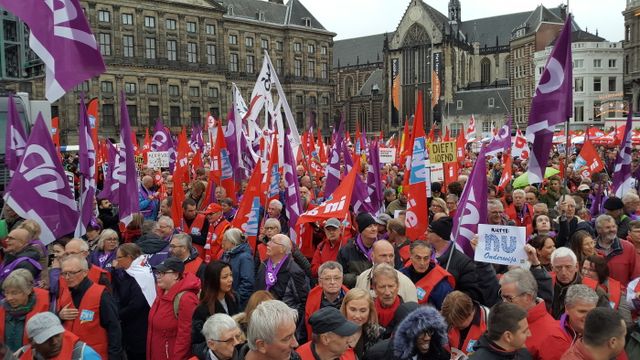
On Saturday, November 10, 10,000 people protested against the pro-corporate policies of the liberal-conservative government of Prime Minister Mark Rutte (VVD), which has been in power for a year. The government has already lowered corporate taxes, and is about to increase taxes on basic supplies, such as foodstuffs and medicine. One particular plan sparked most public outrage: the abolition of dividend taxes, a handout of 1.9 billion euro to shareholders.
The demonstration on the “Dam” square in Amsterdam was organised by the trade union federation FNV and its Christian counterpart CNV. FNV chairman Han Busker (annual salary: slightly over 100,000 euro) delivered the opening speech. He declared, “We're not going to stand for this. We do not accept that the money is spent on the companies and the rich, but not on the people. We do not accept that banks are bailed out, but hospitals are allowed to go bankrupt.”
Part of the demonstration in Amsterdam
Recently, in the course of just three days, five hospitals and a labour clinic went bankrupt. Patients were moved out and relocated, which led to at least one life-threatening situation.
“Just a month ago, the government thought it was a good idea to abolish dividend taxes. We, together, protested and this ridiculous idea was off the table,” Busker claimed.
This is, in fact, a lie. The tax handout was included in the coalition agreement of Rutte’s government on the behest of a lobby of influential Dutch companies, such as Shell Oil, foodstuffs giant Unilever, medical and electrical equipment maker Philips, plus the employers’ organisation VNO-NCW. Prime Minister Rutte, who felt “with every fiber in his body” that this was the right thing to do to create the right “climate” for multinationals to settle and bring in jobs, strongly supported it.
As it turned out, many foreign shareholders were not too concerned about paying a small tax on their stock profits, which were still enormous. The American Chamber of Commerce in the Netherlands (AmCham) announced that a deal exists between the US and the Netherlands that exempts US shareholders of American companies operating in the Netherlands from paying the dividend tax.
Finally the dividend tax remained, not because of the unions, but because Unilever, one of the multinationals that lobbied for its abolition, announced that it has cancelled its plans to move its headquarters from England to the Netherlands. The issue was “reconsidered” within the coalition, and then dropped.
Later in his speech, Busker acknowledged that it was not public outrage which changed Rutte’s mind, but simply a “text message from the CEO of Unilever.”
Living conditions for ordinary workers have drastically deteriorated under Rutte, who has been Dutch prime minister for eight years at the head of shifting coalitions of parties. Nowhere else has the number of “flexible” temporary contracts increased as much as in the Netherlands.
Since 2008, there has been a shortage of 10,000 new homes and apartments every year. In the northern province of Groningen, houses are literally shaken apart by earthquakes, which increase in frequency and intensity due to natural gas extraction. Earlier this year, a secretive deal between the state tax service and Shell, which exploits the gas fields, was exposed. Apparently, Shell was able to avoid paying dividend taxes since 2005.
These policies are responsible for growing social inequality. The wealthiest 10 percent of the Dutch population control 68 percent of Dutch wealth, which totals 726 billion euro. The poorest 10 percent have a combined debt of 65 billion euro.
This assault on the working class will continue. Corporate taxes, which now stand at 25 percent for large companies and 20 percent for small to medium-sized companies, will be reduced gradually to 20.5 percent and 15 percent, respectively. Company directors will see a tax cut on corporate loans. Investments in research and development will also be taxed less.
Furthermore, starting in 2021, some 200 million euro will be allocated annually towards reducing the cost of labour. This might include cuts to social security benefits or holiday and Christmas bonuses. All these measures total up to about 1.9 billion euro, the same sum the abolition of dividend tax would have cost.
A new labour law reform has also been presented. Permanent contracts can now be ended on many minor pretexts. Many previous criteria protecting workers have been scrapped. Moreover, the temporary contracts can now be extended over three years instead of two years.
Protesters on Dam square
The demonstration on Dam square was followed by a protest-march through the city towards the Museum square, where it ended after a brief closing speech by a union official.
It was a trade union show from start to finish, a rally to boost the position of the trade unions. It was an attempt to channel popular opposition against the government’s pro-corporate policies behind the nationalist, social-democratic, dead-end perspective of the trade unions.
The trade unions will never challenge class relations, because their comfortable position at the negotiating tables ensures them a good share of the spoils. With their nationalist approach, trade unions seek to divide the international working class, in order to prevent workers from uniting with their brothers and sisters from abroad and find strength in their massive numbers.
FNV chairman Han Busker, in his opening speech, appealed many times to the government to pursue a more social-democratic instead of a neo-liberal policy. But social democracy today is a nationalistic dead end, abolishing all the social reforms of the past.
During the protest march, many people voiced concern and anger over the government’s spending of taxpayer money on companies and international shareholders. “The entire parliament has shifted towards the right-wing. There are no ‘left-wing’ parties anymore,” is a much-heard critique.
The social-democratic labour party PvdA was decimated in last year’s national election, losing 29 seats in parliament. GroenLinks (Green Left) is neither green nor left, and the Socialist Party (SP) has linked their social demagogy with attacks on immigrants.
Most of those on the demonstration had still some faith in the trade unions, and thought that the government will eventually listen to the public, if these demonstrations grow in frequency and proportion.
A janitor at a public school, who has a minor disability, told the WSWS that he is paid according to his productivity. His wage is below the legal minimum and is supplemented by the social-welfare institution UWV, towards the minimum income. “What is a minimum-wage good for, if employers can find a way around and still pay you less?” he asked.
Max, a young chef who works at a restaurant in the southern province of Zeeland, said that he is participating in the demonstration because the government works for big business, not the people. Max said that Dutch politics was shifting to the right, even to the extreme right, and that workers need an “extreme left party” to counter that. One of his thoughts was that a state-funded, basic income would be a great first step towards income equality, so people could really develop their talents and pursue their interests.