21 Nov 2018

Protests over PetroCaribe continue as Haitian president seeks imperialist support

John Marion

For the second time in a month, thousands of Haitians took to the streets on Sunday to demand that the government come clean about embezzlement of PetroCaribe funds, and to call for the ouster of President Jovenel Moïse.
Tires were set on fire in the streets of Port-au-Prince, and rocks were thrown at the office building of Prime Minister Jean-Henry Céant. More than 3,000 police were deployed in the capital. As of Sunday evening, 11 people had been killed across the country, 45 injured and 75 arrested, according to protest organizers.
November 18 was chosen as a protest date because it was the anniversary of the 1803 Battle of Vertières, in which Haitian forces under General Jean Jacques Dessalines triumphed over French troops shortly before Haiti won formal independence.
Although Sunday’s protests were smaller than those held on October 17, they posed enough of a threat to Moïse that he did not travel to Cap-Haïtien for the traditional ceremony marking the day. Only a year ago, he used the occasion to announce the remobilization of the Haitian army, which had been disbanded in 1994 by Jean-Bertrand Aristide.
Haiti signed onto Venezuela’s PetroCaribe program in 2006. It is structured so that the Haitian government buys petroleum products on credit, sells them domestically, and then has 25 years to repay the Venezuelan government at very low interest rates. The funds retained by the Haitian government are supposed to be used for development and infrastructure projects. In reality, millions of dollars have been siphoned off by construction and energy companies in fraudulent schemes, or used for the purchase of police vehicles. Much of the corruption happened under President Michel Martelly, Moïse’s predecessor and mentor.
From the start of Haiti’s PetroCaribe participation through March 31, 2014, 29.4 million barrels of petroleum products were shipped from Venezuela to Haiti, and the Haitian government has reimbursed less than half the value. The growing protest movement has been demanding to know what happened to the rest of the money. Moïse has blocked Senate investigations into the question.
The Superior Court for Accounts and Administrative Litigation (CSCCA), which is in Moïse’s pay, also tried to stall investigations. However, it has done an about-face in response to the protests and is now promising an investigation to be completed in January.
The October 17 protests saw tens of thousands take to the streets across Haiti. Although a weekday, it was a holiday for workers because it marks the day when Dessalines was killed in 1806. Of the 10 departments in the country, only Nippes did not see large marches.
According to a report by the National Network for the Defense of Human Rights (RNDDH), three young protesters were arrested in the Martissant neighborhood of Port-au-Prince and executed in cold blood. Two journalists were threatened by police who fired their guns in the air and tried to confiscate a camera. A week later, on October 25, a protester was bludgeoned by the Haitian National Police for carrying a protest sign that depicted a replica of a check from the Venezuelan government to the Haitian government.
Eight people were killed on October 17. Two weeks later, on October 31, a funeral was held for six of the dead in the Port-au-Prince slum of Bel Air. The RNDDH report documents that Haitian National Police from the BOID (Brigade of Operations and Departmental Interventions) and UDMO (the Departmental Unit for the Maintenance of Order) were deployed outside. Funeral attendees threw stones and bottles and shouted that they didn’t need to be protected by the assassins themselves.
The police responded by firing their guns for 30 minutes, along with tear gas. While no one was hurt, panic filled the chapel and the funeral was delayed. As of November 9, two of the families still didn’t know where their children had been buried.
After the funeral, a march to protest the October 17 deaths was organized and it grew into a protest demanding information about the PetroCaribe corruption. During the march, one man was shot to death and at least eight others were injured by bullets.
There are also allegations that members of the BOID helped a gang leader called Ti Junior carry out a massacre in La Saline on November 13. More than 20 people were killed and their bodies left in piles of garbage on the street.
Moïse Jean-Charles, a former senator who ran unsuccessfully for president in 2016, has been
seeking to divert the PetroCaribe protests into his Pitit Dessalines movement. His supporters have provocatively hoisted red and black flags in Cap-Haïtien and Port-au-Prince and carried them in marches. These colors were used by Dessalines before they were replaced with red and blue in 1806; the Duvalier dictatorship resurrected the red and black flag in 1964.
Jean-Charles ran on a program advocating political and economic sovereignty—particularly through making Haiti agriculturally self-sufficient—and a strong national government. In his biography, he boasts of his admiration for Fidel Castro, “whom on many occasions he had the privilege and honor of meeting.”
The United States and other imperialist powers are planning their next moves in response to the deepening crisis. US Ambassador Michèle Sison has met behind closed doors with the head of the two houses of parliament, while Prime Minister Céant met with Core Group representatives (from the UN, the OAS, the EU, France, Germany, Spain, Canada, Brazil and the United States) at the Canadian embassy. After violent protests in July against austerity measures, the Core Group haughtily declared that “while concerns about the difficulties of everyday life are legitimate, nothing can justify behaviors that may threaten…the safety of property, as well as the progress made in recent years in terms of stability and security and democratic progress in Haiti.”
President Moïse has met with the UN special representative for Haiti and with members of the country’s big bourgeoisie. Helen Meagher La Lime, the chief of the UN’s MINUJUSTH police force, met with Senate President Joseph Lambert, who tweeted afterward that “they recognized together the urgent necessity of reinforcing Haitian institutions that are too often broken.”
Céant was sworn in as prime minister on September 17, two months after the July protests led to his predecessor’s resignation. Since October 17, there have already been calls for Céant to fire cabinet ministers.


20 Nov 2018

UN says millions in Britain deliberately plunged into “great misery”

Robert Stevens

The report on poverty and human rights in Britain by United Nations Special Rapporteur Philip Alston is an extraordinary depiction of the social catastrophe devastating the working class.
For years, the special rapporteur only investigated “developing” countries such as China, Ghana and Mauritania, where “extreme poverty” is endemic.
However, the offensive against the working class in the advanced capitalist countries is so severe that Alston has been forced to turn his attention to them. He visited the United States in 2017, where he was confronted with levels of poverty and inequality that “shocked” him.
Alston has now published a 24-page UK report into nine cities, including London, Oxford, Newcastle, Cardiff, Glasgow and Belfast.
Opening the London press conference on his findings last week, Alston said that he wanted to contrast the “great prosperity in Britain,” the fifth largest economy in the world, with the fact “that a fifth of the people, 14 million people, are living in poverty. Four million of those are more than 50 percent below the poverty lines and one and half million are destitute.”
Child poverty rates are “staggering” and “are predicted to go up significantly over the next couple of years.”
Millions of people are suffering “great misery,” he writes, as “British compassion for those who are suffering has been replaced by a punitive, mean-spirited, and often callous approach.”
There is an “immense growth in foodbanks and the queues waiting outside them, the people sleeping rough in the streets, the growth of homelessness, the sense of deep despair that leads even the Government to appoint a Minister for suicide prevention and civil society to report in depth on unheard of levels of loneliness and isolation. …
“For almost one in every two children to be poor in twenty-first century Britain is not just a disgrace, but a social calamity and an economic disaster, all rolled into one.”
Most telling of all is Alston’s revelation that the impoverishment of the working class is a deliberate policy. Alston declares that austerity is not simply determined by economic circumstances but is driven by a political agenda for “radical social re-engineering.”
“Successive governments have brought revolutionary change in both the system for delivering minimum levels of fairness and social justice to the British people, and especially in the values underpinning it. Key elements of the post-war Beveridge social contract [welfare state] are being overturned,” he concludes.
Alston quotes National Audit Office figures showing that local governments in England have seen central government funding halved over the last seven years. As a result, more than 500 children’s centres closed between 2010 and 2018 and more than 340 libraries closed between 2010 and 2016.
The resulting level of social misery is appalling. “In England, homelessness is up 60% since 2010, rough sleeping is up 134%. There are 1.2 million people on the social housing waiting list, but less than 6,000 homes were built last year.”
Alston writes, “During my visit I have spoken with people who depend on food banks and charities for their next meal, who are sleeping on friends’ couches because they are homeless and don’t have a safe place for their children to sleep.”
The use of food banks is “up almost four-fold since 2012…there are now about 2,000 food banks in the UK, up from just 29 at the height of the financial crisis.”
The working poor are turning to food banks in droves. The Trussell Trust charity that runs many food banks told Alston that “one in six people referred to their food banks is in work. One pastor said, ‘The majority of people using our food bank are in work. … Nurses and teachers are accessing food banks.’ ”
Millions more are on the verge of going under: “A social safety net is not just for people already in poverty. … Many families are living pay check to pay check. And 2.5 million people in the UK survive with incomes no more than 10% above the poverty line. They are thus just one crisis away from of falling into poverty through no fault of their own.”
A sizable section of Alston’s report deals with the suffering imposed by the punitive Universal Credit (UC) system, which the government is attempting to roll out nationally during this Parliament. He notes: “no single program” involves the “promotion of austerity programs more than Universal Credit.” The move to UC was the government “wanting to make clear that being on benefits should involve hardship.”
Even claiming UC proves impossible for many people due to it being an entirely online process. Not only does “digital by default” entail severe hardship for claimants, but UC is “designed with a five-week delay between when people successfully file a claim and when they receive benefits. Research suggests that this ‘waiting period,’ which actually often takes up to 12 weeks, pushes many who may already be in crisis into debt, rent arrears, and serious hardship, requiring them to sacrifice food or heat.”
Central to UC is the “imposition of draconian sanctions, even for infringements that seem minor. Endless anecdotal evidence was presented…to illustrate the harsh and arbitrary nature of some of the sanctions, as well as the devastating effects that resulted from being completely shut out of the benefits system for weeks or months at a time. As the system grows older, some penalties will soon be measured in years.”
So draconian is UC, that Alston recalls conversations with local authorities and the voluntary sector “about their preparations” for its rollout. “I was struck by how much their mobilization resembled the sort of activity one might expect for an impending natural disaster or health epidemic. They have expended significant expense and energy to protect people from what is supposed to be a support system.”
Alston writes, “We are witnessing the gradual disappearance of the post-war British welfare state behind a webpage and an algorithm. … The impact on the human rights of the most vulnerable in the UK will be immense.”
He draws attention to the statement of philosopher Thomas Hobbes that without a social contract, life would be “solitary, poor, nasty, brutish, and short.”
Turning the clock back decades, to the era before the existence of welfare state provision, will provoke a social backlash, Alston warns. “Almost all studies have shown that the UK economy will be worse off because of Brexit, with consequences for inflation, real wages, and consumer prices.”
If current policies “towards low income working people and others living in poverty are maintained. … This could well lead to significant public discontent, further division and even instability.”
Speaking to Channel Four News, Alston said government figures he spoke to “were pretty much unconcerned” about the devastation their policies had wrought and were “in denial.”
This is a charitable statement, given his insistence that austerity is a deliberate policy of social engineering. The newly appointed work and pensions secretary, Amber Rudd, is the former home secretary and a pro-European Union (EU) “Remainer.” Confirming the hostility to the working class shared with the “Brexiteers,” Rudd rejected Alston’s findings. Adopting a pose of outrage, she expressed how “disappointed” she was “by the extraordinary political nature of his language,” which “discredited a lot of what he was saying.”
This is a declaration by the ruling elite that, in or out of the EU, the offensive against the working class will continue unabated.

Thousands of Austrian metal workers on strike

Markus Salzmann

Since the beginning of last week, several thousand workers have been striking in the Austrian metal industry. Hundreds of plants across the country are affected by temporary work stoppages. A total of 130,000 workers are employed in the Austrian metal industry. They are striking for higher wages and against the tightening of labour laws by the right-wing government.
Company representatives broke off the pay negotiations for a collective agreement two weeks ago. Even during the talks, the chairman of the Association of Metallurgical Industry (FMTI), Christian Knill, announced to the media that he did not expect an agreement and that the companies were prepared for “combat measures.” As a result, the Production Union (Pro-Ge) and the Union of Private Employees, Printing, Journalism, Paper (GPA-djp) called for warning strikes. Since then, company representatives and trade unions have met several times, but without reaching an agreement. This week could lead to full-time strikes.
The unions are calling for a 5 percent wage increase and a mitigation of the new working time rules, with measures such as higher overtime pay increases. The government, a coalition of the right-wing conservative People’s Party (ÖVP) and right-wing extremist Freedom Party (FPÖ), has tightened labour legislation since September 1. Now, companies are allowed to work their employees up to 12 hours a day, 60 hours a week. The government had passed the amendment in close consultation with the companies.
The industrialists had initially offered a wage increase of 2 percent and then raised this to 2.7 percent, which is still a provocation. The annual inflation rate in Austria is 2.4 percent.
The government has arrogantly brushed aside any criticism of the tightening of labour laws. Minister of the Economy Margarete Schramböck (ÖVP) even claimed in parliament that workers would benefit from longer working hours. According to unconfirmed sources, the government is already planning further tightening of labour laws.
After pressure from workforces inside the plants, the unions responded with a warning strike. The trade unions, which are closely linked to the Social Democratic SPÖ, continue to move to the right with their accelerating decline and strictly reject a confrontation with government and business. With his assumption of office in June, the new head of the trade union federation (ÖGB), Wolfgang Katzian, had signalled the readiness of the ÖGB to cooperate and declared: “We are not a thorn in the side of the government, the economic chamber or anybody else.”
Although the union speaks of “compensating” for the effects of tightening the law in collective agreements, it strictly rejects a fight against the anti-social legislation.
In recent decades, there have rarely been major industrial disputes in the Austrian metal industry, and they have mostly been suppressed and sold out by the SPÖ and the trade unions. The biggest metal strike took place in May 1962. In 2003, opposition to the government’s pension reform (also an ÖVP and FPÖ coalition) led to the largest mass protests since 1945. In that year over 10 million working hours were lost in Austria due to strikes.
The last major strike in the metal industry took place in October 2011, when collective bargaining faltered. The workforces of almost all metal companies participated in work stoppages. The mass strike potential of the then more than 200,000 workers shocked the ÖGB. They stopped the strikes after a few days and started new negotiations, ultimately agreeing to a moderate wage increase.
As in many other European countries, protests against low wages and poor working conditions have become increasingly common in Austria. Tens of thousands of social workers took part in a warning strike in February. They called for a reduction in working hours with full pay compensation. Shortly before the beginning of a major strike wave, the union agreed with the employers’ camp and negotiated a ridiculous wage increase of 2.5 percent. The demand for shorter working hours was swept aside.
The unions are unwilling to tackle the ÖVP-FPÖ government’s social attacks. Under the guise of small-scale, superficial criticism, the ÖGB and its affiliated unions have increasingly adapted to the right-wing, anti-working-class policy of the government. Ex-ÖGB leader Erich Foglar, who was in office until the summer, had even publicly called for cooperation with the right-wing extremist FPÖ at the highest level. Josef Muchitsch, the head of Bau-Holz trade union, is also seen as championing close cooperation with the far right.
Preparing for a violent confrontation, the government is exploiting the unions’ sabotage of a growing willingness among workers to fight. Just a few weeks after its swearing-in, the government launched the “security package” that undermined basic democratic rights and created authoritarian structures. Now they are preparing further surveillance and censorship measures on the Internet.
Federal Chancellor Sebastian Kurz (ÖVP) and Vice-Chancellor Heinz-Christian Strache (FPÖ) have announced their intention to introduce a “digital anti-mask law” to make “association on the Internet more respectful.” Strache said they wanted to better define “hate speech” and “swiftly hold perpetrators to account.” He did not say anything more concrete. Since the FPÖ maintains close ties with neo-Nazis and the identity politics milieu, one can easily imagine how they will define the term “hate speech.”
According to the Wiener Standard, the government is considering extending the already existing duty of disclosure. Currently, Internet platform operators are required to provide user information when it comes to prosecuting criminal charges. The storage and disclosure obligations of the operators could now be extended. In addition, the government in Vienna wants to introduce a network enforcement law based on the German model, which obliges Internet platforms to censor far and wide. Chancellery Minister Gernot Blümel (ÖVP) told Austrian Broadcasting Corporation that the feasibility of a network enforcement law in Austria is currently being examined.

Thousands of GM salaried workers to lose jobs in 2019

Jerry White

Thousands of salaried employees at General Motors in the US and Canada will be thrown out of their jobs at the beginning of 2019 as the Detroit-based automaker accelerates its cost-cutting campaign. The white-collar job cuts, which are also coming at Ford, are part of an expected blood-letting of salaried and hourly jobs amid declining sales worldwide and telltale signs of an impending restructuring of the global auto industry.
Lordstown Assembly Complex
GM sources told the Detroit Free Press and Detroit News that at least 3,000 employees would be terminated because not enough had agreed to “voluntary buyout” offers sent out last month. The company is targeting 17,700 salaried workers with at least 12 years’ experience or more than a third of its white-collar workforce in North America.
According to internal sources who spoke to the Detroit media outlets, GM hoped to get at least 7,000 white-collar workers to sign up for the buyout offer by noon Monday, but managers told employees late last week that only 4,000 had done so. “That means 3,000 or more salaried workers in North America could be terminated starting in January if the automaker in fact opts for forced job cuts, which it has said it would consider if buyouts fell short,” the Free Press wrote.
GM managers held staff meetings last Thursday and Friday to ratchet up pressure on salaried workers to take the deals, which include six months’ of pay and health care coverage. It is unlikely many more will opt to do so since this is exactly the same severance package for a GM employee with 12 years or more seniority who is involuntarily terminated.
According to one source who spoke to the Free Press, “GM will complete the voluntary buyouts by Nov. 29. The managers we’ve talked to are already making their list and will select their cuts in January.” On January 15, he said, GM will announce the involuntary job eliminations, and “walk people out.”
Industry analysts said the cuts targeting engineers, designers, mid-level managers and others are only a prelude to slashing thousands of production workers’ jobs. Market economist Jon Gabrielsen, an adviser to the auto industry, told the Free Press, "I absolutely still believe that 7,000 to be the salaried job reduction number for GM in metro Detroit over the course of an auto downturn in the next two to three years, plus as much as another 7,000 in hourly based on how much sales soften," he said.
The global automakers are under enormous pressure from Wall Street to increase profit margins and shareholder payouts despite falling sales. Last month, GM reported that its third-quarter operating profits in North America increased by 37 percent to $2.8 billion despite an 11 percent drop in sales during the quarter in the company’s key US market.
Lordstown workers on last day of the second shift in June
In an internal memo obtained by the Free Press, which was sent out to managers after the profit announcement, GM said, "We can't confuse progress with winning. Today, our structural cost is not aligned with the market realities nor the transformational priorities ahead. We must take significant actions now while our company and the economy are strong” to “reduce structural costs and improve vehicle profitability."
While GM is planning to cut $6.5 billion in costs, it has squandered over $10 billion in stock buybacks and dividend payouts for its richest investors since 2017, and $25 billion since 2012.
Earlier this month Ford said it will reduce its salaried US workforce of 70,000 employees by an unspecified number as part of its $11 billion “fitness” cost-cutting plan. Morgan Stanley analyst Adam Jonas projected a 12 percent cut in Ford staff worldwide in a note to investors in August saying, “We do not see restructuring at Ford as a ‘nice to have’… but as a crucial step to set the global business on a more balanced footing.”
While seeking to slash jobs all of the automakers have increased the number of white-collar workers hired through temporary agencies who receive lower pay and few, if any, health care and pension benefits.
At the same time, the Detroit-based automakers have carried out temporary layoffs of production workers and permanent jobs cuts and plant closings are expected. Last month, Ford idled its Kansas City, Missouri plant, putting 2,000 workers on temporary layoff, and Fiat Chrysler idled workers at its Indiana transmission plants.
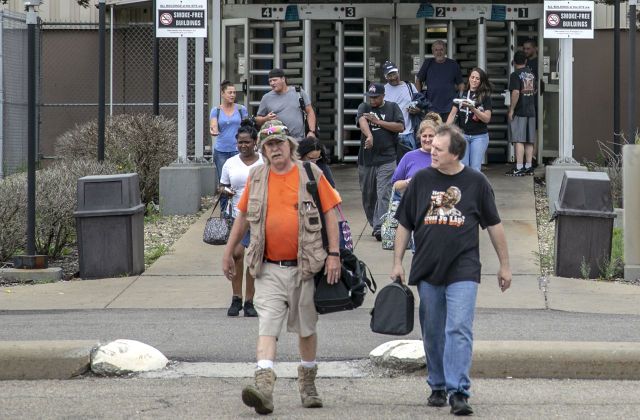
With sales of its Chevy Cruze compact falling, there are widespread concerns that GM may close its assembly plant in Lordstown, Ohio, halfway between Cleveland and Pittsburgh. GM laid off 1,200 workers when it eliminated the third shift at the plant last year and another 1,200 workers when the second shift ended in June.
A second-tier worker at Fiat Chrysler’s Belvidere, Illinois assembly plant told the WSWS Autoworker Newsletter that threats are being spread about the possible elimination of one shift at that facility. “A supervisor told me to start watching the Illinois.gov WARN site for them to post a 60-day notice of layoff,” the worker said, adding, “our union steward said there is a very good chance that we will be laid off December 15 for an unspecified amount of time. More and more talk of eliminating the first shift is causing people to transfer departments and shifts in hope of saving their jobs.”
Temporary layoffs have hit a number of Fiat Chrysler facilities including Belvidere Assembly and Kokomo, Indiana transmission plants.
The United Auto Workers (UAW) has not even made a pretense of opposing jobs cuts, echoing management’s claims they are necessary to ensure continued profitability in the face of slowing sales. The automakers have been able to extract huge profits in North America, despite falling sales, with the collusion of the UAW, which has signed labor agreements slashing the wages of new hires, eliminating income security for laid off workers and expanded the number of temporary part-time workers who pay union dues but have no rights and do not qualify for supplemental unemployment benefits.
The salaried and hourly job cuts are clearly a shot across the bow of autoworkers in advance of the negotiations for new labor agreements, after the current deals expire in September 2019. The threat of plant closures and mass layoffs were used by the automakers and the UAW to ram concession deals past the opposition of workers who initially voted down a contract at Fiat Chrysler in the first such defeat of a UAW-backed national deal in three decades.
In a letter sent to workers UAW Vice President for GM Terry Dittes made it clear the UAW would try to blackmail workers with job threats once again. “Filling our plants with product” would be the UAW’s top priority in the 2019 contract negotiations Dittes said before echoing Trump’s American First nationalism by railing against GM for expanding production in Mexico and China.
This underscores the need for autoworkers to build new organizations of struggle, including factory committees, controlled by rank-and-file workers themselves and independent of the corporate-controlled UAW, to wage a collective fight against coming attack on jobs and living standards. Such a fight must unite workers throughout the world against the transnational auto companies and the capitalist profit system, which enriches the corporate and financial elite at the expense of workers the world over.
“They’re instilling fears about cutting a shift and eliminating anyone hired after 2011,” the Belvidere worker told the Autoworker Newsletter. “Threatening more layoffs, all tactics are to get tier-two employees to take whatever they throw at us in upcoming contract negotiations.”
The worker referred to the corruption scandal that has erupted in the UAW, which revealed how union negotiators had taken million in bribes to sign “company friendly agreements.” “The tides have shifted. The UAW is no longer on our side and they haven't been in a long time. The more these cases are exposed, the more apparent that is becoming. It’s very sad, but it’s true.”

PTDF Masters & PhD Scholarships 2019/2020 for Study in UK, Germany and France

Application Deadline: 31st December 2018

Offered annually? Yes

Eligible Countries: Nigeria

Fields of Study:  For 2019, the scholarships will be restricted to select courses (available on the PTDF website)

About the Award: Under this scheme, candidates are invited to apply through PTDF to specific programmes at the partner institutions in any of the countries (full list of sponsored courses is available below). The award includes the provision of flight tickets, payment of health insurance, payment of tuition and bench fees (where applicable) as well as the provision of allowances to meet the costs of accommodation and living expenses. The programmes will also include language classes to aid scholars settle into their new environments.

Type: Masters, PhD

Selection Criteria and Requirements: PTDF scholarships are highly competitive and only candidates who are outstanding across the board are selected. A selection committee will be constituted to assess applications using the following criteria;
  • Academic merit as evidenced by quality of degrees, full academic transcripts, other professional qualifications acquired, and relevant publications (where available) to be referenced by applicants
  • Awards for leadership and/or academic excellence (where available).
  • Membership of professional bodies
  • The viability of the study/research plan.
  • Applicants are required to make a case for their scholarship by submitting a statement of purpose (maximum 500 words) stating the reason(s) they want to undertake the study, the relevance of the proposed study to the oil & gas industry and its expected impact on national development.
Requirements:

MSc
  1. A minimum of Second Class Upper (2.1) qualification in their first degree or a Second Class Lower (2.2) with relevant industry experience
  2. Must have completed the mandatory National Youth Service (NYSC)
  3. Must be computer literate
  4. Possession of 5 O/level credits including English Language.
PhD
  1. Must have completed the mandatory National Youth Service (NYSC)
  2. Must be computer literate
  3. A minimum of Second Class Lower (2.2) in their first degree and a good second-degree certificate;
  4. Must submit a research proposal relevant to the oil and gas industry (of not more than 5 pages) to include: Topic, introduction, objective, methodology and mode of data collection (Click here for a sample of Ph.D. research proposal format)
  5. Applicants must also include their master’s degree project
Number of Scholarships: Several

Value of Scholarship: Full scholarship

Duration of Scholarship: for the duration of the degree programme

How to Apply: 
  • Click the here or follow this link http://ptdf.flexisaf.com/
  •  Applicants are advised to read through the requirements in the link below before applying.
  • GOODLUCK!

Visit Scholarship webpage for details to apply

ISTR/WITS Africa PhD Seminar 2019 at Wits Business School, Johannesburg, South Africa

Application Deadline: 15th December 2018

Eligible Countries: African countries

To be taken at (country): South Africa

About the Award: The PhD Seminar is scheduled for May 14-15, 2019 prior to the first annual Conference on Philanthropy, organized by the Wits Business School’s Centre for Philanthropy and Social Investment in collaboration
with the Center for African Studies at Harvard University, TrustAfrica and Africa Philanthropy Forum on May 16-17, 2019. The conference will be held at the WBS School. The conference will address themes that include private sector giving, impact investing, sustainable development goals, philanthropy, civil society and various other topics. PhD Seminar students are required to attend the conference.


Type: PhD, Conference

Eligibility:
  • Students must be currently enrolled in a university and must be able to attend the entire PhD Seminar and Philanthropy Conference
  • . Past participants of ISTR Seminars are welcome to apply to participate.
Number of Awards: Approximately 20 doctoral students will be accepted.

Value of Award: ISTR/WITS will cover the cost of shared room accommodation for the PhD Seminar and the Conference on Philanthropy and meals during both events. Limited travel support is available to supplement support the student’s university can provide. ISTR will grant accepted students 2019 membership in ISTR with all of the associated benefits. Accepted students must attend the Conference on Philanthropy (attendance is free of charge)

Duration of Programme: Conference on Philanthropy begins the next morning on May 16, 2017 and concludes the afternoon of May 17, 2019. If traveling from out of town, participants are expected to arrive the evening of May 13, 2019 and depart the evening of May 17, 2019 or the next morning as flights require.

How to Apply: To apply, please complete the online form here before the December 15 deadline:
https://www.istr.org/page/WITS_ISTRPhDSeminarApplication


All applications must include the following information:
  1. – Full name and gender
  2. – Contact details (including e-mail and phone number)
  3. – Disciplinary background
  4. – Institutional affiliation and name(s) of the supervisor(s)
  5. – Working title of PhD project and formal start/end dates
  6. – Indication of the stage of your research
  7. – Abstract of PhD research (min. 500 – max. 800 words). The abstract must include: research questions, theoretical framework, methods, and results if already applicable
  8. – Feedback needed on your PhD research
  9. – Letter from your faculty advisor/department head providing
    • information about the quality of the candidate,
    • specific information about how participation in the PhD seminar would benefit your doctoral studies, and
    • a statement of financial support the university is able to provide in support of your participation in the PhD Seminar.
  10. – A brief description (100-150 words) of your motivation to participate in the ISTR PhD Seminar
  11. – Research Keywords
Visit Programme Webpage for Details

CERN Summer Student Programme (Member and Non-Member States) 2019 for International Students

Application Deadline: 31st January 2019

Eligible Countries: Member and Non-Member countries

About the Award: Over a period of 8 to 13 weeks, you will work on an advanced technical project in an experimental or engineering team.
During this unique and exciting time, you can attend a series of lectures specially prepared for you where experts and scientists from around the world share their knowledge about a wide range of topics in the fields of theoretical and experimental particle physics, engineering and computing. Visits to the CERN facilities, as well as discussion sessions and workshops are also key features of the programme. Find out more on the Summer Student information page: https://hr-dep.web.cern.ch/content/summer-students. A short report on your work and project at CERN will be expected at the end of your stay.

Type: Internship

Eligibility: In order to qualify for a place on the programme you will need to meet the following requirements:
  • You are a Bachelor or Master student (not PhD) in Physics, Engineering, Computer Science or Mathematics and should have completed, by the European Summer 2019, at least three years of full-time studies at university level.
  • You will remain registered as a student during your stay at CERN. If you expect to graduate during European summer 2019 (as of May), you are also eligible to apply.
  • You have not worked at CERN before with any other status (Technical Student, Trainee, User or other status) for more than 3 months.
  • You have a good knowledge of English; knowledge of French would be an advantage.
Candidates of all nationalities are welcome to apply for this Summer Student Programme.

Number of Awards: Not specified

Value of Award: CERN would very much like to benefit from your expertise, commitment and passion.
In return, CERN will provide you with:
  • A contract of association of 8 to 13 weeks* to work on a technical project.
  • An extensive physics lecture programme (students will also be able to attend a series of IT lectures organized by Openlab).
  • A 90 CHF per calendar day (net of tax) subsistence allowance to cover the cost of accommodation and meals in the Geneva area for a single person for the whole contract duration.
  • A travel allowance on a lump sum basis paid at the end of your stay to help you with the cost of travel between Geneva and your residence at the time of the selection committee,
  • Coverage by CERN’s comprehensive Health Insurance scheme (contribution already deducted from allowance).**
  • Assistance to find accommodation on the CERN site or nearby.
Duration of Programme: 8 weeks

Possible arrival dates
  • Every Monday from beginning of June to the 1st Monday in July inclusive, namely 3 June, 11 June*, 17 June, 24 June and 1 July 2019.
  • *Exception is Tuesday 11th June, as Monday 10th 2019 is a bank holiday at CERN.
How to Apply: You will need the following documents to complete your application (please make sure to name the documents accordingly e.g. CV, motivation letter, academic transcript, reference letter):
  • A CV in either English or French.
  • A copy of your most recent academic transcript giving an overview of your marks (if you download it from your university portal please make sure the document is not protected so that we can open it).
  • At least one reference letter (dated less than 12 months), preferably 2, from your lecturers.
Please make sure you have all the documents requested to hand when you start your application on our career portal as they cannot be added after its completion (only reference letters can be submitted afterwards).
Once your application has been submitted, you will receive a confirmation e-mail which contains a link. You must forward this link to at least one referee, so that they can upload their recommendation letter. Please note that this must be done before the application deadline (31 January 2019).


Visit Programme Webpage for Details

US Government TechWomen Program 2019 for Women in STEM (Science, Technology, Engineering and Math) Fields

Application Timeline: Opens TODAY 20th November 2018
  • Application closes: 16th January, 2019
  • March 2018: Semifinalists are contacted
  • May 2018: Final selection decisions are made
  • September – October 2019: U.S. TechWomen program
Eligible Countries: Algeria, Cameroon, Egypt, Jordan, Kazakhstan, Kenya, Kyrgyzstan, Lebanon, Morocco, Nigeria, Pakistan, the Palestinian Territories, Rwanda, Sierra Leone, South Africa, Tajikistan, Tunisia, Turkmenistan, Uzbekistan or Zimbabwe.

To be taken at (country): USA

Eligible Field of Study: Any STEM fields

About the Award: From the moment the Emerging Leaders arrive, they are immersed in the innovative, constantly evolving culture of Silicon Valley and the San Francisco Bay Area. Emerging Leaders work closely with their Professional Mentors to design meaningful projects while exploring the San Francisco Bay Area with their Cultural Mentor and fellow program participants.
TechWomen Emerging Leaders will:
  • Challenge themselves with new questions and concepts
  • Collaborate with like-minded women in their fields on an innovative project
  • Network with influential industry leaders
  • Discover their own innovative leadership style
  • Create meaningful friendships with women from all over the world
  • Explore the diverse communities of the San Francisco Bay Area and Washington, D.C.
  • Inspire the next generation of women and girls in their home countries
Type: Training, Fellowship

Eligibility: Applicants must
  • Be women with, at minimum, two years full-time professional experience in the STEM (science, technology, engineering and math) fields. Please note that internships and other unpaid work experience does not count toward the two-year professional experience requirement.
  • Have, at minimum, a bachelor’s degree/four-year university degree or equivalent.
  • Be proficient in written and spoken English.
  • Be citizens and permanent residents of Algeria, Cameroon, Egypt, Jordan, Kazakhstan, Kenya, Kyrgyzstan, Lebanon, Morocco, Nigeria, Pakistan, the Palestinian Territories, Rwanda, Sierra Leone, South Africa, Tajikistan, Tunisia, Turkmenistan, Uzbekistan or Zimbabwe at the time of application and while participating in the program.
  • Be eligible to obtain a U.S. J-1 exchange visitor visa.
  • Not have applied for an immigrant visa to the United States (other than the Diversity Immigrant Visa, also known as the “visa lottery”) in the past five years.
  • Not hold U.S. citizenship or be a U.S. legal permanent resident.
Preference will be given to applicants who
  • Demonstrate themselves as emerging leaders in their chosen professional track through their work experience, volunteer experience, community activities and education.
  • Are committed to return to their home countries to share what they have learned and mentor women and girls.
  • Have limited or no prior experience in the United States.
  • Have a proven record of voluntary or public service in their communities.
  • Have a demonstrated track record of entrepreneurialism and commitment to innovation.
  • Demonstrate a willingness to participate in exchange programs, welcome opportunities for mentoring and new partnership development, and exhibit confidence and maturity.
TechWomen encourages people with diverse backgrounds and skills to apply, including individuals with disabilities.

Selection: TechWomen participants are selected based on the eligibility requirements above. Applications are reviewed by independent selection committees composed of industry leaders and regional experts. Semifinalists may be interviewed by United States Embassy personnel in their country of permanent residence.

Number of Awardees: 100 women

Value of Scholarship: International travel, housing, meals and incidentals, local transportation and transportation to official TechWomen events are covered by the TechWomen program. Participants are responsible for the cost of any non-program activities in which they wish to partake, such as independent sightseeing and non-program-related travel.

Duration of Scholarship: The 2018 TechWomen program will occur over five weeks from September – October 2019. Due to the fast-paced nature of the program, arrival and departure dates are not flexible.

How to Apply:
  • Interested TechWomen participants should apply based on the application requirements in link below.
  • GOODLUCK
Visit Programme Webpage for details

Award Provider: US Department of State

Google AI for Social Good Contest 2019 ($25 million Pool Fund+Consulting)

Application Deadline: 22nd January 2019

Eligible Countries: All

About the Award: At Google, we believe that artificial intelligence can provide new ways of approaching problems and meaningfully improve people’s lives. That’s why we’re excited to support organizations that are using the power of AI to address social and environmental challenges.
We’re looking for projects across a range of social impact domains and levels of technical expertise, from organizations that are experienced in AI to those with an idea for how they could be putting their data to better use. Since 2005, Google.org has invested in innovative organizations that are using technology to build a better world.

Type: Award

Selection Criteria: 
  • Impact. How will the proposed project address a societal challenge, and to what extent? Is the application grounded in research and data about the problem and the solution? Is there a clear plan to deploy the AI model for real-world impact, and what are the expected outcomes?
  • Feasibility. Does the team have a well-­developed, realistic plan to execute on the proposal? Does the team have a plan to access a meaningful dataset and technical expertise to apply AI to the problem? Have they identified the right partners and domain experts needed for implementation?
  • Use of AI. Does the proposal apply AI technology to tackle the issue it seeks to address?
  • Scalability. If successful, how can this project scale beyond the initial proposal? Can it scale directly, serve as a model for other efforts, or advance the field?
  • Responsibility. Does the proposed use of artificial intelligence align with Google’s AI Principles? See Google’s Responsible AI Practices for practical guidance.
Number of Awards: Not specified

Value of Award: Selected applicants will receive coaching from Google’s AI experts, Google.org grant funding from a $25 million pool, and credits and consulting from Google Cloud. Grantees will also join a specialized Launchpad Accelerator program, and we’ll tailor additional support to each project’s needs in collaboration with data science nonprofit DataKind.

How to Apply: 
  • If you have an idea and your organization is eligible (see FAQs), you’re ready to apply. Download our application and apply through the link below.
  • Organizations will have until 11:59:59pm PST January 22, 2019 to submit their applications. After the deadline, Google and our panel of experts will review proposals and announce grant recipients in spring 2019.
  • Apply now
  • GOODLUCK!
Visit Programme Webpage for Details

CEBHA+ Doctoral Scholarship 2019 for Students in Sub-Saharan Africa

Application Deadline: 26th November 2018.

To be taken at (country): For the CEBHA+ Doctoral Scholarship, each of the doctoral candidates will be hosted at one of three institutions:
  • South African Medical Research Council (students may be registered at any university in sub-Saharan Africa)
  • Stellenbosch University
  • University of Malawi
About the Award: Sub-Saharan Africa is affected by a substantial burden of disease, with premature deaths due to non-communicable diseases (NCDs) and unintentional injuries being on the rise. There is thus a substantial need to develop and implement evidence-based interventions to prevent and treat NCDs and unintentional injuries in Africa, as well as to address their root causes. CEBHA+, a research network with partners in many African countries, including South Africa, Malawi, Uganda, Rwanda and Ethiopia has emerged from this need. The Network aims to build long-term capacity and infrastructure for evidence-based healthcare and public health in sub-Saharan Africa, by focusing on both prevention of disease and delivery of care for NCDs.

Type: PhD

Eligibility: View CEBHA+ Doctoral Scholarship Eligibility table in Program Webpage (see Link below)

Number of Awards: Not specified

Value of Award: The total scholarship is valued at € 24,000 and will be paid out over 3 years. The CEBHA+ Doctoral Scholarship will be administered through the successful candidate’s university; and it will cover tuition fees and research costs, and contribute towards living expenses. Payment of the scholarship will be as per the university policy; and continued payment of the scholarship will depend upon the candidate’s satisfactory progress against agreed goals. The successful candidate will be mentored by experienced researchers within the CEBHA+ Network.
Conditions of the scholarship: The successful doctoral candidate will be expected to:
  • Conduct policy relevant NCDs-related research within the low and middle income country (LMIC) public health context
  • Submit at least 2 manuscripts emerging from the doctoral research to peer-reviewed journals
  • Complete his or her doctoral studies within 3 years after first registration (by the end of 2021)
  • Repay the scholarship amount given if the candidate fails to complete his or her studies within the expected period.
Duration of Programme: 3 years

How to Apply: Applicants who meet the eligibility criteria should please submit the following documents by 26 November 2018.
  • Completed application form
  • Copy of Passport/ID
  • Full CV
  • Motivational letter outlining relevant research experience
  • Proof of registration from doctoral candidate’s university (if applicable)
  • Summary of intended doctoral research
Visit Programme Webpage for Details

Important Notes: Please note that Incomplete applications will not be considered

With Nearly 400,000 Dead in South Sudan, Will the US Finally Change Its Policy?

Edward Hunt

The Trump administration has remained largely silent about the ongoing conflict in South Sudan, maintaining a quiet diplomacy with the country’s leaders despite a recent report that nearly 400,000 people have died in the country’s civil war.
This figure of nearly 400,000 deaths is comparable to the estimated number of deaths in the war in Syria. About 2 million people have been internally displaced in South Sudan, and more than 2.5 million people have fled the country.
Making matters worse, the people of South Sudan are experiencing one of the worst humanitarian crises in the world. About 6 million people, or about 60% of the population, are severely food insecure, and another 1.7 million people are facing a looming famine.
“As the conflict has gone on and worsened, the numbers of people in need of assistance has simply continued to grow,” Mark Lowcock, the UN Emergency Relief Coordinator, said earlier this year.
The civil war in South Sudan began in 2013 when President Salva Kiir and Vice President Riek Machar turned their forces against one another. Although the war is often portrayed as an intractable ethnic conflict between Kiir’s Dinka ethnic group and Machar’s Nuer ethnic group, the two men have really been more focused on power and wealth.
“It has ethnic aspects to it, but it is a power struggle of taking control of the country and who holds control of the country,” Hilde Johnson, a former head of the UN Mission in South Sudan, said in 2016.
The United States has played an influential role in the country. Before the war began, the Bush administration helped South Sudanese leaders with the negotiations that led to the country’s independence in 2011. President Kiir often wears the cowboy hat that George W. Bush gave to him.
Since 2005, the United States has provided South Sudan with more than $11 billion in assistance. “That level of U.S. support is unprecedented in sub-Saharan Africa, and represents one of the largest U.S. foreign aid investments globally in the past decade,” according to a report by the Congressional Research Service.
The United States has also taken sides in the war. The Obama administration supported President Kiir, helping him acquire arms from Uganda, a close U.S. ally in the region. “Uganda got a wink from us,” a former senior official has acknowledged.
To keep the weapons flowing, the Obama administration spent years blocking calls for an arms embargo.
During another major crisis in 2016, the Obama administration continued to side with President Kiir. After Machar had been chased out of the country, U.S. officials advised Machar to give up his position in the government.
“We do not believe it would be wise for Machar to return to his previous position,” Special Envoy Donald Booth told Congress.
Jon Temin, who worked for the State Department’s Policy Planning Staff during the final years of the Obama administration, has been highly critical of the Obama administration’s choices. In a recent report published by the U.S. Holocaust Memorial Museum, Temin argued that some of the worst violence could have been avoided if the Obama administration had implemented an arms embargo early in the conflict and refrained from siding so consistently with President Kiir.
“The United States, at multiple stages, failed to step back and broadly reassess policy,” Temin reported.
By the time the Obama administration handed things over to the Trump administration in 2017, the country was cracking apart. In July 2017, a group of analysts and former officials told Congress about horrific levels of violence, citing mass atrocities, war crimes, and crimes against humanity.
President Kiir leads “a brutal regime that continues to murder and plunder its people,” said former U.S. diplomat Payton Knopf, who has spent years working on the crisis. “We may be looking at a civilian death toll that is akin to the war in Syria, but among the population that’s half its size.”
More recently, the Trump administration has started paying some attention. The White House has posted statements to its website criticizing South Sudanese leaders and threatening to withhold assistance. Administration officials coordinated a recent vote at the United Nations Security Council to finally impose an arms embargo on the country.
In other ways, however, the Trump administration has continued many of the policies of the Obama administration. It has not called much attention to the crisis. With the exception of the arms embargo, which could always be evaded with more winks to Uganda, it has done very little to step back, reassess policy, and change course.
The United States could “lose leverage” in South Sudan “if it becomes antagonistic toward the government,” U.S. diplomat Gordon Buay warned earlier this year.
Of course, there has been one undeniable change from the Obama years. Not only has President Trump displayed little concern about the horrors that have unfolded in South Sudan, but he is widely reported to have made racist comments about Africans and African nations. He seems entirely unaware of the role that the United States has played in South Sudan.
The long-term prospects for peace appear remote. Although President Kiir and Machar have agreed to a new peace deal, numerous observers remain skeptical, believing that the two men will never share power peacefully.
“It’s insanity to keep repeating the things that haven’t worked,” Kate Almquist Knopf, a former Pentagon analyst, recently commented.