24 Nov 2018

World Trade Organisation warns of rising protectionism ahead of G20 summit

Nick Beams

The World Trade Organisation (WTO) has issued a warning about the rise of protectionism in the lead-up to the summit meeting of the G20 group of countries in Buenos Aries at the end of next week.
According to the WTO, from mid-May to mid-October an additional $481 billion worth of trade was affected by new restrictive measures imposed by member countries. This was six times larger than in the previous reporting period and the largest since the WTO began collecting such data in 2012.
The WTO said 40 new trade restrictions were applied in G20 economies alone during the five-month period, including tariff increases, import bans and export duties.
Commenting on the report, WTO director-general Roberto Azevedo said its findings “should be of serious concern for G20 governments and the whole international community.” He added: “Further escalation remains a real threat. If we continue along the current course, the economic risks will increase, with potential effects for growth, jobs and consumer prices around the world.”
Azevedo said the WTO was doing all it could to “de-escalate” the situation but “finding solutions will require political will and it will require leadership from the G20.”
While the WTO did not point the finger of blame for the rise in protectionist measures, the chief factor is the aggressive policies instigated by the United States. Three quarters of the latest restrictions were tariff hikes, many in retaliation against the steel and aluminium tariff increases the Trump administration imposed in March.
Besides threatening further measures against China, including lifting its 10 percent tariff on $200 worth of Chinese goods to 25 percent at the start of next year, the US is considering imposing a 25 percent tariff on auto imports on “national security” grounds—the same pretext as for the steel and aluminium tariffs.
These measures remain on hold at this point because Washington is seeking cooperation for its anti-China push from Europe and Japan, which would be adversely affected by such actions. But they remain an ever-present threat.
Rather than acting against the rise of protectionism, the G20 meeting is likely to see a further escalation of tensions as the US steps up calls for measures against China, including through the WTO.
The overall trend of development is indicated by the draft communiqué prepared for the summit. When the G20 became the world’s premier economic forum in 2009 following the global financial crisis, it placed the fight against protectionism at the centre of its statements. Political leaders insisted they would not go down the trade war road of the 1930s.
But in the latest communiqué, now under negotiation, there is no explicit reference to fighting protectionism. Instead it refers to the importance of the multilateral trading system and the need to keep markets open and ensure a level playing field.
The specific reference to protectionism may be dropped in the hope of averting the kind of conflict that erupted at June’s G7 meeting in Canada, where President Donald Trump clashed with the other participants.
Whatever the final wording, the main issue at the meeting will be a scheduled sideline meeting between Trump and Chinese President Xi Jinping on trade issues.
When that meeting was first announced, it was expected to lead to a lessening of tensions. Those hopes have since faded rapidly. Last weekend, US Vice President Mike Pence launched a major attack on China at the Asia Pacific Economic Cooperation (APEC) summit in Papua New Guinea. For first time in its 29-year history, APEC leaders were unable to agree on a final statement.
Over the past week, tensions between the US and China have increased on a number of fronts.
The Wall Street Journal reported that the US administration is contacting foreign allies to persuade wireless and internet providers in their countries not to purchase equipment from the Chinese telecommunications giant Huawei, on the grounds that it could be used to endanger cyber security.
Huawei responded, saying it is not beholden to the Chinese government and that even if Western manufacturers, such as Finland’s Nokia or Sweden’s Ericsson, were preferred, all manufacturers share common supply lines.
One of the problems facing the US in trying to restrict Huawei is that, in the key area of 5G mobile phone technology, the company’s equipment is regarded as better quality and is available at a lower price than the alternatives.
Another conflict that could surface at the G20 meeting, as it did at APEC, is the US demand that the WTO take action against China over alleged theft of technology and “market-distorting” subsidies to key state-owned enterprises (SOEs). One of the G20 summit agenda items is reform of the WTO.
Speaking at a news conference yesterday, Chinese Vice Commerce Minister Wang Shouwen put forward China’s position on WTO reform. He criticised “excessive” agriculture subsides used by developed countries and said reforms should correct discrimination against Chinese investment.
Defending China’s own policies, he said it opposed groundless criticism of “normal SOE and industrial subsidies” and “normal sharing of technological innovations.”
In another attack on China, one of Trump’s top economic advisers has indicated Washington considers there is a case for excluding China from the WTO. Kevin Hassett, the chairman of the president’s Council of Economic Advisers, told the BBC China had “misbehaved” as a WTO member and the global trade organisation had failed the US.
“We never really envisioned that a country would enter the WTO and then behave in the way that China has. It’s a new thing for the WTO to have a member that is misbehaving so much,” Hassett said. In the interview, he raised the question of whether the China issue could be fixed through bilateral negotiation, reform of the WTO or “should we pursue evicting China from the WTO?”
Hassett echoed the view expressed by US Trade Representative Robert Lighthizer earlier this year, that it was a mistake for the US to have agreed to China’s entry into the WTO in 2001. The Clinton administration’s assessment, which helped prepare the way for China’s accession, and for the George W. Bush administration to sign off on it, was that China would remain in a subservient position as a supplier of cheap consumer goods.
But the steps initiated by the Xi Jinping regime for China to move up the value chain and invest heavily in high-tech industrial development under its “Made in China 2025” program have provoked intense opposition. The US political and military establishment regards such development as a threat to American economic, and ultimately military, hegemony, and is determined to counter that possibility by all means considered necessary.

23 Nov 2018

Political turmoil in Sri Lanka intensifies as opposition takes control of parliament

Pani Wijesiriwardena 

Sri Lanka’s political crisis took another turn yesterday when all the MPs backing Prime Minister Mahinda Rajapakse walked out of parliament after the Speaker refused to allocate them a majority on a key committee that could trigger the cutting off of funds to his government.
Factions around Rajapakse and ousted Prime Minister Ranil Wickremesinghe battled for control of the Parliament Select Committee (PSC) because it determines the parliament’s functions, including its agenda.
Last Sunday, at an “all party conference,” President Maithripala Sirisena told the opposition led by Ranil Wickremesinghe’s United National Party (UNP) he did not accept the no-confidence motions passed against Rajapakse, his appointee, because they did not follow parliamentary standing orders.
At the beginning of yesterday’s parliamentary session, Speaker Karu Jayasuriya said that as party leaders could not agree on the PSC’s composition, he had nominated members according to “the provisions secured by the constitution.”
Jayasuriya allocated five seats each to Rajapakse’s faction and the UNP, and one each for Janatha Vimukthi Peramuna (JVP) and Tamil National Alliance (TNA). As the JVP and TNA back the UNP, the opposition now controls the committee, as well as the Speaker’s post. Jayasuriya is a senior member of the UNP.
House Leader Dinesh Gunawardena, a Rajapakse supporter, declared that his faction would walk out to “oppose the unconstitutional composition” of the PSC. He accused Jayasuriya of acting partially.
After the government members left the chamber, the remaining 121 MPs voted on the committee nominations electronically, according to a proposal by JVP MP Vijitha Herath. The JVP, posing as a champion of parliamentary democracy, is effectively backing the UNP’s machinations to regain office.
UNP leaders jubilantly claimed the vote also showed that the majority of the parliament opposed the Rajapakse-led government, which they claim Sirisena illegally appointed.
The opposition MPs continued the parliamentary session until the evening to propagate their criticisms of Sirisena for installing Rajapakse to replace Wickremesinghe as prime minister. After their speeches, parliament was adjourned until next Tuesday.
At a media conference, House Leader Gunawardena later declared that the government would boycott the parliament and decide later whether to participate after considering its next agenda.
By controlling the PSC, the UNP-led opposition seeks to cripple the Rajapakse administration. Supported by the JVP and TNA, it has submitted a motion to suspend funds to the office of prime minister, which could be passed on November 29.
The opposition also plans to submit another no-confidence motion to parliament before December 4, when the Supreme Court starts hearing petitions against Sirisena’s bid to dissolve the parliament. On November 12, the court suspended Sirisena’s proclamation dissolving parliament pending a further hearing.
In 2015, the US and other global powers backed Sirisena to defeat Rajapakse in a presidential election because Rajapakse was regarded as too close to China. Sri Lanka is a strategic location in the drive by Washington, with India’s support, to combat China’s influence across the Indo-Pacific region.
The bitter fight between the two competing factions around Sirisena and Rajapakse on one hand, and Wickremesinghe on the other, has nothing to do with the democratic or social rights of the people, as they both pretend. All of those involved have participated in administrations that protected the capitalist profit system at the expense of the working people and poor. Both groupings are seeking power in order to impose the International Monetary Fund (IMF)-dictated austerity program against mounting working class resistance.
At a meeting in the southern town of Beliatta on Thursday, Rajapakse reiterated his call for an election. “All people in this country are saying that the best way to solve the crisis is to go before the people,” he said, promising concessions, including for farmers and small holders.
This is cynical posturing. In power from 2005 to 2015, Rajapakse recommenced the communal war against the separatist Liberation Tigers of Tamil Eelam (LTTE) to divide the working class and suppress opposition to attacks on social rights.
Rajapakse has clamoured for a parliamentary election since his Sri Lanka Podujana Peramuna (SLPP) won a majority of councils in February’s local government polls. Calculating that the SLPP could exploit the popular opposition to the Sirisena-Wickremesinghe government, he promised to establish a “strong government” and salvage country from an “anarchic situation.”
Whichever faction grabs power, it will deliver ruthless attacks on workers and the poor. The country’s dire economic problems are exacerbating the political crisis and increasing the pressure of the global powers, which are currently backing Wickremesinghe.
This week, the Moody’s rating agency downgraded Sri Lanka and the IMF said it would delay its next loan program discussions “pending clarity on the political situation.” Reuters reported that during the past four weeks alone, 17.2 billion rupees flowed out of the bond market, along with 7.8 billion rupees from the stock market. Yesterday, the Sri Lankan rupee dropped to new low of less than 180 per US dollar, nearly a 15 percent depreciation since the start of the year.
Mangala Samaraweera, the finance minister under Sirisena and Wickremesinghe, told a media conference that their government “managed the economy very carefully, trying to put as little burden on the people as possible, because we inherited a lot of debt.” This is a lie. Samaraweera championed IMF policies and imposed the burden on workers and the poor, triggering continuous protests.
Samaraweera’s praise of past policies is another warning that the next regime, whether led by Wickremesinghe, Sirisena or Rajapakse, will have no choice but to intensify these attacks and resort to dictatorial forms of rule to do so.
The US and other powers are continuing to weigh their options in the ongoing crisis. On Tuesday, Colombo-based diplomats from the US, UK, Canada, Norway, Switzerland, EU, India, Korea and Bangladesh met with TNA parliamentarians, led by its leader R. Sambandan.
After the meeting, Sambandan told the media: “It is unacceptable that all these efforts are getting stalled in the absence of a government or a PM. Action should be taken immediately to resolve the crisis.” He added: “The diplomats have said we will do what we can do.”
The TNA, which represents the interests of the Tamil capitalist class, is working with the UNP and Wickremesinghe. Having close ties with Washington, the TNA is not only looking for privileges for the Tamil elite but to position Sri Lanka to serve the geopolitical interests of US imperialism.
Under this pressure, Rajapakse told his cabinet on Wednesday: “We expect to engage with the IMF along with other financing agencies.” He proposed a memorandum on the state of the economy.
Rajapakse secured an IMF bailout loan in 2009 after the global financial crisis and the anti-Tamil war sharply affected the economy. The IMF loan conditions meant slashing subsidies and increasing the prices of food, fuel and other essentials. The US and European powers backed Rajapakse’s war against the LTTE, but turned against him when he sought aid and investment from China.
These competing factions of the ruling elite offer the working class no choice. Behind the bogus championing of parliamentary democracy, they are preparing for authoritarian forms of rule.
Workers must form their own action committees in workplaces, large estates and neighbourhoods to build an independent socialist movement to fight for a workers’ and peasants’ government as part of the struggle for international socialism.

French president bans fuel tax protest in Paris as strikes expand

Alex Lantier

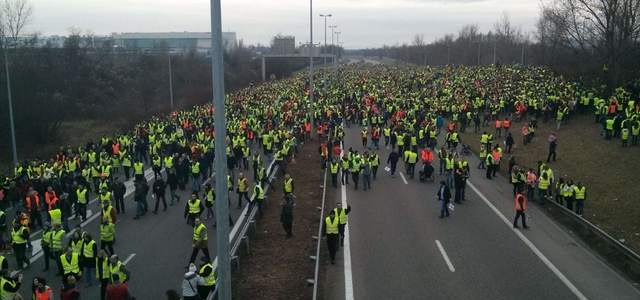
As the government of French President Emanuel Macron moved to ban protests against its fuel tax increase, strikes and demonstrations in support of the protest movement spread across France yesterday.
Fuel tax protestors in France
At present, the Facebook pages associated with the fuel tax protests, referring to themselves as “yellow vests,” have defied the government order and are maintaining calls for protests at Place de la Concorde. Tens of thousands of people are expected to take part at the capital from cities and towns across the country for the second successive Saturday. There are growing rumors that railway workers will allow demonstrators to travel by train to the capital for free. They will be met by thousands of riot officers and police dispatched by the government of President Emmanuel Macron.
In a press statement on the protest, Interior Minister Christophe Castaner indicated that he had “excluded the possibility that it will occur at the Place de la Concordes for obvious reasons of security.” The square is next to the US Embassy and the Elysée Palace, which houses the president. Castaner similarly threatened that “the judicial response will be uncompromising in case of trouble.”
The prefect of Bordeaux, Didier Lallement, has issued an interim order outlawing a protest in the center of the city.
The government’s threats have been largely met with anger and rejection by workers in France, in Belgium—where “yellow vest” protests are also taking place—and internationally. Since the first protest on November 17, it has become clear that the movement against Macron’s fuel tax increase was an initial expression of explosive social discontent among broad sections of workers and in the middle class across Europe.
After roadblocks were organized on roadways outside various workplaces, workers have gone on strike in support of the fight against Macron.
While strikes are taking place at Amazon in Germany, Spain and the UK, Amazon workers on strike at Lauwin-Planque in the north of France joined with groups of “yellow vest” protesters near their hub, where traffic had been affected by a roadblock. Truck drivers honked their horns in support of the protest as they drove past.
After police forces shut down roadblocks outside the Esso oil refinery in Fos-sur-Mer, in the south of France, a strike movement has struck six out of seven refineries in the country.
The Stalinist General Confederation of Labor (CGT) unions, whose leadership is openly hostile to the protest movement and has denounced it as neo-fascist, insists that the strikes have nothing to do with the demands of the “yellow vest” protesters against Macron. Yesterday, the head of the CGT, Phillippe Martinez, issued another attack on the protests, warning that they contained “extreme-right elements.”
“The annual industry-wide wage negotiations opened today. This is a day of action across all the sites facing job cuts,” Fabien Cros, a CGT at the La Mede refinery, told AFP. Nonetheless, Cross was forced to admit that around 150 strikers at La Mede had joined a blockade of around 50 “yellow vest” protesters at a roundabout entrance to the refinery, and were distributing leaflets there. “No product is entering or leaving from the depot,” he added.
Contacted by telephone, one striker told AFP: “We are not against any struggle; everything is good against Macron. We are totally fed up.”
These statements make clear that the trade unions, supported by parties such as the New Anticapitalist Party and Jean-luc Melenchon’s Unsubmissive France, are fighting to protect Macron. But they are being shaken by the rapid entrance of large sections of workers into struggle against the government.
To keep control of the workers’ anger and avoid being pushed aside, some union officials are switching to nominally support the protests. The CGT port and dockworkers unions have declared their support. One official, Herve Caux, explained: “A lot of our workers are ‘yellow vest’ protesters and the government is indecent. To force it to bend, we have to be together.”
On Reunion Island, where Macron has threatened to dispatch the military against protesters, dockworkers joined the blockade at the East Port, while 16 roadblocks were reported on the principal roads on the island.
At the same time, thousands of protesters continued to organize roadblocks across France and Belgium yesterday. They shut down highways near Montelimar in France’s southeastern Drome department, in Brittany, Normandie, and in the regions of Agen, Toulouse, Narbonne and Beziers. They blocked multiple shopping centres in Carpentras as well as multiple sites in Belgium to mark “Black Friday.”
The decisive question remains to orient the movement against Macron’s austerity measures toward the international working class, and to organize independently of the trade unions. Workers face not merely an economic struggle but a political fight against the Macron government and the entire European Union that stands behind it. It is therefore necessary to build a Marxist leadership of the working class to wage such a fight.
As Macron seeks to suppress the “yellow vest” protests and reinstate the military draft in order to promote nationalism and militarism, the fight for an internationalist, socialist and revolutionary perspective is critical. Against the determination of the financial aristocracy and their political representatives to impose their will upon the whole of society, the development of working-class struggles poses ever-more directly the necessity of taking power into the hands of the working class itself.
The “yellow vest” protests remain at present a politically heterogeneous movement. Tendencies of a right-wing and extreme-right character are seeking to influence it. But as the working class enters into struggle against Macron, the right wing is increasingly abandoning the protests. Laurent Wauquiez, the leader of the Republicans who joined the protest last Saturday, has made clear he will not participate in today’s demonstration.
At the same time, certain figures in the “yellow vest” protest have publicly distanced themselves from the right wing, including Eric Drouet, the truck driver who issued one of the original calls for protests on Facebook.
Drouet wrote in a Facebook post: “It is important that every person who wishes to participate in this movement be able to do so, no matter their skin color, country of origin, sexual orientation, gender or religion… No, the Yellow Vests are not the sheep of nationalists, fascists and other extremist movements, just as our movement is not represented by any party or union. We denounce the government’s tax on those most in need while it enriches the ultra-wealthy.”

Australian parliament to pass expanded laws to call out the military to suppress domestic unrest

Mike Head 

For the third time since 2000, with virtually no public debate, Australia’s parliament is set to hand governments sweeping, additional new powers to mobilise the armed forces to put down domestic unrest.
The Labor Party joined the Liberal-National Coalition government in pushing the Defence Amendment (Call Out of the Australian Defence Force) Bill through the House of Representatives late last month. The upper house, the Senate, is likely to rubberstamp it before the end of the year.
The adoption of expanded military call-out powers, on top of a barrage of anti-“foreign interference” and other laws to increase the powers of the police and intelligence agencies, is another warning of plans to suppress growing discontent and political disaffection amid worsening social inequality and the rising danger of trade war and war.
Introduced, like every other police-state measure, under the pretence of protecting the population against terrorist attacks, the bill will allow government ministers to call out the military on a far wider basis than combating “terrorism.”
Former Special Air Service (SAS) commander Andrew Hastie, now a leading figure in the Coalition government, told parliament last month he was “very pleased” that the bill would “unlock” the capabilities of the country’s two Special Forces units—the SAS Regiment in Perth and the 2nd Commando Regiment in Sydney.
“They’re constantly training for a number of contingencies,” Hastie said. “They benchmark against Five Eyes special operations and law enforcement units, so they have world’s best practice at their fingertips. They also have significant combat experience acquired through ADF [Australian Defence Force] operations in Afghanistan over the past decade or so.”
Hastie added: “They are surgical in the application of lethal force. Culturally—this is a key point between our police and military—they’re ruthlessly mission-focused, particularly when it comes to resolving these sorts of situations. I mentioned the combat experience that is resident in both of those units.”
While Hastie couched his remarks in terms of countering terrorism, his references to Afghanistan, the US-led “Five Eyes” operations and “surgical” use of lethal force are chilling. Australia’s Special Forces, including soldiers commanded by Hastie, have been accused of war crimes against civilians during the ongoing neo-colonial war in Afghanistan, and the Five Eyes network conducts global mass surveillance targeting people deemed a threat to the major capitalist powers.
Under the new laws, government ministers can issue call-out orders if they consider there is a “threat” of undefined “domestic violence,” even if the relevant state or territory government objects. Military personnel will have unprecedented peacetime powers, including to use lethal force, detain civilians, issue directives, search people and premises and seize property.
As with the previous bills to deploy the military on home soil—in 2000 and 2008—the Coalition and the Labor Party have worked closely together to limit parliamentary debate and ride roughshod over alarms raised by lawyers’ and civil liberties groups about the overturning of fundamental civil and democratic rights.
The bill further repudiates a centuries-old principle—derived from overthrowing the absolute monarchy in Britain—of barring those in power from unleashing the military against the people.
Former Prime Minister Malcolm Turnbull originally foreshadowed the latest measures in mid-2017, supposedly in response to a coroner’s report on the December 2014 Sydney café siege, conducted by lone gunman Man Haron Monis.
The government and the media falsely labelled the event a terrorist emergency and claimed it demonstrated the need for the Special Forces regiments to intervene with lethal force. In reality, like similar incidents around the world, the café hostage-taking was perpetrated by a mentally-disturbed individual who had been under close surveillance by police and intelligence agencies.
Moreover, the legislation is not at all confined to dealing with terrorism. In “specific circumstances”—another undefined term—the government can order the military to respond to any threat to “public safety” or vaguely-defined “Commonwealth interests,” that is, anything that imperils the existing capitalist order.
Backed by Labor, the government refused to amend the bill to define “specific circumstances.” Instead, it changed the bill’s explanatory memorandum to declare: “What constitutes specified circumstances will depend on the situation in question.”
The memorandum was revised to claim: “Peaceful protests, industrial action or civil disobedience would not fall within the definition of ‘domestic violence.’” However, this proviso, contained in section 39 of the bill, does not apply if there is a “reasonable likelihood of serious damage to property.” In other words, alleged danger to property can be cited to set troops against strikers or demonstrators.
“Domestic violence” is a term contained in the 1901 Australian constitution, referring to serious civil unrest that endangers the ruling establishment. At present, because the constitution left police powers in the hands of the states, the ADF is supposed to be called out only if states and territories “are not, or are unlikely to be, able to protect themselves or Commonwealth interests against domestic violence.”
This limit will be junked. The prime minister or two “authorising ministers”—now including the home affairs minister—will have the power to mobilise the ADF support if they decide it “would be likely to enhance the state or territory’s ability to protect itself or Commonwealth interests.”
In effect, the military can take control of entire urban areas, overriding state and territory governments and police forces. According to the bill’s memorandum, “the ADF will be required to consult with every state and territory affected by a call-out, to the extent possible in the circumstances” and act in accord with the relevant police force “as far as is reasonably practicable” [italics in the original].
Alternatively, ministers can order a “contingency call out” that pre-authorises the ADF chief to deploy troops. Currently that power is limited to aviation and the protection of “Commonwealth interests.” The bill will extend it to cover state and territory interests, whether in the land, air, or maritime domain.
In a Senate committee submission, the Attorney-General’s Department revealed that: “Such orders have been regularly made as part of security measures to protect major Commonwealth events (for example, the G20, Commonwealth Games, and the ASEAN summit) from circumstances involving air threats.”
Although no call-out orders have been issued since the power was first formalised in 2000, these “contingency callouts” have been dress rehearsals for military mobilisations, designed also to accustom the population to ADF operations in major cities.
The bill expands the military’s powers, including to kill people, far beyond situations where commanders claim it is necessary to protect a life. Lethal force can be used to protect “designated infrastructure” or stop someone escaping from military custody, or end “threats to public health or public safety.”
In addition, military personnel will be further protected from legal liability by adding a new blanket defence of “acting in good faith.”
For all the talk of combating terrorism, when the bill was first tabled in June, Attorney-General Christian Porter told journalists the military could be used to restore order in case of “widespread rioting.”
Greens MP Adam Bandt nervously told parliament last month: “Allowing this wide-ranging ability to bring the Defence Force out onto our streets is something that most people in this country would not agree with if they knew it was happening.”
But the Greens have no basic opposition to the domestic use of troops, instead issuing a dissenting Senate committee report calling for token modifications to the bill. Together with the media, the government and Labor, they have done nothing to alert the public to the real purpose of the expanded powers: preparations by the entire ruling establishment for convulsive struggles against austerity and war.

Tens of thousands of retail jobs lost in UK

Margot Miller

Hundreds of thousands of jobs are disappearing from the UK high streets as major retail giants shutter their stores.
In the months up to September this year, 85,000 retail jobs were lost. Household names such as the House of Fraser, Poundworld and Evans Cycles, as well as smaller independent traders, either shut stores or went bust—a total of almost 1,000 retail businesses going under. While department store chain British Home Stores closed in 2016, another large chain, Toys“R”Us, wrapped up business last year, as well as stationery chain Staples. The 99p discount stores chain shut in March this year. Prezzo restaurant chain closed 94 of its UK branches in April and May.
Other long established firms such as Mothercare, Homebase, Carpetright and Newlook have resorted to a Company Voluntary Arrangement (CVA)—an insolvency procedure for businesses with debt problems—a 73 percent increase since last year.
Many high street shops lie empty, especially in smaller towns. The number of empty premises rose in the first six months of 2018 by more than 4,400, a figure compiled by the retail analysis Local Data Company.
The list of closures reads like a cull. In August, the more up-market House of Fraser department store chain, with a 169-year history, went into receivership. The company’s share price dropped by 75 percent last year. After being bought for £90 million by Sports Direct, the number of branches singled out for closure was reduced from 31 to around eight. Among those closing is its large store in Manchester, with at least 160 jobs at risk.
Multi-national department store retailer Debenhams, founded in the 18th century, is planning to close 50 stores out of its 165 branches over the next five years, after posting record annual losses. Around 4,000 jobs are at risk.
Another large department store retailer, Marks and Spencer (M&S), plans to close the doors on 100 of its stores by 2022. By last May, 22 had already closed, with another 14 to close by May 2019. These have seen 1,500 staff made redundant out of M&S’s total workforce of 72,000.
Under a CVA, fashion store Newlook plans to shut 60 shops. Lloyds pharmacy, seen on every high street, will stop trading in 190 of its stores in England. Supermarket giant Waitrose will close five stores, while restaurateur Jamie Oliver plans to close one third of his Italian restaurants in the UK.
This week, global retail conglomerate IKEA announced that 7,500 office jobs will go as part of its global transformation plans. 350 of these will be among its 12,100 UK employees. IKEA plans to develop smaller inner city outlets and improve its online operation. While some new stores are opening in the UK, where it already has 22, in May IKEA ditched plans to open a new one near Preston in the north of England due to uncertainty over the retail industry in Britain.
Since the summer, when retail sales rose 2.3 percent in the three months to July, growth in sales fell back to 0.4 percent in the three months to October, for the second month in a row. Head of retail at Deloitte, Ian Geddes, put the fall down to consumers holding back until the November Black Friday sales. Others suggest consumers are delaying purchases because of uncertainty surrounding the outcome of the Brexit negotiations.
Some 2.8 million workers (around 9.5 percent of the workforce) were employed in the retail industry as of 2017. By 2025, retailers predict that a third of these jobs will be lost, due they say to changes in technology and the rising minimum wage.
Rachel Lund, head of insights at the British Retail Consortium, said, “We are seeing more competition and higher costs on the high street, coupled with a long-term decline in footfall as consumers shop online.”
According to the Office for National Statistics, British online purchases have increased to 17.3 percent of total sales, up from last year’s figure of 16.1 percent.
The growth of online shopping over the last decade has been exponential, with the rise of transnational behemoths like Amazon, the largest online retailer in the world by revenue—second only to Chinese-based Alibaba when measured in total sales. Founded in 1994 by Jeff Bezos, Amazon diversified from selling books to practically everything else—including clothes, electronics and furniture. Amazon now employs over 600,000 workers worldwide, up 13 percent from a year ago, raking in vast profits on the basis of super-exploiting its workforce.
Amazon is only one of a number of online retailers, including eBay and Japanese-based Rakuten, which can outcompete their rivals with expensive bricks and mortar overheads. Amazon ranks 7th in the top 10 largest international retailers, led by US based Walmart.
Other reasons for the closure of so many retail outlets is rising business rates and falling wages, meaning consumers are spending less. Business rates, which increased three percent in April in line with inflation, are a property tax calculated according to rental values, therefore favouring cheaper out of town warehouses where online retailers tend to operate.
While the ONS recently reported that UK wages rose at a faster rate than at any other time during the last decade—by 3.2 percent in the three months to September, when adjusted for inflation this falls to 0.9 percent. The general tendency, however, is that wages in the UK have plummeted to among the lowest levels in Europe bar Greece. Wages are abysmally low and have not recovered to their pre-crash levels in 2008, thus contributing to falling high street sales.
The minimum wage increased in April this year from a paltry £7.50 to just £7.83 an hour for over 25-year-olds, and for 21- to 24-year-olds from £7.05 to £7.38. The London living wage is set at £10.55 an hour. Two thirds of those in work in the UK are classed as the “working poor.”
The Financial Times commented, “Britain’s shoppers relied on borrowing or running down their savings last year to keep spending. Many economists expect that the recovery in real wages will take some time to feed through into higher spending as households repay debt or rebuild their savings.”
In the same three-month period to September, unemployment rose by 21,000 to 1.38 million, or from a rate of 4.0 to 4.1 percent. PricewaterhouseCoopers Senior Economist Mike Jakeman responded by saying, “This slowdown in the number of new jobs opening up is likely to feed through into weaker consumer spending.”
Even more jobs in retail could go with Britain’s exit from the European Union. Data from YouGov analysed by Vend revealed recently that one quarter of small UK retail businesses view Brexit with trepidation. UK Country Manager for Vend, Higor Torchia, said, “The UK retail sector has a huge international footprint, both in the staff it employs and the supply chain it sources through, so it’s understandable that some retailers are nervous about what will happen after March 2019.”

At least 85,000 child deaths in Yemen highlight Saudi-US war crimes

Mike Head

A new estimate by the aid agency Save the Children that 85,000 children have died of hunger in Yemen since Saudi Arabia’s US-backed bombings of the country began in 2015 underscores the criminal character of Washington’s sponsorship of this horrific slaughter.
The charity said 85,000 was a conservative estimate of how many children under the age of five had starved between April 2015, when the Saudi regime began its air war, and October this year. It is difficult to get an exact number of deaths. According to aid workers, many go unreported because only half of Yemen’s health facilities are functioning and many people are too poor to access the ones that remain open.
Backed by the Obama administration, Saudi Arabia intervened in Yemen’s civil war in 2015 to fight Shiite rebels allegedly backed by the Saudi ruling elite’s regional rival, Iran. The brutal offensive has become a virtual proxy war by the US against Iran. The Pentagon has supplied aerial refuelling for Saudi bombers, naval support for a blockade of the port city of Hodeidah and intelligence assistance for selecting targets.
Save the Children said it based its figures on mortality rates for untreated cases of Severe Acute Malnutrition in infant children from data compiled by the UN. The charity warned that, based on historical studies, if acute malnutrition is left untreated, around 20–30 percent of children will die each year.
“For every child killed by bombs and bullets, dozens are starving to death—and it’s entirely preventable,” Tamer Kirolos, Save the Children’s country director in Yemen said. “Children who die in this way suffer immensely as their vital organ functions slow down and eventually stop.
“Their immune systems are so weak they are more prone to infections with some too frail to even cry. Parents are having to witness their children wasting away, unable to do anything about it.”
The Red Sea port of Hodeidah, the entry point for some 80 percent of urgently needed food supplies, medicines and aid into Yemen, has been under blockade since last year. Save the Children said it had been forced to bring aid for the north of the country through the southern port of Aden, significantly slowing deliveries.
Despite supposed US-supported ceasefire offers from the Saudi monarchy, the charity also reported a “dramatic increase” in air strikes. “In the past few weeks there have been hundreds of air strikes in and around Hodeidah, endangering the lives of an estimated 150,000 children still trapped in the city.” Kirolos stated. “Save the Children is calling for an immediate end to the fighting so no more lives are lost.”
Far from ending the slaughter, the US-backed forces are taking it to an horrific new level. Earlier this month, the Saudi-led coalition reported that it had mobilised some 30,000 troops to surround Hodeidah. The troops include Emirati and Sudanese regulars, Al Qaeda militiamen and Yemeni mercenaries.
The port city is being subjected to non-stop bombardment from both the air and sea. Save the Children earlier reported that its staff counted some 100 airstrikes during one weekend, a five-fold increase compared to the first week in October.
In addition, Saudi Arabia has imposed economic sanctions and blockades on Yemen, contributing to the world’s gravest humanitarian crisis. The UN warned recently that 14 million people could soon be on the brink of starvation.
The World Health Organisation recently said nearly 10,000 people, mostly civilians, had been killed in the war. Aid groups believe the death toll may be five times higher. According to the UN, the fighting and blockades had also left 22 million people in need of humanitarian aid, and led to a cholera outbreak that has affected 1.2 million people.
In a statement on Tuesday, President Trump blatantly defended Saudi Arabia’s bloody onslaught, accusing Iran of being “responsible for a bloody proxy war against Saudi Arabia in Yemen,” while “Saudi Arabia would gladly withdraw from Yemen if the Iranians would agree to leave.”
These comments point to the fraud of an announcement the next day by US Secretary of Defense Jim Mattis that peace talks to end the war would begin next month in Sweden. Mattis could provide no dates or details. If the proposed meeting proceeds, the real purpose will be to blame Iran for the bloodbath, demand an immediate end to Iranian support for the Houthi rebels and create a pretext to continue the siege of Hodeidah.
This week, Trump reinforced Washington’s partnership with the Saudi regime by touting a huge Saudi arms purchase and dismissing the evidence that the kingdom’s de facto ruler, Prince Mohammed bin Salman, ordered the killing of the dissident journalist Jamal Khashoggi.
On Wednesday, Trump lauded the Saudis, crediting the regime for a drop in oil prices. He wrote on Twitter: “Oil prices getting lower. Great! Like a big Tax Cut for America and the World. Enjoy! $54, was just $82. Thank you to Saudi Arabia, but let’s go lower!”
Earlier, Trump brushed aside Prince Mohammed’s involvement in Khashoggi’s murder, writing: “[I]t could very well be that the Crown Prince had knowledge of this tragic event—maybe he did and maybe he didn’t!” In line with his belligerent “America First” program, he declared that the Saudi regime, “had agreed to spend and invest $450 billion” in the US, including $110 billion in military equipment purchases, rather than possibly obtain arms from Russia or China.
Trump’s statements are not a personal aberration. They crudely lay bare the underlying interests that American imperialism has pursued in the Middle East for decades. Washington’s lucrative economic relations with the Saudi monarchy and Saudi support for US aggression in the Middle East, particularly against Syria and Iran, are part of an increasingly frenzied drive to assert US dominance over the oil-rich and strategically-critical region.
The escalation of the siege of Hodeidah coincides with the imposition of unilateral and illegal US sanctions against Iran that are tantamount to an act of war. Whatever differences exist with the European powers over the Yemen offensive and the confrontation with Iran, Washington is intent on proceeding, regardless of the terrible human cost.
Likewise, while there may be tactical disagreements within and between the Republican and Democrat leaderships in the US over the naked character of the White House agenda, both capitalist parties and the entire political, military and intelligence establishment regard Saudi Arabia as a bastion of reaction against the working class across the Middle East, and a key ally in the conflict with Iran, Russia and China.

22 Nov 2018

Overseas Development Institute (ODI) Fellowship Scheme 2019/2021 for Motivated Economists to work in Public Sector (GBP 21,000 annual allowance)

Application Deadline: 2nd December 2018 by 23:59 (GMT). 

Eligible Countries: All

To be taken at (country): Developing countries

About the Award: ODI’s prestigious Fellowship Scheme gives postgraduate economists and statisticians the chance to work in developing country public sectors as local civil servants on two-year contracts.
The Scheme has two objectives: to provide developing country governments with high-calibre junior economists and statisticians where there are gaps in local capacity; and to give postgraduate economists and statisticians practical work experience in a developing country.

Type: Fellowship

Eligibility: The Scheme is open to candidates of all nationalities provided they have a master’s degree or PhD in economics, statistics or a related discipline. Postings are determined primarily by the needs of partner governments rather than the preferences of candidates themselves.

Number of Awards: Not specified

Value of Award: GBP 21,000 (GBP 23,000 in the second year) plus accommodation allowance

Duration of Programme: 2 years

How to Apply: To apply, please complete our online application form.

Visit Programme Webpage for Details

OneBeat 2019 Training for Emerging Musical Leaders (Fully-funded to USA)

Application Deadline: 21st December 2018 5:00pm (Eastern Standard Time, USA)

Eligible Countries: Albania, Algeria, Belarus, Bolivia, Brazil, Cambodia, China, Colombia, Cuba, Dominican Republic, Egypt, Haiti, Honduras, Hungary, India, Indonesia, Iraq, Jordan, Kenya, Kyrgyzstan, Lebanon, Macedonia, Madagascar, Malaysia, Mali, Moldova, Mongolia, Morocco, Mozambique, Nepal, Nigeria, Pakistan, Palestinian Territories, Philippines, Russia, Senegal, South Africa, Tajikistan, Tunisia, Turkey, Ukraine, United States, Uzbekistan, Venezuela, Zimbabwe

To be taken at (country): USA

About the Award: An initiative of the U.S. State Department’s Bureau of Educational and Cultural Affairs in collaboration with the groundbreaking New York-based music organization Bang on a Can’s Found Sound Nation, OneBeat employs collaborative original music as a potent new form of cultural diplomacy.
Now in its eighth year, OneBeat brings musicians (ages 19-35) from around the world to the U.S. for one month each fall to collaboratively write, produce, and perform original music, and develop strategies for arts-based social engagement. OneBeat begins with an opening residency, when Fellows collaborate to create original material, record new musical ideas, and incubate their projects. OneBeat fellows then go on tour, performing for a wide array of American audiences, collaborating with local musicians, and leading workshops with youth. During the month, each OneBeat musician also sets out their plans for the future, developing projects in their home countries linked to a mutually-reinforcing network of music-driven social enterprises.

Type: Training

Eligibility:
  • Applicants must be between 19 and 35 year old during the program dates (Fall 2019, exact dates TBD).
  • Musicians from all backgrounds are encouraged to apply, with or without formal musical training. We welcome music of all genres, including but not limited to: traditional/folk, hip hop, experimental, electronic, jazz, classical, sound design, beat-making, multimedia art, or any combination of these styles. In additional to full-time professional musicians, we also invite adventurous musicians who double as community organizers, instrument builders, writers, videographers, musicologists, educators, storytellers, dancers, shadow-puppeteers, and more.
Selection Criteria: 
  1. Musical Excellence – A high level of performance, composition, improvisational, production and/or technological skill. Ideally OneBeat musicians will be innovating stylistically, lyrically, or technologically within their musical worlds.
  2. Collaboration – Applicants’ willingness to reach across cultural and musical divides in creating original music or re-interpreting traditional music, while respecting the essence of each tradition. Applicants should be prepared to try new things musically.
  3. Social Engagement – Musicians who have used music to serve their communities or greater societies. This might consist of guiding young people in music education, addressing social or political issues through musical content, reviving dying musical traditions, and more.
  4. Age – Applicants must be between 19-35 years old.
  5. English Proficiency – Applicants should be able to converse in and understand basic English, as it will be the common language of the OneBeat program.
  6. Country or Territory of Origin – OneBeat Fellows must currently live full-time in one of the 40 eligible countries and territories. We also seek applicants who have not traveled extensively to the U.S. or have rarely performed in the U.S.
  7. Internet Proficiency – Whenever possible, OneBeat Fellows should actively use email and be able to connect to the internet to participate in OneBeat website-based activities.
Number of Awards: Approximately 25 participants will be selected this year.

Value of Award: All costs will be covered for OneBeat Fellows, including travel and accommodations. Fellows will also receive a per diem and a modest honorarium.

Duration of Programme: 1 Month. OneBeat 2019 will take place Fall 2019.

How to Apply: 
Visit Programme Webpage for Details

The Case Against WikiLeaks is a Threat to All Journalists

Heather Wokusch

The Justice Department has prepared criminal charges against WikiLeaks founder Julian Assange and is working behind the scenes to have him extradited to the United States. Press freedom and the right to dissent may hang in the balance.
The criminal charges were accidentally revealed last week when Assange’s name was found on the court filing of an unrelated case, suggesting that prosecutors had copied a boilerplate text and forgotten to change the defendant’s name.
Barry Pollack, a U.S. lawyer on Assange’s team, told the New York Times: “The news that criminal charges have apparently been filed against Mr. Assange is even more troubling than the haphazard manner in which that information has been revealed.” Pollack continued, “The government bringing criminal charges against someone for publishing truthful information is a dangerous path for a democracy to take.”
Assange has been holed up in the Ecuadorian embassy in London since 2012, after seeking protection against sexual assault allegations in Sweden. While the initial arrest warrant has since been revoked, if Assange leaves the embassy he runs the risk of being apprehended by UK authorities and extradited to the United States, a process greatly facilitated by the recent criminal charges.
Using free speech against us
The U.S. government has targeted WikiLeaks and Assange for years. A confidential U.S. Army document from 2008 recommends “legal actions” and attacks on the livelihood and reputation of “current or former insiders, leakers, or whistleblowers” connected to WikiLeaks in order to “damage or destroy” its “trust as a center of gravity.”
WikiLeaks enjoyed a brief heyday among Republicans when it released hacked Democratic National Committee (DNC) emails during the 2016 presidential election. Then-candidate Donald Trump mentioned WikiLeaks over 160 times during the final month of the campaign, calling it “amazing” and saying “We love Wikileaks. Wikileaks. They have revealed a lot.”
During the campaign, Trump adviser Roger Stone often boasted about being connected to WikiLeaks, even claiming to have had dinner with Assange. Days before the dump of hacked Clinton campaign emails, Stone tweeted, “I have total confidence that @wikileaks and my hero Julian Assange will educate the American people soon #LockHerUp.”
Donald Trump Jr. was in repeated contact with WikiLeaks during the 2016 presidential election, and then-Congress member Mike Pompeo openly encouraged his social media followers to visit the WikiLeaks site for “proof” of various claims against Democratic candidate Hillary Clinton.
But it’s one thing to reveal information about the DNC and another thing entirely to expose a CIA hacking program with domestic spying implications — which is exactly what WikiLeaks did in March 2017 with its Vault 7 release. Just a month later, reports surfaced that U.S. authorities were preparing charges against Assange, with Attorney General Jeff Sessions calling his arrest a “priority.”
After being tapped to head the CIA in early 2017, Mike Pompeo actively began targeting Assange. In his first public speech as CIA director, Pompeo slammed WikiLeaks as a “non-state hostile intelligence service,” adding that “we can no longer allow Assange and his colleagues the latitude to use free speech values against us.”
“Use free speech values against us”? So much for the First Amendment.
The Espionage Act
Assange was granted Ecuadorian citizenship in late 2017, possibly part of a covert plan to relocate him to Russia in 2018. The British Foreign Office blocked that plan, however, so Assange remains in London.
The situation is untenable. Ecuador’s President Lenín Moreno sees Assange as an “inherited problem” impacting the country’s relations with the United States. Hanging in the balance for Ecuador could be a military base and an International Monetary Fund loan.
Assange’s recent legal case protesting new asylum conditions was rejected by a court in Ecuador. Meanwhile, his health deteriorates in what amounts to solitary confinement without access to sunlight or fresh air. His contact with the outside world remains severely curtailed.
While the exact criminal charges recently levied against Assange remain secret, the primary issue is whether WikiLeaks is portrayed as a news organization deserving of First Amendment protections or rather as a foreign government agent.
If the Justice Department takes the latter approach, then a World War One-era red-baiting law will probably be used against Assange. Originally intended for spies, the Espionage Act enjoyed a renaissance under President Obama, who used it more than all previous administrations combined — usually to pursue government officials who’d spoken to journalists.
The ACLU calls the Espionage Act “a fundamentally unfair and unconstitutional” liability law that treats whistleblowers exposing civil rights violations the same as spies selling damaging documents to foreign dictators. The Act enables leaked material to be retroactively categorized as classified, and with little justification.
It also makes the legal defense of whistleblowers almost impossible. As Jesselyn Radack, Director of the Whistleblower and Source Protection Program at ExposeFactswrote in a 2014 op-ed entitled “Why Edward Snowden Wouldn’t Get a Fair Trial“: “First Amendment arguments have failed, largely because they would criminalize the journalism made possible by the ‘leaks.’ The motive and intent of the whistleblower are irrelevant. And there is no whistleblower defense, meaning the public value of the material disclosed does not matter at all.”
The stakes of extradition
If extradited to the United States, whether prosecuted under the Espionage Act or not, Assange could become a dead man walking.
Former House Speaker Newt Gingrich has said Assange should be treated like an enemy combatant, while Hillary Clinton has wondered if he could be killed by a drone.
Pompeo recommended the death sentence for whistleblower Edward Snowden. Trump has joked about killing journalists.
Fox host Rush Limbaugh suggested that Assange “would die of lead poisoning from a bullet in the brain and no one would know who put it there!” Fox commentator Bob Beckel offered: “Dead men can’t leak stuff… there’s only one way to do it: illegally shoot the son of a bitch.”
Assange’s mother “shudders to think” what CIA Director “Bloody Gina” Haspel might do to her son. In a recent interview, Christine Assange said, “Once in the U.S., the National Defense Authorization Act allows for indefinite detention without trial. Julian could very well be held in Guantanamo Bay and tortured, sentenced to 45 years in a maximum-security prison, or face the death penalty.”
In February 2018, weeks before his internet access was cut, Assange participated in the Austrian Elevate festival. Via videostream he referred to the “Pompeo Doctrine” of criminalizing transparency seekers as a “serious threat to the press.”
Assange said authorities were using his situation as a “general deterrent,” and added “the more developed the society and economy, the more skill in installing that fear without resorting to assassinations.” He concluded by observing that those who have the luxury of living in peace must see through “the illusions of fear in order to ensure that those people in other countries don’t face the reality of war.”