26 Nov 2018

Australian government accelerates anti-democratic “foreign influence” register

Mike Head

Without any prior notice, the Liberal-National Coalition government last Friday abruptly announced that the draconian Foreign Influence Transparency Scheme (FITS) would commence on December 10, months earlier than previously indicated.
On the pretext of protecting the next federal election from Russian and Chinese “interference,” Prime Minister Scott Morrison’s administration is bringing forward the imposition of far-reaching, anti-democratic laws that were pushed through parliament in July.
In July, the government and the Labor Party joined hands to ram the legislation through both houses of parliament in several days, claiming it was urgently needed to prevent “foreign meddling” in five July 28 by-elections. Without any evidence of such activity, a similar story has been concocted to insist that amendments to the FITS Act must be passed within two weeks so it can be activated immediately.
As of December 10, any political party, business or individual that allegedly works with a “foreign” group or government, including international organisations, would be compelled to register with the FITS authorities, who would hand the information over to the intelligence and prosecution agencies.
Such is the government’s rush that extensive FITS rules, which could force political organisations to hand over private information, such as members’ details, have not been finalised. Instead, incomplete draft versions were hastily posted on the Attorney-General’s web site on Friday.
Attorney-General Christian Porter told journalists that prosecutions could happen “very quickly.” When questioned, however, he declined to provide any evidence of what the government claims is “unprecedented” foreign interference in Australia.
As the Socialist Equality Party warned in a series of public meetings during July, the FITS Act and the accompanying Espionage and Foreign Interference Act, which contains an array of new or expanded criminal offences, have vast implications.
This legislation is aimed at criminalising growing opposition to Australia’s central role in the US-led preparations for war with China, illegalising the activities of publishers and whistleblowers exposing war crimes and government wrongdoing, and cracking down on the emerging struggles of the working class.
Not accidentally, the FITS Act is being activated as the US ramps up trade war and military tensions. Friday’s announcement came after US Vice President Mike Pence provocatively denounced China at this month’s Asia Pacific Economic Cooperation summit in Papua New Guinea (PNG). At the same meeting, the Morrison government committed Australia to be on the frontline of any military conflict with China, including by establishing a joint US-Australian naval base on PNG’s strategically-located Manus Island.
Porter said as-yet unseen amendments to accelerate the operation of the FITS Act must be pushed through parliament during its final two-week session for the year, starting today—no doubt with the Labor Party’s backing once again.
Under the FITS Act, anyone accused of existing links to a “foreign principal” had six months in which to register, but the amendments reportedly would reduce that to three months. In addition, any new links would have to be registered within 14 days, or within seven days after writs are issued for an election.
This is just one aspect of a new barrage of police-state measures. During the same brief parliamentary session, the government is demanding the passage of two other major bills. One would allow the police and spy agencies to crack open mobile phone and social media encryption codes, violating the privacy of millions of people.
The other would strip citizenship from, and deport, anyone convicted of a terrorist-related offence, even a minor one, whom the government alleges is entitled to residency in another country. Prime Minister Morrison last week declared that such people would be detained indefinitely, potentially for life, if no other country would accept them.
These measures are part of a desperate scare campaign in the lead up to the federal election, which must be held by May. Australia is being depicted as under siege from terrorists, immigrants and the Chinese Communist Party regime. At the same time, the laws constitute an historic assault on fundamental democratic rights, including freedom of speech and association.
The entire ruling establishment, in which the Labor Party plays a pivotal role, is preparing to suppress rising social and political discontent amid worsening economic conditions, escalating social inequality and the mounting danger of war. It is also seeking to divert this disaffection in reactionary nationalist directions, particularly directed against China.
The US-linked intelligence agencies, government-funded strategic thinktanks and media outlets are pumping out hysterical reports accusing China of employing hackers, university researchers and even prominent business and political figures to obtain Australian commercial and military secrets. The Australian Financial Review this month published a lengthy article by a semi-retired academic labeling former Foreign Minister Bob Carr a sycophantic “pawn” of China.
Carr, like some others within the ruling class, advocates that the US should accommodate itself to the rise of China, Australian capitalism’s largest export market. He could well become an early victim of the FITS measures because he heads an Australia-China Relations Institute at the University of Technology in Sydney that is partly funded by an Australian-Chinese business tycoon.
The FITS dragnet will extend far further, however, threatening many aspects of political life. “Registrable activities” include “communications activity for the purpose of political or governmental influence.” This covers virtually every political activity and any publication, in print or online, deemed to have a political purpose.
People must register if they undertake such an activity “on behalf of” a “foreign principal.” In typically vague language, “on behalf of” includes “under an arrangement.” Likewise, “foreign principal” includes a “foreign political party” and a “foreign organisation that exists primarily to pursue political objectives.”
This will affect the basic democratic rights of millions of people, especially supporters of political parties, lobby groups or other organisations opposing official policies, including the drive to war itself.
The forbidden activities could extend to elucidating a foreign country’s position on a contested issue, such as China’s on the disputed South China Sea territories, or opposing involvement in a US-led military confrontation with China.
Penalties include up to five years’ jail for failing to register or comply with ongoing reporting requirements. This extends to “recklessly” failing to register, that is, deciding that registration is not necessary. Anyone who fails to register, even inadvertently, can be compelled to do so by a “transparency notice” issued by the Attorney-General’s Department.
The FITS Act hands intrusive powers to the register’s secretary to require “any information or documents.” It is a criminal offence not to comply. Criminal offences also apply for providing “false or misleading” information.
In addition, someone who failed to register could be charged with an offence under the new Espionage and Foreign Interference Act, punishable by up to 20 years’ jail, for “covertly” collaborating with an overseas group or individual to seek political change.
These provisions have ramifications beyond Australia. Their implementation is being closely followed in US and UK ruling circles which regard Australia as a testing ground. Within days of the legislation originally being passed in July, Attorney-General Porter flew to London and Washington for what the Australian described as “high-level talks with his counterparts.”

British government inaction ends in life sentence for PhD student in UAE

Paula Smith

On November 21, a court in Abu Dhabi in the United Arab Emirates (UAE) sentenced British PhD student Matthew Hedges to life imprisonment on charges of espionage, after a five-minute court hearing that gave him no opportunity to offer a defence.
According to Attorney General Hamad al-Shamsi, Hedges was convicted on charges of “spying for a foreign country” and “jeopardising the military, political and economic security of the state.” However, the UAE has not published any evidence or even stated on whose behalf Hedges was supposedly working, although this is widely assumed to mean Qatar, which the UAE—along with Saudi Arabia and other Gulf States—has been blockading for the last 18 months over its support for Iran and sponsoring “terrorism.”
Hedges’ fate has provoked a diplomatic crisis for the British government that remained tight-lipped following his arrest and detention in solitary confinement in an Emirati jail last May, with little consular access or contact with family members. While a comparable case in Russia would have involved a furious outcry, the Foreign Office urged Hedges’ family to say nothing in public about the case, claiming any publicity would impact adversely.
Hedges, 31, was brought up in the UAE and used to work for a security and political consultancy firm based there as an analyst. He had spent two weeks in Dubai researching the UAE’s foreign and internal security policies for his PhD at Durham University. According to his wife, Daniela Tajeda, he was arrested last May as he was leaving Dubai and kept in such dreadful conditions that he was hospitalised at one point. Hedges has denied all accusations against him, but was made to sign a confession, written in Arabic, which he does not read.
Over 650 academics from British universities, many with campuses in Dubai, and internationally signed a petition—co-signed by Professor Clive Jones, Hedges’ supervisor—calling for his release and saying that Dubai could not be regarded as a safe place for academics to work. Durham and Essex are among a number of universities that have severed ties with the UAE.
The American Political Science Association published a letter calling on the UAE to release Hedges and to “reaffirm the UAE’s respect for academic freedom and freedom of expression.”
The UAE routinely hands down long jail sentences to critics, dissidents and human rights activists, particularly after its bust-up with Qatar, when showing sympathy with its neighbour became punishable by up to 15 years in jail. Abu Dhabi has installed a vast surveillance system across the city that it purchased from an Israeli-owned security company to keep tabs on its citizens, migrant workers and tourists. The new Falcon Eye surveillance system “links thousands of cameras spread across the city, as well as thousands of other cameras installed at facilities and buildings in the emirate.”
Nicholas McGeehan, a former Human Rights Watch researcher in the Gulf, told the Middle East Eye that the country had no independent judiciary. “It’s a police state. You have these squads of people who operate completely outside the rule of law and snatch people off the street, snatch people out of airports, and disappear and torture them based on spurious allegations, or based on their background, or based on their associations that the UAE disapproves of.”
The public outcry and the sham nature of the trial finally forced the British government to speak out. Foreign Secretary Jeremy Hunt said he was “deeply shocked” by the sentence, while Prime Minister Theresa May said she was “deeply disappointed.” Hunt finally agreed to meet Tajeda for the first time since Hedges’ arrest in May, despite repeated requests.
Attorney General al-Shamsi responded by pointing out that the verdict against Hedges was not “final” and that he had 30 days to appeal the sentence. The next day, Hunt held “a constructive conversation” with Sheikh Abdullah bin Zayed, the UAE’s foreign minister, who said that his country hopes to find an “amicable solution… The UAE is determined to protect its important strategic relationship with a key ally.” This may indicate a possible pardon or remission on its National day next week when the UAE often grants pardons.
Speaking on the BBC’s Today programme Thursday, Tejada said that the British did not want to upset their close ally. “I got the impression that they were putting their interests with the UAE above a British citizen’s rightful freedom and his welfare and his right to just a fair trial, just to freedom,” she said. “They were stepping on eggshells instead of taking a firm stance.”
The previous week, Baroness Rona Fairhead, Minister of State for Trade and Export Promotion at the Department for International Trade, headed a delegation of 50 companies at the Abu Dhabi International Petroleum Exhibition and Conference in a bid to boost trade following Brexit. Britain exported goods, including weaponry, and services worth £11.1 billion to the UAE in 2017 and imported £7.4 billion. Not only is the UAE the region’s second largest purchaser of Britain’s non-military exports, it is host to more than 120,000 UK citizens who work there, and is a key investor in Britain.
Fairhead said, “The UAE is the fifth largest trading partner for the UK outside Europe, coming after the US, Japan, China and Hong Kong, and bilateral trade is now growing in double digits. In terms of investment, we are the biggest foreign direct investor today in the UAE.”
The previous day, Hunt met Sheikh Mohamed bin Zayed, Crown Prince of Abu Dhabi and Deputy Supreme Commander of the Armed Forces.
It is not just Britain’s economic relations with the UAE that are at stake. The UAE, which as a member of the Trucial States, was once under British “protection” and plays a crucial role in American and British imperialism’s plans to undermine Iran and dominate the resource-rich region as “a long-established partner in security and intelligence matters.”
The UAE joined the NATO-led intervention to topple Colonel Muammar Gaddafi in Libya, where it continues to support the forces of General Khalifa Hiftar in the Benghazi region in opposition to the UN-recognized government in Tripoli. It financed, sponsored and trained proxy forces to overthrow the regime of President Bashar al-Assad, and leads the Saudi-sponsored war on the ground against the Houthi rebels in Yemen.
But it is increasingly, along with Saudi Arabia, pursuing its own interests that on occasion conflict with those of the imperialist powers—as evidenced by the bitter row with Qatar. The UAE’s Crown Prince Mohammed bin Zayed backed Saudi Arabia’s Crown Prince Mohammed bin Salman during his rapid rise to power. Their joint opposition to the Muslim Brotherhood, shared by Egypt’s dictator, Abdel Fattah al-Sisi, has set them against Qatar and Turkey, which hosts Egyptian members of the Muslim Brotherhood and other Islamist exiles.

Iranian steelworkers strike for back-wages, safety, and jobs

Samuel Davidson & Keith Jones

According to social media reports, striking Iran National Steel Industrial Group (INSIG) workers protested yesterday in Ahvaz, outside the headquarters of the government of the southwest Iranian province of Khuzestan.
Nearly 4,000 steelworkers have been on strike at INSIG’s massive steel complex in Ahvaz, Iran’s eighth largest city, since November 10. They are demanding payment of two months’ back wages, improvements in workplace safety, and fresh investment so that shuttered production lines can be restored.
Riot police reportedly attacked yesterday’s protest, when the striking steelworkers tried to cross a bridge and demonstrate through the center of Ahvaz.
The current strike is the third by INSIG workers this year. In June, more than 60 workers were arrested and jailed by security forces. Several were beaten while in prison and denied medical treatment. They were only freed after the striking INISG workers intensified their protests and won support from other workers.
Iranian authorities have all but completely blacked out reports of the INSIG workers’ struggle. But the pro-government Iranian Labour News Agency (INLA) did carry a report about the strike two weeks ago. It said that the workers were angered that the state-owned Bank Melli Iran, which took control of INSIG’s four steel mills last May, has failed to order the raw materials needed for production, placing thousands of jobs at risk.
The INLA report cited comments from several protesters, including a worker who said, “The officials keep making promises but they don’t act.” “Even if the employer pays our back salaries all at once,” said another, “we will not end our protests until raw materials are supplied for the plant’s operation.”
INSIG was privatized in 2010, as part of a privatization drive that has continued under successive Iranian administrations, whether headed by so-called hardliners like Mahmoud Ahmadinejad, “reformers” like Mohammad Khatami or the current president Hassan Rouhani.
In 2010 the steel complex was purchased by Mahafarid Amir Khosravi, who with a fortune of more than a billion US dollars was reportedly Iran’ richest man at the time. However, Khosravi was soon implicated in a massive bank fraud and in 2014 was executed.
The strike at INSIG is part of a growing wave of worker struggles across Iran against unpaid and poverty wages, privatization, and rampant social inequality. In late December 2017 and the first days of this year, Iran was convulsed by mass protests against years of austerity and mass joblessness. The protests—which the authorities brutally repressed on the spurious claim they had been incited by Washington, London and Riyadh—were especially pronounced in regional cities and towns that had hitherto provided a popular base of support for Iran’s bourgeois clerical regime.
Since then, the class contradictions have only deepened, as Iran’s rulers try to maneuver between the rival imperialist and great powers and an increasingly militant working class.
In an act tantamount to a declaration of war, Washington has unilaterally imposed an illegal embargo on all Iranian energy exports and frozen Tehran out of the world-banking system, so as to cripple the rest of its trade. The publicly declared aim of Trump and the cabal of anti-Iran hawks at the summit of his administration is to crash Iran’s economy, so as to compel Tehran to accept unbridled US domination over the Middle East.
Since last spring Iran’s currency, the rial, has lost well-over half of its value, resulting in sharp price hikes, whose burden has fallen most heavily on the poorest sections of the population.
The INSIG strikers have expressed solidarity with four thousand workers at the Haft Tappeh sugar refinery in Shush, a city in Khuzestan one hundred miles south of Ahvaz.
The Haft Tappeh workers have been on strike since Nov. 4 to demand payment of four months’ back wages, continuing pension-payments for retired workers, increased job security and the “revoking of privatization.” They have staged numerous protests in Shush over the past three weeks and have also travelled to Ahvaz to seek redress.
Riot police have been deployed at the sugar mill and last week, security forces took more than 15 workers and a journalist, who had been covering their protest, into custody. According to news reports, all but one of the workers have since been freed on bail.
Thus far, the sugar workers have only received payment for one of the four months owed them.
As in the case of the Ahvaz steelworkers, conditions for the Haft Tappeh sugar refinery workers deteriorated after the company was privatized two years ago.
The spark for their strike were reports that one of the company’s owners had fled the country and another had been detained.
The head of Iran’s official Privatization Organization, Mir Ali Ashraf Pouri-Hosseini, has since said that several Haft Tappeh board members have been arrested “over forex (foreign exchange) issues and other ambiguities.” In August, Pouri-Hosseini boasted that privatization in Iran had witnessed 100 percent growth in the first five months of the 2018-19 Iranian fiscal year.
The Haft Tappeh workers are demanding the government retake control of the sugar refinery. In a Nov. 22 statement, the Haft Tappeh Sugar Cane Workers’ Union complained that in reporting on their strike the BBC has failed to even mention what they consider to be their key demand, “revoking privatization.”
Recent weeks have also seen ongoing protests by teachers. In October, thousands of teachers participated in several days of strikes over “poverty level” wages and on Nov. 13-14, the Co-ordination Council of Teachers’ Trade Organisations of Iran staged sit-ins in several parts of the country. The protests appear to have been especially strong in the country’s majority Kurdish areas.
In addition to demanding pay increases, the teacher protests condemned the introduction of school fees, which they denounced as a form of privatization and a violation of the country’s constitution, and the release of teachers arrested for their part in previous protests.
In August, Mohammad Habibi, a leader of the Iranian Teachers’ Trade Association of Tehran (ITTA-Tehran), was sentenced to ten-and-a-half-years in jail and 74 lashes. Habibi had been arrested by security forces after participating in a peaceful demonstration last May.

EU summit backs Brexit withdrawal declaration

Peter Schwarz

A special summit of the European Union Sunday adopted the treaty on the withdrawal of Great Britain and a joint political declaration on future relations. The vote was unanimous.
The 585-page Brexit deal agreed between the EU Commission and the Conservative government of Prime Minister Theresa May regulates the payments that London must make to the EU coffers after it leaves on March 29, 1919, (around £39 billion), the future status of EU citizens in the UK and of British citizens in the EU, a “backstop” procedure for resolving the controversial border issue between the British province of Northern Ireland and EU member Republic of Ireland, and the transitional period after Brexit.
According to the treaty, Britain will remain in the European single market until the end of 2020, must obey all its rules, but is no longer allowed to have a say in its decisions. If it is not possible to conclude a free trade agreement during this period, it may be extended for a further two years. In addition, the backstop solution for Ireland stipulates that the UK will remain linked to the EU in a customs union until a solution has been agreed for the inner Irish border.
The 26-page political declaration, which unlike the Brexit treaty has no legal force, outlines future relations in trade, fisheries, travel, security and financial services. It states the intention to build “as close as possible a partnership” with the UK after Brexit and deliberately leaves plenty of room for different interpretations. It is intended to make it easier for May to sell the Brexit agreement in Britain.
That the treaty will overcome the next hurdle, the vote in the British Parliament in December, seems highly unlikely, as the agreement between May and Brussels has aggravated the civil war raging between and within the Tories and all the British parties. May’s “hard-Brexit” Tory opponents, the Democratic Unionist Party in Northern Ireland, and all the opposition parties, led by the Labour Party, reject the proposed agreement.
The Brexit hardliners accuse May of transforming Britain into “a satellite state,” dependent on Brussels. It is estimated that anywhere up to 80 out of 331 conservative MPs will reject it—but less than 20 rebellions plus the DUP voting against would likely scupper the agreement. At a conference of the DUP in Belfast, former Foreign Minister Boris Johnson called on the government to “junk the backstop.”
DUP leader Arlene Foster, on whose eight votes May depends in Parliament, also rejected the treaty because it led to the creation of a trade border in the Irish Sea and threatened the unity of the United Kingdom. She threatened May with the withdrawal of support from the DUP.
Labour leader Jeremy Corbyn described the EU’s joint political declaration as “26 pages of waffle.” It was leading into the “blindfold Brexit we all feared… The only certainty contained within these pages is that the transition period will have to be extended or we will end up in the backstop with no exit.”
May and the EU are counting on fear of an unregulated “no deal” Brexit minimising an inner party revolt and securing enough pro-Remain Labourites to back her and secure a majority. If Britain leaves the EU without an agreement, economic chaos is predicted on both sides of the Channel. The scenario ranges from the collapse of air traffic, long traffic jams at the borders, massive collapses in trade and shocks on the stock markets to social unrest. Credit insurer Euler Hermes expects UK exports worth £30 billion and German exports worth €8 billion to be at risk.
On Sunday morning, before the final decision of the EU summit, May published a “letter to the nation,” asking the British people to support the Brexit Treaty and calling for “renewal and reconciliation.” Brexit supporters and opponents must become one people again, she urged. In the coming two weeks she intends to conduct a massive campaign for the treaty with the support of the business community.
If parliament rejects it, which is likely, several scenarios are possible. They range from another parliamentary vote after a bit more haggling, a second Brexit referendum or new elections, to Brexit without an agreement. But even if, contrary to expectations, May were to succeed in getting the treaty through, this would merely usher in a new stage of the conflict.
The negotiations on a free trade agreement are a snake pit. Many unsolved problems in the Brexit contract have merely been postponed. This applies not only to the Irish border problem, but also to the Gibraltar issue. The Spanish government had threatened to veto the agreement if the 6.5 square kilometre rocky outcrop that Spain ceded to Great Britain in 1713 was included within the provisions as a British controlled entity. Spain insisted that this would cut across bilateral negotiations on The Rock’s future, including Spanish or joint sovereignty. Social Democratic Spanish Prime Minister Pedro Sanchez took the opportunity to make his mark as a defender of Spanish national interests in the current Andalusian election campaign.
The 32,000 inhabitants of Gibraltar voted 96 percent in favour of remaining in the EU in the Brexit referendum, but at the same time they want to remain part of Great Britain. Its position as a British enclave has brought unprecedented prosperity to the once completely isolated British military base. Low-taxes, deregulated financial services and a tourism boom have boosted border traffic and the economy of Gibraltar. Around 10,000 Spaniards commute daily to work in the enclave.
Finally, a “compromise” was agreed on, which postpones the problem and which both Sanchez and May celebrated as a victory. Spain will have a right of veto on all matters concerning Gibraltar, which will remain British overseas territory.
One can only understand the Brexit crisis and the violent political conflicts, economic distortions and social conflicts that accompany it within the framework of the deep crisis of world capitalism. Throughout the world, the ruling class is responding to growing social tensions and rivalries between the major powers by moving politically to the right, fomenting nationalism and strengthening militarism.
The EU is not combating this development but exacerbating national tensions. Since it shifted the burden of the 2008/2009 global financial crisis onto the working class through brutal austerity programmes, the EU is seen by ever broader sections of the working class for what it really is: a tool for the most powerful economic and financial interests. Since social democratic parties, trade unions and pseudo-left organisations such as Syriza support the EU’s austerity policy, right-wing nationalist currents have been able to benefit from the opposition to Brussels.
The EU, with the German and French governments playing the leading role, had hoped for a failure of the Brexit referendum. But when the result was certain, they relied on its deterrent effect to keep the 27 EU member states in line. To prevent other countries from following the British example, they deliberately imposed tough conditions in negotiations with May. This has further poisoned the political climate. Europe is sliding more and more openly into the state of national rivalries that made it a breeding ground for fascism and war in the last century.
Only the independent intervention of the working class can prevent a repetition of such disasters. The growth of class struggle throughout Europe must become the starting point of a socialist movement that opposes both the EU and growing nationalism and fights for a United Socialist States of Europe.

Russia fires on and captures Ukrainian Navy ships

Clara Weiss

Early Sunday morning, Russian warships fired on and captured three Ukrainian Navy vessels in the Azov Sea off the coast of Crimea. The military clash represents a major escalation of the ongoing conflict between Russia and Ukraine, which was triggered by the US and EU-backed far-right coup in February 2014.
According to the official Russian version, three Ukrainian warships illegally entered Russian territory at 7 a.m. on Sunday. Moscow then shut down the strait.
The Russian Federal Investigative Service (FSB), the Russian equivalent of the FBI, confirmed later on Sunday that Russia had seized all three Ukrainian warships. Russia asked for an emergency meeting of the United Nations.
Kiev argues that it had announced the crossing of the strait by the three navy ships but had not received a response from Russia, and that the three ships were attacked by Russian warships in an act of “aggression,” claiming “Russia attacks Ukraine.” The Poroshenko regime also claimed that two Ukrainian sailors had been injured and that one Ukrainian tugboat was hit, and demanded the immediate release of both the ships and all servicemen. It has appealed for support to the EU, the US and NATO.
Ukraine President Petro Poroshenko convened an emergency session of his war cabinet on Sunday. After that, he spoke to the country’s parliament, proposing to introduce martial law for sixty days. Officials of the Ukrainian foreign ministry have since been in frenzied discussions with representatives of the EU and NATO.
Russian media reported that SU-24 fighter jets that are based in Crimea are now flying over the Russian bridge in the Kerch Strait, and that Ukraine had sent naval reinforcement to the area. A military escalation in the Azov Sea had been prepared over months with a series of provocations by the Ukrainian regime which enjoyed the full support of the EU and US imperialism.
In late August, Kiev announced the “transfer of additional forces of the Marine Corps and coastal artillery” to the region.
In late September, Poroshenko officially received two Island-class Coast Guard cutters from the US in Baltimore. On October 12, Poroshenko signed a decree on the Azov Sea which claims that Ukraine had sovereignty over territorial waters in the Kerch Strait and the Azov Sea, and called for measures to counter the Russian navy.
The Poroshenko regime is also looking into pulling out of a 2003 agreement with Russia which provides for the equal division of the Azov Sea between both countries, and a ban on foreign warships entering the sea without the consent of both sides. Ukraine’s pulling out of this agreement would enable NATO warships to enter the Azov Sea.
Last month, the Ukrainian armed forces already held military exercises on the coast of the Sea of Azov, while hosting a major NATO air force drill on its soil called “Operation Clear Sky.” Ukraine’s war drills in the Azov Sea have also contributed to a deterioration of relations with neighboring Hungary in recent months, adding to the explosive tensions in the region.
Poroshenko has made the building of another Ukrainian naval base in the Azov Sea before the end of 2018 a cornerstone of his current campaign for reelection as president in March 2019. The chief of staff of the Ukrainian armed forces, Viktor Muzhenko, recently argued that such a naval base was central to Ukraine’s efforts to fight “Russian aggression.” At this point, Ukraine has two naval bases in the Black Sea region: the West Naval Base in Odessa and the Southern Naval Base in Ochakiv and Mykolaiv.
The new naval base would be located at Berdyansk, close to the territories controlled by the Russian-backed East Ukrainian separatists.
Russia too has increased its military presence in the Azov Sea, and currently has between 50–70 patrol ships there which have started to inspect all vessels going to or from Ukrainian ports. Since the construction of a new Russian bridge over the Kerch Strait was completed earlier this year, virtually all ships transiting into the Sea of Azov from the Black Sea must pass under this crossing.
The Poroshenko’s escalation of the military conflict with Russia is supported by the US and driven, to a large measure, by the growing domestic crisis of the regime. Almost five years after an imperialist-orchestrated, fascistic coup brought it to power, the Poroshenko regime is mired in crisis. Recent media reports suggested that some one million people in Ukraine live on the brink of starvation.
Hundreds of thousands have left the country since 2014, fleeing war and social devastation. The past months saw several strikes by Ukrainian miners, railway workers and other sections of the working class. Polls show Poroshenko with the highest negative ranking of any candidate in the upcoming presidential elections.
In its provocations, the Poroshenko regime has enjoyed the full support of both the EU and US imperialism. Washington has called on Russia to stop “harassing” ships in the past; EU officials have also taken Ukraine’s side in the Azov Sea conflict.
Behind the imperialist support for the reckless provocations of the Ukrainian regime are long-term strategic interests in control over the Black Sea region as a key bridge between Eastern Europe and the energy-rich Middle East and Central Asia. The conflict over the Azov Sea is part of the efforts of US imperialism to curb Russian influence in both Eastern Europe and the Middle East, and encircle the country with US and NATO-backed regimes.
Since the dissolution of the USSR in 1991, all major states bordering the Black Sea, with the exception of Russia, have become either NATO-members (Romania) or went through US-orchestrated “color revolutions” that brought to power thoroughly pro-US regimes (Ukraine and Georgia). Turkey has for a long time already been a NATO member.
For Russia, the Black Sea region has historically been critical for access to the Mediterranean Sea and, in particular, the Eastern Mediterranean where Russia has a naval base of its Black Sea Flot in Tartus, in the northeast of Syria. The Azov Sea is also central to Russia’s control of Crimea, which continues to be the subject of an economic blockade by the Kiev regime.
An analysis by the US imperialist think tank, the Center for Strategic International Studies (CSIS), noted that for Russia, “Crimea is the military source, Turkey is the pivot, and the Turkish Straits are the strategic throughput; and the end goal is access to and military presence in the Eastern Mediterranean as a counterbalance to U.S. and NATO expansion eastward and its presence in the Aegean and Central Mediterranean.”
Robert D. Kaplan, one of Washington’s most influential foreign policy strategists, emphasized in a recent book that “Europe’s struggle with Russia might not occur only over the Baltics, but over the Black Sea and involve Romania.” He maintained that NATO-member Romania, which also borders the Black Sea, would be the “southern flank” of a war against Russia, while the Baltic States and Poland would form the northern flank.
At the July 2016 NATO summit in Warsaw, NATO leaders pledged to increase their military presence in the region through the creation of the Tailored Forward Presence (TFP). Last year, NATO held a major military exercise in the Black Sea.
Despite all the “Russiagate”-clamor of the Democratic Party-led, right-wing opposition to Trump, his administration has actually escalated the military and political support for right-wing, anti-Russian regimes in Eastern Europe, including both Poland and Ukraine. It has supplied the Ukrainian regime with various weapons, missiles and patrol ships, including Javelin missiles—steps that President Obama had still shied away from.
That these US-backed provocations threaten a catastrophic escalation of the military conflict with Russia, which is already well underway through proxy forces in both Ukraine and Syria, is part of the calculation. In an October article for the National Interest, Lyle Goldstein, a research professor at the US Naval War College, openly acknowledged the ongoing provocations by the US-backed Ukrainian regime and warned that a large-scale conflict scenario in the Azov Sea “would make operations in Syria look like a round of croquet.”

French riot police assault mass protests in Paris

Alex Lantier

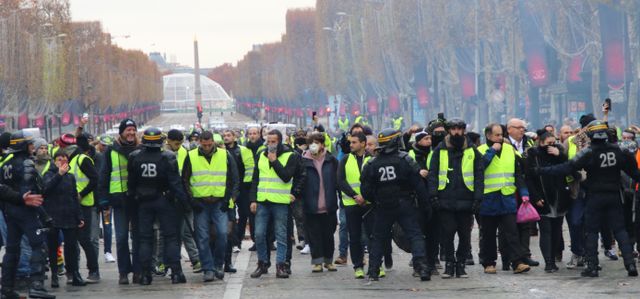
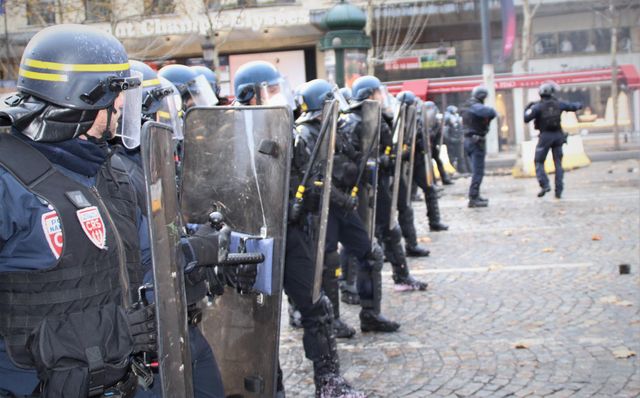
On Saturday, as hundreds of thousands joined “Yellow Vest” protests against French President Emmanuel Macron, riot police viciously attacked protesters on the central march on Champs-Elysées avenue in Paris. Interior Ministry sources claimed that 106,000 people participated in 1,600 protests across France, including 8,000 on the Champs-Elysées.
A section of the protest on the Champs Elysées
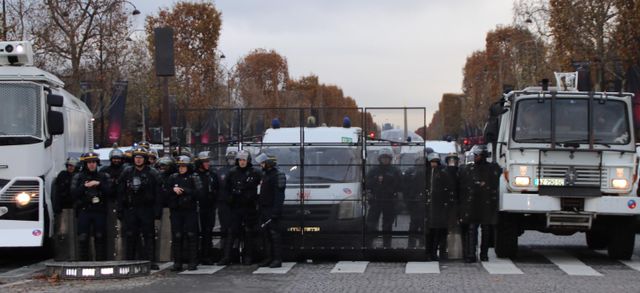
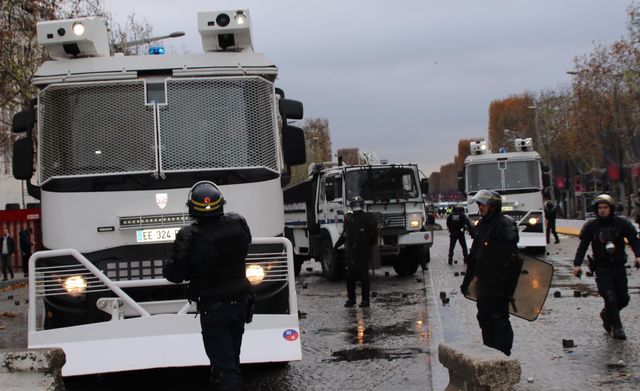
Police had banned protests on the eastern end of the Champs-Elysées, near the presidential palace. When protesters reached the first roadblocks, they were attacked by police units armed with assault rifles who fired water cannon, rubber bullets and thick clouds of tear gas and assaulted marchers with truncheons. Police then repeatedly marched up the avenue, attacking the protesters or trying to surround them, or tearing up the pavement and restaurant chairs to set up makeshift barricades.
Protesters responded by throwing pavement stones and fireworks; clashes continued throughout the day, as marchers chanted “Macron resign” or “Macron get out” and sang the French national anthem calling the citizenry to arms. Police made 103 arrests. Yesterday, 101 people were still being held in 48-hour preventive detention after the protest.
The Paris police prefecture's claims that “violent ultra-right and ultra-left networks” infiltrated the march in order to violently attack each other or the security forces are a pack of lies. The police began and were responsible for the bulk of the violence.
The “Yellow Vest” protest was sparked by Macron's planned fuel taxes hike that disproportionately hit suburbs and rural areas. It has a heterogeneous character, bringing together workers, contractors and small businessmen, who claim to be “apolitical” and to want to build a “popular” movement. However, their growing focus on opposition to social inequality, militarism and to Macron is striking a political chord with broad layers of workers in France and internationally..
Police roadblock guarding eastern side of the Champs Elysées
WSWS reporters at the rally interviewed a group of workers from the Paris suburbs who denounced the crackdown. One, a public sector worker, said: “The government's response, with violence, is not good. This morning they attacked us. I am a mother, I'm peaceful. They tear-gassed us. We arrived, we were at the square, then they arrived, they baton-charged us, they fired at us, we had tear gas in our eyes. No one was vandalizing anything, but they got out their water cannon. I did not expect that, they treated us with contempt.”
Another worker said: “Money rules, Macron is a banker. … He is smashing everything. It started well before, but now we've reached the limits. I work at a hospital, and you see hospitals are closing all the time.” Opposing Macron's planned pension cuts, she added: “A pension is not a privilege, it is the fruit of a lifetime of labor. So retirees have to live with dignity, and today I don't think retirees live with dignity. All this has to stop … there is too much social inequality.”
Police get water cannon into position to fire at protesters
An older worker said, “We regress, regress, regress. Our parents struggled to establish social rights, we are losing everything they won for us. I work for a company and now they only hire temps, you fart once in the wrong direction and you're fired. Workers aren't respected anymore, they treat us just as objects, nothing more. It was always going to explode one day or the other, and now it has begun.”
He said, “We should give the ministers 1,200 euros and see if they can make that last for a month. Our kids are struggling, they live at home until they're 30 because they can't find housing, all the entry-level jobs are minimum wage in most professions. Thank God the old folks are still there to help them, because by themselves they don't have the wherewithal. We are totally fed up.”
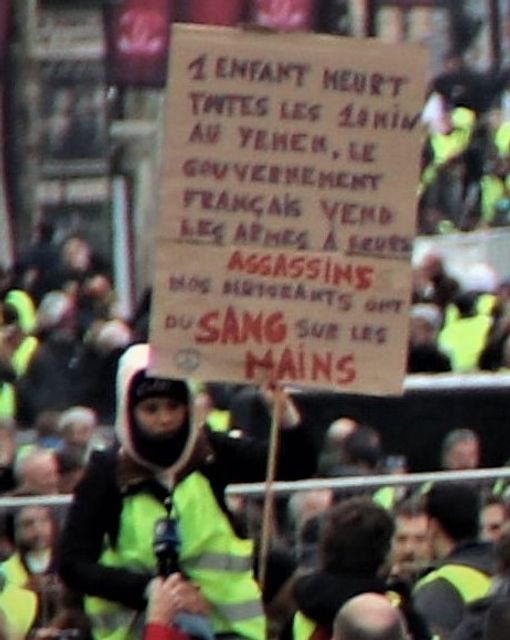
The sign reads, “A child dies every 10 minutes in Yemen. The French government is selling arms to their killers. Our leaders have blood on their hands.”
Didier, a mason, told the WSWS: “Macron he has to resign and scram. We didn't vote for him, it's very simple. That guy, we don't want him anymore and he has to leave. He's made for the rich, he's not made for the working class. … I had a back operation three months ago, I had a heart attack, because I worked all my life. He just sits there and collects money while we struggle. The rich get richer, the poor get poorer; we're going back to the time when we were all serfs.”
Didier also denounced Macron's plans for a European army: “These wars serve no useful purpose, they never do. It's like the Vietnam War, the Algerian war. They are dumb wars, with people who think they know everything sending always the same people to get killed: us. It's always the same thing. What did the First World War accomplish? Nothing.”
Daniel, a shopkeeper, said: “I eat pasta, more pasta, then potatoes. I'm sick of always eating potatoes. … The presidents before did a lot of harm, but he is worse than the others. The population is on the street, he will have to listen or else really he is spitting on us like shit. All of France will explode if he continues, and he knows it.” Daniel explained, “My pension is just 480 euros a month, so they have to stop taking things from us.”
The outpouring of demands reflecting the concerns of people outside the top 10 percent of society is staggering the ruling elites in France and internationally. Claims that the protests are just a tax revolt demanding smaller government are a fraud. In fact, their criticisms of social inequality and war reflect opposition to European Union (EU) policies of austerity and militarism that are reviled by workers in Europe and internationally.
The vest reads, “Today we are on July 14, 1789”
Macron's apparently gratuitous attack on the Paris protest is a class issue. As it defends its wealth and privileges, the financial aristocracy is consciously hostile to the workers. Well aware that social anger and political opposition are primed to erupt, they are preparing war and militarism, including the return to universal military service in France, in an attempt to strangle social opposition. The Yellow Vests' demands have revolutionary implications, and a political confrontation between the working class and the financial aristocracy is brewing.
This is exposing the pro-corporate trade unions and allied political parties of the affluent middle class. These forces boycotted the Yellow Vest march. Instead, the Stalinist French Communist Party (PCF), Lutte ouvrière (LO, Workers Struggle) and members of the Pabloite New Anti-capitalist Party (NPA) attended a small protest against gender violence on Opéra square.
Alexis Corbière of Jean-Luc Mélenchon's Unsubmissive France (LFI) party, the ally of the pro-austerity Syriza government in Greece, has asked Macron for “elections,” reprising Mélenchon's offer last year to be Macron's prime minister. This is a fraud and a political dead end for millions of people across France who want to remove Macron from power.
It is ever more obvious that the Yellow Vests' demands, in France and internationally, can only be obtained through revolutionary struggle and the transfer of political power to the working class.
CRS riot police prepare to charge protesters on the Champs Elysée
Yellow Vest protesters, whom union officials have repeatedly attacked as neo-fascists, denounced the French unions, who have a tiny dues base and receive billions of euros in state subsidies. Daniel noted, “The unions are paid by the state. They're all paid to make us swallow things. … Then they say a few things for popular consumption, but they tell themselves, we won't do too much to avoid weakening the government.”
Didier said, “I'll tell you what I think of the unions. … For me, the unions are a big fat zero. They don't do their work. They did it back in the day; after the May-June 1968 general strike, if a trade union said, 'We're striking,' there was a strike. But today when one union calls a strike, the others say 'No, guys, let's stay home.'” Didier, whose relatives work at a Nestlé plant in Beauvais slated for closure, added: “I saw this factory, it was on strike. Half the workers were outside on strike, half were inside. That is some work the unions are doing.”
He said, “The unions eat from the same trough as the ministers. It's divide and rule: they are told, sit here, you'll be protected, but make sure things stays under control. We know how they work.”

24 Nov 2018

Graduate Women in Science (GWIS) National Fellowships Program 2019 for International Women Researchers

Application Deadline: 11th January 2019

Eligible Countries: All

To be taken at (country): USA

Field of Study: Science-related fields

Type: Research

Eligibility:
  • Awards will be made to women holding a degree from a recognized institution of higher learning, of outstanding ability and promise in research, who are performing hypothesis-driven research at any institution in the U.S. or abroad.
  • Career level (e.g. graduate student vs. assistant professor) of the candidate will be taken into consideration when reviewing the proposals.
  • Awards will be made irrespective of race, religion, nationality, creed, national origin, sexual orientation, or age.
  • Application for the GWIS Fellowships is offered at no cost to current GWIS members, as a member benefit. For non-members, an application processing fee of $50 is required. Fellowships applicants that are not already GWIS members may join GWIS with a 1-year introductory membership at a discounted rate of $40 (click here to join). Please note that membership approval can take up to 48 hours, so if you want to become a GWIS member, please do so (ideally) at least a week before the Fellowships deadline.
  • Financial need of research funding is a requirement for the application. No project that has already been fully funded will be eligible for the awards. All pending funding sources must be listed in the application and reviewers will consider these when assessing the financial need of the project.
Number of Awards: Not specified

Value of Award: Fellowship funds may be used for such things as:
  • expendable supplies
  • small equipment to be used by the recipient (not for general use)
  • publication of research findings
  • travel and subsistence while performing field studies
  • travel to another laboratory for collaborative research
  • Undergraduate collaborators (up to 1/3 of total requested amount)
These costs must be clearly justified in the proposal and integral to the research design.
  • Funds cannot be used for the following:
    • salaries
    • tuition
    • child care
    • travel to professional meetings or to begin a new appointment
    • travel to another institution for coursework
    • living allowances
    • equipment for general use
    • laptops and/or personal computers
    • indirect costs
Terms of Award:
  • All of the work in the proposal must be conducted by the PI of the grant. The fellowships applicant will be the one conducting the work, rather than using the award to support someone conducting work for them (e.g. the funds may not be used by a professor to support a graduate student).
  • The recipient of an award will submit an abstract of 100 words or less along with a recent photo of themselves (.jpg file) to GWIS Bulletin editor (editor@gwis.org) as soon as the awards are announced. This will be used for publication purposes in the national GWIS quarterly publication The Bulletin and on the GWIS website.  Fellowships winners will also need to submit an abstract geared to non-scientists to be used for outreach and further promotion of GWIS activities
  • The recipient of the award will be expected to follow the main outline of the original proposal. If a major deviation from it is essential, approval must be obtained from the Fellowships Committee.
  • If for any reason the recipient is unable to initiate or complete the project, unexpended funds shall be returned to GWIS.
  • At the end of the Fellowship, a one-page progress report, plus the annual expense report must be sent to the past president. The fellowships winner’s supervisor must sign both documents, and the past president must receive it by May 15th, 2019. Any abstracts or reprints resulting from the proposed work must accompany the progress report. Please send both documents to pastpresident@gwis.org. If the research extends beyond one year, submission of an annual progress report acceptable to the Fellowships Committee is required.
  • Acknowledgement of support from an award is requested in pertinent publications, oral presentations and on the awardees’ curriculum vitae.
Duration of Programme: The period of the award shall be one academic year (July 1st to June 30th). Recipients are not eligible for awards in subsequent years, though they may submit applications that include a significantly different proposal/project than the one for which they received a GWIS Fellowship award previously.

How to Apply: 
  • You can find detailed instructions and link to the application here. Make sure to check out the FAQ section before you apply.
  • GOODLUCK!
Visit Programme Webpage for Details

Erasmus Mundus Master Program in Plant Breeding (emPLANT) Scholarships 2019/2021 for International Students

Application Deadline: 15th January, 2019 (noon CET).

Eligible Countries: International

To be taken at (country): emPLANT is an Erasmus Mundus Joint Master Degree in Plant Breeding organized by a consortium of five Universities and Graduate Schools across Europe :
  • University of Helsinki, Finland (UH)
  • UniLaSalle Polytechnic Institute, France (UniLaSalle)
  • Universitat Politècnica de València, Spain (UPV)
  • Swedish University of Agricultural Sciences, Sweden (SLU)
  • Ege University, Turkey (EgeU)
About the Award: The Erasmus Mundus Master Program in Plant Breeding – emPLANT – is a two years Master degree offered by a consortium of five leading European universities in the field of plant breeding, plant biology, seed technology and biotechnology in order to face the challenges of global changes such as population growth and climate change.
The objective of emPLANT is to remedy to the lack of qualified highly skilled plant breeders on Master and PhD level with a training program that combines science, management, law, intercultural competence and language skills.

Type: Masters

Eligibility: If you are interested in applying for the Erasmus+ Master Programme in Plant Breeding, please check if you meet the requirements below:
  • Awarded Bachelor of Science degree (min. 180 ECTS) in Agriculture/Agronomy, Plant Biology, Biotechnology, Biochemistry, Master 1 Genetics, Molecular Biosciences or related relevant fields
  • OR students in their last Bachelor year
  • Language proficiency:
    • B2 in English except when English is your mother tongue. If not, please provide one of the following documents:
      • Official English test: IELTS 6.5 no section below 5.5 ; TOEFL 575 paper-based, 4,5 written, 190 computer-based, 90 internet-based (20 written), etc…
      • Or a University letter attesting English is the medium of instruction of your higher education
    • B1 in Spanish for those applying to UPV in year 2 except when Spanish is your mother tongue. Official test: DELE, ALTE, etc…
  • Application received before the end of the deadline
  • Application form filled out in English
  • Application containing all requested elements and documents
Number of Awards: 23
  • 14 grants for Partner Country students
  • 9 grants for Partner Country students coming for targeted regions of the world
Value of Award: In applying during this call you automatically apply for an Erasmus Mundus scholarship which is a full grant covering participation costs, travel costs, installation costs and living allowance. For academic year 2019-2021, around 27 scholarships are available including:
  • 4 grants for Program Country students
  • 14 grants for Partner Country students
  • 9 grants for Partner Country students coming for targeted regions of the world
More information about the scholarship amount and the distribution of scholarships are available here.

Duration of Programme: 2 years

How to Apply: 
  • Before applying, make sure to go through the emPLANT website and in particular the “Programme”, “Fees/Scholarship” and “How to apply” tabs in order to have a good overview of the emPLANT Master’s Degree.
  • When applying, make sure to have all necessary documents you must upload during the online application. The list of compulsory documents is available here.
  • The link to the online application is available here. Each question of the form is important and the answer must be different from a question to another.
  • Be careful, should any of the mandatory documents be corrupted/damaged/illegible/absent or wrong, the application will be rejected without any possibility of appeal.
  • GOODLUCK!
Visit Programme Webpage for Details

American Middle Eastern Network for Dialogue at Stanford (AMENDS) Youth Summit 2019 for Young Leaders in MENA Region

Application Deadline: 15th December 2018 11:59 PST.

Eligible Countries: Middle Eastern and North African countries

To Be Taken At (Country): Stanford House in Oxford, United Kingdom

About the Award: The American Middle Eastern Network for Dialogue at Stanford (AMENDS) is a collaborative student-led initiative interested in the promotion of understanding and respect around the Middle East, and the support of a generation of leaders who are working to ignite concrete social and economic development in the MENA region.
AMENDS’ mission is to create a platform for promising youth leaders whose work impacts the Middle East, North Africa and United States to share and grow their initiatives. During the conference, we provide delegates opportunities to develop key skills, network and collaborate with established leaders, experts, and fellow changemakers, and share the story of their initiatives with a wider audience after receiving coaching and editing support.

Type: Conference

Eligibility: 
  • be 18 – 28 years old.
  • have innovative ideas and well thought-out initiatives that could affect positive change in the world.
  • have initiatives addressing political, social, or economic issues pertaining to the Middle East in innovative ways.
  • demonstrate the potential to further understanding between the respective regions and demonstrate potential to influence American-Middle Eastern affairs.
Selection Criteria: Delegates will be selected based on the level of their dedication to promoting change in the MENA region and/or in U.S.- MENA relations. AMENDS will also heavily consider the past experiences and backgrounds of each delegate that will enable him/her to contribute a unique perspective to the conference, in order to ensure a rich, diverse group of delegates.

Number of Awards: Not specified

Value of Award: Accepted delegates will:
  • Present a 10-12 minute video talk about their initiative at AMENDS conference. Hosted on our channel, these talks have over 70,000 people.
  • Attend a networking dinner.
  • Receive financial and logistical assistance with flights and visas to and from the 2019 AMENDS conference. Accommodations and food will be provided.
  • Join and take leadership in the AMEND Fellows Network, a self-sustaining network of 120 former delegates. For the past 3 years, a separate reunion conference has been held annually for Fellows.
  • GOODLUCK!
How to Apply:  Apply Here!

Visit the Program Webpage for Details

Fogarty Emerging Global Leader Award 2019 for Health Researchers in Low and Middle Income Countries (LMIC)

Application Deadlines: 
  • Letter of Intent due dates: 30 days before the application due date (4th December, 2018)
Eligible Countries: Low and Middle Income Countries

To be taken at (country): USA

About the Award: The Fogarty Emerging Global Leader Award aims to provide research support and protected time to a research scientist from a LMIC who holds an academic junior faculty position or research scientist appointment at an LMIC academic or research institution. Low-income, lower-middle-income and upper-middle-income countries are included.
The Fogarty Emerging Global Leader Award program is a new program and there are not yet any awards. You may review awards through International Research Scientist Development Award, Fogarty’s related career development program for U.S. scientists.

Type: Research

Eligibility: 
  • Only low- or middle-income country (LMIC) institutions are eligible.
    • Income categories are defined by The World Bank Country and Lending Groups.
    • Country eligibility for Fogarty International Training Grants applies (See in link below)
  • Candidates must be LMIC citizens.
  • Candidates must hold an academic junior faculty position or research scientist appointment at the LMIC applicant institution and must have been in this position for at least one year at the time the application is submitted.
  • Candidates are required to have both U.S. and LMIC primary mentors.
  • Research should take place primarily in the LMIC.
  • Individuals who have already received independent research funding are not eligible.
  • Applicants should demonstrate that they are committed to an independent research career and justify the need for three to five years of mentored research experience in order to become an independent research scientist.
Number of Awardees:  Not specified

How to Apply: View full eligibility details in the program announcement and refer to FAQs before applying

Visit Award Webpage for details

Award Provider:  Fogarty