11 Dec 2018

May delays Brexit vote while Corbyn refuses to move no confidence motion

Chris Marsden 

On the day UK Prime Minister Theresa May called off the vote on her proposed Brexit deal with the European Union (EU), Labour leader Jeremy Corbyn refused to move a motion of no-confidence until she completed a fresh round of negotiations with Brussels.
Amid the threatened collapse of the Conservative government, with 100 Tory MPs opposing May, mainly on its hard-Brexit wing, Corbyn is obsessed with proving his statesmanlike qualities and Labour’s bona fides as a government that can be trusted to safeguard the interests of big business. Once again, he has thrown a lifeline to May, while handing the political initiative to the Brexit wing of the Tories and the pro-EU membership Remainers within the Blairite wing of the Labour Party.
May called off today’s scheduled vote because she knew her proposed agreement would be heavily defeated. All the main opposition parties were opposed, based on either supporting remaining in the EU or renegotiating permanent access to the Single European market and Customs Union that would, in the end, mean remaining in the EU. To these critics, May stressed that her deal was the only alternative to a hard-Brexit with tariff-free access to Europe’s markets closed to the UK immediately. But her fate was more directly threatened by the Tory hard-Brexiteers and the Democratic Unionist Party (DUP), whose 10 MPs she depends on for a majority.
Both have denounced the “backstop” arrangement designed to avoid the return of a hard-border between Northern Ireland and EU member state, the Republic of Ireland, in the event that the UK leaves the EU without an all-encompassing trade deal. With the EU stipulating that this means Northern Ireland staying in the EU customs union, large parts of the single market and the EU value added tax system, and with no clear procedure on how to end the arrangement, the DUP and the Tory right warn this could potentially split the Northern six counties from the UK.
For three humiliating hours in parliament, May repeatedly made clear that her ambitions were limited to seeking reassurances from the EU that would placate the concerns of the Brexiteers and the DUP—especially “to ensure that the backstop cannot be in place indefinitely”. Hers was still the only deal that honoured the Brexit referendum vote to leave, she insisted, while still preventing a hard-Brexit.
On the opposition benches, Corbyn said the government was in “complete chaos” and repeatedly urged May to stand down. But he again faced down calls, backed by the Scottish National Party (SNP) and the Liberal Democrats, to table a vote of no-confidence. Over 50 Blairites—most of whom are opposed to a general election that would bring Corbyn to power—signed a letter demanding a no confidence motion, while a party spokesperson replied, “We will put down a motion of no confidence when we judge it most likely to be successful … When she brings the same deal back to the House of Commons without significant changes,” when Labour would have the backing of “others across the House”: That is, when Labour would possibly secure the support of pro-Remain Tories and enough Brexiteers to end May’s premiership.
Corbyn has again given the Tories time to potentially regroup, rather than fulfil his hope for them to commit political suicide. May continues to use the prospect of electoral defeat as her main weapon, warning her rebels in the Mail on Sunday: “We have a leader of the opposition who thinks of nothing but attempting to bring about a general election, no matter what the cost to the country. I believe Jeremy Corbyn getting his hands on power is a risk we cannot afford to take.” Leading Brexiteer Jacob Rees-Mogg called her out, stating, “This is not governing, it risks putting Jeremy Corbyn into government by failing to deliver Brexit … The prime minister must either govern or quit.”
With speculation that the next days will finally see the 48 Tory MPs submitting the necessary letters to trigger a no confidence motion in May, there was discussion of a possible “dream ticket” of top Brexit figure Boris Johnson standing for leader and Remainer Amber Rudd as his deputy.
It is unclear whether May intends to resubmit a revised or “clarified” deal next week, or delay until the New Year. She has only said the final deadline is January 21. But there is every likelihood that her party would remove her before then, or that parliamentary arithmetic shifts sharply enough towards Remain to change everything—including raising the possibility of a general election or a second referendum. In whatever way events unfold, May’s days are numbered.
EU leaders, including president of the European Commission Jean-Claude Juncker and Irish premier, Leo Veradkar, have queued up to insist that no substantive changes will be made to the agreement. Juncker said, “We will not renegotiate the deal that’s on the table right now. That is very clear,” while his spokesman said “[A]s far as we’re concerned the UK is leaving the EU on the 29 March 2019. We are prepared for all scenarios.” This was backed up with statements indicating advanced preparations for a no-deal Brexit.
To reinforce the EU’s hard-line stance, judges at the European Court of Justice ruled that MPs had the option of unilaterally revoking Article 50, ending withdrawal and maintaining full EU membership. The case was brought by an alliance of Labour Remainers and the SNP. The judges ruled that a letter from the government to the European Council of Europe’s leaders would stop Brexit if received any time before the March 29, 2019 deadline. The Blairite Chris Leslie described the ruling as “a game-changing moment” in opening the possibility of a second “People’s Vote” referendum after any parliamentary rejection of May’s deal.
The only silver lining for May was offered by former European Commission president, Romano Prodi, who said renegotiation was possible given the economic and political consequences of the UK crashing out of the bloc without a deal.
Indicating the scale of the unfolding crisis, the delayed vote caused the pound to fall to its lowest level in 18 months, so that a euro is now worth 90 pence.
The response within Labour on the issue is to exert maximum pressure on Corbyn to commit to a second referendum—with the pro-Corbyn Momentum group now openly allied with the Blairites. Corbyn continues to resist, fearing that moving too quickly would alienate most Labour voters who supported Brexit.
Each side now regularly warns of social and political unrest—if the popular vote for Brexit is thwarted, or if a hard-Brexit leads to economic chaos. Writing in Bloomberg, Therese Raphael warned that the UK could soon see “unrest” similar to the Yellow Vests movement in France. “[W]hat happens if traditional pathways for affecting change no longer work? What happens, say, if the political sphere is so unstable that there is no clear policy vision; if government not only ceases to be responsive but is no longer even coherent? Britain may be about to find out … Someone will begin passing out high-visibility vests or another symbol of defiance. It may not be immediate, but chaos, loss, uncertainty and disruption will breed palpable anger.”
All such warnings point to the underlying issue of rising social tensions and class antagonisms produced by the savage austerity measures that all factions of Britain’s ruling elite are committed to. Against contending strategies for trade war and militarism, workers in Britain should seek maximum unity with workers in France, Germany, Italy, Greece and throughout Europe—fighting against the austerity measures of their national governments being imposed in collusion with the EU—in a common offensive for a United Socialist States of Europe.

Egypt bans yellow vest sales as French protesters reject Macron’s concessions

Alex Lantier 

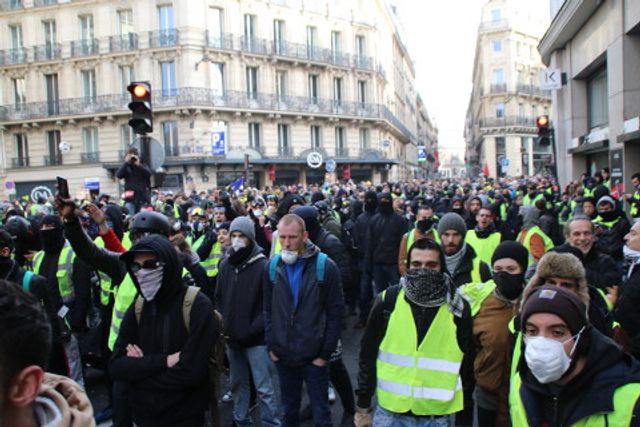
The bloody Egyptian dictatorship of General Abdel Fattah al Sisi is banning the sale of yellow vests, as protests spread internationally in sympathy with the movement against French President Emmanuel Macron. This came as “yellow vest” protesters in France rejected Macron’s offer of concessions in an attempt to placate the growing movement.
The Sisi dictatorship is terrified that growing working class anger in Egypt and across North Africa could erupt around “yellow vest” protests like those in France. Cairo retailers contacted by AP said police ordered them not to sell the vests until after the protests on January 25 of next year—the eighth anniversary of the 2011 revolution that toppled the hated dictator Hosni Mubarak. Since it took power in 2013 in a bloody military coup, the Sisi regime has banned such protests and sent riot police to beat or kill anyone who defied the ban.
“The police came here a few days back and told us to stop selling them. We asked why, they said they were acting on instructions,” one retailer told AP. Another said, “They seem not to want anyone to do what they are doing in France.”
Industrial safety equipment distributors are reportedly under orders not to sell yellow vests to walk-in customers, but only to verified construction companies who have police permission. Many press outlets reported that the Egyptian Interior Ministry did not answer requests for comments on the yellow vest ban.
Sisi is reportedly a close friend of former French President François Hollande, and French Internet spying firms are deeply implicated in surveillance of the Egyptian population and the identification of individuals via Internet and social media to be arrested and tortured. Despite their best efforts, however, bread riots, textile workers strikes and protests against Sisi’s privatizations and food subsidy cuts have repeatedly shaken Egypt in the last two years.
Sisi’s attempted preemptive strike against “yellow vest” protests in Egypt points to the panic of governments worldwide at the radicalization of the international working class. Demands for social equality, wage increases, an end to militarism and repression and the ouster of unpopular governments, that drive the yellow vest protests in France, are shared by workers and toiling people in every country. As Sisi desperately tries to keep such protests from spreading to Egypt, various forces are calling such protests from one country to the next.
In Europe, Belgian police violently cracked down on Friday’s “yellow vest” protest in Brussels, as protesters also donned yellow vests in the Netherlands and Bulgaria, and also Iraq. After a “yellow vest” protest in Basra against contaminated water and poor city services under the NATO-backed neo-colonial regime, protesters in Baghdad also wore yellow vests to marches on December 7 to show their solidarity with the Basra protests.
Particularly after the brutal police crackdowns in Brussels and on Saturday in Paris, protests are spreading across Africa. In Burkina Faso, a Facebook group has been set up calling for such protests on December 13. It states: “So on December 13, 2018, across Burkina Faso, let us occupy without violence and pacifically every street corner and intersection in our neighborhoods in the cities and villages across the entire country to say: –No to the rise in fuel prices // –No to injustice in all its forms.”
In Tunisia, a recently-founded Facebook group of “Red Vests” issued its first statement on December 7. It denounced the “failure and corruption” of the Tunisian political system and the government’s “policy of systematic impoverishment” of the population. This came after a strikes last week by Tunisian teachers against wage cuts.
As in Egypt, anger in Tunisia is expected to erupt on January 14, on the eighth anniversary of the 2011 revolution that ousted European-backed dictator Zine El Abedine Ben Ali. The General Union of Tunisian Labor (UGTT) trade union, which was a close supporter of the Ben Ali dictatorship, felt compelled to call two symbolic, one-day strikes in the public sector last month. Calls are circulating for a general strike in Tunisia next month.
In Algeria, protesters donned yellow vests and joined in a march in Béjaïa yesterday, prompting worry in bourgeois media. Noting the “gloomy social climate due to the drastic fall in Algerians’ purchasing power,” Mondafrique wrote that protests “have caused an all-out political crisis in France. Is Algeria safe from a possible, indeed probable infection?”
The upsurge of the class struggle and growing solidarity with the “yellow vest” protests in Africa underscore again that the greatest ally of workers in France mobilizing against Macron is the international working class. It has been nearly eight years since the first great revolutionary mobilization of the working class in the 21st century toppled two dictators in North Africa. Now, as calls for general strikes grow in France, Tunisia and across the region, the class struggle is moving objectively towards an eruption of an international general strike.
The task of preparing and organizing such a struggle cannot be left to the union bureaucracies. They support the reactionary national governments, divide the working class along national lines, and were bitterly hostile to the initial “yellow vest” protests in France. Workers will have to take this struggle out of the hands of the unions, and unify their struggles against the unions and the middle class parties affiliated to the unions—all of whom endorsed the bloody European imperialist wars in Libya, Syria and Mali that followed the 2011 revolutions.
As the International Committee of the Fourth International (ICFI) has stressed, this requires first and foremost building an Marxist political vanguard in the international working class, to offer it revolutionary leadership.
The explosive growth of the class struggle has exposed middle class forces like the Pabloite New Anti-capitalist Party and Jean-Luc Mélenchon in France. Having endorsed the 2011 Libyan war that led to the subsequent NATO onslaught against Africa as a “humanitarian” endeavor, they refused to give any perspective to oppose Macron during the run-off in last year’s presidential elections. Now, they are rejected by broad layers of the “yellow vest” movement, some of whose members rejected Mélenchon’s outreach by telling him to go see “his friend Macron.”
Their aim to tie protesters in France to the perspective of some type of trade union talks and deals with Macron—a perspective rejected by the “yellow vest” protesters—is a trap for the workers. This came to the fore as “yellow vest” protesters dismissed Macron’s ineffectual 13-minute speech last night, in which he tried to convince them to give up the fight.
Macron insisted he would not repeal the tax cut on the rich, abandon plans for deep cuts to unemployment insurance and pensions, or let up on his standing order for a crackdown on protests. Having threatened the protesters, he offered them a 100 euro monthly (6.7 percent) increase in the minimum wage, a partial repeal of tax hikes on retirees, and tax cuts on overtime pay. Finally he appealed to anti-immigrant racism, calling for an “unprecedented” public debate on national identity and “secularism,” now used as a code word for attacks on Muslim headscarves.
This proposal of an official policy of inciting anti-Muslim racism is dictated primarily by police and military considerations. The French ruling class does not want the emergence of a joint struggle of European and African workers that would cut across its wars, nor a unification of “yellow vest” and immigrant workers that would hamper its police crackdown at home. The way forward for workers is to reject Macron’s neo-fascistic debate with contempt, and seek unity with their class brothers and sisters of all ethnic and religious origins.
Commenters on “yellow vest” Facebook pages largely rejected Macron’s offer, pointing out that it aimed to divide the protesters based on whether or not they are on minimum jobs, retired, etc. “Don’t fall into the trap! All he wants to do is set us against each other to end the movement! So let’s stay united and continue so that each one of us gains a victory,” read one post on the France en colère page, which was overwhelmingly opposed to Macron’s speech.
A new “yellow vest” protest next Saturday in downtown Paris has been called.

10 Dec 2018

Brexit Britain’s Crisis of Self-Confidence Will Only End in Tears and Rising Nationalism

Patrick Cockburn

The UK has long been divided by class, region and race, but these divisions have been masked by political and economic success. This has meant the English, as the dominant nation in the UK, are not good at coping with a sense of failure and a loss of self-confidence.
The current focus is on parliamentary turmoil and the acceptance or rejection of Theresa May’s muted version of Brexit but, whatever happens in the coming weeks, there will be no resolution of the overall crisis. On the contrary, the divisions exacerbated by Brexit will only get deeper and more toxic, dominating the national agenda to the exclusion of everything else.
The nature of English nationalism – deeply ingrained but so self-confident its norms were assumed by most English people to be part of the natural order of things – is changing. George Bernard Shaw said “a healthy nation is as unconscious of its nationality as a healthy man is of his bones”. Smaller nations like the Irish and the Poles, with a history of defeat and occupation, have grim experience of having to nurse back to health the fractured bones of their nation but for the English worrying about their national identity and the future status is a new and unnerving experience.
The sense of English superiority was real but relaxed and often expressed in self-mockery. I remember my late brother-in-law Michael Flanders, part of the Flanders and Swann duo in the 1950s and 1960s, singing a song entitled Patriotic Prejudice, one version of which ran:
“The English, the English, the English are best,
I wouldn’t give tuppence for all of the rest.
The Germans are German, the Russians are red,
The French and Italians eat garlic in bed.
The English are moral, the English are good,
And clever and modest and misunderstood.”
Many pro-Brexit supporters do not seem to have advanced far beyond this benign picture of the national character. But these days their tone is defensive and self-assertive. Immigrants are to be schooled in British values – whatever those may be – the very thing Shaw saw as a symptom of unhealthy nationalism.
Analysis of the forces that led to Brexit usually looks at issues over too short a time span. The English may once have been confident of their own nationality but this does not mean they were as tolerant of others as they sometimes like to suppose. Punch cartoons in the 19th century showed the Irish as murderous sub-humans. The Aliens Act of 1905, brought in by a Conservative government with an eye to winning votes in a general election the following year, aimed to exclude Jews fleeing Russian pogroms. A century later, the Conservative Party spent years trying to trump Tony Blair’s ability to win successive elections by experimenting with different types of dog-whistle anti-immigrant rhetoric, often combined with demonisation of the EU.
Conservative politicians such as David Cameron, whose career was to be destroyed by the outcome of the 2016 Brexit referendum, were highlighting the migrant threat a year before the vote, warning of “a swarm of people, coming from the Mediterranean, seeking a better life, wanting to come to Britain”. This showed real chutzpah, or cheek, since Cameron played a central role in launching the Nato war to overthrow Gaddafi in 2011 that turned Libya into a land of warlords and predatory militias, opening the way for migrants from North Africa to try to reach Europe from Libya in overcrowded boats and dinghies, often dying in the attempt.
A further feature of English nationalism will make it difficult to manoeuvre during the coming years of preoccupation with European relations. Small nations get used to inferior status and playing a weaker hand against opponents who hold most of the cards. British diplomats understand this, but a large part of public opinion in Britain, as in other former imperial nations, sees compromise as a sign of inexplicable weakness of will or as a treacherous stab in the back.
This lethal inability to calculate the real balance of power in the EU or anywhere else is not confined to an ill-informed public which has been spoon-fed war-time triumphs. Covering wars in Afghanistan, Iraq, Libya and Syria over the last 20 years, I noticed again and again how difficult British politicians found it to take on board what was really happening and distinguish winners from losers, obvious though this often was.
A further English weakness – and the switch from referring to the English rather than the British is deliberate – is that neither Leavers nor Remainers have ever thought through what self-determination really means and how it can best be achieved. This is a perfectly legitimate aim that has inspired national movements in much of the world but Remainers tend to deride it as spurious patriotic bombast tinged with racism, and Leavers speak of achieving real independence for Britain almost automatically once the shackles of the EU are removed. This is in keeping with the behaviour of every nationalist or liberation movement in history which has invariably blamed all the woes of its people on foreign rulers or domestic tyrants. This conveniently saves them the trouble of having to explain what they would do themselves.
Britain could achieve a greater degree of formal self-determination outside the EU, though everybody in the country would be considerably poorer. But it would not be as a free trading entrepot like Singapore or Dubai: political and economic isolation for any country usually leads to the state playing a greater role. This is already happening in a small way in Britain with the Department of Health arranging uninterrupted supplies of medicine in case Britain topples out of the EU next year without an agreement.
A contradictory aspect of the Brexiteer project is fanaticism about freeing Britain from EU courts and regulations. At the same time, Leavers are relaxed about British water companies and other essential utilities being owned by financiers in Sydney, Hong Kong and anywhere else in the world.
As Shaw pointed out, national self-confidence is not something that you notice until it is gone and it is then difficult to win back. The same is true of national unity: the obvious fallacy that the British as a whole chose to leave the EU, when the vote was so evenly divided, could only end in a self-destructive crisis. To expect such a revolutionary change to be carried out by a minority government was demented. Whatever happens in the coming months and years, the English nationality will have to mend a lot of broken bones.

German Christian Democrats select Merkel’s favoured candidate as party leader

Peter Schwarz & Ulrich Rippert 

The former secretary-general of the Christian Democratic Union (CDU), Annegret Kramp-Karrenbauer, is the new leader of the party. At the CDU party congress in Hamburg on Friday, 517 of the 999 delegates voted in her favour. She received only 35 votes more than her main rival, Friedrich Merz. A third candidate, the country’s current health minister, Jens Spahn, was eliminated in a first round of voting, having received 157 votes.
Kramp-Karrenbauer was the favoured candidate of the party’s outgoing chairperson, Angela Merkel, who announced her resignation after more than 18 years as party leader. Merkel has declared that she intends to remain chancellor until the next scheduled federal election in 2021. Kramp-Karrenbauer gave up her post as premier of the state of Saarland last spring to take over as head of the party apparatus in Berlin following a request from Merkel.
Merkel has been under pressure in the CDU following a succession of electoral defeats. At the start of the congress, she defended her term in office in a half-hour speech and was given a long standing ovation by the delegates. Her “system,” Merkel explained, consisted of “concentrating on the subject matter… often in a rather dry manner and without using big words.”
In fact, what characterised Merkel's term in office was her ability to implement a reactionary, anti-working class and militarist policy without provoking major class battles or protests. Unlike many veteran CDU members, who grew up in the philistine fog of the Adenauer era or fought in the student revolt of the late 1960s, Merkel, the daughter of a protestant pastor who grew up in the former East Germany, had no ideological blinkers. She was able to straddle very diverse positions with equal conviction and cooperate with the neoliberal Free Democratic Party (FDP), the Social Democratic Party (SPD), the Greens, the trade unions and even the Left Party. She had an innate sense that the wealthy middle classes on which these parties are based were moving to the right.
Under Merkel’s chancellorship, Germany has developed into the most unequal country in Europe—one where a sixth of the population lives in poverty and some 40 percent of all workers are employed in precarious forms of work. In Greece, Portugal and other European countries, Merkel’s name is synonymous with the brutal austerity programs that have ruined the lives of millions. Under her chancellorship, the German elite has returned to an aggressive great power foreign policy following five decades of military abstinence.
In the agreement on which the current grand coalition government is based, the conservative Union parties, the CDU and the Christian Social Union (CSU), and the SPD agreed to raise defence spending to two percent of gross domestic product by 2024, an increase to more than €75 billion per annum.
This policy of rapid military rearmament, coupled with massive social cuts, restrictions on democratic rights and the build-up of the police and intelligence services is now being intensified. All three candidates for the CDU leadership represent extreme right-wing political positions.
Health Minister Jens Spahn defends the bureaucratic harassment of the unemployed and Hartz IV recipients. Calling himself a representative of the younger generation—he is 38 years old—he has pledged to ensure that “the burden of social costs” is minimised.
Kramp-Karrenbauer promised to implement an uncompromisingly hard line in immigration policy, and Friedrich Merz stood in the race for party leadership as an open advocate of the financial oligarchy and the super-rich.
Merz was supported by the party's business wing, the financial press and conservative media outlets. He retired from active politics 16 years ago and has since earned millions through his business and financial interests. In addition to several supervisory board positions and advisory mandates, he was supervisory board chairman and lobbyist for the German section of BlackRock, the investment management firm known as the world’s largest “shadow bank.”
As chairman of the CDU, his task would have been to bring the policies of the CDU and federal policies as a whole more in line with the demands of the financial markets. Two days before the election, Wolfgang Schäuble, the conservative patriarch of the CDU, publicly called for Merz’s election and campaigned on his behalf.
In the event, CDU delegates decided against Merz and in favour of Kramp-Karrenbauer, but this does constitute a rejection of Merz’s neoliberal views. Rather, delegates hope that, with the support of the party apparatus she represents, Kramp-Karrenbauer will be able to carry through anti-working class and militarist policies more effectively.
In her speech to the party congress, Kramp-Karrenbauer spouted hackneyed phrases about a “new start” and a “new future” to dress up her credentials as a defender of Fortress Europe, austerity policies and European militarism. Europe had to be “made secure against external threats” and “the euro finally made crisis-proof,” she said. What was needed was a “Europe that not only formulates, but implements its common security interests with a European security council and a European army.” One needed to have “the courage to write this in our election program,” she added.
Time and again, Kramp-Karrenbauer emphasized that the task was not only to formulate a right-wing government program, but to implement it with the appropriate harshness. It was necessary to “leave the comfort zone…and translate into deeds that which one could, should and must do….” In the course of her political career she had “learned to lead,” and was ready to take “the next step.” It was necessary to “embrace change with courage, even if it means breaking with cherished habits.”
Domestically, this means the establishment of a veritable police state. “If we have the courage, then we will make a strong state…one that is consistent,” she told the delegates. “A state that does not let itself be fooled, not by petty criminals, not by tax fraudsters, not by big criminal clans and not by the anarchistic, chaotic people who ran riot here in Hamburg at the G20 meeting. Here, too, we have to show a clear profile.”
The decision in favour of Kramp-Karrenbauer must be seen within the context of the growing economic and social crisis. More and more workers and young people are opposed and hostile to the government’s policies.
The change of leadership in Germany’s main governing party takes place in the midst of a new eruption of class struggle in Europe. Merkel's closest ally in the European Union, French President Emmanuel Macron, faces a rebellion against horrendous levels of social inequality—a rebellion that is rapidly expanding and finding broad resonance among workers and youth across Europe.
In the face of this growing social storm, the political establishment is closing ranks. At the centre of all the speeches at the CDU congress were appeals for unity, cooperation and determination.
Following her selection, Kramp-Karrenbauer went on to offer both Merz and Spahn leading posts in the party, while calling upon all of the party’s factions to work together.
The CDU’s main coalition partner, the SPD, reacted enthusiastically. SPD leader Andrea Nahles effusively congratulated the new CDU chairman and offered “intensive and good cooperation.”
Congratulations also came from the leadership of the Green Party. “We look forward to exciting political competition and the upcoming debates about the best ideas for our country and Europe,” declared the joint chairs of the Greens, Annalena Baerbock and Robert Habeck.
The Left Party also celebrated the CDU delegates’ decision. “Congratulations to AKK [Annegret Kramp-Karrenbauer],” wrote Left Party leader Dietmar Bartsch on Twitter. The CDU had “opted for continuity with its choice.” Bartsch hailed Merkel’s term in office with the words: “Eighteen years as chairman of the CDU. Our respect and appreciation.”
The trade unions also responded enthusiastically. Both the head of the German trade union federation (DGB), Reiner Hoffmann, and Frank Bsirske, the leader of Germany’s main public service union (Verdi), were present at the party congress. “I have got to know Annette Kramp-Karrenbauer as a person who remains down to earth, even though she has great responsibility,” Bsirske said, adding that he looked forward to good cooperation in the future.

France’s “yellow vest” protesters brave repression and mass arrests

Alex Lantier & Kumaran Ira

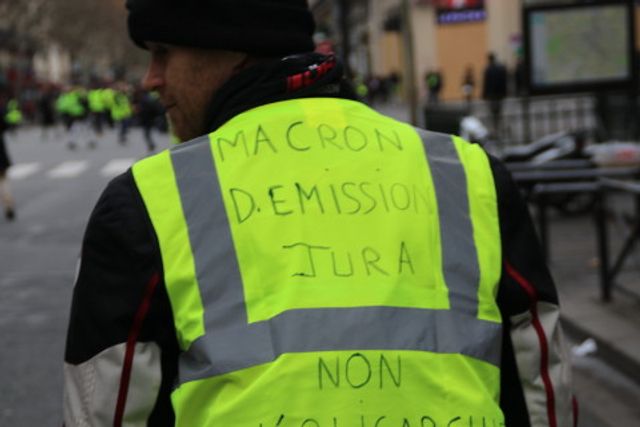
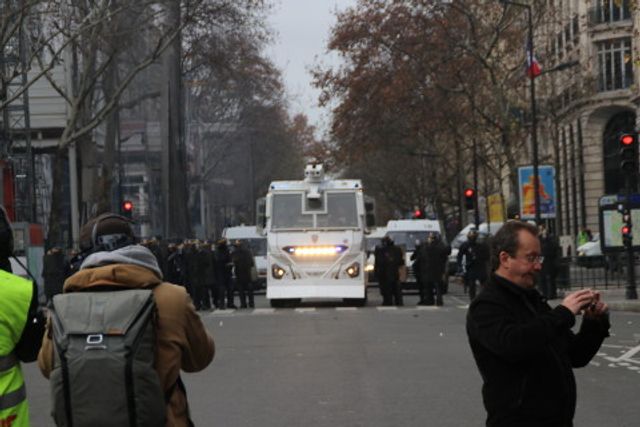
For the fourth consecutive Saturday, “yellow vest” (gilet jaunes) protestors demonstrated yesterday across France against the rightwing government of Emmanuel Macron. They did so in defiance of ominous threats of state violence and a massive mobilization of security forces.
Clearly, the French President’s attempts to end the protests, first by postponing the gas tax hikes that set the movement into motion and then by canceling them outright, failed. The demands being raised—for social equality and against militarism and dictatorship—show that this is a movement directed towards the defense of workers’ interests, not just in France, but also internationally.
Yesterday’s protests paralyzed France and large sections of Belgium. The Minister of the Interior reported that 125,000 “yellow vests” protested in France. In the major cities where demonstrations were organized most shops were closed. On Saturday evening, the Vinci highway network reported “significant disruptions” and slowdowns on over 20 highways, many of them as the result of “yellow vest” protests and barricades.
Demonstrations took place in many cities, including Paris, Lyon, Bordeaux, Toulouse, St. Etienne, Perpignan, Marseille, Avignon, Nantes, Brest, Quimper, Lille and Rennes.
Some 400 people were arrested in Brussels during a “yellow vests” rally of 1,000 protesters. This is the second “yellow vest” demonstration in the Belgian capital, directed against rising fuel prices and the increased cost of living. The protestors are demanding the resignation of Prime Minister Charles Michel.
Unrest has also spread to the Belgian provinces. “We must take from the rich to give to the poor,” a “yellow vest” nurse told the press.
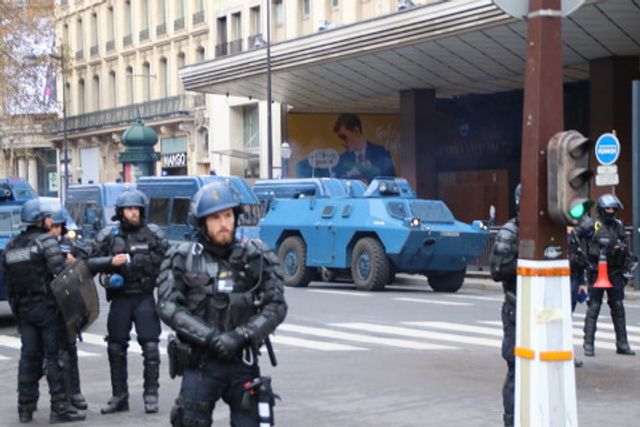
The French government hurled hysterical accusations against protesters descending on Paris, accusing them of preparing to “slaughter” (massacre) the “forces of order.” Police viciously attacked and repressed demonstrations in major cities, arresting almost triple the number of protesters as on the previous Saturday, December 1.
Throughout the country, police arrested 1,723 people, a level that French Minister of the Interior Christophe Castaner characterized as “exceptional.” Of these, 1,220 were ordered held in custody. Paris police headquarters announced that more than 1,082 people had been arrested, of whom more than 625 are being kept in custody.
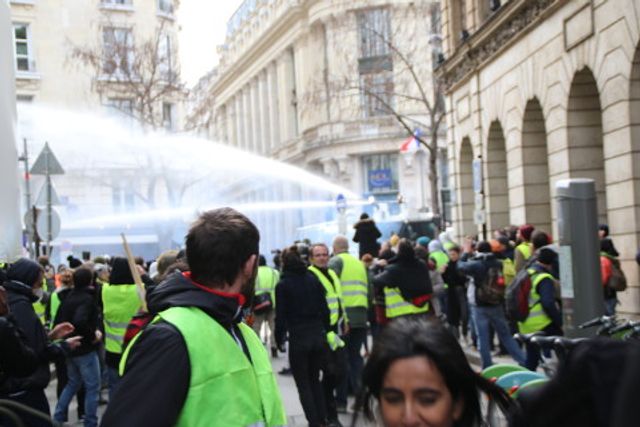
Clashes and confrontations between protesters and law enforcement broke out in the major French cities, including Paris, Bordeaux, Lyon and Toulouse. The police fired tear gas and flash balls to disperse the protesters, wounding over 100. In Paris and in Marseille’s Old Port, security forces attacked protestors with armored vehicles and water cannons.
In Paris, the police proceeded with extraordinary aggressiveness. To disperse the protesters early in the day, police mounted charges against peaceful demonstrators from the outset, before they could group together in a more powerful mass. Police attacked protesters on the Champs-Elysees and elsewhere in the city, surrounding and trapping peaceful protesters, and dispersing them with armored vehicles and mobile gendarmerie, including a mounted horse brigade.
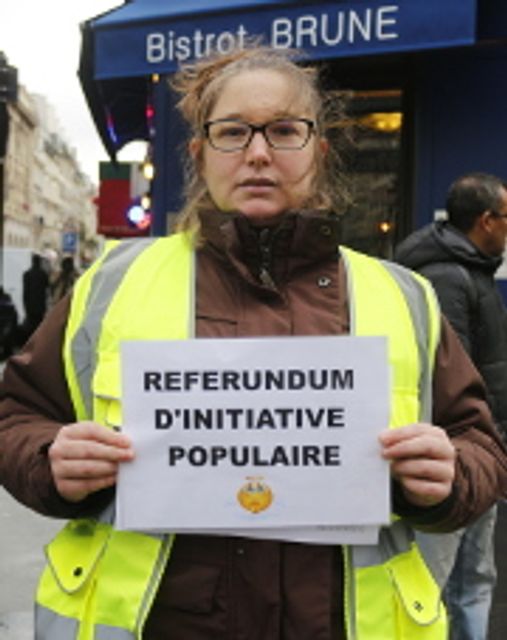
Sylvie
WSWS reporters interviewed people in Paris. Sylvie, from the Oise region of northern France, said, “Every time that there has been anger, it’s because people can no longer provide for themselves. There is no right; there is no left. The unions have also taken us for a ride. We represent the people. We have the right to live decently, we have the right to be respected by those who are supposed to represent us.”
She added, “We are also denouncing the 1 percent who take advantage of the 99 percent; we want it to stop. In fact, it is they who tax us, they are the ones who hold the wealth. It’s modern slavery.”
Stéphane told us: “Macron very clearly showed where he was going, when he eliminated the tax on the wealthy and reduced my Housing Aid by €5. Is this democracy? No, we are now in a financial dictatorship. And I hope it will not become a military dictatorship. “
Shortly after being teargassed, the wife of a railway worker told the WSWS: “Mr. Macron treats us with contempt. They surround us, they send us to the right, then to the left, and they gas us.” She stressed that Macron no longer has any political legitimacy. “We cannot even demonstrate peacefully anymore; the police force charges us and fires tear gas at us. I hope the people will rise up. Excuse me, but is this a way to treat people, with tear gas?”
Once again, the government has indicated that it intends to trample on the demands of the “yellow vests” and continue the austerity policy that has been rejected by the vast majority of the French people.
During a very short press conference on Saturday evening, Prime Minister Edouard Philippe stressed that there would be no change in government policy: “Vigilance and mobilization remain in place, because thugs are still at work in Paris and in some provincial towns (...) In order to confront this day, we had to conceive an exceptional plan, with the extensive mobilization of the forces of the law and means to ensure their continuous mobility.”
“It is necessary to reestablish our national unity, through dialogue, through work, through regroupment. The President of the Republic [Macron] will speak and propose (...) measures that will allow the French nation to find itself,” he added.
Rising anger among workers and young people in the face of official intransigence is developing into an open confrontation between the working class and the government, and towards a general strike. The main advantage the government enjoys at present is that, in this explosive situation, large masses of workers do not clearly see a revolutionary perspective. As they seek to fight against the government, they are confronted with Macron’s support from the petty-bourgeois parties that for decades have posed as the “left.”
Jean-Luc Mélenchon is calling for respect for the police. “Never deceive yourself as to your opponent. The handling of police forces is not the job of the police. It is the business of the politicians who give the orders. The duty of the police is to serve and obey. And the orders are political,” tweeted the leader of La France Insoumise (LFI). This defence of the security forces and French state is provoking ever greater mistrust of, and hostility toward, the LFI among the “yellow vests.”
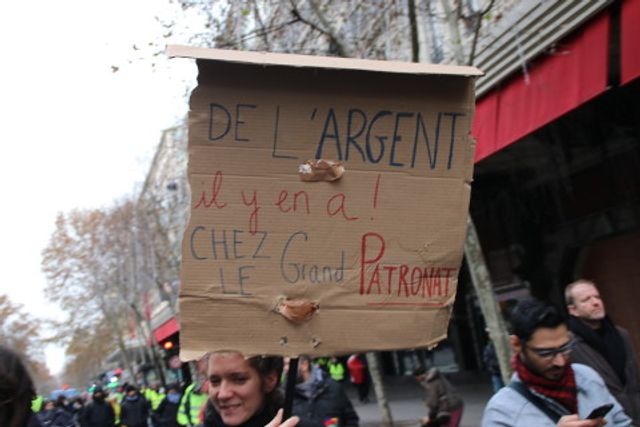
One sign reads: There is money! At the boss's house
On Saturday “yellow vests” in Flixecourt in the northeast announced that, in the name of “political independence,” they would distance themselves from LFI MP Francois Ruffin, who had declared himself to be on their side. Ruffin had said he wanted to serve as a “bridge” between the movement and the government. But this proposal stumbled on the hostility of the “yellow vests” to the union apparatus and their political allies such as the LFI.
François Ruffin “gave us very honest support, but we do not want to be taken over by the media or politicians. We are fighting for full political independence, even though, of course, we all have a political color,” said Christophe Ledoux, one of the leaders of the movement in Flixecourt.
This development underscores the need to build action committees, independent of the trade union apparatuses, to enable workers in struggle to coordinate their actions, and a Marxist vanguard that will enable workers to identify and thwart attempts by official circles to smother and strangle their struggles.

China summons American ambassador over detention of Huawei executive

Peter Symonds 

China has condemned the detention of top Huawei executive Meng Wanzhou by Canadian authorities on December 1 and threatened retaliation against Canada and also the US, which is seeking her extradition. The highly provocative actions of the US are part of the Trump administration’s broader campaign to prevent Chinese corporate giants such as Huawei from challenging American technological dominance.
Meng, who is Huawei’s financial controller and daughter of its founder and current head Ren Zhengfei, was seized while changing planes in Vancouver on her way to Mexico from Hong Kong. She is still being held pending the outcome of a bail hearing due to continue today. If Meng is extradited to the US and convicted on charges of fraudulently evading American sanctions on Iran, she faces up to 30 years in jail.
Chinese foreign vice-minister Le Yucheng summoned Canadian ambassador John McCallum on Saturday to lodge a “strong protest” over Meng’s detention and urged Ottawa to release Meng immediately. Beijing has warned of “grave consequences,” accusing Canada of “hurting the feelings of the Chinese people.”
On Sunday, Le also summoned Terry Branstad, the US ambassador in China, to lodge “solemn representations and strong protests” against the case against Meng. He told Branstad that the US should immediately correct its wrong action and overturn the order for her arrest.
Editorials over the weekend by the state-run Xinhua news agency and the People’s Daily, the mouthpiece of the Chinese Communist Party (CCP), reinforced the condemnation, giving voice to widespread public outrage in China.
Xinhua denounced the detention as an “extremely nasty” act and warned that it caused “serious damage to Sino-Canada relations.” It noted that Canadian Prime Minister Justin Trudeau must have known about the pending arrest, but chose not to notify China, but instead “assisted the US side’s unilateral hegemonic behaviour.”
The People’s Daily warned that to “avoid paying a dear price” Canada had to “immediately stop its infringement of the legitimate rights and interests of the Chinese citizen.” In a warning directed at the US, the editorial declared: “China will not stir up trouble. But it is also not afraid of trouble. Nobody should underestimate China’s confidence, willpower and strength.”
To add insult to injury, Meng’s arrest took place as President Trump was holding talks with Chinese President Xi Jinping at the G20 summit in Argentina to do a deal to halt Washington’s escalating economic war against China that has led to massive US tariffs on Chinese goods, and counter-tariffs by China. A vague agreement by the two leaders to resolve a long list of US economic demands within 90 days is now in doubt.
Speaking on CBS television yesterday, Robert Lighthizer, the US trade representative, blithely declared that Meng’s detention “shouldn’t really have much of an impact” on trade talks. “This is a criminal justice matter. It is totally different from anything I work on,” he said.
However, as Lighthizer is well aware, the US-China talks over the next three months are not simply about reducing the US trade deficit with China. On the basis of allegations of intellectual property theft and forced technology transfers, the Trump administration is demanding that Beijing end its “Made in China 2025” plans to make the country a global leader in key hi-tech industries, including computer chips, robotics and electric cars.
The US has already targeted Huawei, the world’s second largest smartphone manufacturer, as well as ZTE, another huge Chinese hi-tech corporation. In May, the Pentagon ordered retail outlets to stop selling Huawei and ZTE smartphones on military bases. In August, Trump banned the US government and government contractors from using equipment from the Chinese manufacturers.
Washington has also enlisted allies such as Australia and New Zealand which have barred Huawei and ZTE from involvement in establishing the next generation, 5G wireless networks. Last week UK telco group BT announced it would not buy Huawei equipment for the core of its 5G network.
The high stakes involved were spelled out by Paul Triolo, the head of global tech policy at risk consultancy Eurasia Group, who told CCN that Huawei was the only company in the world right now that can produce all the elements of a 5G network, including base stations, data centres, antennas and handsets, and assemble them “at scale and cost.”
An editorial in the state-run China Daily last week declared: “The US is trying to do whatever it can to contain Huawei's expansion in the world simply because the company is the point man for China’s competitive technology companies.”
Meng’s detention demonstrates that the US will stop at nothing to ensure that China does not threaten its lead in key hi-tech products and related military hardware and systems, or more broadly its global economic and strategic dominance. Her arrest dramatically escalates the thuggish US practice of imposing unilateral sanctions, not backed by the UN, in this case by President Obama against Iran, then inflicting massive penalties on individuals and corporations that violate them.
In the hearing last Friday, a lawyer for Canada’s Justice Department for the first time outlined the US allegations against Meng and Huawei, which is accused of using a Hong Kong company, Skycom Tech between 2009 and 2014 to do business with Iranian telecos. It is alleged that Meng misled American banks into clearing transactions that were in violation of US sanctions.
A lawyer for Meng told the bail hearing that there was “no evidence” that Skycom was a subsidiary of Huawei during the time in question and declared that US allegations of fraud against his client would be “hotly contested.”
The Beijing regime has not indicated what retaliation it might take if Meng is extradited to the United States and put on trial on fraud charges. Clearly the Chinese leadership has to weigh up the consequences of a complete breakdown of talks with the US over trade and other economic issues, against the lawlessness of American actions and the danger that any deal would be quickly broken by the White House.
Aggressive US economic, diplomatic and military moves against China, begun under Obama’s “pivot to Asia,” is intensifying under Trump. In a demagogic speech two months ago, US Vice President Mike Pence lashed out against Beijing, denouncing it on issues ranging from “human rights” and intellectual property theft, to the “militarization” of the South China Sea and creating “debt traps” for countries through its Belt and Road Initiative for massive infrastructure spending across Eurasia.
Speaking on CBS television yesterday, Republican Senator Marco Rubio stepped up the threats against Huawei and ZTE, declaring that he would introduce legislation to ban the companies from operating in the US. “Huawei and ZTE and multiple Chinese companies pose a threat to our national interests, our national economic interests and our national security interests,” he said. Rubio is a senior member of the Senate foreign relations committee and chairman of the Congressional-Executive Commission on China which is a hotbed for anti-China propaganda and measures.
Locking Huawei out of the US could threaten its existence. Tom Holland of Gavekal Research pointed out last Friday that 33 of Huawei’s 92 main suppliers are US companies, including chipmakers Intel, Qualcomm, and Micron, and software firms Microsoft and Oracle. “If Washington now prohibits these companies from selling to Huawei, the Chinese telecoms giant will struggle to survive,” Holland wrote in a note.
The detention of the Huawei executive has far broader implications. Just as the Trump administration has been threatening trade war measures not only against China but against allies such as Germany and Japan, so the US could target their top executives in the same manner as Meng has been detained on concocted charges. The arrest is another sign of the accelerating economic rivalry and conflict that is leading towards the eruption of global war.

On the Sidelines of G-20: India's Third Way

Sandip Kumar Mishra

Indian Prime Minister Narendra Modi participated in several bilateral and multilateral meetings on the sidelines of the G-20 Summit in Argentina. Such meetings are not unusual. However, this year, two trilateral meetings that PM Modi was a part of drew significant attention. One meeting was held between India, Japan and the US, called JAI (Japan, America and India), and the other trilateral was called RIC (Russia, India and China). The composition of these meetings, representing countries that are often in contest, with India as the only common participant, is a positive development from India's perspective. While some may consider this Indian opportunism or a ploy to benefit from both formations, it is more useful to recognise India's intention to work as a bridge between differing world views. It is an open message from India: that both groupings have important roles to play in achieving a stable, prosperous and peaceful global order. Any future economic and security architecture of the region must be inclusive, and India is willing to take the diplomatic leap to emphasise this point.
JAI was the first trilateral meeting of its kind. All three participating countries stressed the import of a "free, open, inclusive and rule-based" order as essential for peace and security in the Indo-Pacific. Modi spoke of "shared values" as the basis for regional economic growth. He noted that the acronym JAI translates as "success" in Hindi, and that cooperation would undoubtedly "enhance connectivity, maritime cooperation and stability in Indo-Pacific." India suggested five action points for the grouping: connectivity, sustainable development, disaster relief, maritime security and unfettered mobility. It is important to remember that the US, Japan and Australia, along with India, have been articulating their Indo-Pacific strategy, which is considered to be aimed at containing China’s ‘assertive’ behaviour in the region.
The articulation of the quadrilateral network and annual joint Malabar naval exercises are seen as elements of this same broad strategy. India is viewed as a consequential member of this formulation, and there have been several calls for more active participation. While India's role and significance in the Indo-Pacific arises from its geopolitical positioning and as a lynchpin in restraining future Chinese disruption, for India, the vision finds consonance with its goal of a free and fair global order in which any country that plays by the rules is an equal partner. India feels that if China is able to exercise discretion in its behaviour, it could contribute immensely  to the region on both the economic and security fronts. This was underlined by Modi at the Shangri La Dialogue in June 2018, where he said, “India does not see the Indo-Pacific region as a strategy or as a club of limited members. Nor as a grouping that seeks to dominate. And by no means do we consider it as directed against any country.”
India’s participation in RIC meeting must also be seen in light of the above. This was the second trilateral meeting between India, Russia and China, held after a gap of 12 years. The leaders of the three countries acknowledged that their friendship and cooperation would "enhance world peace." It also announced that all three countries give importance to reform and strengthening of multilateral institutions. In this context, an example of India pursuing balanced and consistent relations with both the US and Russia is its deal with the latter to buy the S-400 missile defence system, despite signs of displeasure from the US. Similarly, India has sought to maintain working relations with China, with Modi most recently meeting President Xi Jinping for an informal summit meet to 'reset' India-China bilateral relations in April 2018. India is clearly interested in maintaining its relations with a diverse set of countries, some of whom are often at odds with each other.  
The most significant takeaway from the two trilateral meetings is that India is confident and transparent in its intent to work as a bridge between the two apparently contesting articulations for the regional economic and security order. India seeks a 'third way' in which cooperation rather than contestation between the US and China is the dominant principle, which will help bring peace, prosperity and stability to the region. These two meetings must thus be seen as complimentary, and in contradiction of each other.

8 Dec 2018

Women Deliver Conference 2019 Scholarship Program for Women (Fully-funded to attend Conference in Canada)

Application Deadline: 15th January 2019

Eligible Countries: International

To Be Taken At (Country): Vancouver, Canada

About the Award: The Scholarship program is opened to individuals of any age, but preference will be given to applicants from low- and middle-income countries and/or vulnerable populations who are working to advance gender equality and the health, rights, and well-being of girls and women—including sexual and reproductive health and rights.
Everyone deserves a seat at the table. Women Deliver is committed to making our conferences accessible to people across all geographies, ages, and backgrounds.

Type: Conference, Training

Eligibility: Upon acceptance, scholarship recipients must be willing to complete the following commitments.
  • Participate in the online communication and advocacy boot-camp in spring of 2019
  • Hold at least one policy dialogue post-conference in home country
  • Secure visa at least 3 months prior to the conference (Canada allows applications 6 months prior to the event)
  • Participate fully in the conference (on-site attendance for the full duration)
  • Respond promptly to requests for information from the organizers
Number of Awards: Not specified

Value of Award: Scholarship covers
  • Economy Airfare,
  • Registration Fee,
  • Hotel Accommodation (days of conference only)
  • Per Diem (days of conference only),
  • Ground Transportation (days of conference only),
  • Visa Reimbursement,
  • Health Insurance.
Duration of Program: June 3-6 2019

How to Apply: APPLY TODAY

Visit the Program Webpage for Details

ICTP Mathematics Research Fellowships 2019 for International Researchers

Application Deadline: 7th January 2019

Eligible Countries: International

To be taken at (country): Italy

About the Award: Every year, ICTP’s Mathematics section offers research opportunities for outstanding mathematicians, including postdoctorates. The section is now accepting applications for its Postdoctoral and Visiting Fellowships. ICTP Visiting Fellowships are intended for short visits to ICTP (1 to 6 months).

Type: Research, Fellowship

Eligibility: 
  • Fellows must have a PhD in mathematics prior to the start of their fellowship.
  • Preference will be given to candidates who will benefit most from the time spent at ICTP, in the sense of pursuing their own research, using the ICTP facilities, interacting with other mathematicians, and ultimately turning the fellowship into a positive opportunity for their home institution or country as well as for themselves.
Number of Awards: Limited

Value of Fellowships: Fully-funded

Duration of Fellowships: 
  • Visiting Fellowships: 1 to 6 months
  • Research Fellowships: The fellowships have a 24-month duration with a possible extension for a further 12 months;
How to Apply: Candidates should apply using the ICTP online application system.

Visit Fellowship Webpage for details

ICTP Postgraduate Diploma Scholarship 2019 for Students from Developing Countries

Application Deadline: 28th February 2019.

Offered Annually? Yes

Eligible Countries: Developing Countries

About the Award: The Postgraduate Diploma Programme started in 1991, and since then, many of its graduates have gone on to do PhDs at various prestigious universities, including in Europe and North America. Many of them, after a few postdoctoral stints abroad, have returned to their home countries, where they are actively involved in teaching and in developing advanced research groups there. Others have pursued scientific careers in leading scientific institutions worldwide. Many former students continue to maintain an active collaboration with ICTP throughout their careers.
Two semesters of classes are followed by a research project and dissertation. Interested students can apply to study in one of five subject areas:
  • High Energy, Cosmology and Astroparticle Physics
  • Condensed Matter Physics
  • Earth System Physics
  • Mathematics
  • Quantitative Life Sciences
After the completion of the courses (including examinations), participants are required to work on a dissertation, to be submitted and defended.

Type: Research

Eligibility: 
  • The Programme is open to young qualified graduates in physics, mathematics or related fields.
  • Scholarships are awarded to successful candidates from developing countries (with particular emphasis on students from the least developed regions of the world).
Selection Criteria: The selection of the candidates is based on their university performance as well as on academic recommendations. The selection committee aims to select the best academically qualified candidates while striving for gender balance and geographical distribution.

Number of Awards: A limited number of scholarships (around 10 per field) will be awarded to successful candidates.

Value of Award: Scholarships will be used to cover candidate’s travel and living expenses during their stay at ICTP.

How to Apply:  Apply online.

Visit the Program Webpage for Details

Facebook AI Research (FAIR) Residency Program 2019

Application Deadline: 28th January 2019 at 5:00 pm PST.

Eligible Countries: International

To Be Taken At (Country): USA

About the Award: The Facebook AI Research (FAIR) Residency Program is a one-year research training program with Facebook’s AI Research group, designed to give you hands-on experience of machine learning research. The program will pair you with a senior researcher or engineer in FAIR, who will act as your mentor. Together, you will pick a research problem of mutual interest and then devise new deep learning techniques to solve it. We also encourage collaborations beyond the assigned mentor. The research will be communicated to the academic community by submitting papers to top academic venues (NIPS, ICML, ICLR, CVPR, ICCV, ACL, EMNLP etc.), as well as open-source code releases. Visit the FAIR research page for examples of research performed in FAIR .
The AI research residency experience is designed to prepare you for graduate programs in machine learning, or to kickstart a research career in the field. This is a full-time program that cannot be undertaken in conjunction with university study or a full-time job.

Type: Internships/Jobs

Eligibility: Prior experience in machine learning is certainly a strength but we seek people from a diverse range of backgrounds, including areas ostensibly unrelated to machine learning such as (but not limited to) math, physics, finance, economics, linguistics, computational social science, and bioinformatics.
  • Bachelors degree in a STEM field such as Mathematics, Statistics, Physics, Electrical Engineering, Computer Science, or equivalent practical experience.
  • Completed coursework in: Linear Algebra, Probability, Calculus, or equivalent.
  • Coding experience in a general-purpose programming language, such as Python or C/C++.
  • Familiarity with a deep learning platform such as PyTorch, Caffe, Theano, or TensorFlow.
  • Ability to communicate complex research in a clear, precise, and actionable manner.
Preferred Qualifications
  • Research experience in machine learning or AI (as established for instance via publications and/or code releases).
  • Significant contributions to open-source projects, demonstrating strong math, engineering, statistics, or machine learning skills.
  • A strong track record of scholastic excellence.
Number of Awards: Not specified

Value of Award: Residents will be paid a competitive salary. Residents will also:
  • Learn how to perform research in deep learning and AI.
  • Understand prior work and existing literature.
  • Work with research mentor(s) to identify problem(s) of interest and develop novel AI techniques.
  • Translate ideas into practical code (in frameworks such as PyTorch, Caffe 2).
  • Write up research results in the form of an academic paper and submit to a top conference in the relevant area.
Duration of Program: 
  • Residency Program start: August 2019
  • Residency Program end: August 2020
How to Apply: To apply, complete the application in the Program Webpage (Link below) and include the three required documents in PDF format. Any applications or late materials after this date will not be considered.
If your application passes an initial screening, we will contact you to request a letter of recommendation. Following this, we may want to interview you in person over video conference.

Visit the Program Webpage for Details

Award Providers: Facebook