14 Dec 2018

The Inequality Gap on a Planet Growing More Extreme

Nomi Prins 

As we head into 2019, leaving the chaos of this year behind, a major question remains unanswered when it comes to the state of Main Street, not just here but across the planet. If the global economy really is booming, as many politicians claim, why are leaders and their parties around the world continuing to get booted out of office in such a sweeping fashion?
One obvious answer: the post-Great Recession economic “recovery” was largely reserved for the few who could participate in the rising financial markets of those years, not the majority who continued to work longer hours, sometimes at multiple jobs, to stay afloat. In other words, the good times have left out so many people, like those struggling to keep even a few hundred dollars in their bank accounts to cover an emergency or the 80% of American workers who live paycheck to paycheck.
In today’s global economy, financial security is increasingly the property of the 1%. No surprise, then, that, as a sense of economic instability continued to grow over the past decade, angst turned to anger, a transition that — from the U.S. to the Philippines, Hungary to Brazil, Poland to Mexico — has provoked a plethora of voter upheavals. In the process, a 1930s-style brew of rising nationalism and blaming the “other” — whether that other was an immigrant, a religious group, a country, or the rest of the world — emerged.
This phenomenon offered a series of Trumpian figures, including of course The Donald himself, an opening to ride a wave of “populism” to the heights of the political system. That the backgrounds and records of none of them — whether you’re talking about Donald Trump, Viktor Orbán, Rodrigo Duterte, or Jair Bolsonaro (among others) — reflected the daily concerns of the “common people,” as the classic definition of populism might have it, hardly mattered. Even a billionaire could, it turned out, exploit economic insecurity effectively and use it to rise to ultimate power.
Ironically, as that American master at evoking the fears of apprentices everywhere showed, to assume the highest office in the land was only to begin a process of creating yet more fear and insecurity. Trump’s trade wars, for instance, have typically infused the world with increased anxiety and distrust toward the U.S., even as they thwarted the ability of domestic business leaders and ordinary people to plan for the future. Meanwhile, just under the surface of the reputed good times, the damage to that future only intensified. In other words, the groundwork has already been laid for what could be a frightening transformation, both domestically and globally.
That Old Financial Crisis
To understand how we got here, let’s take a step back. Only a decade ago, the world experienced a genuine global financial crisis, a meltdown of the first order. Economic growth ended; shrinking economies threatened to collapse; countless jobs were cut; homes were foreclosed upon and lives wrecked. For regular people, access to credit suddenly disappeared. No wonder fears rose. No wonder for so many a brighter tomorrow ceased to exist.
The details of just why the Great Recession happened have since been glossed over by time and partisan spin. This September, when the 10th anniversary of the collapse of the global financial services firm Lehman Brothers came around, major business news channels considered whether the world might be at risk of another such crisis. However, coverage of such fears, like so many other topics, was quickly tossed aside in favor of paying yet more attention to Donald Trump’s latest tweets, complaints, insults, and lies. Why? Because such a crisis was so 2008 in a year in which, it was claimed, we were enjoying a first class economic high and edging toward the longest bull-market in Wall Street history. When it came to “boom versus gloom,” boom won hands down.
None of that changed one thing, though: most people still feel left behind both in the U.S. and globally. Thanks to the massive accumulation of wealth by a 1% skilled at gaming the system, the roots of a crisis that didn’t end with the end of the Great Recession have spread across the planet, while the dividing line between the “have-nots” and the “have-a-lots” only sharpened and widened.
Though the media hasn’t been paying much attention to the resulting inequality, the statistics (when you see them) on that ever-widening wealth gap are mind-boggling. According to Inequality.org, for instance, those with at least $30 million in wealth globally had the fastest growth rate of any group between 2016 and 2017. The size of that club rose by 25.5% during those years, to 174,800 members. Or if you really want to grasp what’s been happening, consider that, between 2009 and 2017, the number of billionaires whose combined wealth was greater than that of the world’s poorest 50% fell from 380 to just eight. And by the way, despite claims by the president that every other country is screwing America, the U.S. leads the pack when it comes to the growth of inequality. As Inequality.org notes, it has “much greater shares of national wealth and income going to the richest 1% than any other country.”
That, in part, is due to an institution many in the U.S. normally pay little attention to: the U.S. central bank, the Federal Reserve. It helped spark that increase in wealth disparity domestically and globally by adopting a post-crisis monetary policy in which electronically fabricated money (via a program called quantitative easing, or QE) was offered to banks and corporations at significantly cheaper rates than to ordinary Americans.
Pumped into financial markets, that money sent stock prices soaring, which naturally ballooned the wealth of the small percentage of the population that actually owned stocks. According to economist Stephen Roach, considering the Fed’s Survey of Consumer Finances, “It is hardly a stretch to conclude that QE exacerbated America’s already severe income disparities.”
Wall Street, Central Banks, and Everyday People
What has since taken place around the world seems right out of the 1930s. At that time, as the world was emerging from the Great Depression, a sense of broad economic security was slow to return. Instead, fascism and other forms of nationalism only gained steam as people turned on the usual cast of politicians, on other countries, and on each other. (If that sounds faintly Trumpian to you, it should.)
In our post-2008 era, people have witnessed trillions of dollars flowing into bank bailouts and other financial subsidies, not just from governments but from the world’s major central banks. Theoretically, private banks, as a result, would have more money and pay less interest to get it. They would then lend that money to Main Street. Businesses, big and small, would tap into those funds and, in turn, produce real economic growth through expansion, hiring sprees, and wage increases. People would then have more dollars in their pockets and, feeling more financially secure, would spend that money driving the economy to new heights — and all, of course, would then be well.
That fairy tale was pitched around the globe. In fact, cheap money also pushed debt to epic levels, while the share prices of banks rose, as did those of all sorts of other firms, to record-shattering heights.
Even in the U.S., however, where a magnificent recovery was supposed to have been in place for years, actual economic growth simply didn’t materialize at the levels promised. At 2% per year, the average growth of the American gross domestic product over the past decade, for instance, has been half the average of 4% before the 2008 crisis. Similar numbers were repeated throughout the developed world and most emerging markets. In the meantime, total global debt hit $247 trillion in the first quarter of 2018. As the Institute of International Finance found, countries were, on average, borrowing about three dollars for every dollar of goods or services created.
Global Consequences
What the Fed (along with central banks from Europe to Japan) ignited, in fact, was a disproportionate rise in the stock and bond markets with the money they created. That capital sought higher and faster returns than could be achieved in crucial infrastructure or social strengthening projects like building roads, high-speed railways, hospitals, or schools.
What followed was anything but fair. As former Federal Reserve Chair Janet Yellen noted four years ago, “It is no secret that the past few decades of widening inequality can be summed up as significant income and wealth gains for those at the very top and stagnant living standards for the majority.” And, of course, continuing to pour money into the highest levels of the private banking system was anything but a formula for walking that back.
Instead, as more citizens fell behind, a sense of disenfranchisement and bitterness with existing governments only grew. In the U.S., that meant Donald Trump. In the United Kingdom, similar discontent was reflected in the June 2016 Brexit vote to leave the European Union (EU), which those who felt economically squeezed to death clearly meant as a slap at both the establishment domestically and EU leaders abroad.
Since then, multiple governments in the European Union, too, have shifted toward the populist right. In Germany, recent elections swung both right and left just six years after, in July 2012, European Central Bank (ECB) head Mario Draghi exuded optimism over the ability of such banks to protect the financial system, the Euro, and generally hold things together.
Like the Fed in the U.S., the ECB went on to manufacture money, adding another $3 trillion to its books that would be deployed to buy bonds from favored countries and companies. That artificial stimulus, too, only increased inequality within and between countries in Europe. Meanwhile, Brexit negotiations remain ruinously divisive, threatening to rip Great Britain apart.
Nor was such a story the captive of the North Atlantic. In Brazil, where left-wing president Dilma Rouseff was ousted from power in 2016, her successor Michel Temer oversaw plummeting economic growth and escalating unemployment. That, in turn, led to the election of that country’s own Donald Trump, nationalistic far-right candidate Jair Bolsonaro who won a striking 55.2% of the vote against a backdrop of popular discontent. In true Trumpian style, he is disposed against both the very idea of climate change and multilateral trade agreements.
In Mexico, dissatisfied voters similarly rejected the political known, but by swinging left for the first time in 70 years. New president Andrés Manuel López Obrador, popularly known by his initials AMLO, promised to put the needs of ordinary Mexicans first. However, he has the U.S. — and the whims of Donald Trump and his “great wall” — to contend with, which could hamper those efforts.
As AMLO took office on December 1st, the G20 summit of world leaders was unfolding in Argentina. There, amid a glittering backdrop of power and influence, the trade war between the U.S. and the world’s rising superpower, China, came even more clearly into focus. While its president, Xi Jinping, having fully consolidated power amid a wave of Chinese nationalism, could become his country’s longest serving leader, he faces an international landscape that would have amazed and befuddled Mao Zedong.
Though Trump declared his meeting with Xi a success because the two sides agreed on a 90-day tariff truce, his prompt appointment of an anti-Chinese hardliner, Robert Lighthizer, to head negotiations, a tweet in which he referred to himself in superhero fashion as a “Tariff Man,” and news that the U.S. had requested that Canada arrest and extradite an executive of a key Chinese tech company, caused the Dow to take its fourth largest plunge in history and then fluctuate wildly as economic fears of a future “Great Something” rose. More uncertainty and distrust were the true product of that meeting.
In fact, we are now in a world whose key leaders, especially the president of the United States, remain willfully oblivious to its long-term problems, putting policies like deregulation, fake nationalist solutions, and profits for the already grotesquely wealthy ahead of the future lives of the mass of citizens. Consider the yellow-vest protests that have broken out in France, where protestors identifying with left and right political parties are calling for the resignation of neoliberal French President Emmanuel Macron. Many of them, from financially starved provincial towns, are angry that their purchasing power has dropped so low they can barely make ends meet.
Ultimately, what transcends geography and geopolitics is an underlying level of economic discontent sparked by twenty-first-century economics and a resulting Grand Canyon-sized global inequality gap that is still widening. Whether the protests go left or right, what continues to lie at the heart of the matter is the way failed policies and stop-gap measures put in place around the world are no longer working, not when it comes to the non-1% anyway. People from Washington to ParisLondon to Beijing, increasingly grasp that their economic circumstances are not getting better and are not likely to in any presently imaginable future, given those now in power.
A Dangerous Recipe
The financial crisis of 2008 initially fostered a policy of bailing out banks with cheap money that went not into Main Street economies but into markets enriching the few. As a result, large numbers of people increasingly felt that they were being left behind and so turned against their leaders and sometimes each other as well.
This situation was then exploited by a set of self-appointed politicians of the people, including a billionaire TV personality who capitalized on an increasingly widespread fear of a future at risk. Their promises of economic prosperity were wrapped in populist platitudes, normally (but not always) of a right-wing sort. Lost in this shift away from previously dominant political parties and the systems that went with them was a true form of populism, which would genuinely put the needs of the majority of people over the elite few, build real things including infrastructure, foster organic wealth distribution, and stabilize economies above financial markets.
In the meantime, what we have is, of course, a recipe for an increasingly unstable and vicious world.


The Yemeni Dead: Six Times Higher Than Previously Reported

Patrick Cockburn

The number of people killed by the violence in Yemen has for the first time risen above 3,000 dead in a single month, bringing the total number of fatalities to over 60,000 since the start of 2016. The figure is six times greater than the out-of-date figure of 10,000 dead often cited in the media and by politicians.
“We have recorded 3,068 people killed in November, bringing the total number of Yemenis who have died in the violence to 60,223 since January 2016,” says Andrea Carboni, a researcher on Yemen for the Armed Conflict Location and Event Data Project (ACLED), formerly based at Sussex University, that studies conflicts and seeks to establish the real casualty level.
The figures do not include the Yemenis who have died through starvation or malnutrition – the country is on the brink of famine, according to the UN – or from illnesses caused by the war such as cholera.
This number of Yemenis dying in the war has been played down by the Saudi and UAE-led coalition, which has active military support from the US, UK and France, and has an interest in minimising the human cost of the conflict. The coalition has been trying since March 2015 to reinstate in power Abdrabbuh Mansour Hadi, whose government had been overthrown by the rebel Houthi movement in late 2014.
Mr Carboni says that ACLED’s latest figures, which were released on Tuesday, are drawn primarily from information in hundreds of online papers and news sites in Yemen. The possible political bias of these sources is taken into account and different reports are cross-referenced using the most conservative numbers, to arrive at the final number.
ACLED executive director Clionadh Raleigh says: “ACLED’s estimation of Yemen’s direct conflict deaths is far higher than official estimates – and [these are] still underestimated. Fatality numbers are only one approximation of the abject tragedy and terror forced upon Yemenis.”
The 60,223 figure for those killed in the fighting is lower than the total fatalities in Yemen since Crown Prince Mohammed bin Salman began the Saudi intervention in March 2015 because ACLED only began its count at the beginning of 2016.
But the organisation is now also conducting a count of those killed in 2015, whom Mr Carboni says he estimated “to number between 15,000 and 20,000”. This would mean that the overall figure for fatalities as a result of violence over almost four years of war would rise to between 75,000 and 80,000.
The steep increase in the number killed this year is explained by the Saudi and UAE-led assault on the port of Hodeidah on the Red Sea coast which is the main conduit for relief supplies reaching the Yemeni population.
Houthi followers demonstrate to show rejection of an offer by the Saudi-led coalition to pay compensation for victims of an air strike in Saada, Yemen (Reuters)
This has led to a 68 per cent increase in the number killed in the first 11 months of this year, to 28,115, according to ACLED.
The number of those who have already died in Yemen may soon be far surpassed by the number likely to die because of hunger and disease. Some 20 million people are not getting enough to eat – 70 per cent of the population – and for the first time, 250,000 are facing “catastrophe”, according to the UN humanitarian chief Mark Lowcock, who has recently returned from Yemen.
He said that there has been “a significant, dramatic deterioration” of the humanitarian situation with those Yemenis facing starvation and death being concentrated in the four provinces where the fighting is at its most intense: Hodeidah, Saada, Taiz and Hajja.
A significant change in the conflict in Yemen is that the Saudi role in the war is coming under far greater scrutiny since the murder of dissident Saudi journalist Jamal Khashoggi by a Saudi team in Istanbul on 2 October. International revulsion over his killing has led to greater focus and criticism of the Saudi-led war in Yemen and the humanitarian calamity it has produced.
At the UN-sponsored talks between the Houthis and the Saudi-backed government being held in Sweden, delegates are discussing the expansion of a shaky truce in Hodeidah. Under this proposal, all troops would withdraw from the city and later from the province, leaving the UN with oversight over an interim administration. The UN envoy to Yemen, Martin Griffiths, said he wanted “to take Hodeidah out of the war” so aid could be delivered.
Another sign of a limited de-escalation of the war came on Tuesday with the Saudi-backed government and the Houthis exchanging lists of some 15,000 prisoners to open the door for a swap agreement. But the talks, set to last until 13 December, have yet to make progress on important differences over a ceasefire at Hodeidah, reopening the Houthi-held airport at the capital Sanaa, and the shoring up of the central bank.
The prisoner swap would take place on 20 January via Sanaa airport in north Yemen and government-held Sayun airport in the south – a process overseen by the UN and the International Committee of the Red Cross.
“We have exchanged more than 7,000 names from each side, including some 200 high-ranking officers,” said Ghaleb Mutlaq, a delegate for the Houthis.
The Trump administration is paying an increasingly high political price at home and abroad for its continued support for the Saudi crown prince and the war in Yemen, which are coming under strong criticism from both Republicans and Democrats in Washington.
Nevertheless, the administration says it will continue to back the Saudi-led coalition, claiming that this is necessary to combat Iranian influence and Islamic fundamentalists.
“We do believe that support for the coalition is necessary. It sends a wrong message if we discontinue our support,” said Timothy Lenderking, US deputy assistant secretary for Arabian Gulf Affairs at the weekend.
Even so, time appears to be running out for the Saudis and it is becoming clear that their long war may have destroyed Yemen but has failed in it purpose of defeating the Houthis.

Greenland ice sheet melting at an accelerating rate due to global warming

Philip Guelpa

A newly published article in the journal Nature (“Nonlinear rise in Greenland runoff in response to post-industrial Arctic warming,” Trusel et al., 6 December 2018) reports finding that runoff from the Greenland ice sheet (GrIS) is accelerating as a result of global warming. The consequences for both sea-level rise and climate change are severe.
Using stratigraphic data from ice cores extending deep into the center of the ice sheet, which document changes in melting and refreezing over time, the researchers found a very high statistical correlation (P<0.01, less than 1 percent probability that the correlation is due to chance) between the ice core data, data from modern satellite observation, air temperature records, and computer modeling of melt rates. By comparing the annual thickness of layers of refrozen meltwater within the ice, as documented in the cores, with modern records, the researchers could extrapolate backwards to reconstruct the annual rate of melting during the period represented in the cores. This method is roughly analogous to the study of past climates using tree rings.
Scientists stand on the edge of a crevasse formed by meltwater flowing across the top of the Greenland Ice Sheet during a WHOI-led expedition in 2007. Credit: Photo by Sarah Das, Woods Hole Oceanographic Institution
Their conclusion is that “the magnitude of recent GrIS melting is exceptional over at least the last 350 years.” And further, that “the initiation of increases in GrIS melting closely follow the onset of industrial-era Arctic warming in the mid-1800s, but that the magnitude of GrIS melting has only recently emerged beyond the range of natural variability.” In other words, human-induced global warming is causing the ice sheet to melt at an unprecedented and increasing rate, at least during the period documented in the cores.
The analysis found “a pronounced 250% to 575% increase in melt intensity over the last 20 years, relative to a pre-industrial baseline period (eighteenth century),” based on two separate cores. “Furthermore, the most recent decade contained in the cores (2004-2013) experienced a more sustained and greater magnitude of melt than any other 10-year period in the ice-core records.” In one of the cores, 2012 was the strongest melt season on record.
Ominously, the data indicate that the correlation between the rise in air temperature and the rate of melting is “nonlinear”—the latter is increasing faster than the former. Consequently, in the future “continued atmospheric warming will lead to rapid increases in GrIS runoff and sea-level contributions”—i.e., the flow of melted water from the icecap into the ocean.
Accelerating rates of ice sheet melting coincide with pronounced decreases in Arctic sea ice, both indications of warming climate. The greater expanses of open water in the Arctic Ocean cause increased absorption of solar radiation (dark water absorbs more heat than white ice), leading to warming of the water and even greater melting of sea ice, resulting in warming of the overlying air. The authors suggest a consequent acceleration of ice sheet melting due to increased air temperatures. This, in turn, causes reduced reflectivity (decreased albedo) and greater solar absorption on the ice sheet’s surface due to puddled meltwater. Together, these processes constitute a vicious circle, increasing the rate of melting on both land and sea. Quantitative changes are rapidly being transformed into qualitative ones, which may soon become irreversible.
The increased flow of fresh water into the North Atlantic as well as the decrease in Arctic sea ice are likely to be at least contributing causes of shifting ocean circulation, known as the summer North Atlantic Oscillation, with potentially dramatic consequences for regional climate. One effect could be the southward deflection of the Gulf Stream. The reduction in warm water flow northward and eastward could, ironically, result in a decrease in temperatures in northeastern North America and Europe, with negative effects such as shorter growing seasons.
Similar recent increases in the rate of ice melting have been documented in Antarctica.
The consequences of sea level rise alone, given the huge amount of water currently stored in the Antarctic and Greenland ice sheets, the two largest reservoirs of frozen water on the planet, would be devastating. Eight of the world’s 10 largest metropolitan areas—Tokyo, Mumbai, New York City, Shanghai, Lagos, Los Angeles, Calcutta, and Buenos Aires—and up to half of the world’s population are vulnerable to sea level rise. Estimates vary widely, depending on a variety of scenarios, but sea levels could potentially increase by several meters in the foreseeable future. The displacement of hundreds of millions of people would dwarf the scale of anything previously experienced. Ultimately, if all the world’s ice sheets were to melt, sea levels could rise on the order of 65 meters (over 200 feet), inundating vast expanses of currently inhabited land.
The data collected from the Greenland ice cores objectively demonstrate the reality of accelerating global warming during the industrial period. Coming shortly after the dire warnings made by the UN Intergovernmental Panel on Climate Change, and starkly illustrated by the growing intensity of hurricanes and wild fires around the world in recent years, this study reinforces the overwhelming scientific understanding that climate change is an immediate threat to human civilization.
The feeble and ineffectual measures so far attempted by the bourgeoisie to address climate change do not begin to meet the scale of the problem. The division of the world into rival nation states and the imperious drive to maximize profit under capitalism preclude the level of effort that is required. Only a unified worldwide marshaling of resources, guided by socialist policies, can avert the otherwise inevitable catastrophe.

Australian Labor Party prepares for government amid political and economic turmoil

Mike Head

The Australian Labor Party is holding its national conference in Adelaide, starting Sunday, amid rising working-class struggles and popular discontent globally, intensifying geo-political tensions and signs of a looming recession in Australia.
With the current minority Liberal-National Coalition government disintegrating and an election due by next May, the Labor Party will paper over its deep internal divisions at the three-day gathering as it prepares for government.
Since the 2008 global financial breakdown, successive governments, both Labor and Coalition, have been torn apart by the deepening political and economic conflicts. Installed in August, Scott Morrison is the seventh prime minister since 2007.
During the same period, the memberships of both the Labor Party and its affiliated trade unions have plunged to new lows—a measure of the disaffection in the working class after repeated experiences of the destruction of jobs, conditions and basic services at the hands of Labor governments and the unions.
Bill Shorten’s Labor leadership is simultaneously making two pitches. One is to attempt to quell the seething hostility to the political establishment by offering vague promises of reducing inequality.
The other is to seek the backing of big business, and Washington, for a government that can divert or suppress unrest, impose the corporate elite’s austerity requirements and prepare for further US-led wars.
In his official welcome message to conference delegates, Labor Party National President Wayne Swan gave some indication of Labor’s fears. He referenced the political disaffection and re-emerging class struggle, which is now wracking all the long-standing political parties, from the “Yellow Vest” movement in France to the crisis gripping the May government in Britain and the Trump administration in the US.
Swan, who was the country’s national treasurer throughout the last Labor government from 2007 to 2013, warned: “Politics in so many parts of the world today have become populist, ragged and ugly. At the same time, we have seen parties representing hundreds of years of democratic tradition in their countries put to the sword, either by the electorate or by internal insurgencies—sometimes by both.”
The 224-page “final draft platform” for the December 16–18 conference reflects that anxiety. It commits a Labor government to “restore trust and faith” in the parliamentary order, amid worsening social inequality, a “disrupted world” driven by the US-China conflict and danger signs of an economic crash.
“Too many Australians are disengaged from their democracy and distrustful of their representatives; too many people suspect politicians are only in it for themselves—and too often they are right,” the draft platform warns.
Hence, under the banner of “A Fair Go for Australia,” the document claims that “Labor’s mission is to create a more equal and inclusive society.” It holds out the prospect of “a fairer distribution of political and economic power, wealth and income.”
This typifies the platform’s vacuous language, however. Throughout the sections on health, education, housing, welfare and disability programs, there is virtually nothing concrete on what a Labor government would do to reverse the deteriorating conditions in these essential services.
At the same time, the document vows, in its opening section, to ensure a “responsible fiscal policy.” In fact, as part of Labor’s pitch to big business, Shadow Treasurer Chris Bowen has pledged to deliver “bigger budget surpluses” than the Coalition government. This inevitably means further reducing social spending.
While the platform declares that “inequality has risen over the past generation,” it omits the fact that this process initiated by the Hawke-Keating Labor governments of 1983–96 and accelerated under the Rudd-Gillard Labor administrations of 2007–13.
On the contrary, the document hails these governments for “economic reform through the Hawke and Keating years” and “seeing Australia through the [2008–09] global financial crisis without recession.”
Working in close partnership with the trade unions, Hawke and Keating enforced the greatest ever-redistribution of wealth and taxes to benefit the financial elite, while Rudd and Gillard bailed out the banks and finance houses, all at the expense of the jobs and conditions of the working class.
Significantly, the platform also lauds previous Labor governments for “the creation of a genuinely national economy in wartime.” This is a revealing reference to Labor’s role as the preeminent capitalist party of war and crisis, having been called to office during the 1930s Great Depression and both world wars.
A nationalist and militarist thread runs through the document, starting with the slogan, which refers to “a fair go” for “Australia,” not for “Australians” or “Australian working people.” It sets out a program to shore up the interests of Australian imperialism, especially in the face of escalating US-China tensions.
Its unequivocal pro-US orientation contrasts with that of the Coalition, which has been wracked by rifts generated by the dependence of major sections of business on Chinese markets. Just before he was ousted in August, ex-Prime Minister Malcolm Turnbull had sought to repair relations with Beijing, as he tried to balance between the US and China.
Noting China’s rise as a “great power and global economic giant,” the platform declares that the US alliance is “critical to Australia’s national security requirements in vitally important areas,” including intelligence, military equipment and “the US’ long-term role in underpinning broader stability in the region.”
In reality, the Trump administration, intensifying the confrontational stance begun by the Obama administration, is destabilising the Indo-Pacific by instigating a trade and economic war against China and continuing the US military build-up throughout the region.
Given the massive profits at stake in China, Labor’s platform pays lip service to extending “Australia’s engagement with China.” But it echoes Washington in blaming “pre-emptive claims to oceanic features” for producing “potential flashpoints in our region.”
Without explicitly naming China, this is an obvious reference to Chinese territorial claims in the South China Sea. Turnbull’s government had declined US requests to send warships and planes into these areas to join provocative US “freedom of navigation” operations.
The document pledges to further ramp up military spending, on top of the $200 billion already promised by the Coalition government over the next decade, and “foster a strong national defence industry.” This “must become a national mission,” uniting business, the trade unions, all tiers of government and the “vocational and tertiary institutions.”
Without openly declaring the need to prepare for war, the platform insists on ensuring “sovereign capability” by producing military weapons in Australia “to the greatest extent possible.” No mention is made of the billions of dollars required for this expansion.
Anticipating unrest, the platform commits a Labor government to ensure that the “security” agencies and police can “acquire such additional powers they may need to meet the changing national security threats.”
To enhance the industrial policing role of the trade unions, the document pledges to facilitate “multi-employer collective bargaining” and include unions “alongside business, community and other appropriate interests in constituted boards, committees and consultative bodies.”
This is in line with the Australian Council of Trade Unions’ “Change the Rules” campaign, which is seeking to stem the rapid loss of union members, especially among young and the lowest-paid workers, and incorporate the unions into German-style corporatist partnerships with big business.
On refugee policy, the platform commits Labor to retaining offshore detention and “robust border security measures.” This is code for militarily repelling refugee boats.
An editorial in Rupert Murdoch’s Australian on Wednesday signalled the readiness of key sections of the ruling class to support Labor’s return to office. It contrasted “Shorten Labor’s discipline, unity and political skills” with “the Coalition’s tendency to fall into amateur-hour chaos.”
The test of Shorten’s “mettle” would come at the national conference, the editorial insisted, specifying strict adherence to the anti-refugee policy, plans for “flexible workplaces to deliver productivity” and Bowen’s commitment to “bigger budget surpluses.”
These are the marching orders for the Labor and union leadership at the conference and beyond.

Indian state elections show mounting social anger against ruling Hindu-supremacist BJP

Wasantha Rupasinghe & Keith Jones 

India’s ruling party, the Hindu supremacist Bharatiya Janatha Party (BJP), suffered a major reversal in five state elections whose results were tabulated Tuesday.
The BJP lost power to the Congress Party in three states that are part of the “Hindi heartland,” its traditional power-base—Madhya Pradesh, Rajasthan and Chhattisgarh. The first two are respectively India’s fifth and sixth largest states. With Chhattisgarh, they have a combined population of more than 185 million people.
In all three states there was a sharp swing against the BJP from the previous state assembly polls, with the BJP suffering statewide drops in its popular-vote share of from roughly five to ten percentage-points. The drop was even greater when compared with the BJP’s share of the vote in the 2014 national election, when it won 62 of the 65 seats from Madhya Pradesh, Rajasthan, and Chhattisgarh.
The other two state elections were won by ethnic-regional parties. In the tiny northeastern state of Mizoram, the sitting Congress government was ousted by the Mizoram National Front. In Telangana, India’s twelfth most populous state, the Congress placed a poor second to the Telangana Rashtra Simiti (TRS), the party that spearheaded the campaign for Telangana’s separation from Andhra Pradesh in 2014.
Nevertheless, overall the election results represented a desperately needed shot-in-the-arm for the Congress, which until a few weeks ago appeared to be nearing its death-rattle.
These were the last state elections before India’s April-May 2019 national election. Consequently, their results are expected to have an inordinate impact on national politics, helping shape the rival multi-party alliances and their respective campaigns.
Held in late November and early December, the state elections were an extremely distorted expression of mounting social anger and growing opposition to the BJP, due to mass joblessness, rural distress and rampant social inequality.
Led by the would-be Hindu “strongman” Narendra Modi, the BJP was propelled to power in New Delhi in 2014 by the Indian bourgeoisie to intensify neoliberal “reform” and more aggressively assert its great-power ambitions on the world stage.
In winning India’s first parliamentary majority since the 1984 election, the BJP exploited mass disaffection with both the Congress Party, which during the previous quarter-century had spearheaded the bourgeoisie’s drive to transform India into a cheap labor haven for global capital, and the Stalinists. Beginning in 1989, the Communist Party of India (Marxist) and its Left Front had repeatedly propped up right-wing national governments, most of them Congress-led, while implementing what the Stalinists themselves termed “pro-investor” policies in the states where they held office.
Modi’s government has driven forward the bourgeoisie’s socially incendiary “reform” agenda, slashing social spending, selling off public sector enterprises, and gutting environmental regulations and restrictions on layoffs; while integrating India every more fully into Washington’s military-strategic offensive against China.
As for Modi’s promises of jobs and development, they have predictably proven to be a cruel hoax. According to a recent International Labour Organization (ILO) report, although there are more than 10 million annual entrants into India’s labour force, between May 2014, when the BJP took office, and October 2017, less than a million additional jobs had been created, and most of these were in “vulnerable employment.”
Undoubtedly, the BJP will respond to growing popular opposition by further stoking communal reaction. This could well include increased belligerence against Pakistan. Front-and-center in the BJP’s promotion of Modi is the claim that the cross-border raids or “surgical strikes” he ordered on Pakistan in September 2016, precipitating a months-long war crisis, constituted a bold reversal of decades of Indian self-abnegation before “Pakistani terrorism.”
A second tack will likely involve the BJP providing a short-term boost to the economy in the run-up to next spring’s national election, through a loosening of credit and possibly increased government spending. For months the government has been embroiled in a bitter dispute with the Reserve Bank of India (RBI) over its demands that the central bank lower interest rates, ease restrictions on lending by the country’s many troubled banks, and hand over “surplus” funds. On the eve of Tuesday’s vote-count, the RBI governor announced he was stepping down effective immediately. While Urjit Patel cited “personal reasons” for his departure, it has been all but universally concluded that he was pushed out.
Needless to say, for the Congress—which has been reduced to third and even fourth party status in much of India, including Uttar Pradesh, the “Hindi heartland” state that is home to one in every six Indians—this week’s election results have come as a godsend.
Rahul Gandhi, the latest member of the Nehru-Gandhi dynasty to lead the Congress Party, boasted his party would bring “change,” including a “vision for overall development” to Madhya Pradesh, Rajasthan, and Chhattisgarh. In fact, the big business Congress’ “vision” of investor-driven “development” through intensified exploitation of working people is a carbon copy of that of the BJP. Moreover, in a further marked shift to the right, the Congress sought to counter the BJP’s crude communal attacks on it for “favoring Muslims” and opposing “Hindu India,” by mounting a campaign that even much of the corporate media dubbed “Hindutva lite.”
Rahul Gandhi toured Hindu temples, while the Madhya Pradesh Congress election manifesto pledged to bolster the BJP state government’s ban on cow-slaughter and provide $150 million for developing temples and other religious sites along a river, the Narmada, considered holy by orthodox Hindus. This in a state where due to destitution a desperate peasant commits suicide every 7 hours.
The Stalinists have responded to the intensification of class struggle—the bourgeoisie’s embrace of Modi and social reaction and the growth of popular opposition to poverty and precarious employment—by redoubling their efforts to chain the working class to the Congress Party; a host of caste-based and regional parties, many of them erstwhile BJP allies; and the “democratic,” “secular” Indian state.
The Communist Party of India (Marxist) or CPM warmly welcomed the Congress victories in Madhya Pradesh, Rajasthan, and Chhattisgarh and joined Rahul Gandhi in suggesting they opened the door to alternate policies. In a December 11 statement, the CPM called on the incoming Congress governments to “respect the people’s verdicts and adopt policies aimed at improving people’s livelihoods and reducing miseries.”
The CPM and their close ally, the smaller, older Communist Party of India (CPI), are working assiduously to use their “left” credentials to corral a myriad of social struggles and above all a growing movement of the working class, behind the reactionary drive for an “alternate” bourgeois government in New Delhi.
In Tamil Nadu, the CPM-aligned Center of Indian Trade Unions (CITU) sabotaged a recent series of militant strikes at auto-sector plants, while using them to promote and deepen its prospective electoral alliance with the DMK, one of the most important regional partners of the Congress.
The CPM has also invited Congress leaders, including Rahul Gandhi, and other rightwing politicians onto the platforms of various farmer protests.
CPM General Secretary Sitaram Yechury played a role second only to Andhra Pradesh Chief Minister Chandrababu Naidu, whose TDP was until recently a member of the BJP-led National Democratic Alliance, in organizing a meeting last Monday at which the Congress and twenty other parties discussed a coordinated campaign to defeat the BJP at the polls next spring.
At present, the Stalinists are promoting an “Anybody But BJP” approach, in which its Left Front would rally behind whichever party or coalition of parties has the best chance of defeating the BJP-NDA in a given state.
There are multiple reasons for the CPM opposing a pre-poll “grand alliance.” Among them, it fears it will be further discredited if it is in a formal coalition with the Congress Party and it does not want to have to ally with its arch-rival in West Bengal, the Trinamul Congress.
But the Stalinists are emphatic that post-election they will once again lend their support to any right-wing political combination that, in the name of defending “secular India,” prevents the BJP from returning to power.
There is no question that the BJP is a vile enemy of working people. But it is the Stalinists’ policy of systematically suppressing the class struggle and politically subordinating the working class to the Congress and other bourgeois parties—thereby preventing the working class from advancing its own, socialist solution to the social crisis—that has battened communal reaction and led working people into a political impasse.
After a quarter-century of the Stalinists’ ruinous policy of “opposing” the BJP, by supporting the right-wing parties of the bourgeoisie and themselves implementing pro-investor policies, the working class must blaze a new path. It must mobilize its independent class strength and rally the oppressed toilers behind it in the fight for a workers’ government committed to the socialist reorganization of socio-economic life in alliance with workers around the world.

After 89 days, trade unions sell out historic strike in Costa Rica

Andrea Lobo

The strike that began on September 10 against a new regressive fiscal plan rammed through by the National Coalition government of President Carlos Alvarado ended this weekend after 89 days.
While initially incorporating the entire public sector of Costa Rica and entailing mass marches with broader sectors of workers and youth throughout September—with dozens arrested and the killing by police officers of Antuán Serrano, 17— the strike was continued virtually only by teachers after October.
It was the longest strike in Costa Rican history and marks a new stage in the growth of social opposition and the class struggle. At the same time, it demonstrates that the treachery of the trade unions, which betrayed the strike with the complicity of their pseudo-left backers and left workers to fend for themselves against reprisals from administrators, knows no bounds.
According to figures published by the Ministry of Education, the participation of teachers started with 93 percent, fell to 70 percent in early October and ended with 51.8 percent, which kept most schools closed.
A labor court declared the teachers’ strike illegal on October 9 claiming “it cannot be considered a peaceful movement” because protesters blocked roads. Similar rulings against workers in other public institutions were used by ministries, municipalities and the trade unions to intimidate most workers back to work with threats of mass firings. By October 12, the government indicated that 98.5 percent of workers in strike were educators.
“We never received any declaration of illegality but were still threatened with being fired. Workers got scared,” Francisco, a municipal worker in San José told the WSWS. “Then the ANEP [trade union] ended the strike. They imposed that on us. We didn’t do it or vote. Now, ANEP is telling us that if we collect 500,000 signatures against the fiscal plan, we can bring it down.”
Under immense pressure from teachers, the three major trade unions in the education sector—SEC, ANDE, and APSE—submitted objections to the ruling, and an appeals court annulled the declaration of illegality on November 19, stating that no evidence was presented to substantiate that the protests were not peaceful, sending the case back to the labor tribunals.
As late as November 29, after the SEC ended the strike, 97 percent of APSE members and an overwhelming majority of ANDE members voted for continuing the strike. However, the trade unions were then openly discussing efforts to “compromise our will” with the government and “to provide a proper end to the school year.”
A week later, on December 3, the Congress approved the new fiscal plan after undergoing several reviews by the top courts. That day, the trade unions sent out a declaration indicating that “a battle has been lost.” The following day, they held backdoor discussions with the government.
The strike terrified the ruling class, leading it to accelerate its build-up of police forces and to intensify threats and pressure on trade unions to work more aggressively to suppress the class struggle.
On December 5, amid an escalation of defamatory attacks by the media and government officials against teachers, ANDE and APSE put the strike to a vote without any previous discussions or assemblies as a last ditch attempt to end the strike before the vacations and a few days before the final ruling by the labor courts.
Teachers on social media denounced pressure by union bureaucrats, who were telling them that there was nothing left to fight for and that a break was required to “recharge our strength.” APSE even included in the ballot the contradictory option of rejecting any agreement with the government while halting the strike, which received 58 percent of the votes. More than a third voted to continue the strike.
In this way, the arduous 89-day strike was ended.
The furious response by teachers was immediate, particularly among APSE members. Hundreds of teachers flooded social media platforms to denounce the isolation and deceit used by the trade unions to end the strike, with several calling for teachers to abandon the three bureaucracies.
“‘Walking out together and returning together’ has lost its meaning,’ commented Diego on the APSE Facebook page. ‘Yesterday you had said that we would decide things democratically, but there was no assembly. Why rush? What were the motives to stop moments before a final ruling by the courts?”
Alejandro, another teacher wrote: “It leaves a lot to think about and a heartache. We are now being criticized like never before… The same union contradicts itself completely in its arguments. One day it says it’s dangerous to go back and the next day that we should return. Things don’t work like that. We should have at least waited until a final ruling. To go back was to betray us.”
The new fiscal plan constitutes an initial attack to open the floodgates to further social cuts and regressive taxes. It includes new regressive added-value taxes, new brackets minimally increasing taxes for the highest incomes and widespread cuts for public employees. The most reviled measure is a new 1 percent tax on staple foods.
However, the law also enshrines further cuts to spending proportionate to the size of the public debt. While the measures specified by the new law amount to 1.2 percent of GDP yearly, the Central Bank estimates that the total “savings” from future cuts that the bill demands will add up to 3.7 percent of GDP by 2022.
The yearly public deficit is equivalent to 7 percent of GDP and most of it is composed of interest payments to financial vultures—a disbursement that has doubled since 2012 and continues to increase exponentially as interest rates increase internationally and the currencies in emerging markets like the colon are being devalued against the dollar.
Followed by a 5.7 percent of GDP in Brazil, Costa Rica has the second highest proportion in Latin America and the Caribbean of its yearly economic production going to interest payments on government debt, reaching 3.97 percent of GDP in 2018. This wealth is being directly looted from the working class and transferred to the accounts of foreign and local financiers.
Earlier this month, Moody’s predicted that, even with the new fiscal plan, public debt will continue to grow rapidly. The Wall Street credit rating agency makes clear that investors expect deeper social cuts that “will be difficult facing popular opposition and a context of growth deceleration.”
The strike in Costa Rica, the widespread popular support for it and, more fundamentally, the resurgence of class struggle across the world foreshadow even more explosive struggles in the coming period.
A University of Costa Rica poll published November 21 found that, for the first time in five years, the main social grievances are the high cost of living and fears about the economy, with 83.3 percent of interviewees viewing the economic situation of the country negatively.
Many teachers referred online to the “yellow vest” protests in France, “where the people have risen.” This is because the demands and grievances of French workers are shared in Costa Rica and globally.
The 2018 strike in Costa Rica is an integral part of an incipient resurgence of working class struggle internationally against social inequality, austerity, attacks against democratic rights and militarism, whose logic will push workers toward general strikes across entire sectors and continents and present a direct challenge to capitalist rule.
The essential lesson of the 89-day strike for teachers and all workers in Costa Rica is that the only way to unite their struggles across Costa Rica and internationally is to organize independently from the unions, which function as agents of the bourgeoisie.
Only a Marxist leadership in the working class armed with the international, socialist and revolutionary program fought for by the International Committee of the Fourth International can guarantee the political independence of this growing resistance among workers and youth against capitalism and lead it into a progressive direction.

“Five Eyes” intelligence agencies behind drive against Chinese telecom giant Huawei

Nick Beams

Evidence has come to light that US operations against the Chinese telecommunications giant Huawei and the arrest and detention of one of its top executives, Meng Wanzhou, to face criminal charges of fraud brought by the US Justice Department are the outcome of a coordinated campaign by the intelligence agencies of the so-called “Five Eyes” network.
According to a major report published in the Australian Financial Review (AFR) yesterday, the annual meeting of top intelligence officials from countries in the network—the US, Britain, Australia, New Zealand and Canada—held last July decided to “co-ordinate banning” Huawei from 5G mobile phone networks.
The two-day meeting, held in the Canadian capital, Ottawa, decided that the intelligence chiefs should spend time publicly explaining “their concerns” about China.
In the months that followed “an unprecedented campaign” has been waged by the five members of the network “to block the tech giant Huawei from supplying equipment for their next-generation wireless networks” which has now led to the arrest of Meng in Canada.
On August 23, in one of his last acts as Australian prime minister before being deposed in an inner-party leadership coup, Malcolm Turnbull rang US President Trump to tell him that Huawei and another Chinese firm, ZTE, had been banned from the country’s 5G rollout. The basis of the decision was to exclude “vendors who are likely to be subject of extrajudicial directions from a foreign government.”
This was followed on October 29 by a speech by the director-general of the Australian Signals Directorate, Mike Burgess, in which, while not directly naming Huawei, he said the “stakes with 5G” could not be higher. It was the first public speech by the head of the organisation in its 70-year history.
The speech was followed seven days later by a decision of the New Zealand Labour government to ban Huawei from supplying 5G equipment to the phone company Spark.
The article then noted that on December 6, the head of the Canadian Security Intelligence Service (CSIS), David Vigneault, who had hosted the Five Eyes meeting, delivered his first public speech warning of a security threat.
“CSIS has seen a trend of state-sponsored espionage in fields that are crucial to Canada’s ability to build and sustain a prosperous, knowledge-based economy,” he said, referencing artificial intelligence, quantum technology and 5G. China was not mentioned specifically but there was no doubt it was the target and Canada is expected to shortly announce a ban on Huawei and ZTE.
The day after the speech by his Canadian counterpart, the head of Britain’s MI6 addressed a meeting at St Andrews University in Scotland in which he warned that “much of the evolving state threat is about our opponents’ innovative exploitation of modern technology.”
The British situation is more complex than that of the other Five Eyes members because of the agreement reached by British Telecom (BT) to partner with Huawei in the 3G and 4G networks 15 years ago. But that is changing as BT has said it will strip out Huawei equipment from its networks and will not use its technology in 5G.
The key attendee at the meeting was CIA director Gina Haspel. The US has been leading the push against China, has already banned Huawei and has been waging an international campaign to have its equipment banned by other strategic allies beyond the Five Eyes group.
The AFR article noted that the sharp focus of Washington on Beijing “plays into Trump’s obsession with trade war but it would be wrong to think it’s solely driven by the president. Over the last two years Republicans and Democrats in Congress and the departments of Defence, State and the security agencies have come to the conclusion China is a strategic threat.”
Other evidence of the way in which the US intelligence and military apparatus is driving the attack on Huawei and Chinese technology companies more broadly has been revealed in an article published in the Financial Times yesterday.
It cited a leaked memo, “apparently written by a senior National Security Council official” warning about the implications of the rise of Huawei to become the world’s biggest supplier of telecommunications equipment and that it was leading the field in the development of 5G.
“We are losing it,” the memo said. “Whoever leads in technology and market share for 5G deployment will have a tremendous advantage towards … commanding the heights of the information domain.”
The memo said 5G was “by no means simply a ‘faster 4G’” but was “a change more like the invention of the Gutenberg press” as it would bring faster speeds, lower lead times between the network and the device and had a much larger capacity to transfer data.
These developments, the article said, will underpin self-driving cars, artificial intelligence and machine-to-machine communications, and will “transform the way everything from hospitals to factories operate.”
China was far ahead in preparing for 5G which requires more base stations than existing networks and had almost 2 million cell sites in early 2018, ten times the number in the US. According to the Deloitte consultancy there are 5.3 sites for every 10 square miles in China compared to 0.4 in the US.
These figures make clear the reason for the ferocity of the US economic war against China. It fears that its economic and military supremacy is under direct threat and is determined to take all measures considered necessary to counter China’s rise.
The objective logic of this development was underlined in an article, also published in the AFR yesterday, by Columbia University professor Jeffrey Sachs.
The arrest of Meng Wanzhou, he wrote, “is a dangerous move by US President Donald Trump’s administration in its intensifying conflict with China. If, as Mark Twain reputedly said, history often rhymes, our era increasingly recalls the period preceding 1914. As with Europe’s great powers back then, the United States, led by an administration intent on asserting America’s dominance over China, is pushing the world towards disaster.”
Sachs drew attention to the hypocrisy surrounding the detention of Meng on charges of committing fraud in breach of US-imposed bans on dealing with Iran. He noted that in 2011 JP Morgan Chase paid $88.3 million in fines for violating US sanctions against Cuba, Iran and Sudan. “Yet [CEO] Jamie Dimon wasn’t grabbed off a plane and whisked into custody.”
None of the heads of banks or their financial officers was “held accountable for the pervasive law-breaking in the lead-up to or aftermath of the 2008 financial crisis” for which the banks paid $243 billion in fines.
The US actions against Huawei were part of an “economic war on China, and a reckless one.”
He noted that when global trade rules obstruct the “gangster tactics” of the Trump administration then it deems the rules have to go, citing a comment by Secretary of State Mike Pompeo in Brussels last week in which he admitted as much.
“Our administration,” Pompeo said, “is lawfully exiting or renegotiating outdated or harmful treaties, trade agreements and other international arrangements that don’t serve our sovereign interests, or the interests of our allies.”
Pointing to the unilateral decision of the US to reject the decision of the UN Security Council to lift all bans on Iran as part of the 2015 Iran nuclear agreement, Sachs concluded: “The Trump administration, not Huawei or China is the greatest threat to the international rule of law, and therefore to global peace.”

Germany: Ford announces massive job cuts at its Saarlouis plant

Ulrich Rippert 

The offensive against autoworkers across the globe is intensifying. Hardly a week goes by without a new round of job cutting. Following General Motors’ announcement of the closure of five plants in the US and Canada and the elimination of nearly 15,000 hourly and salaried workers, Ford has announced its own plans for huge job cutbacks.
At a factory meeting last Monday in Saarlouis in the German state of Saarland, the local Ford management announced that production of the company’s C-Max model is to be discontinued. A quarter of the 6,300 jobs at Ford-Saarlouis, or about 1,600, are to go with the reduction of shifts from three to two. It is still uncertain how many jobs would be lost, a company spokeswoman said, implying that the total could be even higher.
The company works council representative immediately sought to mollify the anger of the workforce. Nothing had been finally decided, he said, pointing out that 400 workers were due to leave the company at the end of this year due to retirement. In addition, 500 temporary employment contracts were due to expire in mid-2019 and would not be extended, he said with contempt for these workers. In addition, several hundred employees could accept an early retirement deal.
The works council rep stressed several times he was keen to arrive at a “socially responsible solution” for those losing their jobs. The phrase “socially acceptable job reduction,” constantly used by works councils and union officials, is in fact a threat. It means that the so-called employee representatives will work closely together with company management, conduct secret negotiations behind the backs of staff, and agree to worsened conditions while suppressing any serious fight to defend jobs.
Despite the reassurances of the works council it is clear that the Ford-Saarlouis announcements are the opening shot in a massive cost-cutting program that will cost many more jobs at Ford.
At a factory meeting in the main plant in Cologne on Tuesday, the mood was very tense. The workers present expected concrete information about the future of their jobs, but neither management nor the works council made any clear statements. Both pointed out that negotiations on a cost-cutting program had not yet been completed.
Gunnar Herrmann, the CEO of Ford Germany, who was also present in Saarlouis, spoke at the Cologne headquarters in a general fashion about “inevitable adjustment measures” resulting from the “strict austerity measures” laid down by the company’s headquarters in Dearborn, Michigan.
Herrmann gave a detailed report on the poor earnings situation at Ford Europe. The numbers are alarming, he said. In the second quarter of this year, the company had already lost $73 million in Europe. The situation deteriorated again significantly in the summer and Ford reported a loss of 245 million euros for the third quarter.
The Handelsblatt newspaper reported that US corporate management has stipulated a minimum profit rate of six percent, which is now considered indispensable throughout the auto industry. At Ford in Cologne where the European and German businesses are headquartered no one believes that a turnaround will be possible by the end of the year: “The US group will finish deep in the red in Europe in 2018,” a statement read.
The austerity program already in place for the plant in Saarlouis has already had drastic consequences and the effects will soon be felt at the company’s Cologne headquarters with its 18,500 employees.
When contacted by the WSWS editorial board after the meeting in Cologne, the chairman of the works council, Martin Hennig, said he could provide no further information. Asked whether there were negotiations in the company’s Economic Committee or in other committees, Hennig said, “Of course there are discussions and negotiations, but no results as yet.” He could only say that the plant in Cologne is one of the most efficient factories with an employment security protection agreement until 2021. The works council recognises the difficult situation of the company, he said, but would demand that Ford comply with its job security promises.
Such assurances are worthless. The works council and the IG Metall union are intent on keeping workers in the dark for as long as possible to prevent any resistance to the foreseeable job losses.
At the end of September, a similar factory meeting took place to supposedly reassure the workforce. There were rumors then that the entire Ford production in Germany was in danger after the company announced, “tough cuts.” The British newspaper Sunday Times reported that more than 20,000 jobs were in acute danger.
A worker on the way to factory meeting at the time said: “We saw what happened at the Belgian Mondeo plant in Genk four years ago. That’s an example how quickly those at the top can close down a work. This still sits in our bones.”
Ford has already announced cuts in France and the UK. The headquarters of the British Ford plants in Brentwood is due to be shut down and its 1,700 jobs lost. All of the company’s operations in the UK are to be concentrated at the Ford Dagenham plant and Ford Dunton in Basildon. In France, Ford plans to close its plant in Blanquefort near Bordeaux at the end of next year. The factory employs about 900 workers.
At the same time, Ford is investing 200 million euros in Craiova, Romania, for the production of another model. The number of Ford workers in Romania is to be increased by 1,500 to 6,000. The Romanian Ford employees work under slave-like conditions with some workers earning as little as 300 euros per month. At the beginning of 2018, 4,000 workers in Craiova took strike action to prevent the imposition of a new, extortionate contract. Since then their overtime allowances have been cut and they have been forced to accept new “flexible” shift schedules.
The latest job losses at Ford are part of a massive assault on workers, auto plants and suppliers around the world. At Opel, formerly owned by GM, new cuts and attacks have been taking place step by step since the company’s takeover by the French based PSA. The German company Volkswagen is also gearing up for new attacks on its workforce. VW management has just agreed to build more cars in the US to avoid US customs barriers. Currently, the VW Group is considering a partnership with Ford to use the latter’s American manufacturing facilities. VW is also stepping up its development of electric motors which will invariably lead to new attacks on auto workers.
Across the globe the unions and local works councils are working closely with senior management to enforce job cuts in such a manner as to suppress all resistance. The turn to electric motors, the corrupt company practices revealed in the Diesel-gate scandal, Brexit, growing trade war and a general economic crisis make abundantly clear that autoworkers around the world face the same problems and attacks. At the same time the unions are adamantly opposed to any struggle to defend all jobs, wages and social standards.
It is therefore necessary for workers to take the defence of jobs and conditions into their own hands and organise independently of the unions.
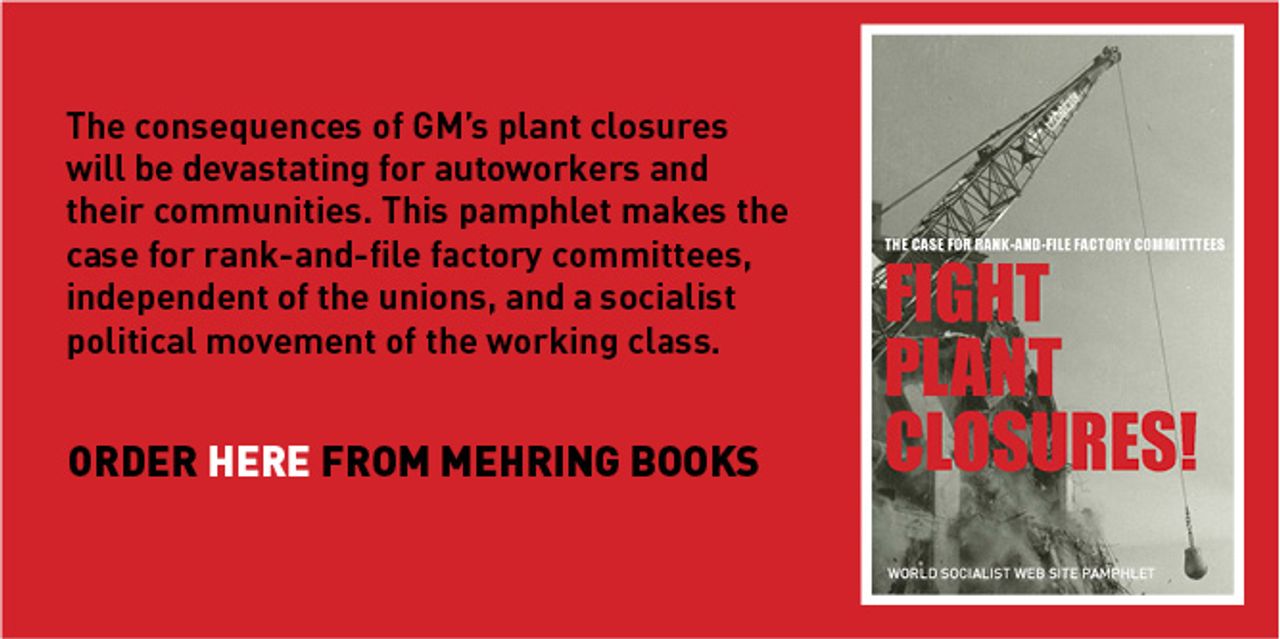
In this context, the meeting held by the World Socialist Web Site Autoworker Newsletter last Sunday in Detroit, Michigan, is of great importance. Participants decided to organize rank-and-file committees, independently of the unions, to oppose GM’s plant closings and mass layoffs.
At the meeting, a Ford worker from Dearborn described her experiences with the United Auto Workers union (UAW), which imposed a pro-company contract in 2015 by resorting to lies, intimidation and vote-rigging. This had “shown that our union is not on our side. It does not act in our interests,” she said. From that point onwards, the workers met outside the factory and union meetings to discuss how to defend their own interests, she said.
The participants at the Detroit meeting passed a resolution calling for the building of “rank-and-file committees, independent of the UAW, Unifor [in Canada] and other unions, in all the affected workplaces and neighbourhoods, to organise opposition to the plant closures.”
These committees would “Establish lines of communication and collaboration with all workers—including auto parts workers, teachers, Amazon workers, service workers and others—and fight for the unity of American workers with our class brothers and sisters in Canada, Mexico and the rest of the world.”