24 Dec 2018

Autoworkers at JLR and Vauxhalls UK face thousands of job losses

Margot Miller 

The UK’s biggest car maker, Jaguar Land Rover (JLR), is to carry out the first part of a £2.5 billion cost saving plan in the new year, threatening up to 5,000 jobs.
The plans were revealed by the Financial Times on December 15 and have not been denied by JLR. The newspaper reported, “During January the company will outline the short-term part of its plan, which will include job losses that run into the thousands, according to several people close to the company. The group has already shed 1,000 roles at its flagship plant in Solihull and reduced working hours at other sites amid falling demand for its diesel vehicles and saloon cars. Analysts are penciling in up to 5,000 roles that may be lost, as the business is forced to take an axe to its workforce in order to survive.”
Employing 40,000 workers in the UK, JLR, owned by the Indian multinational Tata group, is acting following the posting of its first six months of losses in a decade. JLR was considered the flagship of a resurgent British auto industry since its takeover from Ford in 2008, with sales burgeoning year on year. In 2017 it sold 604,009 units, of which 431,161 were Land Rover vehicles and 172,848 Jaguar vehicles. In 2016, car production in the UK was the highest this century and JLR its biggest manufacturer, turning out one-third of the 1.7 million total vehicles produced.
By 2018, however, the company laid off 1,000 temporary contract workers at its two factories in the West Midlands and reduced hours at other sites due to falling global demand for diesel cars and its large saloon model, as well as uncertainties over Brexit. The falling pound after the 2016 European Union EU referendum Leave vote also bumped up the price of components from abroad.
Sales in the same period fell by 13 percent, with a fall in demand in every major market. Sales to the Chinese market, which had absorbed 25 percent of JLR sales, was 50 percent lower in November than the previous year.
In the three months to September, JLR lost £90 million pre-tax compared to the same period in 2017 when it made a profit. It brought in the Boston Consulting Group to come up with a restructuring plan, on top of a hiring and non-essential travel ban already in place—“targeting £2.5bn of cost, cash and profit improvements over the next two years.”
JLR’s decision to shed jobs highlights the increasing anxiety of the majority faction of the UK bourgeoisie opposed to a hard Brexit. Over half of UK car exports are destined for the European Union and two-thirds of car imports come from the EU. In March, JLR sales to Europe fell from 45,000 units to 35,000. UK car industry bosses all supported a Remain vote in the referendum and lobbied May to opt for a soft Brexit, including tariff-free access to the single market. Losing access to the EU’s Single Market and Custom’s Union would create a nightmare scenario for UK manufacturing industry, with supply chains disrupted and the spectre of queues of lorries choking up the ports.
A no-deal Brexit would mean falling back on World Trade Organisation rules, increasing production costs up to £2,370 per vehicle. Even a 5 percent tariff on imported and exported cars between the UK and the EU, and 2.5 percent on components, would add an extra cost of £1,202.
In October, chief executive Ralph Speth warned JLR could lose tens of thousands of jobs as it faced a “very, very difficult situation” and that a bad Brexit deal could cost the firm £1.2 billion a year. The company is clearly factoring in the devastating consequences of a possible “no-deal” Brexit at the end of next March.
The UK car industry across the board is threatened not just by Brexit, but the developing international trade war. Brexit is only one expression of a global breakdown of international relation between capitalist nations and a renewed struggle for markets.
The announcement comes in the wake of last month’s wildcat strike at Ellesmere Port near Liverpool against Vauxhall’s decision to shed 241 jobs. Vauxhall is owned by PSA, who also own Peugeot and Citroën. The wildcat disrupted the collaboration between the Unite union and PSA, who had been locked in negotiations for months in restructuring talks. The union issued no statement opposing job losses at Ellesmere Port and only called for “urgent assurances” over the plant’s future. It would be “pressing for guarantees of no compulsory redundancies …”
The union collaboration in Vauxhall reduced its Ellesmere Port operations to a single shift. These cuts are on top of a total 60 percent jobs losses at the plant over the last two years, with the full collaboration of the union. Fully 400 jobs were lost last year and another 250 earlier on in the year, leaving a workforce of just 1,100.
This year, Japanese-based car-maker Nissan announced hundreds of redundancies at its plant in Sunderland amid rumours the plant may shut.
Workers can expect no fight from Unite at JLR or anywhere else. The union responded to the FT report by demanding only that it be party to any plans over job losses. A spokesman said, “Unite is not aware of any further job losses to those already announced and planned for early in the new year at Jaguar Land Rover. Unite also expects ongoing transparency regarding the difficult current climate the automotive sector is operating in the UK and its impact with the company.”
Most UK car companies, which employ 169,000 workers, are downsizing and cutting costs. Trade unions the world over pursue a nationalist policy, lining up with management to increase the competitiveness of their own companies in the shrinking global market, at the expense of their members’ jobs, wages and conditions.
US President Donald Trump promised his “America first” nationalism would bring back jobs to the US. In November, however, General Motors (GM) announced the closure of five car plants in the US and Canada, which will lead to the elimination of almost 15,000 jobs. The response of the United Autoworkers Union has been a nationalist campaign denouncing GM for moving production to China and Mexico, while offering more concessions in its 2019 contract negotiations with the company.

French “yellow vest” protesters mount pre-Christmas protest against Macron

Alex Lantier

On Saturday, tens of thousands of “yellow vest” protesters demonstrated in France, amid a growing strike wave in neighboring Spain and in Portugal, where protesters also donned yellow vests. Thousands of people joined protest marches in France’s major cities, or blockaded highway intersections and France’s borders with Spain, Italy or Germany, to express their opposition to Macron and the European Union (EU).
According to the Interior Ministry, there were 2,000 “yellow vest” demonstrators in Paris, where protesters divided themselves between the Champs-Élysées and Montmartre, after having tricked police into thinking they were marching on Versailles. The authorities had preemptively shut down the Versailles Palace, next to which they stationed water cannons. In the provinces, according to official figures, thousands demonstrated in Bordeaux, Toulouse and Lille, while hundreds protested in Nantes, Marseille and Lyon.
As usual, the security forces reacted with violent repression. In Paris they arrested Eric Drouet, a truck driver who helped launch the “yellow vest” protests on Facebook, alleging that he had a “sort of nightstick.” Another widely circulated video showed a policeman drawing his pistol and taking aim at protesters after throwing stun grenades unprovoked at the protesters.
The mobilization was a rebuke to Interior Minister Christophe Castaner, who last week declared that on the “yellow vest” protests, “It’s enough,” and ordered police to smash highway blockades. After more than a month of protests and violent police repression of demonstrators, however, the movement is still very widely popular. It has 70 percent support in the French public, and various polls say that between 54 and 62 percent of French people want the movement to continue.
Citing Interior Ministry figures—showing 40,000 protesters Saturday, well less than the 125,000 it announced after the first protest on November 17—the French media are all predicting the imminent end of the movement and a return to order.
It remains to be seen whether the dip in participation figures reflects Interior Ministry manipulation, protesters taking a break for the Christmas holidays, or a more lasting move away from the “yellow vest” blockades and protest marches. What is clear, however, is that political opposition and social anger to the entire Macron government and French state machine are continuing to grow in the working class.
The political situation is becoming more explosive. The government has not satisfied a single one of the demands underlying the ‘yellow vest” protests: for social equality, large wage increases, raising taxes on the rich, Macron’s resignation and the end to police repression. From now on, moreover, everyone is aware of the yawning class gulf separating workers from the union bureaucracies and official “left” parties who were surprised and appalled by the protests.
Macron—who called workers hostile to his policies “lazy” and contemptuously told unemployed workers to “cross the street’ to get a job—now can only hold onto power hiding behind the armored vehicles and tear gas salvoes of the military police. A helicopter team now stands ready to snatch and rescue him from the Elysée palace, should protesters ever storm his official residence. And any excursion out from the Elysée is forbidden to him, even to the cinema or the bakery, according to Le Monde, because it is “too dangerous.”
As his approval ratings collapse further to around 20 percent, the daily added that “The Elysée is now ruled behind closed doors.”
It is ever clearer that if Macron saluted collaborationist dictator Philippe Pétain in November, after passers-by booed him during his “commemorative tour” of French battlefields of World War I, it is that he saw in Pétain a fellow head of state who also inspires mass anger and loathing. A few days later, just before the first “yellow vest” protest, Macron admitted publicly that he had “not succeeded in reconciling the French people with its elites.” This month, he reportedly told his political advisers that he was the target of the “hatred” of the French people.
The awareness that Macron is hated will not, however, change the policy of the capitalist ruling elite, save to make it more violent and repressive. Targeting Macron, protesters have launched a struggle against an entire European and international regime that imposes the diktat of the banks and the financial aristocracy on the workers. The only way to fight the austerity demands of European capitalism is to mobilize workers across the continent to expropriate the banks and transfer power to the working class.
Despite the manifest opposition of an overwhelming majority of French people, the ruling elite continues to demand austerity and militarism. The Macron government is planning drastic cuts to unemployment insurance, pensions and public sector wages. Pierre-Alexandre Anglade, of Macron’s Republic on the March (LRM) party, declared with a straight face: “This is what we were elected to do, and this must remain our compass.”
From Chad, where he was discussing NATO’s neocolonial war strategy, Macron threatened the protesters yesterday: “It is clear that the most severe judicial responses will be given. Now order must reign, calm and good harmony. That is what our country needs.”
Macron has called for months of “coordination” of policies with the protesters for 2019. Like his promises of a minimum wage increase or his canceling of the initial fuel tax hike, this offer is utterly worthless. Macron has given only crumbs, and in bad faith as well, as it is clear that he intends to take back these crumbs as soon as possible.
On Tuesday, Prime Minister Edouard Philippe announced he was suspending all Macron’s concessions to the “yellow vests,” claiming they were too expensive. He flip-flopped a few hours later amid a wave of anger on social media. But these two 180-degree turns in the course of a few hours showed that the government’s promises deserve no confidence whatsoever.
The government is cultivating the “free yellow vest” faction led by Jacline Mouraud, who want to set up dialog with Macron, echoing the “social dialog” between the union bureaucracies, the bosses’ groups and the state, or Francis Lalanne, who is proposing a “yellow vest” list for the European elections. Pollsters are already calculating whether Lalanne’s list might increase the influence of Macron and LRM in the European parliament.
For the “yellow vest” demonstrators, like for the entire working class, there is nothing to negotiate with Macron or with the European Union. Rising class struggles in Europe and internationally, as well as the increasingly bitter political contradictions inside France itself, point rather to the rapid emergence and escalation of a political confrontation between radicalized workers and the reactionary Macron regime.

At least 280 dead as tsunami hits Indonesian settlements

Richard Phillips 

According to the latest official figures, 280 people were killed and more than 1,000 injured, when a tsunami suddenly hit coastal cities and beach resort towns adjoining Indonesia’s Sunda Strait at 9.30 p.m. local time on Saturday.
The official death toll is expected to rise over the next days. At least 57 people are missing and rescuers have still not yet been able to reach all the affected areas.
The disaster came just three months after an earthquake and tsunami struck Palu City on the island of Sulawesi on September 28, killing over 2,500 people and engulfing hundreds of homes in deep mud.
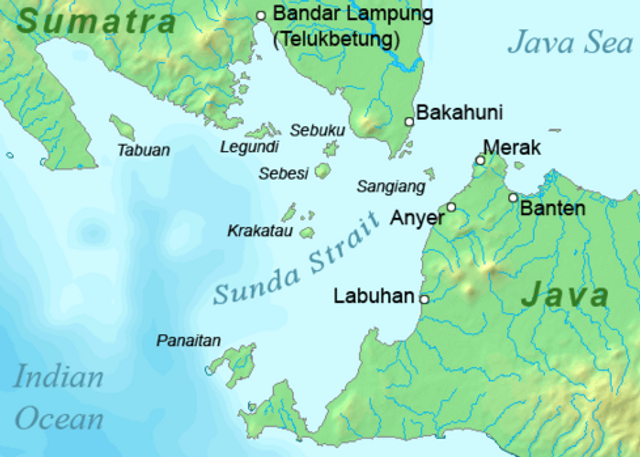
Sunda Strait, Indonesia
Saturday’s tsunami struck without warning at the height of the Christmas holiday long weekend. It destroyed hundreds of homes, businesses, and at least nine tourist hotels and other buildings. The Pandeglang region of Java’s Banten province near Jakarta, along with South Lampung settlements in Sumatra, were among the worst affected areas.
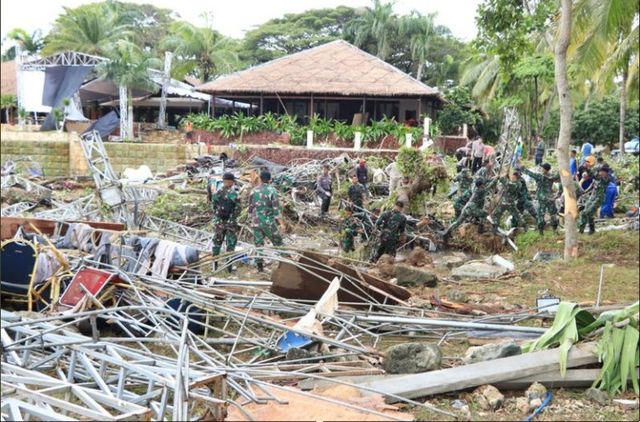
Splintered wood, concrete, bricks and other broken building material lie scattered along the coast and the now deserted villages and towns. Thousands of people have been rendered homeless. Survivors have posted photographs and video on social media of upturned and badly damaged vehicles and boats, and debris-laden water smashing into homes and other buildings.
Many of those killed were tourists, thought to be visiting the popular beach resort area of Pandeglang which also encompasses a national park. Frightening footage of a beachside concert by “Seventeen,” a local rock band, shows a massive wave demolishing the concert platform and sweeping away the band and audience members.
The concert was part of a holiday retreat for workers and their families from PLN, Indonesia’s national electricity company. The rock group has released a statement saying that their bass player, guitarist and road manager were killed and that two other band members and the wife of one of the performers were missing.
Aftermath of the tsunami where the concert was held
A spokesman for Indonesia’s National Disaster Mitigation Agency (BNPB) said that many victims were trapped under collapsed buildings, and that heavy machinery would be required to help with search and rescue efforts. However, as of Monday morning, the much-needed machinery had yet to be sent to all of the affected areas.
Geophysicists suggest that the tsunami could be the result of a major landslide, above or below the water line, at Anak Krakatoa (Child of Krakatoa), a 300-metre high active volcano in the Sunda Strait. This is believed to have pushed a huge wall of water across the strait, which, at its narrowest, is only 24 kilometres wide.
Anak Krakatoa, which emerged from the caldera of Krakatoa about 90 years ago, is one of the country’s most active volcanoes. It has been erupting since June and did so a day before the tsunami. According to a BBC report today, it is still erupting, raising fears that another tsunami might be imminent.
Earthquake geologist and University of Michigan professor, Ben van der Pluijm, told Reuters that the “instability of the slope of an active volcano can create a rock slide that moves a large volume of water, creating local tsunami waves that can be very powerful. This is like suddenly dropping a bag of sand in a tub filled with water,” he said.
Rahmat Triyono, earthquake and tsunami chief at Indonesia’s Meteorology, Climatology and Geophysics Agency (BMKG), told the New York Times that “there was no earthquake” and that’s why “there was no tsunami warning.”
The apparent absence of an earthquake, and thus seismic data, only partially explains the absence of any tsunami warning.
In the wake of the devastating 2004 earthquake and tsunami that claimed an estimated 230,000 lives in the Indo-Pacific, most of them in Indonesia, major powers pledged to help set up an early warning system to ensure such a catastrophe would never happen again.
The early warning system was to link global seismic detection centres, with a system of buoys and sensors that could detect water movements characteristic of tsunami. Various land-based systems were then supposed to be built to sound the alarm.
Even if the weekend’s tsunami was not triggered by a quake, the buoys and sensors should have been in place to provide an early warning. Clearly that was not the case and the victims had no time to react to the wall of water that engulfed them.
Indonesia’s National Disaster Management spokesman Sutopo Purwo Nugroho admitted in September this year, following the Palu disaster, that the country’s warning system was inadequate. The network of 22 hi-tech buoys has not been working since 2012 due to the lack of funding. As a result, the warning system relies on some 134 tidal gauges which are limited in their ability to provide advance notification.
Whether there were any working sensors in the Sunda Strait last weekend is not known at this stage.
Indonesia has 130 active volcanoes and its location in the Pacific “Ring of Fire”—an arc of intense seismic activity that stretches around the Pacific and includes the whole Indonesian archipelago—means that earthquakes and volcanoes are a fact of life.
The devastation caused by what are termed natural disasters is compounded by the poverty that is rife throughout the region. Many people are compelled to live in makeshift housing, often close to the sea, that leaves them vulnerable to tsunamis and quakes as well as typhoons that are also common.
The Indonesian government certainly bears a large measure of responsibility for the latest tragedy. The lack of proper infrastructure, inadequate warning systems and poorly funded rescue and relief services are testimony to the indifference of the government and the ruling class to the lives of millions of working people.
The major powers, which exploit countries like Indonesia as cheap labour platforms, also bear responsibility for the lack of resources for warning systems and disaster relief. The promises that were made after the 2004 catastrophe have proven worthless.
Following the weekend’s tsunami, political leaders around the world have been shedding crocodile tears for the victims. US President Trump described it as “unthinkable devastation,” adding: “We are praying for recovery and healing. America is with you!” What will follow, however, is a pittance in aid, if anything, and the tragedy will be quickly pushed aside in the world’s capitals.

22 Dec 2018

Government of Flanders Priority Country Scholarship 2019/2020 Programme – Belgium

Application Deadline: 1st April 2019 GMT+1.

Eligible Countries: Brazil, Chile, Japan, Mexico, Morocco, Russia, South Africa, Turkey and the United States of America.

To be taken at (University): Various universities in Belgium
  • KU Leuven / University of Leuven
  • University of Antwerp
  • Ghent University
  • Hasselt University
  • Vrije Universiteit Brussel
University colleges (Arts and Nautical Sciences)

  • Artesis Plantijn Hogeschool Antwerpen
  • Arteveldehogeschool
  • Erasmushogeschool Brussel
  • Hogere Zeevaartschool
  • Hogeschool Gent
  • Howest, Hogeschool West-Vlaanderen
  • Karel de Grote-Hogeschool
  • LUCA School of Arts
  • Odisee: Stefanie Derks
  • Hogeschool PXL
  • Hogeschool VIVES
  • Thomas More Mechelen-Antwerpen
  • Thomas More Kempen
  • UC Leuven
  • UC Limburg
Eligible Field of Study: The program holds for all study areas.

About the Award: The selection for the Priority Country Programme is made only once a year.
Many forms of mobility are accepted under the Priority Country Programme: both short mobility of one, two or three months, or long mobility of one semester up to a period of maximum one year, both for study or internship:
  • Brazil, Chile, Japan, Mexico, Morocco, Russia, South Africa, or the United States of America: fellowships for students in both directions, both short and long mobility.
  • Turkey: fellowships for students in both directions, short mobility only: duration of mobility is restricted to one month for internship and two months for study.
Type: Masters

Eligibility: Due to the unique nature of this program, in order to be eligible, the exchange project needs to fulfill all requirements below:
  • The applicant of a Priority Country Programme grant is full-time enrolled in a study programme of EQF level 5, 6 or 7.
  • In case of study mobility: A higher education institution in Belgium/Flanders (Home institution) and an educational institution in Brazil, Chile, Japan, Mexico, Morocco, Russia, South Africa, Turkey or the United States of America (Host institution) have established an academic cooperation agreement or have the intention to set up a new cooperation agreement by writing a letter of engagement.
  • In case of internship: A higher education institution in Belgium/Flanders (Home institution) and an institution/organization/company in Brazil, Chile, Japan, Mexico, Morocco, Russia, South Africa, Turkey or the United States of America (Host institution) have established a traineeship agreement.
  • The Flemish higher education institution, as well as the partner from Brazil, Chile, Japan, Mexico, Morocco, Russia, South Africa, Turkey or the United States of America cannot ask tuition fees to the students for the exchanges.
  • To be eligible for a Priority Country Programme grant, the student cannot be staying in the country of the Host institution already at the time of the selection procedure.
  • International students meet all academic entrance criteria, including relevant language requirements, for entering the study programme in the Flemish host institution.
  • A maximum of six applications per country can be submitted per higher education institution.
Nationality of the student is not a criterion

Number of Awards: It is estimated that 100 to 120 students can benefit from the Priority Country Programme.

Value and Duration of Scholarship: 
  • The grant amount is €650/month for the Flemish student with a total maximum of €2.600 and €800/month for the international student with a total maximum of €3.200.
  • The students receive a supplementary reimbursement for travel expenses, according to the following rules in the link below.
How to Apply: 
  • The application needs to be submitted following the rules for 2019/2020 submission in the Program Webpage (see Link below).
  • All documents are to be written in English, with exception of the official Transcript of records. If the Transcript of Records written in another language than Dutch, French or English, enclose a certified translation.
  • International students meet all academic entrance criteria, including relevant language requirements, for entering the study programme in the Flemish host institution.
Visit Scholarship Webpage for details

Rice University Business Plan Competition 2019 for Student Entrepreneurs

Application Deadline: 10th February, 2019

Eligible Countries: All

To Be Taken At (Country): Houston, Texas

About the Award: The Rice Business Plan Competition is the world’s richest and largest graduate-level student startup competition. It is hosted and organized by the Jesse H. Jones Graduate School of Business at Rice University and the Rice Alliance for Technology and Entrepreneurship, Rice University’s internationally-recognized initiative devoted to the support of entrepreneurship.

Sectors: business plans and companies should fall into one of four categories, or sectors:
  1. Life Science – includes (but not limited to) Medical Devices, Therapeutics, Diagnostics, Health IT, Biotechnology
  2. Energy/Clean Technology – includes (but not limited to) Sustainability, Water, Battery Technologies, Control Systems, Smart Metering, PV Technology, Natural Gas, Transportation/Mobility, Oil & Gas Technologies, Algae, Fuel Cells, Hybrid Vehicles
  3. Technology – Includes (but is not limited to): Mobile Apps, Software, Digital Media, Consumer Web, Bto-B Applications, Enterprise Software, SAAS, Internet, Web, Virtual Reality, Big Data, Machine Learning, Artificial Intelligence, Drones, Hardware, Robotics, Unmanned Vehicles
  4. Other Innovations – Includes (but is not limited to): Advanced Materials, Nanotechnology, Composites, Nanotechnology, Consumer, Other Technology
Teams must choose one sector/category for their companies. Teams may chose a second sector/category, though a second sector/category is optional and not required. Please choose sectors/categories that best align with your company’s product, technology, system or mission.

Type: Entrepreneurship/Contest

Eligibility: Teams must meet all the following eligibility requirements in the Program Webpage below

Value of Award: 
  • Rice University will provide an intense, immersive experience over the course three days for student startup founders to pitch to investors, receive multiple rounds of feedback and advance their startup.
  • There will be over $1 million in prizes, and all 42 teams who compete at Rice University in Houston are guaranteed to win cash prizes. The minimum cash prize is $500 and the grand prize winner receives a $300,000 investment (typically in the form of a convertible debt note, without geographic restrictions.)
Duration of Program: April 4-6, 2019

How to Apply: Submit your application online at www.rbpc.rice.edu
It is important to go through all application instructions and eligibility requirements before applying.

Visit the Program Webpage for Details

ACCEL Awards 2019 for Early-stage African Startups (All expenses paid to London, UK + £15,000 Award)

Application Deadline: 31st January 2019

Eligible Countries: African countries

To be taken at (country): UK

About the Award: The Africa Club is a student-run club at London Business School. We exist to promote engagement on Africa within the school and with the broader business community, either in London, Africa or globally. Our members are individuals who have either worked in Africa or have cultural or professional interests in the continent.
The Accelawards will be hosted at the Annual Africa Business Summit on Saturday 27th April, 2019. The Africa Business Summit is one of the largest of its kind globally, and the leading forum in Europe for shaping business perspective on Africa’s future. This summit will give the ACCELAwards finalists an unrivalled stage to engage with global business leaders and African professionals.

Type: Entrepreneurship

Eligibility: You need to be an African entrepreneur with a business proposal that has proof of concept. The business needs to be Africa focused or caters primarily to the African market.

Selection Criteria:Each entry will be assessed by a minimum of two judges based on the below 5 criteria.
a. Originality of idea
• Is the start-up a new or novel application of existing knowledge/technology/business model to the Africa region in focus ?
• High scores should be given to start-ups that are not clones of well known business models already existing within the African region

b. Strength of business case
• Is the founder able to articulate a strong business case including target market, pain points and how the start-up is differentiated?
• Does the start-up have clear revenue models and path way to profitability?
• High scores should be given to those applications that demonstrate clear business plan to achieving a profitable business

c. Level of product development
• Is the product or idea well developed and ready for investment opportunities?
• Do they have technology patents, rights, brand ownerships or partnerships already in place?
• Is the product already in the market?
• High scores should be given to those applications that demonstrate well developed products or services that are already on sale

d. Level of business opportunity or impact
• What is the level of potential social impact of the idea in Africa?
• What is the potential size of the market share and profitability
• High scores should be given to those applications that demonstrate scalable social impact

e. Team’s ability to execute the idea and other Intangibles
• Does the team have the right combination of passion? insight? experience? qualifications?
• Do secondary aspects of the application strengthen the likelihood of success e.g. founder’s story?
• High scores should be given to those applications that demonstrate passionate teams with significant expertise in the relevant business sector


Number of Awards: 3 Finalists, 1 Winner

Value of Award:
  • Get Unparalleled International Exposure
  • Prestigious Brand Partnership
  • Global Business Mentoring&Network
  • Fully Sponsored Trip to London for the Top 3 Start-ups
  • £15,000 in Award Prizes
Presentation of Award:  27th April, 2019.

How to Apply: 
  • It is important to go through all application requirements on the Programme Webpage see link below) before applying

Visit Programme Webpage for Details

France: Centre International de Mathématiques et d’Informatique (CIMI) Masters Fellowships 2019/2020 in Mathematics and Computer Studies for International Students

Application Deadline: 3rd February 2019 (2200 Paris time).

Eligible Countries: International

To be taken at (country): France

Eligible Field of Study: Maths and Computer studies

About the Award: Every year CIMI (Centre International de Mathématiques et d’Informatique) in Toulouse provides a number of fellowships for students enrolled in a Master course in Mathematics or Computer Science in one of the programs associated with CIMI.

Type: Masters

Eligibility: 
Those fellowships are open, on a competitive basis, to French and foreign students and awarded on the basis of the quality of the academic records.
First year (M1) applicants: Applicants must have obtained a degree corresponding to the European Bachelor’s degree.
Second year (M2) applicants : Applicants must have successfully completed the first year of a European Master’s degree, or an American Bachelor’s degree, or any equivalent level.
The CIMI LabEx applies an equal opportunity policy in selection.


Selection: Fellowships applications will be examined by the LabEx CIMI Executive Committee  and Prospective Committee. Grants will be awarded on the basis of the quality of the academic records.

Number of Awardees: 4 fellowships for students starting on the first year of a Master’s degree M1 and 10 fellowships for those starting on the second year of a Master’s degree M2 will be available.

Value and Duration of Scholarship: The level of funding will be competitive and sufficient to cover tuition fees and part of living expenses in Toulouse :
  • 600€ per month over 10 months for applicants starting in the first year M1
  • 1 000€ per month over 10 months for applicants starting in the second year M2
How to Apply: 
1.    Curriculum Vitae (max. 2 pages)
2.    Details of the grades obtained at University from the 1st year to present
3.    Details of the courses attended in the year 2017-2018
4.    Two recommendation letters : do not forget to mention (step 4 of the application process) the e-mail address of the professors wishing to send recommendation letters. They will receive an automatic e-mail to upload their letter.
5.    Applicant’s motivation letter : applicants for a Master 2 fellowship MUST clearly state in their letter the M2 programme (M2R, IMAT,…) they are applying for.
6.    Information about current level of French language skills (only applies to foreign students from non French speaking countries applying for a M1 fellowship).  All Master 1 courses will be taught in French.


To apply please CLICK HERE.


Visit Scholarship Webpage for details

MIASA/Network Point Sud 2019 Summer School on Intra-Regional Migration in Africa (Fully-funded to Accra, Ghana)

Application Deadline: 4th February 2019

Eligible Countries: African countries

To be taken at (country): University of Ghana; Legon, Accra 

About the Award:  The objective of the summer school is twofold. Firstly, it aims to confront different disciplinary approaches in order to stimulate a fruitful dialogue about theories, methods and fields of investigation related to the subject. Secondly, the summer school seeks to shift away from the over-emphasis on current dominant perspectives on migration in Africa.
Following a comparative perspective, this interdisciplinary dialogue will permit to discern the commonalities and specificities with regard to different forms and dimensions of the intra-regional migration in Africa. The summer school does not have an ambition to cover every dimension of African migration.

Type: PhD, Postdoctorate, Short-course

Eligibility:
  • The call is open for doctoral and postdoctoral students doing research on one of the axis mentioned above.
  • Post-doctoral candidates should have defended their thesis no longer than five years ago.
  • Doctoral students should be in an advanced stage of their project and should be able to present first results of their research.
  • Candidates should relate their application to one of the axes mentioned above.
  • Candidates should have good skills in English and/or French language.
Number of Awards: Not specified

Value of Award:  The entire cost for each participant (travel, accommodation, meals, etc.) will be covered by MIASA.

Duration of Programme:  The summer school will take place from the 23rd to 28th May 2019 at the Centre for Migration Studies in Accra/Ghana.

How to Apply: 
  • Candidates are required to send an abstract of their research (500 words maximum), a CV with current academic affiliation and a letter of motivation.
  • Please send your application via email by 4th February 2019 to the following address: scholze@uni-frankfurt.de
  • It is important to go through all application requirements on the Programme Webpage see link below) before applying
Visit Programme Webpage for Details

Award Providers:  The Summer School is financed by the Merian Institute for Advanced Studies (MIASA) and organized in collaboration with the network Program Point Sud, the Centre for Migration Studies at the University of Ghana in Accra and the Goethe University Frankfurt/Main in Germany.

Government of Flanders Mastermind Scholarships 2019/2020 for International Students – Belgium

Application Deadline: Varies by institution. Some institutions have as deadline 1st February 2019! Apply early!

Offered annually? Yes

Eligible Countries: All

To be taken at (country): Various universities in Belgium
  • KU Leuven / University of Leuven
  • University of Antwerp
  • Ghent University
  • Hasselt University
  • Vrije Universiteit Brussel
University colleges (Arts and Nautical Sciences)
  • Antwerp Maritime Academy
  • Artesis Plantijn University College Antwerp
  • Erasmus University College Brussels
  • Karel de Grote University College
  • LUCA School of Arts
  • PXL University College
  • University College Ghent
Eligible Field of Study: The program holds for all study areas.

About the Award: The programme aims to promote the internationalization of the Flemish Higher Education, as stated in the Action Plan for Student Mobility, Brains on the Move (September 2013).
Students cannot apply directly. Applications need to be submitted by the Flemish host institution.

Offered Since: 2015

Type: Masters

Eligibility: The Flemish host institution applies on behalf of the student.
General eligibility requirements
  • The applicant applies to take up a Master degree programme at a higher education institution in Flanders (hereafter ‘Flemish host institution’).
  • The applicant should have a high standard of academic performance and/or potential. He/she meets all academic entrance criteria, including relevant language requirements, for entering the Master programme in question offered by the Flemish host institution.
  • All nationalities can apply. The previous degree obtained should be from a higher education institution located outside Flanders.
  • Students who are already enrolled in a Flemish higher education institution cannot apply.
Selection: A Flemish selection committee awards the scholarships, in cooperation with the Flemish Department of Education and Training.

Number of Awardees: 30 to 40

Value of Scholarship: The incoming student is awarded a scholarship of maximum €8000,- per academic year.

Duration of Scholarship: The duration of mobility is minimum 1 academic year and maximum the full duration of the master programme. If the student obtains less than 45 ECTS in the first year, then he/she loses the scholarship in the second year.

How to Apply: 
  • You can find more information in the guidelines for application in the Scholarship Webpage link.
  • You need to contact the Flemish higher education institution to inquire about their internal selection procedures and deadline for submitting the application.

Visit Scholarship Webpage for details

Indian Agencies Snooping Into Your Computer: The Orwellian Nightmare Is Here

Kabir Deb

In 2001, for the very first time, I took George Orwell’s masterpiece “1984” in my hand. A dystopian novel having a dictator named “Big Brother” who believes in “WAR IS PEACE, SLAVERY IS FREEDOM, IGNORANCE IS STRENGTH” and used to spread his belief by hook or crook. Big Brother used to spy on every citizen of his rule because he wanted no one to go against him, either by technology or by marching in the street against him. The novel gave me chills even in my adolescence and it brought much more reality for me because I saw the Godhra Riot after the novel’s conclusion. Even when the novel showed its Big Brother slicing out freedom from every citizen it seldom brought so much tension in me until Narendra Modi government came into power with its nonsense policies.
Few days back I went through “1984” and “No Place to Hide” by Glenn Greenwald, a book on the much needed Edward Snowden. Snowden made 1984 seem a reality because he released the bitter truth of the spying American agencies like CIA, FBI etc., which used to observe every move of the citizens of America. He said, “I don’t want to live in a world where everything that I say, everything I do, everyone I talk to, every expression of creativity or love or friendship is recorded”. That’s right, he showed that even a Samsung TV to a refrigerator, everything was a means to gather information which can cripple the government and its evil motives.
Today after the BJP government legalised “Hacking or Spying of Data by 10 Agencies of the Central government” just replicated “1984” in India and just like Snowden showed the reality of America, today it feels that actually Edward Snowden released the reality of the governments of each and every nation. The ten agencies that have been authorised to intercept, monitor and decrypt “any information generated, transmitted, received or stored in any computer resource” include the two intelligence agencies — internal spy body Intelligence Bureau and external intelligence agency Research and Analysis Wing.
The other agencies include: the Narcotics Control Board (which polices illegal drug trade), Enforcement Directorate (which looks after economic crimes), the Central Board of Direct Taxes (which is responsible for income tax), the Directorate of Revenue Intelligence (an anti-smuggling agency) and the Central Bureau of Investigation (which is tasked with investigating high-level corruption and other crimes).
In 2017, when the Supreme Court declared Right to Privacy as a fundamental right, the decision gave us a relief that along with it the Big Brother of India will fall which can help in keeping what’s private as private. From our sexuality to computer data, everything which is ours would be ours forever without any external involvement in the form of spying. It made many debates appear rational because one fundamental right brought a fair conclusion to many irrational discussions. Today when the government released this evil decision to provide full power to these ten agencies to spy over each and every citizen it reveals the naked picture of our country and its present condition. The present time is poisonous, it’s insecure, intolerant and the leaders are insecure that the citizens might cripple them through computer data or by releasing the evil secrets which can lead to mass killing or framing anyone.
It says that the UPA government brought the Information Technology (IT) Act, for the very first time and just like the former party, the present party is doing the same. Ironically, it sounds like “He is a shit so I have to become a shit”. UPA government never gave full power to Central Agencies to survey on Indian Citizens to gather information. Instead it gave power to Intelligence Bureau only, for the protection of the nation from external means. But today, the BJP government released its dictatorial picture before the country by giving full permission to the agencies which never should have the power because it’s against everything, both Law and Ethics.
The Orwellian Era has returned back and the Big Brother sits on the throne with Saffron colour and framed, mythical Gods as his shield. He sits with everyone beside him vowing to convert everyone, I repeat, everyone into THE Saffron Army to stay in power and to build an irrational and fragile country out of its tradition full of mythology.

Macron and the Air France Experience

Peter Koenig

On an Air France flight from Paris to Latin America, the plane is full, mostly with working class Latinos, going home for Christmas to spend a few festive days with their families and friends. They have worked hard to save their money for the trip. The plane is old and decrepit. Has no properly working entertainment system – and that on a trajectory of over 12 hours without interruption. Who cares. Management knows that the humble passengers won’t complain. Anyway, they are under-people. Let’s reserve the better and newer planes for classier people. They pay better, are better clients. Isn’t that the thinking behind such decisions? – Of course, it is. It’s the greed-driven maximizing profit scheme to the detriment of the population. It’s not just AF, it’s everywhere, everywhere you look and are touched by a corporate giant. We the people, are not even sheepish anymore; we are silenced. We are not asked, not consulted, whether we agree to be photographed and face-read at every corner. It’s just the way it is. Its intimidation by control – by over-control, and by cattle treatment. In this, the French and the US TSA (Transportation Security Administration) are not far apart.
For airport security, you are pushed through what I call a “naked-machine” – Though they tell you that it’s not true, that nobody sees anything other than potential drugs or weapons hidden in human crevices – well if they see crevices, they must see you naked. Behind the scene hidden away in some dark room are the machine operators, they see every human passing through it naked, balls, vagina, breasts and all. Imagine, the absurdly obscene, pathological imagination of those operators – and those who command them!
A machine, a robot of sort, disposes over you. If you don’t conform, you are just left behind,or harassed no end – you may literally lose your plane or connection. Cases of the US TSA abound – some of them are violent and are brought before a court – but in most cases to no avail. The ‘system’is always right. And mind you the system, is a private system, its not even state owned, its outsourcing and privatization “ÜberAlles”. But no protests à la Yellow Vests. We are conveniently silenced. It’s Macron “ÜberAlles” – sounds like déjà vu? – Well, yes. It is. –Neofascism is undeniable.
Yes, that’s the way the ordeal begins. Actually, it begins earlier – at the check in, for example. AF weigh your luggage by the kilo – and, while some agents are a bit more lenient than others, if you are unlucky it hits you having a kilo in excess. Either you somehow dispose of it or reshuffle it to hand luggage – which also has a limitation of weight, you are charged the fee for an extra luggage. What to do? – You are at the airport. They have a captive “market”, because this money-profit centered “market” system has the power over you. You are at the airport, you have to fly, you charge this horrendous extra fee to your credit card, or else you are left behind; no scruples. That’s Macron 101. No concessions. And the French employees are well trained, lest they may lose their bad paid, but nevertheless vital jobs. You want to survive – bend over. No solidarity, no empathy, just hardball. Le Roi Macron says so. And you better obey —- or else — but the ‘or else’ has now suddenly gotten a yellow face – the Yellow Vests. We can just hope that they will propel the finance-mafia dictator into his overdue abyss.
Next, boarding the plane – an elderly passenger visibly with a hurting leg, kindly asked the flight assistant, alias the “cattle guard”, whether he could go through with the privileged ‘frequent flyers’, those who have given the company enough money to justify an extra discriminatory favor. She refuses. He insists, she refuses – until a man behind tells her, for human’s sake, please let him through. She hesitantly nods, then lets him go through.
What does all that have to do with Macron? – Everything. The sort of de-humanized civil behavior is what he instills in people, incorporations. Greed first, everything else, like solidarity, is not even second, it’s of no value. The young who want so desperately cling to their slave-paid jobs, have to obey, or else, they may lose their employment.But now it’s gone too far. Enough is enough. The Yellow Vests represent every industry, every citizen, every abject Macron law; they want to reverse the wheel, à la French Revolution. Enough is enough. Enough privileges for the rich and powerful. Even on the planes.
In ‘economy’,where the cattle is herded, those who saved hard to afford a trip to see their families, rows are getting narrower and narrower. Over time your legs get cramped; an increased risk of thromboses that can be deadly,especially when it happens on 10,000 meters altitude – far from an airport, above the sea. This, of course is quite different for those on first, business or economy plus class, they have more space, sit comfortably, and their entertainment system works fine even on an old decrepit plane. Proper maintenance for the rich and beautiful, neglect for the “less beautiful” populace.
When I complain about the inoperable entertainment system (ES), the chief of cabin arrives. He promises to see what he can do. After a while he returns with a tablet-screen full of my previous AF flights. I’m a good customer. So, he discretely offers me to be placed on an economy-plus seat, where the ES works. He whispers, you are a good customer, so we will do something for you. Amazing in an overcrowded plane he finds an unoccupied seat. I go and look at it – and as soon as they – the flight attendants for the better people – see me, they say, “Sir, the bathrooms are in the rear”. When I tell them that the cabin chief offered me a seat in their section, their tone changes: “Sir, can we offer you a glass of Champagne?” – I’m disgusted, but politely decline, deciding to stay with my kind of ‘cattle’. I prefer reading and writing – like this little essay – among my same-sakes. And am happy about it.
The cabin chief was admittedly nice. He fulfilled his duty, keeping a relatively ‘good customer’ happy, I have to admit. I’m fodder for the ‘maximizing profit’ doctrine.Yet, due to his friendly smile and body language, I give him the benefit of the doubt. Hopefully, not all those who have to make a living off the neoliberal Macron and greed driven money machine, have lost their innermost identity. That’s the cloud’s silver lining. That’s the remaining hope to build on. Hope is the last glow that dies.
Food service, used to be decent with AF. No longer. They don’t have you pay for it yet, but it is almost inedible. – But then, I think of the millions of Yemenis who thanks to the western and Macron-supported killing machine are suffering and dying from famine. So, I eat my portion happily.As a parenthesis, according to the UN, about 85,000 children below age 5 perished through the satanical Saudi-US-UK-French led war of horror. Most of the children died from famine and cholera induced diseases. I was thinking of those big eyed- and skeleton-like bodies, too weak to stand, let alone walk, destroyed for life from famine.
What does that have to do with Macron? – Everything, of course. Macron’s Airforce helped the crime regime of the Saudis bombing Yemen, a poor but proud people, to bits and pieces; to kill possibly hundreds of thousands – nobody counts – mainly children and women. Macron, siding with the elite – he surely has no reason whatsoever to bomb Yemen – helped the ‘allies’ of crime, destroy an entire nation. He of course is not alone, but accompanied by the best and the brightest of the western allies, even Germany – which, according to their non-aggression treaty (remnant of the WWII Armistice arrangement) – is not allowed to participate in any conflict hostility emanating from her territory – except, of course, if the Master of the treaty orders it.
The Yellow Vests want Macron out. Macron has become the enemy of the people. Literally. He is probably proud of it, because that’s testimony enough that he works for the rich and powerful, that he accomplishes the tasks he has been slanted and put in office for, with less the 25% of eligible votes. He lied, promising change, but change that benefited the people. Change to the detriment of the people is what he implemented. The result is an equation of dynamics, the right has not thought of. Well, thanks god for these dynamics; they brought about the storming of the Bastille in 1789, and a transformation of much of the world. Though, granted, not all that came out of the French Revolution has persevered. The rich and powerful have an unlimited and insatiable stock of wealth to draw upon. Never mind that it’s stolen wealth – as long as they dispose of it and are able to defend it with brute military and police power, they command.
And so, the merry-go-round continues. Air France will play the game; they have to. They are bound into the system, along with French corporatism. The name of the game is intimidation. “Inconvenient”, not-playing-by-the-rules staff are being dismissed. Of the face reading / passport machines, only one out of three is operable, causing long queues. Out of about 20 customs boots, only two are occupied by an agent. Macron saves at the cost of stressed passengers, who have to spend precious time in long lines, risking literally missing their connection planes.
But the Big shots don’t care. The populace’s time is worth peanuts – its like slave time. In any case – you have to go through ‘the system’ – if not, screw you, you remain stranded.
Good riddens Mr. Macron, very good riddens – to never appear again on the horizon. – Vivent les “gilets verts”!

Australian Labor Party rejects demands to increase unemployment benefits

Robert Campion

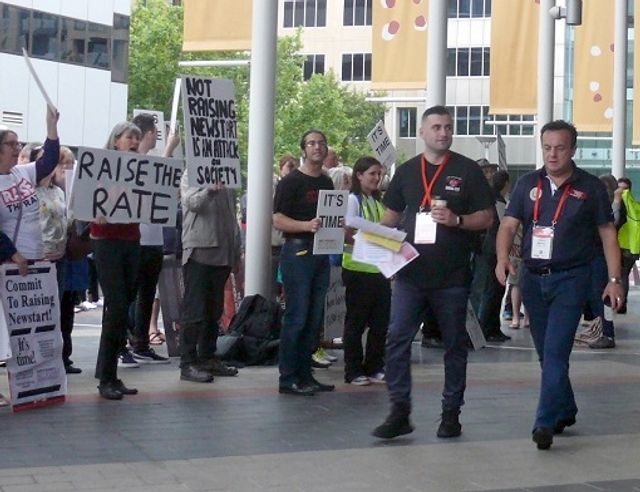
Despite “raise the rates” protests in the foyer, the Labor Party’s national conference in Adelaide this week rejected calls for a Labor government to immediately increase the sub-poverty levels of the unemployment payments, Newstart and Youth Allowance.
ALP delegates walk past protest for an increase in Newstart
More than anything else, this unanimous stand against the poorest members of the working class exposed the utter fraud of the “fair go for Australia” logo that dominated the conference stage, foreshadowing the party’s campaign pitch for the looming federal election.
Despite the endless claims at the conference about fighting inequality and low-wage exploitation of workers, the decision means that the allowances will remain at levels deliberately kept low in order to coerce unemployed workers into taking jobs on substandard wages and conditions.
In the lead-up to the conference, the Australian Council of Social Services (ACOSS) and a coalition of non-government organisations campaigned for an immediate rise in the rates, which have effectively remained frozen in real terms for a quarter century since the Keating Labor government of the 1990s.
Media reports forecast a passionate debate on the floor of the conference, with “Left” faction members committed to moving a resolution to back the demand. In his opening address to the conference, however, Labor leader Bill Shorten made plain that no such resolution would be accepted. He said the party’s policy would remain to merely promise an unspecified “review” of the issue, indicating that the party’s factional heavyweights would ensure that outcome.
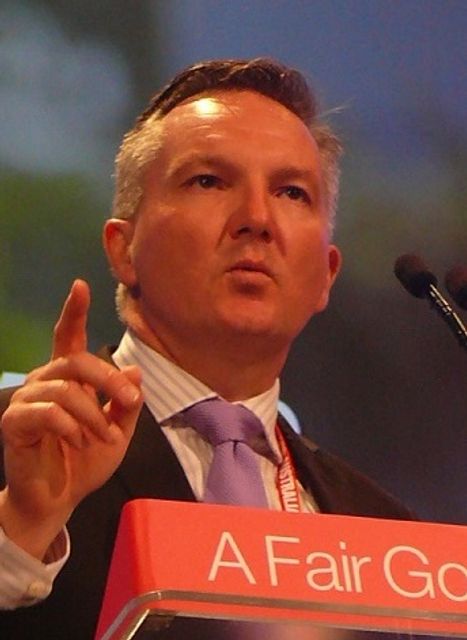
Chris Bowen
Shadow treasurer Chris Bowen soon reinforced Shorten’s words at a press conference where he responded to the Liberal-National Coalition government’s just-released Mid-Year Economic Outlook (MYEFO).
The World Socialist Web Site asked Bowen whether his frequent references to Labor taking “difficult decisions” to deliver bigger budget surpluses than the government meant keeping Newstart and other welfare payments at sub-poverty levels, deliberately imposing suffering on the unemployed. Bowen twice refused to answer the question, except to confirm that the party’s decision to “review” the rate had been announced already.
As with all the issues presented during the conference, the decision had been made behind closed doors in order to present a “unified” and “disciplined” party to the Australian and international ruling elite, ready for government and capable of presiding over economic and political turmoil.
Newstart is among the lowest unemployment allowances in the OECD. The cost of living has drastically increased since the 1990s, making it impossible to live on the allowances and cover the costs of rent, electricity, food, transport, a phone, clothing and other essentials.
According to the limited, semi-official Henderson Poverty Index, the poverty line as of June 2018 was $517 per week for a single adult. The Newstart base rate is little over half that—$275.10 per week, or less than $40 a day.
Youth Allowance rates—for unemployed youth under 18 living away from their parent’s home for study, training or job searching—are even lower, on $222.90 per week.
About 900,000 people are trying to survive on Newstart, Youth Allowance and other related benefits. Compounding the social crisis is the lack of job opportunities. For every job vacancy there are eight people looking for work.
Further exposing the fraud of Labor’s “fairness” slogan was the “Left” faction’s shameless endorsement of the consensus decision to reject the “raise the rates” demands during the “debate” on the conference floor.
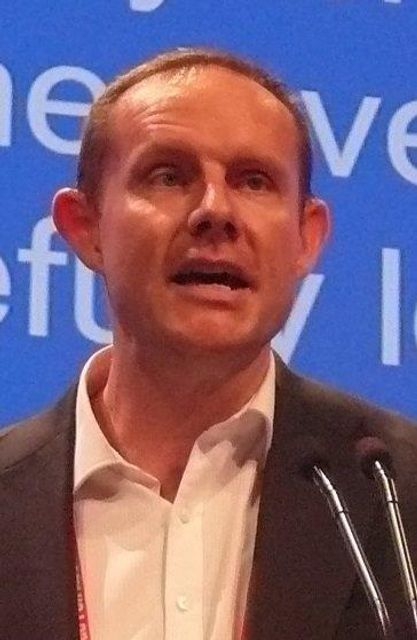
Darcy Byrne
The “Left” faction’s Darcy Byrne had declared before the conference that simply reviewing the Newstart rate was “not good enough.” He said he would be moving a resolution to commit a Labor government to substantially raise it during its first term in office.
When he spoke at the conference, he lamely announced that the increase was not supported by the party leadership “due to its expense” but his faction had “won” a commitment for a Labor government to “urgently review” the rate within 18 months of taking office. He provided no details of this review.
The amended resolution was seconded by another “left,” Rose Jackson, the party’s assistant general secretary in the state of New South Wales. For all her confected fiery rhetoric about inequality and appeals for the party to be “bold,” she sought to justify the agreed resolution by claiming that a review would be “useful” because it would “demonstrate” that the current rates are “inadequate.”
These comments fly in the face of the obvious inadequacy of the payments, and the strong public support for raising the rates. A poll commissioned by ACOSS in June found that over two-thirds (68 percent) of Australians supported an increase in Newstart payments. Furthermore, 92 percent agreed that no one in Australia should go without basic essentials like food, healthcare, transport and power.
The real issue is not the “cost” of raising the rates. A Deloitte Access Economics study released in September estimated the annual cost of raising the Newstart levels by $75 a fortnight would be $3.3 billion. This is dwarfed by the estimated $11.6 billion cut from social security spending over the past four years, let alone the massive increases in military spending. With bipartisan Labor-Coalition support, the federal government is currently spending more than $17 billion on buying 72 F35 war planes from the US.
The reality is that the allowance rates are kept low in order to drive desperate workers and young people into super-exploitative, insecure work. Shorten himself spelt out that fact in 2013, when he championed the Gillard Labor government’s refusal to raise the rates.
In a letter to a Greens senator, Shorten—then the Labor government’s employment minister—declared that lifting Newstart payments would have “unintended and undesirable” consequences, because the unemployed might “no longer have an incentive to work.”
Notably, the primary reasons cited by the Labor “Lefts” for addressing the issue had nothing whatever to do with the fundamental social right of all workers to a decent, liveable, income or social safety net.
Instead, they cited the concerns voiced by sections of big business that the low rates were restricting economic growth. The Business Council of Australia, representing the largest corporations operating in Australia, noted as far back in 2012 that Newstart levels “may now be so low as to represent a barrier to employment.”
On the first day of the Labor Party conference, “raise the rate” protesters handed delegates leaflets pamphlets asking: “Can you give us some decent policies to vote for—not just the lesser of 2 evils?”
This campaign sought to channel widespread working class disgust back into illusions that a Labor government could be pressured into a less cruel policy. But these pleas fell in deaf ears.
As with its “sister” social democratic parties around the world, the Labor Party has long been in the forefront of the assault on working class basic rights and social conditions, dedicated to serving the profit requirements of the financial markets.