24 Dec 2018

New Zealand government calls for greater US military presence in the Pacific

Tom Peters

During a recent visit to Washington, New Zealand Deputy Prime Minister Winston Peters signaled a further escalation in the Labour Party-led coalition government’s alignment with the Trump administration’s economic war and military preparations against China.
Peters is also Foreign Minister and leader of the NZ First Party, a right-wing nationalist, anti-Asian party. Despite receiving just over 7 percent of the votes in the 2017 election, NZ First was given several ministerial roles by Labour Prime Minister Jacinda Ardern and plays a major role in determining the government’s foreign and military policy.
Peters met with senior members of the Trump administration, including Vice-President Mike Pence, Secretary of State Mike Pompeo, Director of National Intelligence Dan Coats and National Security Adviser John Bolton.
Peters also delivered a major speech at Georgetown University on December 15, calling for a stronger US-New Zealand alliance in the Pacific. He declared that the South West Pacific was “becoming more contested and its security… ever more fragile.” He called on the US “to engage more” in the region, adding, “we think it is in your vital interests to do so, and time is of the essence.”
Clearly referring to China, Peters noted that “larger players are renewing their interest in the Pacific with an attendant element of strategic competition. The speed and intensity of those interests at play are of great concern to us.” He also pointed to the supposed “threat” posed by North Korea and by “militarised” islands in the South China Sea, which “challenge international law and norms.”
China’s territorial disputes with neighbouring countries in the South China Sea have been seized on by the Obama and Trump administrations as the pretext for a vast US military build-up in the region.
In an attempt to reverse its long-term economic decline, the US ruling elite is preparing for war against China, which it views as the main obstacle to its global hegemony. Washington is demanding unwavering support from all its allies, including Australia and New Zealand.
Despite New Zealand’s economic reliance on China, its largest trading partner, the Labour-NZ First government, which also includes the Green Party, has significantly strengthened New Zealand’s alliance with US imperialism. The government has redeployed troops to Iraq and Afghanistan and sent air force personnel to Japan to join the encirclement of North Korea. Most significantly, this year’s Defence Strategic Policy Statement echoed the Pentagon in labelling Russia and China the main “threats” to global stability.
In his Washington speech, Peters praised the historic collaboration of New Zealand with US imperialism in the Pacific, which he called a “vast canvas for the United States’ emergence as a global power in the nineteenth and twentieth centuries.” He listed the US colonies of American Samoa, Palau, Micronesia, the Marshall Islands, the Northern Marianas and Guam—some of which host important US military facilities and were the site of bloody battles in World War II.
Peters also mentioned New Zealand’s colonies Niue, the Cook Islands and Tokelau. For more than a century, NZ’s ruling class has relied on its major imperialist allies, Britain and the US, to support its own colonial ambitions in the Pacific.
The Deputy Prime Minister pointed out that since World War II “New Zealand has regularly answered the call when the United States has mobilised its friends in defence of its interests and international security more broadly.” Successive NZ governments have supported one US war after another, including in Korea, Vietnam, Iraq and Afghanistan.
The Labour-NZ First government, Peters said, had a “sense of urgency about Pacific risks” and recently purchased four new maritime surveillance aircraft “to do our share to promote regional security.” He praised US “military cooperation,” including “maritime security” and “support for training and equipment for Papua New Guinea, Fiji and Tonga.”
Peters’ call for further militarisation comes amid an intensifying anti-Chinese campaign in New Zealand, aimed at overcoming widespread anti-war sentiment and hostility to the Trump administration.
A central figure in the campaign is academic Anne-Marie Brady, who has denounced political donations by Chinese-born businessmen and demanded that New Zealand’s intelligence agencies monitor Chinese people involved in politics, business, universities, media and cultural organisations.
Without any evidence, Brady has accused Jian Yang, a Chinese-born MP in the opposition National Party, of being a Chinese Communist Party “agent,” a claim echoed by NZ First.
Brady has been promoted in the media as an independent “China expert”. One Fairfax Media columnist labelled her “New Zealander of the Year.” She is also backed by the Daily Blog, a nationalist publication funded by three trade unions.
Brady has received funding for her research from the Washington DC-based Wilson Center and the NATO military alliance and is supported by US Democratic and Republican politicians. In May, former US presidential candidate Hillary Clinton praised Brady for drawing attention to the “new global battle” against Chinese influence.
Visiting New Zealand this month, US Assistant Secretary of Defense for Asian and Pacific Security Affairs, Randall G. Schriver, revealed that he personally knew Brady and had spoken to her about “Chinese influence operations.” He told the media on December 11 that the Trump administration was ready to “collaborate” with NZ intelligence agencies in an investigation along the lines suggested by Brady.
Following Schriver’s and Peters’ statements, New Zealand’s spy agency, the Government Communications Security Bureau (GCSB), joined its US and UK counterparts in publicly accusing Beijing of carrying out a “global campaign” to steal intellectual property and commercial data, including from organisations in New Zealand. The agency provided no evidence for these claims.
Whistleblower Edward Snowden revealed in 2015 that the GCSB spies on China as part of the US-led Five Eyes intelligence network.
New Zealand’s integration into US war plans and provocations against China demolishes the claims by pseudo-left groups and trade unions that the Labour-NZ First-Greens government represented a shift to the left. In fact, the coalition was formed in October 2017, following the intervention of US Ambassador Scott Brown, who signalled that Washington wanted the new government to take a harder line against China.
With the anti-Chinese NZ First playing a central role, the Ardern government has ramped up the ruling elite’s agenda of austerity, nationalism and militarism, and is dragging the country into a potentially catastrophic confrontation between nuclear-armed powers.

As Australian government unravels, Labor prepares to take office

Mike Head 

This year is ending with Australia’s Liberal-National Coalition government being torn apart by factional warfare and the Labor Party steeling itself to take power under conditions of intensifying global tensions, economic slump and an eruption of working class struggles worldwide.
As in previous periods of crisis and war—during both world wars, the Great Depression of the 1930s and the global financial meltdown of 2008—key sections of the ruling capitalist elite are looking to Labor to protect their interests.
Today, however, the in-fighting wracking the Coalition marks a deeper political crisis that affects the entire parliamentary order. There is sweeping popular discontent with all the establishment parties, including Labor and the Greens. For decades, successive governments, both Coalition and Labor, have enforced a corporate assault on working class jobs, working conditions, living standards and basic services.
Feeding into the turmoil is the instability surrounding US President Donald Trump, combined with Washington’s escalating economic and military confrontation with China, Australian capitalism’s largest export market. These developments are sending shock waves through the Australian ruling class, which has relied on US global hegemony since World War II to pursue its own predatory interests throughout the Indo-Pacific region.
In response to this explosive situation, the Coalition’s most right-wing elements, orbiting around Home Affairs Minister Peter Dutton and ex-Prime Minister Tony Abbott, are striving to refashion the Liberal and National parties into a Trump-style populist and semi-fascistic movement to divert the unrest in nationalist directions.
Having ousted Prime Minister Malcolm Turnbull, a member of the Coalition’s supposed “socially progressive” wing, in August, these layers are prepared to destabilise the government of his successor, Scott Morrison, even if it means losing the looming federal election.
Last week the civil war inside both the Liberal and National parties reached new heights. A succession of scandals and politically-damaging leaks led to a split over energy policy with the New South Wales state Liberal government, which is desperately distancing itself from Morrison’s unraveling administration.
Morrison himself was accused of trying to protect a far-right parliamentarian by offering a lucrative Liberal Party job to a factional opponent.
The infighting then engulfed the rural-based National Party. One of its ministers was forced to quit, accused of sexual misconduct—now a prominent means of waging factional wars—followed by similar allegations against another as-yet unnamed government member.
Even with an election due by May, at the latest, National Party parliamentarians aligned with the Dutton-Abbott camp and former National Party leader Barnaby Joyce responded by making what media outlets described as a “flurry” of calls for the removal of current leader Michael McCormack. A previously unknown junior minister, McCormack was installed as the Nationals’ leader, and deputy prime minister, in February after Turnbull forced Joyce to quit—also via a sex scandal.
This instability has thrown into doubt the Coalition government’s ability to survive until May, when Morrison had said he would call a federal election after handing down an early budget in April.
Amid this worsening turmoil, last week’s Labor Party national conference in Adelaide became a platform for the Labor leaders, closely supported by the trade union bureaucrats, to assure the financial and corporate elite of their readiness to form a more unified pro-business and pro-US government, despite making anxious warnings about rising social unrest.
Carefully stage-managed performances brushed aside all the media speculation about likely “flash-point” differences on the floor of the conference, which had been designed to give Labor an image of a democratic party that could be pressured into adopting a more progressive course.
The power brokers of Labor’s various “Left” and “Right” factions and sub-factions, and the associated trade unions, came together to ensure a common front on every major issue, above all, unequivocal commitment to the US military and strategic alliance, and to “fiscal responsibility.”
Labor leader Bill Shorten concluded the conference by declaring that his party was “more united, energised and determined than ever.” At the same time, acutely conscious of the mounting social discontent and political disaffection, he ludicrously claimed it had been a conference of “passion and vision” under the logo of “Fair Go for Australia.”
Shorten’s message to the ruling class had been underscored during the conference by shadow treasurer Chris Bowen. He gave a press briefing to respond to the government’s Mid Year Economic and Fiscal Outlook (MYEFO), which predicted a budget surplus in 2019-20, for the first time since the 2008 crisis, despite growing signs of another global crash.
Bowen accused the Coalition government of “five years of confusion and chaos” since the last Labor government was defeated in 2013. He attacked the government from the right, accusing it of “giving up on budget repair.” By contrast, Labor was committed to a “good, prudent return to surplus” based on taking “difficult decisions.”
A Labor government, Bowen reiterated, would deliver “bigger budget surpluses” because Labor did not share the government’s assumption of “synchronised global economic growth.” Standing alongside Bowen, shadow finance minister Jim Chalmers said larger budget surpluses were essential as a “buffer for international circumstances.”
These comments were the only references made during the three-day conference to the prospect of another global crash, even though world financial markets had already fallen for several months and become increasingly volatile.
Nevertheless, despite Shorten’s assurances of Labor’s unity and determination, the conference was overshadowed by fears that working class struggles could break out of the control of Labor and unions. During his opening address, Shorten warned of mounting “distrust and disengagement, scepticism and cynicism” toward the entire political system.
In her address to the conference, Australian Council of Trade Unions (ACTU) secretary Sally McManus invoked the spectre of a tsunami of discontent. “Working people are crying out for action on insecure work and crying out for fair pay rises,” she warned.
Behind the empty rhetoric of a “fair go,” the Labor and union apparatus is preparing to seek to suppress working class resistance to the even deeper cuts to working conditions and living standards that the corporate ruling class will demand amid an economic slump and Australian involvement in a US war against China.
On the eve of the Labor Party conference, an Australian Financial Review editorial on December 14 drew attention to the conflicts engulfing governments and the old ruling parties in Europe and the US.
“Bill Shorten is likely to become only the fourth Labor Opposition Leader to take the party into government since World War Two,” it declared. The Coalition was “riven by the scars of leadership battles and disoriented by the wider instability of centre-right politics, such as the UK Conservative government’s civil war over Brexit and Donald Trump’s takeover of the US Republican Party.”
The editorial issued Labor its orders. It was “critically important” that a Shorten government “be more like Hawke-Keating than Whitlam or Rudd.”
The Hawke and Keating governments of the 1980s and 1990s repudiated the social reformist program of the Whitlam government of 1972 to 1975. They worked in partnership with the unions to restructure the economy along the lines required by global corporations, dismantling hard-won conditions of workers and imposing a massive redistribution of income and wealth in favour of the corporate elite.
The last Labor governments, those of Rudd and Gillard from 1996 to 2013, deepened this assault, and propped up the big banks and financial elite, while initially boosting social spending slightly as part of their efforts to restabilise the economy after the 2008 crisis.
The editorial welcomed the fact that Shorten “is no radical,” having been a long-time leader of the openly pro-employer Australian Workers Union. But it warned that Labor’s political pitch could be “overtaken by the populist politics of redistributing income and the backlash against big business.”
An editorial in the Murdoch media’s Australian on December 19 provided another indication of what the ruling class is demanding of a Labor government. It complained that the Coalition’s internal conflict, “drip-fed by scandal after scandal,” was corroding “political confidence.” This was making it “that much harder for true leaders to persuade voters to sacrifice something short term for reforms that serve an enduring national interest.”
This call for “sacrifice” is a warning. Any Labor government will be pledged to inflicting on the working class enormous cuts to living standards, working conditions, social services and basic democratic and social rights, under conditions of global economic breakdown and lurch toward another world war.

Nissan to lay off 1,000 Mexican autoworkers

Alex González 

On Thursday, Nissan announced that it would lay off 1,000 workers in its central Mexican plants in Aguascalientes and Morelos as a result of what the company calls “challenging market conditions.” The job cuts come in the wake of almost 15,000 layoffs by General Motors (GM) in the US and reports of potential job cuts by Ford as part of a new restructuring of the auto industry.
Given the complex auto production supply chain, the layoffs will have a devastating effect for tens of thousands of autoworkers across North America. Nissan currently sells one in five cars in Mexico and employs about 17,000 workers in the country. In Aguascalientes, Nissan has three assembly plants that employ 8,000 workers and 37,000 more workers indirectly through hundreds of auto parts plants that serve the facility. The CIVAC assembly plant in Cuernavaca employs another 3,500 workers and is the main direct and indirect job provider in Morelos.
Along with the job cuts, which are set to take effect in January, Nissan announced that it will decrease production at its two plants following a slowdown in the US and Mexican markets. The company’s sales dropped by 14 percent from January to December of this year, according to the Mexican Association for the Auto Industry (AMIA). The company has not released figures on how many workers will be laid off at each facility.
The job cuts will leave thousands of already vulnerable families scrambling for new sources of income under conditions of vast social want. According to government statistics, Aguascalientes had a poverty rate of about 30 percent in 2016, with about half of the population having at least one social deficiency, defined as a lack of access to adequate food, education, and other social services. In Morelos, about half of the population lives in poverty and about 75 percent of the population has at least one social deficiency.
The job cuts must be seen not as a state or national event, but as part of an international assault on the working class. While making massive profits, corporations are taking the offensive by demanding further concessions on wages and working conditions. The free-up of funds will be used to continue a program of stock buybacks to boost the portfolios of the wealthy shareholders.
Three weeks ago, GM announced that it would be closing five plants in the US and Canada, eliminating about 15,000 jobs in already heavily deindustrialized areas. This was shortly followed by Wall Street bank Morgan Stanley projecting that Ford may make 25,000 cuts. Earlier this year, about 950 Volkswagen and Audi Mexican autoworkers were laid off, as well as 500 workers at the CIVAC Nissan plant in Morelos.
Financial markets have rewarded the announced layoffs, with GM’s company stock rising by nearly 7 percent after the company’s announcement. This assault on workers takes place under conditions in which companies continue amassing billions in profits, with GM expected to make USD$10 billion and Nissan USD$4.5 billion in profits in 2018.
In response to these ruthless cuts, the nationalist unions in every country have defended the “right” of companies to destroy jobs and attack working conditions in order to maximize investors’ profits. Far from an organized fight to defend jobs, the Nissan Workers Independent Union’s response to the last round of layoffs in March was simply to promise to add workers to a shortlist to get rehired by the company.
The union’s pro-capitalist policies are coupled with poisonous chauvinism aimed at convincing workers that their enemies are not the elites that hoard all of society’s wealth, but poor workers in other countries that are exploited by the very same companies at different segments of the production process.
The government of Aguascalientes, like its counterpart in Morelos, bent over backwards to secure plants in the state. Nissan opened its first Aguascalientes plant in 1992 and its second in 2013. Its third plant, operating in conjunction with Daimler, started operations in December 2017. The CIVAC plant in Morelos opened its doors in 1966 and pays autoworkers among the highest salaries in the country at about USD$21 per day.
Now, the state government of Aguascalientes is seeking to contain anger by announcing limited support for thousands of affected families. Governor Alma Hilda Medina Macías announced a job fair in January, which, as workers know, is not a promise of job security or earning equal, let alone improved wages.
Mexican autoworkers are a key driver of the economy. Mexico is the seventh largest producer of motor vehicles, with the auto industry contributing 3.7 percent of GDP in 2017. The auto sector is the fourth largest employer in Mexico and counts among its forces some 700,000 autoworkers.
Autoworkers must use their objective economic and social strength to put an end to attacks on their living standards. They must link with other sections of workers, in Mexico and internationally, who face the same challenges and have the same class interests—well-paid and secure jobs, fully-funded pensions, an end to the assault on immigrants, and trillions for infrastructure, health and education.
As the latest attack on jobs lays bare, the crisis of the capitalist system affects workers in every country. Nissan, GM and Ford are all international corporations that cannot be challenged with a national strategy. All autoworkers must carefully study the resolution passed by autoworkers in Detroit, Michigan to form rank-and-file committees, independent of United Auto Workers (UAW) and the Canadian Unifor, to coordinate and expand the struggle.
The resolution stated that the steering committee, which was formed after the meeting, must “mobilize workers on the basis of their own demands” and “establish lines of communication and collaboration with all workers—including auto parts workers, teachers, Amazon workers, service workers and others—and fight for the unity of American workers with our class brothers and sisters in Canada, Mexico and the rest of the world.”

Autoworkers at JLR and Vauxhalls UK face thousands of job losses

Margot Miller 

The UK’s biggest car maker, Jaguar Land Rover (JLR), is to carry out the first part of a £2.5 billion cost saving plan in the new year, threatening up to 5,000 jobs.
The plans were revealed by the Financial Times on December 15 and have not been denied by JLR. The newspaper reported, “During January the company will outline the short-term part of its plan, which will include job losses that run into the thousands, according to several people close to the company. The group has already shed 1,000 roles at its flagship plant in Solihull and reduced working hours at other sites amid falling demand for its diesel vehicles and saloon cars. Analysts are penciling in up to 5,000 roles that may be lost, as the business is forced to take an axe to its workforce in order to survive.”
Employing 40,000 workers in the UK, JLR, owned by the Indian multinational Tata group, is acting following the posting of its first six months of losses in a decade. JLR was considered the flagship of a resurgent British auto industry since its takeover from Ford in 2008, with sales burgeoning year on year. In 2017 it sold 604,009 units, of which 431,161 were Land Rover vehicles and 172,848 Jaguar vehicles. In 2016, car production in the UK was the highest this century and JLR its biggest manufacturer, turning out one-third of the 1.7 million total vehicles produced.
By 2018, however, the company laid off 1,000 temporary contract workers at its two factories in the West Midlands and reduced hours at other sites due to falling global demand for diesel cars and its large saloon model, as well as uncertainties over Brexit. The falling pound after the 2016 European Union EU referendum Leave vote also bumped up the price of components from abroad.
Sales in the same period fell by 13 percent, with a fall in demand in every major market. Sales to the Chinese market, which had absorbed 25 percent of JLR sales, was 50 percent lower in November than the previous year.
In the three months to September, JLR lost £90 million pre-tax compared to the same period in 2017 when it made a profit. It brought in the Boston Consulting Group to come up with a restructuring plan, on top of a hiring and non-essential travel ban already in place—“targeting £2.5bn of cost, cash and profit improvements over the next two years.”
JLR’s decision to shed jobs highlights the increasing anxiety of the majority faction of the UK bourgeoisie opposed to a hard Brexit. Over half of UK car exports are destined for the European Union and two-thirds of car imports come from the EU. In March, JLR sales to Europe fell from 45,000 units to 35,000. UK car industry bosses all supported a Remain vote in the referendum and lobbied May to opt for a soft Brexit, including tariff-free access to the single market. Losing access to the EU’s Single Market and Custom’s Union would create a nightmare scenario for UK manufacturing industry, with supply chains disrupted and the spectre of queues of lorries choking up the ports.
A no-deal Brexit would mean falling back on World Trade Organisation rules, increasing production costs up to £2,370 per vehicle. Even a 5 percent tariff on imported and exported cars between the UK and the EU, and 2.5 percent on components, would add an extra cost of £1,202.
In October, chief executive Ralph Speth warned JLR could lose tens of thousands of jobs as it faced a “very, very difficult situation” and that a bad Brexit deal could cost the firm £1.2 billion a year. The company is clearly factoring in the devastating consequences of a possible “no-deal” Brexit at the end of next March.
The UK car industry across the board is threatened not just by Brexit, but the developing international trade war. Brexit is only one expression of a global breakdown of international relation between capitalist nations and a renewed struggle for markets.
The announcement comes in the wake of last month’s wildcat strike at Ellesmere Port near Liverpool against Vauxhall’s decision to shed 241 jobs. Vauxhall is owned by PSA, who also own Peugeot and Citroën. The wildcat disrupted the collaboration between the Unite union and PSA, who had been locked in negotiations for months in restructuring talks. The union issued no statement opposing job losses at Ellesmere Port and only called for “urgent assurances” over the plant’s future. It would be “pressing for guarantees of no compulsory redundancies …”
The union collaboration in Vauxhall reduced its Ellesmere Port operations to a single shift. These cuts are on top of a total 60 percent jobs losses at the plant over the last two years, with the full collaboration of the union. Fully 400 jobs were lost last year and another 250 earlier on in the year, leaving a workforce of just 1,100.
This year, Japanese-based car-maker Nissan announced hundreds of redundancies at its plant in Sunderland amid rumours the plant may shut.
Workers can expect no fight from Unite at JLR or anywhere else. The union responded to the FT report by demanding only that it be party to any plans over job losses. A spokesman said, “Unite is not aware of any further job losses to those already announced and planned for early in the new year at Jaguar Land Rover. Unite also expects ongoing transparency regarding the difficult current climate the automotive sector is operating in the UK and its impact with the company.”
Most UK car companies, which employ 169,000 workers, are downsizing and cutting costs. Trade unions the world over pursue a nationalist policy, lining up with management to increase the competitiveness of their own companies in the shrinking global market, at the expense of their members’ jobs, wages and conditions.
US President Donald Trump promised his “America first” nationalism would bring back jobs to the US. In November, however, General Motors (GM) announced the closure of five car plants in the US and Canada, which will lead to the elimination of almost 15,000 jobs. The response of the United Autoworkers Union has been a nationalist campaign denouncing GM for moving production to China and Mexico, while offering more concessions in its 2019 contract negotiations with the company.

French “yellow vest” protesters mount pre-Christmas protest against Macron

Alex Lantier

On Saturday, tens of thousands of “yellow vest” protesters demonstrated in France, amid a growing strike wave in neighboring Spain and in Portugal, where protesters also donned yellow vests. Thousands of people joined protest marches in France’s major cities, or blockaded highway intersections and France’s borders with Spain, Italy or Germany, to express their opposition to Macron and the European Union (EU).
According to the Interior Ministry, there were 2,000 “yellow vest” demonstrators in Paris, where protesters divided themselves between the Champs-Élysées and Montmartre, after having tricked police into thinking they were marching on Versailles. The authorities had preemptively shut down the Versailles Palace, next to which they stationed water cannons. In the provinces, according to official figures, thousands demonstrated in Bordeaux, Toulouse and Lille, while hundreds protested in Nantes, Marseille and Lyon.
As usual, the security forces reacted with violent repression. In Paris they arrested Eric Drouet, a truck driver who helped launch the “yellow vest” protests on Facebook, alleging that he had a “sort of nightstick.” Another widely circulated video showed a policeman drawing his pistol and taking aim at protesters after throwing stun grenades unprovoked at the protesters.
The mobilization was a rebuke to Interior Minister Christophe Castaner, who last week declared that on the “yellow vest” protests, “It’s enough,” and ordered police to smash highway blockades. After more than a month of protests and violent police repression of demonstrators, however, the movement is still very widely popular. It has 70 percent support in the French public, and various polls say that between 54 and 62 percent of French people want the movement to continue.
Citing Interior Ministry figures—showing 40,000 protesters Saturday, well less than the 125,000 it announced after the first protest on November 17—the French media are all predicting the imminent end of the movement and a return to order.
It remains to be seen whether the dip in participation figures reflects Interior Ministry manipulation, protesters taking a break for the Christmas holidays, or a more lasting move away from the “yellow vest” blockades and protest marches. What is clear, however, is that political opposition and social anger to the entire Macron government and French state machine are continuing to grow in the working class.
The political situation is becoming more explosive. The government has not satisfied a single one of the demands underlying the ‘yellow vest” protests: for social equality, large wage increases, raising taxes on the rich, Macron’s resignation and the end to police repression. From now on, moreover, everyone is aware of the yawning class gulf separating workers from the union bureaucracies and official “left” parties who were surprised and appalled by the protests.
Macron—who called workers hostile to his policies “lazy” and contemptuously told unemployed workers to “cross the street’ to get a job—now can only hold onto power hiding behind the armored vehicles and tear gas salvoes of the military police. A helicopter team now stands ready to snatch and rescue him from the Elysée palace, should protesters ever storm his official residence. And any excursion out from the Elysée is forbidden to him, even to the cinema or the bakery, according to Le Monde, because it is “too dangerous.”
As his approval ratings collapse further to around 20 percent, the daily added that “The Elysée is now ruled behind closed doors.”
It is ever clearer that if Macron saluted collaborationist dictator Philippe Pétain in November, after passers-by booed him during his “commemorative tour” of French battlefields of World War I, it is that he saw in Pétain a fellow head of state who also inspires mass anger and loathing. A few days later, just before the first “yellow vest” protest, Macron admitted publicly that he had “not succeeded in reconciling the French people with its elites.” This month, he reportedly told his political advisers that he was the target of the “hatred” of the French people.
The awareness that Macron is hated will not, however, change the policy of the capitalist ruling elite, save to make it more violent and repressive. Targeting Macron, protesters have launched a struggle against an entire European and international regime that imposes the diktat of the banks and the financial aristocracy on the workers. The only way to fight the austerity demands of European capitalism is to mobilize workers across the continent to expropriate the banks and transfer power to the working class.
Despite the manifest opposition of an overwhelming majority of French people, the ruling elite continues to demand austerity and militarism. The Macron government is planning drastic cuts to unemployment insurance, pensions and public sector wages. Pierre-Alexandre Anglade, of Macron’s Republic on the March (LRM) party, declared with a straight face: “This is what we were elected to do, and this must remain our compass.”
From Chad, where he was discussing NATO’s neocolonial war strategy, Macron threatened the protesters yesterday: “It is clear that the most severe judicial responses will be given. Now order must reign, calm and good harmony. That is what our country needs.”
Macron has called for months of “coordination” of policies with the protesters for 2019. Like his promises of a minimum wage increase or his canceling of the initial fuel tax hike, this offer is utterly worthless. Macron has given only crumbs, and in bad faith as well, as it is clear that he intends to take back these crumbs as soon as possible.
On Tuesday, Prime Minister Edouard Philippe announced he was suspending all Macron’s concessions to the “yellow vests,” claiming they were too expensive. He flip-flopped a few hours later amid a wave of anger on social media. But these two 180-degree turns in the course of a few hours showed that the government’s promises deserve no confidence whatsoever.
The government is cultivating the “free yellow vest” faction led by Jacline Mouraud, who want to set up dialog with Macron, echoing the “social dialog” between the union bureaucracies, the bosses’ groups and the state, or Francis Lalanne, who is proposing a “yellow vest” list for the European elections. Pollsters are already calculating whether Lalanne’s list might increase the influence of Macron and LRM in the European parliament.
For the “yellow vest” demonstrators, like for the entire working class, there is nothing to negotiate with Macron or with the European Union. Rising class struggles in Europe and internationally, as well as the increasingly bitter political contradictions inside France itself, point rather to the rapid emergence and escalation of a political confrontation between radicalized workers and the reactionary Macron regime.

At least 280 dead as tsunami hits Indonesian settlements

Richard Phillips 

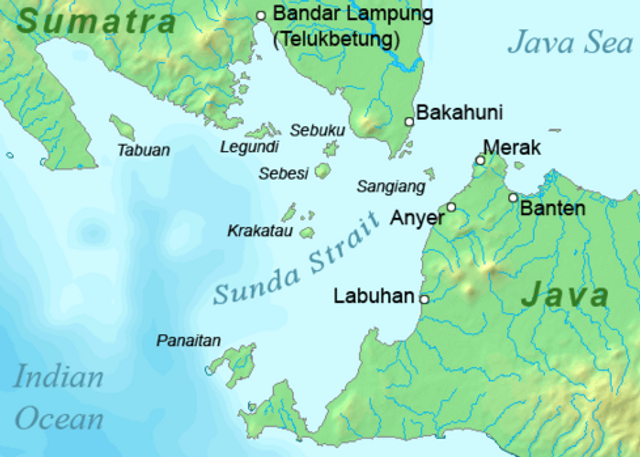
According to the latest official figures, 280 people were killed and more than 1,000 injured, when a tsunami suddenly hit coastal cities and beach resort towns adjoining Indonesia’s Sunda Strait at 9.30 p.m. local time on Saturday.
The official death toll is expected to rise over the next days. At least 57 people are missing and rescuers have still not yet been able to reach all the affected areas.
The disaster came just three months after an earthquake and tsunami struck Palu City on the island of Sulawesi on September 28, killing over 2,500 people and engulfing hundreds of homes in deep mud.
Sunda Strait, Indonesia
Saturday’s tsunami struck without warning at the height of the Christmas holiday long weekend. It destroyed hundreds of homes, businesses, and at least nine tourist hotels and other buildings. The Pandeglang region of Java’s Banten province near Jakarta, along with South Lampung settlements in Sumatra, were among the worst affected areas.
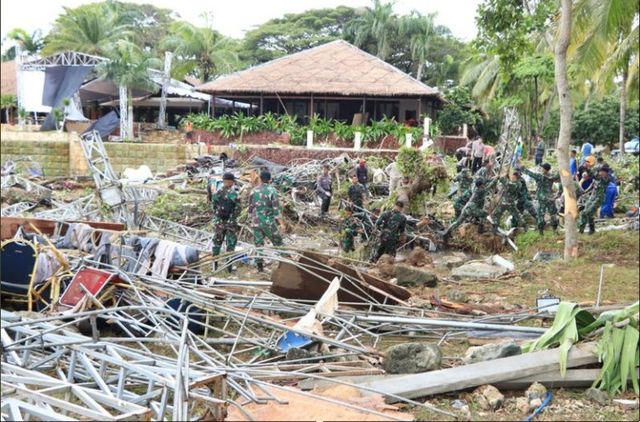
Splintered wood, concrete, bricks and other broken building material lie scattered along the coast and the now deserted villages and towns. Thousands of people have been rendered homeless. Survivors have posted photographs and video on social media of upturned and badly damaged vehicles and boats, and debris-laden water smashing into homes and other buildings.
Many of those killed were tourists, thought to be visiting the popular beach resort area of Pandeglang which also encompasses a national park. Frightening footage of a beachside concert by “Seventeen,” a local rock band, shows a massive wave demolishing the concert platform and sweeping away the band and audience members.
The concert was part of a holiday retreat for workers and their families from PLN, Indonesia’s national electricity company. The rock group has released a statement saying that their bass player, guitarist and road manager were killed and that two other band members and the wife of one of the performers were missing.
Aftermath of the tsunami where the concert was held
A spokesman for Indonesia’s National Disaster Mitigation Agency (BNPB) said that many victims were trapped under collapsed buildings, and that heavy machinery would be required to help with search and rescue efforts. However, as of Monday morning, the much-needed machinery had yet to be sent to all of the affected areas.
Geophysicists suggest that the tsunami could be the result of a major landslide, above or below the water line, at Anak Krakatoa (Child of Krakatoa), a 300-metre high active volcano in the Sunda Strait. This is believed to have pushed a huge wall of water across the strait, which, at its narrowest, is only 24 kilometres wide.
Anak Krakatoa, which emerged from the caldera of Krakatoa about 90 years ago, is one of the country’s most active volcanoes. It has been erupting since June and did so a day before the tsunami. According to a BBC report today, it is still erupting, raising fears that another tsunami might be imminent.
Earthquake geologist and University of Michigan professor, Ben van der Pluijm, told Reuters that the “instability of the slope of an active volcano can create a rock slide that moves a large volume of water, creating local tsunami waves that can be very powerful. This is like suddenly dropping a bag of sand in a tub filled with water,” he said.
Rahmat Triyono, earthquake and tsunami chief at Indonesia’s Meteorology, Climatology and Geophysics Agency (BMKG), told the New York Times that “there was no earthquake” and that’s why “there was no tsunami warning.”
The apparent absence of an earthquake, and thus seismic data, only partially explains the absence of any tsunami warning.
In the wake of the devastating 2004 earthquake and tsunami that claimed an estimated 230,000 lives in the Indo-Pacific, most of them in Indonesia, major powers pledged to help set up an early warning system to ensure such a catastrophe would never happen again.
The early warning system was to link global seismic detection centres, with a system of buoys and sensors that could detect water movements characteristic of tsunami. Various land-based systems were then supposed to be built to sound the alarm.
Even if the weekend’s tsunami was not triggered by a quake, the buoys and sensors should have been in place to provide an early warning. Clearly that was not the case and the victims had no time to react to the wall of water that engulfed them.
Indonesia’s National Disaster Management spokesman Sutopo Purwo Nugroho admitted in September this year, following the Palu disaster, that the country’s warning system was inadequate. The network of 22 hi-tech buoys has not been working since 2012 due to the lack of funding. As a result, the warning system relies on some 134 tidal gauges which are limited in their ability to provide advance notification.
Whether there were any working sensors in the Sunda Strait last weekend is not known at this stage.
Indonesia has 130 active volcanoes and its location in the Pacific “Ring of Fire”—an arc of intense seismic activity that stretches around the Pacific and includes the whole Indonesian archipelago—means that earthquakes and volcanoes are a fact of life.
The devastation caused by what are termed natural disasters is compounded by the poverty that is rife throughout the region. Many people are compelled to live in makeshift housing, often close to the sea, that leaves them vulnerable to tsunamis and quakes as well as typhoons that are also common.
The Indonesian government certainly bears a large measure of responsibility for the latest tragedy. The lack of proper infrastructure, inadequate warning systems and poorly funded rescue and relief services are testimony to the indifference of the government and the ruling class to the lives of millions of working people.
The major powers, which exploit countries like Indonesia as cheap labour platforms, also bear responsibility for the lack of resources for warning systems and disaster relief. The promises that were made after the 2004 catastrophe have proven worthless.
Following the weekend’s tsunami, political leaders around the world have been shedding crocodile tears for the victims. US President Trump described it as “unthinkable devastation,” adding: “We are praying for recovery and healing. America is with you!” What will follow, however, is a pittance in aid, if anything, and the tragedy will be quickly pushed aside in the world’s capitals.

22 Dec 2018

Government of Flanders Priority Country Scholarship 2019/2020 Programme – Belgium

Application Deadline: 1st April 2019 GMT+1.

Eligible Countries: Brazil, Chile, Japan, Mexico, Morocco, Russia, South Africa, Turkey and the United States of America.

To be taken at (University): Various universities in Belgium
  • KU Leuven / University of Leuven
  • University of Antwerp
  • Ghent University
  • Hasselt University
  • Vrije Universiteit Brussel
University colleges (Arts and Nautical Sciences)

  • Artesis Plantijn Hogeschool Antwerpen
  • Arteveldehogeschool
  • Erasmushogeschool Brussel
  • Hogere Zeevaartschool
  • Hogeschool Gent
  • Howest, Hogeschool West-Vlaanderen
  • Karel de Grote-Hogeschool
  • LUCA School of Arts
  • Odisee: Stefanie Derks
  • Hogeschool PXL
  • Hogeschool VIVES
  • Thomas More Mechelen-Antwerpen
  • Thomas More Kempen
  • UC Leuven
  • UC Limburg
Eligible Field of Study: The program holds for all study areas.

About the Award: The selection for the Priority Country Programme is made only once a year.
Many forms of mobility are accepted under the Priority Country Programme: both short mobility of one, two or three months, or long mobility of one semester up to a period of maximum one year, both for study or internship:
  • Brazil, Chile, Japan, Mexico, Morocco, Russia, South Africa, or the United States of America: fellowships for students in both directions, both short and long mobility.
  • Turkey: fellowships for students in both directions, short mobility only: duration of mobility is restricted to one month for internship and two months for study.
Type: Masters

Eligibility: Due to the unique nature of this program, in order to be eligible, the exchange project needs to fulfill all requirements below:
  • The applicant of a Priority Country Programme grant is full-time enrolled in a study programme of EQF level 5, 6 or 7.
  • In case of study mobility: A higher education institution in Belgium/Flanders (Home institution) and an educational institution in Brazil, Chile, Japan, Mexico, Morocco, Russia, South Africa, Turkey or the United States of America (Host institution) have established an academic cooperation agreement or have the intention to set up a new cooperation agreement by writing a letter of engagement.
  • In case of internship: A higher education institution in Belgium/Flanders (Home institution) and an institution/organization/company in Brazil, Chile, Japan, Mexico, Morocco, Russia, South Africa, Turkey or the United States of America (Host institution) have established a traineeship agreement.
  • The Flemish higher education institution, as well as the partner from Brazil, Chile, Japan, Mexico, Morocco, Russia, South Africa, Turkey or the United States of America cannot ask tuition fees to the students for the exchanges.
  • To be eligible for a Priority Country Programme grant, the student cannot be staying in the country of the Host institution already at the time of the selection procedure.
  • International students meet all academic entrance criteria, including relevant language requirements, for entering the study programme in the Flemish host institution.
  • A maximum of six applications per country can be submitted per higher education institution.
Nationality of the student is not a criterion

Number of Awards: It is estimated that 100 to 120 students can benefit from the Priority Country Programme.

Value and Duration of Scholarship: 
  • The grant amount is €650/month for the Flemish student with a total maximum of €2.600 and €800/month for the international student with a total maximum of €3.200.
  • The students receive a supplementary reimbursement for travel expenses, according to the following rules in the link below.
How to Apply: 
  • The application needs to be submitted following the rules for 2019/2020 submission in the Program Webpage (see Link below).
  • All documents are to be written in English, with exception of the official Transcript of records. If the Transcript of Records written in another language than Dutch, French or English, enclose a certified translation.
  • International students meet all academic entrance criteria, including relevant language requirements, for entering the study programme in the Flemish host institution.
Visit Scholarship Webpage for details

Rice University Business Plan Competition 2019 for Student Entrepreneurs

Application Deadline: 10th February, 2019

Eligible Countries: All

To Be Taken At (Country): Houston, Texas

About the Award: The Rice Business Plan Competition is the world’s richest and largest graduate-level student startup competition. It is hosted and organized by the Jesse H. Jones Graduate School of Business at Rice University and the Rice Alliance for Technology and Entrepreneurship, Rice University’s internationally-recognized initiative devoted to the support of entrepreneurship.

Sectors: business plans and companies should fall into one of four categories, or sectors:
  1. Life Science – includes (but not limited to) Medical Devices, Therapeutics, Diagnostics, Health IT, Biotechnology
  2. Energy/Clean Technology – includes (but not limited to) Sustainability, Water, Battery Technologies, Control Systems, Smart Metering, PV Technology, Natural Gas, Transportation/Mobility, Oil & Gas Technologies, Algae, Fuel Cells, Hybrid Vehicles
  3. Technology – Includes (but is not limited to): Mobile Apps, Software, Digital Media, Consumer Web, Bto-B Applications, Enterprise Software, SAAS, Internet, Web, Virtual Reality, Big Data, Machine Learning, Artificial Intelligence, Drones, Hardware, Robotics, Unmanned Vehicles
  4. Other Innovations – Includes (but is not limited to): Advanced Materials, Nanotechnology, Composites, Nanotechnology, Consumer, Other Technology
Teams must choose one sector/category for their companies. Teams may chose a second sector/category, though a second sector/category is optional and not required. Please choose sectors/categories that best align with your company’s product, technology, system or mission.

Type: Entrepreneurship/Contest

Eligibility: Teams must meet all the following eligibility requirements in the Program Webpage below

Value of Award: 
  • Rice University will provide an intense, immersive experience over the course three days for student startup founders to pitch to investors, receive multiple rounds of feedback and advance their startup.
  • There will be over $1 million in prizes, and all 42 teams who compete at Rice University in Houston are guaranteed to win cash prizes. The minimum cash prize is $500 and the grand prize winner receives a $300,000 investment (typically in the form of a convertible debt note, without geographic restrictions.)
Duration of Program: April 4-6, 2019

How to Apply: Submit your application online at www.rbpc.rice.edu
It is important to go through all application instructions and eligibility requirements before applying.

Visit the Program Webpage for Details

ACCEL Awards 2019 for Early-stage African Startups (All expenses paid to London, UK + £15,000 Award)

Application Deadline: 31st January 2019

Eligible Countries: African countries

To be taken at (country): UK

About the Award: The Africa Club is a student-run club at London Business School. We exist to promote engagement on Africa within the school and with the broader business community, either in London, Africa or globally. Our members are individuals who have either worked in Africa or have cultural or professional interests in the continent.
The Accelawards will be hosted at the Annual Africa Business Summit on Saturday 27th April, 2019. The Africa Business Summit is one of the largest of its kind globally, and the leading forum in Europe for shaping business perspective on Africa’s future. This summit will give the ACCELAwards finalists an unrivalled stage to engage with global business leaders and African professionals.

Type: Entrepreneurship

Eligibility: You need to be an African entrepreneur with a business proposal that has proof of concept. The business needs to be Africa focused or caters primarily to the African market.

Selection Criteria:Each entry will be assessed by a minimum of two judges based on the below 5 criteria.
a. Originality of idea
• Is the start-up a new or novel application of existing knowledge/technology/business model to the Africa region in focus ?
• High scores should be given to start-ups that are not clones of well known business models already existing within the African region

b. Strength of business case
• Is the founder able to articulate a strong business case including target market, pain points and how the start-up is differentiated?
• Does the start-up have clear revenue models and path way to profitability?
• High scores should be given to those applications that demonstrate clear business plan to achieving a profitable business

c. Level of product development
• Is the product or idea well developed and ready for investment opportunities?
• Do they have technology patents, rights, brand ownerships or partnerships already in place?
• Is the product already in the market?
• High scores should be given to those applications that demonstrate well developed products or services that are already on sale

d. Level of business opportunity or impact
• What is the level of potential social impact of the idea in Africa?
• What is the potential size of the market share and profitability
• High scores should be given to those applications that demonstrate scalable social impact

e. Team’s ability to execute the idea and other Intangibles
• Does the team have the right combination of passion? insight? experience? qualifications?
• Do secondary aspects of the application strengthen the likelihood of success e.g. founder’s story?
• High scores should be given to those applications that demonstrate passionate teams with significant expertise in the relevant business sector


Number of Awards: 3 Finalists, 1 Winner

Value of Award:
  • Get Unparalleled International Exposure
  • Prestigious Brand Partnership
  • Global Business Mentoring&Network
  • Fully Sponsored Trip to London for the Top 3 Start-ups
  • £15,000 in Award Prizes
Presentation of Award:  27th April, 2019.

How to Apply: 
  • It is important to go through all application requirements on the Programme Webpage see link below) before applying

Visit Programme Webpage for Details

France: Centre International de Mathématiques et d’Informatique (CIMI) Masters Fellowships 2019/2020 in Mathematics and Computer Studies for International Students

Application Deadline: 3rd February 2019 (2200 Paris time).

Eligible Countries: International

To be taken at (country): France

Eligible Field of Study: Maths and Computer studies

About the Award: Every year CIMI (Centre International de Mathématiques et d’Informatique) in Toulouse provides a number of fellowships for students enrolled in a Master course in Mathematics or Computer Science in one of the programs associated with CIMI.

Type: Masters

Eligibility: 
Those fellowships are open, on a competitive basis, to French and foreign students and awarded on the basis of the quality of the academic records.
First year (M1) applicants: Applicants must have obtained a degree corresponding to the European Bachelor’s degree.
Second year (M2) applicants : Applicants must have successfully completed the first year of a European Master’s degree, or an American Bachelor’s degree, or any equivalent level.
The CIMI LabEx applies an equal opportunity policy in selection.


Selection: Fellowships applications will be examined by the LabEx CIMI Executive Committee  and Prospective Committee. Grants will be awarded on the basis of the quality of the academic records.

Number of Awardees: 4 fellowships for students starting on the first year of a Master’s degree M1 and 10 fellowships for those starting on the second year of a Master’s degree M2 will be available.

Value and Duration of Scholarship: The level of funding will be competitive and sufficient to cover tuition fees and part of living expenses in Toulouse :
  • 600€ per month over 10 months for applicants starting in the first year M1
  • 1 000€ per month over 10 months for applicants starting in the second year M2
How to Apply: 
1.    Curriculum Vitae (max. 2 pages)
2.    Details of the grades obtained at University from the 1st year to present
3.    Details of the courses attended in the year 2017-2018
4.    Two recommendation letters : do not forget to mention (step 4 of the application process) the e-mail address of the professors wishing to send recommendation letters. They will receive an automatic e-mail to upload their letter.
5.    Applicant’s motivation letter : applicants for a Master 2 fellowship MUST clearly state in their letter the M2 programme (M2R, IMAT,…) they are applying for.
6.    Information about current level of French language skills (only applies to foreign students from non French speaking countries applying for a M1 fellowship).  All Master 1 courses will be taught in French.


To apply please CLICK HERE.


Visit Scholarship Webpage for details

MIASA/Network Point Sud 2019 Summer School on Intra-Regional Migration in Africa (Fully-funded to Accra, Ghana)

Application Deadline: 4th February 2019

Eligible Countries: African countries

To be taken at (country): University of Ghana; Legon, Accra 

About the Award:  The objective of the summer school is twofold. Firstly, it aims to confront different disciplinary approaches in order to stimulate a fruitful dialogue about theories, methods and fields of investigation related to the subject. Secondly, the summer school seeks to shift away from the over-emphasis on current dominant perspectives on migration in Africa.
Following a comparative perspective, this interdisciplinary dialogue will permit to discern the commonalities and specificities with regard to different forms and dimensions of the intra-regional migration in Africa. The summer school does not have an ambition to cover every dimension of African migration.

Type: PhD, Postdoctorate, Short-course

Eligibility:
  • The call is open for doctoral and postdoctoral students doing research on one of the axis mentioned above.
  • Post-doctoral candidates should have defended their thesis no longer than five years ago.
  • Doctoral students should be in an advanced stage of their project and should be able to present first results of their research.
  • Candidates should relate their application to one of the axes mentioned above.
  • Candidates should have good skills in English and/or French language.
Number of Awards: Not specified

Value of Award:  The entire cost for each participant (travel, accommodation, meals, etc.) will be covered by MIASA.

Duration of Programme:  The summer school will take place from the 23rd to 28th May 2019 at the Centre for Migration Studies in Accra/Ghana.

How to Apply: 
  • Candidates are required to send an abstract of their research (500 words maximum), a CV with current academic affiliation and a letter of motivation.
  • Please send your application via email by 4th February 2019 to the following address: scholze@uni-frankfurt.de
  • It is important to go through all application requirements on the Programme Webpage see link below) before applying
Visit Programme Webpage for Details

Award Providers:  The Summer School is financed by the Merian Institute for Advanced Studies (MIASA) and organized in collaboration with the network Program Point Sud, the Centre for Migration Studies at the University of Ghana in Accra and the Goethe University Frankfurt/Main in Germany.