27 Dec 2018

A Safe Alternative to Female Circumcision

Cesar Chelala

Female circumcision, also called female genital mutilation (FGM) is widely practiced in 29 countries in Africa and the Middle East. More than 125 million women have been subjected to different forms of genital mutilation across Africa and in areas of western and southern Asia, and 2 million women undergo the procedure annually. According to UNICEF, 91 percent of women age 15–49 undergo female circumcision in Egypt, where a young woman died recently following this procedure.
It is also carried out in Australia, Canada, England, France, and the United States among immigrants from countries where it is performed as a ritual. Female genital mutilation is internationally recognized as a violation of the human rights of girls and women. FGM has no health benefits to women. On the contrary, by removing normal, healthy genital tissue the procedure interferes with the body’s natural functions. An alternative rite to replace this practice offers hope to change this situation.
A safe alternative to traditional female genital mutilation has been used for many years in some African countries. If more extensively used, it can contribute to putting an end to a practice that has caused considerable harm and suffering to millions of women worldwide.
This alternative rite was initiated in the Tharaka District in Kenya in 1996, and grew out of the collaboration between a women’s Kenyan group, called “Maendeleo Ya Wanawake Organization” (MYWO) and the Program for Appropriate Technology in Health (PATH), a nonprofit, international organization whose aim is to improve the health of women and children in developing countries.
The alternative rite initially practiced in Kenya is known as “ntanira na mugambo” or “circumcision through words.” Young women go through a weeklong program of counseling, training, and education, capped by a day designated as the “coming of age day,” when members of the community join for a celebration with music, dances, and feasting.
The rite consists of a week of seclusion. In it, the adolescents are taught basic concepts of anatomy and physiology, sexual and reproductive health and hygiene, and are counseled on gender issues, respect for adults, how to improve their self-esteem, and how to deal with peer pressure.
The program recognizes the girls’ need for recognition, so they receive a certificate, presents, are granted special wishes, and become the center of attention in the community during the final day of celebration. The mothers, many of whom act as peer educators, are then able to convert the fathers and the rest of the family.
A similar ritual, in which the girl is declared a woman without maiming her for life, is carried out in Uganda among the Sabiny tribe of farmers. What makes the Uganda case particularly interesting is that the clan elders, who formed the Elders Association in 1992, decided to outlaw FGM and promoted the new rite to replace it. Because of their work they received the 1998 United Nations Population Award.
This new rite has hopes of success because it offers an attractive alternative rather than a blunt prohibition to a long-established cultural practice. It could thus become one of the most significant measures toward improving women’s health and quality of life on a large scale.
This alternative rite is similar to ceremonies practiced in other religions. In the Jewish faith, after years of training in religious principles, history and family matters, 12-year-old girls go through a ceremony (bat mitzvah) that signals their passage to womanhood. It also indicates that from then on they become full-fledged members of the Jewish community with all the responsibilities that come with it.
Among Hindu and Buddhist women living in regions of Nepal and in Southern India, girls are kept in the dark for 12 days immediately following menarche, during which they are not allowed to see a man’s face or to take a bath. Afterward, they bathe and there is a ceremony with feasting and presents indicating their entrance into womanhood.
In many societies, FGM is considered a cultural tradition, which has been used as an argument to continue its practice. In other societies, the prevalent view is that it is recommended in religious texts. There is no evidence, however, to support this last assertion.
FGM can provoke serious psychological and bodily harm to women who undergo the procedure. Research on this issue has shown that if communities decide to abandon FGM, the practice can be eliminated very rapidly. The use of this alternative and safer procedure can protect women from unnecessary harm and help them lead healthier, and more active and fulfilling lives.

Ten Charts Show How the World is Progressing on Clean Energy

Iain Staffell

Rapid progress towards clean energy is needed to meet the global ambition to limit warming to no more than 1.5C above pre-industrial temperatures.
But how are countries doing so far? In our Energy Revolution Global Outlook report, written with colleagues at Imperial College London and E4tech – and published by Drax– we rank progress in 25 major world economies.
Our report provides a league table of their efforts to clean up electricity generation, switch from oil to electric vehicles, deploy carbon capture and storage, eliminate fossil fuel subsidies and tackle energy efficiency.
The ten charts below compare these 25 countries today and their progress over the last decade.

Progress on clean electricity

Electricity has been the fastest sector of the economy to decarbonise as countries move away from coal and embrace low-cost renewables. Yet the average carbon intensity of electricity worldwide has fallen only 7% in the last decade to 450 grams of CO2 per kilowatt hour (gCO2/kWh).
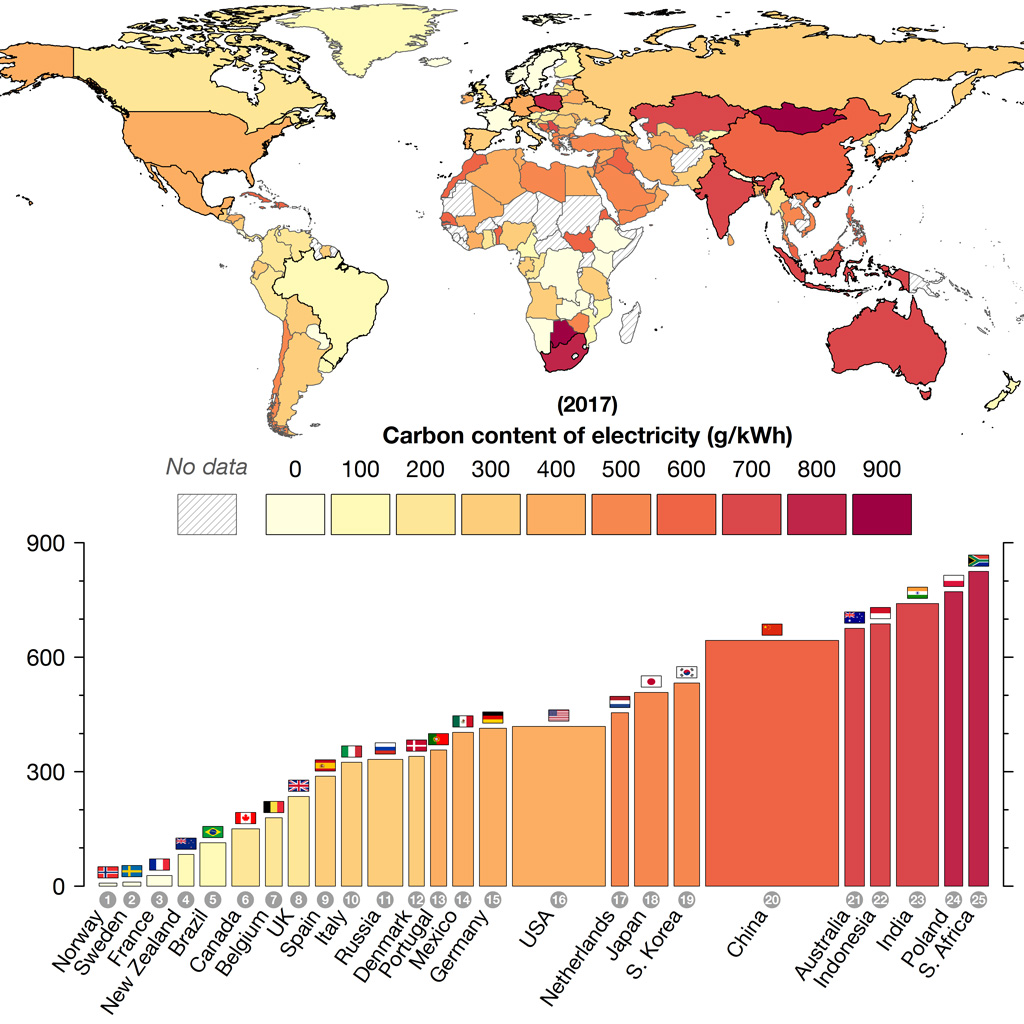
The chart below maps the carbon intensity of electricity generation around the world and ranks the 25 major economies covered by our report. These countries include the G7 group of rich nations along with Brazil, Russia, India, China and South Africa (the “BRICS”) and others. These countries account for 80% of global population, 77% of global GDP and 73% of the world’s CO2 emissions.
Individual countries range from having virtually zero-carbon electricity (in the Nordics, France and New Zealand, left-hand columns in the lower chart) up to near-total reliance on coal (in South Africa and Poland, on the far right).
Combined world map and bar chart showing The carbon intensity of electricity generation during 2017, in grams of CO2 per kWh. The map includes all countries for which data is available. The bar chart ranks 25 major economies including all G7 and BRICS countries. Bar widths represent the amount of electricity consumed in each country, with a minimum width so that smaller countries are still visible. Source: Drax 2018.
The carbon intensity of electricity generation during 2017, in grams of CO2 per kWh. The map includes all countries for which data is available. The bar chart ranks 25 major economies including all G7 and BRICS countries. Bar widths represent the amount of electricity consumed in each country, with a minimum width so that smaller countries are still visible. Source: Drax 2018.
Countries across Europe and North America have almost unanimously reduced the carbon intensity of their electricity over the last decade. They have done this by reducing their reliance on coal and increasing their share of renewables, as well as by reducing electricity demand in many cases.
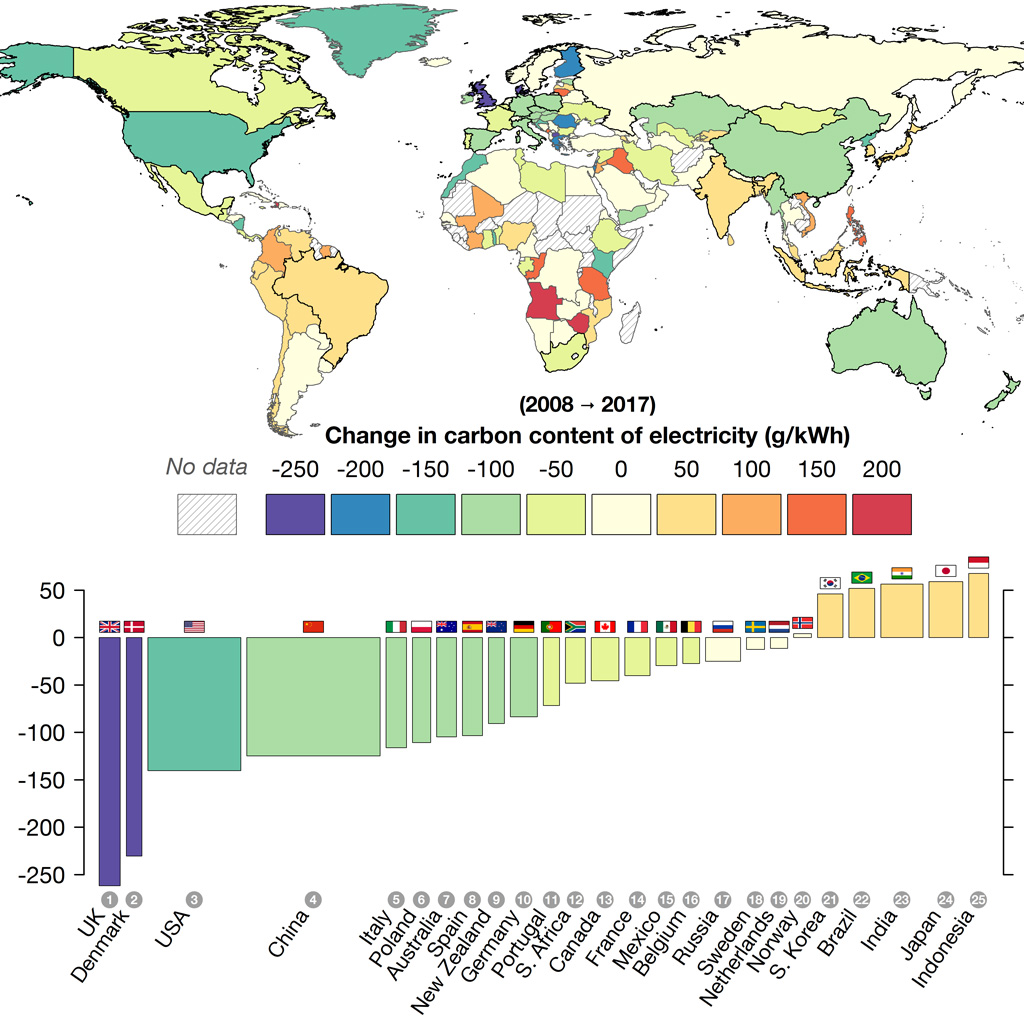
On the other hand, several large Asian countries – Japan, South Korea, India, Indonesia – increased their carbon intensity as they now rely more heavily on coal. China is one of the only Asian countries to be cleaning up its power system, having reduced carbon intensity by one-sixth this decade. The US is also progressing faster than most, behind only the UK and Denmark as in the chart, below.
Combined world map and bar chart showing The change in carbon intensity of electricity generation over the last decade, in grams of CO2 per kWh. Shades of blue and green indicate reductions while yellows and reds are increases. Source: Drax 2018.
The change in carbon intensity of electricity generation over the last decade, in grams of CO2 per kWh. Shades of blue and green indicate reductions while yellows and reds are increases. Source: Drax 2018.
One of the main drivers in cleaning up power systems worldwide is the rise of renewable energy. In absolute terms, China is the clear leader, having both one third of the world’s installed wind capacity and one third of installed solar.
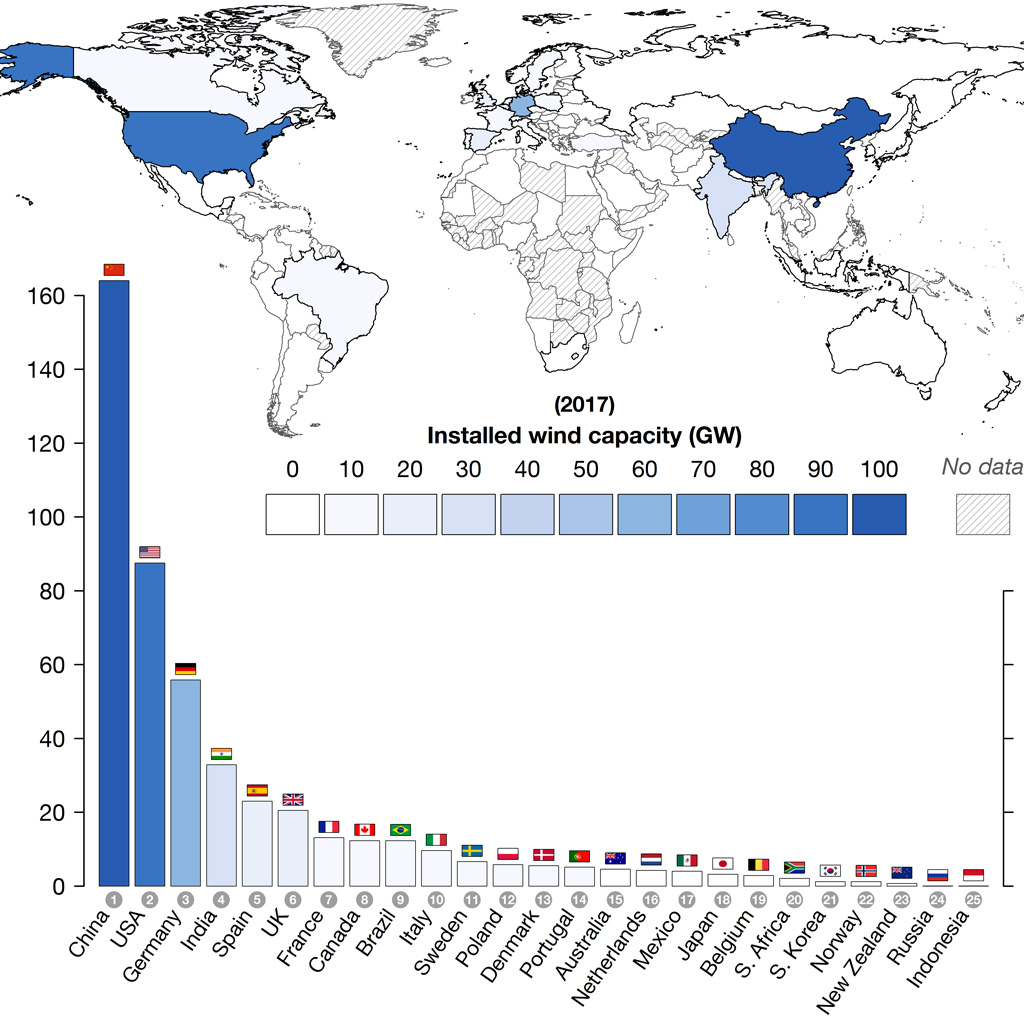
China’s near-130 gigawatt (GW) solar capacity is roughly equal to the next three largest countries put together: Japan, Germany and the US. For wind capacity, other notable high-fliers include fourth-ranked India and Poland in twelfth, which has a larger wind capacity than Denmark, as shown in the chart, below.
Combined world map and bar chart showing The installed capacity of wind power at the end of 2017, in gigawatts (GW). Source: Drax 2018.
The installed capacity of wind power at the end of 2017, in gigawatts (GW). Source: Drax 2018.
However, on a per-capita basis, Denmark has the most wind, with 1,000 watts of capacity per person, and Germany the most solar at 500 watts per person.

Progress on clean transport

Clean electricity could move beyond homes and offices to power the way we move. Electric vehicles are rapidly coming down in price, and several countries are now legislating the demise of the internal combustion engine over the coming decades.
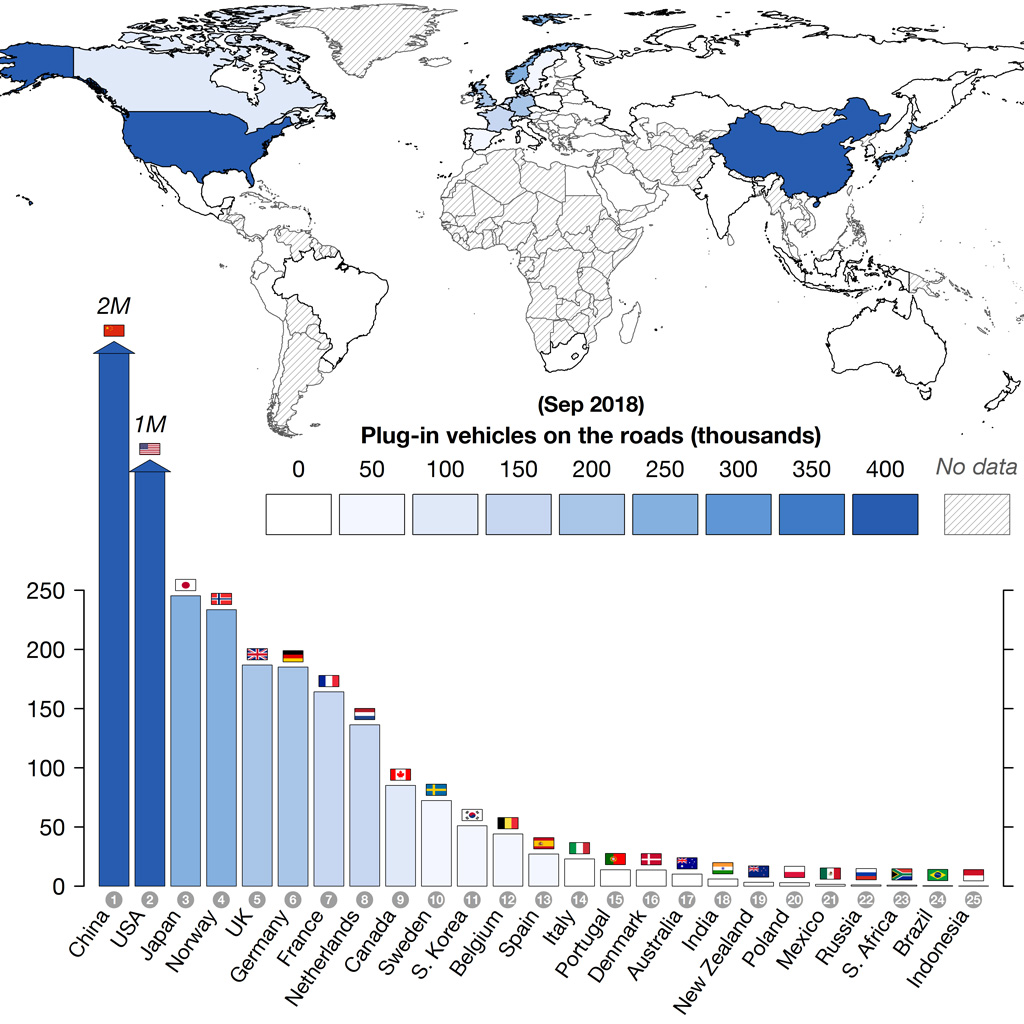
So far, some 4.5m electric vehicles have been sold worldwide, nearly half of which are in China, and a quarter in the US, as the chart below shows.
Combined world map and bar charts showing The number of electric vehicles on the roads (both battery and plug-in hybrid) as of September 2018. Source: Drax 2018 and EV-volumes 2018.
The number of electric vehicles on the roads (both battery and plug-in hybrid) as of September 2018. Source: Drax 2018 and EV-volumes 2018.
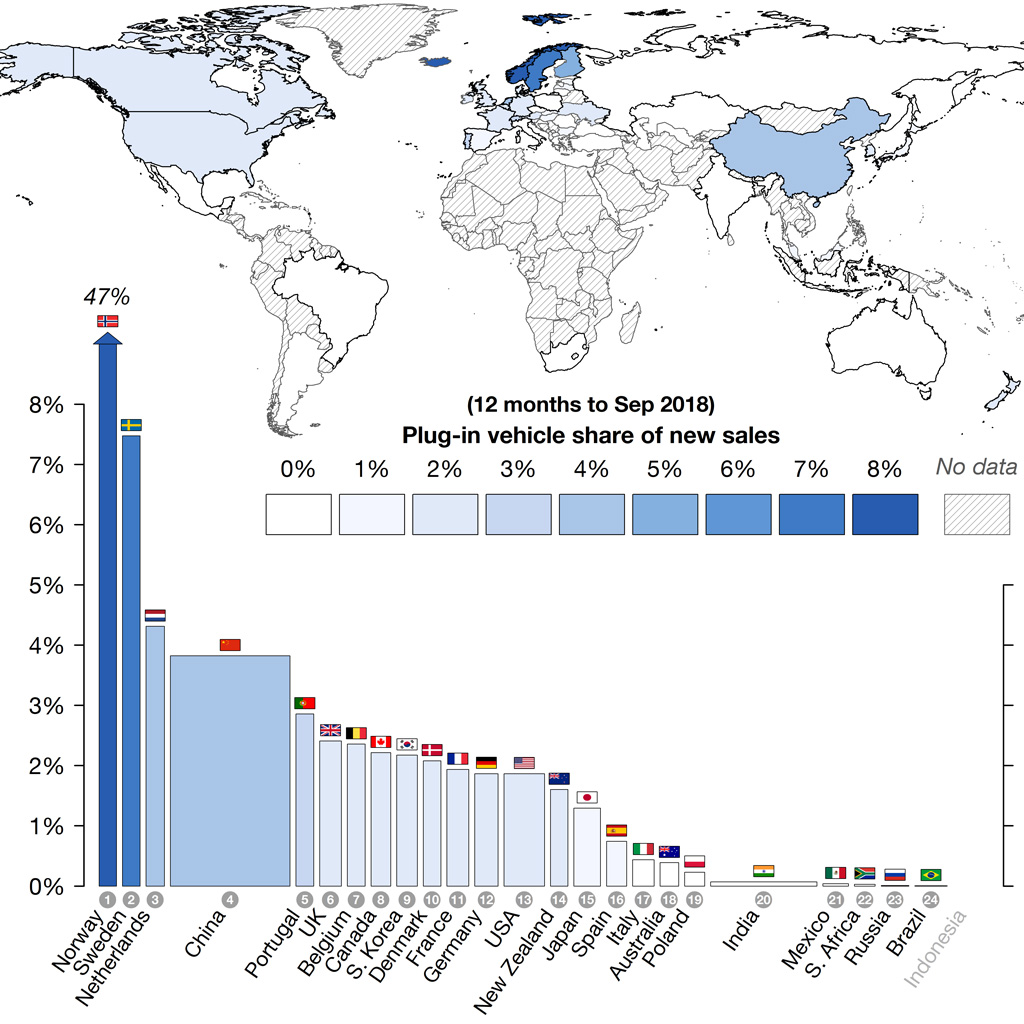
Several countries have reached a 2% market share for electric vehicles, meaning they make up 1 in 50 new cars sold. The rate in China is around double this, while Norway is well ahead of the pack with almost 1 in 2 vehicles sold now electric, as the lower chart below shows.
Combined world map and bar charts showing The share of electric vehicles (both battery and plug-in hybrid) within new car sales, for the 12 months to September 2018. Bar widths represent each country’s population. Source: Drax 2018 and EV-volumes 2018.
The share of electric vehicles (both battery and plug-in hybrid) within new car sales, for the 12 months to September 2018. Bar widths represent each country’s population. Source: Drax 2018 and EV-volumes 2018.
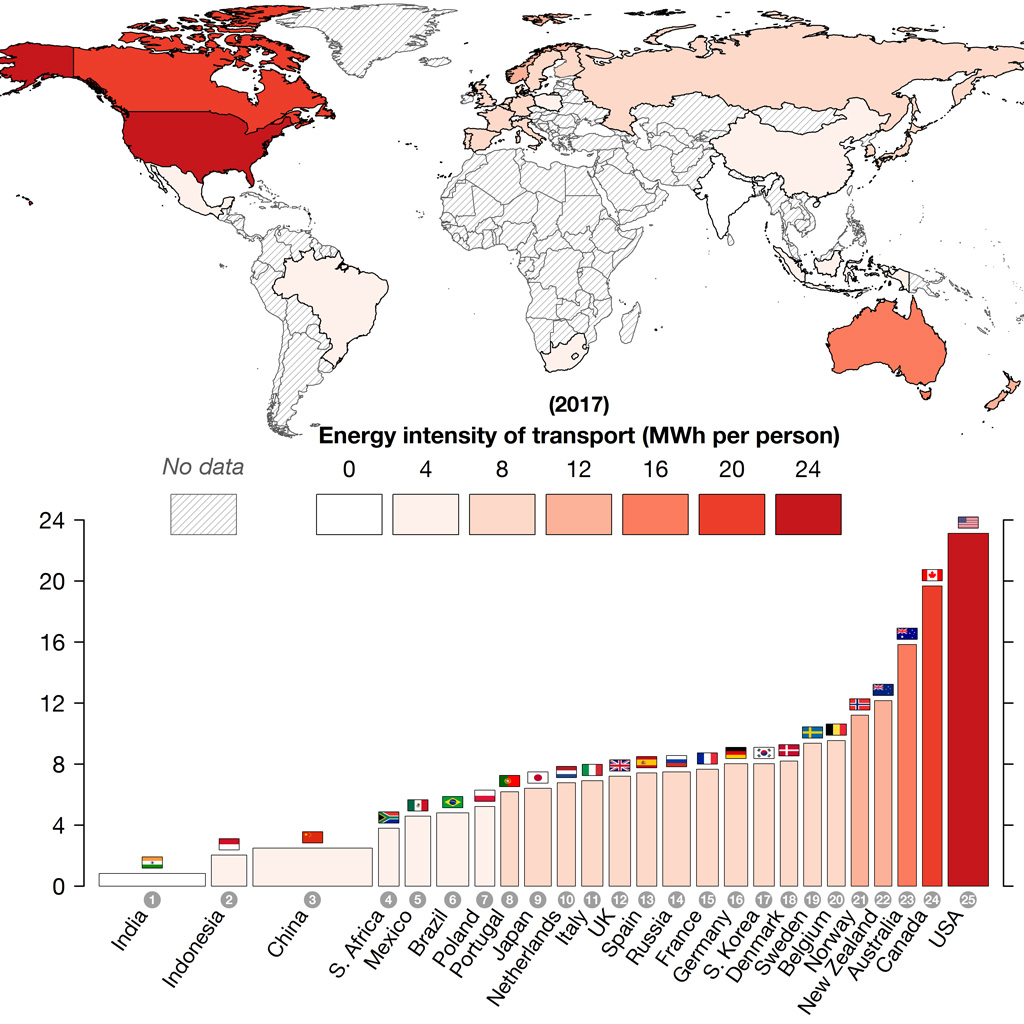
Cleaning up the transport sector does not just rely on new technologies, however, as people could travel less or using more efficient forms such as public transport. The amount of energy consumed per person on transportation varies greatly across the world, with the average American consuming 10 times more than the average Indian, as the charts below show.
Combined world map and bar charts showing The energy consumed per person for transportation of people and goods, in megawatt-hours (MWh) per person per year. Bar widths represent each country’s population. Source: Drax 2018.
The energy consumed per person for transportation of people and goods, in megawatt-hours (MWh) per person per year. Bar widths represent each country’s population. Source: Drax 2018.
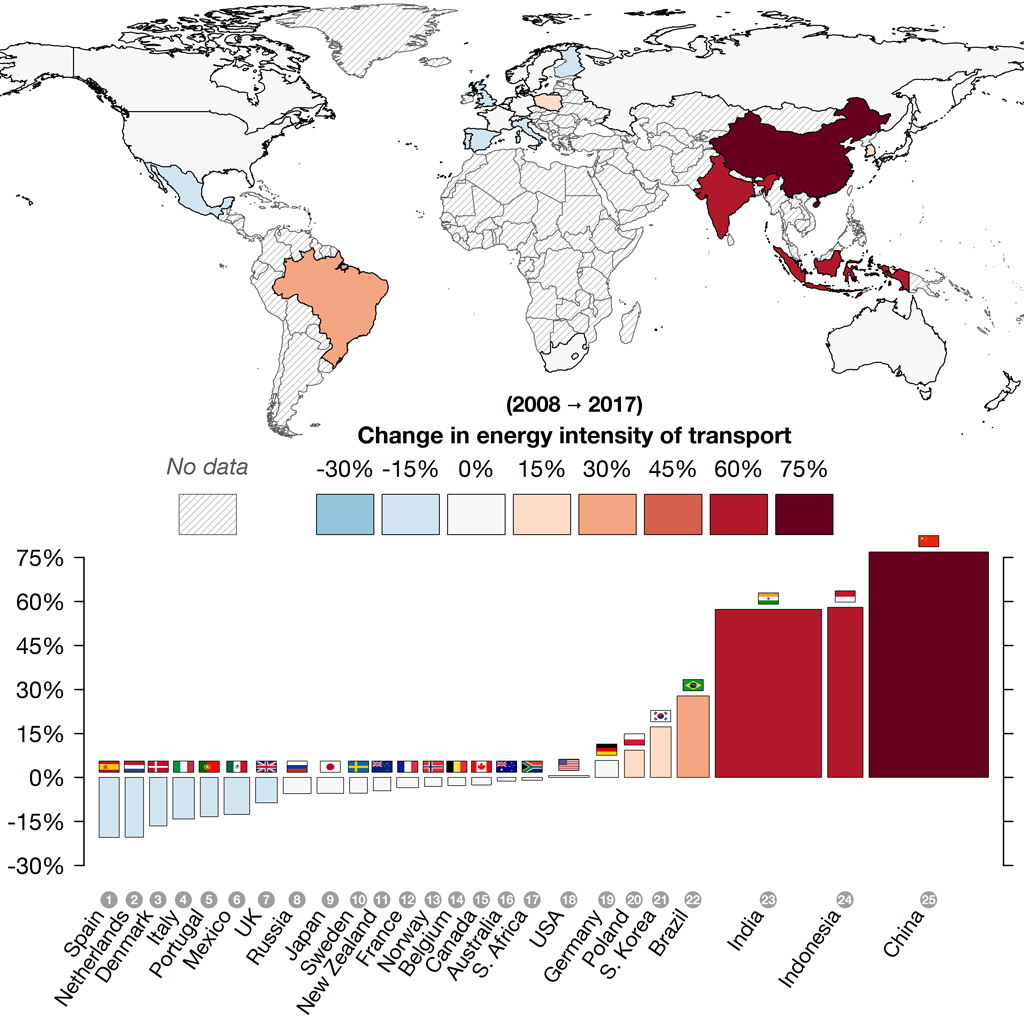
Large countries where people routinely fly between cities consume the most, but China and India are rapidly catching up as incomes rise. Their transport energy consumption rose 80% and 60% per person over the last decade, respectively. This has dwarfed the modest increases in transport efficiency seen across Europe and North America, as in the chart, below.
Combined world map and bar charts showing The change in energy consumed per person for transportation of people and goods over the last decade, showing the percentage rise (reds) or fall (blues) in MWh per person per year consumed. Bar widths represent each country’s population. Source: Drax 2018.
The change in energy consumed per person for transportation of people and goods over the last decade, showing the percentage rise (reds) or fall (blues) in MWh per person per year consumed. Bar widths represent each country’s population. Source: Drax 2018.

Progress on energy efficiency

Efficiency is not only slow to improve in the transport sector. Improving the energy efficiency of buildings worldwide is urgently needed to reduce the demand for carbon-intensive heating.
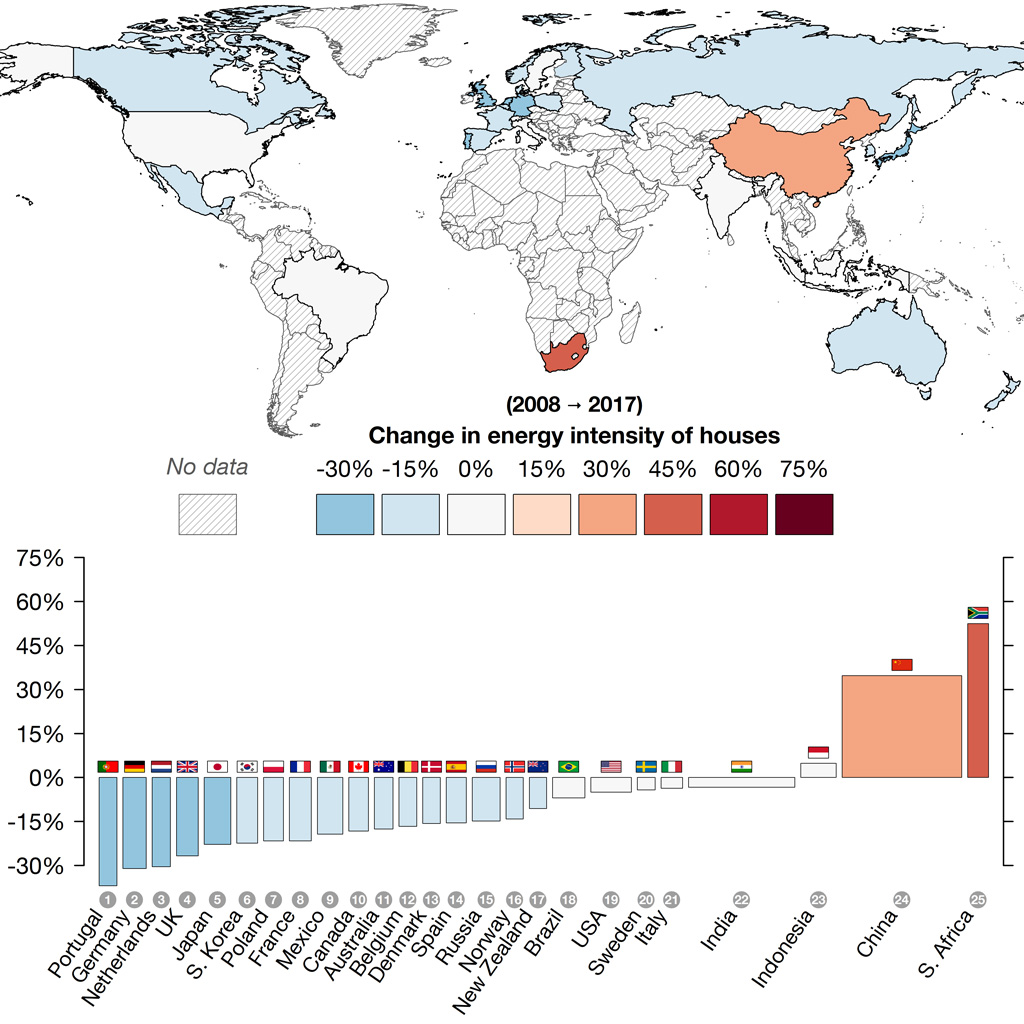
Homes in most major countries are using less energy than they did a decade ago, per square metre of floor area. While some of this can be credited to improving building standards and more energy-efficient appliances, the gains may also be due to the residual effects of the global recession and the run of mild winters caused by rising global temperatures.
In some parts of the world, notably China and South Africa, improved living standards have lead to a rapid growth in household energy consumption, as the chart below shows.
Combined world map and bar charts showing The change in energy consumed for heating and powering households over the last decade, showing the percentage rise (reds) or fall (blues) in MWh per person per year consumed. Bar widths represent each country’s population. Source: Drax 2018.
The change in energy consumed for heating and powering households over the last decade, showing the percentage rise (reds) or fall (blues) in MWh per person per year consumed. Bar widths represent each country’s population. Source: Drax 2018.

Progress on fossil fuels and carbon capture

Government support for fossil fuels is a perverse feature of many economies, holding back the transition away from coal, oil and gas.
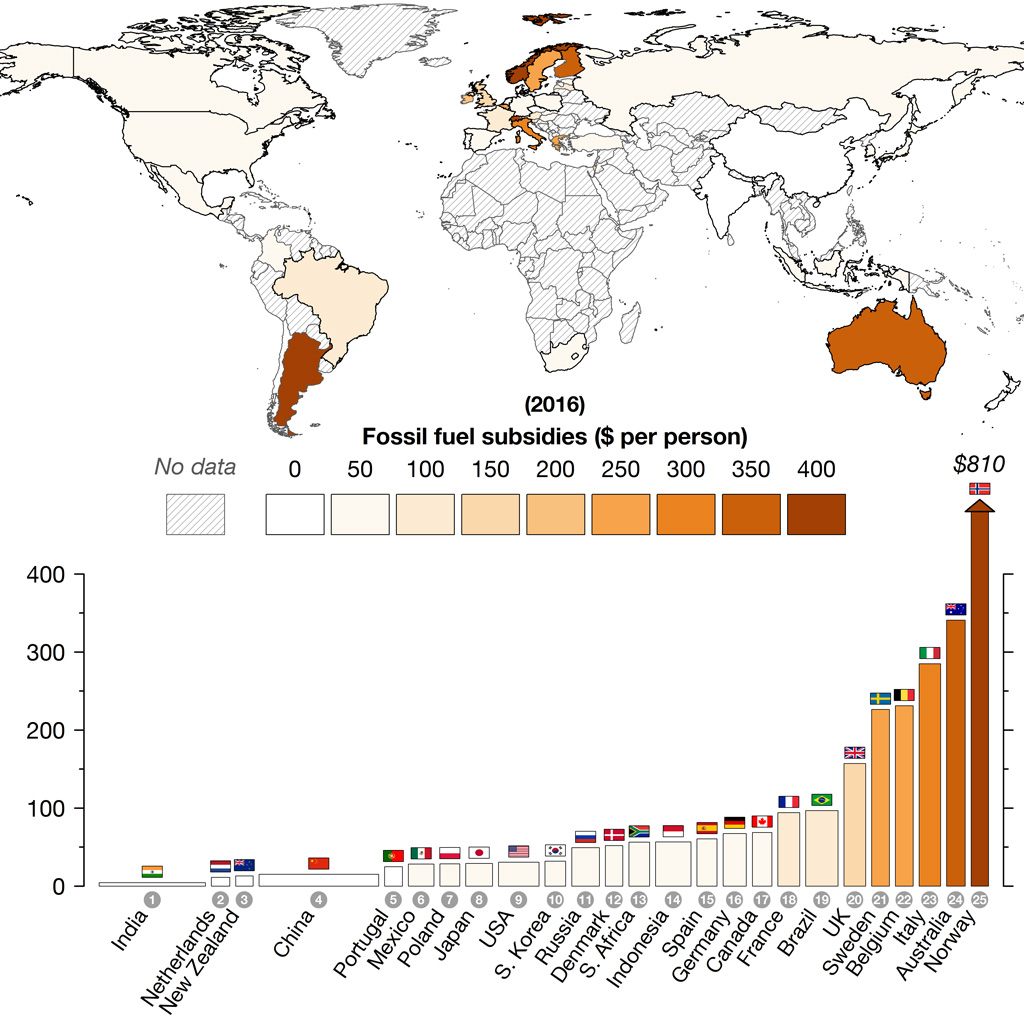
The definition of fossil fuel subsidies is widely disputed. Yet according to the definition used by the Organisation for Economic Cooperation and Development (OECD) several major fossil fuel producing nations with relatively small populations, such as Norway and Australia, provide hundreds of dollars per capita per year, as the chart below shows. On this measure, the UK also gives large subsidies.
Combined world map and bar charts showing The level of subsidies offered to fossil fuels per person in 2016, including direct expenditures by government, forgone tax revenues and other fiscal concessions. Bar widths represent each country’s population. Source: Drax 2018.
The level of subsidies offered to fossil fuels per person in 2016, including direct expenditures by government, forgone tax revenues and other fiscal concessions. Bar widths represent each country’s population. Source: Drax 2018.
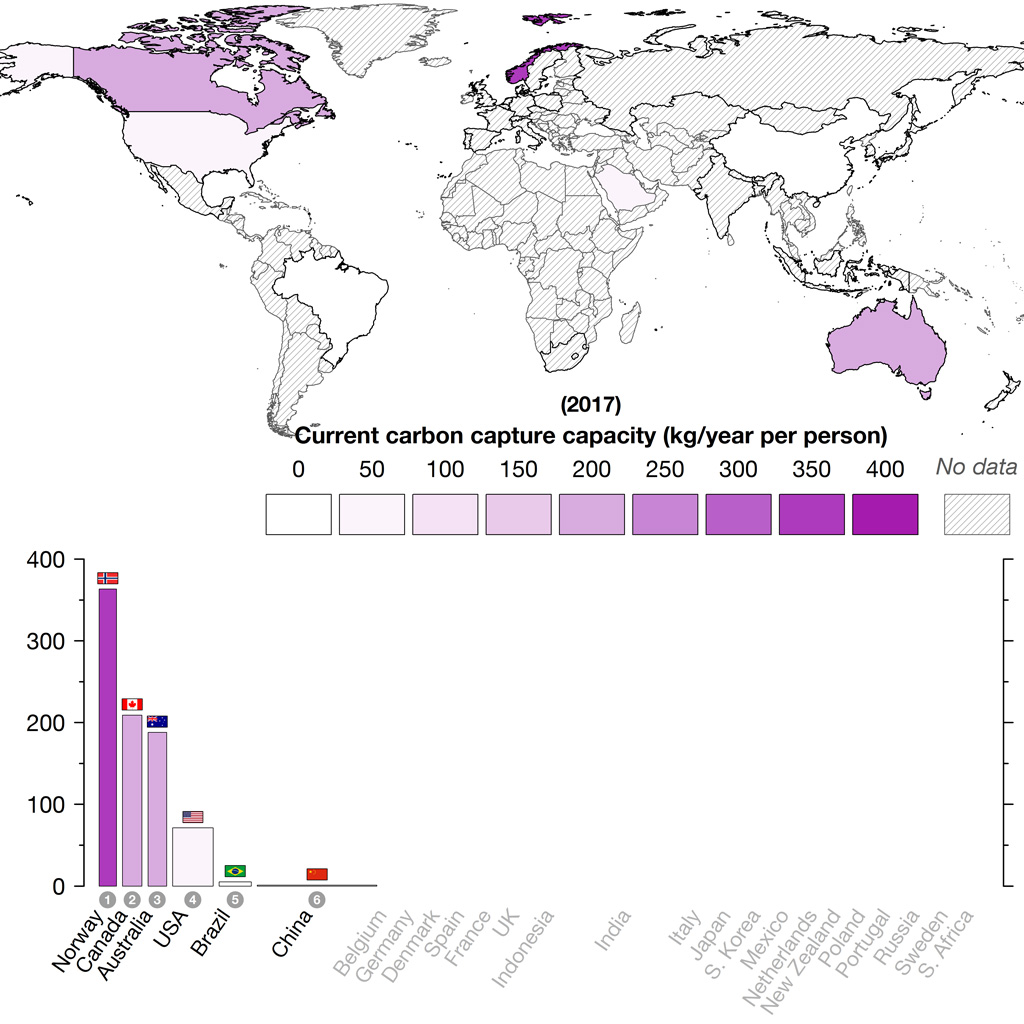
One important feature of many pathways to 1.5 or 2C is to combine hard-to-avoid uses of fossil fuels, such as in steel-making or cement, with carbon capture and storage. Today, however, there are just 18 large-scale carbon capture and storage (CCS) facilities around the world, concentrated in six countries with major oil and coal extraction industries, as the chart below shows.
Combined world map and bar charts The installed capacity for carbon capture at large-scale CCS facilities as of the end of 2017, measured as kg of CO2 that can be captured per person per year. Actual level of capture may be lower, if facilities do not run at full availability. Bar widths represent each country’s population. Source: Drax 2018.
The installed capacity for carbon capture at large-scale CCS facilities as of the end of 2017, measured as kg of CO2 that can be captured per person per year. Actual level of capture may be lower, if facilities do not run at full availability. Bar widths represent each country’s population. Source: Drax 2018.
Together, these CCS facilities are capable of capturing 32 million tonnes of CO2 each year. This is less than one-tenth of one percent of the roughly 37 billion tonnes of CO2 produced each year by the world’s energy sector. If CCS does see widespread roll-out over the coming decades, the potential for storing CO2 underground will not pose a barrier. The US alone could store all of the CO2 produced worldwide since the start of the industrial revolution.

Conclusion

All in all, progress towards clean energy around the world is mixed, with some countries pushing ahead on many fronts but others going backwards. Overall, our rankings show that the world’s nations are falling far short of what is needed and that progress over the next decade must be far stronger to avoid the worst impacts of climate change.

Moon targeted for further exploration, orbiting space stations and militarization

Henry Allan & Bryan Dyne

Earlier this year, NASA announced plans to build a Lunar Orbital Platform-Gateway, which is slated to be humanity’s tenth space station and the first that will orbit the Moon. The Gateway is projected to be operational by the mid-2020s, with the first initial component of the outpost ready to launch in 2022. Congress has already provided $504 million for the initial planning and design of the space station and the project, if it goes forward, is estimated to cost $3 billion a year.
NASA’s planned Lunar Orbital Platform-Gateway outpost (on the left), being approached by an Orion spacecraft as envisioned by an artist. Credit: NASA
NASA is promoting the Gateway as a lunar-orbiting station with scientific instruments attached externally as well as internally in order to conduct scientific experiments, control lunar rovers, or even act as a jumping off point for further ventures into space, including possible launches towards deep space.
“I envision different partners, both international and commercial, contributing to the gateway and using it in a variety of ways with a system that can move to different orbits to enable a variety of missions,” said William Gerstenmaier, associate administrator for Human Exploration and Operations at NASA Headquarters in Washington, earlier this year. “The gateway could move to support robotic or partner missions to the surface of the moon, or to a high lunar orbit to support missions departing from the gateway to other destinations in the solar system.”
Whatever its potential achievements, however, the development of the Gateway cannot be seen outside the context of the plan to create a “Space Force” as the sixth branch of the US military and the growing militarization of space in general.
When US President Donald Trump announced his intent to form the “Space Force” in June, he made it clear that the move was part of the war plans directed against Russia and China. “Our destiny beyond the Earth is not only a matter of national identity but a matter of national security,” Trump declared, adding that the United States should not have “China and Russia and other countries leading us.” He further emphasized, “It is not enough to merely have an American presence in space; we must have American dominance in space.”
House Space Subcommittee Chairman Brian Babin, a Texas Republican, echoed the national-chauvinist line of Trump, declaring, “Under the president’s leadership, we are now on the verge of a new generation of American greatness and leadership in space—leading us to once again launch American astronauts on American rockets from American soil.”
The Gateway would inevitably be a part of these efforts. A US space station orbiting the Moon immediately raises the possibility of policing of the space between Earth and the Moon, whether by manned or unmanned vehicles. These in turn would need a broader support network of spy satellites and other infrastructure necessary for such an undertaking, including space-based weapons.
It would no doubt also be used as an attempt to counter the influence of China, which is currently planning on building its own base on the surface of the Moon. It is not far-fetched to consider a “freedom of navigation” provocation, like those conducted repeatedly by the US military in the South China Sea, carried out against Chinese vessels in space. The Gateway might also be used as the pretext for attacking a craft that simply went too close to the station, violating its “territorial waters,” so to speak. Any of these could be used to start a war.
One view of the International Space Station. Credit: NASA
Such moves in the direction of new wars of aggression came into sharp focus when Trump announced the unilateral US withdrawal from the Intermediate-Range Nuclear Forces (INF) treaty with Russia, which prohibited Washington and Moscow from developing short- and medium-range missiles capable of carrying nuclear warheads. The withdrawal will set the stage for a further development of the US nuclear arsenal. It also poses the possibility of placing strategic weapons in space, perhaps even as part of the proposed space station.
The Gateway has also drawn criticism from scientists and astronauts who oppose the project as a drain on the already limited resources for space exploration. While the total cost of the Gateway is not fully worked out, it is already known that it will take twenty launches from currently available rockets to get the planned modules for the station to the Moon. This would eliminate twenty launches that could otherwise be dedicated to different unmanned interplanetary missions. While this could be reduced to as little as four if the Gateway was built with either NASA’s Space Launch System or SpaceX’s Super Heavy Starship, neither of those rocket designs have yet to be built.
Opponents of the Gateway have also pointed out that, unlike the currently operational International Space Station (ISS), because there are no agreements to share any benefits that might be gained from the Gateway, there are no cost-sharing agreements for the station’s operation. If US unilateralism on trade is an example of what will be demanded in space, then other nations will probably stick to the ISS or even begin developing their own, similar projects, with the same inherent risks—the danger of disaster in space and war on Earth.
It is also not clear that the Gateway would actually be a “stepping stone” to missions elsewhere in the Solar System. To arrive at the station, a spacecraft would have to enter orbit around the Moon, which costs fuel. As of now, a trip to the surface of the Moon that first stopped at the Gateway would require thirty percent more fuel. A trip to an asteroid, Mars or elsewhere faces similar problems.

Labour’s London mayor Sadiq Khan plans to demolish 8,000 council homes

Charles Hixson

Residents in working class housing estates are organising in opposition to the Labour Party mayor of London Sadiq Khan’s proposed social cleansing “regeneration” schemes.
In February, Khan proposed “mandatory balloting schemes where any demolition is planned as a strict condition of his funding.” Residents “would be at the heart” of decision-making, and there “must be no loss of social housing,” claimed the mayor.
At a Mayor’s Question Time in March, Khan promised he would not sign off on any new estate demolitions during a consulting period ending April 10. He concealed the fact that he had just hastily pushed through dozens of proposals allowing demolition and refurbishment by Labour councils and housing associations, all of whom would avoid his “progressive” new policy.
Khan’s rush to allow funding for these schemes excluded from balloting ensure that 31,000 residents in at least 8,000 homes will face demolition on 118 estates in the coming decade, with other estimates placing the numbers even higher.
Answering criticisms, Khan cynically claimed he had kept his promise not to sign off on any new estate demolitions. But social cleansing continues under his administration. He said most decisions on the 34 estates had already been made before the summer of 2017 (he was elected in May 2016) and that 16 of the contracts signed after December 1 were for schemes already receiving City Hall funding.
Moreover, there are further restrictions on democratic accountability even on those developments not excluded from voting. Only schemes with Greater London Authority (GLA) funding would be eligible, and only where at least 150 new homes are planned to be built could residents have a say. Further exceptions and loopholes concern infrastructure, supported housing, and buildings that the landlord declares must be demolished for safety reasons.
Khan’s move to allow balloting before demolition only came following Jeremy Corbyn’s suggestions at the 2017 Labour Party conference, and only after Corbyn had been placed under huge rank-and-file pressure to take a stand and demand Labour councils stop social cleansing policies. Corbyn is still not opposed to working class estates being demolished, with his “criticism” of Labour council privatisations’ social cleansing framed as timidly as possible. A spokesman said Corbyn recognised the need for special funding and was at pains to reassure them that “Jeremy recognises councils have to be creative over these plans, and his speech wasn’t intended as a direct criticism of them.”
Opposition to the balloting proposal arose from Labour-controlled councils, including Haringey in north London, who were planning to carry out a £2 billion sell-off of public assets with the developer Lendlease. Haringey explained they opposed a ballot “because a yes/no vote would risk oversimplifying a complex issue.” Due to growing public opposition that culminated in Blairite councillors being deselected, the Haringey privatisation was halted. However, with their Corbynite replacements being elected, the threat of social cleansing in other forms remains, as well as a further £14 million in austerity cuts.
Labour councils imposing social cleansing are on the same page as their corporate partners. A Freedom of Information request found a majority of housing associations providing views to City Hall opposed balloting, including the UK’s largest, Clarion. They argued, “Ballots will slow down and increase the risk in what are already long drawn-out and uncertain regeneration programmes and are a disincentive to investing early on in the process.”
Social cleansing of London and nationally continues. In June, Karen Buck, Labour MP for Westminster North, released analysis that shows sales of social housing to the private sector more than tripling since 2001. Since 2012, more than 150,000 homes for social rent have disappeared nationally, 3,891 of them in 2016. Labour runs local authorities in most urban areas.
Housing associations in five London boroughs alone have collected £82.3 million from auctioning 153 properties in Westminster (Tory-controlled), Brent (Labour), Camden (Labour), Hammersmith and Fulham (Labour), and Kensington and Chelsea (Tory).
Ministry of Housing data shows a fall of over 100,000 London local authority homes since 2003. On the Heygate estate in Labour-run Southwark, the luxury development of Elephant Park replaced the 1,200 council homes that were destroyed between 2011 and 2014. Only 82 of the new 3,000 units were for social rent. Green Party London councillor and party co-leader Sian Berry said that analysis of the London Development database suggests another 7,600 homes would disappear on “regeneration” sites.
Many residents on affected estates, such as those in Haringey, Southwark and Lambeth, have been actively opposing rebuilding schemes for years. In March, the News from Crystal Palace website reported secret deals between Khan and Lambeth Council that excluded a demolition vote for residents of Cressingham Gardens, Fenwick, Knights Walk, South Lambeth and Westbury estates.
Nicola Curtis, chair of Central Hill residents and tenants’ association, posted, “[Labour-run] Lambeth are avoiding our calls for a ballot and have just awarded a £15m contract to the designers of the new estate and are showing by their actions they have no intention of balloting our residents.” Residents of Cressingham Gardens have been running their own poll showing a majority opposed to the scheme.
Labour-run Hackney Council has been in the process of demolishing and rebuilding the Woodbury Down estate since 1999, with developer Berkeley Homes and the Genesis Housing Association. Phases 2-8 of the project will cause a net loss of 645 socially rented units.
Architects for Social Housing spokesman Simon Elmer referred to the numbers as “grim reading. … The possibilities of estate regeneration become radically reduced as soon as an estate is demolished. The cost of demolition, of compensation for residents, and of the construction of new-build dwellings is so high that at least 50 percent of the redevelopment will be properties for private sale at half a million pounds plus, with the resulting mass loss of homes for social rent from the demolished estate.”
The Haringey Defend Council Housing group declared, “Tellingly, and terrifyingly, the Mayor wants decisions about ballots to be made by ‘investment partners’...it’s clear that Sadiq Khan still puts the interests of developer profit first.”
With more than 250,000 Londoners on housing waiting lists, the Khan ballot scandal and refusal of the authorities to bring anyone to justice for the deaths of 72 people in Grenfell Tower that occurred as a direct result of decades of social cleansing, deregulation and profiteering have galvanised residents.
Some 30 local and citywide groups are affiliated to the Radical Housing Network. The Grenfell Action Group is part of the network. In pursuit of safe, decent, affordable public housing, GAG fought the Conservative-run Royal Borough of Kensington and Chelsea council and its management company, the Kensington and Chelsea Tenant Management Organisation (KCTMO) imposing a “refurbishment” of Grenfell Tower. This saw the tower encased in highly flammable cladding that turned it into a death trap. A GAG blog post, just seven months before the fire, warned that only a “catastrophic event will expose the ineptitude and incompetence of our landlord, the KCTMO, and bring an end to the dangerous living conditions and neglect of health and safety legislation that they inflict upon their tenants and leaseholders.”
Similar calls to Khan, a tried and trusted friend of the financial oligarchy, will also fall on deaf ears. As a mayoral candidate, he cemented ties with the main business groups from the Chamber of Commerce & Industry to the City of London Corporation. He promised the right-wing Spectator magazine he would be “dismantling the barriers to growth that exist and increasing productivity.” As for the accumulation of obscene wealth, he enthused, “I want to be the most pro-business mayor yet. ... I welcome the fact that we have got 140-plus billionaires in London. That’s a good thing. I welcome the fact that there are more than 400,000 millionaires. That’s a good thing.”

UK: Denial of access to justice following Legal Aid cuts

Dennis Moore

One million people live in areas where there is no Legal Aid provision for housing, with another 15 million in areas where there is only one provider. This information was found in Ministry of Justice (MoJ) data analysed by the BBC’s Shared Data Unit.
Since April 2013, with the introduction of the Legal Aid, Sentencing and Punishment of Offenders Act (LAPSO) (2012), large swathes of the Legal Aid system were radically changed with many cut off from access to basic democratic rights. It impacted many areas of civil law in England and Wales, with civil Legal Aid work only made available for a limited number of cases, stricter means-test criteria introduced, and automatic eligibility for those in receipt of means-tested benefits scrapped.
Data compared with 2011-2012 showed that there are 1,000 fewer Legal Aid providers being paid for civil Legal Aid work, with up to a million fewer Legal Aid claims being processed each year.
Wales and South Wales are now covered by just 4 Legal Aid providers, while only 41 cover London and the South East.
The number of solicitor’s firms in the South West offering Legal Aid has fallen from 327 in 2011/2012 to 197 in 2017/2018. Richard Miller, head of justice at the Law Society, said provision of legal advice across England and Wales was disappearing, creating “Legal Aid deserts.”
MoJ figures show that the year before LAPSO was introduced, Legal Aid was granted to 925,000 cases a year. After it came into force, this figure had dropped to 497,000 cases, a fall of 46 percent.
An analysis of the figures, when broken down into specific areas of the law, show a significant impact. In 2012-2013 welfare law included 88,378 cases that received Legal Aid funding. Following LAPSO, it dropped to just 145 cases, a 99 percent reduction. Family cases fell by 60 percent and housing cases by 50 percent.
The lack of Legal Aid and access to representation in the courts has resulted in a fivefold increase of people representing themselves. Volunteers from the Personal Support Unit, working to assist people in the courts, reported helping around 65,000 people last year. Just six years ago it was 10,000.
There are growing concerns that some of the most vulnerable people are now representing themselves in courts and are clearly ill-equipped to do this. Rachel Francis, a barrister, explained, “I have seen people in court attempting to represent themselves when they lack capacity, have very significant learning difficulties or are otherwise incapable of representing themselves effectively.”
Since 2011/2012, the town of Swindon has seen a fall in Legal Aid spending of £2.5 million in civil cases and a fall of £350,000 in criminal cases. These cuts have had a major impact on cases, including housing, welfare benefits, and domestic violence.
Olwen Kelly, director of Swindon Women’s Aid, said, “It’s a failure in the justice system, we are failing to protect the most vulnerable people in our society ultimately. These cuts are really biting, and the victims are paying the price for it.”
Cuts to Legal Aid funding disproportionately affect the poorest in society, who are often affected by issues such as poor housing, unfair welfare benefit decisions, and debt—and not able to pay for legal help, or representation.
The government claims that those most in need can still access free legal help through the not-for-profit sector, and via Exceptional Case Funding (ECF). ECF was set up to help provide a safety net to some of the most vulnerable people. However, these areas of legal help are not provided at an early stage when someone starts to experience problems, when many people could have had their problems resolved. According to Amnesty International, evidence suggests that ECF is failing the most vulnerable and marginalised in society.
Pete Moran, head of the Cumbrian Law Centre, said, “The pervading rhetoric in recent years has been about intervening early in the development of a person’s socio-economic problems, before things get very difficult and more expensive to rectify, but the current system does the opposite. It’s much more difficult now for people to get early advice; they have to wait until their situation becomes critical before they can access help.”
A good illustration of this is the problems people face when trying to challenge Housing Benefit decisions. Housing Benefit is a means-tested welfare benefit to help meet costs for rented accommodation. Following the introduction of LAPSO, Legal Aid funding for Housing Benefit cases was removed. This was critical in those cases where there was an issue with accruing rent arrears, which if resolved at an early stage of the proceedings could help to prevent possession proceedings and evictions.
Cuts to Legal Aid have led to an increased demand on those agencies that are left, many of which are based in the not-for-profit sector. Though research is scant, those organisations Amnesty International spoke to report having to turn people away because they could not take on the case.
The cuts have prevented agencies being able to provide advice holistically, with many people experiencing interconnected legal problems. Following the introduction of LAPSO, agencies reported that they were only able to deal with one or two issues that someone may present with, and the underlying cause of the problems was not addressed.
The mental health charity Mind found that up to half of people facing legal problems, who were not entitled to legal help following the introduction of LAPSO, had mental health problems.
Spending on Legal Aid has fallen by £600 million since 2013, with the number of providers falling by 1,200 for civil cases, and 800 for crime.
In a March 2013 report, the UN Special Rapporteur on the Independence of Judges and Lawyers commented, “Legal Aid is an essential component of a fair and efficient justice system founded on the rule of law. It is also a right in itself and an essential precondition for the exercise and enjoyment of a number of human rights, including the right to a fair trial and the right to an effective remedy.”
In the five years since, the vast scale of Legal Aid cuts in the UK was noted by the United Nations Special Rapporteur on Extreme Poverty and Human Rights, Philip Alston. In his report last month following a recent visit, Alston wrote, “There have been dramatic reductions in the availability of Legal Aid in England and Wales since 2012 and these have overwhelmingly affected the poor and people with disabilities, many of whom cannot otherwise afford to challenge benefit denials or reductions and are thus effectively deprived of their human right to a remedy. The LASPO Act…gutted the scope of cases that are handled, ratcheted up the level of means-tested eligibility criteria, and substituted telephonic for many previously face-to-face advice services.”

Germany’s Der Spiegel spreads fake news

Peter Schwarz

The German news magazine Der Spiegel has published numerous reports in recent years, which were entirely fictitious. The editors of Germany’s most widely-read weekly news magazine were forced to make this disclosure last week.
According to the latest issue of the magazine, one of its writers, Claas Relotius, has “manipulated his own stories to a large extent” and told “beautifully made fairy tales.” “Truth and lies were mixed together in his texts.” Some of his stories were “complete inventions, and others tarted up in part with doctored quotes and other types of factual distortion.”
Der Spiegel, according to its own admission, has published 55 original texts by Relotius. “Many of which are wholly or partially invented, falsified, fake.” Born in 1985, the journalist had been working for Der Spiegel for seven years, the last one and a half years as a full-time editor. He has also written articles for numerous other German publications, including Cicero, taz, Die Welt, SZ-Magazin, Weltwoche, ZEIT online, ZEIT Wissen, Frankfurter Allgemeine Sonntagszeitung and Neue Zürcher Zeitung am Sonntag.
The 33-year-old Relotius was regarded as a star journalist and received numerous prizes for his reports, including the Peter Scholl-Latour Prize and Konrad-Duden, Kindernothilfe, Catholic and Coburg Media Prizes. CNN named him “Journalist of the Year.” He also received the Reemtsma Liberty Award, the European Press Prize and was on the Forbes list of “30 under 30 - Europe: Media.”
Der Spiegel has responded to the revelation that it is responsible for the distribution of massive amounts of fake news with a mixture of admission of guilt, self-pity and attempts to shift the blame. The editorial staff presents itself as the innocent victim of an impostor and solemnly promises to wipe its slate clean.
Der Spiegel’s latest edition dedicates 24 pages and a cover photo to the Relotius affair. In it, the editorial board declares: “This house is shocked. The worst that could happen to an editorial team has happened to us. We’re going to turn every stone upside down and have created a commission that will thoroughly check the Relotius case, as well as anything else that might come up.”
In fact, the fake reports of Relotius were not hard to uncover. Another Spiegelemployee, Juan Moreno, conducted a thorough research effort that exposed Relotius’ lies, but when he warned Spiegel editors, he met with a wall of rejection.
“In the dispute surrounding Relotius, Moreno risked his own job, researching his colleague in his own time, desperate, and all at his own expense,” Spiegeleditor-in-chief Ullrich Fichtner admits. “For three or four weeks, Moreno went through hell, because colleagues and supervisors in Hamburg did not initially believe his allegations.”
Moreno had his suspicions long before Relotius started working for Der Spiegel. As he reports in the new edition, he had read an article by Relotius about “the supposedly first tax adviser in Socialist Cuba,” which claimed that shoe-shiners were lining up to seek his advice. “So, once again, shoe-shiners have tax problems, and this is in Cuba!”, Moreno describes his reaction and concludes: “Anyone reading a Claas Relotius text today will wonder how stupid Der Spiegel and all the prize juries must have been to believe such nonsense.”
Four years ago the Swiss magazine NZZ folio had already terminated its collaboration with Relotius, after bizarre contradictions surfaced in a report he wrote about Finland.
One can only conclude from this that Der Spiegel, the other newspapers and the prize juries published and rewarded Relotius’ forgeries because he was writing what they wanted to hear. His lies fit into their official narrative, reinforcing the propaganda of the ruling elites.
Josef Joffe, longtime co-editor of Die Zeit and notorious for his own vile propaganda articles, openly admitted this in a post for Politico. He writes: “In Relotius’ case, another, a more insidious dynamic may have been at work—the unarticulated expectations of editors as they send off their reporters, and their anticipation the reported piece that comes back will confirm what they already know to be true.”
A glance at some of Relotius’ reports, which according to Der Spiegel are based on falsifications, confirm this. Factually they are as fantastic as Grimm’s fairy tales, but fit in well with official foreign policy and militarist propaganda.
In February 2017, Der Spiegel published “Lion cubs,” a reportage by Relotius on two brothers aged 12 and 13, who were kidnapped, tortured, indoctrinated and then sent to Kirkuk with explosives vests by the Islamic State. Although the text is, according to Der Spiegel, “a particularly repellent example of Relotius’ fakes,” it goes on to praise the article even now.
“In such texts, the present is reduced to a readable format, the broad sweep of contemporary history is tangible and suddenly the big picture is understandable from a human perspective,” writes editor-in-chief Ullrich Fichtner. “Anyone with access to such material as a reporter, and who has a talent for dramaturgy, can spin gold out of it like in the fairy tale. Relotius has the talent. He invents the material. He presented one of the best stories of the past few years, a masterpiece.” He “blinded everyone. Chief editors, department heads, archivist, colleagues, journalism students and friends. Various juries consisting of bishops and entrepreneurs, human rights activists and media professionals, politicians and patrons were ecstatic about his texts, and rightly so: they were frequently terrific and beautiful.”
If Der Spiegel were honest, it would have to admit that the assorted bishops and entrepreneurs, human rights activists, media professionals, politicians and patrons were “ecstatic” about Relotius’ articles because they fit in seamlessly with the official war propaganda that seeks to defend imperialist military interventions and crimes in Iraq and Syria under the mantle of the struggle for democracy and human rights.
Relotius’ report is not only false on an empirical level because he freely invented events, individuals, and dialogues, he also falsified the context, background, and causes of the catastrophe in the Middle East that has driven millions of people either to their deaths or in flight from their homelands.
Relotius remains an amateur in this regard. His exposure is so embarrassing for Der Spiegel and the rest of the media because he was working with crude falsifications while they do the same but somewhat more subtly. At a time when the left-wing and the socialist press is regularly denounced as fake news and censored on the Internet, the Spiegel scandal has led many people to realise that they are being deceived, manipulated, and duped by the mainstream media.
Another of many examples how Relotius reinforced officially propagated prejudices was his reportage “In a Small Town”, published by Der Spiegel in March 2017. He portrayed the inhabitants of Fergus Falls in Minnesota, who in their majority voted for Donald Trump, as primitive country bumpkins. The story was subsequently thoroughly checked by two residents of the town over a period of one and a half years and exposed as a work of complete fiction. For their part, the editors at Der Spiegel had no problem with the article.
Once again, the forgery suitably served official propaganda. The complex reality—in particular the anti-working-class and militaristic policies of Barack Obama and Hillary Clinton, which made Trump’s electoral victory possible—is left out. Instead, Trump’s voters are universally portrayed as a backward, reactionary mass.
It is no coincidence that Relotius was awarded a journalistic post at Der Spiegel. The news magazine has repeatedly published aggressive campaigns in the interest of German imperialism disguised as reports. In February 2014 Dirk Kurbjuweit, now deputy editor at the magazine, published the article “Culpability Question Divides Historians Today”, aimed at playing down the crimes committed by German imperialism during the first and second World Wars in order to support the revival of German militarism.
Later, Der Spiegel participated in the campaign against the Trotskyist youth organization, the IYSSE, which had criticised this article—and in particular the statement by historian Jörg Baberowksi: “Hitler was not vicious”. In its university edition and on Spiegel Online Sebastian Kempkens fiercely denounced the IYSSE, without even seeking to substantiate his allegations. “Gutter journalism in the service of German imperialism”, we commented at the time.
In July 2014, Der Spiegel appeared with a front cover fuelling the campaign for war against Russia. In huge print it demanded “Stop Putin Now!” surrounded by a gallery of private photos showing the victims of flight MH 17 shot down over Ukraine. Up until today there is no conclusive evidence to indicate that Russia was responsible for shooting down the plane.
Based on its record and the latest revelations, the magazine’s claim that it had been deceived by Relotius and has remained committed to the truth and to Der Spiegel’s journalistic ideal “Say what is” lies in tatters.

Death toll rises from Indonesian tsunami

Richard Phillips

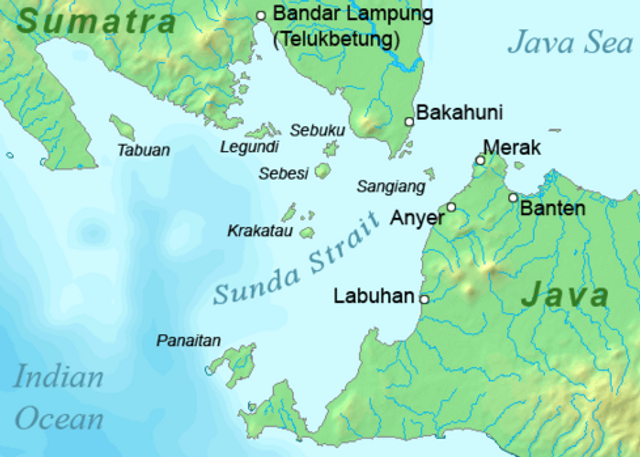
The death toll from the Sunda Strait tsunami disaster continues to rise. The Indonesian National Board for Disaster Management (BNPB) announced yesterday that at least 429 people have been killed, over 1,480 injured and more than 150 remain missing. Thousands of homes and over 70 hotels and 60 shops were heavily damaged or destroyed.
Scientists have confirmed that the tsunami was caused by a 64-hectare landslide on the nearby island volcano of Anak Krakatoa. It produced the massive and fast-moving waves that hit towns and popular beach resorts on both sides of the Sunda Strait at about 9.30 p.m. on December 22.
The volcano lies in the middle of the western side of the narrow strait. Survivors received no warning of the tsunami with waves estimated to have been between 2 and 5 metres high.
The Pandeglang district, on the Javan side of the strait and not far from Jakarta, suffered the largest numbers of casualties. Some 290 people were killed and over 14,390 rendered homeless—that is, the overwhelming majority of 20,000 people displaced by the catastrophe.
Sunda Strait, Indonesia
Heavy monsoonal rains and flooding are now complicating emergency rescue and relief with teams from the Indonesian military, the Indonesian Red Cross and NGOs unable to reach remote areas.
Damaged bridges and flooded rivers have made roads impassable, holding up convoys delivering heavy machinery and emergency relief supplies—food, medicine, shelters, latrines and generators—and forcing disaster officials to use helicopters to drop supplies and evacuate residents. Emergency relief doctors have told the media that supplies of medicine and clean water are dwindling and that children are becoming dehydrated and falling ill. Thousands of survivors are living in unhealthy conditions in areas hit by the tsunami.
National Disaster Mitigation Agency spokesman Sutopo Purwo Nugroho said that the search for victims and possible survivors was being expanded but that “the casualties may keep increasing” because many victims might still be buried under the debris.
The lack of heavy equipment in these remote areas means that distraught local residents have had to pick through the rubble of collapsed homes and other dwellings to try and find the bodies.
The Indonesian government has rejected offers of international aid, declaring that it can deal with the latest disaster. Emergency operations will only continue in Pandeglang district until January 4, and December 29 for Lampung Selatan District on the Sumatran side of the Sunda Strait.
Disaster response officials have warned that ongoing volcanic activity at Anak Krakatoa and high tides could produce more tsunamis.
On Tuesday, Dwikorita Karnawati, head of Indonesia’s Meteorology, Climatology and Geophysics Agency (BMKG), told the media that “the walls of the volcano’s caldera have been getting fragile [and could result in more landslides], especially if heavy rains pour onto it.” She called on local residents to “stay away from coastal areas, [and] at least between 500 metres and 1kilometre from the shoreline.”
Saturday’s tsunami is the third major disaster to hit Indonesia in the past six months. Powerful earthquakes took place on the island of Lombok in July and August. A tsunami in September killed around 2,200 people and displaced about 70,000 others in Palu on Sulawesi Island.
Yesterday marked the 14th anniversary of the 2004 Boxing Day tsunami that killed 226,000 people in 13 countries, including more than 120,000 in Indonesia, triggered by an earthquake off northern Sumatra.
In the aftermath of the 2004 catastrophe, a UN conference in Japan agreed to establish the Indian Ocean Tsunami Warning System—a network of deep sea sensors, as well as seismic stations and tidal gauges, linked to onshore alarm systems to alert those in danger. Assistance was to be provided by a number of countries, including the US, Europe and Japan.
Indonesia’s current warning system is made up of sea-bed sensors that are to detect changes in pressure and indicate an incoming tsunami. Surface buoys receive this data and transmit it to satellites. An earthquake near Sumatra in 2016, however, revealed that 22 of these buoys were not working and had not been since 2012.
The fact that the tsunami was caused by a massive landslide, rather than an earthquake, meant no seismic data was produced. A deep-sea buoy in the Sunda Strait could have triggered an alert but it not clear at this stage whether such a buoy was ever deployed in the area. Given the narrowness of the Sunda Strait, a highly efficient warning system was needed in order to give people in danger even a small amount of time to flee.
After Saturday’s tragedy, Indonesian President Joko Widodo directed the country's Meteorology, Climatology and Geophysics Agency (BMKG) to develop systems “that can provide early warnings to the community.”
Yesterday the Indonesian government announced it will begin work on a new warning system capable of detecting undersea landslides, the BBC has reported. Iyan Tu from the government’s Agency for the Assessment and Application of Technology, told the BBC that the new system would address the holes in the current system and be capable of detecting landslides.
In line with previous promises, this is likely to be little more than hot air. As the World Socialist Web Site warned in a perspective published in the aftermath of the Lombok tsunami-earthquake:
“There is no shortage of money in the hands of the rich in Indonesia and globally that could be used to vastly improve the warning system. Like the rest of the world, Indonesia has become increasingly socially unequal. Last year, 32 dollar billionaires had a combined wealth of $113 billion, while 93 million people, more than a third of the population, lived on less than $3.10 a day.
“Successive governments have stripped away funding for basic infrastructure, including emergency systems, while slashing corporate taxes and regulations that are seen as constraints on profits. ...
“Indonesia is far from unique. Throughout the world, from earthquakes in China and Nepal, to hurricanes in the United States and Haiti, profit-driven considerations make natural calamities immeasurably worse. The results include climate change and environmental degradation, the lack of emergency services, poverty and social inequality, and the failure of governments to cooperate internationally in the interests of protecting vulnerable people.”