28 Dec 2018

Ten 2018 Extinction Awards

Bill Quigley

Given the way people are transforming the earth into a place where the human species cannot survive, it is only right and just that we honor achievement in the race to extinction.
Without further ado, here are the top eight Extinction Awards of 2018.
2018 Extinction Global Person of the Year Award: Donald J. Trump         
One person did more in 2018 to advance the extinction of the human race than any other.  While space makes it impossible to list all the ways he acted to damage the earth, a look at just a few of the highlights from 2018 gives a clear snapshot.  In 2018, he made it easier for coal plants to pollute, made it easier for industry to engage in hazardous air pollution, announced the US will be pulling out of a twenty year old nuclear weapons treaty, started to rollback vehicle mileage standards, opened up oil and gas drilling on millions of acres of protected public lands, vigorously opposed the rights of children in the US to challenge the federal government for its role in global warming, and is making it easier for oil and gas companies to drill in the Artic National Wildlife Refuge. The world cannot forget that in 2017 he displayed his dedication to extinction when he boldly withdrew the US from the Paris climate agreement.
2018 Extinction Award for Country: United States
Worldwide, the United States produces the most oil, consumes the most oil, consumes the most natural gas, produces the most solid waste, and eats the most meat per capita (264 pounds per person).   The US is second in the world in fuel emissions, second in carbon dioxide emissions, and third in consumption of coal.  The US has over 6500 nuclear weapons putting it a close second to Russia which has 6550 and is planning to build many more.  The US has over 850 vehicles per 1000 people, far and away number one in the world.  Three out of every four new vehicles sold in the US are gas guzzling trucks or SUVs.  The fact that the US is led by the Extinction Global Person of the Year suggests it is well positioned to hold onto the leading role in next year’s awards as well.
2018 Extinction Award for Country, Runner Up: China 
In recent years, China has been surging in the extinction sweepstakes.  China now produces the most carbon dioxide emissions, has the most fossil fuel emissions, consumes the most coal, and leads the world in mismanaging plastic waste.  China is second in the world in solid waste, second in oil consumption, and third in use of natural gas.  Three of China’s biggest cities are among the ten most polluted in the world.  But China has some work to do to catch up with the US in key areas.  It has only 280 nuclear weapons, about 5 percent of what the US possesses.  Its population owns 104 vehicles per 1000 people, only about 12 percent of the US rate.  Given all the country has achieved lately, the US dare not stay too comfortable.
2018 Extinction Award for Most Polluted City in the World: Cairo
The award for most polluted city on earth goes to Cairo.  Residents of Cairo breathe in air nearly 12 times as dangerous as recommended by the World Health Organization.
2018 Extinction Award for Most Polluted City in the US: Los Angeles
The award for most polluted city in the United States goes to Los Angeles. It has ranked number one in ozone pollution in the US for years. In fact, eight of the ten most polluted cities in the US are in California.
2018 Extinction Award for Oil and Gas Privately Held Company: ExxonMobil
ExxonMobil barely edged out Chevron for this award.  ExxonMobil was the world leader in emissions among privately held oil and gas companies. The Union of Concerned Scientists analyzed the biggest leading privately held oil and gas companies in several categories  Chevron and ExxonMobil were both categorized as outstandingly bad or egregious in renouncing disinformation on climate science and policy.  Both achieved poor rankings in planning for a carbon free world and supporting fair and effective climate policies.  Exxon Mobil pulled ahead by a nose with a worse rating than Chevron in disclosure of climate risks.
2018 Extinction Award for Privately Held Utility Company: Duke Energy
Duke Energy is the nation’s largest electrical utility.  Two thirds of its power comes from coal.  Half of that coal comes from mountain top removal.  Coal is a profoundly harmful source of energy.  It is linked with diseases from asthma to cancer and heart and lung ailments.  After being caught after years of polluting four rivers in North Carolina with toxic coal ash, it plead guilty to nine criminal violations of the Clean Air Act and paid a fine of over $100 million.  Duke admitted fourteen of its plants across the nation were leaking harmful amounts of chemicals: one in Florida; three in Indiana; one in Kentucky; seven in North Carolina; and two in South Carolina. The leaking chemicals include arsenic, cadmium, chromium, cobalt, lead, lithium, molybdenum, radium 226, radium 228, selenium, and thallium.  Recently the company been accused of further polluting rivers in North Carolina with arsenic70 times more harmful than standard.
2018 Extinction Award for Pipelines: True Company
The cleanup continued this year from the half a million gallons of crude spilled from the Belle Fourche Pipeline in North Dakota.  The spill continued until it was discovered by a local farmer. True Company, operator of the pipeline, first said the spill was only one-third as large as it turned out to be also admitted that it was not clear why electronic monitoring equipment failed to detect the spill.  This was a highly contested category with many worthy contenders. All American Pipeline was convicted of one felony and eight misdemeanors for its misconduct in causing California’s worst oil spill in decades.  Energy Transfer Partners, a company with many environmental problems, was fined $430,000 by West Virginia for multiple water pollution violations and one of its subsidiaries, Bayou Bridge Pipeline, was judicially determined to have trespassed on private property by commencing substantial building of its pipeline in Louisiana prior to being given permission to expropriate.
2018 Extinction Award for Offshore Oil Spills: Taylor Energy
Taylor Energy, a relatively small company, took the honors this year.  It was recently revealed by the Washington Post that one of Taylor’s oil platforms knocked down in 2004 has been leaking as much as 10 to 20 thousand gallons of oil per day for the last 14 years!  So much oil has leaked that the Taylor spill is now a legitimate contender for the worst offshore environmental disasters in history, threatening to overtake BP’s 2010 Deepwater Horizon.
2018 Extinction Award for Automobile Manufacturer: Mercedes-Benz
Mercedes-Benz wins this award for producing the top three vehicles in Forbes “Dirty Dozen: The Ecologically ‘Meanest” Cars for 2018.”  Mercedes-Benz gave the world three SUVs which pollute in outstanding fashion: the G550 which gets 11 miles per gallon city and highway; the AMG G65, which gets 11 in the city and 13 on the highway; and the AMG G63 which clocks in at 12/15. This award is particularly important in the US market where nearly three out of every four new vehicles purchased are either trucks or SUVs.
Congratulations to all this year’s winners. With these kinds of achievements, there will come a day when the goal will be met and there will be no one left to recognize these accomplishments.  So, celebrate now.

Thoughts on Putin, Economic Downturns and Democracy

Dean Baker

A friend called my attention to this Project Syndicate piece by Kenneth Rogoff, a Harvard economics professor and former chief economist at the I.M.F. Rogoff  argues that Russia will need major economic reform and political reform in order for its economy to get back on a healthy growth path.
In the course of making his argument, Rogoff makes a quick and dirty case that the fact Putin was able to win re-election despite the economic downturn in 2015-2016 resulting from the collapse of world oil prices, shows that the country is not a western democracy.
“The shock to the real economy has been severe, with Russia suffering a decline in output in 2015 and 2016 comparable to what the United States experienced during its 2008-2009 financial crisis, with the contraction in GDP totalling about 4%. …..
“In a western democracy, an economic collapse on the scale experienced by Russia would have been extremely difficult to digest politically, as the global surge in populism demonstrates. Yet Putin has been able to remain firmly in control and, in all likelihood, will easily be able to engineer another landslide victory in the presidential election due in March 2018.”
First, the I.M.F. data to which Rogoff links, does not support his story of an economic collapse in Russia. The reported decline in GDP is 2.7 percent, not the 4.0 percent claimed by Rogoff. And, it is more than reversed by the growth in 2017 and projected growth in 2018. In other words, there does not seem to be much of a story of economic collapse here.
But the idea that a Russian government could not stay in power through an economic downturn, if it were democratic, is an interesting one. According to the I.M.F., Russia’s economy shrank by more than 25 percent from 1992 to 1996 under Boris Yeltsin, a close U.S. ally. Yet, he managed to be re-elected in 1996 despite an economic decline that was an order of magnitude larger than the one under Putin from 2014 to 2016. By the Rogoff theory, we can infer that Yeltsin should not have been able to win re-election through democratic means.

Social crisis worsens under New Zealand Labour Party-led government

Tom Peters

When the Labour Party-led government was installed in October 2017, Prime Minister Jacinda Ardern declared that her priority would be to turn around homelessness and child poverty figures. Deputy Prime Minister and NZ First leader Winston Peters promised to restore “capitalism's human face.”
Liberal commentators, trade union leaders and pseudo-left groups all joined in a chorus of praise for the “reformist” government. The media fawned over Ardern for having a baby and being a “working mother,” implying she would be more sympathetic to working people.
More than a year of continuing austerity and deepening social inequality has exposed the government’s promises as a fraud. The gap between rich and poor is widening and levels of food insecurity, homelessness and suicide are continuing to soar.
Official statistics released this month show that the richest 20 percent of New Zealand households have increased their net worth by $394,000 since 2015 and are now worth a median $1.75 million. This layer controls 70 percent of household wealth, while the top 1 percent has 20 percent of all assets.
The poorest 50 percent of adults, 1.8 million people, hold just 2 percent of net wealth. The bottom 40 percent has seen no increase in wealth over the past three years as the cost of living, especially housing and fuel, has soared.
One indicator of widespread social misery is the record number of people resorting to charity to feed their families over Christmas. The Christchurch City Mission reported that demand for food parcels had increased 45 percent as compared to the same time last year, with a large number of working people unable to afford the basics.
The Auckland City Mission told the media it had handed out 8,500 Christmas hampers over 10 days, double the amount compared to last year, and was still unable to meet the demand. On December 19 alone, about 400 families were turned away after the charity ran out of food. Missioner Chris Farrelly told Radio NZ: “It’s been quite overwhelming and shocking for us to see just the volumes of people... there is significant food poverty in this country—we’re seeing here, at the moment, the real hard end of it.”
The government has promised to halve child poverty, but its time frame is 10 years, making the promise essentially meaningless. Welfare and wage increases have been insufficient to meet the cost of living. Labour has refused to increase taxes on the rich and corporations, and kept spending levels relative to gross domestic product at the same level as the previous National Party government. Meanwhile, billions of dollars are being spent on upgrading the military and expanding the police force.
The austerity measures provoked an upsurge of working class struggles in 2018, including nationwide strikes by nurses and teachers.
The government’s Child Poverty Monitor report, released on December 10, found that between 161,000 and 188,000 children, one in five, live in households with “moderate to severe food insecurity,” and 18 percent receive help from food charities.
Children’s Commissioner Andrew Becroft told Radio NZ there had been “no real change” in child poverty levels in the past year. He added that due to inadequate housing children living in the poorest areas were three times more likely to be hospitalised for respiratory illnesses than those in more affluent areas.
In April the Child and Youth Mortality Review Committee reported that children living in “the most deprived areas” are three times more likely to die in childhood or adolescence than those in the least deprived areas. The leading cause of death for teenagers aged 15 and over was suicide.
In the 12 months to August, 668 New Zealanders took their own lives, an all-time annual record. Maori men, one of the most exploited sections of the working class, were over-represented with 97 suicides.
Cannons Creek, Porirua, one of the poorest suburbs in the country, experienced six suicides between June and October, out of a population of around 8,000. Five of those who took their own lives were under 30 years old.
Anjanette
Anjanette Coley, a local resident who has been unemployed for five years, told the World Socialist Web Site she was not surprised by the tragic toll: “There’s no jobs at all. Two of my daughters are on benefits and they have young kids. The government doesn’t give a hoot. The poor get poorer every day.” In the 2013 census about one in five people in the suburb was unemployed and its median income was about $10,000 below the national median of $28,500.
Anjanette explained that looking for work was “very stressful because I’m under so much pressure. I get depression. Heaps of people are being pushed into a corner they can’t get out of.” The attitude of Work and Income New Zealand (WINZ), the social welfare agency, was: “Get over yourself, stop making excuses, get a job.”
She received a benefit of $283 a week and paid $200 in rent. “It’s a broken-down home,” she said. “I live with my daughter and two grandkids. We’re both unemployed and paying $200. Landlords can up the rent any time they like, WINZ don’t understand.”
The government has promised to upgrade 2,000 state homes in Eastern Porirua over the next 25 years, but the total supply will only be expanded by 150 homes. Fairfax Media reported that there are currently 303 people on the waiting list for public housing in the area.
Anjanette had voted for the Green Party and Labour, but said “it was a stupid mistake.” The parties’ promises to reduce poverty and stop mistreating people on welfare were “the biggest lies of all.”
Zac, a 17-year-old Cannons Creek resident, believed “the majority of youth have more mental health problems” than older people, and poverty was a factor. “Some parents have seven kids and work 12-hour shifts every single day. They try and get food for their kids and they don’t have enough money,” he said.
“I’ve experienced depression and I know other people who have, and who have committed suicide or tried to, and survived,” he continued. “I just finished school and I don’t really know what to do. I’ve been looking at tech jobs and someone from my church is trying to help me.
“Other people can’t handle the stress of trying to find a job, they’ve just finished school and probably their parents are pressuring them to find a job. I know some people that start working pretty young and are trying to help their family out with rent, with putting food on the table. They sleep during the whole school day sometimes. It’s pretty common.”

Protests erupt in Tunisia after self-immolation of journalist Abderrazak Zorgui

Alex Lantier

Workers and youth have clashed with police for three days in cities across Tunisia following the self-immolation of journalist Abderrazak Zorgui. The 32-year-old cameraman burned himself to death in his hometown of Kasserine after posting a video on social media calling for an uprising and saying he hoped his act would help start a new revolution.
His suicide came eight years after revolutionary uprisings in Tunisia and Egypt triggered by the December 2010 self-immolation of Tunisian vegetable vendor Mohamed Bouazizi. Absent a revolutionary leadership capable of leading the working class to take power, the old Tunisian regime was able to restabilize itself and impose the financial diktat of the European and American banks. Tunisia’s current president, Beji Caid Essebsi, served under Zine El Abidine Ben Ali, the dictator toppled by the working class on 14 January 2011.
In his video, Zorgui denounced the Tunisian regime and the “war on terror,” saying, “To all unemployed youth of Kasserine, hungry and without resources: When we protest, they throw terrorism back at us. We go into the street to demand the right to work and they go on about terrorism, which means ‘shut up and go home to starve.’ I tell the people and the unemployed of Kasserine, today I will make a revolution alone. Those who want to join me are welcome. If someone finds a job afterwards, my self-immolation will not be in vain.”
He added, “We are sick and tired, they have been giving us promises for eight years and these are just lies. For my part, I belong to no party. They forget the unemployed and speak for the wealthy, while the unemployed and entire regions do not have a cent.”
Since Zorgui’s self-immolation, protests have erupted every night in Kasserine as well as in Jbeniana, Tebourba and working class districts of the capital, Tunis. Youth in Kasserine burned tires and responded to volleys of tear gas from riot police with stones.
With unemployment nationally at 15.5 percent, and double that around Kasserine, while inflation is running at 7.5 percent and the Tunisian dinar collapsing, anger is mounting among workers. Nebil Gassoumi, a schoolteacher in Kasserine who joined the protests, told France Info: “Nothing is going well here. The dinar is low and so our living standards are low, even for those who have work. Everyone here is suffering.” He added, “There is no investment, there are no jobs for job seekers.” Gassoumi said he hoped the protests would continue.
Also this week, protests erupted against the murder of Falikou Coulibaly, the president of the Association of Ivorians in Tunisia. This led to an outpouring of criticism by sub-Saharan African workers and students of working conditions and racist behavior in Tunisia. “Why do you suppress us? You strangle us sub-Saharans. To be honest, you are mean. Morally and psychologically, we feel terrible,” a worker, Alexandre Diaoré, said of Tunisia on RFI.
“It is quite fashionable for a certain bourgeois layer to go shop at Carrefour, the retail outlet in the north suburbs, with two black maids,” AFP reports. At the same time, it notes, “Young maids from the Ivory Coast or nearby countries work seven days per week, paid little and with their passports confiscated.” The wire service also noted complaints of “a Senegalese student who was asked whether he sleeps in the trees and feeds himself with bananas.”
The Tunisian government is responding to the growing protests with police violence and high-level plans for a crackdown. In Kasserine’s Ennour and Ezzouhour districts, police arrested 16 people in house-to-house searches, charging them with rioting. Five stand accused of destroying surveillance cameras installed by the Tunisian Interior Ministry.
Yesterday, the Tunisian Council of Ministers met. While it affirmed the “need to respect the right to protest peacefully,” it acted to integrate all internal security operations under the president’s control. The Defense and Interior ministries are coordinating army and police operations during protests to commemorate Ben Ali’s overthrow, and in media and police circles a concerted, hysterical campaign is underway to threaten protesters or slander them as terrorists and criminals.
In a La Presse editorial titled “Beware excesses and the unknown,” Abdelkrim Dermech wrote:
“Those who make parallels between the spark lit by Bouazizi on 17 December 2010 and that of Abderrazak Zorgui on Monday in Kasserine forget for whatever reason that such a comparison can no longer be made. While there is a real divorce between the current political establishment and youth in the so-called less-favored regions, violence, senseless aggression and damage to public or private property can no longer be accepted, tolerated or seen as democratic.”
On Thursday, the Council of Ministers absurdly declared that the circumstances of Zorgui’s death were “obscure,” and police gave an initial report on interrogations of detained protesters. The web site Kapitalis endorsed the police findings as follows: “Extremists, including adolescents arrested on December 25 and 26, 2018, affirmed during their interrogation that they had been paid off by smugglers to infiltrate the demonstrators and attack police and National Guard stations with stones and Molotov cocktails.”
Insofar as Tunisian security authorities are still investigating themselves on charges of torture and other crimes they committed under Ben Ali, these “confessions”—which read as if they were scripted by Essebsi’s Council of Ministers—have no credibility whatsoever.
Eight years after the fall of Ben Ali in the first revolutionary uprising of the working class in the 21st century, none of the demands that drove workers into struggle have been resolved. Capitalism is economically and socially bankrupt. As for Tunisia’s democratic reforms, they were just a facelift for the old regime and the old police state, which now proceeds under the threadbare cover of the “war on terror.”
This vindicates the perspective advanced by the International Committee of the Fourth International (ICFI) immediately after Ben Ali’s ouster. The ICFI recognized that the revolutionary uprising in Tunisia, and then Egypt, marked a new era in the international class struggle and the struggle for world socialist revolution.
Its 17 January 2011 statement, “The mass uprising in Tunisia and the perspective of permanent revolution,” warned:
The Tunisian masses, however, are at only the initial stages of their struggle. As is already clear from the continuation of military violence under the new interim president, the working class faces immense dangers. The crucial question of revolutionary program and leadership remains unresolved. Without the development of a revolutionary leadership, another authoritarian regime will inevitably be installed to replace that of Ben Ali.
After nearly a decade of war and economic crisis, a new eruption of the class struggle is underway in Tunisia and beyond. As bread riots break out in Sudan, political protests and strikes are staggering France, Portugal and Spain after a year that saw international strikes by Amazon and Ryanair workers, protests by Iranian workers and mass strikes by US teachers.
Zorgui’s decision to commit suicide as he called for revolution is a particularly tragic illustration of the ICFI’s analysis that in this situation the critical question is the building of a revolutionary leadership in the working class. The turn now is to building sections of the ICFI in Tunisia, across the Mediterranean and around the world.

27 Dec 2018

A Safe Alternative to Female Circumcision

Cesar Chelala

Female circumcision, also called female genital mutilation (FGM) is widely practiced in 29 countries in Africa and the Middle East. More than 125 million women have been subjected to different forms of genital mutilation across Africa and in areas of western and southern Asia, and 2 million women undergo the procedure annually. According to UNICEF, 91 percent of women age 15–49 undergo female circumcision in Egypt, where a young woman died recently following this procedure.
It is also carried out in Australia, Canada, England, France, and the United States among immigrants from countries where it is performed as a ritual. Female genital mutilation is internationally recognized as a violation of the human rights of girls and women. FGM has no health benefits to women. On the contrary, by removing normal, healthy genital tissue the procedure interferes with the body’s natural functions. An alternative rite to replace this practice offers hope to change this situation.
A safe alternative to traditional female genital mutilation has been used for many years in some African countries. If more extensively used, it can contribute to putting an end to a practice that has caused considerable harm and suffering to millions of women worldwide.
This alternative rite was initiated in the Tharaka District in Kenya in 1996, and grew out of the collaboration between a women’s Kenyan group, called “Maendeleo Ya Wanawake Organization” (MYWO) and the Program for Appropriate Technology in Health (PATH), a nonprofit, international organization whose aim is to improve the health of women and children in developing countries.
The alternative rite initially practiced in Kenya is known as “ntanira na mugambo” or “circumcision through words.” Young women go through a weeklong program of counseling, training, and education, capped by a day designated as the “coming of age day,” when members of the community join for a celebration with music, dances, and feasting.
The rite consists of a week of seclusion. In it, the adolescents are taught basic concepts of anatomy and physiology, sexual and reproductive health and hygiene, and are counseled on gender issues, respect for adults, how to improve their self-esteem, and how to deal with peer pressure.
The program recognizes the girls’ need for recognition, so they receive a certificate, presents, are granted special wishes, and become the center of attention in the community during the final day of celebration. The mothers, many of whom act as peer educators, are then able to convert the fathers and the rest of the family.
A similar ritual, in which the girl is declared a woman without maiming her for life, is carried out in Uganda among the Sabiny tribe of farmers. What makes the Uganda case particularly interesting is that the clan elders, who formed the Elders Association in 1992, decided to outlaw FGM and promoted the new rite to replace it. Because of their work they received the 1998 United Nations Population Award.
This new rite has hopes of success because it offers an attractive alternative rather than a blunt prohibition to a long-established cultural practice. It could thus become one of the most significant measures toward improving women’s health and quality of life on a large scale.
This alternative rite is similar to ceremonies practiced in other religions. In the Jewish faith, after years of training in religious principles, history and family matters, 12-year-old girls go through a ceremony (bat mitzvah) that signals their passage to womanhood. It also indicates that from then on they become full-fledged members of the Jewish community with all the responsibilities that come with it.
Among Hindu and Buddhist women living in regions of Nepal and in Southern India, girls are kept in the dark for 12 days immediately following menarche, during which they are not allowed to see a man’s face or to take a bath. Afterward, they bathe and there is a ceremony with feasting and presents indicating their entrance into womanhood.
In many societies, FGM is considered a cultural tradition, which has been used as an argument to continue its practice. In other societies, the prevalent view is that it is recommended in religious texts. There is no evidence, however, to support this last assertion.
FGM can provoke serious psychological and bodily harm to women who undergo the procedure. Research on this issue has shown that if communities decide to abandon FGM, the practice can be eliminated very rapidly. The use of this alternative and safer procedure can protect women from unnecessary harm and help them lead healthier, and more active and fulfilling lives.

Ten Charts Show How the World is Progressing on Clean Energy

Iain Staffell

Rapid progress towards clean energy is needed to meet the global ambition to limit warming to no more than 1.5C above pre-industrial temperatures.
But how are countries doing so far? In our Energy Revolution Global Outlook report, written with colleagues at Imperial College London and E4tech – and published by Drax– we rank progress in 25 major world economies.
Our report provides a league table of their efforts to clean up electricity generation, switch from oil to electric vehicles, deploy carbon capture and storage, eliminate fossil fuel subsidies and tackle energy efficiency.
The ten charts below compare these 25 countries today and their progress over the last decade.

Progress on clean electricity

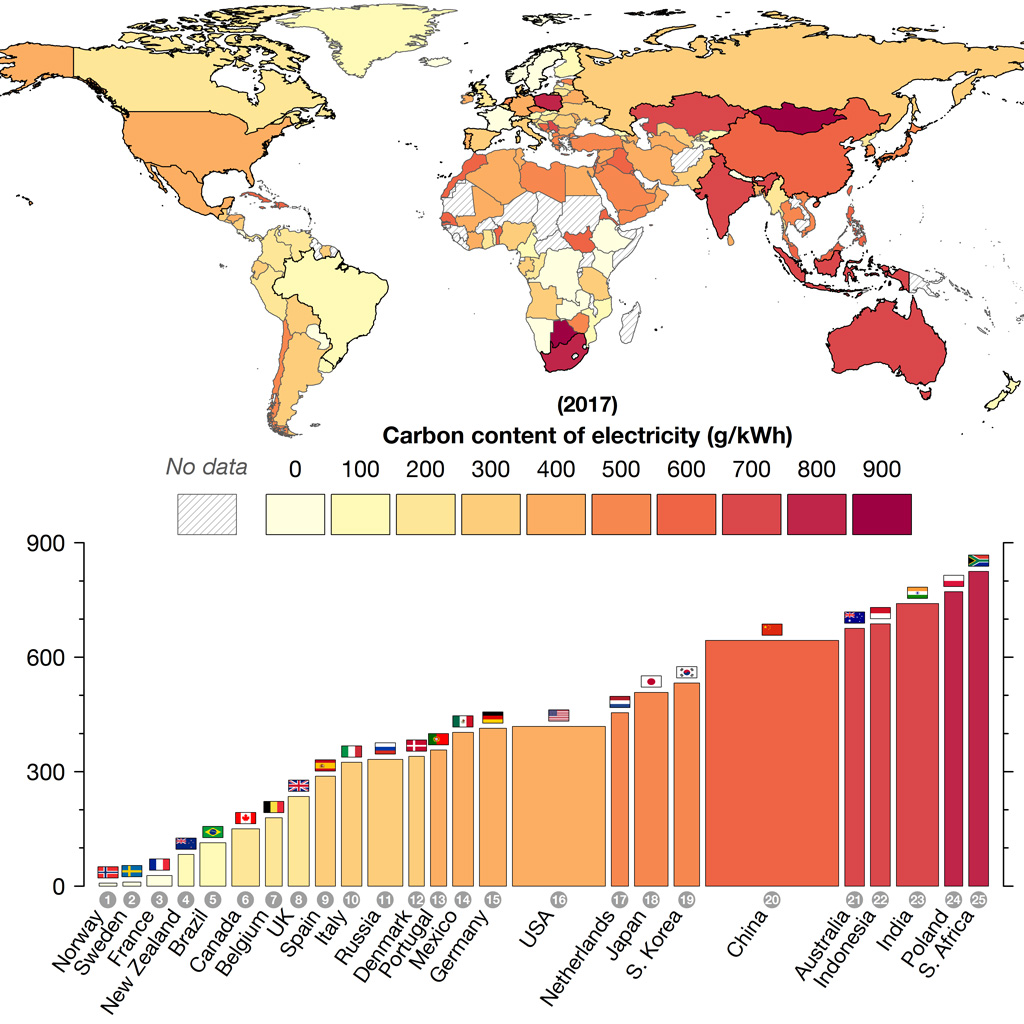
Electricity has been the fastest sector of the economy to decarbonise as countries move away from coal and embrace low-cost renewables. Yet the average carbon intensity of electricity worldwide has fallen only 7% in the last decade to 450 grams of CO2 per kilowatt hour (gCO2/kWh).
The chart below maps the carbon intensity of electricity generation around the world and ranks the 25 major economies covered by our report. These countries include the G7 group of rich nations along with Brazil, Russia, India, China and South Africa (the “BRICS”) and others. These countries account for 80% of global population, 77% of global GDP and 73% of the world’s CO2 emissions.
Individual countries range from having virtually zero-carbon electricity (in the Nordics, France and New Zealand, left-hand columns in the lower chart) up to near-total reliance on coal (in South Africa and Poland, on the far right).
Combined world map and bar chart showing The carbon intensity of electricity generation during 2017, in grams of CO2 per kWh. The map includes all countries for which data is available. The bar chart ranks 25 major economies including all G7 and BRICS countries. Bar widths represent the amount of electricity consumed in each country, with a minimum width so that smaller countries are still visible. Source: Drax 2018.
The carbon intensity of electricity generation during 2017, in grams of CO2 per kWh. The map includes all countries for which data is available. The bar chart ranks 25 major economies including all G7 and BRICS countries. Bar widths represent the amount of electricity consumed in each country, with a minimum width so that smaller countries are still visible. Source: Drax 2018.
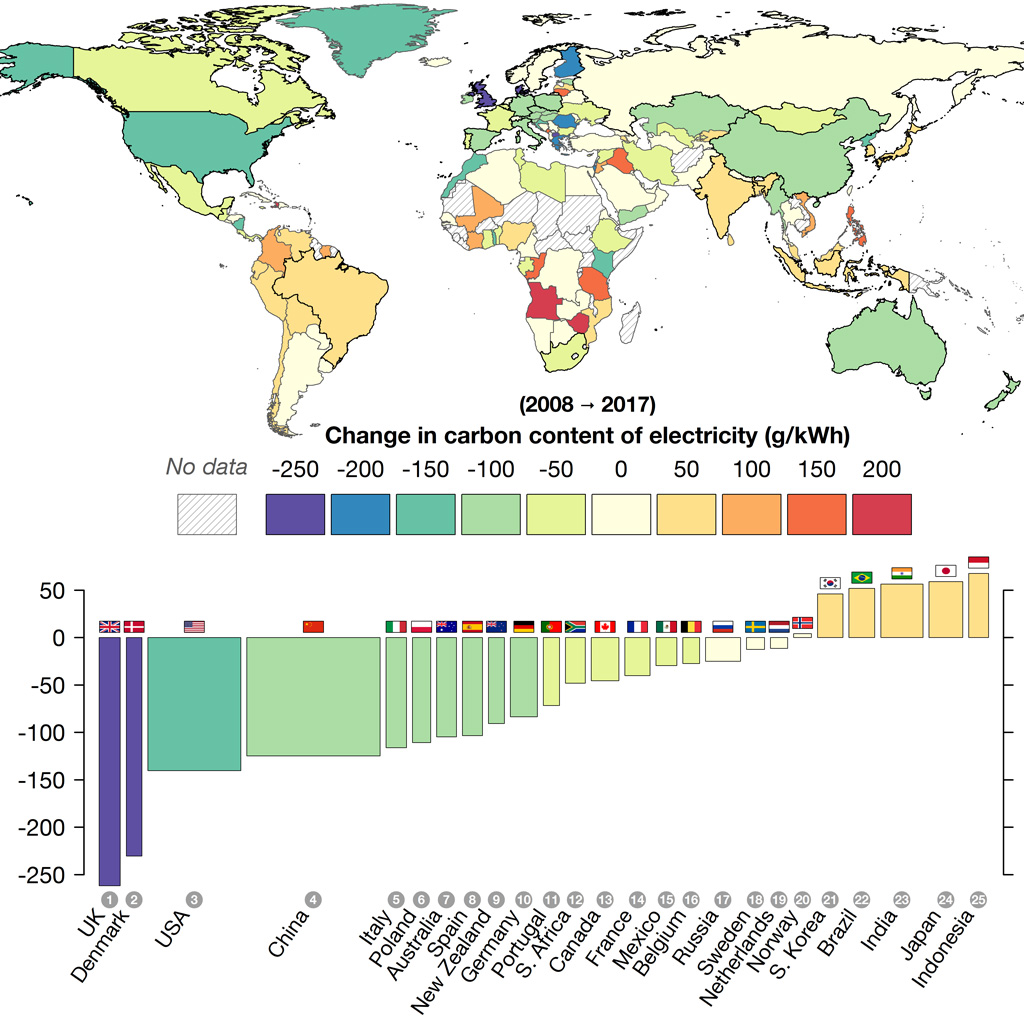
Countries across Europe and North America have almost unanimously reduced the carbon intensity of their electricity over the last decade. They have done this by reducing their reliance on coal and increasing their share of renewables, as well as by reducing electricity demand in many cases.
On the other hand, several large Asian countries – Japan, South Korea, India, Indonesia – increased their carbon intensity as they now rely more heavily on coal. China is one of the only Asian countries to be cleaning up its power system, having reduced carbon intensity by one-sixth this decade. The US is also progressing faster than most, behind only the UK and Denmark as in the chart, below.
Combined world map and bar chart showing The change in carbon intensity of electricity generation over the last decade, in grams of CO2 per kWh. Shades of blue and green indicate reductions while yellows and reds are increases. Source: Drax 2018.
The change in carbon intensity of electricity generation over the last decade, in grams of CO2 per kWh. Shades of blue and green indicate reductions while yellows and reds are increases. Source: Drax 2018.
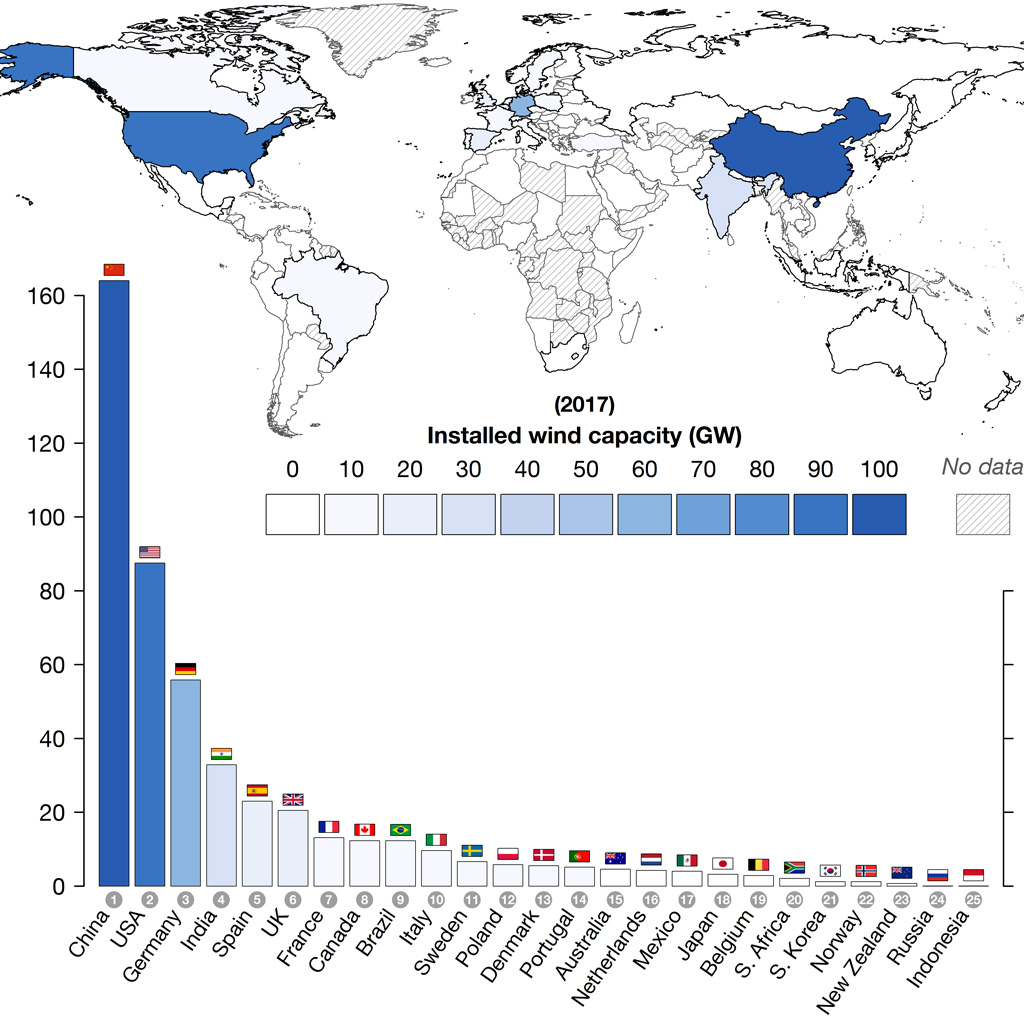
One of the main drivers in cleaning up power systems worldwide is the rise of renewable energy. In absolute terms, China is the clear leader, having both one third of the world’s installed wind capacity and one third of installed solar.
China’s near-130 gigawatt (GW) solar capacity is roughly equal to the next three largest countries put together: Japan, Germany and the US. For wind capacity, other notable high-fliers include fourth-ranked India and Poland in twelfth, which has a larger wind capacity than Denmark, as shown in the chart, below.
Combined world map and bar chart showing The installed capacity of wind power at the end of 2017, in gigawatts (GW). Source: Drax 2018.
The installed capacity of wind power at the end of 2017, in gigawatts (GW). Source: Drax 2018.
However, on a per-capita basis, Denmark has the most wind, with 1,000 watts of capacity per person, and Germany the most solar at 500 watts per person.

Progress on clean transport

Clean electricity could move beyond homes and offices to power the way we move. Electric vehicles are rapidly coming down in price, and several countries are now legislating the demise of the internal combustion engine over the coming decades.
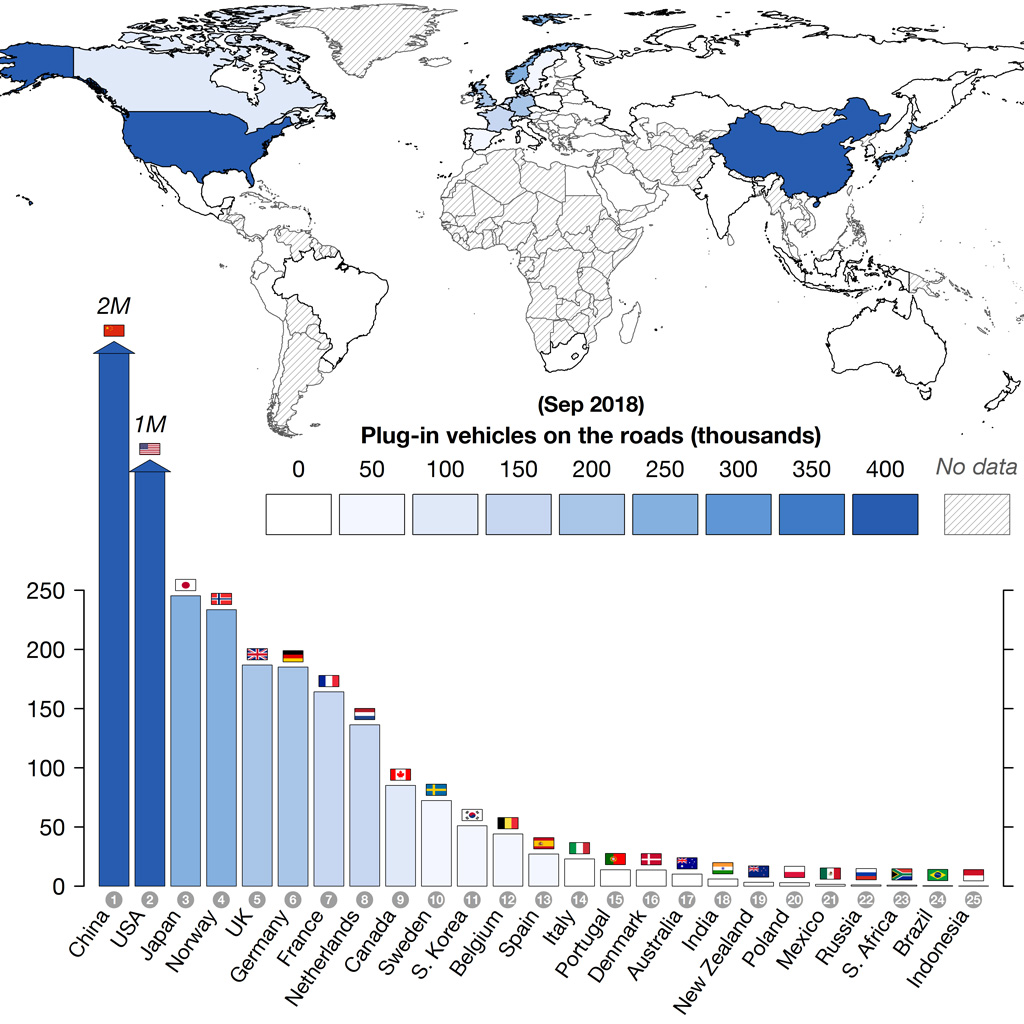
So far, some 4.5m electric vehicles have been sold worldwide, nearly half of which are in China, and a quarter in the US, as the chart below shows.
Combined world map and bar charts showing The number of electric vehicles on the roads (both battery and plug-in hybrid) as of September 2018. Source: Drax 2018 and EV-volumes 2018.
The number of electric vehicles on the roads (both battery and plug-in hybrid) as of September 2018. Source: Drax 2018 and EV-volumes 2018.
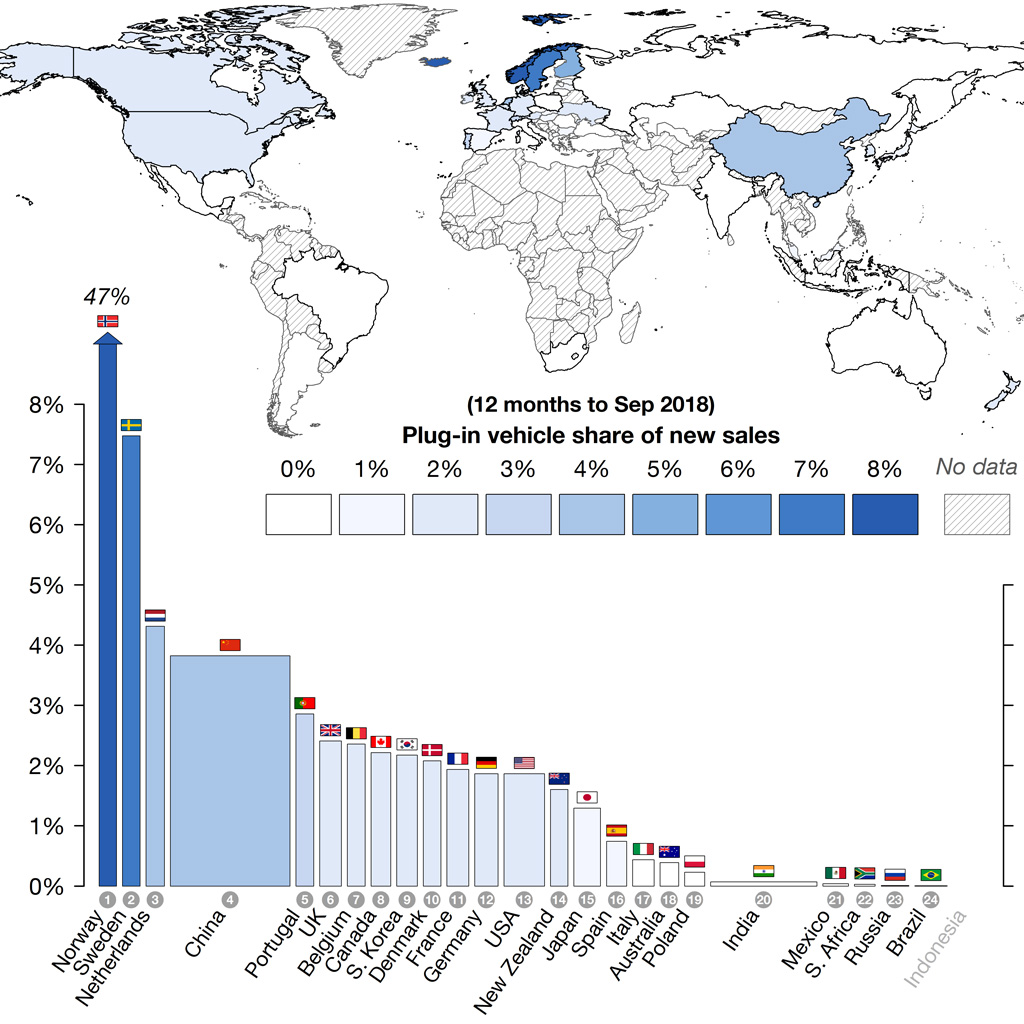
Several countries have reached a 2% market share for electric vehicles, meaning they make up 1 in 50 new cars sold. The rate in China is around double this, while Norway is well ahead of the pack with almost 1 in 2 vehicles sold now electric, as the lower chart below shows.
Combined world map and bar charts showing The share of electric vehicles (both battery and plug-in hybrid) within new car sales, for the 12 months to September 2018. Bar widths represent each country’s population. Source: Drax 2018 and EV-volumes 2018.
The share of electric vehicles (both battery and plug-in hybrid) within new car sales, for the 12 months to September 2018. Bar widths represent each country’s population. Source: Drax 2018 and EV-volumes 2018.
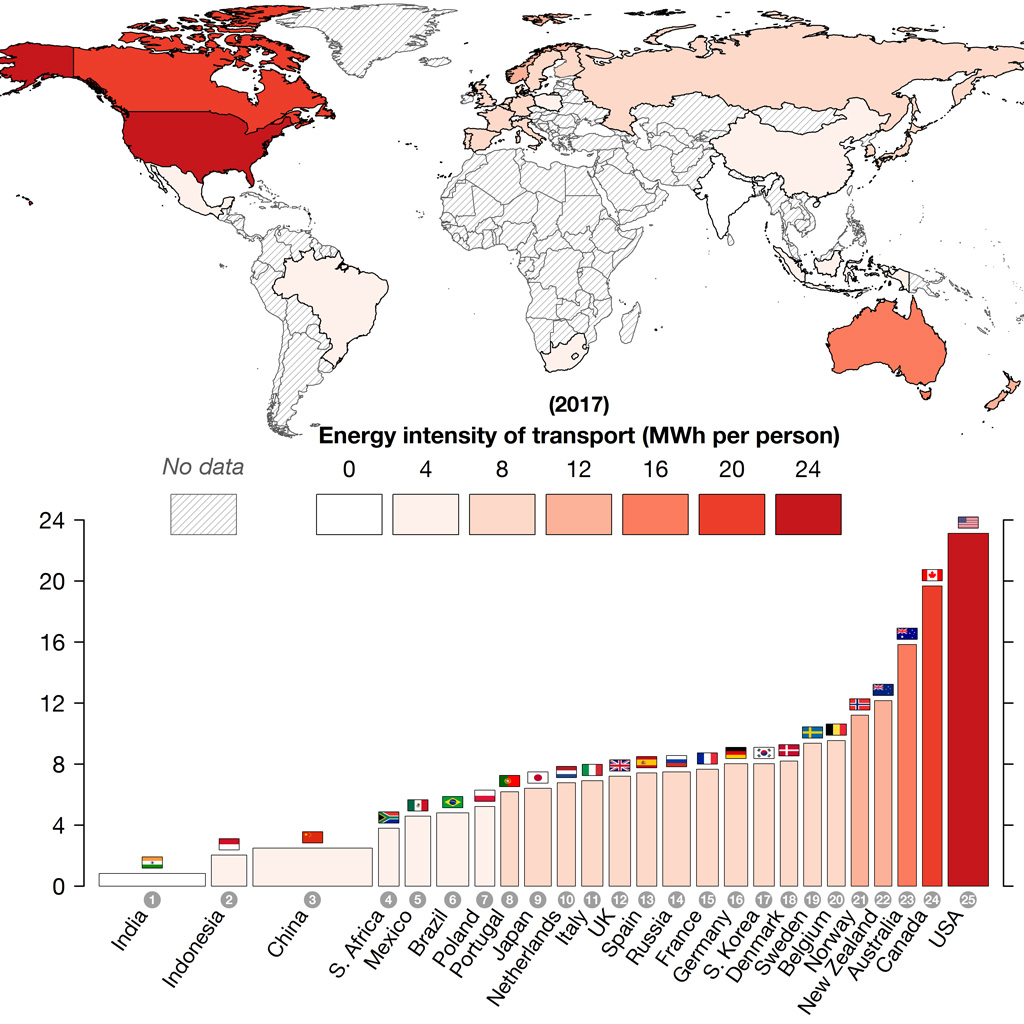
Cleaning up the transport sector does not just rely on new technologies, however, as people could travel less or using more efficient forms such as public transport. The amount of energy consumed per person on transportation varies greatly across the world, with the average American consuming 10 times more than the average Indian, as the charts below show.
Combined world map and bar charts showing The energy consumed per person for transportation of people and goods, in megawatt-hours (MWh) per person per year. Bar widths represent each country’s population. Source: Drax 2018.
The energy consumed per person for transportation of people and goods, in megawatt-hours (MWh) per person per year. Bar widths represent each country’s population. Source: Drax 2018.
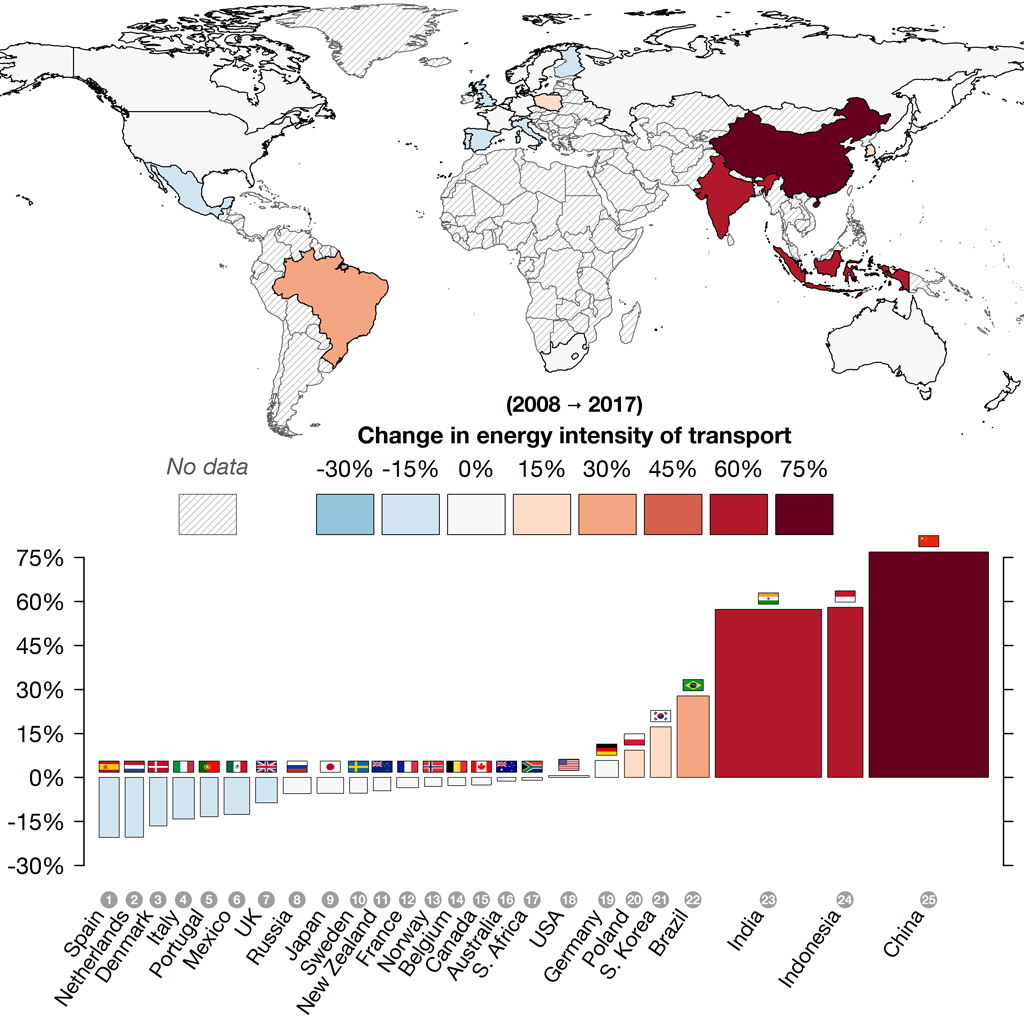
Large countries where people routinely fly between cities consume the most, but China and India are rapidly catching up as incomes rise. Their transport energy consumption rose 80% and 60% per person over the last decade, respectively. This has dwarfed the modest increases in transport efficiency seen across Europe and North America, as in the chart, below.
Combined world map and bar charts showing The change in energy consumed per person for transportation of people and goods over the last decade, showing the percentage rise (reds) or fall (blues) in MWh per person per year consumed. Bar widths represent each country’s population. Source: Drax 2018.
The change in energy consumed per person for transportation of people and goods over the last decade, showing the percentage rise (reds) or fall (blues) in MWh per person per year consumed. Bar widths represent each country’s population. Source: Drax 2018.

Progress on energy efficiency

Efficiency is not only slow to improve in the transport sector. Improving the energy efficiency of buildings worldwide is urgently needed to reduce the demand for carbon-intensive heating.
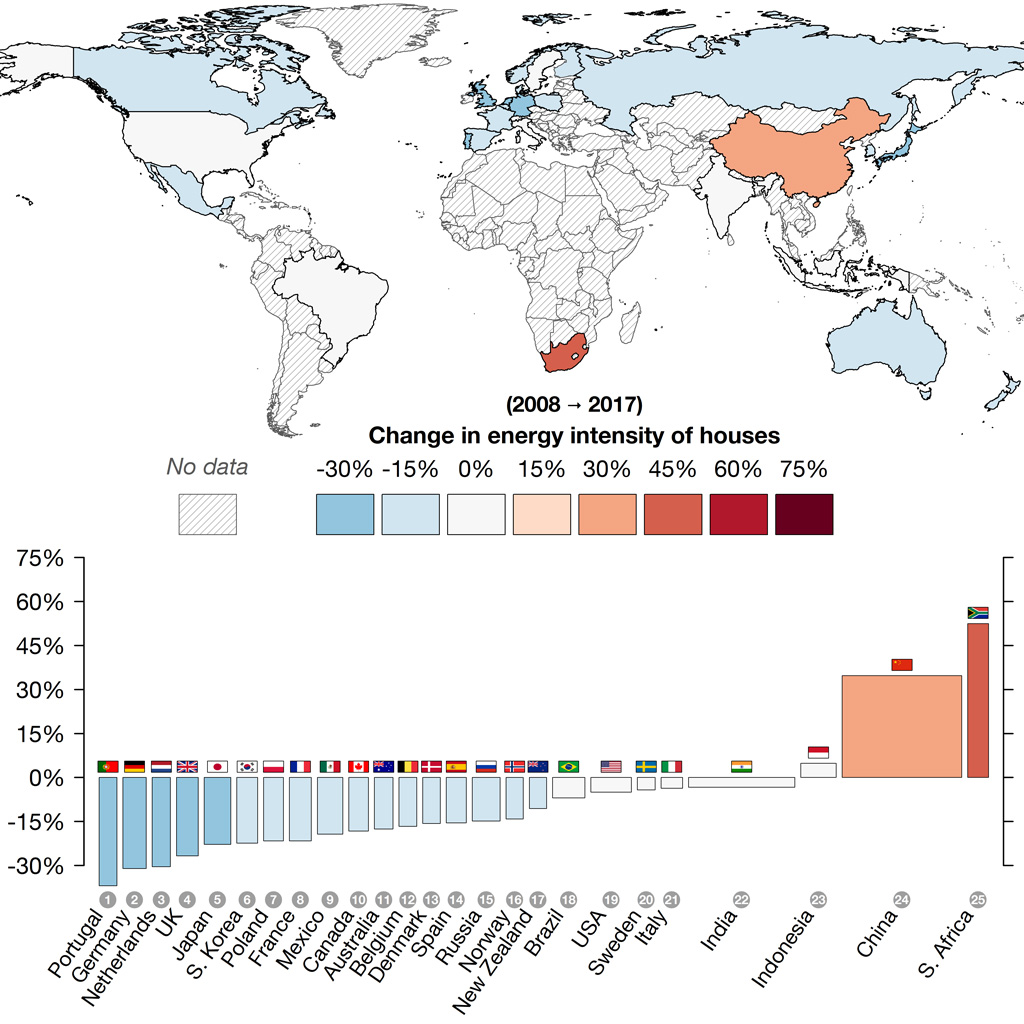
Homes in most major countries are using less energy than they did a decade ago, per square metre of floor area. While some of this can be credited to improving building standards and more energy-efficient appliances, the gains may also be due to the residual effects of the global recession and the run of mild winters caused by rising global temperatures.
In some parts of the world, notably China and South Africa, improved living standards have lead to a rapid growth in household energy consumption, as the chart below shows.
Combined world map and bar charts showing The change in energy consumed for heating and powering households over the last decade, showing the percentage rise (reds) or fall (blues) in MWh per person per year consumed. Bar widths represent each country’s population. Source: Drax 2018.
The change in energy consumed for heating and powering households over the last decade, showing the percentage rise (reds) or fall (blues) in MWh per person per year consumed. Bar widths represent each country’s population. Source: Drax 2018.

Progress on fossil fuels and carbon capture

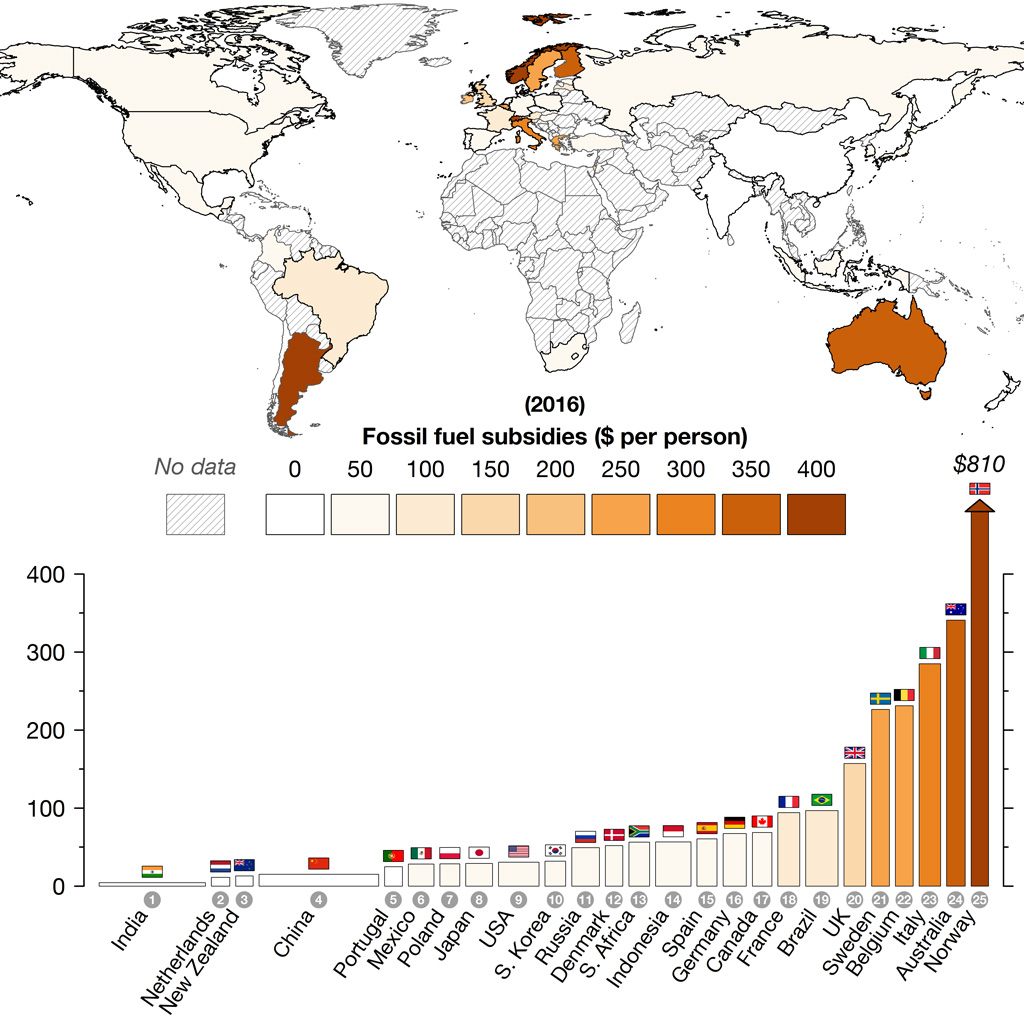
Government support for fossil fuels is a perverse feature of many economies, holding back the transition away from coal, oil and gas.
The definition of fossil fuel subsidies is widely disputed. Yet according to the definition used by the Organisation for Economic Cooperation and Development (OECD) several major fossil fuel producing nations with relatively small populations, such as Norway and Australia, provide hundreds of dollars per capita per year, as the chart below shows. On this measure, the UK also gives large subsidies.
Combined world map and bar charts showing The level of subsidies offered to fossil fuels per person in 2016, including direct expenditures by government, forgone tax revenues and other fiscal concessions. Bar widths represent each country’s population. Source: Drax 2018.
The level of subsidies offered to fossil fuels per person in 2016, including direct expenditures by government, forgone tax revenues and other fiscal concessions. Bar widths represent each country’s population. Source: Drax 2018.
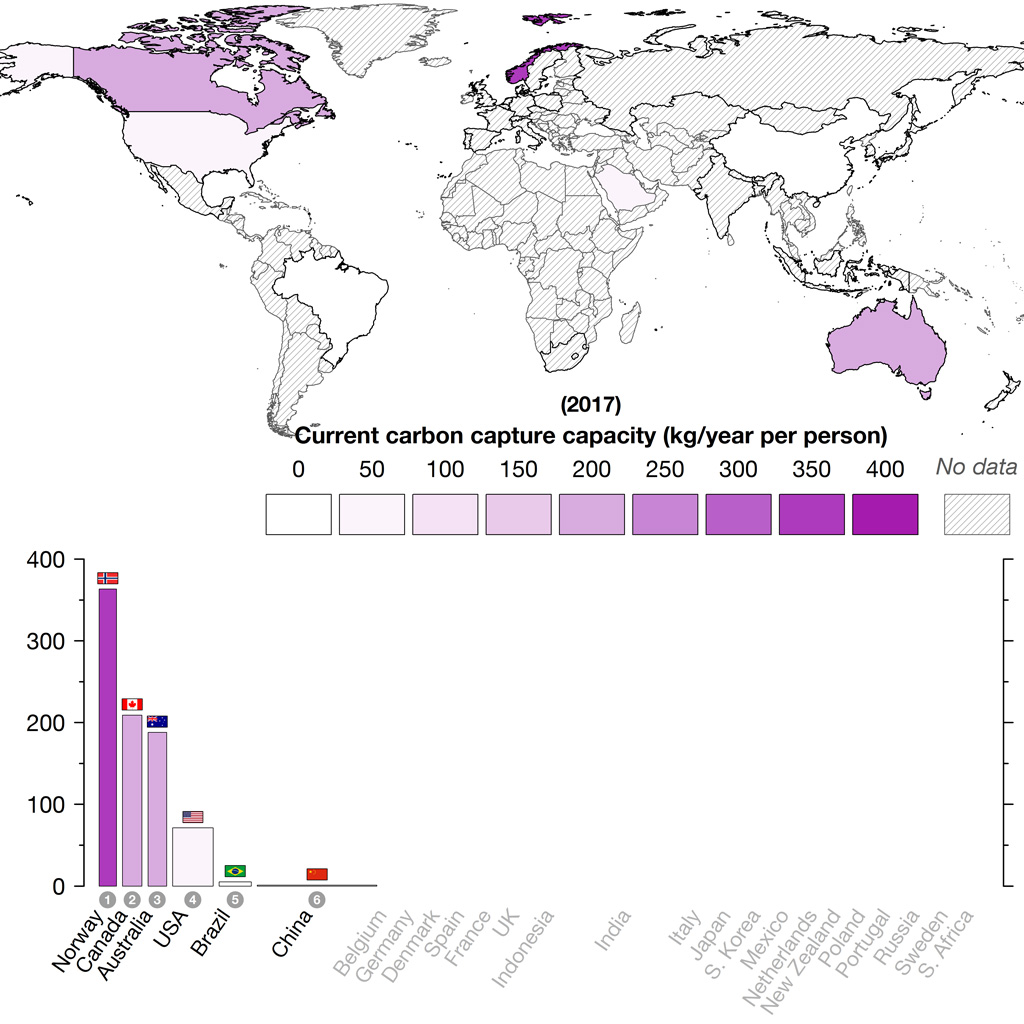
One important feature of many pathways to 1.5 or 2C is to combine hard-to-avoid uses of fossil fuels, such as in steel-making or cement, with carbon capture and storage. Today, however, there are just 18 large-scale carbon capture and storage (CCS) facilities around the world, concentrated in six countries with major oil and coal extraction industries, as the chart below shows.
Combined world map and bar charts The installed capacity for carbon capture at large-scale CCS facilities as of the end of 2017, measured as kg of CO2 that can be captured per person per year. Actual level of capture may be lower, if facilities do not run at full availability. Bar widths represent each country’s population. Source: Drax 2018.
The installed capacity for carbon capture at large-scale CCS facilities as of the end of 2017, measured as kg of CO2 that can be captured per person per year. Actual level of capture may be lower, if facilities do not run at full availability. Bar widths represent each country’s population. Source: Drax 2018.
Together, these CCS facilities are capable of capturing 32 million tonnes of CO2 each year. This is less than one-tenth of one percent of the roughly 37 billion tonnes of CO2 produced each year by the world’s energy sector. If CCS does see widespread roll-out over the coming decades, the potential for storing CO2 underground will not pose a barrier. The US alone could store all of the CO2 produced worldwide since the start of the industrial revolution.

Conclusion

All in all, progress towards clean energy around the world is mixed, with some countries pushing ahead on many fronts but others going backwards. Overall, our rankings show that the world’s nations are falling far short of what is needed and that progress over the next decade must be far stronger to avoid the worst impacts of climate change.

Moon targeted for further exploration, orbiting space stations and militarization

Henry Allan & Bryan Dyne

Earlier this year, NASA announced plans to build a Lunar Orbital Platform-Gateway, which is slated to be humanity’s tenth space station and the first that will orbit the Moon. The Gateway is projected to be operational by the mid-2020s, with the first initial component of the outpost ready to launch in 2022. Congress has already provided $504 million for the initial planning and design of the space station and the project, if it goes forward, is estimated to cost $3 billion a year.
NASA’s planned Lunar Orbital Platform-Gateway outpost (on the left), being approached by an Orion spacecraft as envisioned by an artist. Credit: NASA
NASA is promoting the Gateway as a lunar-orbiting station with scientific instruments attached externally as well as internally in order to conduct scientific experiments, control lunar rovers, or even act as a jumping off point for further ventures into space, including possible launches towards deep space.
“I envision different partners, both international and commercial, contributing to the gateway and using it in a variety of ways with a system that can move to different orbits to enable a variety of missions,” said William Gerstenmaier, associate administrator for Human Exploration and Operations at NASA Headquarters in Washington, earlier this year. “The gateway could move to support robotic or partner missions to the surface of the moon, or to a high lunar orbit to support missions departing from the gateway to other destinations in the solar system.”
Whatever its potential achievements, however, the development of the Gateway cannot be seen outside the context of the plan to create a “Space Force” as the sixth branch of the US military and the growing militarization of space in general.
When US President Donald Trump announced his intent to form the “Space Force” in June, he made it clear that the move was part of the war plans directed against Russia and China. “Our destiny beyond the Earth is not only a matter of national identity but a matter of national security,” Trump declared, adding that the United States should not have “China and Russia and other countries leading us.” He further emphasized, “It is not enough to merely have an American presence in space; we must have American dominance in space.”
House Space Subcommittee Chairman Brian Babin, a Texas Republican, echoed the national-chauvinist line of Trump, declaring, “Under the president’s leadership, we are now on the verge of a new generation of American greatness and leadership in space—leading us to once again launch American astronauts on American rockets from American soil.”
The Gateway would inevitably be a part of these efforts. A US space station orbiting the Moon immediately raises the possibility of policing of the space between Earth and the Moon, whether by manned or unmanned vehicles. These in turn would need a broader support network of spy satellites and other infrastructure necessary for such an undertaking, including space-based weapons.
It would no doubt also be used as an attempt to counter the influence of China, which is currently planning on building its own base on the surface of the Moon. It is not far-fetched to consider a “freedom of navigation” provocation, like those conducted repeatedly by the US military in the South China Sea, carried out against Chinese vessels in space. The Gateway might also be used as the pretext for attacking a craft that simply went too close to the station, violating its “territorial waters,” so to speak. Any of these could be used to start a war.
One view of the International Space Station. Credit: NASA
Such moves in the direction of new wars of aggression came into sharp focus when Trump announced the unilateral US withdrawal from the Intermediate-Range Nuclear Forces (INF) treaty with Russia, which prohibited Washington and Moscow from developing short- and medium-range missiles capable of carrying nuclear warheads. The withdrawal will set the stage for a further development of the US nuclear arsenal. It also poses the possibility of placing strategic weapons in space, perhaps even as part of the proposed space station.
The Gateway has also drawn criticism from scientists and astronauts who oppose the project as a drain on the already limited resources for space exploration. While the total cost of the Gateway is not fully worked out, it is already known that it will take twenty launches from currently available rockets to get the planned modules for the station to the Moon. This would eliminate twenty launches that could otherwise be dedicated to different unmanned interplanetary missions. While this could be reduced to as little as four if the Gateway was built with either NASA’s Space Launch System or SpaceX’s Super Heavy Starship, neither of those rocket designs have yet to be built.
Opponents of the Gateway have also pointed out that, unlike the currently operational International Space Station (ISS), because there are no agreements to share any benefits that might be gained from the Gateway, there are no cost-sharing agreements for the station’s operation. If US unilateralism on trade is an example of what will be demanded in space, then other nations will probably stick to the ISS or even begin developing their own, similar projects, with the same inherent risks—the danger of disaster in space and war on Earth.
It is also not clear that the Gateway would actually be a “stepping stone” to missions elsewhere in the Solar System. To arrive at the station, a spacecraft would have to enter orbit around the Moon, which costs fuel. As of now, a trip to the surface of the Moon that first stopped at the Gateway would require thirty percent more fuel. A trip to an asteroid, Mars or elsewhere faces similar problems.