29 Dec 2018

Dozens killed in protests against austerity and repression in Sudan

Jean Shaoul

At least 27 people have been killed and 219 injured during protests opposing the Sudanese government of president Omar al-Bashir. Hundreds more have been arrested in a brutal crackdown on demonstrations against the rising cost of basic commodities including bread.
Among those arrested were 14 leaders of an opposition coalition, the National Consensus Forces, including its leader, the 85-year-old Farouk Abu Issa, who is in poor health, a senior leader of Sudan’s Communist Party, as well as leaders from the pan-Arab Ba’ath and Nasserist parties. Authorities have also blocked social media sites and disrupted internet services to stop protesters communicating.
Yesterday, security forces fired tear gas at hundreds of protesters following Friday prayers outside a mosque in Omdurman, part of the Greater Khartoum conurbation.
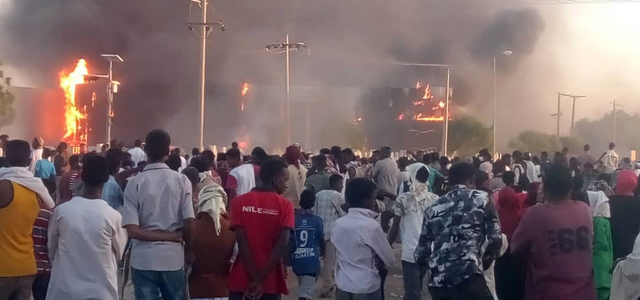
A crowd of protesters outside the burning offices of the ruling National Congress Party
The protests initially broke out on December 19 over the tripling in the price of bread and fuel shortages in the northeastern city of Atbara, where protesters torched the ruling National Congress Party’s offices. Atbara, is known as the “City of Steel and Fire” because of its historical importance to the rail network and the presence of a militant rail workers’ trade union that was dismantled under military rule in the 1980s.
The protests rapidly spread across Sudan’s major towns and cities, including the Riverain region—reputedly the regime’s stronghold—and the capital Khartoum, with demonstrators torching the party’s offices in Dongola. Within 24 hours, the demonstrations had escalated into a more generalized expression of opposition to years of austerity, economic hardship and suppression of the most basic democratic rights that make life intolerable for most Sudanese people, particularly the youth. In Khartoum, the average age of protesters is reportedly around 17 to 23 years.
Within two days of the protests starting, the government imposed curfews and states of emergency in several cities, deploying the army around the country. It ordered the police to use tear gas wherever there were large crowds, so that they fired tear gas against fans leaving a football match immediately after they exited the stadium in Khartoum.
Earlier this week, with thousands demonstrating peacefully in what was described as the largest of its kind in years in central Khartoum calling for the ouster of President Bashir—in power since a military coup in 1989—and his regime, security forces fired live ammunition to prevent protesters reaching the presidential palace. The Sudanese Professionals Association had called Tuesday’s demonstration “to direct our voices and our strength towards removing this regime that has devastated us and divided our country.”
Sudan’s workers and poor farmers face a massive hike in prices, with inflation running at nearly 70 percent last September. According to a Reuters report of market vendors’ prices last month, the cost of a kilo of flour had risen 20 percent, beef by 30 percent and potatoes 50 percent.
With prices spiraling, there has been a huge demand for cash, leading to hour-long queues at ATMs that often run out. This has followed the government’s sharp devaluation of the Sudanese pound last October and the central bank’s policy of restricting the money supply to shore up the currency and prevent a run on the banks, leading to a liquidity crunch and a shortage of cash.
People have been forced to turn to the black market, but with the pound losing at least 25 percent of its value against the US dollar in the last month alone, the cost has become exorbitant.
The government’s brutality has only fueled the protests. On Thursday, the Sudanese Journalists’ Network announced that its members were starting a three-day strike in solidarity with the protesters and in opposition to the government’s crackdown. Journalists have faced the regular confiscation of newspapers by the security forces, along with beatings and arrests of those covering demonstrations.
The Sudanese Professionals’ Association, that includes doctors and other professional workers, began a nationwide strike Monday, saying that the work stoppage aimed to “paralyse” the government and deny it much-needed revenue.
The Sudanese Communist Party issued a statement calling on opposition groups to continue the protests, saying, “We urge the Sudanese people to continue their demonstrations until success is achieved by overthrowing the regime.”
The country’s largest political parties, Umma and Democratic Unionist, are also demanding that Bashir step down.
Bashir, who spoke on the crisis for the first time on Monday, tried to downplay the protests as based purely on economic frustrations. He refused to increase the bread subsidies, saying he would not “surrender to our enemies.” Claiming that “Some mercenaries serving the agendas of our external enemies are exploiting the lack of some commodities to sabotage our country,” he warned people to ignore “attempts to instill frustration.”
His assistant and deputy of the ruling party, Faisal Hassan Ibrahim, said the protests were “coordinated and organized” and that two of those killed in demonstrations in the city of al-Qadarif were from the armed forces, leading to the deployment of the military across the country.
That Sudan’s ruling elite has responded with such ferocity to these demonstrations testifies to the depth of the economic and political crisis. Sudan, a country of more than 40 million people, has never recovered from South Sudan’s secession in 2011, after nearly 30 years of civil war. The war was largely orchestrated by the US in an attempt to disrupt China’s growing economic influence in the Horn of Africa. Following the secession, Sudan lost three-quarters of its oil output, a crucial source of foreign currency.
Although Sudan endured harsh US sanctions, imposed in the 1990s following allegations by Washington that Khartoum was aiding international terrorism, US-Sudan relations have warmed somewhat. Last year, the Trump administration lifted the sanctions, largely due to pressure from the Gulf monarchies, including Saudi Arabia and the United Arab Emirates, following Sudan’s dispatch of some 1,000 ground troops to fight with the Saudi-led coalition in Yemen. There were promises of Saudi investment, after Sudan cut diplomatic ties with Iran in January 2016.
Nevertheless, Washington set conditions for the full normalisation of ties, with the result that Sudan’s economy has seen few benefits and there has been a falling out between different factions within the ruling clique.
In January, the government introduced austerity measures that included cutting subsidies on wheat, electricity and other essential goods, sending prices soaring and sparking wide protests the government managed to suppress by arresting hundreds of people.
Last April, Foreign Minister Ibrahim Ghandour, reportedly in favour of meeting US conditions, was sacked for indicating the scale of the economic crisis confronting the government. He had told parliament that his ministry was facing a financial crisis and needed $30 million to cover its costs, adding, “Sudanese diplomats have not received their salaries, and paying rent for diplomatic missions has also been delayed.”
Bashir can count on the support of the region’s dictators, all of whom fear for their own shaky regimes. Egypt was quick to voice its support, while Qatar reportedly offered “all that was necessary to help Sudan overcome this ordeal…” Qatar and the Gulf States, which have been an important source of funding for Sudan since the secession of South Sudan, as well as Turkey have been competing for influence in the Horn of Africa.
Earlier this month, Bashir was dispatched to Damascus to put out feelers on behalf of Riyadh and Abu Dhabi to Syrian President Bashar al-Assad. It was part of a broader effort to reduce Tehran’s influence in the war-torn country, under conditions where the Gulf States have lost influence in the Levant, Lebanon, Syria and Iraq.
The US, Britain, Norway and Canada have issued a joint statement expressing their concern about the use of live ammunition on the demonstrators and calling on all parties to avoid violence or the destruction of property, while affirming the right of the Sudanese people to peacefully protest to express their “legitimate grievances.”

Facebook: The global censor

Andre Damon

The year 2018 has seen a vast intensification of internet censorship by Google, Facebook and Twitter, transforming them from tools for exchanging information and communicating around the world into massive censorship dragnets for policing what their users say, do and think.
In August 2017, the World Socialist Web Site published an open letter to Google charging that the company, in collusion with the US government, was working to shape political discourse by manipulating search results. The open letter warned that Google’s actions set a dangerous precedent for subverting constitutional protections of freedom of speech and demanded that the company cease what the WSWS called “political blacklisting” of left-wing sites.
Sixteen months later, the central argument of the open letter—that Google and its peers are carrying out political censorship—is undeniable. The regime that Google pioneered through its search engine has been expanded to all major US social media platforms, including Facebook, Twitter and YouTube.
In a front-page article published Friday, titled “How Facebook Controls What World Can Say,” the New York Times writes that Facebook’s actions “make the company a far more powerful arbiter of global speech than has been publicly recognized or acknowledged by the company itself.”
Facebook has “quietly become, with a speed that makes even employees uncomfortable, what is arguably one of the world’s most powerful political regulators,” the article states. “Increasingly,” the Times concludes, “the decisions on what posts should be barred amount to regulating political speech—and not just on the fringes.”
The transformation of Facebook into an instrument for political censorship was driven home in an end-of-year statement by Facebook CEO Mark Zuckerberg published just hours after the appearance of the Times report.
“We’re a very different company today than we were in 2016, or even a year ago,” writes Zuckerberg. “We’ve fundamentally altered our DNA to focus more on preventing harm in all our services, and we’ve systematically shifted a large portion of our company to work on preventing harm. We now have more than 30,000 people working on safety and invest billions of dollars in security yearly.”
Lurking behind the billionaire CEO’s sickly-sweet euphemisms about “harm prevention” is a much darker reality. The 30,000 employees Zuckerberg cites—a majority of Facebook’s workers—are engaged not in “harm prevention,” but “speech prevention.” They read the communications of Facebook users, determine what political views are and are not acceptable, and remove, ban or block users and posts.
Zuckerberg boasts that Facebook is “removing millions of fake accounts every day,” and working “to identify misinformation and reduce its distribution.” Facebook has “built AI systems to automatically identify and remove content related to terrorism, hate speech and more before anyone even sees it.”
In other words, every single Facebook post, comment and message is read and analyzed by humans, machines or both to determine whether or not it falls afoul of the company’s entirely arbitrary, undefined, amorphous and opaque (“and more”) standards.
If Facebook determines that what you post is “sensational,” such as a criticism of Israeli massacres of Palestinian civilians, your post may be secretly demoted. If you protest the persecution of Sri Lanka’s Tamil minority, your statements may be deleted. And, as Facebook has made clear, in certain unspecified cases it passes on information to the police and intelligence agencies based on users’ political statements.
Zuckerberg continues, “We’ve improved News Feed to promote news from trusted sources. We’re developing systems to automatically reduce the distribution of borderline content, including sensationalism and misinformation.”
In plain language, if Facebook determines that what you have to say is “borderline content” (whatever that may be), you will not be able to say it, and you cannot appeal to anyone.
“Trusted” sources, among which Zuckerberg has previously named the New York Times and Washington Post, are to be promoted, while those that question these quasi-official outlets of the American state will be gagged.
The Times article cited above concludes: “The company’s goal is ambitious: to reduce context-heavy questions that even legal experts might struggle with—when is an idea hateful, when is a rumor dangerous—to one-size-fits-all rules.”
It notes that the company has internal rules governing whether its users are allowed to use certain terms. “Words like ‘brother’ or ‘comrade’ probably cross the line,” the Times writes.
It adds that “Moderators say they face pressure to review about a thousand pieces of content per day. They have eight to 10 seconds for each post.”
Despite the explosive character of the article’s revelations, the report is a controlled release of information intended to push Facebook to systematize its censorship regime in coordination with the US government. Instead of what the article describes as a Byzantine maze of excel spreadsheets and PowerPoint files, the Times, one of the leading proponents of internet censorship, is demanding a clear set of government guidelines about what kind of speech Facebook is to remove.
But according to the First Amendment of the US Constitution, as well as various international human rights agreements, the government has no right to tell anyone what he or she can and cannot say. “Congress shall make no law” declares the First Amendment, “abridging the freedom of speech, or of the press.”
Facebook’s censorship drive has taken place at the direct instigation of the American state. In over a half dozen hearings this year by Senate and House committees, leading figures in the US Congress as well as officials from the intelligence agencies have demanded that the company create exactly the sort of Orwellian censorship regime that is now being described.
All of this is one great, unconstitutional, illegal conspiracy to destroy the freedom of expression.
The reasons behind the censorship drive are not hard to find.
The year 2018 has been one of mounting social struggle, ending in an international upsurge of the working class expressed most clearly in France’s “yellow vest” movement. With a looming global recession, mounting international antagonisms and deepening political crisis in the United States and other countries, the capitalist state faces what its representatives themselves call a “crisis of legitimacy.” It is desperately seeking to resolve this crisis by preventing the masses from accessing left-wing views and coordinating their struggles via social media.
But just as the coming year will see a further intensification of the class struggle, it will also see an upswing in the struggle against internet censorship.

28 Dec 2018

Japan Wants to Jettison Its Vow to “Forever Renounce War”

Brian Cloughley

On December 26 Japan announced it would leave the International Whaling Commission and resume whale-hunting which was banned since 1986 when it was acknowledged (albeit reluctantly by Tokyo) that some species had been driven almost to extinction.
Irrespective of the moral aspects of the affair, and the fact that whale-killing is one of mankind’s cruelest commercial entertainments, the decision signals yet another move by Japan to assert itself on the world stage where it is demonstrating its determination to expand its military capabilities.
On December 11 Japan’s Kyodo news agency reported that “Japan plans to effectively upgrade its helicopter carriers to enable them to transport and launch fighter jets.”  Concurrently the Indian Ministry of Defence noted that in the course of a large exercise being held in India by the US and Indian air forces, “two military pilots from Japan are also taking part in the exercise as observers.”  There was also a Reuter’s account of Tokyo’s plans “to boost defense spending over the next five years to help pay for new stealth fighters and other advanced US military equipment.”
Coincidentally, these developments were reported in the same week as the anniversary of the Nanking Massacre of 1937-38, which was totally unreported by the Western media but remembered in China where “over a period of six weeks, Imperial Japanese Army forces brutally murdered hundreds of thousands of people” and wreaked further death and destruction there and throughout Asia until 1945.  They killed or otherwise caused the deaths of countless millions.
There was another anniversary in early December :  that of the Japanese attack on Pearl Harbor, which killed 2,400 Americans.  President Roosevelt declared that “Yesterday, December 7, 1941 — a date which will live in infamy — the United States of America was suddenly and deliberately attacked by naval and air forces of the Empire of Japan.”
The date has not lived in infamy, or indeed in any other way so far as the New York Times or the Washington Post are concerned, because neither’s front pages mentioned Pearl Harbor on either December 7 or 8.  A few days later, however, the Post reported that “Japan will announce plans to buy 40 to 50 [Lockheed Martin] F-35s over the next five years but may ultimately purchase 100 planes [which cost about $100 million each]. That will have the added benefit of mollifying President Trump, who has complained about the US trade deficit with Japan as well as the cost of stationing tens of thousands of US troops here.”  And the NYT headlined that “Japan to Ramp Up Defense Spending to Pay for New Fighters, Radar.”
Japan is embarking on a military spending surge which is totally inconsistent with the provisions of its Constitution, but entirely in line with the anti-China alliance that is being forged by Washington with various nations.
At the end of the Second World War, Japan was devastated and reeling from US operations in the Pacific that culminated in two atomic bomb attacks. It had to be rebuilt, and the generous United States helped its former deadly enemy to rise from the ashes. As officially recorded, “Between 1945 and 1952, the US occupying forces, led by General Douglas MacArthur, enacted widespread military, political, economic, and social reforms . . . In 1947, Allied advisors essentially dictated a new constitution to Japan’s leaders. Some of the most profound changes in the document included . . .  renouncing the right to wage war, which involved eliminating all non-defensive armed forces.”
There have not as yet been any amendments to Japan’s Constitution about waging war, and the Constitution is precise in stating that “the Japanese people forever renounce war as a sovereign right of the nation and the threat or use of force as means of settling international disputes. In order to accomplish the aim of the preceding paragraph, land, sea, and air forces, as well as other war potential, will never be maintained. The right of belligerency of the state will not be recognized.”
It could not be clearer :  given its own fundamental principles, Japan cannot maintain armed forces.  Yet a recent report indicates that “According to Japan’s 2018 Defense White Paper, the total strength of the Self-Defense Forces stands at 226,789 personnel,” including 138,126 in the army, 42,289 in the navy and 46,942 in the air force — or, to use the descriptions employed to fudge the fact that these are military forces with offensive capabilities, they are the Japan Ground Self-Defense Force (SDF), the Japan Maritime SDF (18 submarines, 37 destroyers; two more on the way), and the Japan Air SDF (260 advanced combat aircraft).
That is a potent military force, and under the government of Shinzo Abe it will continue to be enlarged and developed with the warm approval of the United States with which Japan has a Treaty of Mutual Cooperation and Security.
When Abe was re-elected head of his party in September he declared “It’s time to tackle a constitutional revision,” and everyone knows what “revision” he wants to make. As reported by Asahi Shimbun “He is proposing to add a clause to Article 9, which bans the use of force in settling international disputes, to explicitly permit the existence of Japan’s military, now called the Self-Defense Force.”  And if he succeeds in having that amendment approved, the resurgence of militarism will gain speed.
Japan has territorial disputes with China and Russia, the former about sovereignty over some islands in the South China Sea, and that with Russia concerning the Kuril Island chain, which is inhabited by Russians, having been handed over to the Soviet Union a short time before the end of World War Two. The US Navy and Air Force, in Washington’s self-appointed role as Führer of the world’s oceans, continue to challenge China in the South China Sea in its confrontational “Freedom of Navigation” operations, and as recently as December 6 was involved in a similar naval fandango when, as the CNN headline had it : “US warship challenges Russia claims in Sea of Japan.”
CNN stated that the US had sent the guided missile destroyer USS McCampbell “to Peter the Great Bay to challenge Russia’s excessive maritime claims and uphold the rights, freedoms, and lawful uses of the sea enjoyed by the United States and other Nations.”
It is hardly coincidental that “Peter the Great Bay is the largest gulf in the Sea of Japan, also known as the East Sea, and home both to the Russian city of Vladivostok and the Russian Navy’s Pacific Fleet.”  Little wonder that the US wants to challenge Russia in that region — and of course it is entirely fortuitous that this maritime provocation comes after Ukraine’s naval incursions in the Kerch Strait, which were intended to encourage domestic and international support for Ukraine’s President Poroshenko. (Russia called a meeting of the UN Security Council to discuss the affair, but it descended into an insult offensive by the US.)
It is apparent that Washington intends to continue challenging China and Russia in a region where the US has a vast military presence, with the Seventh Fleet being based in Yokosuka, the 3rd Marine Expeditionary Force in Okinawa and some 150 combat aircraft of the USAF at three major air bases.
Along their borders in the Asia-Pacific region both China and Russia face increasingly confrontational US military maneuvers which are intended to provoke them to take action. For the moment, Japan’s “self-defense” forces are constitutionally forbidden to get involved in anything that would involve the “threat or use of force as means of settling international disputes”. But after Shinzo Abe succeeds in having Japan’s constitution amended, just watch developments, because Washington will encourage Tokyo to join in its military provocations.
It’ll be just like the old days in Nanking and Pearl Harbor. And don’t forget the whales that are going to be slaughtered.

Ten 2018 Extinction Awards

Bill Quigley

Given the way people are transforming the earth into a place where the human species cannot survive, it is only right and just that we honor achievement in the race to extinction.
Without further ado, here are the top eight Extinction Awards of 2018.
2018 Extinction Global Person of the Year Award: Donald J. Trump         
One person did more in 2018 to advance the extinction of the human race than any other.  While space makes it impossible to list all the ways he acted to damage the earth, a look at just a few of the highlights from 2018 gives a clear snapshot.  In 2018, he made it easier for coal plants to pollute, made it easier for industry to engage in hazardous air pollution, announced the US will be pulling out of a twenty year old nuclear weapons treaty, started to rollback vehicle mileage standards, opened up oil and gas drilling on millions of acres of protected public lands, vigorously opposed the rights of children in the US to challenge the federal government for its role in global warming, and is making it easier for oil and gas companies to drill in the Artic National Wildlife Refuge. The world cannot forget that in 2017 he displayed his dedication to extinction when he boldly withdrew the US from the Paris climate agreement.
2018 Extinction Award for Country: United States
Worldwide, the United States produces the most oil, consumes the most oil, consumes the most natural gas, produces the most solid waste, and eats the most meat per capita (264 pounds per person).   The US is second in the world in fuel emissions, second in carbon dioxide emissions, and third in consumption of coal.  The US has over 6500 nuclear weapons putting it a close second to Russia which has 6550 and is planning to build many more.  The US has over 850 vehicles per 1000 people, far and away number one in the world.  Three out of every four new vehicles sold in the US are gas guzzling trucks or SUVs.  The fact that the US is led by the Extinction Global Person of the Year suggests it is well positioned to hold onto the leading role in next year’s awards as well.
2018 Extinction Award for Country, Runner Up: China 
In recent years, China has been surging in the extinction sweepstakes.  China now produces the most carbon dioxide emissions, has the most fossil fuel emissions, consumes the most coal, and leads the world in mismanaging plastic waste.  China is second in the world in solid waste, second in oil consumption, and third in use of natural gas.  Three of China’s biggest cities are among the ten most polluted in the world.  But China has some work to do to catch up with the US in key areas.  It has only 280 nuclear weapons, about 5 percent of what the US possesses.  Its population owns 104 vehicles per 1000 people, only about 12 percent of the US rate.  Given all the country has achieved lately, the US dare not stay too comfortable.
2018 Extinction Award for Most Polluted City in the World: Cairo
The award for most polluted city on earth goes to Cairo.  Residents of Cairo breathe in air nearly 12 times as dangerous as recommended by the World Health Organization.
2018 Extinction Award for Most Polluted City in the US: Los Angeles
The award for most polluted city in the United States goes to Los Angeles. It has ranked number one in ozone pollution in the US for years. In fact, eight of the ten most polluted cities in the US are in California.
2018 Extinction Award for Oil and Gas Privately Held Company: ExxonMobil
ExxonMobil barely edged out Chevron for this award.  ExxonMobil was the world leader in emissions among privately held oil and gas companies. The Union of Concerned Scientists analyzed the biggest leading privately held oil and gas companies in several categories  Chevron and ExxonMobil were both categorized as outstandingly bad or egregious in renouncing disinformation on climate science and policy.  Both achieved poor rankings in planning for a carbon free world and supporting fair and effective climate policies.  Exxon Mobil pulled ahead by a nose with a worse rating than Chevron in disclosure of climate risks.
2018 Extinction Award for Privately Held Utility Company: Duke Energy
Duke Energy is the nation’s largest electrical utility.  Two thirds of its power comes from coal.  Half of that coal comes from mountain top removal.  Coal is a profoundly harmful source of energy.  It is linked with diseases from asthma to cancer and heart and lung ailments.  After being caught after years of polluting four rivers in North Carolina with toxic coal ash, it plead guilty to nine criminal violations of the Clean Air Act and paid a fine of over $100 million.  Duke admitted fourteen of its plants across the nation were leaking harmful amounts of chemicals: one in Florida; three in Indiana; one in Kentucky; seven in North Carolina; and two in South Carolina. The leaking chemicals include arsenic, cadmium, chromium, cobalt, lead, lithium, molybdenum, radium 226, radium 228, selenium, and thallium.  Recently the company been accused of further polluting rivers in North Carolina with arsenic70 times more harmful than standard.
2018 Extinction Award for Pipelines: True Company
The cleanup continued this year from the half a million gallons of crude spilled from the Belle Fourche Pipeline in North Dakota.  The spill continued until it was discovered by a local farmer. True Company, operator of the pipeline, first said the spill was only one-third as large as it turned out to be also admitted that it was not clear why electronic monitoring equipment failed to detect the spill.  This was a highly contested category with many worthy contenders. All American Pipeline was convicted of one felony and eight misdemeanors for its misconduct in causing California’s worst oil spill in decades.  Energy Transfer Partners, a company with many environmental problems, was fined $430,000 by West Virginia for multiple water pollution violations and one of its subsidiaries, Bayou Bridge Pipeline, was judicially determined to have trespassed on private property by commencing substantial building of its pipeline in Louisiana prior to being given permission to expropriate.
2018 Extinction Award for Offshore Oil Spills: Taylor Energy
Taylor Energy, a relatively small company, took the honors this year.  It was recently revealed by the Washington Post that one of Taylor’s oil platforms knocked down in 2004 has been leaking as much as 10 to 20 thousand gallons of oil per day for the last 14 years!  So much oil has leaked that the Taylor spill is now a legitimate contender for the worst offshore environmental disasters in history, threatening to overtake BP’s 2010 Deepwater Horizon.
2018 Extinction Award for Automobile Manufacturer: Mercedes-Benz
Mercedes-Benz wins this award for producing the top three vehicles in Forbes “Dirty Dozen: The Ecologically ‘Meanest” Cars for 2018.”  Mercedes-Benz gave the world three SUVs which pollute in outstanding fashion: the G550 which gets 11 miles per gallon city and highway; the AMG G65, which gets 11 in the city and 13 on the highway; and the AMG G63 which clocks in at 12/15. This award is particularly important in the US market where nearly three out of every four new vehicles purchased are either trucks or SUVs.
Congratulations to all this year’s winners. With these kinds of achievements, there will come a day when the goal will be met and there will be no one left to recognize these accomplishments.  So, celebrate now.

Thoughts on Putin, Economic Downturns and Democracy

Dean Baker

A friend called my attention to this Project Syndicate piece by Kenneth Rogoff, a Harvard economics professor and former chief economist at the I.M.F. Rogoff  argues that Russia will need major economic reform and political reform in order for its economy to get back on a healthy growth path.
In the course of making his argument, Rogoff makes a quick and dirty case that the fact Putin was able to win re-election despite the economic downturn in 2015-2016 resulting from the collapse of world oil prices, shows that the country is not a western democracy.
“The shock to the real economy has been severe, with Russia suffering a decline in output in 2015 and 2016 comparable to what the United States experienced during its 2008-2009 financial crisis, with the contraction in GDP totalling about 4%. …..
“In a western democracy, an economic collapse on the scale experienced by Russia would have been extremely difficult to digest politically, as the global surge in populism demonstrates. Yet Putin has been able to remain firmly in control and, in all likelihood, will easily be able to engineer another landslide victory in the presidential election due in March 2018.”
First, the I.M.F. data to which Rogoff links, does not support his story of an economic collapse in Russia. The reported decline in GDP is 2.7 percent, not the 4.0 percent claimed by Rogoff. And, it is more than reversed by the growth in 2017 and projected growth in 2018. In other words, there does not seem to be much of a story of economic collapse here.
But the idea that a Russian government could not stay in power through an economic downturn, if it were democratic, is an interesting one. According to the I.M.F., Russia’s economy shrank by more than 25 percent from 1992 to 1996 under Boris Yeltsin, a close U.S. ally. Yet, he managed to be re-elected in 1996 despite an economic decline that was an order of magnitude larger than the one under Putin from 2014 to 2016. By the Rogoff theory, we can infer that Yeltsin should not have been able to win re-election through democratic means.

Social crisis worsens under New Zealand Labour Party-led government

Tom Peters

When the Labour Party-led government was installed in October 2017, Prime Minister Jacinda Ardern declared that her priority would be to turn around homelessness and child poverty figures. Deputy Prime Minister and NZ First leader Winston Peters promised to restore “capitalism's human face.”
Liberal commentators, trade union leaders and pseudo-left groups all joined in a chorus of praise for the “reformist” government. The media fawned over Ardern for having a baby and being a “working mother,” implying she would be more sympathetic to working people.
More than a year of continuing austerity and deepening social inequality has exposed the government’s promises as a fraud. The gap between rich and poor is widening and levels of food insecurity, homelessness and suicide are continuing to soar.
Official statistics released this month show that the richest 20 percent of New Zealand households have increased their net worth by $394,000 since 2015 and are now worth a median $1.75 million. This layer controls 70 percent of household wealth, while the top 1 percent has 20 percent of all assets.
The poorest 50 percent of adults, 1.8 million people, hold just 2 percent of net wealth. The bottom 40 percent has seen no increase in wealth over the past three years as the cost of living, especially housing and fuel, has soared.
One indicator of widespread social misery is the record number of people resorting to charity to feed their families over Christmas. The Christchurch City Mission reported that demand for food parcels had increased 45 percent as compared to the same time last year, with a large number of working people unable to afford the basics.
The Auckland City Mission told the media it had handed out 8,500 Christmas hampers over 10 days, double the amount compared to last year, and was still unable to meet the demand. On December 19 alone, about 400 families were turned away after the charity ran out of food. Missioner Chris Farrelly told Radio NZ: “It’s been quite overwhelming and shocking for us to see just the volumes of people... there is significant food poverty in this country—we’re seeing here, at the moment, the real hard end of it.”
The government has promised to halve child poverty, but its time frame is 10 years, making the promise essentially meaningless. Welfare and wage increases have been insufficient to meet the cost of living. Labour has refused to increase taxes on the rich and corporations, and kept spending levels relative to gross domestic product at the same level as the previous National Party government. Meanwhile, billions of dollars are being spent on upgrading the military and expanding the police force.
The austerity measures provoked an upsurge of working class struggles in 2018, including nationwide strikes by nurses and teachers.
The government’s Child Poverty Monitor report, released on December 10, found that between 161,000 and 188,000 children, one in five, live in households with “moderate to severe food insecurity,” and 18 percent receive help from food charities.
Children’s Commissioner Andrew Becroft told Radio NZ there had been “no real change” in child poverty levels in the past year. He added that due to inadequate housing children living in the poorest areas were three times more likely to be hospitalised for respiratory illnesses than those in more affluent areas.
In April the Child and Youth Mortality Review Committee reported that children living in “the most deprived areas” are three times more likely to die in childhood or adolescence than those in the least deprived areas. The leading cause of death for teenagers aged 15 and over was suicide.
In the 12 months to August, 668 New Zealanders took their own lives, an all-time annual record. Maori men, one of the most exploited sections of the working class, were over-represented with 97 suicides.
Cannons Creek, Porirua, one of the poorest suburbs in the country, experienced six suicides between June and October, out of a population of around 8,000. Five of those who took their own lives were under 30 years old.
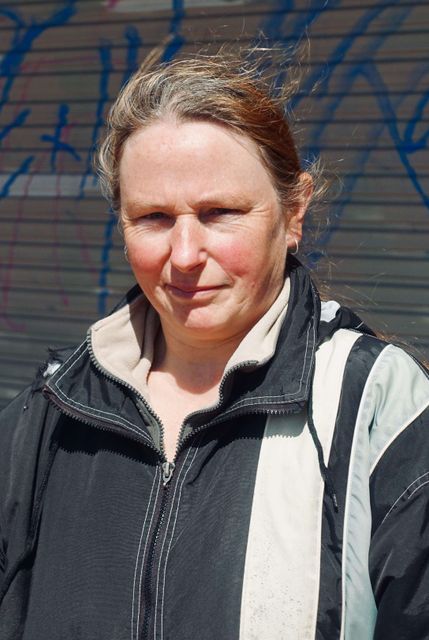
Anjanette
Anjanette Coley, a local resident who has been unemployed for five years, told the World Socialist Web Site she was not surprised by the tragic toll: “There’s no jobs at all. Two of my daughters are on benefits and they have young kids. The government doesn’t give a hoot. The poor get poorer every day.” In the 2013 census about one in five people in the suburb was unemployed and its median income was about $10,000 below the national median of $28,500.
Anjanette explained that looking for work was “very stressful because I’m under so much pressure. I get depression. Heaps of people are being pushed into a corner they can’t get out of.” The attitude of Work and Income New Zealand (WINZ), the social welfare agency, was: “Get over yourself, stop making excuses, get a job.”
She received a benefit of $283 a week and paid $200 in rent. “It’s a broken-down home,” she said. “I live with my daughter and two grandkids. We’re both unemployed and paying $200. Landlords can up the rent any time they like, WINZ don’t understand.”
The government has promised to upgrade 2,000 state homes in Eastern Porirua over the next 25 years, but the total supply will only be expanded by 150 homes. Fairfax Media reported that there are currently 303 people on the waiting list for public housing in the area.
Anjanette had voted for the Green Party and Labour, but said “it was a stupid mistake.” The parties’ promises to reduce poverty and stop mistreating people on welfare were “the biggest lies of all.”
Zac, a 17-year-old Cannons Creek resident, believed “the majority of youth have more mental health problems” than older people, and poverty was a factor. “Some parents have seven kids and work 12-hour shifts every single day. They try and get food for their kids and they don’t have enough money,” he said.
“I’ve experienced depression and I know other people who have, and who have committed suicide or tried to, and survived,” he continued. “I just finished school and I don’t really know what to do. I’ve been looking at tech jobs and someone from my church is trying to help me.
“Other people can’t handle the stress of trying to find a job, they’ve just finished school and probably their parents are pressuring them to find a job. I know some people that start working pretty young and are trying to help their family out with rent, with putting food on the table. They sleep during the whole school day sometimes. It’s pretty common.”

Protests erupt in Tunisia after self-immolation of journalist Abderrazak Zorgui

Alex Lantier

Workers and youth have clashed with police for three days in cities across Tunisia following the self-immolation of journalist Abderrazak Zorgui. The 32-year-old cameraman burned himself to death in his hometown of Kasserine after posting a video on social media calling for an uprising and saying he hoped his act would help start a new revolution.
His suicide came eight years after revolutionary uprisings in Tunisia and Egypt triggered by the December 2010 self-immolation of Tunisian vegetable vendor Mohamed Bouazizi. Absent a revolutionary leadership capable of leading the working class to take power, the old Tunisian regime was able to restabilize itself and impose the financial diktat of the European and American banks. Tunisia’s current president, Beji Caid Essebsi, served under Zine El Abidine Ben Ali, the dictator toppled by the working class on 14 January 2011.
In his video, Zorgui denounced the Tunisian regime and the “war on terror,” saying, “To all unemployed youth of Kasserine, hungry and without resources: When we protest, they throw terrorism back at us. We go into the street to demand the right to work and they go on about terrorism, which means ‘shut up and go home to starve.’ I tell the people and the unemployed of Kasserine, today I will make a revolution alone. Those who want to join me are welcome. If someone finds a job afterwards, my self-immolation will not be in vain.”
He added, “We are sick and tired, they have been giving us promises for eight years and these are just lies. For my part, I belong to no party. They forget the unemployed and speak for the wealthy, while the unemployed and entire regions do not have a cent.”
Since Zorgui’s self-immolation, protests have erupted every night in Kasserine as well as in Jbeniana, Tebourba and working class districts of the capital, Tunis. Youth in Kasserine burned tires and responded to volleys of tear gas from riot police with stones.
With unemployment nationally at 15.5 percent, and double that around Kasserine, while inflation is running at 7.5 percent and the Tunisian dinar collapsing, anger is mounting among workers. Nebil Gassoumi, a schoolteacher in Kasserine who joined the protests, told France Info: “Nothing is going well here. The dinar is low and so our living standards are low, even for those who have work. Everyone here is suffering.” He added, “There is no investment, there are no jobs for job seekers.” Gassoumi said he hoped the protests would continue.
Also this week, protests erupted against the murder of Falikou Coulibaly, the president of the Association of Ivorians in Tunisia. This led to an outpouring of criticism by sub-Saharan African workers and students of working conditions and racist behavior in Tunisia. “Why do you suppress us? You strangle us sub-Saharans. To be honest, you are mean. Morally and psychologically, we feel terrible,” a worker, Alexandre Diaoré, said of Tunisia on RFI.
“It is quite fashionable for a certain bourgeois layer to go shop at Carrefour, the retail outlet in the north suburbs, with two black maids,” AFP reports. At the same time, it notes, “Young maids from the Ivory Coast or nearby countries work seven days per week, paid little and with their passports confiscated.” The wire service also noted complaints of “a Senegalese student who was asked whether he sleeps in the trees and feeds himself with bananas.”
The Tunisian government is responding to the growing protests with police violence and high-level plans for a crackdown. In Kasserine’s Ennour and Ezzouhour districts, police arrested 16 people in house-to-house searches, charging them with rioting. Five stand accused of destroying surveillance cameras installed by the Tunisian Interior Ministry.
Yesterday, the Tunisian Council of Ministers met. While it affirmed the “need to respect the right to protest peacefully,” it acted to integrate all internal security operations under the president’s control. The Defense and Interior ministries are coordinating army and police operations during protests to commemorate Ben Ali’s overthrow, and in media and police circles a concerted, hysterical campaign is underway to threaten protesters or slander them as terrorists and criminals.
In a La Presse editorial titled “Beware excesses and the unknown,” Abdelkrim Dermech wrote:
“Those who make parallels between the spark lit by Bouazizi on 17 December 2010 and that of Abderrazak Zorgui on Monday in Kasserine forget for whatever reason that such a comparison can no longer be made. While there is a real divorce between the current political establishment and youth in the so-called less-favored regions, violence, senseless aggression and damage to public or private property can no longer be accepted, tolerated or seen as democratic.”
On Thursday, the Council of Ministers absurdly declared that the circumstances of Zorgui’s death were “obscure,” and police gave an initial report on interrogations of detained protesters. The web site Kapitalis endorsed the police findings as follows: “Extremists, including adolescents arrested on December 25 and 26, 2018, affirmed during their interrogation that they had been paid off by smugglers to infiltrate the demonstrators and attack police and National Guard stations with stones and Molotov cocktails.”
Insofar as Tunisian security authorities are still investigating themselves on charges of torture and other crimes they committed under Ben Ali, these “confessions”—which read as if they were scripted by Essebsi’s Council of Ministers—have no credibility whatsoever.
Eight years after the fall of Ben Ali in the first revolutionary uprising of the working class in the 21st century, none of the demands that drove workers into struggle have been resolved. Capitalism is economically and socially bankrupt. As for Tunisia’s democratic reforms, they were just a facelift for the old regime and the old police state, which now proceeds under the threadbare cover of the “war on terror.”
This vindicates the perspective advanced by the International Committee of the Fourth International (ICFI) immediately after Ben Ali’s ouster. The ICFI recognized that the revolutionary uprising in Tunisia, and then Egypt, marked a new era in the international class struggle and the struggle for world socialist revolution.
Its 17 January 2011 statement, “The mass uprising in Tunisia and the perspective of permanent revolution,” warned:
The Tunisian masses, however, are at only the initial stages of their struggle. As is already clear from the continuation of military violence under the new interim president, the working class faces immense dangers. The crucial question of revolutionary program and leadership remains unresolved. Without the development of a revolutionary leadership, another authoritarian regime will inevitably be installed to replace that of Ben Ali.
After nearly a decade of war and economic crisis, a new eruption of the class struggle is underway in Tunisia and beyond. As bread riots break out in Sudan, political protests and strikes are staggering France, Portugal and Spain after a year that saw international strikes by Amazon and Ryanair workers, protests by Iranian workers and mass strikes by US teachers.
Zorgui’s decision to commit suicide as he called for revolution is a particularly tragic illustration of the ICFI’s analysis that in this situation the critical question is the building of a revolutionary leadership in the working class. The turn now is to building sections of the ICFI in Tunisia, across the Mediterranean and around the world.