Application Deadline: 1st April 2019. Offered annually? Yes Eligible Countries: African countries To be taken at (country): Uppsala, Sweden About the Award: The purpose of the Guest Researchers’ Scholarship Programme is to provide opportunities for postdoctoral researchers in Africa to pursue their own research projects, thereby indirectly strengthening the academic milieux in African countries. The scholarship offers access to the Institute’s library and other resources that provide for a stimulating research environment. Through the programme, the Nordic Africa Institute can establish and maintain relations with and between African and Nordic research communities. Type: Research Eligibility:
The scholarship programme is directed at postdoctoral researchers based in Africa and engaged in Africa-oriented research within the discipline of Social Sciences and Humanities.
The applicant should be affiliated to an African university/research center and have a proven track record of extensive research experience.
The Institute strives to achieve a fair distribution of scholarship positions in regards to gender and geographic focus.
Number of Awards: Not specified Value of Award:
The scholarship includes a return air-fare (economy class), accommodation, a subsistence allowance of 300 SEK (approx. 34 USD) per day plus an installation grant of 2,500 SEK (approx. 280 USD) and access to a computer in a shared office at NAI.
The Institute’s library is specialized in literature on contemporary Africa and focuses on Social Sciences. Guest Researchers also have access to the Uppsala University Library, including their online resources, and to the Library of the Swedish University of Agricultural Sciences.
Guest Researchers have the possibility to present their research at the Nordic Africa Institute and to visit other institutions in the Nordic countries.
Duration of Program: The maximum duration of the stay is 90 days, minimum is 60 days. How to Apply:
Up-to-date CV, including list of publications (if available online, please include links)
Outline of research project, 5 pages: – A well elaborated research proposal; the research topic must relate to the research themes of the Institute – A work plan, including expected results, specific for the time spent at the Institute
Reference: A signed letter of support from the applicant’s Head of Department or other senior scholar in the same field, which confirms current affiliation and field of research. (Scanned versions of signed support letters can be emailed by the applicant.)
Please note that incomplete applications will not be considered. Persons currently or previously employed by or otherwise professionally affiliated with the Nordic Africa Institute are not eligible for scholarships. Kindly also note that the application must be in English. In the extraordinary event that the Scholarship Programme for 2018 does not receive full funding, applicants will be informed immediately. Submission of applications: Applications can be sent by post/airmail or by email. Applications sent by post/airmail should contain 2 copies of each document. Applications sent by email should contain only 1 copy of each document. Applications sent by post/airmail should be addressed to The Nordic Africa Institute Annika Franklin P.O. Box 1703 SE-751 47 Uppsala, Sweden. Applications sent by email should be addressed to Annika Franklin, Research Administrator, email: annika.franklin@nai.uu.se Please note: On the subject line of your email, write: “Application: Guest Researchers’ Scholarship Programme”. Scanned versions of signed support letters can also be sent to the above email address. Visit Scholarship Webpage for details Award Provider: Nordic Africa Institute Important Notes: Please note that the subsistence allowance will be provided only for the days spent in Uppsala. Also note that most academic institutions in the Nordic countries, including the Nordic Africa Institute, are closed or at least running at a reduced capacity during the periods 15 June–15 August and 15 December–15 January. Applicants are thus asked not to choose these periods for their visit.
On Jan. 1, 5.5 million women in the Indian state of Kerala (population 35 million) built a 386-mile wall with their bodies. They stood from one end to the other of this long state in southwestern India. The women gathered at 4 p.m. and took a vow to defend the renaissance traditions of their state and to work towards women’s empowerment. It is not an exaggeration to say that this was one of the largest mobilizations of women in the world for women’s rights. It is certainly larger than the historical Women’s March in Washington, D.C. in 2017.
Kerala’s government is run by the Communists. It is not easy for a left-wing government to operate in a state within the Indian union. The Central Government in New Delhi has little desire to assist Kerala, which suffered a cataclysmic flood last year. No assistance with the budgetary burdens of relief and reconstruction, and no help with financing for infrastructure and welfare services. The Communist government has a wide-ranging agenda that runs from its Green Kerala Mission — a project for stewardship of the state’s beautiful environment — to its fight for women’s emancipation. The Left Democratic Front government believes that dignity is a crucial a goal as economic rights, and that it is centrally important to fight against everyday humiliation to build a truly just society.
Over the course of the left’s government in Kerala, it has pushed ahead the agenda against everyday humiliation. For instance, in 2017, the government provided free sanitary pads for young women in school. The logic was that during their periods, young women who could not afford sanitary pads avoided school. Prejudices against menstruation had become a barrier to equal education. The government called this project “She Pad,” which benefited students and teachers. Pinarayi Vijayan, the Chief Minister of Kerala, said of the effort, “Menstrual hygiene is every girl’s right. The government is hoping that initiatives like these will help our girls to lead a life of confidence.”
A hundred miles north of Kerala’s capital — Thiruvanthapuram — sits a temple for Ayyappan, a celibate god. Women between the ages of 10 and 50 had not been permitted into the temple due to a belief that the celibate god would not be able to tolerate women who menstruate. The Indian Supreme Court took notice of this and, in September 2018, declared that the temple must allow all women to enter. The Left Democratic Front government agreed with the courts. But the temple authorities, and the far-right groups in the state, disagreed. When women tried to enter the temple, the priests blocked them, assisted by the far right. The situation was at a deadlock.
Chief Minister Pinarayi Vijayan called upon progressive organizations across the state to start mobilizing the citizens toward the building of a Women’s Wall (Vanitha Mathil) on Jan. 1. The energy in the state was electric. Women gathered at hundreds of mass meetings across the state. They recognized immediately that this was not a fight only to enter a temple, but this was a fight principally for women’s emancipation, for the right of women, as Vijayan had said, “to lead a life of confidence.”
The public meetings in November and December galvanized the opposition to the far right, arguing that women have every right to enter public spaces, including religious buildings. January began in anticipation. Women had been organized by districts and knew where to go. Women of all ages and backgrounds, from schoolteachers to members of the fishing community, began to line up around 3 p.m. After taking an oath, they marched through their towns and cities. They exuded joy and confidence, a freedom that should warm the hearts of sensitive people.
Strikingly, the media outside India paid little attention to this global, historical event. Press coverage in the United States was nearly absent. Internationalism in our time is such a façade, with so little care to amplify the bravery of people around the world. When the Women’s March took place in Washington, D.C., newspapers in Kerala reported it in detail. The favor was not returned. Silence was the answer.
Two days after the Women’s Wall, the right-wing in Kerala went on a rampage. Their members attacked the leaders on the left and threw bombs at government buildings. Over 700 people — mostly men on the far right — were arrested that day.
Walking down a main shopping street in Thiruvanthapuram, I see visible signs of the far-right’s attack. On one side of the street are posters and signs of left organizations torn and broken during the day of rampage by the far right. On the other side of the street, far-right supporters sit on a hunger strike.
Even liberals have taken the side of the far right. One liberal politician said that while he favored women’s rights, he also favored the temple’s rights. But the temple has no rights, nor does tradition. As Gandhi wrote almost a hundred years ago, “If I can’t swim in tradition, I’ll sink in it.” Neither the temple nor tradition trumps the rights of women to live with confidence. If a tradition is discriminatory, it deserves to be set aside.
There are no half measures in this debate in Kerala. The mood is that one must not walk away from one’s principles.
5.5 million women in Kerala — one in three women in the state — took to the streets to champion the emancipation of women. What brought them to join the Women’s Wall was that the Left Democratic Front government took a clear position, a principled position: that menstruation should not be used as a penalty against women’s full participation in society. Clarity defines the struggle. It is a lesson worth learning around the world.
There have been severalpieces in recent weeks about the drop in birth rates in recent years. Birth rates declined in the recession and they have not recovered even as the economy has improved.
As these pieces point out, economics plays a big role in the drop in birth rates. Young adults often are having difficulty finding and keeping jobs that provide a decent wage. This was certainly true in the downturn, but it is still often the case even now with the unemployment rate at 50-year lows.
In addition, the United States badly lags other rich countries in providing support to new parents. We are the only wealthy country that does not guarantee workers some amount of paid parental leave or sick days. While many companies offer these benefits, millions of new parents, especially those in lower paying jobs, cannot count on any paid leave. (It is important to note that manystates and cities have required paid family leave and/or sick days in the last two decades, making up for the lack of action by the federal government.)
Child care is also a huge problem for young parents. Quality care is often difficult to find and very expensive. This leaves many young parents, especially mothers, struggling to provide care for their children even as they hold down a job.
These are real and important policy concerns. People should be able to have children without undue hardship. We also want to make sure that children have decent life prospects. Having parents that are not over-stressed and access to good quality child care are important for getting children on a good path is school and their subsequent careers and lives.
For these reasons, leave policy and child care need to be near the top of the policy agenda. However, the fact that people are having fewer kids is not a good rationale for supporting these policies. A stagnant or even declining population is not a public policy problem.
The pieces noting the prospect of a declining population usually treat it as self-evident that this is a bad development. It isn’t. The prospect of fewer traffic jams and less crowded parks and beaches does not sound especially scary.
There are some who see a declining population as a threat to the United States status as a world power. It’s not clear that this is especially true. Indonesia ranks 4th in world population with 270 million people, more than four times the population of the United Kingdom, but Indonesia does not usually get listed among the world’s most powerful countries. More importantly, many of us don’t necessarily like everything the United States does as a world power, so doing somewhat less of it may not be a bad thing.
If we focus on the economics of a stagnant or declining population the standard story is that we will have a smaller number of workers to support each retiree. This is true, other things equal, but also not an especially big deal.
First, the “other things equal” is a big qualification here because for the foreseeable future we are likely to be able to get as many working-age people we want from the rest of the world by relaxing immigration restrictions. Working at even the lowest paying jobs in the United States is likely to offer a huge improvement in living standards for hundreds of millions of people in the developing world. This means that if we are worried about having too few workers at some point in the future, we just need to open the door to more immigrants.
But even pulling out the impact of immigrants, the reality is that we have been seeing a fall in the ratio of workers to retirees pretty much forever. Life expectancies have been rising as people have better living standards and better health care. (Recent years have been an exception, where life expectancies have stagnated.) In 1950 there were 7.2 people between the ages of 20 and 65 for every person over the age of 65. This ratio now stands at just 3.6 to 1.
Over this 70-year period, we have seen huge increases in living standards for both workers and retirees. The key has been the growth in productivity which allows workers to produce much more in each hour of work. (We also have a much higher rate of employment among workers between the ages of 20 and 65, as tens of millions of women have entered the labor force.)
The impact of productivity growth swamps the impact of demographics, as can be shown with simple arithmetic. The Social Security Trustees project that the ratio of people between the ages of 20 and 65 to people over age 65 will fall to 2.8 by 2070. In its “high-cost” scenario, which assumes both lower birth rates and higher life expectancies, this ratio falls to 2.03. Let’s take a more extreme case and assume it falls to 1.8.
Not everyone in the age 20 to 65 group works. Let’s assume an employment rate for this group of 75 percent. Of course, this can vary depending on economic conditions. In a tight labor market, with wages being bid up, more people are likely to choose to work.
This is also the case with people over age 65. Many already are working and we can expect this number to increase over time as the people in these older cohorts are increasingly educated and there are more employment opportunities that are not physically demanding. But for purposes of this exercise, we’ll assume no one over age 65 works.
I’ll also assume that retirees get on average 75 percent of the income of a worker. This is considerably more than the average Social Security benefit, but it should in principle include other sources of income for retirees. I treat their income as a tax on the working population.
Here’s the basic picture.
I have assumed a 1.4 percent annual rate of real wage growth, which is roughly the projection used by the Social Security trustees. The index number in the first row should be understood to be hourly compensation since the trustees assume that an increasing share of compensation will go to non-wage benefits, primarily employer-provided health care insurance.
As can be seen, in spite of the projected fall in the ratio of workers to retirees, the after-tax wage would still be considerably higher in 2070 than it is today. While before-tax income slightly more than doubles in the middle scenario, after-tax income still rises by almost 91 percent. Even in the extreme demographic case, after-tax income still rises by more than 66 percent over this period.
I then played with a more rapid productivity growth scenario where I assumed that productivity growth averaged 1.7 percent annually. In this case, before-tax income in 2070 would be 236 percent of its 2019 level. In that case, even in the extreme demographic scenario shown in the last column, after-tax income would be 151.7. This is higher than the 149.6 level shown in the middle scenario with the standard wage growth projection.
In other words, the impact of a modest increase in the rate of productivity growth will more than offset the impact of even very extreme demographic assumptions. And, a 1.7 percent rate of productivity growth is hardly unrealistic. The economy saw a 3.0 percent average rate of productivity growth in the period from 1947 to 1973 and again from 1995 to 2005.
So it is certainly possible that the rate of productivity growth will again accelerate. Or to take the other side, the slowdown of productivity growth from its 1995–2005 pace, to the rate of the last dozen years of less than 1.5 percent, was largely unexpected. While the impact of this slowdown on living standards, if sustained, will swamp any conceivable impact of changing demographics, it has received far less attention.
One final point on this topic: the robots will take all the jobs story is a scenario of massive increases in productivity growth. It is truly incredible, we can find stories of demographic collapse in the media, where we don’t have enough workers to change the bedpans for us old-timers. While on the next page there will be stories of robots eliminating the need for workers in large, and growing, areas of the economy.
In principle, one of these can be a problem, but it doesn’t make sense that both a shortage of workers and a shortage of work can be a problem at the same time. Such is the state of economic debates in the United States.
By passing the Citizenship (Amendment) Bill 2016 in the Lok Sabha the Narendra Modi government at the Center has taken up another step towards the contempt of the Constitution. The Bill provides that six non-Muslim communities – Hindu, Sikh, Christian, Buddhist, Jain, Parsi – of Bangladesh, Pakistan and Afghanistan will be granted citizenship of India in the event of religious persecution. The Bill not only lays down the rules of granting citizenship of India to not only Hindus, Sikhs, Christians, Buddhists, Parsis and Jains coming from Bangladesh but also from Pakistan and Afghanistan. There is no such concession for the people of the Muslim community in the Bill. The BJP MPs also have said that the way the population of Hindu community is decreasing in Bangladesh, Pakistan and Afghanistan, this Bill was necessitated. They say that Hindus are being persecuted in those countries and India wants to give them protection.
The immediate opposition of this Bill is happening in the North-East. The Asom Gana Parishad (AGP) has withdrawn its support from the Sarbadananda Sonowal government in Assam. Meghalaya’s Chief Minister, Conard Sangma, an ally in the NDA, has said that his party is against this Bill. The Indigenous Peoples Front of Tripura (IPFT), another ally of the NDA, has also opposed the Bill. Another NDA partner and Mizoram Chief Minister Zormamthanga also opposed this bill. The BJP’s 11-party North-East Democratic Alliance (NEDA), which includes regional parties of Tripura, Nagaland and Mizoram, called the Bill a threat to local communities. There have been bandh at several places in northeastern states in protest of the Bill. The BJP office in Shillong has also been attacked by a bomb.
In fact, the demand of the Assam movement emerged in the North-East in the eighties was that all foreigners should be taken out of the region, who were spoiling the local identity. There was no discrimination on the basis of Hindu or Muslim. It was a kind of sub-nationality that was found in different ways throughout the North-East. In order to handle that sub-nationality question of the North-East, the Congress leader and then Prime Minister Rajiv Gandhi made the Assam Accord in 1985. In that agreement, a promise was made to identify all the foreigners and get them out. The agreement became a victim of all kinds of hindrances and, as a result, the Congress became weak in the North-East and the BJP formed its own governments in Assam, Manipur, Tripura and Arunachal Pradesh and its allies in Meghalaya, Nagaland and Mizoram
The BJP has come to power in the North-East on the shoulders of sub-nationality and is now converting the same into its long-cherished dream of Hindu Nation. The BJP believes that the way in which it has extended its expansion by riding on the shoulders of regional parties across the country and is doing its Hinduisation, it will be successful in the North-East as well. That is why the opposition to this Bill is emerging mainly in the North-East. RSS/BJP have been making the issue of preaching and conversion of Christian missionaries in the North-East. But by giving concession to Christians in this Bill, it has tried to save the church’s displeasure at the moment. Even if the immediate goal of this Bill is to make Hinduisation of the northeastern states, its effect will not be limited to that region. The Union Ministers in the government have stated openly in the House that its impact will affect the whole country.
The BJP claimed that what it is doing in this direction is in very much accordance with the sentiment of the Assam Accord. In the Assam Accord the accepted year of entry in Assam was 1971. This Bill has made it 2014. The time limit of settling in India to get citizenship was kept 11 years, which has now been reduced to six years. The main thing is that there was no provision for getting citizenship on the basis of religion in the Assam Accord. India is a secular nation and citizenship is not provided in any secular nation on the basis of religion. Therefore, this step of amending the Citizenship Law is not only against the Assam Accord, but completely opposite to the basic spirit of the Constitution.
It is possible that this amendment resulted in a decrease in the number of people (around 40 lakh) who did not find place in the National Register of Citizens (NRC) and a large number of people become citizens of India. But this will lead to the emergence of sub-nationality of the North-East and there will be intense communal polarization in the state like Assam, where Muslims constitute 34 percent of the population. This polarization was also seen during the Assam movement. Nellie massacre is its proof. But at that time the agitating section of Assam was embarrassed with this communal tangle. Today the communal politics of the BJP is creating the same conditions again.
The Socialist Party believes that this Bill is going to strengthen the principle of a religion-based nation and it has come out of the RSS’s thinking of making India a Hindu Nation. While the Constitution makers have granted India an identity of secular nation. The Socialist Party wants that this Bill be prevented from becoming a law by not passing it in the Rajya Sabha.
The party further believes that this problem of Assam and the North-East should be resolved under the broader idea of constituting a federation (mahasangh) of India-Pakistan and Bangladesh. Because this sub-continent was divided geographically on religious basis, but its history, culture and economy are connected to each other. Therefore, trying to divide it on the religious basis is creating new problems.
Isolation is proving to be a reality that comes with old age. Ageing being inevitable, everyone goes through these stages, provided death does not come calling in the meantime. Thus, irrespective of our stature, all of us come to a stage where we need others.
Currently, around the globe, senior citizens are being deprived of their rights. They face acute problems on the psychological, financial and social fronts. There are thousands around us who are playing this penultimate role on the stage of the world. For some, the going is good but for many it is a saga of suffering. They do not have those around them whom they long for. They do not find the supporting hands they need. They do not get the love they yearn for. They miss the people who would make them smile. Some live in isolation even while living with children. Some want to pass their final days at home, but can’t.
Changing family value system, economic compulsions of the children, neglect and abuse has caused elders to fall through the net of family care. The elderly people who are alone face health problems, depression and loneliness. The rapid urbanization has overtaken the traditional value system of our people and shifted their socio-economic priorities. Sons and daughters and their children find no time for the senior citizens in their family. The elderly who have provided their services and support to the society feel unloved and neglected at this phase of their lives. The concept of Old Age Home arises when the old aged persons in a family are not cared for at home. Many children argue that their financial conditions do not favor their looking after parents who impose a huge burden upon them. These words bear no reason as parents did not throw them away when they might have faced financial constraints. The term “Old Age Homes” actually speaks volumes about our insensitivity.
With the advent of industrialization there has been a significant change in the family system in particular and social structure in general. Joint families disintegrated and small nuclear families emerged where the young couple finds no time to look after their old parents. In such families the position of the old has become a crucial factor. The old themselves find it difficult to adjust with the modern ways of living of their young children. In the cities where there is growth of individualism and with it the desire to be self- reliant, the clashes between generations distress the old. Many of the problems faced by the urban elderly do not exist in the villages. Therefore a good number of elderly from urban group have taken resource to old age homes
In the pursuit of our mercenary goals, we ignore those who have laid the foundations of our lives, those who have taught us to walk and talk, those who have endured great discomfort for our wellbeing, and those who have mortgaged their present for our better future. The elderly in return pin their hopes on us to be the sources of support and comfort in their old age. But things go diametrically the opposite way when the time comes. This leads to psychological problems which the ageing fail to cope with.
As per the Rising Kashmir report, the colours of life were vibrant in all spheres of life in the house of Ghulam Rasool. Fun, love and trust were the words that echoed the walls. Sadness has engulfed the house where celebrations were common. Ghulam Rasool and his wife Begum Fatima (names changed) have a sorrowful tale to share. While their children live far away in the West, the two of them are completely on their own, dependent of one another.
Rasool may be heartbroken but his wife is shattered. “They send us money every month, but they have forgotten that more than money its love, which is more important for a human being,” Fatima says. The old couple point out that not money but belongingness was the criteria. “This affinity is lost in our lives,” Fatima says. “When our old bones start aching, we cry out of pain in a closed room.”
As per another report, “there was a case where a mother of three sons and two daughters, all married, was living in a cattle shed in inhuman conditions alongside two cows. She was a widow and her family had called her mentally unfit but she was the only lady who made sense to us in that whole village in many informative enquiries about the village in general and villagers in particular. If you look deeply into her life, it was disturbing to even think about how she must have managed during the unforgiving Kashmir winters and in that cattle shed but her children seemed least bothered”.
In yet another report, “we met a man who must be in his late 70’s. He had two sons and both of them are govt. servants. He was dragged out from the house he had built himself as they sought ownership of the property by making him sign the house document. He had already resolved to settle their shares before his death but this was shocking. He said he took to begging in different streets of Kashmir, mostly in districts where no one knows him. He has to do this because he is too old to do any physical labour and he needs to get medicines every week which costs him a lot”.
I have only mentioned these three cases but there is a huge list of elderly people in Kashmir who have been abandoned by their families or are confined in the same house where they are ill-treated. It’s very hard to accept that in a hospitable culture like Kashmir, such horrific cases exist.
Recent experiences have shown that the most neglected among Kashmir’s elders at the moment are the parents of some of the non-resident Kashmiris. A doctor friend from the Institute of Medical Sciences related story of an elderly person, a very high and senior retired government functionary who was brought to the hospital by the security guards who had been posted at his residence even after retirement because of his very senior position. All his children are abroad. The doctor friend accompanied him back home. There are reports of people having expired and the fact coming to light accidentally after a couple of days or so. This happens in the west also where a milkman reports non-lifting of bottles near the door of a flat and the firemen after climbing through the window come to know the lonely man or woman is dead! There cannot be anything more inhuman and callous than this. Surely, such a thing has never been part of Kashmiri culture. However, with the so called “Modernisation”, we too may end up like that!
Based on a survey by Dr Humaira Showkat (International Journal of Research in Sociology and Anthropology (IJRSA)), out of 150 respondents (all senior citizens) in Srinagar city, 45% voiced the need for Old Age Homes. The respondents, both males & females, were spread across the city & were from all income groups.
On a lighter note, I would request elders-to-be to take care of themselves by utilising huge amounts of money which most of them leave for their children. In the changed circumstances, the elders need to rethink about their investments. Invariably, most of the people invest money in properties beyond one’s requirement which are ultimately left for the children. Elders should in their prime years first keep provision for old age to be well looked after not necessarily by their own children who usually get scattered all over the world during the present global times.
Traditionally elders in Kashmir used to be given all the love and care but the “Modernisation” has left some of them isolated and lonely. Therefore setting up of facilities like old age homes for such neglected bunch even though would be a welcome step but it strikes at the very root of our centuries old tradition where respect and care for the old is not only a moral obligation but a religious duty! A Muslim is ordained to take care of his mother; then his mother; then his mother and then his father and then other relatives in closeness. Any deviation or violation of this Divine Command is unforgivable! For now, it may not be possible or practical to suddenly begin building old age homes but what we can do is to look at ways and means of effectively engaging with different local organizations to make use of existing infrastructure and funds to make room for the homeless elderly. Most orphanages homes in Kashmir have room and resources that can be facilitated to help elderly people. This could also be emotionally healing for both older people and orphan children as they’re both deprived of normal love and care.
There used to be a pair of beautiful swings for children, not far from an old rural temple in Mie Prefecture, where I used to frequently power walk, when searching for inspiration for my novels. Two years ago, I noticed that the swings had gotten rusty, abandoned, and unkempt. Yesterday, I spotted a yellow ribbon, encircling and therefore closing the structure down. It appears that the decision had already been made to get rid of the playground, irreversibly.
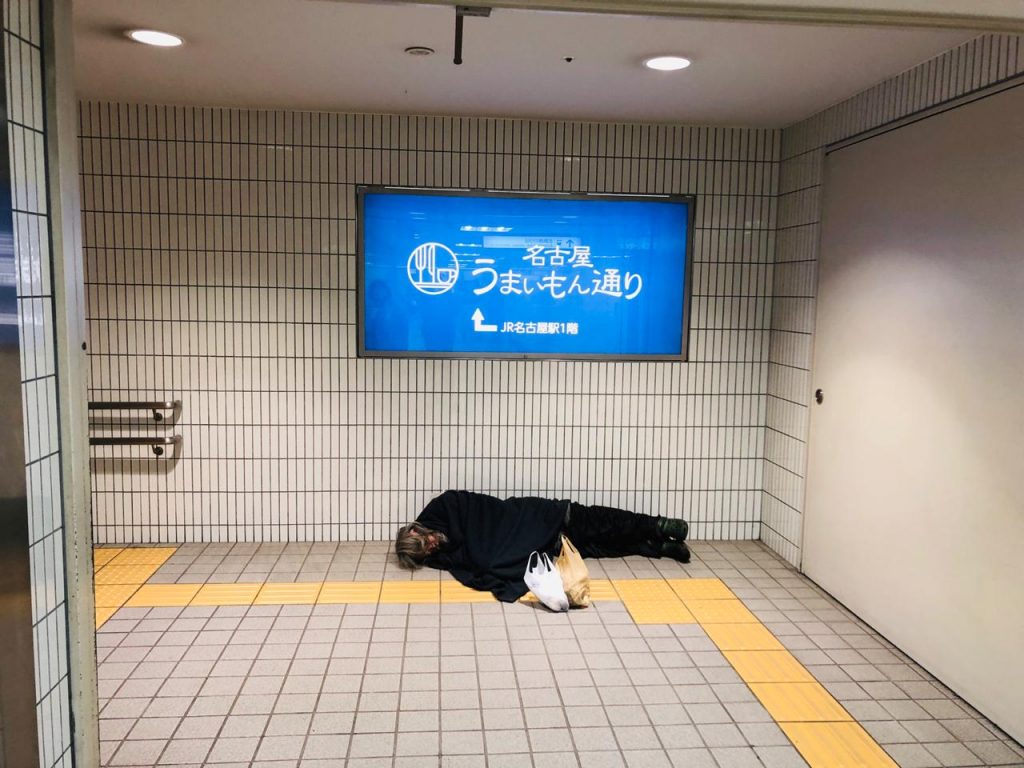
Homeless man at Nagoya station
One day earlier, I observed an old homeless man sleeping right under a big sign which was advertising a cluster of luxury eateries at the lavish Nagoya train station.
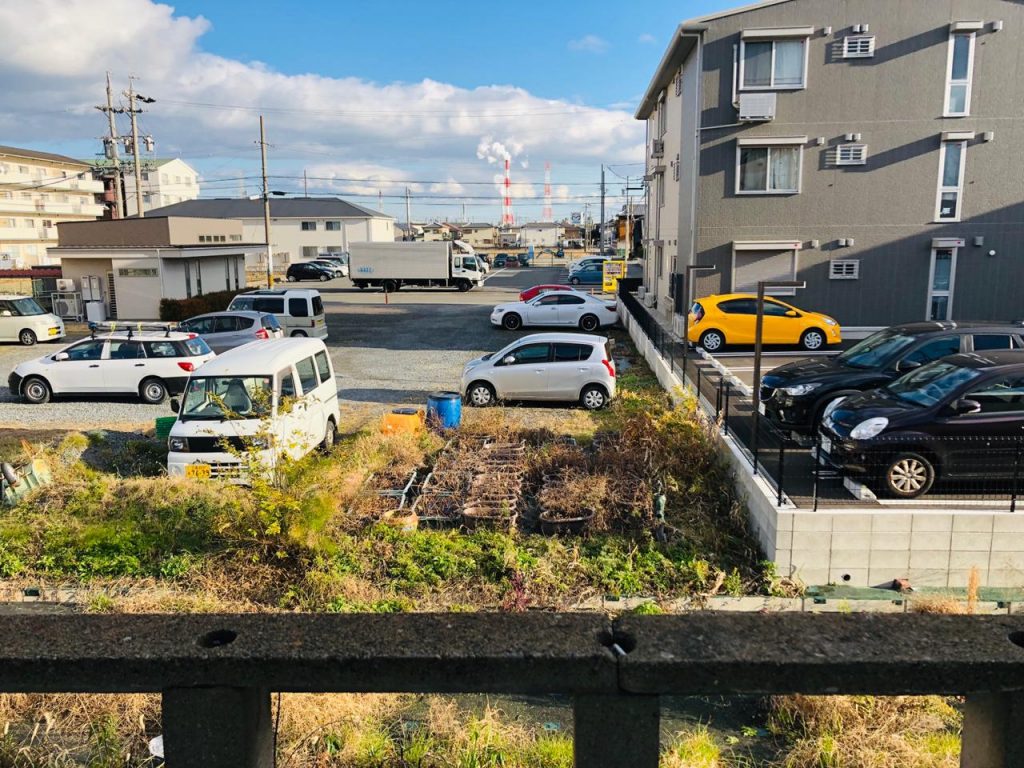
And in the city of Yokkaichi, which counts some 350,000 inhabitants, almost all but very few bus lines had disappeared. What had also disappeared was an elegant and unique, shining zodiac, which used to be engraved into the marble promenade right in front of the Kintetsu Line train station, the very center of the city. The fast ferry across the bay, connecting Yokkaichi with Centrair International Airport that serves Nagoya and in fact almost the entire area of Central Japan, stopped operating, as the municipal subsidies dried up. Now people have to drive some seventy kilometers, all around the bay, burning fuel and paying exuberant highway tolls and airport parking fees, to make it to their flight. What used to constitute public spaces, or even just rice fields, is rapidly being converted into depressing parking lots. It is happening in Central Japan, but also as far southwest as the city of Nagasaki, and as north as Nemuro.
Homeless people are everywhere.Cars (Japan now has more cars per capita than the United States) are rotting in the middle of rice fields and at the edges of once pristine forests, as they lose value rapidly, and it costs a lot of money to get rid of them properly. Entire rural villages are being depopulated, in fact turning into ghost towns. There is rust, bad planning and an acute lack of anything public, all over the country.
No more public spaces, just parking lots
Japan is in decay. For many years, it was possible,with half-closed eyes,to ignore it, as the country was due to inertia hanging on to the top spot of the richest nations on Earth. But not anymore: the deterioration is now just too visible.
The decay is not as drastic as one can observe in some parts of France, the United States, or the UK. But decay it is. The optimistic, heady days of nation-building are over. The Automobile industry and other corporations are literally cannibalizing the country, dictating its lifestyle. In smaller cities, motorists do not yield on pedestrian crossings anymore. Cars are prioritized by urban planners, and some urban planners are paid, bribery by the car industry. Many areas can now only be reached by cars. There are hardly any public exercise machines, and almost no new parks. Japan, which prides itself on producing some of the most refined food, is now fully overwhelmed by several chains of convenience stores, which are full of unhealthy foodstuff.
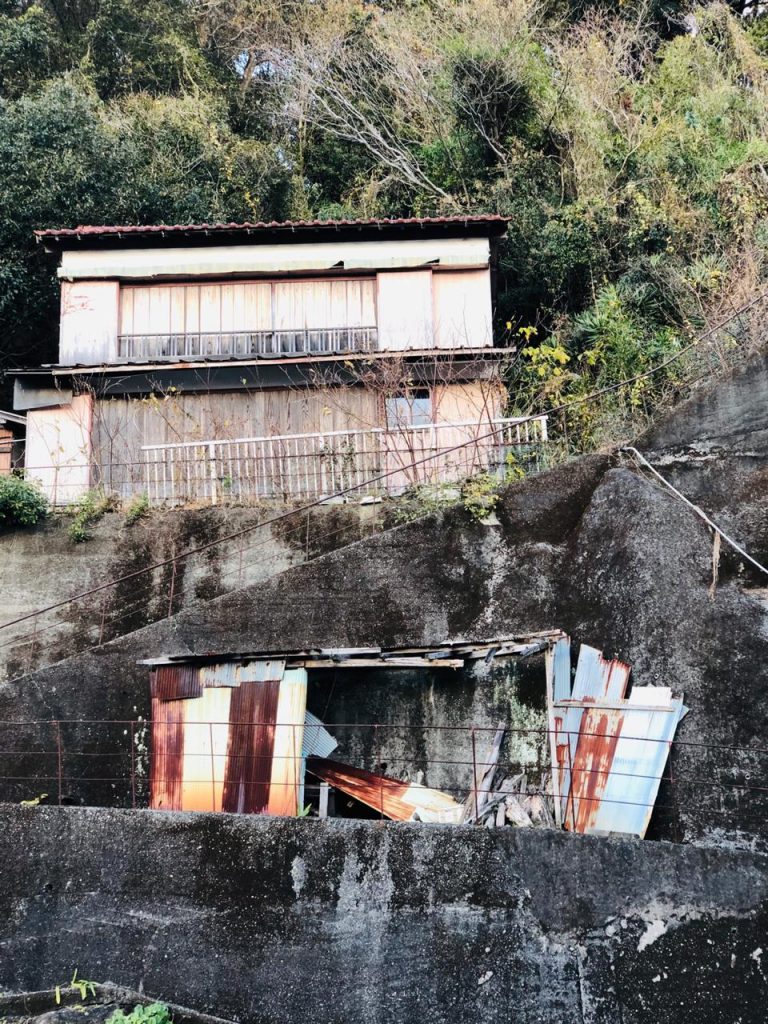
Abandoned houses – south Mie
For generations, people were sacrificing their lives in order to build a prosperous, powerful and socially balanced Japan. Now, there is no doubt that the citizens are there mainly to support powerful corporations or in short: big business. Japanese used to have its own and distinct model, but now the lifestyle is not too different from one that could be observed in North America or Europe. For the second time in its history, Japan has been forced to ‘open to the world’ (read: to Western interests and to the global capitalist economy), and to accept the concepts that used to be thoroughly alien to the Asian culture. The consequences were quick to arrive, and in summary, they have been thoroughly disastrous.
*
After WWII, Japan had to accept occupation. The Constitution was written by the US. Defeated but determined to rebuild and join the ranks of the richest countries on earth, Japan began collaborating with the West, first supporting the brutal invasion to Korea (the so-called “Korean War”). It totally gave up on its independence, fully surrendering its foreign policy, which gradually became indistinct from that of the United States in particular, and the West in general. The mass media has been, since the end of the war to now, controlled and censored by the regime in Tokyo. Major Japanese newspapers, as well as the Japanese national broadcaster NHK, would never dare to broadcast or publish any important international news, unless at least one major US or British mainstream media outlet had set the tone and example of how the story should be covered by the mass media in the ‘client’ states. In this respect, the Japanese media is not different from its counterparts in countries such as Indonesia or Kenya. Japan is also definitely not a ‘democracy’, if ‘democracy’ simply means the rule of the people. Traditionally, Japanese people used to live mainly in order to serve the nation, which was perhaps not such a bad concept. It used to work, at least for the majority. However, now, they are expected to sacrifice their lives solely for the profits of corporations.
People in Japan do not rebel, even when they are robbed by their rulers. They are shockingly submissive.
Japan is not only in decay. It tries to spread its failure like an epidemy. It is actually spreading, and glorifying its submissive, subservient foreign and domestic policies. Through scholarships, it is continuously indoctrinating, and effectively intellectually castrating tens of thousands of willing students from the poor Southeast Asian nations, and other parts of the world.
*
In the meantime, China, which is literally ‘next door’, is leading in scientific research, in urban planning, and in social policies. With ‘Ecological Civilization’ now part of its Constitution, it is way ahead of Japan in developing alternative sources of energy, public transportation, as well as organic food production. By 2020, there will be no more pockets of extreme poverty on the entire huge territory of China.
And in China, it is all done under the red Communist banners, which the Japanese public has been taught to despise and reject.
Tremendous Chinese determination, zeal, genius and socialist spirit are evidently superior, compared to the sclerotic, conservative and revanchist spirit of modern Japan and of its handlers in the West.The contrast is truly shocking and very clearly detectable even with unarmed eyes.
And on the international stage: while Japanese corporations are plundering entire countries, and corrupting governments, China is helping to put entire continents back on their feet, using good old Communist internationalist ideals. The West does its best to smear China and its great efforts, and Japan is doing the same, even inventing new insults, but the truth is more and more difficult to hide. One speaks to Africans, and he or she finds out quickly what goes on. One travels to China, and everything becomes even clearer. Unless one is paid very well not to see.
*
Instead of learning and deciding to totally change its economic and social system, Japan is turning into a sore loser. It hates China for succeeding under its independent policies, and under its Communist placards. It hates China for building new and beautiful cities designed for the people. It hates China even for doing its best to save the environment, as well as the countryside. And it hates China for being fully independent, politically and socially, even academically.
China tried‘playing’footsies with the Western academia, but the game almost turned deadly, leading to ideological infiltration and the near collapse of China’s intellectual independence. But at least the danger was identified, and the Western subversion was quickly stopped, just 5 minutes to Midnight so to speak; before it was too late.
In Japan, submission and collaboration with the Western global imperialist regime is worn as some code of honor. Japanese graduates of various US and UK universities frame their university diplomas and hang them on the wall, as if they’d symbolize great proof of their success, instead of collaboration with the system which is ruining almost entire planet.
*
I remember, some fifteen years ago, Chinese tourists would stand on the bullet train platforms all over Japan, with their cameras ready, dreaming. When train would pass, they’d sigh.
Now, China has the most extensive and the fastest bullet train network in the world. Their trains are also more comfortable and incomparably cheaper than the Japanese or French ones; priced so everyone can afford to travel.
Chinese women used to eye, sadly, the offerings of Japanese department stores. iPhones were what the middle class was dreaming of possessing. Now Chinese visitors to Japan are dressed as elegantly as the locals, iPhones are not considered a luxury, and actually, Huawei and other Chinese manufacturers are now producing better phones than Apple.
I also remember how impressed Chinese tourists to Japan were with the modern architecture, international concert halls, and elegant cafes and boutiques.
Now, the cultural life of Beijing and Shanghai is incomparably richer than that of Tokyo or Osaka. Modern architecture in China is much more impressive, and there are innovations in both the urban and rural life of China, that are still far from being implemented in Japan.
While public playgrounds in Japan are being abandoned or converted into parking lots, China is building new parks, huge and small, recovering river and lake areas, turning them into public spaces.
Instead of omnipresent Japanese advertisements, China is placing witty and educative cartoons speaking about socialist virtues, solidarity, compassion and equality, at many arteries, even at the metro trains. Ecological civilization is ‘advertised’ basically everywhere.
Japanese people are increasingly gloomy, but in China, confident smiles are seen at each and every step.
China is rising. It is unstoppable. Not because its economic growth (government is actually not interested in it, too much, anymore), but because the quality of life of the Chinese citizens is going steadily up.
And that is all that really matters, isn’t it? We can clearly improve the life of people under a tolerant, modern Communist system. As long as people smile, as long they are educated, healthy and happy, we are clearly winning!
*
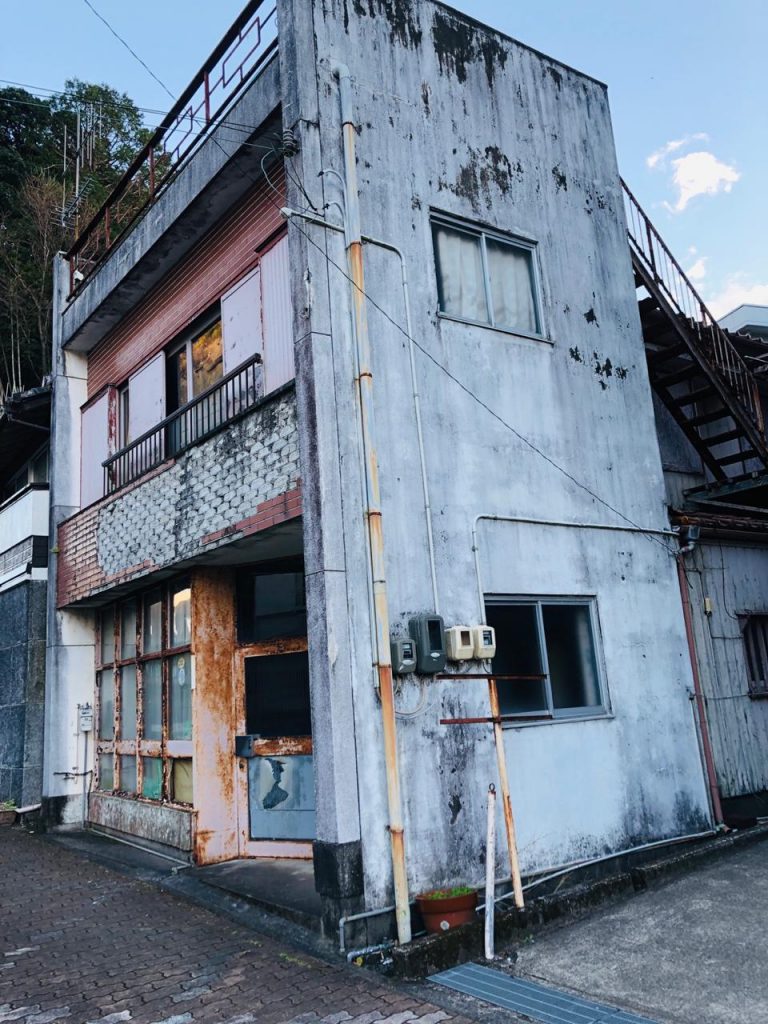
Suburban decay all over Japan
Some individuals are still chasing those magic images of pristine Japanese forests and lakes. Yes, they are still there, if you search very hard. Tea rooms and trees, lovely creeks. But you have to work very hard, you have to edit and search for the perfect shots, as Japanese cities and countryside are dotted with rotten cars and weird metal beams, with unkempt public spaces, with ugly electric wires hanging everywhere. As long as money can be saved, as long as there is profit, anything goes.
Japanese people find it hard to formulate their feelings on the subject. But in summary: they feel frustrated that the country they used to occupy and torture, is doing much better than their own. To Japanese imperialists, the Chinese were simply‘sub-humans’. It is never pronounced, but Japan has only been respecting Western culture and Western power. And now, the Chinese ‘sub-humans’ are exploring the bottoms of the oceans, building airplanes, running the fastest trains on earth, and making wonderful art films. And they are set on liberating the oppressed world, through its ‘Belt and Road Initiative’, and through other incredible ideas.
And what is Japan doing? Selfies and video games, idiotic meaningless nihilist cartoons, brainless social media, an enormous avalanche of uninventive pornography, of decorative ‘arts’, pop music and mass-produced cars. Its people are depressed. I have three decades of history with Japan, I know it intimately, still love it; love many things about it, but I also clearly see that it is changing, in fact collapsing. And it is refusing to admit it, and to change.
Oma , Aomori Prefecture
I work with China, because I love where it is going. I like its modern Communist model (I was never a great supporter of the “Gang of Four”and their cult and glorification of poverty)– let all Chinese people be rich soon, and let the entire oppressed world be wealthy as well!
But that is not what Japan wants. For some time, it felt ‘unique’. It was the only rich Asian country. The only Asian country allowed to be rich, by the West. During apartheid, in South Africa, the Japanese people were defined as “honorary whites”. It is because they had embraced Western culture. Because they opted to plunder the world, together with the Europeans and North Americans, instead of helping the subjugated nations. In many ways, it was a form of political and moral prostitution, but it paid well; extremely well, so its morality was simply not discussed.
Now China is getting ahead simply because of its courage, hard work, the genius of its people, and all this, under the wise leadership of the Communist Party and its central planning. Precisely under things that the Japanese people were brainwashed into hating.
This is frustrating. It is scary. So, all that submission, humiliation and bowing to the empire was for nothing?In the end, it is China, it is Communism which will win, and which will be doing the greatest service to humanity.
Yes, Japan is frustrated. These days, polls speak of some 80% of the Japanese disliking the Chinese.
As I interact with people from all corners of Japan, I am getting convinced that the Japanese public subconsciously feels that, for decades, it has been betting on the ‘wrong horse’. It is too proud to verbalize it. It is too scared to fully reflect on it. But life in Japan, at least for many, is clearly becoming meaningless, gloomy and depressing. And there is no revolution on the horizon, as the country was successfully de-politicized.
China is building, inventing, struggling and marching forward, confidently, surrounded by friends, but independently.
Japan is tied up and restrained. It cannot move. It doesn’t even know how to move, how to resist, anymore.
“The road to hell is paved with good conventions.” (Bert Rolling, The Law of War and National Jurisdiction since 1945).
The Global Conventions Betrayed the Humanity
The UNO, The Geneva Conventions, The Hague Conventions, The Declaration of Human Rights, The Human Rights Commission and so many other paper-based laws and conventions often are a distraction from the prevalent reality of raging global conflicts needing urgent and forceful action for peace and human security. Workings of the countless international institutions appear to have diminished the hope for systematic global law and order. While the global mankind bleeds, the institutional leadership formulated by a class of people relies on false statements to console the humanity as if all is well. The institutional culture of governance is no different than the previous century of mediocre politicians. In a 21st century knowledge-based rational society, politics is nothing else except conflict management, protection of human rights, peace, human security and human progress. But cynicism about politicians and their role in societal peace and progress is becoming endemic. Most politicians are like actors, pretension on screen for the good of people. Thomas Paine ( The Rights of Man, 1792), rightly pointed out that “ man is not the enemy of man but through the medium of false system of government – the wisdom of a nation should apply itself to reform the system – revolution by reason and accommodation rather than convulsion.” The 21stcentury politicians are detached from the thoughts and concerns of the real world lacking understanding and imperatives of the sanctity of human life. The global order needs a navigational change. Politicians do not view themselves as citizens but a class of people to rule the society. Once elected, their agenda contradicts the principles of human life and priorities.
The Two World Wars devastated the humanity and planet because of the failure of global institutions and leadership. It is estimated that 65 million people were killed during the 2ndWW. The account of the First WW is not recorded correctly except being several millions lost in the planned savagery – man against man. War negates human nature and societal peace and harmony. H.G. Wells manifested the declaration of human rights in 1939 and wondered “What are we Fighting for?”
1928 Paris General Treaty (Kellog-Brand Pact) signatories renounced the use of force – war as an instrument of national policy and agreed to settle the conflict by “pacific means..” In 1925 Geneva Protocols prohibiting the use of poisonous gases as crime against peace and waging a war of aggression. The commencement of the 2nd WW witnessed betrayal of all the peaceful principles. The 1949 Geneva Convention called for respect of human rights and integrated human rights with the law of war. Many conventions described the rules but nothing sensible was practiced to support the good conventions. The living history tells how the world was engulfed with the insanity of planned wars and how the European-American advanced killing machines deliberately massacred millions and millions across the global landscape. Have we, the THINKING PEOPLE of the globe learned anything useful from the record of history? Have we taken heed to ensure the practice of the rules and laws of peace and war? In an endless and self-repeating political treachery, the tragic tensions of history are intensifying the global affairs. Unless the global humanity is actively organized for peace, the coming of the Third World War is reasonably predictable.
The Bogus War on Terrorism
For almost two decades, America in alliance with NATO is fighting the war on terror. Why did America invade Iraq and Afghanistan? Iraq and Afghanistan never invaded America nor posed any threat to its security. There is a critical crisis in THINKING and IDENTITY across the United States. Frank Scott (“Who Are we?” Media Monitors Networks) offers a rational context to Who Are We?
“Under assault by a consciousness control system that insists we are doing quite well even when evidence shows we’re on the critical list, we have reason to be confused…..If we, the people of these United States, are ever to be a united nation we have to penetrate the lead curtain of misinformation in which we are imprisoned and begin thinking as a population with a collective destiny which demands collective action. We have a serious social identity crisis and cannot save ourselves by making war against ourselves. But if we want a peaceful world and safe environment, we need to break out of the mental prison in which we’ll remain as long as we are kept separate, and unequal, by the controllers of what goes into our minds under the false label of information.”
Americans and most European masses are indoctrinated that Islam and Muslims are their enemies and somehow, the 9/11 attacks have come to revisit the superstitious and unthinkable episode. In reality, “terrorism” myth was manufactured by the lobbyist-run Western political leaders and groups whereas; it has nothing to do with Islam or Muslims. The myth is self-engineered by the former neo-conservatives of the Bush administration.
History exposes the Europeans transgressors who invaded the morally and intellectually advanced Islamic Civilization and crushed it by military campaigns all their material and scientific progress and public institutions. The colonization scheme of things was not outcome of the Western democratic values to spread freedom, liberty and justice but ferocity of violence and killings of millions and millions of human lives for the European Empires to be built on colored bloodbaths. The European crusaders crossed the channels and unknown time zones to subjugate the much divided Muslim people as part of their superior nationalism perception and values that Muslims were inferior to the European race and could be used as subjects without human identity and raw material to build the new Empires. Centuries later if there was a UNO at the time, it would not have dared to call the European invaders as terrorists because it defied the democratic reasoning as the colonized masses lived in slavery and denial of basic human rights and identity. They were classified as “subjects of conquered race.” In an information age, knowledge–driven global culture of reason, ignorance is no longer a requisite to learn from the living history.
Age of Perpetuated Insanity against the Global Citizens
Too many text books describe historical conventions, laws and rules of engagements but nothing is practiced when it comes to the reality of war. We are living in an information age, a world of knowledge but ignorance and arrogance rule where sanctity of human life is not a virtue, often incomprehensible to common citizens. All the legal stipulations appear devoid of reason to protect the life and dignity of human life. The protection of human rights is fast becoming a fashionable business exhibited by “goodwill ambassadors”, the movie stars and sportsmen on the screen and nothing beyond that endless deception to human affairs. The vitality of human rights cannot be imagined by media portrayal of few selected movie stars. Wars are continuously raging and millions and millions are displaced, massacred, charcoaled by chemical weapons and drones but the UNO, NATO, global leaders and other emissaries issue statements of concerns when cold blooded murders are unstoppable in Syria, Yemen, Iraq, Palestine, Somalia, Libya and Kashmir challenging the human conscience – if there is such a thing still in existence. These are unforgivable atrocities and crimes against the innocent mankind. Is there a tangible and reliable global system of accountability to prosecute the perpetrators of wars and crimes against humanity? The ICC is just another name for the few to try relatively less important violators and small nations, certainly not the criminals like George W. Bush, Tony Blair and so many others. All conclusions have consequences and wars are a direct threat and violation of human rights.
Bertrand Russell and Alfred Einstein Manifest (1955) called “a war with H bomb might possibly put an end to the human race.” In 2017, America tested the Mother of Bombs in Afghanistan. The Human Rights Commission, Geneva is a class of its own, meeting for nine weeks in a year and reading the papers and complaints and doing nothing else. On the 50th anniversary of the Declaration of Human Rights, over 12 million people from across the globe asked the UN Secretary General to fulfill the promises envisioned in the 1948 Declaration. The UNO or global leadership lack visionary and intelligent commitment and power to implement anything useful for the protection of humanity. In a world of reason, we NEED reasoned dialogue and open public discussion on the issues of human rights, protection of civilians in conflict zones and sustainable movement for peacemaking and conflict resolution. It is explicitly connected to the global citizens. There cannot be any secret game of politics to get elected and be accountable to the demands of citizens. The global political leadership desperately needs an inner eye and soul to comprehend the prevalent reality of concerned citizens to ensure freedom from fear and annihilation by the unknown forces of human ignorance and cruelty which held the humanity captive during the Two WW. Political wretchedness requires rational cure. Time is living; its importance must not be ignored. Being rational human being, rationality requires objective reasoning in all of human endeavors complemented by a defined and working system of accountability. Otherwise, history will not remember us as people of knowledge, wisdom and age of enlightenment but people belonging to an age of unending darkness whose viciousness destroyed their own existence.
A century earlier C.E, M. Joad (Guide to Modern Wickedness), captioned the human tragedy in these words:
“….Human nature is at least in part wicked and in part foolish, how can human beings be prevented from suffering from the results of their wickedness and folly? ….Men simply do not see that war is foolish and useless and wicked. They think on occasion that it is necessary and wise and honourable, for war is not the work of bad men knowing themselves to be wrong, but of good men passionately convinced that they are right.”
On Thursday, after a nearly two-week delay in releasing the results of the December 30 poll, Congo’s electoral authority, the Independent National Electoral Commission (CENI) declared Felix Tshisekedi, leader of the Union for Democracy and Social Progress (UDPS), the victor in the hotly contested election to determine the successor to President Joseph Kabila, who has ruled Congo for 18 years.
Ahead of CENI’s announcement Thursday, heavily-armed riot police were deployed outside the electoral commission’s headquarters in Kinshasa.
Speaking on the eve of his victory before a crowd of supporters Tshisekedi gave an indication of a behind the scenes agreement with the Kabila regime, lavishing praise on the outgoing president and declaring Kabila “an important political partner.” Notably, Tshisekedi’s running mate was Vital Kamerhe, a former Kabila campaign manager.
The surprising announcement of a Tshisekedi victory was followed by an outcry from opposition candidate Martin Fayulu, who called the electoral commission’s decision an “electoral swindle.” On Saturday, Fayulu, a former Exxon-Mobil executive, filed a challenge with the Congo Constitutional Court requesting a manual recount of all votes cast in the poll.
Voting data compiled by the Episcopal Conference of Congo (CENCO), a Catholic bishop’s group, who placed 41,000 election observers at polling stations around the country, disputed the result certified by CENI.
In a statement to media regarding its assessment, the bishops declared, “The government’s decision does not correspond to the data collected by our observation mission.” While not publicly naming Fayulu the winner, several diplomats and reporters, as well as the Kabila government, have stated that the CENCO privately informed them that they had determined Fayulu was the victor.
CENI’s declaration of Tshisekedi as the winner raises serious questions regarding the integrity of the poll. According to pre-election poll data, Fayulu had taken a clear lead over all other candidates in the contest. In comparison, pre-election polling placed Tshisekedi far behind. Poll data showed that Emmanuel Ramazani Shadary, Kabila’s handpicked candidate, occupied a distant third place in the contest.
The three candidates, occupying the wealthy social layer comprising the Congolese bourgeoisie, represented a choice between various strategies for advancing the interests of the ruling capitalist elite. Regardless of who won, not one of these parasites could be expected to improve the miserable social conditions experienced by the Congolese masses.
The grotesque affair of the election itself, representing nothing that could be called democratic, was conducted amid the atmosphere of a quasi-police state. A significant presence of armed security forces patrolled city streets, with several mobilized to polling stations in a blatant display of intimidation to voters and poll workers alike. The Catholic Church reported 115 instances in which its election observers were forcibly removed by police at several polling locations across the country.
A young man at a polling station in the town of Walungu in eastern Kivu province was shot to death by a policeman after a brief altercation occurred in which the policeman accused the youth of voter fraud. Several voters who witnessed the shooting retaliated against the policeman and beat him to death.
In addition to the heavyhanded police repression, voters throughout the country were frustrated by long delays consisting of several hours before the opening of many polling stations. There were several reports of ballot box stuffing and tampering, as well as the theft of uncounted ballots in several districts and outright vote buying.
Electronic voting machines were utilized for the first time throughout the country, leaving many voters who had never even used a computer with little instruction in the machines’ use. Additionally, many areas of the country experience frequent power outages, and on the day of the poll, electrical blackouts caused voters to suffer significant delays. Further, the Catholic Church’s election observers noted 544 cases throughout the country of malfunctioning voting machines.
Fitting with the anti-democratic character of the ruling government, ahead of the poll on December 30, the Kabila regime cut off internet access nationwide, under the bogus pretext of “ensuring security and peace.”
Furthermore, the Kabila government explicitly barred 1 million voters from casting a ballot in the North Kivu province, an area facing a renewed outbreak of the deadly Ebola virus. Kabila’s ridiculous claim behind the imposition of the vote restriction was the possibility that afflicted residents could infect voters and worsen the pandemic. Notably, North Kivu province is a base of significant support for Fayulu. Furious protests erupted against the ban in the North Kivu cities of Beni and Butembo.
Angered by the voting restriction, Jacob Salamu, a 24-year old first-time voter and resident of Beni, expressed the widespread contempt felt by the Congolese masses toward the government when he told reporters, “We do not have Ebola. Kabila is worse than Ebola.”
Washington and the capitals of Europe are observing the developments closely in the Congo. At a United Nations Security Council meeting on Friday, Washington, along with France, Belgium, and Germany requested CENI to release its voting data. For Washington’s part, they have kept a watchful eye over the elections, having deployed 80 troops to nearby Gabon for the purpose of “protecting US assets” in the event of political turmoil arising from the elections.
Both France and Belgium challenged the Kabila government regarding the poll’s official outcome, calling the declaration of Tshisekedi inconsistent with election observers’ findings and stating that Fayulu appears to be the true winner.
French Foreign Minister Jean-Yves Le Drian told France’s CNews television: “It really seems that the declared results ... are not consistent with the true results. On the face of it, Mr Fayulu was the leader coming out of these elections.”
Kabila government spokesman Lambert Mende lashed back at the statement of Le Drian, retorting, “France has nothing to do with the vote in the Congo, and if Mr. Le Drian thinks Congo is a province or colony of France, he just needs to name the president of Congo.”
The Southern African Development Community (SADC), comprising of a collection of southern African nations including the Congo, moved to soothe political tensions by suggesting to the Tshisekedi and Fayulu factions to enter into a power-sharing agreement. Weighing most heavily on the minds of the SADC countries and the Western capitalists in Europe and the United States is their fear that a prolonged election dispute could erupt into a wider political conflict leading to war and, in turn, disrupting their economic interests in the Congo.
For both Washington and Europe, the stakes in the outcome of the election are the Congo’s estimated $24 trillion in untapped raw resources in the form of rare earth minerals, many of which are used in the manufacture of batteries that power smartphones, laptop computers and electric vehicles.
A geopolitical component also figures prominently in the minds of Western imperial strategists, with China perceived by Washington as representing the most significant threat to American dominance in the central African region. China has exercised enormous economic influence with governments across the African continent over the last decade, an arrangement that Washington views as intolerable.
In recent years, the Kabila government has experienced a falling out with Washington over Kinshasa’s cozying relationship with Beijing, with Kabila cementing several economic agreements with Chinese companies, in particular projects in the valuable Congolese mining sector.