15 Jan 2019

Top UK executives earn average worker pay within three days

Alice Summers 

A new report into the pay gap between workers and the ruling elite has laid bare the extreme levels of inequality that pervade economic and social life in the UK.
According to research carried out by the High Pay Centre (HPC) and the Chartered Institute of Personnel and Development (CIPD), within the first three working days of January, the highest paid Financial Times Stock Exchange (FTSE) 100 bosses had already raked in as much money as the average full-time worker will earn in a year.
New research for “Fat Cat Friday” found that by lunchtime on January 4, top executives had already made the UK median annual salary of £29,574, needing only to work 29 hours, at a rate of around £1,020 an hour. This means that over the course of the year, the median FTSE 100 CEO will earn approximately £3.9 million.
This equates to 133 times the annual pay of a full-time worker, up 11 percent on the previous year, when FTSE 100 CEOs had a median pay packet of approximately £3.5 million. This represented a salary 120 times higher than the average UK worker at the time.
The economic gulf separating the working class and the super-rich has massively expanded in recent years, creating inequality on a scale unseen for almost a century. While today top executives earn 133 times the salary of the average worker, this has rocketed up since 1998, when the ratio stood at roughly 47 to 1. This represents a pay gap increase of a staggering 183 percent in 20 years.
According to the CIPD and HPC’s report from August 2018, FTSE 100 CEOs’ mean pay saw an even bigger increase—jumping a massive 23 percent in a year—from £4.6 million in 2016 to £5.7 million in 2017 (the latest year for which figures are available).
By comparison, figures from the Office for National Statistics (ONS) indicate that mean salaries for all workers in the UK increased by a mere 2.5 percent from 2016 to 2017, barely keeping pace with, or even falling behind, inflation rates. According to the CIPD and HPC, it would take the average (mean) UK worker “on a salary of £29,009 a total of 195 years to earn the mean FTSE 100 CEO reward package.”
While top executives have seen their annual pay grow rapidly year on year, for the vast majority of Britons the picture is very different. Workers in the UK have suffered a decline in wages unsurpassed for over a century, falling further than any European country except Greece.
At least 6 percent of the workforce is on zero-hour contracts, rising from 1.7 million to 1.8 million in 2017. Over 14 million people, including 4.5 million children, one-third of all children, live below the poverty line. More than two-thirds comprise the “working poor.” At least 320,000 people are homeless, meaning 1 in every 200 adults is without a permanent place to live. At least one person dies on the streets each day, yet the majority of homeless are in employment.
While many workers struggle to meet their basic living costs on poverty wages, corporate executive remuneration has shot up, with the highest paid FTSE 100 CEO, Jeff Fairburn of housebuilding firm Persimmon Plc, receiving an obscene salary of £47.1 million in 2017. This is more than 20 times his pay packet the previous year, and roughly 1,130 times the average (mean) pay of his company’s employees.
On top of this, Fairburn pocketed a £75 million bonus in mid-2018, supposedly awarded for “outstanding performance.” The Guardian calculated that this is more than enough to house all 760 homeless families in the Yorkshire and Humber region where the firm is based, with around £15 million to spare. Fairburn was eventually forced to step down from his position, as the media controversy surrounding his pay packet was negatively affecting the company’s reputation.
Simon Peckham, CEO of Melrose Industries, also received a massive pay boost, with his pay packet rising a staggering 4,233 percent, from roughly £987,000 in 2016 up to £42.8 million in 2017.
These enormous income windfalls are not just reserved for FTSE 100 companies. In 2017, Denise Coates, CEO of online gambling site Bet365, became Britain’s highest paid boss, raking in a staggering £265 million. This was up from £199 million the year before, based on salary and perks, and is nearly 10,000 times more than the average UK salary.
In response to the HPC and CIPD reports, Tim Roache, general secretary of the GMB union, labelled the revelations “sickening.”
“Three days into the year and fat cat bosses have already made what average workers will earn all year. … It’s not fair, and it makes no sense in how we value people’s contribution to society and it makes no sense for the economy—I don’t know any care workers who squirrel their wages away in offshore accounts, they spend it in their local areas and on paying their bills.”
Frances O’Grady, general secretary of the Trades Union Congress (TUC), commented: “There are millions of hardworking people in Britain who give more than they get back, but greedy executives are taking more than they’ve earned.
“We need to redesign the economy to make it fair again,” she continued, “and that means big reforms to bring fat cat pay back down to earth.”
Even these limited criticisms ring hollow. For years, the trade union bureaucracy has consistently acted to suppress any significant working-class action to fight for better pay and conditions. Functioning as industrial police on behalf of the government and employers, they have worked to systematically limit strikes and to prevent coordination by workers across national borders. That such a gap between the pay of workers and their bosses exists is evidence of the extent of the collaboration between the unions and employers, which has accelerated over the last decade with the drive by the ruling class to impose the burden of the economic crisis onto the working class.
The CIPD and HPC report limited itself to calling for “greater diversity among those responsible for setting CEO pay, both in terms of their ethnicity and gender, for example, but also their professional backgrounds and expertise in order to combat ‘group think.’ “
The widening chasm between the working class and the ruling elite cannot be solved by tweaking the racial or gender composition of those occupying the top jobs, or by calling for a “fairer” or kinder form of capitalism, as advocated by Labour’s nominally “left” leader, Jeremy Corbyn.
Social inequality is not some aberration of capitalism that can be reformed away, but is its essential feature. Capitalism is predicated upon the exploitation of the working class in order to ensure the profits of the corporate and financial oligarchy and is incapable of providing economic security and a decent standard of living for working people.
Society must be reorganised along socialist lines, so that the accumulation of wealth is subordinated to the needs and requirements of its producers and users, controlled and regulated by them.


UK parliament to vote on Brexit deal today

Chris Marsden

Tonight will see Britain’s parliament finally vote on Prime Minister Theresa May’s proposed deal with Brussels on Britain’s exit from the European Union (EU).
May is almost certain to be defeated, largely as a result of opposition in the Conservative Party and the Democratic Unionist Party to “backstop” arrangements to prevent the return of a hard-border between Northern Ireland and the Republic of Ireland, an EU member state. However, whatever follows, British workers will still confront escalating attacks on their jobs, wages and essential services.
Today’s “meaningful vote”, as far as the pro-Brexit faction of the Tories is concerned, must not be allowed to cut across their efforts to free themselves from the restraints associated with EU membership to securing independent trade deals with the US, China, India, etc., taking advantage of Britain’s role as a centre for global speculative finance and deepening its transformation into a cheap labour investment platform modelled on Singapore.
However, all claims by the advocates of “Remain”—in the Conservative Party, the Blairite wing of the Labour Party and the smaller opposition parties—to represent an alternative are false. They are belied by their own history of defending big business and imposing cuts, and their embrace of the EU, even as it continued to impose austerity on workers throughout the continent on behalf of the major corporations, banks and its constituent governments.
What is being fought out in Westminster is a conflict over which is the best means of advancing the interests of British imperialism under conditions of a ferocious trade war for control of global markets: within the European trade bloc, or as a junior partner of the US—hopefully without losing access to the Single European Market that accounts for 40 percent of UK exports.
Such has been the exposure of the reactionary nationalist agenda of Brexit and its impact that most polls show a shift of public support back towards Remain. But whichever side wins today, the struggle to be “globally competitive”, especially under the threat of a second economic crash to rival that of 2008, means a deepening offensive against working people.
Believing the claims that EU membership is a means of opposing the xenophobia and right-wing reaction that characterises Brexit demands only a wilful blindness to the EU’s long record of crimes against refugees and to the growth of far-right movements such as the Alternative for Germany, France’s National Rally, and their taking a governmental role in Italy, Austria, Hungary and elsewhere.
The advocates of Remain have no such illusions themselves. Their sole concern, whether the Blairites or pseudo-left groups such as Socialist Resistance and Left Unity operating under the umbrella “Another Europe is Possible,” is with securing the place of British imperialism within the EU on which the privileged lifestyles of their upper-middle class constituency is based. They are even arguing against Labour leader Jeremy Corbyn’s pro-forma attempts to prioritise a no confidence motion in the government and the demand for a general election over supporting a second referendum to reverse Brexit.
“A general election will not resolve Brexit,” write the Pabloites of Socialist Resistance. A “general election is unlikely… The key to the situation remains the issue that Jeremy Corbyn continues to ignore the issue of a second referendum.” Left Unity adds cynically that it “agrees with the socialist critiques of the EU but believes the possibility of international worker unity together with the democracy of the European Parliament provide the basis of seeing the EU as a ‘terrain of struggle’.” [Emphasis added]
The pseudo-left advocates of “left leave” in 2016 now all claim that a Corbyn-led Labour government is the only answer to continued austerity, even if this means retreating from their past support for a “workers’ Brexit.”
The Socialist Party writes, “The ‘people’s vote’ that is urgently needed is a general election—so the Tories can be ousted and a Corbyn government brought in.” After this, “Exactly what deal Corbyn’s future negotiators could extract from the EU leaders can’t be predicted in advance…”
This a priori endorsement of whatever manoeuvres Corbyn will conduct with the EU, should he come to office, is proof that the pseudo-left groups, pro-or-anti-Brexit, are all appendages of rival factions of the Labour and trade union bureaucracy and of Britain’s ruling elite.
Corbyn is not genuinely animated politically by his occasional use of anti-austerity rhetoric, but by a desire to protect British capitalism and save it from a deepening economic and social crisis by breaking “the deadlock” in Brexit.
He frames his call for a general election and promise to table a no confidence motion in the government “soon” alongside a pledge to extend Article 50 to delay Brexit and conduct “new negotiations” with the EU. His aim would be to secure, “At the very minimum, a customs arrangement with the European Union” and “if we can, to stop the danger of a no-deal exit from the EU on 29 March which would be catastrophic for industry, catastrophic for trade.”
Opposed to any struggle against big business, he has stressed, “What I’m saying is we’re campaigning for a country that is brought together by investment … What we’re saying to the EU is: this is the political situation in Britain, where we have a country that’s divided on this issue. We want to bring them together. A trade relationship helps to bring people together.”
Corbyn and his allies have already accepted that, should his no-confidence motion fall, he will then assume a statesmanlike role in ensuring a second referendum—prioritising restoring EU membership over any defence of the working class against the attacks of the Tories and the employers.
The Blairites are either demanding Corbyn gets his no-confidence motion out of the way or accept that Labour must be committed immediately to Remain. But Corbyn will inevitably fall into line, as he has so often before. His Shadow Foreign Secretary Emily Thornberry was only the latest to confirm Corbyn’s trajectory of travel. “The prime minister must call an election,” she told parliament. “But if she refuses, if Labour’s no confidence motion fails, and if we have to move to other options, including campaigning for a public vote, we will take no lectures from her about respecting our country’s democracy.”
The key to opposing austerity is not to place hopes in a general election and a Labour government, whether inside or outside the EU. It demands a unified struggle against the British, European and international capitalist class by the British, European and international working class.
In every country, though largely unreported by the media and deliberately ignored by Corbyn, strikes and anti-austerity protests are breaking out—always in a rebellion against the stranglehold imposed by the labour and trade union bureaucracy.
This initial upsurge will inevitably escalate as the crisis of the profit system deepens. Against the political apologists for Corbyn and Labour, the Socialist Equality Party urges workers to take up the strategy of international class struggle and socialism under its leadership.

World Bank warns of “storm clouds” over global economy

Nick Beams 

The World Bank has added its voice to those warning of a worsening outlook for the global economy this year, amid signs that some major economies could experience a recession.
In its Global Economic Prospects report issued last week, entitled “Darkening Skies,” it stated that “storm clouds are brewing for the global economy” and contrasted the situation with that of a year ago.
“At the beginning of 2018 the global economy was firing on all cylinders, but it lost speed during the year and the ride could get even bumpier ahead,” the World Bank chief executive Kristalina Georgieva said.
Pointing to the main reasons for the slowdown, the bank said international trade and investment had softened, trade tensions remain elevated and several large emerging markets experienced “substantial financial pressures last year.” Growth in emerging markets and developing economies is expected to remain flat, the pickup in economies that rely heavily on commodity exports is likely to be much slower than hoped for and “growth in many other economies is anticipated to be decelerate.”
The bank cut its June forecast for global growth of 3 percent this year to 2.9 percent and warned that “the risks are growing that growth could be even weaker than anticipated.” It predicted that growth in world trade will slow to 3.6 percent this year, down from 3.8 percent in 2018 and 5.7 percent in 2017.
After downgrading its forecasts for global growth last November, saying “global expansion has peaked,” the Organisation for Economic Cooperation and Development (OECD) issued a series of leading indicators yesterday pointing in the same direction.
“In the United States and Germany, the tentative signs of easing growth momentum, that were flagged in last month’s assessment, have been confirmed,” it stated. For the third consecutive month, the OECD’s index for the US was below the 100 mark, which points to steady growth, and the index for Germany was below 100 for the fourth straight month.
One of the clearest indications of economic weakening comes from Europe. Data published last week showing that eurozone labour productivity had stopped growing for the first time in almost a decade. Since the financial crisis of 2008, eurozone productivity growth has been around half its previous levels. But in the third quarter of last year it dropped to zero compared to the same period in 2017. In Germany, Europe’s leading economy, it contracted at an annual rate of 0.3 percent, the first decline since 2009.
Industrial production is falling in the main eurozone economies, bringing warnings that Germany and Italy could record a technical recession with a second consecutive contraction in gross domestic production in the final quarter of last year.
In an editorial comment on Saturday, the Financial Times warned that after a “staggered” economic expansion, “a bout of nerves is now gripping the major economies in an unhelpfully synchronised wave” with “signs of trouble” in China and the US, “accompanied by an ever-extending period of weakness in the eurozone.”
Having “chugged along” for the past five years, the eurozone economy seemed to hit some turbulence in the summer months but “more recently, data seem to suggest the blip is at risk of turning into a sustained downturn” and “eurozone growth ended the year very weakly.”
The slowdown is centred in Germany. Economic problems that started to emerge six months ago were initially attributed to the effect of new emissions regulations in the car industry.
“The longer the weakness has continued, however, the more the slowdown has appeared more fundamental,” the editorial noted, with the most recent data showing German industrial production falling sharply, and imports and exports contracting in November.
Another key area of concern is China. The stock market fell by 25 percent last year and there are indications that growth rate of 6.5 percent could move down to 6 percent over the next year.
The China slowdown made a major impact earlier this month. For the first time in 16 years, Apple was forced to cut its sales forecasts for the coming year, citing the contracting Chinese market and rising trade tensions with the US. It led a 660-point fall in Wall Street’s Dow index.
The fall in the sales of iPhones is only one indicator of the slowdown in Chinese consumption spending which is impacting on all global brands. When the final data for last year are issued they are expected to show that car sales in China fell in 2018 for the first time in 28 years.
The car sector represents about 5 percent of the country’s GDP and around 30 percent of the global car market but the significance of China extends far beyond the auto market.
China accounted for around 16 percent of global GDP last year and over the decade since the global financial crisis has contributed around 30 percent of global growth. This has been largely the result of the vast stimulus package initiated by the Chinese government and financial authorities in the wake of the 2008-09 global financial crisis. But now the government is seeking to rein in credit expansion in order to lower debt levels in the economy.
At the same time, the economic problems to which this gives rise are being compounded by the trade war measures of the US. Anti-China hawks in the Trump administration are actively seeking to weaken the Chinese economy in order to extract greater concessions in negotiations.
Evidence of the impact of the US trade war measures emerged yesterday when government data revealed that exports had fallen 4.4 percent in December, far below the predictions of a 3 percent increase from a poll of economists. Imports also shrank 7.6 percent against expectations of a 5 percent rise.
In the US, the turbulence in financial markets is giving rise to concerns that a recession is in the making as the prospect of a yield inversion in bond markets draws closer. An inversion, which occurs when the yield on long-term bonds fall below that on shorter term bonds, is regarded as an indicator of recession as investors seek a safe haven. Inversion has not yet occurred but the gap between the yield on two-year Treasury bonds and of ten-year bonds has been narrowing.
While growth in the rest of the world slowed in 2018, the US continued to advance largely because of the stimulus effect of the corporate tax cuts enacted by the Trump administration at the end of the 2017. While Trump promised this would boost investment and jobs, most of the money went towards share buybacks in an effort to boost equity values and its effect will now start to wear off.
At least one major investor has countered claims by Trump that he is presiding over a strong economy. According to Jeffrey Gundlach, the head of DoubleLine Capital LP, the US economy is floating on an “ocean of debt.”
“I’m not looking for a terrible economy, but an artificially strong one, due to stimulus spending,” he told a forum organised by the investment and financial news service Barron’s. “We have floated incremental debt when we should be doing the opposite if the economy is so strong.”
Short-term economic data are not the only cause for concern. A major issue is whether the long-term increase in debt, which has continued since the global financial crisis, and rising geo-political tensions, will exacerbate the impact of any significant global slowdown.
In a comment published last week, Financial Times economics correspondent Martin Wolf wrote that the economy appeared to be heading into what he called a “mild cyclical downturn.” However, this was taking place amid profound structural changes, characterised by the growth of debt and major political shifts. These included the rise of nationalism, Brexit, the election of Trump as well as “a trade war between the world’s two most important economies and an erosion of the liberal global economic order.”
The “worry” was not over the short-term cycle, he wrote, but rather “the context in which such a slowdown might occur.”
“It is the political and policy instability, combined with the exhaustion of safe options for credit expansion, that would make handling even a limited and natural short-term slowdown potentially so tricky.”
But, he concluded, there were “no simple mechanisms” for reducing these “deeply ingrained” developments which were more likely to get worse than better.

US ratchets up threats against Iran, Turkey amid Syria withdrawal plans

Bill Van Auken

In the midst of a tour by Secretary of State Mike Pompeo, ostensibly aimed at reassuring Washington’s Middle East allies in the wake of President Donald Trump’s announced decision to withdraw US troops from Syria, a series of US actions have escalated tensions, posing the threat of a far wider war in the region.
Pompeo has used his trip to eight countries—seven monarchies and the police-state dictatorship of Gen. Sisi in Egypt—to make clear, as he put it over the weekend, that the Syria withdrawal is merely a change in tactics, while US strategy for asserting imperialist domination over the Middle East remains unchanged.
“The fact that a couple thousand uniformed personnel in Syria will be withdrawing is a tactical change. It doesn’t materially alter our capacity to perform military actions we need to perform,” Pompeo told reporters traveling with him during a stop in the United Arab Emirates on Sunday.
In an interview with CBS’s “Face the Nation,” Pompeo insisted that the absence of US troops in Syria would halt neither the US attacks on ISIS nor its military pressure on Iran.
“Those are the real missions,” he said. “The tactical changes we’ve made and the withdrawal of those 2,000 troops is just that—a tactical change. Mission remains the same.”
It is apparent that the strategic focus remains US imperialism’s drive to curtail Iranian and Russian influence in the region, including by means of military force.
The US government has developed plans for military strikes against Iran, according to media reports. Monday, The Wall Street Journal cited current and former US official who said that the National Security Council, headed by National Security Adviser John Bolton, had asked the Pentagon last fall for military options for attacking Iran.
The pretext for the attack plans was an incident last September in Iraq in which a Shia militia had fired mortar rounds into an open lot near the US embassy, harming no one and inflicting zero damage. There is no evidence whatsoever that the shelling was carried out on instructions from Tehran.
Nonetheless, Bolton led a series of meetings aimed at preparing plans for a military attack on Iran.
“People were shocked,” a former senior administration official told the Journal. “It was mind-boggling how cavalier they were about hitting Iran.”
Bolton has been a longtime and fervent advocate of regime change in Iran, writing a column for the New York Times in 2015 titled, “To stop Iran’s bomb, bomb Iran,” and becoming the most aggressive proponent within the US administration of Trump’s decision to abrogate the Iran nuclear deal last May and impose a series of escalating economic sanctions that are tantamount to an act of war.
Bolton has repeatedly indicated that US policy in Syria is still aimed at driving out Iranian advisers, who are present in the country at the invitation of the government in Damascus. This posture was echoed by Pompeo in his jingoistic speech in Cairo on Thursday, in which he vowed that the US would continue its intervention in Syria “to expel every last Iranian boot” from the country.
Meanwhile, Axios reported on Monday that Trump had repeatedly asked then-Defense Secretary James Mattis and other aides why the US Navy could not simply blow up Iranian boats in the Persian Gulf.
In response to Pompeo’s statement and the reports of US military threats, Iran’s Foreign Ministry issued a statement Monday insisting that, “The US must learn lessons from the defeat of its numerous warmongering policies in the region over the past decades and know that the Islamic Republic of Iran does not value such US threats and will not be swayed by them.”
Even as it escalated its confrontation with Iran, Washington also heightened tensions with its ostensible NATO ally, Turkey.
Trump tweeted on Sunday that the United States was starting the military pull-out he announced on December 19, while the Pentagon clarified that it had only begun withdrawing some equipment—no troops—and that their pullout would “not be subject to an arbitrary timeline.”
“Will attack again from existing nearby base if it [ISIS] reforms,” Trump tweeted. “Will devastate Turkey economically if they hit Kurds. Create 20-mile safe zone ... Likewise, do not want the Kurds to provoke Turkey.”
Asked in Saudi Arabia what Trump meant by devastating Turkey, Secretary of State Pompeo replied, “You’ll have to ask the president.”
The semi-incoherence of the US president’s tweet—not to mention the threatened eruption of a wider war—is driven in large measure by the centrifugal forces unleashed by the US regime change operation in Syria, which relied initially on Al Qaeda-linked militias—funneling in billions of dollars’ worth of arms and money as well as Islamist “foreign fighters” that ultimately strengthened the Islamic State of Iraq and Syria (ISIS), allowing it to overrun much of Iraq.
Having failed in the protracted and bloody campaign to oust the government of President Bashar al-Assad, Washington shifted to a military campaign to defeat ISIS—all under the Obama administration—utilizing the Syrian Kurdish YPG militia as its principal proxy ground force, backed by devastating US airstrikes.
Turkey, which Trump had indicated will replace the US as the main anti-ISIS force in northeastern Syria, regards the YPG as a branch of the Turkish Kurdish PKK (Kurdistan Workers Party), which Ankara defines as a “terrorist” group and has combatted militarily for decades. The right-wing government of President Recep Tayyip Erdogan sees rolling back the YPG from its border as its first priority, and the campaign against ISIS as a distant second.
US attempts to square the circle between its NATO ally Turkey and its Kurdish proxies in Syria have thus far proven unsuccessful. Bolton, on a mission to walk back Trump’s announcement that US troops were going to quickly abandon Syria in 30 days, was snubbed in Ankara last week, relegated to meeting with a government spokesman and deputy ministers, after he demanded that Turkey lay off “the Kurds.”
Trump and Erdogan held a telephone conversation on Monday in an apparent bid to smooth over the friction caused by the US president’s tweet.
White House Press Secretary Sarah Sanders said Trump “expressed the desire to work together to address Turkey’s security concerns in northeast Syria while stressing the importance to the United States that Turkey does not mistreat the Kurds and other Syrian Democratic Forces with whom we have fought to defeat ISIS.”
Turkish officials said that Erdogan had reiterated his support for the US withdrawal and that he had discussed with Trump the potential creation of a “safe zone” carved out of a 20-mile-wide swath of Syrian territory. The two also reportedly spoke of the situation in Manbij, a Syrian town on the western side of the Euphrates River that had previously been held by the YPG together with US “advisers.”
Turkey has threatened to send its forces into Manbij and has continued to build up troops and armor on its border with Syria. Meanwhile, an Islamist militia backed by Turkey has said that its forces are prepared to attack the area. For its part, the YPG appealed to the Syrian government, which has sent troops into the area around Manbij as the Kurdish militia has withdrawn. The threat of the town turning into a flashpoint involving a clash between the major powers involved in the Syrian conflict remains acute.
Trump’s political opponents within the Democratic Party and the military-intelligence apparatus continue to attack the Syria withdrawal proposal from the right, accusing the administration of bowing to Moscow and Tehran.
The New York Times published an editorial statement along these lines Saturday titled, “John Bolton’s Wars,” expressing sympathy for “bomb Iran” Bolton for his mission of trying “to explain, or even undo, the president’s more impulsive and erratic foreign policy decisions.” The piece praised Bolton and Pompeo—the two leading advocates of an escalation of US militarism in the Middle East—for “trying to at least mitigate the damage caused by some of Mr. Trump’s surprise pronouncements.”
Under conditions in which the Trump White House may well be tempted to provoke a major military conflict with Iran or Russia in order to divert public attention from the crisis conditions created by the government shutdown, the multiple investigations surrounding so-called “Russian meddling” and “collusion,” and the growth of the class struggle in the US itself, the supposed Democratic opposition is only pressing for an escalation of American militarism.

70,000 workers strike at US-Mexico border sweatshops

Alex González & Eric London

At least 70,000 workers from 45 factories—including tens of thousands of auto parts and assembly workers at companies that supply GM, Ford and Fiat-Chrysler—have launched a wildcat strike in the US-Mexico border town of Matamoros.
The strike is a rebellion against both the “maquiladora” manufacturing corporations and the pro-company trade unions. Over 1 million workers endure low wages and sweatshop conditions at the 3,000 “maquiladora” factories that line the Mexican side of the border and account for 65 percent of Mexican exports.
The strike is a powerful sign of the growing mood of insurgency among workers across the world. It takes place alongside a strike of 30,000 public school teachers in Los Angeles, growing “yellow vest” demonstrations against inequality in France, and widespread anger among US and European autoworkers over massive planned job cuts by GM and Ford.
The workers decided to strike on Saturday at a mass general assembly meeting where the 2,000 in attendance repudiated the hated Union of Laborers and Industrial Workers of the Maquiladora Industry (SJOIIM) and agreed to elect representatives from their factories to direct their struggle free from the control of the union.
Smiling workers walking out of a plant in Matamoros
After the meeting, strikers visited each plant to call out their coworkers and hang red and black banners on closed plants—the traditional Mexican symbol of a factory occupation.
In defiance of orders by the union to stay on the job until Wednesday, groups of workers fanned out across the city to block the entrances to the shuttered plants and to stand guard both day and night. Workers have also set up common cafeterias and other amenities for strikers.
Workers are demanding a 20 percent wage increase, a bonus of 30,000 pesos (USD$1,500) and a return to the 40-hour workweek. Workers initially demanded a 100 percent wage increase, but this was reduced by the union when SJOIIM President Juan Villafuerte agreed to officially sanction the strike.
The SJOIIM’s decision to give official backing is a maneuver by the union to control and suffocate the strike. Workers are already posting screenshots online of text messages from union representatives threatening them with mass firings if they do not return to work immediately.
Breyssa, a striking Matamoros worker, told the World Socialist Web Site, “The union leaders are getting rich off the workers. Every day they take five pesos from our salary, and if you do overtime, they take a percentage of the hours you log in. In December, they take a portion of our holiday pay.”
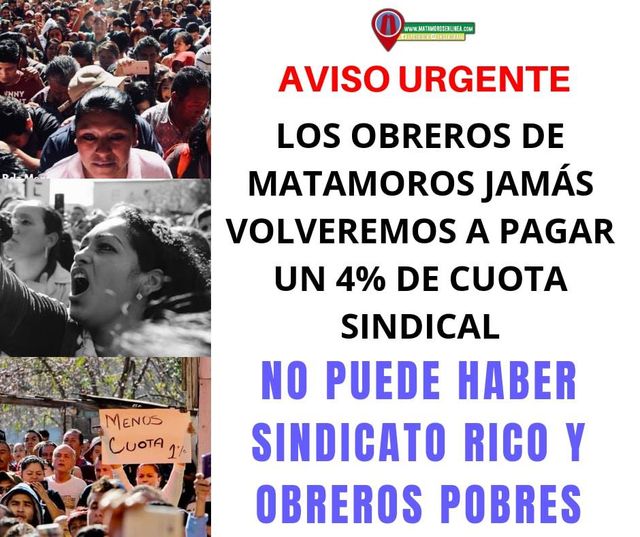
One of workers’ chief demands is a reduction in union dues. Among the social media graphics workers are circulating is one that reads, “The workers of Matamoros will never go back to paying 4 percent union dues. You can’t have a rich union and poor workers.”
“The workers of Matamoros will never go back to paying 4 percent union dues. You can’t have a rich union and poor workers.”
Another image states, “Urgent notice: We need a representative from each factory to report urgently. New leaders are urgently needed. General strike January 16.”
A third says, “All SJOII workers are being summoned to attend a special assembly. The order of the day will be the removal of the present union leader and his workgroup for failing to help.” The mass meeting is scheduled for Wednesday morning.
"Urgent notice- We need a representative from each factory to report urgently. New leaders are urgently needed. General strike January 16.”
The companies on strike include Inteva, STC, Polytech, Kemet, Tyco, Parker, AFX and Autoliv. Pro-industry publications fear the strike wave may spread to other border towns, including Tijuana, Mexicali and Ciudad Juarez.
The strike takes place just across the border from Brownsville, Texas, where Donald Trump visited last week to denounce Mexicans and Central Americans as “criminals” and to demand the construction of a border wall amid the ongoing US government shutdown. Among the main goals of this wall is to physically divide the working class of Latin America from their natural class allies north of the border.
The US and Canadian auto unions have echoed Trump’s nationalist, anti-Mexican rants in an effort to direct workers’ attention away from the real enemies: the corporations and their union collaborators.
In November, when General Motors announced it was slashing 15,000 jobs in the US and Canada, the United Auto Workers and Unifor blamed Mexican workers for “stealing jobs.”
Ford has also announced thousands of job cuts in Europe and, with more cuts forthcoming amid an international restructuring of the auto industry, the unions and companies fear that workers will unite across national boundaries in a common fight. At a recent Unifor union rally in Windsor, Ontario, a woman stood near the speakers’ platform dressed in a sombrero and poncho to insult Mexican workers. These are the racist views of the wealthy union leaders, not of US and Canadian workers who are looking for a way to stop the job, wage and benefit cuts.
Mexican maquiladora workers are not the enemies of US and Canadian workers. They are exploited by the same companies and are engaged in the same process of production. While the union bureaucrats in the US make upwards of $200,000 per year, Matamoros workers make on average 176 pesos (USD$9.20) per day.
Matamoros maquiladora workers also confront an enemy in the new government of Mexican president Andrés Manuel López Obrador (AMLO), whose National Regeneration Movement (Morena) controls the national legislature. Matamoros maquiladora workers are angry that they will not receive a raise as part of AMLO’s new free economic zone, aimed at facilitating the exploitation of Mexican workers by US manufacturers in the border region.
Though AMLO’s plan includes a 100 percent hike to the minimum wage, Matamoros workers will be negatively affected because they already make slightly more than the minimum wage. The corporations are using the minimum wage hike as an excuse to slash bonuses and benefits for all workers.
Matamoros’ new mayor, Mario Lopez, who is a member of Morena, said in a late 2018 interview on Central TV that because of the minimum wage increase, maquiladora workers’ wage demands are “not financially viable for the maquiladoras.” In the same interview, Lopez admitted that he was involved in a backroom “chat” with the unions and the bosses to eliminate workers’ bonuses from the new contract. “I am intervening to make sure the parties reach a conciliatory plan,” he said at the time.
Striking workers occupy Novalink factory
Workers across the world experience the same conditions. Breyssa, the Matamoros striker, described life at her parts plant:
“In my plant there is always machine oil on the floor, and it is terribly loud. We are not given safe footwear or ear plugs for the noise. We had to bring our own safety equipment. Shifts are more than 10 hours per day, Monday through Saturday. We are on our feet without anywhere to sit, and sometimes we were forced to work overtime.
“We get there at 5:30 a.m. and leave at 6 or 7 at night. We are not allowed to go to the bathroom more than five times during our shift, and then we can only take five minutes. We are not able to drink much water, although it is often very hot in our work areas.”
Breyssa spoke about the threat of reprisals by the auto parts companies after the strike was announced:
“Many companies are threatening workers with mass firings. In companies like Kemet, workers have been locked out. In another company called AFX, workers are being threatened with violence if they hang a banner indicating that they are on strike. At another plant called Autoliv, the police were called and were used to remove workers from the property. Workers want this information to get out, but they are afraid. There have been many years of injustices and poor treatment, and we are tired.”
The WSWS contacted AFX corporate headquarters in Port Huron, Michigan and asked whether the company was threatening workers with violence. A representative said, “I have no comment on that.”
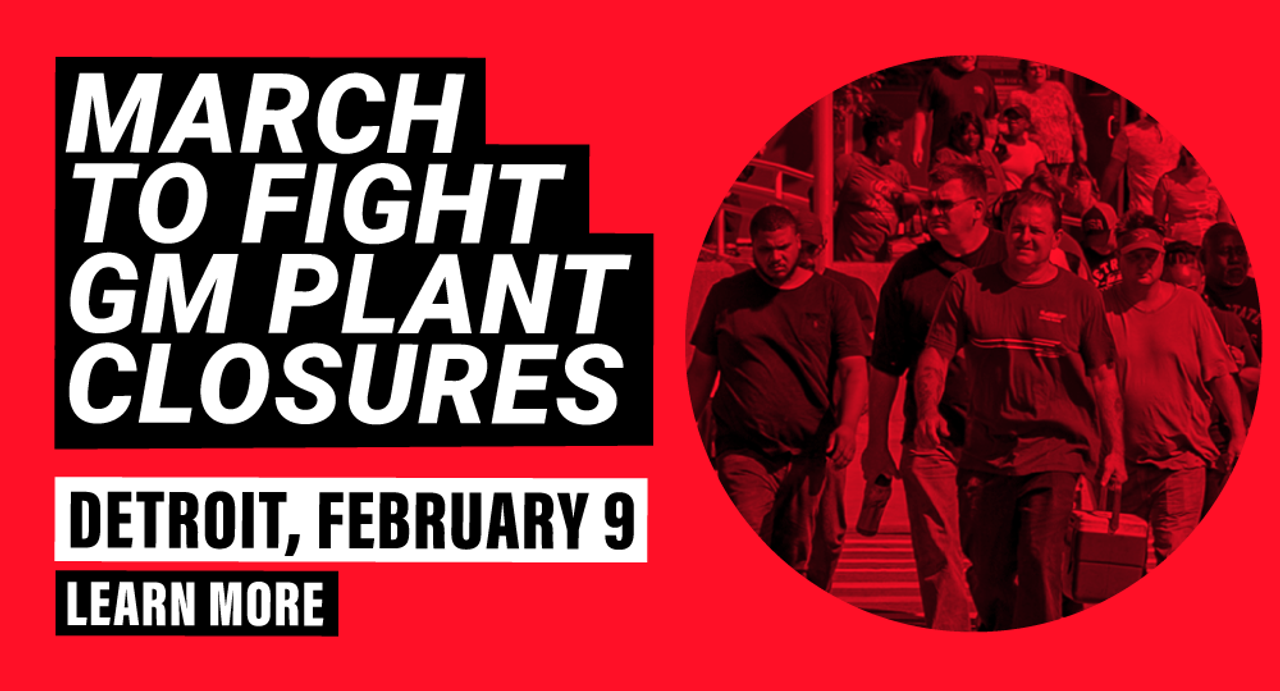
The movement by workers internationally against job cuts, wage cuts and concessions is gaining momentum. On February 9, at 2 p.m. autoworkers will demonstrate at GM headquarters in Detroit, Michigan to show that they do not accept the job cuts and concessions announced by the auto and parts companies and are prepared to link up across all North America in a united fight for social equality.

Trump and the China-North Korea Equation

Sandip Kumar Mishra

US President Donald Trump is going to have a second meeting with North Korean leader Kim Jong-un in mid-February 2019. The core objective of this meeting is North Korea's denuclearisation, which has remained elusive. Even though it is well-established that denuclearisation will not happen overnight, at least two short-term moves are instrumental to gauging whether the process is moving in the right direction. One, deliberation, and if possible, agreement, on the detailed trajectory of denuclearisation. Two, incremental trust-building measures between the US and North Korea to help create an overall positive may produce positive bilateral environment for denuclearisation.
Unfortunately, neither of these two things have happened after the much hyped first summit meet between Trump and Kim in June 2018 in Singapore. All the reported interactions between the US and North Korea after the first summit have been contentious, limited, and superficial. On a few occasions, representatives from both countries have openly expressed their dissatisfaction with each other. US and North Korean diplomatic signals in the recent past suggest that the trust quotient between them has, if not worsened, at least not improved. There is a bilateral deadlock, and if the current trend continues, it will be hard to expect much by way of substance - or anything at all - from the second meet.
The much more significant development after the first summit meet is the growing closeness between North Korea and China. The Trump administration has rather unintentionally become instrumental in bringing North Korea and China closer. Top Chinese and North Korean leaders did not have any direct meetings after Kim Jong-un came to power in 2011, and there were very few high-level visits between the two countries in that period. However, the bilateral relationship has re-energised quickly in the past one year.
Chinese President Xi Jinping and Kim have had four summit meetings in less than a year, and there are reports that Xi will soon make his first official visit to North Korea. China, too, has not been in favour of North Korea's successive nuclear and missile tests given particularly the closing gap they have initiated between its borders and US defence preparedness. However, it has been unable to stop North Korea’s stubborn quest because of limited leverage as well as its equally important foreign policy goal of ensuring the North Korean regime's survival. It is for this same reason that despite strains in the relationship when Kim Jong-un took over power, both countries avoided direct confrontation or a public spat.
China welcomed the shift in North Korea's approach when it agreed to talk denuclearisation with the US. Kim utilised this opportunity quite cleverly, and made a quiet visit to North Korea before his first summit meet with South Korean President Moon Jae-in. Afterwards, before any important meetings with South Korean or US leaders, Kim been consistent in first discussing issues with China. This is based on the knowledge that North Korea’s proximity to China gives him the required strategic depth and leverage.  In this light, an interesting observation is that when the US acknowledged that there were "positive developments" regarding denuclearisation, China demanded a reciprocal easing of sanctions on North Korea. China’s demand was, in a way, an endorsement of North Korea’s position of seeking reciprocity in its dealings with the US.
In contrast, the Trump administration has gradually drifted away from China both on the North Korean issue as also their own bilateral issues. Through the narrow lens of North Korea’s denuclearisation, it seems that the Trump administration has not achieved any substantial forward movement but has instead pushed its rivals - China and North Korea - closer to each other.
Donald Trump appears to be more intent on managing news and opinion about himself rather than contending with the ground realities of its negotiations with North Korea. Further, Trump continues to believe, quite erroneously, that North Korea has come to the negotiating table because of the US policy of "maximum pressure," not realising or acknowledging the significant work done by South Korea in this regard. The importance of trust-building, give-and-take and concessions, and long-term goal setting have not been paid any heed by the Trump administration. Perhaps the president does not realise that even if you are not able to make new friends, you must at least maintain old relationships, and work to not bring your rivals even closer.

14 Jan 2019

Peace Revolution Alafia Francophone Fellowship 2019 for Young Africans from Francophone Countries

Application Deadline: 30th March 2019

Eligible Countries: Francophone countries in Africa

To be taken at (country): Bingerville, Ivory Coast

About the Award: Do you want to reach the peak of your performance? Are you ready to try something new in order to make the best version of yourself? With the tools of the “inner arts”, emotional intelligence and meditation, the World Peace Initiative Foundation through its project “Peace Revolution” offers you the opportunity to unleash the latent potential that lies dormant in you so that you become the unique person you deserve to be – through the principle of Peace Inside Peace Outside.
The Training begins with a first phase consisting in following 21 days of the Online Personal Development Program on our interactive platform aiming to offer you the basic theory and practice to cultivate your inner peace.
The second phase offers a 4-day intensive training program that allows participants to better understand the relationship between meditation and the various skills needed to improve efficiency in their professional and social life. Participants will learn more about the benefits of meditation in relation to:
  • Self-empowerment
  • Emotional intelligence
  • Work-life balance
  • Stress management, pressure and resistance
  • Nonviolent Communication
Type: Fellowship

Eligibility: 
  • Being a national of one of the following countries: Republic of Congo, Republic of Congo, Sao Tome and Principe, Gabon, Guinea, Equatorial Guinea, Republic of Congo, Republic of Congo, Chad, Ivory Coast, Mauritania, Cape Verde, Senegal, Niger, Guinea Bissau, Mali, Togo, Burkina Faso, Tunisia, Morocco, Libya, Algeria, Djibouti, Rwanda, Burundi, Madagascar.
  • Have completed at least 21 days of the Personal Development Program online by July 06, 2019. Note that applicants do not necessarily need to have completed the personal development program online at the time of submission of the application form. application. Have a good command of the French language (written and oral). Knowledge of the English language is an asset. However, the training will be conducted exclusively in French.
  • Be optimistic, open-minded, demonstrate leadership, take a particular interest in social change. Candidates can be peace activists, civil servants, journalists, entrepreneurs, young leaders of local, national or international organizations etc. change catalysts in general.
  • Applicants must commit to becoming involved with the World Peace Initiative Foundation after the training by submitting a project proposal that uses the practice of meditation as a tool to address various social challenges in their respective communities.
Everyone is welcome to join the fellowship. But to be eligible for the airfare support, candidates must be between 20-30 years old at the time of submitting application. However, if you are above 30 years old but still want to receive airfare support write us directly at the following email cwestafrica@peacerevolution2010.org

Number of Awards: Not specified

Value of Program:
  • Airfare (Full or partial)
  • accommodation
  • Restoration
  • Local transport
Duration of Program: September 12 – 15, 2019

Apply Here

Visit Program Webpage for details

IMF F&D Essay Competition 2019 for Graduate Students Worldwide

Application Deadline: 31st January 2019

Eligible Countries: International

To be taken at (country): Online

About the Award: The International Monetary Fund (IMF) is an organization of 189 countries, working to foster global monetary cooperation, secure financial stability, facilitate international trade, promote high employment and sustainable economic growth, and reduce poverty around the world.
Finance & Development,the IMF’s quarterly print magazine and online editorial platform, publishes cutting-edge analysis and insight on the latest trends and research in international finance, economics, and development. The print edition is published quarterly in English, Arabic, Chinese, French, Russian, and Spanish, while the web edition is complemented with additional, online-only content. Finance & Development is written by both IMF staff and prominent international experts, and is read by leading policymakers, academics, economic practitioners, and other decision makers around the world.

Type: Contest

Eligibility: This competition is open to:
  • All graduate students worldwide,
  • Those who have graduated from a master’s degree program or higher in 2018.
Number of Awards: 1

Value of Award: The winning essay will be published in a forthcoming edition of F&D magazine in six languages both in print and online–reaching leading policymakers, central bankers, academics, economic practitioners, development experts, journalists and other decision-makers around the world.

How to Apply: 
  • The deadline to submit your English essay of 1500 words or less is January 31st, 2019. Please submit your full name, graduate program, university affiliation, email address and essay to fanddcompetition@imf.org.
Visit Programme Webpage for Details

Yunus&Youth Global Fellowship Program 2019 for Social Entrepreneurs

Application Deadline: 18th February, 2019 11:59 EST

Eligible Countries: All

To be taken at (country): Online

About the Award: Yunus &Youth enable early-stage young social entrepreneurs to create stronger positive social impact, while also helping them to become financially sustainable by providing mentoring, business training and access to a global network. 
Yunus &Youth offers a 6-month Global Fellowship Program to help exceptional young people running businesses doing good.
By training talented young social business leaders and accelerating their enterprises with the right resources, we cultivate a highly capable and impactful next generation of social entrepreneurs wherever they are.

Type: Fellowship, Entrepreneurship

Eligibility: If you have started working on your social business and are dedicated to making it succeed, then you fulfill the main criteria. You must be under 35 years old, comfortable speaking and communicating in English and have access to stable Internet connection. You must also be able to commit to at least 5 hours per week on exercises that will help you improve your business.

Number of Awards: Not specified

Value of Award:
  • Mentorship: You’ll be paired with a mentor who is right for you. You’ll work together to develop your social business throughout the 6-month program.
  • Supportive Peers: You’ll meet driven entrepreneurs from around the world. Each class cohort is made up of fearless young people who provide one another with feedback, connections and support.
  • Expert Webinars: We bring you experts from a diverse range of fields including social enterprise, business fundamentals, digital marketing, finance, learn start-up principals and more.
  • Just the Right Resources: We’ve developed a no-hassle, just-what-you need curriculum, resources, tools and exercises that will take your enterprise to the next level.
  • Recognition: As a Y&Y Fellow, the world knows you’re a social entrepreneur destined to make a long-lasting impact.
  • Connections: Our network includes some of the world’s top social impact organizations, international institutions, incubators, and investors.
  • Professional Support: The Y&Y Team knows your time is valuable. We’ve structured the process to ensure that every step is as impactful as possible.
  • Growth: Our Fellows cite Y&Y as one of the most important and supportive experiences in shaping and growing their social businesses.
Duration of Programme: The program lasts for six months.

How to Apply: APPLY NOW
  • It is important to go through all application requirements on the Programme Webpage see link below) before applying
Visit Programme Webpage for Details

Canada: Jill Sanders Memorial Scholarship 2019 for African Students

Application Deadline: 31st January 2019

Eligible Countries: African countries

About the Award: Scholarship support is available for individuals attending or planning to attend an educational institution to undertake a defined program of study directly related to HTA or to individuals participating in an internship program through an HTA agency, Ministry of Health, or relevant Non-Governmental Organization (NGO) on a full-time basis.
The program objective is to have a positive impact on HTA capacity in African countries.
Additional funding will support scholarship recipients to attend the HTAi Annual Meeting in the June immediately following completion of their scholarship award term to present their research and/or professional experience acquired during the program.

Field of Study:
  • Scholarship funding may be requested to support completion of a Masters, PhD, Fellowship or other certification or training program in HTA or a closely related field.
  • Scholarships may also support participation in an internship with an HTA agency or body, other public sector body, or non-governmental organization (NGO) to gain practical experience and/or contribute to specific research projects in HTA. Both formal and informal internships will be considered; however, the latter require a clear statement of the scope of work, role and duties of the internship position and how this will lead directly to capacity building and development of the individual’s knowledge and skills in HTA
Type: Masters, PhD, Fellowship, Training

Eligibility:
Individual applicants To be eligible to apply for HTAi Scholarship, an individual applicant must:
  • Be a current student at an educational institution or employed by a health sector organization in Africa.
  • Be registered or accepted for registration in a qualifying educational or fellowship program in HTA or in a closely related field, or have been accepted for an internship with an HTA body, other public sector body, or NGO.
  • Agree to complete the educational/fellowship/internship program for which the scholarship is sought.
  • Agree to attend the HTAi Annual Meeting the June following the completion of the educational/fellowship/internship program to present a short report of the research undertaken and/or the experience gained through the program. Funding support for economy travel and accommodation costs will be provided by the HTAi for participation in this event.
  • Attest that he/she intends upon completion of the program to apply to the best of their ability the knowledge and skills gained towards the advancement of HTA in Africa.
Organizational Sponsor: The organizational sponsor is an HTA or health organization or an educational institution in an African country where the individual applicant works or studies. The organizational sponsor is represented by a senior manager, supervisor or department head within the organization who can attest to the quality of the applicant, their competencies and career interests in HTA, and also agrees to support the individual in the applying the skills and knowledge gained in the educational or internship program in an African country. The organizational sponsor is required to complete the corresponding section of the scholarship application form.
An organizational sponsor must:
  • Operate in Africa and have an organizational mandate and/or undertakes activities in areas relevant to the field of HTA.
  • Be an organization where the individual applicant is a:
– Student in an undergraduate, Masters, Doctoral or Post-Doctoral program.
  • Be represented by a senior manager, supervisor, department head or equivalent, who is to complete the organizational sponsor portion of the application form.
  • Agree to foster the individual applicant to apply the knowledge and skills gained in the scholarship program for the advancement of HTA in Africa. This may include, for example, the offer of a position of employment or study for the individual after completion of the program, mentorship of the applicant during or after the scholarship period, or by connecting the individual by sharing network contacts or making formal introductions of the individual to other health or HTA organizations where their skills and competencies can be applied to achieve the goal of increasing HTA capacity in Africa. HTAi will consider a range of possible arrangements of support to the individual, depending on the sponsoring organization’s nature and resources.
Number of Awards: Not specified

Value and Duration of Award:
  • A total of $20,000.00 CAD is available for the HTAi Scholarship Program each calendar year. Multi-year awards will be considered for exceptional applicants, up to a maximum of $20,000.00 CAD per year for two years.
  • Recipients who are awarded funding for a single year at a time are welcome to submit a separate application the following year for subsequent scholarship support
  • Upon the awarding of the scholarship, the individual recipient will also receive a complimentary 1-year HTAi membership, and be invited to join the HTA in Developing Countries Interest Group.
  • Additional funding will support scholarship recipients to attend the HTAi Annual Meeting in the June immediately following completion of their scholarship award term to present their research and/or professional experience acquired during the program.
  • Applicants may request scholarship funding to support the following expenses related to their education, fellowship or internship program: • Tuition fees • Books and other educational materials • Accommodation • Travel expenses • General living expenses
How to Apply: 
  • It is important to go through all application requirements on the Programme Webpage see link below) before applying
Visit Programme Webpage for Details