18 Jan 2019

Growing signs of worker resistance to US government shutdown

Philip Guelpa

As the partial federal government shutdown, now in its fourth week, drags on, its effects on large sectors of the US population are intensifying and the resulting anger and reaction continue to grow.
On Wednesday, the Transportation Safety Administration (TSA) was forced to openly acknowledge what has been widely known for some time, noting in a statement that “many employees are reporting that they are not able to report to work due to financial limitations.”
TSA workers are among the lowest-paid federal employees, living paycheck to paycheck. The impossible situation to which they are subject—forced to work without any income—is prompting growing resistance going beyond the initial form of individual ‘sickouts.’ A TSA representative reported that increasing numbers are explicitly stating that their refusal to come into work is due to financial hardship. These frank statements, by workers who are legally prohibited from striking, are a gauge of their rising level of anger.
The TSA reports that on Tuesday and Wednesday, 6.1 percent of the workforce was absent. So far, three major airports—Atlanta, Houston and Miami—have been forced to implement contingency plans due to the lack of necessary staff, causing increasing delays for passengers. The situation will only worsen and spread as the lack of pay drives growing numbers of workers to stay home.
TSA and other unpaid federal employees are being forced to turn to food banks or donations from the public to provide meals for themselves and their families. At the Minneapolis-St. Paul International Airport, for example, an unused room has been turned into a collection point for donations for the workers. Food banks across the country are expressing alarm that the demand will rapidly outstrip their resources.
The partial government shutdown is also impacting aircraft safety. The Federal Aviation Administration (FAA) is forcing over 2,200 furloughed inspectors back to work, without pay. These are professionals who are responsible for ensuring the airworthiness of aircraft and for conducting accident investigations. Air traffic controllers have already been required to work without pay.
The wife of an air traffic controller in Chicago told the World Socialist Web Site, “Chicago has been working understaffed for a very long time.” Even before the shutdown began, her husband, who has been there for 20 years, typically worked six days a week, averaging 48 hours.
Now, she said, they’re on “short breaks and staying longer on position. Are they losing sleep? Yes, even more now.
“The new guys are having a hard time. One paycheck with no pay is bad, but wait until the second one comes with no pay.”
Despite this, when asked by the New York Times whether the union would organize any sort of job action, Trish Gilbert, executive vice president of the National Air Traffic Controllers Association, replied that they “would not condone or endorse any kind of activity like that.”
Federal workers around the country are protesting against the shutdown and its devastating effect on their lives. They are expressing a growing determination to break out of the constraints imposed on them by the government and the unions.
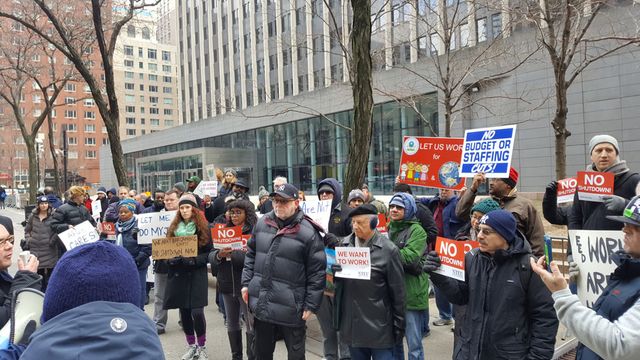
Federal workers rally Wednesday in Manhattan
Dozens of federal workers participated in a rally in front of the federal building in downtown Manhattan Wednesday. WSWS reporters spoke to a furloughed Environmental Protection Agency worker participating in the protest. “This is the second rally we’ve had,” he said. “Today is bigger than the one last week—a fraction of the press though. They must be losing interest.
“I’m still furloughed now, but they’re calling back most of the IRS in our building. If I was them, I don’t know if I’d go back. It’s hard to stick your neck out when you’re by yourself, but it’s getting to the point, especially if we miss next week’s paycheck too, that a lot of people will be fed up and desperate.
“They keep saying that striking is illegal for federal employees. But I took an oath to uphold the constitution. What about the 13th amendment? Isn’t slavery supposed to be illegal? We didn’t ask for this fight, but what are we going to do? We can’t just sit back and keep getting pummeled.”
One of the more than 46,000 furloughed IRS workers being forced back to work without pay, Meeka Katherine, an IRS tax examiner, expressed her outrage in a Facebook post:
“The IRS workers can end this shutdown if we all refuse to work until we get paid they will have no choice but to give in and why shouldn’t we fight? We have been used as pawns long enough we should stand up united and give this guy a taste of his own medicine if he’s gonna hold out our checks and not care if we can even make it to work yet we are expected to be there that’s ridiculous... We need to come together or this could last a long time. We are not disposable and if we go along with this we are just making it easier for it to continue.”
Another federal worker posted her experience, faced by many who are about to lose their homes:
“So I spoke with my leasing office who is under the lincoln property management corporation they are a national leasing management corp. I was informed they have not received any direction from the corporate office. So if rent is not paid by the third of the month they will proceed with the eviction process. I was also advised if u know you cant afford next month rent turn in your keys by the last day of this month and we will work you on remaining balance of lease. So if you rent from lincoln property management please contact their corp office about the effects of the government shut down. Maybe if they hear from enough people they will grow a heart.”
The average federal worker is estimated to have lost about $5,000 so far since the shutdown began.
Federal employees are not the only workers whose lives are being severely impacted by the shutdown. Many jobs are done under contract. Unlike federal workers, the more than one million people working as contractors are not likely to receive back pay once the shutdown ends. These workers range from janitors employed by companies with contracts to clean federal buildings to professionals in large consulting companies. As invoices to the government go unpaid, growing numbers of workers will be laid off, and some companies will go out of business.
Bloomberg estimates that these losses could amount to as much as $200 million per day. The ripple effects of this alone will have major impacts on the US economy, even after the shutdown ends.
A growing number of commentators are raising concerns that effects of the partial government shutdown could push the US economy into recession. Estimates vary, but the combined cost of the shutdown is already in the billions. The direct and ancillary effects could well trigger a crisis in the already fragile US and world economy.
Behind the fears of a loss of business and consumer “confidence” due to the shutdown lies the reality of the extreme social inequality that has developed over decades, which is rapidly hollowing out any confidence that workers and young people may once have had in their prospects under capitalism.
The way forward is indicated by the Yellow Vest protests in France, auto parts workers in Mexico and recent teachers strike in the US in which the workers are moving to free themselves from the treacherous control of the unions and social democratic parties and their pseudo-left supporters. Workers must form their own workplace action committees and fight to replace capitalism with a socialist society dedicated to the fulfillment of human needs rather than private profit.

Report to Davos meeting points to deepening contradictions of global capitalism

Nick Beams

The report prepared by the World Economic Forum (WEF) for its annual gathering in Davos, Switzerland, next week presents a picture of the ongoing disintegration of all the mechanisms—economic, political and ideological—that have served to sustain the global capitalist order in the post-war period.
In his preface to the report, WEF president Børge Brende said the world was facing a “growing number of complex and interconnected challenges—from slowing global growth and persistent economic inequality to climate change and geopolitical tensions,” as well as changes brought about by technological developments, characterised by the WEF as the Fourth Industrial Revolution.
As an institution dedicated to the preservation of the capitalist order in the interests of the multi-billionaires and global elites it represents, the WEF is very mindful of the mounting development of the international class struggle, noting that “social anger” is increasingly prevalent.
“Polarization is on the rise in many countries,” Brende wrote, and in some cases, “the social contracts that hold societies together are fraying.”
This was an era of “unparalleled resources and technological advancement” but for too many people it was an era of economic insecurity. “New ways of doing globalization” had to be found to respond to this development.
The report itself, however, indicates that right at the point where a coordinated response by the major capitalist powers is needed, conflicts among them are deepening.
The executive summary begins: “Is the world sleepwalking into a crisis? Global risks are intensifying but the collective will to tackle them appears to be lacking. Instead divisions are hardening.”
The summary noted that what it called “the world’s move into a new phase of strongly state-centred policies”—in other words, the rise of nationalism—which the WEF had previously cited, continued throughout 2018.
“The energy now expended on consolidating national control risks weakening collective responses to emerging global challenges. We are drifting deeper into global problems from which we will struggle to extricate ourselves.”
On the economic front, macro-economic risks had moved into “sharper focus,” with signs of a slowdown in the major economies and China. At the same time, global debt had risen to around 225 percent of global gross domestic product, significantly higher than before the financial crisis of 2008. “Deepening fissures” in the international financial system suggested that “systemic risks may be building.”
“If another global crisis were to hit, would the necessary levels of cooperation and support be forthcoming?” the summary asked. “Probably, but the tension between the globalization of the world economy and the growing nationalism of world politics is a deepening risk.”
At a press conference on Wednesday to launch the report, Brende also pointed to the implications of the slowdown in world economic growth.
“We simply do not have the gunpowder to deal with the kind of slowdown that current dynamics might lead us towards,” he said. Economic policy, once a way for economic rivals to mutually benefit, was now “frequently seen as a tool of strategic competition.”
Trade had been the “engine of growth” but that trend was now declining. The “coming months will be crucial in building trust,” Brende said. “The biggest risk is the lack of willingness to collaborate—we are not mitigating that risk.”
As an expression of rising economic nationalism, the report drew particular attention to the US Commerce Department’s strategic plan for 201822, which stated that “economic security is national security.”
This trend is not confined to the US and the Trump administration. The report said developments in foreign direct investment over the past years were “arguably even more significant than trade tensions.” A number of European countries had introduced restrictions on foreign investments.
“Western governments in particular have been sharpening their power to block investments in strategic sectors, particularly emerging technologies—raising the prospect of a partial unwinding of globalization in investment, as in trade.”
Pointing to what it called the threat to multilateralism, the report stated: “Political leaders have increasingly asserted the primacy of the national state in the international system and sought to weaken the constraints placed on national autonomy by international agreements and multilateral institutions.”
In seeking to track social and political tensions, the report cited a “sobering” finding from the Edelman Trust Barometer that the populations of 20 out of the 28 countries surveyed were “distrusters,” that is, they lacked confidence in the prevailing establishment.
“Beyond economic impacts, eroding trust is part of a wider pattern that threatens to corrode the social contract in many countries. This is an era of strong-state politics, but also one of weakening national communities.”
The term “class conflict” is one that the WEF and other such institutions seek to avoid like the plague. But the reference to “weakening national communities” is an expression of the rise of social struggles against the national ruling classes.
The report noted that in its survey of business and political elites, some 59 percent of respondents said they expected risks associated with “public anger against elites” to increase in 2019.
Such anger, the WEF warned, could have serious political implications. “A vicious circle may develop in which diminishing social cohesion places ever greater strain on political institutions, undermining their ability to anticipate or respond to societal challenges.”
The report said it was now widely acknowledged that more should have been done to “provide protection of or remedies to the losers from globalization” and that “it should not have taken a crisis to recognize this.”
Recognition may be one thing, but action is another. The WEF report could not point to a single instance where those lessons had been acted upon. In fact, what has been revealed since the 2008 financial crisis is that the very processes that led to it—the promotion of speculation and the accumulation of fantastic wealth on the heights of society at the expense of the majority—have become an entrenched and permanent feature of the global capitalist economy as whole and its modus operandi in every country.
The deepening social polarisation, the report said, would “complicate any attempt to find consensus on bold attempts to rethink global capitalism,” to which the 2019 WEF annual forum would devote itself.
Such efforts are doomed to failure—the modern equivalent of alchemists’ efforts in medieval times to turn lead into gold—for reasons to which the report itself alludes where it cites the global character of all economic processes, as national divisions harden.
These contradictions, which first erupted in the form of the outbreak of World War I in 1914, are once again ripping apart the world economy, threatening even more devastating consequences. They cannot be overcome by a “rethink” but only through the unified international struggle of the working class to end the rule and domination of the elites represented at the WEF annual meeting.

US-born anchor for Iranian TV jailed without charges

Bill Van Auken 

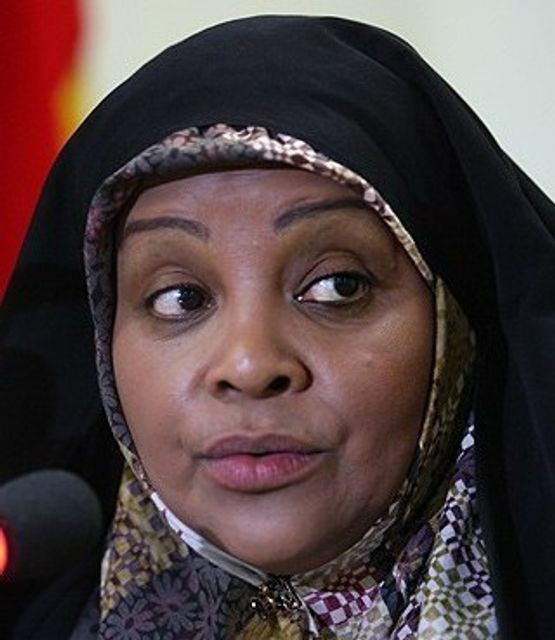
Marzieh Hashemi, an anchor and reporter for Press TV, the English-language station of Iran’s state-run broadcasting system, was arrested Sunday at St. Louis Lambert International Airport, transported to a Washington detention facility in manacles and chains and has been held ever since without charges or any public explanation from either the US Justice Department or the Federal Bureau of Investigation (FBI).
Hashemi was in the United States to visit her family, including a brother suffering from cancer, and was working on a documentary film on Black Lives Matter.
Marzieh Hashemi
The arrest of Hashemi, a 59-year-old US citizen married to an Iranian, who has worked as a journalist in Iran for 25 years, has all the characteristics of the kind of forced “disappearances” executed by fascist-military dictatorships. It has been carried out in flagrant violation of constitutional rights to freedom of the press and freedom from arbitrary arrest, as well as the basic right of habeas corpus.
Hashemi was allowed to call her family to inform them she was imprisoned only two days after she was seized at the airport. US authorities have provided no information to her children as to the reason for her detention, saying only that she is a material witness in an undisclosed investigation.
Her son, Hossein Hashemi, a research fellow at the University of Colorado, said that he and his siblings have also been subpoenaed to appear before a grand jury in Washington.
Hashemi’s children have reported that their mother has been subjected to cruel and degrading treatment by the US authorities. She is locked in a cell in manacles at an undisclosed detention facility. A Muslim, she has been denied food she can eat and offered pork by her jailers in a blatant attempt to ridicule her religion. She told her son she had only pretzels to eat since her arrest. She was stripped of her hijab and given only a T-shirt to wear.
Born Melanie Franklin in New Orleans, Hashemi studied journalism at Louisiana State University in Baton Rouge, where she came into contact with Iranian students who supported the 1979 revolution against the US-backed dictatorship of the Shah. Marrying an Iranian, she moved to Tehran and pursued her journalistic career, working for the Islamic Republic of Iran Broadcasting, or IRIB.
She is a prominent figure on Press TV, anchoring the English language news for the Iranian broadcaster, conducting interviews and producing documentary films.
Her son, Hossein, noted that in her on-air commentary his mother had been “critical of a lot of the domestic policies of the United States government,” as well as “the wars abroad and the regime change policies that the United States enforces all the time and puts major budgets behind.”
Hashemi’s arrest has been largely ignored by the corporate media, as well as by the pseudo-left outfits that orbit the Democratic Party.
All the pundits and editorial boards that postured as defenders of freedom of the press in the face of the Saudi monarchy’s assassination of former regime insider and journalist Jamal Khashoggi have maintained a stony silence in the face of this grossly unjust imprisonment of the American-born Iranian journalist.
One can only imagine their furor had Iranian authorities dragged Christiane Amanpour, the Iranian-raised and US state-connected ABC News anchor, away in chains and imprisoned her without charges.
Their silence in the face of the Hashemi affair is no accident. Her jailing is in line with the attempt by the US ruling class—with the full support of the corporate media—to intimidate, censor and silence all critical and independent journalists and media organizations around the world.
The treatment meted out to her is precisely what the US authorities hope to inflict upon WikiLeaks founder Julian Assange if they are able to pry him out of the Ecuadorian embassy in London where he has rather tenuous sanctuary.
The brutal abduction and detention of Hashemi is also bound up with the increasingly bellicose and provocative American imperialist offensive against Iran, which has escalated steadily since the Trump administration abrogated Washington’s commitment to the 2015 Iran nuclear accord and began the imposition of increasingly punishing sanctions aimed at starving the Iranian people into submission.
The US ruling establishment has been conducting a bitter internecine struggle over President Donald Trump’s announced decision to withdraw troops from Syria, with leading administration officials, including National Security Adviser John “Bomb Iran” Bolton and Secretary of State Mike Pompeo, walking back Trump’s promise of a swift pullout and redoubling US threats against Iran.
Whether Hashemi is being held as part of a wider pseudo-legal plot to discredit Iran and stoke the war drive remains to be seen. Such an attempt was made under the Obama administration with the fabrication of a case based upon ludicrous allegations that supposed Iranian agents (one of them a DEA informant) had attempted to hire a Mexican drug cartel to blow up the Saudi ambassador to the US in a Washington restaurant.
Whatever the case, the imprisonment of Hashemi and the brazen violation of her basic democratic rights constitute a deadly serious warning. As they lurch toward war and are driven by mounting fear of the developing opposition and mass struggles of the working class from below, the US government and the capitalist oligarchs who rule America are turning ever more openly toward dictatorial forms of rule.

General strike of 700,000 public sector workers shakes Tunisia

Johannes Stern

Eight years after the ouster of Tunisian dictator President Zine El Abedine Ben Ali on January 14, 2011, renewed mass struggles are shaking the country’s government.
Yesterday a one-day general strike involving close to 700,000 public service workers brought the country to a standstill. According to media reports, all flights in and out of Tunisia’s main airport were canceled. Schools were closed and ports, hospitals, public transport and other public services disrupted.
Called by the General Union of Tunisian Workers (UGTT), the strike was the largest since the mass demonstrations following the assassination of prominent opposition leader Chokri Belaid in February 2013.
In the capital Tunis, tens of thousands of protesters rallied at the national union headquarters and marched through the city’s main thoroughfare with signs reading “Get Out!” and “The People Want the Fall of the Regime.” Demonstrations also took place in other important cities, including Sidi Bouzid, where the first mass protests broke out in December 2010 after the self-immolation of Mohamed Bouazizi.
The general strike follows nationwide protests and clashes with police after another self-immolation, by 32-year-old journalist Abderrazak Zorgui, in the industrial city of Kasserine at the end of December.
The renewed mass protests and strikes demonstrate, once again, that none of the grievances that sparked the mass revolutionary uprisings in Tunisia, Egypt and throughout the Middle East have been resolved. “The core demands of the 2011 revolution were employment, the betterment of the Tunisian economy and an end to corruption. However, none of these demands have been met. This is why today we are here,” one protester, Lassad Hamdi, told the National.
The government of Prime Minister Youssef Chahed and President Beji Caid Essebsi, who served under Ben Ali, is continuing the anti-working class, pro-imperialist policies of the old regime. In December 2016, Tunisia struck a deal with the International Monetary Fund (IMF), pledging to impose drastic austerity measures and cut the public sector wage bill to 12.5 percent of gross domestic product in 2020 from the current 15.5 percent.
Chahed warned that the strike would result in a “considerable cost” for the Tunisian economy and might force the government to seek further foreign loans with even tougher conditions. Speaking on public television Wataniya 1 on Wednesday night, Chahed said: “We did everything possible to avoid the strike in presenting proposals that improve purchasing power while at the same time taking into account the country’s capabilities.” He invited the trade unions back to the “negotiating table” after the end of the strike.
The UGTT, long a central pillar of the Ben Ali dictatorship and now a key ally of the ruling Nidaa Tounes party of Essebsi and Chahed, called the strike to control the explosive anger in the working class, while continuing to work hand-in-glove with the regime. In an interview with Jeune Afrique, UGTT secretary general Noureddine Tabboubi complained that the government had “no respect for the agreements ... and decisions made.” However, he stressed, “a solution will be found.”
Tabboubi announced that the UGTT’s administrative commission would convene on Saturday to “make decisions up to the expectations of Tunisian workers who have campaigned for their rights.”
This is a transparent fraud. The UGTT is essentially in agreement with the IMF “reform agenda” and seeks to find a modus operandi with the government to implement it without provoking another revolution. In his speech on the 8th anniversary of Ben Ali’s ouster, Tabboubi warned: “We hope that the government will realize, before it is too late, its reluctance ... to initiate the necessary reforms in the fields of education, health care and take bold measures to resist tax evasion.”
The UGTT is being assisted by the Popular Front (PF), a petty-bourgeois “left” alliance that does everything in its power to subordinate the working class to the unions and their nationalist and pro-capitalist agenda. In a January 16 statement, the PF complained that the government “bears full responsibility for the failure of the negotiations” and pledged its support for the UGTT “in all the steps to be taken in defense of its perspectives […] and the independence and sovereignty of the country.”
This confirms the perspective advanced by the International Committee of the Fourth International (ICFI) immediately after Ben Ali’s ouster. In its statement, “The mass uprising in Tunisia and the perspective of permanent revolution,” the ICFI insisted that “the only viable program for the working class and oppressed masses of Tunisia and the entire Maghreb and Middle East is the program […] of socialist revolution. Only through the independent struggle of the working class, leading all of the oppressed sections of society against both the native bourgeoisie and imperialism, can democratic and social rights be won and social equality established as the foundation of political life.”
As a new powerful eruption of the class struggle is underway in Tunisia and throughout the region and internationally, the lessons of the 2011 uprising are decisive. The struggle for social equality and democratic rights requires a clear revolutionary perspective, program and leadership. Trotskyist parties must be built throughout northern Africa and the Middle East to unite the working masses under the banner of the United Socialist States of the Middle East and the Maghreb, as part of the fight for world socialist revolution.

17 Jan 2019

AIMS NEI Fellowship Program 2019 for Women in Climate Change Science

Application Deadline:28th February 2019, 23:59 CAT.

About the Award:  Applications are invited from outstanding female scientists currently residing anywhere in the world. Successful applicants are expected to execute in a suitable African host institution a self-initiated project with the potential to contribute significantly to the understanding of climate change and its impacts, and/or to the development and implementation of innovative, empirically grounded policies and strategies for mitigation, adaptation, and/or resilience.

This Fellowship Program was made possible by a grant from the International Development Research Centre, Ottawa, Canada, www.idrc.ca, and financial support from the Government of Canada, provided through Global Affairs Canada (GAC), www.international.gc.ca.
It is part of a broader effort by AIMS NEI to build the intellectual capital needed to solve the myriad challenges to Africa’s development resulting from climate change.

Type: Fellowship

Eligibility: To be eligible, applicants must be:
  • female
  • in possession before the fellowship start date of a doctorate in a quantitative discipline, including, but not limited to, applied mathematics, climatology, physics, chemistry, computer science, theoretical biology, and engineering
  • currently employed, on either a permanent or a temporary basis, in a non-profit work environment, including government
  • actively engaged in research, policy, and/or practice relevant to climate change modelling, mitigation, adaptation, and/or resilience
  • the lead and/or senior author of at least one refereed publication on a topic relevant to climate change modelling, mitigation, adaptation, and/or resilience.
Selection Criteria: All reviews done by the Selection Committee members and other reviewers will be based on the following criteria:
  • Quality of applicant: academic qualifications; quality of publications; experience in climate change-related work; real-world impact & recognition (e.g. through awards) of prior work.
  • Quality of proposed project: relevance to climate change modelling, practice and policy; strength of connection to the mathematical sciences; experience of applicant in project topic; quality of project design; feasibility; suitability of proposed host institution environment and of named collaborator; quality and realism of budget projections.
  • Potential impact of proposed project on scientific knowledge, practice and policy.
Number of Awards: Not specified

Value of Award: The fellowship is worth up to USD 35,000. The exact amount of the fellowship will be specified at the time of the award. This amount will be paid to the Fellow in three installments in accordance with a schedule that will be defined at the time of the award. Fellows must submit accurate banking details (using the form provided below) to avoid undue delays in receiving their fellowship payments.

How to Apply: 
  • To apply, please complete this online application form and submit by the 28 February 2019, 23:59 CAT with the following documents
  • It is important to go through the Application process on the Program Webpage (see Link below) before applying.
Visit the Program Webpage for Details

SheTrades in the Commonwealth programme 2019 for Women-owned Businesses in Commonwealth Countries

Application Deadline: 15th February 2019

Eligible Countries: Commonwealth Countries

About the Award: The SheTrades initiative aims to connect three million women to market by 2021 and rallies stakeholders around the world to work together on seven actions to address trade barriers and create greater opportunities for women entrepreneurs. It is supported by a web and mobile digital platform. For more information, please visit shetrades.com

Under the SheTrades in the Commonwealth programme, selected women-owned businesses, business support organizations and corporations will benefit from a wide range of opportunities to expand their business and jointly advance women economic empowerment. 

Type: Entrepreneurship

Eligibility:
Women Owned Business (WOB)- If your company/cooperative is at least 30% owned, managed and controlled by women; legally registered and incorporated company domiciled in Bangladesh, Ghana, Kenya, and Nigeria. Operating in one or several of the indicated sectors:
CountryProductsServices
BangladeshTextiles and apparel including handicraftsIT&BPO
GhanaAgribusiness (shea, cashew and cocoa),  Textiles and apparel including handicraftsIT&BPO and Tourism
KenyaAgribusiness (avocado, beans&peas, coffee, tea), Textiles and apparel including handicrafts and leatherIT&BPO and Tourism
NigeriaAgribusiness (cashew, shea, spices (ginger and turmeric)) Textiles and apparel including handicraftsIT&BPO

Business Support Organization (BSO) – If you are a trade and investment support institution, e.g. export promotion organisations, chambers of commerce; women’s associations; and sector associations etc.

Corporation– If you are a company/foundation/academia interested in sourcing, investing and/or sharing and exchanging with women entrepreneurs

Number of Awards: Not specified

Value of Award: 
For Women-Owned Business 
  • Get connected to potential buyers, investors, suppliers and business support organizations;
  • Learn new skills to boost your business potential through our free-of-cost and tailored  e-learning courses, on-site workshops and webinars; 
  • Receive support to attend national, regional and international trade fairs;
  • Participate in B2B meetings;
  • Increase your visibility and enlarge your network in international markets.
Business-Support Organization
  • Increase your visibility and expand your network in the international arena;
  • Benefit from customised capacity building activities;
  • Expand your portfolio of services offered to women-led SMEs;
  • Contribute to the Sustainable Development Goals and support women’s economic empowerment;
  • Share, exchange and learn from other institutions.
Corporation
  • Connect with over 3000 women-owned businesses from Bangladesh, Ghana, Kenya and Nigeria and expand your pool of suppliers;
  • Identify unique and innovative businesses opportunities;
  • Learn, share and exchange with key businesses, governments and institutions;
  • Support the UN Sustainable Development Goals by empowering women;
  • Develop new partnerships and increase your visibility in emerging markets.
How to Apply: 
  • It is important to go through all application requirements on the Programme Webpage see link below) before applying

Visit Programme Webpage for Details

European Commission STARTS Prize (€20,000 plus funded to Award programs in Brussels and Amsterdam) 2019

Application Deadline: 1st March 2019

Eligible Countries: All

About the Award: Science, Technology and Arts (=STARTS) form a nexus with an extraordinarily high potential for creative innovation. And such innovation is considered to be precisely what’s called for if we’re to master the social, ecological and economic challenges that Europe will be facing in the near future. The role of artists thus is no longer seen to be just about propagating scientific and technological knowledge and skills among the general public but much more as a kind of catalyst that can inspire and trigger innovative processes. The artistic practice of creative exploration and experimental appropriation of new technologies has a wide reaching potential to contribute to the development of new products and new economic, social and business models. Accordingly, the STARTS Prize focuses on artistic works that influence or change the way we look at technology, and on innovative forms of collaboration between the ICT sector and the world of art and culture.

Considering the novelty of this award competition and the interdisciplinary approach, Ars Electronica is launching the STARTS Prize 2018 with a dual approach for submissions:
  • Submission via open call: The STARTS Prize aims to showcase and celebrate visions and achievements at the interface between innovation and creation—driven by both science/technology and the Arts. The submission is open to all forms of artistic work and all types of technological and scientific research and development.
  • Recommendations through international advisors: 15 international advisors who have reputation and credibility in the field will recommend projects and help to encourage wider ranges of participants as well as a geographical and gender balance. These recommended projects will be contacted by the organizers and asked to submit their project via the submission platform. So the same process and deadlines will be applied as for the open submissions. The international advisors serve as facilitators to identify relevant works and projects during the submission process. However, they will not be part of the jury meeting and therefore will not have voting rights.
Type: Contest

Eligibility:
Who can enter?
  • Artists / creative professionals or the researchers / companies involved from throughout the world; STARTS is not limited to citizens of EU-member states.
What can be submitted?

  • groundbreaking collaborations and projects driven by both technology and the arts. Purely artistic or technologically driven projects are not the focus of this competition.
  • all forms of artistic works and practices with a strong link to innovation in technology, business and/or society; furthermore, STARTS is not restricted to a particular genre such as media art and digital art.
  • all types of technological and scientific research and development that has been inspired by art or involves artists as catalysts of novel thinking.
Selection Criteria: 
  • Quality of the artistic research and its potential influence on technology
  • Quality and success of the collaboration between art and technology
  • Quality and intensity of the connection to innovation, education, social inclusion or sustainability
  • General criteria such as aesthetics, originality, convincing concept, innovation and the technique and quality of the presentation
Number of Awards: 2

Value of Award: 
  • Two prizes, each with €20,000 prize money, are offered to honor innovative projects at the intersection of science, technology and the arts: one for artistic exploration, and thus projects with the potential to influence or change the way technology is deployed, developed or perceived, and one for innovative collaboration between industry/technology and art/culture in ways that open up new paths for innovation.
  • Grand Prize—Artistic Exploration
    Awarded for artistic exploration and art works where appropriation by the arts has a strong potential to influence or alter the use, deployment or perception of technology.
  • Grand Prize—Innovative Collaboration
    Awarded for innovative collaboration between industry or technology and the arts that opens new pathways for innovation.
Duration of Program: The jury convenes on April 15th, 2019. All STARTS Prize winners will be notified by May 2019 at the latest.

How to Apply:
  • A video documentary (approximately 3 minutes in length)
  • Images (JPG, TIF, BMP, PNG) at the highest possible resolution; compressed files (such as .zip or .lzh files) are unacceptable.
  • A clear, detailed description of the artistic concept, the form of interaction and technical implementation; since specific prerequisites have to be fulfilled for an onsite presentation to take place (e.g. in conjunction with the Ars Electronica Festival), the project’s specifications as to hardware & software and spatial requirements should be as detailed as possible. Moreover, the entrant must specify what he/she can provide on his/her own in order to stage such an onsite presentation, and what must necessarily be furnished by Ars Electronica Linz.
  • A printable portrait photo and a biography of the artist
  • At the entrant’s option, additional material such as images, documents and drawings (as PNG or PDF) can also be submitted.
 SUBMIT NOW!

Visit the Program Webpage for Details

Canon Collins Trust Scholarships 2019/2020 for Masters Study for Africans – UK

Application Deadline: 25th February 2019 at 17:00 UK time.

Offered annually? Yes

Eligible African Countries: Angola, Botswana, Lesotho, Malawi, Mozambique, Namibia, South Africa, Swaziland, Zambia, Zimbabwe.

To be taken at: the following UK Universities;
  • School of Oriental and African Studies
  • University of Sussex
  • University of Edinburgh
Accepted Subject Areas: All Subjects

About the Award: Canon Collins Trust Scholarships Programme aim to help build the human resources necessary for economic, social and cultural development in the southern African region and to develop an educated and skilled workforce that can benefit the wider community. Canon Collins Trust scholarship holders are thus expected to use the knowledge, training and skills acquired through their studies to contribute positively to the development of their home country.
Scholarships fall under several different schemes, with some administered in partnership with the British Foreign & Commonwealth Office and UK universities.
Over the past 30 years the Trust has supported over 3,000 inspirational individuals who are now making their contributions through governments, NGOs, business and universities.

By what Criteria is Selection Made? Applicants for all schemes within the UK Scholarship Programme will be assessed on the basis of the information that they supply on their application form in addition to the criteria outlined below:
  • Demonstrable leadership qualities
  • Demonstrated commitment
  • Quality and relevance of work experience, including work reference, and other skills
  • Financial Need and the potential to contribute to Southern Africa’s future prosperity
  • Academic record and academic reference
  • Relevance of proposed course
  • Intended career path
  • Likely future impact
  • Completion of form:
    • Demonstrate a high standard of English with no spelling and language errors
    • Answer all of the questions fully and with attention to detail
    • Provide all the necessary documentation and supporting documents.
Who is qualified to apply? To apply for a scholarship under this programme you must:
  • Be a national of, or have refugee status, in one of the following countries: Angola, Botswana, Lesotho, Malawi, Mozambique, Namibia, South Africa, Swaziland, Zambia, Zimbabwe.
  • Be normally resident in southern Africa
  • Be in possession of a good first degree (minimum second class, upper division or equivalent) or about to graduate in the year of application
  • Be applying for a full-time one-year taught masters course at one of the above named universities.
  • Have at least 2 years work experience in a relevant field
Number of Awards: Up to 5

What are the benefits? Full tuition fees, a monthly stipend, a return economy flight, a settling-in allowance and other support whilst in the UK.

How long will sponsorship last? All scholarships are for postgraduate masters taught study for one academic year.

How to Apply: Applicants can access the application forms and guidelines on the webpage. Applicants must apply to their chosen universities separately and awards are conditional on the applicant being offered a place at the relevant university.

Visit the Scholarship Webpage for Details

Open Society’s Civil Society Scholar Awards 2019 for Doctoral Research Students and Faculties

Application Deadline: 29th March 2019

Offered annually? Yes

Eligible Countries: See Below

Type: Research Grants

Eligibility: The awards are open to the following academic populations:
  • doctoral students of eligible fields studying at accredited universities inside or outside of their home country
  • full-time faculty members teaching at universities in their home country
Candidates must be citizens of the following countries: Afghanistan, Albania, Angola, Azerbaijan, Belarus, Bosnia and Herzegovina, Cambodia, Democratic Republic of Congo, Republic of Congo, Egypt, Equatorial Guinea, Eritrea, Ethiopia, Guinea, Haiti, Kosovo, Laos, Libya, Macedonia, Moldova, Mongolia, Myanmar/Burma, Nepal, Palestine, Papua New Guinea, Serbia, Sudan, South Sudan, Syria, Swaziland, Tajikistan, Tunisia, Turkmenistan, Uzbekistan, or Yemen.

Selection Criteria: Civil Society Scholars are selected on the basis of their outstanding contributions to research or other engagement with local communities, to furthering debates on challenging societal questions, and to strengthening critical scholarship and academic networks within their fields.
Requests for support for first-year tuition and fees only will be considered on the basis of a clearly demonstrated need from doctoral students who have gained admission to universities outside of their home country.
Selected grantees may be invited by CSSA to attend short-term trainings/summer school, and a participant conference during the grant period. Travel costs and accommodation for these events will be covered by CSSA.

Number of Awardees: Not specified

Value of Program: Maximum funding requests: $10,000 for doctoral students; $15,000 for faculty members.

The awards support short-term, international academic projects, such as: fieldwork (data collection); research visits to libraries, archives, or universities; course/curriculum development; and international research collaborations leading to peer-reviewed publication.

Duration of Program: 
  • Project duration: between two and nine months
  • Eligible dates: September 1, 2019–August 31, 2020
How to Apply: Detailed guidelines on the conditions of these awards are available in the Program Webpage link below.
  • Online Applications: Applicants are strongly advised to submit their application online.
  • Paper Applications: For those wishing to submit a paper application, an application form and budget/timeline template can be downloaded from the Download Files section.

Visit Program Webpage for details

Ivan Karp Doctoral Research Awards 2019 for African Students in South African Universities

Application Deadline: 1st May 2019

Eligible Countries: African countries

To Be Taken At (Country): South Africa

About the Award: The African Critical Inquiry Programme (ACIP) seeks to advance inquiry and debate about the roles and practice of public culture, public cultural institutions and public scholarship in shaping identities and society in Africa. The ACIP is committed to collaboration between scholars and the makers of culture/history, and to fostering inquiry into the politics of knowledge production, the relationships between the colonial/apartheid and the postcolonial/postapartheid, and the importance of critical pluralism as against nationalist discourse. ACIP is a partnership between the Centre for Humanities Research at the University of the Western Cape and the Laney Graduate School of Emory University in Atlanta, Georgia (USA).
Funding is to be used for on-site dissertation research; research cannot be at the applicant’s home institution unless that institution has necessary site-specific research holdings not otherwise available to the applicant. Applicants who have completed significant funded dissertation research by the start of their proposed ACIP research may be ineligible to apply to extend research time. Eligibility will be at the discretion of the ACIP Selection Committee, depending on completed research time and funding. Please note that the Ivan Karp Doctoral Research Awards support dissertation research only and may not be used for dissertation write-up, tuition, study at other universities, conference participation, or to reimburse debts or expenses for research already completed. The programme does not accept applications from Ph.D. programmes in Law, Business, Medicine, Nursing, or Journalism, nor does it accept applications in doctoral programmes that do not lead to a Ph.D.

Type: Research

Eligibility:  
  • The Ivan Karp Doctoral Research Awards are open to African postgraduate students (regardless of citizenship) in the humanities and humanistic social sciences.
  • Applicants must be currently registered in a Ph.D. programme in a South African university and be working on topics related to ACIP’s focus.
  • Awards will support doctoral research projects focused on topics such as institutions of public culture, particular aspects of museums and exhibitions, forms and practices of public scholarship, culture and communication, and the theories, histories and systems of thought that shape and illuminate public culture and public scholarship.
  • Applicants must submit a dissertation proposal that has been approved by their institution to confirm the award; this must be completed before they begin ACIP-supported on-site research or by December 2018, whichever comes first.
Selection Criteria: Selection will be based on the merit and strength of the application.
  • Awards are open to proposals working with a range of methodologies in the humanities and humanistic social sciences, including research in archives and collections, fieldwork, interviews, surveys, and quantitative data collection.
  • Applicants are expected to write in clear, intelligible prose for a selection committee that is multi-disciplinary and cross-regional.
  • Proposals should show thorough knowledge of the major concepts, theories, and methods in the applicant’s discipline and in other related fields and include a bibliography relevant to the research.
  • Applicants should specify why an extended period of on-site research is essential to successfully complete the proposed doctoral dissertation.
  • Guidance and advice on how to write a good proposal and budget can be found in the Resources section of the ACIP website (see Links in Program Webpage below)
Number of Awards: Not specified

Value of Award: Grant amounts vary depending on research plans, with a maximum award of ZAR 40,000.

How to Apply: To apply, eligible applicants should submit the following as a single file attachment with documents in the order listed:
  • completed cover sheet (form below and online at http://www.gs.emory.edu/about/special/ahtml)
  • abstract of the proposed research project (250 words maximum)
  • research proposal outlining the project’s goals, central questions, significance, and relevance for ACIP’s central concerns. Proposals should include a clearly formulated, realistic research design and plan of work responsive to the project’s theoretical and methodological concerns. Applicants should provide evidence of appropriate training to undertake the proposed research, including the language fluency necessary for the project. Proposals should be no longer than 5 pages; they should be double spaced, with one inch margins and a font no smaller than 11 point. Applications that do not follow this format will not be considered.
  • bibliography of up to two additional pages
  • project budget listing and justifying project expenses to be supported by the award
  • your curriculum vitae
  • current transcript
  • two referee letters; one of these must be from your supervisor. Your referees should comment specifically on your proposed project, its quality and significance, and your qualifications for undertaking it. They might also evaluate the strengths and weaknesses of your project and how you and your work would benefit from receiving the research award. Referee letters should be submitted directly to the selection committee.
Please submit materials as a single file attachment with documents in the order listed above. Applications should be sent by email with the heading “ACIP 2019 Research Award Application” to lameezlalkhen@gmail.com.

Visit the Program Webpage for Details

Award Providers: Supported by funding from the Ivan Karp and Corinne Kratz Fund

Canada: IFCN Education and Research Scholarships 2019 for Young Clinical Neurophysiologists in Developing Countries

Application Deadline: 31st March 2019

Eligible Countries: These scholarships will be split between applicants from economically disadvantaged and developed countries.

To Be Taken At (Country): Canada

About the Award: 
  • Education Scholarship: The IFCN awards THREE scholarships each of $25,000 USD for young clinical neurophysiologists wishing to spend at least 6 months in a neurophysiological laboratory with a national/international reputation. Applicants are expected to advance their training in Clinical Neurophysiology.
  • Research Scholarship: The IFCN awards THREE scholarships each of $25,000 USD for young clinical neurophysiologists wishing to spend at least 6 months in a neurophysiological research laboratory with a national/international reputation. Applicants are expected to participate in a research project.
Type: Training, Research

Eligibility: These scholarships will be split between applicants from economically disadvantaged countries and applicants from developed countries and covers at least 6 months of study (application should stipulate duration of studies). Applicants who are 35 years of age or less will be given preference.

Number of Awards: 6 (3 for each scholarship)

Value of Award: Both the education and research scholarships are for $25,000 USD.

Duration of Program: At least 6 months

How to Apply: 
  • In order to apply for these scholarships, applicants must attach required documents for the scholarship they are applying for (List is in Program Webpage Link below)
  • It is important to go through all application requirements on the Programme Webpage see link below) before applying
Visit the Program Webpage for Details

KAAD Germany Fellowship Programme 2019/2020 (Masters & PhD) for Developing Countries

Application Deadline: 30th June 2019 for the September academic session.

Offered annually? Yes

Eligible Countries: Countries in Africa, Asia, the Middle East or Latin America. Countries in Africa include: Ghana, Ethiopia, Kenya (with Uganda and Tanzania) and Zimbabwe.

To be taken at (country): Germany.  There is also the possibility for Master-scholarships at local universities.

Eligible Field of Study: There is no specific subject-preference. However, the selection board has often given preference to courses and subjects that they felt to be of significance for the home country of the applicant. This holds true especially for subjects of PhD-theses. There is therefore a certain leaning towards “development oriented” studies – this does however not mean that other fields (cultural, philosophic, linguistic, etc.) can not be of significance for a country and are ruled out.

About the Award: The KAAD Scholarship Program is addressed to post-graduates and to academics living in their home countries who already gained professional experience and who are interested in postgraduate studies (or research stays) in Germany. This program is administered by regional partner committees, staffed by university professors and church representatives. Normally documents are submitted to the committee of the applicant’s home country.

Type: Postgraduate(Masters and PhD) scholarship

Eligibility: To be eligible for the KAAD Fellowship, candidates must:
  • come from a developing or emerging country in Africa, Asia, the Middle East or Latin America and are currently living there
  • have a university degree and professional experience from their home country
  • want to acquire a master’s degree or a PhD at a German university or do a post-doctoral research project (2-6 months for established university lecturers) at a German university
  • be Catholic Christian (or generally belong to a Christian denomination). Candidates from other religions can apply if they are proposed by Catholic partners and can prove their commitment to interreligious dialogue
  • possess German language skills before starting the studies (KAAD can provide a language course of max. 6 months in Germany)
Selection Criteria: 
  • KAAD’s mission is to give scholarships mainly to lay members of the Catholic Church. This means, that – There is a preference for Catholic applicants.
  • However, among the scholars, there is a limited number of: Protestant Christians, Orthodox Christians (especially from Ethiopia)and Muslims.
  • Catholic priests and religious people are eligible only in very rare cases.
Expectations from KAAD: 
  • Above-average performance in studies and research
  • The orientation of your studies or research towards permanent reintegration in your home region (otherwise the scholarship is turned into a loan),
  • Religious and social commitment (activities) and willingness to inter-religious dialogue.
Number of Awardees: Not specified

Value of Scholarship:  Applicants who are awarded scholarships for Germany under S1 are helped by KAAD with their Visa-modalities, paid for the flights to Germany and back, provided with language training in Germany prior to their studies, etc.

Duration of Scholarship: Duration of program

How to Apply: Interested graduates can fill an online questionnaire, which they find on the application webpage www.kaad-application.de. For detailed information about application requirements and procedures, we recommend to read the FAQs.

Visit Scholarship Webpage for details