21 Jan 2019

Latest US airstrike kills scores in Somalia

Bill Van Auken

A US airstrike Saturday killed at least 52 people in Somalia, according to the Pentagon. As with all such attacks, the US military’s Africa Command (AFRICOM) claimed that all of the victims were members of the al-Shabab Islamist militia.
AFRICOM reported that the strike was carried out near Jilib, a town in the Middle Juba region of southern Somalia near the coast of the Indian Ocean.
It was the bloodiest US airstrike since October, when the US claimed to have killed about 60 fighters near the al-Shabab-controlled community of Harardere in Mudug province in the central part of the country.
The latest bombing came in response to an al-Shabab attack that threatened to overrun a garrison of US-backed Somali government troops.
Al-Shabab reported that its fighters had killed 41 Somali soldiers in attacks on two separate bases in the area.
The US has been waging a war in Somalia for a dozen years, yet has failed to crush al-Shabab, which controls broad swathes of territory in the south of the country and retains the ability to carry out armed attacks across wider areas of Somalia and over the border into Kenya.
Saturday’s airstrike comes in the wake of the internationally reported al-Shabab attack on a hotel and office complex in the Kenyan capital of Nairobi last week that claimed 21 lives.
The Islamist militia has conducted such attacks since Kenya, one of Washington’s closest allies in Africa, sent its army into Somalia to combat al-Shabab. In 2015, al-Shabab gunmen killed 148 students at Garissa University and in 2013 it attacked Nairobi’s luxury Westgate shopping mall in a three-day siege that killed 67 people.
Al-Shabab has managed to recruit inside Kenya, particularly after the country’s crisis-ridden government responded to these first two major attacks by rounding up thousands of ethnic Somalis who were subjected to police abuse. It appears that all six involved in the latest attack were Kenyans.
The US has at least 500 troops, most of them from special operations units, deployed inside Somalia. It has relied heavily, however, on a bombing campaign using drones and US warplanes. Since Donald Trump took office, AFRICOM has doubled the number of airstrikes on Somalia, and previous restrictions on US military commanders ordering such actions have been waived.
The bombing campaign, which has inflicted increasing civilian casualties, has served to stoke anti-US sentiments within a population that has suffered decades of war and foreign occupation and is largely hostile to the corrupt and incompetent government in Mogadishu, which is kept in office only thanks to US and other foreign troops.
Al-Shabab was formed in response to a 2006 US-backed invasion of Somalia by the Ethiopian army, a regime change operation that toppled a moderate Islamist government, the Islamic Courts Union, which had established its control over most of the country.
Ethiopian troops still comprise the bulk of the African Union Mission in Somalia (AMISOM), a 20,000-strong African military force funded by Washington, which occupies the country.
The Ethiopian Defense Forces announced Saturday that they were preparing a major offensive against al-Shabab in retaliation for an attack by the Islamist militia that reportedly killed more than 50 Ethiopian soldiers.
Tensions between Somalis and the Ethiopian occupation force have risen in recent weeks with its intervention in Somalia’s South West State, where it killed 15 protesters, wounded many more and arrested over 300. The protests were provoked by the arrest of Muhktar Robow, the former second-in-command of al-Shabab, who quit the group and became the leading candidate for the presidency of the state.
The government subsequently expelled the United Nations representative in Somalia, Nicholas Haysom, after he raised questions about the involvement of UN-supported Somali security forces in the repression.
The Pentagon issued a review last June calling for cutting the number of special operations troops deployed across Africa in half as part of the Pentagon’s announced strategic shift from the war on terror to the preparation for great power conflicts with so-called “revisionist states” challenging US global hegemony, first and foremost China and Russia.
It appears, however, that the 12-year-old shadow war being waged in Somalia, behind the backs of the American people, will go on. Washington views the country through the prism of its strategic position bordering the Gulf of Aden, a key chokepoint for the maritime transit of oil.
US National Security Adviser John Bolton spelled out Washington’s aims in Africa, asserting in a bellicose speech delivered last month that counter-terrorism had been eclipsed by the objective of confronting “great power competitors, namely China and Russia”.
He accused both countries of pursuing “predatory practices” on the content that “threaten the financial independence of African nations; inhibit opportunities for US investment; interfere with US military operations; and pose a significant threat to US national security interests.” In other words, Beijing and Moscow are becoming impediments to US imperialism’s aim of asserting semi-colonial domination over Africa and its vast resources.
Bolton emphasized the strategic importance of the Horn of Africa, which includes Djibouti—where the US has its main African base (in addition to dozens of smaller ones in the region) and China has set up its only overseas military base—Eritrea, Ethiopia, and Somalia.
Determined to reverse its declining economic dominance in Africa by military means, US imperialism is prepared to continue and intensify the bloodletting in Somalia.

Can the EU Secure its Strategic Interests through the JCPOA?

Manuel Herrera

The EU’s strategic interests with regard to Iran and the Joint Comprehensive Plan of Action (JCPOA) rest on four main pillars: maintaining stability in the Persian Gulf which is vital for global oil supply and prices; resolving conflicts in the Middle East so as to prevent further refugee movement toward Europe; diversifying energy supplies by increasing Iranian imports and reducing Europe’s significant energy dependence on Russia; and boosting the export of its industrial goods by expanding economic relations with Iran to address weak European growth rates over the past decade. This article will explore these four pillars in pursuit of the argument that the JCPOA is critical to the EU’s strategic-security concerns, and consider the primary challenges that the EU faces in its attempts to preserve the deal.
Military Escalation in the Middle East and Consequences for the EU
The current US approach towards the Middle East - and particularly Iran - is seen with concern in Europe because it heightens the risk of a nuclear arms race and further military escalation in Europe’s backyard. In an already unstable region, US foreign policy towards Iran may force Tehran to resume its nuclear programme, and in the event that Iran is able to develop a nuclear weapon, this could likely trigger a US-Israeli bombing campaign. Iran, with decades-long experience in asymmetric warfare, would then mobilise its allies in Iraq, Syria and Lebanon in retaliation. And, with the Iranian bomb eventually becoming a real prospect, the temptation to emulate would become irresistible in Riyadh, Ankara and Cairo. Although this is a hypothetical scenario, the consequences of the Middle East plunging into a nuclear arms race and major regional war must be considered.
A major war in the Middle East will have an immense spillover effect on the EU. Since the beginning of the Syrian civil war in 2011, about one million displaced Syrians have moved to Europe - this figure will only increase. Also, a military confrontation where Iran is involved could easily disrupt oil and gas exports, in particular from the Gulf, with consequences for global prices. Additionally, any major war with Iranian involvement will paralyse European investments in the country. To Brussels, therefore, the JCPOA is much more than just a nuclear agreement. Its preservation is a strategic imperative.
Challenges Confronting the EU
Despite the chord that links the JCPOA to the EU’s security considerations, the latter has failed to achieve anything significant to preserve the deal so far because of the US withdrawal, and European companies fleeing Iran as a result. This draws from reasons arising from two different geographical contexts. The first reason is the EU’s inability to counter the US position on Iran. Economically, US dominance in the international financial system influences many European business decisions. Geopolitically, the US policy of ‘maximum pressure’ poses a big challenge to the EU policy of cooperation and rapprochement with Iran, of which the JCPOA is the centrepiece.
The second reason relates to Iran’s foreign policy rationalisation based on economic motivations. The Iranian regime has publicly stated that the country will leave the JCPOA if the deal is unable to fulfil its national interests, particularly those that relate to its economy. According to the World Bank, Iran’s annual GDP growth in 2017 was +3.8 per cent, -1.5 per cent in 2018, and is expected to be -3.6 per cent by 2019. Iran ended 2017 with an unemployment rate of 11.7 per cent; the rate increased to 12.1 per cent in 2018. Finally, despite the lack of official public figures on poverty in the country, it is estimated that more than 40 per cent of Iranian households live below the poverty line. If the JCPOA is unable to address these critical economic indicators, Iran may choose to abandon the deal and thereby forego the current limitations on their nuclear programme, which will once again have a negative fallout for security in Europe.
Conclusion
Safeguarding the JCPOA and managing a new relationship with Tehran is the best option for the EU to have a meaningful influence in a region where it has tangible security interests at stake. If the nuclear deal is undermined, instability in the Middle East is likely to deteriorate further. In this case, the EU will be dragged once again into a confrontational course with Iran and definitely suffer from regional de-stabilisation and escalation. In order to preserve the JCPOA, therefore, the EU must maintain commercial interactions with Iran, particularly through small and medium companies that do not operate in the US market. For example, Central and Eastern Europe have many local companies (most of which build medical equipment) that do not have a presence in the US market and thus have no reason to fear US secondary sanctions. Finally, the EU could also work on allowing Iran to export its oil to Europe and enable European financial institutions to process payments through alternative mechanisms such as ad hoc payment schemes or entities that channel Iranian payments.
The EU will have to necessarily undertake a set of targeted measures to help secure the JCPOA, and, as a consequence, its own strategic-security interests, in the face of opposition from the US, and a less than favourable regional environment. The silver lining despite this grim outlook is that ultimately, it is not all out of options.

19 Jan 2019

East Africa Social Science Translation (EASST) Visiting Fellowship 2019 for East African Students

Application Deadline: 1st March 2019 11:59 pm U.S. Pacific Time.

Offered annually? Yes

Eligible Countries: Kenya, Uganda, Tanzania, Ethiopia, or Rwanda

To be taken at (country): USA

About Scholarship: The EASST Visiting Fellowship seeks to equip East African social scientists with the skills needed to carry out rigorous evaluations of social or economic development projects in East Africa. During a four-month fellowship, researchers will be based at the University of California, Berkeley during the Fall academic semester.
Our EASST fellows are able to audit courses, present research, attend seminars, develop curricula and design collaborative research projects. Fellows receive a living stipend, round-trip economy class air travel to Berkeley, CA, and the opportunity to receive seed funding promote impact evaluation at their home institution in East Africa.

Type: Research, Fellowship

Who is qualified to apply?
  • Be a resident of an East African country participating in EASST (i.e. Kenya, Uganda, Tanzania, Ethiopia, or Rwanda);
  • Have a PhD or Masters (completed within the last 5 years), or be enrolled in a doctoral program, in economics, statistics, epidemiology/public health, or other social science discipline;
  • Have conducted an impact evaluation study (either randomized or quasiexperimental), or have an interest in micro-level data collection and quantitative analysis;
  • Should hold a staff position at a research institution, university or other recognized national institution in East Africa that has an element of quantitative social science research;
  • Will return to a university or research institute in East Africa for at least 1 year after the fellowship;
  • Be computer literate and fluent in English.
Number of Awards: Several

What are the fellowship benefits? Fellows receive a living stipend, round-trip economy class air travel to Berkeley, CA, and the opportunity to receive seed funding promote impact evaluation at their home institution in East Africa.

Duration of Fellowship:  Fall 2019 (September – December) or Spring 2020 (January – May).

How to Apply: To apply, please review application information available through the Request for Applications, below. All materials should be submitted using the online platform in the Submittable link below

Visit the Scholarship Webpage for Details

“Made in China 2025” at centre of US-China economic war

Gabriel Black

The current negotiations between the US and China over a deal to end the Trump administration’s escalating trade war measures confront a major stumbling block—Beijing’s “Made in China 2025” program, which aims to elevate Chinese competitiveness in key hi-tech industries. The US regards the initiative as a major threat to its own global economic and strategic domination.
China’s meteoric rise has been based on the gross exploitation of hundreds of millions of workers. Shenzhen, the prized miracle of China’s economic “reform,” is the greatest sweatshop in history. The larger Pearl River Delta area, which includes Hong Kong, contains 120 million people. Many of them rural migrants, these workers have been stuffed into factories, assembling and producing goods in some of the world’s most difficult and demeaning conditions.
The Chinese Communist Party bureaucrats, and the oligarchs for whom the CCP speaks, have grown enormously wealthy by providing cheap labour to major global corporations. The Chinese state banks sit on an estimated $3 trillion of foreign reserves. Chinese capitalism, however, has reached a crucial juncture. Either the country remains stuck assembling and producing the world’s goods, in what economists call the “middle income trap,” or it can try to become an owner and designer of leading global commodities.
For the Chinese ruling class this is a life or death question. Amid mounting economic problems, it has no alternative but to take part in the highly profitable but cutthroat global competition to develop and sell high end goods. It is not surprising therefore that the US is determined to prevent such a challenge through all available means.
The “Made in China 2025” program, which was announced in 2015, provides state subsidies and support to encourage the domestic production of at least 70 percent of the components of 10 key high-tech industries. The program targets next generation information and telecommunications technology, particularly 5G, as well as advanced industrial and medical robotics, artificial intelligence, and electric cars—for which China, as the world’s largest oil importer, is desperate.
For all the hype in both the Chinese and US media, however, China has a long way to go. Though Chinese manufacturing has grown enormously, going from less than 10 percent of global value added in 2005 to 25 percent in 2015, it remains dependent on foreign companies for the most cutting-edge, high-tech products. For example, China consumes 60 percent of the world’s semiconductors, but it only produces 13 percent of the supply. The United States dwarfs Chinese chip makers, with China importing more than $200 billion worth of chips. The top US suppliers of chips—Intel, Broadcom and Qualcomm—are each at least 10 times the market capitalization of China’s biggest chip maker Shenzhen Huiding Technology.
Another example is robotics. China has the largest market for industrial robots in the world—with over 430,000 in operation. However, as Qu Daokui, deputy director of China’s State Engineering Research Center for Robotics notes, “Only a quarter of the robots in the Chinese market are domestically made and the three core parts and components of domestic robots have long relied on imports.”
In the past 10 years, China’s GDP and GDP per capita have trebled, but Chinese corporations lag behind on the world stage. Quantitatively, China’s companies are some of the biggest in the world, as a list of the largest corporations by revenue shows. However, these companies are frequently oriented towards China’s own domestic market in contradistinction to other top companies that sell their goods globally. For example, of the top 50 corporations in the world, 11 are Chinese. However, their focus is overwhelmingly domestic: construction, electricity, railway, insurance, SAIC, China’s domestically focused car company, and oil.
The US and its allies are determined to restrict the ability of Chinese corporations to break into global markets. Using the pretext of national security, the United States, Australia and New Zealand have blocked China’s cell phone giants, Huawei and ZTE, from developing 5G networks, including in collaboration with major companies like AT&T. Legislation was signed into law last year making it illegal for US government employees to use Huawei or ZTE phones.
In a further move against Huawei, Washington instigated the detention of its chief financial officer Meng Wanzhou by Canadian authorities and is pushing for her extradition to face charges of breaching unilateral US sanctions on Iran. The extraordinary step based on sanctions that have no international standing is another indication that the US will stop at nothing to undermine China.
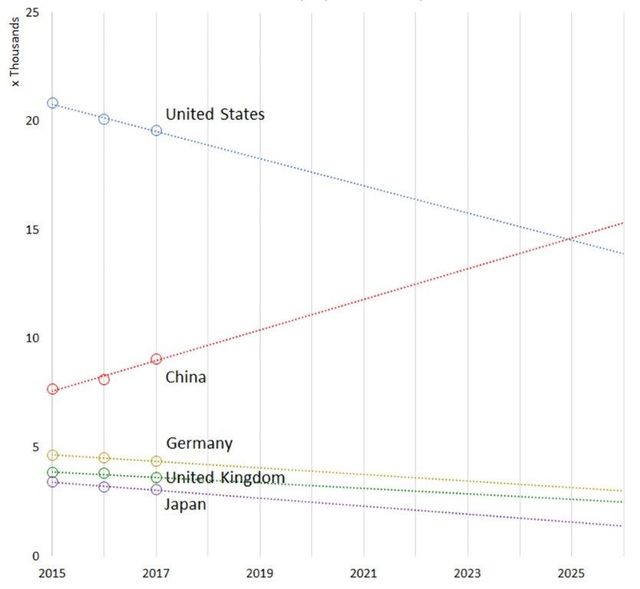
While facing huge hurdles overcoming US-led opposition to it “climbing the technology ladder,” China has invested enormous sums trying to do so. Last year the National Science Board of the United States stated that China was poised to overpass the US in R&D spending by the end of the year. China has increased its spending an average of 18 percent per year between 2005 and 2015.
China is training large numbers of scientists and engineers. A National Science Board report found, “Between 2000 and 2014, the number of S&E bachelor’s degrees awarded in China rose more than 360 percent to 1.7 million. The US had more moderate growth (54 percent) over the same period.” Likewise, it showed that peer-reviewed science and engineering articles rose 8 percent every year between 2006 and 2016, while the US had an annual increase of just 1 percent.
The relationship between these quantitative indicators of technical growth and actual achievement is complex. China, for example, has surged in the number of patents that it files—surpassing the United States several years ago. However, US patents were about two times more likely to be accepted than Chinese patents, according to a report from the St. Louis Federal Reserve. Other measures, such as the Nature Index, which measures country-by-country contribution to the leading science journals, shows an unmistakable trend: a substantial development of the scientific output of Chinese universities.
Contributions to Top Scientific Journals by top five countries, source: Nature
In this context, the Trump administration has sought to restrict Chinese students entering the United States. Since last June the State Department has restricted visas for Chinese graduate students in sensitive areas of research—changing them from five-year to one-year visas, with increased scrutiny for acceptance.
The Trump administration’s focus on “Made in China 2025” is also bound up with US preparations for war. Beginning with the Obama administration’s “pivot to Asia,” and accelerated under Trump, the US has been engaged in a huge military build-up and strengthening of alliances and basing arrangements throughout the Indo-Pacific against China.
The US is determined to maintain its technical edge in military hardware and warfare systems by undermining China’s own technological development including through its “Made in China 2025,” a crackdown on China’s alleged intellectual property theft, and restrictions on Chinese citizens, including students, in the United States.
FBI director Christopher Wray bluntly told the US Senate last year, “One of the things we’re trying to do is view the China threat as not just a whole-of-government threat, but a whole-of-society threat on their end. And I think it’s going to take a whole-of-society response by us.”
As in the 1930s, trade war and other forms of economic rivalry and conflict are intimately bound up with the drive to war—in this case between nuclear armed powers. The intense hostility in Washington to “Made in China 2025” is another indication of the advanced character of the war preparations currently underway.

Canada ramps up anti-China campaign as US threatens action against Huawei

Roger Jordan 

Canada’s Liberal government and corporate media have ratcheted up their denunciations of China ahead of next week’s World Economic Forum in Davos, Switzerland. Launched with the arrest December 1 by Canadian authorities of Meng Wanzhou, the chief financial officer of Huawei, China’s largest technology firm, the campaign is aimed at bringing the Canadian ruling elite fully into line with US imperialism’s aggressive course of confronting Beijing, both economically and militarily.
On Thursday, Foreign Minister Chrystia Freeland declared that the Canadian delegation to Davos would raise the issue of two Canadians in Chinese custody with other attendees and appeal for them to speak out publicly against Beijing. Her reference is to former diplomat Michael Kovrig and businessman Michael Spavor, who were detained in China in the days following Meng’s arrest and accused of endangering national security.
A third Canadian, Robert Schellenberg, who was recently sentenced to 15 years in prison on a drug conviction, had his sentence hastily increased to the death penalty last Monday in what the Canadian government says is further retaliation for Meng’s arrest. Both Prime Minister Justin Trudeau and Freeland have issued statements appealing for clemency for Schellenberg, with prime minister denouncing the application of the death penalty as “arbitrary.”
Freeland boasted that Canada has already secured public statements denouncing China from the United States, Britain, the European Union, France and Germany, among others. For its part, China attacked Canada for internationalizing the issue of the three detained Canadians and demanded that Ottawa respect the sovereignty of China’s courts.
Meng’s arrest, coming the same day as US President Donald Trump met Chinese President Xi Jinping on the sidelines of the G-20 summit to negotiate a solution to the US-China trade conflict, was unprecedented in its brazenness. Even former Liberal Deputy Prime Minister John Manley acknowledged that it may have been wiser to have quietly warned Meng not to fly through Canada so as to evade the US extradition. The Trump administration, which instigated Meng’s arrest, is calling for her extradition on trumped-up charges of bank fraud related to Washington’s illegal sanctions against Iran. If deported and convicted, Meng could face 30 years in prison.
The Canadian government feels it can act so provocatively because its demonization of China is part of a broader offensive against Beijing led by US imperialism. On Thursday, a report revealed that the US is considering charging Huawei with stealing trade secrets, in what would mark a major escalation of Washington’s conflict with Beijing. German officials also indicated that Berlin is considering banning Huawei from its 5G network.
These moves come in the context of the intensification of Trump’s drive to economically isolate China. Tariffs on $200 billion worth of Chinese imports have been imposed by Trump, as well as a ban on US government agencies doing business with Huawei over national security concerns. This has been accompanied by comments from supporters of Trump’s aggressive strategy calling for the US economy to “decouple” from trade with China, a policy that recalls the protectionism of the 1930s that played a major role in setting the stage for World War II.
The US ruling elite, supported by its Canadian ally, is determined to prevent China’s rise as an economic rival, which is calling US global hegemony into question. In doing so, Washington is not merely relying on economic means, but is more than ready to resort to all-out war. Last October, Vice President Mike Pence delivered a bellicose speech in which he railed against Chinese expansion and vowed that the US was preparing for a direct military conflict with China—a conflict which would be fought with nuclear weapons.
Having served as US imperialism’s closest military-strategic partner for over seven decades, Canadian imperialism is playing a key role in this aggressive agenda. It has been intimately involved in US military operations in the Asia-Pacific since the Obama administration’s “pivot” to Asia. This includes a secret agreement with the US military on the joint management of resources, and the deployment of Canadian ships and personnel to the highly volatile South China Sea and Korean Peninsula. In 2017, the Liberal government also identified China as a “global threat” in its new defence policy.
However, factions of the US and Canadian establishments, led by the military-intelligence chiefs and the corporate media, remain dissatisfied with Canada’s supposed failure to go far enough in confronting Beijing. Underscoring the bipartisan character of the anti-China campaign in the US, Senator Mark Warner, vice chairman of the Senate Intelligence Committee, and Republican Senator Marco Rubio have both warned Canada that its failure to ban Huawei from its 5G network as the US, Australia and New Zealand have done would result in a downgrading of intelligence sharing between Washington and Ottawa.
Ward Elcock, former director of the Canadian Security Intelligence Service, the country’s primary spy agency, told the Globe and Mail Thursday that such threats from the US must be taken seriously. The same Globe article noted that assistant director of intelligence at CSIS, Michael Peirce, issued a warning to Canada’s research universities last October about doing business with Huawei.
For some, even banning Huawei, which would cost Canadian telecommunications providers hundreds of millions of dollars to replace Huawei-made equipment, wouldn’t go far enough. Writing in the Toronto Star, business columnist David Olive urged the Trudeau government to break off diplomatic ties with Beijing over their detention of Kovrig and Spavor. “China needs to know in forceful ways that its continued brutal treatment of Canadians will come at a heavy price,” Olive wrote. “This is a time for severing diplomatic relations with China. It’s also appropriate for Ottawa to revoke its approval of the $40-billion LNG Canada mega-project in B.C. unless state-owned PetroChina relinquishes its stake in the consortium.”
In the neoconservative National Post, Kelly McParland attacked China for its “boorish, threatening and ill-tempered” behaviour.
The bourgeois press has further inflamed the dispute between Canada and China since Meng’s arrest. Both the National Post and the Globe explicitly welcomed her detention as an opportunity to shift public opinion on Canada’s policy to China. Although important sections of the ruling elite have been pushing for some time for a free trade agreement with Beijing to open up new markets for Canadian energy and raw material exports, the past several months have demonstrated that the overwhelming majority of the establishment stands full square behind Washington’s provocative anti-China drive.
Incapable of appealing to the international working class to oppose the imperialist onslaught against China, the regime in Beijing, which represents the interests of a wealthy capitalist oligarchy, has reacted by whipping up reactionary nationalism. At a press conference Thursday, Chinese ambassador to Canada Lu Shaye vowed that Beijing would retaliate against Canada if it bans Huawei. “I hope Canadian officials and relevant authorities and bodies will make a wise decision on this issue,” said Lu. “But if the Canadian government does ban Huawei from participating in the 5G networks, I believe there will be repercussions.”
Responding to the Trudeau government’s call for the release of the arrested Canadians, Lu denounced Canada for “white supremacy” and “Western egotism.” Beijing also issued a travel warning for Chinese visitors to Canada.

Tesla, Nissan announce mass layoffs, Fiat Chrysler jobs threatened

Marcus Day 

Signaling an expansion of the global onslaught on jobs, automakers Tesla, Inc. and Nissan Motor Co. announced plans for layoffs in the United States on Thursday and Friday. Altogether, nearly 4,000 workers' jobs are on the chopping block at the two companies.
The job cuts come as part of a wave of planned sackings and cost cuts throughout the industry. The auto giants are seeking to terrorize an increasingly insurgent workforce into submission, as the companies confront slumping sales, a looming economic crisis, significant financial pressure from rising commodity prices and the impact of escalating trade wars, and the ever-present pressure by Wall Street and the big banks to reduce costs.
Nissan, based in Japan and the world’s sixth-largest automaker, has been plagued in recent months by the scandal surrounding the arrest of its former chairman, Carlos Ghosn, based on allegations of unreported earnings. Behind Ghosn’s arrest, maneuvers and conflicts are taking place among the company’s directors over a possible merger with Renault, one of Nissan’s two partners.
The cuts announced by the company Thursday will reportedly target nearly 700 contract workers at its Canton, Mississippi, assembly plant. Nissan will eliminate one shift each involved in the production of vans and pickup trucks. The job reductions in Mississippi come less than a month after Nissan stated that it would lay off some 1,000 workers at plants in Aguascalientes and Morelos in Mexico.
Tesla, the California-based electric vehicle manufacturer, revealed Friday that it plans to cut its workforce by seven percent, or approximately 3,150 jobs according to industry analysts' estimates.
Tesla has struggled to meet production targets of its “low-cost” Model 3 sedan over the past year, and shares dropped 13 percent on the announcement. The company has also revealed its intentions to drop prices slightly on its entry-level car, in an effort to offset the phasing out of consumer tax credits.
CEO Elon Musk, in the email announcing the cuts, alluded ominously to the speed-up, which will face the remaining workers, who are already under enormous and nearly intolerable pressure.
“Tesla will need to make these cuts while increasing the Model 3 production rate and making many manufacturing engineering improvements in the coming months,” he wrote, adding, “There isn’t any other way.”
In the face of mounting attacks autoworkers, long suppressed by the pro-company unions, are moving into open rebellion, as demonstrated by the ongoing wildcat strike wave by tens of thousands of maquiladora workers just across the US border in Matamoros, Mexico. Opposition is developing among the working class internationally, with spontaneous walkouts and job actions occurring recently at General Motors’ Oshawa, Ontario assembly plant and at the nearby parts supplier Inteva.
In November, General Motors fired the opening shot in the latest jobs massacre when it announced plans to idle four factories in the United States, one in Canada, and two as-yet unnamed plants overseas, wiping out approximately 15,000 jobs. The announcement followed GM’s closure of its assembly plant in Gunsan, South Korea, last May, laying off thousands. Industry analysts have indicated in recent weeks that a number of GM engine and engine component plants may soon also face cuts, such as plants in Romulus and Flint, Michigan.
Last week, Ford announced plans to shutter plants and slash thousands of positions at its operations in Europe, as part of a $14 billion dollar cost-cutting plan. In addition, the company earlier indicated plans to significantly reduce its global salaried workforce, and is cutting shifts at its US operations.
On Tuesday, Ford also revealed the first stages of its long-signaled intentions to form an alliance with Germany’s Volkswagen, in a move that bodes even more sackings and plant consolidations.
The same day Ford announced its plans for reductions in Europe, Jaguar Land Rover, the United Kingdom’s largest automaker, confirmed its previously indicated aim to slash some 4,500 jobs.
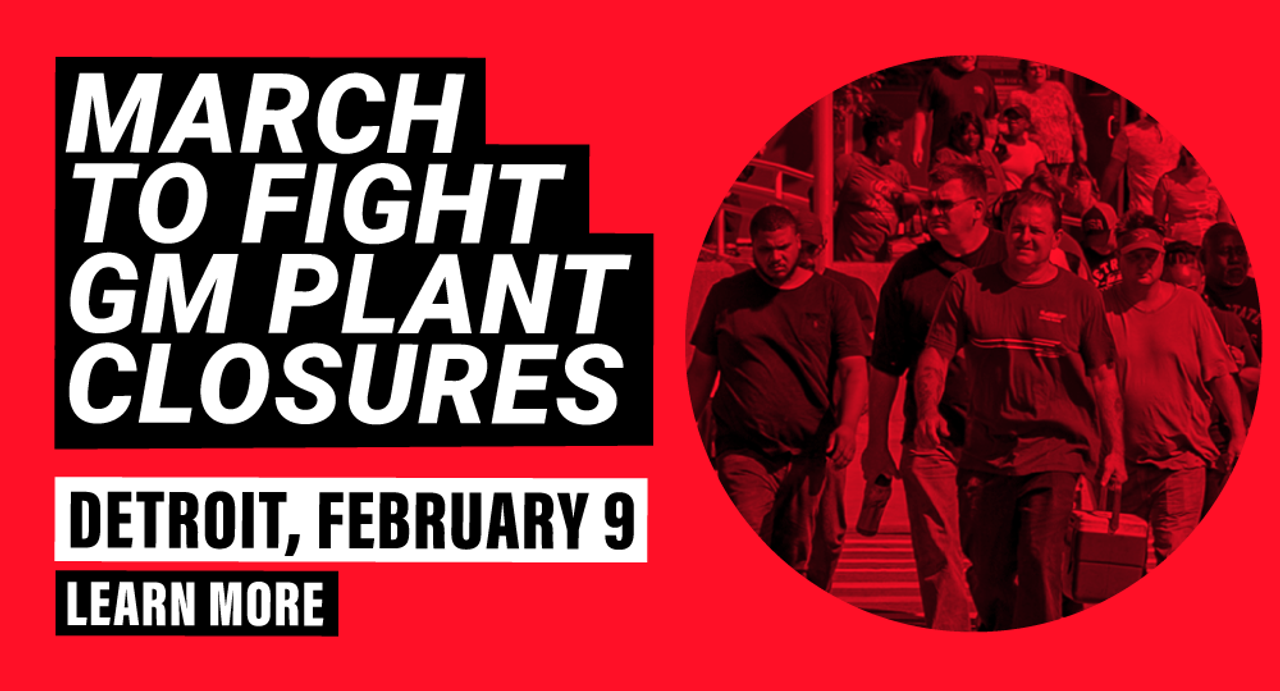
The global character of the attack on jobs underscore the importance of the February 9 demonstration against layoffs and concessions at General Motors’ headquarters in Detroit. The action has been called by the Steering Committee for the Coalition for Rank-and-File Committees in order to launch a counter-offensive by workers to reverse decades of attacks on their living standards.
Fiat Chrysler, the smallest of the Detroit Three automakers, has yet to indicate mass layoffs on the order of GM and Ford, having drastically reduced its US footprint and ending car production following the 2009 bailout and bankruptcy restructuring. However, it faces enormous pressures to cut costs in the wake of the imposition of $800 million in fines and other charges to settle lawsuits relating to the rigging of diesel emissions tests.
Autoworkers at the company’s Belvidere Assembly Plant, just outside Rockford in northern Illinois, have contacted the World Socialist Web Site Autoworker Newsletter to report the layoff of an entire shift is imminent.
“We are up in the air right now about C shift going away,” said Steve, a C shift worker at the plant. “We are in limbo and only building like 400 cars per shift and when the number is met they are short shifting.”
“I know FCA is holding out and going to pit plants against each other for future product and seek more concessions because it is a contract year. Our local union knows this and they usually concede to the company.”
“There are a lot of pissed off workers here about the collusion between the UAW and Big Three,” he continued, referring to the corruption scandal in which the UAW was shown to have taken millions in bribes from the company. “They told us recently when taking suggestions for future contract negotiations that we cannot submit anything about pay. But a majority want COLA back and no more tiers.”
Roughly 5,000 work at the plant, producing the Jeep Cherokee. The layoff of an entire shift, over 1,500 workers, in the economically depressed Rockford area would pose catastrophic consequences for workers and their families.
John, another worker on C shift, said, “Employees will be displaced, all while sales are up, profits are up, but yet they tell us it’s because of slumping sales…Right now, we’re not sure when this is supposed to take place, but we’re hearing sometime in March.”
“The workers get screwed so the CEOs and their shareholders stay profitable,” Steve continued. “That’s the corporate oligarchy we live under.”
“All I can say is it won’t work in the end... Oligarchs will lose!”
Referring to the yellow vest protests by workers against inequality in France, he said, “I believe we need a massive global movement/protest to turn the tide. [I’m hoping that] the government shutdown along with all the other protests going on would start our own massive yellow vest movement across the country.”
Whether at Fiat Chrysler, GM, Ford, Nissan, or the many parts and supplier companies, workers must reject the demand that they suffer the continued destruction of their jobs and livelihoods.
Workers should look to the courageous example of those striking at the maquiladora sweatshops in Matamoros, Mexico, where workers are rejecting the despised and corrupt unions and are in the initial stages of forming their own organizations.
Across the auto and auto parts plants throughout North America, workers should organize meetings and act to elect and organize rank-and-file factory committees, independent of the unions, linking their struggle with striking Los Angeles teachers and government workers as well as reaching out across borders to their brothers and sisters in other countries.
Above all, workers must recognize they are in a struggle against not just one or another greedy corporation; they are locked in conflict with the entire capitalist system and the political parties and organizations which defend it. In order to secure the needs of the working class, a new political strategy is needed, i.e., socialism, which means the fight for social equality, not the profit interest of the corporations and super-rich.

Science and social crisis in 2019

Bryan Dyne

In the opening days of the new year, a series of major scientific breakthroughs have demonstrated humanity’s immense capacity for understanding the world and using this knowledge to solve the many social ills plaguing modern life:
• On January 1, NASA’s New Horizons spacecraft flew past the Kuiper Belt object Ultima Thule. It was the second astronomical body observed by New Horizons, after Pluto, and the most distant asteroid ever observed by a robotic explorer launched from Earth. The data sent back by the probe, through the combined efforts of an international team of hundreds of scientists and engineers, has already begun to inform the research describing the early history of our Solar System.
• On January 3, the China National Space Administration (CNSA) lunar exploration mission Chang’e 4 achieved the first soft landing on the far side of the Moon and successfully deployed its rover Yutu-2. The scientific payloads were developed and are operated in tandem with researchers in China, Germany, the Netherlands, Saudi Arabia and Sweden. It sent back the first closeup images of the less explored half of the Moon via a relay satellite positioned so as to be able to communicate with Earth and the lander simultaneously. Both New Horizons and Chang’e 4 are among the dozens of spacecraft, landers and rovers that are currently studying the Earth, Sun, Moon, Mars, Venus, Jupiter, asteroids, comets and even the regions immediately outside our Solar System.
• On January 4, plant scientists from the United States Department of Agriculture and the University of Illinois showed that it is possible to make genetically engineered plants that fix a “glitch” in photosynthesis. This flaw sometimes causes plants to produce toxins within themselves that must be expunged. Crops grown without this flaw could improve their productivity by 40 percent, which has the potential to help mitigate climate change and abolish world hunger.
• On January 14, scientists operating Chang’e 4 announced the successful germination of food and clothing crops on the Moon, under the very low gravity of that body and after being bathed in solar radiation. Cotton, potato and rapeseed were all grown inside a miniature, artificial self-sustaining environment that was launched as part of the spacecraft’s scientific payload. While the experiment has reportedly reached the end of its lifespan, it was a critical step towards establishing and maintaining human life on the Moon, Mars and beyond.
• Concurrently, machine learning and artificial intelligence are becoming more and more integrated with aspects of modern life, including medicine, transportation and manufacturing. Computer scientists are constantly exploring new ways to use this technology and they have encountered as yet no limits. Whole cities are steadily becoming powered by AI. Self-driving cars are on the verge of mass implementation.
Each of these advances demonstrates the potential to alleviate the need for backbreaking labor, to vastly reduce the time and human resources needed to build homes, schools and hospitals, to roboticize farming and transportation and to develop breakthroughs in medicine and human health. They are powerful rebukes to the incessant contemporary glorification of irrationalism, whether through the cultivation of backwardness and religious prejudice or the promotion of postmodernism and its rejection of objective truth. They stand as a mighty vindication of the materialist understanding of the world, that there are objective laws of nature and that humans can comprehend them and through practice based on that understanding, shape the world to improve human life.
These breakthroughs, on the other hand, contrast sharply with similar developments in society that have heralded 2019:
• The most recent data collected from UNICEF, the World Health Organization and the World Bank show that one in nine human beings, 815 million people, face malnourishment or hunger and 9.1 million people starve to death annually. These figures include 150 million children who are hungry and 3.1 million children who starve to death each year.
• There are currently 68.5 million people fleeing war, persecution and oppression. The UN estimates there are an additional 210 million people who have been displaced as a result of climate change.
• Fascist and extreme right ideologies are once again being promoted by the political establishments in every country. Far-right parties are part of the governments in Italy, Austria, Brazil, Poland, Hungary, Japan, Finland, Bulgaria, the Czech Republic, Slovakia, the Philippines and Greece. The Alternative for Germany (AfD) has been welcomed into German parliament committees and their policies on refugees and internal security have been adopted by the German state. In France, President Macron has openly praised the country’s World War II-era fascist dictator Marshal Philippe Petain.
• Thousands of scientists at NASA, NOAA, the NSF, the USDA and the National Institutes of Health are currently furloughed as a result of the government shutdown. Dozens of long term experiments that are critical to monitoring Earth’s climate, agriculture and public health are being increasingly disrupted. This disaster for scientific research comes as both Democrats and Republicans agree that the latest developments in modern technology, including drones and sensors, should be deployed against desperate refugees fleeing US-backed oppression and poverty in Central America.
These are only some of the contradictions of life in the 21st century. Even as technology is used to probe deep space, develop higher forms of global coordination and unlock the potential of key biological processes, it is being used to increase militarization, censorship and oppression at home and abroad. Every advance made in space exploration is intertwined with increased militarization internationally and the growing threat of world war. For every rocket that is aimed to study the cosmos, many more are developed and built to destroy either a part or the whole of humanity. Crop science is not used to feed the tens of millions of starving humans on six continents but to increase the profits and market dominance of a few agriculture conglomerates and to develop biological and chemical warfare. Science under capitalism is used to increase, not decrease, social inequality.
Artificial intelligence plays a particularly sinister role. It is being increasingly used by companies such as Amazon, Uber and Lyft to track every move employees make and force them to work longer and harder. Tens of thousands of jobs will be eliminated as automation becomes more and more commonplace. And it has been deployed on a mass scale by Google, Facebook and other tech companies in conjunction with US military and intelligence agencies to impose censorship on left-wing, anti-capitalist and socialist publications, track down immigrants with facial recognition, spy on virtually every human being and make war against the world’s population on an ever increasing scale.
Both factions of the US ruling elite are at war with science. Trump and the Republicans deny climate change and openly promote religious obscurantism. Official liberalism and academia are in thrall to the postmodernists who reject any conception of objective truth and the application of science to human thought, society, and culture, denying in particular the revolutionary role of the working class.
In contrast, Marxists insist that science can and must be applied to society itself, above all, to the socio-economic structures in which humanity is currently trapped. This means cutting through the ideological domination of the corporate elite, and studying the unfolding events from the standpoint of the class forces at work. This means taking up a study of Marxism, which bases its revolutionary politics on an analysis of objective reality and class interests, and it means a turn toward the working class, the only progressive, revolutionary and international social force on the planet.
The working class offers humanity an alternative to the war, poverty, and social misery that are endemic to capitalism. It is noteworthy that, in the ongoing Los Angeles Teachers strike, educators are demanding not only better pay and smaller class sizes, but the defense of public education from a capitalist oligarchy intent on gutting it. While the ruling elite is set on dragging society backwards, the working class, in the struggle for socialism, offers it a way forward.
Only in a socialist society can the vast scientific and technological achievements of mankind be transformed from cudgels for enforcing class exploitation and fighting war, to the instruments of securing a prosperous and fulfilling life for all people.

18 Jan 2019

German International Parliamentary Scholarship Program 2019 for Young Leaders in North Africa

Application Deadline: 31st January 2019

To be taken at (country): Berlin, Germany

About the Award: The German Bundestag invites you to spend four weeks in Berlin in September 2018. The programme is intended for talented Arab people who are interested in politics and who are keen to play an active role in promoting core democratic values in their home countries. The German Bundestag is offering you the opportunity to get to know the German parliamentary system during an intensive programme.

In light of the Bundestag elections taking place in 2018, you will have the opportunity during a one-week internship in a Member’s constituency to experience the work carried out there and to come into contact with political decision-makers. Successful candidates will be chosen by the German Bundestag’s independent selection panel.

Type: Training, Conference

Eligibility: 
  • Citizenship of an eligible country
  • Under the age of 35 at the start of the scholarship
  • University degree
  • Very good knowledge of German
  • An interest in politics, and social/political commitment
Number of Awardees: Not specified

Value of Scholarship: Participants will receive a monthly scholarship of 500 euros. In addition, accommodation in an apartment complex will be provided free of charge, and the costs of travel to and from Berlin will be covered, as well as the costs of health, accident and personal liability insurance

How to Apply: Interested candidates should go through the application requirements on the Scholarship Webpage (see Link below) before applying.
Send your completed application documents by email as a PDF-file to the German mission in your home country; the PDF-file name should consist of your surname, followed by your given name (i.e. “surname-first name”).

Visit Scholarship Webpage for details

East Africa Digital Rights and Online Freedom of Expression Litigation Surgery 2019 for Lawyers in East Africa

Application Deadline: 7th February 2019

Eligible Countries: Burundi, Ethiopia, Kenya, Rwanda, Tanzania and Uganda

To be taken at (country): Kampala, Uganda

About the Award: MLDI provides legal support to journalists, bloggers and independent media. In recent years, MLDI has supported a significant number of cases involving online media. These have included challenging social media blocking and internet shutdowns, contesting cybercrimes legislation, ‘false news’ laws and intermediary liability, as well as calling for greater protections for online privacy and protection of journalistic sources.
Specifically, the objectives of the litigation surgery training are:
  • To equip participants with the skills and knowledge to litigate using national and international laws as well as regional and international mechanisms relevant to freedom of expression online;
  • To build a digital rights network and help facilitate its engagement with international legal mechanisms and global civil society initiatives; and  
  • To assist and develop working relationships between lawyers undertaking such cases.
Type: Training

Eligibility: Participants will be selected on the following criteria:
  • The surgery is open to lawyers who work and reside in Burundi, Ethiopia, Kenya, Rwanda, Tanzania and Uganda;
  • Applicants can either be working in private practice or be working for or be affiliated with NGOs promoting the right to freedom of expression in East Africa through litigation. Exceptionally strong applications will be considered from lawyers who have not yet undertaken freedom of expression work, but have experience litigating other human rights cases and have a strong interest in undertaking freedom of expression work;
  • Applicants must be proficient in English;
  • Applicants must have a demonstrated interest in and/or knowledge of the right to online freedom of expression, digital rights, internet freedom and/or related issues;
  • The lawyers must have a demonstrated interest in and/or knowledge of international and regional human rights law;
  • As part of the application, interested lawyers are asked to submit a case study of a case which they are either litigating or intend to litigate and that could be discussed during the litigation surgery. For participants who do not have a case that is pending it will suffice to have identified a relevant law, practice or policy relating to online freedom of expression that they would like to challenge in court. However, such participants must demonstrate their ability and willingness to pursue the case after the surgery;
  • The cases submitted must involve a violation of the fundamental right to freedom of expression online;
  • The following non-exhaustive list of themes are a guide for the type of cases that could be submitted with the application: 
    • Cybercrime laws;
    • Intermediary liability;
    • Internet shutdowns;
    • Restriction of online media;
    • Online privacy;
    • National security; and
    • Anonymity online.
MDLI is committed to advancing equality and diversity; and will therefore consider gender, age, and country of origin in the selection of participants.

Number of Awards: A maximum of 12 participants will attend the training. 

Value of Award: MLDI will cover airfare, accommodation, travel expenses and a modest per diem.  

Duration of Programme: 8 – 12 April 2019

How to Apply: 
  • It is important to go through all application requirements on the Programme Webpage see link below) before applying
Visit Programme Webpage for Details

West African Research Association (WARA) Travel Grants 2019 for African Scholars

Application Deadlines: 15th March 2019

Eligible Countries: West African countries

To be taken at (country): Any African country of candidate’s choice.

About the Award: The WARC Travel Grant program promotes intra-African cooperation and exchange among researchers and institutions by providing support to African scholars and graduate students for research visits to other institutions on the continent

Type: Research Grants

Eligibility: This competition is open only to West African nationals, with preference given to those affiliated with West African colleges, universities, or research institutions.

Number of Awardees: Not specified

Value of Grants: The WARC Travel Grant provides travel costs up to $1,500 and a stipend of $1,500. Travel grant funds may be used to:
  1. attend and present papers at academic conferences relevant to the applicant’s field of research;
  2. visit libraries or archives that contain resources necessary to the applicant’s current academic work;
  3. engage in collaborative work with colleagues at another institution;
  4. travel to a research site.
Duration of Grants:  Between December 1, 2018 and June 30, 2019 for the 15th Sept 2018 deadline

How to Apply: All applications must be submitted online here
It is important to go through Application requirements before applying.

Visit Grants Webpage for details

Award Provider: Funding for WARA’s Fellowship Program is provided by the Bureau of Educational and Cultural Affairs of the US Department of State through a grant from the Council of American Overseas Research Centers.

A Global Battle of Values and Ideals

Graham Peebles

With each day that passes the conflict and animosity between the conservative reactionary forces and the global movement for progressive change becomes more acute, uglier and increasingly dangerous; wherever one looks in the world the battleground between groups on either side of the divide rages. In essence it is a battle of values and ideas, of what kind of society we want to live in, but as the extremes, particularly those on what is commonly called the ‘right’, assert themselves, the space for rational, open debate is being crushed and a febrile intolerant atmosphere fueled.
Decades of systemic failure, environmental vandalism and social injustice have caused widespread discontent and anger among people in many countries, injustice made more severe by policies of crippling austerity following the 2008 banking crash. Among the 38 members of the wealthy OECD nations it is said that 50% of the population feel disenchanted with the political-economic system.
Consistent with the times we are living in – times in which the forces of the past are receding and the energies of the new are increasing in potency, the reaction to such discontent has been polarized. While large numbers of people recognize systemic change is needed and are calling for greater levels of cooperation between people and nations, others, in many cases equally great in numbers, blame external forces and immigration, and retreat into a narrow form of nationalism, seeking security.
Antagonisms have been enflamed by politicians who either fail to understand the impact of their poisonous rhetoric or simply don’t care what effect they have. The resulting political divisions are acute and, in many cases, compromise between groups on either side of the debate appears impossible as, for example, the government shut down in America and the Brexit deadlock demonstrate. Brexit has become the burning issue of conflict in the UK, fueling fractious, volatile political debate and entrenched national divisions. As one pro-EU protestor told The Observer, “this is civil war without the muskets…it is appalling.”
Throughout Europe and America a huge increase in hate crimes against immigrants and other groups is one of the consequences of these tensions, as is distrust of the mainstream media and the abuse of MPs, particularly of women: a report (surveying 55 female MPs from 39 countries) from the Inter-Parliamentary Union reveals that 44.4% of all women elected to office have received threats of either “death, rape, beatings and/or abductions.” In Britain, the BBC relates that, “Labour MP Jess Phillips said in one night she received 600 rape threats and was threatened with violence and aggression every day.” Other female members of parliament in the UK, especially those from Black, Asian and Minority Ethnic groups, have consistently been the victims of such disturbing attacks, and on the 7th January online abuse spilled on to the streets when MP Anna Soubry, a pro-Europe member of the Conservative party, was verbally attacked and physically intimidated by a group of far right activists who support the UK leaving the European Union. The men surrounded her outside the House of Commons, called her a ‘Fascist’ and a ‘Nazi’, and blocked her way as she tried to enter Parliament; these men are “not protestors” said Soubry, “they are thugs.” And, as the murder of the MP Jo Cox on 16th June 2016 so tragically showed, in the hands of such people, vile words can easily become violent actions.
Such intolerance and hate flows from fear and ignorance, both of which are constantly agitated by misinformation. People increasingly live in like-minded bubbles, their views – no matter how extreme – are constantly reinforced by what they choose to read and watch and who they listen to; alternative positions remain unheard, balance denied. As one right-wing protestor, who supports a plethora of conspiracy theories, told the Observer, “I find news the way I need to find it…if I can get it from a family member then that’s it…The country should prepare for riots,” he says. “They can’t expect the people to be law-abiding citizens when government is as corrupt as it is. All them people in here [inside Parliament] are getting paid backhanders all the way through the system.”
This level of suspicion makes discussion, cooperation and compromise impossible, divisions inevitable, leading potentially to conflict. Walls are erected, some constructed from steel or concrete, others, perhaps even more dangerous, made up of prejudice and distrust. Both strengthen isolation and deepen divisions, nationally and globally, which makes dealing with any type of global crisis, e.g. a pandemic or economic crash, a greater risk than would otherwise be the case.
The polarization of politics and large numbers of the public has come about as a result of the enormous resistance to fundamental change that has been consistently shown by weak politicians of all colors; this inability to respond to the demands of the times has created great uncertainty. The longer change is resisted, and the ways of the past are perpetuated, the more intense the divisions and insecurities will become.
It is the conservative-leaning political parties, institutions and corporations of the world that are most firmly attached to the existing systems and modes of living. And despite the fact that the prevailing socio-economic order has fueled unprecedented levels of inequality, concentrated wealth and power in the hands of a tiny percentage of the population and trapped working class people in economic uncertainty and in many cases poverty, it is this very demographic that is energizing the reactionary groups that are working to maintain the status-quo.
The toxic movement towards isolation, intolerance and division is a crystallized fearful response to the unstoppable current of change that is sweeping the world, and the determination by those who have benefited from the current systems to resist change at all costs.
Every age has its own specific qualities; the last two thousand years or so have seen the emergence of individuality on a mass scale, of which tribal nationalism is an extreme and negative form of expression. Individuality is a most valuable and positive quality, but when, as is often the case, it is expressed as selfishness, and self-centered activity it becomes destructive. In order to breach the prevailing divisions and overcome the various crises facing humanity the strengths of the individual, the diversity and beauty of people and nations needs to be placed at the service of the wider community, and not simply used for the benefit of the individual or the particular country.
Building on from the achievement of mass individuality the key ideals of the time and the age that stretches before us are unity, cooperation and tolerance; such qualities necessitate and encourage a shift away from a narrow ‘me first’ approach to living to an awareness and responsibility for society more broadly and the natural world. Sharing is the essential element in the manifestation of such Principles of Goodness, through its expression trust is cultivated, and where trust exists barriers break down.