25 Jan 2019

Reports indicate Haitian government involvement in La Saline massacre

John Marion 

The La Saline massacre, which occurred in Haiti on November 13, rivals the crimes of the Duvalier dictatorship and of the military regimes that seized power after Duvalier fell. Fifty-nine people, including children as young as three years old, were murdered in La Saline in a premeditated slaughter. Only the Jean-Rabel massacre, perpetrated in 1987 by the regime of Henri Namphy with support from tontons macoutes, has involved more deaths.
La Saline is a poor neighborhood in Port-au-Prince, described by PBS as a place where people “cook over open fires in alleyways so narrow that two people can’t pass without touching shoulders.” The Saint Jean Bosco church of Jean-Bertrand Aristide was in La Saline, and recent protests against government corruption have found support there. It is located on the other side of a canal from the former Fort Dimanche prison, where the Duvaliers tortured and murdered thousands of people.
La Saline also houses a commercial port with three terminals, and the Croix-des-Bossales market that sells produce from the country to restaurants, wholesalers and supermarkets. Early press reports blamed the killings on gangs fighting over control of the market.
The National Network for the Defense of Human Rights (RNDDH) has conducted a thorough investigation of the massacre, including interviews with survivors, family members, hundreds of La Saline residents, judicial and police figures, and a parliamentary deputy. The resulting report describes how for years the government has made use of the armed gangs, about whose murders and extortion it is fully aware, to subdue the population. People interviewed accuse government figures of supplying arms and money to the gangs.
The report describes how, in October 2017, a commission including the minister of the interior, the minister of public health, and the wife of President Jovenel Moïse, visited La Saline to promise the rebuilding of one school, the creation of another, and the renovation of a public health facility. In return, they demanded that residents keep protesters from marching through the neighborhood. The residents refused.
One year later, the protests of October 2018 made use of the neighborhood as a meeting place.
The RNDDH names several government figures accused of direct involvement in the November 13 massacre. Fednel Monchery, director general of the Ministry of the Interior, is accused of having participated in the planning and of having furnished arms and vehicles.
Joseph Pierre Richard Duplan, former mayor of Port-au-Prince, is accused of having supplied arms and uniforms. Some perpetrators of the massacre were wearing Haitian National Police (PNH) uniforms. Separately, Duplan has been questioned in the disappearance of news photographer Vladjimir Legagneur 11 months ago.
Police agent Gregory Antoine is accused of having participated directly in the massacre, fighting alongside the Base Nan Chabon gang. Police agent Jimmy Cherizier is accused of having participated directly and of having hosted the meeting at which the massacre was planned.
A lawsuit filed by 13 residents of La Saline in December seeks to determine whether the president, the prime minister, the minister of justice, the minister of the interior, and the director general of the PNH were involved, according to Le Nouvelliste. The 13 people bringing the suit represent a group of more than 50, most of whom remained anonymous out of fear for their safety.
The 59 murders were gruesome: People were dragged out of homes and executed point blank; others were chopped to death with machetes; children were shot in their homes; bodies were burned, chopped into pieces, left in heaps of garbage, and fed to pigs. Women were raped.
The RNDDH was able to identify 45 of the 59 dead and includes details of their murders in its report. When it confronted the police and judiciary with its findings, they claimed ignorance. The police claimed not to know how many were killed, while the judicial authorities said they had “no precise information relating to the events.” The report also notes that, aside from the announcement by Prime Minister Jean Henry Ceant that he was opening an investigation, the government made no pronouncements in the first two weeks after the massacre.
The silence and evasion foreshadow future crimes. The government of Ceant and President Moïse is in deep crisis, and desperate. Moïse’s previous prime minister resigned after his attempts to cut fuel subsidies caused massive protests last July.
Haiti’s rate of inflation was more than 15 percent last year and its currency continues to drop against the dollar. A shortage of gasoline and diesel is developing because of the government’s inability to pay the company that has been importing them from the US since Haiti’s participation in the PetroCaribe program. More protests against austerity and corruption are planned in February.
The big bourgeoisie has come out publicly against Moïse, with Reginald Boulos criticizing him for having voted against Venezuela’s membership in the Organization of American States and Dimitri Vorbe of Sogener telling the TV program “Haïti, sa k ap kwit” that “the state needs to be organized to create all the conditions needed to promote the functioning of businesses in Haiti, which would allow them to make money, but also to give it to the state (in taxes).”
On January 14, protests occurred in the commune of Lascahobas after months of electricity rationing. After the protesters blocked traffic with barricades, police from the Departmental Unit for the Maintenance of Order (UDMO) fired live ammunition, killing at least two. One of the victims was shot in the heart.
In December the offices of Radio Kiskeya, known for its political reporting since 1994, burned to the ground after a fire spread from the building next door. Liliane Pierre-Paul, one of its founders, had survived torture and exile by the Duvalier regime in the 1980s. In 2015, at a time when the station was critical of then-president Michel Martelly, an unidentified person fired shots at the station.
In the weeks following the fire, which destroyed not just the station but its archives as well, criticism of the government’s response was limited to the underfunding of firefighters, who took more than an hour to respond. However, Le Nouvelliste reported this week that Pierre-Paul and Director General Jean Marvell Dandin filed a lawsuit on January 18 demanding that the court investigate whether the fire was set. The suit also asks the judge to determine whether the firefighters were delayed deliberately by the government.

Brazilian Workers Party uses crime wave to back fascistic Bolsonaro on repression and austerity

Miguel Andrade

A wave of attacks on public infrastructure in Ceará, one of the poorest states in Brazil’s Northeast, has provided an opportunity for the self-styled “anti-fascist” opposition in the Workers Party (Partido dos Trabalhadores—PT)—which run’s Ceará’s state government—to collaborate with Brazil’s fascistic new president, Jair Bolsonaro.
The government has so far reported 235 attacks in 50 municipalities, mostly directed at police and mass transit, including the metro of the state capital, Fortaleza, but also extending to schools, garbage collection and energy transmission infrastructure.
The crime wave was reportedly initiated by a “tactical agreement” between the state’s largest drug trafficking gangs as a response to the nomination of a new head for the state’s prison system. Already entering its fourth week, it is only the latest episode in the protracted and tragic crisis of the country’s overcrowded and abusive prison system, true dungeons of a system of social apartheid in one of the world’s most unequal societies. Hundreds of inmates have been killed in numerous riots, many by the most horrific methods.
Brazilian prisons are filled to no less than 100 percent overcapacity. Forty percent of the 700,000 inmates—the world’s third largest prison population—have not even been sentenced, while fully 20 percent of those sentenced are in jail for simple theft and are eligible for alternative sentences judges never bother to apply.
The situation is even worse in Ceará, where overcrowding stands at 300 percent, and an even more staggering two-thirds of inmates have not been sentenced. Even so, the PT state governor announced at the end of 2018 he would nominate Luís Mauro Albuquerque Araújo, the former head of the prison system in neighboring Rio Grande do Norte state, for the same position in Ceará.
Araújo has been held responsible for institutionalizing state-sponsored torture in Rio Grande do Norte’s prisons in a 2018 report by the Justice Ministry’s Torture Prevention Committee. The panel compared his administration to that of the US-run Abu Ghraib prison in Iraq with regular humiliation of naked inmates, beatings, isolation and deprivation of family visits.
The dismal conditions of prisons is widely considered by experts as the single most influential factor in gang recruitment, since belonging to a gang is considered by inmates the best means of abuses ranging from theft of personal belongings to rape. “Christened” inmates are from then on required to obey the gangs after they are released, under the threat of torture and execution of family members by their own “chiefs.”
At the beginning of the crime wave, Governor Camilo Santana asked the Justice Ministry for the deployment of the National Guard, which was swiftly implemented amid reports of an increase in police abuse beginning to flood the state’s Human Rights Council. Reports vary from house-to-house searches and fabricated evidence to a doubling down of inmate abuse, with guards unleashing dogs on naked inmates. In perhaps the most serious abuse, security agents have been forcing suspects to declare belonging to gangs in widely shared whatsapp videos, a procedure considered by experts to be a death sentence, allowing for rival factions to come after the suspect on the streets or in prison.
The most lasting impact of the crime wave, however, is the Workers Party’s embrace of Bolsonaro’s proposal to extend the country’s anti-terrorism law to include “burning buses” and “damaging public buildings.” The move was formalized in a meeting between Santana and Bolsonaro’s right-wing justice minister, Sérgio Moro, on January 17 in which Santana asked for the federal government’s support. This followed an interview with Santana on CBN radio January 11, in which he suggested that “state autonomy” should be wider in defining terrorism—a matter currently in the hands of the federal government.
A longstanding demand of Brazil’s far-right, such an extension of the definition of terrorism is directed at the criminalization and repression of social opposition. It would vastly widen the reach of a draconian law approved under PT President Dilma Rousseff in 2016 using the pretext of the 2016 summer Olympics in Rio de Janeiro.
The 2016 anti-terror law characterizes as terrorism “sabotage with the goal of provoking social or generalized terror.” Defended by the PT as a “democratic” law that drew a distinction between actions carried out for the purpose of pressing demands and those aimed at “provoking generalized terror.” However, it left it to the security forces to determine which was which.
The right-wing shift in Brazilian politics beginning under the PT, with the 2013 mass anti-austerity and anti-World Cup protests against Rousseff, has already seen 23 demonstrators sentenced to an average of seven years imprisonment for “qualified damage” and “resistance,” based on 2013 and 2014 laws that pre-date the anti-terror legislation.
Other PT governors have also since early 2018 aped Bolsonaro’s far-right, repressive agenda, making “security issues” a central tenet of their electoral campaigns. Some of them have even discussed issues of controlling protest and surveillance with the Israeli ambassador to Brazil. Repressive “partnerships” with Israeli law enforcement and security companies are one of the central issues in Bolsonaro’s far-right rants. The PT’s Piauí state governor, Wellington Dias, is currently in Israel to discuss such issues, after his counterpart in the state of Bahia, PT Governor Rui Costa, did his own right-wing “pilgrimage” to Israel after reelection, in November 2018.
Meanwhile, some 20 congressmen from Bolsonaro’s Social Liberal Party (PSL) returned from a recent trip to China, paid for by the Chinese government, in which they were presented with a system of facial recognition to be installed in Rio de Janeiro’s streets and mass transit system, allegedly to fight crime. The trip was offered by the Chinese government as a “goodwill” gesture to deflect the anti-Chinese demagogy that characterized Bolsonaro’s election campaign.
For its part, Justice Minister Sérgio Moro left Ceará to meet his Argentine counterpart in Brasília to sign a new treaty expediting extraditions between the two countries, in order to avoid “what happened to Cesare Battisti,” who was subjected to a rendition operation with which the Bolivian, Italian and Brazilian governments illegally cooperated. As Moro considers that existing rights to challenge extradition were an obstacle to Battisti’s rendition, the new treaty can only mean Brazil and Argentina will work to legalize such methods.
Most importantly, the collaboration on “security issues” has been a central argument for meetings between PT governors and Bolsonaro’s candidate for speaker of the House, Rodrigo Maia, of the Democrats party (DEM), who is seeking reelection. The support for Maia, who was first elected as speaker in 2016 with crucial PT votes, has been posed by the PT and its allies as a defense of Congress’s “independence.”
After Maia left a meeting with PT congressmen and the Piauí governor Dias, the PT-aligned Brasil247 celebrated with a headline: “Maia defends pact with the PT and displeases Bolsonaro clan.” The meeting happened after the PT’s president, congressional representative Gleisi Hoffmann, feigned indignation over Bolsonaro’s support for Maia, saying that the party would not support him if Bolsonaro’s PSL did.
Maia will nonetheless have the official support of the Democratic Labor Party (PDT), which came in third in the October presidential vote and was courted by the PT with the offer of the vice-presidential position on its slate, and of the Maoist Communist Party of Brazil (PCdoB), which actually accepted a similar PT offer, running Manuela D’Ávila for vice president. It is clear that if Maia is reelected, it will be due to PT “defections.” The same must be expected on the crucial votes on the “pensions reform,” which PT governors already have declared “must be discussed” in a November 14 letter to Bolsonaro.
Another PT ally, Renan Calheiros of the Brazilian Democratic Movement party (MDB), who twice presided over the Senate under PT’s rule, is also seeking favor with Bolsonaro in order to be elected for a third term. Calheiros’ son was elected with PT support as governor of Alagoas state, also in the northeastern region. During his campaign, the PT’s presidential candidate Fernando Haddad declared at a rally: “I come here to bring the acknowledgment of Lula for your defense of him and your dignity.” Calheiros, however, saw no obstacle to jumping from Lula’s defense to that of Bolsonaro’s son, senator Flávio Bolsonaro, under pressure to resign over accusations of graft and of collaboration with death squads in his home state of Rio de Janeiro. On January 18, he described the younger Bolsonaro as “a boy with strong opinion and who defends them, who wants to do good.”
Just three weeks into Bolsonaro’s administration, the PT’s claims to offer a “democratic resistance,” let alone an alternative, are being thoroughly exposed. The same is true for all the pseudo-left currents, many of which posture as socialist or even “Trotskyist,” which not only called for a vote for the PT, but which are now covering up the party’s collaboration with Bolsonaro.
These include first and foremost the myriad Pabloite and Morenoite currents operating within the Socialism and Liberty Party (PSOL), the parliamentary split from the PT, but also the PT apologists within the Workers Cause Party (PCO), which claims that the collaboration with Bolsonaro is restricted to the “right wing” of the party, and that its “left” should be defended. Such a “left” includes jailed former president Lula—who hand-picked the right-wing, pro-austerity Fernando Haddad to substitute for him in the elections, Hoffmann, and the union bureaucrats who on December 18 recorded a video sent to Bolsonaro saying they were “sorry” for questioning his legitimacy and also offering to negotiate the “pension reform.”

Davos overshadowed by crisis and social upheaval

Nick Beams

This year’s gathering of the global elites at the World Economic Forum’s annual meeting in Davos, Switzerland, is perhaps best summed up in the phrase: The chickens are coming home to roost.
For almost five decades, the WEF has been at the centre of the promotion of the free market policies that have funnelled trillions of dollars into the hands of the world’s wealthiest individuals and led to the widening of social inequality to historically unprecedented levels—an institutionalised process that accelerated to new levels after the meltdown of 2008.
In January 2009, as the financial crisis was still unfolding, there was a widespread fear at the annual Davos meeting that the bonanza was about to end. But as concerns over an immediate social backlash receded somewhat and the vast accumulation of wealth on the heights of society continued, thanks to the massive injection of cheap money by the US Fed and other major central banks, it appeared that all was still for the best in the best of all possible worlds.
No longer. Social anger and the class struggle are intensifying around the world. As the Guardian columnist Aditya Chakrabortty commented, the Davos billionaire is now experiencing a new and unsettling emotion: fear. As they face a world order crumbling before them, the Davos plutocrats are “terrified” and “whatever dog-eared platitudes they may recycle for the TV cameras, what grips them is the havoc far below.”
Surrounding the Davos gathering, there were attempts to introduce a course correction. In a column produced for the meeting, Financial Times economics commentator Martin Wolf pointed to the responsibility of the global elites for the elevation of populist and authoritarian political leaderships and insisted that law-governed democracies had to be made to work better. “Davos people,” he concluded, “please note: this is your clear responsibility.”
The international charity Oxfam issued a report showing that 26 billionaires held as much wealth as the bottom 50 percent of the world’s population, some 3.8 billion, that wealth accumulation at the top was increasing at the rate of $2.5 billion per day and called or a new “human economy” to be financed through increased wealth taxes.
The “Davos people” gave their answer to this reform agenda when they handed the platform for the keynote address to the newly installed extreme right wing and fascistic president of Brazil, the former military commander, Jair Bolsonaro, after giving it to another right-wing authoritarian Donald Trump the previous year.
Bolsonaro’s remarks were music to their ears as he set out his agenda for a “new Brazil” by creating new market opportunities, lower taxes on business and a “much-needed overhaul” of the country’s pension system. And they would have been mindful that these measures come with a commitment for the suppression of the working class.
As the Davos summit opened, the WSWS noted that the present regime of the world capitalist order, dominated and controlled by the global billionaires and their financial markets, was as incapable of any reform as pre-1789 France or the pre-1917 czarist autocracy in Russia both of which responded to social opposition with increased repression. The red-carpet treatment for Bolsonaro sent a message to the working class the world over: this is how your demands will be met.
This year’s annual meeting was marked by the absence of a number of political leaders, itself an expression of the growing political disorder within bourgeois politics and the rising tide of class struggle. British Prime Minister Theresa May could not attend due to the turmoil over Brexit; US President Donald Trump withdrew himself and the rest of the planned American delegation because of the government shutdown; French President Emmanuel Macron stayed at home as he confronted continuing protests by the “yellow vest” movement.
The circumstances surrounding another absentee were also significant. On the eve of the meeting, Zimbabwe’s president, Emmerson Mnangagwa, decided he would skip Davos in order to direct the suppression of protests against his government’s doubling of fuel prices, which, according to reports, led to 12 deaths last weekend.
Hanging over the entire gathering was the worsening global economic outlook and the consequences of even a minor downturn under conditions of deepening trade conflicts, above all the US trade war against China, the palpable breakdown of long established political structures and the rising tide of social anger and class struggle.
In the lead up to the meeting, David Lipton, the deputy managing director of the International Monetary Fund issued a warning that “history suggests” an economic downturn “somewhere over the horizon.” But under conditions of deepening distrust in government institutions there was no guarantee that the regulatory regimes put in place after the finance crisis “will be sufficient to keep a ‘garden variety’ recession from becoming another full-blown systemic crisis.”
Another warning came in the form of a letter written by billionaire investor Seth Klarman, which, the New York Times reported, was passed around amid the Davos attendees. Its central focus was on the impact of rising class struggles
“It can’t be business as usual amid constant protests, riots, shutdown and escalating social tensions,” he wrote. Citing the “yellow vest” movement in France, he continued on this theme: “Social cohesion is essential for those who have capital to invest.”
Klarman is among those who are aware that the measures taken by financial authorities over the past decade to combat the effects of the financial crisis are contributing to the creation of a new one as debt levels rise.
“The seeds of the next major financial crisis … may well be found in today’s sovereign debt levels,” he wrote. “There is no way to know how much debt is too much, but America will inevitably reach an inflection point whereupon a suddenly a more skeptical market will refuse to continue to lend to us at rates we can afford.”
And such a crisis will have immediate political effects, as Klarman and others recognise. “It’s not hard to imagine worsening social unrest among a generation,” he wrote,” that is falling behind economically and feels betrayed by a massive national debt without any obvious benefit to them.”
But a social order in which, as Oxfam reports, 82 percent of all the wealth created in 2017 went to the top global 1 percent is organically incapable of responding to deepening opposition other than with repression, underscoring the analysis of the International Committee of the Fourth International that present political situation is above all characterised by revolution versus counter-revolution.

Indian teachers, government workers launch indefinite strike in Tamil Nadu

Deepal Jayasekera

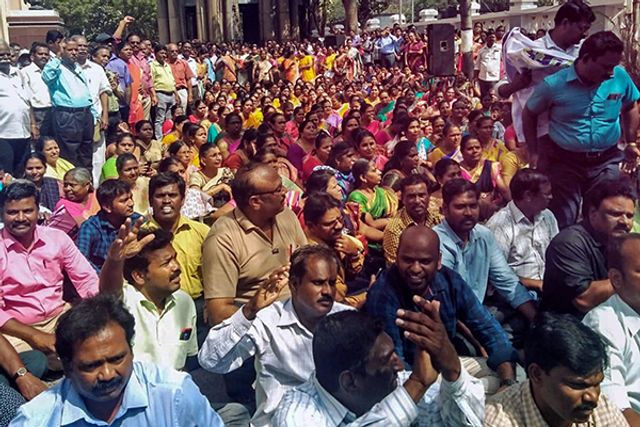
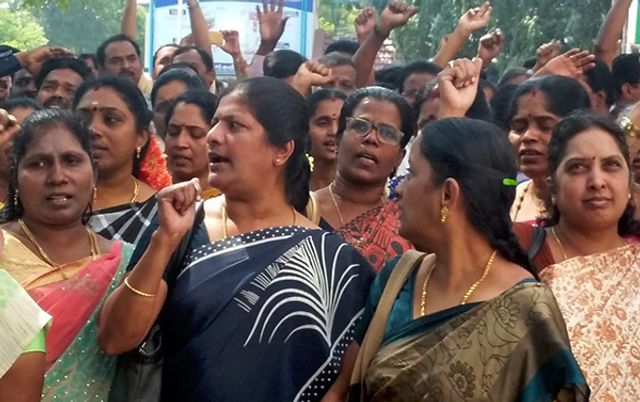
In another outbreak of massive working class struggles in India, about 700,000 teachers and state government employees in the southern state of Tamil Nadu have been on indefinite strike since Tuesday. They walked out over a list of demands that includes reversal of retirement pension cuts, pay increases and permanency for school teachers and anganwadi (day care centres) workers.
More than 20,000 strikers have been arrested for participating in street demonstrations throughout the state, defying threats of disciplinary action by the right-wing communalist All India Anna Dravida Munnetra Kazhagam (AIADMK)-led state government. On Wednesday, the Madras High Court ordered them to return to work by today—a warning of further government retaliation.
Tamil Nadu teachers picketing
The strike is a part of a growing upsurge of the international working class after decades of worsening conditions and widening social inequality. The revolt includes the strike by tens of thousands of Matamoros maquiladora workers on the Mexico-US border, the teachers’ strikes in Los Angeles and across the US and the Yellow Vest protests across France.
Workers throughout South Asia have taken determined industrial action, as seen in last month’s nine-day strike by Sri Lankan plantation workers demanding a doubling of their wages, and this month’s eight-day strike by garment workers in Bangladesh for higher pay.
Just two weeks ago, workers across India joined a two-day strike on January 8 and 9 against the pro-investor “reform” and austerity measures of Prime Minister Narendra Modi’s Hindu supremacist Bharatiya Janatha Party (BJP) government. Late last year, over 3,000 workers from three major auto factories in Oragadam, near the Tamil Nadu state capital Chennai—Yamaha, Royal Enfield and Myoung Shin India Automotive—participated in two-month-long strikes.
Teachers and other state government employees want to roll back the Contributory Pension Scheme (CPS) and reverse the imposition of the National Pension Scheme (NPS), which have cut salaries and placed their pension funds in the hands of the stock markets.
The NPS, introduced by the last BJP-led central government, was imposed in 2014. Since then, all new central and state government employees have been deprived of the previous pension rights and 10 percent of their salaries have been diverted into a pension fund that fattens the profits of share market investors.
The seven-point list of strike demands includes payment of 21-month pay arrears, regularisation of part-time employees and anganwadi teachers and increased pay for secondary school teachers. Non-permanent workers are increasingly exploited, under various categories like “contract,” “part time,” “trainee” and “apprentice,” in both the public and private sectors, to impose poverty-level wages and divide the working class.
The strike has shut down many schools throughout the state. Workers in other state government departments, such as Revenue, Health, Rural Development and Agriculture, have joined the strike.
Despite mass arrests, strikers participated in protests in the capital Chennai and other major cities like Mudurai, Coimbatore, Virudhungar, Ramanathapurum, Sivaganga, Theni, Vellore and Dindigul.
Strikers outside a District Collector office
However, the trade unions, which were forced to call the action due to the growing militancy among workers, are totally opposed to any mobilisation of the working class against the government’s attacks. The Joint Action Council of Tamil Nadu Teachers Organisations and Government Employees Organisations (JACTTO and GEO), an alliance of teachers and government unions, claims that the AIADMK government can be pressured to reverse its policies.
What workers have experienced is the opposite—a government crackdown. On Monday, the day before the indefinite strike began, state Chief Secretary Girija Vaidyanathan threatened to cut off strikers’ wages and cancelled all leave, except for medical reasons, during the strike. The state education department moved to hire strike breakers, offering temporary appointees a meagre 7,500 rupees ($US106) a month.
The last state AIADMK government unleashed brutal repression against striking government employees in 2003, sacking hundreds of thousands.
The striking workers also have had bitter experiences with the unions. Workers have repeatedly come forward to fight against the CPS. In February 2016, for example, they started an indefinite strike, but the Tamil Nadu Government Employees Association (TNGEA), an alliance of 68 unions, ended the strike after 10 days without meeting their demands.
The unions justified that betrayal by citing election and school examination duties that government employees needed to perform, and by supposedly giving the government time to think over workers’ demands. JACTTO refused to join the strike, claiming that the incoming state government’s 2016 budget would concede the demands.
Successive governments at both central and state levels have continued such socially-incendiary “economic reforms,” imposing on workers the burden of the deepening crisis of Indian and world capitalism since the 2008 global financial breakdown.
Major “reform” measures similar to the CPS have been introduced around the world at the dictates of the International Monetary Fund. They will not be reversed by replacing the BJP-led Modi government at the Indian general election due to be held in April-May. The opposition Congress—the traditional party of Indian ruling elite—and the regional capitalist parties like the Dravida Munnetra Kazhagam [DMK], the AIADMK’s current Tamil Nadu rival, are equally committed to same pro-big business measures.
The only viable strategy to defeat these attacks, as in Mexico, the US, France and around the world, is one based on the international class struggle and the independent political mobilisation of the working class against the reactionary capitalist order.
India’s main Stalinist parliamentary parties—the Communist Party of India (Marxist) (CPM) and the Communist Party of India (CPI)—are trying to channel the rising movement of workers behind the return of yet another capitalist government, whether led by the Congress Party or a series of smaller, right-wing regional parties—after the April-May general election, on the pretext of defeating the Hindu communalist BJP.
The same Stalinist parties made an electoral alliance with the AIADMK in the 2011 Tamil Nadu state elections, even after its mass sackings of striking government employees in 2003.
As the World Socialist Web Site explained in its January 12 Perspective on the political significance of the two-day national general strike: “All these parties have played a pivotal role in implementing the Indian bourgeoisie’s drive to make India a cheap-labour haven for global capital. Between 1991 and 2008, the CPM and CPI sustained in power a succession of governments, most of them Congress Party-led, which spearheaded the neo-liberal agenda and pursued closer ties with Washington.”
Indian workers should follow the example of the Abbotsleigh tea plantation workers in Sri Lanka, who, under the guidance of the Socialist Equality Party, have established a rank-and-file action committee completely independent of the trade union apparatuses that have enforced their brutal exploitation for decades. Auto workers in the US, confronted by plant closures and thousands more job losses, have taken a similar course.
Such rank-and-file workplace committees must develop a working class counteroffensive by unifying the struggles of workers across India and by reaching out to workers around the world, with whom they are closely interlinked by global capitalist production.
Above all, Indian workers need a revolutionary party, based on an internationalist socialist program and strategy, embodying all the strategic lessons of the struggles of the world working class, to prosecute the struggle for workers’ power. That party is the International Committee of the Fourth International (ICFI).

Canada’s diversity imperialism

Keith Jones

Canada’s trade union-backed, ostensibly “progressive” Liberal government is playing a key role in the regime-change coup that Washington has launched against Venezuela’s elected president, Nicolás Maduro.
Canada quickly seconded US President Donald Trump’s announcement Wednesday recognizing Juan Guaidó, Venezuela’s self-proclaimed “interim president,” as the country’s head of state.
The cabinet Trudeau named after winning office in October 2015 was hailed as an exemplar of diversity and inclusiveness. With an equal number of women and men, newspaper columnists lauded the “gender-balanced cabinet.” It boasted an indigenous Justice Minister, an Indian-born Sikh defence minister, a former Somali refugee as immigration minister, a gay Treasury Board president, and a quadriplegic Veteran Affairs Minister.
Particular acclimations were given for the selection of a female minister of foreign affairs, Christina Freeland. In an article in September on Canada’s “feminist foreign policy,” Foreign Policy magazine wrote that last year Canada hosted “the first-ever meeting of female foreign ministers, as part of a package of commitments it made to prioritize women’s issues under its G-7 presidency this year.”
The meeting, Foreign Policy wrote, was “unprecedented in its display of female power on the world stage.”
“It is important—and historic—that we have a prime minister and a government proud to proclaim themselves as feminists,” declared Freeland. “Women’s rights are human rights.”
In reality, as underscored by Canada’s role in aiding and abetting the US-orchestrated regime-change operation in Venezuela, the only “identity” that matters is that all the members of the Trudeau cabinet are defenders of imperialism.
Trudeau has been enthusiastically promoted by the New York Times and Guardian as a poster boy of contemporary liberalism. That is a liberalism that has renounced all social reform, is pro-austerity and pro-war, and which privileges issues of racial, ethnic and gender identity, as a means of rallying the support of sections of the affluent middle class.
Trudeau and Freeland are recycling and amplifying the foul propaganda emanating from the CIA and the likes of Brazil’s new ultra-right president, Jair Bolsonaro, that Guaidó—a representative of the country’s traditional US-aligned oligarchy—is the incarnation of the democratic aspirations of the Venezuelan people.
Ottawa’s role, however, goes far beyond trying to provide a smokescreen for yet another “made in USA” coup and obscuring the inexorable connection between Washington’s current intrigues in Venezuela and the succession of invasions, occupations and coups it has orchestrated in Latin America since 1898.
Ottawa, according to news reports, will soon host a meeting of the Lima Group, a coalition of US allies in the Americas, to plot the next steps in the “regime-change” operation against Maduro and the bourgeois nationalist regime he heads.
Since its establishment in August 2017, Canada has acted as Washington’s principal agent inside the Lima Group. Last September, Canada was conspicuous in leading opposition to a Lima Group “pledge” to oppose any foreign military intervention in Venezuela—i.e. a US invasion.
Wednesday’s US-fomented coup has pushed the impoverished South American country to the brink of civil war and, with Trump demonstratively declaring “all options on the table,” brought the US to the brink of a military assault on Venezuela.
There is every reason to believe that Canada will participate in any US military action against Venezuela, reprising, albeit almost certainly on a larger and bloodier scale, its 2004 role in assisting the US in overthrowing Haiti’s elected president, Jean-Bertrand Aristide.
Washington has spearheaded the resurgence of imperialism, waging a never-ending series of wars since 1991 in an increasingly desperate attempt to offset the decline in its global economic position. But all the imperialist and aspiring great powers, big and small, are rearming and reviving war as a vital instrument of state policy.
A major belligerent and, from an economic and strategic vantage point, beneficiary of the two imperialist world wars of the last century, Canadian imperialism is no exception. Long gone are the days when Canada’s ruling elite, with a view to politically and ideologically harnessing the working class to its rule, promoted the myth that Canada and its military have a special “peacekeeping” vocation.
Since 1991, Canada, under Liberal and Conservative governments alike, has played a leading role in one US-led war after another, including the first Gulf War, the 1999 NATO war on Yugoslavia, the Afghan War, the 2011 regime-change war in Libya, and the ongoing US war in the Middle East.
As in Venezuela today, Canada’s government and military have, in the course of these wars and interventions, repeatedly aligned with extreme right-wing and outright fascist forces. Canadian Armed Forces (CAF) personnel involved in the bombing of Libya described themselves as “al Qaeda’s air force.” Similarly, in the Ukraine in 2014, Canada helped orchestrate, in concert with Washington, a fascist-spearheaded coup against the country’s elected president.
Canada’s longstanding and rapidly expanding military-security alliance with Washington and Wall Street enjoys all but unanimous support with the Canadian ruling class, as the best means to assert its own predatory imperialist interests and aims on the world stage.
Canada’s banks and resource companies are important players in Latin America and the Caribbean, and the Canadian ruling elite shares Washington’s determination to roll back Chinese and Russian economic and geopolitical influence in the Americas.
Under Trudeau and his purported “feminist foreign policy,” Canada is playing an even more rapacious and reactionary role in world affairs than under the neoconservative and onetime Iraq war enthusiast, Stephen Harper.
Declaring that Canada must prepare for the wars of the 21st Century and play a larger role in sustaining a US-led world order, the Trudeau government announced in June 2016 plans to hike military spending by more than 70 percent to almost $33 billion by 2026.
Already Canada is playing a leading role in US imperialism’s three main military-strategic offensives, any one of which could rapidly spiral into a war between nuclear-armed powers: in the Middle East, against Russia and against China.
Canada is leading one of NATO’s four new “forward deployed” battalion-sized battlegroups on Russia’s borders; routinely deploys warplanes and battleships to patrol the Black Sea, Baltic States and Eastern Europe; and is training Ukrainian Army and National Guard personnel to, in Trudeau’s words, “liberate” Eastern Ukraine.
And long before Ottawa ordered, at Washington’s behest, the December 1 arrest of Huawei executive Meng Wanzhou on trumped-up charges, Canada was closely aligned with Washington in its escalating confrontation with China. Building on a secret 2013 US-Canadian military agreement on coordinating operations in the Asia-Pacific, the CAF has greatly expanded deployments in Asia. CAF head Jonathan Vance now routinely describes the South China Sea and Malacca Straits, key chokepoints in US war planning against China, as of vital strategic importance to Canada.
There are vital lessons to be learned from Trudeau’s role in Trump’s coup attempt in Venezuela, applicable in every country all over the world. Replacing one set of representatives of the financial oligarchy with another, regardless of their race, gender, or sexual preference, will not lead to a more “humane” outcome. The struggle against imperialism and social inequality must base itself on the social force capable of opposing capitalism and imperialist war: the working class.

24 Jan 2019

WHO-TDR Clinical and Research Development Fellowship 2019/2020 for Developing Countries

Application Deadlines: 7th March 2019, 16:00 (GMT)

Eligible Countries: Low- and Middle income countries of WHO African Region.

About the Award: Successful applicants are placed for 12 months in host training organizations (pharmaceutical companies, product development partnerships (PDPs) or research organizations) and then receive a reintegration plan for 12 months at their home institution.

Type: Fellowship

Eligibility: On the date of the deadline set for submission of applications, the fellow should:
  • Be a postgraduate (MSc or PhD) or medical/pharmacy graduate conducting clinical research activities in the scope of TDR’s mandate.
  • Have obtained their first degree within the 15 years prior to submission of this application.
  • Have been a researcher or clinical staff member employed for the past 12 months in an institution with a registered legal entity in an LMIC conducting clinical research activities in the scope of TDR’s mandate.
  • Must be a national or citizen of, and resident in, an LMIC.
Number of Awards: Ten (10) Master’s scholarships

Value of Award: 
  • The grant covers one economy class return air ticket (home – host training organization – home); a monthly stipend of approximately US$ 4000; a one-time allowance of US$ 1500 for educational support materials; health insurance and support to attend relevant meetings during the course of the fellowship, up to a maximum amount of US$ 3000, and access to an alumni website and to the Professional Membership Scheme for clinical trialists website.
  • A break at 6 months of fellowship may be offered to the fellow to return to their home institution to present to their peers the acquired training and scientific progress made.
  • The grant also includes provisional funds for reintegration, conditional upon the approval of a progress report and reintegration plan.
How to Apply:
  1. Please send the completed application form in electronic format (Word or PDF only) to cdftdr@who.int.
  2. It is important to go through all application requirements on the Programme Webpage see link below) before applying
Visit the Program Webpage for Details

Award Providers: World Health Organisation, Research and Training in Tropical Diseases (TDR)

Shanghai Government Scholarship 2019/2020 for Bachelors, Masters and PhD International Students

Application Deadline: from 1st March 2019 to 30th March 2019.

Eligible Countries: International

To be taken at (country): China

Eligible Field of Study:
  1. Bachelor’s degree programs
  2. Master’s degree programs (except MBA and MTCSOL*)
    • Note: MBA is short for Master of Business Administration;
    • MTCSOL refers to Master of Teaching Chinese to Speakers of Other Languages.
  3. Doctoral degree programs
Type: Bachelors, Masters and PhD

Eligibility: 
  1. Be a non-Chinese citizen in good health.
  2. Not be an enrolled degree student in Chinese universities at the time of application.
  3. Be a high school graduate under the age of 25 when applying for the undergraduate programs;
  4. Be a master’s degree holder under the age of 40 when applying for doctoral programs.
  5. Be a bachelor’s degree holder under the age of 35 when applying for master’s programs.
  6. 3.Language proficiency: new HSK5 level (scored at least 180)
Value of Scholarship: The scholarship covers tuition waiver and comprehensive medical insurance for bachelor’s students; it covers tuition waiver, accommodation, stipend, and comprehensive medical insurance for master’s students and doctoral students.

Duration of Scholarship: 
  1. Bachelor’s Degree Program: 4 to 5 years
  2. Master’s degree programs: 2 to 3 years
  3. Doctoral degree programs: 3 to 4 years
How to Apply: 
Step 1 – Submit the scholarship application on http://study.shmec.gov.cn, print out the scholarship application form and sign on it.
Step 2 – Submit the program application on http://ao.sufe.edu.cn, print out the degree program application form and sign on it.
Step 3 – Present the supporting documents to the Admission Office at ICES SUFE.
Please mail or hand in directly to the Admission Office by the application deadline (mailing date considered as submission date).
  • It is important to go through all application requirements on the Programme Webpage see link below) before applying
Visit Programme Webpage for details

Dag Hammarskjöld Journalism Fellowships 2019 at United Nations Assembly for Developing Countries

Application Deadline: 1st March, 2019. 

Offered annually? Yes

Eligible Countries:
  • Developing nations of Africa, Asia (including Pacific Island nations), Latin America and the Caribbean.
  • For 2019 only, the Fund will not accept applications from the countries of the 2017 fellows – Argentina, India, Kenya and Yemen – in an effort to rotate recipient countries.
To be taken at (country): New York, USA

Area of Interest: Journalism

About Fellowship: The Dag Hammarskjöld Fund for Journalists accepts applications from journalists of the developing nations of Africa, Asia (including Pacific Island nations), Latin America and the Caribbean to cover the United Nations General Assembly beginning in September each year. The fellowships offer a unique opportunity for promising young journalists from developing countries to see the United Nations at work and to report on its proceedings for news media in their home countries.

Offered Since: 1961

Type: Professional Fellowship

Eligibility: The Dag Hammarskjöld Fund for Journalists fellowships are open to individuals who:
  • Are native to one of the mainly developing countries of Africa, Asia (including Pacific Island nations), Latin America and the Caribbean. For 2019 only, the Fund will not accept applications from the countries of the 2018 fellows – Argentina, India, Kenya and Yemen – in an effort to rotate recipient countries.
  • Currently live in and write for media in a developing country.
  • Are between the ages of 25 and 35.
  • Have a very good command of the English language since United Nations press conferences and many documents are in English only.
  • Are currently employed as professional journalists for print, television, radio or internet media organizations.  Both full-time and freelance journalists are invited to apply.
  • Have approval from their media organizations to spend up to three months in New York reporting from the United Nations.
  • Receive a commitment from their media organizations that the reports they file during the term of the Fellowship will be used and that they will continue to be paid for their services.
Number of Fellowships: not specified

Value of Fellowship: The Fund will provide: round-trip airfare to New York; accommodations; health insurance for the duration of the fellowship, and a daily allowance to cover food and other necessities. The Fund will not be responsible for other expenses of a personal nature, such as telephone calls.

Duration of Fellowship: first three months of the General Assembly session

How to Apply: 
  • CLICK HERE for the application in Word format
    CLICK HERE for the application in PDF format (requires Adobe Reader, free download)
You MUST ALSO INCLUDE ALL necessary documentation as outlined in the Eligibility and Documentation Requirements with your application.
An originally completed AND signed application, along with all six (6) of the Documentation Requirements, should be sent by postal or courier service (such as DHL, FedEx, Airborne) to:
Dag Hammarskjöld Fund for Journalists
512 Northampton Street, No. 124A
Edwardsville, PA 18704 USA


Visit the Fellowship Webpage for Details

Friedrich-Ebert-Stiftung (FES) Doctoral Scholarship Program 2019 for Students from Developing Countries

Application Deadlines: Applications will be accepted no later than:
  • diploma / magister / state examination: by the end of 6th semester
  • Bachelor/ undergraduate programmes: until 3 semesters before finishing the standard period of study (if 6 semesters by the end  of 3rd semester; if 7 semesters by the end  of 4rd semester)
  • postgraduate/ Master programmes: by the end of 1st semester
  • duration of application process:
    4-7 months
Offered Annually? Yes

Eligible Countries: Students from Developing Countries already studying in Germany.

About the Award: The promotion of young talent has been one of the founding principles of the FES.
At the time when Friedrich Ebert was elected as the first president of the Weimar Republic, it was almost impossible for talented children from socially disadvantaged backgrounds to study at universities or take part in research programmes. With the foundation of the Friedrich-Ebert-Stiftung in 1925, the first scholarships were awarded to particularly talented young individuals from a working class milieu who were taking an active part in the young democracy of the Weimar Republic.
To address social disadvantages by supporting students who actively work for freedom, justice and social cohesion in their commitment to social democracy, or will do so in future, continues to be one of the aims of the FES.

Type: Doctoral

Eligibility: The FES can only award scholarships to applicants from abroad who have already enrolled in a German university or have a supervisor for their doctoral studies.
    • For the FES, service to the common good deserves recognition. It is therefore not only the applicants’ academic achievement but their social and political involvement and personal attitudes that play an important part in the selection process.
  • The FES also supports foreign applicants who are already studying, or doing their postgraduate studies, in Germany at the time of application. Up to 40 students from Africa, Asia, Latin America and Eastern Europe may qualify for the scholarship programme every year with the exception of those who are already receiving some support from public sources.
  • Students are expected to be living in Germany before they apply and have to provide proof of an adequate command of the German language by submitting a language proficiency certificate ( C 1, TestDAF)
  • Since foreign scholarship holders will receive an extensive social and political side programme, German language proficiency is crucial even when the study programme itself (M/B) is carried out in English.
  • We do not support foreign students from Western European countries at present, but only those from the developing countries of Asia, Africa, Latin America and Eastern Europe.
  • At the time of application, foreign students should be able to submit proof of their initial academic achievements/marks with the exception of those enrolled in Master or other postgraduate programmes.
Selection Criteria: The FES supports
  • all academic subjects
  • students from public or state-approved universities and from universities of applied sciences/polytechnical colleges (FH)
  • postgraduate programmes (PhD)
The FES does not support
  • second degree courses
  • study visits outside Germany
  • final phases of academic studies
  • postgraduate courses in medicine
Number of Awards: This year, about 2.700 students and postgraduates will receive a grant from FES.

Value of Award: Foreign scholarship holders receive:
  • 650 € per month (basic scholarship programme) / 1000 € per month (graduate scholarship programme)
  • 276 € of family allowance, if applicable
  • refund of health care costs
  • any income exceeding 400 € per month will be credited against the scholarship.
Expectations: FES expects scholarship holders:
  • to participate in extra-curricular seminars and activities of FES campus groups on a regular basis
  • to achieve above-average results in their degree courses
  • to continue and intensify their socio-political commitment.
At the end of each term, a semester report has to be submitted to FES which describes the scholarship holder’s current academic performance and his/her social engagement.

How to Apply: 
    • Self Application: Please use the “Online-Bewerbung” on the Internet – in German only! supplementary sheet
    • Individual interviews: In a second step, selected candidates will be invited to two individual interviews. The first interview will be conducted by one of the lecturers from the FES, and the second interview by one of the members of the FES scholarship committee (AWA). Two reports are written on the basis of these interviews and presented to the AWA.
    • Discussion and final decision by the AWA: The AWA will eventually make a final decision about your application. The AWA is an independent body composed of university lecturers as well as other persons from the fields of science, politics, art and media. The committee meets at least three times a year. The AWA will discuss every application at great length and then make the final decision.
  • Written notification: You will be notified of the AWA’s decision.
Visit the Program Webpage for Details


Award Providers: Friedrich-Ebert-Stiftung (FES)

DW Akademie Journalism Masters Scholarships 2019 for Journalism Students and Professionals in Developing Countries – Germany

Application Deadline: 31st March 2019

Eligible Countries: Developing Countries

To Be Taken At (Country): Germany

About the Award: The program is targeted at students from around the world that want to work in a position of responsibility in journalism or the communications sector. It especially addresses journalists-in-training, media representatives from radio, TV, online and print and communication experts. Those interested must have completed an academic program (bachelor’s degree or equivalent) and have acquired at least one year of professional experience in a media-related field after their first degree. The program is bilingual (English and German), whereby English is the prevalent course language.
Full Scholarship: We are granting full scholarship to up to 10 applicants each year. Prospective students from developing countries can apply for the full scholarship. The scholarship is 750 EUR per month covering costs for living and accommodation. The tuition fee and the flight will be also reimbursed. A committee will decide which applicants are to receive a scholarship after the application deadline has expired.
Partial Scholarship: Prospective students from developing countries and countries in transition who do not meet the requirements for the full scholarship, may apply for a partial scholarship. This will cover the costs of the tuition fees of 6,000 EUR. The expenses for travelling, accommodation and living will have to be paid by yourself.

Type: Masters, Training

Eligibility: Especially targeted at:
• Media representatives from radio, TV, online and print
• Journalists-in-training, especially from electronic media
• Journalists and management from community radio stations
• Communication experts
• NGO employees
• Employees from ministries
• Employees from cooperative development groups and projects
• Representatives from regional working groups and national broadcasters
• Media association representatives

For the Master’s Program, applicants must have a bachelor’s degree, at least one year of professional experience in a media-related field and advanced skills in German and English.

Number of Awards: Not specified

Value of Award: Full and Partial scholarships are available.

Duration of Program: Four semesters

How to Apply: Applications must be made online.
Before you begin filling out the online application form make sure you have all the required documents:
• Letter of motivation (signed and dated)
• Current Curriculum Vitae (Europass format, signed and dated)
• Certificate of your first academic degree (including ALL transcripts)
• Evidence of at least one year’s professional experience in a media-related field AFTER obtaining your first academic degree (for a full scholarship you must give evidence for at least one additional year of professional experience)
• Certificate of APS (for applicants who completed their first degree in China, Vietnam or Mongolia)
• Evidence of sufficient English language skills (TOEFL IBT: score of 83 or higher, IELTS: score of 6.0 or higher, BULATS: score of 70 or higher, LCCI: level 3) – English language certificates are valid for two years from the date of issue
• Evidence of sufficient German language skills (TestDaF at least level TDN 3 in all four parts of the examination, Goethe Zertifikat at least level B2 or DSH at least level 1)
• Copy of your passport.

If you would like to apply for a full scholarship, you will be required to submit some additional documents:
• Recent recommendation letter from a University (with letterhead, official University stamp, signature and date)
• Recent recommendation letter from your employer (with letterhead, official company stamp, signature and date)
• DAAD application form
• High school diploma

Please sign the documents where required, scan them and upload them. You will need to bring the originals with you in case you are accepted to the program.

Visit the Program Webpage for Details


Award Providers: DW Akademie

How Worried Should We be If China’s Growth Rate Slows to 6.4%?

Dean Baker 

There have been numerous articles in the news recently telling us about China’s slowing economy (e.g. here and here). From the accounts I’ve seen, it does sound like China has problems, although we have heard this story before. (There have been China experts predicting a financial collapse since the late 1990s.)
But the striking part is that a slowing economy is treated as something unexpected. China had been maintaining extraordinary double-digit growth through the 1980s, 1990s, and 2000s. The idea that China could continue to grow at this rate seemed pretty far-fetched. In fact, if we go back to 2016 and look at the IMF’s forecast for growth in China in 2018 and 2019, it was 6.0 percent for both years. The IMF’s forecasts are generally in the middle of professional forecasts. For this reason, it is a bit strange to read an article in the NYT telling us that China’s slowdown to 6.4 percent growth last year is really bad news for the world economy.
It is also worth noting the ostensible problem here. The idea is that if China’s economy were growing more rapidly, it would be creating more demand for goods and services produced by other countries. This is true, but there is another way that the countries facing insufficient demand can generate it if China’s economy is not cooperating. Their governments could spend money.
The problem of insufficient demand is best countered by more demand. Insofar as the US faces this problem right now (it may not), it can be remedied by doing things like extending access to health care and child care or starting a Green New Deal. It really is not that hard to find ways to spend money.