25 Jan 2019

The Yellow Vests, the Crisis of the Welfare State and Socialism

Michèle Brand

Far from dying down after the holidays, France’s yellow vest movement is continuing to blaze throughout the country. Every Saturday for eleven weeks, protesters have been disrupting or blocking roads, traffic circles and freeway toll plazas, gathering in the squares of villages, taking to the streets of towns, marching in massive numbers through city boulevards, and confronting violent police repression. Ten people have died in the protests, mainly due to accidents at road blocks, and over 2000 have been injured by the police, around 100 seriously. 17 people have lost an eye due to rubber bullets, according to an independent association and an investigative journalist, while the interior minister recently said there were 4. Thousands have been arrested.
Old and young, workers, retirees, artisans, some small business owners, farmers, students, self-employed and unemployed people are converging to protest not only Macron’s gloves-off reforms in favor of capital, finance and the ultra rich, but especially their own decline in living standards. Increasingly aggressive capitalism, the dismantling of the welfare state, and deindustrialization have eroded standards of living for forty years, and have stepped up pace with the crisis of 2008 and Macron’s “neoliberal” reforms dictated by the European Union.
Yellow vested demonstrators are fed up with running out of money before the end of the month, job insecurity, rising taxes on the working class, insufficient and decreasing pensions, falling social benefits, and working multiple jobs or extra long hours to make ends meet. France’s broad middle class is downwardly mobile. People are also protesting rising energy costs, job losses due to offshoring, deteriorating working conditions, homelessness on the rise, increasing numbers of undernourished children and people scavenging for food, underfunded public services such as hospitals, schools, post offices and transportation, especially in rural areas, and a host of other issues.
At the same time, fueling the fire, Macron has enacted a series of measures friendly to finance, capitalists and the rich, such as annulling the wealth tax (a tax of 0.5 to 1.5% on personal wealth above 800,000 euros), lowering the corporate tax rate, offering extra tax credits to companies, and gutting the work code, the law that has long provided strong labor protections to France’s working class.
The aggressive form of capitalism known as neoliberalism and austerity, as well as the declining situation of the working class, are not at all unique to France. Things are much worse in Spain, Greece, Italy and elsewhere. The French people, however, have a long and cherished tradition of rising up and gaining social advances, starting in 1789, which inspires the world over. 1789, 1830, 1848, 1871, 1945, 1968… today, a revolt is overdue. France is in its fifth republic, and the constitution is not a bible. The French know from historical experience that no institutions are set in stone, and that popular protest is necessary to abolish the present state of things.
67% of the population sympathize with or support the movement, while 25% are against it, according to a January 14 poll. The movement has spread so deeply and widely in French culture that young children in schoolyards throughout France are playing games of “yellow vests vs. cops” and shouting “Macron, resignation!” Elderly women and men in yellow vests are chanting alongside the crowd “Macron, we’ll come find you at your house!” and “Castaner, nique ta mère!” Many yellow jackets are newcomers to social protests, which is part of the force of the movement. Others, seasoned demonstrators, say that they have been waiting for this popular revolt to spark for years, even decades, as they watched living standards sink. Many protesters are among the 50% of the population who abstain in legislative elections. Both left and right are represented, and there seems to be a slide toward the left since the beginning of the protests especially as the trade unions get more involved. Apart from the occasional sticker or trade union flag, there is a tacit understanding (broken occasionally by Trotskyite groups) that no partisan affiliation will be shown – people have come together in their revolt against the current state of things, and not to represent a particular party. The rallies are “organized” by a number of nonpartisan facebook pages.
This leaderless quality means that the demands of the movement are extremely heterogeneous, often naïve and sometimes contradictory, and that the political future of the movement is unpredictable. But it also means that the uprising is very hard for Macron’s administration to pinpoint, target and shut down. There is no union or party to slander or recuperate, there is no entity to negotiate with, pressurize or buy out, there is no figurehead to decapitate. There is only a formless mass of angry people largely disillusioned by traditional politics, united in a new and unknown color, yellow.
Asked about his view of the movement’s lack of leadership, a protester who revealed that he was a CGT union member, said that it’s excellent, for now. For years, the unions have had one discouraging failure after another as they followed the traditional protest march formulas. Older tactics weren’t going anywhere. This kind of uprising has never happened before, it’s shaking things up, it’s the best we can ask for at this point. It’s nationwide, truly popular, strong in both rural areas and cities, and supported by the vast majority of the French people. Its unpredictability is, for now, an advantage. And it’s providing an important “street education” in activism for young people. Later we’ll see how things evolve, but for now this should be embraced.
Another protester, an oyster farmer who owns his own business, works long hours 7 days a week and says he doesn’t earn a decent living, drew a darker picture. He said that he thinks the movement will degenerate into more violence as the government will refuse to change anything, and people will get sick of marching in the streets, getting sprayed with teargas and not being heard.
One bearded older man in a yellow vest and colorful beret had been to every protest since the beginning. “Our goal,” he said, “is to exhaust the police.” He looked at the group of young men in riot gear who had gotten out of a police van, and taken up positions to block a street from a group of protesters arriving at the intersection. “In order to make them come over to our side.” An unknown but reputedly significant number of riot cops have taken sick leave. Attempting to exhaust the police is one tactic, but one shouldn’t have illusions about bringing them over to our side. As Marx wrote, the current State [and its police] are “nothing more than the form of organisation which the bourgeois necessarily adopt… for the mutual guarantee of their property and interests” (The German Ideology). Tired or unwilling individuals can easily be replaced, like other workers.
In order to try to absorb, clean up and neutralize the odor of this rebellious energy expanding like spilled oil, the government has instituted a “big debate,” inviting people to give their opinions on 35 preselected questions about 4 issues (not including the wealth tax), in local assemblies, on an online platform, by regular mail, and at stands in public places. After a month of this process, in each region 100 people picked by chance will debate on the topics and attempt to give concrete suggestions. Apparently a desperate and hasty measure, denounced as a masquerade and smokescreen by the yellow vests, the big debate could easily backfire on Macron. As an unwieldy process that will necessarily exclude more than it includes, it will likely give another clear proof of Macron’s insincerity and theatricality. It will also provide the media the opportunity to chastise yellow vested protesters for continuing to protest despite the invitation to be heard through institutional channels. But alternative in-person forums for debate are also springing up.
Whether or not the government is hearing the protesters in the streets, it is certainly hearing the protests of business owners who are losing money due to the weekly events. Two billion euros worth of business was lost in December in the retail sector due to the protests, two billion in transport and distribution, and the agri-food sector estimates a potential loss of 13 billion since mid-November largely due to blockages of highways and intersections. Tourism has dropped 10%, 4000 cars and 2000 businesses have been vandalized for a total of 100 to 200 million euros in damages, and financial groups which are thinking about moving to Paris after leaving London due to Brexit are now hesitating, “wondering about the consequences and the longevity of the movement.” Already, Macron is seen as a lame duck by his European counterparts, having lost the support of the population and possibly unable to enact the rest of his ambitious program of capital-friendly reforms.
But even if he wanted to, Macron would have a hard time bringing back the French social model as it existed during the 30 “glorious” years between 1945 and 1975. The yellow vest movement is essentially calling for a return to the welfare state, and their movement is born of the crisis of the European welfare state in its last strong bastion, France. But the welfare state is (was) an attempt to stabilize capitalism in the highly developed countries, and rather than trying to save it or bring it back, we should call for a new form of socialism.
Deficit spending and the redistributive system, on which the welfare state is based, are stretched to their limits, producing the crisis that sparked the protests. Keynesian deficit spending attempts to stabilize capitalism by providing shock absorbers during its inevitable crises, and is impossible in the context of chronically high debt. French public debt is at 99% of GDP, up from 67% in 2008. Lowering the debt and reinvigorating redistribution mechanisms would depend on tax revenue, but taxing the wealthy and the corporations, in the globalized economy, just makes them flee the country. The only way to keep companies, factories, and their profits in the country is to nationalize them so they can’t leave. To create a durable “redistribution,” that is, true economic equality, the means of production have to be collectively – that is, publicly – owned.
The protesters are calling on the state to “tax big the big ones, and tax little the little ones.”  The 40 biggest corporations in France (CAC40) made record profits in 2017 and 2018, and the people know it. But French corporate tax is among the highest in the world (33.3%, though it will gradually drop to 25% by 2022), and the large companies, which already use every loophole they can, could move their headquarters elsewhere, for example to Ireland where corporate tax rates are nominally 12.5% but effectively 2-4%. Companies are taxed based on the location of their headquarters, not where they extract, manufacture or sell their products. The small and medium-sized companies which can’t leave are already overstretched, and some of these business owners are wearing yellow vests on Saturdays. Increasing corporate tax on companies which already have one foot out the door will not save the welfare state.
The yellow vests are particularly angry at the fact that Macron killed the wealth tax on the ultra-rich, as their own taxes rise, their wages and pensions fall, and public services suffer. But the wealth tax only brought in 1.4% of tax revenues in 2017, its last year of existence, and it was more symbolic than significant for the budget. Reinstating or even raising it would not bring back the conditions necessary for the welfare state, and the money of the rich would simply continue to leave. In our current globalized and deindustrialized economies, taxation can’t provide the revenue necessary for the social programs associated with the welfare state. Private wealth necessarily slips away. Only public ownership of the sources of wealth can finance the social programs that the French are used to, and more.
Socialism is the only answer to this situation, the crisis of the welfare state. The only way to keep the results of economic activity inside the country and available for social services is to nationalize the industries, so that they become public goods, owned collectively and not by private individuals and stockholders. The only way to maintain and pay for the public programs that the population cherishes, is to finance them through state ownership of the means of production and distribution. The welfare state is played out, and the yellow vest protests are symptomatic of this. Rather than looking backward and wishing it to return, we should embrace the future by building the conditions for socialism.
The Figaro, the French conservative daily newspaper, recently published an ultraliberal article arguing that the yellow vest movement is “the fruit of the death-throes of the welfare state.” In this, the analysis is correct (though the mixed metaphor is ugly). But the solution proposed is inhuman: to overcome the crisis we need more “liberalism,” or liberation of capitalism from the last grip of the nanny state; we need “to organize the gradual but thorough withdrawal of the public power” from the economy. To hell with the people who don’t fit into the Silicon Valley economy, except (maybe!) as end-user consumers. The ideologues of the elite are delighted with the sufferings of the welfare state, waiting for the kill. “Liberated” (barbaric) capitalism is one possible path, socialism is the other, and there is no other way.
What is the welfare state? It is a series of concessions made by the Western capitalist elite, under pressure from workers’ struggles, to make capitalism a bit less inhuman in the Western countries and thus to prevent socialist revolutions there. It is not only the result of generations of workers’ struggles for social gains, but also a defensive, counterrevolutionary creation around the middle of the 20thcentury to impede the expansion of socialist movements in the West. In the first half of the twentieth century, the movements fighting for socialism were very strong in the West, despite the repression. Advanced capitalism was producing deep economic crises, massive unemployment and wars, and it was clear to all at the time that the Soviet planned economy was much more successful than Western ones in the 30s (whatever else one may think of the USSR). It grew so much that in 25 years it brought the USSR from a backwards and destroyed nation to being capable of victory over the strongest military in the world. Clearly a planned economy was more efficient than the chaos and waste under capitalism. To prevent socialist views from spreading, the Western capitalist elite adopted a two-pronged attack: repression and concessions. The new deal and welfare state were essentially counterrevolutionary measures, concessions intended to stop the spread of socialist movements in capitalist countries. They were part of the strategy adopted by the bourgeois elite from the 30s to the 60s to stabilize capitalism in the West.
Whatever we may think of the reality of the Soviet and Chinese systems, their effect in the West in the 20thcentury was to contribute to the adjustment and softening of Western capitalism, which put on the mask of a human face. Then in the 1990s when there seemed to be no more threat, no more alternative system to compete against ideologically, the capitalists stopped providing, and the mask dropped. The yellow jackets are confronting its real face.
Furthermore, the welfare state is inseparable from Western imperialism, which has largely contributed to financing it through siphoning off resources from neocolonies. The rise of standards of living in the West has gone hand in hand with the overexploitation of the peoples of the Global South, who have been kept in underdevelopment and debt. Their raw materials and agricultural products have been practically stolen, their workers severely overworked and underpaid, their local industrial development stunted by forced importation, their governments kept submissive to Western powers and business interests. Objectively profiting from the exploitation of their counterparts in the Global South, large parts of the Western working class (and even more so, the middle class) have been won over to the idea that capitalism can provide. With the crisis of the welfare state, they are being confronted with the truth. This is not to say that socialist states, not guilty of imperialist exploitation, will not be able to provide a high standard of living. Our current level of development is high enough to provide a good living for all with shorter working hours, if we don’t have the rich absorbing all the wealth.
One of the measures of the standard of living of a country is the gross national income (GNI: total income received from sources both domestic and abroad) divided by the number of inhabitants. But if instead we take the GNI and divide it by the domestic population plus the number of people in foreign countries who contribute directly to this income – for example the exploited workers making Apple products, picking Chiquita bananas, mining copper for Freeport McMoRan, etc. – the “standard of living” of the country would fall dramatically. In addition, capitalism, including its form called the welfare state, has always been dependent on the exploitation of resident undocumented workers.
The welfare state has always only brought its benefits to a small, privileged part of the world population, and has created the illusion among them that capitalism can be humanized. It’s essentially reactionary, unsustainable and not worth fighting for. Socialism is what we should fight for. In abandoning the aspiration toward the welfare state model, we’re certainly not abandoning the struggle for workers’ rights, social services, and all the other advantages associated with the welfare state. We’re fighting for these with a clearer vision of the goal: socialism.
The yellow jacket movement’s weakness is the vagueness of its demands, calling for the return of the welfare state. But its force is its dynamism, its determination, its size, and its deep-set, justified feeling of anger at economic injustice and inequality. To win, we should stop looking backward, and start looking forward, toward the construction of socialism.


India must enact a domestic law on Genocide

Aftab Alam

The United Nations General Assembly adopted the Convention on the Prevention and Punishment of the Crime of Genocide in December 1948. Seventy years later the Delhi High Court for the first time unhesitatingly recognised the 1984 anti-Sikh pogrom as Genocide.
Thirty four years after the massacre a bench of justices S Muralidhar and Vinod Goel finally last month held former Congress MP Sajjan Kumar guilty of conspiring riots, incitement of violence, abetment to murder and looting, arson and various other offences and was sentenced to life imprisonment.
The HC while citing some important incidents of mass killings such as Mumbai (1993), Gujrat (2002), kandhamal (2008) and Muzaffarnagar (2013) expressed concerns over targeting of minorities and the attacks spearheaded by the dominant political actors with the connivance of the law enforcement agencies. It also expressed its dissatisfaction over inadequacy of domestic legal framework in India dealing with mass atrocity crimes especially crimes against humanity and genocide and this called for strengthening the legal system by plugging the loophole urgently.
It is interesting to note that political parties in India recognise an act as genocide only if it suits them politically and refuse to acknowledge the same if it does not help them. For example Congress takes offence if one call 1984 anti-Sikh riots as genocide but the BJP never do so. Similarly Congress never dithers calling 2002 Gujrat pogrom as genocide but the BJP at the same time never recognises so.
The Indian Government also seems to be confused on the matter and its stand definitely defies logic. While two senior cabinet ministers of the government Rajnath Singh and Arun Jaitley have described the 1984 anti-Sikh massacre as ‘genocide’ but the Ministry of External Affairs in 2017 strongly rejected a resolution passed by the legislative assembly of Canada’s Ontario province describing it as ‘genocide’. Dismissing the motion the MEA’s spokesperson Gopal Baglay had said that “We reject this misguided motion which is based on a limited understanding of India, its constitution, society, ethos, rule of law and the judicial process”.
This confusion on the part of government on the subject seems to be mainly due to lack of national legislation on genocide as highlighted by the HC. Though India had signed and ratified the Genocide Convention in 1948 and 1958 respectively and is obliged under article 5 to enact a law for the prevention and punishment of genocide, unfortunately no sincere efforts have so far been made to effectively criminalize the offence of genocide in our domestic criminal law. The Constitution also, under Article 51, requires India to endeavour to “foster respect for international law and treaty obligations”.
This is generally attributed to our mistaken belief that the crime of genocide already falls under ordinary domestic criminal law provisions prohibiting murder and bodily harm. This was reflected in the statement of Home Minister for State Kiren Rijiju in Rajya Sabha in 2016 claiming that both substantive and procedural criminal law provide an appropriate legislative framework to deal with acts like genocide in India.
We must realise that genocide is neither a case of simple murder nor a case of mass killing as it is generally understood. The most significant aspect of the crime of genocide is the intent part which distinguishes it from the crime of an ordinary murder or inflicting bodily harm. Thus in genocide one targets individuals because they are member of a particular national, ethnic, racial or religious group which one seeks to destroy, in whole or in part.
Even a cursory review of our criminal law reveals that there are no parallel provisions embodied in the Indian Penal Code criminalising killing or causing serious bodily or mental harm to individuals of a particular national, ethnic, racial or religious group, with the intent to destroy such a community in whole or in part which is the essence of the crime of genocide.
Furthermore there is section 197 of the Code of Criminal Procedure which is often used to shield public servants from prosecution and therefore diametrically opposed to Article IV of the Genocide Convention which calls upon State Parties to punish guilty persons irrespective of their official positions and amend their domestic laws in order to remove any immunity that may accrue to certain State officials.
In view of this lacuna in our domestic criminal law and treaty obligation there is an urgent need to enact a national law to criminalise and punish the crime of Genocide instead of relying on IPC and Cr. P C. The International Court of Justice (ICJ) in the Bosnian Genocide case (2007) has clarified that the state’s obligation to enact a national law is binding.
It should also be noted further that India follows ‘dualistic’ system in the matter of implementation of international law whereby any treaty to which it is a signatory will not automatically become part of our national laws. For this purpose the parliament will have to enact an enabling legislation under Article 253 of the Constitution which obliges Parliament to make any law “for implementing any treaty, agreement or convention”.
We must realize that the principle of prohibition of genocide has been recognised as part of general international law and constitute obligations erga omnes and thus we are bound by, besides treaty obligations, the general international law obligations to prevent and punish acts of genocide. But these principles are not self-executory and hence we need not only to render the acts referred to under genocide convention as punishable offence but also require designating or establishing ‘competent tribunal’ to try them.
It is also high time for India to review its policy of not acceding to Rome Statutes which established a permanent International Criminal Court in 2002 and offers framework for states to investigate and prosecute the crime of genocide.

Imperialism’s Direct Intervention In Venezuela

Farooque Chowdhury

First phase of imperialism’s direct intervention in Venezuela has started.
The US has “officially” recognized a self-proclaimed president of Venezuela as the country’s president while the rightists are trying to create chaos on Caracas streets. Guaidó, the self-proclaimed president, have been recognized by Argentina, Brazil, Colombia, Chile, Costa Rica, Ecuador, Guatemala, Paraguay and Peru, the countries collaborating with the US imperialism, followed the imperialist power within two hours of the US move. The Organization of American States (OAS) has also recognized Guaidó as president. Canada and France have extended its support to Guaidó. European Council president Donald Tusk expressed hoped the EU would “unite in support of democratic forces”. The imperial alliance is active.
Guaidó, an obscure lawmaker a few days ago and head of the National Assembly, called on the armed forces to disobey the constitutionally formed government of Venezuela. However, Venezuela’s defense minister has condemned Guaidó, a former student leader participating in protests against socialist leader Chavez.
US president Trump, in a statement, described Nicolas Maduro’s leadership as “illegitimate”. Trump’s statement said: “The people of Venezuela have courageously spoken out against Maduro and his regime and demanded freedom and the rule of law.”
Nicolas Maduro, who was sworn-in as president of Venezuela earlier this month, has declared breaking of diplomatic and political relations with the US. The measure is in response to Trump’s recognition of Guaidó. Venezuela has given the US diplomatic staff 72 hours to leave Venezuela. Maduro has declared all US diplomats persona non grata, after the imperial power recognized Guaidó as Venezuela’s president.
US secretary of state Pompeo rejected Venezuela’s move to cut ties with the US. Pompeo said the US did not recognize Maduro as leader of Venezuela. He said the US would conduct relations “through the government of interim President Guaidó” although there’s nothing like “government of President Guaidó”. Pompeo also urged Venezuela’s military to support efforts to restore “democracy”, and said the US would back Guaidó in his attempts to establish a government.
These developments are a continuation of a long drawn out imperialist intervention plan. The imperialist power, it seems, is determining issues like legitimacy and people’s representation in another country while it is passing through a government shutdown.
Maduro has accused Washington of trying to govern Venezuela from afar, and said the opposition was seeking to stage a coup. “We’ve had enough interventionism, here we have dignity, damn it!” president Maduro said in a televised address from the presidential palace while a huge assembly of people joined in solidarity to Maduro in front of Miraflores Palace, the presidential house in Caracas.
Venezuela’s foreign minister lashed out at “subordinate clowns” who he said followed the “owner of the imperialist circus”.
Bolivia declared, as tweeted by president Evo Morales, “solidarity with the people of Venezuela and brother Nicolas Maduro” in resisting the “claws of imperialism” in South America. Bolivia pledged full support to Maduro.
Mexico and Cuba also have expressed support to Maduro.
Maria Zakharova, spokesperson of the Russian foreign ministry, said the US “handpicking” of a government in Caracas perfectly illustrates the true Western sentiments toward international law, sovereignty and non-interference in internal affairs of states.
Therefore, Caracas is hot with imperialist intervention. More moves that are imperialist will follow. The moves will appear originating from within Venezuela although those were seeded externally.
Already there has appeared the Venezuelan Observatory of Social Conflicts. More such organizations and “opposition voices” will be organized and heard. They will provide figures – number of wounded and death, number of incidents of looting market places, number of incidents of arson, and similar many others.
There will appear voices of “conscience”, a part of which will be comprised of elements claiming to be “left” and “progressive”. These “left-progressive” elements will turn dear friends of and reliable sources of information for the mainstream media.
Neither the mainstream nor the “progressive-lefty friends” will ever raise the following questions:
  1. Who has appointed the imperial power to determine the question of legitimacy in another land?
  2. Shall the imperial power allow this practice – determining the question of legitimacy related to the imperial power or a state subservient to the imperial power by another state – to others?
  3. Which state shall allow another state to issue a call to the state’s armed forces to rise in rebellion?
  4. Is the self-proclaimed president above constitution of Venezuela?
  5. Shall this incident be cited as a precedent in cases of other countries whenever imperialists will feel that that country is moving away from its orbit?
  6. Is it going to be norm/practice in the area of international relations?
It’s a dangerous precedent set by imperial powers. It’s dangerous not only for the people of Venezuela, but for other countries also; because, imperialists can arrange similar set up of opposition/demonstration/claim to the seat of power in cases of other countries trying to move in a dignified way through a road fitting to the country’s need.
The incident shows:
  1. Imperialists don’t consider constitution of other countries.
  2. Imperialists consider they are the guardians of political practices and norms of all countries; and they stand above all constitutions of all countries.
  3. Imperialists know best – which political system is best suited for people of any country; leading imperialists claim to rights above rights of people.
Who knows when which country will face imperialist wrath? Do the “progressive” and “lefty” “friends” looking at political incidents in countries through a black or white lens know? They examine the Bolivarian revolutionary process through that black or white lens, and they turn frustrated as they fail to find “great” bourgeois “democratic” practices there. They deny looking at the reality and limitations – essentially contradictions – in the society struggling for transformation. Thus they, at times, miss imperialism’s role there as they miss in other countries while they appear great crusaders for “democracy”. But the holy hearts don’t question: Why imperialism denies targeting them, the “brave fighters”, but target Venezuela, Chavez, Maduro?
Today’s direct imperialist intervention in Venezuela has not been organized overnight. So-called democratic forces were organized, trained, financed and armed slowly and clandestinely over a long period. Simultaneously, tarnishing image of Venezuela/Chavez/Maduro/the Bolivarian Revolution was carried on unceasingly, and a negative impression was constructed among wider international audience while an economic war against the Revolution was organized. The Venezuelan people’s sufferings due to imperialist intervention were portrayed as failures of the Revolution. There are cases of cancer patients – young, promising, old, infirm – facing death due to lack of essential drugs/equipments, which was due to imperialist economic war against the Revolution. Nevertheless, those stories go missing in the MSM.
So, one of the burning questions today: Shall this imperialist intervention succeed? The broad answer: It depends on the Revolution’s capacity to mobilize the people in the land of Bolivar. To be specific: Venezuela is not Chile of the time preceding murderer Pinochet’s coup backed by the imperial power. Today is not the days of imperialism’s Libya intervention. Today is not the days of betrayer Gorbachev.
The imperial power has its own deeper and wider problems, however. This condition of imperialism may advise it to resort to provocative acts – hot intervention, which is directly sending armed persons – to divert attention of people in its country. Or, with a cautious attitude, imperialism may try to mobilize proxies to intervene in Venezuela after creating a serious bloody situation – a lot of deaths, a lot of cases of arson, use of petrol bombs and homemade firearms, a serious law and order situation.
So, now is the time to stand in solidarity with the Bolivarian Revolution in Venezuela, handle non-hostile conditions in non-hostile way, and not to step into traps of provocations. And, it’s time to call upon the “brave, lefty, progressive friends” not to forget imperialism.

Information Technology And The Media

John Scales Avery

Misuse of Information Technology
The role of the media
Throughout history, art was commissioned by rulers to communicate, and exaggerate, their power, glory, absolute rightness etc, to the populace. The pyramids gave visual support to the power of the Pharaoh; portraits of rulers are a traditional form of propaganda supporting monarchies; and palaces were built as symbols of power. Modern powerholders are also aware of the importance of propaganda. Thus the media are a battleground where reformers struggle for attention, but are defeated with great regularity by the wealth and power of the establishment. This is a tragedy because today there is an urgent need to make public opinion aware of the serious problems facing civilization, and the steps that are needed to solve these problems. The mass media could potentially be a great force for public education, but often their role is not only unhelpful – it is negative. It is certainly possible to find a few television programs and newspaper articles that present the facts about climate change in a realistic way. For example The Guardian gives outstanding climate change coverage. However, the mass media could do very much more. One has to conclude that the media are neglecting their great responsibilities at a time of acute crisis for human civilization and the biosphere. The same can be said of our educational systems at both both the primary and advanced levels. We urgently need much more public education about the severe dangers that we face today.
The mass media have failed us
The predicament of humanity today has been called “a race between education and catastrophe”: How do the media fulfil this life-or-death responsibility? Do they give us insight? No, they give us pop music. Do they give us an understanding of the sweep of evolution and history? No, they give us sport. Do they give us an understanding of the ecological catastrophes that threaten our planet because of unrestricted growth of population and industries? No, they give us sit-coms and soap operas. Do they give us unbiased news? No, they give us news that has been edited to conform with the interests of powerful lobbys. Do they present us with the urgent need to leave fossil fuels in the ground? No, they do not, because this would offend the powerholders. Do they tell of the danger of passing tipping points after which human efforts to prevent catastrophic climate change will be useless? No, they give us programs about gardening and making food. A consumer who subscribes to the “package” of broadcasts sold by a cable company can often search through all 95 channels without finding a single program that offers insight into the various problems that are facing the world today. What the viewer finds instead is a mixture of pro-establishment propaganda and entertainment. Meanwhile the neglected global problems are becoming progressively more severe. In general, the mass media behave as though their role is to prevent the peoples of the world from joining hands and working to change the world and to save it from thermonuclear war, environmental catastrophes and threatened global famine. The television viewer sits slumped in a chair, passive, isolated, disempowered and stupefied. The future of the world hangs in the balance, the fate of children and grandchildren hangs in the balance, but the television viewer feels no impulse to work actively to change the world or to save it. The Roman emperors gave their people bread and circuses to numb them into political inactivity. The modern mass media seem to be playing a similar role.
Alternative media
Luckily, the mass media do not have a complete monopoly on public information. With a little effort, citizens who are concerned about the future can find alternative media. These include a large number of independent on-line news services that are supported by subscriber donations rather than by corporate sponsors. YouTube videos also represent an extremely important source of public information. Countercurrents is an outstanding example of an independent Internet news service, and the vitally important work deserves our wholehearted support.
Perpetual war
The military-industrial complex needs enemies. Without them it would wither. Thus at the end of the Second World War, this vast power complex was faced with a crisis, but it was saved by the discovery of a new enemy: communism. However, at the end of the Cold War there was another terrible crisis for the military establishment, the arms manufacturers and their supporters in research, government and the mass media. People spoke of the “peace dividend”, i.e., constructive use of the trillion dollars that the world wastes each year on armaments. However, just in time, the militaryindustrial complex was saved from the nightmare of the “peace dividend” by the September 11 attacks on New York and Washington. No matter that the attacks were crimes committed by individuals rather than acts of war, crimes against which police action rather than military action would have been appropriate. The Bush Administration (and CNN, Fox, etc.) quickly proclaimed that a state of war existed, and that the rules of war were in effect.
The Cold War was replaced with the “War on Terrorism”. To a large extent, this over-reaction to the events of 9/11/2001 can be interpreted in terms of the needs of the military-industrial complex against which Eisenhower had warned. Without a state of war and without enemies, this vast conglomerate of organizations and pressure groups would have languished. If the aim of the “War on Terror” had been to rid the world of the threat of terrorism, acts like illegal assassination using drones would have been counterproductive, since they create many more terrorists than they destroy. But since the real aim is to produce a state of perpetual war, thus increasing the profits of the military-industrial complex, such methods are the best imaginable. Urinating on Afghan corpses or burning the Koran or murderous night-time raids on civilian homes also help to promote the real goal: perpetual war.
Even the events that initiated the “War on Terror”, seem to have been made worse than they otherwise might have been, in order to give a better excuse for invading Iraq, attacking Afghanistan, and attacking civil liberties. There is evidence that a number of highly placed officials in the US government knew as early as April 2001 that the World Trade Center might soon be attacked. The testimony given by CIA insider Susan Lindauer is very explicit about this point. There is also evidence that charges of thermite were placed on the steel structures of several buildings, to melt the steel and thus ensure collapse. Molten steel and traces of thermite were found in the ruins before these were sealed off from public scrutiny by the FBI. The collapse of Building 7 (which was not hit by any aircraft) is particularly suspicious. Larry Silverstein, the leaseholder of the World Trade Center, said shortly afterwards in a PBS interview: “I remember getting a call from the fire department commander telling me that they were not sure that they would be able to contain the fire…” (and he said that) “I think that the smartest thing to do is to pull it.” The phrase “pull it” is one used to speak of controlled demolition, and the subsequent free-falling collapse of Building had all the earmarks of this process. Architects and Engineers for 9/11 Truth, an organization of more than a thousand accredited architects and engineers, have produced a two hour documentary film pointing to evidence that the collapse of the World Trade Center buildings was due to explosive charges of thermite rather than to fire or the impact of airplanes 1 For those who belong to the military-industrial complex, perpetual war is a blessing, but for the majority of the people of the world it is a curse. Since we who oppose war are the vast majority, can we not make our wills felt?
The deep state
It is obvious, almost by definition, that governmental secrecy and democracy are incompatible. In a true democracy, the citizens need to know what is going on, and their well-informed votes must control the actions of their government. The revelations of Edward Snowden and others have shown that the number of people involved in secret operations of the United States government is now as large as the entire population of Norway: roughly 5 million. The influence of this dark side of government has become so great that no president is able to resist it. In a recent article, John Chuckman remarked that “The CIA is now so firmly entrenched and so immensely well financed (much of it off the books, including everything from secret budget items to the peddling of drugs and weapons) that it is all but impossible for a president to oppose it the way Kennedy did. Obama, who has proved himself to be a fairly weak character from the start, certainly has given the CIA anything it wants. The dirty business of ISIS in Syria and Iraq is one project. The coup in Ukraine is another. The pushing of NATO’s face right against Russia’s borders is another. Several attempted coups in Venezuela are still more. And the creation of a drone air force for extra-judicial killings in half a dozen countries is yet another. They don’t resemble projects we would expect from a smileyfaced intelligent man who sometimes wore sandals and refused to wear a flag pin on his lapel during his first election campaign.” 2 Of course the United States government is by no means alone in practicing excessive secrecy.

Figure 1: The data of major Internet corporations was stolen without their knowledge or consent.
Secret land purchases in Africa
According to a report released by the Oakland Institute, in 2009 alone, hedge funds bought or leased nearly 60 million hectares of land in Africa, an area the size of France. 3 As populations increase, and as water becomes scarce, China, and other countries, such as Saudi Arabia are also buying enormous tracts of agricultural land, not only in Africa, but also in other countries. 4 These land purchases are very often kept secret from the local populations by corrupt governments.
Secrecy, democracy and nuclear weapons
Nuclear weapons were developed in secret. The decision to use them on the civilian populations of Hiroshima and Nagasaki in an already-defeated Japan was made in secret. Since 1945, secrecy has surrounded all aspects of nuclear weapons, and for this reason it is clear that they are essentially undemocratic. Nuclear disarmament has been one of the core aspirations of the international community since the first use of nuclear weapons in 1945. A nuclear war, even a limited one, would have global humanitarian and environmental consequences, and thus it is a responsibility of all governments, including those of non-nuclear countries, to protect their citizens and engage in processes leading to a world without nuclear weapons.
Figure 2: These huge buildings in Fort Meade, Maryland, are the main headquarters of NSA.
Figure 3: Angela Merkel’s telephone was bugged by NSA. In a cartoon depicting the incident, she says “Tell the Americans to stop listening to our telephone conversations”. Her aide replies, “You just did”.
Figure 4: The revelations of Edward Snowden and others have shown that the number of people involved in secret operations of the United States government is now as large as the entire population of Norway: roughly 5 million.
Figure 5: According to a report released by the Oakland Institute, in 2009 alone, hedge funds bought or leased nearly 60 million hectares of land in Africa, an area the size of France. These land purchases are very often kept secret from the local populations by corrupt governments.
Freedom from fear
In order to justify secrecy, enormous dark branches of government and mass illegal spying, governments say: “We are protecting you from terrorism”. But terrorism is not a real threat, since our chances of dying from a terrorist attack are vanishingly small compared to (for example) preventable disease or an automobile accident. If we are ever to reclaim our democracy, we must free ourselves from fear.
2 If properly used, information technology can unite the world
We stand on each other’s shoulders
Cultural evolution depends on the non-genetic storage, transmission, diffusion and utilization of information. The development of human speech, the invention of writing, the development of paper and printing, and finally, in modern times, mass media, computers and the Internet: all these have been crucial steps in society’s explosive accumulation of information and knowledge. Human cultural evolution proceeds at a constantly-accelerating speed, so great in fact that it threatens to shake society to pieces. In many respects, our cultural evolution can be regarded as an enormous success. However, at the start of the 21st century, most thoughtful observers agree that civilization is entering a period of crisis. As all curves move exponentially upward, population, production, consumption, rates of scientific discovery, and so on, one can observe signs of increasing environmental stress, while the continued existence and spread of nuclear weapons threaten civilization with destruction. Thus, while the explosive growth of knowledge has brought many benefits, the problem of achieving a stable, peaceful and sustainable world remains serious, challenging and unsolved. Our modern civilization has been built up by means of a worldwide exchange of ideas and inventions. It is built on the achievements of many ancient cultures. China, Japan, India, Mesopotamia, Egypt, Greece, the Islamic world, Christian Europe, and the Jewish intellectual traditions, all have contributed. Potatoes, corn, squash, vanilla, chocolate, chili peppers, and quinine are gifts from the American Indians.
The sharing of scientific and technological knowledge is essential to modern civilization. The great power of science is derived from an enormous concentration of attention and resources on the understanding of a tiny fragment of nature. It would make no sense to proceed in this way if knowledge were not permanent, and if it were not shared by the entire world. Science is not competitive. It is cooperative. It is a great monument built by many thousands of hands, each adding a stone to the cairn. This is true not only of scientific knowledge but also of every aspect of our culture, history, art and literature, as well as the skills that produce everyday objects upon which our lives depend. Civilization is cooperative. It is not competitive. Our cultural heritage is not only immensely valuable; it is also so great that no individual comprehends all of it. We are all specialists, who understand only a tiny fragment of the enormous edifice. No scientist understands all of science. Perhaps Leonardo da Vinci could come close in his day, but today it is impossible. Nor do the vast majority people who use cell phones, personal computers and television sets every day understand in detail how they work. Our health is preserved by medicines, which are made by processes that most of us do not understand, and we travel to work in automobiles and buses that we would be completely unable to construct.
The fragility of modern society
As our civilization has become more and more complex, it has become increasingly vulnerable to disasters. We see this whenever there are power cuts or transportation failures due to severe storms. If electricity should fail for a very long period of time, our complex society would cease to function. The population of the world is now so large that it is completely dependent on the high efficiency of modern agriculture. We are also very dependent on the stability of our economic system.
The fragility of modern society is particularly worrying, because, with a little thought, we can predict several future threats which will stress our civilization very severely. We will need much wisdom and solidarity to get safely through the difficulties that now loom ahead of us. We can already see the the problem of famine in vulnerable parts of the world. Climate change will make this problem more severe by bringing aridity to parts of the world that are now large producers of grain, for example the Middle West of the United States. Climate change has caused the melting of glaciers in the Himalayas and the Andes. When these glaciers are completely melted, China, India and several countries in South America will be deprived of their summer water supply. Water for irrigation will also become increasingly problematic because of falling water tables. Rising sea levels will drown many rice-growing areas in South-East Asia. Finally, modern agriculture is very dependent on fossil fuels for the production of fertilizer and for driving farm machinery. In the future, high-yield agriculture will be dealt a severe blow by the rising price of fossil fuels. Economic collapse is another threat that we will have to face in the future. Our present fractional reserve banking system is dependent on economic growth. But perpetual growth of industry on a finite planet is a logical impossibility. Thus we are faced with a period of stress, where reform of our growth-based economic system and great changes of lifestyle will both become necessary. How will we get through the difficult period ahead?
I believe that solutions to the difficult problems of the future are possible, but only if we face the problems honestly and make the adjustments which they demand. Above all, we must maintain our human solidarity. The great and complex edifice of human civilization is far too precious to be risked in a thermonuclear war. It has been built by all humans, working together. And by working together, we must now ensure that it is handed on intact to our children and grandchildren.
The collective human consciousness
No man is an island entire of itself; every man is a piece of the continent, a part of the main, John Donne (1572-1631)
If I have seen further it is by standing on ye shoulders of Giants, Isaac Newton (1643-1727)
One needs an exceptional stupidity even to question the urgency we are under to establish some effective World Pax, before gathering disaster overwhelms us. The problem of reshaping human affairs on a world-scale, this World problem, is drawing together an ever-increasing multitude of minds. H.G. Wells (1866-1946)
The Open Access Movement has fought valiantly to ensure that scientists do not sign their copyrights away but instead ensure their work is published on the Internet, under terms that allow anyone to access it., Aaron Schwartz (1986-2013)
Sharp qualitative discontinuities have occurred several times before during the earth’s 4-billion year evolutionary history: A dramatic change occurred when autocatalytic systems first became surrounded by a cell membrane. Another sharp transition occurred when photosynthesis evolved, and a third when the enormously more complex eukaryotic cells developed from the prokaryotes. The evolution of multicellular organisms also represents a sharp qualitative change. Undoubtedly the change from molecular information transfer to cultural information transfer is an even more dramatic shift to a higher mode of evolution than the four sudden evolutionary gear-shifts just mentioned. Human cultural evolution began only an instant ago on the time-scale of genetic evolution. Already it has completely changed the planet. We have no idea where it will lead. The whole is greater than the sum of its parts.
Human society is a superorganism, far greater than any individual in history or in the present. The human superorganism has a supermind, a collective consciousness far greater than the consciousness of individuals. Each individual contributes a stone to the cairn of civilization, but our astonishing understanding of the universe is a collective achievement. Science derives its great power from the concentration of enormous resources on a tiny fragment of reality. It would make no sense to proceed in this way if knowledge were not permanent and if information were not shared globally. But scientists of all nations pool their knowledge at international conferences and through international publications. Scientists stand on each other’s shoulders. Their shared knowledge is far greater than the fragments that each contributes. Other aspects of culture are also cooperative and global. For example, Japanese woodblock printers influenced the French Impressionists. The nonviolent tradition of Shelly, Thoreau, Tolstoy, Gandhi, Martin Luther King and Nelson Mandela is international. Culture is cooperative. It is not competitive. Global cultural cooperation can lead us to a sustainable and peaceful society. Our almost miraculous modern communications media, if properly used, can give us a stable, prosperous and cooperative future society.

Fish kills highlight mismanagement of Australian waterways

Martin Scott

The recent discovery of hundreds of thousands of dead fish in far-western New South Wales (NSW) has prompted renewed questions about the management of Australia’s scarce water resources.
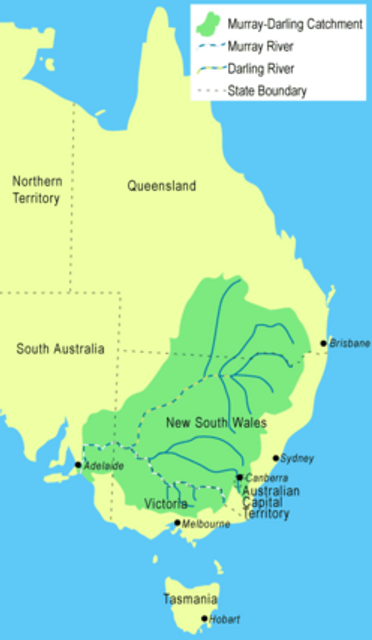
The fish were found at Menindee Lakes, which is part of the Murray-Darling Basin, Australia’s largest river system.
A map showing the Murray-Darling catchment
Spanning more than one million square kilometres in southeastern Australia, the Basin provides drinking water for over three million people, and supports more than 9,000 farms, which produce around 40 percent of Australia’s agricultural output. The Basin is also home to hundreds of species of native birds and fish.
The latest fish kill comes after about 10,000 fish died in a similar event a short distance upstream in late December.
Major fish kill events occur when large blooms of algae are killed by heavy rainfall, as happened in December, or a sudden cold snap, as was the case in January. The bacteria that decompose the dead algae use up what remains of the already depleted oxygen in the water, suffocating the fish.
Blooms of cyanobacteria (blue-green algae) occur as a result of low water levels, high temperatures, and high nutrient content in the water due to fertiliser run-off.
While the current drought certainly contributed to the low water levels in Menindee Lakes, lack of rainfall cannot be solely blamed for the fish kills. Many of the fish that have washed up on the banks of the Darling River at Menindee are Murray Cod, some estimated to be at least 30 years old.
Fran Sheldon of the Australian Rivers Institute explained: “Ecological evidence shows the Barwon-Darling River is not meant to dry out to disconnected pools—even during drought conditions. The presence of certain iconic river animals [such as the Murray Cod] within its channels tell us that a dry river bed is not normal for this system.”
According to Sheldon, excessive diversion of water for irrigation means that the floodplains and wetlands that feed the lower sections of the river are only filled during times of high flow. Low and medium flows that would otherwise have filled these areas are instead captured upstream for irrigation.
As a result, the river system is no longer able to cope with extended drought.
The public outcry over the recent fish kills has prompted a wave of finger-pointing and grandstanding from the major political parties.
NSW opposition Labor Party leader Michael Daley called for an inquiry into the fish kills, saying that the state’s Liberal-National Coalition government “have been repeatedly warned by far-west residents, community groups, scientists and Labor that their water policies would cause devastation on the Darling River.”
NSW Regional Water Minister Niall Blair, a member of the rural-based National Party, hit back, claiming that Daley was “ignoring the fact that similar environmental catastrophes happened under their [Labor’s] watch when last in government.”
Federal Agriculture and Water Resources Minister David Littleproud, another National Party leader, called for Basin states to agree to spend a pitiful $5 million from the Murray-Darling Basin budget to fund a strategy to look after native fish. The Murray-Darling Basin Authority previously cut its native fish strategy after the NSW Coalition government withdrew 60 percent of its funding in 2012.
The poor condition of the Darling River has had wider impacts. The region’s fruit growing industry has been decimated, tourism has all but disappeared, and local residents have reported that the poor quality of tap water from the river has been making them sick.
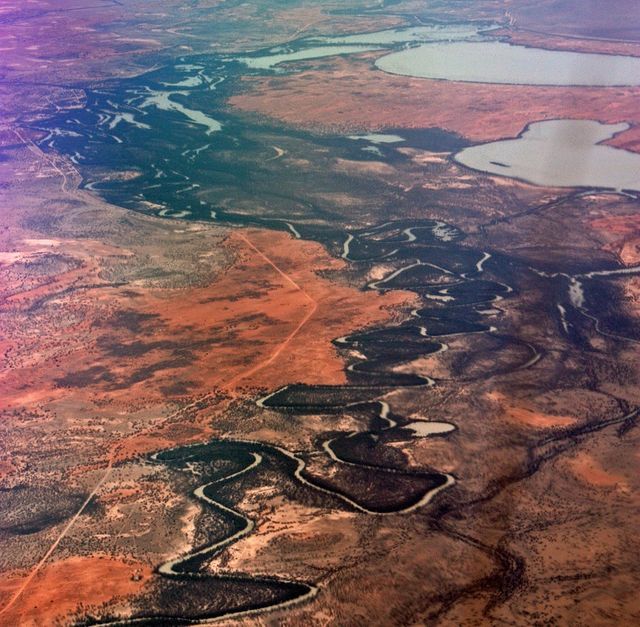
The Darling River and some of the Menindee Lakes, photo courtesy Tim Keegan - Flickr
The common failing of decades of attempts to address water security in the Basin is that they are all based on a “market solution” to the complex problems posed by various environmental, commercial, social and cultural issues.
The management of the river system is linked to a market in tradeable water entitlements, limited only by the total allocation of water usage. The market in water rights has ensured that huge agribusinesses accumulate vast water entitlements that are used to maximise profits to the detriment of rural communities, small businesses and farms and the environment.
In wet years, these corporate giants grow lucrative and thirsty crops such as cotton, and pump water out of the river into massive on-site storage facilities.
During extended dry periods, it may be more profitable for them to simply sell the water at exorbitant “market-rates” to growers of slow-maturing grapevines and fruit trees, who are seeking to avoid the destruction of their businesses.
If they are unable to pay, small farmers are forced to sell out to the big companies, which either farm the land profitably, due to their massive water assets, or simply add any water entitlements to their portfolios.
Since 1994, when water rights were first separated from land ownership under the federal Keating Labor government, the number of farms in Australia has fallen by approximately 16 percent. This consolidation of farm ownership means the use of water, a precious natural resource in the dry continent, is in the hands of big business.
The Labor government of Prime Minister Julia Gillard introduced the Murray-Darling Basin Plan in 2013. Ostensibly, it was designed to address the over-allocation of water for irrigation and improve the conditions of the river system by reserving more water for environmental flows.
Environmental scientists, including the Wentworth Group, criticised the plan, arguing that the 2,750 gigalitre (gL) per year target for water recovered from irrigation for environmental flows was insufficient to restore the Basin to health.
The Wentworth Group pointed out: “This volume fell substantially short of the Murray-Darling Basin Authority’s best estimate that between 3,856gL and 6,983gL was required for a healthy river.” In other words, the substantial shortfall ensured that the plan was unlikely to ever overcome the river system’s environmental problems.
Moreover, the target has not been reached. To date only 2,117.5gL has been recovered, almost three quarters of which was achieved before the Basin Plan was enacted. Progress slowed even further in 2014 when a cap on water “buy-backs” was introduced.
The federal government also seems to have paid well over the market price for several large-scale purchases of water entitlements.
In 2017, after declaring an end to water buy-backs, the government paid $78 million for 22gL of water entitlements from a property at Tandou Station, southwest of Menindee. The Australian Bureau of Agricultural and Resource Economics and Sciences valued the water rights at less than $25 million.
The deal was brokered by then Deputy Prime Minister, National Party leader and Agriculture Minister Barnaby Joyce. It resulted in a $36 million profit for Webster Ltd, the major water trader that owns the Tandou property.
Bill Johnson, a former director at the Murray-Darling Basin Authority, told the media: “It is highly questionable whether the Commonwealth got any water for this money.”
In reality the “buy-backs” of water entitlements do not necessarily mean more water in the river system. The purchase of a water right is meaningless if there is no water flowing in the relevant area.
The main beneficiary of the water entitlements market has been big business. The government has bought back entitlements, in some cases to water that does not exist, and has subsidised improvements to irrigation infrastructure.
The dead fish at Menindee are just one graphic symptom of the failure of the Murray-Darling Basin Plan, like previous “market solutions,” to manage Australia’s largest river system to meet the needs of the majority of people, rather than the profits of the wealthy few.

Reports indicate Haitian government involvement in La Saline massacre

John Marion 

The La Saline massacre, which occurred in Haiti on November 13, rivals the crimes of the Duvalier dictatorship and of the military regimes that seized power after Duvalier fell. Fifty-nine people, including children as young as three years old, were murdered in La Saline in a premeditated slaughter. Only the Jean-Rabel massacre, perpetrated in 1987 by the regime of Henri Namphy with support from tontons macoutes, has involved more deaths.
La Saline is a poor neighborhood in Port-au-Prince, described by PBS as a place where people “cook over open fires in alleyways so narrow that two people can’t pass without touching shoulders.” The Saint Jean Bosco church of Jean-Bertrand Aristide was in La Saline, and recent protests against government corruption have found support there. It is located on the other side of a canal from the former Fort Dimanche prison, where the Duvaliers tortured and murdered thousands of people.
La Saline also houses a commercial port with three terminals, and the Croix-des-Bossales market that sells produce from the country to restaurants, wholesalers and supermarkets. Early press reports blamed the killings on gangs fighting over control of the market.
The National Network for the Defense of Human Rights (RNDDH) has conducted a thorough investigation of the massacre, including interviews with survivors, family members, hundreds of La Saline residents, judicial and police figures, and a parliamentary deputy. The resulting report describes how for years the government has made use of the armed gangs, about whose murders and extortion it is fully aware, to subdue the population. People interviewed accuse government figures of supplying arms and money to the gangs.
The report describes how, in October 2017, a commission including the minister of the interior, the minister of public health, and the wife of President Jovenel Moïse, visited La Saline to promise the rebuilding of one school, the creation of another, and the renovation of a public health facility. In return, they demanded that residents keep protesters from marching through the neighborhood. The residents refused.
One year later, the protests of October 2018 made use of the neighborhood as a meeting place.
The RNDDH names several government figures accused of direct involvement in the November 13 massacre. Fednel Monchery, director general of the Ministry of the Interior, is accused of having participated in the planning and of having furnished arms and vehicles.
Joseph Pierre Richard Duplan, former mayor of Port-au-Prince, is accused of having supplied arms and uniforms. Some perpetrators of the massacre were wearing Haitian National Police (PNH) uniforms. Separately, Duplan has been questioned in the disappearance of news photographer Vladjimir Legagneur 11 months ago.
Police agent Gregory Antoine is accused of having participated directly in the massacre, fighting alongside the Base Nan Chabon gang. Police agent Jimmy Cherizier is accused of having participated directly and of having hosted the meeting at which the massacre was planned.
A lawsuit filed by 13 residents of La Saline in December seeks to determine whether the president, the prime minister, the minister of justice, the minister of the interior, and the director general of the PNH were involved, according to Le Nouvelliste. The 13 people bringing the suit represent a group of more than 50, most of whom remained anonymous out of fear for their safety.
The 59 murders were gruesome: People were dragged out of homes and executed point blank; others were chopped to death with machetes; children were shot in their homes; bodies were burned, chopped into pieces, left in heaps of garbage, and fed to pigs. Women were raped.
The RNDDH was able to identify 45 of the 59 dead and includes details of their murders in its report. When it confronted the police and judiciary with its findings, they claimed ignorance. The police claimed not to know how many were killed, while the judicial authorities said they had “no precise information relating to the events.” The report also notes that, aside from the announcement by Prime Minister Jean Henry Ceant that he was opening an investigation, the government made no pronouncements in the first two weeks after the massacre.
The silence and evasion foreshadow future crimes. The government of Ceant and President Moïse is in deep crisis, and desperate. Moïse’s previous prime minister resigned after his attempts to cut fuel subsidies caused massive protests last July.
Haiti’s rate of inflation was more than 15 percent last year and its currency continues to drop against the dollar. A shortage of gasoline and diesel is developing because of the government’s inability to pay the company that has been importing them from the US since Haiti’s participation in the PetroCaribe program. More protests against austerity and corruption are planned in February.
The big bourgeoisie has come out publicly against Moïse, with Reginald Boulos criticizing him for having voted against Venezuela’s membership in the Organization of American States and Dimitri Vorbe of Sogener telling the TV program “Haïti, sa k ap kwit” that “the state needs to be organized to create all the conditions needed to promote the functioning of businesses in Haiti, which would allow them to make money, but also to give it to the state (in taxes).”
On January 14, protests occurred in the commune of Lascahobas after months of electricity rationing. After the protesters blocked traffic with barricades, police from the Departmental Unit for the Maintenance of Order (UDMO) fired live ammunition, killing at least two. One of the victims was shot in the heart.
In December the offices of Radio Kiskeya, known for its political reporting since 1994, burned to the ground after a fire spread from the building next door. Liliane Pierre-Paul, one of its founders, had survived torture and exile by the Duvalier regime in the 1980s. In 2015, at a time when the station was critical of then-president Michel Martelly, an unidentified person fired shots at the station.
In the weeks following the fire, which destroyed not just the station but its archives as well, criticism of the government’s response was limited to the underfunding of firefighters, who took more than an hour to respond. However, Le Nouvelliste reported this week that Pierre-Paul and Director General Jean Marvell Dandin filed a lawsuit on January 18 demanding that the court investigate whether the fire was set. The suit also asks the judge to determine whether the firefighters were delayed deliberately by the government.

Brazilian Workers Party uses crime wave to back fascistic Bolsonaro on repression and austerity

Miguel Andrade

A wave of attacks on public infrastructure in Ceará, one of the poorest states in Brazil’s Northeast, has provided an opportunity for the self-styled “anti-fascist” opposition in the Workers Party (Partido dos Trabalhadores—PT)—which run’s Ceará’s state government—to collaborate with Brazil’s fascistic new president, Jair Bolsonaro.
The government has so far reported 235 attacks in 50 municipalities, mostly directed at police and mass transit, including the metro of the state capital, Fortaleza, but also extending to schools, garbage collection and energy transmission infrastructure.
The crime wave was reportedly initiated by a “tactical agreement” between the state’s largest drug trafficking gangs as a response to the nomination of a new head for the state’s prison system. Already entering its fourth week, it is only the latest episode in the protracted and tragic crisis of the country’s overcrowded and abusive prison system, true dungeons of a system of social apartheid in one of the world’s most unequal societies. Hundreds of inmates have been killed in numerous riots, many by the most horrific methods.
Brazilian prisons are filled to no less than 100 percent overcapacity. Forty percent of the 700,000 inmates—the world’s third largest prison population—have not even been sentenced, while fully 20 percent of those sentenced are in jail for simple theft and are eligible for alternative sentences judges never bother to apply.
The situation is even worse in Ceará, where overcrowding stands at 300 percent, and an even more staggering two-thirds of inmates have not been sentenced. Even so, the PT state governor announced at the end of 2018 he would nominate Luís Mauro Albuquerque Araújo, the former head of the prison system in neighboring Rio Grande do Norte state, for the same position in Ceará.
Araújo has been held responsible for institutionalizing state-sponsored torture in Rio Grande do Norte’s prisons in a 2018 report by the Justice Ministry’s Torture Prevention Committee. The panel compared his administration to that of the US-run Abu Ghraib prison in Iraq with regular humiliation of naked inmates, beatings, isolation and deprivation of family visits.
The dismal conditions of prisons is widely considered by experts as the single most influential factor in gang recruitment, since belonging to a gang is considered by inmates the best means of abuses ranging from theft of personal belongings to rape. “Christened” inmates are from then on required to obey the gangs after they are released, under the threat of torture and execution of family members by their own “chiefs.”
At the beginning of the crime wave, Governor Camilo Santana asked the Justice Ministry for the deployment of the National Guard, which was swiftly implemented amid reports of an increase in police abuse beginning to flood the state’s Human Rights Council. Reports vary from house-to-house searches and fabricated evidence to a doubling down of inmate abuse, with guards unleashing dogs on naked inmates. In perhaps the most serious abuse, security agents have been forcing suspects to declare belonging to gangs in widely shared whatsapp videos, a procedure considered by experts to be a death sentence, allowing for rival factions to come after the suspect on the streets or in prison.
The most lasting impact of the crime wave, however, is the Workers Party’s embrace of Bolsonaro’s proposal to extend the country’s anti-terrorism law to include “burning buses” and “damaging public buildings.” The move was formalized in a meeting between Santana and Bolsonaro’s right-wing justice minister, Sérgio Moro, on January 17 in which Santana asked for the federal government’s support. This followed an interview with Santana on CBN radio January 11, in which he suggested that “state autonomy” should be wider in defining terrorism—a matter currently in the hands of the federal government.
A longstanding demand of Brazil’s far-right, such an extension of the definition of terrorism is directed at the criminalization and repression of social opposition. It would vastly widen the reach of a draconian law approved under PT President Dilma Rousseff in 2016 using the pretext of the 2016 summer Olympics in Rio de Janeiro.
The 2016 anti-terror law characterizes as terrorism “sabotage with the goal of provoking social or generalized terror.” Defended by the PT as a “democratic” law that drew a distinction between actions carried out for the purpose of pressing demands and those aimed at “provoking generalized terror.” However, it left it to the security forces to determine which was which.
The right-wing shift in Brazilian politics beginning under the PT, with the 2013 mass anti-austerity and anti-World Cup protests against Rousseff, has already seen 23 demonstrators sentenced to an average of seven years imprisonment for “qualified damage” and “resistance,” based on 2013 and 2014 laws that pre-date the anti-terror legislation.
Other PT governors have also since early 2018 aped Bolsonaro’s far-right, repressive agenda, making “security issues” a central tenet of their electoral campaigns. Some of them have even discussed issues of controlling protest and surveillance with the Israeli ambassador to Brazil. Repressive “partnerships” with Israeli law enforcement and security companies are one of the central issues in Bolsonaro’s far-right rants. The PT’s Piauí state governor, Wellington Dias, is currently in Israel to discuss such issues, after his counterpart in the state of Bahia, PT Governor Rui Costa, did his own right-wing “pilgrimage” to Israel after reelection, in November 2018.
Meanwhile, some 20 congressmen from Bolsonaro’s Social Liberal Party (PSL) returned from a recent trip to China, paid for by the Chinese government, in which they were presented with a system of facial recognition to be installed in Rio de Janeiro’s streets and mass transit system, allegedly to fight crime. The trip was offered by the Chinese government as a “goodwill” gesture to deflect the anti-Chinese demagogy that characterized Bolsonaro’s election campaign.
For its part, Justice Minister Sérgio Moro left Ceará to meet his Argentine counterpart in Brasília to sign a new treaty expediting extraditions between the two countries, in order to avoid “what happened to Cesare Battisti,” who was subjected to a rendition operation with which the Bolivian, Italian and Brazilian governments illegally cooperated. As Moro considers that existing rights to challenge extradition were an obstacle to Battisti’s rendition, the new treaty can only mean Brazil and Argentina will work to legalize such methods.
Most importantly, the collaboration on “security issues” has been a central argument for meetings between PT governors and Bolsonaro’s candidate for speaker of the House, Rodrigo Maia, of the Democrats party (DEM), who is seeking reelection. The support for Maia, who was first elected as speaker in 2016 with crucial PT votes, has been posed by the PT and its allies as a defense of Congress’s “independence.”
After Maia left a meeting with PT congressmen and the Piauí governor Dias, the PT-aligned Brasil247 celebrated with a headline: “Maia defends pact with the PT and displeases Bolsonaro clan.” The meeting happened after the PT’s president, congressional representative Gleisi Hoffmann, feigned indignation over Bolsonaro’s support for Maia, saying that the party would not support him if Bolsonaro’s PSL did.
Maia will nonetheless have the official support of the Democratic Labor Party (PDT), which came in third in the October presidential vote and was courted by the PT with the offer of the vice-presidential position on its slate, and of the Maoist Communist Party of Brazil (PCdoB), which actually accepted a similar PT offer, running Manuela D’Ávila for vice president. It is clear that if Maia is reelected, it will be due to PT “defections.” The same must be expected on the crucial votes on the “pensions reform,” which PT governors already have declared “must be discussed” in a November 14 letter to Bolsonaro.
Another PT ally, Renan Calheiros of the Brazilian Democratic Movement party (MDB), who twice presided over the Senate under PT’s rule, is also seeking favor with Bolsonaro in order to be elected for a third term. Calheiros’ son was elected with PT support as governor of Alagoas state, also in the northeastern region. During his campaign, the PT’s presidential candidate Fernando Haddad declared at a rally: “I come here to bring the acknowledgment of Lula for your defense of him and your dignity.” Calheiros, however, saw no obstacle to jumping from Lula’s defense to that of Bolsonaro’s son, senator Flávio Bolsonaro, under pressure to resign over accusations of graft and of collaboration with death squads in his home state of Rio de Janeiro. On January 18, he described the younger Bolsonaro as “a boy with strong opinion and who defends them, who wants to do good.”
Just three weeks into Bolsonaro’s administration, the PT’s claims to offer a “democratic resistance,” let alone an alternative, are being thoroughly exposed. The same is true for all the pseudo-left currents, many of which posture as socialist or even “Trotskyist,” which not only called for a vote for the PT, but which are now covering up the party’s collaboration with Bolsonaro.
These include first and foremost the myriad Pabloite and Morenoite currents operating within the Socialism and Liberty Party (PSOL), the parliamentary split from the PT, but also the PT apologists within the Workers Cause Party (PCO), which claims that the collaboration with Bolsonaro is restricted to the “right wing” of the party, and that its “left” should be defended. Such a “left” includes jailed former president Lula—who hand-picked the right-wing, pro-austerity Fernando Haddad to substitute for him in the elections, Hoffmann, and the union bureaucrats who on December 18 recorded a video sent to Bolsonaro saying they were “sorry” for questioning his legitimacy and also offering to negotiate the “pension reform.”