28 Jan 2019

Presidential campaign officially begins in Ukraine

Jason Melanovski 

Ukraine’s presidential election campaign officially kicked off on December 31. The election season began in the wake of almost two months of martial law in several regions of Ukraine, declared by Ukrainian President Pedro Poroshenko after a US-backed provocation by the Ukrainian navy against Russia in the Azov Sea.
Thirteen candidates have officially registered thus far to run in the election, which will be held on March 31.
Early polling suggests that due to universal disillusionment with the country’s political figures, no single candidate will win outright in the first round of the election. If no candidate garners 50 percent of the vote on March 31, the winner will not be determined until a second round runoff is held in May between the top two candidates.
Even those who are leading the polls—incumbent president Poroshenko and two-time former prime minister Yulia Tymoshenko—are widely hated and despised by the population.
Tymoshenko continues to be the frontrunner in polls, leading by 16-20 percent. She was officially nominated this week at the congress of her Fatherland Party, where she unveiled her campaign slogan, “I believe in Ukraine.” Former Georgian president and American stooge Mikheil Saakashvili and former NATO secretary-general Anders Fogh Rasmussen both appeared in videos expressing their support for Tymoshenko prior to her appearance at the congress.
In a highly staged and choreographed performance, Tymoshenko promised to raise salaries to the level in neighboring Poland, end the civil war that has claimed over 10,000 lives and finally push the country into NATO and the European Union.
Tymoshenko’s advantage among Ukrainian voters is primarily due to her constant criticisms of the bumbling and despised Poroshenko regime. She has also hypocritically positioned herself as a vocal opponent of the country’s subservience to various International Monetary Fund agreements, which she has labelled “economic genocide,” while at the same time promoting the country’s accession to NATO and the EU. As she well knows, complete subservience to IMF dictates would be a prerequisite for the Ukraine joining either organization.
Notwithstanding her early lead, a Tymoshenko victory is far from guaranteed. A recent poll indicated that 26 percent of the country highly dislikes Tymoshenko, greater than the share of people who actively like her. Due to her previous business interests in Russia and her populist criticisms of the IMF, Tymoshenko is also viewed with suspicion in Western capitals and recently toured Washington DC to placate Ukraine’s imperialist backers.
The current president, Petro Poroshenko, generally polls second or third behind Tymoshenko, with 10-13 percent support. Brought to power in a US- and EU-backed coup by the far-right in February 2014, Poroshenko is associated with the rapid deterioration of living standards and the ongoing war in eastern Ukraine. His campaign has relied on the whipping up of extreme militarism and nationalism, religious separatism and fear-mongering about Russian aggression.
A centerpiece of his campaign is the creation of a new Ukrainian Orthodox Church as separate from the Moscow Patriarchate, which historically oversaw the Ukrainian Church. Poroshenko has shamelessly backed the newly created church as a matter vital to the survival of the Ukrainian state and the country’s “identity.” In doing so, he has set the stage for a potentially violent religious conflict between the two churches over property, parioshners and funds.
Comedian Volodymyr Zelenskiy has been polling third or even second to Tymoshenko. A highly popular entertainment figure on both Ukrainian and Russian television, Zelenskiy, who has never held political office, has portrayed himself as a pragmatic “anti-politician” who uses humor to criticize the country’s political elite.
Despite his supposed outsider status as a political “rebel,” a Zelenskiy presidency would simply be the continuation of rule by the country’s super-rich oligarchic elite, just from a different section of the oligarchy, which finds itself in opposition to Poroshenko over business dealings. Zelenskiy was a vocal supporter of the Maidan and the Ukrainian military intervention in the East.
He enjoys close ties with Ukrainian oligarch and 1+1 television channel owner Ihor Kolomoisky. Kolomoisky has been in an ongoing dispute with Kiev over the embezzlement of $5 billion from Ukraine’s PrivatBank, which Kolomoisky previously owned. He is now living in Israel and views the upcoming elections as his chance to return to Ukraine and his business empire once a new regime is in power.
Zelenskiy recently encountered his first PR campaign crisis when it was revealed that he still owned shares in the Russian film company Green Films, despite previously stating that he had cut his Russian business ties after the annexation of Crimea by Russia. Subsequently, he announced that he would be divesting himself of his shares in the company.
Zelenskiy’s candidacy is also expected to face potentially violent opposition from Ukraine’s vocal far-right nationalist parties and groups due to his Jewish background and previous jokes on TV lampooning Ukrainian nationalism.
A crowded group of candidates trails Tymoshenko, Poroshenko and Zelenskiy, including former defense minister Anatoliy Hrytsenko, far-right Radical Party Leader Oleh Lyashko, L’viv Mayor Andriy Sadovyi and Opposition Bloc leader Yuriy Boyko. Boyko is the only candidate in favor of better relations with Russia, but he is unlikely to make it out of the first round, as his party’s base of support lies in separatist eastern Ukraine.
Whatever the outcome in March, none of the pro-imperialist and oligarchic candidates will seek to address the social and political crisis dominating the life of the Ukrainian working class.
According to a recent poll by the Kyiv International Institute of Sociology (KIIS), 9.3 percent of voters don’t even plan to go to the polls on election day and another 4.7 percent plan to cast no-confidence votes to protest the elections.
A separate poll by the International Republican Institute found that over 70 percent of participants believe the country is heading in the wrong direction and more people actively dislike the leading presidential candidates than support them.
Data from a January poll of Ukrainians suggested that the most pressing issues on their minds were not the elections, but rather the never-ending war in the Donbas and the country’s pitifully low wages.
Another recent poll released just prior to the New Year found that 35 percent of Ukrainians would like to work abroad, a portion far greater than those favoring any single politician. Almost one million Ukrainians are living on the brink of starvation, and recent months have seen a series of protests and strikes by the impoverished working class.
The election is being closely followed by Western imperialist powers such as the United States and Canada, which have already begun warning about “Russian meddling” in the electoral process.
At a conference on Ukraine organized by Ukrainian oligarch Viktor Pinchuk as part of the World Economic Forum in Davos, President Poroshenko spoke to an assembled crowd of imperialist functionaries and claimed that “For Russia, this election is a final chance to get its revenge.” Poroshenko’s claims about Russian meddling are being used to set the stage for his regime to cry foul over Russian interference if he loses in March.
Former United States Secretary of State John Kerry and Canadian Foreign Minister Chrystia Freeland were also present for Poroshenko’s speech and voiced support for stamping out Russian “influence” in Ukraine’s election, while planning their own intervention in another country’s election—that of Venezuela. According to Freeland, “By working with Ukraine on helping Ukraine to have a free and fair election, we’re helping ourselves.”

Wave of xenophobic violence against Venezuelans living in Ecuador

Cesar Uco

The killing of a pregnant Venezuelan woman on January 11, stabbed to death by her ex-boyfriend in the northern Ecuadorean city of Ibarra, unleashed a wave of xenophobic mob attacks against Venezuelan immigrants, forcing many to flee for their lives.
Crowds roamed the city’s streets, attacking Venezuelans’ homes, dragging them out and chasing them. Some were pursued by people in vehicles, brutally beaten and stoned. Four individuals were imprisoned for acts of violence.
The night after the murder, a mob went to a shelter for Venezuelan migrants and was only prevented from entering by a police cordon. Then the protesters took to the streets, just as they had done the previous day when the crime was committed.
The Quito daily El Comercio reported: “Desperate families ran through the streets carrying bags, children in their arms, with faces of panic. The Venezuelans reached the bus terminal of Ibarra, where late at night they were looking for tickets with no certain destination.”
The mobs also entered the city’s central parks to evict foreigners who slept in public places. Children and their parents were forced to leave the places where they had rested as their assailants burned their belongings.
Fearing for their lives, others sought to reach the Rumichaca border bridge to Colombia. Among them were migrants who began their exodus from crisis-ridden Venezuela two weeks earlier, crossing Colombia most of the way on foot and then seeking to go through Ecuador to reach Peru where family members and hoped for opportunities await them.
Hearing of the the attacks, many Venezuelans decided not to go to work on Monday, January 21. Despite having worked in Ibarra for more than half a year as a locksmith, Gustavo told El Comercio that “there is no support from local authorities to protect the life of newly arrived foreigners.”
“Like him, there are several families of foreigners,” El Comercio continued, “who remained locked in their homes for fear of being attacked, as happened with other people. Maxsalí, another migrant, sent his wife and four children to the house of some friends. He recalls that his family and other compatriots had to take refuge on the roof of a house for fear of the groups of people who asked for the foreigners.”
The anti-immigrant violence is in line with the policies of the right-wing Ecuadorean government of President Lenin Moreno, which has engaged in an escalating persecution of immigrant workers. In Guayaquil, for example, officials of the Ministry of Labor raided three workplaces under the pretext of verifying the legal status of the workers. A vulcanizer and a car wash were raided. In one establishment, they detained 14 Venezuelans who were working without papers.
Moreno’s government, aping the policies of his increasingly close ally, the imperialist government of US President Donald Trump, is promoting xenophobia in Ecuador in order to blame foreigners for the sharp decay in the Ecuadorean economy.
In the first weeks of January 2019 alone, the Ministry of Labor carried out 75 raids, 30 in the main port city of Guayaquil. In 2018, it staged 16,000 raids, detaining 3,600 for lack of papers.
On Tuesday, January 15, just two days after the rioting in Ibarra, Moreno joined Trump, becoming one of the first Latin American heads of state to recognize the president of the National Assembly, the right-wing stooge of the US State Department, Juan Guaidó, as president of Venezuela, initiating a process that could end up in civil war or US military intervention.
Now Moreno has upped the stakes, blocking flights that had been scheduled for January 26 to allow Venezuelans to go back to their country.
The Venezuelan embassy in Ecuador issued a declaration accusing president Moreno of human rights violations in denying the right of return of 270 people to Venezuela. It emphasized that most of them “have said they have been victims of xenophobia, discrimination, labor exploitation and trafficking on Ecuadorean soil.”
A program offering flights for Venezuelans seeking to return home has so far led to “12,000 repatriations of Venezuelan citizens from Brazil, Peru, Ecuador, Argentina, the Dominican Republic, Colombia, Chile and Panama,” according to Telesur. The brutal the killing of the 22-year-old Venezuelan girl, Diana Carolina, that sparked the anti-Venezuelan pogroms could have been avoided. Newspapers reported that local police officers observed the incident for 90 minutes without intervening after the young woman was taken hostage.
In an attempt to save face, Moreno decided to sack both the governor and the chief of police in Ibarra, while sending a unit of special forces to the city.
The violence shocked most Ecuadoreans. In Quito there was a large protest on January 12 with demonstrators condemning xenophobia as well as a series of murders of young women in the country.
The intense social inequality that pervades Latin America has also given rise to the world’s highest crime rates, with a recent survey finding that the 10 most violent cities in the world (outside of the war zones of the Middle East) were all in the region.
The attempt by the Moreno government to scapegoat Venezuelan immigrants for these conditions is part of a worldwide turn to the right and xenophobia by capitalist governments. It is, at the same time, a manifestation of the ebbing of the so-called “Pink Tide”, within which the former government of President Rafael Correa was counted. In the face of deepening economic crisis and rising social tensions, governments throughout the continent are turning towards methods of class war and repression.

AP report exposes US role in right-wing coup in Venezuela

Eric London

The United States intensified its coup operation against the Venezuelan government of Nicolas Maduro over the weekend as the European Union swung behind the US effort.
Speaking on Saturday before the United Nations Security Council, US Secretary of State Mike Pompeo declared, “The regime of ex-president Nicolas Maduro is illegitimate. We therefore consider all of its declarations and actions illegitimate and invalid.”
Calling Venezuela an “illegitimate mafia state,” Pompeo addressed the governments of the world: “Either you stand with the forces of freedom, or you’re in league with Maduro and his mayhem.”
Also on Saturday, several European governments—including France, Germany, Spain and the UK—delivered an ultimatum, declaring that they would recognize US-backed, self-declared president Juan Guaidó unless Maduro called new elections within eight days. As expected, Maduro rejected the ultimatum.
Throughout Sunday, Maduro visited military bases and tweeted videos of himself in military garb addressing troops and conducting exercises with the Army and Navy.
“To guarantee peace, we must prepare ourselves,” Maduro said. “In this world we respect the brave, the courageous, and we have to respect the Venezuelan nation with military power.” He reiterated that the military would hold the country’s largest nationwide military exercises beginning February 10.
At the same time, Maduro rescinded his previous threat to expel US diplomats in Venezuela, allowing Saturday’s initial expulsion deadline to pass without incident. Maduro announced that he would let US diplomats stay for another 30 days. He indicated in an interview on Turkish CNN that he had sent Trump “many messages” and was interested in “engaging in comprehensive dialogue.”
The US categorically rejected Maduro’s 30-day deadline in a statement yesterday that declared: “We do not have any plans to close the embassy.”
While Guaidó refused Maduro’s offers for talks, the US government is openly acknowledging its role in orchestrating the anti-Maduro coup. The Associated Press published a report Friday titled “Anti-Maduro coalition grew from secret talks,” which noted that the US-backed Guaidó coalition “came together over weeks of secret diplomacy that included whispered messages to activists.”
The AP reported that “in mid-December, Guaidó quietly traveled to Washington, Colombia and Brazil to brief officials on the opposition’s strategy of mass demonstrations.” According to anonymous US officials, “long sessions of encrypted text messages became the norm,” and when the decision was made to launch the coup, it was Guaió and his far-right supporters who were chosen to lead the coup. “Some moderate factions were left in the dark,” the report said.
Thus Guaidó met with the three most reactionary government leaders in the Western hemisphere—Donald Trump, Brazil’s fascistic President Jair Bolsonaro and Colombia’s far-right Iván Duque Márquez—and launched the coup with their support.
In a Sunday interview with the Washington Post, Guaidó said the opposition was engaged in negotiations with the Venezuelan military, encouraging them to switch sides and support the US-backed efforts to remove Maduro.
“We have been in talks with government officials, civilian and military men,” Guiadó told the Post. “This is a very delicate subject involving personal security. We are meeting with them, but discreetly.”
Guaidó’s interview with the Post took place after Reuters reported Saturday that Colonel Jose Luis Silva, a top Venezuelan military envoy at the country’s embassy in the US, publicly broke with Maduro and posted a video calling for his fellow military officers to support the US-backed opposition.
“Today I speak to the people of Venezuela, and especially to my brothers in the armed forces of the nation, to recognize President Juan Guaidó as the only legitimate president,” Silva said in a video recorded in his office in Venezuela’s embassy in Washington.
Since Maduro pulled back from threats to physically remove US diplomats from the embassy, the Trump administration has found a new potential provocation for direct military intervention. According to Guaidó, the US, through the opposition, may soon seek to deliver $20 million in promised food aid in order to force Maduro to choose between allowing the food to enter the country—thereby acknowledging the legitimacy of the Guaidó government—or rejecting the aid and allowing Guaidó, the US and European powers to denounce Maduro for “spreading hunger and disease,” as the Post put it.
Speaking last night, Guaidó announced new demonstrations set for Monday and “ordered” Venezuelan soldiers not to fire on protestors. Some 30 people have died in demonstrations in recent days.
There is a concern in the US-backed opposition that a protracted period of instability will incite the Venezuelan working class to take independent action.
According to a January report from the Venezuelan Observatory of Social Conflict (OVCS), there were 12,715 anti-government demonstrations over the course of 2018, or 35 per day.
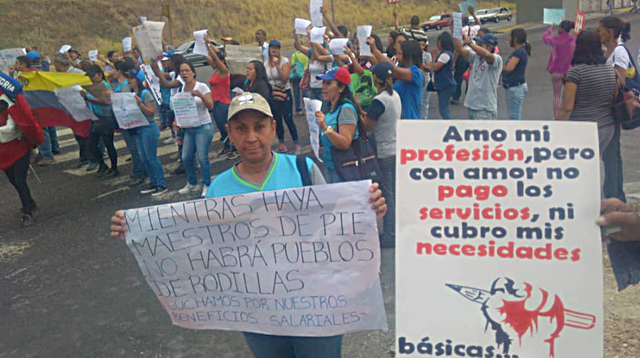
"When you have teachers on their feet you won't have people on their knees," and "I love my profession but love doesn't pay for services or cover my basic necessities"
The OVCS reports that only 11 percent of the demonstrations were led by the upper-middle class. A full 89 percent of the protests “occurred based on demands for economic rights” largely in the working class neighborhoods. The OVCS report notes that “the lack of social services also played a protagonistic role as one of the motives for the growth of protests in 2018. In fact, 3,716 protests were for this reason: 1,731 for lack of gas in homes, 1,138 for lack of access to water and 847 for lack of electricity.”
Venezuelan teachers shut road in January 17 protest
Just days before the January 23 opposition-led demonstration, Venezuelan teachers initiated a one-day national strike, which received widespread support among teachers and workers across the country.
On January 17, tens of thousands of teachers poured out into the streets, demanding massive raises and increases in spending for public education in what protesters called a “day of dignity for teachers.”
Like their counterparts in France, Mexico, Argentina and the US, Venezuelan teachers initiated spontaneous demonstrations numbering in the thousands, with slogans such as “The teacher who is fighting is also teaching.” Though the Maduro government downplayed the significance of the strike, videos and photos from across the country show that participation was in the tens or hundreds of thousands.
"Thousands of Venezuelan teachers demonstrate for wage increases to address the cost of living and increases to education spending
The Democratic Party in the US has lined up entirely behind Trump’s coup. The AP report exposing secret talks between Guaidó and the US noted: “Just as impressive, [Trump’s] tough-handed approach drew bipartisan support, with two of the Senate’s most senior Democrats, Dick Durbin and Bob Menendez, offering praise.”
On his show Friday, liberal media personality Bill Maher launched a colonialist rant, praising Trump’s coup as a sign that the president is bucking his supposed Russian backers:
“Today, Venezuela—this is the front page of the New York Times —Venezuela, okay, they have a guy, an opposition leader who finally stood up, and we are backing him. And Russia warned us to back off because they’re backing the dictator. This was the Monroe Doctrine! This is our backyard! And Russia is now telling us to back off of what goes on in Venezuela, because they know they can? Because they’re so emboldened? That doesn’t bother you?”
Washington’s cynical claims to be defending “democracy” in Venezuela are belied by the fact that the Trump administration appointed Elliot Abrams to oversee the “transition to democracy” on Friday. Abrams was convicted of lying to federal investigators during the Iran-Contra scandal and was a prominent advocate of the use of death squads in Central America during the civil wars that ravaged the region in the 1980s.

Hundreds missing, 58 dead in Brazil mine disaster

Gabriel Lemos 

Over 300 people are missing and 58 confirmed dead after a dam belonging to the Brazilian-based mining multinational Vale in the town of Brumadinho, in the southeastern Brazilian state of Minas Gerais, burst on Friday, January 25, releasing 13 million cubic meters of iron ore tailings on farms, villages and the local environment.
A sea of mud destroyed houses, dragged away cars and reached the Paraopeba River, responsible for one third of the water supply to the metropolitan region of Belo Horizonte, with some 5 million people, and about 50 other cities. There is the possibility that the mud in the Paraopeba River will reach the São Francisco River, the longest and one of the most important in Brazil, polluting 300 km of it that passes through four Brazilian states until it reaches the sea. The environmental impact of the disaster is incalculable.
Thousands of people in the region have had to flee their homes because of the advancing sea of mud. The death toll could have been greater if the mud had reached the center of Brumadinho, but it did erase small villages in the rural area of the town. Most of the dead and missing are Vale employees and their families.
Residents report that the mine’s warning sirens, which could have mitigated the disaster, did not work at the time of the accident. According to a resident who spoke to the daily O Estado de S. Paulo, “a few months ago, [Vale’s] technicians were here in the town to give instructions on the siren. They said that in case of emergency, it would ring. But it was not like that.”
On Sunday morning, 350 people were evacuated from their homes by firefighters because of the risk of another dam burst at Vale’s mine in Brumadinho. By the afternoon, the risk of collapse of this dam had been dismissed by the civil defense.
The causes of the tragedy are still unknown, and Vale said it had not detected any signs that the dam could burst. However, Minas Gerais prosecutor Guilherme de Sá Meneghin told O Estado de S. Paulo, “This new burst is far from a surprise, and one can not speak of an accident: this model is subject to disaster.”
Built in 1976, the dam that burst is an upstream tailings dam, but, according to the prosecutor, there are today more modern technologies for treatment of tailings. “Brazilian mining companies prefer to use the cheapest, most profitable, the most risky methods,” he said.
Until Sunday afternoon, two days after the dam burst, a Minas Gerais court had frozen 11 billion reais (US$ 2.9 billion) in Vale’s accounts for emergency measures and repair of environmental damage. In addition, Brazil’s environmental agency, Ibama, fined Vale 250 million reais (US$ 66 million). However, these figures are a fraction of the profits of one of the largest mining companies in the world—and the largest for iron ore—which in 2017 reached 22 billion reais (US$ 5.8 billion dollars).
The population of Brumadinho and all of Brazil reacted to the tragedy with anger and revulsion. “You [Vale] are killing Minas Gerais. WE HAVE NOT FORGETTEN MARIANA. MINAS REMEMBERS IT,” a local resident wrote on social media.
“Irresponsible, criminal company, how much more blood will you spill?” another resident wrote. “What happened in Brumadinho today was not an environmental accident, it was a crime. Environmental disaster is an earthquake, a tsunami ... Irresponsibility of Vale and of the justice system that did nothing in 2015,” another wrote on social media.
The tragedy in Brumadinho comes three years after Brazil’s previous greatest environmental disaster. In November 2015, a Samarco dam, a joint venture between Vale and the Anglo-Australian BHP Billiton, burst and released more than 39 million cubic meters of iron ore tailings on the Bento Rodrigues district, in city of Mariana, also in Minas Gerais. Eighty percent of the district of 600 inhabitants was buried by the mud, leading to the deaths of 19 people.
In Bento Rodrigues, there was no type of warning system for residents, and Samarco did not give any guidance to the residents in case of an accident, according to the daily O Globo .
The mud released by the dam burst in Mariana reached the Doce River, killing 11 million tons of fish and affecting the water supply of 39 cities in the states of Minas Gerais and Espirito Santo, with a combined population of at least 500,000 people. It is expected that the recovery of the river will take dozens of years, if it is really able to recover at all. Eighteen days after the dam burst, the mud in the Doce River reached the sea on the coast of Espirito Santo, 650 km away from the accident, advancing along many kilometers of the coastline, affecting the marine life, fishing and local tourism.
To this day, no one has been held responsible or convicted of any crime for this human and environmental tragedy in Mariana. Ibama also fined Samarco 250 million reais (US$ 66 million) and the joint venture has paid 1.3 billion reais in compensation to the local residents, but the construction of a new district has been delayed and is expected to be ready only next year. In addition to Samarco being charged with nine environmental crimes, 21 of its employees were charged with murder. After assuming the presidency of Vale in 2017 with the slogan “Mariana never again”, Fábio Schvartsman “apologized” for the tragedy.
After the tragedy in Mariana, there was an attempt to pass a bill in the the state Legislative Assembly of Minas Gerais on dam security that would have toughened inspections and levied harsher punishments on the mining companies. State deputy Rogerio Corrêa (PT), told Folha, “there was pressure from the [mining] companies,” so that the law was not approved.
Last December, Vale had obtained a license from the Minas Gerais government to increase by 88 percent the productive capacity of the Córrego do Feijão Mine, where the dam burst. According to O Globo, “the expansion project had its analysis procedures shortened, with the previous licenses, installation and operation evaluated at the same time. Normally, these licenses are approved individually.” After the disaster, the Minas Gerais government suspended Vale’s activities at the mine.
In Minas Gerais alone, the Brazilian state with the largest iron ore production, there are at least 400 tailings dams, 37 of them without guaranteed structural stability, according to the Association of Environmental Observers of Minas Gerais. In Brazil as a whole, there are 24,902 dams, 42 percent of which operate without any authorization or license, and only 3 percent of which were inspected in 2017. Of the 790 mining tailings dams, in 2017, only 263 were inspected, and 45 were found to be in precarious conditions. The Brumadinho dam which burst did not appear on this list.
Despite such a lack of dam inspection in Brazil, the Brazilian Congress has been moving toward even greater deregulation. Since the disaster in Mariana, six bills that would make environmental licensing more flexible have been discussed. One of these bills, dubbed “Samarco’s Bill,” proposed that “the submission of an environmental impact study would already be sufficient for the execution of the construction—regardless of the results of the study,” Folha reported.
Of these bills, the most advanced in the Congress is a new environmental licensing law that relaxes and accelerates the environmental process and is supported by the rural caucus and the mining companies. In addition, the bill exempts new livestock and agricultural enterprises from the need for licensing. Bolsonaro’s agriculture minister, Tereza Cristina, herself a member of the rural caucus, said that the approval of the bill “would be a very good thing for agriculture and livestock.”
With the coming to office of the Bolsonaro government, these bills diminishing environmental regulation are moving forward. Last December, Bolsonaro criticized what he called the “environmental fine industry,” adding that they are “extortionate” and that they “hinder the execution of infrastructure construction.”
Bolsonaro has also criticized the Paris Agreement, and, before taking office, called for the cancellation of the UN Climate Conference in Brazil, preventing it from being held this year in the country. His foreign minister, Ernesto Araújo, has also criticized the “scientific dogma” of climate change, which, like Trump, he claims is the result of “globalism” designed to “favor China’s growth.”
As for Bolsonaro’s environment minister, Ricardo Salles, in his inaugural speech, he declared: “We need speed, agility, stability and legal certainty [for environmental licensing].”
Salles, who ran in Brazil’s October 2018 elections as a candidate for federal deputy for Sao Paulo with the slogan “zero tolerance against the left and the MST [Landless Rural Workers Movement],” but was not elected, is one of the nine ministers of Bolsonaro government being criminally investigated or charged in court. At the end of December, he was convicted of administrative impropriety when he was environmental secretary of São Paulo for altering the protection map of the Tietê River, the most important of the state, to benefit a mining company. On Saturday, January 26, the São Paulo prosecutor’s office asked a Brazilian court to order Salles to leave the environmental ministry because of his conviction.

The global struggle of autoworkers

Jerry White

Over the last several days, tens of thousands of workers in the global auto industry have been engaged in a wave of powerful strikes against low-wages and sweatshop conditions.
Last Thursday, an estimated 13,000 autoworkers launched a one-week strike at a German-owned Audi assembly and engine plant in the Hungarian city of Győr. Workers at the plant produce 100,000 sedans, luxury sports cars and sports utility vehicles each year, along with gasoline, diesel and electric motors for Audi and other brands owned by the Volkswagen Group, the world’s largest automaker.
A Hungarian Audi worker earns around 1,000 euros (US $1,140) per month, about a third of his German counter-part, although living costs are comparable with Western Europe. The workers, who also earn considerably less than their Eastern European counterparts in the Czech Republic, Slovakia and Poland, are demanding an 18 percent wage increase and at least one full weekend off each month.
The strike coincides with a wave of mass protests against the passage of a hated overtime law by the right-wing government of Prime Minister Victor Orbán that allows companies to press employees to work the equivalent of six days a week on average. The measure, popularly dubbed as the “slave law,” is also known as “Lex Audi, Mercedes or BMW” because it was pushed by foreign automakers, the largest investors in Hungary.
The Hungarian strike follows walkouts by VW workers in Slovakia and Fiat Chrysler workers in Serbia in the summer of 2017 and by Ford workers in Craiova, Romania, just over a year ago. Czech workers at Skoda, VW Group’s highly profitable low-cost brand, are also preparing to strike next month over wages.
These struggles come as workers in Mexico are spearheading what is developing into an international struggle by auto and auto parts workers. Over the last two weeks, up to 70,000 workers at the so-called maquiladora plants have conducted a series of wildcat strikes in Matamoros, just across the US-Mexican border from Brownsville, Texas.
The workers are paid as little as 75 cents an hour to produce parts for the auto industry and other industries. They are demanding a 20 percent raise and a $1,700 bonus. Their action has already cut off the export of critical parts across the border and caused the slowdown of production at Ford and GM assembly plants in Michigan, Ontario, Canada and other locations.
Among the companies being struck by workers are Auburn Hills, Michigan-based Dura Automotive, owned by former Morgan Stanley and Goldman Sachs investment banker Lynn Tilton, whose net worth is $830 million. Matamoros is also home to top auto suppliers, including Delphi, the former parts division of GM, Johnson Controls and Canada-based Magna.
While the Trump administration wants to build a wall on the US-Mexico border and is witch-hunting migrants from Mexico and Central America, with Democrats proclaiming their commitment to “border security,” US-based corporations have no problem moving their goods back-and-forth across the border. The “Brownsville-Matamoros Borderplex” free trade zone has four international bridges and one international rail crossing, which handles at least $1.5 billion in goods each day.
The courageous Matamoros workers have formed strike committees in opposition to the company unions, which have enforced poverty wages and slave-labor conditions. They have marched to the US border to appeal to workers in the US to unite in their struggle. In the face of the media blackout, the WSWS has provided a voice and perspective for the striking Mexican workers.
Their struggle has inspired autoworkers in the US. In an email to the WSWS Autoworker Newsletter, a worker at Fiat Chrysler’s Jeep plant in Toledo, Ohio, wrote: “The situation in Mexico was our call to action. We are working under a contract that isn’t worth the paper it’s written on. The corruption at the top of our [union] leadership directly ties into this rotten contract they sold us. We should be in the streets here… Please tell our brothers and sisters in Mexico, how very proud [we are] of them. They are true heroes! I wish I could have met them at the border to join their demonstration. We are with them in spirit and hope they remain strong! Gracias!”
The strivings of workers in the US, Canada and Mexico to unite cuts across the reactionary nationalist campaign of the UAW and its Canadian counterpart, Unifor. As the Matamoros workers were marching to the border, Unifor president Jerry Dias called for a boycott of “Mexican-made” cars.
There is no such thing as a Mexican-made car, any more than there is an American- or Canadian-made car. A modern vehicle is made up of 30,000 parts, produced and assembled by workers in dozens of countries, not to mention workers who mined and processed the raw materials from around the world. Transnational corporations exploit the labor power of workers in dozens of countries to produce a single commodity and shift production around the world in search of the highest rate of profit.
Nationalism has long been peddled by the unions to cover up their own collaboration with the auto bosses to destroy the jobs and living standards of workers, while the union executives receive a portion of the additional profits extracted from workers in the form of bribes and money funneled through various corporatist labor-management schemes.
The UAW and Unifor are enforcing the blackout of the Matamoros struggle by the news media out of fear that workers in the US and Canada will also rebel against the corporate-controlled unions and unify with workers around the world in a common fight against the global auto companies and the capitalist system.
This is exactly what must be done. The WSWS calls on all workers and young people to attend and support the February 9 demonstration at the General Motors headquarters building in Detroit to fight against the global automaker’s planned shutdown of five factories in the US and Canada and the elimination of the jobs of nearly 15,000 production and salaried workers.
The demonstration has been called by the Steering Committee of the Coalition of Rank-and-File Committees, which was founded at the December 9 emergency meeting against the closures that was sponsored by the WSWS Autoworker Newsletter and the Socialist Equality Party.
That meeting unanimously passed a resolution to fight for the building of rank-and-file committees, independent of the UAW and Unifor, to “establish lines of communication and collaboration with all workers—including auto parts workers, teachers, Amazon workers, service workers and others—and fight for the unity of American workers with our class brothers and sisters in Canada, Mexico and the rest of the world.”
The objective impulse of the struggles of auto workers, teachers and other workers throughout the world is toward a general strike, drawing together all sections of the working class. This objective movement must be consciously developed and organized into a political struggle for workers power and the socialist reorganization of world economy.

26 Jan 2019

International Trade Centre (ITC) SheTrades Invest 2019 for Women-Owned Businesses in Developing Countries

Application Deadline: 31st January 2019 

Fields: Your company would preferably be operating in one of the following sectors:
 – Education – Healthcare – Agriculture – Agri-Business – Manufacturing – Water – Energy – Sanitation – Textile & Apparel – IT and BPO – Tourism – Beauty & Wellness


Type: Entrepreneurship

Eligibility:

1. Be at least 51% owned by woman/women;
2. Be at least 20% owned by woman/women, has at least one woman as CEO/COO/President/Vice President; and has at least 30% of the board of directors composed of women, where a board exists; or
3. Be a SME benefitting women.


Number of Awards: Not specified

Value of Award:
  • – Access to a range of local, regional and global investors and impact investors;
  • – Access to capacity building/technical Assistance from ITC;
  • – Increased level of competitiveness and a deeper understanding and knowledge of business practices, trade and investment.
Eligible Countries: Your company must be legally registered and operating in:
 – Oman – Nigeria
 – Egypt – Rwanda
 – Ghana – Senegal
 – Iraq – South Africa
 – Ivory Coast – Tanzania
 – Jordan – Uganda
 – Kenya – Zambia

How to Apply: 
  • Fill out the survey – link HERE;
  • Application process for Investors: If you are interested in investing in women-owned businesses, please email: womenandtrade@intracen.org
  • It is important to go through all application requirements on the Programme Webpage see link below) before applying
Visit Programme Webpage for Details

Swedish Institute Management Programme (SIMP) Africa 2019 for Young African Leaders

Application Deadline: 22nd February, 2019

Eligible Countries: Ethiopia, Kenya, Rwanda, Tanzania, Uganda, Zambia


To be taken at (country): Sweden and selected countries in Africa

About the Award: Sweden is considered to be one of the leading countries in sustainable business practice. Swedish companies play a prominent role in finding new, innovative ways to integrate social, environmental and ethical concerns into their core business models. But the challenges are global and we have a common need for sustainable development.
The programme curriculum revolves around advanced business-related problem solving, seminars and meetings with front figures in the commercial, political and cultural fields, as well as on-site company visits. By providing the platform for knowledge sharing, experience exchange and quality networking, the programme aims to challenge traditional approaches, reinforce professional skills, deepen cross-cultural perspectives and unite the participants in a long-lasting and active global network.
The programme, spread over seven months, comprises three weeks of intensive training divided into an introductory kick-off at the Swedish Embassy in each country, a two week module in Sweden and a concluding five day module in Africa.

Type: Training

Eligibility: To apply to SIMP Africa you have to:
  • aspire to make sustainability an integral part of your business strategy
  • be in a leading position within trade, industry or the public sector
  • have mandate to influence the business strategy for your organisation
  • be between 25-45 years old (born 1974 – 1994)
  • have a good working knowledge of both written and spoken English
  • be a citizen and resident of Ethiopia, Kenya, Rwanda, Tanzania, Uganda or Zambia
  • be can take part in all parts of the programme
  • be willing to forward competences and knowledge you gain from the programme
Selection: The applications will be evaluated according to the following selection criteria:
  • The relevance and quality of personal motivation and commitment, and the applicant’s answers in the application form.
  • An assessment of the CV
  • The general qualifications of the applicant
The Swedish Institute will make its decision taking into account the recommendations of the selection committee as well as the candidates’ general suitability for the programme. We are striving for as much diversity as possible in the group in order to maximise the exchange of experience between the participants, which means the distribution of candidates from each country will differ.
Out of all applicants, a number of shortlisted candidates will be called for interviews as a second step in the selection process. The interviews will be conducted by Business Sweden. The 25 selected applicants will be contacted by e-mail and offered a place in SIMP Africa 2019.

Number of Awards: 25

Value of Program: 
Costs covered and arranged by Swedish Institute
  • Training and content
  • Accommodation, food and domestic transport during the programme
  • Flight tickets to and from Sweden
  • Insurance covering acute illness and accident when in Sweden
Costs covered and arranged by you
  • Flight tickets to and from the kick-off and module 2
  • Visas costs, when necessary, to all programme modules
  • Occasional meals
  • Occasional airport transfers
  • Insurance when modules are held outside of Sweden
Duration of Program: 3 weeks

How to Apply: 
Create your application online in the application portal.
A complete application consists of all the information in the Program Webpage (see Link below)

Visit Program Webpage for details


Award Provider: Swedish Institute

EnerTracks Training Programme 2019 for Climate & Energy Enthusiasts in Developing Countries (Fully-funded to Berlin, Germany)

Application Deadlines:
  • Fellow Group 1: April 1 – May 10, 2019
    Application Deadline: February 3, 2019
  • Fellow Group 2: May – July 2019Application Deadline: To be announced
  • Fellow Group 3: September – October 2019Application Deadline: To be announced
  • Fellow Group 4: To be announced
  • Application Deadline: To be announced
Eligible Countries: Developing Countries


To be taken at (country): Berlin, Germany.

About the Award: A multi-disciplinary approach on how to tackle climate change and the energy transformation globally through practical lessons, academic training and one-on-one coaching.
A small group of four to six fellows is invited to come to the Agora Energiewende office in Berlin, Germany. Over the course of six weeks, the fellows have the unique opportunity to learn directly from in-house energy experts on why, how and when an independent organisation can support the energy transformation.

Type: Fellowship

Eligibility: Individuals with nationalities from eligible countries (List of Eligible Countries is in link below) currently employed and working in the power sector for non-governmental and not-for-profit organisations, civil society organisations or in academics.

Number of Awards: Not specified

Value of Award: Each fellow participates in the training sessions that are prepared and held by Agora Energiewende energy experts in Berlin, Germany. These sessions cover a variety of topics such as energy markets, least-cost planning, and research methodologies, among others (see full course list here). Supplemental online and reading material as well as group discussions complement each of these sessions.
Furthermore, fellows also benefit from one-to-one mentoring from Agora Energiewende experts. With the support of their mentor, each fellow tackles one specific transformation topic that they choose in advance. The topic should be relevant from the perspective of the fellow’s own organisation, with the intention of transferring the achievements into their domestic work.
  • 40 hours of teaching sessions (see course list here: EnerTracks Fellowship Course List)
  • 40 hours individual reading in preparation for each session
  • 10 hours of one-on-one mentoring
  • 10 study tours in and around Berlin, including executive leadership seminars at the LEAD Academy, focused field visits, seminars, and discussions with key German stakeholders
  • Access to the EnerTracks alumni network
  • Financial support, including a travel grant, fully-covered living accommodations, fully-covered transportation tickets, a daily stipend for food, and available office space
Duration of Programme: See Application Deadline (above)

How to Apply: To apply for the Fellowship Programme, please prepare the following documents in English:
  • letter of motivation
  • curriculum vitae / resume
In the letter of motivation, please explain why you would like to be considered for this fellowship and present a domestic energy transformation topic which you would like to explore with your mentor while in Berlin, Germany.
Please upload your application in a single PDF file by February 3rd, 2019 to the following Cloudlink below
Please use the following wording to name your PDF file:
“application_spring_fellowship_enertracks_surname_name”

  • It is important to go through all application requirements on the Programme Webpage see link below) before applying

Visit Programme Webpage for Details

The Complexity of Citizenship Amendment Bill

Kabir Deb

“If we desire a society of peace, then we cannot achieve such a society through violence. If we desire a society without discrimination, then we must not discriminate against anyone in the process of building this society. If we desire a society that is democratic, then democracy must become a means as well as an end”~ Bayard Rustin
For people outside Barak Valley, it is much easier to give their opinion on the controversial Citizenship Amendment Bill, whereas those who are living in the Barak Valley region or in the Bengali regions of Brahmaputra Valley, it’s tougher to the same extent to decide anything about the impact of Citizenship Amendment Bill because one decision can be false too.
The bill has taken over the seven sisters and it is leading to wide anger from various communities. Many are supporting it to the last extent whereas even more number of people are protesting against it by even giving a decision that if the bill is passed then they would either go for self immolation or they would fight for an independent state. Recently, after Assam, CAB just took over whole Mizoram as many Mizos started protesting against the Bill since it would grant citizenship to many Chakma citizens who they claim as “illegal immigrants”.
In Assam, the scenario is far more complex since it has established various angles because of different ideologies running in a nonsense manner without even thinking that what the bill suggests and what can be its impact. However, those who protest against it from a racist perspective are far worse than the human rights activist, because the former discriminates one community as an illegal community while the latter fights for every community. The complexity, however, cannot be seen because either some are blindly believing it because of communal love whereas another community (Assamese Community) protests for the growing impatience and intolerance against another community which is the minority community.
Let’s dissect that what are complexities of Citizenship Amendment Bill:
● From the perspective of people who live in the region of Barak Valley, if the Citizenship Amendment Bill, is seen then it is clearly dividing the Bengali community into two on the basis of religion: Hindus and Muslims. Even after that, most of the Bengali community supports it because of the growing intolerance inside the Assamese community, which demands for the elimination of the Bengali citizens completely.
Leaders of various political parties protest against the Bill in a very communal manner by saying that, “The Bengali community shouldn’t be allowed to live in the state and so the bill shouldn’t be allowed to pass. And if allowed, then they would demand for an Independent Assam since Assam belongs to Assamese citizens only”. The loud discriminatory and derogatory comments in an open field with thousands supporting the comments is quite enough for people of Barak Valley and Bengali regions of Brahmaputra Valley to support the bill making it a “good move”. It is like the Satan of a pessimistic story. Satan gets the support because the whole plot itself is negative and the only hope to live in the society is by letting Satan live which is supporting them.
● The Assamese community with their own political parties find Assam to be under threat since the state is being populated by the Bengali community and if spoken in a religious manner, then populated by Muslims, which the Assamese citizens find as a threat to the state and it would sustain if the bill is passed and hence, they protest against the Bill. It is quite devastating to see that the whole community, which had the history to be discriminatory over the Bengalis, today finds an even more derogatory path to eliminate the Bengali community over a political platform. The political leaders along with the extremists protest against it by breaking alliance (which is just a way to collect votes) and shooting bullets over the Bengalis of Brahmaputra Valley. For the people, who sit in an air conditioned cabin, it is quite easy to give their own opinion but the field scenario is far more devastating because the whole process of division is racist and communal.
● From the perspective of the Citizenship Amendment Bill itself, we can clearly see that the bill is a silent weapon of the ruling government to divide the Bengali community along with creating an agitation between the Assamese and Bengali. The bill clearly has little protection for the largest minority community of Assam, Bengali Muslims or Muslims as a whole. It plays the trick of divide and rule by dividing the Bengali community into Hindus and Muslims, thus reducing the strength and hence, making the fight even more brutal. It also agitates the Assamese community and hence, pushing the community to be more racist and communal.
It is quite easy to say that the bill is just communal. But the reality is, “the bill is both communal and racist” and as we all know, a victim of racism would be with the helping hand he/she gets from the government without even seeing the pros and cons and that is far more deadly for peace and humanity. It is just like a virus with government as the engineer and the communities of the state as the victim. The government injects the virus to experiment on its interests and no one identifies the side effects because the mutation and pain is a pleasant thing to play politics on.
● If the bill is seen from the perspective of Human rights activists, then it would be sane for the citizens of this country. But it would be insane to ignore the perspective of the Bengali community, and just giving an opinion on the basis of the bill only. The activists protest against the Bill because it is communal in nature since it divides the Hindus and Muslims but at the same time, it is the duty of the activists to visit the Bengali regions of Assam and to identify the reasons that why the community supports the bill! The bill is a danger because it is communal and it is a big reason to stand against the Bill plus what is even more disastrous is the elimination of people in the form of refugees to live in camps. The people who were citizens of this country yesterday, today live in Refugee camps and that is what ruins the Constitution. The bills isn’t just communal to the Muslims but it is racist to the same extent towards the Bengali unity but it is also inhuman towards the thriving humanity of this country.
So, basically, the support for the bill comes out:
of blind faith over a helping hand when the major community of the state passes communal and racist remarks before thousands without any strict judicial action against the minority community of Assam.
because of religious support for the Hindus and a repulsive attitude towards the Muslims.
because of the ongoing extremism by the Assamese extremists.
The complexity which the bill introduced inside the population cannot be seen from one angle without being a part of the state or without speaking to the communities living in the state because the bill has multiple faults and both the support and protest is for the flaws of the bill which for the mass is unseen because the covering of racism and communalism is thicker to penetrate.

Imposition of right-wing candidate intensifies turmoil in Australia’s ruling party

Mike Head

The factional infighting tearing apart the Liberal-National Coalition, a mainstay of capitalist rule in Australia for 70 years, worsened this week when Prime Minister Scott Morrison installed indigenous businessman Warren Mundine as the Liberal Party’s candidate for an electorate south of Sydney, triggering a backlash by local party members.
The anointment of Mundine, an associate of ex-Prime Minister Tony Abbott, overrode the party branches’ previous election of a local real estate agent. It is another indicator of a concerted drive to refashion the Liberal Party along Trump-style right-wing populist lines as a means of diverting mounting social discontent.
Morrison, who was himself installed as party leader last August via a factional operation to oust his predecessor Malcolm Turnbull, is a leading figure in the party’s most right-wing faction, led by Abbott and Home Affairs Minister Peter Dutton.
By “parachuting” Mundine in as the party’s candidate for Gilmore, on the New South Wales (NSW) south coast, Morrison and his backers have sent a message of their determination to restructure the party, even if it means a disastrous result in the imminent federal election, which must be held by mid-May.
Local Liberal Party parliamentarians and branch members reacted with outrage when the party’s NSW state executive moved to overturn the preselection of Grant Schultz at Morrison’s behest. Schulz announced he had quit the party and would contest the seat as an independent, personally denouncing Morrison and accusing the party of betraying democracy.
Long-serving NSW south coast state MP Shelley Hancock, the speaker of the NSW lower house, said it was “one of the darkest days of the Liberal Party” and that the prime minister’s actions had ensured Labor would win the seat.
In response, Morrison only stoked the conflict. He sought to justify his intervention by accusing Schultz of gaining preselection last year by bullying and undermining the previous female local member of parliament, a claim that Schultz vehemently denied.
In his praise for Mundine, Morrison pointed to the actual political calculations behind his nomination. “Warren has demonstrated his leadership ability over many decades, including the role he has played in reforming our welfare system,” Morrison said. “He has strong values on the importance of family and working hard, on respecting each other, and has demonstrated a real ‘no excuses’ policy when it comes to getting things done. He will play a very significant role within our team and the direction we take in the future.”
In other words, Mundine is regarded as a spearhead of a sharp political shift that will include further demonising unemployed workers and other welfare recipients, demanding “hard work” from employees and accepting “no excuses” for failing to sacrifice for the alleged good of the nation. His persona as an indigenous man who reportedly rose from a poor background is seen as a valuable asset in that drive.
The imposition of Mundine is particularly provocative within the context of the factional warfare wracking the Liberal Party, however, because he was not even a member of the party. He was allowed to join on the day before his nomination and granted a waiver from a party rule requiring six months’ membership before selection for parliament.
Until last week, in fact, Mundine was a member of the Liberal Democrats, the far-right libertarian party led by Senator David Leyonhjelm. He had been eyeing a Senate nomination from that group, which demands brutal cuts to social programs and the privatisation of all government services.
Before linking up with Leyonhjelm, Mundine was a prominent member of the Labor Party, rising to national president in 2006–07. He was an unsuccessful Labor candidate for the Senate in 2001 and was defeated in a bid to gain Labor Party pre-selection for a western Sydney seat in 2004. He only quit the Labor Party in 2012 after it failed to appoint him to a Senate vacancy that year.
Moreover, Mundine may be ineligible to sit in federal parliament because one of his businesses received government contracts. Mundine told reporters he would sit down with lawyers and accountants on Thursday to transfer his business interests to ensure he is not in breach of the Australian Constitution.
Throughout Mundine’s seemingly opportunist twists and turns, there has been a consistent political thread. For decades, he has ardently praised the Hawke and Keating Labor governments of 1983 to 1996 for imposing, in partnership with the trade unions, the global pro-market program of de-regulation and privatisation at the expense of working class jobs and conditions.
As a natural progression from Labor’s wholesale assault on behalf of big business, Mundine has been an outspoken advocate of stripping welfare payments off recipients, particularly Aboriginal people, to give them no choice but to accept low-paid work on substandard conditions.
In 2015, for example, he defended the Abbott government’s imposition of draconian “work-for-the-dole” measures on remote Aboriginal communities, saying the greatest “threat” to indigenous Australians was “chronic welfare dependence.”
Together with other members of the privileged indigenous elite, Mundine has called for the breaking up of communal indigenous land ownership in favour of individual titles, to further foster the rise of a wealthy layer that exploits the labour power of impoverished Aboriginal and Torres Strait Islanders.
That was why both Abbott and his 1996–2007 prime ministerial predecessor John Howard appointed Mundine to their indigenous advisory councils. Under Abbott, he initiated programs to allocate government contracts to indigenous businesses, including ones in which he had interests.
To further promote those programs, always in the name of “economic empowerment” and “self-determination” for indigenous people, Mundine became a host on the Murdoch empire’s Sky News, where he has a program titled “Mundine Means Business.” Morrison reportedly views Mundine’s Sky News platform as important for agitating the small but vocal right-wing “base” that it attracts.
Mundine has long been an ally of major mining companies, helping them overcome Aboriginal objections to proposed projects on culturally and environmentally sensitive sites. He worked with iron ore magnate Andrew Forrest on the last Labor government’s “indigenous jobs strategy” to help mining and pastoral companies employ Aboriginal workers as cheap labour.
Mundine also champions the development of nuclear reactors and has been a keynote speaker at the Sydney Institute, a right-wing think tank headed by Gerard Henderson, whose daughter, Elizabeth, a corporate banker and consultant, Mundine married in 2013.
Leading corporate media outlets welcomed Mundine’s anointment. An Australian Financial Review editorial described him as an “asset” to the Liberal Party. It hailed Mundine for concluding, as a member of “the most hard-done-by group in Australia” that “dignity and independence could only come through economic strength, not the politics of the welfare system or a culture of grievance; through schooling, securing employment, home ownership, starting businesses and raising a family, like other Australians.”
Australian columnist Chris Kenny wrote: “It is a fine thing for the Coalition, our national affairs and our Aboriginal communities that Mundine wants to take his brand of commercial activism, self-reliance and indigenous enterprise into parliament.”
Mundine’s elevation is another demonstration of the essential bipartisan unity between Labor and the Coalition—he has been embraced and promoted by both for decades. It also is a further warning sign of preparations for savage austerity measures, aimed at imposing the burden of a deepening economic crisis on the working class, regardless of which party heads the next government.