It is always pleasing for authors to find out that they have readers in far flung places. It was therefore surprising but gratifying to see a picture of a battered copy of a French translation of a book I wrote calledThe Jihadis Return abandoned by Isis fighters, along with suicide vests and homemade explosive devices, as they retreat from their last enclaves in Deir ez-Zor province in eastern Syria.
The book was written in 2014 when Isis was at the height of its success after capturing Mosul, and was sweeping through western Iraq and eastern Syria. I described the Isis victories and tried to explain how the movement had apparently emerged from nowhere to shock the world by establishing the Islamic State, an entity which at its height ruled 8 million people and stretched from the the outskirts of Baghdad to the Mediterranean.
A picture of the book, Le Retour des Djihadistes, was tweeted by Quentin Sommerville, the intrepid BBC Middle East correspondent, who is travelling through the deserts of Deir ez-Zor and reporting what may be the last pitched battles fought by Isis. The book had presumably belonged a French-speaking Isis fighter: many Isis volunteers came from Tunisia, Algeria and Morocco, as well as from France itself, and may now be trapped in this corner of Syria.
But is this truly the last round for Isis? The Islamic State no longer controls territory, but will it live on as an ideology inspiring a core of fanatical believers who will seek to rise again? They know that the US wrongly declared that al-Qaeda in Iraq, the precursor of Isis, was dead and buried in 2007-08. Isis hopes to repeat its previous resurrection by waiting for its many enemies to relax their pressure and to fall out among themselves.
The book found in Deir ez-Zor tried to explain how Isis had escaped decisive defeat last time around, so an Isis fighter might have been interested in reading it in the hope of finding out how his movement might survive today. I wrote that al-Qaeda in Iraq was never quite as dead as people imagined: I had Iraqi business friends who were forced to pay it protection money in Mosul even when it was at the nadir of its fortunes. It was notorious that the Iraqi army of the day was a corrupt money-making racket with “ghost” battalions, from which money for non-existent soldiers, their fuel and supplies was siphoned off by crooked officers. I thought that Iraqi politicians were exaggerating when they told me that the army was never going to fight but they turned out to be right.
The most important factor reopening the door to Isis was the civil war in Syria after 2011, where the armed opposition was rapidly taken over by jihadis directed by battle-hardened commanders sent by al-Qaeda in Iraq. Well-organised fanatics willing to die for a cause and experienced in warfare will always dominate their own side when serious fighting gets under way. I portrayed Isis as an Islamic version of the Khmer Rouge and, like their Cambodian counterparts, they systematically committed atrocities to terrify and demoralise their opponents.
Could all this happen again, or are we looking at the final chapter of the Isis nightmare as the group is cornered in Syria and driven into the desert wastes of Iraq? Perhaps they will survive in small numbers, depending what resources in men and materials they preserve in their hideouts. Occupying armies almost invariably alienate local populations and a resurgent Isis might be able to exploit this. Their reputation for savagery was such that they can give the impression that they are still in business by carrying out a few limited attacks.
I was in Baghdad last year when there were some gruesome killings and kidnappings on the main road north to Kirkuk. These were pinpricks compared to the massacres of 2014, but they were enough to produce extreme nervousness in the capital, where people spoke with real fear of Isis being reborn.
I do not believe that this is going to happen because Isis no longer has the advantage of surprise as it did in the past. The surprise in 2014 was greater than it should have been because Isis had been winning local battles and taking territory for some time. I had made Abu Bakr al-Baghdadi, the Isis leader, the Independent Middle East man of the year for 2013. But a consequence of the unexpected emergence of Isis five years ago is that nobody is ever again going to underestimate them. The Iraqi army of today is very different from the old and recaptured Mosul after overcoming ferocious Isis resistance.
Isis could and probably will revert to guerrilla warfare and high-profile terror attacks to show that it is still an enemy to be feared. The pictures of the suicide vests studded with ball bearings from Deir ez-Zor show that suicide bombing is still an essential part of their tactics. But Isis no longer has the resources of the well-organised Islamic State to recruit, train and finance suicide bombers on the industrial scale of the past.
An invasion of northeast Syria by Turkey, which denounces the Kurdish YPG soldiers fighting Isis with American support as terrorists, could relieve the pressure on the jihadis. Another danger is that former Isis and al-Qaeda fighters will be absorbed into the Arab militia units allied to Turkey, which have already carried out ethnic cleansing of Kurds and Yazidis from the Kurdish majority Syrian province of Afrin that Turkish-led forces captured last year.
Governments have by-and-large learned about the threat posed by Isis and are not going to allow it to rise again. But, in another important sense, the US, UK and allied governments have learned nothing from their disastrous actions in the Middle East and North Africa over the past 20 years which opened the door to Isis. During this period, they repeatedly denounced dictatorial but powerful national leaders – Saddam Hussein, Muammar Al Gaddafi, Bashar al-Assad – as illegitimate and instead supported shadowy opposition figures with whom they were friendly as the true leaders of their countries.
The result was invariably disastrous: in July 2011, to take but one example, the British government announced that it was recognising the rebel council in Libya as the sole governmental authority there. But the rebels turned out to have little real power other than that provided by Nato, making it inevitable that a post-Gaddafi Libya would collapse into criminalised anarchy.
Fast forward to Venezuela this week when the US, along with the UK, Canada and a bevy of South American states, declared that the opposition leader Juan Guaido is the country’s legitimate ruler, replacing President Maduro.
The UK foreign secretary, Jeremy Hunt, said the hitherto little known Guaido was the right person to take the country forward, though there is no obvious reason to think so. On the contrary, we are seeing the same sort of crude imperial overreach producing failed states and chaos that brought calamity to Afghanistan, Iraq, Libya and Yemen. The terrible lesson of the rise and fall of Isis has taught leaders in Washington and London very little.
Today about 4.2 billion people have affordable access to the internet and this number continues to swell. Obviously, exposure to social sites and online video games is increasing with time. And at present, it has already reached to a point where we are compelled to use term ‘addiction’. Among video games, the online multiplayer battle game popularly known as Pub-G (Player unknown’s battle) has been all over headlines after its huge influence on its players. A number of cases have been reported in China, India including Jammu and Kashmir where players of this game were severely influenced.
As a matter of fact, there is no problem in playing video games. Psychologists and psychiatrists have researched that Videogame playing enhances the mental ability of a person like learning does. They believe, it is a sort of learning, which adds to the intelligence, attitude, and courage of a player. Some scientists are of opinion that playing of a video game can improve eye-hand coordination and visual-spatial capacity of a person. Recent findings suggest that videogame playing whip up neurons to release neurotransmitters that are important for the brain building. The Videogame has been found as a medium and an alternative to obviate negative thoughts and immoral distractions.
However, ‘excess of everything is bad’. Even if we receive much-needed oxygen in excess quantity, it can prove deleterious to our health. Same is the case with video games, like PubG. Playing the videogame beyond the bearable limit and being addicted to it, results into the problem. Diverse problems involving social, emotional, psychological etc. are associated with the videogame-addiction
Videogame-addiction, also called ‘pathological gaming’ renders a player socially isolated. He does not get time for his family and friends. In most cases, he remains associated with the people around him physically, but mentally he is found lost. Gamer remains cut off from his personal activities including those that could boost his mental and physical health like, sports, interactions with family, pals etc. By consuming much time in playing games, the person fails to concentrate on studies and consequentially his career may meet an unfavorable end.
Too much obsession with video games may cause health ailments like Carpal tunnel syndrome (a condition that causes numbness and tingling in the hand and arm) due to excessive time spent with gaming accessories. Besides, it may affect eyesight, cause anxiety, headache, and other health problems. According to some Psychologists, the violence that most of these games contain carries bad effects. The addicted players especially teenagers are likely to have belligerent thoughts and emotions. They further say, playing violent video games may affect the psychological faculties of a person adversely. The recently reported murder case in Delhi, wherein a 19yr old boy killed his family members is one of the egregious examples. Later, it was declared that boy was addicted to a videogame- Pub-G, which exposes a person to the virtual battlefield to finish virtual enemies. Keeping all these snags into view WHO has declared gaming addiction as mental health disorder as a step to alert people about imminent problems of videogame obsession.
The immoderate playing of video games and increasing propensity of our wards, students, and others towards it is worrying. Before this growing addiction would engross our youngsters completely, preventive measures need to be taken promptly. And the role of parents here is vital. Parents need to take care of their wards and educate them about the adverse effect of Game addiction and the importance of utilizing time efficiently. Also, they need to keep track of a child’s activity to have regulated the use of mobile phones and other devices. School managements especially teachers need to do their bit in creating awareness about the hazardous impact of video games. The addicts need to accept responsibility; they must concede that the problem does not lie within the game, but with them. They must search for something else to do to beat addiction and rather than living in virtual world, it would be far better to live in real world by connecting to family, chums, and nature around. Furthermore, the simplest solution to this issue, which is possible only through Government, is to ban such games for the larger good.
On Saturday, January 26, Reuters reported that Taliban officials said the US negotiators agreed on a draft peace pact setting out the withdrawal of American troops from Afghanistan within 18 months, potentially ending the United States longest war.
Confirming the news, New York Times reported on Monday, January 28, that the US chief negotiator Zalmay Khalilzad stated the American and Taliban officials had agreed in principle to the framework of a peace deal in which the insurgents guaranteed to prevent Afghan territory from being used by terrorists, and that could lead to a full pullout of American troops in return for a ceasefire and Taliban talks with the Afghan government.
Moreover, Secretary of State Mike Pompeo tweeted on Saturday: “The US is serious about pursuing peace, preventing Afghanistan from continuing to be a space for international terrorism and bringing forces home,” though he declined to provide a timeframe for the withdrawal of American troops from Afghanistan.
The news of drawdown of American forces is expected after the next round of peace talks is held in late February in the capital of Qatar, Doha, in which Mullah Abdul Ghani Baradar, a close aide to the Taliban’s deceased leader Mullah Omar, will lead the Taliban delegation.
Baradar was released from captivity in October by Pakistan’s intelligence agencies and was allowed to join his family in Afghanistan. He was captured in a joint US-Pakistan intelligence operation in the southern port city of Karachi in 2010. His release was a longstanding demand of the Afghan government because he is regarded as a comparatively moderate Taliban leader who could play a positive role in the peace process between the Afghan government and the Taliban.
Alongside the issues of Taliban providing guarantees it would not allow Afghan soil to be used by transnational terrorists, al-Qaeda and Islamic State Khorasan, the Taliban holding direct negotiations with the US-backed Afghan government – which the Taliban regards as an American stooge and hence refuse to recognize – a permanent ceasefire and the formation of a mutually acceptable interim government, a few other minor issues, such as the exchange and release of prisoners, removing travel restrictions on the Taliban leadership and unfreezing its bank accounts are also on the agenda of the peace talks.
Although both Reuters and New York Times reports hailed the news of the pullout of American forces from Afghanistan a diplomatic victory for Washington since the Taliban had agreed to a ceasefire and holding talks with the US-backed government of Afghanistan, in fact the withdrawal of foreign troops from the Afghan soil would be a stellar victory for the Taliban and one of the most humiliating defeats for Washington since the Fall of Saigon in 1975, because besides destroying a country of thirty-million people, Washington has failed to achieve any of its objective, including the much-touted imperialist project of “nation-building,” during its seventeen years of occupation of Afghanistan.
Regarding the presence of transnational terrorist networks on the Afghan soil, the al-Qaeda chief Osama bin Laden has already been killed in a May 2011 raid of the US Navy Seals in the Abbottabad compound in Pakistan and its second-in-command Ayman al-Zawahiri is on the run. Besides, the number of al-Qaeda’s Arab militants in the Af-Pak region does not exceed more than a few hundred and are hence inconsequential.
As far as Islamic State Khorasan is concerned, a number of Islamic State affiliates have recently sprung up all over the Middle East, North Africa and South Asia regions that have no organizational and operational association, whatsoever, with the Islamic State proper in Syria and Iraq, such as the Islamic State-affiliates in Afghanistan, Pakistan, Libya and even Boko Haram in Nigeria now falls under the rubric of the Islamic State.
It is understandable for laymen to conflate such local militant outfits for the Islamic State proper in Iraq and Syria, but how come the policy analysts of think tanks and the corporate media’s terrorism experts, who are fully aware of this not-so-subtle distinction, have fallen for such a ruse?
Can we classify any ragtag militant outfit as the Islamic State merely on the basis of ideological affinity and “a letter of accreditation” from Abu Bakr al-Baghdadi without the Islamic State’s Baathist command structure and superior weaponry that has been bankrolled by the Gulf’s petro-dollars?
The Western political establishments and their mouthpiece, the mainstream media, deliberately and knowingly fall for such stratagems because it serves the scaremongering agenda of vested interests. Before acknowledging the Islamic State’s affiliates in the region, the Western mainstream media also similarly and “naively” acknowledged al-Qaeda’s affiliates in the region, too, merely on the basis of ideological affinity without any organizational and operational association with al-Qaeda Central, such as al-Qaeda in Arabian Peninsula, al-Qaeda in Iraq and al-Qaeda in Islamic Maghreb.
Regarding the creation and composition of the Islamic State in Iraq and Syria, apart from training and arms which were provided to Syrian militants in the training camps located in the Turkish and Jordanian border regions adjacent to Syria by the CIA in collaboration with Turkish, Jordanian and Saudi intelligence agencies, another factor that contributed to the stellar success of the Islamic State in early 2014 when it overran Raqqa in Syria and Mosul and Anbar in Iraq was that its top cadres were comprised of former Baathist military and intelligence officers from the Saddam era.
Reportedly, hundreds of ex-Baathists constituted the top and mid-tier command structure of the Islamic State who planned all the operations and directed its military strategy. The only feature that differentiated the Islamic State from all other insurgent groups was its command structure which was comprised of professional ex-Baathists and its state-of-the-art weaponry that was provided to all militant outfits fighting in Syria by the intelligence agencies of the Western powers, Turkey, Jordan and the Gulf states.
Recently, the Islamic State’s purported “terror franchises” in Afghanistan and Pakistan have claimed a spate of bombings against the Shi’a and Barelvi Muslims who are regarded as heretics by Takfiris. But to contend that the Islamic State is responsible for suicide blasts in Pakistan and Afghanistan is to declare that the Taliban are responsible for the sectarian war in Syria and Iraq.
Both are localized militant outfits and the Islamic State without its Baathist command structure and superior weaponry is just another ragtag, regional militant outfit. The distinction between the Taliban and the Islamic State lies in the fact that the Taliban follow Deobandi sect of Sunni Islam which is a sect native to South Asia and the jihadists of the Islamic State mostly belong to Saudi Arabia’s Wahhabi denomination.
Secondly, and more importantly, the insurgency in Afghanistan and the border regions of Pakistan is a Pashtun uprising which is an ethnic group native to Afghanistan and northwestern Pakistan, while the bulk of the Islamic State’s jihadists is comprised of Arab militants of Syria and Iraq.
The so-called “Khorasan Province” of the Islamic State in the Af-Pak region is nothing more than a coalition of several breakaway factions of the Taliban and a few other inconsequential local militant outfits that have pledged allegiance to the Islamic State’s chief Abu Bakr al-Baghdadi in order to enhance their prestige and draw funds and followers, but which don’t have any organizational and operational association, whatsoever, with the Islamic State proper in Syria and Iraq.
Conflating the Islamic State either with al-Qaeda, the Taliban or with myriads of ragtag, local militant groups is a deliberate deception intended to mislead public opinion in order to exaggerate the threat posed by the Islamic State which serves the scaremongering agenda of Western and regional security establishments.
Come to Southeast Asia and enjoy beaches, cheap sex and raunchy massage parlors. Hang around this part of the world in whichever way you like;wearing flip-flops, shorts and t-shirts. You were told that ‘everything is easy here, that things are cheap and people are friendly and happy’. Do what you want, as almost everything is allowed, especially if you are from the West, and have plenty of cash and some credit cards in your pockets.
That’s what your simplified perception of Southeast Asia is supposed to be. This stereotype has been created, refined and fine-tuned, then finally hammered into the subconscious of the people in North America, Europe, Australia and Japan. It has been done consistently, for many years and decades, until these lies,repeated a thousand times, have replaced reality.As a result, tens of millions of holiday-makers, sexual tourists, adventurers and single men on power trips, descend on Southeast Asia, annually.Most of them do not see anything, and they do not hear. Most of them leave for home after getting suntanned, a bit fatter, and much more confident. They come with clearly formed ideas, and they leave without learning much.
Most of the ‘visitors’ do not want to be disturbed by reality, because the reality could be extremely unsavory, even horrifying.
The ‘hidden’ and extremely uncomfortable truth is: most of Southeast Asia is actually absolutely unfit for tourism. It is deeply, and terribly injured, even,a broken part of the world which has never been allowed to leave its brutal,feudal system behind.
Its people are barely surviving in the straight jacket of extreme capitalism.All sorts of imported rubbish, from brainless pop music to the lowest grade of Hollywood films, junk food, mass media and ‘fashion’ as well as ‘me-me-me habits’ have been put to work in order to irreversibly ruin their traditional cultures. Generally, people here are unhappy;often thoroughly confused. Societies from Thailand to Indonesia and the Philippines are becoming increasingly violent. At the same time, the politically ‘pacified’ population does not rebel against the rulers in the West or its own servile elites: right-wing political and religious extremism are often the only‘answers’ to popular outrage.
The land of Southeast Asia is devastated, as it is nowhere else on our planet; in fact, it has been totally plundered by unbridled mining, logging, palm oil and rubber plantations. The extraction of natural resources is done in a monstrous fashion;often by poisoning rivers with mercury, by cutting most of the primary forests down or by flattening entire mountains.From an airplane, places like the island of Borneo or Peninsular Malaysia appear as nothing less than hell on earth.
This vast part of the world with a total population of around 650 million, does not count on any renowned thinkers or scientists, and with the exception of Vietnam (which is Communist and therefore to a greater degree different) on even one single globally renowned writer or a film director.
All this is not supposed to be discussed ‘like this’; in this fashion. Writers and filmmakers, local and foreign both, are discouraged from describing and documenting what is right in front of their own eyes.
But why?How come that Southeast Asia has managed to escape almost entirely allthe scrutiny by the Western mainstream media?
It is because what I have just described above is nothing else other than a result of the monstrous mass murder, plunder and destruction, which has been perpetrated by the West. It has been happening all over here; in all corners of Southeast Asia. The destruction has been so appalling and frightening, that almost no liberals in Paris, London, Amsterdam, Canberra or Washington are willing to acknowledge it, instead sticking to bizarre clichés and glorification of the state to which the victims have been reduced to; in which they are forced to live.
Entire teams of academics, notably those at the Australian National University (ANU), but also at several other institutions, continuously repeat the official Western dogma, which describes Indonesia as ‘a normal country’.
But isn’t this what the so-called Western ‘political correctness’ is all about? Doesn’t it work like this: “A country is attacked, left-wing government gets overthrown, corrupt leaders put on thrones; then natural resources get plundered, and extreme right-wing ‘elites’ fully subservient to the West quickly steal everything from their country and people, while dutifully sharing the booty with Western corporations. The population gets indoctrinated, totally brainwashed and the opposition either murdered or scared into submission. And then, and then, the West ‘shows great respect’ for that local ‘culture’ and for ‘local people’. Read:respect for its own Frankenstein; for its own creations.
It goes without saying that this gangrenous monster which the West first created and then ordered everyone to ‘respect’, has nothing to do with the culture and ‘the people’.
In the end, the victims themselves,get methodically conditioned with tools such as mass media, ‘education’, and continuous propaganda dispensed by the political regime. They stop being aware of their own conditions. They become resigned.They become religious, submissive. They blame and fight each other, but never the true oppressors; never the regime.
The victims often feel they are not well, but they have no idea, why?
*
For centuries, Southeast Asia suffered terribly at the hands of the French, Dutch, US and British colonizers. For instance, at the beginning of the 20th Century, the US forces brutally massacred around 1 million Filipinos, in their Asian colony.
Official independence from European and North American colonial masters did not stop the suffering of the people.
After WWII, no other part of the world endured more Western massacres and terror than Southeast Asia. Not even Africa, the Middle East or Latin America. The numbers are truly striking.
The West’s lovely ‘holiday destinations’ inhabited by ‘friendly locals’, were carpet-bombed, and poisoned by chemical weapons. Millions of people were slaughtered; by injected military regimes, by monarchs, by elites and military juntas. Not unlike in Latin America, but with numbers astronomically higher, because the West never considered Asian people to be equal human beings (For instance: around 2 million Indonesians were slaughtered during the 1965 military coup of General Suharto. The coup perpetrated by General Pinochet in Chile, in 1973, took lives of 2-3 thousand people. Adjusted to the numbers of people living in both countries, Indonesia still lost approximately ten times more people than Chile).
Everyone knows about the suffering of Vietnam, under French brutal colonial rule, and then, during the terrorist war unleashed against the country by the US and its allies. But no one really knows, precisely, how many Vietnamese people died.The number of victims goes in to millions.At least 4 million Vietnamese citizens vanished.
In Laos – US bombs ‘with love’
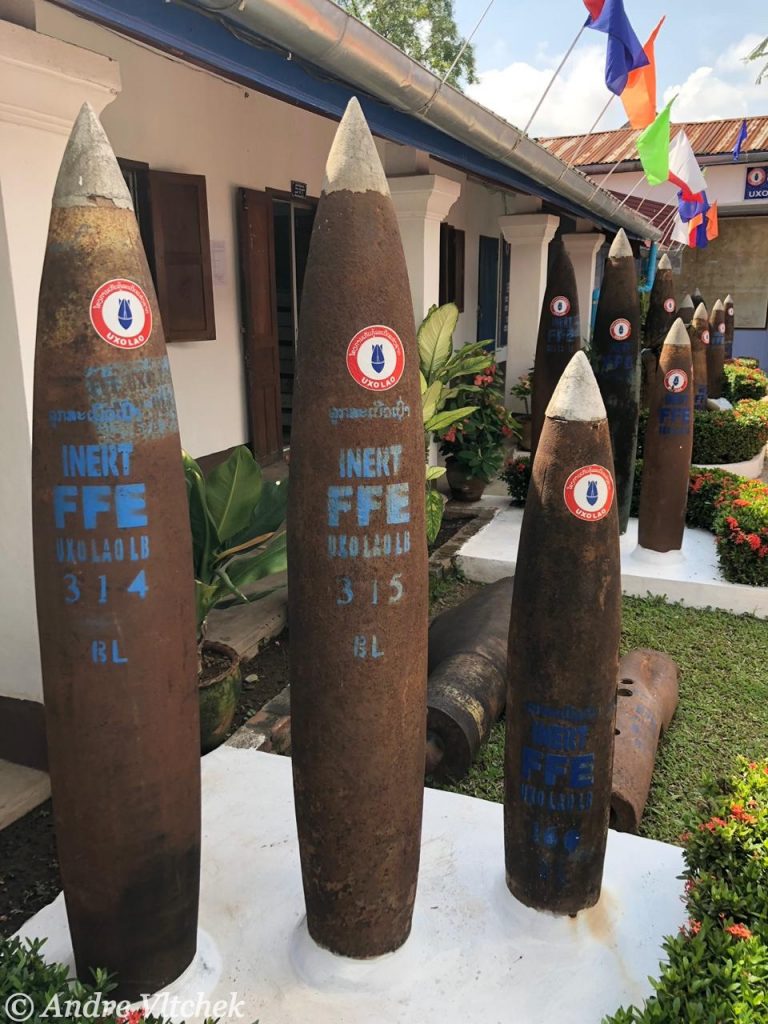
Laos and the so-called ‘side-kick’ or ‘Secret War’ was even worse, on a per capita basis. Hundreds of thousands vanished in this sparsely populated country, which is inhabited by humble and gentle people. Strategic B-52s bombers were deployed against farmers and their water buffaloes, using evil cluster bombs that are, to this day, killing thousands, all over the Laotian countryside. There was no reason for this brutal, monstrous genocide, except some abstract ‘concern’ in Washington that this poor nation could follow Vietnam’s example and ‘go Communist’ (it did, after it tasted true Western ‘democracy’, literally on its skin).
Cambodia– a country where the West nurtured corrupt and brutal elites in Phnom Penh, and then began the same monstrous carpet-bombing campaign as in Laos, against unarmed, desperately poor peasants, using B-52s, killing hundreds of thousands, and displacing millions. People lost their minds from the horrors of the bombing.They were also driven from their land, and began dying from famine. Dismal situation opened doors to Khmer Rouge, which the US decisively supported (on the battlefield and at the UN), even after this deranged murderous group got defeated by heroic Communist forces of Vietnam.
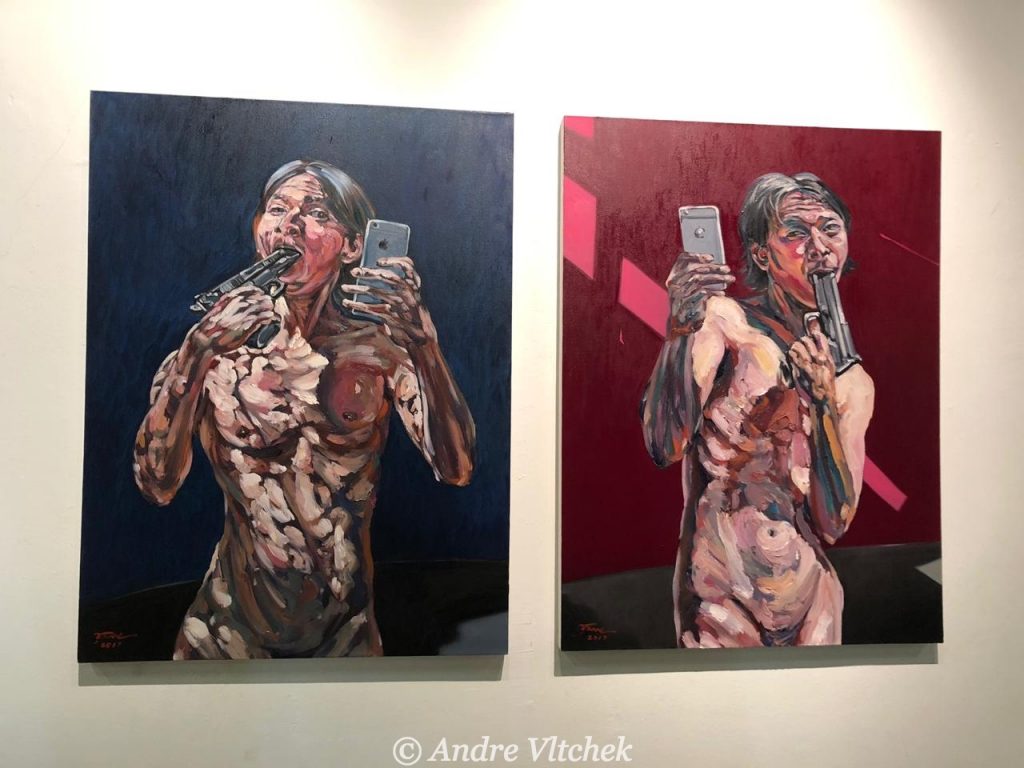
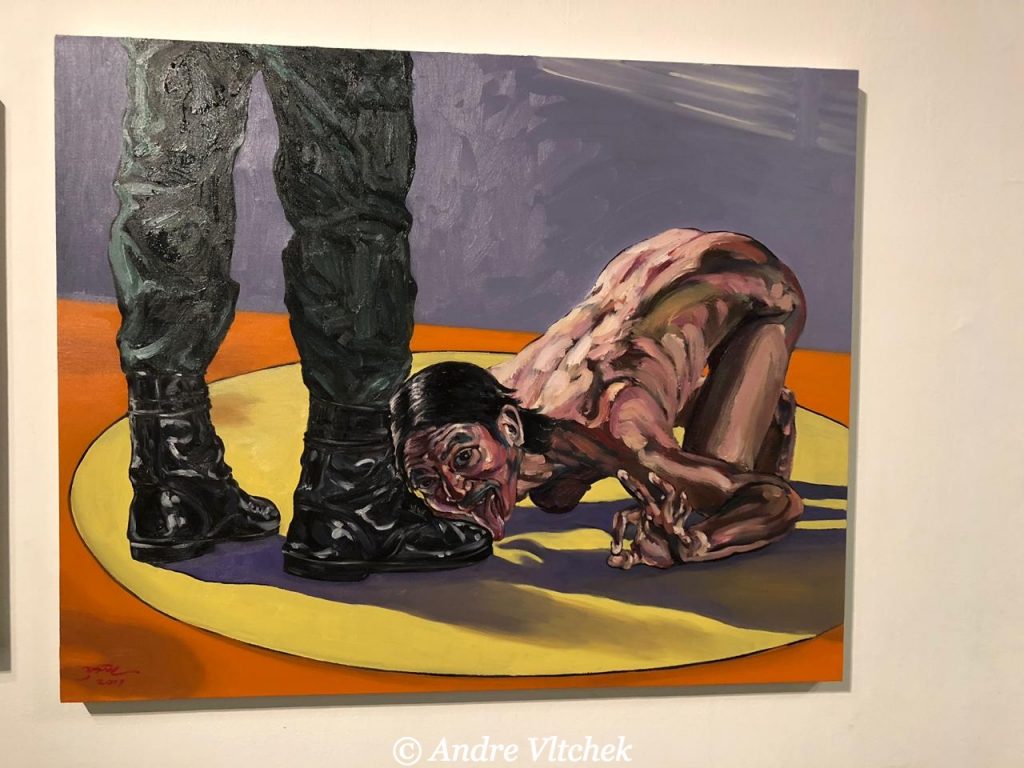
In Bangkok, depiction of modern Thai realityArtwork at BACC, before Thai elections
Thailand – country which has been choked by car industry and monstrous form of extreme capitalism, while upholding its backward feudal system. Thailand with countless military coups designed to sustain pro-Western monarchy. Thailand which accepted on its turf part of defeated Chinese anti-Communist army, and ‘put it to work ‘almost immediately’, allowing it to massacre substantial part of its own left-wing movements. Thai state that massacred and raped its own students, and butchering thousands of Cambodian refugees. Thailand that technically attacked both Vietnam and Laos, by flying Air America missions against those countries, opening its airports to the West, while selling its own women in countless brothels in Pattaya and elsewhere, to the Western pilots and ground staff.
Indonesia, where the 1965 US and UK -sponsored military coup against left-wing President Sukarno and (then) the third largest Communist Party in the world (PKI), took the lives of between 1 and 3 million people, installing perhaps the most grotesque fascist extreme-capitalist regime on earth. Indonesia, where all the great artists and thinkers were killed, or imprisoned in the Buru concentration camp, and, where the West helped to install a totally brainless system de-intellectualizing the nation and forcing it back to the Middle Ages. Indonesia, where secularism is now collapsing, and where, during the upcoming April 2019 elections, voters will decide between an inept and weak pro-capitalist leader, and a truly fascist military mass murderer.
East Timor (Timor Leste) – a tiny country which was overrun by Indonesia in 1975, shortly after it gained independence from Portugal, under the leadership of the left-wing FRETILIN movement. The right-wing dictator of Indonesia – Suharto – declared that he was ‘not going to tolerate a second Cuba near its shores’, and got a big pat on his back, as well as full support from the US, UK and Australia. The result: around 30% of the entire population of East Timor vanished during the occupation. Countless Indonesian leaders, including the former President ‘SBY’, served there. If Indonesia was a ‘normal country’, these individuals would now be facing long jail sentences for genocide, or in some cases, a firing squad.
In West Papua – hundreds of thousands of people have already died, also under the Indonesian genocidal occupation, which is fully supported by the West, because Papua, like Borneo (which is known in Indonesia as Kalimantan) is getting thoroughly plundered by multi-national companies, of course under the careful supervision of Indonesian military forces. Horrors like the state-sponsored ‘trans-migration’ policy, designed to make people of Papua a minority on their own island, are ongoing and relentless. The people,who have lost everything under the occupation, are forced to convert to Islam, and they are also forced to abandon their way of life and their land. What Indonesia does in West Papua is nothing less than genocide. It is not only the killing and rape,of which its military could be accused of. The plunder of Papuan resources is as deadly for many other reasons,it is likeif the force would be used to ‘open up’vast parts of the Amazonia or Orinoco basins in South America – areas inhabited by indigenous tribes that have never come in contact with the outside world. Even the most insane right-wing presidents of Brazil or Venezuela (of the past), would never dream about such brutal genocidal undertakings (although this may change under the fascist presidency of Bolsonaro in Brazil). In West Papua, dozens of fragile cultures are disappearing. People who have never come into contact with the ‘outside world’ are being forced out of their rain forest, as trees are cut down and mining companies, backed by the Indonesian armed forces, ransack the land. Defenseless tribal people are dying from diseases and hunger, at the same time as corrupt Indonesian officials and businessmen are burning money in Jakarta’s over prized malls, as well as in Singapore, Macau and Hong Kong. And now, thousands of Western tourists fly into West Papua, to Raja Ampat, which is becoming an ‘in place’ for diving!
Malaysia had its own share of inter-religious conflicts, although never at the level of neighboring Indonesia. Nature in Malaysia, almost like in Indonesia, is totally devastated, due to massive palm oil plantations and mining.
The Philippines lived through horrific decades of US neo-colonialism, experiencing the similar extreme capitalism that has been imposed on Indonesia. Only in the recent years, sound social policies have been introduced, and a moratorium on mining, at least in some parts of the Mindanao Island, has been enforced.
Brunei, one of the richest exporters of oil on earth, is now governed by Sharia Law, which, at least in theory, allows amputations, flogging, stoning and other religious practices. Another place where such regressive brutality is officially allowed is in an autonomous province of Indonesia – Aceh.
*
I worked in this apart of the world for decades. I covered countless horrors and conflicts in Indonesia. I used to live in Hanoi, and I covered in-depth the situation in Laos, Cambodia, Malaysia, and Papua. I covered East Timor,during the occupation, and was tortured there by Indonesian forces. It happened after I exposed mass rape in Ermera town.
Right now, I am working on a detailed and shocking documentary film about the total environmental destruction of Borneo.
As a local (I actually feel like a ‘local’ in all parts of the world), I often look at the Western travelers visiting this part of the world, and I am wondering, sincerely: are they really so ignorant about the past and the present of Southeast Asia? Or perhaps, are they making sure not to know?
Are they ‘enjoying themselves’, surrounded by devastated nature, privatized and ruined beaches, and a deranged culture? Do they feel powerful, unique, superior, because their countries managed to destroy the entire Southeast Asia, bringing it into shameful submission? Is it, at least partially, why they are here?
Don’t they see? The Indonesian islands of Bali and Lombok have become thoroughly grotesque: everything has been stolen along the coasts, people forced out of their dwellings, and the culture has been fully ruined. Bali suffers from traffic jams and pollution, from over-population, poverty and filth. There is hardly anything pristine there, now. ‘Culture’ is only for sale!
The coastline of Thailand is totally finished. The once pristine islands are now dotted with mass-produced, low quality market towns, with makeshift bungalows and ugly concrete structures. There are standardized,repetitive‘offerings’, most of them of extremely low-quality. There are Thai and Western ‘beach food’, bad old (Western) pop music,countless massage parlors and ersatz bars. There is almost nothing truly Thai left on the Thai coastline. Thai women, the poorest of the poor, many from the north of the country, walk in flip-flops and tasteless T-shirts hand in hand with Western grandfathers, some of them in their 80’s. What a sight!
Everything feels ‘forced’, unnatural, and in terrible taste: in Indonesian ‘resorts’, on the Thai coast, and in the bars of the Philippines, as well as in Cambodia.
In and around Phnom Penh, ‘genocide tourism’ has reached its peak. It is fueled and sponsored by countless Western NGO’s, which are literally pimping the terrible Cambodian past as ‘proof’ that ‘Communism is evil’. Not a word about the fact that most of people who died here, were actually victims of the Western carpet-bombings and consequent famines, and that the Khmer Rouge was in reality a US-sponsored band of freaks, who knew very little about Communist ideology (I spent substantial time talking to them, deep in jungle, and most of them admitted that they had no clue about Marxism or Communism, when they were in power). But to the Westerners, genocide tourism is something thrilling, it represents ‘something new’; ‘something they did not experienced before’.It is good for selfies and for colorful pub stories back at home. And Cambodia is now making huge money out of all this, willing to twist its own horrid past, just to gain some cash. Go to the villages and talk to people: they know the truth. But almost nobody goes. Not even the Western media.
West has totally stolen historic narrative, all over Southeast Asia. Academia in Malaysia, Indonesia, the Philippines and Thailand is deeply influenced, and manipulated from abroad. ‘Soft power’ is being used; scholarships, funding and invitations to the ‘academic exchanges’.
Both the academic narrative and the mass media in Southeast Asia, are now much more “Westernized” than in the West itself.
*
Clichés about this part of the world are mostly incorrect, in fact, surreal.
Despite the fact that it is suffering from the horrid religious intolerance, racism and perpetual conflicts and tensions, Indonesia is portrayed in the West as ‘tolerant’. Not having one single political party that would represent the majority (which is poor), it is branded as ‘democratic’. A place where a Chinese, black, white or Papuan person can hardly make few steps without being insulted on the street, or being mocked for his or her appearance, Indonesia is described by the Western mass media as ‘friendly’.
Thailand is the same. A staunch ally of the West during so-called Vietnam War, and ‘fight against Communism’, the Kingdom is portrayed as ‘Land of Smiles’. In fact, it has higher homicide rate per capita than the United States, and more female tourist are raped here, annually, than in South Africa. Smiles are reserved only for those who are ready to pay any price, without demanding much in return. Any confrontation here can easily deteriorate to violence. The West hardly ever criticizes outrageous capitalist models of Thailand or Indonesia, as well as collapsed infrastructure and inhuman city planning that is prioritizing motor vehicles and ruthless real estate developers over people. Bangkok and Jakarta are much more polluted than the Chinese cities, and Thai and Indonesian governments do almost nothing to change the situation. But, cliché says that it is dangerous to go to Beijing due to the air quality, while Bangkok or Jakarta are hardly ever mentioned.
*
In Southeast Asia, deafening noise is often administered, in order to silence fear. Thinking is discouraged.It is considered impolite to discuss, to face terrible past and the present. Brainless banging into the phones is recommended. Social media is used here much more than anywhere in the world. While some countries like Indonesia have the lowest readership of books on earth, per capita.
Southeast Asia had been living through genocides, coups, and total submission to the Western masters and to savage capitalism. It has been robbed of its nature, and of natural resources. Its population has been ‘pacified’, forced into obedience and submission. Extreme religious concepts have been injected and upheld from abroad. Only in the Philippines, is the situation now gradually changing. In Vietnam, the state is still strongly resisting subversion from the West, although the country had also been damaged to a great degree, by Western NGOs and social media. Elsewhere, it is getting much worse.
Laos is now moving closer to China, which is literally pulling this beautiful and sparsely populated nation out of slumber, building a high speed rail system, infrastructure, factories, dams, schools and hospitals. But the more China does for Laos, the more it is demonized by the West, by its press, academia and the NGOs. It is now one big battle, over Laos.However, it is clear that the Laotian people are benefiting greatly from their proximity to China, after being literally ruined by French colonialism and the Western “Secret Wars”.
On purpose, here, I don’t mention Burma, as there, the situation is extremely complex, and ‘specific’. But later this year, I expect to publish a detailed report on the topic.
*
Southeast Asia is clearly a victim. It is also an ‘untold story’. Deep, dark story.
With the exception of Singapore and to some extent Malaysia, it is a devastated, an impoverished victim. It is also a ‘time bomb’. People here are discontent, often desperate. Often, they do not know why. Unlike in Latin America and Africa, where the political awareness of the victims is extremely high; here the victims often believe that they are treated justly and that ‘this is the only way how the society can be arranged and governed’.
If someone travels here,searching for ‘culture’ and ‘new ways to understand life’, they should think twice. In most of Southeast Asian countries, the local culture was thoroughly uprooted. What they will see are some folk shows for foreigners, hardly ever attended by locals. Most of the native music venues, as well as theatrical and other art forms, have been replaced by the most vulgar Western entertainment, by video games and naturally, by social media.
Western men often feel good here. It is because in Southeast Asia, ‘they have won’. They are often ‘respected’ here, just for being both men, and white. They are respected, the same way as the French, Dutch and British colonialists used to be respected here, a century ago. Not loved, not admired, but esteemed for belonging to the race and culture that managed to conquer, destroy and then to give orders.
In fact, for those who want to relive those days of imperialist ‘grandeur’, this is the perfect place to visit.
Naturally, Southeast Asia is glorified by the West, with the exception of the Philippines, Vietnam and Laos (and Burma, for different reasons) – countries that are trying to get away from Western dictates.
It is because this part of the world is ‘perfect’ in the eyes of rulers of the Empire. Here, human lives are freely sacrificed for the profits of corporations, both Western and local,like when a pedestrian here has to wait until the cars pass by; entire villages have to give way to the mining venues and to palm oil plantations. Social services for the citizens are not something secondary, but tertiary, almost irrelevant. Profit is all that matters.The well-being of the citizens is hardly considered.
The West is almost never criticized here. Like in any ‘good’ feudal society, the West is seen as a ‘daddy’. It is severe, but always right. It beats its ‘children’, but gives directions. Religions help to reinforce this sort of obedience, which in many other parts of the world would be synonymous with the Middle Ages.
The local ‘elites’, in the meantime, are ‘having a ball’. They govern unopposed. They are only accountable to the much bigger, mostly Western, power. They can do anything they want with their subjects. They drive their super expensive sedans and SUVs, purchased with funds stolen from the poor, and the poor bow, and bend, prostrating themselves in great respect, fear, servility and admiration.
And they do the same in front of the West.
In brief: perfect societies, observed from New York, Canberra, London or Paris.
And in Bali or Phuket, women dressed in traditional clothes dance in 5-star hotels, roll their big eyes, and twist their slender arms. In order for the foreign visitors to say: “What a great culture!” While, of course, the true great culture was killed by the military pro-Western regimes; choked and murdered in the concentration camps and inside the army barracks.
The only victims of this ‘perfect’ state of things, are the poor; in fact, the great majority in Southeast Asia (no matter what the official statistics say). But who really cares about them?
*
Did most of the Southeast Asian countries really gain their independence, some decades ago? Were the famous merdeka shouts just a big farce? Is it true that Thailand was ‘never colonized’? Is this entire huge region still a de facto colony? And if it is, can the situation change?
These are not just rhetorical questions; they are real. And the answers to them are never simple.
The People of Southeast Asia were violated, robbed and then encircled by pseudo-reality; by lies about their past and present. They were told that they are well, happy, and that what they are experiencing is progress, freedom and democracy. They were also ordered to believe that what their usurper, the West, represents, is synonymous with ‘good governance’ and honesty. Many of them have never encountered any alternative views.
After burying tens of millions of corpses, and after having their rain forests, rivers and mountains thoroughly ruined, most of the Southeast Asians are still convinced that their tormentors are fully qualified to control the world.
The western Canadian province of British Columbia (BC) continues to be mired in an acute opioid epidemic of crisis proportions. A public health emergency was declared two years ago after the number of overdose deaths doubled in a five-year period. Last March, there were 162 fatal overdoses across the province—the deadliest month on record.
The primary reason for the spike in fatal overdoses is the presence of the extremely potent synthetic opioid Fentanyl, a drug one hundred times stronger than heroin. Significant quantities of the drug are manufactured in China and shipped to BC ports from where it is distributed throughout the country.
However, the availability of this extremely potent drug has proven particularly deadly due to the unprecedented levels of social inequality, the virtual disappearance of permanent, full-time employment and the growth of widespread poverty in the province.
Recent data published by the British Columbia Coroner’s Service (BCCS) reveals that among those workers who fatally overdosed in the five-year period ending in 2016, three quarters were males between the ages of 25 to 54, 20 percent of whom worked in construction, the province’s second largest industry. An additional 13 percent worked in industries connected to construction, including building maintenance and waste management.
The construction sector is notoriously unsafe, with workers suffering high rates of on-the-job injuries and long-term medical conditions. The figures indicate that rather than relying on prescription drugs, many construction workers are risking their lives by turning to cheaper and deadly alternatives like fentanyl and other opioids laced with fentanyl, in order to cope with pain and other ailments.
The disproportionate number of overdoses in the building sector is also a significant indication of the many socio-economic hardships confronting workers in an industry notorious for temporary jobs, variable working hours, and often paltry wages. Garth Mullins, member of the Vancouver Area Network of Drug Users, noted, “there’s a lot of day labor type things and so it can be quite uncertain...you can really be just hanging on there, not making very much and you don’t know when your next job is going to come.”
Precarious work has led many construction workers to struggle under conditions of abject poverty. Temporary labourers make on average $18 an hour, but the living wage in Vancouver is almost $21. The BCCS report found that those who were employed in the year prior to their fatal overdose earned on average a meagre $28,437 a year, much lower than the provincial average of $42,000. A fifth of those victims had worked in the construction industry.
The dismantling of business regulations by successive New Democratic Party (NDP) and Liberal provincial governments has allowed dangerous conditions to become a regular feature of the building trades in BC. There were 44 work-related construction deaths in the province in 2017, a 42 percent increase over 2016. Workers continue to face an occupational fatality rate that is three times the provincial average.
Injured workers face a maze of bureaucratic hurdles to obtain compensation for injuries suffered through the workers compensation system. In addition, budget cuts and a failure to strictly enforce employer contributions to workers compensation have ensured that when workers do receive awards, they are grossly inadequate. Similarly, cutbacks to Canada’s public health care system mean that injured workers often wait months for urgent treatments, or struggle to access specialist services like physiotherapy.
The treacherous workplace conditions in construction, and the gutting of healthcare and workers compensation provisions are the direct product of the transformation of the trade unions into nationalist appendages of corporate management and the capitalist state. No longer interested in even partially defending workers’ interests, including workplace safety and wages, as they partially did in a previous period, they now function as cheap labour contractors and an industrial police force to suppress worker anger with their miserable employment conditions. The vast majority of construction workers in BC have no connection with the unions, which only represent 20 percent of all construction workers.
In response to the Fentanyl crisis, NDP government officials have deliberately ignored the dysfunctional economic and social conditions, focusing instead on tougher law and order measures. BC Premier John Horgan said in a public statement that his initial plan was to “prosecute the criminal.” In the midst of this profound crisis, he has been reluctant to call a public inquiry. Although the NDP touted its appointment of the province’s first mental health minister when it took power with support from the Greens in 2017, nothing has changed for the province’s most impoverished and disadvantaged.
Health officials and advocacy groups alike are responding to the epidemic with calls for tepid reforms such as the introduction of more de-stigmatization programs, better access to treatment and recovery, and legal access to life-saving and clean drugs. Although these measures would likely be helpful to some in the short-term, they are grossly inadequate in addressing the bedrock issue of systemic social and economic dislocation arising out of the crisis of capitalism that has produced the acute overdose epidemic.
It is no accident that BC has become the hotbed of the opioid crisis. The province also has the highest rates of child and senior poverty in the country and is home to Vancouver, one of the most expensive cities in the world to live in, where workers may spend upwards of 50 percent of their gross income on rent and utilities. A quarter of British Columbians say they cannot pay their bills or make their debt payments right now.
By contrast, the construction industry—where residential housing speculation accounts for half of all construction projects—has enjoyed healthy returns over the past half-decade with a cumulative value of $75.1 billion in 2017. This has led to enormous profits for a tiny minority of financiers and speculators, including Canada’s major banks. The resulting social disparity can be summed up in the recent statistic that the ten richest BC families’ wealth is, on average, 5,845 times higher than a typical household in the province.
The accumulation of such vast wealth is directly responsible for throwing thousands of people into desperate poverty. The housing boom in Vancouver and the Lower Mainland has forced unprecedented numbers of people, including many low-wage workers, to live in homeless shelters and on the streets. Last May, Vancouver’s homeless population reached a new record, surpassing 2,100.
The widening gap in income and wealth is not a phenomenon exclusive to British Columbia. Throughout Canada and the globe, it is becoming more and more apparent that the richest 1 percent is amassing great wealth as the vast majority languish in debt and decline.
There are now signs that the bull market conditions are changing. Market analysis indicate a recent slowdown in construction activity and this year new housing investment is expected to fall 25 percent from its 2016 peak. Within the context of a contracting economy, it is to be expected that social conditions will only worsen for BC construction workers, and the working class as a whole.
Some 69,000 people participated in the eleventh weekly protest of “yellow vests” in France, according to the Interior Ministry. Demonstrators told the World Socialist Web Site that they rejected French President Emmanuel Macron’s proposed “great national debate” and hailed workers’ struggles against social inequality around the world.
Discussions with the “yellow vests” revealed great interest in finding a way to mobilize broader opposition to Macron and the banks.
The major provincial cities saw large protests—particularly Toulouse and Bordeaux, where the turnout was 10,000 and 6,000, respectively. Clashes with police led to numerous arrests in these cities. There were also confrontations with police in Dijon, Montpellier, Avignon, Nantes, Lyon and Evreux, where two cars were torched and the French central bank building was attacked, according to the police prefecture.
For the first time since the beginning of the protests, all of the “yellow vests” in Marseille marched together, calling for “unification of the struggle.” Some 4,000 people demonstrated there. Protesters in Marseille intervened to rescue a tourist couple with a baby carriage who were standing nearby and were suddenly attacked with tear gas by the police.
Ilyes, who was at the scene, told Sputnik News: “We were…marching near the Old Port, singing. Everyone was in good spirits. The riot police were positioned right and left around the protest, across the road from it. Everything was under control when a policeman threw a grenade for no reason.”
Clashes took place throughout the afternoon. In total, 300 people were arrested across France, including 66 in Paris. There, police claimed that 4,000 people demonstrated.
Several marches were planned—one cleared with the police between the Champs-Élysées and Bastille Square, another from Nation Square to Bastille Square, and finally “a march in solidarity with yellow vests from faraway territories,” going from the Overseas Territory Ministry to Facebook’s Paris headquarters.
For the first time since the beginning of the protests, the “yellow vests” called for meetings on Republic Square to continue the protests with a “yellow night.” Police broke up the event, firing volleys of tear gas.
Earlier that afternoon, Jérôme Rodrigues, an associate of “yellow vest” spokesman Éric Drouet who had called one of the protests, was seriously wounded in the eye when a police grenade exploded less than five meters from where he was standing. He was carried away for an emergency operation.
In Paris, the WSWS spoke to Quyn, a waitress protesting “for social, tax and economic justice in our country, because Macron is favoring the rich, not the poor, the retirees, the handicapped.” She added, “We are demanding Macron’s resignation.”
Quyn praised the development of international opposition to social inequality and authoritarianism: “This movement is developing across the world—for example, in Burkina Faso there are the red vests; in Belgium, Germany and Canada, sort of everywhere. I think this movement will continue in various forms. It motivates everyone to wake up and struggle against the dictatorships of the major powers that control our epoch. I hope that everyone across the world will wake up.”
On the Oxfam report pointing to rising social inequality around the world, Quyn said: “It is scandalous that small minorities own a majority of the wealth. The economic, social and tax system must make all these CEOs pay where they live, to share the wealth and spread it to workers so they can have a decent salary to live on.”
She stressed that she supported “all the movements against the enslavement of the people, all those who are rising up like the yellow vests against free market capitalism and the oligarchy of the transnational corporations.” She continued: “We need to rise up now…for everyone to be aware that we have enough energy to produce enough to give people a different life. We have all that, but because the governments and the leaders hide what we have, we do not have enough to live, but in fact everything belongs to the people, to all the peoples. It is up to them to win this struggle.”
WSWS reporters also interviewed Rudis, who had traveled from Limoges and works in industrial maintenance: “We want a better distribution of wealth,” he said, “very simply that something be distributed to those who need it. It would be good to change the entire world. Those who are here are nurses, retirees, everyone basically.”
On the “great national debate,” Rudis was unambiguously hostile: “It’s just talk. We aren’t free to go there, we can’t say what we want… Anyway, it’s been many years that it has all just been talk.”
Rudis called for unifying workers of all countries in struggle against the European Union and austerity. “That would be a good idea,” he said, “a way of rebuilding Europe along lines we have chosen, between the European populations, the European and even world population. If we can, this would be ideal because it’s not just us. Africa and everyone are suffering. We are in a country that one can say doesn’t have so much to complain about, but it would be good for everyone to be able to stand proudly, stop the plundering of Africa and all of that.”
On the role of the unions and their positions on the “yellow vests,” Rudis said: “The unions are disguised politicians. They make agreements just for their own interests. I work in a factory with 50 workers but two unions. And they don’t give a shit about us. The union bureaucrats can sit pretty in the factories.”
The WSWS also spoke to Stéphane, who called for the setting up of “citizen-initiated referendums, which will allow the French people to decide on certain questions, propose or abrogate laws hostile to the interests of the people, or even recall an elected official if he acts against the interests of the people.” He continued: “There are different popular assemblies in various areas of France that are interesting, where people are debating, learning or politically being awakened, because we have been held out of politics for a long time.”
Stéphane stressed that workers will get nothing from the “great national debate” offered by Macron: “Mr. Macron’s national debate does not concern the ‘yellow vests.’ It’s a national debate to promote himself. The European elections are coming soon. It is PR.”
Stéphane told the WSWS that he opposes the attempts to put together a “yellow vest” electoral list for the European elections: “Now we’ve seen that there are some ‘yellow vests’ trying to get together to advance an electoral list for the European elections. The vast majority of the ‘yellow vests’ is totally against that… We are not partisan, because the ‘yellow vests’ are a movement representing the people.”
The Sunday Times has reported that the Conservative government is planning for the possible imposition of martial law as a result of the deepening crisis over Britain’s exiting the European Union (EU). The Daily Mirror reported that the EU is anticipating violence on the streets and decades of political instability.
The SundayTimes report is based on leaks from the Cabinet Office. It states that top civil servants in Whitehall have been “gaming a state of emergency and even the introduction of martial law in the event of disorder after a no-deal Brexit” (leaving the EU with no trade deal agreed).
Robert MacFarlane, the deputy director of the Civil Contingencies Secretariat, is identified as being involved in discussions on the use of powers “to deal with national emergencies such as acts of war and terrorism”—part of no-deal contingency planning known as Operation Yellowhammer.
Top civil servants would use the sweeping powers embodied in the Civil Contingencies Act 2004, introduced by the Labour government of Tony Blair.
“Curfews, bans on travel, confiscation of property and, most drastic, the deployment of the armed forces to quell rioting are among the measures available to ministers under the legislation,” the newspaper writes. “They can also amend any act of parliament, except the Human Rights Act, for a maximum of 21 days.”
The pretext for the Civil Contingencies Act was the Blair government’s assertion that previous emergency legislation had been proved inadequate—in events such as the severe flooding of 2000 and the foot-and-mouth outbreak of 2001, but also more generally in waging the so-called “war on terror” after the 9/11 attacks in the US.
The Act granted extraordinary new powers, enabling the government to declare a state of emergency without a parliamentary vote, with ministers empowered to introduce “emergency regulations” under the Royal Prerogative that are virtually unlimited. They include the power to “give directions or orders” including the destruction of property, prohibiting assemblies, closing down electronic communication, banning travel and outlawing “other specified activities.”
The Defence Council, comprised of ministers, senior civil servants and military leaders, can deploy the armed services, again without prior parliamentary debate or approval. Emergency regulations may be passed “protecting or restoring activities of Her Majesty’s Government,” effectively allowing the Defence Council absolutist power—including “any provision which the person making the regulations is satisfied is appropriate” to protect human life, health and safety.
A source told the Sunday Times, “The overriding theme in all the no-deal planning is civil disobedience and the fear that it will lead to death in the event of food and medical shortages.”
Responding to statements that the model used for a no-deal scenario is the impact on Iceland of ash clouds caused by a volcanic eruption in 2010, another source told the newspaper, “Although there is nothing that can replicate the scale of the chaos threatened by a no-deal Brexit, which will be about a thousand times worse than the volcanic-ash-cloud crisis, this is about the closest example we have in modern British history.
“The only other thing that would be comparable would be something like a major Europe-wide war.”
Speaking to the BBC’s Andrew Marr Show, Health Secretary Matt Hancock sought to downplay concerns, saying there was no “specific” plan for martial law, adding: “Of course government all the time looks at all the options in all circumstances. It remains on the statute book, but it isn’t the focus of our attention.”
Pro-Brexit Conservatives and Labour leader Jeremy Corbyn have both previously rubbished such reports of a planned use of the military as part of a “Project Fear” to secure acceptance of Prime Minister Theresa May’s proposed deal with the EU being debated today in parliament.
It is significant, therefore, that details of an EU report into the post-Brexit crisis leaked to the Daily Mirror do not single out a no-deal scenario. As far as European security and intelligence officials are concerned, Britain will descend into political chaos whatever happens in the coming months.
The secret EU report is not directly cited, but only alluded to by the Mirror. EU officials “are believed to have warned that civil unrest and rioting is almost inevitable, regardless of the outcome of the current political deadlock,” the newspaper reports.
An EU source states, “Analysis of the threat levels in Britain is being shared at the top of the EU as we formulate policy for the years ahead. The assessment is that violence is almost inevitable no matter what.
“They are worried that if the current deal goes through the right-wing will kick off. If there’s no deal everybody will object and kick off. If there’s a second referendum, the right will kick off. The right kicking off is causing most concern. This analysis is being kept very quiet for obvious reasons.”
Confirming that escalating state repression is being considered in all eventualities, the pro-Brexit Sunday Telegraph reported that the Electoral Commission is seeking to give itself new “powers of prosecution” prior to any second referendum on Brexit. The newspaper states that the new powers would mean the Commission could bring prosecutions directly against political parties and campaign groups.
The EU is also predicting the possible break-up of the UK, with independence referendums in Scotland and Northern Ireland within 18 months of Brexit.
In a related warning, Irish Prime Minister Leo Varadkar said at the Davos summit last week that soldiers may be deployed to the border with Northern Ireland in a no-deal scenario. The return of a hard border could “involve people in uniform and it may involve the need, for example, for cameras, physical infrastructure, possibly a police presence, or an army presence to back it up,” Varadkar told Bloomberg.
A senior UK government source told the Mirror, “We are seeing civil disobedience across Europe and a growth of the far-right. Anything which changes the status quo, like Brexit, gives those people the opportunity to foment division. We could see protests and public disorder offences.”
All such claims that the “far-right” will be the target of any planned repression should be rejected. There is no doubt that Britain’s as yet small fascistic right-wing will seek to exploit social unrest and channel anti-EU sentiment in a nationalist and reactionary direction—just as have France’s National Rally (formerly National Front), the Liga in Italy and similar larger formations. However, the power of the state will not be directed against such tendencies, which across Europe are either being embraced or even brought into government, but against the true source of social discontent—the working class.
France’s Yellow Vests are routinely slandered as far right extremists by the government of Emmanuel Macron for the “crime” of opposing his savage austerity measures. But it is thousands of working people who have been arrested, brutalised, maimed and killed by riot police on the streets of France. And it would be no different in the UK.
Everywhere a crisis of bourgeois role is emerging, leading invariably to a sharp turn to authoritarianism and state repression—Donald Trump’s threat to declare a state of national emergency in the US, Rodrigo Duterte’s slaughter of 20,000 in his so-called “war on drugs” in the Philippines, Jair Bolsanaro’s glorification of Brazil’s military junta.
This is the ruling class’s response to an explosive growth of social inequality that is rendering impossible the preservation of democracy. The only answer to this danger is the independent political mobilisation of the working class against the ruling elite and its state apparatus. In the UK, this means rejecting any alliance with the pro- and anti-Brexit wings of the capitalist class and forging a unified struggle for a socialist Europe with workers across the continent who face the same threats of social ruin and political repression.
At a White House news briefing on Monday, National Security Advisor John Bolton and Treasury Secretary Steven Mnuchin announced the imposition of wide-ranging sanctions against the Venezuelan state oil company, Petróleos de Venezuela, S.A. (PDVSA).
The sanctions constitute an act of war in support of the US-led regime-change operation against the government of Venezuelan president Nicolás Maduro. They are aimed at securing the support of the Venezuelan military for a coup that would place power in the hands of Juan Guaidó, a right-wing politician and State Department asset who proclaimed himself “interim” president on January 23.
The sanctions prevent US companies and individuals from doing business with PDVSA properties and interests, including its US-based subsidiary, Citgo, unless any earnings from those transactions are placed in accounts from which the Maduro government is blocked. While it has been reported that European and Caribbean companies will be given some time to wind down transactions, it is unclear how far-reaching the sanctions are, and neither Bolton or Mnuchin provided any details.
As the US imports approximately 41 percent of Venezuela’s oil production, the de facto embargo is a huge blow to Venezuela’s already crippled economy, with Bolton himself estimating that the sanctions would deprive Venezuela of $11 billion in earnings. Oil exports constitute about 95 percent of the country’s total export earnings, meaning that the new sanctions will result in further shortages of food, medicine and other commodities.
Although it is expected that the Maduro government will seek other buyers for its oil, some of the more natural options, including Russia and China, may not be viable, as Venezuela is deeply in debt to both and already sends oil to those countries in payment.
Venezuela is the fourth-largest source of US oil imports, amounting to around 580,000 barrels per day (bpd), which is around 6 percent of US oil imports. This is a significant decline from the 1.2 million bpd that Venezuela supplied just 10 years ago. Venezuelan oil exports last year fell by 33 percent compared to 2017, and Venezuelan refineries are reported to be operating at one-third capacity, largely due to shortages of parts and other necessary supplies.
The International Monetary Fund (IMF) has predicted that the Venezuelan economy will shrink by five percent next year, while inflation is expected to reach 10 million percent, a nearly incomprehensible figure. Some 2.6 million Venezuelans have emigrated because of the economic crisis, while 64 percent of those remaining in the country are living under conditions of extreme poverty. In response to the ongoing crisis, the Maduro government devalued the Venezuelan currency by 35 percent on Monday in order to bring it in line with the black-market exchange rate.
There is likely to be an impact on workers at US companies due to the sanctions, especially those working at refineries that handle Venezuelan heavy crude, including those of Citgo, Valero and PBF Energy. According to Mnuchin, refiners are likely to experience “modest” impact in the “short term.”
This latest move in the US government’s attempts at regime change are likely to be devastating to Venezuelan workers, even aside from any violent clashes between supporters of Maduro and Guaidó. A recently published report on Venezuelan sanctions by former special UN rapporteur Alfred de Zayas made clear that “sanctions kill” and recommended that the International Criminal Court consider US sanctions as possible crimes against humanity under the Rome Statute.
The report says, “Modern-day economic sanctions and blockades are comparable with medieval sieges of towns,” and “Twenty-first century sanctions attempt to bring not just a town, but sovereign countries to their knees.”
Nor are the sanctions likely to be the end of the increasingly provocative actions against Venezuela. During the news conference at which the sanctions were announced, Bolton threatened military intervention by carrying a notepad with “5,000 troops to Colombia” on it during the news conference. This can only mean the US is prepared to intervene directly in order to topple the Maduro government, the result of which would no doubt be a bloodbath.
The governments of other countries closely allied with American imperialism have fallen in line with the US attempt to foment a civil war in Venezuela, with a number of governments recognizing Guaidó as interim president, including Israel, Canada and Australia.