1 Feb 2019

Rigging the Science of GMO Ecotoxicity

Jonathan Latham

Researchers who work on GMO crops are developing special “artificial diet systems”. The stated purpose of these new diets is to standardise the testing of the Cry toxins, often used in GMO crops, for their effects on non-target species. But a paper published last month in the journal Toxins implies a very different interpretation of their purpose. The new diets contain hidden ingredients that can mask Cry toxicity and allow them to pass undetected through toxicity tests on beneficial species like lacewings (Hilbeck et al., 2018). Thus the new diets will benefit GMO crop developers by letting new ones come to market quicker and more reliably. Tests conducted with the new diets are even being used to cast doubt on previous findings of ecotoxicological harm.

GMO Cry toxins

Cry toxins are a family of highly active protein toxins originally isolated from the gut pathogenic bacterium Bacillus thuringiensis(Latham et al., 2017). They confer insect-resistance and up to six distinct ones are added to GMO corn, cotton, and other crops (Hilbeck and Otto, 2015).

The resulting crops are usually called Bt crops. Cry toxins kill insects that eat the GMO crop because the toxin punches a hole in the membranes of the insect gut when it is ingested, causing the insect to immediately stop feeding and eventually die of septicaemia.
Cry toxins are controversial. Although the biotech industry claims they have narrow specificity, and are therefore safe for all organisms except so-called ‘target’ organisms, plenty of researchers disagree. They suspect that Cry toxins may affect many non-target species, even including mammals and humans (e.g. Dolezel et al., 2011; Latham et al., 2017; Zdziarski, et al., 2018).

Off-target toxicity

The Cry toxin mode of action, we and others have noted, does not necessarily discriminate between species. Any organism with a membrane-lined gut is, in principle, vulnerable if it consumes the GMO Bt crop. In these Bt crops the leaves, straw, roots, nectar, and pollen, all typically contain Cry toxins. Therefore, most organisms in agricultural landscapes will at some point in their life-cycle be exposed to GMO plant material. As pollinator declines and a more generalised insect apocalypse have revealed, the question of the effects of such crops on biodiversity is far from trivial.
The biotech industry is also very much aware of the steady stream of research, from evidence of allergenicity, to toxicity, of their Cry proteins towards so-called ‘non-target’ organisms. Organisms affected by Cry toxins include monarch butterflies, swallowtail butterflies, lacewings, caddisflies, bees, water fleas, and mammals (Losey et al., 1999Bøhn et al., 2008Ramirez-Romero et al., 2008; Schmidt et al., 2008; Sabugosa-Madeira et al., 2008; Mezzomo et al., 2015; Zdziarski, et al., 2018). Much of this research does not get the attention it deserves (e.g. COGEM 2014), but if swallowtail butterflies can succumb to just 14 pollen grains of Syngenta’s BT-176 corn (Lang and Vojtech, 2006) the industry is aware it can hardly truthfully market GMOs as environmentally beneficial.
As we have reported, one response of the biotech industry has been to try to bake approval into regulatory decisions. That is, make regulatory processes operate such that no possible future findings of unexpected harm by Cry toxins towards non-target organisms, no matter where in the risk assessment process they are observed, can derail approval. Thus, in “The Biotech Industry Is Taking Over the Regulation of GMOs from the Inside” we showed how “tiered risk assessment”, a regulatory procedure being promoted by the crop biotech industry, functions, in practice, as an “approval” system (Romeis et al. 2008). That is, regulatory denial of an application, under tiered risk assessment is nigh impossible.

How to mask Cry toxicity

The latest development, which adds further to the improbability that GMO Cry toxins will fail risk assessment, comes to light thanks to Hilbeck and colleagues (Hilbeck et al., 2018).
They report that these new “artificial diet systems” for raising non-target organisms contain surprisingly large amounts of antibiotics (Li et al., 2014; Ali et al., 2016a; and Ali et al. 2016b). The significance of this is that antibiotics are known to act as antidotes to Cry toxins (Broderick et al., 2006, Mason et al., 2011). By masking the harm caused by the toxin, antibiotics can give the unsuspecting reader a false impression of Cry harmlessness.
This effect of antibiotics was first shown in 2006 by researchers at the University of Wisconsin. They and others showed that gut bacteria are required for Cry toxins to achieve their full effect (Broderick, et al., 2006; Mason et al., 2011). Broderick et al wrote:
“Here, we report that B. thuringiensis does not kill larvae of the gypsy moth in the absence of indigenous midgut bacteria. Elimination of the gut microbial community by oral administration of antibiotics abolished B. thuringiensis insecticidal activity” (Broderick et al., 2006)
What Hilbeck et al., note about the diets, which their inventors claim are “needed” for reproducible testing of Cry toxins on carnivorous insects such as green lacewings and ladybirds, are the very large quantities of antibiotic compared to the amounts necessary to prevent spoilage (Li et al., 2014; Ali et al. 2016a; and Ali et al. 2016b). The diets developed by these authors contain the antibiotics Streptomycin (130mg) and Cephalosporin (50mg) per 100g (Li et al.; 2014); or Streptomycin (400mg) and Penicillin (400mg) per 100g (Ali 2016a); and Streptomycin (400mg) andPenicillin (400mg) per 100g (Ali 2016b).
Such large antibiotic quantities are questionable on several grounds. Previous authors have specifically noted the need to minimise antibiotic use in test diets intended to measure the toxicity of Cry proteins. As Porcar et al. (2010) wrote:
“Antibiotics were deliberately excluded from the diet composition since bacteria occurring in the insect midgut naturally might be critical for sensitivity (Broderick et al., 2006).” (Porcar et al. 2010)
 Furthermore, a very similar diet developed by other authors, also in China, for green lacewings (reared for different reasons), used no antibiotics (Cheng et al., 2017). Third, Li et al. (2014) claimed their diet is a development of one from Cohen and Smith (1998). Yet the diet developed by Li et al. contains almost six times as much streptomycin and two and a half times the level of a second antibiotic, cephalosporin (though Cohen and Smith used tetracycline). No mention or explanation of the raised antibiotic levels was made.
In other words, the problem of antibiotics acting as antidotes to Cry proteins is widely known to Cry toxin researchers but is ignored by the authors of these three papers. Less surprisingly, using their antibiotic-laden diet Li et al. in 2014 found “no detrimental impact of these Cry proteins on any of the C. sinica(Green lacewing) life-table parameters measured”, as also did Ali et al. (Ali et al., 2016a)
Such papers as these have multiple harmful effects. Their results contradict (in strong probability erroneously) previous findings that GMO Cry toxins harm non-target insects like ladybeetles and lacewings; thus placing earlier findings in doubt. Second, future experimenters who adopt these diets will also likely, wittingly or unwittingly, obtain falsely negative results. Third, if the claimed “need” for them is any guide, these artificial diet systems will be promoted (with industry help) to be adopted as gold-standards for future research, just like tiered risk assessment.
Unsurprisingly perhaps, researching the background of these authors one finds that Joerg Romeis is one of them (Li et al., 2014). Romeis is a Swiss academic who has for many years been closely associated with the biotech industry. Romeis has called studies that find harmful effects of Cry toxins “bad science”; he has published many papers with industry authors that he believes refute evidence of effects on non-target organisms, and he led their tiered testing project (Romeis et al., 2008; Romeis et al., 2013).
Who is really doing bad science?

A liberal elite still luring us towards the abyss

Jonathan Cook

A group of 30 respected intellectuals, writers and historians has published a manifesto bewailing the imminent collapse of Europe and its supposed Enlightenment values of liberalism and rationalism. The idea of Europe, they warn, “is falling apart before our eyes”, as Britain prepares for Brexit and “populist and nationalist” parties look poised to make sweeping gains in elections across the continent.
The short manifesto has been published in the liberal elite’s European house journals, newspapers such as the Guardian. “We must now fight for the idea of Europe or perish beneath the waves of populism,” their document reads. Failure means “resentment, hatred and their cortege of sad passions will surround and submerge us.”
Unless the tide can be turned, elections across the European Union will be “the most calamitous that we have ever known: victory for the wreckers; disgrace for those who still believe in the legacy of Erasmus, Dante, Goethe, and Comenius; disdain for intelligence and culture; explosions of xenophobia and antisemitism; disaster”.
The manifesto was penned by Bernard-Henri Levy, the French philosopher and devotee of Alexis de Tocqueville, a theorist of classical liberalism. Its signatories include novelists Ian McEwan, Milan Kundera and Salman Rushdie, the historian Simon Shama, and Nobel prize laureates Svetlana Alexievitch, Herta Müller, Orhan Pamuk and Elfriede Jelinek.
Though unnamed, their European political heroes appear to be Emmanuel Macron of France, currently trying to crush the popular, anti-austerity protests of the Yellow Vests, and German chancellor Angela Merkel, manning the barricades for the liberal elite against a resurgence of the nationalist right in Germany.
Let us set aside, on this occasion, the strange irony that several of the manifesto’s signatories – not least Henri-Levy himself – have a well-known passion for Israel, a state that has always rejected the universal principles ostensibly embodied in liberal ideology and that instead openly espouses the kind of ethnic nationalism that nearly tore Europe apart in two world wars last century.
Instead let us focus on their claim that “populism and nationalism” are on the verge of slaying Europe’s liberal democratic tradition and the very values held dearest by this distinguished group. Their hope, presumably, is that their manifesto will serve as a wake-up call before things take an irreversible turn for the worse.
Liberalism’s collapse
In one sense, their diagnosis is correct: Europe and the liberal tradition are coming apart at the seams. But not because, as they strongly imply, European politicians are pandering to the basest instincts of a mindless rabble – the ordinary people they have so little faith in. Rather, it is because a long experiment in liberalism has finally run its course. Liberalism has patently failed – and failed catastrophically.
These intellectuals are standing, like the rest of us, on a precipice from which we are about to jump or topple. But the abyss has not opened up, as they suppose, because liberalism is being rejected. Rather, the abyss is the inevitable outcome of this shrinking elite’s continuing promotion – against all rational evidence – of liberalism as a solution to our current predicament. It is the continuing transformation of a deeply flawed ideology into a religion. It is idol worship of a value system hellbent on destroying us.
Liberalism, like most ideologies, has an upside. Its respect for the individual and his freedoms, its interest in nurturing human creativity, and its promotion of universal values and human rights over tribal attachment have had some positive consequences.
But liberal ideology has been very effective at hiding its dark side – or more accurately, at persuading us that this dark side is the consequence of liberalism’s abandonment rather than inherent to the liberal’s political project.
The loss of traditional social bonds – tribal, sectarian, geographic – has left people today more lonely, more isolated than was true of any previous human society. We may pay lip service to universal values, but in our atomised communities, we feel adrift, abandoned and angry.
Humanitarian resource grabs
The liberal’s professed concern for others’ welfare and their rights has, in reality, provided cynical cover for a series of ever-more transparent resource grabs. The parading of liberalism’s humanitarian credentials has entitled our elites to leave a trail of carnage and wreckage in their wake in Afghanistan, Iraq, Libya, Syria and soon, it seems, in Venezuela. We have killed with our kindness and then stolen our victims’ inheritance
Unfettered individual creativity may have fostered some great – if fetishised – art, as well as rapid mechanical and technological developments. But it has also encouraged unbridled competition in every sphere of life, whether beneficial to humankind or not, and however wasteful of resources.
At its worst, it has unleashed quite literally an arms race, one that – because of a mix of our unconstrained creativity, our godlessness and the economic logic of the military-industrial complex – culminated in the development of nuclear weapons. We have now devised the most complete and horrific ways imaginable to kill each other. We can commit genocide on a global scale.
Meanwhile, the absolute prioritising of the individual has sanctioned a pathological self-absorption, a selfishness that has provided fertile ground not only for capitalism, materialism and consumerism but for the fusing of all of them into a turbo-charged neoliberalism. That has entitled a tiny elite to amass and squirrel away most of the planet’s wealth out of reach of the rest of humanity.
Worst of all, our rampant creativity, our self-regard and our competitiveness have blinded us to all things bigger and smaller than ourselves. We lack an emotional and spiritual connection to our planet, to other animals, to future generations, to the chaotic harmony of our universe. What we cannot understand or control, we ignore or mock.
And so the liberal impulse has driven us to the brink of extinguishing our species and possibly all life on our planet. Our drive to asset-strip, to hoard resources for personal gain, to plunder nature’s riches without respect to the consequences is so overwhelming, so compulsive that the planet will have to find a way to rebalance itself. And if we carry on, that new balance – what we limply term “climate change” – will necessitate that we are stripped from the planet.
Nadir of a dangerous arrogance
One can plausibly argue that humans have been on this suicidal path for some time. Competition, creativity, selfishness predate liberalism, after all. But liberalism removed the last restraints, it crushed any opposing sentiment as irrational, as uncivilised, as primitive.
Liberalism isn’t the cause of our predicament. It is the nadir of a dangerous arrogance we as a species have been indulging for too long, where the individual’s good trumps any collective good, defined in the widest possible sense.
The liberal reveres his small, partial field of knowledge and expertise, eclipsing ancient and future wisdoms, those rooted in natural cycles, the seasons and a wonder at the ineffable and unknowable. The liberal’s relentless and exclusive focus is on “progress”, growth, accumulation.
What is needed to save us is radical change. Not tinkering, not reform, but an entirely new vision that removes the individual and his personal gratification from the centre of our social organisation.
This is impossible to contemplate for the elites who think more liberalism, not less, is the solution. Anyone departing from their prescriptions, anyone who aspires to be more than a technocrat correcting minor defects in the status quo, is presented as a menace. Despite the modesty of their proposals, Jeremy Corbyn in the UK and Bernie Sanders in the US have been reviled by a media, political and intellectual elite heavily invested in blindly pursuing the path to self-destruction.
Status-quo cheerleaders
As a result, we now have three clear political trends.
The first is the status-quo cheerleaders like the European writers of liberalism’s latest – last? – manifesto. With every utterance they prove how irrelevant they have become, how incapable they are of supplying answers to the question of where we must head next. They adamantly refuse both to look inwards to see where liberalism went wrong and to look outwards to consider how we might extricate ourselves.
Irresponsibly, these guardians of the status quo lump together the second and third trends in the futile hope of preserving their grip on power. Both trends are derided indiscriminately as “populism”, as the politics of envy, the politics of the mob. These two fundamentally opposed, alternative trends are treated as indistinguishable.
This will not save liberalism, but it will assist in promoting the much worse of the two alternatives.
Those among the elites who understand that liberalism has had its day are exploiting the old ideology of grab-it-for-yourself capitalism while deflecting attention from their greed and the maintenance of their privilege by sowing discord and insinuating dark threats.
The criticisms of the liberal elite made by the ethnic nationalists sound persuasive because they are rooted in truths about liberalism’s failure. But as critics, they are disingenuous. They have no solutions apart from their own personal advancement in the existing, failed, self-sabotaging system.
The new authoritarians are reverting to old, trusted models of xenophobic nationalism, scapegoating others to shore up their own power. They are ditching the ostentatious, conscience-salving sensitivities of the liberal so that they can continue plundering with heady abandon. If the ship is going down, then they will be gorging on the buffet till the waters reach the dining-hall ceiling.
Where hope can reside
The third trend is the only place where hope can reside. This trend – what I have previously ascribed to a group I call the “dissenters” – understands that radical new thinking is required. But given that this group is being actively crushed by the old liberal elite and the new authoritarians, it has little public and political space to explore its ideas, to experiment, to collaborate, as it urgently needs to.
Social media provides a potentially vital platform to begin critiquing the old, failed system, to raise awareness of what has gone wrong, to contemplate and share radical new ideas, and to mobilise. But the liberals and authoritarians understand this as a threat to their own privilege. Under a confected hysteria about “fake news”, they are rapidly working to snuff out even this small space.
We have so little time, but still the old guard wants to block any possible path to salvation – even as seas filled with plastic start to rise, as insect populations disappear across the globe, and as the planet prepares to cough us out like a lump of infected mucus.
We must not be hoodwinked by these posturing, manifesto-spouting liberals: the philosophers, historians and writers – the public relations wing – of our suicidal status quo. They did not warn us of the beast lying cradled in our midst. They failed to see the danger looming, and their narcissism blinds them still.
We should have no use for the guardians of the old, those who held our hands, who shone a light along a path that has led to the brink of our own extinction. We need to discard them, to close our ears to their siren song.
There are small voices struggling to be heard above the roar of the dying liberal elites and the trumpeting of the new authoritarians. They need to be listened to, to be helped to share and collaborate, to offer us their visions of a different world. One where the individual is no longer king. Where we learn some modesty and humility – and how to love in our infinitely small corner of the universe.

Dishonesty, omissions and lies in reporting on the Venezuelan economic crisis

Jón Karl Stefánsson

Since 2015 Venezuela has endured gruesome economic hardships. Inflation rates have spiraled out of control, and the public is facing a recession that is tearing the country apart. Now, Venezuelans not only face economic turmoil, but also direct military aggression. A sane response of anyone who wishes to help Venezuelans through these troubles is to try to understand why this is happening.
Unfortunately, not all opinion pieces and news articles are honest in their approach. In fact, most media outlets seem to regurgitate the same poor and factually erroneous narratives, leaving the public ill-informed. It is necessary to address some common falsehoods that have been circulating concerning the economic situation in Venezuela and to highlight important facts that have largely been omitted from the common narrative.
Venezuela’s economic problems did not start with the Bolivarian revolution
One example of dishonest narratives in the pages of the Western media is that Venezuela’s economic problems are caused by the policies Hugo Chavez and Nicolas Maduro. These men are depicted as despots who have ruined a formerly healthy economy and as the culprits of Venezuela’s current crises. Latent in such narratives is the sometimes-unuttered, sometimes yelled, assumption that the Venezuelan economy was in good shape prior to the public election of Chavez in 1998. This is certainly not true.
Venezuela economic crisis started more than 35 years ago.  From 1983 to 1998 real income fell by 14 percent, in a society that was already extremely corrupt and unequal (Corrales, 1999).According to data from the Inter-American Development Bank, 68 percent of Venezuelans lived below the poverty line in 1998. That same year the unemployment rate was 11.2 percent, and the inflation rate was 35.8 percent. This was a year before Chavez took office as president and before any economic sanctions and pressures from the West started.
After Chavez was elected president the economy strengthened considerably for three years, despite country being hit by massive flooding and landslides in December 1999. The inflation rate fell to 12.5% in 2001 and the poverty rate was successfully lowered to 39% (Weisbrot, 2008). The Bolivarian economic policies followed by the Chavez government were lifting Venezuelans out of poverty when Venezuela fortunately not being targeted for regime change.
What did cause the first downturn of Venezuela’s economy was not its progressive policies, nor Chavez’s alleged despotism, but a major attempt at a CIA assisted military coup d’état in 2002 and a subsequent violent shutdown of the country’s oil industry.  That coup left the country in turmoil despite being unsuccessful.Prior to 2003, the government did not exert control over the oil industry. The oil industry shut-down in 2002-2003 was orchestrated by the “Coordina Democrática”, an umbrella group of political parties, business federations and right-wing unions that pursued to overthrow the government by non-electoral means.We shall examine that coup attempt in more detail later, but we must note that this overt policy of the Venezuelan right-wing and its supporters in the US was conducted in a climate of increasingly positive standards of living, especially for the poor.
Unfortunately, the failure of that coup attempt was not the end, but only the beginning of attempts to force Venezuela to steer from its policies. From that point to the present, Venezuela’s progressive policies were targeted by ever more sinister means and attempts at un-democratic takeover.
A recession followed the coup in 2002 that lasted for two years. But the country bounced back and in 2005, the Venezuelan economy grew by 9,4%, the highest in Latin America. Inflation rates lowered to 15.3% (Wilpert, 2005). In 2012, Venezuela was the most equal society in Latin America in terms of wealth distribution (BBC, 2012). According the CNN, “In 2011, the Gini coefficient — which measures income inequality –was .39, down from nearly .50 in 1998, according to the CIA Factbook. That is, equality in Venezuela was better than in the US and only behind Canada in the Western Hemisphere”. (Voigt, 2013). Thus, despite real and aggressive attempts at sabotage, the Chavéz government managed to put into place policies that aided the poor and, at the same time, strengthened the economy.
Simplistic explanations with glaring omissions
A common theme in current news stories regarding Venezuela’s crisis is that its cause can be found solely in the “economic mismanagement, corruption and political oppression” of Chavéz and Maduro (Laya, 2019). Such claims are supported with examples of the “Dutch syndrome”, where a country becomes to reliant on one commodity (Venezuela is very reliant on oil), on overspending on social programs, heavy lending and corruption. These claims might be open for reasonable debate if Venezuela had in any real sense been allowed to operate in peace. But nothing could be further from the truth.
Oil manipulation
A factor too seldom included in the common narrative on Venezuela’s economic crash is the apparently intentional meddling of oil prices by Saudi Arabia and its allies that apparently aimed at hurting Iran (Cooper, 2014) as well as other oil dependent countries such as Venezuela and Russia. Starting in 2014, Saudi Arabia started to flood the market with cheap oil. Despite this hurting even Saudi Arabia itself, this overproduction of oil had drastic effects. The price of oil went down from $110 per barrel to $28 in two years (Puko, 2016). This plummeting of oil prices had immediate negative effects on the Venezuelan state budget, as well as on other oil dependent countries, leaving Venezuela cash-starved. It is true that the country was indeed over dependent on one resource, and it has a serious corruption problem. But it is hard to see how the government of Venezuela could have managed to deal with such a huge blow to its economy amidst serious sanctions and economic sabotage that already plagued the country. A right-wing government would not have fared better in these circumstances. Instead of showing understanding to its problems, this crisis was used to denounce the Maduro government and to promote propaganda that increased the possibility of violent foreign and internal aggression.
The effects of economic sanctions
Economic sanctions directed by the most powerful military- and economic powers can cripple any economy. Even relatively mild sanctions can have serious consequences for the target economy. It has been found that the imposition of economic sanctions decreases the target state’s real per capita GDP growth rate by 25 to 30 percentage points on average with effects lasting for at least 10 years. More serious sanctions produce more serious effects (Neuenkirch, 2015).Furthermore, economic sanctions have been found to seriously worsen economic inequality and widen the poverty gap in target countries, in effect hitting the poorest people in the target countries hardest (Afersorgbor & Mahadevan, 2016; Mulder, 2018).
For example, in 1993, Serbia was singled out for economic sanctions that lasted until 2001. The sanctions had devastating effects on the public, making more than half the population of the country poor, unemployed, or displaced as refugees (Garfield, R. 2003). In Iraq, the economic sanctions imposed on the country in August 1990 and extended following the 1991 Persian Gulf War, lead to a decrease in GDP from $38 billion in 1989 to $10.8 billion in 1996. Per capita GDP declined over 75%, leading to devastating effects for the public. According to a report by Bossuyt (2000), the transportation, power and communication infrastructure were not rebuilt during the period, the industrial sector was in shambles, and agricultural production suffered greatly due to the sanctions. The “purchasing power of an Iraqi salary by the mid-1990s was about 5 per cent of its value prior to 1990 …” and, as the United Nations Development Program field office recognized, “the country has experienced a shift from relative affluence to massive poverty …The previous advances in education and literacy have been completely reversed over the past 10 years” (ibid).
As should be obvious, economic sanctions have horrible effects on the economy of the targeted nations and their inhabitants. How strange it is that opinion pieces, editorials and news segments tend to completely ignore that the overbearing barrage of economic sanctions directed against Venezuela might be a factor in the current crisis in its economy. Journalists that fail to address this cannot and should not be taken seriously.
The crash in Venezuela is directly linked to economic sanctions
In 2006, the first economic sanctions against Venezuela were put in place by Venezuela’s most important trading partner and,apparently, its worst enemy, the U.S. At first, these were directed against single individuals, but gradually these have evolved into hard and serious sanctions on all Venezuela.
The US House of Representatives passed the Venezuelan Human Rights and Democracy Protection Act (H.R. 4587; 113th Congress) on May 28, 2014. It applied economic sanctions against Venezuelan officials who were alleged to be involved in the mistreatment of protestors during the 2014 Venezuelan protests.
In December that year, the U.S. Congress passed S. 2142 (Venezuela Defense of Human Rights and Civil Society Act of 2014). The bill directed the President to impose sanctions against “any person, including any current or former official for the government of Venezuela or person acting on behalf of that government” who the US Congress would deem as responsible for human rights abuses or “knowingly materially assisted, sponsored or provided significant financial, material or technological support for, or goods or services in support of, the commission of such acts” (Poling et al., 2014). When the US Congress passed the bill, U.S. businesses raised concerns that the legislation could provide an incremental step towards broader sanctions against the Venezuelan economy, including the country’s oil industry despite being introduced as targeting individuals (ibid).
On March 9, 2015, the Obama Administration signed and issued a Presidential order. In it, Venezuela was declared a threat to US national security and sanctions were ordered against Venezuelan officials. How Venezuela was a threat to the United States was not explained. The order was strongly denounced by the Community of Latin American and Caribbean Sates for its “unilateral coercive measures against International Law” (Tejas, 2015). Ernesto Samper, the Secretary-General of the Union of South American Nations, deemed the order as an attempt to disrupt the democratic process in Venezuela.
The Trump Administration greatly escalated the economic pressures started by the Obama Administration. These included financial sanctions against the Venezuelan government and aggressive measures against the oil industry. The additional sanctions on Venezuela that were imposed with Executive Order 13808 on August 24, 2017 were nothing less than an act of aggression against the Venezuelan economy and its people. It specifically bars revenues from Venezuela’s state oil company to paid from the US, bars the Venezuelan government from selling bonds, and even bars the state from receiving loans. These sanctions were designed to prevent Venezuela’s own money from entering Venezuela.Note that all the Venezuelan governments’ outstanding foreign currency bonds are governed under New York State law,and one of Venezuela’s major government assets, the state oil company, is based in Texas. So barring all profit flow from that company is crippling for Venezuela (Ellner, 2019).
The US economic sanctions have indeed had devastating effects on the Venezuelan economy. Francisco Rodriguez, Venezuelan economist and a long-time critic of the Venezuelan government, presented clear evidence that since 2015, and especially after the sanctions imposed by the Trump administration in 2017, Venezuela’s oil production dropped much faster than had been predicted. According to Rodriguez, after the sanctions made it illegal for the Venezuelan government to obtain financing from the US, Venezuelan production fell by 37%, much more than the 6-13% decline that had been predicted. Rodriguez calculated that the difference in total revenue between the “sanctions” and “no sanctions” case over one year was about $6 billion. That sum is 133 times larger than what the UNHCR has appealed for in aid for Venezuelan migrants. Rodríguez summed up the main cause of Venezuela’s economic implosion as follows: “The fall in oil production began when oil prices plummeted in early 2016 but intensified when the industry lost access to credit markets in 2017” (Rodríguez, 2018).
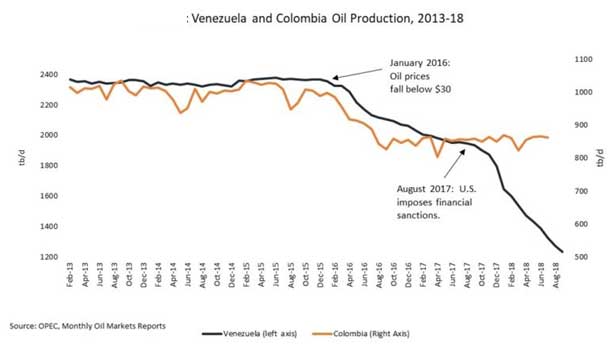
As Rodriguez explained “To understand the magnitude of this effect, consider how much Venezuela would be earning in oil export revenue today if production had not declined. Were the country selling as many barrels to the rest of the world today as in 2015, it would have exported $51bn in oil this year. By contrast, Venezuela will sell only $23bn of oil internationally in 2018. And, if the slide in production continues, only $16bn in 2019.  We can safely say that if the country was receiving $28bn more in yearly export revenue than it does today, it would have experienced a much smaller decline in living standards than it saw.”
The US issued yet another economic sanction on Venezuela on January 28 this year. This time specifically focusing on “persons operating in Venezuela’s oil sector”, especially on Petroleos de Venezuela (PDVSA). The press release announcing these new economic sanctions even specify that the US will “continue to take concrete and forceful actions against those who oppose the peaceful restoration of democracy in Venezuela” adding that the US “stands with interim President Juan Guaido”, an un-elected man (US dep. of State, 2019). This means that not only is the US arbitrarily sanctioning another country’s state assets and intentionally hurting its economy, it is directly involving itself in the internal affairs on another country, which is illegal under international law.
The severe attacks on Venezuela´s economy have been followed by US allies. Recently, the Bank of England refused to return $1.2 billion in gold reserves after lobbying from National Security Adviser John Bolton and Secretary of State Michael Pompeo (Laya, Bronner and Ross, 2019).
Indeed, these sanctions have been described “illegal and could amount to ‘crimes against humanity’ under international law” by Alfred de Zayas, former special rapporteur to the UN. According to de Zayas, the US is engaging in “economic warfare” against Venezuela that results in hurting the economy and killing Venezuelans (Selby-Green, 2019). As the sanctions seem to be means to starve the population of Venezuela and deliberately cripple the economy in order to achieve political aims, these acts can rightly be described as terrorism.
It is very doubtful that any economy would survive such violent sanctions. Unfortunately, the sanctions are only one part of the extensive sabotage that have been done towards the Venezuelan economy and society. An even bigger threat to Venezuela’s economy than US lead sanctions has been the conspicuous acts of the internal enemies of Venezuela’s government and its progressive Bolivarian policies.
Internal subversion
Ever since 1999, the Venezuelan government has been under constant attacks from the very rich and powerful elite of business oligarchs who hate Bolivarian politics with a passion. These oligarchs have been supported by the US, as well as far right groups in the hemisphere, not least in Colombia.
The first serious coup attempt took place in April 2002. It started with a general strike called by unions for the state oil company, PDVSA, which was followed by protest marches through Caracas. As protests neared the Miraflores palace, a massacre took place where 16 people were killed, 7 policemen and 9 civilians. Within hours, the military high command had arrested Chavéz and put in his place Pedro Carmona, the head of Venezuela’s largest business association. This presidency lasted 48 hours. In that short period Carmona, dissolved Congress and cancelled the newly approved constitution of Venezuela. Scores of people were imprisoned, and a military state was put in place. However, thousands of demonstrators and military personnel opposed to Carmona’s rule managed to reverse the coup. According to Bellos (2002),the Bush administration “was left with some eggs on its face. Unlike Latin American countries, which voiced concern that the coup had forsaken democratic principles, the US showed no remorse at Mr. Chavez’s removal”.
The narrative of exactly what happened is still very partisan, but the coup attempt had been organized for at least 9 months by a group of businessmen, military officers and various opposition figures in Venezuela. Keeping in mind how long this coup attempt was planned, it is hard to take seriously claims that the demonstrations and the massacre that occurred in the early hours of April 11, followed by the arrest of Chavez and other political figures by elements of the Venezuelan military were unrelated to these plans. Private media outlets reported with dishonesty about what happened that day (see Wilpert, G. 2009) and were therefore complicit in the coup attempt.
Although the extent to which institutions in the US were involved in the coup attempt, US officials knew it was going to take place. In 2004, declassified intelligence documents showed that the Central Intelligence Agency was aware that dissident military officers and opposition figures in Venezuela were planning a coup against President Hugo Chávez in 2002, well in advance. Parts of the document reads as followed: “disgruntled senior officers and a group of radical junior officers are stepping up efforts to organize a coup against President Chávez, possibly as early as this month…” It stated that Chávez and 10 senior officers were targeted for arrest and the plotters would try to “exploit unrest stemming from opposition demonstrations slated for later this month” (Forero, 2004).
In November 2013, a document titled “Plan Estratégico Venezolano” or “Stratetic Venezuelan Plan” that was written in June that same year, surfaced after suits from attorney Eva Golinger (2013). The document highlighted a plan by representatives of the United States, Colombia and the oligarchs in Venezuela to undermine the economy of Venezuela as part of removing Maduro. The document was prepared by the “Democratic Internationalism Foundations” which is headed by ex-Colombian president Alvaro Uribe, and also the “First Colombia Think Tank” and the US Consulting firm, FTI Consulting.
The document is a very sinister read. It outlines a strategic plan to destabilize Venezuela by various means. For example, it details a strategy to sabotage the electrical system in Venezuela, “maintain and increase the sabotages that affect public services” and “increase problems with supply of basic consumer products”. For propaganda, the authors propose “perfecting the confrontational discourse of [opposition candidate] Henrique Capriles” and generate “emotion with short messages that reach the largest quantity of people and emphasize social problems, provoking social discontent”. More seriously, the authors propose to create “situations of crisis in the streets that will facilitate US intervention, as well as NATO forces, with the help of the Colombian government” adding “whenever possible, the violence should result in deaths or injury”. The document recommends “a military insurrection” against Venezuela with “contacting active military groups and those in retirement to amplify the campaign to discredit the government inside the Armed forces… It’s vital to prepare military forces so that during a scenario of crisis and social conflict, they lead an insurrection against the government, or at least support a foreign intervention or civil uprising” (Golinger, 2013).
The plan was developed during a meeting between the three organizations as well as leaders of the Venezuelan opposition, including Maria Corina Machado, Julio Borges and Ramon Guillermo Avelado, expert in psychological operations J.J. Rendon and the Director of the US Agency for International Development (USAID) for Latin America, Mark Feierstein.
One must ask, how many such plans have been put in place since, but not exposed? The actions and dialogue of these oligarch show just how low they are ready to sink in order to oust a democratically elected government.
The opposition in Venezuela has been very violent and showed complete disregard for democratic principles. For example, in 2014 Venezuela was hit by a big wave of demonstrations following the outcome of the 2013 presidential elections, where Nicolas Maduro won by a small margin, 50.6%. During this time of unrest opposition political figures such as Leopoldo Lopéz, who had also been involved in the 2002 coup attempt, and María Corina Machado, launched a campaign to remove Maduro from office. The plan was named “La Salida” (the exit) and had the intent of having Maduro resign through protests. Machado stated publicly that “we must create chaos in the streets” (Carasik, 2014). At least 36 people died in the unrest following this statement. The opposition predictably blamed the government for these deaths. But considering that the deaths included several security forces and pro-government civilians and others were apparently non-affiliated, that statement must be contested (see Hart, 2014).
Recently, an organization called “Democratic Unity Roundtable” seems to have been coordinating acts of violence against those who are identified as pro-Chavista (Joubert-Ceci, 2017).This group was formed in 2008 to unify opposition Chavéz and can be viewed as the successor of the CoordinadoraDemocrática. The violent protests centered around a call by Maduro to a vote on a Constituent Assembly to rewrite the constitution. Despite having called for the Assembly themselves, the opposition refused to enter dialogue, demanding the presence of the Vatican. But even Pope Francis announced that the dialogue had failed because the opposition would not participate (Nelson, 2017). Instead, the opposition rallied anti-Maduro demonstrators to start a spree of violence that left at least 100 dead (ibid). According to the Canadian Peace Congress of 2017, “if an attempt at internal counter-revolution fails, plans are being put in place for direct military intervention by the United States, possibly under the cover of the Organization of American States (OAS)” (ibid). It is at least clear that the opposition is thoroughly un-democratic in their planning’s and actions but are still supported by Western powers.
To report that the economy of Venezuela is in turmoil solely because of Maduros “socialistic” policies, while ignoring the very serious consequences of economic sanctions, oil price manipulations, and internal sabotage is deliberate denial of facts, is propagandistic journalism, is absurd. Informed discussions about the effects and costs of progressive social programsmay be interesting and useful theoretical exercises.But as distortions and denials of historic facts, emotional attacks on Venezuela’s government should be seen as the propaganda, designed to manipulate American, Canadian and European populations into supporting another violent regime change in another oil-producing nation.

Class, not Brexit, is Britain’s great divide

Chris Marsden

This week’s parliamentary battles over Brexit overshadowed a report by the Centre for Cities think tank that a decade of Conservative cuts means local councils have lost 60 pence in every pound of funding they previously got from central government.
The worst hit towns and cities are in the north of England. The top 10 cities facing the worst cuts are Barnsley (40 percent), Liverpool (32 percent), Doncaster (31 percent), Wakefield (30 percent), Blackburn (27 percent), Newcastle (26.6 percent), Gloucester (23.4 percent), Glasgow (23.3 percent), Hull/Slough (23.1 percent) and Huddersfield (23 percent).
Barnsley has suffered the greatest percentage cut in spending on services, while Liverpool has the deepest cuts per head, at £816.
Every possible spin has been placed on these figures, with commentators seizing on aspects of the report’s findings for their own political ends.
The worst-hit areas are mainly, but not exclusively, areas that voted for Brexit—a fact highlighted by both sides of the raging conflict between the Remain and Leave factions of the ruling class—usually framed in the reactionary terms of a need for stiffer immigration controls.
They are also overwhelmingly Labour Party-controlled authorities, with Labour councils seeing an average fall of 28 percent, compared to 19 percent for Tory authorities—an average decrease of £115 per household in Tory areas and more than £500 in Labour councils. A new funding formula will direct yet more funding to the Tory shires.
What is being deliberately concealed is that this is all part of a war against the entire working class. The cuts have fallen on workers regardless of whether they voted to leave or remain in the European Union (EU), above all in the most deprived areas that have traditionally voted Labour.
Nine of the 10 most deprived UK councils have suffered cuts of almost three times the national average. The national average council spending cut is 14.3 percent, but cities that are home to 55 percent of the population account for 74 percent of this total—£386 per head, compared to a national average cut of £172.
London has suffered the biggest absolute cut—30 percent of all local government spending, despite having just 16 percent of the population.
In every working-class neighbourhood, people’s lives are being torn apart. Local authority spending has fallen by half nationally since 2010, contributing to more than 1 million public sector job losses; the privatisation and gutting of social care; tragic evidence of homelessness and drug addiction on every major street; the closure of libraries, parks, swimming pools and youth clubs; public transport gutted and fares hiked to unaffordable levels; crumbling roads and infrastructure; and overflowing household bins.
With rising poverty and an aging population, nearly half of Britain’s cities now spend more than half of their budget on social care. Barnsley spends 62 percent on looking after its vulnerable adults and children.
The Labourites now making anti-Tory noises are all guilty of imposing these cuts, with Labour leader Jeremy Corbyn and his shadow chancellor, John McDonnell, instructing councils to continue enforcing “legal budgets.” The trade unions have not defended a single job or service.
Labour has given the Tories a blank cheque to build on the massive transfer of wealth from the working class to the super-rich that began under Margaret Thatcher and continued under Tony Blair and Gordon Brown.
The government is now planning further cuts to corporation tax—from its extraordinarily low rate of 19 percent, to just 17 percent. It stood at 28 percent in 2010. Those companies deigning to pay their taxes—Amazon’s UK tax bill fell to just £4.6 million last year on a turnover of £2 billion—will hand over £12 billion less by 2022. This comes on top of the £16.5 billion a year they have already saved since 2010 as a result of corporate tax cuts. The annual shortfall in the National Health Service budget is £20 billion.
To this must be added an estimated £1.7 billion annually in company tax avoidance. Fully 25 percent of FTSE 100 companies avoided taxation by locating subsidiaries to tax havens recognised by the UK—increasing to 98 percent of such companies if a stricter US definition is applied. In 2016, four of the top 10 FTSE companies paid no corporation tax at all.
The result is that United Nations special rapporteur Professor Philip Alston issued a report last November stating that austerity policies have left 14 million people in poverty, including 4.5 million children—with this situation “not just a disgrace, but a social calamity and an economic disaster.”
Yet when Parliament debated his report January 9, just 14 MPs turned up—one for every million poor—and the “debate” was over in a half hour. The contrast between this and the house packed with baying and jeering MPs during the interminable Brexit debates could not have been more grotesque.
Two things are clear:
• Neither the Brexiteers nor the Remainers have any interest in or concern for the working class. Their fight is over how best British capitalism can pursue a trade war for control of global markets and investment. And whether Britain leaves the EU or stays, class war austerity will continue and deepen in the name of making Britain “globally competitive.”
• A Labour government led by Corbyn would do nothing substantial to end the suffering inflicted on millions of working people, especially the most vulnerable. That would require a frontal political assault on the major banks and corporations, a struggle that is anathema to Corbyn and McDonnell, busy wooing the City of London and pledging to uphold the “national interest.”
Workers and young people must trust in themselves and adopt the methods of class struggle against the ruling elite and all its parties. The task is not to rebuild “national unity” across the Brexit divide under Labour, but the unification of the working class in Britain and across Europe against the capitalist class.
Workers must form their own organisations of struggle, independent from the Labour and trade union bureaucracy, to bring down the Tories and form a workers’ government pledged to socialist policies to meet public need, not private profit.
The allies the British working class needs for its own victory are already coming into struggle in a European and international movement against austerity and social inequality—of which the “yellow vest” protests in France, the strike wave in Portugal, strikes and protests by Hungarian and Mexican autoworkers, by millions of Indian workers and by US teachers are only the initial expression.
The Socialist Equality Party and our sister parties in the International Committee of the Fourth International’s European sections, the Parti de l’égalité socialiste (PES) in France and the Sozialistische Gleichheitspartei (SGP) in Germany, call for a unified struggle against the EU and its constituent governments for the United Socialist States of Europe.

US “Worldwide Threat Assessment” takes aim at China

Andre Damon

Amid a bipartisan escalation of US pressure on China, the US “intelligence community” published Tuesday its annual “Worldwide Threat Assessment,” ahead of testimony by US intelligence officials before the Senate Intelligence Committee that day.
While the broadcast media have largely focused on differences between the assessment provided in the document and the statements of the White House, in reality the threat assessment reflects a bipartisan escalation of US efforts to block the economic, military, and technological development of Russia and China, with particular emphasis on China.
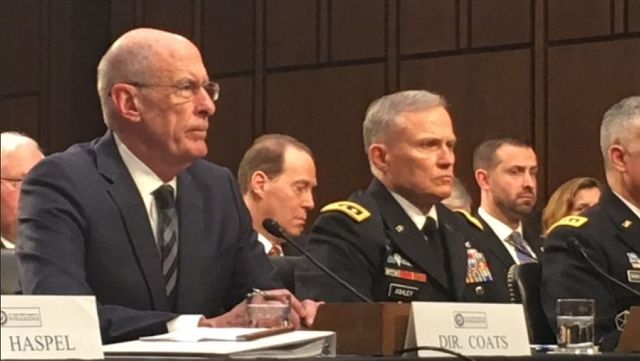
Daniel Coats testifies before the Senate Intelligence Committee
The publication of the document came just one day after the US Justice Department announced a series of trumped-up charges against the Chinese technology company Huawei, alleging that it conspired to help evade US sanctions against Iran and stole technology from the US carrier T-Mobile.
Both the publication of the Worldwide Threat Assessment and the charges against Huawei set the tone for the White House’s trade negotiations with China, which reached an inconclusive outcome on Thursday.
In a development over last year’s document, this year’s threat assessment begins by warning of a growing alignment between Russia and China, declaring that the two countries “are more aligned than at any point since the mid-1950s, and the relationship is likely to strengthen in the coming year as some of their interests and threat perceptions converge, particularly regarding perceived US unilateralism and interventionism.”
The report adds that, “At the same time, some US allies and partners are seeking greater independence from Washington in response to their perceptions of changing US policies on security and trade and are becoming more open to new bilateral and multilateral partnerships.”
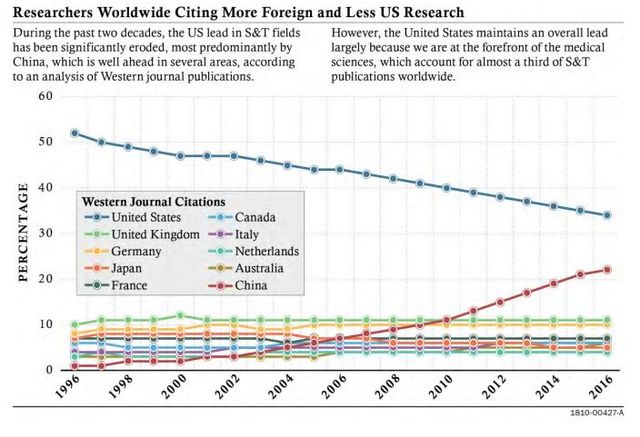
The assessment declares, “For 2019 and beyond, the innovations that drive military and economic competitiveness will increasingly originate outside the United States, as the overall US lead in science and technology (S&T) shrinks; the capability gap between commercial and military technologies evaporates; and foreign actors increase their efforts to acquire top talent, companies, data, and intellectual property via licit and illicit means. Many foreign leaders, including Chinese President Xi Jinping and Russian President Vladimir Putin, view strong indigenous science and technology capabilities as key to their country’s sovereignty, economic outlook, and national power.”
The report points to the critical role of artificial intelligence technology in this “strategic competition,” declaring, “The global race to develop artificial intelligence (AI)—systems that imitate aspects of human cognition— is likely to accelerate the development of highly capable, application-specific AI systems with national security implications.”
The report pointed to Chinas growing leadership in research
It goes on to report that “Foreign production and adoption of advanced communication technologies, such as fifth-generation (5G) wireless networks, most likely will challenge US competitiveness and data security, while advances in quantum computing foreshadow challenges to current methods of protecting data and transactions. US data will increasingly flow across foreign-produced equipment and foreign-controlled networks, raising the risk of foreign access and denial of service.”
The report alleges that “China and Russia are expanding cooperation with each other and through international bodies to shape global rules and standards to their benefit and present a counterweight to the United States and other Western countries.”
The two countries will “present a wide variety of economic, political, counterintelligence, military, and diplomatic challenges to the United States and its allies. We anticipate that they will collaborate to counter US objectives.”
It warns, “We assess that China’s leaders will try to extend the country’s global economic, political, and military reach while using China’s military capabilities and overseas infrastructure and energy investments under the Belt and Road Initiative to diminish US influence.”
It further warns that “Successful implementation of the Belt and Road Initiative could facilitate PLA [People’s Liberation Army] access to dozens of additional ports and airports and significantly expand China’s penetration of the economies and political systems of participating countries.”
Commenting on the document, the New York Times points to its correspondence with Trump’s focus on China. “The report also makes a reasoned assessment of some of the issues that Mr. Trump has focused on in his public statements… China is stealing trade secrets, spying and expanding its military and economic reach. From building islands in the South China Sea to working more closely with Russia than at any time since the mid-1950s, China has a ‘long-term strategy to achieve global superiority.’”
In response to this week’s developments, the primary concern of the Washington Post was to praise Trump’s belligerent stance toward China, while seeking to make sure he does not back down from his conflict with it in exchange for tactical trade concessions by Beijing.
“Mr. Trump is on much sounder footing in calling for a structural overhaul of China’s unfair system,” the Post writes. “What’s more, he deserves credit to the extent that his hardball tactics have forced China at least to discuss such issues.”
But it concludes, “now that a crisis has arrived, it shouldn’t be squandered. Mr. Trump and his negotiators must not settle for less than at least a start on bonafide structural change in China.”
The report, and the response to it, make clear that the US ruling elite is intent on responding to the decline of its global military and economic hegemony by escalating its economic, geopolitical, and military conflict with Russia and China by all means at its disposal.
In an ominous warning, The US and Russia announced the failure of talks to prevent the United States’ withdrawal from the INF treaty, setting the stage for a new global nuclear arms race.

Immigrants subjected to nasal force-feeding at ICE detention center

Patrick Martin

The US Immigration and Customs Enforcement is force-feeding immigrants held in a detention center in Texas, using brutal torture against at least ten men engaged in a hunger strike against their prolonged confinement and mistreatment. The men, mainly Sikhs from the Punjab region of India, are being force-fed either through plastic nasal tubes or intravenous lines, inserted several times a day. At least 30 men are participating in the hunger strike, include some from Cuba as well as the majority from India.
Force-feeding through nasal tubes is a method of torture, used at the Guantanamo Bay detention camp and other CIA-run secret prisons overseas, which has been condemned by international human rights groups. The American Medical Association bars its members from participating in such mistreatment. So long as the hunger striker is making a conscious and reasoned decision to refuse food, the AMA guidelines say, a medical doctor should respect their right to do so.
Democratic Party politicians who are making a show of opposition to Trump’s demands for a wall on the US-Mexico border have nothing to say about the brutal treatment of immigrants and asylum seekers in ICE detention centers that have provoked the hunger strikes and other protests. On the contrary: the legislation now being discussed in a House-Senate conference committee would provide billions more for ICE to expand the American gulag.
The detainees, held at the ICE El Paso Service Processing Center in the west Texas city, have asked immigration advocates visiting them in detention to make their struggle known to the public. The hunger strike was first reported Thursday morning by the Associated Press. A lawyer for one of the detainees and a volunteer immigration advocate both spoke to the World Socialist Web Site about the conditions the men face.
Ruby Kaur is a Michigan-based immigration attorney who speaks Punjabi, the first language of many of the prisoners, who are Sikhs from the north Indian state of Punjab. She represents one of the hunger strikers and said her client had been put on an IV and then force-fed after more than three weeks without eating or drinking water. “They’ve been held for at least six months,” she said. “They are distinguishing them for treatment primarily on the basis of race.”
Kaur said that her client and the other strikers were protesting mistreatment and physical abuse in the detention, and the response of ICE to the hunger strike was even greater mistreatment. “Physical abuse to me is when they’re being force fed,” she said.
She said that the lawyers for the hunger strikers were still gathering information about the physical condition of their clients. “We are not sure about that yet, because we are still in the process of meeting individuals,” she explained.
“I’m very passionate about immigrants’ rights,” Kaur said, adding that some of the hunger strikers had been placed in solitary confinement, which is also classified as a form of torture by international human rights groups.
She told the Associated Press, “They go on hunger strike, and they are put into solitary confinement and then the ICE officers kind of psychologically torture them, telling the asylum seekers they will send them back to Punjab.”
Margaret Brown Vega from Advocate Visitors with Immigrants in Detention, an immigrant support group based in New Mexico, gave additional details about the conditions at the El Paso ICE facility. She is a volunteer for a group that organizes visits to people in detention, to try to minimize their isolation and despair.
“We became aware of the hunger strike,” she told the WSWS. “Three of us volunteers went and visited with four of the men to talk to them about their situation. El Paso Service Processing Center, the ICE facility, it’s a prison. If you look at the standards they operate under, and how they refer to the detainees, it is a prison. They are very much treated like prisoners.
“It’s very hard to get information about them. I spoke to one individual. Another volunteer spoke to two individuals. A third volunteer spoke to the fourth individual.
“Force-feeding is very troubling. They’re very weak. They walk very slowly, shuffling their feet. Their eyes are very tired looking. The man I saw showed me his arms. He’s been getting three or four IVs a day and he said he thought he would be put on a feeding tube through the side of the nose. I believe this is on an ICE protocol.”
The detainees are required to present themselves for their own torture, she explained: “They’ve complained about having to walk to the medical area instead of being brought in a wheelchair.”
Vega added, “What’s difficult for people to understand is that the conditions in immigration facilities are such they bring people to this point. It’s psychologically very challenging. Sometimes it’s physically challenging.
“I think people underestimate how bad it is to be held indefinitely in a place where you don’t get enough food, where you’re constantly berated, where people place obstacles in your way and play games with you. And the worst thing is never knowing when it’s going to end. It’s pretty bad, when it’s day in and day out.”
Vega said that there had not really been much of a change from the Obama administration to the Trump administration, in terms of conditions inside the detention facilities. “I would say that many people feel this is not new,” she continued. “In these facilities, going back ten years, people have noticed these conditions. Even though there are supposedly standards that guide how these places are run.
“I have encountered people in detention who went to a port of entry and applied for asylum. I met one individual who was detained and never given parole. In the El Paso area we’re seeing 100 percent denial rates on parole. We encounter asylum seekers who are not a flight risk, who are not a threat to the community, but they’re not released.”
Both Ruby Kaur and Margaret Brown Vega made it clear that the prisoners had taken the initiative in seeking to have their hunger strike become public, known to a far wider audience than the ICE agents who run the El Paso center.
“Our first priority was to make this situation known,” Vega said. “It’s a matter of First Amendment rights. We feel like it’s our responsibility to help them amplify their voices. It’s very difficult to go even a couple of days without eating. They’re putting their bodies at risk.”
A federal judge has authorized the force-feeding, according to a spokeswoman for ICE, who did not address the charges of physical and psychological abuse by ICE agents. The El Paso facility is directly operated by ICE, not through a subcontractor as at many other detention centers.
When a hunger strike passes the one-month mark, as is the case with the immigrant detainees, there is mounting danger of irreversible physiological damage.
The Associated Press report quoted Amrit Singh, the uncle of two men participating in the hunger strike. “They are not well. Their bodies are really weak, they can’t talk and they have been hospitalized, back and forth,” Singh told AP. “They want to know why they are still in the jail and want to get their rights and wake up the government immigration system.”
There have been repeated hunger strikes by immigration detainees over the last several years, but in most cases the strikers agreed to take food and water under threat of court-ordered force-feeding. It is the continued worsening of conditions, as well as the prospect of indefinite confinement, that has driven some prisoners to take this latest desperate step and defy the threat of torture.
The Freedom for Immigrants organization, the umbrella group to which AVID is affiliated, has documented nearly 1,400 people on hunger strike at 18 detention facilities since May 2015.