2 Feb 2019

European Parliament backs US-led coup in Venezuela

Alex Lantier & Alejandro Lopez 

The European Parliament has voted a resolution supporting the brazen US-led coup to topple Venezuelan President Nicolás Maduro, endorsing the Trump administration’s aggressive policy.
While right-wing oppositionist Juan Guaidó unilaterally declared himself president amid a mass rally in Caracas on January 23, Trump Tweeted: “Today, I have officially recognized the President of the Venezuelan National Assembly, Juan Guaidó, as the Interim President of Venezuela.”
On Thursday night, the EU parliament voted 439 to 104, with 88 abstentions, to support Maduro’s ouster. The resolution “recognises Mr Guaidó as the legitimate interim president of the Bolivarian Republic of Venezuela” and urges that EU “Member States adopt a strong, unified stance, and recognise Juan Guaidó as the only legitimate interim president of the country.” It also asks EU states to let Guaidó’s allies take over their Venezuelan embassies, by deciding to “accredit those representatives to be appointed by the legitimate authorities” of Venezuela.
The resolution calls for strong-arming Maduro into holding new elections. It urges EU authorities “to engage with the countries in the region and any other key actors with the aim of creating a contact group ... with a view to building an agreement on the calling of free, transparent and credible presidential elections.”
The resolution “condemns the fierce repression and violence, resulting in killings and casualties,” which it blames exclusively on Maduro.
Venezuelan Ambassador to the EU Claudia Salerno criticized the vote, warning, “The important thing is to ask whether the European Union is willing to take a step forward to bring Venezuela into a situation of civil war; that is the question that must be asked.” She said the EU is not “above the UN Security Council,” where Maduro can rely on Russian and Chinese support.
Pro-coup Venezuelan oppositionist Antonio Ledezma told Euronews, however, that the EU “contact group” should only be used to hasten regime change: “If they’re going to create a workgroup or something like that, then it has to be clear that we would only accept a workgroup to define the terms of the end of usurpation. Not false statements or negotiations that back Maduro.”
Most of the main EU powers endorsed the coup: Germany, Britain, France and Spain all issued an ultimatum, going beyond the EU parliament resolution, for Maduro to step down in eight days. Italy’s right-wing government broke with the consensus, however.
Foreign Minister Manlio di Stefano of the Five-Star Movement (M5S) condemned the coup, declaring: “Italy does not recognize Guaidó because we are absolutely against the fact that a country or group of external countries can define the domestic politics of another country. This is known as the principle of noninterference and it is recognized by the UN.” Citing the 2011 NATO war in Libya, he warned that a coup could lead to war: “The same error was made in Libya; today everyone must recognize that. We must prevent the same thing from happening to Venezuela.”
Di Stefano’s position was publicly contradicted by Junior Foreign Minister Guglielmo Picchi of the neo-fascist Lega party, however. Picchi Tweeted, “Maduro’s presidency is finished.”
EU support for the coup in Venezuela marks a new exposure of the EU’s pretensions to be the gentler, more democratic alternative to US imperialism. It is ultimately no less ruthless and willing to resort to war than Washington in pursuit of its predatory interests. As Washington escalates its confrontation with Russia and China, EU countries are stepping up social austerity and moving to pour hundreds of billions of euros into their own armies to join in the imperialist scramble to plunder profits and markets around the world.
In this scramble, Washington and the European powers are ultimately rivals—a rivalry that in the previous century twice plunged humanity into world war.
As the EU aligned itself with Trump in Venezuela, it announced the launch of a financial instrument to skirt the US dollar and US sanctions against Iran to allow trade in humanitarian goods. Esfandyar Batmanghelidj, the founder of a Europe-Iran business forum, hailed it as “an experiment and as part of a bigger project to strengthen EU economic power. … The EU is doing something despite the position of the US, and in opposition to the US. This is something new.”
In Venezuela, however, the EU powers apparently prefer to extend their influence at Russian and Chinese expense by backing a right-wing US coup, for now at least.
Some of their calculations were laid out in a University of Hamburg briefing, titled “China is Challenging but (Still) Not Displacing Europe in Latin America.” It wrote that Europe “still holds the upper hand as the principal investor in Latin America,” with €1.2 trillion invested in the region but only $110 billion from China. However, it worried that while “China has not really displaced Europe in terms of Latin American trade … this might change in the future.”
On this basis, Ouest France sounded the call for a coup to oust China and Russia from Venezuela. Its January 31 editorial, “Venezuela divides the world,” stated: “Russia and China are faithful allies of the regime and will not easily abandon Maduro. Behind the ideological veneer, economic and geopolitical realities come first. Russia is Caracas’s top arms supplier and China its top creditor, lending it over 50 billion euros in exchange for oil. So Nicolas Maduro’s collapse would be a shock for Beijing, which is already facing the greatest slowdown of its economy in 40 years.”
It noted the conflict in Europe between those “more sensitive to Russian and Chinese support, like Italy,” and London, Paris, Berlin, The Hague, Lisbon and Madrid, who “exercise progressive pressure so normal elections take place. Failing that, these countries will recognize Juan Guaidó.”
Despite its invocations of democracy, Ouest France made clear it looks to the Venezuelan generals to oust Maduro, hailing “the decisive role of the army.” After noting “the absence, for now, of shifts from the army brass in favor of Guaidó,” it added: “But the situation is fluid, including among the officers. And US pressure is very strong.”
EU condemnations of repression in Venezuela are utterly hypocritical. Beyond their support for a coup in Caracas, their own regimes at home are turning themselves ever more into authoritarian police states deploying violence against opposition in the working class. While it denounces Maduro’s repression of right-wing protests in Venezuela, the EU is silent on the repression by the French government—with thousands of arrests and hundreds of casualties—of “yellow vest” protests against social inequality.
The Spanish Socialist Party (PSOE) government, which holds multiple political prisoners after cracking down on the 2017 Catalan independence referendum, aggressively campaigned for regime change last week in Latin America. Prime Minister Pedro Sánchez stopped in Santo Domingo to denounce the Nicaraguan Sandinista government, after working to expel it from the social-democratic Socialist International. He then traveled on to Mexico to pressure it to back the Venezuelan coup.
Top PSOE official Alfonso Guerra made clear what methods Madrid is considering in Venezuela with remarkable comments endorsing the bloody 1974-1990 dictatorship of Chilean General Augusto Pinochet. While military dictatorships are “at least effective in the economic field,” Guerra said, Maduro is “useless.”
Citing surging inflation in Venezuela, Guerra added: “Between the horrible dictatorship of Pinochet, and the horrible dictatorship of Maduro, there is a difference: in one place the economy did not collapse, in another it has.” Guerra’s preference for a military regime carrying out mass murder over Maduro is an unambiguous signal that the EU supports a bloody coup in Venezuela.

Matamoros strike grows as Mexican ruling class warns of national strike wave

Eric London & Andrea Lobo

The strike of tens of thousands of Matamoros workers spread beyond the maquiladoras this week to new industries as workers in water purification, milk production, and Coca-Cola bottling walked out of their Matamoros workplaces Thursday and Friday.
Several additional auto parts maquiladoras also joined the strike at the end of the week, including at Spellman, Toyoda Gosei Rubber and Tapex. Although over a dozen plants have returned to work after the companies granted the 20 percent wage increase and $1,700 bonus, more than 25 remain on strike, costing the mostly US-based companies a whopping $37 million per day.
At the same time, a strike of 30,000 teachers in the state of Michoacan neared the end of its third week with thousands of teachers blocking train tracks linking industrial hubs with the critical Pacific ports at Lázaro Cárdenas in Michoacan and Manzanillo in Colima. Last Monday, thousands of teachers in Oaxaca joined the strike.
Noticieros Televisa wrote Thursday that the teachers’ blockades “impact not only national industries but also their principle trading partners in Asia. In Guanajuato, the auto industry already reports an impact to supply lines.”
Mexican President Andrés Manuel López Obrador (AMLO) attacked the teachers in a press conference Monday, ordering them to get back to work and absurdly calling them right-wing: “This has nothing to with left-wing politics,” he said. “This radicalism has everything to do with conservatism.”
The Mexican ruling class is terrified of the growing strike movement.
In an article titled “The end of labor stability,” Mexico’s main business paper, El Financiero, warned on Thursday that “not in decades has Mexico been presented with 44 strikes in only one blow.” In comparison to recent weeks, the six-year presidential terms of Vicente, Felipe Calderón and Enrique Peña Nieto saw only 49, 40 and 23 strikes respectively.
“As easy as one two three, the labor stability which we have maintained for decades, with hundreds of thousands of successful contract negotiations, is broken. And it won’t stop there,” El Financiero wrote, warning that the future will bring “polarization” and “a growth of the contradictions between capital and labor. It is the end of labor peace.”
An Associated Press report published Friday exposes AMLO’s anti-working class role in seeking to break strikes and suppress wages. According to business representatives cited in the AP article, AMLO and leaders of his Movement for National Regeneration (Morena) “actively discouraged the Matamoros union from seeking the pay increase.”
It wasn’t the union which demanded the wage increase, but the workers themselves who organized independently and against the explicit threats of the union. Now, the ruling class is leaning desperately on the trade unions and their backers to block the development of a nationwide strike movement.
Milenio newspaper warned that “there is a fear of a contagion in the border region, where millions hope for an increase to their incomes.” The paper quotes an anonymous business leader who said, “This is without precedent. We are all involved in what here will mark what will be the future of manufacturing in this country.”
The industry website Manufactura.mx reported that a corporate representative said industry workers were “contaminated” by the demands for a 20 percent wage increase and that companies anticipate the strikes will spread. The business representative said, “We have an excellent relationship with the union” and hoped the union would help the company avoid a strike.
According to Noticieros Televisa, in “the maquiladora industry in Baja California [where the largest maquiladora city, Tijuana, is located] there is a fear that workers will launch a strike for wage increases.” Noticieros Televisa reports that maquiladoras are “maintaining dialogue with the unions of the industry with the goal of avoiding a labor stoppage.”
Workers are both excited by the growth of the strike and concerned that the companies plan to betray whatever agreement they reach.
One Matamoros striker said, “We all have to go out together. The union is afraid that we are uniting. The majority of us are already out. The problem is that the union hasn’t helped us and hasn’t represented us. Now we have to go out and organize guards. We are not asking for gifts, only what we deserve.” The worker said a union official told her “you are nobodies for being out here.”
A striking Kearfott worker told the WSWS, “I’m glad for the new strikers. This is for all workers across the border that have that clause in their contracts” requiring wages increase in parity with the minimum wage. “The same companies put it there and now they have to pay. We are the most exploited and least rewarded class. I think that it’s time for them to give back to us what they have taken.”
A worker at Autoliv explained to the WSWS that after the company agreed to workers’ demands, “as soon as we went back to work, they began to fire people.”
A worker at Tyco, which also agreed to the wage increase and bonus, also told the WSWS there is a growing mood to strike again to protect their coworkers from retribution:
“At Autoliv, they are firing a bunch of people without severance or bonus. The manager fires workers and mocks them, telling them that they are not going to pay their bonus or severance. They are being sent to the conciliation and arbitration board and are told that they’ll have to wait half a year or a year to resolve things. Obviously this board is on the side of Autoliv.
“I think that the majority that are now working, many who didn’t even participate in the wildcat strikes, should all strike again to support their fired co-workers. They are already getting their bonus and raise. We are a new generation that didn’t know how to strike. We have won respect whether people like it or not. Maybe it’s not all the respect we need, but this is our first strike and if things don’t get better, our second strike will be more organized.”
Though the US business press is beginning to report on the impact of the strikes in Mexico from an economic standpoint, the websites of the International Socialist Organization (ISO) and Socialist Alternative as well as the Democratic Socialists of America’s (DSA) Jacobin magazine have all ignored the strike entirely. None of these anti-working class, anti-socialist organizations has published a single article on the rebellion of Mexican maquiladora workers.

GM to lay off 4,250 salaried workers in North America starting Monday

Shannon Jones 

General Motors will begin laying off 4,250 North American salaried workers Monday morning as part of a sweeping restructuring announced in November that includes the closure of five plants and the elimination of 15,000 jobs. The plan includes the destruction of 15 percent of the company’s 54,000 North American salaried jobs.
According to one press report, the jobs massacre will take the form of “rolling layoffs” that will continue until the end of the month. Three assembly plants—Lordstown, Ohio; Detroit-Hamtramck; and Oshawa, Ontario—along with Warren Transmission in Michigan and a propulsion plant in Maryland—are slated to close by the end of the year, devastating entire towns and cities.
One report said that GM management was determined to begin the layoffs before the company releases its fourth quarter 2018 and full year 2018 earnings reports on Wednesday, which are expected to show a drop in profits. This underscores the fact that Wall Street is cracking the whip on GM and the rest of the auto giants to press ahead with cost-cutting and stepped up attacks on the workers in order to drive up stock prices and the speculative profits of the banks, hedge funds and big investors. GM has said the job cuts and plant closings will free up $6 billion in cash, but the automaker has spent $10.6 billion since 2015 buying back its own shares in order to fatten the portfolios of the financial oligarchs.
The cuts have generated enormous anger and opposition among autoworkers in the US and Canada, who have never recovered from job cuts and concessions imposed with the collaboration of the auto unions as part of the Obama administration’s 2009 forced bankruptcy and restructuring of GM. The cuts will further impoverish regions in both the US and Canada that have been ravaged by decades of deindustrialization.
Last month, workers at the Oshawa assembly plant staged a five-hour sit down protest after GM CEO Mary Barra announced that she would not reconsider the decision to close the factory. Workers took the action independently of Unifor, terrifying the union officials and sending them scrambling to quash the rebellion.

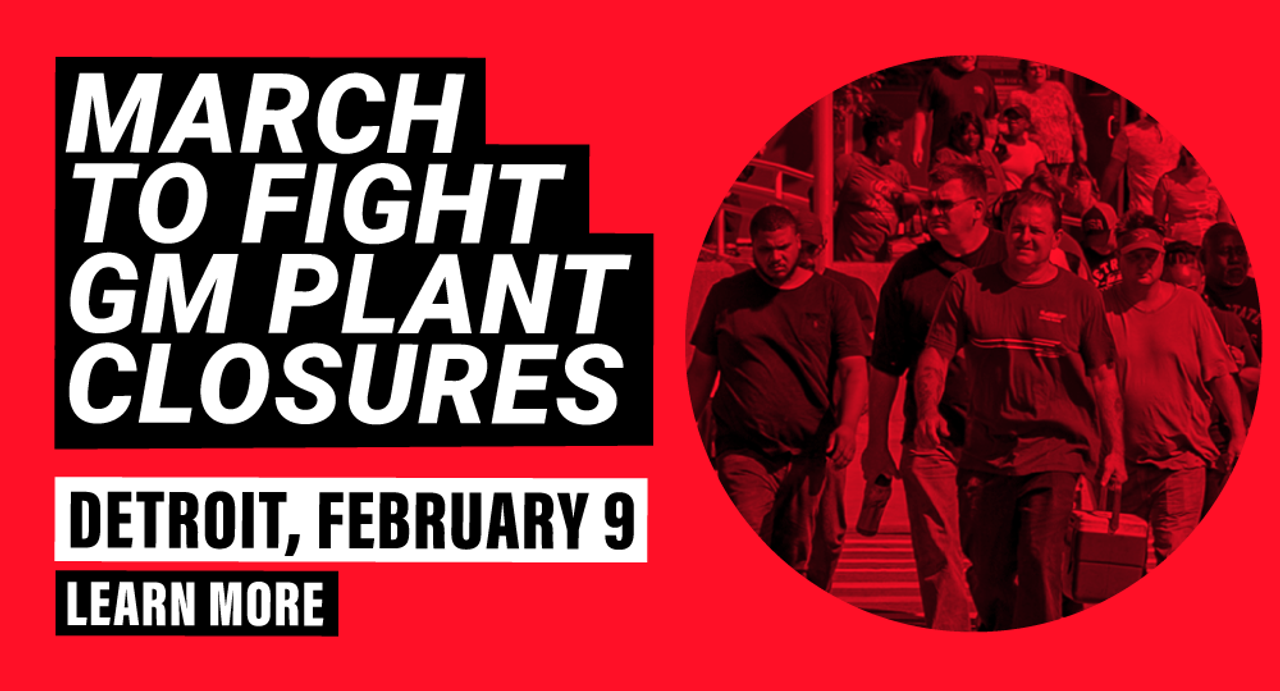
February 9 demonstration in Detroit against GM plant closures

The World Socialist Web Site Autoworker Newsletter and the Steering Committee of the Coalition of Rank-and-File Committees have called a demonstration for February 9 outside GM headquarters in Detroit in opposition to the plant closings. It has called on workers to mobilize independently of the UAW and Unifor to defend their jobs and living standards and link up with the struggle of 70,000 Mexican autoworkers in Matamoros, across the border from Brownsville, Texas, who have been carrying out a wildcat strike for nearly three weeks.
The demonstration is not an appeal to GM and the corporate bosses, but rather a call for workers to mobilize their strength and fighting determination through the formation of rank-and-file committees independent of the pro-corporate unions and the corporate-controlled politicians and parties.
The call has garnered widespread interest and support. A central theme of this action is the unity of US, Mexican and Canadian workers against job cuts and concessions and against all attempts to divide workers along national lines.
This means an implacable struggle against the economic nationalism promoted by the unions. The response of the United Auto Workers and Unifor in Canada to the plant closures is to spew nationalist poison. This week, the United Auto Workers announced that is joining a boycott of GM vehicles assembled in Mexico previously initiated by Unifor.
These same organizations oppose any industrial action by GM workers to fight the layoffs. They plan to use the threat of plant closings to blackmail workers into accepting new concessions that will be demanded by the auto companies in contract negotiations later this year.
The call for a boycott targeting the jobs of Mexican workers is an attempt to divert workers from a struggle against the real enemy—the transnational auto companies and the profit system as a whole—and instead channel their anger against their fellow workers south of the Rio Grande. In this way, the unions line up behind the Trump administration’s fascistic attacks on immigrant workers from Mexico and Central America.
The announcement of the GM closures takes place against a background of growing worker militancy around the word, including strikes by autoworkers in Hungary, yellow vest protests in France, a general strike in India and a walkout by 30,000 teachers in Los Angeles.
Of particular concern to the UAW and Unifor is the strike by the maquiladora workers in Matamoros against sweatshop conditions at auto parts manufacturers and other industries. To this date, the UAW has not said a word about the heroic actions of the Matamoros workers, who launched their strikes independently of and in opposition to the official unions.
A worker at the Ford Sterling Axle plant outside of Detroit told the WSWS in response to the UAW’s call for an anti-Mexican boycott, “It is not the fault of Mexican workers. It is corporate greed. They just want more profits.
“We haven’t heard a word from [UAW President] Gary Jones since he got elected. He doesn’t want to piss off the car companies because he is afraid of losing perks. They are invested in GM through the retiree health care fund.”
Referring to the blackout of reports about the strikes in Matamoros, he said, “They don’t want us to get any ideas. What the Mexican workers are doing is sticking together and saying enough is enough. They don’t want us to find out because they don’t want us raising our own demands.”
A General Motors worker at the Delta Township assembly plant near Lansing, Michigan said he planned to attend the Feb 9 demonstration. “It is not the Mexican workers’ fault. They are trying to provide for their families.
“GM is closing five plants, but they are making record profits. They are trying to force the older workforce to retire by placing them in other plants and making them drive long distances. It leaves them little time for their families. They can’t just relocate and buy new homes. It forces them to retire.
“You haven’t heard anything from the UAW about Canadian plants being closed. We should work on how you hurt them by sticking together. You should have Mexican, Canadian, US workers all united together.”
In another demonstration of the UAW’s lineup with the Trump administration, on Thursday UAW President Gary Jones announced his support for Trump’s executive order titled “Strengthening Buy-American Preferences for Infrastructure Projects.” In a brief statement Jones declared, “Companies like General Motors have an obligation to build where they sell and stop exporting jobs abroad.”
Meanwhile, Unifor says it plans to run ads promoting its anti-Mexican boycott during this Sunday’s Super Bowl football game. These ads are extremely costly, reportedly $5.25 million for a 30 second spot, or roughly the equivalent of the monthly dues contribution of 100,000 workers.
The nationalist “Buy American” and “Made in Canada” campaigns of the UAW and Unifor are both reactionary and absurd. They ignore the global character of production, which makes it impossible to determine the “nationality” of any given vehicle.
After ignoring the strikes in Matamoros for weeks, Unifor President Jerry Dias announced his “support” for striking Mexican autoworkers in a perfunctory statement this week. This followed determined attempts by the establishment media, pseudo-left groups, Unifor and the UAW to black out all news of the strike by Mexican workers.
The launching of mass layoffs by GM gives added urgency to preparations for the February 9 demonstration in Detroit. The WSWS and the Socialist Equality Party call for the widest possible mobilization of autoworkers as well as other sections of the working class, teachers, auto parts workers, Amazon and United Parcel Service workers as well as students and youth against the plant closures and layoffs.

The US scraps the INF treaty: Another step toward nuclear war

Andre Damon

At the height of the Cuban Missile Crisis, as the world stood on the brink of nuclear annihilation, President John F. Kennedy told his brother Bobby, “If this planet is ever ravaged by nuclear war, if 300 million Americans, Russians, and Europeans are wiped out by a 60-minute nuclear exchange, if the survivors of that devastation can then endure the fire, poison, chaos, and catastrophe, I do not want one of those survivors to ask another, ‘How did it all happen?’ and to receive the incredible reply, ‘Ah, if only one knew.’”
Unbeknownst to President Kennedy, who was seeking to avoid a nuclear war, or his general staff, many of whom wanted to start one, such a war would have wiped out not 300 million people but all of humanity. The theory of nuclear winter, discovered in the mid-80s and subsequently accepted by scientific consensus, concludes that a full-scale nuclear war, as planned by the United States military, would render the entire planet uninhabitable for a century.
But it is precisely such a nuclear apocalypse that the United States is not just blindly stumbling toward, but directly preparing for. As a recent article in Foreign Affairs told its readers: “Prepare for Nuclear War.”
On Friday, US Secretary of State Mike Pompeo declared that the United States would suspend its compliance with the Intermediate Range Nuclear Forces (INF) treaty, a 1987 agreement between the Soviet Union (and subsequently Russia) and the United States that bans the deployment of missiles with ranges between 500 and 5,500 kilometers.
The move makes almost inevitable the US withdrawal from the other key global arms control agreement, the New START treaty, agreed between the United States and Russia in 2011, in what US president Trump called “one of several bad deals negotiated by the Obama administration.”
Little need be said about the White House’s official justifications for leaving the treaty: that Russia is in violation of the treaty’s provisions, despite repeated offers by Moscow for not only the United States, but international authorities and journalists, to inspect its missiles. The White House’s allegations are echoed by people who do not believe them and left unquestioned by a media apparatus that functions as a mouthpiece for the military.
In an article that fully backs the White House’s accusations against Russia, the New York Times’ David Sanger, a conduit for the Pentagon, spells out with perfect lucidity the real reasons why the United States is leaving the INF treaty:
“Constrained by the treaty’s provisions, the United States has been prevented from deploying new weapons to counter China’s efforts to cement a dominant position in the Western Pacific and keep American aircraft carriers at bay. China was still a small and unsophisticated military power when Ronald Reagan and Mikhail Gorbachev, the last leader of a rapidly-weakening Soviet Union, negotiated the I.N.F. agreement.”
Sanger’s own words make perfectly clear why the United States wants to leave the treaty, which has nothing to do with Russia’s alleged violations: Washington is seeking to ring the island chain surrounding the Chinese mainland with a hedge of nuclear missiles. But Sanger somehow expects, without so much as a transition paragraph, his readers to believe the hot air spewed by Pompeo about Russia’s “bad behavior.”
The US withdrawal from the INF treaty is not the result of Trump’s peculiar fondness for nuclear weapons. Rather, it is the outcome of a reorientation of the United States military toward “great-power” conflict with Russia and China.
Over the past two years, the American military establishment has grown increasingly alarmed at the rapidity of China’s technological development, which the United States sees as a threat not only to the profitability of its corporations, but the dominance of its military.
Two decades ago, at the height of the dotcom bubble, China was little more than a cheap labor platform, assembling the consumer electronics driving a revolution in communications, while American companies pocketed the vast bulk of the profits. But today, the economic balance of power is shifting.
Chinese companies like Huawei, Xiaomi, and Oppo are capturing an ever-greater portion of the global smartphone market, even as their rivals Samsung and Apple see their market share slip. The Shenzhen-based DJI is the uncontested global leader in the consumer drone market. Huawei, meanwhile, leads its competitors by over a year in the next-generation mobile infrastructure that will power not only driverless cars and “smart” appliances, but the “autonomous” weapons of the future.
As the latest US Worldwide Threat Assessment warns, “For 2019 and beyond, the innovations that drive military and economic competitiveness will increasingly originate outside the United States, as the overall US lead in science and technology shrinks” and “the capability gap between commercial and military technologies evaporates.”
It is the economic decline of the United States relative to its global rivals that is ultimately driving the intensification of US nuclear war plans. The United States hopes that, by leveraging its military, it will be able to contain the economic rise of China and shore up US preeminence on the world stage.
But a consensus is emerging within the US military that Washington cannot bring its rivals to heel merely with the threat of totally obliterating them with its massive arsenal of strategic missiles. Given the fleet of nuclear-armed ballistic missile submarines possessed by both Russia and China, this option, even ignoring the effects of nuclear winter, would result in the destruction of the largest cities in the United States.
Rather, the US is working to construct a “usable,” low-yield, “tactical” nuclear arsenal, including the construction of a new nuclear-capable cruise missile. This week, a new, low-yield US nuclear warhead went into production, with a yield between half and one third of the “little boy” weapon that leveled the Japanese city of Hiroshima, and hundreds of times less than the United States’ other nuclear weapons systems.
The Trump administration’s Nuclear Posture Review, released last year, envisions using such weapons to turn the tide in conflicts that begin with conventional weapons, under the pretense (whether the Pentagon believes it or not) that such wars will stop short of full-scale nuclear exchanges.
Nearly 75 years ago, the United States, after having “scorched and boiled and baked to death,” in the words of General Curtis Lemay, hundreds of thousands of civilians in a genocidal “strategic bombing” campaign over Japan, murdered hundreds of thousands more with the use of two nuclear weapons: an action whose primary aim was to threaten the USSR.
But ultimately, the continued existence of the Soviet Union served as a check on the genocidal impulses of US imperialism.
Despite the triumphalist claims that the dissolution of the Soviet Union would bring about a new era of peace, democracy, and the “end of history,” it has brought only a quarter-century of neocolonial wars.
But the wars in Iraq, Afghanistan, Libya, and Syria have not achieved their intended purpose. Having spent trillions of dollars and killed countless millions of people, the global position of US imperialism is no better than when it launched the “war on terror” in 2001.
Now, the United States is upping the ante: setting “great-power conflict” with Russia and China on the order of the day. In its existential struggle for global hegemony, US imperialism is going for broke, willing to take the most reckless and desperate means, up to and including the launching of nuclear war.
There is no peaceful, capitalist road toward managing the global crisis that has erupted with such force and violence. If humanity is to survive the 21st century, it will take the intervention of the working class, the only social force capable of opposing the war aims of the capitalist ruling elites, through the struggle to reorganize society on a socialist basis.

1 Feb 2019

Johnson&Johnson Africa Grants Programme (AGP) 2019

Application Deadline: 28th February 2019 midnight.

About the Award: THET welcomes grant applications to strengthen the healthcare workforce in one of the following two areas:


Stream 1: Essential Surgical and Anaesthetic Care
This stream will focus on reducing morbidity and mortality from conditions requiring essential surgical intervention and/or enhancing patient safety as a result of improved anaesthetic care through the training of relevant health workers. The aim of this stream is to improve the access to, and availability of, quality surgery and/or anaesthetic care (particularly for maternal, neonatal or paediatric surgical conditions).

Stream 2: Community Healthcare
This stream will focus on increasing the availability and quality of essential healthcare (including attended births) and health information to underserved populations, particularly women and children, by training those who work and serve in the community. The stream will focus on the training of cadres working in the community (Clinical Officers, Community Health Workers, etc.), which is in line with the national strategy and policies in-country. Partners will work at the rural and district level, outside of the central hospital systems.

Type: Grants

Eligibility:
Core Eligibility: The core requirements for the AGP 2019-20 are as follows:
  • Grant recipients must be eligible organisations under this programme (see Q&A document)
  • Applications must be made by eligible partnerships under this programme (see Q&A document)
  • Projects must fit within the parameters of either stream 1 or stream 2, as outlined above
  • Project budgets cannot exceed £50,000
See other Eligibility and requirements in the Program Webpages

Number of Awards: Not specified

Value and Duration of Award: Grants are available from £15,000 up to a maximum of £50,000. All funded projects are expected to last between 6 and 16 months. Project activities can be implemented from May 2019 until August 2020.

Duration of Programme: 

How to Apply: The Grant Application Form and Budget Template should be completed and submitted, along with letters of support from each of the lead partner institutions and any managing partners, in one email to AGP@thet.org by midnight 28th February 2019.
  • It is important to go through all application requirements on the Programme Webpage see link below) before applying

Visit Programme Webpage for Details

CARTA Postdoctoral Research Fellowship 2019 for African Scholars

Application Deadline: 22nd February, 2019

Eligible Countries: African countries

About the Award: Two modes of post-doctoral fellowships will be considered as follows:
  1. Full-time fellowships for 12 months, whereby the fellow will be resident at the host institution for the entire fellowship period;
  2. Split fellowships, whereby the fellow will be expected to make at most three visits of not less than three months to only one host institution over the 12-month period.
Type: Fellowship, Postdoctoral

Eligibility: Applicants must be PhD graduates of the CARTA program. They must demonstrate strong commitment to research capacity building at their institution as well as potential for research leadership.


Number of Awards: Not specified

Value of Award: The postdoctoral fellowship award will be up to a maximum of US$ 48,000 and will include travel costs, a monthly stipend of US$3,000 and funds for formation of new research collaborations and partnerships, development of pilot projects, training opportunities on specific research skills and attendance of an international conference. Due to the short-term nature of the postdoctoral research fellowship program, the fellowships will not cover accompanying dependents.

Duration of Program: 12 months

How to Apply: Applicants must contact the CARTA Secretariat to get the application form.
Applicants must submit the following documents to the CARTA Secretariat (carta@aphrc.org), and copy the same to their focal person(s):

1. A completed application form.
2. Updated CV, showing publications and awards.
3. A statement from the current employer indicating willingness to release and readmit the applicant at the end of the postdoctoral training period
4. Letters of support, from:
a) a senior academician, from your home institution, who understands your research and potential;
b) your Head of Department or Dean;
c) the prospective host institution indicating:
i. its willingness to host the applicant; and
ii. the name of the proposed mentor.
d) your proposed mentor (including his/her CV) from the host institution(s).
5. E-copies of your most significant publications over the last three years


Visit Programme Webpage for Details

Reporters Without Borders Berlin Scholarship Programme 2019 for Bloggers, Professional and Citizen Journalists (Fully-funded to Berlin, Germany)

Application Deadline: 19th February 2019

Eligible Countries: See Eligibility below


To Be Taken At (Country): Berlin, Germany

About the Award: In a journalistic work, the aim of the study is to provide students with a practical knowledge of how to protect themselves against digital threats. In addition, they want to receive training on how to teach others in their home region about digital security issues.

Type: Short course

Eligibility: Professional journalists, bloggers and citizen journalists who
  • are exposed to digital threats due to their work in their home regions,
  • want to learn and work extensively with digital security
  • in their own home regions and, ideally, already have some experience in teaching (including in other areas).
Selection Criteria: Scholarship holders want to have good command of English, as the working language of the scholarship program wants to be English. They should also have adequate experience working as a journalist. In addition, applicants have every intention of returning to their home region after three to four months of residence in Germany.

Number of Awards: 4

Value of Award: We cover the travel costs, take care of all visa-related matters, provide a pleasant apartment in Berlin for the duration of the scholarship, pocket money of around € 1000 per month, free use of public transportation in Berlin and a fully equipped computer, in a field of digital security and didactics. Furthermore, during their stay in Berlin scholarship holders will be given insights into the activities of a globally active journalist and human rights organization.

Duration of Programme: 1.05.2019 to 31.08.2019 or 1.09.2019 to 31.12.2019

How to Apply: Please send a completed and signed application form, the completed questionnaire, your CV and your identity documents in separate PDF documents as attachments (in total 4 PDF’s) either via: Signal-Messenger to +49163 6182705 or if you have an Protonmail-Account to rog.digitalfreedom@protonmail.com or if you know how to use PGP by encrypted email to digitalfreedom@reporter-ohne-grenzen.de (GnuPG/GPG-Key).

Visit Programme Webpage for Details

Coimbra Group Short-Term Scholarship Program 2019 for Young Researchers from North African Countries (Fully-funded)

Application Deadline: 31st March 2019

Offered annually? Yes


Eligible Countries:  Albania, Algeria, Armenia, Azerbaijan, Belarus, Bosnia and Herzegovina, 
Egypt, Former Yugoslav Republic of Macedonia, Georgia, Israel, Jordan, Kazakhstan, Kosovo, Kyrgyzstan, Lebanon, Libya, Moldova, Montenegro, Morocco, the Palestinian Authority, Serbia, Syria, Tajikistan, Tunisia, Turkmenistan, Ukraine, and Uzbekistan.

To Be Taken At (Country): The following Coimbra Group Universities are participating in the 2019 edition of the Coimbra Group Scholarship Programme:
  • Eötvös Loránd University Budapest (Hungary)
  • University of Granada (Spain)
  • Karl Franz University of Graz (Austria)
  • University of Heidelberg (Germany)
  • Alexandru Ioan Cuza University of Iasi (Romania)
  • KU Leuven (Belgium)
  • University of Padova (Italy)
  • University of Poitiers (France)
  • University of Salamanca (Spain)
About the Award: Universities of the Coimbra Group offer short-term visits to young researchers from higher education institutions from countries in the European Neighbourhood. The main aim of this scholarship programme is to enable scholars to undertake research in which they are engaged in their home institution and to help them to establish academic and research contacts.

Type: Research

Eligibility: Applicants must fulfil all the following criteria:
  • be born on or after 1 January 1984
  • be nationals of and current residents in one of the above-listed countries
  • be current academic staff members of a university or an equivalent higher education institution located in one of the above-listed countries and be of postdoctoral or equivalent status, although some institutions may offer opportunities to doctoral students
Number of Awards: Not specified

Value of Award: Successful candidates will have access to excellent academic knowledge in quality facilities. The scholarships include financial support for tuition, living costs, airfares etc.

Duration of Program:  The dates of your stay should be agreed upon between the applicant and the academic supervisor at the Coimbra Group University. Typically this will be during the academic year 2019/2020

How to Apply: APPLY HERE

It is important to go through the Application instructions on the Program Webpage (see Link below) before applying

Visit the Program Webpage for Details

Coimbra Group Short-Term Scholarship Program 2019/2020 for Young Researchers in Sub-Saharan Africa

Application Deadline: 31st March 2019

Offered annually? Yes


Eligible Countries: All African countries except Algeria, Egypt, Libya, Morocco, and Tunisia (applicants from these countries are eligible under the Scholarship Programme for Young Researchers from the European Neighbourhood).

To be taken at (Country): The following Coimbra Group universities are participating in the 2019 edition of the scheme:
  • University of Barcelona (Spain)
  • University of Coimbra (Portugal)
  • University of Cologne (Germany)
  • University of Granada (Spain)
  • University of Graz (Austria)
  • University of Groningen (The Netherlands)
  • KU Leuven (Belgium)
  • University of Padova (Italy)
  • University of Pavia (Italy)
  • University of Poitiers (France)
  • University of Salamanca (Spain)
  • University of Siena (Italy)
About the Award: Universities of the Coimbra Group offer short-term visits (generally 1 to maximum 3 months) to young African researchers from higher education institutions from Sub-Saharan Africa. The main aim of this scholarship programme is to enable scholars to undertake research in which they are engaged in their home institution and to help them to establish academic and research contacts. The scholarships are financially supported by the Coimbra Group member universities participating in this programme, while the Coimbra Group Office is in charge of the administrative management of the applications.

Type: Research, Short course

Eligibility: Applicants should be:
  • born on or after 1 January 1974
  • nationals of and current residents in a country in Sub-Saharan Africa
  • current staff members of a university or an equivalent higher education institution in Sub-Saharan Africa
  • of doctoral/postdoctoral or equivalent status although some universities offer grants for Master’s level students (please see details in the table in the Link below).
Female candidates are encouraged to apply and will be prioritised.

Selection: The administrative check of applications will be undertaken by the Coimbra Group Office in order to select candidates who meet the eligibility criteria. The selection of candidates will be undertaken by the host universities. When selection has been agreed upon, the host university may send a letter of invitation directly to the successful candidate. The Coimbra Group Office will contact all candidates and inform them about the result of their application. Successful candidates currently employed by a University are responsible for ensuring that their home institution will grant them leave of absence to undertake the proposed visit.

Number of Awardees: Limited

Value of Award: Successful candidates will have access to excellent academic knowledge in quality facilities. The scholarships include financial support for tuition, living costs, airfares etc.

Duration of Program: From 1 to maximum 3 months. The dates of candidate’s stay should be agreed upon between the candidate and the academic supervisor at the Coimbra Group University. Typically this will be during the academic year 2019/2020.

Submit your application here

It is important to go through the Application instructions on the Program Webpage (see Link below) before applying


Visit Scholarship Webpage for details

Climate Research for Development (CR4D) in Africa Initiative 2019 for African Researchers

Application Deadline: 10th February 2019.

Eligible Countries: African countries

About the Award: The CR4D initiative was conceptualized at the Africa Climate Conference in 2013 as a mechanism to strengthen links between climate science research and climate information needs to support development planning in Africa. The initiative addresses climate research priority areas that have been identified in Africa by African researchers.
Over the next year, CR4D will support research into identified priority areas for climate change and development linkages. The research will cover foundational climate science, impacts, information and research translation and engagement with policy and decision-making communities. The goal will be to produce research outputs that inform policy in climate sensitive sectors to better prepare Africa to deal with the impacts of climate change. 

Type: Research


Eligibility
  • CR4D candidates must be hosted by or affiliated with a university, research institute or other eligible institution of higher education in Africa.
  • They must and hold a PhD in climate or related sciences and/or have a proven track record of high-quality, impactful research in a relevant field.
  • Applicants must have a clearly defined scientific research proposal
  • All African nationals are eligible to apply.
Number of Awards: 15

Value of Award:
  • CR4D will award 1-year research grants to 15 African climate researchers of up to USD 130,000.
  • Through The AAS Rising Research Leaders programme, grantees will be supported to develop as independent research leaders through training, mentoring, and networking opportunities that will enable international collaborations.
Duration of Programme: 1 year

How to Apply: Apply Here
  • It is important to go through all application requirements on the Programme Webpage see link below) before applying
Visit Programme Webpage for Details

UNV and UNFPA Young Innovators Fellowship Programme 2019

Application Deadline: 10th February 2019

Eligible Countries: All

To be taken at (country): Different member countries (see Programme Webpage)

About the Award: The fellowship programme provides an opportunity to bring 14 young people into UNFPA with a dedicated focus on both providing a youth perspective and driving innovation. 


Type: Entrepreneurship, Job (Paid Volunteership)

Eligibility: We will recruit innovative young people from around the world who have demonstrated commitment to development issues within their communities as UN Volunteer Young Innovators.

Number of Awards: 14

Value of Award:
  • Selected fellows would join UNFPA headquarters in New York for two months, where they would undergo a dedicated leadership training.
  • Two of the Young Innovators will remain as international UN Volunteers for a further six months at UNFPA headquarters in New York; these two HQ positions are open to applicants of all nationalities. The other 12 Young Innovators will return to their home countries, where they will complete six-month national UN Volunteer assignments in UNFPA Country Offices (and must be nationals of these countries). 
How to Apply: If you are a young person committed to bringing your innovative spirit and skills to UNFPA as a UN Volunteer in your country or at UNFPA headquarters, check out available assignments in Programme Webpage Link below.
  • It is important to go through all application requirements on the Programme Webpage see link below) before applying
Visit Programme Webpage for Details

IBM Great Minds Student Internships 2019 for International Students (Pitch your vision and win an internship in Zurich, Nairobi, or Johannesburg)

Application Deadline: 25th February 2019

Eligible Countries: African countries, central and eastern Europe, the Middle Eastern countries

To be taken at (country): Zurich, Nairobi or Johannesburg

Fields of Study: The program is open to all full-time students enrolled in a Master’s program in Computer Science, Electrical Engineering, Physics, Software Engineering, Industrial Engineering or Service Science at a recognized university or college in central and eastern Europe, the Middle East or Africa.

Type: Internship, Contest


Eligibility:
  • The students must have a solid command of the English language in both written and spoken form.
  • IBM is an equal-opportunity employer and encourages applications from both genders as well as minority groups.
  • We would especially like to encourage qualified women to participate in this competition.
Value of Internship: IBM will pay the winners a lump sum towards travel expenses as well as compensation that covers adequately the cost of living in Switzerland, Kenya or South Africa, respectively. IBM will also obtain the necessary visa and work permits for the successful candidates.

Duration of Internship: 3 – 6 months. The internships will take place in 2019. The exact starting time and duration will be agreed upon with the winning students individually, taking into account their academic commitments and the availability of IBM staff.

How to Apply: Participants must be nominated by a faculty member. A recommendation letter from a faculty member is mandatory.
To participate in the Great Minds competition, see the detailed instructions for students in the link below.

Visit Internship Webpage for details

Thailand International Postgraduate Scholarship and Training Program 2019 for Developing Countries

Application Deadline: Each embassy has a different deadline.

Eligible Countries: Developing Countries


To Be Taken At (Country): Thailand

About the Award: Annual International Training Course (AITC) was initiated in 1991 as a framework in providing short-term training for developing partners. Today, the AITC remains one of TICA’s flagship programmes. It offers not only a training experience, but also a platform in exchanging ideas and establishing professional network among participants from across the world.

Thailand International Postgraduate Programme (TIPP) was introduced in 2000 as a framework in providing postgraduate scholarships for developing partners. Believing that knowledge sharing is an important pillar of South-South Cooperation, TIPP offers opportunities for Thailand and its partners to exchange their experiences and best practices that would contribute to long-term and sustainable development for all.
Aiming at sharing Thailand’s best practices and experience to the world, the AITC training courses and the TIPP scholarships focus on development topics of our expertise which can be categorized under five themes namely; Food Security, Climate Change, Public Health,  other topics related to Sustainable Development Goals (SDGs), and “Sufficiency Economy Philosophy” or SEP which Thailand is proud to introduce as the highlighted theme. SEP has been added with an aim to offer an insight into our home-grown development approach which is the key factor that keeps Thailand on a steady growth path towards sustainable development in many areas.

Fields of Study: Food Security, Climate Change, Public Health,  other topics related to Sustainable Development Goals (SDGs), and “Sufficiency Economy Philosophy” or SEP

Type: Training, Postgraduate (Masters, PhD)

Eligibility: 
  • Candidates must be nominated by central government agencies in a country from the TIPP eligible countries/territories list.
  • Candidates should be an officer or agent (preferably from government agencies) currently working in the area related to the course provided.
  • Candidates must have bachelor degree and/or professional experience related field or related to graduate degree.
  • Candidates must have a good command of English.
  • It is recommended that candidates be less than 50 years of age.
  • Candidates must have good physical and mental condition.
  • TICA reserves the rights to revoke scholarship offered to participants who are pregnant during the period of study or violate rules and regulations.
  • Other requirements apart from these will be under consideration by the University regulations.
English Language Requirements: Candidates must have a good command of English. Candidates whose English is not the first language/Bachelor’s degree was not taught in English/ who is from a country other than New Zealand, USA, the United kingdom, Australia, Canada has to pass and English Language proficiency test according to criteria announced by University regulations.

Selection Criteria: 
  • In considering applications, particular attention shall be paid to the candidates’ background, their current position in the service of their Government, and practical use they expect to make of the knowledge and experience gained from training on the return to their Government positions.
  • Selection of participants is also based on geographical distribution and gender balance, unless priority is set for particular country/ group of countries.
Number of Awards: Over 700 training fellowships and 70 postgraduate scholarships. Each eligible countries/territory can nominate up to five (5) candidates per academic program.

Value of Award: Successful candidates will be offered an award which covers:
  • Return economy class airfare
  • Accommodation allowance
  • Living allowance
  • Book allowance
  • Thesis allowance
  • Settlement allowance
  • Insurance
  • Airport meeting service
How to Apply: 
  • The nomination must be made by central government agencies in charge of the nomination of national candidates (such as Ministry of Foreign Affairs) or by relevant central government agencies for which the nominated candidates currently work. The nomination must be in line with relevant rules and regulations of the nominating countries/territories.
  • The nomination must be submitted to TICA through the Royal Thai Embassy/ Permanent Mission of Thailand to the United Nations/ Royal Thai Consulate-General accredited to eligible countries/territories. (See “List of Eligible Countries/Territories”)
  • Originals of nomination documents, duly filled out, must be received no later than a specified deadline for each academic program.
  • The application form must be filled in the typed-block letter.
The nomination must be supported by the following documents;

  • AITC Application Form
  • Medical Report
  • Transcript
  • Recommendation letters
  • English score (e.g. TOEFL/IELTS)
  • One original with two (2) copies of all forms duly filled out, counter-signed and stamped by the authorized person must be submitted.
Visit the Program Webpage for Details

Award Providers: Government of Thailand