Application Deadline: Rolling Eligible Countries: All To be taken at (University): Fellows are trained at CEIBS, Columbia University, INSEAD, the London Business School, THNK School of Creative Leadership and Innovation, and the Wharton School of the University of Pennsylvania. About the Award: As a Global Leadership Fellow at the World Economic Forum, your job will combine on-the-job training in roles that vary from knowledge creation to project management to insight generation to community curation. You will benefit from rigorous training in Systems Leadership through a customized learning programme established in partnership with leading global universities, and you will have the opportunity to work on your individual development with an experienced executive coach. Throughout the three-year programme, you can expect to rotate at least once to another role in the Forum giving you the opportunity to experience different parts of the organization. Type: Fellowship Eligibility:
Between four and eight years of full-time work experience
Master’s degree, from an accredited university, in any discipline
A high level of intellectual curiosity and humility
Excellent verbal and written communication skills
Strong organizational and project management skills
Ability to think conceptually and globally about a broad range of issues
Experience in writing briefs, capturing information and generating insights
Ability to engage and interact with high-level stakeholders and present information with confidence
Adaptable and resilient; able to thrive in an ambiguous and dynamic environment
Ability to empathize with others and see the world through their lens
A high degree of energy, enthusiasm and positivity.
Number of Awards: Not specified Value of Program: As a Fellow, you will learn to manage complexity and ambiguity, work in a fast-paced and dynamic environment, become an agile and resilient leader, earn a Master’s in Systems Leadership, and interact with some of the world’s most influential individuals and institutions. Duration of Program: 3 years How to Apply: The application for the 2019 Global Leadership Fellows Programme is open. Positions that are tied to the Global Leadership Fellows Programme will be posted throughout the year on a rolling basis on our career website. The Global Leadership Fellows Programme will start in July 2019. Visit Program Webpage for details
Application Deadline: 8th February 2019 Offered annually? Yes About Scholarship: At the inaugural plenary of the India – Africa Forum Summit held in New Delhi in April 2008, the Hon’ble Prime Minister of India announced the Government of India’s initiative to enhance the academic opportunities for students of African countries in India by increasing the number of scholarships for them to pursue undergraduate, postgraduate and higher courses. The ICCR – Indian Council for Cultural Relations – implements this scheme on behalf of the Ministry of External Affairs. Type: undergraduate, post-graduate Eligibility
Students applying for doctoral/ post doctoral courses should include a synopsis of the proposed area of research.
Students wishing to study performing arts should, if possible, enclose video/ audio cassettes of their recorded performances.
Candidates must have adequate knowledge of English.
ICCR will not entertain applications which are sent to ICCR directly by the students or which are sent by local Embassies/High Commissions in New Delhi.
Priority will be given to students who have never studied in India before.
No application will be accepted for admission to courses in MBBS/MD or Dentistry/Nursing.
Candidates may note that Indian universities/educational institution are autonomous and independent and hence have their own eligibility criteria which have to be fulfilled. Please also note that acceptance of application by the University is also not a guarantee of admission. A scholarship is awarded only when admission is confirmed by ICCR.
Student must carry a proper visa. Students should ensure that they get the correct visa from the Indian Embassy/High Commission. Government of India guideline stipulate that if a scholar arrives without proper visa and his/her actual admission at the University/Institute does not materialize, he/she will be deported to his/her country.
Before departing for India the scholars should seek a full briefing from the Indian Diplomatic Mission in their country about living conditions in India/the details of scholarship/the type and duration of the course to which he/she is admitted. Scholars should inform the Indian Embassy/High Commission of their travel schedule well in advance so that ICCR can make reception and other arrangements for them.
Scholars are advised to bring some money with them to meet incidental expenditures on arrival in India.
The scholars who are awarded scholarships should bring with them all documents relating to their qualification in original for verification by the respective college/university at the time of admission
Number of Scholarships: 900 Value of Scholarship: (figure is in Indian currency)
Undergraduate-5,000, Postgraduate-7,000, M/Phil / Ph.D and M.Tech./ME-12,500, Postdoctoral studies-15,500, Tuition Fee/Other Compulsory Fee-As per actual (excluding refundable amount) –Thesis and dissertation Expenses (Once in entire duration of course)
D Scholar-10,000 and for BBA/BCA/MBA/MCA/M.Tech and other course required submission of Project-7.000
-Medical Benefits
Under the scheme scholars are expected to seek treatment only at medical centre or dispensary attached to universities / Institutes where they enrolled or in the nearest Government hospital (Bill are settled as admissible according to AMA/CGHS norms)
Duration of Scholarship: For the period of study Eligible Countries: Under this Scheme, the Council offers 900 scholarships to the following African countries: Algeria, Angola, Benin, Burkina Faso, Burundi, Cameroon, Central African Republic, Cape Verde, Chad, Cote d’Ivoire, Comoros, Congo (Republic of), Djibouti, Democratic Republic of Congo, Egypt, Equatorial Guinea, Eritrea (concurrent from Nairobi), Ethiopia, Gabon, Gambia, Ghana, Guinea-Bissau, Guinea, Kenya, Libya, Lesotho, Liberia, Madagascar, Mali, Malawi, Mauritania, Mauritius, Morocco, Mozambique, Namibia, Nigeria, Rwanda, South Africa, South Sudan (Republic of), Senegal, Seychelles, Sierra Leone, Somalia, Sao Tame & Principe, Sudan, Swaziland, Tanzania, Togo, Tunisia, Uganda, Zambia and Zimbabwe. To be taken at (country): India How to Apply
Please read the instruction before filling out the application form.
Please also read the financial terms and conditions.
Detailed guidelines on the process of applying for ICCR Scholarships online on the A2A Portal and procedure and norms governing the same is given on the www.a2ascholarships.iccr.gov.in.
Students must read instructions and apply through the same website and no hard copy of the application form is required at the Mission.
Application Deadline: 22nd March 2019 by 12.00 PM (BST) Offered annually? Yes Eligible Countries: Bangladesh, Cameroon, Eswatini, Ghana, Guyana, India, Kenya, Kiribati, Lesotho, Malawi,Mozambique, Nigeria, Pakistan, Papua New Guinea, Rwanda, Samoa, Sierra Leone, Solomon Islands, Sri Lanka, Tanzania, The Gambia, Tuvalu, Uganda, Vanuatu, Zambia To be taken at: UK Universities About the Award: Commonwealth Distance Learning Scholarships provide the opportunity for individuals to study for a UK Master’s degree while living and working in their home country. The scheme was established in 2002, as a direct response to the measures taken by its funder, the UK Department for International Development (DFID), to explore new methods of delivery as part of the drive for poverty reduction. To date, nearly 1,000 Commonwealth Distance Learning Scholarships have been awarded. Offered Since: 2002 Type: Masters Eligibility: To apply for these scholarships, you must:
Be a citizen of or have been granted refugee status by an eligible Commonwealth country, or be a British Protected Person
Be permanently resident in an eligible Commonwealth country
Hold a first degree of at least upper second class (2:1) standard; a lower qualification and sufficient relevant experience may be considered in certain cases
Be unable to afford to study your chosen course without this scholarship.
The CSC aims to identify talented individuals who have the potential to make change. We are committed to a policy of equal opportunity and non-discrimination, and encourage applications from a diverse range of candidates. Selection Criteria: Selection criteria include:
Academic merit of the candidate
Potential impact of the work on the development of the candidate’s home country
Application Deadline: 20th March, 2019 Offered Annually? Yes Eligible Countries: The scholarship is announced for the citizens of following countries: Egypt, Lebanese Republic, Republic of Iraq, State of Israel, Palestine, Islamic Republic of Pakistan, Syrian Arab Republic, The Hashemite Kingdom of Jordan, Republic of Kenya, Federal Democratic Republic of Ethiopia and Nigeria. To be taken at (country): Hungary About the Award: The core mission of the Scholarship Programme for Christian Young People is to provide the possibility of studying in Hungary for young Christian students living in the crisis regions of the world and/or being threatened in their country because of their faith. After completing their studies, the scholarship holders will return to help their home community with their gained knowledge, and thy will participate in the reconstruction of war-destroyed countries and contribute to improvement of social situation and preservation of culture of Christian communities. Type: Bachelor, Masters Eligibility: The Scholarship Programme is based on the cooperation between the Ministry of Human Capacities of Hungary and churches, pursuing humanitarian activities in crisis regions.
The applicants may not have Hungarian citizenship.
Local Churches are to verify and prove that the applicant belongs to their religious community. Only those applications can be awarded with scholarship, which also possess the recommendation from the local Church along with the approval of the Deputy State Secretariat for the Aid of Persecuted Christians.
Scholarship holders must possess the relevant language and education certificates, degrees requested by the host university of the selected degree programme.
The scholarship holders commit themselves in the scholarship agreement that after the scholarship agreement ends they return to their home countries, if the local security and political conditions allow it so.
Scholarships are for young applicants who are older than 18 years of age by the time their education starts
An individual may win the scholarship only one time at a study level.
Selection Criteria: Applications are considered formally eligible if all criteria are met:
the applicant is eligible for participation in the Scholarship Programme;
the applicant has applied for a scholarship type and study programme available within the framework of the Scholarship Programme;
the applicant has submitted the application and all documents as required no later than the application deadline (except for cases listed in section 3.3.);
the applicant has proved his/her language proficiency and the language skills meet the requirements of the Host Institution.
Applicants with an eligible, formally correct application can proceed to the institutional entrance examinations. Each applicant can participate in up to two institutional entrance examinations – based on the submitted application form. Number of Awards: Not specified Value of Programme:
Tuition-free education – exemption from the payment of tuition fee
Monthly stipend – bachelor, master and one-tier master level: monthly amount of HUF 119 000 (cca. EUR 380) contribution to the living expenses in Hungary, for 12 months a year, until the completion of studies
Accommodation – dormitory place or a contribution of HUF 40 000 to accommodation costs for the whole duration of the scholarship period
Medical insurance – health care services according to the relevant Hungarian legislation (Act No. 80 of 1997, national health insurance card) and supplementary medical insurance for up to HUF 65 000 (cca. EUR 205) a year/person
How to Apply: The applicants must fill out and save all requested information on the online application form in English language and also present all relevant documents. PLEASE APPLY HERE! Visit Programme Webpage for Details
The United Arab Emirates is projecting itself as a leader of inter-communal and inter-faith harmony with the first ever visit by a Catholic pope to the Gulf and an inter-faith conference that is as much about dialogue as it is about absolute political control.
There is no doubt that the UAE is a leader in the Muslim world in promoting concepts of religious tolerance and prevention of religiously packages militancy.
The UAE has bolstered perceptions of its leadership by declaring February, the month of Pope Francis’s visit and the conference, a month of tolerance. The UAE is one of a few if not the only country that has a government ministry of tolerance.
The UAE, unlike its ally and more powerful neighbour, Saudi Arabia, increasingly allows adherents of other faiths like Jews, Christians and Hindus, to openly worship and practice their beliefs.
In hosting the pope as the star of an inter-faith dialogue organized by the UAE-sponsored Council of Elders, entitled International Interfaith Meeting on Human Fraternity in the United Arab Emirates, the UAE hopes to cement its position as the icon of Muslim tolerance.
The council is a brainchild of Sheikh Ahmed el-Tayeb, the grand imam of Egypt’s Al-Azhar, the revered 1,000-year-old seat of Sunni Muslim learning.
The council is part of a broader UAE and Saudi effort that includes groups like the Global Forum for Prompting Peace in Muslim Societies and the Sawab and Hedayah Centres that aim to counter the influence of controversial, Qatar-based Islamic scholar, Sheikh Yusuf al-Qaradawi, the Muslim Brotherhood, and more political and militant Islamist forces.
The effort targets any political expression of Islam and promotes an interpretation of the faith that dictates absolute obedience to the ruler. It competes with Turkish efforts to globally promote a more activist form of Islam supportive of President Recep Tayyip Erdogan’s authoritarianism and Morocco’s projection of itself as a paradigm of Islamic moderation.
Timed to coincide with the council’s meeting, Muhammad bin Abdul Karim Al-Issa, a former Saudi justice minister and secretary general of Saudi Arabia’s Muslim World League, once a major vehicle for the propagation of the kingdom’s intolerant ultra-conservative strand of Islam, highlighted his inter-faith outreach in an op-ed in Newsweek magazine.
“I have travelled to the Vatican to elevate interfaith understanding with His Holiness, Pope Francis. I visited the Grand Synagogue of Paris and the United States Holocaust Memorial Museum. I welcomed the highest-level delegation of U.S. evangelical Christian leaders ever to visit Saudi Arabia… Among my proudest achievements (as justice minister) was licensing Saudi Arabia’s first women lawyers. I also reformed the Saudi judiciary system,” Mr. Al-Issa wrote.
While segments of the justice system were indeed reformed, it remains a system that equates atheism with terrorism, enables authorities to imprison people for the slightest expression of criticism and allows for an anti-corruption campaign that lacks transparency and accountability and has the appearance of a power and asset grab.
In line with ultra-conservative precepts, Mr. Al-Issa’s past track record includes denunciation of witchcraft defined as including, among other things astrology, the use of plants for medicine, palm-reading, and animal calling.
In a bid to deprive the council as well as the league of a monopoly on Muslim empathy with non-Muslim groups, Iranian-born Australian Shiite Muslim imam Mohamad Tawhid tweeted on Sunday about his visit to Auschwitz, one of Nazi Germany’s foremost extermination camps for Jews.
While there can be no doubt that the UAE’s example of tolerance of non-Muslim belief systems constitutes an important contribution to more harmonious inter-faith relations, there is also little question that it is part of an effort to fortify autocratic rule in the greater Middle East and cement an environment that is intolerant towards any form of criticism or dissent.
In doing so, the UAE’s advocacy of religious tolerance and political intolerance is part of a global struggle about values that underlies tectonic shifts shaping a new world order. That struggle involves a redefinition of concepts of tolerance designed to ensure autocratic regime survival and enhance ways of avoiding and/or resolving conflict without bolstering transparency, accountability and a free flow of ideas.
The dark side of the UAE’s concept of tolerance manifests itself in the country’s conduct together with Saudi Arabia of its four-year old war in Yemen, the 20-month old rift in the Gulf with Qatar, and its harsh repression of dissent and freedom of expression
In a letter to the pope, Human Rights Watch called on Pope Francis to use his visit to press the government to address “the serious human rights violations by its forces in Yemen and to end its repression of critics at home.”
The human rights group asserted that the Saudi-UAE military coalition in Yemen had “indiscriminately bombed homes, markets, and schools, impeded the delivery of humanitarian aid, and used widely banned cluster munitions. Domestically, UAE authorities have carried out a sustained assault on freedom of expression and association since 2011. And the many thousands of low-paid migrant workers in the country remain acutely vulnerable to forced labour.”
In a more hard-hitting comment, Islam scholar Usaama al-Azmi warned that “whether engaged in brutal wars like the one in Yemen with hundreds of thousands displaced and tens of thousands killed, or crushing dissent and political liberties at home, the UAE government is no better than its neighbour next door. Yet its savvy PR means that such matters frequently fall below the radar of international observers.”
It is truly an amazing site: monstrous US hotels and casinos, just few hundred meters from the Mainland China. All that kitsch that one usually associates with Las Vegas or Atlantic City, but bigger, much bigger! In fact, Macau is the biggest casino sprawl in the world.
Casinos, most of them confined inside the US mega-hotels, make approximately 5 times more money here, than in Las Vegas.
You want Venetian; a tremendous mind-blowing temple of bad taste, complete with a fake San Marco Square, canals, gondolas (gondoliers don’t sing O Sole Mio, thank God, as they are mostly from Portugal) and overcooked pasta – it is all here; one of the largest buildings on earth, and the biggest casino in the universe!
You want Parisian; yet another vulgar monstrosity, complete with afake Eiffel Tower which lightens up right after dark to the great delight of the armies of selfie-takers? It is also here, in Cotai, Macau, together with the fake Champ de Mars that doubles as an (phony again) ice-skating rink.
Macau is tiny, measuring only some 115 km square. But with around 650,000 people, it is one of the most over-populated places in the world. There is no space to move around here, anymore. Macau is a total, thorough urban nightmare and failure, propelled and ‘justified’ only by greed. But its plans are still Napoleonic. The territory wants more and more. Or more precisely: the Macau government, together with big business from the West, want more and more visitors, more and more casinos, luxury retail stores, and of course, profits.
24 hours a day, 365 days a week, Macau sucks in like a monstrous turbine, millions, in fact billions of dollars, yuan or whatever currency manages to enter its territory. It attracts like a magnet,masses of people from the PRC, who are often still naïve, innocent and defenseless when confronted by brutal and extreme forms of capitalism and its advertisements.
In January 2019, I visited several casinos in Macau, and not surprisingly, there are very few traditional roulette tables there, but masses of electronically controlled machines. Everything is noisy, confusing and lacking transparency. Western casinos treat Chinese people like some brainless children. At least the classic roulette mainly wins (for casino) on ‘neutral’ 0 (zero), giving a gambler very fair chance. But electronic, futuristic machines are a sham, and can ‘strip’ an unseasoned gambler of everything, in just a few hours, even minutes. But that is, obviously, precisely the goal.
I am horrified to see hordes of good Chinese (PRC) citizens who work hard, building their beautiful country, and then crossing to that fake universe of Macau, where they are literally blowing their savings in spasmodic, insane sprees.
On 23 January, 2019, CNN reported from Hong Kong:
Chinese authorities say they have busted an underground money-smuggling ring used to launder more than $4.4 billion through the Asian gambling hub of Macau.
The case is a high-profile example of Beijing’s crackdown on attempts to dodge its capital controls, which it has tightened in recent years to prevent money from flooding out of the country and destabilizing the economy.
Macau’s Judicial Police said the syndicate was formed in 2016 and relied on point-of-sale machines — the devices used by shops to conduct transactions with credit cards or debit cards — which were smuggled in from China.
These in theory would allow Chinese citizens to make withdrawals from their bank accounts that appeared to be domestic transactions, thereby avoiding China’s strict limits on how much money people can move across its borders.
In theory, Chinese citizens are only allowed to take out of country no more than 100,000 Yuan, which amounts to approximately $15,000 annually. But local businessmen and gangs are always looking for loopholes.
Macau gangs are brutal and they are dealing with huge amounts of money. Antagonizing them is dangerous. Even journalists and academics connected to this tiny but super rich territory, prefer not to speak openly; only on condition of anonymity. One of my good colleagues replied, sarcastically, to my request for a quote:
“I don’t think I could contribute anything to your open eyes approach – and for me to write the truth on what I see in this fishing village making firecrackers turned capitalist paradise of Macau would be like you risking lèse-majesté in Bangkok by mocking the golden towers of the royal palace.”
*
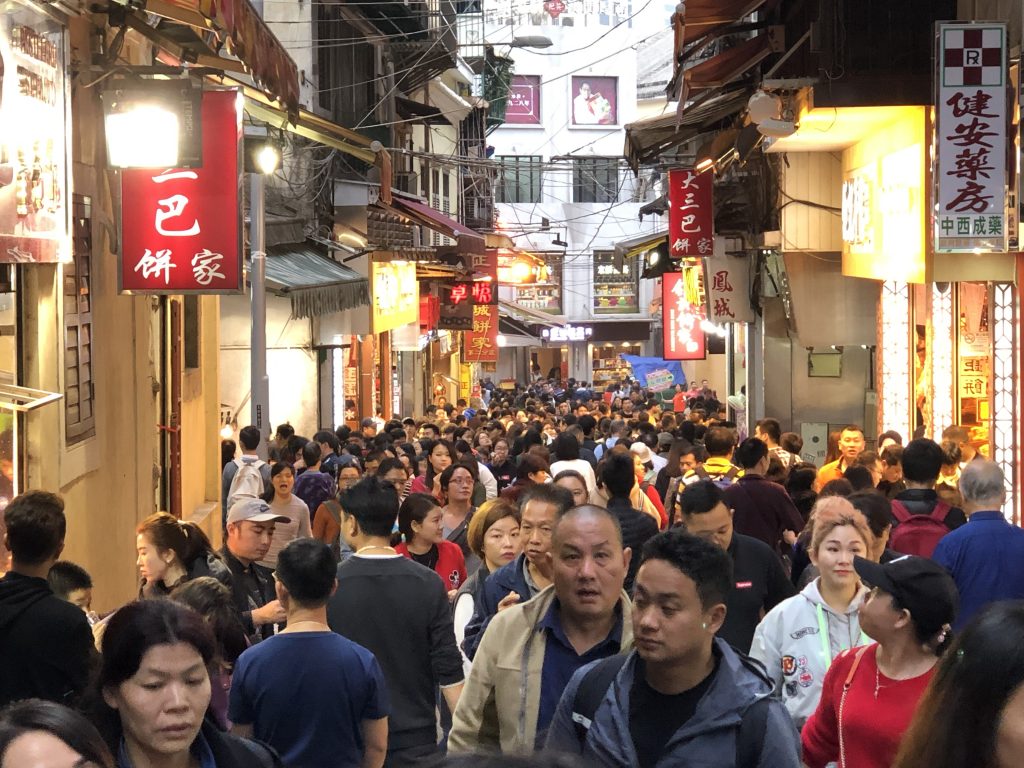
In historic Macau pedestrian traffic jams
In the old, Portuguese historic area of Macau, which happens to be a UNESCO-inscribed world heritage site, there is hardly any place left to move. Weekends are the ‘deadliest’, with monstrous ‘pedestrian traffic jams’ and more than one hour-long taxi lines. However, weekdays are not much better.
Beijing tried to crack down on gambling and for some time it worked, but during the last months, casinos have been bouncing back. The loopholes are too numerous. In the meantime, the territory panicked (‘God forbid it could not make as much money as before!’) and began trying to attract even more tourists, mainly from the Mainland, by all means available: a new bridge, advertisements… It also began to cater to the lowest of tastes; historic houses have been painted in kitschy pink, vulgar bluish and greenish, as well as yellow colors. Culture and art has almost disappeared. And everything has become mass-produced and fake, including ‘Portuguese food’.
Frankly, all that Macau represents is wrong: it has already ruined millions of human lives through mass gambling. It robs Mainland China of billions of dollars. Instead of educating people, it offers fake culture, in fact a disgusting parody‘Las Vegas-style’. It is brainwashing Chinese people, so they see ‘the world according to Disney, Hollywood and big US hotel chains’.
Many hotel managers come from Portugal (for ‘authenticity’, I suppose). They are arrogant, more North American than North Americans themselves, ambitious and unscrupulous. Many of them speak about Mainland China sarcastically, with spite. Typical Western ‘democracy’ and ‘freedom of speech’ nonsense.
Stripped of authenticity and decency, Macau adopted a gold-digging, repulsive culture. Talk about ‘fake news’ and fake culture! Everything that is fake,is here, in Macau.
Across the water, in the PRC, beautiful modern cities are growing,simple, elegant, and confident; built for the people.
In Macau, morale, socialist spirit, as well as family savings, are getting ruined and burned.
‘One country two systems’ has gone too far in Macau. This territory produces nothing. Not even those traditional firecrackers, perhaps. It only consumes, and perverts.
One of Sheraton Macau’s employees, a Philippine lady born in Macau, explained:
“I don’t recognize my own home city, anymore! It used to be a dormant, beautiful place. Now it is thoroughly ruined.”
I don’t recognize Macau either. And people who come here, from Mainland China, tend to change, quickly. Is this yet another Western subversion, an attempt to break China into pieces? Definitely. The government of the PRC should take more decisive action, soon; protecting its people and funds.
Boris Johnson, the leading Brexiteer and former foreign secretary, spoke last month at an event organised by Lord Bamford, the billionaire chief executive of earth moving equipment manufacturer JCB. Johnson reportedly earned £10,000 for his grovelling speech, littered with droll references to JCB’s products.
His remarks were directed towards sections of the ruling elite who might back a Johnson Conservative Party leadership bid. His appeal promoted regional economic competition and deregulation as the bedrock of a post-Brexit economy.
The government “should be devolving power to cities in coherent regions,” he said, including bundling together local taxes such as “council tax, business rates stamp duty, land tax” to give to “local mayors and politicians to spend so that they have clear incentives to go for growth.”
Johnson called for the creation of Free Ports, pointing that “there are now 135 countries in the world that have Free Ports.” These attract growth “and it is absurd that Britain will be forbidden by this deal [Theresa May’s European Union (EU) Withdrawal Agreement] from doing the same.”
Free Ports are better known as Free Trade Zones (FTZ) or Special Economic Zones (SEZ). The last three decades have seen hundreds of such zones proliferate worldwide, particularly in the Indian subcontinent, South East Asia and China. The zones have become synonymous with the unbridled exploitation of the working class.
In floating Free Ports in Britain, Johnson is speaking to a discussion within both the Conservative and Labour parties on how best to use the Brexit crisis to complete the deregulation of the economy and slash the wages and conditions of the working class. In the words of her former Chancellor Nigel Lawson, the hard-Brexit wing intend to “finish the Thatcher Revolution” and “make the UK the most dynamic and freest country in the whole of Europe: in a word, to finish the job that Margaret Thatcher started.”
Johnson’s proposals hinge on developing Britain, particularly its most deprived areas, as cheap labour and tariff-free manufacturing platforms.
In 2016, Tory MP Rishi Sunak issued a report, “The Free Ports Opportunity,” calling for an “extensive and ambitious network of UK Free Ports. … These would not only provide domestic manufacturers with a wealth of tangible benefits, but also send a clear message to international markets that Britain’s new global role will be open, innovative, and outward looking. It is therefore imperative that, if the recommendations of this report are to be implemented, the Government acts to legislate in the immediate aftermath of Britain’s departure from the [European Union].”
The proposals were debated in Westminster in October last year. Brexiteer Tory MP Simon Clarke explained, “At its simplest, a Free Port is an area that is physically within a country but legally outside it for customs purposes. Consequently, goods that enter a Free Port do not incur import duty. Instead, import duty is paid only if and when goods pass from the Free Port into the domestic economy.”
This allows goods to be imported, processed and re-exported without paying any duty. Free Ports offer “tax reliefs and a simplified regulatory environment” and could be seaports or airports. Clarke gave the example of the Jebel Ali free zone in the United Arab Emirates (UAE), in which 7,000 companies currently employ 145,000 workers. The zone draws in 40 percent of all foreign direct investment to the UAE.
Clarke declined to mention conditions in the Jebel Ali free zone and across UAE, where a young and largely immigrant workforce, mostly recruited from rural areas in India, Pakistan, Bangladesh, Sri Lanka and the Philippines, toil in overcrowded work camps.
He cited a recent report from consultants Mace Group “Supercharged Free Ports—the ultimate boost for Britain’s economy,” promoting the prospects for Free Ports in the north of England. Commissioned by the Tory mayor of Tees Valley, Ben Houchen, the report breathlessly outlines a scenario for a network of Free Ports, based on the ports of Immingham, Grimsby and Hull on the Humber Estuary, Teesport and Hartlepool on the Tees Estuary in the east and Liverpool on the Mersey in the west. Connected by improved road, rail and network infrastructure, these could produce an additional £70 billion in GDP and “rebalance” the British economy by increasing productivity in the North of England.
The report cited existing industrial concentrations in these areas which, freed of regulatory restrictions, could expect to draw in more investment. It alluded to the availability of cheap labour, arising from decades of demolition of the living standards of the working class: “[T]here is a further economic rationale for selecting these ports in particular: they are in some of the most deprived parts of the UK. At the local authority level Hull ranks 3rd most deprived in England on the Government’s Index of Multiple Deprivation. That’s out of 326 English local authorities. Liverpool ranks 4th worst (Knowsley, incidentally, is 2nd), Manchester 5th worst, and Middlesbrough 6th worst. Nearly a clean-sweep of deprivation. Relatively lofty Newcastle is 53rd worst, though still in the bottom quintile of local authorities.”
According to Clarke, previous Tory governments had not gone far enough in opening the workforce up to super-exploitation. In 1984, the then Thatcher government attempted setting up Free Ports in Belfast, Birmingham, Cardiff, Liverpool, Prestwick airport and Southampton. They all failed, Clarke continued, because of an “uncharacteristic lack of ambition by the Thatcher government, but mostly due to the regulatory constraints placed on them by the EU.”
The Free Ports would “offer lower levels of taxation and less burdensome regulations than exist outside,” cut down on customs documentation, offer secure perimeter areas and therefore lower insurance costs and avoid Value Added Tax (VAT).
Sunak’s report noted that Free Ports would have broad ideological appeal that could be expected to command bipartisan support, allowing the policy to act as a rapid response in the event of British withdrawal from the EU Customs Union: “It is easy to see Labour mayors of regional port cities partnering with a pro-enterprise, pro-trade Conservative Government to make Free Ports successful.”
Former right-wing Labour MP, Frank Field, now an Independent, assisted Clarke in setting up the Westminster debate. Field and Clarke penned a joint letter to TheTimes explaining that their Free Port proposal hinged on state aid the UK could deploy after Brexit. The duo complained, “The EU’s state aid regulations are far more stringent than those of the WTO; the most fundamental difference being that, under WTO law, only ‘financial contributions’ count as subsidies, whereas the European Commission describes state aid as ‘an advantage in any form whatsoever.’”
In other words, more perks and tax breaks can be handed over to investors and more social spending can be redirected towards drawing in cheap labour manufacturers.
Labour MP for Redcar, Anna Turley, also spoke in the debate, hailing Free Port zones as “recognised around the world as playing a major role in retaining, reshoring and growing domestic manufacturing activity and boosting trade.”
Turley begged the government to “give serious consideration” to a Teesport Free Port “without delay.”
Turley called for the need “to ensure that there is no erosion of employment rights, environmental rights or health and safety rights.” But this is worthless verbiage. The purpose of the Free Port proposal is to ruthlessly crank up rates of exploitation.
Significantly, Turley opposes Brexit and supports a rerun of the 2016 referendum. In her view EU membership is no barrier to establishing Free Ports.
In a desperate attempt to cover its tracks, the propaganda network linked to Britain’s security services, the Integrity Initiative (II), has wiped its website and locked its Twitter account “pending an investigation into the theft of data.”
The decision was taken shortly after the Anonymous hacking group released new II documents targeting Russia as supposedly the greatest threat to world peace, based on claims that it is the country most likely to use nuclear weapons.
The documents reveal yet more of the disinformation campaign used to justify NATO preparations for war with Russia, including the use of nuclear weapons.
Minutes from a joint workshop of the Institute for Statecraft (IfS), which runs the II, and the US government-funded Center for Naval Analyses discuss what would happen if the “West” intervened to “push back” a Russian advance in the case of a localized conflict. “The reality of the Russian nuclear doctrine is that it will not back down. … War games usually start with Russia about to, or using a nuclear weapon,” the minutes conclude.
Citing the inevitability of Russian use of nuclear weapons is used to justify their “pre-emptive” use by the NATO powers in the type of “pre-emptive war” made infamous by President George Bush’s criminal invasion of Iraq and which now forms the bedrock of the Pentagon’s National Security Strategy. Last Friday, US Secretary of State Mike Pompeo announced US withdrawal from the 1987 Intermediate Range Nuclear Forces (INF) treaty as part of the reorientation of the US military toward “great-power” conflict with Russia and China.
Registered as a Scottish charity promoting good “governance and statecraft” and working to “counter disinformation,” the IfS and II privately list their “top three” objectives as:
“Developing and proving the cluster concept and methodology”—that is, creating various national networks of assets in government, the military, the media and academia to covertly coordinate anti-Russian propaganda. The “silencing [of] pro-Kremlin voices on Serbian TV” by the Serbian political analyst and director of the Center for Euro-Atlantic Studies, Jelena Milic, is given as an example.
“Making people (in Government, think tanks, military, journalists) see the big picture, making people acknowledge that we are under concerted, deliberate hybrid attack by Russia,” as seen in the II’s coordination of the media response to the Skripal affair.
“Increasing the speed of response, mobilising the network to activism in pursuit of the ‘golden minute.’” That is, creating fraudulent “popular” campaigns and “independent” news stories to push an anti-Russian agenda, as with the successful effort to prevent the promotion of an insufficiently Russophobic general in Spain and the attack on Labour Party leader Jeremy Corbyn.
This work is overseen by military intelligence operatives and run in service to the Ministry of Defence (MoD) on behalf of a network of pro-British and US imperialist outfits.
The IfS co-founder and director, Daniel Lafyeedney, is a Senior Member, St. Antony’s College, University of Oxford. His online university biography notes, “As Senior Associate Fellow at the Advanced Research and Assessment Group at the Defence Academy of the UK (2004-2010) he specialised in the development and implementation of capacity-building projects for high-level governance of the security sector in European and middle-Eastern countries …” It adds, “His military service, legal background and career as an entrepreneur have given him an understanding of the importance of the link between business and national security.”
Speaking in Israel in 2018, Lafyeedney explained, “We have supported the creation of special Army reserve units (e.g., 77 Bde and SGMI—Specialist Group Military Intelligence) with which we now have a close, informal relationship” and how the work of the IfS and II feeds “into the highest levels of MoD and the armed forces.”
In return, the IfS and II receives £2.6 million in funding for 2018-19 as well as office space in central London provided by the British Foreign and Commonwealth Office. Funding also comes from HQ NATO Public Diplomacy, the US State Department, the “German business community,” the Lithuanian Ministry of Defence, the US think tank the Smith Richardson Foundation and other named “partner institutions.”
II is involved in a concerted anti-Russian offensive in Eastern European states. Ukraine, the Baltic states, Moldova and Armenia are all referenced as crucial areas of II work. One document on the Baltics refers to the need to be “educating our audience to understand how Russia sees this world as being at war.” Another on the war in Eastern Ukraine claims “aggression is inherent in the Russian condition.”
A file called “Moldova Democracy” explicitly argues for regime change, demanding that “A new team of people with integrity must come to power” or else “Moldova will remain a captured state forever, under Russian direct influence.”
During the 2018 protests in Armenia, the II published articles and intervened in social media to encourage a break with Russia after a change in government.
One of its key partners in Ukraine is Stopfake, which defends the far-right Ukrainian regime and the fascist forces which put it in power. An II document resolves to “Provide guest articles from … our clusters for StopFake’s printed material published and distributed along the contact line in Eastern Ukraine.”
In the UK the II is engaged in efforts to shut down uncooperative media outlets, accusing them of precisely the dirty tricks that it itself engages in. The most notable target is Russia Today (RT), which, II laments, is finding an audience because of “growing mistrust of western media among westerners.”
RT has been the target of an escalating campaign of attempted censorship with MPs demanding its broadcasting license be revoked. In December, the regulator Ofcom threatened to fine RT, claiming it had broken impartiality rules. There was no prior announcement from Ofcom that any RT shows had received more than 10 complaints from the public—as is standard practice. The II’s hidden hand is suggested in an II “Production timetable” document, which included the item in “eight complaints forwarded to Ofcom on RT’s failure to ensure due impartiality with request to launch a formal investigation.”
Other II plans include efforts to investigate “likely target[s] (e.g., a university with an anti-fracking agenda)” in receipt of Russian funding—even where those organisations are not in breach of the law.
A 2016 report by Péter Krekó and Lóránt Győri of the Budapest-based Political Capital Institute on “pro-Russian far-left parties in Europe” names parties such as Syriza in Greece, the Left Party in Germany, and Unsubmissive France and essentially accuses them of being Russian stooges. Invoiced for payment to the II, the report ends with the recommendation that states “need to assess in more detail the security implications” of these parties’ alleged Russian connections.
In the UK—and this helps explain the complete absence of media coverage of its sordid activities—the leaked II documents list the names of a “cluster” of top journalists and TV reporters including the Times’ David Aaronovitch and Dominic Kennedy, the Guardian’s Natalie Nougayrede, Carole Cadwalladr and Paul Canning, the BBC’s Jonathan Marcus, the Financial Times’ Neil Buckley, the Economist’s Edward Lucas and Sky News’ Deborah Haynes.
Leading Blairite Labour MP Ben Bradshaw is listed, as are “individuals who are very senior civilian experts in some relevant area, such as Hedge Fund managers, senior bankers, Heads of PA companies, etc., i.e., people whom the Army could never afford to hire, but who donate their time and expertise as patriots.”
The drawing together of such figures is a manifestation of the strategy laid out in the recent British National Security Capability Review, which singled out Russia as enemy number one for British imperialism. It called for a “Fusion Strategy” to advance the UK’s strategic interests against Moscow, which would make use “of all our capabilities; from economic levers, through cutting-edge military resources to our wider diplomatic and cultural influence on the world’s stage” to “project our global influence.” The BBC and “collaborative programmes with industry and academia” are listed as examples.
The II is proof that these plans are far-advanced and have been able to proceed without a word of criticism from a complicit bourgeois media.
Drug manufacturers began the new year with a new round of price hikes for already highly expensive US-branded prescription drugs.
According to Reuters, drug manufacturers raised the prices of more than 250 prescription drugs, including the world’s top-selling medicine, Humira.
Such annual price hikes are common among drug makers. Around this time last year, pharmaceutical companies raised the prices of over 400 medications, according to the data analyst website Rx Savings Solutions.
Although this year’s price hikes are smaller than in previous years, possibly in response to Trump’s tepid threats against the drug industry, such price increases will continue throughout the year, placing further financial burdens on workers struggling to afford life-saving medications.
Among the worst offenders was Allergan Plc, the Irish-based drug maker who raised the prices on more than 50 drugs, with more than half of the drugs going up in price by 9.5 percent.
Drug maker AbbVie Inc. increased the price of their most popular medication Humira, used to treat rheumatoid arthritis, by more than 6.2 percent. Last year, the company recorded $20 billion in sales of this drug alone. Between 2012 and 2018, AbbVie raised the price of Humira from $19,000 to more than $38,000 per year, a 100 percent increase.
Johnson & Johnson raised prices on two dozen prescription medications by 6-7 percent, including the psoriasis treatment Stelara, the prostate cancer drug Zytiga and the blood thinner Xarelto, the company’s best-selling products.
Although profits for drug makers have soared the past three years, with the profit margins of the industry generally exceeding other sectors with the exception of finance, more price increases were expected before the new year began.
Reuters reported late last year that almost 30 pharmaceutical companies notified California’s agencies that they plan to raise the prices of their drugs. Most significantly, the article notes that the United States, a country that leaves drug pricing entirely to “market competition,” has higher prices for drugs than any other country.
For example, a pre-filled carton of two syringes containing Humira costs an average of $2,669 in the United States, but only $1,362 in the United Kingdom and $822 in Switzerland.
Another striking feature of the drug price phenomenon is its astronomical rise in comparison to the inflation rate. According to a report released by the American Association of Retired Persons (AARP) in December, the retail prices of 768 widely used prescription drugs rose 50 times higher than the general rate of inflation.
President Donald Trump told members of his cabinet in October that he expected the prices of drugs to decrease tremendously this year. Health and Human Services (HHS) Secretary Alex Azar also attended the meeting. HHS has since proposed policy changes aimed at lowering the cost of medications.
The so-called “pressure” that Trump has applied to the giant pharmaceutical conglomerates has been nothing short of lip-service against a rapacious and widely despised industry.
As Rx Savings Solutions CEO Michael Rea noted in Business Insider, “I think the calls for decreases or no increases by the president, the public and payers are largely disregarded.” He continued, “If they’re hitting their numbers, they’re going to continue using the practice that allows them to do that.”
The proposed policy changes are not expected to alleviate the high costs of medications in a country that has the most lucrative market for manufacturers. These measures fall significantly short of governmental control over negotiating and regulating drug prices.
Even as public outrage has spread over the perpetual price increases, the response of the pharmaceutical industry has amounted to sheer indifference. Ronny Gal, an analyst for Bernstein Research, told Business Insider that there could be a “step up in both the number and magnitude of list price increases.”
“However,” he continued, “while individual companies may do well, the price increases taken together would suggest Pharma is ‘tone deaf’ to public concerns.”
The unaffordability of medications and the rising profits of big pharma demonstrate the incompatibility between the needs of the majority of the population and the profit interests of the ruling class.
President Trump, Vice President Pence and National Security Advisor John Bolton escalated threats to launch a war against Venezuela, as large pro- and anti-government demonstrations filled Venezuela’s streets on Saturday.
In an interview with CBS’s “Face the Nation” program that aired before the Super Bowl yesterday, Trump reiterated that military intervention “is an option.” Pence assured a crowd of far-right Venezuelan exiles in Miami on Friday that “this is no time for dialogue, it is the moment for action, and the time has come to end the Maduro dictatorship once and for all… Those looking on should know this: all options are on the table.”
Bolton, who helped author the playbook that was used to launch the 2003 invasion of Iraq, issued a blunt threat Friday that the US would kill or jail and torture Venezuelan President Nicolas Maduro if he did not resign. Comparing Maduro to Nicolae Ceaușescu and Benito Mussolini—both of whom were killed—Bolton told right-wing radio host Hugh Hewitt: “The sooner he takes advantage of that [i.e., resignation], the sooner he’s likely to have a nice quiet retirement on a pretty beach rather than being in some other beach area like Guantanamo.”
Self-proclaimed “interim president” Juan Guaidó, the US and their allies in South America and Europe are preparing a new provocation aimed at forcing the Venezuelan military to abandon Maduro, with Guaidó announcing that the US will deliver aid at three locations along the Venezuelan border in the coming days.
While Maduro and the Venezuelan military leadership have said they will refuse the aid, the US hopes that images of crowds gathering to receive food and medication will either provoke the military to defect to the opposition and help distribute the aid or provide valuable propaganda footage justifying the need for a “humanitarian” intervention.
Over the weekend, hundreds of armed Colombian soldiers dressed in battle fatigues deployed to one of the three “aid distribution” centers, Cúcuta, on the Venezuela-Colombia border. Colombia’s far-right President Iván Duque issued a statement proclaiming, “Few hours remain to the Venezuelan dictatorship.” At a press conference last week announcing Washington’s moves to topple Maduro, Bolton held under his arm a note pad with the words written in plain view: “5,000 troops to Colombia.”
Guaidó also announced that one of the “aid” locations would be on the border with Brazil, which deployed troops to the border last year, while the third would be on an island in the Caribbean.
The stepped-up pressure produced an initial crack in the Venezuelan military, which remains the backbone of the Maduro government. Over the weekend, one Air Force general and a small group of mid-level Air Force officials defected and issued public statements calling on their colleagues to join them.
Germ án Ferrer, a sitting Venezuelan legislator and United Socialist Party member who opposes Maduro, told the CBC that Maduro has disabled combat aircraft for fear the Air Force will turn on the government.
The US is imposing blanket sanctions on Venezuelan oil that amount to a blockade on oil exports. This act of economic war is intended to increase social misery.
Shannon O’Neil of the Council on Foreign Relations told a conference call of bankers, government officials and oil executives last week that the sanctions will lead to “more deprivation, even given the low base we’re at, more among the population.” The sanctions will force thousands to flee the country, she added: “You’re going to see more refugees pouring into countries throughout the hemisphere and elsewhere around the world.”
The Brookings Institution explained that the present stage of the coup operation is aimed at “building an off-ramp for the Maduro regime.” In the parlance of US imperialism, countries whose leaders do not take the “off-ramp” are, like Saddam Hussein in Iraq, Gaddafi in Libya and Assad in Syria, subject to a hailstorm of bombs and missiles from the air and US troops or proxy armies on the ground.
As the Council on Foreign Relations’ O’Neil told the corporate conference call, “If it [sanctions] doesn’t work in dislodging this regime, then there’s not a lot left in the toolkit besides things like military intervention.”
A military intervention in Venezuela—population 30 million—could kill hundreds of thousands or millions of people and transform Latin America into an imperialist slaughterhouse.
The geopolitical intelligence think tank Stratfor recently noted, “A military intervention could quickly snowball into one of the largest worldwide military operations since the 2003 invasion of Iraq.”
Francisco Toro, a Washington Post columnist and anti-Maduro think tank analyst, told the Council on Foreign Relations gathering that a military intervention would lead to “a kind of Syrian civil war” and confrontation between nuclear-armed powers.
He said: “There is this definite threat that if a military operation takes any amount of time in Venezuela, that other countries then start to move in too. And you can imagine, easily, Brazil moving into the southeast, Colombia into the southwest. You can imagine Russia trying to defend its oil interests, because Russia has big oil investments in Venezuela. You can imagine China doing I don’t know what. And Cuba has already intelligence penetration into the Venezuelan armed forces.”
Maduro’s strategy is three-fold. First, he is seeking to present himself as palatable to US imperialism and open to negotiation with the far-right opposition. Second, he is using the threat of “another Vietnam” as bargaining leverage against a US military intervention. Third, he is violently crushing working class opposition over inflation, poverty and record levels of social inequality.
Maduro rejected the demand of several European imperialist powers that he announce by February 2 the holding of new presidential elections. As the deadline passed, European governments—including the UK, France, Spain, Austria, Portugal, Belgium, the Netherlands and Germany—officially joined the US in recognizing Guaidó as president.
Maduro will now participate in large military exercises scheduled to last from February 5 to February 10. His government has also reportedly armed tens of thousands of members of a civilian reserve force with World War Two-era bolt-action rifles in anticipation of a possible invasion.
Key to the government’s strategy is a ferocious military crackdown on working class demonstrations and food riots. While the military and police have maintained a more passive presence at “official” demonstrations held by the right-wing opposition, government forces have murdered dozens of workers and youth participating in demonstrations over lack of access to food, water and other basic necessities.
The Maduro regime has responded to these demonstrations, which largely take place at night in the slum areas, with midnight raids by death squads, “disappearing” working class opponents in an effort to terrorize the areas that once were bastions of support for Maduro’s predecessor, Hugo Chávez Frias. The corporate media does not report these crackdowns.
In this way, Maduro is attempting to prove to his opponents in the US and Europe—as well as his backers in Russia and China—that he remains the best option for ending instability and keeping the oil flowing.
At its roots, Washington’s intensifying efforts at regime-change in Venezuela are part of a “pivot to Latin America” aimed at eradicating Chinese and Russian influence and transforming the whole Western Hemisphere into the exclusive cheap-labor and primary resource platform for US imperialism.
In November 2018, when Bolton announced the “Troika of Tyranny”—Cuba, Venezuela and Nicaragua—he was elaborating the strategic view that the US cannot successfully conduct operations against Russia in Eastern Europe, against China in South Asia, or against both Russia and China in Central Asia, without eliminating their presence in “America’s backyard” and freeing up the region’s resources for the US war machine. The establishment of a US-ruled “Fortress Americas” was a central foreign policy component of the “America First” movement in the early 1940s.
In a March 2018 document published by the US Army War College titled “The Strategic Relevance of Latin America in the US National Security Strategy,” the Army notes that in the aftermath of the fall of the dictatorships of the 1970s and 1980s, “most democratic societies in the Western Hemisphere” are “feckless and unconsolidated, thereby representing a threat to the national security of the United States by external actors (such as China and Russia) opposing US interests in the region.”
The strategy document indicated another reason for possible military operations in Venezuela: the need for the US military to test its operating capacities in heavily populated urban areas.
“Latin American megacities are also a laboratory for the US Army in cooperation with its strategic partners in addressing another important issue, or, perhaps, an old issue in the post-Cold War international system: how to fight a conventional war in an unconventional environment,” the document states. “Megacities are the new arena for conflicts in the 21st century. Therefore, the US Government and Army cannot afford to be caught off guard when called upon to exercise and accomplish its mission.”

 .
.