5 Feb 2019

United Nations Office at Geneva (UNOG) International Law Seminar Fellowships 2019 for Graduate Students and Law Professionals

Application Deadline: 8th April 2019

Eligible Countries: ALl. Fellowships available for developing countries


To Be Taken At (Country): Geneva, Switzerland

About the Award: The Seminar takes place on an annual basis and is designed for postgraduate students in international law, young scholars, government officials as well as young lawyers in the field of international law, to widen their knowledge of both the work of the International Law Commission and of the codification and progressive development of international law. It also provides an opportunity for lawyers coming from different legal systems and cultures to exchange views regarding items on the agenda of the Commission.
The International Law Seminar is not intended to be an introduction to international law. Applicants must prove a sound knowledge of international law, on the basis of either their postgraduate studies or significant professional experience in the field. Twenty five participants from various Member States of the United Nations participate in ILS. As well as attending the meetings of ILC, participants are expected to take an active part in the discussions which follow lectures given by members of the Commission, officials of the United Nations or specialized agencies in Geneva and other speakers invited for the occasion.

Type: Training, Conference

Eligiblilty: Applicants must between 24 and 38 years of age. This rule will be applied strictly.

Selection Criteria: The members of the Selection Committee choose an average of six candidates from different countries from four geographic regions (Africa, America, Asia/Middle East and Europe) and are guided by the following criteria:
  • Legal experience and academic background
  • Usefulness of the Seminar for the career of the applicant and for his/her country
  • Good knowledge of at least two of the three working languages of the Seminar (English, French, Spanish)
  • Adequate gender balance
  • Availability of funds for fellowships.
All applications will be considered, but the Selection Committee does not disclose the motivation of its choices and decisions are final and cannot be appealed.

Number of Awards: Not specified

Value of Award: While participation in the Seminar is free of charge, the United Nations is unable to cover the cost of travel or subsistence for all participants. Governments have however contributed to the Trust Fund of the Seminar which awards fellowship stipends every year to participants, primarily from developing countries.
Candidates can request for fellowship on the application form and justification must be provided in the letter of motivation. The awarding of fellowships will be decided by the Selection Committee, depending on the availability of funds.

Fellowships awarded for subsistence
An allowance to cover accommodation, meals and miscellaneous will be paid to participants upon their arrival at Geneva. Participants must provide proof of accommodation to the Legal Office.
This allowance does not cover (and the United Nations does not assume responsibility for) the following:
a)  all expenses for passport, visa, vaccination and other miscellaneous items; all expenditures in the home country and in connection with the travel;
b)  payment of any salary and related allowances from the current employer of participants during the period of the Seminar;
c)   travel and other costs incurred by dependents who might accompany participants;
d)  costs incurred with respect to travel and accident insurance, medical bills and hospitalization costs in connection with attending the Seminar;
e)  compensation in the event of death or disability in connection with attendance of the Seminar.


Fellowships awarded for travel
Participants will be awarded a return air ticket to Geneva from their country of residence for the period concerned (arrival the day before the opening of the Seminar, return at the latest the day after closure). No payment will be made to cover other routing or modes of transportation or extension of the period referred to above.
The ticket issued to you will be in economy class and no change in the reservation will be permitted which would incur additional expenses to the Organization.

Duration of Program: Three weeks (8 to 26 July 2019)

How to Apply: The 2019 online application is now available here.


Visit the Program Webpage for Details

Government of Austria ITH Fully-funded Masters Scholarships 2019/2020 for Developing Countries

Application Deadline: 1st May, 2019

Offered annually? Yes


Eligible Countries: Scholarships are offered to i) ADC Priority countries (See list below) and ii) Other Developing countries

To be taken at (country): The Institute of Tourism and Hotel Management in Salzburg Klessheim, Austria

About the Award: The Austrian Development Cooperation through the Institute of Tourism and Hotel Management offers about 30 scholarships to applicants from priority countries as well as other developing countries. The Tourism School in Salzburg has an outstanding international reputation and a long tradition. They train future entrepreneurs and employees according to the needs of the international tourism and leisure industry.

Type: Postgraduate

Eligibility: To apply for this programme at ITH, candidate must meet the following criteria:
  • Be between 18 – 35 years of age
  • Have a secondary school leaving certificate (high school diploma)
  • Have a minimum of one year‘s experience within the tourism and hospitality industry
  • Non-native English speakers must have an English qualification e.g. TOEFL, Cambridge 1st Certificate, IELTS or equivalent
Successful candidates should be ambitious and open-minded with good organisational and time management skills

Number of Awardees: up to 30

Value of Scholarships: Scholarship for Priority countries include:
  • tuition fee
  • accommodation
  • flight tickets (from home country to Salzburg and back)
  • health insurance
  • food from Monday – Sunday
  • excursions (except field trip to ITB Berlin)
  • € 205.- pocket money per month
Not included in this scholarship are:
  • transfer from the Airport to the hostel and back to the Airport when leaving
  • visa fee: the visa fees have to be paid by the applicants. The entry visa is approximately $ 110, – and the 8 months residence permit, which will be issued in Salzburg, costs approximately € 120.
Scholarship for Developing countries include:
  • tuition fee
  • health insurance
  • food from Monday – Friday
  • excursions (except field trip to ITB Berlin)
  • € 205.- pocket money per month
Not included in the Scholarship are:
  • accommodation: accommodation costs have to be covered by students who are awarded this scholarship. It is € 247, – per month. (€ 1976, – in total). The total accommodation fee of € 1.976, – has to be remitted in advance before admission letter can be issued.
  • flight ticket: Students who are on this scholarship have to cover their own travel expenses from their countries to Salzburg and back.
  • visa fee: the visa fees have to be paid by the applicants. The entry visa is approximately $ 110, – and the 8 months residence permit, which will be issued in Salzburg, costs approximately € 120.
Eligible Countries: 
ADC Priority countries include: Ethiopia, Uganda, Burkina Faso, Mozambique, Bhutan, Palestinian Territories, Georgia, Armenia

Other Developing countries include: Afghanistan, Bangladesh, Benin, Burundi, Cambodia, Central African Republic, Chad, Comoros, Congo, Dem. Rep., Eritrea, Gambia, The, Guinea, Guinea-Bisau, Haiti, Kenya, Korea, Dem Rep., Kyrgyz Republic, Liberia, Madagascar, Malawi, Mali, Myanmar, Nepal, Niger, Rwanda, Sierra Leone, Somalia, South Sudan, Tajikistan, Tanzania, Togo, Zimbabwe, Bolivia, Cameroon, Cape Verde, Congo, Rep., Côte d’Ivoire, Djibouti, Egypt, Arab Rep., El Salvador, Ghana, Guatemala, Guyana, Honduras, India, Indonesia, Kiribati, Kosovo, Lao PDR, Lesotho, Mauritania, Micronesia, Fed. Sts., Moldova, Mongolia, Morocco, Nicaragua, Nigeria, Pakistan, Papua New Guinea, Paraguay, Philippines, Samoa, São Tomé and Principe, Senegal, Solomon Islands, Sri Lanka, Sudan, Swaziland, Syrian Arab Republic, Timor-Leste, Ukraine, Uzbekistan, Vanuatu, Vietnam, West Bank and Gaza, Yemen, Rep., Zambia, Albania, Algeria, American Samoa, Angola, Argentina, Azerbaijan, Belarus, Belize, Bosnia and Herzegovina, Botswana, Brazil, Bulgaria, China, Colombia, Costa Rica, Cuba, Dominica, Dominican Republic, Ecuador, Fiji, Gabon, Grenada, Hungry, Iran, Islamic Rep., Iraq, Jamaica, Jordan, Kazakhstan, Lebanon, Libya, Macedonia, FYR, Malaysia, Maldives, Marshall Islands, Mauritius, Mexico, Montenegro, Namibia, Palau, Panama, Peru, Romania, Serbia,  Seychelles, South Africa, St. Lucia, St. Vincent and the Grenadines, Suriname, Thailand, Tonga, Tunisia, Turkey, Turkmenistan, Tuvalu and Venezuela

How to Apply: Apply here

Visit Scholarship Webpage for details

The 12-Step Method of Regime Change

Vijay Prashad

On 15 September 1970, US President Richard Nixon and National Security Advisor Henry Kissinger authorised the US government to do everything possible to undermine the incoming government of the socialist president of Chile, Salvador Allende. Nixon and Kissinger, according to the notes kept by CIA Director Richard Helms, wanted to ‘make the economy scream’ in Chile; they were ‘not concerned [about the] risks involved’. War was acceptable to them as long as Allende’s government was removed from power. The CIA started Project FUBELT, with $10 million as a first instalment to begin the covert destabilisation of the country.
CIA memorandum on Project FUBELT, 16 September 1970.
US business firms, such as the telecommunication giant ITT, the soft drink maker Pepsi Cola and copper monopolies such as Anaconda and Kennecott, put pressure on the US government once Allende nationalised the copper sector on 11 July 1971. Chileans celebrated this day as the Day of National Dignity (Dia de la Dignidad Nacional). The CIA began to make contact with sections of the military seen to be against Allende. Three years later, on 11 September 1973, these military men moved against Allende, who died in the regime change operation. The US ‘created the conditions’ as US National Security Advisor Henry Kissinger put it, to which US President Richard Nixon answered, ‘that is the way it is going to be played’. Such is the mood of international gangsterism.
Phone Call between Richard Nixon (P) and Henry Kissinger (K) on 16 September 1973.
Chile entered the dark night of a military dictatorship that turned over the country to US monopoly firms. US advisors rushed in to strengthen the nerve of General Augusto Pinochet’s cabinet.
What happened to Chile in 1973 is precisely what the United States has attempted to do in many other countries of the Global South. The most recent target for the US government – and Western big business – is Venezuela. But what is happening to Venezuela is nothing unique. It faces an onslaught from the United States and its allies that is familiar to countries as far afield as Indonesia and the Democratic Republic of Congo. The formula is clichéd. It is commonplace, a twelve-step plan to produce a coup climate, to create a world under the heel of the West and of Western big business.
Step One: Colonialism’s Traps.
Most of the Global South remains trapped by the structures put in place by colonialism. Colonial boundaries encircled states that had the misfortune of being single commodity producers – either sugar for Cuba or oil for Venezuela. The inability to diversify their economies meant that these countries earned the bulk of their export revenues from their singular commodities (98% of Venezuela’s export revenues come from oil). As long as the prices of the commodities remained high, the export revenues were secure. When the prices fell, revenue suffered. This was a legacy of colonialism. Oil prices dropped from $160.72 per barrel (June 2008) to $51.99 per barrel (January 2019). Venezuela’s export revenues collapsed in this decade.
Step Two: The Defeat of the New International Economic Order. In 1974, the countries of the Global South attempted to redo the architecture of the world economy. They called for the creation of a New International Economic Order (NIEO) that would allow them to pivot away from the colonial reliance upon one commodity and diversify their economies. Cartels of raw materials – such as oil and bauxite – were to be built so that the one-commodity country could have some control over prices of the products that they relied upon. The Organisation of Petroleum Exporting Countries (OPEC), founded in 1960, was a pioneer of these commodity cartels. Others were not permitted to be formed. With the defeat of OPEC over the past three decades, its members – such as Venezuela (which has the world’s largest proven oil reserves) – have not been able to control oil prices. They are at the mercy of the powerful countries of the world.
Step Three: The Death of Southern Agriculture.
In November 2001, there were about three billion small farmers and landless peasants in the world. That month, the World Trade Organisation met in Doha (Qatar) to unleash the productivity of Northern agri-business against the billions of small farmers and landless peasants of the Global South. Mechanisation and large, industrial-scale farms in North America and Europe had raised productivity to about 1 to 2 million kilogrammes of cereals per farmer. The small farmers and landless peasants in the rest of the world struggled to grow 1,000 kilogrammes of cereals per farmer. They were nowhere near as productive. The Doha decision, as Samir Amin wrote, presages the annihilation of the small farmer and landless peasant. What are these men and women to do? The production per hectare is higher in the West, but the corporate take-over of agriculture (as Tricontinental: Institute for Social Research Senior Fellow P. Sainath shows) leads to increased hunger as it pushes peasants off their land and leaves them to starve.
Step Four: Culture of Plunder.
Emboldened by Western domination, monopoly firms act with disregard for the law. As Kambale Musavuli and I write of the Democratic Republic of Congo, its annual budget of $6 billion is routinely robbed of at least $500 by monopoly mining firms, mostly from Canada – the country now leading the charge against Venezuela. Mispricing and tax avoidance schemes allow these large firms (Canada’s Agrium, Barrick and Suncor) to routinely steal billions of dollars from impoverished states.
Step Five: Debt as a Way of Life.
Unable to raise money from commodity sales, hemmed in by a broken world agricultural system and victim of a culture of plunder, countries of the Global South have been forced to go hat in hand to commercial lenders for finance. Over the past decade, debt held by the Global South states has increased, while debt payments have ballooned by 60%. When commodity prices rose between 2000 and 2010, debt in the Global South decreased. As commodity prices began to fall from 2010, debts have risen. The IMF points out that of the 67 impoverished countries that they follow, 30 are in debt distress, a number that has doubled since 2013. More than 55.4% of Angola’s export revenue is paid to service its debt. And Angola, like Venezuela, is an oil exporter. Other oil exporters such as Ghana, Chad, Gabon and Venezuela suffer high debt to GDP ratios. Two out of five low-income countries are in deep financial distress.
Step Six: Public Finances Go to Hell.
With little incoming revenue and low tax collection rates, public finances in the Global South has gone into crisis. As the UN Conference on Trade and Development points out, ‘public finances have continued to be suffocated’. States simply cannot put together the funds needed to maintain basic state functions. Balanced budget rules make borrowing difficult, which is compounded by the fact that banks charge high rates for money, citing the risks of lending to indebted countries.
Step Seven: Deep Cuts in Social Spending.
Impossible to raise funds, trapped by the fickleness of international finance, governments are forced to make deep cuts in social spending. Education and health, food sovereignty and economic diversification – all this goes by the wayside. International agencies such as the IMF force countries to conduct ‘reforms’, a word that means extermination of independence. Those countries that hold out face immense international pressure to submit under pain of extinction, as the Communist Manifesto (1848) put it.
Step Eight: Social Distress Leads to Migration.
The total number of migrants in the world is now at least 68.5 million. That makes the country called Migration the 21st largest country in the world after Thailand and ahead of the United Kingdom. Migration has become a global reaction to the collapse of countries from one end of the planet to the other. The migration out of Venezuela is not unique to that country but is now merely the normal reaction to the global crisis. Migrants from Honduras who go northward to the United States or migrants from West Africa who go towards Europe through Libya are part of this global exodus.
Step Nine: Who Controls the Narrative?
The monopoly corporate media takes its orders from the elite. There is no sympathy for the structural crisis faced by governments from Afghanistan to Venezuela. Those leaders who cave to Western pressure are given a free pass by the media. As long as they conduct ‘reforms’, they are safe. Those countries that argue against the ‘reforms’ are vulnerable to being attacked. Their leaders become ‘dictators’, their people hostages. A contested election in Bangladesh or in the Democratic Republic of Congo or in the United States is not cause for regime change. That special treatment is left for Venezuela.
Step Ten: Who’s the Real President?
Regime change operations begin when the imperialists question the legitimacy of the government in power: by putting the weight of the United States behind an unelected person, calling him the new president and creating a situation where the elected leader’s authority is undermined. The coup takes place when a powerful country decides – without an election – to anoint its own proxy. That person – in Venezuela’s case Juan Guaidó – rapidly has to make it clear that he will bend to the authority of the United States. His kitchen cabinet – made up of former government officials with intimate ties to the US (such as Harvard University’s Ricardo Hausmann and Carnegie’s Moisés Naím) – will make it clear that they want to privatise everything and sell out the Venezuelan people in the name of the Venezuelan people.
Step Eleven: Make the Economy Scream.
Venezuela has faced harsh US sanctions since 2014, when the US Congress started down this road. The next year, US President Barack Obama declared Venezuela a ‘threat to national security’. The economy started to scream. In recent days, the United States and the United Kingdom brazenly stole billions of dollars of Venezuelan money, placed the shackles of sanctions on its only revenue generating sector (oil) and watched the pain flood through the country. This is what the US did to Iran and this is what they did to Cuba. The UN says that the US sanctions on Cuba have cost the small island $130 billion. Venezuela lost $6 billion for the first year of Trump’s sanctions, since they began in August 2017. More is to be lost as the days unfold. No wonder that the United Nations Special Rapporteur Idriss Jazairy says that ‘sanctions which can lead to starvation and medical shortages are not the answer to the crisis in Venezuela’. He said that sanctions are ‘not a foundation for the peaceful settlement of disputes’. Further, Jazairy said, ‘I am especially concerned to hear reports that these sanctions are aimed at changing the government of Venezuela’. He called for ‘compassion’ for the people of Venezuela.
Step Twelve: Go to War.
US National Security Advisor John Bolton held a yellow pad with the words 5,000 troops in Colombia written on it. These are US troops, already deployed in Venezuela’s neighbour. The US Southern Command is ready. They are egging on Colombia and Brazil to do their bit. As the coup climate is created, a nudge will be necessary. They will go to war.
None of this is inevitable. It was not inevitable to Titina Silá, a commander of the Partido Africano para a Independència da Guiné e Cabo Verde (PAIGC) who was murdered on 30 January 1973. She fought to free her country. It is not inevitable to the people of Venezuela, who continue to fight to defend their revolution. It is not inevitable to our friends at CodePink: Women for Peace, whose Medea Benjamin walked into a meeting of the Organisation of American States and said – No!
It is time to say No to regime change intervention. There is no middle ground.

Sharp Manias: Knife Crime in London

Binoy Kampmark

London: A bleak London assailed by daily news about Brexit negotiation, prospects of food shortages and higher prices in the event of a no-deal with the European Union, provides the perfect apocalyptic backdrop for headlines. The city is ailing; the residents are panicked; and the authorities are gloomy.
Such environments are ideal for talk about emergencies.  One doing much filling on London airtime is that of knife crime.  Not that knife crime in of itself is unusual: for years, stabbing implements have made their way into broader law and order issues in the city’s policing scene, a good number featuring errant youth.  These have encouraged a wide array of myths masquerading as solid fact: London, the city of the “no-go” area; Londonistan, city of perpetual, spiraling crime.
In 2008, Britain’s public institutions – political and public – became darkly enraptured with knife crime afflicting inner city areas, with a heavy focus on London.  Stabbings were reported in lurid fashion; threats to urban safety were emphasised.  As Peter Squires noted in a fairly withering examination of the phenomenon in British Politics, “The knife crime ‘epidemic’, as it came to be called, coincided with a series of youth justice policy measures being rolled out by the government, and significantly influenced them.”
Kevin Marsh of the BBC, writing at the same time, wondered how best a news organisation might report such crime figures. “How much does tone and prominence distort the real picture?  Is some coverage self-fulfilling prophecy?  Does it spread fear and anxiety way beyond the rational?”  Marsh would admit that being a victim of a knife crime was “very, very unlikely”; and that young men, in the main, did not carry knives; “most young people are not components of what some politicians are calling the ‘broken society’.”
For all that, Marsh found himself admitting that “it’s part of the purpose of our media to draw things to our attention, however crudely.”  The crude element remains the sticking point, resisting nuance, despite the hope that reporters might help “us citizens really think hard about possible solutions”.
Knife crime has become the bread and butter of lazy reportage, one hitched to the coattails of the broken society argument.  Describing a broken fence is easier fare than describing a mended one; solutions remain dull, academic matters.  The emergency narrative tends to emerge ahead each time; matters of social causes and complexity receive short shrift.  In 2017, Gary Younge turned his noise up at the panic merchants, and deemed teenage knife crime “a tabloid obsession, blamed on feral youth running riot in our cities.”  Such fears speaks to an obsession with decay and decline; youth go wrong if society does not go right.
In 2018, knife crime became a meme of terror.  The Express shouted with “London BLOODBATH” in a June headline, and subsequently began using it as a running title for any knife-related crime.  Political parties also capitalised on the atmosphere. In the east London borough of Havering, a local Conservative leaflet, buttering up electors ahead of the March local elections, promised mayhem.  “Mayor Khan and Corbyn’s men are desperate to grab power in our Town Hall, so get ready for… A London crimewave with even less police.”  In Lewisham East, UKIP candidate David Kurten added his bit in a by-election with a leaflet featuring the words “STOP THE KARNAGE” placed across a picture of a knife.
The dreary world of knife crime figures is erratic.  Between 2008 and 2014, offences involving knives or sharp instruments fell from 36,000 recorded offences to 25,000.  Then came an increase in 2015/6 – a nudge to 28,900.  The figures on death occasioned by knife crime are even more inscrutable, prompting Spiked Online to conclude that there was “no huge upsurge in knife violence because society overall is becoming less violent, and crime in general is falling.”  This was not to say that no concern should be felt: the issue is particular in London, and its effects disproportionate on young working-class black men. A possible explanation?  Not just indigence or exclusion, but nihilism and plain susceptibility.
Barely two months into this year, and the rounds of panic are in full swing.  As always, it’s the deceptive field of statistics dragged out to give a picture of clear, bolt-the-doors-and-hide doom.  It began with a spate of violent actions on New Year’s Eve, which saw four young men stabbed to death in London, prompting London Mayor Sadiq Khan to berate the government for its squeeze on youth services, policing and education.
Police statistics, pounced upon by the Evening Standard just in time for the evening commute on Monday, suggest that 41 percent across London’s boroughs involve those between the green years of 15 to 19.  Eight percent range from the even greener 10 to 14.
The Standard’s Martin Bentham sliced and spliced the announcement from the police with maximum, terrifying effect, all assisted by a picture perfect grim background of law enforcement officials at a crime scene on Caledonia road.  “The new figures came as a Scotland Yard chief warned that attacks in the capital were also becoming ‘more ferocious’ as offenders were ‘more and more young’ tried to kill or injure by ‘getting up close and stabbing someone several times’.
Descriptions on police tactics follow, resembling those of urban battle plans keen on frustrating potential attacks.  Chief Superintendent Ade Adelekan, head of the Met’s Violent Crime Task Force is quoted as claiming that “some progress” is being made.  There was also a more frequent use of search and “other tactics” including “the deployment of ‘embedded’ plain clothes officers to work with uniformed counterparts” in acts of prevention.
As Younge rightly notes, such realities are “more complex – and we cannot save lives if we do not understand it.”  But understanding is a term absent in times of panic. These are times rich for exploitation.  With Brexit having become the great psychodrama, all else is ripe for distraction and manipulation.

India and the Maldives strengthen military ties

Rohantha De Silva

Following his election on November 17, Maldives President Ibrahim Solih, has rapidly moved to strengthen political and military relations with India. This process was further highlighted by last month’s week-long visit to India by Defence Minister Mariya Ahmed Didi, who was accompanied by Chief of Maldivian Defence Force, Major-General Abdulla Shamaal, and other senior officers.
Chinese influence in the Maldives had greatly expanded under former President Abdulla Yameen. These relations were opposed by India, which considers the region to be its backyard, and the US, in line with its preparations for war against China. Last year Washington and New Delhi initiated a regime-change operation to elevate the pro-US Solih into the presidency.
Indian Prime Minister Modi attended Solih’s swearing-in ceremony in November. A joint statement was signed which declared the “importance of maintaining peace and security in the Indian Ocean and being mindful of each other’s concerns and aspirations for the stability of the region.
During last month’s visit, Maldivian Defence Minister Didi met with her Indian counterpart Nirmala Sitharaman, as well as top Indian military officers.
Both countries agreed to expand maritime security cooperation and to complete the previously stalled Coastal Radar Surveillance System (CSRR) in the Maldives. An Indian defence ministry statement said the talks were “substantive,” and “further strengthened bilateral defence cooperation.” The two countries would “continue their traditionally close cooperation on issues of maritime security [and] counter-terrorism.”
An India-Maldives Defence Cooperation Dialogue was also held during Didi’s visit. Sitharaman reiterated New Delhi’s commitment to the “capacity building” and “training requirements” of the Maldivian defence forces. Didi later told the media that the two countries discussed ways of establishing a “collaborative structure” for information sharing and a “fusion mechanism.”
During his administration, former President Yameen relied on the support of the Maldivian military to safeguard his rule, attack democratic rights and suppress the political opposition. Last February, however, the Maldivian Supreme Court, in an attempt to undermine Yameen and bring a pro-Indian, pro-western administration to power, issued several highly unfavourable decisions against Yameen.
The court ordered the immediate release of opposition leader and former President Mohamed Nasheed and the dropping of eight convictions against other political leaders. Yameen responded by declaring a state of emergency and had Supreme Court Chief Justice Abdulla Saeed and another judge arrested. Under this pressure, the remaining three Supreme Court judges annulled its previous rulings.
As tensions increased the pro-US Nasheed called on New Delhi to invade the Maldives, declaring the country was becoming a Chinese colony. The Indian media reported that although New Delhi had made some military preparations it would not do so, as it was concerned about a possible Chinese response to any “external” intervention in Maldivian internal affairs.
India, however, is now taking advantage of the new regime in the Maldives to further expand its geo-strategic and military influence in the region. That is the meaning of its pledge to assist in the “training” and “capacity building” of the Maldivian security forces.
The Press Trust of India reported that the two countries agreed to remain mindful about the stability of the Indian Ocean region and not allow their territories “to be used for any activity that is hostile to each other’s interest.” This was a clear jab against China.
Didi later claimed that her government did not “talk about our relations with other countries”—i.e., China and Pakistan. “India respects our sovereignty,” she said, adding, “We are very comfortable [with] having India as our very close friend because they always came to our rescue—[be it] in 1988, the 2004 tsunami or the recent water crisis.”
In 1988, Maldivian President Abdul Gayoom appealed for Indian military assistance to help to defeat a coup d’état by a group of Sri Lanka Tamil mercenaries who attempted to install Maldivian businessman Abdulla Luthufi as the country’s leader. Indian Prime Minister Rajiv Gandhi immediately respond ed to Gayoom’s call and, under the codename Operation Cactus, dispatched 1,600 troops within nine hours to defeat the coup.
India and the Maldives will now will intensify their military ties. The 2016 defence cooperation Action Plan between the two countries, which was halted under Yameen, will be revived. A top priority will be India’s “partnering” with the Maldives to build coast guard infrastructure at the Uthuru Thila Falhu atoll, one of the joint defence projects in the Action Plan. In addition, the Maldives will allow New Delhi to have access to facilities for training, surveillance of the Exclusive Economic Zone and so-called Humanitarian Assistance and Disaster Relief.
The Maldives is strategically located in the southwest tip of India, just above key sea-lanes from the Middle East and Africa to East Asia, South East Asia and Australia. These routes, which provide China, Japan, South Korea and India with access to Middle Eastern oil, are a focal point for rivalry between the US and India on one side and China on the other.
Each year more than 100,000 ships carrying oil, minerals and manufactured goods pass through the international shipping lanes in the northern Indian Ocean. Diego Garcia, the US’s principal Indian Ocean military base, lies 1,300 kilometres south of Male, the Maldivian capital.
The recent flurry of high-level political and military meetings since Solih became president reveals how Delhi, with US backing, has quickly moved to establish a pro-Indian government in the Maldives. Under the intensifying geo-political tensions between the US and China, even the nominal independence of underdeveloped nations is a thing in the past.

Lack of teachers, work overload undermine Dutch education system

Harm Zonderland 

A survey held amongst teachers exposes the disastrous working conditions in the primary schools, high-schools and universities of the Netherlands.
More than 10,000 respondents, all members of the education union AOb, shared their experiences. Teachers reported that they are going to work while sick, that they are training one temporary teacher after another, and that they are not able to give the individual attention and guidance pupils need. The survey report features many quotes from teachers about the situation in their schools.
The main result of the survey is that due to a lack of teachers, the quality of education is at risk, with 84 percent of primary schools reporting a lack of stand-in teachers, and 20 to 29 percent of job vacancies unfilled in 2018.
As a result, teachers keep working while they’re sick. A teacher reports: “Co-workers keep going while they should be home in bed. I recently kept working despite a severe bursitis in my shoulder. I couldn’t write on the blackboard to explain something. I only stayed at home when I really couldn’t go on any more.”
This is not an isolated case, as 67 percent of the respondents who work in primary education report that they are regularly working while ill. Another teacher: “Multiple co-workers sick. There is no money to replace sick teachers. All drop-outs due to disease, schooling, leave of absence, etc., are to be covered within the school team, which structurally overloads personnel. Also, one feels obligated when one’s sick or out for schooling, because a co-worker has to work extra hours.”
School boards are trying to find “creative” ways around teacher absences. Pupils are being divided and assigned to other classes (82 percent in primary education). Another teacher comments: “It basically comes down to keeping them busy. Not only are the children who are being divided troubled by this, also the children from other classes are hindered in their learning process.”
Qualified teachers are replaced with unqualified workers, 45 percent of the respondents working in high schools report. Thirty-eight percent report that in many cases children are simply put into an available classroom to do their homework. A teacher comments: “Unqualified assistants standing in for qualified professionals ‘cage’ pupils and simply make them do their homework instead of actually teaching them.”
The growing number of unfilled job openings and the difficulties with finding stand-ins cause a lot of anxiety among the pupils as well, which in turn causes unrest within the classrooms. Pupils get to see three to five different teachers per week. From the survey: “The children are anxious because they get a different teacher every day. There are no people to provide extra support for weaker pupils. ... Stand-ins feel no need to give extra support or guidance, which causes growing unrest. It hinders students and spreads to other classes.”
Overall, 64 percent of primary schools and 45 percent of high schools report growing unrest in classrooms.
All of this exacerbates the situation for those still teaching. When pupils from one class are divided, other classes get bigger. This not only increases the workload for teachers, but also for assistants, tutors and other supportive personnel.
School directors are making phone calls around the clock to find replacement teachers via temporary agencies, who in many cases are either unqualified or students themselves.
From the survey: “Training these new co-workers takes a lot of time. Moreover, they only stay for a short while. And then the whole training thing starts anew.”
The quality of the Dutch education system is quickly deteriorating. The Ministry of Education suggested that if primary schools were to hire 15 percent less teachers, resulting in three pupils per class more than now, the problem would be “solved.” But in the survey, teachers report countless times that growing class sizes are a major issue and cause a lot of extra workload. The Dutch education sector has one of the highest number of workers suffering burnouts.
After the 2008 global financial crisis, huge amounts of public money were stolen by the government to bail out banks and finance Dutch co-operation in the criminal US-led wars in Afghanistan and the Middle East. Education spending has been slashed dramatically over the past decade, with many teachers not having seen any pay rise since then, while inflation kept rising. To make matters worse, taxes on basic necessities of life such as groceries and medicine increased by 50 percent at the start of this year.
An entire generation of young students suffers from the ruling elite’s drive for profit. In many cases (43 percent in primary school and 34 percent in high school) students are simply sent home because there is nobody to teach them. The entire working class suffers as well. Unqualified personnel teach more and more classes without professional support, with lower wages than actual teachers. It will be increasingly difficult for young teachers, looking for their first job, to get decent pay.
In 2018, numerous teachers’ strikes in countries the world over have taken place. Each time, the demands were the same: for better wages and reduced workload, against the privatization of education. In the US, teachers in Arizona, Oklahoma and West Virginia went on strike, not only against the state, but also against the will of the trade unions, who did everything they could to end the strikes and impose worthless agreements with no gains whatsoever.
The new year has kicked off with growing protests and strikes in France, Belgium, Germany, the UK, the Netherlands and Mexico and with a large teachers’ strikes in Los Angeles, California. In France, thousands of teachers have expressed solidarity with their class brothers and sisters in the US, by joining “Red Pen” protest groups on Facebook.
In 2018, PO in Actie, a supposedly “grassroots” organisation, succeeded in mobilizing large numbers of Dutch teachers to stage protest marches and strikes and compelled the government to allocate more funds for education. But the increased funds, incorporated in the 2018-19 government budget, do not repair anything. Billions more are needed every year to meet the sector’s demands.
But the “grassroots” veneer still partially covering PO in Actie should not fool anybody into thinking they are there for the workers. During last year’s protest march in The Hague, WSWS supporters distributed a statement from the European Editorial Board of the WSWS, which had this to say about PO in Actie: “They helped negotiate the sell-out [labour agreement early 2018] and celebrate it as a success. After the dirty work was done, the leaders of ‘PO in Actie,’ Thijs Roovers and Jan van de Ven, announced their resignations on October 1. Neither of them represents the interests of ordinary teachers, but those of the trade unions and the government. Roovers has close ties to the FNV [Bondgenoten, the largest trade union in the Netherlands], and the Christian Trade Union Confederation CNV and van de Ven is a member of the governing party D66.”
The teachers’ union AOb has announced a “week of action” starting March 11, to culminate in a national strike on March 15. The CNV is withholding its participation, as it is currently in negotiations with the government. The established unions do not stage protests and strikes for the workers they claim to represent, but for their comfortable positions at the negotiating tables. They keep the workers in check with their “better than nothing” sell-out deals, which can (and will) easily be rolled back when a new economic crisis unfolds. Strikes are for blowing off steam.
Neither governments nor trade unions represent the interests of the majority of the people, the working class. The fight for jobs, higher wages and better working conditions demands a broad independent political mobilisation of working people based on a revolutionary socialist program.

UK’s largest supermarket Tesco to shed 9,000 jobs

Margot Miller

Amid speculation about 15,000 possible job losses, UK supermarket giant Tesco has confirmed that it will shed 9,000 jobs.
Tesco announced its intention to close 90 fresh-food counters and delicatessens as part of a three-year restructuring plan initiated in 2016 in a bid to save £1.5 billion. Hundreds more jobs will disappear as 200 staff canteens are shut—a service provided by outsourcing companies since 2017. The numbers of head-office employees will also be trimmed.
It expects to save between £150 million to £170 million a year with the latest job losses and achieve an operating margin of 3.5 percent to 4.0 percent by 2019-2020—up from 2.9 percent in 2017-2018.
As the biggest supermarket chain in the UK, Tesco captures a quarter of the market in groceries. It is the largest private employer in the UK, with 324,000 workers employed at more than 3,400 stores in the UK and Ireland.
Competition in the retail industry, which is the biggest employer in the private sector, is fierce and growing. In 2017, around 9.5 percent of the workforce or 2.8 million workers were employed in retail. Retailers predict that a third of these jobs will be lost by 2025.
German-based budget retailers Aldi and Lidl are steadily eroding the market share of the older established chains like Tesco, by undercutting their prices. In the run-up to Christmas, Aldi’s sales increased by 10 percent. If Tesco rival Sainsbury’s manages a takeover of Asda, its very size will increase its bargaining power with suppliers and pose a challenge to Tesco.
Continued austerity and low wages, still below their pre-2008 levels, have reduced the disposable income of consumers. Two thirds of those in work in the UK are classed as the “working poor.” This translated into disappointing sales figures for many high street stores over the Christmas period. Sales slumped for Sainsbury’s, Marks & Spencer, Halfords, Debenhams and Mothercare. Tesco, however, offered a number of seasonal discounts and saw its best Christmas sales in a decade.
High street shopping is increasingly giving way to shopping on the Internet. Competitors like Amazon, eBay, Japanese-based Rakuten and Chinese-based Alibaba increased their global market share to 17.3 percent.
According to the chairman of Debenhams, Sir Ian Cheshire, “[The retail] world has been upturned by the arrival of smartphones, which has really allowed internet shopping to take off, that has totally changed the game.”
Internet companies are not immune from slumping demand. In December, the shares of online fashion retailer Asos fell 38 percent after weak consumer demand led to a fall in profits, and a similar fate was shared by rival Boohoo. Retailers say shoppers are reining in their spending due to fears of how Brexit will impact on their personal finances.
Though most high street chains have diversified into online shopping, they are saddled with costly brick-and-mortar overheads, as well as long-term leases they cannot extricate themselves from.
Debenhams, for example, wishes to close one third of its retail department stores. The problem is the company has signed leases of 25 or 30 years on the buildings they do not own but occupy, and the only way to get out of them is to resort to a Company Voluntary Arrangement (CVA)—an insolvency procedure for companies with debt problems.
Last year Mothercare, Homebase, New Look and Carpetright entered into CVAs. On the brink of administration, House of Frazer was rescued by Sports Direct. Retail tycoon Mike Ashley secured deals with landlords to close 23 House of Frazer stores and it is unclear how many more will go.
The retail property market is huge, considered by investors a safe, long-term bet. A collapse in property market values because of store closures would have implications far beyond the companies involved. In 2008, inflated property prices were at the heart of the economic crash in the world financial system.
Last year, 85,000 retail jobs were lost as department stores closed their doors.
The response of the trade unions to the proposed 9,000 job losses has been predictably muted. No fight will be waged by the unions to save a single job. Since 2014, when Tesco’s current chief executive, Dave Lewis, took over, Tesco has slashed 10,000 jobs with the collaboration of the unions, in a four-year restructuring programme.
Pauline Foulkes, the national officer of the Union of Shop, Distributive and Allied Workers (Usdaw), the main union representing Tesco staff, said, “Usdaw is seeking an urgent meeting with the company to clarify the situation, to examine the details of what changes they are proposing and what this means for staff. ...”
She added, “This [9,000 job losses] is devastating news for staff, who have played a crucial role in Tesco’s turnaround project, contributing to 12 successive quarters of growth, solid Christmas trading and over a billion pounds of profit.”
Foulkes said nothing about mobilising any of the more than 160,000 members it has at Tesco or any of its total membership of 430,000 to fight the job losses. Instead, she proposed only that the union “will enter into consultation talks with Tesco, where we will examine the business case for their proposed changes.”
Unite represents 1,000 workers in four Tesco distribution centres. Its national officer for retail distribution, Adrian Jones, said, “Our top priority this week is to arrange a meeting with Tesco’s management to get a clear picture of what the supermarket is planning.”
Three of the UK’s big four supermarkets—Tesco, Morrisons, Sainsbury’s—have begun to cut prices in an attempt to protect their share of the market. Any benefit to consumers, however, will be short-lived, as the prices of imports are predicted to shoot up in the eventuality of Brexit, in whatever form.
The British Retail Consortium recently sent a letter to the crisis-ridden Conservative government of Theresa May. The letter was signed by the bosses of the biggest food retailers—Sainsbury’s, Asda, Marks & Spencer, the Co-op, Waitrose, Costcutter, KFC UK, Pret a Manger, Lidl and McDonald’s. It warned that Britain’s just-in-time food supply chain would be disrupted in the event of a no-deal Brexit. Nearly a third of foodstuffs consumed in the UK comes from Europe. Without a trade deal, tariffs would send prices soaring.
While manufacturers are stockpiling food at record levels, their supply of perishables like fruit and salad will last only for two weeks before running out.
In the lead-up to Brexit, many manufactures are either moving their headquarters out of the UK onto mainland Europe or setting up additional companies in Europe. While Dyson is moving headquarters from the UK to Singapore, Japanese electronics company Panasonic is moving to Amsterdam. Sony is moving out to the Netherlands, while Japanese banks Nomura and Daiwa are establishing operations in Germany.
Whichever way the Brexit crisis pans out, the world economy is increasingly characterised by sanctions and tariff barriers spurred on by the US. American sanctions against the world’s second-largest economy, China, which may rise to from 10 percent to 25 percent after March 1 on £200 billion worth of Chinese goods, could plunge the world into recession.
In the fight to defend their jobs and livelihoods, retail workers must look to the example of autoworkers in Mexico and the US, and plantation workers in Sri Lanka, who are rejecting the unions and building their own rank-and-file committees in order to wage a genuine struggle to defend jobs and fight for better wages and working conditions.

Integrity Initiative: UK interference in Norway

Bjørn Halvorsen

Hacked Integrity Initiative (II) documents have exposed the scale of the UK’s anti-Russia foreign interference activities in northern Europe. Norway has been targeted, with the II operating a secret “cluster,” whose stated aim is to overturn the views of the Norwegian public that are deemed “soft” on Russia.
The Integrity Initiative is a network of UK military and intelligence operatives, academics and journalists spreading anti-Russia propaganda and fake news. It includes “specialist Army Reserve units” linking to “very senior civilian experts” including “hedge fund managers” and “senior bankers” who have volunteered as “patriots.” The group’s existence was made public by the Anonymous hacking collective in December.
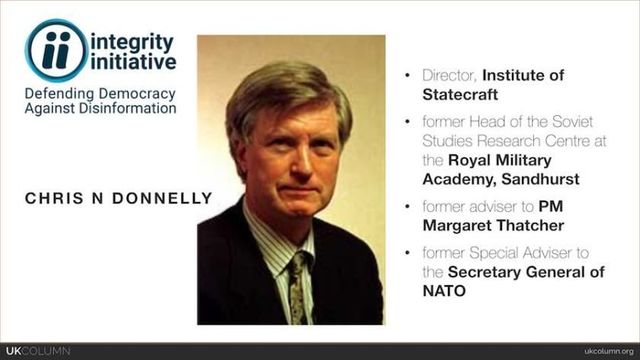
Among a fourth trove of documents leaked by Anonymous last month is a memo by Chris Donnelly, who co-ordinates II’s activities from a basement office at 2 Temple Place in London. He details sinister operations in Norway, including psy-ops targeting the Norwegian public. The II is financed by the UK’s Foreign and Commonwealth Office.
Integrity Initiative Director Chris Donnelly
In August 2016, Donnelly visited Oslo and outlined the “current situation” in Norway: “The Norwegian public are generally inclined to be soft on Russia as a near neighbor in the North (where there is a tradition of freindship [sic] and a good working relationship). Although the public can be hard-nosed about Putin and Moscow’s policies, their scepticism of US/western politics can lead to their being less critical of Russia’s position at times.” This problematic public attitude to Russia was expressed in a 2017 Sentio poll, which found that 76 percent of north Norwegians think authorities should do more to improve Norway’s relationship with Russia.
The leaked memo included Donnelly’s packed itinerary. He attended meetings with Ministry of Defence, Ministry of Justice and Police officials. At a workshop on “Fighting the Information War” chaired by the Defence Research Institute’s Henning-Andre Sogaard, they discussed how “the project” could be “generated in Norway nationally, across Nordic states, and internationally. Building the cooperation between the classified and unclassified world, keeping in mind that one of the main targets is the hearts and minds of the public.”
The Anonymous leaks expose an anti-democratic conspiracy aimed at subverting public discourse and shifting the political climate in a right-wing militarist direction.
Despite evidence of such top-level intrigue, Norway’s mainstream media and political parties have been virtually silent on the matter. The online newspaper ABC Nyheter was alone in publishing an article, in which the named Norwegian cluster members denied involvement (echoing the response of those contacted in the UK). The Norwegian left-radical news blog (steigen.no), having probed more deeply, was able to establish the likely involvement of those named.
Such diplomatic silence contrasts markedly with the media frenzy that followed unsubstantiated allegations of Russian interference in Norway. In February 2017, Norway’s Police Security Services (PST) claimed Russia was behind an attempt to hack the Norwegian Labour Party, the Defence and Foreign ministries and the PST itself. Its allegations mirrored the FBI’s equally bogus claims of Russian hacking of the US Democratic National Committee. Norway’s biggest media outlets published the PST’s allegations without question, with screaming headlines about a “Russian Hacker Attack against Norway” (national broadcaster NRK).
The PST’s allegations fueled an ongoing media barrage. Just days before, Aftenposten, Norway’s largest circulation daily newspaper, was warning that “Russian hackers—with the support of the Kremlin—are in the process of influencing the major, important elections in Europe.”
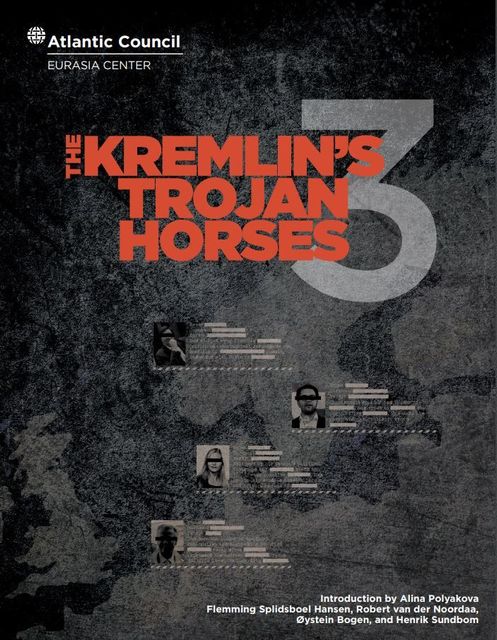
The Integrity Initiative leaks follow last year’s “The Kremlin’s Trojan Horses 3” report by the Atlantic Council, a US-backed partner to the II. The report alleged “Russian Influence in Denmark, The Netherlands, Norway, and Sweden” and denounced Kremlin “allies” among politicians, journalists and public servants. “[T]he Kremlin’s tentacles do not stop in Ukraine, Georgia, or East Central Europe,” the Atlantic Council claimed. “They reach far and deep in the core of western societies.” The report targeted three Norwegian parliamentary parties—the Socialist Left, the Red Party and the far-right Progress Party—whose representatives had questioned aspects of US/NATO policy or were insufficiently hostile to Russia.
The Atlantic Council’s November 2018 report alleging “Kremlin influence” across Scandinavia
Norway was a founding member of NATO in 1949, but it prohibited foreign troops from being stationed in the country. Norway’s post-war Labour governments cultivated an image of semi-neutrality, aligning with the United States during the Cold War, while eschewing overtly aggressive measures along its 106-kilometre north-eastern border with the Soviet Union. But the dissolution of the USSR in December 1991 and the eruption of US military efforts to encircle and confront Russia produced a fundamental shift. Norway is integrating ever more openly with US-UK provocations against Russia:
In 2016, Norway announced 300 US marines would be stationed at Vaernes military base in central Norway. This number has since doubled.
In 2017, Norway announced plans to join the US-NATO Missile Defence System (MDS) aimed at Russia. A global network of missile launchers, control centres, radars, airbases and sea-based missiles, the MDS is at the centre of US-NATO plans for a “winnable” nuclear war.
In 2018, Norway hosted Exercise Trident Juncture, NATO’s biggest military exercise since the cold war, a display of force involving 40,000 soldiers and 10,000 vehicles.
Last year, Conservative Party Prime Minister Erna Solberg’s government cut all funding to peace organisations, while boosting its defence spending commitment to NATO. For this she was awarded a “Global Citizen Award” by the Atlantic Council. The opposition Labour Party has backed Norway’s militarist trajectory, criticising the government for not spending enough on defence. Norway is one of the highest per-capita defence spenders in the world.
The actions of Norway’s political establishment are sharply opposed to the anti-war views of the public. Fully 80 percent opposed the Iraq war, with mass protests in Oslo in February 2003 the largest ever held in the country. Public opposition saw Norway’s government refrain from openly supporting the invasion. But Prime Minister Kjell Magne Bondevik’s Conservative Party government sent 150 troops in July 2003 as engineers and mine clearers operating under British command. A smaller number of Norwegian troops remained until 2006, and in 2015 Norway again sent troops as part of the international coalition “to counter ISIL.”
The official left parties in Norway have opened the gates for Norwegian militarism. The Labour Party has been the staunchest supporter of Norway’s military alliance with the US, exemplified by the seamless transition of its party leader of 12 years, Jens Stoltenberg, to become secretary general of NATO in 2014. The Socialist Left party likewise supported NATO’s bombing of Yugoslavia and Libya, and, during its time as coalition partner in the Labour-led government of 2005-2013, dropped its previous opposition to the war in Afghanistan.
The public’s well-founded “scepticism” in Norway towards “US/western politics” has nothing whatsoever to do with “Russian interference.” It is fueled by the bloody reality of US-led wars and regime change operations from North Africa to the Ukraine. It is these sentiments that the UK’s Integrity Initiative and the CIA-backed Atlantic Council have targeted as their chief obstacle to securing Norway as a frontline state in the West’s offensive against Russia.

US “border security”: Troops, torture, barbaric prisons

Patrick Martin

The Pentagon has confirmed that it is deploying an additional 3,750 troops to the US-Mexico border, continuing the build-up of repressive forces directed against defenseless immigrants and refugees seeking asylum in the United States.
Some of the 3,750 soldiers will replace those being rotated out of the border area, but there will be a sizeable net increase of at least 2,000. The total number of troops, regular and National Guard, will be more than 6,000, the largest force deployed to the southern border since 1917, when General John J. Pershing led a punitive expedition against Pancho Villa during the Mexican Revolution.
The confirmation of the troop deployment Sunday came only two days before President Trump is to give the State of the Union speech at the US Capitol building, in which a major focus is expected to be border security. Trump forced a partial shutdown of the US government for 35 days in an effort to force Congress to approve $5.7 billion in funding for a border wall.
The White House had to back down January 26, agreeing to a three-week reopening of the government while House and Senate negotiators discussed the budget for the Department of Homeland Security, which includes both Customs and Border Protection and Immigration and Customs Enforcement.
The House-Senate conference must reach agreement by February 8 to give time for congressional approval of a bipartisan deal by February 15. Otherwise there will be another shutdown, or Trump has threatened to declare a national emergency and use funds appropriated for some other purpose, such as military construction, to build the wall.
In discussions with reporters last week, Trump hinted that he might declare the national emergency in his State of the Union speech. “I don’t want to say it, but you’ll hear the State of the Union, and then you’ll see what happens right after the State of the Union,” he blustered. Whether or not that is the case, he is likely to center the speech on demands for the wall and warnings about crime and drugs supposedly associated with immigrants and refugees.
Congressional Democrats, while opposing a permanent structure or wall, largely on the grounds of its proven ineffectiveness, continue to offer vast sums for the CBP, ICE and other repressive measures against immigrants, under the rubric of “border security.”
This includes the mobilization of troops without any significant Democratic opposition, but also the abusive treatment of tens of thousands of immigrants held in ICE and CBP facilities in the border region, some operated directly by the two agencies, others by contractors, some of them billion-dollar companies that are making vast profits operating what amount to concentration camps.
A report by the Department of Homeland Security’s inspector general, issued last week, found that ICE detention facilities don’t meet national standards for prisons, despite billions in outlays to build and operate the camps. According to the report, over a 33-month period ending in June 2018, “ICE paid contractors operating the 106 detention facilities subject to this review more than $3 billion … Despite documentation of thousands of deficiencies and instances of serious harm to detainees that occurred at these detention facilities, ICE rarely imposed financial penalties.”
The inspector general’s report examined half of the 211 detention facilities run by ICE directly or indirectly, housing an average of 35,000 detainees every day—the size of a small city. The report found that ICE regularly issue waivers to excuse deficiencies, some of them of grotesque proportions, such as allowing a detention facility to use tear gas against detainees, although the standard limits efforts to “control” detainees to pepper spray, which is much less toxic.
ICE did not dispute the inspector general’s findings, instead issuing a worthless declaration that it is “committed to continually enhancing civil detention operations to promote a safe and secure environment for both detainees and staff.”
More than a dozen immigrants have died in ICE custody since 2015, including two children from Guatemala who died in December, prompting wide publicity and popular revulsion.
Prisoners at ICE facilities have begun to fight back against their brutal treatment in one of the few ways still available to them, a hunger strike, which began at the detention facility in El Paso, Texas, but has since spread to facilities in Miami, Phoenix, San Diego and San Francisco, according to an ICE spokesman.
On Sunday, ICE confirmed to the Associated Press that it was force-feeding nine of the hunger strikers in El Paso, up from six the week before, after obtaining a federal court order authorizing the brutal procedure, condemned as torture by international human rights groups, and banned by the American Medical Association.
Most of those being force-fed, and a majority of the hunger strikers, are Sikhs from the north Indian state of Punjab who have fled persecution by the right-wing Hindu supremacist government of India.
One detainee, identified by the AP only by his last name, Singh, which is very common among Sikhs, described “being dragged from his cell three times a day and strapped to a bed before being force-fed liquid through tubes pushed through his nose.”
“They tie us on the force-feeding bed, and then they put a lot of liquid into the tubes, and the pressure is immense so we end up vomiting it out,” Singh told the AP. “We can’t talk properly, and we can’t breathe properly. The pipe is not an easy process, but they try to push it down our noses and throats.”
Human Rights Watch issued a statement February 1 calling force-feeding “a cruel, inhuman and degrading” practice and pointing out that “medical ethics and human rights norms generally prohibit the force-feeding of detainees who are competent and capable of rational judgment as to the consequences of refusing food.”
All these brutal measures would become much worse—and virtually impervious to legal challenge—if Trump declares a national emergency and orders the military to build his 30-foot wall along the US-Mexico border.
Under the 1976 National Emergencies Act, if Trump declares an emergency, Congress can take action to overturn the declaration under an expedited procedure under which the Senate would be required to vote within 30 days of action by the House of Representatives. However, Trump could veto the resolution and the emergency would remain in effect unless his veto was overridden.
Congressional leaders and civil liberties groups have indicated they plan to challenge an emergency declaration in the courts, but the White House expects that any appeal would be expedited quickly to the US Supreme Court, which has a 5–4 right-wing majority expected to uphold virtually any executive action.