26 Feb 2020

Irish pseudo-left groups back Sinn Féin-led coalition

Steve James

Sinn Féin emerged as clear winners in this month’s general election in the Republic of Ireland.
The party won 24.5 percent of first preference votes, against 22.2 percent for Fianna Fáil and 20.9 for Fine Gael. The result expressed deep frustration in the working class at extreme levels of social inequality in Ireland, with Sinn Féin benefiting from rhetorical pledges to implement reforms that won support among swathes of the working class, particularly young, people.
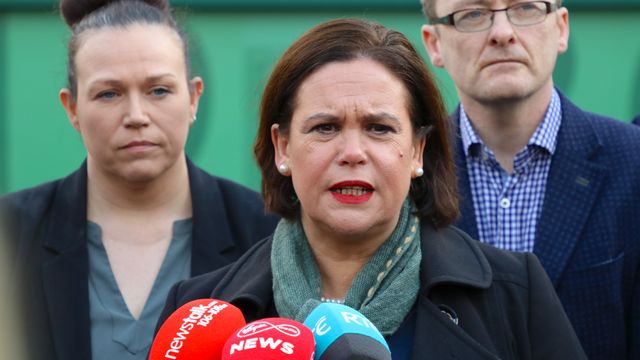
Sinn Féin leader Mary Lou McDonald [Credit: Sinn Féin]
The outcome took Sinn Féin by surprise as much as anyone. The party only stood 42 candidates and therefore only won 37 seats in the 160-seat Dáil, 14 more than last time.
No party is anywhere near a majority and months of coalition negotiation and uncertainty lie ahead, or possibly fresh elections.
In the days after the election Sinn Féin leader, Mary Lou McDonald, made clear she was willing to enter coalition talks with Fianna Fáil. But McDonald’s overtures were rebuffed.
This leaves the possibility of a coalition of Fine Gael and Fianna Fáil. Although Fianna Fáil and Fine Gael, with smaller partners, have between them formed every government in Ireland since independence from Britain, the two parties have never ruled together.
Fianna Fáil suffered a catastrophic collapse following the financial crisis of 2008 and its imposition of austerity policies. Fine Gael took power in 2011, temporarily in alliance with Labour, but continued austerity. In 2016, Fine Gael lost one third of its seats. Since then a Fine Gael government has been held in place through a “confidence and supply” deal with Fianna Fáil. Today the combined weight of both parties is not enough for a majority and agreement with a third party would be required via a coalition or “confidence and supply” arrangement.
In this volatile situation, overhung by economic uncertainty and the impact of Britain’s departure from the European Union (EU), the pseudo-left parties are playing the central role in agitating for a Sinn Féin-led coalition. They unanimously present this as a government of “real change,” to cover efforts to corral Irish workers behind openly bourgeois parties with long and proven anti-working-class records.
Days after the vote, People Before Profit demanded on their website: “The parties who gained from this upsurge, Sinn Féin, Greens, Social Democrats, People Before Profit, have a duty to carry through on this mandate by forming a minority left government.”
Sinn Féin have been in power in Northern Ireland since 2007 where they, along with the hard-right Democratic Unionist Party (DUP), imposed austerity and slashed social spending.
Sinn Féin and the DUP recently agreed with the British and Irish government that the Northern Ireland Executive and Assembly should be revived.
The Greens entered government in the South in 2007 along with Fianna Fáil. Two years later, amid the financial crisis, the Greens signed off on the Fianna Fáil government’s €65 billion bailout on behalf of the EU-led “troika,” which led to devastating levels of unemployment and welfare cuts.
The pseudo-left played a direct role during the financial crisis. In 2012, under the auspices of the United Left Alliance (ULA), Richard Boyd Barrett, then of the Socialist Workers Party, along with Clair Daly, then of the Socialist Party, met with the “troika” as part of efforts by the Irish bourgeoisie to legitimise the planned assault on living standards.
Only the Social Democrats do not have a record in government. But the party was formed in 2015 out of disgruntled former Labour Party members. The party’s election manifesto states “we are committed to maintaining the 12.5 percent corporate tax rate which is an important factor in our competitiveness as an FDI [foreign direct investment] location.”
Pseudo-left TDs (Teachta Dála–members of parliament) voted last week for McDonald for Taoiseach (prime minister). The TDs offered a selection of dishonest and evasive formulations for their lack of principle.
Mick Barry of Solidarity and the Socialist Party claimed he was voting for McDonald to increase pressure on her and her party “to deliver the change that people demand.” Barry was obliged to acknowledge that the policies needed in Dublin “are the complete opposite of the neo-liberal policies Sinn Féin has implemented in Belfast alongside the DUP.”
Paul Murphy, formerly of the Socialist Party, now with his own outfit, Rise, formed on the basis of seeking a closer accommodation with Sinn Féin, claimed that his vote for McDonald came with strings and should not be taken as support for a coalition between Sinn Féin and the establishment parties. By inference, McDonald, in Murphy’s view, can form a government that “prioritises the needs of people and our environment, not the profits of big business,” if only it maintains some distance from Fianna Fáil and Fine Gael.
Richard Boyd Barrett was most explicit. In his view a “left Government is now possible” led by McDonald. Boyd Barrett reeled off a list of demands—reduction in pension age, cessation of public land sales, affordable housing, rent controls, climate change measures and increased minimum wage—that he suggested a McDonald-led minority government could introduce.
No one should believe a word of this. Notwithstanding its historic opposition to the British government, Sinn Féin is a capitalist party, as committed to attracting investment and extracting profit from the working class as the establishment parties it is seeking to supplant.
Why a prospective McDonald government should go back on the record of all its component parts, none of the pseudo-lefts can explain. Instead, they call for an extra parliamentary protest movement to prop up a Sinn Féin government and divert attention from its pro-business and anti-working-class character.
According to the Socialist Party, Sinn Féin “should use their enhanced position and resources to help initiate a new mass movement of ordinary working people and the young to fight on the issues and to push the establishment and their parties back.” Any mass movement with Sinn Féin in a leading role would, by definition, be a nationalist trap for the working class, subordinated to the interests of capitalism in Ireland.
The pseudo-left in Ireland, as with their peers internationally, represent a rightward moving layer of the upper middle class, heavily represented in the trade union bureaucracy, academia, the media and the state. Enriched through rising property and share prices, they view the class struggles developing in Ireland and internationally as a threat to their own material interests.
How they serve capitalism is underscored by the calculated support given to the prospect of a Sinn Féin government by disparate sections of big business.
The Financial Times (FT), mouthpiece of the City of London, hailed the result as an “historic achievement.” An editorial stated, “Ireland’s left-wing nationalists are no opportunistic upstarts, but as much part of the fabric of Irish history as Fianna Fáil and Fine Gael, the two traditional centre-right ruling parties.”
The problem was that “Ireland’s political system ... has had a muted left-right,” a problem which must now be resolved.
Following recent referenda on abortion and same-sex marriage, the FT concluded this “election could pull the party-political system, too, into the 21st century.”
The FT view Sinn Féin’s entry into government as a party capable of peddling a certain amount of “leftist populism” as vital for maintaining the stability of capitalism in Ireland.
Brian Hayes, a lobbyist for the Irish banking system and former Fine Gael finance minister and chief executive of Banking and Payments Federation Ireland, encouraged his financier peers to be “relaxed.” Hayes wrote of Sinn Féin, “If people were talking about radical change to investment policy and free movement of capital, that would be a worry. But I don’t think they are. I’m confident of a stable government.”
IBEC, the employers’ group, concurred. Business could “absolutely” work with Sinn Féin, said the group’s director Danny McCoy. “We have seen them in action in the North. Their instincts are not mad when it comes to business,” he said.
Johnny Ronan, a major player in building office space for transnational corporations, described Sinn Féin’s investment policies as “sensible stuff.” Facebook recently took out a 25-year lease on Ronan’s Fibonacci Square office development, described in the Irish Times as “the largest single office letting in the history of the State.” In addition to Facebook, Google and Amazon, LinkedIn and Salesforce are all establishing new campuses in Dublin on top of their existing operations. Google employs 8,000 in Dublin and is intending to recruit many more.
These ringing endorsements of Sinn Féin and McDonald come from those responsible for maintaining Ireland, and its capital Dublin, as a primary investment hub for the world’s largest tech and financial services companies at the direct expense of the working class.

China auto sales plummet as coronavirus threatens to trigger global downturn

Marcus Day

Car sales in China, the world’s largest automobile market, plunged 92 percent in the first two weeks of February compared to a year earlier. The fall was driven largely by the impact of the novel coronavirus, which continues to cause widespread disruption to economic activity and daily life both in China and a growing number of countries.
In China, a country of nearly 1.4 billion people, average sales dropped to a staggeringly low 811 vehicles a day in the first week of February, according to a report by the China Passenger Car Association.
“The market is dead. There is no one buying cars,” Dalibor Petkovic, a China auto analyst, bluntly told the Financial Times. “We can’t expect an upsurge in sales for a while.”
Stock markets internationally have fallen sharply over the last two days, as revised projections for the further global spread of the novel coronavirus have led to fears that the disease is increasingly likely to tip the already fragile world economy into a major recession. The US Dow Jones Industrial Average experienced its biggest two-day point decline in history since Monday, with other indexes in Asia and Europe seeing even bigger percentage declines.
With a global jobs massacre already well underway, with over 500,000 auto-industry jobs cut in 2019 and at least 100,000 more projected for 2020, the international working class is being forced to shoulder the costs of the economic crisis.
The areas of China most significantly impacted by the coronavirus, centered on the city of Wuhan (dubbed China’s “Motor City”) and the Hubei province, are also those which account for a substantial portion of both auto production and sales in the country. The Financial Times cited an analysis by LMC Automotive, which indicate that the regions with more than 500 cases of the coronavirus are responsible for 61 percent of passenger car sales and 54 percent of production. GM, Honda, Nissan, Renault, and the PSA Group all have auto plants within Wuhan.
Hubei has announced it will continue its shutdown of non-essential business through March 11.
Dealerships in the country expect sales to be down by as much as 80 percent for the month, according to a report by the China Automotive Dealership Association. Although roughly 20 percent of dealerships have showrooms open, sales are only at approximately five percent of their typical level.
Both automakers and the Chinese state view the slump in sales with increasing nervousness, but have yet to undertake significant measures in response. Geely, one of China’s top automakers, recently launched an online buying service in an effort to make up for the drop in in-person purchases at dealerships.
The Chinese government has signaled it will take as-yet undefined steps to offset the impact of the outbreak on the auto industry, with the commerce ministry stating last week that it would work to stabilize sales. Bloomberg News cited an unnamed source who indicated the government is considering reintroducing subsidies for electric vehicles.
Car sales in China have been estimated to decline by 10 percent in the first half of 2020 and 5 percent throughout the year overall, according to projections released last week by the China Association of Automobile Manufacturers. This drop—which may turn out to be a significant underestimation—would follow two straight years of falling sales in the country, which were driven by the trade war with the US and broader economic stagnation. Until 2017, China’s auto market had experienced soaring growth and accounted for an increasingly significant share of global automakers’ revenue.
The ratings agency Fitch said that General Motors is particularly vulnerable to a downturn in China, since the country now accounts for 40 percent of the company’s sales. GM’s sales in the country were already down 40 percent in January year-over-year. The company already earlier this month announced a further reduction in its presence in global markets, revealing plans to essentially end operations in Australia, New Zealand and Thailand.
S&P Global Ratings has estimated the coronavirus outbreak will result in a 15 percent reduction in China’s auto production in the first quarter of 2020.
However, the globally integrated character of the auto industry—combined with the increasingly international scope of the coronavirus—threaten much more than China’s domestic auto market.
While all the major automakers have been compelled to suspend production within China for weeks, with some still idled or only recently and slowly restarting, supply chains have been increasingly disrupted, hampering production and operations far outside the country’s borders.
Italy reported a significant increase in the number of cases in recent days, with the majority concentrated in the highly industrialized north of the country. While Fiat Chrysler has yet to announce any halt to production within Italy itself, it has been forced to idle its plant in Serbia due to a shortage of parts from suppliers in China.
In this photo taken Wednesday, Feb. 12, 2020, a worker cleans the glass doors at an empty auto showroom in Beijing, China. (AP Photo/Ng Han Guan)
A spokesman for French automaker Renault said, “We cannot restrict the impact of this crisis to a specific geographic area, as all our plants use components from China. The complexity of the supply chains and the uncertainty about the evolution of the restrictive measures in China do not allow us to give an accurate forecast of the impacts.”
An overwhelming proportion, 80 percent, of the global auto industry relies upon auto parts from China. Tu Le, founder of Sino Auto Insights, described the critical character of China’s auto parts production to the global auto industry, telling Automotive News, “It could be some super innocuous part, a nut or a bolt that shuts the whole line down. Everyone sources from China…No one can say: I’m not affected.” In addition to FCA’s Serbian plant, Hyundai and Nissan have been forced to idle factories in South Korea due to parts shortages.
Experts have increasingly warned that the outbreak threatens to spread further around the world than initial projections. “I think the likely outcome is that it will ultimately not be containable,” Marc Lipitsch, epidemiology professor at Harvard, told the Atlantic.
On Tuesday, officials at the US’s Centers for Disease Control and Prevention warned that they expected the disease to spread more broadly in the US and potentially reach pandemic levels. “It’s not so much a question of if this will happen anymore but rather more a question of exactly when this will happen and how many people in this country will have severe illness,” said Dr. Nancy Messonnier, director of the CDC’s National Center for Immunization and Respiratory Diseases.
Given the lack of preparedness of even the most advanced countries to deal with a major outbreak of the coronavirus—as health systems have faced increasing cuts and critical research has been starved of resources—analysts have produced increasingly dire scenarios for the world economy in recent weeks. Oxford Economics has estimated global GDP may fall as much as $1.1 trillion if the coronavirus “morphs into a global pandemic.”

25 Feb 2020

The ‘Healing’ Touch of Nurses

Sheshu Babu

In big hospitals – Government or private – nurses play a crucial part. While doctors look after patients till operation, nurses take care of post-operative trauma and assist in speedy recovery. They have not only to deal with in-patients and comfort them by their constant attendance, but also calm down the anxious helpers who accompany patients and eagerly wait for nurses in administering medicines to relieve patients from pains that are mostly unbearable at times. Their duties include regular check-up round the clock to note down temperature variations, blood -pressure changes, monitoring intra-venous injections, etc.
Shortage
According to American Nurses Association, by 2022, there will be a need for 3.44 million nurses. (Nurses Shortage Statistics, posted on January 19, 2016,by Liz Sheffield, peopleelement.com). The nursing shortage becomes serious issue when considering how it impacts patient care. Evidence suggests that some in-hospital or discharge deaths could be prevented with improved nurse-to-patient ratio.
In India, shortage of doctors is estimated at 600,000 and nurses shortage is 2 million according to scientists who found that lack of staff who are properly trained in administering antibiotics is preventing patients from accessing life-saving drugs. (India facing shortage of 600,000 doctors , 2 million nurses: Study ,last updated April 14, 2019, economictimes.indiatimes.com). In India, there is one government doctor for every 10,189 people (World Health Organization (WHO) recommends a ratio of 1:1000) and the nurses patient ratio is 1:483 which is huge.
Trying conditions
With many hospitals reluctant to hire nurses adequately, the existing staff are forced to work in trying circumstances often with extended hours as substitutes are not available most of the time. Yet, they try hard to look after patients. Despite exhaustion and work related stress, nurses rarely show anger on patients. Many of them are given adequate salary and face insecurity with high chances of firing by management.
Male nurses low
In 1970, a study from United States Census Bureau indicates the total percent of men who worked as nurses within United States in terms of all the girls who worked as nurses was just 2.7 percent.( Nursing Facts and Statistics , posted by admin on March 11 2019,trendstatistics.com). A recent check indicates that some 9.7 percent of Americans working as nurses are men.
The percentage of men as nurses in India can easily be imagined. Thus, there is a strong bias in this field. Due to low wages, tedious work conditions, many men do not prefer to work in this field. Women who mostly have limited option and little choice are forced to choose this field.
Healers
These nurses are true ‘healers’ of mankind as they serve all sections of society across caste or religion or gender and do not hesitate to touch any part of body and administer the medicines on affected part.
They should be respected and provided with better facilities for a better living

Waiting times for aged care in Australia quadruple over past decade

Clare Bruderlin

An Australian Productivity Commission report, released last month, shows that a growing number of elderly people across Australia are left waiting more than nine months to receive vital aged care services.
In 2018–19, just over 40 percent of people who were assessed as needing care waited nine months or more to be admitted into residential aged care. This number has skyrocketed, from just 5.4 percent in 2008–09.
In 2018–19, the median time between being assessed as eligible by the Aged Care Assessment Team (ACAT) and entering residential aged care was 152 days, or around five months. This was out of a total of 60,657 admissions into care. The median wait time increased more than fourfold in a decade, from 36 days in 2009–10.
The percentage of people entering residential aged care within three months was lower in outer regional and remote areas, at 40.3 percent and 37.8 percent respectively, compared with 42.5 percent in major cities.
The report shows a similar trend in the wait times for home care packages. Home care packages provide funding for elderly people to access aged care services at home, including personal care, social and medical support.
Home care packages are assessed in four levels, ranging from low-level care needs (Home Care Package Level 1), to high-care needs (Level 4).
Once a person is assessed as needing home care, the approximate wait time for Level 2, Level 3 and Level 4 packages is over a year, according to the Australian government’s MyAgedCare website. For Level 1 Packages the wait is 3-6 months.
The Productivity Commission report found that across all home care levels, total admissions fell from 36,474 in 2015–16, to 24,156 in 2017–18, while the median time for receiving a home care package rose from 73 days in 2015–16 to 137 days in 2017–18.
These waiting times are in addition to the process of applying to receive aged care services, and having this application approved by ACAT, which typically takes up to six weeks.
The Australian Health Department’s latest quarterly report showed that as of December 2019 there were 112,237 people waiting for a home care package. This had increased from 108,456 people in January 2018.
Many elderly people have died before their home care package was delivered, while others have been forced to go into residential aged care. In its interim report, released last November, the Royal Commission into Aged Care Quality and Safety noted that in 2018, more than 16,000 people died waiting for a home care package, and 14,000 were forced into residential aged care.
The Productivity Commission report cites the lack of availability of aged care places/packages as one of the main reasons for increased wait-times, as well as an older person’s “need to delay entry into residential aged care due to personal circumstances, such as selling their home,” and decisions to reject a place in residential aged care due to the cost.
According to MyAgedCare, all residents of aged care facilities are charged a maximum “basic daily fee” of $51.63 per day, or $18,844.95 per year. This is around 85 percent of the basic age pension for a single person, which is a maximum of $850.40 per fortnight.
This amount is in addition to a “means-tested care fee,” which can be up to $252.20 per day based on an income and assets test, and a refundable accommodation deposit, which has no maximum amount and averaged $316,876 in July 2019. Many aged care facilities also charge additional “service fees” that are not government subsidised. These services can include providing residents with “a preferred brand of toiletries” or “accessing a hairdresser.”
Such is the failure of capitalism and the contempt of the ruling elite for the working class, that elderly people who have worked all their lives are then forced to give up their assets and savings to obtain care. By contrast, the wealthy can afford expensive private services.
A recent report published by Flinders University and submitted to the royal commission in January, shows that of 22 countries in its study, Australia’s spending on long-term aged care was among the lowest. The report also states that staffing levels for residential aged care in Australia is “at the lower end of the range internationally, both for total staffing and nursing.”
After the Aged Care Royal Commission delivered its interim report in November, Prime Minister Scott Morrison’s Liberal-National Coalition government announced just 10,000 additional home care packages. This is an insult to the well over 110,000 people already assessed as needing home care services and on the waiting to die list.
Following the release of the Productivity Commission’s January report, the Labor Party’s shadow minister for ageing, Julie Collins, called the figures, “another wake-up call for the Morrison government on the terrible state of our country’s aged care system.”
However, during the May 2019 federal election Labor’s response to the aged care crisis was to pledge to “immediately investigate” how to better triage those waiting for home care packages, fast-track a “workforce strategy” and encourage doctors to do home visits. Labor outlined no strategy for addressing the poor quality and lack of aged care services, and no increased funding.
Moreover, both Labor and Coalition governments have overseen the lengthening queues and the extensive privatisation of aged care services.
In 2010–11, after three years of a Labor government, the number of residential aged care services managed by government organisations had dropped to 10 percent. Not-for-profits (charitable, religious-based and community based organisations) and private corporations owned 60 percent and 30 percent, respectively.
By 2018, the proportion of residential aged care services managed by government organisations had fallen further to 9 percent, according to the most recent GEN Aged Care Data.
Continuing this privatisation, the Morrison government announced last December that it would tender out ACAT, which approves applications for aged care services, to the private sector this year. This is another indication that corporate profit interests are increasingly placed above providing for even the most basic needs of workers as they age.

Sri Lanka: IMF presses new government to implement austerity

Saman Gunadasa

An International Monetary Fund (IMF) team reviewed the economic policies of the new Sri Lankan government of President Gotabhaya Rajapakse government and issued a cautionary statement requiring compliance with its drastic austerity measures.
In the statement of February 7, the IMF mission head for Sri Lanka, Manuela Goretti, pointed to Sri Lanka’s repeated breaches of the prescribed fiscal deficit targets, risks associated with mounting foreign and domestic debts and, in veiled language, criticised the government’s tax cuts.
“Given the high level of public debt and refinancing needs in the country, ensuring macroeconomic stability called for fiscal consolidation, prudent monetary policy, and sustained efforts to build international reserves,” Goretti stated. She called for the implementation of “ambitious structural and institutional reforms” including the privatization and commercialization of state-owned bodies.
The so-called “prudent monetary policy” means keeping to the IMF’s fiscal target. The previous government of President Maithripala Sirisena and Ranil Wickremesinghe obtained a bailout loan amounting to $US1.5 billion in June 2016 and promised gradual reduction of the fiscal deficit to 3.5 percent of gross domestic product (GDP) in 2019. This was later extended to 2020.
The government adhered to the IMF’s demands by slashing price subsidies and imposing taxes on essentials, driving up prices which severely affected the living conditions of workers and the poor. This triggered a wave of strikes and protests.
However, the fiscal deficit still shot up to 6.3 percent of GDP in 2019 and the projected rise in 2020 is 7.9 percent, more than double the IMF target. Goretti blamed this year’s increase on “newly implemented tax cuts and exemptions”, other accumulated expenditure and the “low mobilization of revenue.”
The IMF official also said the “Net International Reserves fell short of the end-December target” for 2019 “by about $100 million amid market pressures after the presidential elections and announced tax cuts by the new government.”
The Rajapakse government is desperately trying to patch up the ailing economy, which registered just 2.6 percent growth in 2019—the lowest since 2002. Responding to a section of big business, the government declared the need for “a stimulation program,” by reducing the value added tax (VAT), and corporate and income tax. These taxes had been implemented under IMF-proposed amendments to the Inland Revenue Act. The revenue loss to the government due to tax cuts has been estimated at 500-800 billion rupees by the treasury.
Only big business was benefited from the VAT reduction and other tax concessions. While it is usually not opposed to concessions to big business, the IMF wants to tighten the screws, as happened during the crisis in Greece, to squeeze the masses for the repayment of loans to international banks.
The IMF statement declared: “Given risks to debt sustainability and large refinancing needs over the medium term, renewed efforts to advance fiscal consolidation will be essential.” It called for greater “efficiency in the public administration,” which will mean job losses, and greater “revenue mobilization,” which means high tax collection.
According to the IMF, Sri Lanka’s estimated foreign debt will reach a staggering 64 percent of the GDP this year, while public debt will exceed 91 percent. According to the Central Bank, the government will have to pay $4.8 billion to service its external debt this year, and on average, $5 billion a year over the next four years. Repayments on private sector debt will be another $1.2 billion.
Significantly, the IMF did not mention the final installment of its existing loan amounting to $145 million. At the end of 2018, the IMF withheld the sixth installment of its loan when President Sirisena attempted to remove then-Prime Minister Wickremesinghe. The installment was only released in November last year. Though the final amount is small, the government depends on the approval of international institutions like the IMF to raise more loans on the global money market.
As the IMF team discussion concluded, Prime Minister Mahinda Rajapakse told parliament on February 5 that the fiscal deficit would be reduced to four percent this year, indicating the government will bow to IMF demands.
Central Bank governor, W.D. Lakshman, told a conference of the Ceylon Chamber of Commerce on February 10 that “there are difficult decisions that ought to be made by the political leadership.” He declared that “the IMF should not be treated as an enemy” and called on the government to seek another IMF program.
The cash-strapped government is also looking for a delay in the repayment of foreign loans. During his visit to New Delhi early this month, Mahinda Rajapakse asked India for a three-year moratorium on loan repayments. He told the Hindu: “If the Indian government takes this step, then other governments might agree to do the same thing, including China.” Sri Lanka has loans amounting to $6 billion from China.
In line with IMF demands, the government has already called on the private sector to invest in the government-owned production facilities such as the graphite mine in Kahatagaha. Industry and Commerce Minister Wimal Weerawansa told the media on February 10, that inactive SOEs such as the Eastern Valaichchenai Paper Mills, North Saltern and Ceylon Ceramic Corporation factory at Oddusudan are being “revived” as Public Private Partnerships (PPP). “Revival” will mean savage cost-cutting.
Facing a desperate financial crisis, the government sought parliamentary approval last week to lift the debt ceiling from 721 to 1,088 billion rupees. It also requested a 367 billion rupees supplementary budget for urgent expenditure, blaming the previous government for its economic woes. However, it had to withdraw these requests last week at the last minute when the opposition United National Party rejected the proposals.
President Rajapakse is planning to dissolve parliament in the first week of March and hold a general election at the end of April. He is aiming at winning a two-thirds parliamentary majority to change the constitution and strengthen the president’s authoritarian powers. The extra money was in part to fund programs to win votes.
The IMF in its review predicted that Sri Lanka’s growth rate would rise this year and could reach 3.5 percent. However, economic commentators are pessimistic, warning of a deepening crisis amid the global downturn and geopolitical tensions. Sunday Times columnist Nimal Sanderatne warned on February 9: “Once again the Sri Lankan economy is facing severe external shocks.”
The IMF austerity program and worsening economic crisis will translate into major attacks on workers and the poor, setting the stage for a resumption and escalation of sharp class struggles in Sri Lanka as part of the growing global upsurge.

Two impoverished teenagers die working in an illegal Peruvian mine

Cesar Uco

Two Peruvian brothers, ages 14 and 17, died on February due to inhaling toxic gases while working in a mine to earn money to pay for their school supplies for the upcoming school year. The “informal” mine had not been registered with the Ministry of Mines and thus was operating illegally.
This is yet another tragedy added to the toll of thousands of miners killed in mines where the government has expressly denied registration for failure to comply with safety regulations, or those like the one where the two impoverished youth were killed that do not even attempt to register because of appalling conditions.
The two brothers and another 16-year-old teenager were hired a few weeks ago to work at the mine located in the village of Llacuabamba in the Andean region of La Libertad, in the north of the country.
The newspaper La Industria reported that the youth “were on site when suddenly it started to emanate toxic gases that spread all over the place”. The two brothers ran to the mouth of the pit, but “inhaled the gas and vanished.... The other child was able to leave the scene and was taken to the sector hospital, where he has been recovering.”
Relatives of the minors are demanding justice for this crime––that the case be investigated and the mine owners prosecuted. An aunt of one of the youth said: “They work without having the necessary safety equipment and were exposed daily to toxic gases, unfortunately on Tuesday they were no longer able to leave the site.”
Several of the illegal mine owners—some locals and others living in lavish neighborhoods in the capital Lima—have hired gunmen to oversee the exploitation of the mines and their workers. Peru21 reports that “The head of the Third Police Macroregion of La Libertad, General Lucas Núñez, warned that crime has spread to the Andean area, like Pataz [district in Parcoy Province],” the region where the three teenagers inhaled toxic gases in Llacuabamba. “He pointed out that the violence has increased because illegal mine owners hired hitmen who have been released from prison because of overcrowding.” Peru21 further reports that the gunmen are mainly composed of released convicts known as “Los Topos del Frío” (Moles of the Cold). El Comercio reports that 18 members of this gang were captured earlier this month “with almost US $10 million in gold... extracted from pit mines of the La Libertad Andes mountains, and sent to Europe and Asia by two foreign financiers. Authorities retained more than 200 kilos of gold ore from the criminal organization in warehouses.”
A Chinese citizen was arrested in a building which operated as a front business through which the illegal gold was exported.
The center of operations of this criminal network were the Pataz district villages of Retamas and Llacuabamba, where the two youth recently died. It had tentacles extending into up to five regions of the country.
The Moles of the Cold are not the only criminal band involved in the exploitation of the miners. Other organizations are “The Octopuses” and “The Damned of Triumph”, which include ex-convicts as well as ex-army personnel, according to El Comercio. In 2019, 169 people were assassinated in 19 robberies in the mining areas of La Libertad.
Such killers are responsible for the January murder of five miners in Trujillo, the capital of the La Libertad region, arising from a dispute between illegal mining operations. Their bodies were found in reed beds near the Moche River, each shot in the head, execution style. The executed miners had been operating a truck with 30 tons of minerals, mostly gold ore.
The scale of illegal mining operations is vast. According to a 2016 study by José de Echave titled “Illegal Mining in Peru—Between informality and crime”:
Along with the mining boom across the country, Peru has seen illegal mining grow in its territory. In the ranking of the main criminal activities according to the amount of money they mobilize, illegal mining continues to share the first places with drug trafficking and illegal logging, despite the fall in mineral prices on the world market. Illegal and informal miners have even succeeded in deploying effective influence strategies and built bridges to politics.”
According to de Echave, in the last years of the boom formal, registered mines and illegal mining operations often worked side by side:
In many of these areas, the gold rush has caused entire communities to turn to extraction in areas close to operations and concessions from large and medium-sized formal mining companies. In some of these cases, coexistence ends up generating competition and open dispute over access to concessions.
Crimes in the last few years against Peruvian miners, who are forced by poverty to work in informal, unsafe operations, without safety equipment and other basic safety protections, include:
  • In April 2019, eight miners died and three more barely survived after poisonous gases filled an informal gold mine in El Toro mountain located in the Andes in La Libertad, that is, the same mining region where the teenagers died on February 11.
  • In June 2018, a 17-year-old and a 12-year-old died from gas intoxication inside the informal mine in Gran Chimú, in the Ancash region, south of La Libertad.
  • In January 2017, seven Peruvian miners were buried under an avalanche of mud and stones that trapped the men in a tunnel hundreds of feet underground. The tragedy at the Las Gemelas mine occurred when heavy rains unleashed a flood that covered the entrance and exit of the mine, which is located in a remote area in the district of Acarí, in the Arequipa region. Initially, there were 15 miners in the mine, but eight managed to get out before the barrage covered its entrance and exit.
De Echave’s reference to of illegal mining’s “bridges to politics” finds expression in President Martin Vizcarra’s recently sworn in Minister of Energy and Mines. Susana Vilca Achata.
Vilca Achate acknowledged while serving as Deputy Minister of Mines under former President Ollanta Humala (2006-2011) that she “owned mining concessions.” What Vilca Achata failed to declare was that she “was accused in Congress of owning 17 informal mining concessions in different areas of the country... since 2003, the Brandon HV mining concession, located in the Ancash region,” as La Industria reports in its February 13 edition.
The proliferation the illegal mining operations is tolerated due to corruption at the highest levels of the Peruvian government as well the direct involvement of members of the political establishment.

EU police departments preparing massive international facial recognition database

Kevin Reed

Internal documents leaked to The Intercept show that the European Union (EU) is creating the legislative framework for implementing an international facial recognition database that will likely be integrated with a similar system already in place in the US.
The Intercept reported on Friday that an unnamed European official “who is concerned about the network’s development” leaked information revealing that Austria is leading 10 EU police departments “to introduce and interconnect such databases in every member state.” The Austria-led report states that face recognition is a “highly suitable” method for identifying suspects and should be implemented “as quickly as possible.”
The report was circulated in November 2019 among EU officials and representatives from individual countries as part of ongoing discussions about the development of a continent-wide biometric data repository. Known as the Prüm system, the database enables DNA, fingerprint and vehicle registration data to be mutually searched by law enforcement and EU intelligence services across all 27 member countries.
The Intercept report states that the preparations for the legislation have included an investment of €700,000 (US$750,000) in a study by the consulting firm Deloitte “on possible changes to the Prüm system, with one part of the work looking at facial recognition technology” and €500,000 paid to a consortium of agencies to “map the current situation of facial recognition in criminal investigations in all EU Member States.”
One of the leaked documents was a project presentation that was sent to national representatives in Brussels that outlined the goal of the initiative as moving “towards the possible exchange of facial data” among EU countries.
The Intercept report explains that legislation was passed by the EU last April that “established a database that will hold the fingerprints, facial images, and other personal data of up to 300 million non-EU nationals, merging data from five separate systems.” When Deloitte initially proposed to the 10 police forces that facial images be integrated into this system, “the idea was met with unanimous opposition from law enforcement officials.”
However, the police organizations recognize the value of having all European facial recognition systems linked with each other and with the US. The Intercept writes that as early as 2004, the US Embassy in Brussels was calling for “expansive exchanges and sharing all forms of data, including personal data.” Since 2015, the Department of Homeland Security has demanded data sharing agreements with countries participating in the Visa Waiver Program.
Other US biometric databases have been integrated with Europeans more recently. According to Reinhard Schmid, a senior official in the Austrian criminal intelligence service who spoke to The Intercept, Austria began running fingerprints against the FBI’s criminal fingerprint databases in October 2017. Since then, about 12,000 prints have been checked, leading to 150 matches. Schmid said, “Around 20 of these identified persons were under investigation and suspected of membership of terrorist organizations,” while in 56 cases individuals had attempted to use a false identity.
According to a report in RT News, beginning in 2001 the US negotiated agreements to share both analytical and personal data between Europol and US law enforcement. “However, Europol’s inability to collect the data itself meant it was dependent on what was supplied by member states. A facial recognition database in every nation, hooked into a central data-sharing network, creates an enviable transatlantic trough at which everyone’s law enforcement can feed.”
It is clear that facial recognition data is being gathered by local, national and international law enforcement organizations from states throughout the world and that the ability to link and integrate this information on globally searchable networks is becoming the norm. In the US, the mass surveillance of the population with facial recognition software is combined with scrubbing of social media accounts for facial images and other identity details.
There are no US laws governing this unconstitutional activity, which is a violation of at least the First and Fourth Amendments. A face image gathered by security services at an airport or at a highway toll booth can be combined with travel details and license plate information and stored into a federal criminal database without the permission or knowledge of the individual being photographed.
Discussing the EU moves to consolidate and share face profiles among states, Neema Singh Guliani, senior legislative counsel at the American Civil Liberties Union, told The Intercept that once the information sharing agreements are in place, there is nothing stopping data collected by the local police from being “shared with additional levels of U.S. law enforcement,” such as the FBI, Homeland Security, the Central Intelligence Agency or the National Security Agency.
Guliani went on, “Their logic here is, ‘When I have a serious crime and I want to run someone’s photo against a database, why shouldn’t I have this?’” Yet, she added, the privacy implications are enormous. “Once you have the access, you ultimately have the ability to identify almost anyone, anywhere.”
The Intercept also spoke with Edin Omanovic, advocacy director for Privacy International, who said, “This is concerning on a national level and on a European level, especially as some EU countries veer towards more authoritarian governments.” Omanovic also said he worries about a pan-European face database being used for “politically motivated surveillance.”
With the growth of class conflict rising as well as the refugee crisis intensifying on every continent, the use of advanced artificial intelligence systems by the state to monitor the movement of every single person by way of biometric data is a serious threat. The use of authoritarian methods against individuals who have spoken up against injustice or anyone who has been labeled an “enemy of the state” will be on the rise.
At the center of these changes is US imperialism, where facial recognition tools are being perfected as part of a global system of perpetual surveillance, harassment, imprisonment, rendition, torture and assassination of its enemies. The working class can place no confidence in the bourgeois political order of any country to defend basic democratic rights. All talk of creating legislative frameworks for the use of facial recognition systems is both a cover-up of the advanced stage of their use today and the legitimization of their use tomorrow.

Russia seeks to ease tensions with Belarus over energy dispute

Andrea Peters

In an effort to ease tensions with Belarus, Russia has offered to compensate the neighboring state $300 million to offset the effect of changes made to oil export taxes instituted in 2018. According to Belorussian President Alexander Lukashenko, who announced the deal late last week, the country has sustained $430 million in losses due to the tariff regime. The Kremlin has yet to publicly confirm details of the agreement, but Russian Energy Minister Alexander Novak stated the government was contemplating a $2 per ton price cut for the Belorussian market.
Last week’s deal came about 10 days after face-to-face talks between Lukashenko and Russian President Vladimir Putin failed to produce a solution to the dispute between the two countries. The Belorussian leader then threatened to siphon off Russian oil transiting through Belarus via the Druzhba pipeline, which delivers a million barrels a day to the European market.
Moscow has long supplied Minsk with below-market-value oil, which the state has then directed toward domestic use and foreign resale. According to Rosneft, Russia’s low-cost supplies account for 50 percent of Belorussian consumption. Economists estimate they have amounted to a subsidy equivalent to about 3 percent of Belarus’ gross domestic product. This economic boost, however, was eroded by the changed tax structure imposed in 2018.
After a contract between the two countries expired in January, Russia briefly cut oil deliveries to Belarus. Although a temporary agreement was reached, Russian supplies continued to remain low. Minsk made up for the deficit with oil purchases from Norway, delivered by way of NATO member state Lithuania. The government is also in negotiations with the United States and Saudi Arabia to secure oil via American ally Poland.
The oil price dispute between Russia and Belarus is part of a larger geopolitical conflict. In an effort to isolate Russia, both the United States and Europe are working to draw Belarus into their orbit and undermine the historically close ties between Minsk and Moscow.
Despite being longstanding allies, an agreement signed between Russia and Belarus in the late 1990s to form a political and economic union has failed to come to fruition. In mid-February, Lukashenko declared the Kremlin’s push for some type of formal unification to be an attack on Belorussian sovereignty. “By integration, they mean takeover of Belarus,” he stated, declaring that Moscow was using its power as an energy supplier to dominate the country. “They are already saying, become part of Russia, then we will supply spare parts, then there will be other prices for oil and gas.”
In a crazed outburst of war-mongering, Ukraine’s far-right, American-allied government appealed to Belarus last week to not be overly “calm and patient” but initiate military action against Russia. Insisting that Moscow likely intends to “start killing you,” Ukrainian Foreign Minister Vadym Prystaiko declared that Minsk could, under foreign pressure, either “be prudent and calm—and lose, or start fighting right now.”
As the Belorussian-Russian oil price dispute was unfolding this month, representatives of Minsk were meeting with the US-allied government in Georgia. Declaring the country to be “an important and reliable” ally, Belorussian officials outlined plans for greater bilateral investment in agriculture and industry. The aim, they stated, is to bring trade turnover between the countries to $200 million a year. While this amounts to a tiny fraction of Belarus’ turnover with Russia, Minsk is making clear that it is seeking to develop closer ties with Western-allied governments in the region.
The European Bank for Reconstruction and Development (EBRD) has dramatically increased investment in Belarus. In 2019, it poured an unprecedented $433 million into the country. The EBRD’s Belorussian portfolio is expected to climb to $600 million this year.
After more than a decade of sanctions, justified on the basis of Lukashenko’s human rights abuses, Washington is now rebuilding relations with Minsk. US Secretary of State Mike Pompeo visited Minsk in early February, the first time a government representative had been in Belarus in over 15 years. The US also recently appointed an ambassador to the country and announced plans to increase embassy staff.
In November 2019, the US said it would support efforts by Belarus, whose imports and exports are currently overwhelmingly dominated by the Russian market, to join the World Trade Organization (WTO). Negotiations on ascension are expected to conclude at the end of 2020 or the start of 2021.
Speaking last year, American Chargé d’Affaires Jennifer Moore, the highest ranking US official in Belarus at the time, made clear that in return for US backing, Washington expects of Minsk a “commitment of a political nature” and the removal of whatever obstacles remain to the penetration of the country by American and international capital.
“Along the way forward we will help Belarus implement such changes so that all companies—private and state ones alike, domestic and foreign ones—could compete on equal footing. I am talking about the relevant price regulations and certainly it is necessary to ease up business operation regulations, including trade terms. If the terms are equal, new opportunities will emerge, including opportunities for American entrepreneurs to work in Belarus,” Moore stated.
A February 18 article put out by Chatham House, a top foreign policy think tank in Great Britain, lamented Lukashenko’s failure to completely break ties with Russia and welcome IMF-style austerity. The author called on Western powers to intervene in Belarus and work to build an opposition allied to Washington and Brussels.
“Lukashenka [sic] is unlikely to still be president in 10-15 years, so policymakers should develop relations with the broader ruling elite, which will remain after he leaves, and try to be present in Belarus as much as possible helping it to improve public governance and develop private businesses,” writes Ryhor Astapenia. “The West should also support the country’s civil society and independent media, for whom Belarusian independence is a matter of principle rather than something to be bargained away. Lukashenka may be a strong leader, but the state he has built is weak.”
The real attitude of the Western powers towards Belarus was highlighted in a recent article by Fred Kaplan in the online magazine Slate. In an article discussing the wisdom of using low-yield nuclear weapons in a conflict with Moscow, Kaplan reports that during secret anti-Russian war games conducted under the Obama administration, one of the scenarios practiced involved the nuclear annihilation of Belarus.
“The [National Security Council’s] principals decided we had to respond with nuclear weapons, to maintain credibility among our allies and adversaries. They decided to fire a few nuclear weapons at the former Soviet republic of Belarus, even though, in the game, it had no involvement in the Russian attacks,” he writes.

24 Feb 2020

Creative Girls Mentorship Program 2020 for Lady Creatives and Professionals

Application Deadline: 9th March, 2020

Eligible Countries: All

About the Award:  In the Creative/Professional world, meeting other individuals who have made significant progress in their lives and with their Art and Work is invaluable. It creates a paradigm shift as the young and inexperienced creative is exposed to resources, guides, angles and dreams that are achievable.
Now in its fourth year, the For Creative Girls Mentoring program matches women who are taking over their industries with upcoming female creatives and professionals.
For Creative Girls has created a 2-month mentorship program for Female Creatives and Professional. The mentorship program has been developed to help upcoming artists and professional women get the guide, help, and resources that they need to accelerate their growth in their chosen fields.
Makers, creators, social activists, and artists are thriving around the globe, and this mentorship program is tailored to help bridge the gap between female creatives uncomfortable with the stage their art and skills are currently at and those who have grown tremendously.

Type: Training

Eligibility: The program is for women engaged in the Creatives (Design, Arts, Writing, Painting, Photography etc) and other types of professionals

Number of Awards: Not specified

Value of Award: This program is a One-on-One virtual mentorship guidance that will hold for 2 months causing accelerated growth in a person who is thirsty for growth in their chosen field.

Duration of Program: 2 months

How to Apply: Apply Here

Visit the Program Webpage for Details

thisisFINLAND Foreign Correspondents’ Programme for International Journalists Fully-funded 2020

Application Deadline: 19th March 2020 11.59 pm local time.

Eligible Countries: Argentina, Australia, Chile, Ethiopia, Tanzania, Angola/Namibia, Tunisia, Israel, Belarus, Uzbekistan, Turkey, Hungary, Poland and the UK;

To Be Taken At (Country): Finland

About the Award: The Ministry for Foreign Affairs of Finland has administrated thisisFINLAND Foreign Correspondents’ Programme (FCP) since 1990.The programme is targeted for young international journalists.
ThisisFINLAND’s Foreign Correspondents’ programme will be held again from June 7 to 13, 2020. During the week, you will find out about inspiring Finnish solutions for reaching carbon neutrality, Finland’s human-rights-based foreign policy, and equality in Finnish society, not to mention pristine nature, sauna customs, and vibrant urban culture.
The programme provides an excellent opportunity to learn more about Finland, Finnish society and the Finnish way of life. It includes briefings on various subjects, meetings with Finnish professionals and visits to business enterprises, cultural sites and institutions.

Type: Short courses/Training

Eligibility: This year’s Foreign Correspondents’ Programme is definitely for you if you are:
  1. An aspiring journalist (recent graduate or soon to graduate) with some work experience in a media company (broadcast, print, or online), or a social media influencer, for example an accomplished blogger or vlogger;
  2. A citizen or permanent resident of one of the following countries: Argentina, Australia, Chile, Ethiopia, Tanzania, Angola/Namibia, Tunisia, Israel, Belarus, Uzbekistan, Turkey, Hungary, Poland and the UK;
  3. Able to work and communicate fluently in English;
  4. Interested in learning new things, meeting people from different cultures, and spending a week in a foreign country;
  5. Excited about becoming a lifelong friend of Finland!
Number of Awards: Not specified

Value of Award: 
  • The scholarship covers the costs of travel to and from Finland, local travel in Helsinki, accommodation and the daily programme, including transportation and some meals.
  • The programme does not cover medical insurance, per diem allowance or meals not listed as part of the programme.
  • The programme is intensive, and includes briefings on various subjects, meetings with Finnish professionals and visits to business enterprises, cultural sites and institutions.
  • It also includes a weekend stay as the guest of a Finnish family.
  • The programme provides an excellent opportunity to learn more about Finland, Finnish society and the Finnish way of life.
  • It also offers the means to enhance your professional skills, as well as expand your network of professional colleagues and international friends.
Duration of Program: June 7 to 13, 2020.

How to Apply: All application documents should be written in English. They include:
    1.  Attached application form
    2.  Curriculum vitae, including photo
    3.  A work sample, or an essay (600–800 words), or a link to a short video (2–3 minutes) emphasising your interest in Finland.
All application materials should be sent by email to the relevant Finnish Embassy or Consulate (see their contact details below). Incomplete or late applications will not be considered.

Visit the Program Webpage for Details

WHO/EDCTP Clinical Research and Product Development Fellowships 2020 for African Researchers

Application Deadline: 28th February 2020, 17:00

Eligible Countries: African countries

About the Award: The EDCTP Association and TDR decided to implement this fellowship scheme through a joint call for proposals. This joint call will have a leverage effect on the number of individuals trained, resulting in an increased impact on research and development capacity in LMICs. The partnership will ensure synergies between the different parties involved and will facilitate communication with researchers and clinical staff, academic affiliated research institutions, clinical research organisations (CROs), pharmaceutical companies and product development partnerships (PDPs).

Type: Grants

Eligibility: A proposal will only be considered eligible if:
  1. its content corresponds, wholly or in part, to the topic/contest description for which it is submitted
  2. it complies with the eligibility conditions set out below, depending on the type of action:
    1. The applicant must be a legal entity established in sub-Saharan Africa and must be the home organisation employing the fellow**.
    2. The fellow must:
      1. be a post-graduate (MSc or PhD) or medical graduate with clinical and/or research experience in infectious diseases;
      2. have obtained their post graduate or medical graduate degree within 15 years of submission of the application;
      3. be a researcher or clinical staff member employed for the last 12 months in an organisation with a registered legal entity in sub-Saharan Africa, and who has been conducting clinical research activities in the scope of the EDCTP2 programme;
      4. provide a letter of support from the home organisation for the fellowship which is justifying the training needs of the fellow and explaining how the home organisation will benefit from the fellowship and how the reintegration of the fellow will be ensured***;
      5. not have been funded under this fellowship scheme before****.
    3. Placements sought shall be for a period of 15 months, following which there will be a re-integration period of up to 6 months
    4. The requested EDCTP contribution per action shall not exceed EUR 100,000.
Number of Awards: Not specified

Value of Award: €100,000 maximum funding
Projects funded under this Call for Proposals should:
  • contribute to the achievement of SDG3 ‘Ensure healthy lives and promote well-being for all at all ages’
  • support the development of human resources and should promote high quality research and development in sub-Saharan Africa
  • add significantly to the development of promising researchers from sub-Saharan Africa, in order to enhance and maximise their contribution in research institutions in sub-Saharan Africa, including training of peers
  • contribute to strengthening collaboration between research institutions, researchers and clinical staff in sub-Saharan Africa, pharmaceutical companies, CROs and PDPs.
How to Apply: 
  • It is important to go through all application requirements on the Programme Webpage (see link below) before applying
Visit Programme Webpage for Details