5 Mar 2020

UK coronavirus plan underscores gutting of health and social care

Robert Stevens

On Tuesday, Conservative Prime Minister Boris Johnson outlined his government’s plan for the coronavirus COVID-19 outbreak.
He confirmed that the ruling elite in Britain, as internationally, are responding based on defending the interests of the tiny layer of financial parasites, who dominate society at the expense of the working class.
Flanked by the government’s Chief Medical Officer and Chief Scientific Advisor, Johnson outlined a four-pronged plan: containing the virus, delaying its spread, researching its origins, and mitigating its impact.
He said in relation to this collection of ill-defined aims, “The plan does not set out what the government will do, but the steps the government will take on the basis of scientific advice.”
The only concrete advice offered by Johnson to the UK population was to “wash your hands with soap and hot water for the length of time it takes to sing Happy Birthday twice.”
After he spoke, it was announced that the number of people infected in Britain had risen to 51 from 39 at the start of the day. By the following afternoon, the total reached 87—more than doubling in 24 hours. This could be a vast underestimation, as just 16,659 people have been tested in Britain.
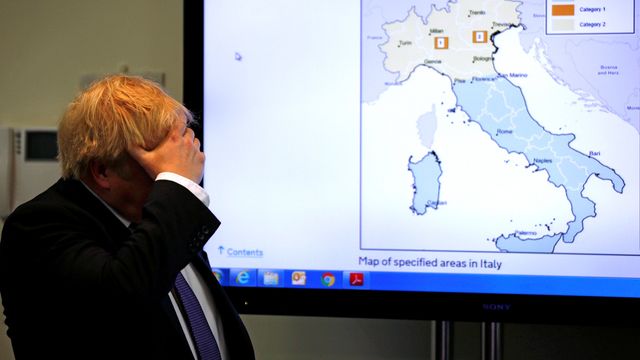
Britain's Prime Minister Boris Johnson visits the command centre at the Public Health England National Infection Service, after more than 10 new coronavirus patients were identified in England,. (Photo Credit: Henry Nicholls/Pool Photo via AP)
At this stage, the coronavirus has not officially reached epidemic levels and with the required resources available it could be eradicated. But Johnson is playing down the threat of the virus to extraordinary levels. According to the government, what is being confronted is nothing much worse than the annual bout of winter flu.
While the government has admitted in a worse-case scenario that 80 percent of the population in the UK could be infected with the virus—over 50 million people—its plan states, “The majority of people with COVID-19 have recovered without the need for any specific treatment, as is the case for the common cold or seasonal flu. We expect that the vast majority of cases will best be managed at home, again as with seasonal colds and flu.”
These claims are bogus. Coronavirus has a much higher death rate than flu—between 10 and 24 times depending on age.
The government admits that were 80 percent of Britain’s population to be infected, up to 500,000 could die, with up to two million people requiring hospital treatment. According to researchers, between five and 40 coronavirus cases in 1,000 will result in death, with a best estimate of nine in 1,000 (about one percent). This week, Health Secretary Matt Hancock said the government's "very best assessment" was that the mortality rate was "2 percent or, likely, lower."
The death rate is still subject to much debate, with World Health Organization's Director General, Tedros Adhanom Ghebreyesus, declaring Tuesday that "globally, about 3.4% of reported Covid-19 cases have died."
What is clear from the global death toll is that the older people are, the more likely they are to die—with those in the 60-69, 70-79 and 80+ age brackets most at risk. Those with serious health conditions, including cardio-vascular disease, diabetes, respiratory disease and hypertension, also have a higher death rate.
There is nothing in Johnson’s plan to provide any extra resources to treat the elderly, or anyone with the virus. His speech was full of his usual stupid bluster, including the statement, “Our country remains extremely well prepared, as it has been since the outbreak began in Wuhan several months ago.”
He added cynically, “Let’s not forget, we already have a fantastic NHS [National Health Service], fantastic testing systems and fantastic surveillance of the spread of disease.”
There is no “fantastic” NHS or fantastic anything in Britain. What has been exposed by the coronavirus crisis is that the basic social infrastructure in all the major capitalist countries has been eviscerated after decades of looting at the hands of the ruling elite.
Tens of billions of pounds have been slashed from the NHS budget in “efficiency savings” and vast swathes of service provision privatised. Such have been the cuts to public health and social care by successive Labour and Tory governments that the NHS is now longer able to even cope with the annual outbreak of winter flu.
The NHS has no provision for the required life and death services for the millions of people who could be infected with the virus. Over 15,000 beds have been slashed from the NHS in the last decade.
The Guardian reported last week that there are just 15 available beds for adults in England to treat the most severe cases of respiratory failure. The beds for providing adult extracorporeal membrane oxygenation (ECMO) treatment are available at just five centres across England.
The NHS will “struggle to cope if there are more than 28 patients who need them if the number of coronavirus cases rises,” the Guardian reported. It cited an NHS report from 2017, warning that if there are no more ECMO beds available in the UK “within the designated and surge capacity,” more beds would have to be secured from other countries, including Sweden.
There are only around 3,700 adult critical care beds in England, and these already run at a dangerous occupancy rate of over 80 percent, leaving just 670 such beds free. Overall, a massively dangerous occupancy level of 94 percent of beds was recorded throughout the NHS last week.
Part of the government’s plan is for all NHS Accident and Emergency units to set up an isolation pod, where those suspecting of contracting the virus can “isolate” themselves. One of these, at Lincoln County Hospital, consists of a 3m x 5m tent next to the kitchen bins. No electricity, heating, or running water or toilet is provided—just a chair and a telephone with a note that people call the NHS 111 helpline if they suspect they have coronavirus.
Many elderly people rely on social care, but this is no longer provided by the NHS. Since 2014, local authorities have been forced to provide the care and charge enormous sums to do so. This must often be paid for by elderly people themselves and involves them handing over their life savings or selling their homes. Anyone with savings of over £23,250, or who owns their own home is not entitled to the cost of care from a local council.
The destruction of NHS provision and social care has already had a terrible human death toll. In 2017, a team of researchers at University College London concluded that the “squeeze on public finances since 2010 is linked to nearly 120,000 excess deaths in England with the over 60s and care home residents bearing the brunt.”
Last year, the Institute for Public Policy Research (IPPR) think tank reported that a reversal of public health initiatives has led to 130,000 preventable deaths since 2012.
NHS frontline staffing has been slashed, with 200,000 departing since 2010, culminating in over 100,000 staff vacancies.
Forced to recognise the devastating impact of their own policies, the government’s plan states that “if transmission of the virus becomes established in the population” then “Staff rostering changes may be necessary, including calling leavers and retirees back to duty.”
Under conditions of a mass outbreak of the virus, the logic behind bringing back retired NHS workers—among the age group most at risk from contagion—to treat coronavirus cases defies comprehension.
Millions and even tens of millions of workers face being unable to work under conditions of a mass infection of the population. The government admits that “up to one-fifth of employees [over 6 million workers] may be absent from work during peak weeks,” yet proposes virtually nothing in relief.
After days of prevaricating, yesterday Johnson allowed that workers who are forced to “self-isolate” at home will get statutory sick pay (SSP)—paid by employers for up to 28 weeks—from the first day off work, not the fourth as per usual. This would provide workers with only an additional £40. SSP is set at the rock bottom level of just £94.25 a week (£13.46 a day).
Millions will receive nothing in SSP as they do not earn the £118 a week to enable them to qualify. Asked Wednesday during Prime Minister’s Questions how these two million workers, many in the gig economy working on zero hours contracts, would survive during a mass outbreak of the virus, Johnson replied, “Others will be entitled to help through existing systems such as Universal Credit.”
Access to Universal Credit requires a five-week delay and compulsory attendance at job centres.
The government is also offering nothing extra to small businesses, who may be forced to go under due to subdued demand and workforce absences.
But when it comes to propping up the big business and the stock market, Britain committed Tuesday, as one of the G7 nations, to use whatever "fiscal measures" to “support the economy” are required and “to use all appropriate policy tools to achieve strong, sustainable growth and safeguard against downside risks.”
The ruling class will do nothing that impinges on its own money mad, sociopathic self-interest and will do whatever it takes to defend itself from the working class.
Johnson’s authoritarian government has already developed plans, under “Operation Yellowhammer” to roll out police state measures to confront mass social discontent post-Brexit. It intends to use the coronavirus crisis to test out this agenda.
Its plan states that the military could be enlisted to “provide support to civil authorities.” Moreover, “the police and fire and rescue services, will enact business continuity plans to ensure they are able to maintain a level of service that fulfils their critical functions. For example, with a significant loss of officers and staff, the police would concentrate on responding to serious crimes and maintaining public order…”
Other moves being considered are “population distancing strategies” including “reducing the number of large-scale gatherings,” and giving Border Force police extra powers.

Coronavirus kills at more than 20 times the rate of seasonal flu

Bryan Dyne

The World Health Organization (WHO) announced on Tuesday that the mortality rate for reported cases of COVID-19 has risen to 3.4 percent, based on the ratio of the current number of deaths caused by the virus to the confirmed infections. At the time of the announcement, those figures stood at 3,254 and 95,184, respectively.
The coronavirus fatality rate is more than 20 times the death rate of the seasonal flu, according to data from the US Centers for Disease Control and Prevention (CDC)—a stark measure of the dangers the novel coronavirus poses to the world’s population.
This number is an increase over early estimates of the mortality rate by the WHO at just above 2 percent. It reflects the spread of the coronavirus to 83 countries and territories outside of China. The fatality ratio has stayed relatively constant since February 25, even as new cases and new deaths have been confirmed. It is unclear whether the current mortality rate will hold or change in the coming days.
One of the many causes of the spread of COVID-19 is the fact that workers are unable to take sick days, even when exhibiting symptoms of the infection. Chipotle workers in New York City yesterday held a protest against the fast food chain demanding that the company stop forcing workers to work while sick, especially in light of the spread of the coronavirus in the state. They exposed retaliation by the company against workers who stayed home to recover and prevent the spread of the disease in spite of orders by management.
Questions are also being raised as to whether a vaccine will reduce the impact of the disease, especially if it is not distributed freely. Asked at a congressional hearing last week to guarantee that once a vaccine against the virus is developed it will be available to all, US Health and Human Services Secretary Alex Azar, a former pharmaceutical executive, refused. “We would want to ensure that we worked to make it affordable,” he said, “but we can’t control that price because we need the private sector to invest. Price controls won’t get us there.”
As the spread of the coronavirus continues, the WHO is very concerned that the medical supplies necessary to combat the disease could run out. A statement issued by the organization on March 3 warned that “supplies are rapidly depleting.” It said the medical industry had to increase manufacturing by 40 percent if the demands placed upon the world’s health care infrastructure by the pandemic were to be met.
In raw numbers, the world needs 89 million medical masks, 76 million examination gloves, 30 million gowns, 1.6 million goggles and 2.9 million liters of hand sanitizer each month until the pandemic is contained. The WHO has also called for “the rational and appropriate use of personal protective equipment in healthcare settings, and the effective management of supply chains,” after prices for gowns doubled, respirators tripled and surgical masks increased six-fold.
This shortage is especially dangerous in regions with a higher fatality ratio or where coronavirus cases have been surging. While the number of new cases in China dropped to 119 yesterday, South Korea, Italy and Iran reported 435, 587 and 586 new cases, respectively. Those countries also reported 3, 28 and 15 new deaths, raising concerns that COVID-19, given its two week incubation period, has already infected large swaths of those countries.
There are also worries that the virus is much more widespread than currently reported in the United States. To date, 11 out of the 154 known cases have resulted in the patient’s death. Assuming that the average mortality rate of 3.4 percent holds true, the 11 confirmed deaths predict that there are actually 324 cases of the coronavirus in the country, and that 170 of them have gone unreported.
While there are many reasons that an infection of COVID-19 might be missed, the most prominent is the enormous cost for Americans to visit a doctor. Costs for those who have been tested for the coronavirus have reportedly been as high as $3,200.
Moreover, the response by federal, state and local governments to the crisis has been improvised and disorganized at best. The CDC has been unable to provide testing kits on a mass scale for hospitals around the country. Thus far, only 472 tests for COVID-19 have been carried out in the US, as compared to 23,345 in Italy, 109,591 in South Korea and tens of millions in China. The CDC insists that hospitals and laboratories in the US use its testing procedure and equipment, rather than those of the World Health Organization. This has essentially crippled the ability of medical professionals in the US to detect the coronavirus and protect their patients and themselves.
Typical of commentaries on US social media, Twitter user Matt Stoller wrote: “Just spoke with ER doc who say[s] he’s seeing cases he’s 99 percent sure are #coronavirus. Negative for flu, recent travel, work in airports. Not allowed to test. Patients return to work because they can’t take time off w/out a firm diagnosis. Other ER docs seeing the same thing.”
In addition to spreading, there is now evidence that it has developed into different types. A study published Tuesday in the National Science Review found genetic markers indicating that a subset of the virus in Wuhan evolved from a less aggressive S-cov to a more transmittable and deadly L-cov, but that the spread of L-cov was largely curbed by the quarantine of Hubei province.
This is little comfort. Mutations that happen once can happen again. Given the spread of the coronavirus around the world, a version that is more aggressive and lethal has the potential to kill hundreds of thousands and infect tens of millions.
The world’s resources must be mobilized at once against this pandemic to contain the disease, treat the sick and save lives.

COVID-19 and its Disruption of the Chinese Economy

Kamal Madishetty

The damaging outbreak of COVID-19 that began in the city of Wuhan—a major logistics and industrial hub—has serious economic implications for China as well as the wider region. The most significant impact is the disruption to manufacturing supply chains and the logistics sector. Consequently, China's economic growth in the first quarter of 2020 will slow considerably, while also exerting a drag on the full-year growth rate.  
Impact on the Manufacturing Sector
The Hubei province—of which Wuhan is the capital—is a powerhouse of steel, chemicals, electronics and auto parts manufacturing. It is the seventh largest contributor to China's overall GDP. Following the outbreak, manufacturing units located in Hubei have been completely shut down, barring only a few exceptions.
The province has been on lockdown since 23 January, when the authorities froze all transportation links. The halting of several freight trains that operate from Wuhan, to both domestic and international destinations, has crippled economic activity in the region. A large number of workers who had traveled to their hometowns for Chinese New Year remain stranded because of travel restrictions, leading to a shortage of manpower.
While Hubei is the worst affected, other manufacturing hubs across the country also been operationally debilitated. Following the viral outbreak, the government extended the end of the Chinese New Year holiday period from 31 January to 10 February. But the disruptions persist, as companies are still wary of restarting production activities. While operations in financial centres like Shanghai and Beijing have resumed after 10 February, economic activity remains muted in manufacturing clusters in the hinterland. Companies in these areas fear a potential spread of the infection among the large number of employees working in close proximity.
The smartphone manufacturing sector's supply chain is the worst affected, after already  reeling from weak global demand over the past couple of years. Almost all of the major global smartphone brands source their inputs from suppliers based in China. Production in such units has come to a grinding halt.
Foxconn, the leading supplier for Apple and the world’s largest contract electronics maker, remains shuttered. A resumption of its production activities is still unclear. According to a forecast by the International Data Corporation, China's smartphone shipments are expected to drop by 30 per cent in the first quarter of the year. Others, like research firm Canalys, expect this fall to be even sharper. Owing to the integrated nature of electronics supply chains, the latest disruption not only affects output in China, but can also undermine the entire value chain and distribution channels across multiple countries in the region.
Logistics and Tourism: Knock-Down Impact
The outbreak has also had a negative impact on logistics and tourism. Like during the SARS outbreak, Chinese authorities have imposed severe travel restrictions, which have crippled the  transportation sector. Firms with operations in roadways, cargo, and waterways are severely hit. Although some have gradually started to restore operations, activity is well below the usual levels. According to the Ministry of Transport, as of 22 February, less than 30 per cent of the firms in the transportation sector have resumed operations, while highway traffic is at around half the normal level.
Air travel restrictions to and from China has led to widespread flight cancellations. While the impact of this will be most felt on domestic carriers, the losses to airlines from several other countries is also significant. According to the International Air Transport Association, the cost of the outbreak to airline revenue in the Asia-Pacific region is expected to be about US$ 27.8 billion. Of this, US$ 12.8 billion will be the revenue loss to China's domestic carriers. Since fixed costs associated with labour, aircraft, and ground operations are difficult to reduce, airline companies in the region face a real risk of bankruptcy.
Tourism is also likely to take a hit across East and Southeast Asia as a consequence of the travel restrictions. A number of tourism-dependent countries in this region rely heavily on Chinese travelers for revenue generation. According to IHS Markit, Chinese tourists account for at least 30 per cent of the total foreign tourist visits to Thailand, Japan, and Vietnam. They also makes a sizeable contribution in other countries in the region, like Singapore, Australia, and Cambodia. A sharp fall in visitor arrivals, as already estimated in the case of Singapore, will have a knock-on impact on economic activity in all these countries.
Conclusion
Taken together, the impact of the viral outbreak on China's manufacturing and services sectors will slow growth in the first quarter of 2020 significantly. According to a recent Reuters poll, economists have predicted growth during this period to slow to 4.5 per cent from the 6 per cent recorded in the previous quarter. The wider impact on the yearlong growth rate, however, is not as clear. While the full-year growth rate for 2020 is certain to be slower (pegged at 5.5 per cent by economists in the Reuters poll) than the 6.1 per cent recorded in 2019, it is largely dependent on how soon the government is able to contain the outbreak. As such, there are no concrete signs that the crisis has bottomed out. However, some health experts suggest that the spread of COVID-19 could be reined in faster than the time taken for SARS, which took about six months. While such an optimistic scenario bodes well for an economic rebound for China later this year, it will still not be enough to allay the negative business sentiment, which could  linger for many months.

4 Mar 2020

Commonwealth Distance-Learning Scholarships 2020/2021 for Developing Countries

Application Deadline: 13th April 2020 by 16.00 PM (GMT)

Offered annually? Yes

Eligible Countries: Bangladesh, Cameroon, Eswatini, Ghana, Guyana, India, Kenya, Kiribati, Lesotho, Malawi, Mozambique, Nigeria, Pakistan, Papua New Guinea, Rwanda, Samoa, Sierra Leone, Solomon Islands, Sri Lanka, Tanzania, The Gambia, Tuvalu, Uganda, Vanuatu, Zambia

To be taken at: UK Universities

About the Award: Commonwealth Distance Learning Scholarships provide the opportunity for individuals to study for a UK Master’s degree while living and working in their home country. The scheme was established in 2002, as a direct response to the measures taken by its funder, the UK Department for International Development (DFID), to explore new methods of delivery as part of the drive for poverty reduction. To date, nearly 1,000 Commonwealth Distance Learning Scholarships have been awarded.

Offered Since: 2002

Type: Masters

Eligibility: To apply for these scholarships, you must:
  • Be a citizen of or have been granted refugee status by an eligible Commonwealth country, or be a British Protected Person
  • Be permanently resident in an eligible Commonwealth country
  • Hold a first degree of at least upper second class (2:1) standard; a lower qualification and sufficient relevant experience may be considered in certain cases
  • Be unable to afford to study your chosen course without this scholarship.
The CSC aims to identify talented individuals who have the potential to make change. We are committed to a policy of equal opportunity and non-discrimination, and encourage applications from a diverse range of candidates.

Selection Criteria: Selection criteria include:
  • Academic merit of the candidate
  • Potential impact of the work on the development of the candidate’s home country
How to apply: The CSC’s online application form is now open.
  • You should apply to study an eligible Master’s course at a UK university that is participating in the Distance Learning scheme. Click here for a list of participating universities and eligible courses.
  • You must also secure admission to your course in addition to applying for a Distance Learning Scholarship. You must check with your chosen university for their specific advice on when to apply, admission requirements, and rules for applying. You must make your application using the CSC’s online application system, in addition to any other application that you are required to complete by your chosen university. The CSC will not accept any applications that are not submitted via the online application system.
  • You can apply for more than one course and/or to more than one university, but you may only accept one offer of a Distance Learning Scholarship.
  • It is important to go through all application requirements on the Programme Webpage see link below) before applying

Why Do Cars Kill More People in Unequal Nations?

Indian Resistance Against Hindutva Fascism

Bhabani Shankar Nayak

Hindutva fascism is no more an imaginary political depiction of reactionary and right-wing Narendra Modi led BJP/RSS government in India.These reactionary forces are the original anti nationals of India. Any serious analysis of forward march of Hindutva fascism in India needs to understand Indian social and economic conditions where caste, tribe, gender and class interact within a Brahmanical order both in rural and urban areas. It is the life and blood of Hindutva fascism. The social fascism emanating from Brahminism within exploitative Hindu caste order continues to be the foundation of propertied class that controls the state and political apparatus of the government. In spite of exceptionally favourable political environments, the liberals and progressive forces have failed to shake the authoritarian social and religious structures that enables Hindutva fascism in India today. The electoral defeat of liberal and progressive forces is inextricably linked with electoral opportunism, revisionist ideological policies and their earlier political association with regional reactionaries. Soft Hindutva cannot replace Hindutva fascism. In such a context, defeatism is a product of ideological ambiguity and political compromises of forming opportunistic electoral alliances. The result is gloomy.
From Gujarat 2002 to Delhi 2020, India witnesses continuous deterioration of the constitutional, secular, liberal values of a democratic state. The social, political and cultural normalisation of violence against Muslims and silence of the Supreme Court is unprecedented in independent India. The processes of law, order and justice were subverted to defend the organisers of pogrom as a patriotic act and depict the victims as anti-nationals.The mainstream media, judiciary, executive, police and other pillars of modern democracy are crumbling and working as the type writers of Hindutva fascist power.
The magnitude of capitalist crisis and electoral victory of Hindutva fascists in last two parliamentary elections in India is neither unique nor surprising. It is the repetition of history in the rise of fascism.The Hindutva fascist murders provide cultural logic to apartheid caste order and capitalist crisis.There is absolutely no surprise in the policies and actions of BJP led fascist RSS govt in India. They are following their playbook of anti-Muslim pogrom in letter and spirit. In the long run, it is not only a threat to Muslims but also a threat to lives and civil liberties of all Indians. The unity and integrity of India depends on how we build up a mass movement in defence of Muslims and against the hate factory of RSS/BJP. The sporadic movements and opposition to Hindutva fascism in India are not enough.The task is to overcome this defeatism by reclaiming radical promises of Indian constitution based on universal citizenship and democratic rights of Muslims in India.
Indian resistance against Hindutva fascism led by students and women that threatens the very foundation of old and new political cretins who consider themselves as aficionados of electoral democracy and parliament. But people are spontaneously forming their own resistance movements in different parts of Indiaagainst Hindutva fascism. It is important to bring them together as a mass movement with alternative politics of hope, peace and justice. It is only possible by forming united front of Dalits, students, youths, women, Muslims, minorities, workers and all other progressive forces in the society. The priority of such a united front is to stand unconditionally in defence of Muslims.
The Hindutva fascists deceptive narrative of nationalism needs to be exposed. History is the witness to Hindutva betrayal of Indian independence struggles. It is important to highlight the sacrifice and significant role of Muslims in anti-colonial struggle and in shaping the secular character of postcolonial India. These ideological praxis needs to be the foundational principles of India’s resistance to Hindutva fascism.The broken republic of India needs such a resistance project which can help to nourish the social harmony and economic stability.

Australian government revives plan for internal electronic surveillance

Mike Head

Prime Minister Scott Morrison and Home Affairs Minister Peter Dutton have once again launched a scare campaign about internet paedophile networks to justify plans to formally allow the country’s electronic eavesdropping and cyber warfare agency to spy on people inside Australia.
The Australian Signals Directorate (ASD) forms a key part of the global “Five Eyes” surveillance and cyber-attack network led by the US National Security Agency (NSA). The ASD also operates closely with the military within the Defence portfolio. It provides information to support military operations and conducts “offensive” operations to hack into or disrupt facilities in targeted countries such as China and Iran.
Promoting the ASD proposal, Morrison said Australia’s crime and intelligence agencies would “get what they need to protect kids” from perverts operating on the “dark web.” This is just the latest invocation of on-line child sexual exploitation, which already is intensively monitored globally, to provide a pretext for the development of police-state surveillance.
Currently, the ASD is legally barred from most domestic spying, but previous secret documents released by WikiLeaks and NSA whistleblower Edward Snowden proved that this is a façade. The material showed that the ASD and its Five Eyes partners intercept the communications of millions of people around the globe, as well as rival governments, and freely exchange data about each others’ citizens.
Giving the ASD domestic powers would allow it free reign to target people inside Australia with military-grade snooping and hacking capabilities, including malware that exploits vulnerabilities in applications and operating systems like Windows.
The Liberal-National Coalition government is seeking to remove even the limited legal restrictions on these operations. At present, the ASD’s supply of information to the Australian Federal Police (AFP) and the Australian Security Intelligence Organisation (ASIO), the main domestic spy agency, is meant to require ministerial approval.
Acutely aware of widespread opposition to the continual expansions of the powers of the police and intelligence apparatus, Morrison and Dutton have dressed up the proposal as being about cracking down on paedophiles and other “criminal networks.” Dutton raised the imaginary spectre of an encrypted server in Sydney with images of “a five- or six-year-old child being sexually exploited and tortured.”
For years, the government has offered similar scenarios repeatedly to justify unprecedented expansions of surveillance over the population. This includes encryption-cracking powers and metadata-retention laws that compel telecommunications providers to store detailed data about every call or internet search their customers make.
This latest proposal is another sham. The AFP already targets online child abuse through a Virtual Global Taskforce, which cooperates with INTERPOL, EUROPOL and other international enforcement agencies. In addition, the AFP’s Cybercrime Investigation teams investigate cyber crimes.
Moreover, the AFP and ASIO have vast resources and powers, including to access computers, emails, bank records and text messages. Both agencies have more than tripled in size since 2001, with successive governments pouring hundreds of millions of dollars into their budgets.
Based on leaked documents, News Corp national political editor Annika Smethurst first reported in 2018 that the government was planning to increase the ASD’s domestic powers. The government vehemently denied the report and then, last June, authorised the AFP to raid her Canberra home, hunting for evidence to prosecute the journalist and her sources.
A day later, the AFP raided the Sydney headquarters of the Australian Broadcasting Corporation (ABC), confiscating 120 files. That was over another revealing exposure, about the protracted official cover-up of war crimes by Australian Special Forces units involved in the US-led invasion of Afghanistan.
The precedent for this assault on the media and free speech was set by the April 11, 2019 British police arrest of WikiLeaks founder Julian Assange. He was dragged out of asylum in Ecuador’s London embassy to face extradition to the US on manufactured charges of espionage for exposing war crimes, mass surveillance and other abuses by the US and its allies, including Australia.
The connection to Assange’s persecution was highlighted the day after the ABC raid. AFP acting chief Neil Gaughan said the raid’s purpose was to protect access to the Five Eyes network. Gaughan’s remark pointed to the pressure coming from the Trump administration to ensure that the public is kept in the dark about the increasingly aggressive activities of the US spy and military forces against China and other US rivals.
Last month, a Federal Court judge bluntly dismissed an ABC legal challenge to the raid, declaring that the interests of “national security” overrode those of the public’s right to information. Last week, the ABC announced that it would not appeal the ruling, thus giving the government a further green light to prosecute journalists and whistleblowers.
To head off the continuing outcry among journalists and the public, the government and the AFP released a proposal to allow police to issue journalists and media outlets with “Notices to Produce” documents and the names of confidential sources, supposedly to avoid the need for police raids.
Journalists, press freedom advocates and even the corporate media chiefs denounced the scheme as “window dressing.” It adds new police powers, while leaving in place the threat of raids being mounted if requested materials are not handed over.
In addition, the government is proceeding with two trials, mostly to be conducted behind closed-doors, over leaks that exposed the criminality of the intelligence apparatus. In one, former military lawyer David McBride is accused of giving the ABC the “Afghan Files” on the Special Forces cover-up. In the other, a former Australian Secret Intelligence Service (ASIS) officer, known only as Witness K, and his lawyer Bernard Collaery could be jailed for up to two years for exposing ASIS’s illegal bugging of East Timor’s cabinet office during oil and gas negotiations.
Despite the public outcry over the police raids and trials, the Labor Party, which has a long record of commitment to the US military alliance, has backed bolstering the state apparatus. For years, Labor has joined hands with the Coalition to pass more than 75 pieces of legislation handing unprecedented powers to the police and intelligence agencies. This has included barrages of “counter-terrorism” laws, the 2015 metadata retention provisions, the 2018 encryption-cracking measures and the 2018 “foreign interference” legislation , which expanded the scope and penalties of the secrecy laws.
Like the Coalition, Labor has backed the US vendetta against Assange from the outset. In 2010, Labor Prime Minister Julia Gillard denounced Assange for publishing documents exposing US war crimes in Afghanistan and Iraq, and its diplomatic conspiracies around the world. To this day, led by Anthony Albanese, Labor continues to support the US operation to extradite Assange, an Australian citizen, and condemn him to prison for life.
Throughout the ongoing “war on terrorism” launched by Washington in 2001, Australian governments, both Coalition and Labor, have erected a repressive framework. These measures will be used to suppress dissent as opposition rises to the political and corporate elite over social inequality, environmental and health disasters, war preparations and the accompanying assault on basic legal and democratic rights.

Defender 2020: Largest mobilisation of NATO troops against Russia in 25 years

Markus Salzmann

The largest deployment of troops across the Atlantic in 25 years entered its main phase last weekend within the framework of the Defender Europe 2020 exercise. The scale of NATO's provocative military exercise underscores how far advanced the preparations for war are 75 years after the end of World War II.
The United States and 18 other countries are deploying large contingents of troops from America and Western Europe to the Russian border within a short period of time. In total, around 37,000 soldiers are participating in the exercise, which is to continue until June. Their objective is Poland and the Baltic states.
The freight ship Endurance docked in Bremerhaven last week together with four other vessels carrying US tanks and other heavy military equipment. The US alone is deploying 20,000 troops and their armaments to Europe.
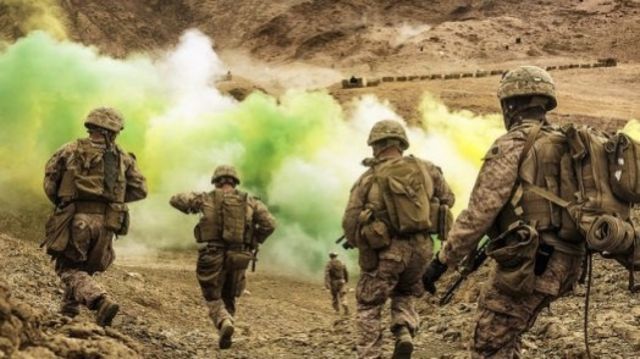
U.S. Marines run to firing positions during live-fire training in Jordan [Credit: Marine Corps, Staff Sgt. Dengrier M. Baez]
Stand-alone infrastructure is being established to facilitate the troop movements. The German army has established a central transport control centre, set up tent camps on military training grounds, and deployed mobile refueling stations. Although the kilometres-long convoys are generally on the move during the night, they are causing significant disruption to transport.
The German army has remained silent on the cost of the exercise. Referring to sources in the army, the Tagesspiegel newspaper estimates that the cost will be €2.5 million in Germany alone. “This needs analysis by the parts of the armed forces involved based on the deployment of equipment and personnel, accommodation, and the provision of infrastructure. Additionally, further costs could arise,” wrote the Tagesspiegel .
A spokesman for the US military stated that the countries involved would invest in military infrastructure. As an example, he referred to Lithuania, which like Germany is investing in the expansion of its railway network for heavy cargo.
Of the 37,000 soldiers from 19 countries involved in the exercise, more than half, 20,000, come from the United States. 4,000 German soldiers are taking part. In addition, police units are protecting the transportation of materials. Alongside around 33,000 vehicles and containers, some 450 tanks will deploy to the Russian border. Over 100 rail transportation trips will take place. Overall, the troops will move through seven countries and use 14 airports and ports.
Germany is the main hub of the exercise. In the first phase, which runs until April, American weaponry and military equipment will be deployed in Germany, Belgium, and Poland. In stage two, which will run partially in parallel until May, troops will be deployed through Germany to Poland. In the final phase prior to the main exercise all remaining troops will be deployed from Germany to Poland and the Baltic states. The final exercise will take place in Bergen on the Lüneburger moors, Germany, at the end of May, before the withdrawal of all forces is completed by the end of July.
The manoeuvre builds on military exercises held well into the 1990s in Western Europe, some of which involved up to 130,000 troops. Now, for the first time, such a large-scale exercise is being carried out right up to the Russian border and on former Soviet territory.
The manoeuvre is designed to send a message of deterrence, according to the German and US militaries. Lt. Gen. Martin Schelleis commented on this, “The reality is that Russia, with its illegal annexation of Crimea in 2014, provoked this development. But Russia is not the pretext for the exercise; military capacity can only be rebuilt and maintained over an extended period of time.”
NATO's European supreme commander Gen. Tod. D. Wolters described the exercise as a “platform to strengthen the readiness and interoperability of allied forces.”
Like the Sabre Strike exercise in Lithuania in 2017 and Trident Juncture in 2018, the current manoeuvre aims to test the capacity to rapidly deploy combat-ready troops and equipment to the Russian border, before the “alliance case” is put to the test in a series of combat simulations.
The advanced character of the preparations for war with Russia was underscored last week when US Defence Secretary Mark Esper participated in a war game at the US Strategic Command in Omaha, Nebraska, during which the firing of nuclear weapons against Russia was simulated.
The US military stated that the war game involved an unexpected incident in Europe during which a war is being waged on Russia, and Russia decides to fire a small-scale nuclear weapon on a location in NATO territory.
Two exercises will take place in Latvia on the border with Russia during the early part of this year. A Swift Response Training involving Latvian and international troops will run between April and May. Military units from the United States, Britain, Italy, and Spain will practice aerial manoeuvres in case of a sudden threat.
However, it is not only the Trump administration that is speaking the language of war. Germany and the European powers are attempting to emerge militarily from the shadow of the United States.
This applies above all to Germany. In his speech at the recent Munich Security Conference, German President Frank-Walter Steinmeier complained that Russia had annexed Crimea without any regard for international law. Moscow “used military force and the violent redrawing of borders on the European continent as legitimate policy options.”
“Observing is insufficient,” declared Annegret Kramp-Karrenbauer, Germany's defence minister, who spoke in Munich on the topic of “Defending the West.” On this issue, she stated her “full agreement” with French President Emmanuel Macron, who called at the Munich Security Conference for a more independent European military policy. The Europeans must not simply “describe their weaknesses, comment on the actions of others or complain about them, but also conduct much more strategic dialogue in Europe and do something concrete for our security.” Germany in particular is “obliged to develop a greater capacity to act and a willingness to take action.”
All political parties in Germany support this drive to war. The formerly pacifist Greens are no exception to this. With their typical demagogy, they have sought to turn events on their head and present the current NATO exercise as a contribution to disarmament. Green party defence spokesman Tobias Lindner stated that one successful outcome of the exercise would be that a permanent stationing of more US troops in Germany and Europe would not be required.
Russia, which was given the assurance 30 years ago when Germany was reunified that NATO would not expand into eastern Europe and certainly not onto former Soviet territory, has responded with alarm to the latest provocation. Foreign Minister Sergei Lavrov remarked, “Of course we will respond. We can't ignore developments that cause us concern. But we will respond in a way that does not create any unnecessary risk.”

European Union intensifies war against refugees at Turkish-Greek border

Martin Kreickenbaum

A nightmarish scene was presented to the world public at the Kastanies border crossing Tuesday. On the ground, Greek border police, supported by masked soldiers, brutally attacked unarmed refugees and forced them back with tear gas grenades, baton rounds and water cannons. From the air, a high-ranking European Union delegation, consisting of Commission President Ursula von der Leyen, EU Council President Charles Michel, European Parliament President David Sassoli and Croatian Prime Minister Andrej Plenkovic, accompanied by Greek Prime Minister Kyriakos Mitsotakis, watched the martial spectacle.
Up to 20,000 refugees, mainly from Syria, Iraq and Afghanistan, are still waiting at the Greek-Turkish border, seeking protection in the EU. Many of them have been living for years under the most miserable conditions in Turkey, where they are not legally recognised as refugees but are, at best, tolerated. They had come to the Greek-Turkish border in the hope that the EU would take them in and that they could once again lead a dignified life.
However, the EU is instead deepening its brutal war against the refugees. Von der Leyen thanked Greek Prime Minister Mitsotakis for “being our European shield in these times.” Although border guards shot women and children with tear gas before her eyes, von der Leyen praised them for their “tireless efforts.”
She declared that this border “is not only a Greek border, but a European one. And I stand here at your side as a European. Those who want to test the unity of Europe will be disappointed. We will stay on course and maintain unity.”
She assured Mitsotakis that the Greek government would receive all necessary support to continue to repel the refugees. This included a rapid reaction force of the European border protection agency Frontex to support the Greek border guards. In addition, Frontex will provide a supply ship, six patrol boats, two helicopters, an aircraft and vehicles with thermal imaging cameras. The Greek government will receive €700 million in emergency aid to help strengthen border fortifications.
A rally on Tuesday in front of the Chancellery in Berlin, in defence of the refugees at the Greek-Turkish border
Croatian Prime Minister Plenkovic also defended the merciless action of the border police, proclaiming, “Greece is now the shield, the real external border of the European Union and the guarantee of European stability.”
During their visit, von der Leyen, Michel and Sassoli, the highest representatives of the EU, explicitly approved the Greek government’s actions—contrary to international law—in suspending the right of asylum and imposing a one-month halt in granting any more asylum applications.
The United Nations High Commissioner for Refugees, Filippo Grandi, strongly condemned this step, saying there was no basis for it in the Geneva Conventions or in EU law. “Even persons who enter state territory irregularly should not be punished for applying for asylum to the authorities immediately.”
What the suspension of the right of asylum means has been experienced first-hand by the refugees who have reached one of the Aegean islands of Lesbos, Samos or Chios by rubber dinghy in the last few days, or who have managed to escape the Greek border guards. The camps on the islands were simply declared closed, new asylum applications were no longer accepted and the refugees were not even registered.
The Greek government is not shying away from using sinister gestapo methods. According to news magazine Der Spiegel, refugees on Lesbos have been told to come to the harbour because a boat was waiting for them there. In fact, only the riot police were waiting, who then chased the refugees through the streets.
The same police have given marauding right-wing thugs a largely free hand to push refugee boats back into the sea, to beat up journalists and refugee aid workers and to destroy and burn down aid organisations’ facilities.
Britain’s Guardian reported that a group of doctors who flew to Lesbos to volunteer at the Moria migrant camp were forced to flee after being set upon by a 50-string mob wielding nail-encrusted cudgels. “We left fearing for our lives,” said Dr Victoria Bradley, an Irish GP. “It was very, very frightening.”
Somehow “we managed to drive back to the camp and seek refuge there,” she added. “Refugees were so kind, they brought us falafels and blankets. We stayed the night in a portable building. It was absolutely freezing. All I could think of was the people in the tents outside.”
Several aid organizations, including “Médecins sans Frontières”, have announced that they will cease their involvement on Lesbos.
The BBC also released a video showing the Greek coast guard firing live ammunition at an overcrowded inflatable boat and then forcibly pushing it away, as well as thugs beating up a reporter on Lesbos.
On the islands, all newly arriving refugees can now expect to be immediately detained and taken to the mainland, where they will be put into fortified camps. From there, they are to be deported as quickly as possible—without ever having had a chance to apply for asylum.
The same applies to refugees who have made it across the land border. If they are picked up by the Greek police, they are declared as illegal immigrants and threatened with up to four years’ imprisonment.
The German government has only agreed to take in a few unaccompanied children who have been vegetating for months in appalling conditions in the “hotspots” on the Aegean islands. Interior Minister Horst Seehofer stressed that this could only be implemented by an alliance of EU states.
Seehofer is pleading for the refugees to continue to be provided for in Turkey and for the EU borders to remain closed. “If we do not achieve an orderly solution here, we will end up with disorder and loss of control,” he told ARD television.
Incessant talk of “protecting the borders” is grist for the mill of the extreme right. Moreover, the EU is putting into practice their fascist policy against refugees. It is no accident that the chairman of the Alternative for Germany (AfD), Jörg Meuthen, could rejoice on his Facebook page, saying, “The Greeks are doing it right. This is the way it is done!”
A few tens of thousands of refugees are being presented as a threat to Europe, a continent of 500 million inhabitants.
The EU’s unrelenting attitude towards the refugees on the Greek-Turkish border is supported by the supposedly liberal press. In the online edition of Die Zeit, Ulrich Ladurner defends the brutal actions of the border soldiers as representing the legitimate interests of the EU, which should “not tolerate irregular migration.” For Ladurner, the desperate people at the EU’s external borders are part of a blackmail attempt by the Turkish government. “Europeans should be grateful to the Greek government for rejecting [Turkish President Recep Tayyip] Erdoğan’s blackmail attempt in the past few days at the border,” he wrote.
The mass of the population looks with disgust at the merciless war against refugees. On Tuesday, thousands demonstrated in front of the Federal Chancellery in Berlin for a humanitarian refugee policy and an opening up of the borders.
But appeals to the government in this matter are completely futile. The war against refugees on Europe’s external borders is only the flip side of the growing right-wing extremist terror at home—two sides of the same coin. The ruling class is pursuing an aggressive policy of rearmament and militarism in order to defend and increase its interests and wealth. To break the growing resistance against this, demands more and more openly on fascist violence and authoritarian forms of rule.

3 Mar 2020

COVID-19 Upends Political Landscape and Global Economy

George Ochenski

We knew the Democratic primary campaign was going to be exciting and sure enough, it is. Bernie Sanders is now the front-runner and, despite all efforts by the establishment Democrats to derail his campaign, he crushed the competition in the Nevada primary and shows no sign of slowing down as Super Tuesday approaches with enough delegates for Sanders to be “unstoppable.”
But what has overshadowed all the political campaigns at the state and national level is the outbreak of coronavirus, the highly contagious virus that causes pneumonia-like symptoms, can be fatal, and is running rampant across the globe.
While the disease itself is serious, the effects from quarantines, lock-downs and avoidance of highly populated areas is significantly impacting both the domestic and global economy. Here in the U.S., the stock market has lost all gains from this year and continues to plunge as the outbreak, which could become a global pandemic, impacts vital global transportation and supply chains.
It’s estimated that 80% of what Walmart sells is made in China, for instance. Or the fact that a huge number of U.S. manufacturers use parts made in China. Chinese tourism has plummeted already, with predictions it may not recover for years.
In the meantime, we have Donald Trump, the guy who has told more than 16,000 lies in his time in office, as our so-called “leader” in this crisis. He’s already tried the usual ploy of blaming someone else for the problems — including saying the Democrats and media are in cahoots to crash the economy to prevent his re-election. And boy, those Democrats must have been really busy spreading the mischief Trump wants us to believe, since coronavirus now exists in 60 nations.
But don’t worry, germaphobe Trump has passed off responsibility for the most serious health and economic crisis in recent times to science-denier Mike Pence. Feeling better now? Assured that our future is in good hands? Or even that you’re going to get a shred of the truth?
The Centers for Disease Control says the spread of contagion is “inevitable” and the World Health Organization just raised the threat assessment to its highest level. Trump and Pence, meanwhile, continue to blather that it’s totally “under control” while research scientists say a vaccine is still a year away.
Of course, Trump is correct that the estimated $3.5 trillion that has been wiped away in the last week is going to significantly harm his chances of re-election. I mean, other than the booming economy he inherited from Barack Obama, what else does he have to crow about? Certainly not the trillions in new debt he added to the nation’s deficit with tax breaks for the already wealthy. And guess what, the billions he diverted to build his wall won’t keep out a virus.
Here in Montana the silence from our supposed or wannabe leaders is deafening. What are the state’s plans for when it shows up here — or even to find out if it’s already here? Nada. Zip. Zilch. Suddenly, when we really need leadership, we have a vacuum. Given that the virus shows no preference for Republicans or Democrats, one might think they’d put away the partisan knives to deal with the threat and show a little unity. But that, at least so far, is simply not happening.
In the meantime, Bernie Sanders’ plan for universal health care is starting to look a lot better about now. Since the entire purpose of government is to take care of the populace it’s up to we, the people, to chose leaders who are dedicated to do just that.