10 Mar 2020

Germany sees rapid increase in coronavirus infections and first deaths

Markus Salzmann

Amid a rapid increase in coronavirus infections throughout Germany, two people have died in connection from the disease Covid-19. On Monday, an 89-year-old woman died at the university hospital in Essen. She had last been treated in the intensive care unit, where she died of pneumonia. A man who died in Heinsberg district was 78 years old and “had a variety of previous illnesses, including diabetes and a heart condition. Since Friday, he had been treated in the hospital in Geilenkirchen.
On Sunday, for the first time a German citizen was proven to have succumbed to Covid-19. This was a 60-year-old man who had travelled to Egypt a week ago as a tourist.
According to official figures, as of Monday evening 1,194 people in Germany had been infected with the Sars-CoV-2 pathogen. From Friday to Saturday alone, the number rose by 155 cases. At the beginning of the week, it had been 150, with North Rhine-Westphalia being the main focus of the disease. The Ministry of Health in Düsseldorf reported 484 confirmed infections on Sunday afternoon—107 more than on Saturday. Federal Health Minister Jens Spahn (Christian Democratic Union, CDU) called on people to refrain from travelling to this state.
An employee wearing a face mask and gloves is waiting for the next patient behind the door of the corona diagnostic centre in Düsseldorf. (AP Photo/Martin Meissner)
In the meantime, with the exception of Saxony-Anhalt, infections have been officially confirmed in every German state. But even in Saxony-Anhalt, facilities have already been closed and people quarantined. In Zerbst, a hospital was closed to new patients and visitors at the weekend because a doctor from Saxony, who tested positive for the coronavirus, works in the facility.
On Friday, several groups of school children from the risk area of South Tyrol had returned to Saxony-Anhalt. The students and their carers must remain in quarantine for two weeks for the time being. School closures are taking place in numerous states, and in Berlin alone, three schools are currently affected. Hundreds of suspected cases are in quarantine, and no decrease in the rate of infections is expected.
The pathogen has now spread throughout Europe. In neighbouring France, the number of cases is increasing at a similar rate as in Germany. Some 1,126 people have become infected, the French health authorities announced on Sunday evening. The number of fatalities was given as 19. The first death was also reported in the Netherlands. In Austria, more than 140 cases are now known and in Switzerland there are already more than 300 cases (with two deaths).
On Monday evening, the Italian government announced that an emergency lockdown would be extended from the northern region to the entire country.
It is expected that the situation will worsen in the coming days in Germany. Lothar Wieler, president of the Robert Koch Institute (RKI), a German federal government agency and research institute responsible for disease control and prevention, said it could not be foreseen when the peak of the emerging epidemic would be reached in Germany. It was equally unclear how the virus would behave in the future.
The massive spread of the coronavirus in Germany shows both the government’s indifference to the dangers faced by the population and the precarious state of the country’s health care system, which has been systematically run down in recent years.
When Health Minister Jens Spahn remarked two weeks ago that Germany was facing a coronavirus epidemic, he claimed the country was prepared for it. Practical measures, however, were not taken.
Spahn’s latest government statement on the subject was also hard to beat in terms of ignorance. He called for “level-headedness” in dealing with the virus asserting there was “much experience in dealing with all possible dangers,” although little is known about the disease.
The only measure Spahn specifically presented was export restrictions on protective suits and masks from Germany. At a meeting of European Union health ministers in Brussels, several countries protested against the action. This kind of unilateral action bore the risk of undermining a “collective approach,” warned EU Civil Protection Commissioner Janez Lenarcic.
Numerous experts have warned of the dangers of spread of the disease and have outlined possible measures against it. For example, the virologist and director of the Institute for Medical Microbiology at Halle University Hospital, Professor Alexander Kekulé, suggested closing schools and day-care centres and cancelling major events. In this way, the spread of the virus could be curbed and the number of people who fell ill, as well as the number of dead, could be “considerably reduced,” said Kekulé. He commented on the inaction of the German government, saying, “Does Minister Spahn think that the Germans are immune to coronavirus?”
In fact, federal and state governments seem willing to accept any risk. North Rhine-Westphalian Health Minister Karl-Josef Laumann (CDU) announced on Wednesday that the Mönchengladbach Health Office saw no reason to cancel the Bundesliga match between Borussia Mönchengladbach and Borussia Dortmund on Saturday.
In the end, the game took place in front of 50,000 spectators only a few kilometres away from Heinsberg, the hot spot of the virus’s spread in Germany. The city administrators of Mönchengladbach justified the irresponsible decision by saying it did not expect “a situation where people would be infected excessively during this game,” city spokesman Wolfgang Speen explained on Friday. It was assumed that infected people were in quarantine and that “no positive case is heading for the stadium.”
Even now, when it can be assumed that the peak of the spread is far from being reached, the dilapidated state of the health system in one of the richest countries in Europe is already becoming apparent. Bernd Mühlbauer, Professor of Health Economics at the Westphalian University of Applied Sciences Gelsenkirchen, drew attention to staff shortages in connection with the spread of the virus.
In an interview with the TV news broadcast Tagesschau, Mühlbauer remarked that “17,000 nursing staff are already lacking in inpatient hospital care alone.” If the particularly endangered professional groups such as doctors and nursing staff became infected themselves, they must be quarantined, and patients transferred to the surrounding hospitals. “We should actually be prepared for this situation right now,” Mühlbauer said.
In fact, the extreme staff shortage means that guidelines for containing the infection are not being observed. If a clinic employee had contact with an infected person or was infected himself, he or she would have to be quarantined for 14 days, according to the recommendation of the RKI. Now, more and more clinics are declaring that they cannot follow this recommendation, as otherwise the entire health system would collapse.
“If we send all medical personnel who have had contact with infected persons into quarantine, medical care for the population will collapse,” Christian Drosten, head of virology at the Berlin Charité, told the Neue Osnabrücker Zeitung. Drosten announced that the Charité would no longer implement the RKI recommendations one-to-one.
At the University Hospital in Aachen, a region with a particularly high number of cases, a nurse in the premature infants ward had tested positive for coronavirus. Because the woman in the intensive care unit was in contact with 45 hospital employees, they should all have been quarantined for 14 days according to RKI recommendations. This would have brought the work in the intensive care unit to a standstill, the clinic emphasised, thus justifying its disregard for the recommendation.
Doctors outside the clinics, for example family doctors, also work under catastrophic conditions and are not supported by the authorities. In the Frankfurter Rundschau newspaper, family doctor Martina Schaffner reported that she could not order protective masks, gloves or disinfectants for her practice and patients. Out of necessity, she had to buy dust masks at the hardware store.
“I have now found another paint and varnish dealer who can deliver 50 masks to me at the beginning of the week. Otherwise there are none. Or they are so expensive that it becomes unaffordable. When I asked the Association of Statutory Health Insurance Physicians they told me that the health insurance companies are currently refusing to cover the costs. The costs will therefore remain with me,” the doctor said.
According to World Health Organisation (WHO) estimates, 89 million respiratory masks and 76 million examination gloves are already needed every month worldwide. If the exponential increase in infections continues, this demand will rise massively. Although there have been repeated outbreaks of infections in recent years, the premise has always been to purchase protective materials as cheaply as possible and keep them in the smallest possible quantities.
At the same time, Schaffner complained that there were no contacts for physicians in private practice who would be able to provide assistance in the numerous, complex questions surrounding the handling of the pathogen. This meant that small practices cannot keep isolation rooms available. Even larger hospitals are now reaching the limits of their capacities. In many regions, general practitioners are also unable to test suspected cases comprehensively due to a lack of protective equipment and test kits.
The official medical services are also already hopelessly overtaxed due to a lack of personnel. Martina Hänel, chief medical officer at the Marzahn-Hellersdorf Health Office (Berlin), told the Berliner Morgenpost as early as February, “Half of the 22 medical posts are currently unfilled.” For example, public health officers were responsible for the imposition and monitoring of quarantine measures. The authorities were not equipped for such a drastic increase in cases.
The situation is the result of the radical austerity policies of recent years and the subordination of social needs to the drive for profits. The RWI’s Hospital Rating Report 2019 confirms that the situation in German hospitals is deteriorating further. The proportion of hospitals with a negative annual result at group level has increased significantly, to 28 percent compared to 16 percent in the previous year. Around 12 percent of hospitals are thus exposed to an increased risk of insolvency.
Even now, entire units in clinics are increasingly being closed due to staff shortages. Many clinics can no longer maintain emergency care, and this is under supposedly “normal” conditions. During a crisis—as is currently the case with the highly contagious coronavirus pathogen—the demands on clinics increase. Nevertheless, there are already more far-reaching plans for cutbacks.
A study conducted by the Bertelsmann Foundation last year advocated closing more than half of all clinics in Germany. Less than 600 of the current 1,400 hospitals are to be retained, according to the study, which was commissioned by the foundation and conducted by the Berlin Institute for Health and Social Research. With the grotesque argument that only by closing clinics could more staff, better equipment and higher quality be achieved, the report also calls for a further reduction in hospital stays and an even stronger focus on generating profits.
In the expanding pandemic, the capitalist elites in Germany, Europe and worldwide are proving unwilling and unable to take effective action against the spread of the deadly virus. Decades of austerity have ruined health care systems. Massive investment is now needed to ensure that the virus is prevented from spreading further and treated on an international scale. This demands a socialist transformation of society.

Prison riots erupt as Rome extends coronavirus lockdown to all of Italy

Alex Lantier

Late Monday evening, Italian Prime Minister Giuseppe Conte announced the extension of Sunday’s partial quarantine orders for northern Italy to the entire country. The decision came after 1,797 new coronavirus cases and 97 deaths from the disease were recorded in Italy, bringing the total to 9,172 cases and 463 deaths—amid a surge of contagion across Europe with 557 new cases in Spain, 203 in France and 184 in Germany.
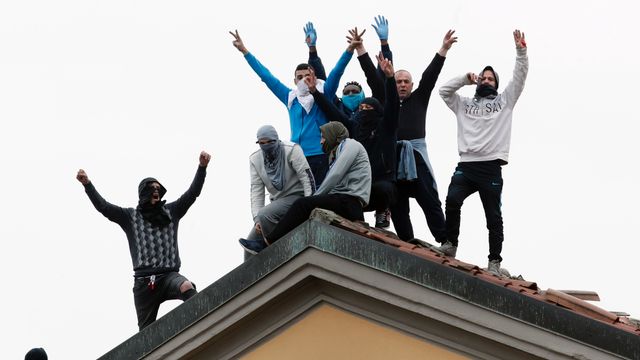
Conte’s announcement came as prison riots exploded across northern Italy after authorities cut off family visitation rights, ostensibly to keep inmates from catching the disease from their families. Inmates’ families also protested outside prisons against the authorities’ refusal to release prisoners or provide them with any protection from contagion inside overcrowded prisons. The Conte government sent police and army units to violently crack down on the prisoners, killing six.
Inmates stage a protest against new rules to cope with coronavirus emergency, including the suspension of relatives' visits, on the roof of the San Vittore prison in Milan, Italy, Monday, March 9, 2020. (AP Photo/Antonio Calanni)
Reading prepared remarks, Conte said: “The numbers tell us we are having an important growth of infections, of people hospitalized in intensive and sub-intensive care, and unfortunately of the deceased. Our habits therefore need to change. They need to change now. I demand even more stringent, stronger measures immediately. I am about to sign a measure that we can summarize as ‘I stay at home.’ There will no longer be a red zone on the Italian peninsula. All of Italy will be in the emergency zone.”
Authorities are imposing a draconian regime. All Italian schools, universities, museums and large public events are to be closed until April, all travel other than for urgent health- or work-related reasons is banned, and bars and restaurants are only allowed to remain open if they ensure a minimum distance is maintained between all clients.
These measures, which previously applied to 16 million people, are to be extended to Italy’s entire 60.5 million population in a desperate attempt to halt the spread of the virus.
The devastation of Italy’s health system by decades of European Union (EU) austerity and state authorities’ initial, careless response to the coronavirus are having horrific consequences. The speed of the disease’s spread is overtaking Conte’s inadequate pledges to get €8 billion to fight it, and hospitals are rationing care as they are overflowed with more coronavirus patients in critical condition than they have respirators to keep them alive.
Giorgio, a doctor in Brescia near Milan, told the French daily Libération the situation is “terrible, people outside do not realize it.” He explained, “Initially when the first few patients arrived, we did not understand how grave the situation was. We greeted them without masks. Since then, we wear them, and with gloves and protective overalls. I live apart from my family. … But then a few days later, the number of Covid-19 patients exploded. They took over a quarter of the beds, then half, now almost all.”
Doctors now tell coronavirus patients to return home and wait to see whether their pneumonia symptoms become severe—that is, requiring a hospital stay for oxygenation or emergency ventilation. Patients in critical condition, who are now flooding hospitals and being put even in hospital corridors, receive emergency antimalarial drugs or antiviral drugs usually prescribed for AIDS. However, approximately 5 percent of patients do not respond to this treatment and require emergency ventilation to survive.
Initially hospitals would treat everyone who developed critical symptoms, Giorgio told Libération, but “now, we only send the youngest patients. The anesthesiologists are asking us not to send them aged patients whom they will unsuccessfully ventilate for 15 to 20 days. Initially, the cut-off was 80 years old. Now, given the deterioration and the seriousness of the situation, it is 70 and anyone with other pathologies.” This provokes opposition from doctors, he noted, but “in practice, directors of hospitals with resources for more intensive care refuse to take our older patients.”
Giorgio said there are one or two deaths each day in his hospital, leading him to ask whether “the number of dead is very greatly under-reported.” He added, “In my ward, there are 11 doctors, two of us have fever. I was tested Tuesday, I have not gotten my result yet. Probably we all have the virus. But we do not have symptoms yet, and given the medical emergency, we must all continue to work.”
These conditions, which trample basic social rights such as the right to medical care and the right to safe working conditions, expose the bankruptcy of capitalism. They are the product of EU policies imposed for decades over opposition in the working class to enrich the Italian and European financial aristocracy. These have stripped public hospitals to the bone and left them unprepared for a major epidemic, nearly two decades after the first 2002-2003 SARS epidemic made clear that coronavirus epidemics pose a major threat.
Aggressive quarantines imposed in China bought time for the rest of the world to prepare for the arrival of the virus, and have largely brought the epidemic under control in China. However, governments across Europe have failed miserably: health staff across the continent were left unprepared and vulnerable to the spread of the disease.
Another population at enormous risk are detainees in prisons or refugee camps. Forty-two prisons in Italy have an overcrowding rate of over 150 percent, leaving inmates desperately vulnerable to a highly contagious, deadly and untreatable disease like the coronavirus.
After Iran released 70,000 inmates in an attempt to prevent the spread of coronavirus in its prisons, prison inmates in at least 27 facilities across the Italian peninsula protested this weekend and yesterday to demand their freedom and the right to see their families. The Italian government responded with a bloody crackdown.
On Saturday, 200 prisoners barricaded themselves on the roof of a prison in Salerno, near Naples; protests then spread to Poggioreale, Pavia, Frosinone, Vercelli, Alessandria, Foggia, Modena, and beyond. Prisoners in Milan’s San Vittore prison wrote “pardon” on a sheet they waved aloft on the prison’s roof.
Army troops and Carabinieri military police assaulted protesting inmates who tried to flee Saint Anna penitentiary in Modena, at the heart of the zone worst hit by the coronavirus, killing six.
One inmate’s wife wrote to the prisoners’ rights group Antigone to warn: “Should the virus make its way to those cold walls, it would be the end. My husband has health problems, the prison is small and there are twice as many people staying there as it’s made for. One falling ill would be enough to infect the rest of the inmates.”
Others whose loved ones have almost finished their prison sentences appealed for an early release from unsanitary prisons where many diseases are already circulating.

9 Mar 2020

Corporations are Human Creations. We Can’t Let Them Threaten Our Survival

David Korten

We live in a world in extreme crisis. By the estimates of the Global Footprint Network, the human species currently consumes at a rate 1.7 times what Earth’s regenerative systems can sustain. Yet billions of people face a daily struggle for survival that strips them of happiness and fulfillment of their human potential.
A growing concentration of financial wealth puts ever more political power in the hands of fewer and fewer people. According to Oxfam, twenty-six billionaires now hold personal financial assets greater than those of the poorest half of humanity (3.9 billion people).
This rapidly accelerating environmental and social crisis is a direct and predictable consequence of global rules that facilitate a concentration of economic and political power in corporations—rules that provide minimum accountability for the consequences of how they use that power to monopolize markets, evade taxes, and operate in whatever place offers the cheapest labor and least environmental protections.
As Allen White has correctly noted, appeals to corporations to exercise conscientious self-regulation do not work. The reason is simple. Mentally healthy living humans have a conscience. Corporations are constructs of law. They have no conscience beyond whatever responsibilities the law may require of them—backed by strict enforcement.
Corporations that are under the control of individual humans—rather than the financial markets—may act responsibly when those individuals possess a deep concern for the common good. Such corporations, however, are rare – at least among those of any consequential size.
Most large corporations are captives of financial markets that drive the pursuit of short-term financial gain with no concern for the social or environmental consequences. Not only do they fail to serve the common good, but they are also driving us all toward civilizational collapse. Indeed, they are driving us toward human self-extinction.
These conditions create an imperative for urgent structural change. Fortunately, corporations are entirely human creations. Indeed, there is no equivalent in nature. If they do not serve our needs, humans have both the right and the means to change—even eliminate—them.
Corporate purpose
Allen White notes there was a time in the early United States when corporations were chartered only for a specific length of time to fulfill a designated public purpose, such as to build a bridge or a canal. The former colonies had fought a brutal war to gain their freedom from the abuses of imperial rule, including the state-sanctioned monopoly power of the British East India Company. They were acutely aware of the potentials for abuse of corporate power, and they wanted none of it.
Despite that early public awareness, corporate interests have been able to mount a relentless drive for power that has, over time, reduced US democracy to little more than an aspiration. Indeed, the United States has become a global driver of the processes by which global corporations pursue with impunity the destruction of Earth’s capacity to support life. And ironically, they do so for the primary purpose of growing the fortunes of billionaires.
It is worth remembering that a corporation exists only when a government has issued a charter. There is no legitimate reason for any democratically accountable government to issue a corporate charter other than to serve a public purpose. Similarly, there is no legitimate reason why a corporation chartered by one government jurisdiction has any inherent right thereby to do business in any other jurisdiction unless granted that privilege by the people of that jurisdiction through their government.
That current law contradicts these simple truths is a consequence of corporate interests’ ability to manipulate the legal system.
Current rules governing corporate conduct encourage and reward what should be treated as criminal behavior. Consider the following examples:
1. They allow corporations to reap the rewards of their decisions without bearing the full costs. For example, when they evade paying taxes, they evade paying their fair share of the costs of infrastructure, education, or other essentials of doing business.
2. They allow the corporation to assess value only in terms of financial costs and returns, thus ignoring the need to secure the health of Earth’s regenerative systems on which all life depends.
3. They allow corporations to use their enormous financial resources and centralized decision-making to shape public opinion and pressure politicians to assure that laws favor corporate interests instead of public interests.
Calls for corporate responsibility generally assume that those who work for corporations, especially top management, are free to exercise moral responsibility on behalf of the corporation should they choose to do so. This ignores an important reality. Unless they own the corporation, those who lead a corporation only appear to be in charge. They serve only at the pleasure of financiers who compete for control of any corporation that is not taking full advantage of opportunities to maximize profits – which often means externalizing costs.
Business in service to community
Science is coming to recognize what many indigenous people have long understood: life exists – can only exist – in diverse communities of living beings that self-organize to create and maintain the conditions of their own existence. The concept is captured by the South African term ubuntu, which translates to “I am because we are.”
This basic frame of how life organizes is demonstrated in a very personal way by the human body. For each of us, our body consists of tens of trillions of cells and micro-organisms that self-organize beyond our conscious awareness to create and maintain the vessel of our consciousness and the vehicle of our agency. On a far grander scale, the countless living organisms that comprise Earth’s community of life similarly self-organize to create the conditions on this planet essential to life’s existence.
The purpose of all human institutions—including corporations—must be to serve human well-being and the health of the planet on which we all depend.
Trying to set and enforce rules at a global level to force transnational corporations to serve the people and planet they were created and designed to exploit would be an exercise as futile as a call for voluntary responsibility. Any global institution created to implement such rules will be subject to nearly instant co-option by the very corporations it is created to control.
A better solution is to break up transnational corporations and restructure them in ways that assure community accountability. How this might be done to best serve the well-being of people and Earth is a topic worthy of serious discussion, with implications well beyond the corporation.
With few exceptions, humans have fallen into a pattern of organizing around hierarchical institutions that centralize power. Capitalism vs. socialism is a false choice specifically because both, as currently understood and practiced, centralize rather than distribute power. Thus, they diminish local control and responsibility and suppress essential local adaptation to changing local conditions. Electing the leaders who head those institutions is only a partial corrective.
Our challenge in learning to function as a global society dependent on the health of a living Earth is to learn to organize as life organizes – within holonic structures that self-organize from the bottom up in response to constantly changing local conditions, with the support of higher system levels. It is a frame for which we barely have the language needed for a coherent discussion. Yet it is the way that life has organized since life first emerged. And it is the way we must now learn to organize.
The closest human approximations would probably be the organizational forms common to most indigenous societies. In the business sector of contemporary societies, they might be the varied forms of cooperative organization based on cooperative ownership.
The work of developing creative options would be a fitting challenge for schools of management interested in creating organizational models for the new human civilization we must now create together.

The Long-term Political Fallout of Coronavirus

James M. Dorsey

As the coronavirus spreads, so does its likely political fallout.
For authoritarians and autocrats, the fallout is likely to be a mixed bag.
Some will benefit from invasive tracing and monitoring of those affected by the virus that is likely to boost the evolution towards a Big Brother and surveillance state as well as nationalist economic policies propagated by populists and nationalists like US President Donald J. Trump.
Others are seeing perceived government failures to confront the virus effectively early on further undermine public trust and fuel demands for greater transparency, accountability and freedom of expression.
For religious ultra-conservatives, including Salafi minorities in non-Muslim nations who are in the firing line because of their refusal to adopt to Western habits like men shaking the hand of women, the virus is likely to reap benefits.
The question is whether the threat of endemics and pandemics that are egalitarian in the extreme and recognize no physical or social borders will prompt the international community to take note of the risk of breakdowns in already weak public health systems in conflict situations such as Syria, Yemen and Libya.
The risks are magnified by the deliberate targeting of hospitals and other medical facilities and the mass dislocation of millions who are forced into bare-knuckle, unhygienic refugee camps with hardly any services and rampant malnutrition.
Protesters in countries like Iraq and Thailand, demanding an overhaul of the political system, and Hong Kong where reform is the driver, have dashed government hopes that fear of contagion would take the wind out of the demonstrators’ sails.
Protesters in Iraq, that has so far reported 40 cases and three deaths, refused to abandon mass public gatherings, calling instead for the virus to take its toll on the country’s leadership.
“Listen to us Corona, come and visit the thieves who stole our wealth, come and take revenge from who stole our dreams, we only loved our homeland, but they killed us,” protesters chanted.
“The government uses coronavirus as an excuse to end the protests. They tried everything — snipers, live bullets, tear gas, abduction and so on and on — but they failed. They are now finding another way to stop us, but they will fail again,” said Yasamin Mustafa, a teenage protester from Basra, referring to government warnings about the virus.
Similarly, students in Thailand have ignored calls by military-backed Prime Minister Prayuth Chan-Ocha for an end to protests because of the virus risk. The students are demanding Mr. Prayuth’s resignation and political reforms after the Constitutional Court disbanded Future Forward, a popular pro-democracy party.
In Hong Kong, with Chief Executive Carrie Lam’s approval rating sinking to a record low of just 9.1% after her government faced criticism over its handling of the virus, protests have moved from the street to online public gatherings in support of long-standing demands for reform.
At the same time, Ms. Lam’s backers in Beijing are confronting demands for greater freedom of speech at a moment that the government of President Xi Jinping has imposed absolute media conformity.
Mr Xi’s critics insist that greater transparency and freedom could have prevented the virus from turning China into the world’s most affected country with yet to be fully appreciated severe economic consequences.
Writing in The Wall Street Journal, Bloomberg’s former China bureau chief Dexter Roberts warned that the long-term fallout of the virus could be fundamental with hundreds of millions of domestic migrant workers “still facing unprecedented virus-related disruptions in their lives and work” as incomes have dried up, aggravated by enforced quarantines and “a skewed health care system (that) relegates (them) to understaffed and underfunded clinics.”
The government, like in the wake of the SARS crisis in 2003, will likely benefit in the short-term from middle- and upper-class support for increased political and social controls enabled by its roll out of a 21st century Orwellian surveillance state, Mr. Roberts argued.
“The coronavirus may eventually fade as a threat, but it has exposed the deep inequities that divide Chinese into two classes… That split remains the biggest obstacle to China’s development” with the disadvantaged migrant workers posing “the biggest threat to its economic and political future,” Mr. Roberts said.
The virus crisis certainly was not the last nail in the Iranian government’s coffin, but it has significantly widened an already yawning gap in public trust ripped open by widespread corruption, repressive policies, lack of transparency and the government’s handling of the downing in January of a Ukrainian airliner.
“The relationship between the government and the public is severely damaged. The government is suffering a massive loss of confidence. And this shows in critical situations like now. Due to this distrust, society ignores information given out by the government. In recent weeks, the government has too often had to correct its own statements.”  said sociologist Saeed Paivandi.
Mr. Paivandi was referring to faltering efforts by supreme leader Ayatollah Ali Khamenei and the government to persuade Iranians to observe disruptive health precautions at a time that the country is struggling to cope with the devastating economic impact of harsh US sanctions that have complicated its access to medical products.
Initial government failure to confront the crisis head on by, for example, quarantining the holy city of Qom, the Iranian hub of the virus, coupled with the sanctions that have turned Iran into a source of the virus elsewhere in the Middle East and beyond, threatens to put the Islamic republic in the same risk category as Syria, Yemen and Libya.
The virus crisis is also grist for nationalists’ mills, prompting Mr. Trump to pressure US pharmaceutical companies that have moved overseas to shift their operations back to the United States.
“The coronavirus shows the importance of bringing manufacturing back to America so that we are producing, at home, the medicines and equipment and everything else that we need to protect the public’s health,” Mr. Trump said.
If Mr. Trump sees a silver lining in the virus crisis, so do religious ultra-conservatives and critics of European measures to impose Western behaviour on segments of Muslim minority communities.
With governments advising against customary physical greetings such as handshakes, kissing and hugs, ultra-conservatives like Salafis who refuse to shake a women’s hand argue privately that that their attitude is going mainstream at a time that their practices are under fire in Europe.
Dutch parliamentarians last month took Salafis to task for their refusal, arguing in a parliamentary inquiry into “unwanted influencing by unfree countries” that shaking a woman’s hand was part of Dutch culture and refusal to do so impeded integration.
The Coronavirus has, at least for now, undermined that argument.
Danish authorities have suspended citizenship naturalization ceremonies that require a handshake as part of the process in line with legislation adopted in 2018 to force the hand of ultra-conservatives that refuse to shake hands with the opposite sex.
Critics of the law said the suspension highlighted the absurdity of forcing people to have physical contact. “It’s absurd. The path to Danish citizenship should be about inclusion, not exclusion,” said Peder Hvelplund, a green lawmaker.

Councils to increase tax across UK as services are slashed

Dennis Moore

The coming year will see nearly all councils across the UK increasing council tax, according to the annual 2020 State of Local Government Finance report, with one in 10 having to make cuts to essential services because they cannot balance the books.
The survey, carried out by the Local Government Information Unit (LGIU) and Municipal Journal of senior officials of 152 of England’s 343 councils, details the enormous pressure being placed on councils following a decade of central government funding cuts.
It found that 97 percent of all councils plan to increase council tax in 2020/2021, with most (93 percent) planning to raise it by more than 1.5 percent. Ninety-seven percent of councils plan to increase fees and charges for services, including leisure services and parking services, by the maximum amount (14 percent).
Some households in England could see their council tax bills rise by £70 next year, on the back of powers to increase the levy by 4 percent in 2020.
According to the Local Government Association (LGA), since 2010 central government grants to local authorities have been slashed by a staggering £16 billion—a cut of almost 60 percent.
These cuts come at enormous cost to those dependent on frontline services, with almost one in five (19 percent) of councils saying their residents have seen a decline in the level of frontline services they are able to access over the last year.
In 2020/2021, only a third of councils estimate they will be able to comfortably provide a range of non-statutory services.
Despite councils planning to increase their funding streams, there were concerns from 12 percent of those surveyed that they would be unable to fulfil their statutory duties, including care for the elderly, vulnerable children and providing housing for the homeless.
One in seven of the councils (14 percent) said that they were anticipating an increase in judicial challenges due to the level of service cuts this year, including areas such as special educational needs and disabilities, libraries, waste, homelessness and adult social care.
Three-quarters of councils plan to increase borrowing in the coming year, with more than half of councils having to tap into their financial reserves again. This follows 74 percent of councils having used their reserves last year.
At present more than 160 councils receive no revenue support grant from Whitehall and the government is shifting responsibility for the funding of local services from government to local council taxpayers.
The ministry of housing, communities and local government said councils could spend a record £49.1 billion in the next financial year, but it is only providing £1.3 billion of the £2.9 billion annual increase, with the rest coming from council tax rises.
At the end of the last year, council leaders warned that one in five councils in England may be forced to impose drastic funding cuts to stave off bankruptcy, with the LGA saying that it had little confidence that they would be able to deliver the already tough savings targets councils have set themselves for the 2019/2020 financial year.
Speaking at the time, LGA chairman Lord Porter told MPs that vulnerable people would die as a result of social care cuts if the gap between resources and demand widened further.
He told Parliament’s housing, communities and local government committee, “I am not sure anybody who gets elected to Parliament wants to be the person who stands on the newsstand and explains why people died because of fiscal policy. It is only money, at the end of the day. Why do we need to lose people because of money?”
Porter speaks as a Conservative Party district councillor in South Holland, Lincolnshire. His party inaugurated the “age of austerity” under David Cameron in 2010 that has led, between 2012 and 2019, to the avoidable deaths of at least 131,000 people.
The situation can only get a lot worse. A report published by the New Economics Foundation last year pointed to a deteriorating situation in local authorities.
Non-ringfenced government grants to local authorities have fallen from £32.2 billion in 2018/2019 to £4.5 billion in 2019/2020, with expectations that they will be cut further by 2024/2025.
Local authorities can now retain more of the business rates with a growth in business rates they collect, yet they still have significantly fewer resources available to them in 2019/2020 than in 2009/2010.
Over the same time period there has been a rise in demographic price pressures that have driven up the costs of meeting urgent need.
The New Economics Foundation compared how much local authorities would have available to them with how much they would require to be able to provide services at the level of quality and access for 2009/2010. This showed that there would be a shortfall of £25.4 billion by 2024/2025.
These estimates point to local authorities requiring an additional 54 percent of funding on top of current projections.
It is estimated that there will be a funding gap across all regions of England with the North West facing the biggest per capita gap of £535 per person by 2024/2025.
Historically, areas that were more deprived received higher grants to be able to deliver service provision that was similar to areas that were better off. With the virtual abolition of central grants and the diminution of business rates redistribution, this has left councils fiscally vulnerable.
Since 2010, the system provided 46 percent more expenditure per capita for councils in the most deprived councils across England. By 2019 this had been reduced to 19 percent with poorer councils being less well funded.
These cuts have had a major impact on local communities. Between 2010/2011 and 2016/2017 weekly domestic waste collections have fallen by a third, standardised public bus transport has fallen by almost 50 percent, and one in 10 libraries have been shut down. Since 2010, 773 libraries have closed. There were 24,000 salaried staff working in libraries. Nearly 9,000 librarians have been made redundant with staff numbers down from 24,000 salaried staff to just over 15,000. There are more than three times the number of volunteers at libraries (51,000) than paid workers.
Local authorities have responded by cutting back on services where they face very few or no legal responsibilities. This has led to a marked fall in funding for “discretionary services.”
Spending on planning and development has decreased by 52.8 percent since 2010/2011, with cultural and related services falling by 34.9 percent and highways and transport falling by 37.1 percent.
The British Medical Association reports serious concerns about inadequate levels of public health funding, which has impacted negatively on certain population groups in regards to sexual health, smoking cessation and other issues.
Services covering statutory provision, such as for children, the elderly or disabled, are increasingly at risk. Nine out of 10 councils plan to introduce an additional levy of 2 percent to council tax to cover the cost of social care. While the government has provided an extra £1 billion to councils towards social care in 2020/2021—after years of cuts dwarfing this sum—98 percent of respondents surveyed said that they were unhappy with progress towards a comprehensive social care policy to relieve the pressure these areas already faced.
The cuts to councils’ budgets are imposed by central government, but none of the resulting destruction of council services and the more than 220,000 staff made redundant in local authorities since 2010 could have gone ahead without the collaboration of Labour councils.
Every major urban conurbation in England and Wales is run by a Labour council, who have imposed every cut demanded of them for a decade. Labour’s nominally “left” leader since 2015, Jeremy Corbyn, and his shadow chancellor John McDonnell played a major role in this. Just weeks after Corbyn won the party leadership, claiming that he would fight austerity, he and McDonnell sent a letter to all Labour councils demanding they abide by the law and impose austerity cuts demanded by the Conservative government.

Greek police shoot at refugees using live ammunition

Martin Kreickenbaum

The situation for refugees on the Greek-Turkish border has further worsened in the last days. More than 10,000 people are trapped in the border area, unable to move backward or forward. Greek border police and soldiers are using live ammunition to prevent refugees from entering the country. At least six refugees have been seriously injured, one Syrian refugee has even been shot dead.
The use of live ammunition is being carried out with the explicit support of the European Union (EU). Meetings of EU interior ministers in Brussels on Wednesday, and EU foreign ministers on Thursday, reaffirmed Europe’s inhuman attitude towards the plight of the refugees.
The statement of the EU interior ministers states, “Illegal border crossings will not be tolerated. The EU member states would take ‘all necessary measures in accordance with EU and international law’ to ‘protect’ the borders against refugees.” EU Internal Affairs Commissioner Ylva Johansson added, “I am counting on the Greek government to follow suit.”
The EU is calling on the Greek government to drive back the refugees with all its might, and is putting this call into practice by having border police and border guards shoot at refugees.
Although the government in Athens rejects reports about the use of live ammunition at the border as “false reports,” videos circulating on the internet have been determined to be genuine and authentic by journalists. Reporter Mark Stone of Sky News confirmed a video showing injured refugees being carried away from the border wrapped in blankets. In this case alone, six refugees had been seriously injured by shots in the chest, head, legs and groin area.
The internationally renowned research agency Forensic Architecture, which is affiliated with London University and has investigated, among other things, the fire at London’s Grenfell Tower and the murder of Halit Yozgat in Kassel by the neo-Nazi National Socialist Underground (NSU), also confirmed the murder of refugee Muhammad Al-Arab.
video shows the 22-year-old from Aleppo, Syria, who was fatally hit with rubber bullets fired by border police on the border river Evros, being carried away bleeding heavily from his head. The Greek government has so far refused to investigate these incidents.
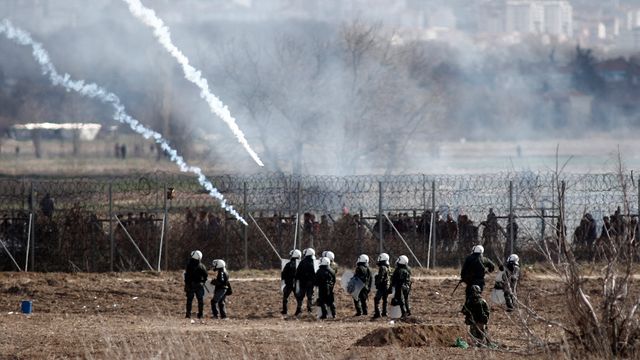
Moreover, Greek police do not use “normal” tear gas grenades when seeking to expel refugees at border crossings, but instead use cartridges with a tip. A photo from the investigative website Bellingcat shows a Greek border police officer loading such a bullet into his tear gas rifle.
Greek police and army guard as migrants gather at a border fence on the Turkish side, during clashes at the Greek-Turkish border in Kastanies, Evros region, on Saturday, March 7, 2020. (AP Photo/Giannis Papanikos)
According to Bellingcat, “normal tear gas grenades have a limited range,” however, the projectiles used by the Greek police at the border have “significantly more force” and in combination with the sharp tip are “potentially lethal.” Bellingcat notes that almost identical tear gas cartridges were used against demonstrators during the recent protests and riots in Iraq, injuring or even killing dozens.
Violence against refugees is increasing dramatically, not only on the land border between Greece and Turkey; in the Aegean Sea, too, refugees are being brutally prevented from landing on a Greek island.
The refugee aid initiative Alarmphone, to which refugees in the Mediterranean who are in distress at sea can turn, reports several cases that occurred between March 1 and 3, in which refugee boats were fired at or attacked and robbed by masked people. In some cases, the boats’ engines were stolen, leaving the refugees helplessly adrift at sea. Emergency forces of the EU border protection agency Frontex and the Greek coast guard did not intervene, although they were in the immediate vicinity.
The German refugee aid organization Pro-Asyl, which recently reported shots being fired at the Hungarian border, sharply criticized the use of rubber bullets and live ammunition at the Greek-Turkish border. “There are several reports that fugitives are also being shot at on the Greek border. The order to shoot is a European reality; just four years after the demands of the [far-right Alternative for Germany] AfD.” Pro-Asyl is referring to statements by the then AfD chairperson Frauke Petry, who declared in 2016 that the Federal Police must “if necessary, also use firearms” when confronting those crossing borders “illegally.”
In contrast to 2016, however, the order to shoot at European borders has become official German government policy. Foreign Minister Heiko Maas (Social Democratic Party, SPD) unreservedly supports the brutal action of the Greek police towards refugees. He told Deutschlandfunk radio, “We are assuming that all this is being done in a proportionate and also very appropriate manner, and we are also prepared to help the Greeks in this difficult situation, including with funds that we are making available.”
This support consists of an EU grant of €700 million to further strengthen border security against refugees. Seven ships, aircraft, helicopters and vehicles with thermal imaging cameras will also be made available to the Greek government. The Frontex intervention force will be transferred to the border.
Maas, who always demands compliance with international law whenever it serves German interests, also approves of the suspension of the right of asylum, which is contrary to international law, and the illegal deportations of refugees carried out by the Greek authorities.
At their meeting on Thursday evening in Zagreb, Croatia, at the insistence of the German foreign minister, EU foreign ministers increased the pressure on the Turkish government to comply with the EU-Turkey refugee agreement. The EU expects Turkey to comply with this declaration in return for financial support and to guarantee the accommodation of refugees in Turkey, Maas said.
This attitude is cynical and dishonest. Turkey has taken in a total of 3.6 million refugees from Syria, more than twice as many as all EU member states together. Moreover, the dirty deal that Chancellor Angela Merkel negotiated with Turkish President Recep Tayip Erdogan in Spring 2016 has no legal force whatsoever, as it is not a recognised accord, but only a declaration of intent. The European Union has thus engaged the Turkish government as a stooge to prevent by force the further influx of refugees into the EU.
The insistence on this shameful deal is now creating a humanitarian disaster on the Turkish-Greek border and on the Syrian-Turkish border in the Idlib region, where hundreds of thousands of refugees are stranded and camped in makeshift tents.
Through the EU’s uncompromising and violent defence of “Fortress Europe,” refugees on the Greek-Turkish border are literally caught between a rock and a hard place. On the one hand, the Greek border police are hunting down refugees as “illegal immigrants” and shooting at them using live ammunition, on the other hand, they are prevented from returning to Turkey by special units of the Turkish police. More than 10,000 people are thus trapped in no man’s land.
The German government, which has a decisive influence on EU migration policy, has also made clear it will not deviate from its tough stance, by refusing to accept even one unaccompanied child from the catastrophically overcrowded internment camps on the Greek Aegean islands or from the Greek-Turkish border area. A motion by the Green group in the Bundestag (federal parliament), which provided for the admission of just 5,000 unaccompanied children from the Greek camps, was rigorously rejected by the grand coalition of the Christian Democrats (CDU/CSU) and Social Democrats (SPD) together with the votes of the AfD.
While the brutal offensive against refugees and all those sympathetic to refugees is supported by the governments in Berlin and Paris, and by the EU in Brussels, ever broader sections of the population are turning against this inhumane policy at the expense of defenceless people seeking help. A survey conducted by the opinion research institute Infratest dimap showed that despite all the anti-refugee propaganda against asylum seekers, half of those questioned still support the unconditional admission of refugees from Greece and Turkey.
In Athens and Thessaloniki, thousands protested against the brutal attacks on refugees at the Greek border and on the islands of Lesbos and Chios, where a fascist mob chased refugees and pushed them back into the sea, without being stopped by the police. The protesters kept chanting, “Together we can fight against exploitation, war, nationalism and racism.”
The war against refugees at Europe’s external borders is the flip side of the growing right-wing extremist terror against those with an immigrant or Jewish background, as recently seen in the fascistic terrorist attacks in Hanau and Halle. The two cannot be separated. The ruling class is pushing ahead with its policy of militarism and social cuts in order to defend its interests and wealth. In order to suppress any opposition, it openly promotes nationalism and seeks to divide the working class along ethnic lines. In this way, it is not only preparing the ground for fascist violence and dictatorship but is already putting this into practice.

Australian government moves to boost data-swapping with US spy network

Mike Head

The Australian government is helping spearhead moves by the Trump administration to force internet companies to hand over encryption-cracking capabilities, and to intensify data-swapping within the US-dominated “Five Eyes” global surveillance network.
At a Five Eyes summit in Washington D.C. last week, Australian Home Affairs Minister Peter Dutton joined US Attorney General William Barr and senior ministers from the UK, Canada and New Zealand in ramping up their demands that the tech companies provide unprecedented access to their customers’ encrypted communications.
At the same time, in Canberra, the Liberal-National Coalition government unveiled a bill to expand and legalise the capacity of the US intelligence and police agencies, including the National Security Agency (NSA), to obtain intercepted data from their Australian counterparts, and vice versa.
This dual development highlights the frontline role being played by the Australian government and military-intelligence apparatus in the mass spying operations and war preparations of the US authorities.
As the thousands of secret US documents published by NSA whistle-blower Edward Snowden and by Julian Assange via WikiLeaks showed, the Five Eyes partners intercept the communications of millions of people around the globe, routinely exchange data about each others’ citizens, and also supply cyber warfare facilities and targeting information to their militaries.
Both Barr and Dutton dressed up the intensified collaboration as one focused on combating on-line paedophilia. Dutton hailed “a new page” in the fight against child-sex abuse after the Washington meeting approved guidelines designed to push companies such as Google, Facebook and Twitter to shut down “Dark Web” sites on their platforms.
The measures are part of a drive to compel the companies to hand over to the Five Eyes agencies information about how to open up the encryption technologies that millions of people employ to protect their privacy from government and corporate monitoring and interference.
Both Barr and Dutton targeted encryption. Barr said “predators” communicated using “virtually unbreakable encryption.” Dutton echoed him, saying encryption “allows offenders to diversify their methods and evade law enforcement.”
The actual concern of these governments is not “child sex predators,” whose activities are closely monitored by international police agencies, which already have vast interception powers. The overriding fear in ruling circles is that working people worldwide use encrypted messages to discuss and organise free of government eaves-dropping, amid mounting social unrest and political disaffection.
Last Thursday, a day before the Five Eyes announcement, US congressional leaders released a bipartisan bill that threatens to strip the liability protections of internet companies if they do not help block the use of encryption and other privacy safeguards on social media platforms.
Currently, section 230 of the US Communications Decency Act can shield sites from lawsuits over user content. The proposed Eliminating Abusive and Rampant Neglect of Interactive Technologies Act (EARN IT) would force companies to “earn” their liability protection by complying with anti-encryption measures.
In Australia, equally anxious to block access to encryption services, Dutton has been engaged in a public attack on Facebook since it announced plans to roll out end-to-end encryption from WhatsApp to its other messaging services, Facebook Messenger and Instagram.
The top-level Five Eyes gathering at the White House coincided with the introduction of a bill to the Australian parliament that would clear the way for a reciprocal agreement under the US Clarifying the Lawful Overseas Use of Data Act (the CLOUD Act).
The Trump administration introduced the CLOUD Act in 2018 to force US-based cloud and tech companies to hand over data held offshore. This power is now to be extended to Australia and other close partners.
In a media release, Dutton said the Telecommunications Legislation Amendment (International Production Orders) Bill was an “essential precondition” for agreements with the US and other countries to replace “outdated, cumbersome processes” for exchanges of electronic information.
Dutton referred to combating terrorism and paedophilia, yet section 1 of the Bill allows for much wider exchanges. It refers to investigations of “serious offences.” This could cover a vast field, including leaks of government documents and other offences under Australia’s draconian “ foreign interference ” legislation.
Section 1 also permits the swapping of information connected to “the carrying out by the Organisation of its functions.” This refers to the country’s primary political spy force, the Australian Security Intelligence Organisation (ASIO). In other words, the Bill covers ASIO’s extensive operations, which are, above all, focused on “subversive” activity deemed a threat to the political establishment and capitalist order.
The Bill further allows interception of the communications of a person who is not even under investigation if authorities assert “reasonable grounds” that the suspected “offender” uses that other person’s communications services.
The legislation would compel Australian service providers to hand over data to US authorities if presented with an “international production order.” Hand-picked members of a vetted tribunal, the Security Division of the Administrative Appeals Tribunal, could issue such orders.
The orders could be for (1) interception, to authorise wiretaps of video and voice calls, (2) stored communications from a messaging application or (3) telecommunications “metadata,” including customers’ names, contact details and account information.
The Bill comes just days after ASIO’s head Mike Burgess admitted, in a “threat assessment” speech, that the agency had accessed encrypted data within 10 days of the anti-democratic Assistance and Access Act coming into effect with the Labor Party’s support.
That Act allows intelligence and police agencies to issue “technical assistance notices” or “capability notices” to compel cooperation from technology companies in building weaknesses into products to make them open to hacking or encryption-cracking.
Encrypted data from these operations would be available to the US under the CLOUD Act exchange plan.
In his speech, Burgess alluded to the danger of large-scale violent attacks by right-wing extremists, like the ones seen in Germany and New Zealand. Dutton, however, immediately insisted that “left-wing extremism” posed an equal threat.
The Bill was tabled just after Dutton and Prime Minister Scott Morrison revived a propaganda campaign to justify plans to formally allow the Australian Signals Directorate (ASD), the electronic eavesdropping and cyber warfare agency, to spy on people inside Australia. The ASD is a key component of the Five Eyes network.
Digital Rights Watch chairperson Lizzie O’Shea told the Guardian the latest Bill “largely solidifies in legislation the existing practical cooperation that occurs informally with Australia’s Five Eyes partners.”
O’Shea commented: “Our concern is every time legislation permits increased surveillance capabilities, that becomes the lowest common denominator and our allies can access that same information using powers in Australia to do so.”
A police-state framework is being created, with the complicity and assistance of the internet companies. According to a Facebook transparency report, Australian authorities made 931 requests for user data between January and June 2019, and the company complied with three-quarters of the requests.
This is occurring under conditions of both rising domestic political discontent and sharpening US conflicts with China.
On every front, from encryption-cracking to increased US access to military bases in northern Australia, the Coalition government is placing the country on the frontline of a potentially catastrophic US war against China. This is accompanied by a barrage of anti-China propaganda.
The government is doing so with the support of the opposition Labor Party, which is equally committed to the US military alliance and has backed every move over the past two decades to strengthen the powers of the military and intelligence apparatus.