14 Mar 2020

Coronavirus will deepen social and health problems in Sri Lanka

Naveen Dewage

As of yesterday, the number of confirmed coronavirus cases in Sri Lanka rose to five, with three more people testing positive. Sixty Sri Lankans and two foreigners are under observation.
The Rajapakse government has imposed travel bans on 11 countries, including South Korea, Iran and Italy. Yesterday, one-week travel bans were imposed on France, Spain, Germany, Switzerland, Denmark, the Netherlands, Sweden and Austria. This week, the government declared that all schools in the country will close until April 20.
The first coronavirus victims, who include a 52-year-old tourist guide believed to have contracted the virus from an Italian tourist group, are being treated at Colombo’s poorly-equipped Infectious Disease Hospital (IDH). It is the only hospital in the country capable of providing Covid-19 treatment.
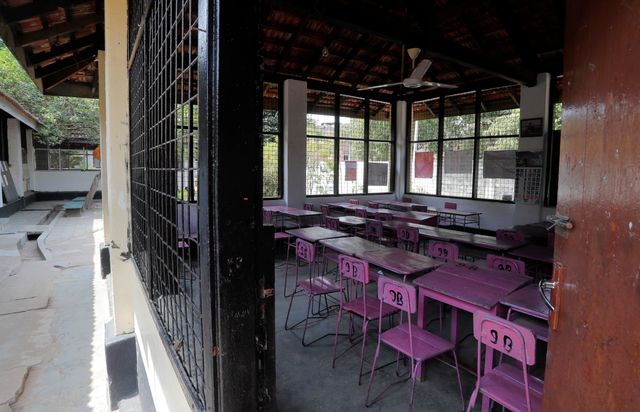
An empty classroom in Colombo on Friday [Credit: AP Photo/Eranga Jayawardena]
On March 6, President Gotabhaya Rajapakse proclaimed that Sri Lanka “has been successful so far in the battle against the global health crisis.” At the same time, the government has warned that the risk of the virus spreading is high and has called for “public support for the health authorities in taking preventive measures.”
In reality, the profit interests of the ruling elite are incompatible with properly-funded public health services, and could create a disastrous situation for millions of people.
The jobs and livelihoods of workers and the poor, who have been battered by the decades-long communalist war and government austerity measures, will be hard hit.
In January, a Chinese woman who visited with a tourist group was found infected with Covid-19. She left the country last month, following treatment at the IDH. After photo-ops with the woman, Health Minister Pavithra Wanniarachchi claimed the country was ready for any virus pandemic.
Wanniarachchi previously instructed health officials to consider using indigenous medicinal methods to treat the coronavirus. The minister met with traditional Ayurvedic practitioners and declared: “Western medication would cost 120 billion rupees ($US650 million), which is not a good thing for the country.”
Wanniarachchi’s nationalist rhetoric about indigenous treatments is not based on any medical research. What is required to deal with the worldwide Covid-19 pandemic is the global mobilisation of scientific resources to combat the disaster.
Consecutive governments have slashed spending on the public health sector, leaving it in serious decay. In line with the austerity measures dictated by the International Monetary Fund (IMF), last year’s budget allocation for health was just 105 billion rupees, compared to 392 billion rupees for the military.
While health authorities have announced that 17 hospitals are currently on standby, they lack dedicated ICU facilities.
The IDH itself has limited resources. The hospital has no testing kits and has to wait on diagnoses from the Medical Research Institute (MRI). Only 10 beds are available for isolation and treatment of affected patients.
WSWS reporters found that doctors, nurses and other health workers have not been provided with proper clothing to protect them from the virus.
Only limited numbers of PCR (polymerase chain reaction) tests are available. The test also costs 10,500 rupees, almost the minimum monthly wage of a worker in Sri Lanka.
The free public health service has been gutted. The number of public hospital beds is severely limited, with many patients forced to sleep on the floors of wards or in chairs. Poor patients have to pay for medicines and laboratory tests from private institutions and there are drastic shortages of doctors, nurses and other health workers. By contrast, the private health sector, which only the rich can afford, has prospered over the past three decades.
The globalisation of production has led to a massive growth of the international workforce. Around one million Sri Lankan workers are employed in the Middle East and tens of thousands in Italy and South Korea. Government authorities first instructed migrant workers returning from those countries to remain in their homes for two weeks due to the lack of quarantine facilities.
Rudimentary quarantine facilities have been established at Batticaloa University and the Kandakadu rehabilitation centre in the east. Both facilities are controlled by the military. Visitors from Iran, Italy and South Korea are being held there for 14 days.
Chief of Defence Staff and Army Commander Shavendra Silva proclaimed that the military “is once again shouldering the national responsibility.” This is yet another occasion for the army to boost its image as President Rajapakse militarises his administration.
This week, migrant workers arriving from South Korea protested at the Katunayake International Airport over being sent to the Batticaloa centre, because it would cost them 7,500 rupees per day. Later that day, the military said the quarantine service would be free of charge.
Addressing the media, an army spokesman had threatened the protesting workers, declaring that unless they supported the government’s quarantine efforts, they should go back to where they came from.
Government authorities are more concerned with maintaining Sri Lanka’s position as a global low-wage labour supplier than assisting migrant workers. South Korean consulate official Gamini Senarath Yapa warned that the return of Sri Lankan workers might lead to smaller quotas in the future.
Tens of thousands of Chinese and Indian workers are employed in Sri Lanka. Those who returned home to celebrate Chinese New Year are trapped there because of Colombo’s transport restrictions.
According to the Sri Lanka Apparel Exporters Association, disrupted global supply chains could see the closure of 50 or more garment factories in Sri Lanka, resulting in thousands of workers losing their jobs.
A Teejay Lanka garment factory worker in the Avissawella economic zone told the WSWS that overtime had been slashed by half at the plant due to supply shortages from China. The overtime cuts could reduce workers’ salaries by one third.
Fishermen, who are ruthlessly exploited by middlemen, are also struggling because major export markets in Europe, especially in Italy, are collapsing. Last week, hundreds of fishermen demonstrated at Dikovita, 11 kilometres north of Colombo, demanding income protection. The government has not offered any solution.
P.B. Jayasundara, an economist and secretary to President Rajapakse, declared this week that if the coronavirus situation worsens more drastic quarantine and disease ordinance measures will be activated.
The ruling elite has no progressive solution to the crisis and has a long record of penalising the victims of social catastrophes. The current government and the parliamentary opposition are all guilty of imposing the IMF’s austerity demands, including drastic cuts to public health.

Iraq condemns US-UK strikes that killed soldiers, police and civilian

Bill Van Auken

The Iraqi government and military together with various Iraqi political parties roundly condemned US-British airstrikes carried out early Friday morning against some five separate locations, killing three Iraqi regular army soldiers, two policemen and a civilian worker. Another four soldiers, two policemen, five militiamen and one civilian were wounded, some of them critically. The death toll is expected to rise as rescue workers dig through the rubble.
The Pentagon launched the bombing raids in retaliation for a rocket attack Wednesday that killed two US and one British military personnel at Camp Taji, a base north of Baghdad. Washington blamed the attack on Kataib Hezbollah, one of the largest components of the Popular Mobilization Forces (PMF), comprised of predominantly Shia militias, which has been incorporated by the Baghdad government into the country’s armed forces. Kataib Hezbollah has not claimed responsibility for the attack, and Washington has offered no evidence of its responsibility for firing 18 rockets that struck the base.
Within hours of the rocket attack, warplanes struck a Kataib Hezbollah position in eastern Syria’s Deir Ezzor province near a strategic border crossing with Iraq, killing some two dozen of its fighters.
Iraq’s military described Friday’s US-British airstrikes as “treacherous” and a “targeted aggression.” It warned that the attacks threatened an “escalation and deterioration of the security situation in the country, and exposes everyone to more risks and threats.”
The country’s President Barham Salih called the bombing raids a “violation of national sovereignty” that could “slide Iraq into anarchy and chaos.” He added, “The repeated violations the state is being subjected to are a dangerous and deliberate weakening of its abilities especially at a time when Iraq faces unprecedented challenges on political, economic, financial, security and health fronts.”
The Iraqi Foreign Ministry convened an emergency meeting of its top officials and summoned the US and British ambassadors to answer for the act of “American aggression.” It said it would raise formal complaints before the United Nations Security Council.
Meanwhile, the Fatah Alliance, one of the most powerful blocs in the Iraqi Parliament, issued a statement stressing that there was no other answer to the attacks outside of forcing the withdrawal of the nearly 6,000 US troops deployed on Iraqi soil.
The Iraqi Parliament voted overwhelmingly in support of a resolution calling for the immediate expulsion of all foreign forces from the country in the wake of the January 3 US drone assassination of Gen. Qassem Suleimani, one of Iran’s top government officials, after he landed at Baghdad’s international airport for a meeting with Iraqi Prime Minister Abdul Mahdi on attempts to defuse rising regional tensions between Iran and Saudi Arabia. Also killed in the attack was Abu Mahdi al-Muhandis, the leader of Kataib Hezbollah and deputy commander of the entire Popular Mobilization Forces, along with several other Iraqis and Iranians.
This criminal assassination brought the region and the world to the brink of a catastrophic war. Iran responded five days later with missile strikes on two US bases housing American troops in Iraq. While there were no fatalities resulting from the strikes, some 110 soldiers were left with traumatic brain injuries.
The retaliations and counter-retaliations now unfolding in Iraq threaten again to trigger such a war.
Iran Friday rejected US attempts to hold it responsible for Wednesday’s rocket attack that killed the US and British soldiers.
“The United States cannot blame others ... for the consequences of its illegal presence in Iraq and the nation’s reaction to the assassination and killing of Iraqi commanders and fighters,” Iranian Foreign Ministry spokesman Abbas Mousavi said. “Instead of dangerous actions and baseless accusations, Mr. Trump should reconsider the presence and behavior of his troops in the area.”
While the Pentagon, as always, described its bombing raids as “precision” and “proportionate,” one of the targets hit by US bombs was an unfinished civilian airport under construction outside of the Shia holy city of Karbala, 60 miles southwest of Baghdad.
The Imam Hussein Holy Shrine, which oversees the airport’s construction in an agreement with several Iraqi companies, stressed that “this airport is completely civilian” and condemned “this unjustified and blatant assault.” Iraqi television news channels broadcast footage from the scene, showing a building with its windows blown out with signs over the door reading “Karbala International Airport” and “Site Offices.” The one known fatality from the raid was a cook for the civilian workforce.
Speaking in Washington on Friday, Marine Gen. Kenneth McKenzie Jr., the chief of US Central Command which oversees US military operations throughout the region, dismissed the Iraqi protests with all the arrogance and contempt of a colonial occupier.
“We consulted them [Iraq] in the wake of the attack,” he said. “They knew the response was coming.” As for the soldiers, police and the civilians killed and wounded in the strikes, he said, “it’s probably not a good idea to position yourself with Kataib Hezbollah in the wake of a strike that killed Americans and coalition members.”
“I don’t know whether the Iraqis are happy or unhappy,” the general said. And for him, as the commander of what now unquestionably constitutes an occupying imperialist army, the matter is one of complete indifference.
While the US troops now deployed in Iraq were sent in as part “Operation Inherent Resolve,” with the ostensible mission of driving back the Islamic State of Iraq and Syria (ISIS), the Sunni Islamist militia that overran a third of Iraq’s territory in 2014, routing the US-trained Iraqi security forces, McKenzie and other Pentagon officials have made it clear that they now see the Iraqi Shia militias that played the decisive role in defeating ISIS on the ground, rather than ISIS itself, as the main enemy.
Significantly, the US government and media have paid nowhere near as much attention to two US Marine Raiders killed in a March 8 firefight with ISIS members in a cave complex near Iraq’s northern city of Makhmour than they have to the two who died in the rocket attack on Camp Taji.
This shift is part of a region-wide US military buildup against Iran, which has seen Washington backing Turkey in the defense of Al Qaeda-linked militias in Syria’s Idlib province, bringing the NATO member country to the brink of war with nuclear-armed Russia.
General McKenzie told reporters on Friday that the Pentagon will continue to maintain two aircraft carrier strike groups in the Persian Gulf region, led by the USS Dwight D. Eisenhower and the USS Harry S. Truman. The CENTCOM commander said that it was the first time that two such strike groups had been deployed near the Persian Gulf since 2012.
While Trump has repeatedly spoken about withdrawing US troops from Washington’s “endless wars,” the reality is that there are now 90,000 US personnel operating in the areas covered by CENTCOM, 10,000 more than before the assassination of Suleimani in January.
Testifying before the Senate Armed Services Committee on Thursday, General McKenzie suggested that Iran was more likely to take aggressive action because of the extreme crisis confronting the country. The effects of an explosive growth of the coronavirus pandemic and the plummeting of oil prices have been made all the more devastating by Washington’s maintenance of a “maximum pressure” sanctions regime tantamount to a state of war.
“As the maximum pressure campaign against Iran continues, they are unable to respond really economically or diplomatically, the two channels that we’re using to apply pressure on them,” McKenzie told the Senate panel. “As they seek to find a way to respond, the only way that’s left is the military component.”
The CENTCOM commander followed up these remarks on Friday by declaring, “We never have to wait to be struck. If we believe an attack is imminent … I and my commanders have full authority [to strike].”
The implications are clear. US imperialism is continuing its buildup for a war of aggression against Iran aimed at eliminating a key regional rival for hegemony over the oil-rich Persian Gulf region. It feels emboldened by the deepening economic and health crisis plaguing Iran. Such a war would far eclipse the carnage wrought by two decades of imperialist aggression and occupation in Afghanistan and Iraq, while threatening to drag in all of the major powers, including nuclear-armed Russia and China.

Coronavirus hits Israel, threatens catastrophe for West Bank and Gaza

Jean Shaoul

Israel’s caretaker Prime Minister Benjamin Netanyahu, never one to miss an opportunity to turn a crisis to his political advantage, is exploiting the coronavirus outbreak to shore up his political position.
His right-wing bloc of ultranationalists and orthodox religious parties won 58 seats in the 120 seat Knesset in the March 2 elections, the third in less than a year, leaving Israel’s political system once again deadlocked. His trial--for bribery, fraud and breach of trust in three separate cases--starts on March 17 in the Jerusalem District Court.
According to health authorities, 127 Israelis have thus far tested positive for the novel coronavirus and thousands have been placed in isolation. 104 people infected with the virus have been hospitalised, while 19 are being treated at home.
Following the elections, Netanyahu has used the virus to create an aura of national emergency, with himself as the chief spokesperson for the nation, giving daily press conferences and sowing widespread fear. Seen by many as over-hyping the situation, he has announced a number of measures to control the spread of the virus, some of them ill-thought-out and without the allocation of necessary resources.
He has effectively placed the country in quarantine, banning flights from the European Union, although not from the US, ending the very limited land entry with Israel’s neighbours as well as sea entry for international visitors, closed event venues and prohibited gatherings of more than 100 people. No foreigners are allowed into Israel, unless they can prove they are able to self-quarantine for 14 days after their arrival.
On Thursday evening, Prime Minister Benjamin Netanyahu announced that schools and universities would close. This has prompted a furious response from staff in kindergartens, daycare centres and schools for those with special needs, which are not included in the closures. Special education teachers have written to Netanyahu to include them in the nationwide school closures over coronavirus. As one teacher said, “Is the health of special education teachers any less worthy than the health of regular teachers? Don't tell me routine is important for the children, health is more important.”
The teachers’ union announced it would declare a labour dispute with the Education Ministry if it did not close kindergartens as well and told kindergarten teachers to call in sick, while several local authorities announced they would close kindergartens and special needs schools.
Netanyahu is also believed to be considering ordering all non-essential businesses and services to close, with staff working at home.
Announcing the closure of schools and universities on Thursday night, Netanyahu used the pandemic to press his opposition rival, Blue and White leader Bennie Gantz to form an “emergency unity government.” He appealed to Gantz to join “without hesitations” for a limited time so that “together we will save tens of thousands of citizens.”
He made it clear however that an emergency unity government would not include the third largest party, the four Arab parties in the Joint List. He told Gantz that “There is no place for supporters of terror, in routine times and during emergency.”
In the meantime, Justice Minister Amir Ohana has expanded his powers to freeze court activity should the incidence of coronavirus cases increase, enabling him to declare a state of emergency in the justice system and thereby postpone Netanyahu’s trial.
Four hospitals were designated as special centres for the virus. Within days, medical teams in two of these, staff in the emergency room at the Ichilov Hospital in Tel Aviv and Beilinson Hospital in Petah Tikva wrote to the hospital administrator saying that they did not feel properly protected from the coronavirus outbreak and were “beginning to fear for our health.” They said they were “at the forefront” of the fight to contain the outbreak in Israel, and “hope to get support from the system we belong to.”
Health workers at Ichilov Hospital called for a separate emergency room to isolate patients showing symptoms of the virus, the supply of maximum protection measures for workers in the emergency unit and for patients with a cough be tested for the coronavirus, as well as any staff member who fears for their health.
By Wednesday, 16 members of Ichilov’s staff were in quarantine after being exposed to a coronavirus patient, as were some of Beilinson medical staff. In all, nearly 2,500 medical staff are now in quarantine across the country.
That medical staff should be forced to make such basic requests despite the relatively low number of confirmed infections to date illustrates just how ill-prepared Israel’s public healthcare system is to test masses of suspected coronavirus carriers, or to provide severe cases with adequate intensive care facilities. Successive governments have for years implemented austerity budgets for healthcare and other critical social services.
There is every indication that Netanyahu has largely sealed off the country and closed down services because Israel’s health system would collapse under the weight of mass treatment and cure.
But there is a further consideration—that the coronavirus could spread to Gaza, sparking an extreme humanitarian and health crisis of biblical proportions. It is Israel’s worst nightmare—because of its broader political and social implications.
Under the Hague Convention (1907) and the Fourth Geneva Convention (1949), Israel as the occupier of Gaza, whose borders it controls, and the West Bank is legally responsible for the safety and welfare of civilians living in the occupied territories, a responsibility which Israel denies. Should an epidemic occur, particularly in Gaza, Netanyahu is acutely aware that the world would hold Israel responsible.
Israel has closed its borders with the West Bank and Gaza for the Jewish holiday of Purim, ending on March 14, when it will decide whether to extend the closure in the light of the spread of the coronavirus. With around 120,000 Palestinians in the West Bank working in Israel, as well as others who travel to and from East Jerusalem, it is only a matter of time before the highly contagious disease hits the West Bank, which cannot be sealed off from Israel.
So far, some 35 cases have been diagnosed in the West Bank, although none of those infected are believed to be in danger. Most of the cases are in Bethlehem which Israel and President Mahmoud Abbas’s Palestinian Authority (PA) have placed under lockdown for 30 days. The streets are deserted. Some 2,900 people are at home in quarantine in the city. Most are now without work or income. The PA has declared a state of emergency, ordering all schools, universities, mosques, and churches in Bethlehem to close. Jordan has closed the Allenby Bridge, the main crossing used by Palestinians and Jordanians to travel to and from Jordan.
The PA’s healthcare system, such as it is, is limited and ill-equipped to deal with the emergency, having inherited a minimal service from Israel after the 1993 Oslo Accords. The coronavirus tests, whose kits have been brought in by the WHO, are carried out in Ramallah and then confirmed at an Israeli hospital. This is hardly surprising as the PA spends around 40 percent of its budget on the security services that police the Palestinian people on Israel’s behalf.
There are also thousands of Palestinians in Israeli jails, where political prisoners are held in notoriously overcrowded and dirty conditions. One prisoner has reportedly come into contact with an Israeli doctor who had tested positive for the virus and is now being held in quarantine, with suspected cases in two other prisons.
There are widespread fears that the Israeli government and prison authorities, which the Palestinians have long accused of deliberate medical negligence, are not taking the appropriate measures, including the provision of sanitizers and soap, to prevent the virus spreading and treat those who become sick.
As yet, there have been no reported cases of the coronavirus in Gaza, thanks to the Israeli blockade that ensures that few people enter or leave what is little more than an open-air prison.
As a result of Israel’s 12-year-long siege, which Egypt and the PA have aided and abetted, living conditions are truly atrocious. Half the population is unemployed. Poverty is endemic. A 2012 UN report predicted that Gaza would become uninhabitable by 2020, given the extreme overcrowding, the collapsed infrastructures, lack of electricity and water and the poor sanitary conditions and said that Gaza needed 1,000 more doctors.
In January, the Israeli rights group B’Tselem described the unprecedented health crisis in Gaza, as its barely functioning hospitals try to deal with the horrendous injuries and amputations inflicted on the Palestinians by Israel’s armed forces during the weekly “Great March of Return” that started two years ago.
Under these circumstances, Gaza will be totally unable to cope when Covid-19—no respecter of sieges and borders—reaches the enclave. Some 7,000 Palestinians travel to Israel for work, a number to be increased under a recent agreement with Hamas, the bourgeois clerical group that controls Gaza, increasing the risk of infection.
The Palestinians in Gaza not only have no possibility of controlling the spread of the virus, they will suffer from its effects with no access to medical treatment and supplies. Thousands if not hundreds of thousands of Gaza’s 1.8 million inhabitants could die as a result.

Coronavirus pandemic threatens to overwhelm India’s dilapidated health system

Wasantha Rupasinghe

India’s mass poverty, teeming slums, and poor to non-existent public infrastructure provide an ideal environment for the coronavirus to quickly spread and produce a human catastrophe threatening the lives of millions. Yet Narendra Modi and his Bharatiya Janata Party (BJP) government are stubbornly refusing to mobilize significant state resources to halt the spread of the virus, let alone expropriating resources from the rich and their private hospitals to protect the population.
After weeks of inaction, the BJP government announced a sweeping travel ban last Wednesday, but provided no significant injection of funds and resources to halt the spread of the coronavirus. New Delhi has suspended all travel visas to India, apart from a few highly specialized categories, such as diplomatic and employment, till April 15.
At least five states and territories—the national capital Delhi, Kerala, Bihar, Madhya Pradesh and Jammu and Kashmir—have issued “social distancing” orders, closing all or most educational institutions and cinemas till March 31, or in the case of Madhya Pradesh till “further notice.” In Kerala, which is on “high alert,” Chief Minister Pinarayi Vijayan has announced that public gatherings “must be avoided at any cost”.
At a press briefing Friday evening, a Health Ministry official put the number of confirmed COVID-19 cases in India at 81, but said that 4,000 potential cases, identified through “contact tracing,” were being monitored. Although the World Health Organization (WHO) has declared COVID-19 a global pandemic, he and other officials denied India is facing “a health emergency.”
There is every reason to believe that the Indian government figures grossly underestimate the prevalence of the coronavirus. In a country of 1.3 billion people, just 6,700 people have been tested for the disease.
While most of the confirmed COVID-19 patients can be connected to travel to a country that was already affected by the coronavirus outbreak, reports show that at least 11 people contracted the infection through local transmission, pointing to the danger of large scale but as of yet undetected community transmission.
A 68-year-old woman succumbed to COVID-19 at a Delhi hospital Friday. Meanwhile, the son of the 76-year-old man who became India’s first coronavirus fatality last Tuesday is charging that his treatment was delayed for several days because multiple hospitals refused to admit him because they feared he had the disease, and that this delay led to his death.
The Indian state spends the equivalent of less than 1.5 percent of the country’s GDP on health care, among the lowest figures in the world.
The budget for the 2020-21 fiscal year, tabled little more than a month ago as China was already engulfed by a coronavirus epidemic, allocated just US $9.7 billion for health, while setting aside a massive $66 billion for the military, so that New Delhi can pursue the predatory global ambitions of the Indian bourgeoisie.
On average, India has only a single state-run hospital for every 55,591 people, and a single hospital bed for every 1,844 people. It would require at least 500,000 more doctors to meet WHO’s recommended doctor to population ratio.
In a tweet on March 12, Indian Prime Minister Narendra Modi told people to “Say No to Panic, Say Yes to Precautions” and proclaimed: “We can break the chain of spread and ensure safety of all by avoiding large gatherings.” These empty and careless statements are an attempt to cover up his government’s criminal negligence in taking timely action to halt the spread of the coronavirus and provide quality care.
Modi’s appeal to “avoid large gatherings” ignores the realities of contemporary India. With on average 420 people per square kilometer, India has one of the world’s highest population densities. Moreover, tens of millions live in cramped quarters in India’s slums, many of which are already ravaged by tuberculosis and other social diseases.
A further risk factor is India’s high rate of internal migration. Tens of millions of Indians migrate annually from their villages to do seasonal work, such as agriculture, or short-term work (e.g. construction).
In addition to the travel visa suspension, the government has mandated 14-day quarantine for all incoming travelers, including Indian nationals, arriving from or having visited China, Italy, Iran, Republic of Korea, France, Spain and Germany after February 15.
On March 5, the Indian Ministry of Health and Family Welfare had issued a travel advisory asking those arriving in the country including Indian nationals from COVID-19-affected Italy and South Korea to produce a certificate showing that they had tested negative for the deadly virus.
This has caused immense difficulties. On Wednesday, the Hindustan Times reported nearly two hundred Indian nationals were stranded at Milan and Rome airports because they either were unaware that medical certificates were required or had been unable to procure them.
The Modi government, which in recent weeks has been preoccupied with suppressing the mass opposition to its anti-Muslim Citizenship Amendment Act, will undoubtedly seek to exploit the coronavirus pandemic to arrogate power and attack democratic rights.
On March 11, a Cabinet Secretary meeting decided that states and Union territories should invoke Section 2 of British colonial state’s Epidemic Diseases Act, 1897. This empowers authorities to conduct searches of homes and passengers, forcibly segregate ill or affected persons, order the evacuations and demolition of infected places, ban large gatherings, public meetings and festivals and suspend pilgrimages.
Responsibility for establishing and running India’s quarantine facilities is being given over to the military.
Underscoring how necessary quarantining and other actions can be abused, the BJP government in Karnataka government issued a temporary regulation on Wednesday, “Karnataka Epidemic Diseases, COVID-19 Regulations, 2020,” under which persons, institutions or organizations found guilty of using print or electronic media to spread “misinformation” on COVID-19 can be punished. According to the Central Bureau of Health Intelligence National Health Profile 2017, Karnataka spent only 0.7 of its GDP on healthcare, the third lowest in the country after Maharashtra and Haryana.

Poland, Czech Republic close borders, shut down public life due to coronavirus

Clara Weiss

As the coronavirus continues to spread internationally, Poland declared a state of “epidemic emergency” on Thursday. The Czech Republic declared a national emergency on Wednesday. Both countries closed their borders.
As of Friday evening, Poland had 68 confirmed cases of corona, and two people have died. Among those infected is a Polish chief of the army who was diagnosed earlier this week after returning from a meeting with high-ranking German military officials. In Poznan, the head of the local clinic has reportedly been infected.
In the Czech Republic, 131 cases were reported by Friday, an increase of almost 50 within 48 hours. In neighboring Germany, the number of infected had risen by 50 percent within the past 24 hours, from 1567 on Thursday to 2369 on Friday.
The Czech government announced a 30-day state of emergency effective March 13. Beyond a ban on large gatherings, schools, all sports facilities, clubs, galleries and libraries are closed. Restaurants, cafes and other hospitality venues will only be permitted to open from 6 a.m. to 8 p.m. The police will be deployed to check upon quarantined individuals. The country will be closing its borders on Sunday night to foreign citizens from 18 countries deemed a “risk,” including much of the European Union, deploying the army on the border. The country is also preparing to shift toward a regime of food self-sufficiency. The Czech Ministry of Agriculture declared on Friday that it had secured plans and supply routes to guarantee food supplies for the duration of the state emergency.
On Friday, Polish Prime Minister Mateusz Morawiecki announced that Poland too would suspend international air and train travel starting Sunday. Border controls on the highways will start in the night from Saturday to Sunday. Polish citizens are allowed to return to Poland but will have to go into a 14-day quarantine. All events with more than 50 participants will be banned, restaurants and all shops in malls with the exception of grocery stores and pharmacies will be closed. Many Polish cities and regions have closed their schools, though a national closure of schools is not yet in place.
The measures are a desperate attempt, after months of virtual inaction, to contain the spread of the pandemic and prevent a total collapse of the social infrastructure, while simultaneously preparing the conditions for a mobilization of the armed detachments of the state for a possible confrontation with the working class.
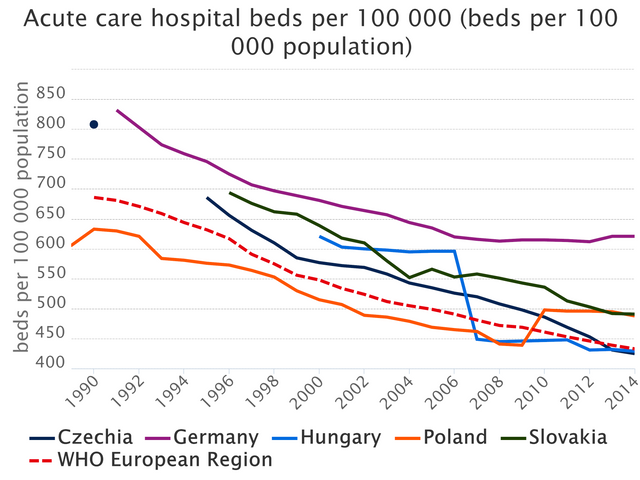
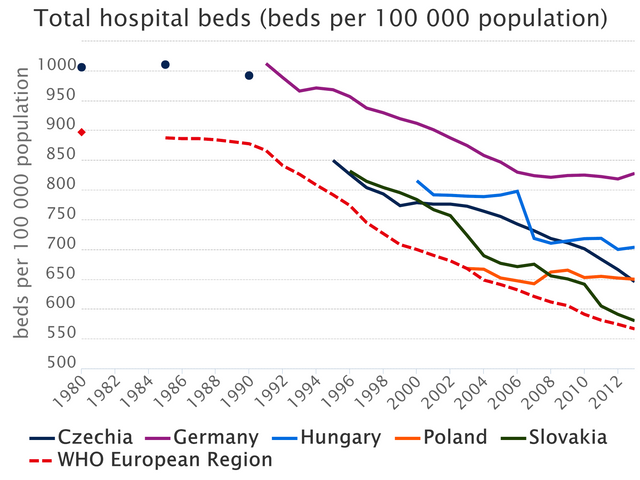
Three decades after the restoration of capitalism and endless austerity, the health care system in Poland and the Czech Republic, as across all of Europe, is in devastating conditions.
Acute care hospital beds per 100,000 (beds per 100,000 population)
According to data by the World Health Organization, the total number of acute care hospital beds per 100,000 has declined from over 600 to under 500 between 1989 and 2014 in Poland and from over 650 to under 450 in the Czech Republic. The number of total hospital beds per 100,000 has declined even more dramatically in the Czech Republic from almost 850 in 1996 to under 600 in 2014. Since then, more cuts have been implemented. Since 2014, the number for both has no doubt declined further.
In Poland, according to reports by the Rzeczpospolita, a medical unit in a hospital was closed every day last year, and some months up to three units were closed per day. Poland, in particular, has a decrepit social and health infrastructure. Young doctors and nurses have left the country en masse in the past decades because of poverty wages, meaning that much of the medical staff and especially doctors are over 60.
Polish hospitals were already on the brink of collapse before the crisis began and are woefully unprepared for the further spread of the virus. Starved of funds for years, they are totally under-equipped. The first hospitals treating coronavirus patients were running out of critical supplies, including masks, disinfectants, protective gear for medical staff and respirators almost as soon as the crisis began. At the University Hospital of Kracow, the director took the desperate measure of evacuating all patients to prevent further spread.
Total hospital beds (beds per 100,000 population)
On Wednesday, a Facebook post by a young doctor from the Silesian town Rybnik, pointing to the utter lack of preparedness by the government and health care system to confront the crisis, went viral on the Polish internet. The doctor pointed out that the actual number of cases of coronavirus in Poland must be significantly higher than officially reported, “Because we don’t have tests. In my hospital we set up a tent, it was announced that people could undergo a test for coronavirus there. Yesterday, there was not a single test kit for the virus.”
She warned that the medical staff was not being protected from infection, threatening widespread infection among nurses and doctors and a total collapse of the system within weeks. Shockingly, she described that entire cities had hospitals without a single available respirator, and that patients had to be driven across the country in search of a place with the necessary equipment for their treatment. She warned that the situation in Poland might well become “MUCH WORSE than in Lombardy,” in Italy.
In interviews with the liberal Gazeta Wyborcza on March 4, doctors had already predicted that the outbreak would be devastating in Poland. An internist in a clinic in Warsaw, the country’s capital, said, “In my hospital there is a daily struggle for respirators. The ambulances with patients are driving all over Warsaw because we don’t have a single free respirator available.” He added, “We are not prepared for an epidemic of a diseases in which the lungs [of the patient] have to be supported. We don’t have additional teams of nurses who can handle apparatuses in the ICU.”
Another doctor pointed out that virtually all hospitals for infectious diseases in smaller towns had been “liquidated,” despite the fact that there had been a growing number of cases of tuberculosis in recent years. People living in rural areas, which in Poland still comprise 40 percent of the population of about 38 million, often have to travel dozens of kilometers to get to the nearest clinic.
While the health care system in the Czech Republic is rated higher than that in Poland, here too devastating cuts to hospitals have left the system unprepared to deal with a pandemic that is still in its early stages. Apart from the elderly and sick, and immigrants, the Roma minority is at particular risk in the Czech Republic and throughout Eastern and South Eastern Europe where it comprises about 5 million to 6 million people.
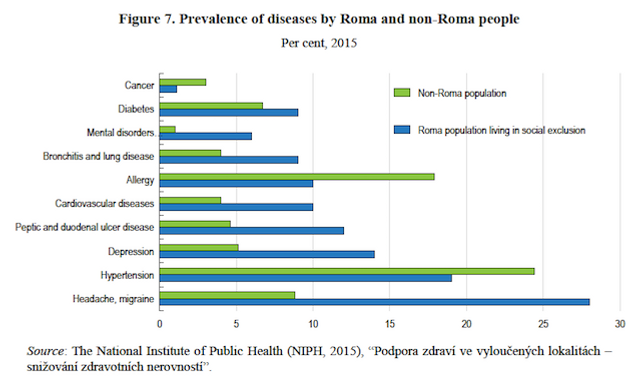
Roma population diseases in the Czech Republic
In the Czech Republic, the 250,000–300,000 Roma (about 2–3 percent of the population) live in utter poverty. Many live in virtual ghettos with poor hygiene and without running water and electricity. Studies have shown that in the Czech Republic and other countries, the Roma population is many times more likely to lack health insurance and access to basic medical care.
A study by the Czech National Institute of Public Health from 2015 found that Czech Roma are much more likely to suffer from diabetes, bronchitis and lung diseases and cardiovascular diseases than the non-Roma population. These diseases are known to significantly increase the danger of serious progression of the disease and the likelihood of a fatal outcome in case of an infection with COVID-19.

Russia’s coronavirus cases double in two days, as Ukraine reports first death

Andrea Peters

Coronavirus cases in Russia have more than doubled since Wednesday of this week, bringing the total number of recorded infections in the country to 45 as of Friday evening. Neighboring Ukraine, where so far only a handful of people were reported to have contracted COVID-19, reported its first death from the disease yesterday.
The bulk of infections in Russia are concentrated in the country’s main population centers—Moscow and Saint Petersburg—where officials have now banned large gatherings. Flights to Italy, Germany, France, and Spain are suspended, expanding travel restrictions already in place. Russia closed most of its border crossings with China two weeks ago and stopped issuing visas to Chinese, Iranian, South Korean, and Italian travelers.
Thus far, the government reports that all of Russia’s coronavirus cases are among those who recently traveled to locations with a significant outbreak or have been in close touch with someone who has. Russian Prime Minister Mikhail Mishustin credited the country’s clampdown on travel with China for allegedly averting a large-scale outbreak. Despite efforts by Russian lawmakers to project the image that state policies have managed to protect the population, it is clear that they have not, and government officials anticipate community spread.
Three hospitals in Leningrad Oblast, which includes the city of Saint Petersburg and its environs, have been specifically designated to handle coronavirus victims. This week Moscow’s mayor Sergei Sobyanin ordered the immediate building of a field hospital on the city’s outskirts, with construction crews already breaking ground as they prepare to bring in prefabricated buildings and medical equipment and hook up a sanitation system. The school where a ten-year old girl fell ill with COVID-19 has been shuttered. Rospotrebnadzor, the agency responsible for consumer rights and well-being, announced that people should avoid visiting public places at rush hour.
The government continues to promote anti-Asian chauvinism, deporting 100 Chinese students who allegedly violated their quarantine. Anticipating the need to use police state measures to control the spreading outbreaks, Moscow authorities threatened those who fail to follow government orders to self-isolate with five-year prison terms.
In an expression of the political tensions within the country, parliamentary member Sergei Katasonov of the far-right Liberal Democratic Party of Russia (LDPR) was sharply criticized for violating self-isolation after returning from travel abroad and attending a Duma session at which President Vladimir Putin spoke.
On Thursday, the media outlet Lenta featured the commentary of Doctor Pavel Brand, who warned that an “Italian scenario” would be “very bad” because Moscow alone has only enough ventilators for 1,500 to 2,000 people. It would need five to six times as many.
Ordinary Russians are already feeling the economic fallout of the coronavirus pandemic. The value of the ruble has dropped to 75 rubles to the dollar, down from 63 a few weeks ago, despite government efforts to arrest the decline with large expenditures of foreign currency reserves. Prices for consumer items are rising as a result, under conditions in which family budgets are already strapped due to a steady drop in real incomes for several years.
Alexei Kudrin, a well-known liberal politician and former minister of finance with close ties to Putin, is predicting a rise in Russia’s poverty levels. The country’s target growth rate of 1.9 percent is unachievable in the new global environment and the recent dramatic collapse in global oil prices once again threatens the state’s budget, which needs the price of a barrel to be no less than $40 to $45 to avoid a crisis.
While neighboring Ukraine has thus far only reported three cases of COVID-19 and one death, the government has already sealed its borders to foreigners, closed all educational institutions for three weeks, and banned non-government events with upwards of 200 people. The right-wing government of Volodomyr Zelensky announced that it will devote 100 million Ukrainian hryvnia ($3.8 million) to combat the disease, a totally inadequate amount in a country battered by years of IMF austerity, extreme levels of social inequality, and war.
The spread of coronavirus in Ukraine will be devastating. Average male life expectancy is just 67 years, according to the World Bank. 2012 data showed that the Ukrainian government spent less than $300 per capita on public healthcare. A dramatic decline in public funding for healthcare has witnessed a sharp rise in out-of-pocket medical expenses and unmet needs. For twenty-three percent of households in 2015, those costs are characterized as either “impoverishing” or “catastrophic,” according to the World Health Organization. An estimated 60 percent of the population live beneath the subsistence level.
Particularly vulnerable are the estimated 3.5 million people in Ukraine who are already in need of humanitarian assistance, a result of the six-year long civil war in East Ukraine that was provoked by the 2014 US-backed far-right coup in Kiev. About 1.4 million people are registered as internally displaced, most of them live in major cities like Donetsk, Luhansk, Kiev, and Kharkiv. A large number of them still don’t have permanent residence and live in container homes.
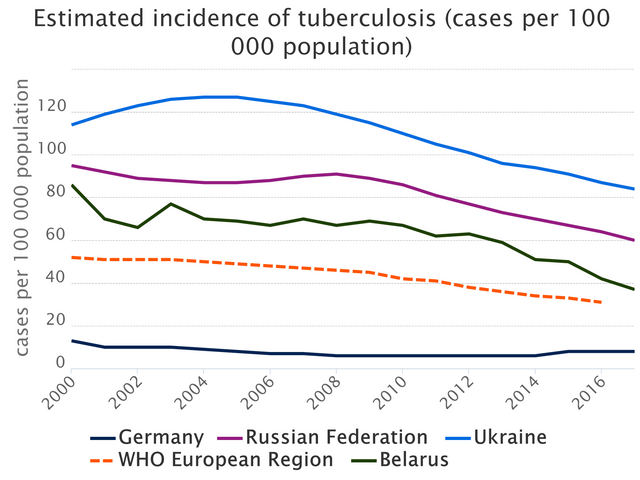
Estimated incidence of tuberculosis (cases per 100,000 population)
Even when compared to other post-Soviet countries, Ukraine’s health profile is disastrous. Its overall mortality rate is substantially higher. It has a particularly high rate of infections, parasites, and tuberculosis compared to other states. Since 2017, measles has infected 115,000 people.
The existence of ample hospital beds in the country is of little consequence because facilities have very little modern equipment. In the eastern region of Donbass, where the Ukrainian government is trying to suppress a Russian-backed separatist movement, one-third of hospitals and clinics have been destroyed.

Collapse of quarantine building in China exposes public anger over Beijing’s COVID-19 measures

Ben McGrath

The March 7 collapse of a hotel in China being used as a quarantine center for people possibly infected with the COVID-19 coronavirus has triggered public anger over the measures taken by the regime in Beijing to curb the virus.
Seventy-one people were inside the Xinjia Hotel, in the city of Quanzhou, Fujian Province, when it collapsed. The death toll reached 29 last Thursday as the final victim was recovered from the rubble, the authorities said. All those in quarantine had previously tested negative for the virus.
The exact cause of the collapse is still not known, but the building’s first floor had been undergoing renovations. The building was opened in 2013, but its third, fourth and fifth floors were converted into a hotel in 2018. Construction workers reported a deformed pillar minutes before the collapse. The building’s owner, surnamed Yang, was summoned for questioning by the police.
People expressed outrage at the hotel’s collapse and solidarity with those trapped. On the evening of March 7, the accident was the top trending topic on the social networking site Weibo, China’s version of Twitter. One person wrote: “The Quanzhou government must be scrutinized! This is not a natural disaster. This is a man-made disaster!” Another wrote: “Gravely hold those responsible accountable.”
This anger is being fueled by the fact that millions in China have been forced to endure lockdowns of entire cities and forced quarantines. Despite these measures, nearly 81,000 people have been infected in China, and more than 3,000 have died, although the spread is said to be slowing, with just eight new cases officially reported on Thursday.
On Weibo, another person contrasted the feelings of being quarantined to being trapped in rubble: “I feel despair after getting locked into a room for just one hour. I can’t imagine those people trapped under rocks for many hours. Hope they are all surviving and strong.”
Building collapses and industrial accidents are common in capitalist China, where companies often cut corners and ignore safety regulations to inflate profits. Last May, a building in Shanghai collapsed, killing 10 construction workers. It was also undergoing renovations.
Many people on social media referred to the hotel as another example of “tofu-dreg construction,” meaning shoddy work. This term gained wide use after the Sichuan earthquake in 2008, when several schools collapsed as a result of poor construction, leading to the deaths of thousands of children.
The collapse of the hotel threatens to crack the narrative that the measures taken by Beijing to curb COVID-19 should be emulated. On Tuesday, President Xi Jinping visited Wuhan, where the virus is believed to have originated, and claimed that the spread of the disease had been halted in the city.
However, a building collapse or other disaster could easily contribute to the further spread of COVID-19, for example, by exposing rescue workers to infected patients or preventing people from accessing medical care.
These types of construction accidents demonstrate the subordination of healthcare and other social services to the capitalist market, which Beijing defends. This greatly exacerbates any catastrophe, whether arising from a new virus, earthquake or other disaster.
Beijing is working to deflect criticism from inside China to prevent an explosion of social anger, as well as counter criticism from the US that is of an entirely different and right-wing character. Beijing’s state publishers recently put out a book for this purpose titled, A Battle Against Epidemic: China Combating COVID-19 in 2020. Social media users in China have circulated pictures of the book, denouncing it as “totally shameless.”
Wuhan’s new party secretary, Wang Zhonglin, also earned scorn by demanding residents of the city show gratitude to President Xi and the Chinese Communist Party. Journalist Chu Zhaoxin retorted: “You are a public servant, and your job is to serve the people. Now the people you serve are broken, the dead are still cold, and the tears of the living have not yet dried. The sick have not yet recovered, and much of their dissatisfaction is completely reasonable.”
Wang seemed to be responding, at least in part, to Wuhan residents who denounced the handling of the quarantine during Vice Premier Sun Chunlan’s visit to the city the previous week. As he toured a residential compound, people shouted, “Fake! Fake! It’s all fake!” according to the Los Angeles Times. Residents said they had been neglected while the compound’s management orchestrated a phony clean-up and grocery deliveries shortly before Sun’s visit.
However, China is under pressure from the United States government, which is using the virus outbreak as a pretext for ramping up tensions with Beijing.
US Secretary of State Mike Pompeo said last week: “Remember, this is the Wuhan coronavirus that’s caused this, and the information that we got at the front end of this thing wasn’t perfect and has led us now to a place where much of the challenge we face today has put us behind the curve.”
On Tuesday, Chinese Foreign Ministry spokesman Geng Shuang criticized Pompeo, saying: “Despite the fact that the WHO (World Health Organization) has officially named this novel type of coronavirus, [a] certain American politician, disrespecting science and the WHO decision, jumped at the first chance to stigmatize China and Wuhan with it. We condemn this despicable practice.”
Washington is similarly trying to deflect fear and anger in the United States as the COVID-19 outbreak grows and it becomes clear that the US government is completely unprepared. A number of American politicians have taken to calling COVID-19 the “Wuhan virus” or the “Chinese coronavirus.”
Pompeo claimed on Monday that this was being done to counter propaganda from Beijing. In reality, Washington is exploiting the health crisis to escalate its war drive against China.

Trudeau exploits coronavirus crisis to strengthen Canada-US imperialist alliance

Roger Jordan

While Canada’s ruling elite has wasted critical weeks in initiating efforts to combat the coronavirus pandemic, Justin Trudeau’s Liberal government suddenly swung into action yesterday. In a press conference, Trudeau announced a series of nationalist and xenophobic measures that were clearly motivated by pressure from, and a desire to coordinate policy with, the Trump administration and US imperialism.
Like Trump earlier in the week, Trudeau’s address, albeit in less aggressive language, focused on the need to strengthen Canada’s borders and portrayed the virus as a foreign problem. Speaking from self-isolation at Redhall Cottage, where he will remain for two weeks after his wife was diagnosed with COVID-19, Trudeau warned Canadians against all foreign travel and declared that a “Team Canada response” was required to manage the crisis.
He also announced unprecedented restrictions to travelers coming into Canada, including reductions in flights and the number of airports to which passengers can fly. “We are looking to reduce the number of airports that will accept travelers from overseas in order to be able to give the proper resources on all arrivals to ensure we’re doing everything we can to keep Canadians and Canada safe,” stated Trudeau.
A group of federal ministers, including Health Minister Patty Hajdu, Deputy Prime Minister Chrystia Freeland, and Transport Minister Mark Garneau, unveiled additional measures at a separate press conference. These included enhanced security checks at airports, the banning of all cruise ships from Canada, and the recommendation that all international travelers entering Canada go into two weeks of voluntary self-isolation.
These measures were clearly a response to Trump’s Wednesday night address, during which he banned virtually all travel from Europe for 30 days and sought to blame the coronavirus pandemic solely on China and the inaction of the European powers. Earlier this week, Canada’s Foreign Minister, François-Philippe Champagne, stressed that Canadian officials were in daily contact with their US counterparts to coordinate their policies.
This coordination has nothing to do with developing a concerted global response to the pandemic, systematically mobilizing the resources of the world to halt the spread of the virus and provide the quality health care urgently required by the population. On the contrary, it is aimed at exploiting the current deadly public health pandemic to strengthen the Canada-US imperialist alliance.
This was underscored Friday when the Trudeau government announced an agreement with the opposition Conservatives, New Democrats, Bloc Quebecois and Greens to suspend Parliament for five weeks. One of the terms of the agreement was that Parliament would rush through passage of the US-Mexico-Canada Agreement (USMCA) by the end of the day. The deal, which replaces NAFTA, contains provisions aimed at consolidating North America as a continental trade bloc against international rivals, above all China, so it can serve as a basis for trade war and military conflict.
Also Friday, the Bank of Canada announced a snap decision to cut interest rates by 0.5 per cent for the second time in ten days, funneling billions of dollars into the coffers of the financial markets and big business.
Meanwhile, the attempts by all levels of government in Canada to combat the virus have been utterly inadequate. Trudeau announced the derisory sum of $1 billion in assistance for Canada’s dilapidated health system on Wednesday, which is a mere drop in the bucket compared to the tens of billions required to repair the damage done by decades of austerity measures. Hospitals in Ontario and British Columbia are already reporting a shortage of critical medical supplies, resulting in patients seeking treatment being turned away. Additionally, the measures announced to help workers who fall ill or who have to go into self-quarantine were no more than a tiny fraction of what is needed to provide millions of Canadians with the financial resources to support their families through illness, self-isolation or the loss of income due to workplace shutdowns.
The attitude of the ruling class to the vast majority of the population was summed up in comments by Hajdu to the House of Commons Health Committee Wednesday. After describing the coronavirus outbreak as a “national emergency and crisis,” she went on to blandly declare, “There are a range of estimates. But I would say that it is safe to assume that it could be between 30 per cent of the population that acquires COVID-19 and 70 per cent of the population.”
The Globe and Mail article that reported her remarks did not indicate that any MP challenged Hajdu’s incredible statement, which accepted the worst prognoses of the World Health Organization and other experts as an accomplished fact. Nor did anyone ask why, given that this crisis has been developing internationally for several months, nothing was done by the Canadian government to expand hospital facilities, purchase critical medical equipment, roll out testing to all communities, and establish isolation facilities for those who need them.
Even taking the lower end of Hajdu’s estimate as a starting point, this would mean that 12 million Canadians would be infected. The general medical advice states that 15–20 per cent of all cases will require an intensive care bed due to breathing problems, which would translate into between 2 million and 2.4 million people. Assuming a mortality rate of 2 per cent, which is well below the rate in several countries, 240,000 Canadians would die. If the higher end of Hajdu’s projection comes to pass, with a rate of infection of 70 per cent, the death toll would be 560,000.
There is no reason for working people to passively accept that the vast majority of the population in Canada and internationally must contract the virus. What is required is billions of dollars of investments in testing, high quality medical care and supplies, including breathing equipment, masks, gloves and gowns. Billions more must be made available to compensate workers for loss of pay, allowing them to stay at home and follow medical advice rather than risking infection by continuing to work to make ends meet.
But none of this will be forthcoming from Canada’s criminal ruling elite. Instead, workers must mobilize independently to fight for the urgent measures needed to prevent the coronavirus pandemic from becoming a human and social catastrophe.

Spain declares state of emergency as unions agree to mass layoffs

Alejandro López

Yesterday, the Spanish Socialist Party (PSOE)-Podemos government announced that it was implementing a state of emergency for 15 days to control the spread of the coronavirus pandemic. The decision comes as there are 4,209 confirmed cases, 1,000 more than the day before, and 120 deaths.
At a press conference yesterday afternoon, Prime Minister Pedro Sánchez said the state of emergency would come into effect today, allowing the government to temporarily restrict the movement of citizens and mobilise the police and the army. He claimed the measure “would allow for the maximum mobilisation of resources against the virus.”
Sánchez added that “We are only in the first phase of combatting the virus,” and “We have some very tough weeks ahead of us. We cannot rule out reaching 10,000 [infections] by next week.”
The state of emergency allows the government to limit the free movement of people and vehicles; to temporarily requisition any kind of asset; to intervene and temporarily take over industries, factories, workshops, operations or commercial premises; limit or ration the use of services or the consumption of essential items; and issue necessary orders to ensure supply to markets and the functioning of facilities making essential products.
The measure announced complements others taken at the regional level. The region of Madrid has ordered the closure of all hotels, bars and restaurants. The Basque Country has announced a “health emergency”, which empowers the regional government to confine municipalities. Regional elections in the Basque Country and Galicia will likely be suspended.
In Catalonia, the regional government ordered a complete lockdown—the first of its kind—of Igualada, Vilanova del Camí, Santa Margarida de Montbui and Òdena, confining a total of 70,000 inhabitants to their towns. In Igualada alone, 58 of the 319 cases in Catalonia have been identified. This was a bid to slow transmission of the largest outbreak of the coronavirus so far identified in Catalonia, after the regional government refused to close down schools and other large gathering places.
Showing the utter contempt of the ruling class for health care workers, they account for 36 of those infected recently in Catalonia, and there are 250 people isolated, including 200 hospital staff.
Murcia decreed the confinement of eight coastal towns and cities on Friday, affecting 376,000 people. No person may enter or leave these locations except for work or health reasons, and all businesses will be closed except for pharmacies and food stores. The decision came as seven new cases were reported in one night, mostly from Madrid residents who fled from the capital to the coastal areas.
The pandemic is rapidly exposing the inability of the capitalist system to deal with such a crisis. The Spanish government, like all others, has responded with a staggering level of incompetence and disarray. Last Sunday, they allowed the March 8 feminist protest, which gathered 120,000 protesters, to go forward, despite receiving warnings that the spread of coronavirus was accelerating. The Ministry of Health was aware the day virus had begun to spread “without control”, especially in the region of Madrid.
Prime Minister Sánchez insisted that his ministers attend the protest to “show an image of unity of male minsters against sexism”, El Confidencial Digital wrote, forcing some “who expressed reservations, like the head of Social Security, José Luis Escrivá.”
While Sánchez appealed to patriotism and the “heroism of cleaning one’s hands regularly and staying at home” in his press conference, social anger is mounting among health care workers over the lack of basic medical equipment. Department heads of large hospitals are telling the media their centres lack personal protective equipment. It is also widely acknowledged that there is a lack of respirators, which are essential to keep coronavirus patients who are in critical condition alive.
At the same time, private health care centres are charging €300 to test for coronavirus. The Catholic Church has announced it will continue holding mass, even though the Ministry of Health is calling on citizens to avoid large crowds. And the notorious detention centres for migrants will remain open, threatening to spread the virus among innocent refugees imprisoned there.
The pandemic is rapidly exposing the anti-working-class character, not only of the Sánchez government, but also of the trade unions. The Stalinist Workers Commissions (CCOO) and the social-democratic General Union of Labour (UGT) are calling for mass redundancies to let companies offload the economic effects of the coronavirus on workers and their families. As at the time of the 2008 Wall Street crash, the ruling class and its trade union agents are doing everything possible to bail out companies at workers’ expense.
The day before the government announced the state of emergency, the CCOO, UGT and the big business association CEOE and small business Cepyme, agreed on a joint document, calling for big business to implement a temporary workforce adjustment plan (ERTE). This allows the temporary suspension of job contracts on “economic, technical, organizational or production grounds or due to force majeure.”
Employees affected by an ERTE can access unemployment benefits, but only under certain conditions, like having contributed more than 360 days to social security. Labour lawyer Álvaro San Martín told El Pais, “Workers will earn less and will have no access to any compensation for dismissal.”
Car manufacturer Nissan has already announced a workforce adjustment plan (ERE) affecting 2500 workers. Seat is expected to follow suit. Kostal Eléctrica, which produces components for cars, announced a plan affecting 800 workers. Air Europa’s plan will affect 3,600 workers. Hotel group Melia will sack 230 workers. Spanish airline Iberia has announced an ERE affecting 90 percent of its 16,000 workforce.
A wave of mass redundancies is in preparation. Government sources told the Barcelona daily La Vanguardia that “in a few days a large number of ERTE requests could arrive so that companies can adjust their workforces.” The CCOO has already confirmed that 70 procedures have been opened in the Madrid region alone.
Workers and youth must be warned that the state of emergency will be used against striking workers and protesters. The government is empowered to mobilise the police and the army to crush social opposition against job cuts and safeguard conditions against the virus.
The pandemic is proving the urgent necessity of a mass political movement of the working class in Spain and internationally against capitalism and for the socialist reorganization of world economy. This can only be carried out against the misnamed pro-austerity and militarist “progressive” PSOE-Podemos government and the trade unions. An essential principle that must guide the response of the working class to the crisis is that the health and safety needs of working people internationally must take absolute and unconditional priority over all considerations of corporate profit and private wealth.