23 Mar 2020

Coronavirus kills more than 2,600 across Europe in one weekend

Alex Lantier

The coronavirus pandemic surged across Europe this weekend, with more than 2,600 deaths, the majority of them in Italy, followed by Spain, France, Britain, the Netherlands, Belgium and Germany. The weekend toll by itself nearly equaled the entire three-month death toll in China, where the epidemic began.
On Sunday alone there were 1,287 deaths and 17,303 new cases, with Italy, Spain and France all seeing record numbers of deaths from the epidemic. The total for the continent as a whole reached 168,803 cases and 8,785 deaths.
The toll from the pandemic in Europe has now reached more than double the impact in China, which saw 81,054 cases and 3,261 deaths. Worldwide, there have been 335,377 declared cases of coronavirus and 14,611 deaths.
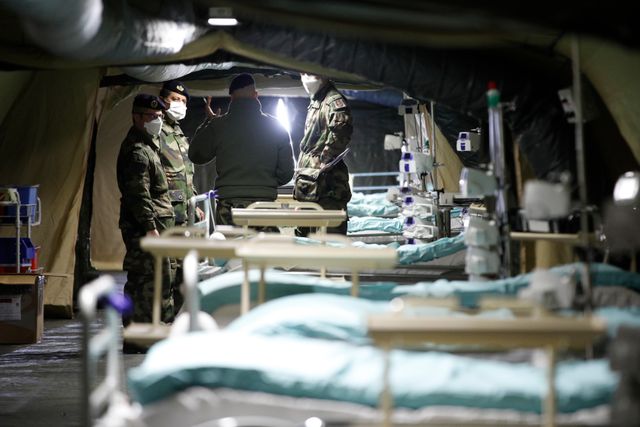
French soldiers discuss inside the military field hospital built in Mulhouse, eastern France, to treat coronavirus patients (AP Photo/Jean-Francois Badias)
A third major epicenter is Iran, where there have been at least 21,638 cases including 1,685 deaths, while the number of cases in the United States has skyrocketed to more than 32,000, with 400 deaths. There is also a rapid growth in the number of cases in Africa and Latin America.
Though Italy, Spain and France are under country-wide lockdown, as well as large parts of Germany, the contagion is spreading relentlessly across Europe, after governments refused for weeks to adopt shelter-in-place orders or make any serious effort to actually stop the contagion by combining lockdowns with testing, contact-tracing and quarantining all those either infected or in contact with the infected.
Italy, Europe’s worst-hit country for now, saw 5,560 new cases and 651 deaths on Sunday after 6,557 new cases and a record 793 deaths on Saturday, for 59,138 cases overall and 5,476 deaths. On Saturday, Prime Minister Giuseppe Conte announced that all factories would close indefinitely except for those “strictly necessary ... to guarantee us essential goods and services.” Officials in Lombardy, the hardest-hit region, warned that stricter measures, like a ban on anyone leaving their homes, might be taken as hospitals continue to be flooded with critically ill patients gasping for air.
While Russian military aid and a group of Cuban doctors arrived in Italy, the European Union (EU) still refuses to provide aid to the devastated country. A diplomatic incident ensued this weekend over the theft of a shipment of 680,000 Chinese face masks to Italy in the Czech Republic, whose government initially denied that anything had been stolen. The Czech government is now sending masks and respirators to Italy, however.
Italian health officials pointed to the slight fall in the number of infected and of deaths on Sunday, as well as the fact that only 30.4 percent of new cases were in Lombardy, as signs the contagion might be slowing. The incubation period of the virus typically ranges from three to seven days and can go up to 14. As confinement orders to prevent further spread of the disease took effect over a week ago, many of those already infected and incubating the virus at that time could be expected to have already started showing symptoms.
However, officials also warned not to take false hope. “I hope and we all hope that these figures can be borne out in the coming days. But do not let your guard down,” commented Italian civil protection service chief Angelo Borrelli.
In Spain, there were 3,925 new cases and 288 deaths Saturday and 3,107 new cases and 375 deaths Sunday, bringing the total to 28,603 cases and 1,756 deaths. One of those who has fallen ill is the beloved opera singer, Placido Domingo, lately a target of the right-wing #MeToo movement. Moreover, 12 percent of the confirmed cases (3,475) are doctors, nurses or health staff, devastating the health system which is already flooded with patients in key areas such as Madrid.
On Saturday, Spanish Prime Minister Pedro Sanchez warned that “the worst is to come.” As confined Spanish people banged on pots and pans to protest his handling of the pandemic, Sanchez pledged to organize more mass testing for coronavirus. The Sanchez government has prolonged Spain’s state of alarm and lockdown until at least April 11.
In France, where the first doctor died of coronavirus in Compiègne, the total number of cases rose to 16,018 with 674 deaths, including 112 on Sunday alone. Health Minister Olivier Véran also said he believed the true number of cases in France is 30,000 to 90,000. However, he brazenly ignored calls from health professionals to carry out mass testing to identify and isolate all the sick before they can spread the disease to others. Instead, Véran said France would increase testing “once confinement orders are lifted,” that is, at some point in the indefinite future.
In Germany, officials are reportedly considering a nationwide lockdown as the number of sick rose 2,488 on Sunday to 24,852. Amid growing fears of coronavirus infections in rest homes, nine elderly residents of a home have died and thirty people have been infected, including some of the rest home’s staff, in the town of Würzburg, where 166 people have already fallen ill. Among those now self-isolating, moreover, is German Chancellor Angela Merkel, who reportedly came into contact with a doctor who later tested positive for the virus.
In Britain, 48 people died and 665 fell ill on Sunday, bringing the total to 281 deaths and 5,683 cases—including the first teenager to die of coronavirus in Britain, aged 18.
Prime Minister Boris Johnson came under growing criticism for his refusal to act against the pandemic. After his scientific advisor Patrick Vallance said it was “not desirable” to prevent Britons from contracting the disease—claiming this would prevent them from becoming immune—Johnson was forced to deny a Sunday Times report that his far-right adviser Dominic Cummings had argued to “let old people die.”
The pandemic is rapidly bringing to the fore deep class divisions internationally. The financial aristocracy is determined to let the disease run its course, so long as they are able to emerge richer than ever before. While the European Central Bank has printed €750 billion since the pandemic began to bail out stock markets and the super-rich, and national states are offering hundreds of billions of euros in financial guarantees for the corporations, businesses across Europe demand workers stay on the job to keep making profits for them.
Anger is mounting among health workers and industrial workers, however, at the ruling elite’s irresponsible attitude to this deadly pandemic. Amazon has stopped shipping non-essential products in Italy, after strikes last week and threats of strike action by Amazon workers in France.
After a wave of wildcat strikes in Italy forced Conte to adopt the initial confinement order, health professionals are bitterly criticizing decades-long EU austerity policies that have slashed health budgets and devastated hospitals .
In Spain, a hospital supply purchaser spoke to El Espanol to criticize Sanchez’s Spanish Socialist Party-Podemos government’s failure to order face masks and emergency respirators. “He did not buy them on time, it is a scandal,” he said. “In the meantime they were debating about local elections in the Basque Country and Galicia or asking whether the Montero law on sexual freedom was creating conflict in the ruling coalition. What stupidities, with coronavirus looming over it all! What a waste of time!”
In France, a group of 600 doctors has sued Prime Minister Edouard Philippe and former Health Minister Agnès Buzyn before the Republic’s Court of Justice (CJR) over their handling of the pandemic. They are accusing Philippe and Buzyn of having “voluntarily abstained from taking or launching measures” against “a danger for the security of persons.” After Buzyn admitted she had warned Philippe of the danger of a pandemic since January, the group is demanding a criminal investigation of Philippe and the seizure of his computers.
Amid growing class conflict, as workers clash with the state and the banks to try to secure social resources to fight the pandemic, the ruling elite—assisted by the union bureaucracy and its pseudo-left political allies—is moving to suppress opposition. Obsessed with giving handouts to the banks and the super-rich, it is preparing attacks on wages and basic social and democratic rights and accelerating moves towards authoritarian forms of rule.
As Portugal’s social-democratic government voted a state of emergency on March 18, suspending the constitutional right to strike for the first time since the fall of the fascist Salazar dictatorship in 1974, Spain deployed the army at home to enforce the state of alarm. In France, the government adopted a bill for a new state of emergency during the coronavirus crisis that allows businesses to slash a week of vacation and eliminate restrictions on the length of the workweek—even after the coronavirus crisis is over. These measures emerged from talks between business and the unions.
In Germany on Friday, the IG Metall union used the coronavirus crisis as a pretext to abandon talks with employers and accept contracts with no wage increases—claiming this was necessary to protect business activity. Left Party official Dietmar Bartsch hailed Merkel’s policies, tweeting, “The Left party fraction will support all measures that demand solidarity to avoid damage to the nation, people and the economy.”
The defense of workers’ health, livelihoods and democratic rights after years of EU austerity and police-state repression demands a social revolution and a break with this rotten establishment. The struggle to stem the pandemic, obtain decent wages during lock-downs, and obtain free and decent medical coverage for all is an international political struggle. This requires the organization of the working class across Europe and internationally in rank-and-file committees of action, independent of the unions, and a struggle to transfer political power to the working class.

Cyber-Nuclear Security Challenges: An Issue that Won’t Go Away

Manpreet Sethi 

As the world—pretty much the entire world—grapples with COVID-19, it is clear that the enormity of the pandemic will not leave any aspect of the economy untouched. Inter-state and societal interactions are also expected to feel the impact. Life may never be the same again. An event of almost similar magnitude in recent memory is the one that took place on 11 September 2001, when the twin towers in New York city came crashing down. That incident, too, changed many things, particularly how the world traveled; as elaborate and many inconvenient security restrictions became the norm.
With the current uncertainty generated by the new Coronavirus, it is a good time to spare another thought for the dangers of nuclear security that too can emerge quickly and leave a widely destructive trail. The subject of nuclear terrorism has silently faded out of public sight and political attention ever since the Nuclear Security Summit (NSS) process ended in 2016. Of course, institutions like the International Atomic Energy Agency (IAEA), Interpol, and some arms of the UN have continued to implement action plans that were drawn when the NSS process wound up. But, over the past four years, there has not been much public scrutiny of the implementation of measures related to the many dimensions of nuclear security. This is too important an issue to let out of sight, and any untoward incident that would qualify as an act of nuclear terrorism would yet again have an impact of the kind that 9/11 or COVID-19 have wrought on countries.
The NSS process that lasted through 2010-2016 paid special attention to the securing of nuclear and radiological material through proper material accounting and regulatory processes. National responsibilities were clearly delineated and were to be performed in keeping with some identified international instruments and benchmarks. During these four years, the number of  subscriptions to these instruments increased, and countries took pride in showcasing efforts towards the fulfillment of their relevant obligations. Attention was also drawn to the physical security of nuclear sites, including obviating chances of airplane crashes into nuclear reactors, à la 9/11.
The NSS process, however, finished without adequately shining the spotlight on all dimensions of nuclear terrorism. While the chances of theft of nuclear material or physical intrusion into nuclear sites and unauthorised access to orphan radiological material were addressed and sought to be minimised, the possibility of cyber-attacks to virtually interfere with nuclear operations did not get as much attention.
In contemporary nuclear threat perceptions, cyber threats to nuclear power plants and facilities as part of a country’s critical infrastructure have significantly grown. With physical access becoming difficult, cyber-attacks—which can be long distance, remote-controlled, and non-attributable—have naturally emerged as more attractive. These can be undertaken for purposes of espionage of technological information, data theft from networked systems, or to trigger some sort of malfunctioning of command and control systems, including accidents such as the loss of coolant (LOCA) kind at a nuclear power plant.
While no such incidence of a great magnitude has yet taken place in the 400-plus nuclear power plants operational across the world, cyber probes of various kinds have, nevertheless, occurred. As per one publication, “There have been over 20 known cyber incidents at nuclear facilities since 1990 all over the world…” A recent such incident came to light in the context of the cyber-attack on the Indian nuclear power plant at Kudankulam in September-October 2019.
According to media reports that began to come out in October 2019, a US-based cyber security company had, on 4 September 2019, informed the Nuclear Power Corporation of India (NPCIL), the operator of all Indian nuclear plants, that an unauthorised actor had breached domain controllers at the Kudankulam nuclear power plant (KKNPP). The initial reaction from the plant officials was a complete denial of any malware infection in their systems since such a cyber-attack was “not possible.” A press release from the KKNP Training Superintendent and Information Officer stated, “KKNPP and other Indian nuclear power plants control systems are stand alone and not connected to outside cyber network and Internet.” But, a day later, the NPCIL admitted that there had indeed been a security breach that had been informed to them by the Computer Emergency Response Team-India (CERT-In). The breach was eventually traced to an infected personal computer that was used for administrative purposes, but was also connected to the Internet. Fortunately, as was reported, the PC was isolated from the critical internal network.
Indeed, the Computer and Information Security Advisory Group of the Department of Atomic Energy (CISAG-DAE), which is responsible for the cyber security of nuclear power plants, has long argued that the practice of air gapping, or physically isolating critical computers or networks from unsecure networks such as the Internet, is an effective way of securing critical infrastructure. However, several cyber experts have pointed out vulnerabilities in this process that may be created by use of removable media, approved access points for maintenance activities, third-party updates, or even by charging personal phones via reactor control room, etc. For all its benefits, air gapping obviously does not guarantee adequate security and cannot be a reason for complacency.
Much speculation has taken place after the KKNPP incident about who might have been behind the attack. Several theories abound, and some are backed by analysis undertaken by cyber professionals. Most have concluded that the motive of the attack was theft of information and not sabotage of plant operations. While plant control and instrumentation systems were not compromised in any way, the attack did highlight the challenge of definitive attribution in case of cyber-attacks. This can be exploited by both state and non-state perpetrators of such attacks. Another benefit accrues from the ambiguity about the purpose of the attack. Even when ostensibly unsuccessful, an incidence of this nature nevertheless sends nuclear operators scrambling for patches for perceived vulnerabilities, and thus causes accretion of costs and dissipation of energies.
While enough cyber experts are engaged within and outside the nuclear establishment to secure them from cyber threats, it needs saying that the cyberspace allows new opportunities to resolute enemies to create problems at functioning nuclear plants by causing sabotage to effectuate different degrees of malfunctioning. These threats will only increase as greater digitalisation of power plants’ control systems takes place, which is inevitable given the pervasive utilisation of such technologies. The only defence against them can be stringent articulation and implementation of cyber security standard operating procedures (SoPs) by all those involved, and zero-tolerance for any violations by vigilant regulators. Outsiders (adversaries of all kinds) will constantly be on the lookout for vulnerabilities, and the onus will be on the insiders to keep all avenues blocked.
India must remain engaged with the international community on this issue and be part of national or IAEA-driven technical or training programmes. Regular cyber security courses for all plant personnel, depending on their involvement in digital networks, will be critical to imbue the establishment with a cyber security culture. This culture, in fact, must pervade a wider universe that should also include suppliers, vendors, contractors, and even transporters; any of whom could be used by resolute adversaries to sneak in cyber-attacks. In case of nuclear power plants, virtual security is going to matter as much as their physical security.

21 Mar 2020

COVID-19 May Prove Fatal To Those Exposed To Pollution

Rohin Kumar

According to the experts, the health hazard inflicted on people by long-standing air pollution is likely to impact the fatality rate emerging from Covid-19 infections.
Polluted air is known to cause respiratory diseases and is responsible for at least 8m early deaths annually. This means that Covid-19, which spreads through  respiratory droplets is expected to have a more serious impact on city dwellers and those exposed to toxic emissions from fossil fuels.
However, strict confinement measures in China, where the coronavirus outbreak began, and in Italy, Europe’s most affected nation, have led to falls in air pollution as fewer vehicles are driven and industrial emissions fall.
According to a report by Guardian, a preliminary calculation by a US expert suggests that tens of thousands of premature deaths from air pollution may have been avoided by the cleaner air in China, far higher than the 3,208 coronavirus deaths. It is said particularly in the context of China and Italy (currently most affected with Covid-19), where maximum cities under lockdown witnessed immense emission reduction. Experts clearly stated, It does not mean in any way that experts  are claiming the pandemic as good for health. However, experts have also cautioned saying it is too early for conclusive studies on relation of air pollution and coronavirus.
Observations from previous coronavirus outbreaks suggest that people exposed to polluted air are more at risk of losing lives. Scientists who analysed the Sars coronavirus outbreak in China in 2003 revealed that infected people who lived in polluted areas were twice as likely to die as those in less polluted areas. Early research on Covid-19 also red flags smokers.
Aaron Bernstein, the Interim Director of the Center for Climate, Health, and the Global Environment at the Harvard T.H. Chan School of Public Health, said, “Given what we know now, it is very likely that people who are exposed to more air pollution and who are smoking tobacco products are going to fare worse if infected with [Covid-19] than those who are breathing cleaner air, and who don’t smoke,” quoted Washington Post.
With the lockdowns in place, reductions in emissions have been recorded in Italy. In China, emission reduction was observed in the four weeks after 25 January, when regions shut down as a rapid response to the corona outbreak. The level of PM2.5 fell by 25%, while nitrogen dioxide, produced mainly by diesel vehicles, dropped by 40%.
In Indian context, the 2019 World Air Quality Report released in the last week of February this year, pointed to a 20% reduction in annual emission levels but attributed this to economic slowdown. According to the report, the findings were arrived at by comparing India’s economic growth with air pollution data, where it “appeared” to have a correlation between lower growth and lesser pollution. Having said that, it is also noteworthy to be reminded of the notice served by Central Pollution Control Board (CPCB) to the polluting power plants for non-compliance of emission standards.
CPCB’s Notice
On January 31 this year, in an unprecedented move Central Pollution Control Board (CPCB) issued show cause notices to 14 coal based power plants (5 plants in Haryana, 3 in Punjab, 2 in Uttar Pradesh, 2 in Andhra Pradesh, 2 in Telangana and 1 in Tamil Nadu) with a total capacity of approximately 15 GW. The notices were issued for non-compliance to the deadlines given to these power plants to reduce SO2 emissions by 2019 December under notification issued on 7th december 2015 and later on extension in timelines by CPCB in 2017.
CPCB in its notice asked the power generators, “Why should the plant not be closed down and environmental compensation be imposed for continuing non-compliance of the directions?” The show cause notice cited the notification issued by the Ministry of Environment, Forest & Climate Change in the year 1984, 1986, 1989, 1999 and 2015 which mentioned the revised emission limit for particulate matter and notified new limits for Sulphur dioxide (SO2), Oxides of Nitrogen (NOx) and mercury emission, and water consumption limit for coal/lignite based thermal power plants.
The notice also elaborated on how the power plants have not retrofitted Electrostatic Precipitators (ESP) and missed the deadline for installing Flue Gas Desulphurization (FGD) units. CPCB also strictly advised the power plants to immediately take measures such as installation of low NOx burners and  provide Over Fire Air (OFA) to achieve progressive reduction so as to comply with NOx emissions.
In order to achieve the target of limiting warming to 1.5°C, polluting power plants need to be shut down. Analysts have repeatedly argued that if India is really concerned about the pollution crisis, no new fossil fuel infrastructure should be built.
Fossil Fuel Emissions, deaths and Covid-19
Last year, a report by the Global Alliance on Health and Pollution (GAHP) found pollution to be the largest environmental cause of premature death on the planet, causing 15% of all deaths – some 8.3 million people. Among the 10 countries with the most pollution deaths in 2017, the latest year for which data was available, included both developed and developing nations.
India and China led in the number of pollution deaths, with about 2.3 million and 1.8 million respectively, followed by Nigeria, Indonesia and Pakistan. “India has seen increasing industrial and vehicular pollution from urban growth while poor sanitation and contaminated indoor air persist in low-income communities,” the report said.
Experts’ concerns around air pollution and Covid-19 transmission, if at all, stand substantial in the long run, it calls for caution for countries particularly such as India.
According to the media reports, the link between air pollutants and early deaths are well known and Marshall Burke, at Stanford University in the US, used the data to estimate the impacts on air pollution mortality. The young and old are worst affected by polluted air. As per Burke’s calculation, the cleaner air is expected to have prevented 1,400 early deaths in children under five and 51,700 early deaths in people over 70.
“The study on the relation between fossil fuels emissions and Covid-19 as published by the international publications lacks clarity and the methodology too is unknown, so it’s better to not comment on that,” said Independent Energy Analyst, Kshama Afreen. However, according to Kshama, India is suffering heavily for pollution and that must be addressed immediately. “India is estimated to bear 10.7 lakh crore, or 5.4 per cent of India’s GDP annually, the third highest costs from fossil fuel air pollution worldwide. That amounted to a loss of Rs 3.39 lakh per second, according to the report by environment organisation Greenpeace Southeast Asia. That must be a concern for the governments,” she added.
Experts also believe that indirect impacts of Covid-19 may be probably much higher than currently known. Talking to the Guardian Sascha Marschang, the acting Secretary General of the European Public Health Alliance, said, “Once this crisis is over, policymakers should speed up measures to get dirty vehicles off our roads. Science tells us that epidemics like Covid-19 will occur with increasing frequency. So cleaning up the streets is a basic investment for a healthier future.”

Coronavirus: The Unfolding of an Epistemic Crisis

Ghulam Mohammad Khan

Epistemology involves the philosophical analysis of the nature of knowledge and how it informs the ontology of the concepts like truth and belief or how beliefs are formed, internalized and justified. Notwithstanding the fact that it is happening, however, the whole process of formation and internalization of these beliefs is almost imperceptible. Since the history of the becoming of beliefs is far too deep and elaborate, the occurrence of a sudden anti-epistemological rupture,unbecoming this deep-rooted tradition of beliefs, appears very unlikely. The process of unbecoming may actually take as much time as the process of becoming. However, a black swan event like the present coronavirus pandemic can, if not completely decimate the structured field of our beliefs and values, at least help us to reconsider the relevance of different beliefs, ideologies, institutions and patterns of human behaviour.
The unrelenting coronavirus pandemic has wreaked havoc across the globe. The confused world leaders addressing their nations, the unprecedented media clamour for stricter control and prevention, social media histrionics, the lockdown of towns, cities, and centres of business and education reflects the enormity of the crisis. However, being an immediate threat to life as it certifies the presence of an otherwise normalized absence or uncertainty about death, coronavirus distracts our attention from how actually it subverts the relevance or the semblance of truthfulness from varied forms of behaviour, beliefs and other so-called powerful functional institutions of our world society, which silently evolve along the life itself.Though this pandemic may not completely annihilate humanity from the planet, however, it should teach us some serious lessons to reconstruct our social structure so as to tackle such pandemics with greater readiness and control in the future.
Let’s begin with the belief or ideology that drives our economic system and how it is being run roughshod over by the coronavirus onslaught. In wake of the deepening crisis, the roof of our economic system is slowly crumbling on the very structure supporting it. And this supporting structure is capitalism. When doctors advice people to stay back at home to prevent the contagious virus from spreading, the working class, unlike the super-wealthy who have private jets to flee to germ-free hideaways, can’t afford to stay back and wait for the virus of hunger take them over. In this system of compulsion a worker has to come out of the bed, use public transport, work in crowded places and silently adhere to the compulsive mechanism to save both himself and the system. Under this system even the medical treatment (nobody knows how patients will be saddled with bills who seek the still-awaited vaccine for coronavirus)may not be affordable to the working class. Based on their findings,Kate Pickett and Richard Wilkson extensively highlight in their book The Spirit Level: Why Greater Equality Makes Societies Stronger that inequality of wealth and power ‘leads to a state of chronic stress.’ This stress further wrecks havoc on ‘bodily systems such as cardiovascular system and the immune system, leaving the individuals more susceptible to health problems.’ Therefore, what the present adverse situation teaches us is not that some utopian new liberal system should provide free medicare to face the coronavirus pandemic, but that it is time to rebuild our society where human needs govern the process of production. In the new system we won’t at least have our healthcare regulated by the decisions of wealthy capitalists owning hospitals, medical equipment manufacturing firms, pharmaceutical companies and insurance systems. In other words, it deconstructs the capitalist ideologies of market mechanism which have become ever stronger in the modern age of radical nationalism.
Secondly, let’s see how the novel virus can alter the semantics of the phenomenon of nationalism. In India the sentiment of nationalism or patriotism is not only a strong behaviour but also a religion.Somehow, unfortunately, this sentiment has been merely confined to the sublimated borders and the imaginary soldiers sacrificing their holy blood all the time to safeguard these borders. However, the pandemic should teach us to align our sentiment of patriotism to a different direction. In these real hard times out patriotic feelings should not be driven by the mercenaries or enlisted soldiers fighting imaginary wars but by the doctors, nurses, pharmacists, volunteers and utility workers who risk their lives for others. There can’t be a greater effort to serve and save a nation than their real unflinching hard work. This way, the novel coronavirus can redefine nationalism as something cultivating life and health of a nation and not as something threatening the same of some other nation.
Another important lesson coronavirus can teach us would be redefining the overbearing influence of some religious teachings in the shaping of our ‘sociological imagination.’ In all adverse situations in the past, be it epidemics, disasters, wars, diaspora or prosecutions, religion has not only managed to survive but also emphatically pronounced judgements about such occurrences. The underdeveloped as well as the developing countries where healthcare systems are already inadequate and unequipped to combat the novel virus are unfortunately controlled by, to use a phrase by Milan Kundera ‘sacrosanct certainties.’ Whereas some unanimously profess the belief that cow urine and cow dung can be used as antidotes to prevent coronavirus outbreak, the others exclusively tout themselves as the God’s ‘chosen few’. With a strange celestially approved supercilious attitude, they disavow any possibilities of this virus infecting them. Some even sadistically justify the plight of other humans in different nations simply for being non-religious or anti-religious. In this time of quarantine,these religions of congregation need to falsify some of their obsolete beliefs before it is too late. It is high time to realize that coronavirus doesn’t choose people on the basis of their religious beliefs. The way we justify religious teachings like ‘namaste’ or five time ‘wudu’ (ablution) a day as preventions from coronavirus, in the same breath we should falsify other teachings like congregational supplications, drinking cow urine or handshake. Coronavirus is a real big threat to our collective well-being and the impervious nature of religions, causing much of our non-seriousness to the pandemic, can only make us more vulnerable.
The other possibility is the emergence of a new hyper-real world order. It may sound weird or even unfounded but the people of this generation can never easily be complacent to touch, visiting crowded places or breathing air in an enclosed space. Distancing could be a new normal, pushing technologically advanced societies for a greater telemanipulation of information. Simulated reality, modern Platonic ideal forms will significantly influence our understanding of the new world.
Furthermore, the outbreak of coronavirus has seriously called into question the very phenomenology of love, empathy and compassion. Sadly, it has again proved them irrelevant in the time of sanctions, nationalism and capitalism.
Let’s hope the coronavirus pandemic ends soon and makes space for better changes for a better world.

South Africa: State of national disaster declared as coronavirus hits and social tensions mount

Stephan McCoy

South Africa has become the latest country to see a sharp rise in confirmed cases of COVID-19, making it the hardest hit on the African continent.
On Thursday, Health Minister Zweli Mkhize told the South African Medical Association (SAMA) that the spread of the coronavirus was only just beginning and that between “60 percent and 70 percent” of the population were likely to be infected.
His estimates echo those of the World Health Organisation (WHO).
On March 15, in a national address, President Cyril Ramaphosa announced that the number of confirmed cases of coronavirus had reached 61—a development which came as shock to many. By yesterday, the figure was 202, including 52 new cases in a single day. At least eight cases recorded by March 18 had no previous travel history.
The African National Congress (ANC) government’s response to the pandemic has been lacklustre and incompetent—spending weeks doing nothing to prepare for the inevitable arrival of the virus. Despite declaring a national state of disaster, the measures Ramaphosa outlined were paltry and do not take into account the kind of action that organizations such as the WHO and other experts have said are needed to stem the spread of the virus.
The address made no mention of plans for extensive testing and contact tracing—the two key measures required to halt the spread of the virus. Ramaphosa largely outlined such things as social distancing. Certain land, air and seaports were also to be closed, and a half-hearted approach to school closures was taken—with primary and secondary schools closed while universities were not addressed—leaving them to decide when to close. Most did so haphazardly, cancelling graduations and angering many students. The secondary and primary school closures came only after it was reported widely that a Grade 9 student had tested positive for coronavirus.
The government has now announced that it will focus on closing borders, including building a 40-kilometre fence along the border with Zimbabwe to stem undocumented migration, having already closed 35 of 53 land entry points. Zimbabwe has not yet reported cases of coronavirus.
The crisis has fueled hostility towards the government. Many workers and young people took to social media to voice their anger at this incompetence and indifference, both before and after the address. Some protested being forced to go to work as the virus spreads, noting that the taxi ranks on which many rely were overcrowded and unsanitary.
Health workers took to social media to denounce the government for not doing enough to ensure their safety or to deal with the lack of much needed supplies, such as gloves and masks—exacerbated by thefts from hospitals.
Science Magazine article titled “A ticking time bomb”, cited scientists’ concerns about coronavirus spread in Africa. The article notes that with the populations of many African countries “disproportionately affected by HIV, tuberculosis (TB), and other infectious diseases” and with most having “weak health care systems… experts worry the virus [will] ravage” the continent. Additionally, “[s]ocial distancing” will be hard to do in the continent’s overcrowded cities and slums.”
The BBC reported on the situation in the informal settlements in Alexandra on the outskirts of Johannesburg, where people often live in cramped single rooms and share communal outdoor toilets. Electrician Nicholas Mashabele warned, “If the virus comes here, it’s going to kill everyone… We don’t have money to buy hygiene [products] to protect ourselves. We’re living in high risk.”
His wife, Shebi Mapiane, pointed to the wall of her house, saying, “My neighbour is just here. If I catch it, he’ll catch it, and everyone will catch it.”
Dr. Alison Glass, a clinical biologist, commented, “My biggest worry is... if this spills over into poorer communities where it’s more difficult to identify patients and to contain [the virus].”
South Africa has the highest number of people living with HIV of any country on Earth, a direct result of the ANC’s and former leader Thabo Mbekiʼs criminal irresponsibility at the outset of the HIV epidemic. There are 2.5 million people living with HIV who are not on antiretrovirals, the drug used to fight the onset of Acquired immunodeficiency syndrome (AIDS).
In those living with HIV, Professor Salim Abdool Karim, warns, “[W]e’re likely to see more severe infections.” Those with AIDS, which brings with it pneumonia and recurring respiratory tract infections, face even graver danger.
South Africa is riven by social inequality. The official unemployment rate stands at 26.7 percent—6.7 million workers—youth unemployment is 57 percent, the highest in the world, and the rate of HIV infection is 15 percent, meaning the threat of this virus devastating the population is all too real.
One only need recall Mbekiʼs downplaying of the HIV epidemic to know what the attitude of the South African ruling elite will be. As the situation spiraled and HIV became the single biggest cause of death in South Africa, Mbeki cynically claimed that the reports of alarming number of deaths from HIV was a conspiracy by the World Health Organisation and others to attack his government. At one point he stated, “Whatever the intensity of the hostile propaganda that might be provoked by the WHO statistics, we cannot allow that government policy and programmes should be informed by misperceptions, however widespread and well-established they may seem to be.”
It was Thabo Mbeki who fallaciously used statistics from a much earlier period, with much smaller figures, to downplay the HIV epidemic. One can already see in Ramaphosa’s response to the coronavirus pandemic a similar negligence, denial and cynicism.
On the other hand, with the coronavirus only beginning to take hold, Ramaphosa is already making pledges to business and the corporations to implement “bailout packages” like those offered by his counterparts around the world. While workers are forced to keep going to work in unsafe conditions and risk exposing themselves and their loved ones to the virus, the profits of the bourgeoisie are treated with care and delicacy. Surely no harm must come to them.
As Times Live reports, Ramaphosa told various political parties, “All social partners, specifically government, business and labour, need to jointly develop and implement measures to mitigate the economic impact of Covid-19. Companies in distress need to be helped.”
This means business will be given billions to shore up profits, while the trade unions work to repress mounting opposition, as the police and military are readied for any serious resistance by the working class.
In recent comments, WHO Director-General Tedros Adhanom Ghebreyesus scolded African governments, saying, “Africa should wake up, my continent should wake up.” As far as the fate of the working class is concerned, the African ruling elite will not heed this call.

As coronavirus cases surge in Pakistan, its prime minister preaches “no need to worry”

Sampath Perera

Pakistan is seeing a surge of COVID-19 cases, with the number of confirmed victims of the virus rising from fewer than 30 to 495 in the span of less than a week. There have been three COVID-19 deaths to date.
The rapid spread of the deadly virus will be catastrophic for millions of people in this poverty stricken South Asian country of more than 200 million.
As of now, Pakistan reports the highest number of confirmed cases in South Asia. Despite severe COVID-19 outbreaks in neighbouring countries, including China to the east, the initial epicentre of the virus, and Iran to the west, Pakistani authorities did little to nothing to prepare for the inevitable spread of the coronavirus to the country.
While the government attempted to delay the spread of the virus by refusing to evacuate its citizens from China’s Hubei province and imposed air travel restrictions, no significant measures were taken to mount a medical response to the outbreak. According to reports, most initial tests were conducted on patients who had become infected while traveling in Iran.
Despite the rapid increase of cases, the government has allocated only a paltry 5.4 billion rupees ($34 million) to deal with the pandemic.
The actual infection numbers are certainly far higher than reported, given the severe lack of testing. Prime Minister Imran Khan’s Islamic populist Tehrik-e-Insaaf (PTI) government hurriedly convened the National Security Council March 13 amid reports indicating an unchecked spread of the virus. Following the military-government huddle, it shut down schools and the country’s borders while enforcing restrictions on air travel. However, fearing a backlash from an increasingly powerful Islamic right, the government did not ban prayers or large religious gatherings.
As panic built throughout the country, Reuters reported Wednesday that there was a “growing dispute in Pakistan between federal and provincial authorities.” Provincial authorities were scrambling to secure coronavirus testing kits, according to the report. Additionally, the central government has been blamed for its failure to test and quarantine those returning from abroad.
The criminal indifference of Pakistan’s ruling elite to the well-being of the masses was illustrated by Khan in an address to the nation on Tuesday. As the government is increasingly coming under criticism for a severe lack of testing kits in public health facilities and the prohibitive cost of the test in private medical centres, Khan demanded only those with “intense symptoms” to go to hospitals. “There is no need to worry,” he claimed, demagogically declaring, “We will fight this as a nation. And God willing, we will win this war.”
Pakistan’s public medical facilities are dilapidated, having been ravaged by decades of IMF austerity, and are utterly inadequate to fight a highly contagious and novel virus like the coronavirus. The medical crisis is enormously exacerbated by the poor living and hygienic conditions that the venal Pakistani bourgeoisie imposes on the majority of the population.
In the major cities, where whatever available social infrastructure is concentrated, health facilities were on life-support even before the arrival of coronavirus cases. In rural areas, including in the two most populous provinces, Punjab and Sindh, medical facilities are hardly existent. The situation is even worse in the war-ravaged former Federally Administered Tribal Areas that are now part of Khyber Pakhtunkhwa, and in Balochistan, where the military is brutally repressing a longstanding nationalist-separatist insurgency.
The cost for the coronavirus test in a private facility, 7,900 rupees, or more than US $49, is about equal to the monthly income of most Pakistanis. With extreme poverty, food insecurity and widespread malnutrition among children, the consequences of the virus spreading widely in Pakistan will be catastrophic and far reaching.
Further worsening the current health emergency is the 20.4 percent cut the Khan government made in health expenditure from the 2018-19 financial year, in order to appease the IMF and Pakistan’s other creditors
The impact of the gutting of health care spending is exacerbated by skyrocketing inflation, which has been running at double-digit levels since July. Public health facilities face severe shortages of medical supplies and personnel, neglected maintenance of equipment and facilities, and a shrinking capacity to meet even the usual needs of the population, not to mention a highly contagious pandemic.
Pakistan only provided 0.6 beds per 1,000 people in 2014, the latest statistic available from the World Health Organization. According to the country’s representative for the WHO, the federal and provincial governments have made only 2,000 isolation beds available to deal with the current pandemic.
While utterly indifferent to the horrendous social conditions and virtually non-existent health care services available to the vast majority of the population, Pakistan’s ruling elite fears the pandemic could trigger an economic collapse, which would threaten their wealth and potentially ignite a social explosion.
Speaking to Associated Press, Khan appealed to the “world community” to consider “some sort of a debt write-off for countries” like Pakistan, while voicing concern that the virus outbreak and the measures to arrest its spread could trigger an “unstoppable slide backward” of the economy.
In his address Tuesday, Khan argued against shutting down daily life in the county’s cities with the claim, “people are already suffering” and if they were to be “saved from corona [virus]” by such means, then “they’ll die of hunger.”
The PTI government, as its negligent response to the pandemic and the policies it has pursued in its year and a half in office demonstrate, is chiefly concerned with protecting the wealth of the super-rich.
Khan and his PTI won election in July 2018 by cynically promising an “Islamic welfare state.” Predictably, no sooner did they take office than they pivoted to imposing further austerity and began to lay the groundwork for seeking a new IMF bailout. Khan has increasingly staffed his government with prominent members of the former dictatorial regime of General Pervez Musharraf, which, in addition to making Pakistan the logistical linchpin of the US war in Afghanistan, carried out a wave of privatization and other “pro-investor” neo-liberal reforms.
Pakistan’s coronavirus outbreak has overlapped with the Khan government’s negotiations with the IMF over a further round of austerity and economic “reforms” so as to secure another $450 million tranche of the current $6 billion bailout package. According to reports, the IMF has agreed not to aggregate coronavirus related expenditure towards the budget deficit. Otherwise, the government is expected to fulfill its pledges to the IMF to cut social spending and raise taxes and electricity rates, further increasing the economic burdens on the poor.
When massive floods in 2010 put millions of people at risk of starvation, disease and financial ruin, the government, then led by the Pakistan People’s Party, dutifully followed the diktats of the IMF and refrained from providing any substantial aid to the suffering masses.
Khan’s rise to power in 2018 was facilitated by the country’s nuclear-armed military, which, having ruled the country for decades with Washington’s backing, continues to wield effective control over foreign and military policy, and internal security
While Khan justifies his government’s negligent response to the coronavirus pandemic by claiming the state is bereft of resources, it is spending massive sums on Pakistan’s armed forces, amid dangerously escalating war tensions with India. In February 2019, the reactionary strategic conflict between India and Pakistan came to the brink of all-out war, after their air forces engaged in a dog-fight over disputed Kashmir.
The PTI government has allocated 16 percent of all state expenditure for defence. But this figure excludes pensions for retired military personnel, and never publicly revealed spending on major procurements and strategic programs.

Medical expert warns India could be next coronavirus hotspot

Wasantha Rupasinghe

Several medical experts have warned that India is at risk of a devastating coronavirus outbreak throughout the country. With a crisis-ridden public health system that lacks basic facilities and suffers from widespread staff shortages, and hundreds of millions living in extreme poverty, especially in high density cities like New Delhi, Mumbai, Chennai and Kolkata, the country is vulnerable to a rapid spread of the pandemic.
Having reported over 223 positive cases and four coronavirus-related deaths so far, however, the government of Prime Minister Narendra Modi has refused to initiate mass testing. Indian authorities have limited their response to the imposition of travel restrictions, tests for incoming travelers and contact tracing of those who have registered a positive result.
These steps alone are woefully inadequate to halt the progress of the pandemic in a country of 1.3 billion people. Even though it is weeks since the first COVID-19 case was confirmed, just 14,175 tests have been conducted across the country.
Despite a growing number of infections, the ministry of health has asserted that there is “no evidence” of person-to-person transmission within India in a bid to justify the lack of mass testing.
Dr. T. Jacob John, the former head of the Indian Council for Medical Research’s Centre for Advanced Research in Virology, has warned that while infection rates appear to be relatively low so far, the number of cases will likely increase ten-fold by April 15.
In comments reported by NDTV on March 18, John warned that the authorities were “not understanding that this is an avalanche. As every week passes, the avalanche is growing bigger and bigger.”
Health ministry officials have called for social distancing as a means of slowing the spread of the coronavirus, however medical experts have warned that this is impractical in high density areas.
Across India, an average of 420 people live in every square kilometre, compared with just 148 per square kilometre in China. More than 400 million people live in cities. In Mumbai alone, the population density is 21,000 per square kilometre. Nearly half of Delhi’s 18 million residents live in overcrowded shanty-towns.
Under these conditions, Dr. K. Srinath Reddy, president of the Public Health Foundation of India has bluntly declared that “social distancing is something often talked about but only works well for the urban middle class.”
Reddy, who is also adjunct professor of epidemiology at Harvard University’s T.H. Chan School of Public Health, told NDTV: “It doesn’t work well for the urban poor or the rural population where it’s extremely difficult both in terms of compactly packed houses, but also because many of them have to go to work in areas which are not necessarily suitable for social distancing.”
The response of the Indian ruling elite, like its counterparts around the world, has been criminally negligent. Despite these warnings, the Modi government has done nothing to prepare mass testing or to boost funding to the shambolic public health system.
In an interview with Indian Express on March 17, Nivedita Gupta, senior viral scientist at the Indian Council for Medical Research (ICMR), stated that India had limited its testing to symptomatic travelers and contacts of confirmed cases. Only on Tuesday was it announced that testing would be extended to health workers who are at risk due to contact with infected patients. According to Gupta, India currently has a capacity for 6,000 tests per day. There are around 150,000 test kits in 51 labs.
Responding to World Health Organisation guidance for countries to test as many people as possible to curb the pandemic, Balaam Bhargava, head of the ICMR said mass testing would be “premature” for India. Bhargava sought to justify this position by claiming that community transmissions had yet to be detected.
This assertion has been countered by a number of medical experts. Ramadan Laxminarayan, director of the Center for Disease Dynamics, Economics & Policy told the Hindustan Times on Thursday: “Community transmission began in India two to three weeks ago, around the same time as other countries. India is not an exception to the way the virus behaves,” he stated. “We just haven’t tested a representative sample that the country’s population of 1.34 billion demands.”
The Times also quoted an anonymous public health expert who warned: “Unless you test, you won’t know. Enough testing is not happening. In the initial phase of the epidemic, there are very few cases. But once it begins, it spreads like wildfire.”
Millions of people’s lives have already been placed in danger by the slow response of the authorities.
Indicating the prospects of a mass catastrophe, Dr. T. Jacob John wrote in the Economic and Political Weekly on March 14: “If 10 percent (80 million)—out of India’s total 800 million adult population—get infected and 10 percent of them developed severe illness (8 million; in particular the elderly, those with diabetes, chronic lung diseases, etc. who are more vulnerable), 80,000 may die at a 1 percent case fatality rate and 160,000 at 2 percent case fatality rate, all in one year.”
The Indian government has claimed that its response has been aimed at preventing mass panic and ensuring that the country’s hospital system is not overwhelmed by testing. In reality, its primary concern is to limit public spending amid an ongoing drive to slash costs and drive up the fortune of the country’s investors and wealthy elites.
While no money is made available to fight the pandemic, the Modi government allocated $US66 billion for defence in this year’s national budget, the third largest annual spend by any government in the world. The same budget provided just $9.7 billion for healthcare. This demonstrates that for the Indian elite, boosting its military power to pursue its predatory geo-political interests is a greater priority than the health, and the very lives of ordinary people.
Meanwhile, a tiny and corrupted super rich layer has accumulated a mountain of wealth. Oxfam’s “Time to Care” report released earlier this year found that India’s richest 1 percent hold more than four-times the wealth of the poorest 70 percent of the country, some 953 million people. The collective wealth of the country’s 63 billionaires is more than the annual national budget.

Netanyahu exploits coronavirus pandemic to build up dictatorial regime in Israel

Jean Shaoul

Hundreds of demonstrators protesting against the government’s surveillance measures and the closure of the Knesset, Israel’s parliament, converged on the capital Jerusalem Thursday, in defiance of a ban on large gatherings imposed because of the spread of the coronavirus.
They accused caretaker Prime Minister Benjamin Netanyahu of using the pandemic to consolidate his own position—he faces charges of bribery, corruption and breach of trust in three separate cases—and establish a dictatorship. Their banners read, “No to dictatorship” and “Democracy in danger.” They called Netanyahu the “crime minister.”
The police, in an effort to block the protesters’ entry into the city, turned cars away, leading to scuffles and five arrests. Opposition leaders accused the police of trying to stifle protests at the behest of an un-elected government acting without the Knesset’s authority, accusations the police denied.
The rally’s organisers said their aim was “to save Israel’s democracy” following Netanyahu’s announcement in the early hours of Tuesday morning that the cabinet—not the Knesset—had approved a highly controversial measure that would allow the domestic security service, Shin Bet, to track Israelis’ phones to locate where carriers of the coronavirus had been, and then send a text message to everyone who may have been in the vicinity, telling them to self-isolate.
It means that the same technology that Shin Bet and the police have long used to track Palestinian militants will now be used against Israeli civilians as a weapon against the pandemic. It would affect a great many people, not just those infected but those who are in their proximity.
The Adalah legal centre and the Association for Civil Rights in Israel (ACRI) have filed a petition against the government’s decision authorising Shin Bet to track Israelis’ phones on the grounds that the regulations violate the privacy of the citizens in a disproportionate way. They say, “The usefulness of the draconian measures, obtained after sweeping restrictions on the public have already been imposed, is marginal compared to the serious violation of individual rights and the principles of the democratic regime.”
These measures are being imposed in the context of the terminal decay of Israeli democracy, which has collapsed in the face of the three-fold pressures of the decades-long military suppression of the Palestinian people, the rising social inequality within Israel itself, which ranks among the highest in the developed world, and now the health and economic crisis triggered by the pandemic.
Netanyahu had fast-tracked the measures through the cabinet, using emergency laws, after the outgoing Knesset intelligence committee, led by former IDF chief of staff, Gabi Ashkenazi, refused to approve the proposal without a full discussion by the committee of the incoming Knesset. Attorney General Avichai Mandelblit approved the cabinet’s decision, promising that the information collected would be destroyed after 30 days.
The emergency laws Netanyahu used to give the surveillance measures a veneer of legality were originally passed by the British Mandate government that ruled Palestine from 1918 to 1948. Following the establishment of the State of Israel in 1948, they have been used extensively against Palestinians in the occupied West Bank and Gaza, and only occasionally against individual Israeli citizens, but certainly not in such a wide scale manner as is now proposed.
On Wednesday, the Knesset Speaker and member of Netanyahu’s Likud Party Yuli Edelstein refused to convene the Knesset to vote for a new Speaker as required. He also refused to allow the Knesset to vote on setting up parliamentary oversight of the government’s surveillance measures, saying he was locking the plenary, at least until next week. While he cited the need for unity talks with the opposition Blue and White bloc and coronavirus regulations that prevented gatherings of more than 100 people, this was widely seen as cover for holding on to his own position and paralysing parliament for as long as possible. His purpose was evidently to delay the selection of his successor, since that would be followed by legislation preventing an incoming indicted prime minister from serving and any oversight of the government during the most severe political crisis in the state’s 72-year history.
The Knesset legal adviser Eyal Yinon ruled Edelstein’s closure of the plenary into next week as out of order, while President Rivlin called Edelstein to tell him to reopen parliament. The President’s Office said that Rivlin “implored” Edelstein “to ensure ongoing parliamentary activity, even during the coronavirus crisis.”
The Blue and White party, for its part, filed a High Court petition against Edelstein’s decision to close the Knesset, with Ofer Shelah, a Blue and White Knesset member saying that Netanyahu and Edelstein “are not only trying to destroy Israeli democracy, but also to cause the election results to be disregarded.” He added that Edelstein “hijacked” the Knesset by preventing a plenum vote on a new Knesset speaker, knowing there is a majority for replacing him. He said, “We won’t let that happen.”
Edelstein’s closure of the Knesset, less than 48 hours after the new Knesset members were sworn in, is the latest manifestation of Israel’s deadlocked political system.
Netanyahu was forced to announce elections in late 2018 after one of his coalition partners, Avigdor Lieberman’s nationalist Yisrael Beiteinu (Israel is our Home), quit the government. Since then, following three deadlocked elections in less than a year, he has led—or more precisely dominated—a caretaker government that, unable to set a budget or pass legislation, in effect rules by decree without any effective parliamentary oversight.
After the last election on March 2, President Reuven Rivlin called on the Blue and White’s leader, former Israel Defence Forces (IDF) chief of staff Bennie Gantz, to form a government. Despite being nominated by 61 members of the 120-seat Knesset, it is far from certain that Gantz will be able to do so.
Netanyahu, in the meantime, has used the pandemic to press Gantz to join “without hesitations” in forming an “emergency unity government” so that “together we will save tens of thousands of citizens.” He made it clear, however, that an emergency unity government would not include the third largest party, the four Arab parties in the Joint List, telling Gantz that “There is no place for supporters of terror, in routine times and during emergency.”
His Justice Minister Amir Ohana has declared a state of emergency in the justice system due to the coronavirus outbreak, thereby enabling him to postpone Netanyahu’s trial, set for March 17, to May 24.
Netanyahu has exploited the coronavirus to cast himself as the only figure capable of responding to a national emergency. He has used his daily press conferences to sow fear. While introducing a series of sweeping restrictions that are no doubt justified by the threat of the pandemic—requiring all visitors and citizens returning to the country to self-quarantine for 14 days, closing schools and universities, banning gatherings of more than 100 people and ordering people to stay at home—he is utilizing the state of emergency to consolidate his dictatorial grip over the Israeli state apparatus.
On Friday, the cabinet imposed further restrictions—again bypassing parliamentary oversight by using state emergency regulations—making the restrictions imposed earlier in the week legally binding and enforceable. It ordered Israelis not to leave their homes or visit parks and beaches, other than for food, medicine, medical care and essential work.
The health authorities confirmed 705 COVID-19 cases, of which at least 10 are in serious condition. Two ministers and two legislators are in quarantine after being in contact with someone who tested positive for the coronavirus. In the West Bank, there are 47 confirmed cases
The health care system, neglected for years, has been the victim of repeated budget cuts, as Israel’s war machine took priority over everything, including a growing population, resulting in a service that was already on the point of collapse. It faces the current crisis totally unprepared, with serious shortages of necessary medical equipment to fight the outbreak. The staff at Ichilov Hospital in Tel Aviv wrote to the hospital administrator saying that they did not feel properly protected from the coronavirus outbreak and they were “beginning to fear for our health.”
Netanyahu, as befits the leader of a garrison state, promptly called on Mossad, Israel’s spy agency, to use its web of secret contacts around the world, including Arab and Muslim countries that were better supplied but with which Israel has no diplomatic relations, to find relevant medical supplies. Mossad announced that it had bought 100,000 test kits, only to find they were the wrong ones.

Rideshare drivers speak out on working conditions during coronavirus pandemic

Shuvu Batta

Rideshare drivers utilizing mobile applications such as Uber, Lyft, Postmates and Instacart for employment, have been hard hit by the effects of the coronavirus pandemic.
These drivers are a part of the so-called “gig-economy,” workers who are classified as freelancers and not full-time employees. They have minimal benefits, and do not enjoy a guaranteed wage. Few of them have sick pay or healthcare through their jobs. In the context of a global pandemic, these protections can mean the difference between life and death.
The World Socialist Web Site spoke with two rideshare drivers in the United States who wanted to tell their stories to workers around the world. Muneeb is a driver in New York City and Richard is from Atlanta, Georgia. They are both leading members of ProDriver and the Alliance for Independent Workers (AIW), organizations independent of the official trade unions, that aim to organize and aid rideshare workers.
Muneeb told us, “These companies, Uber and Lyft, they’re leaving their workers in the street. It’s not just a problem in New York, it’s a global problem. Everybody is sitting in their homes now. The drivers, they have to work to make ends meet. They are at risk at the front lines.”
Richard added, “I’m driving every day. I’ve been in the transportation business for about 40 years. I started as a taxi driver in Los Angeles, drove a taxi here in Atlanta. I’ve driven semi’s, excavators, delivery. I’ve done a lot in the transportation industry. Now I’m driving for Uber and Lyft and I’ve started to do delivery now because that’s what you have to do at this point. They don’t have any business, most of the business is just delivery. Uber and Lyft, taking passengers around, that’s not happening.
“Uber just announced today that they were going to suspend the Uber Pool. That’s a good thing but it’s a little too late.”
As Richard indicates, the response from Uber, Lyft and all rideshare app companies to the coronavirus pandemic has been inadequate and slow. Uber Pool, like the similar Lyft Pool, is a service of Uber, which allows riders to share rides with others in order to decrease cost. The service was suspended on March 17, almost a week after the spread of COVID-19 was declared a pandemic by the World Health Organization. At that point the virus, according to the most conservative estimates, had already infected at least 118,000 in over 114 countries. The figure as of this writing stands at 269,694. The real number of infected is likely several times higher since testing kits are in short supply and many of those infected and able to contaminate others show no symptoms.
Rideshare drivers, who are potentially exposed to dozens of people a day from varied locations, are especially at risk of contamination. But the companies have offered virtually no protection for their drivers, many of whom are now adopting stringent measures to protect themselves from the virus.
Richard spoke about the precautions he has taken: “What I have to do personally after every ride, I keep the windows down about an inch, to keep the air circulating. After each trip I sanitize the door handles and door panels with isopropyl alcohol, I sanitize the seats. I let the passengers know; I let them see it and I also put it on camera. It may seem like a bit of overkill, but you don’t know who’s going to try to sue you. You don’t know what’s going to happen.”
Muneeb added “It’s unfortunate and we are the front line of [the pandemic]. Once this used to be a full-time profession but it’s just a race to the bottom now. I’m picking up rides from the airports, picking up people who are more affected. I think if drivers are out on the road, Uber should chip in for testing. I think each driver needs to get tested, at least once a week, or whatever in medical terms would be better to do.
“I have three kids, but I still have to go to work. If I don’t work how am I going to run the house? Most drivers need to work on a daily basis to cover their expenses, and we are getting zero help from Uber and Lyft...and it’s pretty shameful.
“Uber and Lyft, they don’t care about the drivers. They suspended Uber Pool today, not because they care about the driver, but because they want to avoid the lawsuits. They don’t want to get sued by the passengers. To be honest, they steal money from the drivers. They should be giving drivers $300-$400 to each driver for groceries but they’re not even doing that.”
The sudden drop in pay is already affecting rideshare workers. Richard told us about his own situation. “I made $16 today. The other day I made $26. I have a water heater here at my mother’s house. My mother lives with me, she’s 83. The water heater’s gone; I don’t have the money to replace it. So, we won’t have hot water for probably two weeks till I get the money to replace it. She had a stroke two years ago and has aphasia, and I’ve been treating her with MHBOT, Mild Hyperbarrack Oxygen Therapy. We can no longer afford that. It’s $75 dollars a session.
“A week ago, I had to stop that. It’ll be two weeks before her money comes in and she’ll be able to go back to treatment. Its physically causing her to go downhill.
“I haven’t told anyone here this but I’m going to lose my car, probably within the next week or two. I’ve got no money to pay for it, I’ll be two months behind and I’m going to lose my car, I’m going to lose my insurance. And I won’t even be able to do my delivery. I’m just the tip, the very tip of the iceberg, and this just shows you what all these other people must be going through and how they’re suffering.
“I’ve met drivers who have told me, ‘I can’t afford to be sick. I have to drive even when I’m sick’. This is before the coronavirus; I can’t stop driving for even a day because I can’t afford my bills. It’s a form of slave labor.”
For every trip, rideshare app companies like Uber and Lyft, take roughly a third of the earnings created by their workers. Though exact figures are unknown, Uber CEO Dara Khosrowshahi said in a presentation that Uber had “millions of drivers.”
Whatever the exact number, rideshare app companies have a huge workforce providing them with large amounts of revenue. Billions of dollars in profit have been made off their labor. Yet while coronavirus rapidly infects the world’s population, Uber and Lyft have pledged to “assist” drivers by providing them with a paltry 14 days of paid sick leave—if drivers can prove that they are infected with COVID-19.
Testing, which requires unpaid time off, is almost impossible for significant numbers of drivers, particularly in the US, where the government and healthcare infrastructure, despite having more than two months to prepare, is short millions of test kits. As of this writing, the US has tested less than 100,000 people.
Uber and Lyft drivers, in other words, are expected to work till they are infected, just as coal miners for generations were expected to work until they contracted black lung disease. The difference, of course, is that sick or contagious rideshare drivers can infect their passengers and their families and hugely raise the number of the population which is infected by the coronavirus.
If they somehow manage to get tested and prove their illness, they are only given an entirely inadequate two weeks of paid leave for a medical condition that has a hospitalization rate of 15-20 percent and may require months of recovery.
Drivers themselves must act to protect their livelihoods, their health and the health of their families and passengers. The Socialist Equality Party has raised a series of demands to mobilize the working class in response to this crisis, which include an emergency program to expand health care infrastructure, provide free and universal testing for all, safe working conditions, and guaranteed compensation for those unable to work.
These demands can be won by a principled and determined struggle. With the unions beholden to the corporations and the state this will require the formation of rank-and-file factory, workplace and neighborhood committees to ensure safe working conditions, including among rideshare drivers.