26 Mar 2020

Australia unprepared for surge as coronavirus infections, fatalities mount

Oscar Grenfell

Amid an exponential growth of COVID-19 infections across Australia, medical experts and health professionals have warned that the country is unprepared for an expected surge in case numbers and hospitalisations. Insufficient supplies of ventilators and personal protective equipment (PPE) for doctors and nurses, along with intensive care beds in hospitals, have been reported in virtually all states and territories.
As of this morning, the number of confirmed cases across the country stood at 2,613. The majority are in New South Wales, Australia’s most populous state, which has reported 1,219 infections. Another 466 have been confirmed in Victoria, 433 in Queensland, 205 in Western Australia, 197 in South Australia, 44 in the Australian Capital Territory, 34 in Tasmania and 5 in the Northern Territory.
Nationally, the rate of infection is doubling roughly every three days. Yesterday saw the highest number of new cases, with 212 in NSW alone, followed by 190 today. While the rise in new infections was slightly lower this morning than the previous day, fatalities grew by three. Victorian authorities announced another death this afternoon, bringing the national total since the pandemic began to 12.
The failure of federal and state governments, Labor and Liberal alike, to “flatten the curve” of infections has led to predictions of a massive rise in the number of cases over the coming weeks. Speaking on the Australian Broadcasting Corporation’s “Q&A” program on Monday night, Dr Norman Swan stated that unless current trends are reversed, there will likely be some 45,000 confirmed cases in two weeks’ time.
Referring to the sharp upward curve of new cases, which has been likened to a hockey stick, Swan bluntly stated: “If this hockey stick doesn’t change that much, we’ll be out of ICU [Intensive Care Unit] beds in New South Wales” within weeks, and “Victoria will be behind that, by April 10.” Swan said “in that case ICU physicians will be faced with some very difficult decisions” as to who they treat and who they do not.
After decades of funding cuts, there are just 100 intensive care units in public hospitals, with an estimated 1,485 beds. There are another 538 ICU beds in the private healthcare system. Swan’s prediction of 45,000 cases would indicate that at least 2,255 people would require treatment in intensive care units over the coming weeks, posing the prospect of the system being completely overwhelmed.
As part of its criminally-negligent response to the crisis, the federal Coalition government has not outlined any concrete measures to boost the number of hospital beds. Instead, state authorities are carrying out a grossly inadequate scramble for additional beds and spaces, in hospitals that are already so under-resourced that ambulances are frequently compelled to wait outside for hours before a bed is available.
The Victorian government has announced that it will fund 269 new beds. However, some are at the decommissioned Baxter House Hospital in Geelong, meaning that substantial delays are likely. Underscoring the impact of the raft of hospital closures over the past decades, the South Australian government has also stated that it will partially recommission the ECH College Grove and Wakefield Hospitals, in a move that will only establish a total of 188 new beds.
In Canberra, the nation’s capital, wards due for renovation are being used and there are preparations to expand intensive care units, including into what are currently operating theatres. In other words, staff are being forced to manufacture capacity in a system that is already stretched to breaking point.
There are also warnings of a shortage of ventilators, required to keep critically ill patients breathing. If the pandemic continues to spread, up to 50,000 may be required nationally. In Tasmania, for instance, there are only around 50 ventilators to cover a population of half a million.
The federal government has declared that it will boost the number of devices over the coming months. In an indication of the gutting of public medical manufacturing in Australia and the pro-business character of the government’s response to the entire crisis, it has placed orders with a number of private operators. ResMed, one of the companies that have been commissioned, is producing just 1,000 new ventilators and it is unclear when they will be available.
The reality behind official assurances that there are enough of the devices was indicated by an urgent appeal issued by the Australian Veterinarian Board Council this week for all private and university vets to immediately register their ventilators.
The appeal indicates that there are preparations to use machines in public hospitals that have previously treated cats and dogs if there is a rapid surge. Veterinarians have noted that it would be time-consuming and complex to repurpose the ventilators so that they were fit to treat humans.
There are already shortages of personal protective equipment (PPE) at hospitals and doctor’s surgeries across the country. The ABC yesterday cited warnings from the anonymous director of a company that provides supplies to 500 hospitals nationally. He said that “most hospitals” were just days away from running out of protective masks. Elective surgery is being cancelled due to lack of PPE.
One Brisbane general practitioner noted that she only had 100 non-reusable masks, despite seeing more than 150 patients per day. Another doctor in a south east Queensland hospital told the ABC that their workplace would run out of protective equipment in “probably about a week.”
The doctor said: “A lot of the healthcare workers are getting to a point where they’re saying, ‘Well, we’ll not work or we’ll self-isolate and go away,’ which will then crash the healthcare system.”
Yesterday, four staff at the Werribee Emergency Department in Melbourne tested positive for COVID-19.
As the virus continues to spread, the refusal of federal and state authorities to put in place mass testing measures has come into starker focus. Last night, the national cabinet, composed of the federal government and state premiers, announced that it will expand testing by allowing examinations to be conducted on health workers, nursing home staff and individuals in “high risk zones” with a fever and flu symptoms.
Extraordinarily, workers in these industries have previously been refused tests unless they were able to prove that they have recently returned from overseas or have come into contact with a confirmed case. Other workers, who do not meet those criteria but who have symptoms, will still not be tested.
Indicating that there are not enough test kits, federal health authorities have directed universities to fossick around their campuses for materials that could be used to manufacture them.
This is one aspect of the inadequate official response, which has included a refusal to implement lockdown measures demanded by medical experts. The federal government announced on Sunday that non-essential businesses would be directed to close, but shopping centres, hairdressers and a number of other industries are exempt.
Schools remain partially or completely open in most states.
In Queensland, the state Labor government rejected calls for any reduction in school operations throughout the week, despite warnings from its own chief medical officer that the decision places the health of teachers over the age of 60 in jeopardy. Only today did Premier Annastacia Palaszczuk make a confusing statement that schools will move to become “pupil free,” while remaining open for the children of workers in “essential industries.”
The Victorian Labor government has brought forward school holidays, but forced teachers to continue to conduct their duties. The Liberal government in New South Wales announced that schools would not close but that parents should consider keeping their children at home.
Yesterday, Raina MacIntyre from the University of NSW’s Biosecurity Program revealed that the federal government had rejected the majority opinion of its own panel of university experts, which encouraged it to implement an immediate lockdown.
MacIntyre told the ABC: “I was hoping we’d see a more comprehensive lockdown for a short period of time, but that is not the approach we’re taking. It’s more a trickle sort of approach, a little bit by bit, which won’t be as effective at stopping the transmission in the community.”
Meanwhile, the Australian Academy of Science issued a statement yesterday demanding that the federal government “publish the scientific evidence that is supporting its decisions so the scientific know-how of the nation can be brought to bear.”
The refusal to implement a lockdown by state and federal governments is driven solely by concerns over corporate profits. This has been demonstrated by the massive cash handouts made to big business over the past week, while hundreds of thousands of workers have lost their jobs and been forced to queue outside Centrelink offices to claim a meagre welfare benefit.
Thousands of new job losses are being announced each day. This morning, fashion retail corporation Premier shut down all its stores, such as Just Jeans, Dotti, Portmans and Smiggle, until at least April 21. A press release bluntly declared that the company’s 9,000 employees “will not attend work and will not be paid.” On Wednesday Virgin Australia stood down 8,000 people from its 10,000-strong workforce. Today, the company revealed that more than 1,000 of those workers, including all the pilots at its budget arm Tigerair, would lose their jobs permanently.

Leaked government report warns of tens of thousands of deaths in one Canadian province

Roger Jordan

Coronavirus cases continue to grow like wildfire across Canada, with the total number of cases surpassing 3,400 yesterday, almost five times the 727 cases reported just one week before. Deaths have risen from 9 to at least 31.
The rapid spread of the deadly virus has been facilitated by the policies adopted by the federal Liberal government. As cases have surged, Ottawa has focused its energies on funneling hundreds of billions to the banks and big business, rather than mobilizing society’s resources, currently monopolized by the capitalist elite, to support the overstretched health care system and working people.
A warning of the catastrophe this threatens to produce was provided by a report drafted last week by the Saskatchewan Health Authority (SHA) and leaked to the Canadian Press Tuesday. Unless urgent action is taken, says the report, Saskatchewan’s health system will be overwhelmed by the surge in coronavirus cases. This, it estimated, could result in between 9,000 and 15,000 deaths.
That health authorities in Saskatchewan, with a population of just 1.17 million, little more than 3 percent of Canada’s total, are warning of thousands of deaths underscores that hundreds of thousands of lives are at risk across Canada.
The internal SHA report says just 90 ventilators are currently available in the province’s hospitals, with another 240 on order. But it said that between 500 and 600 ventilators would be required each day at the peak of the pandemic if the virus was allowed to spread rapidly and infect 30 percent of the population.
The report says that even under the best scenarios, where the curve of transmission is “flattened,” the province’s health system will be severely taxed in coming weeks and months.
“Demand for acute services,” it warns, will “exceed existing capacity for hospital beds, ICU beds, ventilators, as well as creating a major burden on other acute services, supports, HR [personnel], supplies, and equipment. ..[E]ven under conservative assumptions, COVID-19 will almost certainly overwhelm the health system.”
There is growing criticism of the failure of the federal Liberal and various provincial governments to ramp-up testing and provide desperately-needed supplies for medical professionals across the country. Last weekend, doctors at the Royal Columbian Hospital in the Vancouver suburb of New Westminster warned in an open letter that urgent action was required by British Columbia’s New Democratic Party government to prevent the emergence of a situation like that in Italy, where doctors are forced to ration care due to a lack of supplies and leave patients to die who could otherwise be saved.
Responsibility for this disastrous situation lies with the ruling elite, which did nothing for two months to prepare for COVID-19 despite the news of its deadly impact in China. The Trudeau government has made available a paltry $1 billion in additional health care spending to combat the coronavirus, while trying to enlist manufacturing companies to produce urgently needed medical equipment that should have been stockpiled well in advance. This derisory response is compounded by the fact that Canada’s health care system was vastly overstretched even prior to the COVID-19 outbreak due to decades of vicious austerity and privatization overseen by all the establishment parties, from the Liberals and Conservatives, to the NDP, Parti Quebecois and CAQ.
In Ontario, doctors are also raising concerns about the failure of the provincial authorities to publicize the explosive growth of community transmission. According to the Public Health Agency of Canada, close to half of all COVID-19 cases in Canada have been passed on through local communities and are not related to travelers returning from abroad. Health officers in Ottawa and Toronto have issued warnings about the risk of community spread, despite resistance from the province. “It would be very helpful for senior health leadership in Ontario to acknowledge that there is both travel-related and community-acquired cases of COVID-19, and that now, more than ever, it’s extremely important to adhere to the physical distancing measures recommended by public-health officials,” commented Dr. Isaac Bogoch, an infectious disease physician at Toronto’s General Hospital.
As the health situation has deteriorated, the chief focus of the federal government and opposition parties has been to finalize the transfer of hundreds of billions of dollars to the banks and major corporations. In Parliament yesterday, the Liberal government, supported by the Conservatives, New Democrats, Bloc Quebecois and Greens, unanimously passed a $107 billion COVID-19 Economic Response Plan. The legislation includes $55 billion of tax deferrals, which will overwhelmingly benefit big business and the rich, and just $52 billion of support for lower income Canadians and those who lose their jobs or cannot work because of the pandemic. Laid-off workers will receive just 55 percent of their previous income, while the millions of gig economy and other contract workers who don’t qualify for Employment Insurance (EI), and those who contract COVID-19, or have to go into quarantine or look after others impacted by the pandemic, are to be given a $2,000 a month stipend for four months.
These sums are entirely inadequate to help workers and their families survive the economic crisis triggered by the coronavirus pandemic. Just last week, 929,000 people—5 percent of Canada’s total labour force—applied for EI benefits.
Despite the dishonest efforts of Prime Minister Justin Trudeau and all the opposition parties, the NDP included, to portray the $107 billion bailout as the main support package, the reality is that the government and Bank of Canada have already funneled upwards of $500 billion into the banks and major corporations. Through a $50 billion mortgage buy-back scheme, the halving of bank capitalization requirements and other “supports,” the federal government has demonstrated its determination to guarantee the vast wealth and profits of the super-rich during the pandemic.
Even more is to come, with Finance Minister Bill Morneau indicating Wednesday he will unveil a support package for the oil sector, rumoured to be of the order of at least $15 billion, in a matter of hours or days.
In contrast to the unlimited generosity towards big business, provincial governments across the country are forcing large numbers of workers in non-essential sectors to continue working even as the threat of infection increases. In Ontario and Quebec, where virtual lockdowns have been in place since Tuesday night, the right-wing provincial governments of Doug Ford and Francois Legault have defined “essential services” so broadly that large sections of manufacturing, construction and industry are continuing to operate, even when they have nothing to do with combating the health crisis. A World Socialist Web Site reader in Ontario reported that the hot tub manufacturer where he works has been declared an “essential service.”
In Ontario and British Columbia, the construction sector is largely running at full pace. Protests from workers about unhygienic conditions and a lack of facilities for handwashing have grown. The anger among construction workers is so great that the Carpenters District Council of Ontario, which has over 30,000 members, demanded that the government order the shutdown of construction projects in the province.
A growing number of protest walkouts have also been reported, including 35 miners in Snow Lake, Manitoba, who walked off the job over health and safety fears related to COVID-19.
In Alberta, where a similar lockdown is being prepared, the province is declaring oil and gas workers an “essential service.” This is in spite of the fact that many thousands of workers in the industry live at close quarters in isolated work camps that create ideal conditions for the rapid spread of COVID-19. Moreover, the camps experience a high rate of turnover, with workers flying in and out every two to three weeks. Summing up the casual indifference to the fate of these workers within ruling circles, a report in the Globe and Mail noted in passing that “symptoms of the virus may be mild in the sector’s mainly young and physically healthy workforce.”
Alberta Energy Minister Sonia Savage summed up the main concern of the financial elite, which is that billions in profits and shareholder payments must be sustained during the pandemic. “The oil sands are strategically important to Alberta and Canada,” she wrote in an email to the Globe.

After downplaying COVID-19 pandemic, Japan forced to postpone Olympics

Emiri Ochiai

As the COVID-19 crisis has spread throughout the world, the various national ruling elites have focused their response on propping up the financial markets, while accepting that millions will contract the illness and perish. Japan’s prime minister, Shinzo Abe, has responded in no less a criminal fashion. His government has continued to insist that the population has little to worry about despite the World Health Organization’s declaration of a global pandemic.
For weeks, Abe downplayed the disease in an attempt to ensure that the 2020 Tokyo Olympics would be held this summer. He repeatedly stated that Japan would “continue to work towards holding the Olympics as planned.”
Together with Abe, the governor of Tokyo, Yuriko Koike, stressed to reporters that cancellation of the summer games was “unthinkable.” This was driven in large part by the desire to protect the massive state investment in the event. The government has already spent 3 trillion yen to build the infrastructure and prepare the city. On top of this is the vast scale of corporate profiteering bound up with the event and the geo-strategic importance of hosting the Olympics.
Abe’s negligent attitude toward the pandemic and his effort to proceed on a “business as usual” basis sparked global outrage, with many countries demanding that the games be postponed to a future date. Discussing the decision to postpone the Olympics, International Olympic Committee (IOC) member Dick Pound told USA Today, “On the basis of the information the IOC has, postponement has been decided... The parameters going forward have not been determined, but the Games are not going to start on July 24, that much I know.”
Abe had no choice but to accept the postponement and propose to hold the Olympics in the summer of 2021, which the committee accepted. It is estimated that the one-year delay will cost 300 billion yen.
The Abe administration has used the pandemic to implement undemocratic policies. The Japanese cabinet approved a bill to give the prime minister the ability to declare a state of emergency if and when the virus spreads throughout the country. In addition to ordering social distancing and stay-at-home measures necessitated by the pandemic, the bill gives the government the power to take over parcels of land and houses without the permission of the owners, restrict mail delivery, and take direct control of the press. Despite public criticism of these sweeping powers, little has been made of the authoritarian implications of the law by the Japanese media.
The Ministry of Health, Labour and Welfare has also played a role in downplaying the pandemic. It has been pointed out that Japan is not using its full capacity to test for the coronavirus. Nationwide capacity to conduct PCR tests is 8,000 a day, but on average only 1,190 had been carried out daily as of March 18.
“Just because we have capacity, it doesn’t mean we need to use that capacity fully,” Health Ministry official Yasuyuki Sahara said. “It isn’t necessary to carry out tests on people who are just worried,” he added. This flies in the face of the insistence of the World Health Organization and other scientific and medical authorities of the critical importance of mass testing.
The virus, which is particularly deadly among the elderly, will likely disproportionately affect Japan, which already faces a phenomenon of “super-aging” both in rural and urban areas, meaning that a comparatively larger proportion of its population is above 60. In Japan, people aged 65 and older make up a quarter of the population. According to 2014 estimates, 33 percent of the Japanese population is above the age of 60, 25.9 percent are aged 65 or above, and 12.5 percent are aged 75 or above.
The economic crisis caused by the coronavirus pandemic has wreaked havoc on families and young people. Recent reports note that companies are retracting job offers. The Ministry of Health, Labour and Welfare announced that at least 20 new high school and college graduates have had job offers rescinded by a total of 12 companies.
Since most companies demand that their employees arrive for work at a set time, workers are forced to ride packed trains to commute during rush hour.
In the face of the impending public health catastrophe, the minister of health, labor and welfare, Katsunobu Kato, callously commented, “I don’t use the train to commute, so I do not know the situation well, but I hear some people say that ‘the train is not that crowded.’” Many people reacted to this comment by Kato, pointing out his contempt for the welfare of the people.
The Ministry of Education, Culture, Sports, Science and Technology has requested that all schools resume classes after spring break, as planned. The ministry released guidelines for re-opening schools that list three conditions to be avoided: (1) bad ventilation, (2) conversation and speech at close quarters, and (3) allowing many people to be within reach.
Many schools expressed concern since they do not have the resources to follow the guidelines. Most classrooms are overcrowded, with more than 30 students, and there is not enough room for students to spread out in accordance with the guidelines. No real measures to ensure the safety of students have been implemented by the Ministry of Education, Culture, Sports, Science and Technology.

Warnings that hundreds of thousands of Indonesians may already have COVID-19

Owen Howell & Oscar Grenfell

Over the past week, as the coronavirus has begun to spread rapidly in historically oppressed regions of the world, including South America, Africa and Asia, medical experts have warned of a potential mass outbreak in Indonesia, South-East Asia’s most populous country.
After weeks of the Indonesian government downplaying the threat, its spokesman on COVID-19, Achmad Yurianto, admitted on Friday that, according to official estimates, between 600,000 and 700,000 people have likely come into contact with individuals infected by the virus. Indicating that the government has no idea of the true extent of infections, Yurianto said that this “high risk” population was scattered across the archipelago.
Since the beginning of the week, new cases have been reported in South Sumatra and West Nusa Tenggara, along with North Maluku, Jambi and Papua, on top of infections in Jakarta and Bali.
In comments cited by the Australian yesterday, Achmad Yurianto, an Essex University professor of applied mathematics, stated that, on current trends, half the Indonesian population, or some 135 million people, will be infected by mid-May. The projection, however, is based on the government carrying out a lockdown of Jakarta, the capital and apparent epicentre of the pandemic. No lockdown has yet been ordered. The warnings indicate that millions could die.
Already Indonesia has one of the highest mortality rates per confirmed case of any country in the world. As of yesterday, 55 people had died as a result of the virus, under conditions in which just 686 infections have been identified through testing. This means that over eight percent of confirmed cases have resulted in deaths, approaching the level of Italy, which is thus far the country that has been hardest hit by the global pandemic.
In Indonesia, fewer than 3,000 tests have been carried out. The high mortality rate among confirmed cases likely means that only those who are severely affected by the disease and who are approaching a critical medical condition are being treated. In other words, thousands of others are likely carrying the virus without any prospect of being examined.
Over the past week, horrific videos have circulated widely on social media of people collapsing and dying in public streets with symptoms consistent with COVID-19.
The reality was demonstrated by the death of 72-year-old French tourist Gerard Philippe Follet in Bali on March 15. Follet was found slumped over his motorcycle in Denpasar and unresponsive. In front of dozens of tourists and locals, he briefly appeared to regain consciousness before dying suddenly.
For over a week, Balinese authorities claimed that Follet’s death had been the result of an underlying heart condition combined with excessive alcohol consumption. This was despite the fact that witnesses to his death had immediately reported that he displayed symptoms consistent with coronavirus. Only several days ago did officials acknowledge that Follet died as a result of COVID-19. This means that any real prospect of contact tracing those with whom he had interacted and those who sought to treat him has been lost.
For the past month, President Joko Widodo’s administration has done nothing to expand access to testing. This week, China donated 125,000 testing kits, which are beginning to be rolled-out around the country. Given that the virus has likely already spread widely, the kits will rapidly be exhausted.
There are also warnings that the health system will not be able to cope with an influx of cases. Already, hospitals appear to be overwhelmed, leading the government to establish a make-shift medical centre on the grounds of the athlete’s village from the 2018 Asian games. Hospitals have reported shortages of personal protective equipment, including face masks.
The government has belatedly purchased 105,000 pieces of protective equipment and test kits from Singapore. However, doctors’ and nurses’ representatives warn that the supplies will be insufficient.
Indonesian Doctors Association spokesman Halik Malik told the media this week: “In Italy, 4,800 health workers were infected by coronavirus but in Indonesia we can’t afford a situation like that.”
Malik warned: “The system and the resources we have, in terms of funds, equipment and human resources, can’t handle an explosion of cases. We won’t be able to handle a worst-case scenario.” At least eight of the 55 confirmed deaths are doctors and nurses.
The under-resourced hospitals have been subjected to years of funding cuts, amid a rapid rise in Indonesia’s population.
Widodo’s government has embarked upon further pro-business policies since its victory in last year’s national election, including tax breaks for the wealthy and for international investors, privatisations and greater undermining of environment and safety regulations. This program has encountered growing opposition, including mass student protests late last year.
The class character of the government’s response to the pandemic has been graphically demonstrated by its refusal to institute a lockdown of Jakarta, which has a population of almost 10 million.
While office workers have been encouraged to work from home and the wealthiest layers of the population have reportedly fled the city, maids, nannies, vendors and other sections of the working class and the oppressed have been forced to continue working. Local authorities have announced a “state of emergency,” but parts of the city’s public transport network are continuing to operate. Moreover, there are no restrictions on people travelling in and out of the city, threatening to spread infections to provinces across the country.
An article in the Jakarta Post yesterday, which pointed to the lax measures, nervously asked: “Will Indonesia be Southeast Asia’s Italy?”
The government’s hostility to a lockdown is driven solely by fears that it would dramatically impact on corporate profits, including those of the many transnational corporations with operational bases in Jakarta.
Social anger has erupted on social media. Thousands of workers and young people have denounced the government’s decision to “fast-track” testing for all members of the national parliament, under conditions in which ordinary people have been denied any prospect of a medical examination, much less treatment.
As is the case internationally, the criminal response of the Widodo administration to the disaster is inextricably tied to the massive growth of social inequality and the dominance of the corporate and financial elite over every aspect of society. In 2017, Oxfam ranked Indonesia as the sixth-most unequal country in the world. In a country of some 264 million people, the four richest individuals have a combined wealth greater than the poorest 100 million.
Meanwhile, the pandemic is spreading throughout the region. In Malaysia, there were 1,518 confirmed cases as of Monday, the majority of them linked to a mass religious gathering late last month. Its government has implemented a partial lockdown, including the closure of the border with Singapore, and has deployed the military to enforce restrictions on internal movement.
As a result, residents in Singapore are becoming fearful of a potential food shortage. The city-state’s food self-sufficiency rate is less than 10 percent, and Malaysia is one of its key sources of imports. Long queues have begun to form at Singapore supermarkets.
In Thailand, the Public Health Ministry announced 121 new coronavirus infections on Monday, raising the total to 721 cases. Soaring by a rate of 33 percent daily, the number of infections is predicted to reach about 350,000 by April 15, with 7,000 deaths. By then the number of critically ill people would be an estimated 17,000, enough to exceed Thailand's medical resources.
In the Philippines, more than 670 Manila health workers were quarantined over fears they had been exposed to the virus, which placed additional strain on medical wards. Across the country, two doctors have died from the virus. “It is painful for us to hear about their deaths. This is the reality we face. We are risking our lives as we fulfill our duties,” Maria Theresa Depano, a health staff at a hospital outside Metro Manila, told the Guardian.

Indian prime minister’s coronavirus lockdown threatens social disaster for millions

Wasantha Rupasinghe

The day after the World Health Organisation (WHO) warned that India’s swiftness in dealing with COVID-19 was vital to prevent the global spread of the disease, Prime Minister Narendra Modi declared a nation-wide three week lockdown starting from midnight on March 24.
Referring to India’s large population, WHO emergencies program director Mike Ryan stated on March 23: “The future of this pandemic will be determined by what happens to densely-populated countries. It’s important that India takes aggressive action at the public health level, and at the level of society to control and suppress this disease.”
Modi’s imposition of the lockdown came almost two precious months after India reported its first positive case of COVID-19. While the official figures of positive cases currently stands at 606, with 12 deaths, it is not clear how many of the country’s 1.3 billion people are infected, because barely 20,000 tests have been carried out.
Along with WHO, a series of medical experts warned of a looming incoming disaster. Modi and Indian authorities, however, repeatedly declared their intention “not to panic,” on the basis of claims that no communal transmission had taken place. Modi’s rush now to enforce a total national lockdown only indicates how potentially severe the situation has become.
India’s Economic Times reported on March 23 how the Indian government did not paid heed to the WHO’s demand in February for industry and governments to increase production of health care equipment by 40 percent, in preparation for an exponential rise in global demand. “But the government failed to make any forecast,” the Times commented, adding that “the resultant ‘last minute rush’ by the government is inadequate, feel industry experts.”
Sanjiiv Relhan, chairman of the Preventive Wear Manufacturer Association of India, stated: “Despite us reaching out to the ministry and requesting for anti-profiteering measures to be imposed, as early as February 7, the Indian government did not do that. The price of components used to make the three ply face masks have gone from 250 per kilogram to 3,000 per kilogram. Elastics are not available at any price. We are now facing a crisis which is of our own making.… We also repeatedly raised the need for creating stockpiles of protective gear, which were ignored.”
Modi, in his address, repeatedly asserted that social distancing was essential to stem the spread of infection. He declared that it was “the only way before us” and that “there is no other method or way to escape” the coronavirus.
While social distancing is an important part of preventing the spread of coronavirus, it is not, as Modi asserted, the “only” step. International experience has proven the essential role of large-scale testing to identify all positive cases combined with systematic “tracing” to identify and rapidly isolate and test those with whom an infected person has been in close contact. No less essential is sufficient protective clothing for workers who cannot “isolate,” especially in the health sector.
While declaring the Indian population “must not step outside our home,” Modi did not outline a comprehensive program to deal with enormous difficulties that millions of workers and the oppressed will face under the lockdown, including accessing the most basic food necessities.
A BBC report on March 25 noted: “At least 90 percent of India’s workforce is employed in the informal sector, according to the International Labour Organisation, working in roles like security guards, cleaners, rickshaw pullers, streets vendors, garbage collectors and domestic help.”
This vast section of the population, some 520 million workers in 2019, stand to lose their wages for the whole three-week lockdown period, as they are not guaranteed any salary.
Ramesh Kumar, a construction worker from Banda district in Utter Pradesh, told the BBC: “There won’t be anybody to hire us, but we still took our chances… I earn 600 rupees ($US8) every day and I have five people to feed. We will run out food in a few days. I know the risk of coronavirus, but I can’t see my children hungry.”
Mohammed Sabir, a street vendor, aptly summed up to the BBC the social disaster that faces millions: “I feel so helpless. I fear that hunger may kill many like us before coronavirus.”
Reports suggest that a third of all restaurants could be shut down, shedding more than two million jobs over the coming weeks. Meanwhile, the entire automotive sector is mothballing its factories, putting at risk the incomes of a million people employed in this area.
Modi loudly announced a provision of 150 billion rupees ($US1.9 billion) for “treating the coronavirus patients and strengthening the medical infrastructure of the country.” Given the dimensions of the incoming disaster, this is a drop in the ocean and reflects the negligence and indifference for human lives of the ruling class.
Just weeks ago, the Modi government allocated $66 billion to the defence budget—more than 30 times the outlay on combating the virus. The amount is less than what Modi agreed to spend to buy American-made military helicopters during US President Donald Trump’s visit on February 24-25.
One coronavirus test kit costs the government about 5,000 rupees ($67). If the entire $1.9 billion was spent on testing alone, it would pay for only 29 million tests within a population of 1.3 billion.
However, Modi’s $1.9 grant is not merely for testing, but as he boasted, to improve the severely deficient health infrastructure in country, which has just 2.3 intensive care unit (ICU) beds per 100,000 people. When this figure is compared with Iran, which has 4.6 ICU beds per 100,000 and has been overwhelmed with COVID-19 cases, it brings into stark focus the dire situation that is developing in India over the coming weeks.
As of 2016, the Indian Medical Association reported a shortage of tens of thousands of critical-care specialists. Meanwhile, the majority of doctors and hospital beds are in the private healthcare, which is not affordable for the vast majority of the population, the working class and the rural poor.

Africa records over 2,400 cases of COVID-19

Stephan McCoy


The number of cases of coronavirus on the African continent continues to grow with more than 2,400 confirmed cases and 60 reported deaths across the continent as of Wednesday. There is the potential for a horrific loss of millions of lives, should the virus start to spread in working class areas and densely packed slums in many of the overcrowded cities across Africa. The spread can only be exacerbated by the conflicts, poverty and disease that are a scourge on the continent.

Jan Egeland, the Norwegian Refugee Council secretary-general, warns of the already desperate situation facing many in refugee camps, like the 1 million refugees in the Sahel region who have been displaced by the wars and intrigues of the imperialist powers and their proxy forces in the region. He told the Financial Times (FT), “How can you do social distancing when thousands of people are already crowded together in a tiny camp or refugee settlement?”

Atiya Mosam, a doctor and public health specialist from South Africa, told the FT, “In these areas once it gets in we will have widespread infection. We say, wash your hands, someone in the informal settlements will say, with what?”

In addition to tuberculosis and HIV, some experts are beginning to worry how the virus will affect malaria patients—a disease that kills 404,000 people across the continent each year, mostly children. Dr. Chikwe Ihekweazu, head of the Nigeria Centre for Disease Control and a prominent epidemiologist, told Bloomberg, “There are lots of unknowns. We don’t know how this virus will interact with malaria in our context. ... It’s a challenge around diagnoses, it’s a challenge around care. It makes it even more complex.”

Also speaking to Bloomberg, Dr. Ngozi Erondu, associate fellow in the Global Health Program at Chatham House in London, said, “We are seeing that the virus has a more severe impact on people with underlying health conditions and so it is logical to hypothesize that we may see more severe COVID-19 illness in a population that is malnourished, has malaria as well as a mound of other infections.”

An international and coordinated struggle against the spread of coronavirus on the African continent is an urgent necessity. This is underscored by the attitude of the major imperialist powers to the unfolding crisis. Having spent decades looting and impoverishing the continent, exploiting and oppressing its vast working class, instigating neo-colonial wars of conquest that have resulted in the death, displacement and destitution of millions, the financial oligarchy and its governments are set on abandoning millions to die.

Summing up the mood of the ruling elite to the impending catastrophe in Africa and the urgently needed assistance that will be required to halt the spread of the virus, the FT writes, “[W]ith every country looking inward, there are few with resources to spare.”

The FT quotes Gyude Moore, a government minister in Liberia during the 2014 Ebola outbreak that killed more than 11,000 people in West Africa, that it was no good asking people to stay at home when they needed to work every day to survive. “People do not have resources to stock up. They have to go out and hustle daily to feed their families.”

Moore added, “Health systems back home are in no way as robust as in the West, they will be overwhelmed quickly. In the past you could look to the West to help. But they are battling the same thing so it’s not certain that any help is coming at all.”

South Africa recorded 155 new cases yesterday, for a total of 709. This was a nearly 28 percent increase from the previous day. Nigeria (46 cases) and Zimbabwe (3 cases) each recorded their first deaths. In Egypt, 402 cases have been reported and 21 deaths, and in Algeria, 302 cases and 21 deaths. In Tunisia, there are 173 cases and five deaths, and in Morocco, 225 cases and six deaths. In Ghana, 69 cases are reported and three deaths, and in Senegal, 99 cases. The first case has been reported in war-torn Libya.

In Zimbabwe, Zororo Makamba, a prominent journalist and son of a business tycoon, died from COVID-19 after returning from a trip to New York. He was just 30 years old and had underlying health problems.

With HIV and AIDS the most prominent underlying conditions on the African continent, many other young people are primed to succumb to COVID-19.

According to the international AIDS and HIV charity Avert, “AIDS is now the leading cause of death among young people in Africa,” with “The majority of young people living with HIV [being] in low- and middle-income countries, with 84 percent in sub-Saharan Africa...half of the 15- to 19-year-olds who are living with HIV in the world live in just six countries: South Africa, Nigeria, Kenya, India, Mozambique and Tanzania.” Fully 73 percent of new HIV infections among adolescents occurred in Africa.

In a bid to curb the spread of the novel coronavirus, many African countries have already instituted some form of lockdown and mass quarantine.

South Africa, on Monday, joined the list of countries to implement a lockdown with President Cyril Ramaphosa enforcing a 21-day stay-at-home order and shut down of all non-essential services—deploying the military and police. And in Senegal, the government has instituted a dusk-till-dawn lockdown.

But while African governments posture as taking decisive action to curb the spread of the virus, they have played a major role in the state of virtual collapse of health care. According to Bloomberg, Africa accounts for “16 percent of the global population but just 1 percent of health-care spending.” Italy, where the hospitals have been overwhelmed and over 7,500 have already died from COVID-19, has 41 medical doctors per 10,000 people, whereas in Africa there are just 2 per 10,000.

During the 2014 Ebola outbreak, “More people died from a lack of general health services than from Ebola,” Jimmy Whitworth, a professor of public health at the London School of Hygiene & Tropical Medicine, explained to Bloomberg Business earlier this month. That crisis resulted in the disruption of basic treatments and procedures for HIV, malaria and tuberculosis as clinics shuttered and patients avoided doctors out of fear of contracting the disease.

This horrific scenario is bound to repeat itself, as most doctors lacking personal protective equipment (PPE) are likely to contract the virus and pass it on patients and co-workers, making hospitals transmission hotbeds.

Decades after many African countries won formal independence, even the most basic social services and social infrastructure are a dream for the masses of working people. The bankruptcy of the various petty-bourgeois and bourgeois nationalist movements has been exposed. African governments preside over massive inequality, defend the interests of a narrow layer of capitalist elites and seek to balance between American imperialism, Chinese capitalism and the old European colonial powers.

Much was made of the low number of cases on the African continent in its initial stages, and why there was a long lag between the initial outbreak and its arrival on the continent. But this too was largely an expression of decades of underdevelopment, impoverishment and backwardness that imperialism and the African ruling elite are responsible for. In speaking to France24, Augustin Augier, executive director of Alliance for International Medical Action (ALIMA), said the “most likely reason Africa has such a low number of cases is because of the low volume of contact between the continent and the world, including fewer planes and people coming here.”

An international campaign in the working class demanding the necessary resources, staff and equipment to stop the spread of the virus on the African continent is imperative. But this requires independent political leadership and a perspective based on the struggle against imperialism and its local agents and for socialism.

Israel’s Knesset speaker resigns in order to defend Netanyahu

Jean Shaoul

Knesset Speaker and member of caretaker Prime Minister Benjamin Netanyahu’s Likud Party Yuli Edelstein resigned Wednesday morning. This thoroughly undemocratic manoeuvre comes in the wake of Monday’s High Court ruling that he must allow a vote on his replacement.
The opposition Blue and White Party, led by Bennie Gantz, had petitioned the High Court for a ruling, following Edelstein’s refusal to convene the Knesset, Israel’s parliament, to choose a new speaker.
President Reuven Rivlin nominated Gantz to form a government following the third inconclusive election in less than a year. After receiving a bare majority of the 120-seat Knesset votes, he has rebuffed Netanyahu’s attempt to form a “national emergency government” under his leadership. It is very unlikely that Gantz can form a government because two members of his own party refuse to form one dependent upon the support of the third largest bloc in the Knesset, the Arab Joint List.
Instead he has, with the support of Avigdor Lieberman of Yisrael Beiteinu (Israel Is Our Home), sought to take over the speaker’s office, having won the leadership of several key Knesset committees for his own party and its allies, including the Arab Joint List. His aim is to use his bloc’s control of the parliamentary process to thwart Netanyahu’s attempt to secure his political survival by short-circuiting the Knesset and using the coronavirus crisis to establish a dictatorial regime under his leadership.
Gantz and his allies have few substantive political differences with Netanyahu and his far-right allies. He said, “The proper functioning of democracy does not limit the [Netanyahu’s interim] government’s actions, rather it gives them validity. As long as these difficult processes are handled properly, we will vote in their favour and give our full support, even if it hurts us politically.”
Now that the Knesset committees have been established, the “special means” that the Shin Bet, Israel’s internal security agency, plans on using to trace people who had been in contact with coronavirus patients via their cell phones can go ahead. Last week, the High Court ruled, in response to a petition filed by the Association for Civil Rights in Israel, the Arab minority rights group Adalah and attorney Shahar Ben-Meir, that if by noon Tuesday the relevant Knesset committees were not established to oversee these surveillance measures, long used against the Palestinians in the occupied territories without oversight, they had to stop. It also ruled that the police were not allowed to use digital surveillance until further notice.
In announcing his resignation, which comes into effect after 48 hours, Edelstein said the High Court’s decision “isn’t based on the law, but on a radical unilateral interpretation” and accused the court of undercutting “the foundations of democracy.”
He declared, “The High Court’s decision contradicts the Knesset protocols and is destroying the Knesset’s functionality and constitutes a blatant and vile meddling of the judicial system in matters which are under the purview of the legislature. This decision causes unprecedented damage to the Knesset and the people’s sovereignty.”
He added that his resignation meant that the Knesset—in accordance with procedural rules—would not be able to convene for a vote on a new speaker before Monday.
Attorney General Avichai Mendelblit insisted that Edelstein must obey the court’s decision and hold a vote for his replacement. But Eyal Yinon, the Knesset’s legal advisor, said that the Knesset could not convene before Monday without special instructions from the High Court. He added that the interim speaker, Labour Party leader Amir Peretz, who is allied with the Blue and White Party, could only begin his term on Friday morning.
Edelstein’s resignation has stymied parliament and bought time for Netanyahu and Likud. It serves to reduce the amount of time that Gantz of the opposition Blue and White Party has to pass legislation preventing Netanyahu from serving as prime minister while under indictment for corruption, bribery and breach of trust before Gantz’s mandate to form a government expires in April.
It also signals open war on the part of Likud and its far-right allies against the judiciary. Netanyahu has long denounced his prosecution for bribery and corruption as an “attempted coup” aimed at overturning his premiership. His aim is to incite his far-right supporters and encourage them to take to the streets.
Following Edelstein’s resignation, a convoy of hundreds of cars and around 1,000 demonstrators travelled to the Knesset to demand the election of a new speaker today. The organisers of the “Black Flag” protest said, “This is not just the test of Israel’s leaders, but also of the willingness of Israelis to fight for democracy in a time of crisis.” As in earlier demonstrations last week and on Monday, the police tried to prevent them from protesting in front of the Knesset.
On Saturday, more than half a million people watched a virtual protest broadcast over Facebook opposing Netanyahu’s imposition of strict coronavirus regulations, including permitting Israeli security services to track the phones of coronavirus patients, as well as his attempts to cling onto power. Speakers at the online event included former Mossad chief Efraim Halevy, former Shin Bet head Yuval Diskin and former Attorney General and Supreme Court Vice President Elyakim Rubinstein. Some 65,000 clicked “attending” on Facebook, while 597,000 viewed the live broadcast.
This growing constitutional crisis takes place against the backdrop of social and economic tensions that have escalated in the wake of the coronavirus crisis. There are 2,369 confirmed cases, with 39 people in serious condition. Five people have died.
On Wednesday, teachers returned to work after a near-week-long strike. The government had ordered the schools to close and teachers to deliver online lessons from March13. After four days of remote instruction, the Teachers’ Union announced that their members would stop work because the Finance Ministry had refused to pay them in full for their remote working days, claiming that many teachers, particularly in preschool, were not really working. The government has now agreed to pay them in full and extend the school year by the number of days lost.
Some 573,000 workers have lost their jobs over the past few weeks due to the stay-at-home measures, shuttered businesses and restrictions taken to control the spread of the virus, under conditions where Israel’s health care system is ill-equipped to cope.
The unemployment rate has soared to 17.6 percent, up from 3.6 percent. This is set to increase as Netanyahu has announced new restrictions banning all except essential workers from moving more than 100 metres from their homes and closing all places of worship. He also indicated that his caretaker government is set to impose a total lockdown, presumably with military and police patrols in the streets, if the measures taken thus far fail to stem the tide, saying yesterday in his daily televised broadcast, “It’s a matter of a few days.”
Israel’s central bank has stepped in to buy $13.4 billion in government bonds in a desperate effort to support the country’s declining economy. This follows Netanyahu’s announcement of a $2.8 billion economic package to shore up Israel’s corporations. While $2.2 billion would go to businesses and an unspecified amount to the aviation industry, just $281 million would go to the health system and a similar amount to stem the spread of the virus. He said that any business hit by the virus could request money from the fund.
In another move aimed at helping business and at the request of the Manufacturers’ Association of Israel, Minister of Labour and Social Affairs Ophir Akunis has issued a general work permit that extends the legal maximum working day to 14 hours for up to 60 days.

US Senate passes massive economic “rescue” bill

Patrick Martin

Senate Democratic and Republican leaders reached agreement with the Trump administration early Wednesday on an economic “rescue” package of unprecedented dimensions—an estimated $2 trillion. The bill was passed late Wednesday night by a 96–0 margin, despite the effort of a handful of Republican senators to block it for providing too much money for those thrown out of work by the coronavirus crisis.
Vermont Senator and presidential candidate Bernie Sanders voted for the bill, despite its unprecedented transfer of taxpayer funds to corporations and limited benefits for workers.
The bill’s overall terms were negotiated between Senate Majority Leader Mitch McConnell, Senate Minority Leader Charles Schumer, Secretary of the Treasury Steven Mnuchin and two White House officials, Legislative Affairs Director Eric Ueland and White House Chief of Staff Mark Meadows. McConnell and Schumer announced the deal about 1 a.m. Wednesday morning.
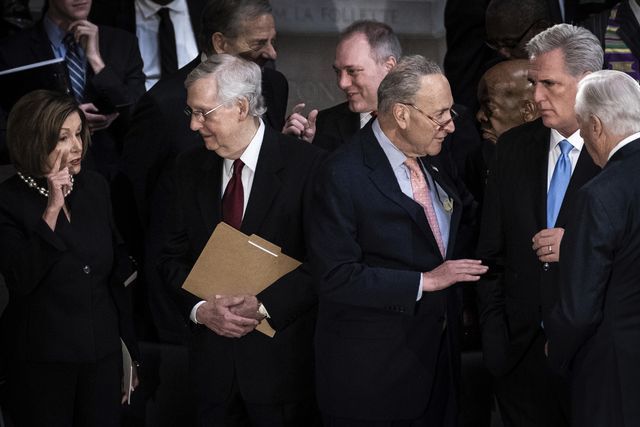
House Speaker Nancy Pelosi (D-CA) talks with Senate Majority Leader Mitch McConnell (R-KY) as Senate Minority Leader Chuck Schumer (D-NY) talks with House Minority Leader Kevin McCarthy (R-CA) and House Majority Leader Steny Hoyer (D-MD) (Erin Schaff/Pool via AP)
The major change from the first version proposed by McConnell and the Republicans last week involved an expansion of unemployment benefits for the rapidly escalating number of workers being laid off as lockdown orders are issued in state after state to try to head off the spread of the coronavirus pandemic.
The number of workers filing new applications for unemployment compensation was expected to jump to more than three million this week, a more than tenfold increase over the previous week but only the beginning of what is expected to be a virtual shutdown of large parts of the US economy over the coming weeks.
Faced with the prospect of levels of unemployment that could exceed those of the Great Depression of the 1930s—and massive social unrest that would result—both Republicans and Democrats agreed on two stopgap measures to stave off an explosion of social struggle by the working class.
The first is immediate and direct federal payments to most Americans, amounting to $1,200 per adult and $500 per child. The payments are to be distributed by the Internal Revenue Service to anyone who filed an income tax return in 2018 or 2019, as well as some of those who were too poor to file, although the exact details of eligibility depend on the final language of the bill, not yet publicly available.
The second measure is a substantial temporary federal supplement to unemployment compensation benefits, which are administered by the states. The federal government will add up to $600 a week to the benefits set by the states, which themselves range on average from under $200 in Mississippi to a high of $515 in Massachusetts. The federal supplement is to last for four months, ending in early August for workers filing claims this week.
The total cost of these two measures is $550 billion—$300 billion for the direct payments and $250 billion for the increase in unemployment benefits. The still leaves the biggest share of the $2 trillion package for corporate and business interests.
Those provisions include $500 billion for corporate bailouts, with about $75 billion earmarked for specific industries, including $50 billion for passenger airlines, $8 billion for cargo airlines, and $17 billion for Boeing (although the company is not named).
Democrats objected to the $500 billion being under the sole control of Treasury Secretary Mnuchin, with even the names of the companies receiving aid to be kept secret for at least six months. They accepted a “compromise” under which auditing is to be carried out by an “independent” inspector-general—the same method employed during the 2008–2009 bailout of Wall Street—and oversight by a five-member panel appointed by congressional leaders.
While corporate borrowers are to be prohibited from stock buybacks and the payment of dividends for a year after the loans are repaid, and will have minor limitations on executive compensation, Mnuchin will have the power to waive those restrictions “upon a determination that such a waiver is necessary to protect the interests of the Federal Government.”
Corporate borrowers will have to commit to maintaining until September 30 the employment levels in place on March 24, but only “to the extent practicable,” another gigantic loophole. They will be barred from cutting employment by more than 10 percent.
More importantly, the $500 billion does not really represent an adequate measure of the scale of the bailout. Besides the $75 billion for transportation, the remaining $425 billion will be used to underwrite lending by the Federal Reserve to companies approved by Mnuchin on a much larger scale, estimated by various analysts as ranging from $2 trillion to $4 trillion.
Another $367 billion is set aside to aid “small business,” although these firms can employ up to 500 workers, a ceiling that will allow many hedge funds and private equity firms to qualify. Trump’s personal holding company, the Trump Organization, would likely have qualified but for a special provision inserted in the bill to make companies owned by the president, vice president or members of Congress ineligible.
Another $50 billion is allocated for an “employee retention tax credit” for businesses that keep workers on the payroll rather than laying them off. The details of this, including which companies will benefit, remain to be clarified.
Nearly $500 billion is to be distributed for the front-line costs of fighting the coronavirus epidemic and other social needs. That sum includes $207 billion for state, local and tribal governments, school districts and public transit agencies; $130 billion for hospitals and public health facilities; $45 billion for the Disaster Relief Fund of the Federal Emergency Management Agency; and $41 billion to pay for additional personal protection equipment for health care workers and to replenish the national emergency stockpile of such materials.
There are lesser amounts for bailouts of farmers hit by Trump’s trade war with China and for other social services, including food stamps, child nutrition, allowing students to defer loan payments for six months with interest waived, and waiving Pell grant restrictions for students forced to leave school because of coronavirus-related closures. There is even $100 million for the National Endowment for the Arts and the Kennedy Center for the Performing Arts, a provision that set off howls from the ultra-right media, although it represents 0.005 percent of the massive bill.
In sum, the spending breaks down into three major components: about $1 trillion for corporate and business interests (although with the Fed’s lending, this could climb to $2.5 trillion); about $500 billion to keep the US population from starving over the next four months; and about $500 billion more directly linked to the effort to contain the pandemic.
The money to support state governments—hit by huge drops in tax revenues just at the point when they must spend more to fight the coronavirus—is not distributed according to need, but according to a political formula that reflects the intrinsic inequities of the Senate, where every state has two votes, regardless of population.
The bill distributes $60 billion in the form of $1.2 billion for each of the 50 states, with the remaining $90 billion distributed based on population, so that New York receives less than Texas, even though it has 30 times as many coronavirus cases.
This slap in the face to the people of New York did not faze Senate Minority Leader Schumer, one of two senators from New York state. In remarks just before the final series of votes, Schumer praised the bill, claiming it would save “millions of small businesses and tens of millions of jobs.” His real concern—like that of all the other senators—was that the corporate bailout and the temporary relief checks to millions of workers would help safeguard the wealth and power of the US financial aristocracy.
One event before the bill’s passage illustrated the vast class divide between the ruling elite and the working people who are the vast majority of the American population. Four Senate Republicans began howling that the price of the bonanza for corporate America was too great. They did not object to the $500 billion for big companies. What stuck in their craw was the unemployment compensation payments to workers whose jobs have been wiped out by the lockdown of half the United States, which they regarded as excessive.
At a remarkable press conference Wednesday afternoon, the four Republicans—Ben Sasse of Nebraska, Tim Scott and Lindsey Graham of South Carolina, and Rick Scott of Florida—inveighed against the unemployment compensation payment of $600 a week. They issued a statement declaring that the payment was a “strong incentive for employees to be laid off instead of going to work.”
Graham and Scott said that with their state’s average unemployment compensation of $360 a week, workers laid off because of coronavirus would be entitled to $960 a week in combined state and federal aid, the equivalent of $24 an hour for a 40-hour work week. They complained that South Carolina employers would be unable to find workers who would take jobs at the usual pay level for the state, a notorious low-wage haven.
Ben Sasse, of a more philosophical bent, declared that the unemployment compensation provision threatened to “disrupt the employer-employee relationship”—Karl Marx called it wage slavery—and was therefore un-American.
But the most revealing comments came from Rick Scott of Florida, a former corporate CEO in the health care industry, who claimed that small businesses could not survive if workers were unwilling to work for low wages because they could make more on unemployment pay. One reporter apologized for asking him, “Do you understand how bad the optics are to have probably the wealthiest person in the Senate potentially holding up this bill for a couple hundred bucks for some of the poorest people in this country?”
The four threatened to use procedural obstacles to slow passage of the bill, thus giving Vermont Senator Bernie Sanders the opportunity for a bit of “left” demagogy. He threatened that if they objected to the unemployment compensation section of the bill, he would raise objections to the corporate bailout. In the end, the four settled for a recorded vote on an amendment by Sasse, which was defeated, and Sanders joined in the bipartisan vote to approve the bill.