27 Mar 2020

Brazil’s Bolsonaro threatens dictatorship over COVID-19 crisis

Miguel Andrade

In a nationally televised broadcast Tuesday night, Brazil’s fascistic President Jair Bolsonaro stepped up the campaign of attacks on the working class unleashed by the ruling elite since the first cases of the new COVID-19 disease were recorded in the country’s largest city, São Paulo.
Just one month after the first case was detected, Brazil has 2,915 confirmed cases and 77 deaths. The Health Ministry admits that this is a gross underestimate, as only patients with serious symptoms are being tested. A London School of Hygiene and Tropical Medicine study found that under-reporting in Brazil is likely as high as 90 percent, bringing the total cases to 30,000.
Tuesday was the first day of decrees ordering the shutdown of retail stores in the country’s most populous state, São Paulo, and in Rio de Janeiro, the second largest city in the country, as all states have shut down schools, and several others have ordered partial shutdowns in other sectors.
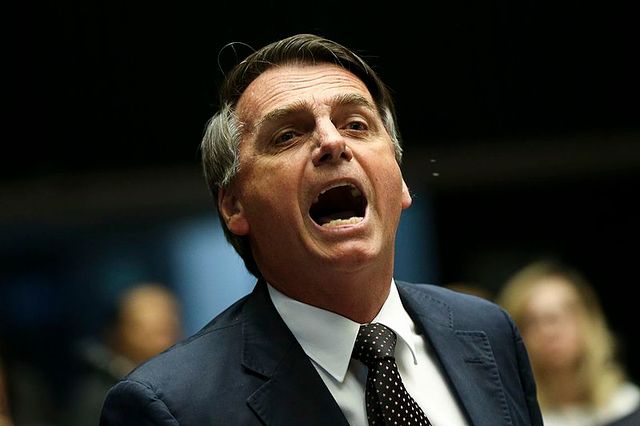
Jair Bolsonaro (Wikipedia Commons)
In his address, Bolsonaro called press reports on the number of dead in Italy “panic-mongering,” saying that the pandemic would be over “soon” in Brazil and calling the partial retail shutdowns across the country a “scorched earth” policy that should be abandoned.
He dismissed medical evidence to claim that “90 percent” of the infected “would feel nothing” and that he, in particular, “with a history of athletics,” would at most feel the symptoms “of a little cold.”
The next day, Bolsonaro told reporters gathered in front of the Alvorada presidential palace that the quarantine measures would result in chaos “that would dwarf what was seen in Chile,” where millions of workers took to the streets against social inequality. He warned darkly that this “might spell a break with democratic normalcy that you [the press] defend so much.”
This threat of a coup was anticipated days before when Bolsonaro declared that “it would be easy” to decree a state of siege and suspend the constitution in the case of social unrest caused by the pandemic.
The world over, the ruling classes are using the catastrophic socioeconomic toll of the pandemic to amass huge wealth through bailouts and quantitative easing and to intensify the exploitation of workers threatened with having no money to eat.
But few rulers have spelled out this attitude in such a cruel and blunt fashion as Brazil’s Bolsonaro. Even more criminal declarations have been offered by businessmen, with the heir of one of Brazil’s largest fast food chains saying that workers should fear unemployment more than COVID-19.
With 23 members of his entourage on a visit to US President Donald Trump’s Mar-a-Lago, Florida resort in early March testing positive for the coronavirus, Bolsonaro has refused to reveal documents on his own diagnosis, citing his lack of symptoms as proof of his thesis that the disease is not serious and implying that he would somehow be invulnerable to the disease.
Having founded in late 2019 his new fascist “Alliance for Brazil” party, based on “loyalty to his principles” and the belief that his presidency is a fulfillment of divine providence, Bolsonaro has sought to make the issue of his health a means of solidifying support among his far-right base.
He has repeatedly sounded this theme since his endorsement of and attendance at the March 15 fascist marches drawing thousands of his supporters to call for the Army to close down Congress and the Supreme Court in order to grant him unlimited powers. A central theme of these marches was a denial and mockery of the pandemic.
Army Commander Gen. Leal Pujol on Wednesday said that the Army High Command faces in the pandemic “the greatest challenge of its generation.” Bourgeois editorialists have chosen to paint this statement in rosy colors and claim, without a shred of evidence, that, in the words of leading pundit Maria Cristina Fernandes, “the Army has shown it will not act as Bolsonaro’s praetorian guard.” Indeed, it may rather signal that the military is once again considering whether to seize power.
For its part, after initially dismissing the pandemic as an “excuse” used by Bolsonaro for the economic stagnation that has plagued Brazil during his term, the Workers Party (PT) has now sought to exploit the coronavirus pandemic as an opportunity to curry favor with dominant factions of the ruling class, especially those dissatisfied with the dead end of Bolsonaro’s unprecedented attempt to subordinate Brazil’s foreign policy to the interests of US imperialism.
The PT’s leader, former president Luiz Inácio Lula da Silva, declared on Wednesday that Bolsonaro lacks the “psychological conditions” to rule and should be impeached or resign. This was a nod to the declaration days earlier by former Bolsonaro allies that he should be evaluated by a medical board and declared unfit for office, as an impeachment would be “too painful.”
The whole of the ruling class is united on imposing upon Brazilian workers the choice of either getting sick and infecting their loved ones or starving to death. One recent report found that 10 million workers in the country’s slums have no savings whatsoever and would lack money for food after a one-week lockdown. The quarantine measures will do little for a population crammed with three generations of relatives into single-bedroom homes in the densely packed settlements.
These conditions can only lead to an explosion of class struggle. Bolsonaro’s ravings are an expression of the desperation of the Brazilian ruling class as it prepares for unprecedented acts of repression.

Horn of Africa and East Africa face coronavirus and locust swarm

Jean Shaoul

Just as the coronavirus takes hold in Africa, threatening the impoverished continent’s entire population, a serious outbreak of locusts is spreading across parts of East Africa and into the Horn of Africa. The outbreak poses an unprecedented threat to food security in some of the world’s most vulnerable countries.
Cases of the coronavirus virus have been reported in Ethiopia, Sudan, Somalia, Kenya, Uganda, Djibouti, with most countries closing their borders, banning international flights, imposing shelter at home orders and lockdown.
As most African countries lack the means to test suspected cases, World Health Organisation (WHO) director Tedros Adhanom Ghebreyesus has warned that official numbers are probably an underestimate of the scale of infection. He said, “Probably we have undetected cases or unreported cases. In other countries we have seen how the virus actually accelerates after a certain tipping point, so the best advice for Africa is to prepare for the worst and prepare today.”
Endemic poverty, the lack of adequate health infrastructure in working class areas, in the overcrowded shanty towns, slums and the countryside—as well as in the refugee camps (home to 18 million refugees, 26 percent of the world’s refugee population), where “social distancing” is an impossibility—and the prevalence of AIDS and tuberculosis together signal a humanitarian catastrophe for the region and the continent as a whole.
This crisis is now magnified by the hugely dangerous increase in locust swarm activity that broke out in January in Kenya, its worst such invasion in 70 years. After periods of exceptionally prolonged and heavy rain following a dry spell, the insects, approximately the length of a finger, fly together in millions to take advantage of the suddenly abundant food supply, devouring crops, destroying grazing plots and threatening food production and local economies. This year’s swarm was triggered by the Indian Ocean Dipole, a naturally occurring but increasingly frequent phenomenon due to climate change that has caused extreme drought in Australia and led to torrential rain in East Africa.
At least one swarm measuring 60km (37 miles) long and 40km (25 miles) wide in Kenya’s northeast—three times the size of New York City—has been reported.
According to the UN’s Food and Agriculture Organisation (FAO), desert locusts, the most dangerous of locust species, can, with the aid of the wind, travel up to 150km (95 miles) in a day and eat their own body weight in greenery. A swarm just one kilometre square, equal to 40-80 million insects, can eat as much food as 35,000 people in a day.
Some 80 percent of the population in the Horn, a region long synonymous with famine, conflicts and refugees, relies on agriculture for subsistence, meaning that the consequences will be devastating for the already vulnerable population. Moreover, under the right conditions, locusts can multiply 20-fold in three months. According to the science journal Nature, widespread breeding is in progress and new swarms of locusts are forming in the region with Kenya, Ethiopia and Somalia facing the biggest risk, although Sudan, Djibouti, Eritrea, South Sudan, Sudan and Uganda are also affected.
Nature points out that swarms have crossed the Red Sea to Yemen and Saudi Arabia and even reached Iran, Pakistan and India, threatening the food supplies of 20 million people later this year as well as the destruction of grazing for livestock.
As Keith Cressman, FAO Senior Agricultural Officer in the Plant Production and Protection Division, explained, “The new generation swarms will coincide with the planting season in the East African region, which normally starts at the end of March and early April.”
Farmers will not be able to plant or will delay planting, which will affect harvests. Cressman fears that by June the desert locusts will have increased their numbers 400-fold, with terrible impacts. It cost a massive $600 million to bring the situation under control in the last upsurge in 2003-5.
Last month, the FAO said the desert locust hopper bands were destroying tens of thousands of hectares of crops and grazing land in North East Africa, creating a dangerous situation for the region and eastern Ethiopia in particular. This prompted Somalia and Pakistan to declare a state of emergency. One swarm has even reached the eastern boundaries of the Democratic Republic of the Congo, which has not seen a locust invasion since 1944 and is still grappling with a civil war and Ebola and measles outbreaks.
Control of locust swarms depends upon the use of chemical pesticides and naturally occurring fungal spores, which require aerial spraying that is costly and reliant upon infrastructure and access to the areas where the locusts congregate.
The measures being taken across the region to control the coronavirus pandemic, particularly airport closures and reduction or suspension of international flights, have wreaked havoc with supply chains, hampering the fight against locusts. This has served to heighten the threat to food security as well as relief efforts at the worst possible time.
With few flights operating, airlifted cargo fell by 14 percent between January and February in Kenya alone. The cost of shipping pesticides has risen threefold and the delivery of pesticides and equipment has been delayed. According to the FAO, the delivery of eight helicopters and pesticides to East Africa will be delayed, while European and Australian experts are considering how to provide remote help to the fight, given that they cannot travel.
Cyril Ferrand, the FAO’s Eastern Africa Resilience Team Leader, said, “The fight against an already critical desert locust outbreak is getting harder.” The infestation in East Africa continues to present “an unprecedented threat to food security and livelihoods, especially as the cropping season begins.”
In January, the FAO issued an appeal for $76 million to help combat the locust outbreak that elicited less than half of the required amount even as the crisis escalated. The FAO has now upped the call to $138 million. The World Food Program (WFP) estimates that without it, the cost of responding to the impact of locusts on food security alone would be at least 15 times higher.
The UN has warned that some 6.5 million people in South Sudan—more than half of the population—could be in acute food insecurity at the height of this hunger season (May-July). Cyril Piou, an expert with the French Agricultural Research Centre for International Development, warned that whereas locust outbreaks typically lasted about two years, without preventive systems they will last longer, happen more frequently and spread further. He said, “We are all linked in some way, what is happening somewhere else affects us all.”
The response to such disasters must extend across national borders. As with every other social problem—including ever-widening social inequality, accelerating climate change and the heightened threat of war—the locust swarms are a global problem that requires an international solution that must not be held hostage to the non-existent largesse of the capitalist governments and the corporations and banks they represent.
Riven by national divisions and the scramble for geopolitical power, they are incapable of any systematic or planned response to the threats facing humanity, be they locust plagues, infectious disease or extreme weather events and climate change. They will only contribute if they can use “aid” to extract concessions favourable to themselves.
The science, technology and productive capacity exists to solve these great social problems and, under a rational and coordinated democratic planning of the world economy, rapidly improve the living standards and quality of life for the world’s population. But only the international working class, through the unified struggle for world socialism, can achieve this goal.

COVID-19 pandemic: Doctors sue French government for criminal negligence

Anthony Torres & Jacques Valentin

With thousands of dead and 29,155 confirmed COVID-19 cases in France, thousands of health-care professionals infected, and six doctors already dead of the disease, anger against the government among workers and medical staff is mounting. Like governments across Europe, the French government downplayed the disease and deliberately withheld critical information from the public.
In response, hundreds of health-care professionals are filing a suit charging top officials with criminal negligence.
A scandal erupted after ex-Health Minister Agnès Buzyn spoke to Le Monde, blaming Prime Minister Édouard Philippe for not calling off the March 15 first round of municipal elections, the second round of which has since been canceled, and for downplaying her warnings on the pandemic. It appears the interview was an attempt by Buzyn to shift criminal responsibility off her shoulders and onto those of Philippe and French President Emmanuel Macron.
Buzyn was following events in China, she said, and “on December 20, an English-language blog reported a strange pneumonia. I alerted the general health directorate. On January 11, I sent a message to the president. On January 30, I warned Édouard Philippe that elections could probably not be held. I was chomping at the bit.”
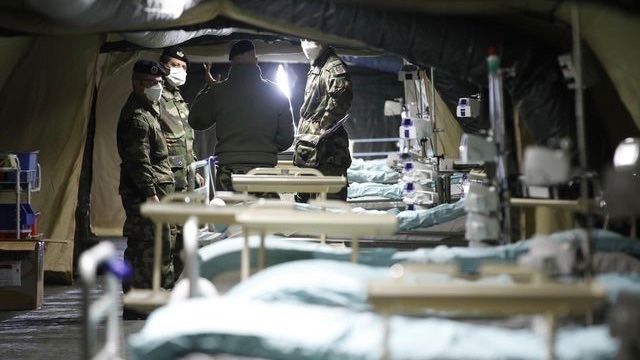
French soldiers discuss inside the military field hospital built in Mulhouse, eastern France, to treat coronavirus patients (AP Photo/Jean-Francois Badias)
Buzyn made clear that top French officials knew and hid the fact that by not calling for a lock-down to stop COVID’s spread, they were exposing themselves and others to mortal danger. When she left the health ministry to briefly run for Paris mayor, Buzyn said, “I was crying, as I knew a tsunami was coming. I left the ministry knowing elections would not be held. From the start I was thinking of just one thing: the coronavirus. We should have stopped everything. We were playing a masquerade. The last weeks were a nightmare. Every time I went to a public meeting, I was terrified.”
After all of this, Buzyn confessed, “There will be thousands of deaths.”
Buzyn’s confession terrified the Macron government and its allies, including Jean-Luc Mélenchon of the petty-bourgeois Unsubmissive France (LFI) party. Shocked, he wrote a Facebook post asking: “Why is she saying this now, when it is too late? Does she not realize that she is raising the criminal liability of both herself and the other people she is claiming she warned?” Mélenchon proposed to drown the scandal in an “information session” of the National Assembly.
In fact, the entire ruling elite, including all factions of the capitalist political establishment in France and across Europe, are responsible for decades of austerity that devastated health systems, and for not challenging Macron’s politically criminal inaction in the initial weeks of the pandemic. As late as March, government spokespeople were comparing COVID-19 to the flu and insisting that workers should not confine themselves at home but go to work to make profits for the banks.
A growing international mobilization of the working class has transformed this situation, however. Wildcat strikes erupted across Italy and tens of thousands of industrial workers walked off the job in France and across Europe, forcing state officials to grudgingly approve confinement measures.
As the death toll has mounted among the population and health staff, growing anger and disillusionment with the Macron government has pushed health-care professionals to file suit against Philippe, Buzyn and other officials.
Several hundred doctors and health staff represented by the lawyer Fabrice di Vizio have filed a suit to the Court of Justice of the Republic (CJR), which has jurisdiction to investigate high crimes by top officials.
Di Vizio said that his clients were suing based on Article 233, part 7 of the Criminal Code, which stipulates: “Anyone who voluntarily abstains from taking or launching measures that would allow, without risk for himself or third persons, for fighting a catastrophe that could threaten physical persons is punished with two years in jail and a 30,000 euro fine.”
Di Vizio pointed to the growing anger of health staff as they discovered that the government’s various assurances about protective equipment like face masks were lies. He said, “The government told them at the end of February that the masks would arrive. At the beginning of March, when they understood that the masks were not coming, they started hearing from the government that masks were not really needed… In fact, this was simply an admission of impotence and a lie. The plain truth is that the government had stocked no supplies.”
French firms are producing face masks, di Vizio added, but the British government placed its orders first. For virtually the entire month of March, as a result, French medical staff did not receive any of them. Nicolas Brillat, an executive at one of these firms, made clear the blame lay with Macron. “We had been telling the French authorities for six weeks that there would be a problem,” he said.
Di Vizio pointed to the significance of Buzyn’s interview in Le Monde: “Now a criminal inquiry is indispensable, to bring to light the extent of what was hidden from the French people and to determine the role and responsibility of each official in this health catastrophe.” The lawyer called for “the health ministry’s internet servers to be impounded and searched.”
A fight to hold government ministers accountable for their actions in the COVID-19 pandemic has wide support in the working class. Polls show that 70 percent of the French population does not believe that the Macron government is telling the truth about the pandemic. However, the task of holding them to account cannot be left to the courts, but requires the political mobilization of the working class, independently of pseudo-left supporters of Macron like Mélenchon.
Bitter historical experience shows that the CJR, which would likely take years to rule on such a case, will not by itself redress the wrongs produced by high-level state criminality.
The last time this court was invoked was over the 1980s tainted blood scandal. Under Socialist Party (PS) President François Mitterrand, the National Center for Blood Transfusion (CNTS) knowingly used blood transfusions infected with the AIDS virus, wiping out France’s hemophiliac population. Then-Prime Minister Laurent Fabius’s PS government wanted to avoid using US companies’ equipment to test for the AIDS virus. It delayed all screening of the blood until French firms could make such equipment, by which point the blood supply was hopelessly contaminated.
The General Inspectorate of the Health Administration concluded in its report that health protection was subordinated to economic considerations. Fabius, former PS Social Affairs Minister Georgina Dufoix, and former PS Health Minister Edmond Hervé all faced trial, nearly 20 years after the fact, before the CJR on charges of “involuntary manslaughter.” Thanks to the extensive rewriting of French laws that had taken place in the intervening period, however, Fabius and Dufoix were both found innocent. Hervé was found guilty on two counts but received no sentence.
Today, the crimes of the ruling class are unfolding on a far larger scale. Workers in Europe and internationally are faced with the challenge of struggling to ensure an effective fight against the disease, and to take power from a financial aristocracy that has irrefutably demonstrated its political criminality.

Europe’s COVID-19 death toll reaches over 16,000

Robert Stevens

Deaths due to COVID-19 continued to increase throughout Europe yesterday with 2,219 new fatalities across the continent. Total deaths now stand at 16,395, with 15,556 of these within the European Union’s 27 member states.
Overall COVID-19 confirmed cases are approaching 300,000 in Europe, with 34,644 new cases, for a total of 283,242.
Years of slashing health and social care budgets, together with government inaction in combating the spread of the virus, have taken a grim toll, with health workers forced to make decisions as to who lives and dies.
Italy and Spain have the most fatalities in the world. In Italy, a further 622 lives were lost as the toll leapt above 8,100. The total number of cases rose by 8.2 percent to 80,589. The number in intensive care treatment rose to 3,612 from 3,489 in 24 hours.
With the 498 deaths recorded in Spain yesterday, more than 4,000 (4,145) have died of the coronavirus. The virus is taking more lives in Spain in a faster period than it did in Italy. In just 19 days Spain went from 10 to 4,089 deaths. In Italy the same leap took 25 days. From 100 cases to 56,000 took four days in Spain compared with 28 days in Italy.
Local newspaper Eco di Bergamo features several pages of obituaries in its March 17, 2020 edition, in Mediglia, Italy (AP Photo/Luca Bruno)
Madrid is the epicentre of the pandemic in Spain. Reports attest to the dreadful circumstances facing health workers. Bloomberg noted, “In the emergency room at one of Madrid’s biggest hospitals, [Dr.] Daniel Bernabeu signed the death certificate for one patient and immediately turned to help another who was choking.
“People are dying in waiting rooms before they can even be admitted as the coronavirus pandemic overpowers medical staff. With some funeral services halted in the Spanish capital and no space left in the morgues, corpses are being stored at the main ice rink.”
In France there were 3,922 new cases and 365 deaths—the largest daily increase so far. Hospitals in the Paris area and in Strasbourg, in the hard-hit Alsace region of eastern France, are overflowing and starting to turn away likely COVID-19 patients.
In the Paris Public Hospitals (AP-HP) system, 628 staff, including 40 percent of doctors, have contracted the illness but many must continue working due to staff shortages. A doctor at Bichat hospital said, “There are no more beds anywhere. … We will look for personnel everywhere and rapidly train medical students starting in the fourth year to replace the nurses we are now missing.”
Brigitte Klinkert, president of the Haut-Rhin department that includes Strasbourg, confirmed to German media that hospitals in the city are so overwhelmed that they routinely refuse to give patients over 75 or even over 70 access to respiratory care. Health staff are forced to decide which patients will live or die. A nurse in Strasbourg’s university hospital centre (CHU) said, “Personnel are exhausted, physically and morally. At the CHU, 238 staff are infected. More and more staff can’t work, and we don’t know how to handle it.”
The death toll continues to rise in Britain, with fatalities up by 115—the first time deaths have jumped to more than 100 in a single day. There are now 578 dead from 11,658 confirmed cases.
As well as killing many with underlying illnesses—a constant threat to millions given that 43 percent of the UK population has a long-term health issue—the virus is taking the lives of young people with no reported health problems.
On Thursday it was confirmed that Chloe Middleton, a 21-year-old woman from High Wycombe, Buckinghamshire—and the youngest victim of the disease in the UK so far—had no underlying health problems. Even younger people are being struck. A 10-year-old girl from Plymouth was diagnosed with coronavirus. The child had a temperature of almost 107f, which caused her to start convulsing. She did not have the persistent dry cough and is one of a growing number who have contracted COVID-19 without one of the main recognised symptoms.
The Johnson Conservative government, having done nothing for weeks as it planned for the population to be infected by the tens of millions in its “herd immunity” policy—is preparing for mass deaths. It has deployed the military to help transform London’s Excel conference and events centre into a 4,000-bed hospital, including two emergency morgues. Yesterday the army delivered oxygen supplies to the centre ahead of its opening on April 4 when an initial 500 patients will be treated. Nearby London City Airport is closed to civilian flights to enable military planes to fly in and out.
According to reports, similar “field hospitals” will be created in major UK cities, including at the National Exhibition Centre in Birmingham and Manchester’s Convention Centre. Sky News reported that a temporary mortuary is being set up at a British military site in Belfast “to cope with an anticipated spike in coronavirus deaths.”
This week saw the deaths of the first two prisoners in Britain—an 84-year-old man at Littlehey prison in Cambridgeshire and a 66-year-old man at Strangeways, Manchester.
The callous attitude of the Tory government towards National Health Service (NHS) workers on the front line trying to save lives—many still without personal protective equipment—was made clear in the comments of chief executive of NHS Providers, Chris Hopson, that London hospitals were facing a “continuous tsunami” of coronavirus patients. He warned, “The CEOs [of the various NHS providers] are concerned that all that extra capacity is now being used up very, very quickly. We’ve got the surge capacity at the ExCel centre but this is filling up very quickly.”
Due to there being no social distancing in place for weeks, and a government policy not to test NHS staff, many are ill having possibly contracted COVID-19 and are in self-isolation at home, with up to 50 percent of staff off sick in some London trusts.
On Thursday at 8 p.m., people around the UK—replicating what has been done in other countries—clapped and cheered NHS workers from their doors, windows and balconies, with others coming into their streets to do the same as part of a “Clap For Our Carers” campaign. In a staggering show of hypocrisy, Prime Minister Boris Johnson and Chancellor Rishi Sunak emerged from Number 10 and 11 Downing Street to join the applause.
Shortly after, on the BBC’s “Question Time” TV show, Richard Horton, the editor-in-chief of the Lancet medical journal said the situation was “a national scandal. We shouldn’t be in this position. We knew in the last week of January that this was coming. The message from China was absolutely clear that a new virus with pandemic potential was hitting cities ... and people admitted to intensive care units and dying and the mortality was growing.
“We knew that 11 weeks ago. And then we wasted February when we could have acted. Time when we could have ramped up testing, time when we could have got Personal Protective Equipment ready and disseminated. We didn’t do it.”
Speaking of Johnson and Sunak, he said, “The hypocrisy of clapping NHS workers and yet not supporting those NHS workers when they go into that front line is tragic and it was preventable.”
In Britain, employers are able to tap a pool of £350 billion for starters, with “unlimited” funds pledged by Sunak. In contrast, with more than 1 million workers already laid off, in the space of a week over 500,000 thousand people have been forced to apply for £73 a week via the Universal Credit benefits system. Many were forced to give up trying, as claims can only be made online and they were faced with a queue of 145,000 others waiting to log on to the website.
Those attempting to make contact regarding their claims failed, despite also calling by phone, in some cases, between 80 and 100 times. Even if laid off and redundant workers do succeed in making a claim, the brutal UC system means they will wait at least five weeks to get a first payment.

Bipartisan corporate bailout gives $17 billion to Boeing

Bryan Dyne

The bipartisan corporate “rescue” package awaiting approval by the House of Representatives carves out of its more than $1 trillion in taxpayer handouts to large businesses some $17 billion for airplane manufacturer Boeing. The company’s cut is part of a $75 billion bailout of the airline industry as a whole.
Though Boeing is not explicitly named in the bill, the provision of $17 billion for commercial air companies that are “important to maintaining national security” is deliberately worded to apply to the nation’s biggest airplane manufacturer and second biggest defense contractor. In a recent press conference, Trump underscored the special treatment for Boeing, saying, “Yes, I think we have to protect Boeing. We have to absolutely help Boeing.”
The company may also have the opportunity to draw from the $500 billion set aside for corporate bailouts in general.
Boeing shares rose more than 25 percent on Wednesday on the heels of the unanimous Senate passage of the bailout bill in the early morning hours. They extended their gains by an additional 15 percent on Thursday, closing at $180. The company’s shares have risen four straight days in anticipation of adoption of the gargantuan fiscal measure. Its share price had fallen from a high of $440 in March of 2019 to a 52-week low of $89 this year.
The rescue of Boeing by the federal government comes one year after the grounding of Boeing’s flagship 737 Max 8 aircraft in the wake of two crashes—Lion Air Flight 610 outside of Jakarta, Indonesia and Ethiopian Airlines Flight 302 from Addis Ababa, Ethiopia. Both occurred shortly after takeoff as a result of a fatal design defect and the company’s rush to bring the new plane onto the market.
To date, no executive who oversaw production of the plane or regulatory official who approved it has been charged, much less prosecuted, for the development, manufacture and marketing of the deadly plane and the death of 346 passengers and crew on the two flights.
As has now been proven, the crashes were caused by a piece of software known as the Maneuvering Characteristics Augmentation System (MCAS). It was installed by Boeing to compensate for the Max 8’s tendency to stall, a byproduct of attaching a newer, larger engine onto the half-century-old Boeing 737 chassis.
The aerospace giant used an old airframe in order to save time and money in bringing to market a new model to compete with European-based Airbus for market share and profit, particularly in the expanding Chinese market. It sold the plane to airlines with the claim that 737 pilots required little additional training, such as flight simulator training, to fly the new model.
In the aftermath of the crashes and the grounding of the Max 8—which both Boeing and the Federal Aviation Administration (FAA) initially opposed—a myriad of reports from aviation safety agencies internationally and leaked internal emails from Boeing employees and officials have established that the company was well aware of the dangerous flaws in the aircraft, but carried out a cover-up in order to get the plane into the air.
The 737 Max 8 disaster has caused a sharp drop in Boeing’s income and share value over the past year. The company’s airplane sales plummeted from 893 in 2018 to just 54 in 2019, and it shuttered its production of the Max 8 aircraft in January. It has also been forced to borrow $13.8 billion to cover some of the estimated $20 billion lost in the wake of the grounding. At the same time, airlines have massively reduced the amount of new planes they are buying in response to the drastically reduced demand for air travel stemming from the pandemic.
Boeing officials claim that the cash infusion from the government “will be used for payments to suppliers to maintain the health of the supply chain.” However, its actions in the wake of the 2008 bailout of Wall Street indicate that the bulk of the money will go to push up Boeing stock and the wealth of executives, hedge funds and major shareholders, which is tied to the massive inflation of share values.
From 2014 to 2019, it spent just under $60 billion on stock buybacks and dividends, all of which went into the pockets of its wealthy investors and top shareholders. This includes ex-CEO Dennis Muilenburg, who oversaw the introduction of the deadly Max 8 jet.
It is worth noting that the $60 billion figure equals what Boeing requested from the government last week. In a statement, the firm said it “supports a minimum of $60 billion… for the aerospace manufacturing industry.” Boeing would receive the lion’s share of any such bailout.
The massive sums being provided to Boeing sharply contrast with the pittance the corporate giant has provided for the 346 families that lost loved ones in the two crashes. Each received a mere $144,500 per crash victim from an account that is overseen by notorious Wall Street “fixer” Kenneth Feinburg. He is acting to defend the airplane manufacturer’s profits and refurbish its public image.
The money to the crash victims also pales in comparison to the money made by the current suite of Boeing executives who sold off a great deal of stock just before the markets began to tank at the end of February and beginning of March. These include President and CEO of Boeing Defense Space & Security Leanne Caret, who sold $5.9 million worth of stock, Executive Vice President Ted Colbert ($2.4 million), Senior Vice President B. Marc Allen ($2.3 million) and President and CEO of Boeing Commercial Airplanes Stanley A. Deal ($2.5 million).
During this same period, these executives rewarded themselves with gifts of stock worth, at their 2019 height, $3.9 million, $2.3 million, $1.7 million and $4.0 million, respectively. At least nine other members of Boeing’s leadership received similar sums in the past month.
Boeing’s major investors also stand to make a killing off the company’s rising share prices. These include The Vanguard Group, Inc., which currently owns $11 billion in shares, Newport Trust Co., with $8.4 billion, and T. Rowe Price Associates, Inc., holding $8.2 billion. If Boeing’s stock returns to its previous values, these companies stand to more than double the value of what they currently own.

New US unemployment claims hit 3.28 million as pandemic produces economic catastrophe

Shannon Jones

New weekly claims for unemployment insurance, as reported by the US Department of Labor for the week ending March 21, give a glimpse of the social catastrophe that is developing for tens of millions of workers due to the COVID-19 pandemic.
New filings for state unemployment benefits in the US surged to a record 3.28 million last week, seasonally adjusted. The total was the highest one-week number of new claims ever recorded, and more than four times the previous record of 695,000 initial claims in October 1982. The number for the previous week was just 282,000, so jobless claims increased by more than 1,000 percent from week to week.
The jump came as states imposed stay-at-home orders and cases of COVID-19 surged across the US, overwhelming hospitals. The number of coronavirus-related death total in the US is now over 1,100 and rising rapidly.
There is reason to believe that the number of new claims would have approached four million, but for the website of New York state, currently the center of the COVID-19 pandemic in the US, crashing due to the crush of new applications. The state reported only 80,334 new claims, a vast underestimate. New York City Mayor Bill de Blasio predicted that 500,000 city residents would lose their jobs due to the coronavirus, to say nothing of those in the suburbs and upstate.
Pennsylvania had the largest number of new unemployment claims actually recorded, 378,908, as the state closed schools and businesses due to the pandemic. According to reports, there have been a staggering 650,000 unemployment claims in the state in the last 11 days. By the end of this week that total is expected to reach 800,000. Governor Tom Wolf asked all “non-life-sustaining” businesses to close as the state’s confirmed COVID-19 cases surged past 1,600.
Pennsylvania was followed by Ohio with 187,784 claims, according to a state estimate. There were 867 reported coronavirus cases in Ohio by Thursday, with 223 people hospitalized and 91 in intensive care, with that number expected to soar. Lieutenant Governor Jon Husted said that the state’s unemployment website had recorded 1.7 million hits in the last five days.
California saw 186,809 new unemployment claims last week, up from an already elevated 57,606 claims the previous week. California now has over 3,000 reported cases coronavirus and that number is doubling every three to four days, with a mandatory stay-at-home order in place.
Michigan had 129,298 new jobless claims and Massachusetts had 147,995. Both states are under lockdown orders. Michigan had some 2,856 coronavirus cases through Thursday and its death toll has passed 60. Texas and New Jersey each had over 155,000 new jobless claims. COVID-19 numbers are surging in both states.
Washington state, another center of the pandemic, had 133,478 jobless claims. There are more than 2,500 COVID-19 cases in the state and nonessential businesses have been asked to cease operation. Boeing shut down its Seattle-based operations Wednesday for two weeks.
In Rhode Island, one in 15 workers, 6.4 percent of the workforce, sought benefits after the state banned all on-premise consumption at eating establishments and bars. In Nevada, nearly six percent of the state’s workforce filed claims as the state’s gaming industry was shut down for 30 days by order of Governor Steve Sisolak.
It should be stressed that all these numbers significantly understate the economic impact of the COVID-19 pandemic on the US population. The surge in new unemployment claims has overwhelmed state unemployment offices, for the most part already significantly understaffed and underfunded due to cuts, meaning many claimants were unable to file. In many cases, phone lines were jammed and websites overloaded. Those unable to file will show up in future numbers.
Further, according to Labor Department procedures, those unemployment offices that fail to file their reports on time, perhaps because they are overloaded, are not counted at all in the official numbers. In addition, many millions more workers in the so-called gig economy are not eligible for regular state unemployment compensation because they are classified as self-employed. Students, undocumented immigrants, those who have worked less than six months in the year and those classified as seasonal also are not eligible.
Due to reactionary changes in state unemployment regulations, the proportion of workers eligible for benefits has steadily declined over the years. These changes have included drastic shortening of the period workers may claim benefits, onerous work search requirements and high earnings thresholds. As a result, considerably fewer than half of those presently unemployed receive unemployment benefits.
This is only the initial sign of a massive shock wave hitting the US economy and disrupting the lives of masses of people. Keith Hall, former director of the Congressional Budget Office and an advisor to George W. Bush, said, “We have not seen this big of a free fall before, not even during the Depression. It’s really like an instant great recession.” He estimated that the official unemployment rate could hit the Great Depression level of 20 percent.
Another economist estimated that if one half the workers in restaurants and retail trade lost their jobs, unemployment could jump by 10 percent to 13 percent. That is well above the post-Depression high of 10.8 percent during the 1981-82 recession.
It is not known at this time how many jobs will be impacted. As a result of the 2008 economic crash, some 26 million jobs were eliminated. The present crisis could exceed that, and in a much shorter space of time.
Paul Goldsmith-Pinkham, an analyst with Yale, and Aaron Sojourner with the University of Minnesota, said that initial jobless claims for the current week could reach 4.7 million. They based their assessment on an analysis of internet search data.
With the crisis still in its initial stages, the profit-driven capitalist system has been utterly unable to respond in a systematic and rational manner to the challenge posed by the pandemic. After ignoring or minimizing the danger from months, the US government, like capitalist governments all over the world, has responded in an improvised and patchwork manner aimed above all at protecting the interests of the big corporations.
The temporary shutdown of nonessential businesses, made necessary by the failure to isolate and contain the spread of the virus early, portends untold suffering and hardship for wide sections of the population already surviving at bare subsistence levels. For millions of workers, the loss of even one weekly paycheck can mean the difference between economic survival and disaster.
Low-wage workers, who predominate in the sectors such as retail and restaurants hardest hit by the virus-related shutdowns, are also the least able to cope, often lacking health benefits and just keeping their heads above water.
Economists predict a wave of bankruptcies and foreclosures to follow in the wake of the massive job cuts. Many of the businesses closed due to the pandemic will likely never reopen. A huge decline in GDP is expected on a scale again not seen since the Great Depression.
The blundering and outright criminal character of the response of the US and other capitalist governments to this catastrophe poses sharply the need for the working class to intervene independently to defend its class interests and the interests of society as a whole. A rational and humane solution can only be found through the fight for an internationalist and socialist program.

Total coronavirus cases in United States surge past Italy, China

Don Barrett

The United States is rapidly becoming the epicenter of the global coronavirus pandemic. The number of cases in the country rocketed past both those in Italy and China. The US now has the largest number of officially recorded cases of COVID-19, 85,594, and the largest number of new cases in a 24-hour period, more than 17,000. The death toll in the United States is now 1,300.
The number of coronavirus cases in America has multiplied 10 times over in only a week. The exponentially increasing caseload is also reflected worldwide, where there are more than 532,000 cases, double the level of six days ago. Deaths are also skyrocketing, now at 24,000 worldwide.
As the US becomes the epicenter of the world pandemic, so New York City has become the epicenter within the country, with nearly 400 deaths, 5,237 hospitalized, and 1,290 in intensive care. These numbers currently double every three days. Mayor Bill de Blasio has released plans to build emergency facilities of more than 1,000 beds in each of its five boroughs, which even now would account for less than one week’s worth of new cases in the city. The arrival of the US Navy hospital ship USS Comfort to the area next week will absorb less than one day’s worth of new hospitalizations.
Similar efforts in other states, such as Louisiana’s plan to temporarily place 1,100 beds in a convention center, are similarly at risk of being rapidly overwhelmed. And such plans recall the nightmarish experience at the same convention center during Hurricane Katrina.
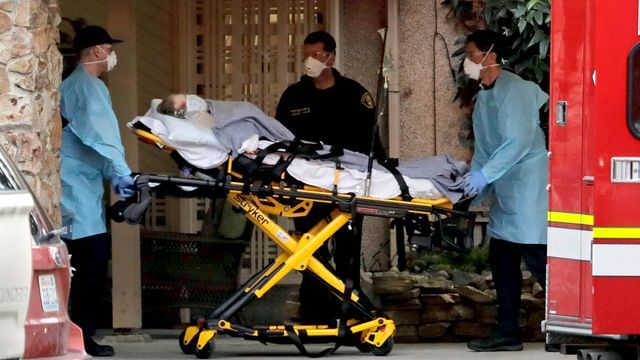
Kirkland Fire and Rescue ambulance workers load a patient into an ambulance, Tuesday, March 10, 2020, at the Life Care Center in Kirkland, Wash., near Seattle (AP Photo/Ted S. Warren)
All sectors of workers are affected. A Mt. Sinai nurse, Bevon Bloise, posted on Facebook, “We do not have enough PPE [Personal Protective Equipment], we do not have the correct PPE, and we do not have the appropriate staffing to handle this pandemic.”
The first death among New York City MTA conductors was reported, 49-year-old Peter Petrassi. The MTA is still not providing employees with necessary protective gear. Workers in other urban transit systems are also demanding masks and gear.
The record number of unemployment claims is another indication of the economic burden that is being placed on the working class. There were 155,000 claims in New Jersey alone, 16 times the previous week, and 3.3 million in the country as a whole, the highest number of weekly jobless claims in history.
In contrast, Wall Street and the big banks have already been given or promised trillions of dollars in liquidity to weather the economic storm the pandemic has triggered, and Congress is currently debating a further stimulus package to prop up the major corporations.
Fifteen states now have more than 1,000 cases, with California numbers climbing by 30 percent to 3,910, Washington by 24 percent to 3,207, Michigan by 25 percent to 2,856, Illinois by 36 percent to 2,538, etc. New hot spots are emerging, including major US cities Chicago and Detroit, which are poised to follow the example of the New York metropolitan area.
The response of the Trump administration was to suggest that the virus was somehow limited to the hardest-hit urban centers like New York, San Francisco, Los Angeles and Seattle, and that large sections of the country are relatively unscathed. At Thursday’s press briefing, White House Coronavirus Task Force Response Coordinator Deborah Birx declared proudly that 19 out of the 50 states still had fewer than 200 cases each, claiming this represented “40 percent of the country” where infection rates were “extraordinarily low numbers.”
She did not list them, but the 19 states with the lowest coronavirus tolls are mostly small in terms of population (including the 16 smallest) and relatively remote from global commerce. (The states are Alaska, Delaware, Hawaii, Idaho, Iowa, Kansas, Kentucky, Maine, Montana, Nebraska, New Hampshire, New Mexico, North Dakota, Oklahoma, Rhode Island, South Dakota, Vermont, West Virginia, and Wyoming.) They may comprise 40 percent of the states, but only 13 percent of the population. To cite such statistics as progress, let alone success, is to deliberately disarm the American public in the face of a rapidly mounting threat.
In a further distortion, she stated that in “no country to date have we seen an attack rate of over one in 1,000,” leaving out the key word, yet. She was clearly seeking to suggest that no more than one in 1,000 Americans was likely to contract COVID-19, or about 330,000 people—a figure that could well be surpassed within a week.
Dr. Birx went on to denounce as unwarranted the reported discussions within hospitals as to how to allocate—and deallocate—critical ventilators when faced, as some hospitals already are, with an overflow of cases. She said it was improper “to make the implication, when they need a hospital bed, it’s not going to be there.” Some hospitals are in fact already at capacity, including two major Detroit-area hospitals, while hospitals in New York City are completely overwhelmed.
What Trump and his sycophantic aides claim as success is actually criminal malpractice. The infection could have been stopped in its tracks if proper testing, contact tracing and isolation measures had been taken from the very beginning of the crisis. Instead, the Trump administration ignored warnings from the World Health Organization in January and allowed the virus to spread essentially unchecked for several weeks.
Even now, coronavirus testing is still restricted to those exhibiting symptoms, despite the fact that COVID-19 is often contagious even when a patient is asymptomatic, one of the many reasons it is so dangerous.
For his part, Trump continued to insist, against overwhelming evidence of popular demands to shut down workplaces to minimize the contagion, that American workers “don’t want to sit around,” and therefore, “we have to go back [to work],” which will ostensibly happen after Easter weekend. One of the indications that this will in fact become policy is that car manufacturers Ford and Honda have announced that they will reopen their North American plants on April 6 and 7, respectively, to be followed by Toyota on April 20. Safety measures for workers have been promised, the details to be revealed—later.
The Trump administration is also planning to deploy 1,000 US troops to the over 5,000-mile-long Canadian border for the first time in modern history, according to an internal Department of Homeland Security memo. This will include the installation of remote sensors, to stop illegal migrants and their “potential to spread infectious disease.” Trump further justified this scheme in an afternoon press briefing by claiming that “we have illegal trade that we don’t like,” referring to alleged dumping of Chinese steel through crossborder Canadian trade.
The militarization of the US-Canadian border and the increased militarization of the US-Mexican border further speaks to the irrational and reactionary response of the Trump administration to the coronavirus pandemic. In yesterday’s remarks to the G20, World Health Organization Director-General Dr. Tedros Adhanom Ghebreyesus insisted, “This is a global crisis that demands a global response. …
“No country can solve this crisis alone. We’re all in this together, and we will only get out of it together. That means a paradigm shift in global solidarity—in sharing experiences, expertise and resources, and in working together to keep supply lines open, and supporting nations who need our support.”
While Dr. Tedros’ words may be sincere, they fall on deaf ears. When facing a crisis which demands that the metaphorical and physical walls between nations come down, Trump and his counterparts are busy erecting even greater barriers to international collaboration. They are much more interested in the three straight days of gains on the stock market, which has risen 20 percent since Monday. The potentially millions of lives that will be lost if workers are ordered back to work are merely the cost of doing business.

26 Mar 2020

Peru deploys army in the streets to enforce COVID-19 curfew

Cesar Uco & Don Knowland

Peru’s President Martín Vizcarra has called the country’s military into the street for the ostensible purpose of enforcing quarantine and curfew orders aimed at reducing the spread of the coronavirus, reporting the number of persons infected had reached 395 and that five had died from contracting it. As of Tuesday, the number of known cases in the country had risen to 412, and the number of deaths to seven. Over three quarters fo the cases are concentrated in the capital of Lima.
Vizcarra declared a national emergency and quarantine on March 15, imposing an immediate ban on all travel between provinces, and into and out of the country, as well as a ban on the use of planes, boats, trains, buses, and private automobiles. On March 17, citizens were required to fill out an online form in order to obtain permission to leave their homes.
On March 18, a curfew was imposed from 8 p.m. to 5 a.m. with the military deployed on city streets to enforce these measures.
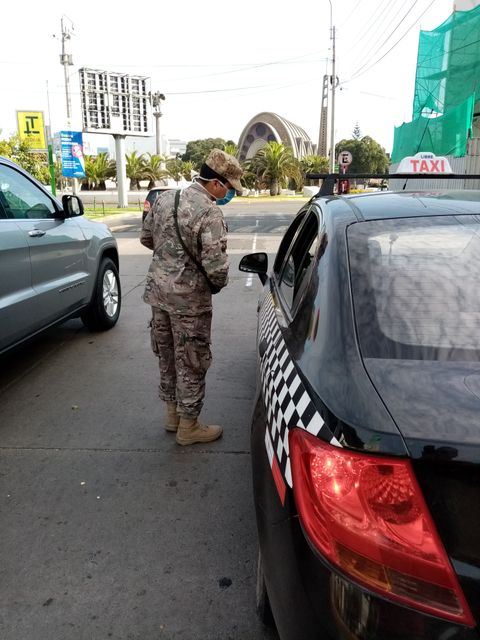
Soldier questioning a driver entering a wealthy neighborhood in Lima.
The underlying aims of the restrictions imposed by President Vizcarra are to protect the economic interests of the wealthy, while preparing for a possible armed confrontation with the masses of Peruvian working people.
The deployment of the military at major intersections, where cars and pedestrians are stopped for questioning as to where they are going, is designed to protect Lima’s wealthiest neighborhoods.
The Armed Forces are not present in the heavily populated poor neighborhoods surrounding Lima where millions of working families and small traders live. There the local police do not impose the quarantine rules, letting children take to the streets to play contact sports conducive to the transmission of virus.
Vizcarra announced that the paltry sum of 380 nuevo (new) soles (US$ 106)—a mere third of the already abysmally low monthly minimum wage—would be distributed at first to the 500,000 neediest families in Lima and the adjoining seaport of Callao, and then to 2.7 million similar families in all regions of the country.
Peruvian workers and poor did not have the purchasing power to buy sufficient food in poorly supplied markets last week, with prices doubling and even tripling. Meanwhile wealthy panic buyers in the posh La Molina district of Lima forced the closing of the well-stocked supermarket of the large national chain WONG.
A WSWS reporter interviewed Felipe, who has a stall at the Miraflores central market in Lima, about market supply conditions and prices.
“I am from the working-class neighborhood of San Juan de Lurigancho and it takes more than half an hour to get to my work here in the central market of Miraflores. There are military personnel here at all major intersections, but there’s none for my neighborhood. They say there are not enough military and local personnel. It seems to me that they are afraid or waiting for the moment when people without work and food rise en masse. It’s going to be big.
“Where I live there are no masks or gloves. The curfew at 8 p.m. is respected, but young people spend the day playing football in the streets under the eyes of police, who do not intervene to enforce the quarantine.
“In the first week, the Miraflores market was full of people buying everything. Now we’re back to normal. Imagine that a kilo of lemons rose from 5 soles to 15 soles, a kilo of carrots from 3 to 6 soles and garlic sold at four times its normal price.
“We are told that everything is planned so that the wholesale market, from where food is distributed to all other markets and grocery stores, will continue to work well and that we shouldn’t worry. But I’m told that the wholesale market staff works without gloves and masks”.
In an attempt to counteract the economic slowdown that is already arising from the coronavirus crisis, the Peruvian Central Reserve Bank (in Spanish, BCR) has taken its most drastic step since 2010, reducing its key interest rate from 2.25 percent to 1.25 percent, its lowest level since 2010. In the last month, yields on Peruvian 10-year Treasury bonds increased by 16.1 basis points, reflecting that the spreads—a measure of risk—of long-term bonds have increased.
Despite such measures by the BCR, analysts are projecting a contraction ranging from 1 percent to 4 percent. The Peruvian currency, the nuevo sol, has depreciated 6.5 percent, making it difficult for the government and corporations to meet loan obligations that are payable in dollars.
A new report by the Peruvian Institute of Economics (PIE) proposes “jumpstarting” the economy through promoting industries “that employ continuous processes” involving intensive use of machinery and equipment, and “little labor participation”, such as the mining sector, cement, glass, and brick-making.
The PIE report emphasizes that quarantine and subsequent measures have suddenly reduced a large portion of the population to a “state of vulnerability”. The report focuses on “a little-studied area within what is known as the ‘vulnerable middle class’, which is estimated at 40 percent of Peru’s population”. This figure is “very large because of the degree of economic informality.”
The report warns that these conditions can produce a social explosion, suggesting that workers must be kept on the job, no matter the threat to the health and lives of themselves and their families posed by the virus. “As far as possible, the government must sustain the continuity of the production of goods and services, and thus avoid the total collapse of the productive apparatus, with the consequent and immeasurable social cost,” it states.
Behind the scenes, President Vizcarra and the Peruvian military, in conjunction with US imperialism, are inevitably preparing for mass repression of the working class and “vulnerable middle class.”
Even before the coronavirus crisis the Andean countries witnessed uprisings, general strikes and confrontation with the police in Chile, Ecuador and Colombia, as the working class and poor revolted against social inequality and attacks on their living standards.
Peru, whose economy had fared somewhat better than other Andean countries, did not see such mass struggles. But given the economic and social tinderbox arising from the coronavirus and the government’s measures taken in its wake, such struggles are inevitable.

The wealth of Australia’s richest 250 soars to $377 billion

Clare Bruderlin

In the midst of the intensifying coronavirus pandemic, with workers losing their jobs and livelihoods, the Australian published “The List” last Saturday—an 82-page glossy magazine glorifying the growing wealth of Australia’s richest 250 people.
The introduction celebrates the fact that: “[T]he amount of wealth generated by the 250 keeps rising with each member’s average fortune now a whopping $1.51 billion—or about $240 million more than last year.”
According to the Murdoch media’s magazine, the number of Australian billionaires has more than trebled in two years, from 33 in 2018 to 117 in February 2020. Their combined wealth amounts to $377.77 billion, a sharp increase from $318.33 billion last year. The cut-off wealth for the list this year is $402 million; last year it was $320 million.
The List’s pages highlight the extravagant lifestyles of the super-rich. Millionaire Ian Malouf’s luxury 54 metre super-yacht is equipped with “Veuve Clicquot champagne on tap, staff at your beck and call, a party deck with a jacuzzi on the roof above us and six bedrooms below.”
The luxury apartments sold by property developer Larry Kestelman include “marble in the kitchens and bathrooms,” $4,000 doors and an amenities floor with “plush dining areas, billiards tables, libraries, a steam and sauna room, a private massage room, a yoga class space and a giant pool for the residents.”
Kestelman’s “exclusive” Azure Club development in Melbourne consists of 38 apartments, ranging in price from $4 million to about $25 million and sitting on floors 32 to 49 of a new tower named Capitol Grand. They come with commanding views, a separate street entrance and a full concierge service for security.
Frank Lowy, the co-founder of the Westfield shopping mall conglomerate, sold the company for $32 billion in 2017. Now retired, he spends most of the year out of Australia. He has a home in Tel Aviv, “the super-yacht Ilona, which moves between various Mediterranean ports in the northern summer,” and a home in New York.
Of the 250 richest, 64 have made their wealth as property moguls and through the rampant financial speculation in the housing market. On top of the list of property developers is Harry Triguboff, whose fortune grew from $12.31 billion to $15.5 billion in the past year, mostly derived from his lucrative Meriton empire, which builds, sells and rents out apartments.
Australia is ranked one of the worst countries in the developed world in terms of housing affordability and mortgage debt. Millions of young people have been locked out of home ownership, and many workers have astronomic mortgages, contributing to historically unprecedented levels of household debt.
Reflecting the domination of the financial elite, 42 individuals on the list made their fortunes through investment. A further 23 made their wealth in retail. The retail industry has one of the highest rates of casual employment in Australia and has seen waves of job cuts and store closures over the past year as companies seek to maintain profits amid the economic downturn.
Another 19 of the richest 250 are mining magnates, including iron ore baron Gina Rinehart, who is No. 2 on the list, with wealth exceeding $16 billion, up from $13.12 billion last year.
There are 19 technology entrepreneurs, benefiting from soaring share market valuations of the sector. Mike Cannon-Brookes and Scott Farquhar, co-founders of the IT software company Atlassian, are the richest, at numbers 5 and 6 on the list, respectively.
Their combined fortunes total $25.27 billion, up from $18.02 billion. Between them they own the two most expensive houses in Australia. Farquhar bought a $71 million Sydney harbour-side mansion in 2017 and Cannon-Brookes purchased the Fairwater mansion, on the same shores, for $100 million in 2018.
The richest individual on the list is Anthony Pratt, with a personal wealth of $16.95 billion—nearly $4 billion more than last year. Manufacturing accounts for just 13 places on the list. Pratt’s increasing wealth reflects the ongoing destruction of the sector. His riches are in large part due to the fact that he owns Pratt Industries in the US, where nearly half of his box-making and recycling operations are based.
A friend of US President Donald Trump, Pratt has a family mansion, Raheen, in Melbourne, but spends much of his time at his penthouse atop the Sherry-Netherland hotel, which faces Central Park in New York’s Upper East Side. He and his family also own a residence in Westchester outside New York, “bought for a reported $15 million from actors Michael Douglas and Catherine Zeta-Jones last July.”
The introduction to the List attempts to justify this unprecedented wealth by highlighting the alleged “generosity” of the rich. It asserts that a “big change” among the wealthy is their approach to philanthropy. It writes that in response to the recent bushfires, many made donations to charity and “Andrew Forrest made the biggest splash, with a $70 million pledge.”
Forrest, who heads iron ore mining company Fortescue Metals Group, has an estimated wealth of $13.06 billion, making him the fourth richest on the list. His wealth has almost doubled from last year, when it was at $7.34 billion.
In later pages of the magazine, it is revealed that $60 million of Forrest’s $70 million pledge was, in fact, donated to his own “Minderoo Foundation,” which has net assets of $1.35 billion, placing its value above the bottom 130 fortunes in the List.
The wealthy donate to such foundations to reduce their taxes, while exploiting their transfers for PR and advertising purposes. The List gives the example of multi-millionaire Graham Tuckwell, who “reportedly admitted in documents filed in a Jersey court that an $81 million donation of shares to a charitable foundation in his name were at least in part motivated by a large personal tax bill.”
The opulence of the financial and corporate elite on display in the List stands in stark contrast to the living and working conditions of millions of workers.
Far from being a “lucky country,” the gap between the wealthiest individuals in Australia and the vast majority of the population is widening. A report by Oxfam in January found that Australia’s richest 1 percent own 22.2 percent of all Australia’s wealth and have more than double the wealth of the bottom 50 percent of the population, some 12.5 million people.
Furthermore, the latest Poverty in Australia report, released last month, estimates that over 3 million people, or 13.6 percent of the population, now live below the poverty line. This includes some 774,000 children under the age of 15. The poverty line is defined as $457 per week for individuals and $960 per week for a couple with children.
The poverty report was compiled before the COVID-19 disaster saw the companies owned by the wealthy lay off hundreds of thousands of workers and plunge them toward financial ruin and immense distress.
Consecutive Labor and Liberal-National governments, with the help of the trade unions, have enforced a decades-long attack on jobs, deteriorating working conditions and declining real wages.
The “economic restructuring” imposed by the Hawke and Keating Labor governments in the 1980s and 1990s began the process, accompanied by the suppression of working-class struggles. This has facilitated the rapid enrichment of a small layer at the top of society.