27 Mar 2020

What Trump is Doing in the Middle East While You are Distracted by COVID-19

Robert Fisk

And still the virus shrouds Donald Trump’s mischief in the Middle East.
First it was his sly retreat from Iraq; now it’s his cosy military exercises with the United Arab Emirates – famous in song and legend as a former Saudi ally in the bloody Yemen war – and his cut of $1bn in aid to Afghanistan because its presidential feuding may hamper another deal with his newly established chums in the Taliban. And then there’s Iran
So let’s look for a moment at the extraordinary mock city built in the Emirates – complete with multi-storey buildings, hotels, apartment complexes, an airport control tower, oil refineries and a central mosque – which Emirati troops and US Marines have been assaulting with much clamour in a joint military exercise. According to the Associated Press reporter who watched this Hollywood-style epic, Emirati soldiers rappelled from helicopters while Marines “searched narrow streets on the Persian Gulf for mock-enemy forces”.
But who were these “forces”? Iranian, perhaps? In which case, the mock-mosque was presumably Shia, the oil refineries presumably in southern Iran, and the old streets in one of Iran’s ancient cities. Surely not Shiraz. Surely not Isfahan.
Brigadier General Thomas Savage of the 1st Marine Expeditionary Force didn’t seem to think the Iranians might find all this a bit suspicious. The exercise – Operation Native Fury, the name of which seemed to carry its own colonial message – is held every two years. “Provocative?” asked the aforesaid Savage. “I don’t know. We’re about stability in the region. So if they view it as provocative, well, that’s up to them. This is just a normal training exercise for us.”
I’m not at all sure that it’s “normal” for American armed forces to stage make-believe attacks on scale-model Muslim cities complete with mosque and narrow streets in order to create “stability in the region”. Surely this particular mock-up was not intended to stand in for Yemeni cities, around which Emirati troops had been fighting for four years against pro-Iranian Houthi fighters before turning against their Saudi allies in the same conflict and doing a quick bunk. The 4,000 US troops had been sent into the Emirates from Diego Garcia and Kuwait, where they might have recently arrived from the three newly abandoned American bases in Iraq. General Savage said none of his men had tested positive for the coronavirus and have “had little contact with the outside world” since shipping out for the exercise.
In a different context, Trump, who also has little contact with the outside world – the real one, that is – has been back to blackmailing his allies “in the region”. While much of that world continues to obsess about imminent pestilential death, the US secretary of state, Mike Pompeo, has suddenly – and with very little publicity — cut $1bn in aid to Afghanistan and threatened further reductions in cooperation. This is a bitter blow for a nation also facing Covid-19 (we can probably dismiss the handful of declared cases and two deaths there as an absurd underestimation), but America comes first!
Trump and Pompeo, you see, are very, very angry that both Ashraf Ghani and Abdullah Abdullah both claim to have been elected president in the recent elections – thus endangering the agreement between Washington and the Taliban to withdraw all US forces in return for the Taliban’s promise to fight Isis, al-Qaeda and all other jihadis wandering around Afghanistan. The signed understanding between the US and what I suppose we must call “Talibanistan” also includes a mutual exchange of prisoners (5,000 of the Taliban for 1,000 government troops) to which both of the rival presidents object.
Abdullah and Ghani, who was once described by his old university in Beirut as a “global thinker”, appear to have forgotten the words of the Persian medieval poet Saadi: that while 10 poor people could sleep on a carpet, two kings could not fit into a single kingdom.
You can see why Pompeo is upset. Not since rival popes – and, I suppose, earlier rival Roman emperors – simultaneously announced their supremacy have we witnessed such a pairing of panjandrums. If Afghanistan is the graveyard of empires, it is also the font of hubris for its local masters – who, with their palaces, villas, bodyguards and 4x4s will not be affected by the cut in aid. If the two men were to reach a resolution to their dispute, Pompeo has announced, the US sanctions will be “revisited” – proving that this is indeed a spot of blackmail by Trump.
But US sanctions are clearly not going to be “revisited” in relation to Iran, which claims – not without some justice – that the ban on imports is hindering its own struggle against Covid-19.
The UN has called for such sanctions to be “urgently re-evaluated”, pointing out that human-rights reports have already described the malign effect of sanctions on Iran’s access to respirators and protective clothes for healthcare workers. The Iranians, with the declared number of cases above 27,000 and more than 2,000 confirmed deaths, may have covered up many more victims – and this, remember, is a regime that couldn’t tell the difference between a Ukrainian airliner and an American cruise missile (and lied about it for two days). They clearly need help. American sanctions, however, matter more than the coronavirus in the Middle East.
So, alas, does Iranian amour propre. With truly Trumpian fantasy – for the US president still calls the virus “Chinese” – Ayatollah Ali Khamenei, inspired it seems by a Chinese official’s comments, has suggested that Covid-19 was man-made in America and that US medicine “is a way to spread the virus more”. This sort of claptrap is on a level with former Iranian president Mahmoud Ahmadinejad, who claimed that a halo shone over his head at the UN and that his listeners didn’t blink for half an hour while he spoke. “You [Americans] might send people as doctors and therapists; maybe they would want to come here and see the effect of the poison they have produced in person,” announced the 80-year-old divine.
After this nonsense, Imran Khan, the Pakistani prime minister, was perhaps the only regional leader who could still appeal to the US to lift the sanctions on “humanitarian grounds” until the virus has receded. Needless to say, he was wasting his time.
And finally, a US Marine Osprey V-22 helicopter took off from the US embassy compound in Beirut last week, carrying aboard Amer Fakhoury, a former member of Israel’s proxy South Lebanon Army militia. Fakhoury, now a US citizen, had returned to Lebanon last September to visit his family – he was met at Beirut airport by a senior army officer – but was recognised by former prisoners as an ex-warden at Israel’s notorious Khiam jail. He was immediately accused by the Lebanese authorities of torturing inmates and brought before a military tribunal.
Fakhoury denied, and still denies, all the charges against him. He was subsequently released when a judge said the crimes leveled against him occurred more than 10 years ago. Fakhoury, who entered hospital in Beirut suffering from stage 4 lymphoma, had fled across the border after Israel’s retreat from Lebanon in 2000. An appeal was lodged against his release by a military judge, but Fakhoury was nonetheless flown out of Lebanon. “We’ve been working very hard to get him freed,” Trump said, which is true: a US embassy official insisted on attending the military court last year when Fakhoury made his first appearance.
Khiam prison was infamous for the torture and mistreatment of Shia Muslim prisoners – both male and female. Amnesty International and Human Rights Watch published numerous and detailed reports of torture at the jail, and The Independent also published eyewitness accounts of torture. Fakhoury’s release prompted an outburst of fury from Lebanese parties who believed that their government had acted under threat of economic sanctions from Washington.
There were even claims that the Hezbollah militia, paid and armed by Iran, had been involved in discussions over Fakhoury’s release with a representative of the Trump administration. Its leader, Sayed Hassan Nasrallah, in a rare burst of anger, denied such a conspiracy.
Of course, scarcely anyone saw the departure of Lebanon’s most famous prisoner. For as the American helicopter lifted him to freedom over the Mediterranean, Beirut’s inhabitants were hiding in their homes to avoid catching Covid-19.

God’s Vengeance: the Christian Right and the Coronavirus

David Rosen

Steven Andrew is pastor of the USA Christian Church in San Jose (CA) who warns, “Obeying God protects the USA from diseases, such as the coronavirus.” He goes on, Bible thumping, “Our safety is at stake since national disobedience of God’s laws brings danger and diseases, such as coronavirus, but obeying God brings covenant protection. … God protects the USA from danger as the country repents of LGBT, false gods, abortion and other sins.”
Andrew is not alone in decrying the coronavirus as god’s curse. Rick Wiles, a Florida minister and founder of the media outlet TruNews, said the virus is a “plague” sent by god. “My spirit bears witness that this is a genuine plague that is coming upon the earth, and God is about to purge a lot of sin off this planet,” he ranted. He stressed that such a plague is part of the “end times,” a period of tribulations that precedes the second coming of Jesus Christ.
Both Andrew and Wiles share a belief that the coronavirus plague is due to widespread immorality, especially involving abortion, homosexuality and gender nonconformity.
Andrew declared March to be “Repent of LGBT Sin Month.” He claims, “God’s love shows it is urgent to repent, because the Bible teaches homosexuals lose their souls and God destroys LGBT societies.” He calls himself the leader of the American Christian Denomination, an association “made up of Christians of all denominations who believe like our founding fathers.” He’s gone so far as to declare 2020 as “Jesus Is King Year – a year of liberty and blessings.” His press release notes that “he has monthly revival events. These outreaches cost $350,000 for the year. Those wanting to help share the Gospel can donate at USA Christian Church.”
Wiles rants, “Look at the spiritual rebellion that is in this country, the hatred of God, the hatred of the Bible, the hatred of righteousness.” He goes on, “Just vile, disgusting people in this country now, transgendering little children, perverting them. Look at the rapes and the sexual immorality and the filth on our TVs and our movies.”
For postmodern secularists, the opinions of Andrew and Wiles may seem absurd if not ridiculous, easily dismissed. Their moralistic judgements seem more appropriate to the 19th – if not 17th – centuries then to 21st century America. Sadly, their religious fundamentalist beliefs appear to be shared by millions of Americans who helped elect Donald Trump. Most worrisome, they embody a moralistic authoritarianism that has congealed into a powerful political movement threatening the nation’s very democratic being.
***
“The rise of the religious right should be cause for alarm among all who care about the future of democracy in America,” warns Katherine Stewart in her new book, The Power Worshippers: Inside the Dangerous Rise of Religious Nationalism.
https://www.bloomsbury.com/us/the-power-worshippers-9781635573459/
Stewart’s invaluable study is a detailed investigation into how, over the last quarter century, the culture wars morphed into a political campaign. The book documents how as this movement failed to gain popular support for its moralistic agenda, it turned to politics to impose its Christian fundamentalist values on American society.
When Trump and other top administration officials took office, they pledged to fulfill the 2016 Republican Party’s platform that asserted:
Traditional marriage and family, based on marriage between one man and one woman, is the foundation for a free society and has for millennia been entrusted with rearing children and instilling cultural values. We condemn the Supreme Court’s ruling in United States v. Windsor, which wrongly removed the ability of Congress to define marriage policy in federal law.
Trump’s election occurred as Republicans controlled both Houses of Congress and, once in office, he appointed two conservatives to the Supreme Court—Neil Gorsuch and Brett Kavanaugh—consolidating the religious right’s control of the nation’s legal authority. Compounding this situation, numerous members of Trump’s inner circle are drawn from the religious right, including Vice Pres. Mike Pence; William Barr, Attorney General; Jay Sekulow, the president’s counsel; and Education Sec. Betsy DeVos.
The hardcore Christian nationalist movement played a key role in Trump’s 2016 victory and will likely do so again in 2020. “The Christian nationalist movement,” Stewart notes, “is far more organized and better funded than most people realize.” And then she warns, “It seeks to control all aspects of government and society. Its successes have been stunning, and its influence now extends to every aspect of American life, from the White House to state capitols, from our schools to our hospitals.”
Stewart details how the Christian right effectively employs a network of think tanks, advocacy groups, pastoral organizations and the fortunes of the very, very rich to achieve its power.  She is a journalist who anchors each chapter in a compelling story of a distinct facet of the Christian nationalist movement. In one chapter she visits Unionville (NC) to attend a seminar sponsored by Watchmen on the Wall considering how to end the Johnson Amendment restrictions on religious organizations endorsing political parties or candidates.
Stewart introduces the cabal of key leaders of the movement, including: Ralph Drollinger (who offers weekly Bible study groups for White House of officials); Paul Weyrich (who led the antiabortion movement); Jim Domen (an ex-gay anti-gay activist who leads Church United, a voter-outreach group); David Barton (of Project Blitz that seeks to end separation of church and state); and R. J. Rushdoony (who she calls “an unacknowledged leader of the movement”). She also explores the role of the religious right in the rise of the homeschooling movement and how calls for “free speech” led to the erosion of the traditional wall separating church and state.
As Stewart warns, Christian nationalism is a movement that aims “to replace our foundational democratic principles and institutions with a state grounded on a particular version of Christianity . . . that also happens to serve the interests of its plutocratic funders and allied political leaders.”
***
The Puritans landed in New England four centuries ago, in 1620. During the first quarter-century of settlement, occasional accusations of witchcraft were raised, but no one was executed. However, during the following half-century, 1647–1693, over 200 people were accused of witchcraft and about 30 were executed. Most of these alleged witches were women who came from more than 30 communities in Connecticut, Massachusetts and New Hampshire, including Easthampton, Long Island, now part of New York. Following the notorious Salem trials of 1692–1693, convictions and executions for witchcraft essentially ended
Few remember just how troubled the lives of the early Puritans was. Their settlement was inspired by the desire to civilize the New World, to wrest from the devil both the natural world and the aboriginal people, and thus create New Jerusalem. Yet, they found themselves confronted at every turn by formidable threats, in constant fear of nature’s uncertainties and in dread of innumerable battles with hostile Native tribes. The New World was a troubled environment in which to create heaven on earth.
Making matters worse, their attempt to establish New Jerusalem was hampered most by the very fragile humans who were expected to accomplish this religiously inspired mission. Humans were imperfect creatures, scarred for all eternity by original sin yet, given the predetermination that directed all of god’s actions, capable of being saved and achieving a state of grace. These troubled beings were subject to a nearly inexhaustible list of sins that fell into two broad categories, sins of character and sins of the flesh.
Among the former were pride, anger, envy, malice, lying, discontent, dissatisfaction and self-assertion. Among the latter were seduction, lust, bestiality, masturbation, fornication, adultery, incest, polygamy, sodomy and temptations like carnality, drunkenness and licentiousness. Almost anything could be a sin.
The Puritans fought mightily against the overpowering threats that were as much external as internal, especially sexual threats. They fashioned, in the words of historian Richard Godbeer, “a culture of sexual surveillance and regulation to strictly oversee and control interpersonal relations.” First and foremost, this surveillance was intended to prevent premarital sex and pregnancy or what was known as “bridal pregnancy.” It was not uncommon for neighbors to carefully observe interpersonal encounters taking place in homes or in fields, on roadways or in the woods.
https://jhupbooks.press.jhu.edu/title/sexual-revolution-early-america
For Puritans, no place was considered private, beyond the bounds of community monitoring. This control was only intensified given the close physical proximity under which Puritan settlements existed. The personal information garnered through surveillance provided the basis for many of the reported scandals involving alleged witchcraft.
Puritans distinguished between a sinner, even one convicted of a sexual offense, and a witch. According to historian Elizabeth Reis, “a witch [was] the most egregious of sinners.” She insists: “Those who admitted signing [the devil’s pact] crossed the forbidden line between sinner and witch.” This act, signing the devil’s book with one’s own blood, marked forsaking God and aligning with Satan. Equally critical, it was a voluntary act, a personal decision, motivated neither by seduction nor temptation.
https://academic.oup.com/jah/article-abstract/82/1/15/736368?redirectedFrom=PDF
The sinner and the witch could engage in the same sexual act, but the meaning for each was fundamentally different. For the sinner, sin was a survivable offense and offered a chance for redemption. This was especially true for male as opposed to female sinners. For the witch, however, there was only hanging and eternal damnation. In addition to fornication, women accused of witchcraft could also be charged with other sex offenses, including adultery, illegitimacy and, the worst, sex with the devil.
As judgment for a sinner’s bad conduct or warning to one so tempted, the Puritans drew upon a wide assortment of punishments to enforce social control. They ranged from excommunication, disenfranchisement and banishment, to public shaming and whippings, to selling a convicted person’s children into bondage, to branding, cutting off body parts (e.g., an ear) and body mutilation (e.g., disfiguring the nose), and, when all else failed, to hanging and even being pressed under rocks until death. Unfortunately, these threats and punishments did not work.
***
It’s now 2020 and old-world Puritanism survives as postmodern Christian nationalism. It is, as Stewart argues, a complex phenomenon. On one level, it is a populist, nonviolent movement, “a militant minority.” She estimates that it consists of “26 percent of the voting age population” who supported electoral candidates in 2016. That year, the voting age population (VAP) was 250 million people, so it would seem that 65 million Americans might be part of the Christian nationalist movement.
However, given the sizable population that Stewart suggests as composing the Christian nationalist movement, it also operates on still other levels. The Southern Poverty Law Center (SPLC) identified within it’s a host of segments the broad religious right — Christian Identity groups, neo-Confederate groups, Ku Klux Klan groups, racist skinheads and other sharing white supremacist beliefs. In a recent report, “The Year in Hate and Extremism, 2019,” it found that the number of white nationalist groups was up slightly to 155 from 148 in 2018. It notes that since 2017, there has been a 55 percent increase in the number of these groups, some of which are calling for bloodshed and a race war. “Most notably,” it found, “some are advocating violence and encouraging their foot soldiers to prepare for (and precipitate) a race war.”
https://www.splcenter.org/sites/default/files/yih_2020_final.pdf
The SPLC notes that “the movement’s followers are breaking into two major strategic camps,” between “mainstreamers” and “accelerationists.” The “mainstreamers” are often referred to as or the “dissident right” faction “who are attempting, with a degree of success, to bend the mainstream political right toward white nationalist ideas.” The “accelerationists” “wholeheartedly embrace violence as a political tool” and, as the SPLC warns, “much of the movement’s energy lies in the growing accelerationist wing, which, for the most part, is organized in informal online communities rather than formal groups.”
One factor that might have contributed to the increased militancy of some aspects of the religious right is the significant decline among those who self-identity as Christians. Pew Research finds that in the decade between 2009 and 2019, there was a 12 percent decline among such people, from 77 percent down to 65 percent. Perhaps more revealing, those who describe their religious identity as atheist, agnostic or “nothing in particular” now stands at 26 percent, up from 17 percent in 2009.
The worldwide spread – and unraveling global crisis – caused by coronavirus pandemic seems like a perfect historical moment for religious fundamentalist – and other racial identity nationalists – to invoke the Puritan past to persecute alleged offenders, nonbelievers. For some religious ranters, when moral suasion fails, it’s time to invoke the power of the state to impose order.
As Christian nationalists secure ever-greater influence, if not control, of the American political system — at the federal and state levels – they will exploit of the power of state authority to impose their values as law and enforcement. For these religious reactionaries, the 2020 election is not about Trump but about power – their power to control America and increasing aspects of the lives of all of us.

The End of the Parasite Paradigm

Kathleen Wallace

Politicians like Lindsey Graham have been worried that some individuals might get a few cents extra during this crisis if the relief bills are too “generous”. The concern does not extend to corporations that bloat and have essentially no stipulations put upon them from the trough of taxpayer largess. This is the clearest indication that our present-day system is nothing but a false social construct in place simply to ensure a modern- day feudalism. It’s never been about any kind of fiscal responsibility; it’s about making sure there are those who are desperate and scared –so they will keep offering themselves up to a system that chews them up daily (even before COVID19). This, all to ensure those at the top don’t even have to do one honest day of work. It’s also the societal normalization of a lack of empathy.
The fact that people are being called upon to continue making rent and mortgage payments while they are being told to stay home clearly shows the societal rules in place for 99% of us. Rent is due April 1st. There is no relief at this time. Maybe some bread crumbs (taxed of course) distributed in May? Unemployment payments don’t happen quickly (let alone when 3 million plus claims land on them at once) and those who were already unemployed—well, I guess they are screwed even more. How do you look for a job under a lock down order?  Not to mention the whole point of the lock downs are to keep our healthcare system from imploding with too much contact and virus sharing. Shelter/Starve in place, please or go apply at the Amazon germatoriums.
There are people hungry right now. The understanding is that citizens do their part in a society and the federal government provides something in return. How is that reciprocity going now? Looks more like parasitism to me.
The set up was never equitable, but this pandemic has truly laid it all bare. The lack of healthcare for many– so clearly exhibited by the only known case of a teen dying from COVID19 in California shows all of this. They are arguing about his case being “complicated” but the facts are……. this kid got sick with a vicious respiratory ailment, was turned away at Urgent Care for lack of insurance—had to present to a most likely already overloaded ER, and died within just a few days. All the while how much spread of the virus occurred in his community in between being turned away for that initial care? He was positive for COVID19. This is not the workings of a system in place that cares for the little guy. The bills will be enormous for those who present and obtain this shattered healthcare. And make no mistake, it’s just testing the waters to talk about killing off the oldsters, in reality everyone who is not in their wealth class is expendable and always has been, like this poor kid. They want to keep enough workers around to serve them, but anything extra is just not really necessary. We’ve all just been too genteel to speak of it much. It’s been obvious to all that testing has been available for the athletes, the no-symptom Hollywood elites….but try being sick and poor during this time. Many will simply die at home alone. Some deaths are avoidable with a caring system in place. This is a dark and lethal free-for-all.
They knew this was coming our way and nothing was done to mitigate the spread in the form of adequate testing supply distribution, PPE centralized distribution, none of it was done………..
And it’s not about a lack of funds.
The money is there for the corporations. Hell, the Federal Reserve imagines it into being and charges us for the privilege of having it exist. This creature from Jekyll Island (fantastic book) clearly describes why the Fed was  put together on the sly in an out of way place largely in secrecy. It was a heist. Created to “protect” against the volatility and panics of the 1800s—the Fed truly is in place to protect the wealth of the few. Our entire system is held together by willful blindness, economic coercion, and the assumed belief that some are entitled to wealth and parasitism over the rest of us. A Dracula Economy.
Multiple stories are running about the bravery of those on the front lines, that is to say those manning our grocery stores and such. Empty platitudes and minimum wages for the masses. It’s clear these are the people keeping everyone fed yet their importance has never been given a living wage. And now they are expected to get sick and possibly die for the privilege. The right (and liberal left) will say that one should get more training to get out of these jobs–go to college, go in debt, join the military. So many fantastic options!  That is just another way the elite can indicate that the people who do these jobs do not deserve to make enough in wages to have a safe and fulfilling life. They need to be at risk all the time and this is why they don’t have a fucking rainy day savings account. They live on the edge by design and our leaders know this. It’s on purpose because this keeps a compliant workforce in place. These corporate enabler Democrats truly meet the minds of the reactionary right Republicans on these issues. One group simply puts a shine on the social darwinism, but the poor know the corporate Democrats are not their friends, opening up the confusion of some in this group backing the illogical and hateful message from Trump Republicans. They are swirling in confusion, and it’s a ripe situation for scapegoating others like Mexicans and whoever else Donald J. Trump can come up with. He’s a sociopath, and if I were of a religious slant, I’d say the Anti-Christ. He brings out the very worst in everything and everyone he touches. But he’s the product of our system, not the sole cause of this misery. He’s a festering boil on an unclean ass. This is why there’s no toilet paper around.
It’s never been about not being able to pay for it. Any of it.
Never forget that clear and undeniable fact.
Other nations are doing things like guaranteeing larger fund distribution and doing moratoriums on certain types of payments. This is at least a band aid that might catch some blood. The US is simply trying to ensure the workers stay hungry but alive (some of them) so they can keep serving the masters.
The gross incompetence of our leaders may be their undoing. Their greed is unsustainable at this point.
The planet is ill– the human population is ill–what more is needed to show that this current state is in its death throes? It will be one crisis to another because we are at the end of this line.
Parasites can only go on so long before they destroy their host. One way or another, it will be the end of this system.

A viral climate of fear

Andrew Glikson

Where the virus may potentially claim the lives of hundreds of thousands or even millions of people, global heating above 4oC is bound to claim the lives of billions, yet most governments hardly listen to the science
By the 25 March 2020 more than 4% of Covid-19 patients, nearly 19,000 people, tragically died worldwide, with more to come, and each death its own heartbreaking story.  Many governments are listening to medical science, implementing essential measures to combat the plague, instigating social isolation and economic support systems in order to avoid a potential demise of hundreds of thousands or even millions of lives.
Climate change is already causing deaths, according to a new report global warming would cause an additional 250,000 deaths per-year from heat and extreme weather events, yet most authorities continue to ignore the scientific evidence of climate disruption that threatens to exceed +2 degrees Celsius and toward 4 degrees Celsius. Potentially this is leading to a demise of billions of lives and many species through extreme weather events.
Between 1998 and 2017, 526,000 people across the world died due to extreme weather events caused by climate change.
Health protection measures to restrict the effects of COVID-19 are essential, but the looming social and economic collapse is something else. It is not entirely clear why, in the majority cases, populations cannot continue to operate at safe distances using protective gear?
There has been no social and economic collapse in the west when:
  • The estimated number of malaria deaths stood at 405 000 in 2018
  • Seasonal flu kills 291,000 to 646,000 people worldwide each year,
  • Each year there are 1.3 million to 4.0 million cases of cholera, and 21 000 to 143 000 deaths worldwide due to cholera.
Nor have societies and economies collapsed in the western world during genocidal atrocities such as in Korea, Viet Nam, Rwanda, Myanmar, the Middle East and Yemen, which killed millions, namely:
  • When 6 million people were bombed in Vietnam
  • When millions were killed in Rwanda and the Congo
  • When millions of people were killed and fled the Middle East
  • When half a million refugees had to escape Mien-Mar
Media reports depend on the profile of the victims. The effects on the share market are elevated above the health issue. Poor and dark-skinned people receive less attention. Memories are short and most people worry about one problem at a time. Nowadays the fatal consequences of a deliberate or accidental nuclear war and of global warming toward four degrees Celsius, as real as those of the pandemic, are hardly mentioned.

The Real Pandemic Danger Is Social Collapse

Branko Milanovic


As the Global Economy Comes Apart, Societies May, Too

As of March 2020, the entire world is affected by an evil with which it is incapable of dealing effectively and regarding whose duration no one can make any serious predictions.
The economic repercussions of the novel coronavirus pandemic must not be understood as an ordinary problem that macroeconomics can solve or alleviate. Rather, the world could be witnessing a fundamental shift in the very nature of the global economy.
The immediate crisis is one of both supply and demand.
Supply is falling because companies are closing down or reducing their workloads to protect workers from contracting COVID-19, the disease caused by the new coronavirus. Lower interest rates can’t make up the shortfall from workers who are not going to work—just as, if a factory were bombed in a war, a lower interest rate would not conjure up lost supply the following day, week, or month.
The supply shock is exacerbated by a decrease in demand due to the fact that people are locked in, and many of the goods and services they used to consume are no longer available. If you shut countries off and stop air traffic, no amount of demand and price management will make people fly. If people are afraid or forbidden to go to restaurants or public events because of the likelihood of getting infected, demand management might at most have a very tiny effect—and not necessarily the most desirable one, from the point of view of public health.
The world faces the prospect of a profound shift: a return to natural—which is to say, self-sufficient—economy. That shift is the very opposite of globalization.
While globalization entails a division of labor among disparate economies, a return to natural economy means that nations would move toward self-sufficiency.
That movement is not inevitable. If national governments can control or overcome the current crisis within the next six months or a year, the world would likely return to the path of globalization, even if some of the assumptions that under-girded it (for example, very taut production chains with just-in-time deliveries) might have to be revised.
But if the crisis continues, globalization could unravel. The longer the crisis lasts, and the longer obstacles to the free flow of people, goods, and capital are in place, the more that state of affairs will come to seem normal. Special interests will form to sustain it, and the continuing fear of another epidemic may motivate calls for national self-sufficiency. In this sense, economic interests and legitimate health worries could dovetail. Even a seemingly small requirement—for instance, that everyone who enters a country needs to present, in addition to a passport and a visa, a health certificate—would constitute an obstacle to the return to the old globalized way, given how many millions of people would normally travel.
That process of unraveling might be, in its essence, similar to the unraveling of the global ecumene that happened with the disintegration of the Western Roman Empire into a multitude of self-sufficient demesnes between the fourth and the sixth centuries. In the resulting economy, trade was used simply to exchange surplus goods for other types of surplus produced by other demesnes, rather than to spur specialized production for an unknown buyer. As F. W. Walbank wrote in The Decline of the Roman Empire in the West, “Over the whole [disintegrating] Empire there was a gradual reversion to small-scale, hand-to-mouth craftsmanship, producing for the local market and for specific orders in the vicinity.”
In the current crisis, people who have not become fully specialized enjoy an advantage. If you can produce your own food, if you do not depend on publicly provided electricity or water, you are not only safe from disruptions that may arise in food supply chains or the provision of electricity and water; you are also safer from getting infected, because you do not depend on food prepared by somebody else who may be infected, nor do you need repair people, who may also be infected, to come fix anything at your home. The less you need others, the safer and better off you are. Everything that used to be an advantage in a heavily specialized economy now becomes a disadvantage, and the reverse.
The movement to natural economy would be driven not by ordinary economic pressures but by much more fundamental concerns, namely, epidemic disease and the fear of death. Therefore, standard economic measures can only be palliative in nature: they can (and should) provide protection to people who lose their jobs and have nothing to fall back on and who frequently lack even health insurance. As such people become unable to pay their bills, they will create cascading shocks, from housing evictions to banking crises.
Even so, the human toll of the disease will be the most important cost and the one that could lead to societal disintegration.
Those who are left hopeless, jobless, and without assets could easily turn against those who are better off.
Already, some 30 percent of Americans have zero or negative wealth. If more people emerge from the current crisis with neither money, nor jobs, nor access to health care, and if these people become desperate and angry, such scenes as the recent escape of prisoners in Italy or the looting that followed Hurricane Katrina in New Orleans in 2005 might become commonplace.
If governments have to resort to using paramilitary or military forces to quell, for example, riots or attacks on property, societies could begin to disintegrate.
Thus the main (perhaps even the sole) objective of economic policy today should be to prevent social breakdown. Advanced societies must not allow economics, particularly the fortunes of financial markets, to blind them to the fact that the most important role economic policy can play now is to keep social bonds strong under this extraordinary pressure.

Novel Pandemonium

Nijam Gara

COVID-19 (Coronavirus disease) is novel in many ways. It has affected 155 countries till date with ever-changing case numbers (283,00 worldwide) and mortality rate pegged at 1 percent with inter-country variations. This rapid rate of spread occurred in barely 3-4 months with first case suspected to have reported in China in November 2019. The world has witnessed the extraordinary containment efforts taken up by China when the initial outbreak was limited to a geographically specified area – Wuhan city in Hubei province.
Transmission of COVID-19 is similar to the seasonal influenza virus that spreads via respiratory droplets. Thus, over time, it is bound to infect millions as being predicted by public health experts. As such predictions emerged, politicians in USA, Europe and India started adopting unprecedented measures to contain the outbreak. Some of these efforts are certainly laudable. In times such as these, a critical evaluation and assessment of such measures is lacking in the name of urgency to act. However, what if some measures hurt more than help? It is paramount to ‘do no harm’, the basic principle of medical practice.
First, it is high time to examine the efficacy of the much-touted concept of social distancing. It certainly makes sense and the oft repeated term of ‘flattening the curve’ of new cases seems to be logical as well. But, in their urge to act, have the politicians and experts ignored the fact that a disease does not exist in its own independent sphere but it has to be considered in a socio-economic context? Take, for example, in a country like India that has 1.38 billion people with an estimated 800 million people that are considered poor. Typically, that would mean multiple people living in a single room in crammed spaces and more importantly millions that live on the streets. What kind of ‘social distancing’ can these bottom two-thirds (or more) of the population practice? From a livelihood perspective, almost all poor households eke out a living dependent on their interactions with the society around them. For example, a street vendor’s lifeline is the presence of a lively street, a maid cannot practice isolation for weeks which would not only impact the maid but also the conveniently situated master in the house. Countless young kids are dependent on the school meal programs and they go hungry when the school is closed. Thus, it is not only impractical but also downright haughty to prescribe social distancing to a country with vast income inequalities where people are left to fend for themselves. While the United States is certainly considered rich, each and every city is a testament to vast social disparities. The rich and desirable neighborhoods could be the best in the world but they coexist in a city with rampant homelessness (for example, Los Angeles, Washington DC and New York, to name a few). The tales on the homeless side of the town would appear to be as sordid as from a third world country. Every night, about half a million people sleep on the streets in one of the world’s richest countries. Do the leaders that promulgated ‘stay at home’ ordinances have a plan for these hapless individuals? Can’t a virus that spreads by droplet transmission infect these individuals and thereby contribute to more cases in the society as a whole? In a country that lives and thrives on capitalism, a blanket shutdown of tourism, aviation and restaurant industries would only mean livelihood loss for millions. Is there an estimate of what that translates in to in terms of jobs lost that would only eventually mean lives lost? Is it all going to be worth the COVID-19 cases prevented by social distancing? There is certainly economic stimulus planned by the US Federal government that is being talked about. However, it would only go so far as witnessed in the 2008-09 economic crisis. There are millions that do not fall in the ‘stimulus’ umbrella. There are countless people that are undocumented but still form the basis of the working-class economy that would not qualify for such a stimulus. They, in turn, would affect the lives of others that live around them. These should have been the considerations before taking the extreme step of bringing the economy to a grinding halt. Now, it’s already too late. Also, of note, China was able to provide basic supplies to all its citizens affected by the lockdown. The government even transported medical professionals to the hospitals themselves so lockdown was universal and truly effective. Is it even remotely possible in a capitalist society such as the USA or in a broken system such as in India to do such a thing?
It is not the intention of this article to downplay the unfolding pandemic. It is important to look at what else can be done that is also extraordinary but at the same time does not hurt the working class as much. China has already shown the world the path. While the politicians in India and USA cherry picked what they can easily do in this crisis, they conveniently ignored the arduous tasks. China built a 1000-bed hospital exclusively to handle coronavirus cases in Wuhan, the epi-center of the outbreak. It is sheer grit, determination and loads of money that go in to such an exercise. The argument being made for social distancing and isolation is to reduce the number of cases that would be seriously ill and require mechanical ventilation. In such a case, what should happen on a war footing is building new hospitals and manufacturing ventilators at a break-neck speed. USA did such an exercise of mass manufacturing during the World War II years albeit on the weapons side but why can’t it be replicated now? On the contrary, if countries are shut down en masse, leave alone ventilators but even personal protective equipment (PPE) crucial for healthcare workers are in scarcity today even in USA. On the frontlines of fighting this virus, when the sickest patient gets admitted to an ICU (Intensive Care Unit) in USA (the writer is managing patients with suspected COVD-19) with a respiratory problem, confirming COVID-19 that involves a PCR (Polymerase Chain Reaction) test for the viral RNA (Ribonucelic acid) is taking 6 days (or more) to result as of today (varies by city and state). It can only be imagined how much longer it would take elsewhere. China, again, has led the path and is far ahead in testing for COVID-19. Yet, the world leader in Trump chose a racial epithet for the virus rather than focusing on collaborating with the Chinese in making test kits widely available.
It is also worth noting that the symptoms of COVID-19 are vague and overlap with any respiratory illness such as the garden variety cold, influenza and a host of other bacterial infections. In such scenario, responses should be measured and focused on catering to the utmost sick and needy. It is intuitive to presume that mortality rate being higher in certain countries is likely linked to late presentation to the hospitals and delays in implementing mechanical ventilation. Because, at the end of the day, COVID-19 is a respiratory illness and cause of death most often would be Respiratory failure. It circles back again to the need for more ventilators and well-equipped hospitals. Not all countries can build a 1000-bed hospital in 7 days but may be it is possible to do it in 30 days in a crisis such as this. Countries such as India and USA can aim for building at least 1 such hospital per state and divert critical cases there. Instead, what is happening today is suspension of routine medical care for other patients in existing hospitals in anticipation of a surge in COVID-19 cases.
If the crackdown-loving leaders show the same will power, they can easily obtain funds for new hospitals from their billionaire class. Cuba has also shown how to effectively train medical professionals and it is worth borrowing from them. Rather than shutting down the economy and coming up with a stimulus package, responsible leaders with conviction would focus on diverting funds towards such productive projects that will result in long-lasting infrastructure and disaster preparedness that will also benefit future generations in fighting new illnesses. COVID-19 will not be the last of these pathogens. There will be more to come as history has shown us if we look back at Small pox, Plague and H1N1 to name a few.
I ardently wish I am wrong on this but it appears that the modern-day world leaders aided and abetted by the all-assuming tech-savvy, social media-crazed global citizenry have taken this too far now and only history will tell us if the aftermath of this shutdown would take more lives than the dreaded virus itself.

Trump’s “Get back to work” demagogy aids the spread of the pandemic

Joseph Kishore

The coronavirus pandemic continues to spread throughout the world. The total death toll globally is over 22,000. On Thursday, there were more than 6,000 new cases and 712 new deaths reported in Italy; 6,600 new cases and 500 new deaths in Spain; and 6,000 new cases and 56 deaths in Germany. The virus is only beginning to spread in Indonesia, Brazil, India and other countries in Asia and Latin America.
The center of the accelerating pandemic is the United States. It has now surpassed Italy and China with the largest number of confirmed cases, at more than 85,000. The US counted 17,000 new cases yesterday, almost three times that of any other country. The death toll has surged to nearly 1,300.
Amidst this escalating crisis, the Trump administration is intensifying its efforts to promote a speedy return to work.
“We have to get back to work,” Trump declared at his Thursday press conference. “Our people want to work, they want to go back, they have to go back… This is a country that was built on getting it done, and our people want to go back to work. I am hearing it loud and clear from everybody.”
In Trump’s imaginary world, “everybody” refers, first and foremost, to himself, and then to a slew of corporate executives who want to have workers back on the job and churning out profit, regardless of the impact on the public’s health.
Trump continued, as if lost in some sort of strange reverie, “They have to go back to work. Our country has to go back. Our country is based on that. And I think it is going to happen pretty quickly…”
Earlier in the day, the administration sent a letter to state governors announcing that it will be updating its guidelines early next week on “social distancing” to press for a relaxation of measures that have shut down non-essential production in many states throughout the country.
The demands of the Trump administration contradict recommendations from all epidemiologists and health care professionals. Yonatan Grad, an assistant professor of immunology and infectious disease at Harvard University told Medscape this week that “social distancing is really the key thing that we can do right now." He continued, "A too hasty retreat from social distancing risks a threat to our health care infrastructure, which itself carries huge economic consequences.”
Larry Gostin, a professor of global health law at Georgetown University, noted that it “would be utterly irresponsible to urge people to go back to work and normal social life. All the evidence suggests that if governments lift physical distancing too soon, it will cause a major resurgence of cases and deaths.”
To justify a back to work order, Trump piled one lie upon another. He claimed that “testing is going very well,” declaring that the US has tested far more people than South Korea, which the administration had previously criticized for testing too much. In fact, there have been only 500,000 tests in the United States, less than one in 650 people, a ratio far below that of South Korea. In California, a center of the outbreak, only one in 2,000 people has been tested.
Deborah Birx, head of the White House Coronavirus Task Force, acknowledged at the press conference that the US is still not testing people who do not have severe symptoms, meaning the vast majority of those who have the virus are not being tested. Doctors are still reporting shortages of tests throughout the country.
Moreover, by testing aggressively, South Korea was able to control the spread of the virus at a relatively early stage. In the United States, there was virtually no testing for months, allowing the virus to spread throughout the country.
In an effort to minimize the seriousness of the pandemic, Trump declared that “the mortality rate, in my opinion is way, way down.” This is under conditions where New York City, which accounts for 30 percent of all cases in the US, is constructing makeshift morgues to deal with the spike in deaths. In New Orleans, which is now experiencing the fastest growth of new cases in the world, hospitals are running out of supplies and room. Amidst a nationwide shortage of basic equipment, hospitals are already discussing policies for determining who will live and who will die.
Then there is the lie that workers “want to go back.” In fact, production has been shut down in some industries due to wildcat strikes and sickouts of autoworkers, sanitation workers, shipbuilders, transit workers, poultry workers and Amazon workers.
In recent days, top Wall Street executives, along with the editorial page of the New York Times, affiliated with the Democratic Party, have insisted that a quick return to work is necessary, under the slogan “the cure cannot be worse than the disease.”
There is a definite class logic to these demands. On Thursday, on the same day as a report showing new unemployment claims soared to 3.3. million, nearly five times more than the previous peaks in 1982 and 2009, the Dow Jones Industrial Average increased by more than 6 percent. The US financial markets are up nearly 23 percent from their lows at the beginning of the week.
In response to a question that noted the record rise in the market, Trump said on Thursday: “They think that we are doing a really good job at running this whole situation having to do with the virus. I think they feel that the administration, myself and the administration, are doing a really good job.”
The “good job” that Wall Street is celebrating is the imminent passage, on an overwhelmingly bipartisan basis, of the grossly misnamed “CARES (Coronavirus Aid, Relief, and Economic Security) Act.” Trump thanked Democrats and Republicans in the Senate “for unanimously passing the largest financial relief passage in American history.” Among those participating in this unanimous vote was Vermont Senator Bernie Sanders.
Democratic House Speaker Nancy Pelosi said yesterday that she expects a “strong bipartisan vote” for the bill sometime today, after which it will go to the White House to be signed into law.
The most significant component of the $2 trillion bill is $425 billion from the US Treasury Department to back $4 trillion or more in asset purchases by the Federal Reserve, which is expected to more than double its current balance sheet to $10 trillion. These programs, announced over the past two weeks, include the purchase of bank assets as well as, for the first time ever, the direct buying up of corporate debt. The programs will be overseen by BlackRock, the largest asset manager in the world.
In essence, Congress is giving the Federal Reserve the authority to provide unlimited sums of cash directly to the banks and giant corporations. In the final analysis, these payouts have to be paid for through the exploitation of labor and the extraction of profit. The ruling class intends to compel workers to return to work under unsafe conditions through economic blackmail and, if necessary, outright force. The police and the military stand ready to enforce labor discipline.
The COVID-19 pandemic has laid bare the deep class divisions in the United States. For the Trump administration and the ruling class, “winning the war” against the pandemic means, above all, restoring the best conditions for the intensified exploitation of the working class. But for the working class, the success of the fight to contain the spread of the coronavirus is measured in lives saved, not profits made.
This is an irreconcilable conflict. The determination of the ruling elite to deal with the pandemic without undermining the capitalist profit system leads to authoritarianism and war. The efforts of the working class to combat the pandemic lead to socialism.

East Timor records first confirmed coronavirus case amid floods

Patrick O’Connor

East Timor recorded its first confirmed COVID-19 virus case on Saturday. The south-east Asian state is among the most impoverished in the world, with only minimal healthcare facilities. If the global pandemic sweeps through the country, there could be mass casualties.
East Timor had previously been among a small group of countries without confirmed cases of coronavirus. Timor’s interim health minister, Elia dos Reis Amaral, issued a statement Saturday explaining that the patient was a foreign national who had recently arrived from overseas. The person had been isolated and reportedly has only mild symptoms.
How many others are infected is unknown. The World Health Organisation (WHO) provided East Timor with 10 testing kits, which allows only 1,000 people to be tested in a country of 1.3 million people. The tests also have to be sent to Australia in order to be “validated,” delaying the results.
Even before the confirmed case, social tensions within East Timor were high. On March 8, police fired tear gas to disperse a crowd of people in Tibar, west of the capital Dili, who were protesting against a quarantine site set up in their village for suspected coronavirus patients. One of those quarantined with coronavirus-like symptoms had reportedly recently returned from holidaying in Italy, one of the disease’s epicentres.
People washing their hands outside Lita Store
Tibar is home to a large rubbish dump. Impoverished residents rake through the daily-delivered rubbish, hoping to find metal sheeting, tin cans, clothes, or other useable items. Rubbish is burned, creating acrid smoke that has created numerous health problems in the village. One woman protesting the quarantine site declared, in a video that was widely distributed on social media, that Tibar had “become a place to put rubbish, to put [people with] HIV, tuberculosis and coronavirus.”
The Timorese government has responded to the first confirmed COVID-19 case by announcing a month-long lockdown and preparing a state of emergency. The country’s only land border, with the Indonesian province of West Timor, is closed to both goods and people. Schools have been shut down, with students told to take an “extraordinary holiday” that will last at least one week. Universities are closed until at least April 4. The Catholic Church also announced that mass services were suspended.
Prime Minister Taur Matan Ruak said his government would make a “rapid” and “emergency” response to the confirmed case. The government, however, is mired in crisis after Ruak lost his parliamentary majority and had his proposed budget voted down in January. A rival coalition of six parliamentary groupings, led by former President and Prime Minister Xanana Gusmao, has sought the endorsement of Fretilin President Francisco Guterres to form a new government, but the impasse continues.
Ruak’s inability to pass his budget through the parliament means that the government funding is through Timor’s “duodecimal system,” which each month allocates one-twelfth of the 2019 budget. Unless somehow circumvented, this restriction will mean the government will not be able to make large-scale investments in health and other emergency infrastructure in the event of a large-scale virus outbreak.
East Timor is among those countries with little capacity to respond to the coronavirus crisis. The former Portuguese colony was invaded by Indonesia and brutally occupied until 1999, when Australian imperialism staged a military intervention on bogus “humanitarian” grounds—which was subsequently exposed by the refusal of successive Australian governments to make available to the Timorese people basic healthcare and other social services.
In 2002 the state received formal sovereignty. In the 18 years since, the Timorese ruling elite have demonstrated the bankruptcy of their claim that they could advance the social and economic interests of the working class and rural poor through the formation of a new capitalist statelet on half of a small island.
The healthcare situation in the country is dire. According to WHO statistics, annual health spending amounts to 1.5 percent of its small gross domestic product, equivalent to just $US102 per person. Hospitals and health clinics are entirely unprepared for a coronavirus pandemic. In rural districts, health clinics often experience power failures and, according to UNICEF, up to 70 percent of village clinics have no access to running water.
Last Sunday, the operators of Bairo Pite Clinic, a non-government organisation providing free healthcare, issued an “urgent” appeal on an East Timor email group for face masks, explaining that they had run out.
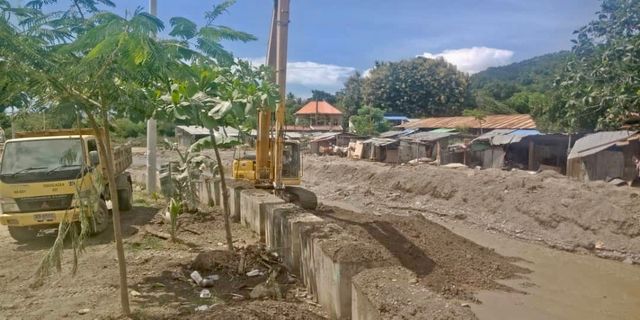
Heavy machinery clearing debris built up in Maufelo River (March 20)
The government’s inability to respond to a significant crisis was demonstrated on March 13, when monsoonal rains triggered flash floods in parts of Dili. Drain systems clogged and flooding destroyed at least 190 homes and affected another 1,500 households. One person, aged 16, was killed, reportedly after he saved a woman and her baby from drowning. Inundated residents were largely left to fend for themselves.
One Dili worker, whose family home was submerged by the flood waters, told the World Socialist Web Site: “The government was not only unprepared for the flood but has done virtually nothing to respond to the emergency situation. During and after the flood, throughout the weekend, we saw not a single government official assisting us. Even though we were desperate for a dry and safe place to stay and sleep, clean water, food, clothing, access to a toilet, and healthcare, nothing was provided. We had to go to a friend’s place to do the washing. Most of my neighbours had to clean their clothing with dirty water, using the same river that caused the flooding.”
He added: “The first confirmed corona virus in Dili has got people in a panicked and worried situation. With the inadequate condition of public hospitals throughout the country I fear that the spreading of the virus will be hard to contain—it could be like a wildfire. The government has no adequate facilities to quarantine coronavirus-positive patients.”