1 Apr 2020

Financial turbulence continues to grow

Nick Beams

When trading on Wall Street closed yesterday, with the Dow down by more than 400 points, it was the end of the worst quarter for stocks since the financial crisis of 2008. The market has fallen 20 percent since the start of the year.
What is most significant is not the size of the fall but the speed at which it has taken place. The quarter divides in two parts.
The beginning of the year was marked by a surge in the market. There was confidence that the Fed would continue to provide ultra-cheap money to finance its speculation and parasitism. At the same time, trade tensions with China had eased somewhat with the signing of a “phase one” deal on January 15.
The market was propelled to new record highs on February 12. It has undergone a precipitous fall in the seven weeks since then.
While the coronavirus was the trigger it was not the underlying cause. Markets had been set up for a crash by the rise and rise of financial assets, above all stocks, completely divorced from the process of production in the real economy.
It took just 16 days for stocks to fall 20 percent from their record high, compared to the previous record for a 20 percent fall set in 1929.
The Vix index, which measures volatility and is often referred to as Wall Street’s “fear gauge,” went to a record high in mid-March. It was one of the factors that led to Fed initiate a massive intervention in financial markets across the board.
This intervention helped prevent an even larger fall that would have seen Wall Street record its worst quarter since the Great Depression.
The Fed has now emerged as the chief backstop for all areas of the financial system.
It has cut interest rates to zero, resumed its multi-billion dollar purchases of Treasury bonds and mortgage-backed securities, bought debt in the commercial paper market, entered the municipal bond market, resumed purchases of securities backed by credit card and student loan debt and, for the first time in its history, undertaken to buy newly issued corporate bonds.
In addition, it has intervened in the overnight repo market to the tune of trillions of dollars in order to try to prevent interest rates spiking, and setting off a freeze in credit markets as took place in the financial crisis of 2008.
The Fed first intervened in the mortgage-backed securities (MBS) market in middle of last month with purchases of $68 billion. However, this was not enough to halt the wave of selling and it had to make an additional $168 billion worth of purchases last week.
This intervention, going well beyond that of 2008, has had unintended consequences because of its impact on hedges taken out by mortgage-backed securities traders.
On Sunday the Mortgage Bankers Association (MBA), whose members underpin the mortgage market, issued a letter warning that the housing market was “in danger of large-scale disruption” because of the Fed intervention.
The hedges involve the practice of shorting in which traders sell a security they do not have—borrowing it from brokers—on the expectation that its price will fall at which point they then buy it.
Such action is aimed to cover any potential losses that might occur between the time the security is initially bought and then sold off to the government-sponsored agencies Fannie Mae and Freddie Mac.
However, the intervention of the Fed has increased the price of mortgage-backed securities, meaning that those who engaged in the hedge operations face potential losses. This has led to an increase in margin calls by brokers, forcing those engaged in the hedge either to sell their holdings at a loss or put more money into their trading accounts.
The MBA letter said that at the end of last week broker-dealer margin calls on mortgage lenders “reached staggering and unprecedented levels.” For a “significant number,” this was “eroding their working capital and threatening their ability to operate.”
The MBS market is not the only area of financial markets facing increased turbulence.
The Financial Times (FT) has reported that “big banks that helped asset managers package risky loans into investment products are sitting on billions of dollars of debt linked to companies most exposed in an economic downturn.”
Banks, including such major firms as Citigroup and Credit Suisse, have become involved in providing credit to the market in collateralised loan obligations (CLOs). This market operates in a similar way to the sub-prime housing market that helped trigger the financial crisis of 2008.
Highly risky loans are made to companies that because of their financial situation do not have high credit ratings.
These loans are then packaged together in securities that are sold off. The assumption behind these operations is that, while there may be defaults by some companies, there will not be a downturn across the board. This was the same kind of assumption made in 2008 that house prices would not fall across the US simultaneously.
The foundations of the CLO market have been blown apart.
The FT reported that between March 1 and March 20 the credit ratings of about 140 issuers with loans held in American CLOs had either been downgraded or put on notice for possible downgrades, about 10 percent of the total.
The value of these financial assets has plummeted as a result of doubts about the ability of heavily indebted companies to withstand big hits to the economy. One executive of a company involved in the CLO investments, cited in the FT report, described the situation as a “disaster.”
The corporate bond market is also being heavily impacted. Yesterday Moody’s cut its outlook on corporate debt to negative, warning that as a result of recession default rates will rise with sectors “most sensitive to consumer demand and sentiment the hardest hit.”
Among its bailout measures, the Fed said that for the first time in its history it would buy corporate debt. Moody’s said, however, that some highly indebted sectors would be still vulnerable because the Fed’s operations will be limited to investment-grade companies with high credit quality.
The Fed’s actions were “unlikely to prevent distress at businesses with less certain long-term viability,” it said.
Those companies will be hammered by what is predicted to be the most serious downturn in the American economy since the Great Depression.
Goldman Sachs further downgraded its forecast for the US GDP for the second quarter of this year. Little more than a week ago it forecast the economy would shrink at annualised rate of 24 percent from April to June.
Yesterday it forecast the annualised rate of contraction would be 34 percent with the US unemployment rate rising to 15 percent by the middle of the year.


St. Louis Fed says 50 million Americans could be unemployed by July

Gabriel Black

An estimate by St. Louis Federal Reserve economist Miguel Faria-e-Castro posted last week on the bank’s Web site predicts that 52.81 million Americans will be unemployed by the beginning of July. This would result in an official unemployment rate of 32.1 percent, exceeding the record 24.9 percent jobless rate recorded at the height of the Great Depression.
Faria-e-Castro made his forecast by averaging a more pessimistic prognosis (40 percent unemployment) and a more optimistic one (10 percent). The estimate excludes those who give up looking for work and does not calculate the impact of whatever support may be given to small businesses.
Meanwhile, as the public health and economic impact of the coronavirus pandemic grows at an exponential rate, fueled by government delay, indifference and incompetence, and the ruling class’s focus on propping up the financial markets, major corporations in the United States are announcing massive furloughs and wage cuts.
* Macy’s, which owns Bloomingdale’s, announced it will furlough the majority of its 125,000 employees this week, citing the collapse of sales. All of the chain’s stores are closed. Its stock is down 68 percent since January.
* Gap, which owns Banana Republic and Old Navy, will furlough 80,000 of its 129,000 employees.
* Kohl’s will furlough 85,000 of its 120,000 employees.
* Landry’s Inc., which owns Del Frisco’s, Golden Nugget Casinos and Bubba Gump Shrimp, will furlough 40,000 of its workers.
* The parent-company of shoe giant DSW will furlough 80 percent of its workforce.
* Marriott International, the world’s largest hotel chain, is laying off tens of thousands of its 130,000-strong US workforce.
* Leaked documents from Delta show that airlines are making plans to reduce all workers’ pay by 20 to 35 percent. Currently, 21,000 Delta workers have been placed on unpaid leave.
These companies are only the largest that have announced layoffs. Hundreds of thousands of smaller businesses across the country and millions around the world have either laid workers off or placed them on indefinite paid leave. Hotels, airlines, restaurants, bars, casinos, resorts, coffee shops, airports, rental car services, museums, cinemas, conference venues and retailers have all shut down or significantly reduced operations, leaving workers without pay.
Goldman Sachs now predicts that between April and June, the US economy will contract at an annualized rate of 34 percent—one of the biggest contractions in history. During the week ending March 21, a record 3.28 million people in the US applied for unemployment benefits. Goldman Sachs expects that this week’s Labor Department report will show that during the week ending March 28, another 5.5 million people applied. The investment bank upwardly revised its estimate of unemployment from 9 percent to 15 percent by July.
In New York, the Department of Labor received over 7 million calls last week regarding unemployment and over 1 million just this past Monday. The program is reportedly so overrun that some workers have called thousands of times over several days and been able to speak to a representative for only five minutes.
The wave of layoffs and the dire economic forecasts expose the fraud of the claims by Democrats as well as Republicans that the bipartisan multitrillion-dollar corporate bailout enacted last week is a measure to protect the jobs and livelihoods of workers. While it hands over, directly and via the Federal Reserve, more than $6 trillion to the banks and corporations, it contains no serious protections against layoffs. Nor does it really prohibit corporate CEOs from funneling the cash windfalls stolen from the public purse into their own coffers and those of the hedge funds and big investors by means of stock buybacks and dividends.
The temporary extension of jobless benefits will not prevent the permanent loss of millions of jobs and the slashing of wages and benefits when workers are called back to work. In fact, the law explicitly permits companies that receive loans and grants to lay off up to 10 percent of their workforce through the end of September, with no restraints of job-cutting thereafter. And even this supposed “ban” on layoffs is rendered meaningless by the caveat that it applies only in so far as “practicable.”
Major retail chains around the world were already struggling before the global pandemic. Prior to the shutdown, Macy’s had announced plans to shut down 125 of its stores in the coming three years, and Gap was in the process of closing 230 of its stores. Coresight Research forecasts that a record 15,000 stores in the US will permanently close this year.
For US restaurant chains, 2019 recorded the lowest rate of growth in more than 20 years, following years of decline as market share was lost to online alternatives. Michael Halen, a Bloomberg analyst, said that in the restaurant sector, “You’re going to see a lot of bankruptcies. You’re going to see more chains go under.”
The pandemic is greatly accelerating transformations that were already taking place in the global economy. Replacing the lost jobs at brick-and-mortar restaurants and retailers will be even lower-paid, more-contingent “flex” jobs, such as those at Uber Eats and Amazon Fresh. Smaller businesses of all types, starved of sales and saddled with debt, will close down, further consolidating capital among a handful or gigantic banks and corporations.
The pandemic will also fuel the replacement of human labor with robotics and automation. A survey of corporate executives by the UK-based auditing firm EY found that 41 percent of companies were speeding up their transition to automation in response to the crisis. Supermarkets and restaurants will speed up the replacement of cashiers with automated check-outs and online delivery services. Manufacturing companies will accelerate the adoption of labor-replacing machines.
A report by the Economic Policy Institute predicts that the extent of joblessness will vary state-by-state. States such as Nevada and Hawaii that rely heavily on the tourism, entertainment and leisure industries will likely be devastated by the contraction, experiencing significantly higher rates of unemployment. In Nevada, 40 percent of all workers are in either the leisure, hospitality or retail sectors. States such as Texas that rely heavily on oil production will also be hard hit as the price of oil plummets and drilling grinds to a halt.

With 30,000 dead in Europe from COVID-19: Workers strike to demand safe working conditions

Robert Stevens

The worsening coronavirus crisis has taken the lives of over 30,000 people in Europe. This is accelerating the class struggle, as workers strike and protest to demand safe conditions.
With employers breaching social distancing measures and often not supplying even the most rudimentary personal protective equipment and hygiene supplies such as sanitisers and soap, strikes and protests have been mounted by Italian and Spanish auto and steel workers, Amazon workers, postal workers, bus drivers, supermarket staff and local government workers.
The Colosseum, that will be closed following the government's new prevention measures on public gatherings, is reflected in a puddle where a face mask was left, in Rome, Sunday, March 8, 2020. . (Alfredo Falcone/LaPresse via AP)
In Italy, the death toll reached 12,428 Tuesday as another 837 died. The number of infected rose by 2,107.
On Monday, 300 workers, mostly drivers, at Amazon’s Calenzano warehouse near Florence walked off the job, demanding a new face mask each shift, reducing deliveries to essential goods, and regularly sanitising all work areas and trucks. Protests continue in Amazon’s facilities in Piedmont, Lazio and Lombardy.
The heightened class tensions were expressed in a widely shared video of a father in lockdown beside his young daughter, who is eating a slice of bread. He tells Italian Prime Minister Giuseppe Conte, “We’ve already been inside for 15 to 20 days and we are at our limit. Just like my daughter, other children in a few days won’t be able to eat this slice of bread. Rest assured you will regret this, because we are going to have a revolution.”
In the UK, after the largest daily rise in deaths was reported, 381, it was announced that a 13-year-old boy who tested positive for coronavirus has died. He was the youngest to perish in Britain, following news that a 12-year-old girl had died in Belgium—the youngest in Europe.
On Monday, 80 postal and administrative staff at a sorting office in Alloa, Scotland, walked out in an unofficial strike. They refused to work in unsafe conditions in the sorting room and have not been given sufficient personal protective equipment (PPE). They also have grievances over delivering junk mail. Fifteen postal workers walked out of another Royal Mail, depot, Lochgelly in Fife, for a second day Tuesday. There were strikes last week over the same issues at Southwark in London and Bridgewater in Somerset.
Warehouse and distribution workers have struck and protested at several sites. On Saturday, 500 warehouse workers employed by British fashion retailer ASOS walked out in Barnsley, South Yorkshire, to protest unsafe conditions. Around 500 staff work each shift at the warehouse where 4,000 people are employed.
The GMB union commented, “The warehouse is now processing orders from the company’s German warehouse—which has closed—and hundreds of extra staff have been drafted in to deal with the million online orders Asos received over the weekend.” ASOS is owned by Scotland’s biggest private landowner, Anders Holch Povlsen, who has an estimated wealth of £6.1 billion.
Images have been widely circulated on social media showing workers going to the warehouse on public transport, with no social distancing, and then clocking in with large numbers gathered in a small area. The warehouse canteen serves hundreds of staff breaking at the same time.
One worker tweeted a message to company CEO Nick Beighton, “I am telling you me and my colleagues we are really afraid to go to work, it is impossible to keep a safe distance inside the warehouse. They told us [is] not [allowed] to wear mask because [this is] not part of our uniform. We gonna die there.”
Just days after issuing a call for workers to inform if their firms were still working without good reason, the Mayor of Greater Manchester Andy Burnham received more than 300 email complaints from staff at 150 different companies.
The most basic health and safety measures are being flouted on building sites. Construction News (CN) reported, “Operatives on sites, which have not been adhering to two-metre distancing rules, are having suspected COVID-19 cases retrospectively confirmed by management, having discovered the information via word of mouth. On one site in the north of England, workers were not told that one of the team who they had been in close contact with was self-isolating because their relative had died from the illness. … There is currently no requirement from government for employers to inform staff if there is a suspected case of coronavirus in their workplace.”
The article states, “All the sources CN spoke to were terrified about losing their jobs, being docked pay and blacklisted from future work.”
In France, another 499 deaths were reported Tuesday, the biggest rise in deaths since the start of the pandemic. The virus has claimed 3,523 lives in total, with 22,757 still in hospital and 5,565 of these in critical condition.
After workers walked off the job at PSA, Renault and Toyota auto plants last week, strikes are continuing. Workers struck March 18 at Amazon’s distribution centre in Montélimar to demand safe working conditions. Now a nationwide sick-out is underway. Half of the firm’s workforce is now calling in sick, according to union officials, although Amazon management in France claimed that only 20 percent were refusing to work.
Workers at the Carrefour supermarket chain in Vitrolles, near Marseille in southern France, walked off the job Monday after two colleagues were diagnosed with COVID-19. They demanded an end to sales of non-food items and the disinfection of the facility before returning to work. Fati Poucel, a trade union official, said workers refused “to continue going to the front lines, risking their lives.” The action forced the company to issue a statement Monday that all its employees nationally will receive protective masks from a batch of 2 million it has ordered.
In Germany, 37 new deaths were reported yesterday, bringing the total to 682.
Workers of FraCareServices, a joint subsidiary of Lufthansa and Fraport, are opposing the lack of PPE at Frankfurt airport. One said, “The conditions at the airport are a scandal and incompatible with the country’s pandemic rules.” The 800 employees take care of passengers who need special help and support including the elderly, children or people with disabilities. One of their tasks is to help people with walking disabilities, something that cannot be done without physical contact.
“We are not provided with any disinfectant, no face mask, not even gloves,” a worker said, “although we naturally have more frequent contact with customers—it is often impossible to maintain the prescribed distance. Actually, the wheelchairs should be disinfected after each guest.” He complained, “There is no crisis management team, and a pandemic plan is not being followed.”
As flights from China, Iran and Italy still arrive in Germany, the worker had not observed any special measures for passengers from these risk areas. “Neither fever is measured on arrival, nor is particular attention paid to the safety distance.”
Truck drivers in Germany are protesting conditions at work. Due to the spread of the coronavirus, restaurants are closed along the motorways. If at all, only snacks are offered. The condition of the sanitary facilities is often horrendous, with showers and toilets not properly cleaned. Truck driver Bernhard Schumann told radio station NDR 1 Lower Saxony, “Before corona we were treated disrespectfully, now we are treated disrespectfully and inhumanely.”
A worker at stainless steel group Outokumpu in Krefeld, who wanted to remain anonymous, told the WSWS, “I know from my own experience that German companies are exploiting the coronavirus pandemic to make a profit at the expense of their employees. They want to profit from closed competitor factories in the Asian region and, with full order books, even let their employees work overtime without regard for their health.” He counts himself among the risk group and complains that there are no disinfectants or other effective precautions to prevent the spread of the virus.

Airlines, auto companies cut pay even as US government bails out corporations

Shannon Jones

Citing the impact of the COVID 19 pandemic, major employers in the US are announcing significant pay reductions and other cost-cutting measures despite the billions corporations are slated to receive from the recently enacted stimulus package.
Workers at major US-based airlines are having their hours and pay reduced and pay cuts and pay deferments are spreading to other sections of industry as well as state and local governments. The loans and grants provided by the Coronavirus Aid, Relief, and Economic Security Act (CARES) stipulate that to be eligible businesses must not reduce their workforce before September 30, 2020.
The CARES Act earmarks $58 billion for airlines; $29 billion in loans and $29 billion in grants, which is essentially free money.
An ABC News/Washington Post poll found that one-third of Americans reported a job loss by themselves or a family member and one half experienced a pay cut or reduction of hours due to the coronavirus pandemic. Further, the poll found a higher impact of job losses or pay cuts on lower income workers.
At United Airlines flight attendants will be paid the minimum required under the terms of their union contract, normally 71-78 hours a month. Typically, a flight attendant would work 85-110 hours or more. Management is therefore, in effect, cutting pay by 20-35 percent.
In a letter to employees United CEO Oscar Munoz said staff cuts would likely be imposed after September 30.
Delta is imposing a cut in the workweek to three or four days instead of the normal five. CEO Ed Bastian told employees the cuts would impact ground employees. Invoking demagogy about “shared sacrifice,” Bastion—who made $15 million in total compensation last year—said he would take a 100 percent cut in his base pay, although he will not forgo stock awards, option awards, and other types of compensation.
Some 21,000 of 91,000 Delta employees have reportedly taken voluntary short term unpaid leaves.
While Bastian framed the reduction in hours as “voluntary,” managers were reportedly telling employees the cuts were mandatory. In effect the company is furloughing workers, despite preparing to accept federal bailout money stipulating no job reductions.
Southwest Airlines has imposed similar measures and American Airlines is expected to follow the lead of United and Delta.
While going hat in hand to the US treasury, it is reported that the top 6 US airlines spent 96 percent of free cash flow over the past 10 years, not to reinvest in the business or improve employee pay, but on stock buy backs and dividends to benefit top executives and wealthy investors.
One angry Delta worker posted on Facebook “Call it whatever you want, but if your check is 25% smaller, it’s a PAY CUT.” Another wrote, “They will keep the bailout $$$ for CEO bonuses and shareholders. It will be a miracle if workers actually see it.”
Underscoring the hazards faced by airline workers, CNN reported last week that a Philadelphia-based flight attendant with American Airlines, Paul Frishkorn, died of suspected coronavirus infection. Friskhorn was in his 60s and had won awards from American Airlines for customer service.
The Detroit-based US auto companies have announced partial salary deferments for their white-collar workforce. In a letter to employees, Fiat Chrysler CEO Mike Manley said that salaried workers not already affected by layoffs would be asked to take a 20 percent salary deferral, supposedly to be repaid by March 15, 2021. The move affects some 15,000 employees in the US.
The FCA boss hauled in $14.4 million in compensation in 2019, including a $1.3 million bonus and “incentive” of $9.6 million.
General Motors previously announced similar pay deferments for all of its 69,000 salaried employees. In addition, the company will furlough 6,500 salaried workers who are not able to work from home, paying them 75 percent of regular pay. Ford said it would cut pay for 300 executives and take other measures to try to generate cash. The company said that job cuts may be in the offing as conditions warrant.
These measures come on top of the savage job cuts already imposed in the auto industry on engineers and other white-collar employees as well as hourly workers. Last year Ford announced the cuts of 7,000 salaried workers from its global operations. Those job reductions were far short of demands by analysts for even more ruthless cost cutting.
The cuts to white collar workers presages inevitable demands by the auto companies for “shared sacrifice” by hourly workers including layoffs, wage and benefit cuts and attacks on already seriously eroded working conditions.
Demands for pay cuts are not limited to auto and airlines, but are spreading across the economy.
General Electric has announced it will cut 10 percent of jobs in its aviation division. The company also announced a hiring freeze, the cancellation of merit pay increases and will furlough half of its maintenance, repair and engine overhaul workers for 90 days. The layoffs will impact 2,600 hourly and salaried workers.
Aircraft maker Boeing last month announced it plans to cut 10 percent of its aviation division workforce. It has cancelled a scheduled salary merit pay increase and will cut non-essential spending while laying off its contingent workers. The company, meanwhile, had requested a $60 billion bailout by the government. Boeing has spent $43 billion on stock buybacks since 2009 and was responsible for hundreds of passenger deaths with its defective 737 Max aircraft.
The past weeks have seen state legislatures in a number of states, including Florida, Georgia and Tennessee reducing scheduled pay raises for teachers. The state of Kentucky seems poised to eliminate a promised $2,000 pay raise for teachers. Many other states appear ready to follow.
Planned protests by teachers demanding pay raises in Tennessee and South Carolina had to be cancelled because of concerns over coronavirus. In Kentucky, teachers drove their cars around the state capitol, horns blaring.
Even though the federal government has provided billions to bail out corporations and Wall Street, it has provided nothing to state and local governments whose tax revenues, as in the 2008-2009 financial crisis, stand to be devastated. In the wake of the Great Recession, state budgets were decimated and hundreds of thousands of teaching positions eliminated as the Obama administration refused any aid. Many states and localities never fully recovered.
In a sign of what is coming, Utah’s biggest healthcare provider, Intermountain Healthcare, announced cuts to the pay of some 2,400 doctors and nurse practitioners even as the coronavirus pandemic explodes in the US. In justifying the cuts, management said it needed to be “flexible” because the company wasn’t bringing in as much money due to cancelled appointments and the cancellation of elective surgery. One medical worker told the Salt Lakes Tribune the cuts were a “slap in the face” to workers who were risking their lives “on the front lines.” The company is not providing hazard pay to those working with coronavirus patients.
A former Intermountain patient Debra May wrote, “I am livid that the hospital organization I have used for years has chosen at this time when doctors and nurses are risking their lives to save others that your organization would have the audacity to begin cutting salaries,” calling the move “despicable.” Tara wrote, “What you have shown is that you are money hungry and you put your bottom line above the health and welfare of your workers.”
Over the past several days there have been a spate of announcements by smaller companies asking for sacrifice from employees. CEO Paul Bascobert of newspaper company Gannett in a companywide e-mail Monday called for “sacrifice” speaking of furloughs and other unspecified cuts. Gannet publishes USA Today, the Detroit News and Free Press and many other regional newspapers.
Other recently announced austerity measures include Kentucky-based Lexmark with pay cuts for all of its 8,200 global employees; small engine manufacturer Briggs & Stratton is cutting the pay of salaried employees by 25-30 percent and ending its 401(k) match; and the National Hockey League will temporarily cut the pay of league office employees by as much as 25 percent, starting April 1. The Philadelphia Orchestra said musicians are taking a 20 percent pay cut through the middle of September along with other staff.

Coronavirus deaths in US nearing 4,000 as Trump washes his hands of responsibility

Benjamin Mateus & Patrick Martin

The coronavirus killed at least 812 people in the United States Tuesday, the highest death toll since the pandemic began, while nearly 25,000 new cases were reported, bringing the total number infected to more than 188,000, the largest number in the world by far.
Along with the unprecedented scale of the infection, its sheer speed is staggering. On March 10, there were only 1,000 reported coronavirus infections in the United States. Three weeks later, it is nearing 200 times that level. Another such three weeks would see 40 million people infected in the United States.
The US death toll has not yet reached the level of Italy (12,428) or Spain (8,464), but that is only a matter of days. And White House officials continue to escalate their projections of the total number of deaths in a “best-case” scenario, setting the figure at a staggering 240,000, with Trump himself hinting that the total could be double that.
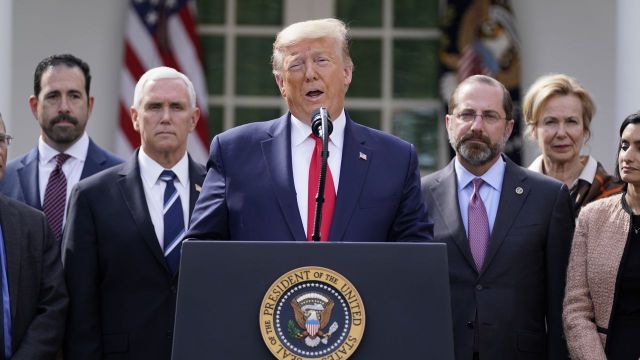
President Donald Trump speaks during a news conference about the coronavirus in the Rose Garden of the White House, March 13, 2020, in Washington [Credit: AP Photo/Evan Vucci]
Four countries—Italy, Spain, the US and France—have now seen more deaths than China, where the epidemic first broke out in the city of Wuhan last December. After 3,305 deaths, China claims to have largely suppressed the outbreak through systematic testing, contact tracing and quarantining of those exposed to the coronavirus.
The American media and the Trump administration continually describe efforts to counteract the coronavirus as a war, where the frontlines are being drawn in emergency rooms and ICUs throughout the United States, and especially in the New York metropolitan area, where half of all COVID-19 cases are located. On Tuesday the death toll in New York City itself hit 1,096, and 10,000 people were hospitalized, with 2,700 of them requiring ventilators.
But in this war, under the incompetent “commander-in-chief” Trump and his hapless lieutenants among the state governors, the troops are being sent into battle haphazardly, without weapons, and largely without regard for their own safety. Healthcare workers lack sufficient personal protection equipment, and they are being infected and incapacitated at an alarming rate, with many deaths.
In Spain, the healthcare workers accounted for 14 percent of the country’s cases, while in Italy, they accounted for 10 percent. The same process is under way in the United States. NPR reported that 345 employees of Boston’s four largest hospitals have tested positive for COVID-19. In New York City, hundreds of workers have fallen ill. At Columbia University Irving Medical Center in Manhattan, 50 percent of the intensive-care staff have been infected.
The result is that in addition to the shortages of hospital rooms, ICU beds, masks, and ventilators, there is a growing shortage of medical staff who can cope with the increasing volume of patients seeking medical attention.
Meanwhile, hospitals and healthcare systems are threatening doctors and nurses who make their concerns over working conditions public. An emergency room physician, Dr. Ming Lin, in Washington state, was fired because he gave an interview to a newspaper complaining about inadequate protective equipment. Ruth Schubert, a spokeswoman for the Washington State Nurses Association, told Bloomberg, “Hospitals are muzzling nurses and other healthcare workers in an attempt to preserve their image.” Nurses who have spoken under conditions of anonymity with WSW S reporters said that they have been told they would be fired if they talked to the media.
In some cases, state governors have made statements that amount to a confession of bankruptcy. On CNN Live, Governor Larry Hogan of Maryland said, “We are all trying to get more testing, but this is a pinch point on testing, on supplies, and materials, and PPE and ventilators. Everybody in America knows we don’t have enough of these things … and without the tests we are really flying blind. We are guessing about where the outbreaks are, what the infection rates in the hospitals are, and the mortality rates.”
However, the Trump White House manages to combine moronic expressions of optimism (largely in the form of testimonials to Trump’s personal genius) with ever more ominous declarations that the death toll in the United States will reach six or even seven figures.
On Sunday, White House adviser Dr. Anthony Fauci said that 100,000 to 200,000 deaths was a midrange figure that could be substantially lowered if proper measures were taken. On Monday, White House coronavirus coordinator Dr. Deborah Birx said that 100,000 to 200,000 was now the floor, the best-case scenario if everything went perfectly, while Trump himself declared that a death toll in that range would represent “a good job” by his administration.
On Tuesday, Fauci and Birx presented a slide show to a press briefing indicating projections that without severe mitigation, total deaths due to COVID-19 could reach 1.2 million to 2.2 million. Birx admitted that even with strict mitigation efforts throughout the month of April, the number of deaths could range as high as 240,000. At the peak of such a “best-case” outcome, 4,000 to 5,000 people would be dying every day.
Shocking as such figures are, even more outrageous is the blithe indifference displayed by Trump personally and his closest aides to the likely results of their own policy of refusing to conduct a serious struggle to contain the pandemic, not merely mitigate it.
Trump himself, towards the end of the press “briefing” that lasted more than two hours—a clear indication, in and of itself, that the White House antivirus campaign is an exercise in political propaganda and media manipulation—made comments that amounted to a self-indictment for criminal negligence on a monumental scale.
“We’re going through the worst thing this country has probably ever seen,” he said. “Look, we had the Civil War. We lost 600,000 people, right? Had we not done anything, we would have lost many times that, but we did something, so it’s going to be hopefully way under that. But you know, we lose more here potentially than you lose in world wars as a country.”
Given that the US death toll in the Second World War was 405,000, Trump is saying, in his semiliterate and meandering way, that the US death toll from the COVID-19 pandemic could well be between 400,000 and 600,000.
There was remarkably little push-back from the journalists of the corporate media who appeared to be in a daze. While several media outlets had taken note that on Tuesday morning, more Americans had died from coronavirus than were killed in the 9/11 terrorist attacks, not even this comparison, inadequate as it is, was made.
The US government’s response is best characterized as malign neglect to a pandemic that was both foreseen and preventable. With complete indifference to the fate of the people, the Trump administration’s primary focus was on ensuring the financial markets were protected. Only when the markets began to implode did the government’s machinery begin to churn to prevent its complete collapse. Everything else was deemed an afterthought.
First, on March 3, the Federal Reserve slashed rates by 0.5 percent, the most significant cut since the 2008 financial crisis. On March 12, the Federal Reserve added $1.5 trillion of liquidity into the banking systems by massively expanding short-term loans to the banks to keep money markets stable and provide banks with cash in hand. When the markets continued to plummet on March 15, the Federal Reserve cut interest rates by a full percentage point down to almost 0.00 percent. They also resumed quantitative easing by purchasing $500 billion in treasuries and $200 billion in mortgage-backed securities. Then Congress rushed through a record $2.2 trillion economic “rescue” bill, whose main purpose was to provide the Treasury and the Federal Reserve the necessary authority to bail out corporate America and Wall Street.
Comparing the gargantuan and energetic efforts to save the markets with the slapdash, indifferent and grossly incompetent actions in relation to public health, it is easy to see what are the priorities of the American financial aristocracy.
But there is another force to be heard from in this crisis—the working class. Instacart, Amazon, and Whole Foods workers have initiated strike actions against forced work under unsafe conditions. Workers at General Electric have protested, demanding their company begin producing ventilators. Many other workers are rebelling against being forced to remain on the job without protective gear.
As the crisis escalates, the decisive question is for the working class to develop a conscious political response, recognizing that it must fight the capitalist system as a whole, based on a socialist program.

31 Mar 2020

Papua New Guinea: 4,000 nurses to strike over COVID-19 readiness

John Braddock

Four thousand nurses are to strike across Papua New Guinea (PNG) this week over a lack of medical supplies and funding to handle the coronavirus outbreak. The action follows a sit-in by nearly 600 nurses in the capital Port Moresby on March 26 over the failure to provide personal protective equipment for medical staff.
PNG nurses are joining an emerging wave of stoppages, strikes and protests by workers internationally, including nurses in New York City, over the incompetence, unpreparedness and indifference of the ruling elites in the face of the deadly pandemic.
Gibson Siune, the general secretary of the PNG Nurses Association, said the majority of the members, which represents 20 percent of the nursing workforce, would participate in the protests for as long as it takes until their concerns are “heard by the national government.”
The association initially raised on March 6 that most hospitals do not have isolation units for handling COVID-19 patients and criticised the inadequate public health measures aimed at controlling the spread of the disease. Nurses are demanding the provision of personal protective equipment (PPE), risk and travel allowances, food rations, and insurance as well as proper training to handle COVID-19.
The Pacific country recorded its first confirmed case on 20 March, a mine worker who had arrived from Europe, and was then sent on to Australia for treatment. Authorities have identified another 3,000 “persons of interest,” of which 2,230 are being actively monitored.
A 14-day state of emergency was imposed on March 23, placing a curfew on the country’s nine million residents and banning travel across the country. Restrictions have been placed on who can speak to the media. A senior doctor, who spoke on condition of anonymity, told the Guardian Australia: “PNG is not prepared to fight the virus simply because it does not have the funds to do so,” adding that almost all hospitals lack basic medical supplies to attend to even ordinary illnesses.
Prime Minister James Marape has given vague assurances that PPE will be made available. However, the strike reflects wider alarm among the population over the lack of government preparedness to handle the pandemic. One resident told the Guardian the lockdown would simply lead to panic buying, while “other unfortunate ones are unable to do that now because they simply do not have the money to buy extra food and basic supplies.”
The government is recalling parliament on Thursday, six weeks early, to pass emergency legislation. No details have been released, but an Emergency General Provisions Bill and a proposed Emergency Defence Bill will be tabled, portending ramped-up authoritarian measures.
The developments in PNG come as the COVID-19 pandemic escalates across the Pacific. Last week the US territory of Guam was the first to report a coronavirus fatality with the death of a 68-year-old woman. The number of confirmed cases is climbing every day and currently exceeds 100 across the small Pacific island nations.
The impoverished, neo-colonial status of most Pacific nations, including lack of health facilities, make them particularly vulnerable to disease outbreaks. Samoa’s devastating measles epidemic that over whelmed the health system and killed 83 people last year revealed how exposed they are. Vanuatu has only two respirators, and other countries are similarly poorly-equipped. Many are forced to send COVID-19 samples overseas for testing, with long delays for the results.
Guam’s total of confirmed COVID-19 cases has risen to 55 with 13 in hospital. A further 36 crew on the aircraft carrier, the USS Theodore Roosevelt, that is docked in Guam with 5,000 people aboard, have tested positive.
French Polynesia, among the worst-affected Pacific territories, declared a curfew from March 28. Until April 15 everyone is required to remain indoors between 8pm and 5am. Anyone breaching the curfew risks being fined at least $US150, and a year in prison. On March 29 the number of people tested positive had risen to 35.
Fiji has four confirmed cases, three from one family including a flight attendant. A nationwide curfew has been imposed while the city of Lautoka is in lockdown with road blocks and patrols. Fiji’s military has been mobilised and 100 police checkpoints erected around the country. Dozens of people have been arrested for breaching the lockdown rules. Prime Minister Bainimarama has foreshadowed even harsher measures to control the population.
In Samoa a state of emergency has been declared and borders closed. Public gatherings are restricted to no more than five people. Failure to comply may lead to a fine of up to $US3,400 or imprisonment for two years. Six test results for COVID-19 have returned negative results while seven further samples have been sent to New Zealand for testing.
In Vanuatu the island of Aneityum is in lockdown following reports that passengers or crew from the cruise ship Voyager of the Seas interacted with locals during a visit on March 11-12. Seven passengers who subsequently disembarked the ship in Sydney were diagnosed with COVID-19.
Solomon Islands Prime Minister Manasseh Sogavare has suspended all international flights indefinitely and declared the capital an emergency zone. Three suspected cases all tested negative and the government is now working with China to establish in-country testing for COVID-19.
In American Samoa, 42 of 145 passengers who arrived on a Hawaiian Airlines flight from Honolulu last week have been quarantined. More than 100 residents who had earlier traveled to Samoa are also being quarantined.
The Northern Marianas, another US territory, has recorded two cases of COVID-19, while the French territory of New Caledonia has seven confirmed cases. In Tonga a state of emergency has been declared: borders are closed, nightclubs and bars shut and gatherings of more than 20 prohibited.
The Cook Islands’ alert status was upgraded on March 25 with the introduction of laws giving health authorities the power to control movements. The provisions were prompted by the surge of cases in New Zealand, to which the Cook Islands had not closed its borders. The major tourist resorts are closing this week creating a disaster for the industry, with hundreds of staff set to lose their jobs.
The escalating crisis prompted Australian Prime Minister Scott Morrison to express his concerns, not for the looming health catastrophe facing people in the Pacific, but for the geo-strategic interests of the imperialist powers. Canberra is seeking to use the emergency to buttress Australia’s neo-colonial domination of the region amid US-led preparations for war against China.
According to the Australian Financial Review on March 28, Morrison warned in a video conference with 20 world leaders that the Pacific islands must receive international support otherwise an “opportunistic China could muscle in to exert stronger influence over vulnerable states in the region.” Chinese health officials have reportedly briefed several Pacific nations on how to curtail the deadly virus—a humanitarian move deemed an imminent threat by Australia’s ruling elite.

Australian government resorts to “pandemic capitalism” as depression looms

Mike Head

Yesterday, the Australian government announced a massive “wage subsidy” bailout for big business that has no precedent. Today’s Australian editorial dubbed it “pandemic capitalism with Australian characteristics.”
In a desperate bid to avert an economic depression which could exceed that of the 1930s, the Liberal-National Coalition government pledged to spend $130 billion in just six months to give employers $1,500 per fortnight for every worker they keep on their payrolls during the worsening COVID-19 disaster.
To quell rising social discontent, the government and the media presented the scheme as one hoping to save the jobs of six million workers and sole traders.
Yet, it is likely to be inadequate to prevent a depression, given the depth of the global crash. More than a million workers have been laid off already, and many businesses will not reopen because the $1,500 a fortnight will not offset their running costs amid the collapse of sales.
As a sign of what is to come, Virgin Australia is asking for more—a $1.4 billion government loan to stay afloat—just after laying off 8,000 workers.
Nor is $750 a week enough for many workers to live on and pay their bills. Moreover, the package excludes hundreds of thousands of workers on temporary visas and casuals who have worked for their employers for less than a year, which may be about half of all casuals.
In reality, most of the funds are destined for the coffers of the largest corporations, such as the construction, mining, logistics and manufacturing giants that are keeping their workforces on the job for as long as possible, often in unsafe workplaces that are exempted from “social distancing” rules. In effect, they will be subsidised to extract profits from the labour power of their workforces.
So pleased were the corporate layers who demanded the package that share prices soared on the Australian stock exchange yesterday. The main index rose nearly 7 percent—the greatest one-day rise in four decades—even as the coronavirus toll worsened in Australia and internationally.
The $130 billion bonanza for employers is more than the annual federal government budget for health and education combined. It is also the third business “stimulus” or “survival” package in 18 days. Prime Minister Scott Morrison’s vow to do “whatever it takes” to protect the current economic order keeps expanding day by day.
These packages, together with the more than $100 billion pumped into the banks by the Reserve Bank of Australia to lend to business, add up to a staggering $320 billion. That is two-thirds of the entire federal budget. State and territory governments have disgorged billions more dollars via business tax concessions and incentives.
The resulting budget deficits will be huge. Already, Treasurer Josh Frydenberg and media commentators are speaking of “generations of debt.” In other words, the cost of this bailout will have to be extracted from the working class by way of the gutting of social spending and further attacks on wages and conditions.
The harsh “austerity” measures imposed on the population to pay for the multi-billion handouts to the banks and business by the last Labor government during the 2008-09 global capitalist breakdown will be dwarfed by those that the ruling class will seek to inflict if and when a “recovery” takes place.
The Australian editorial, while welcoming the “evolving strain” of “pandemic capitalism,” warned: “It will take fortitude to wind back this mammoth expansion of the state; not so much the taking away as the paying back.” In other words, the same financial oligarchy that will “take” the money will demand that it be “paid back” by working people.
For decades, governments around the world have hailed the capitalist market system as the most effective, and even the only possible, means of organising society. Now they are insisting that the state must intervene to rescue the beneficiaries of the market—the wealthy elite whose riches have soared, largely on the back of financial machinations, for year after year.
Some corporate media commentators nervously pointed to the political and ideological discrediting of the capitalist order. The Australian’s editor-at-large Paul Kelly wrote: “The cost over the period constitutes an increase in total government spending of 50 percent. There has never been anything like this. Past ideological prescriptions are annihilated.”
Kelly quoted Deloitte Access Economics partner Chris Richardson, who spoke of the “temporary nationalisation of businesses that we need on the other side of the crisis.”
While all the resources of the state are being mobilised to shore up economic activity, the crucial problem is that this “nationalisation” and the state apparatus itself remain under the control of the same capitalist forces that created this health and economic crisis in the first place.
Warnings of global pandemics were ignored. Hospitals and medical research teams were starved of resources. Essential measures such as mass testing were not taken as soon as COVID-19 became known. Quarantines and shutdowns were delayed for weeks, so as not to cut across corporate profit interests.
Even now, governments and the media are prematurely claiming a “flattening of the curve” of coronavirus infections, yet the numbers keep rising relentlessly, nearing 5,000. In particular, as Australian Broadcasting Corporation medical expert Dr Norman Swan is warning, the number of “community transmissions” not traceable to overseas arrivals is climbing exponentially.
Also unprecedented since World War II is the unified front that has been formed within the entire political establishment. Morrison’s government, widely detested because of its contemptuous response to the summer bushfire calamity, is only able to lurch from announcement to announcement, each one contradicting the other, because of the support being given to it by the Labor Party and the Greens.
A virtual grand coalition government has been formed to try to stabilise the political order and quell social discontent. Morrison is governing with the backing of a frequently-convened “national cabinet.” It is comprised of state and territory leaders, the majority of whom are from the Labor Party.
In addition, Morrison and his key cabinet ministers are holding weekly teleconferences with Labor’s shadow ministers to coordinate the official response. The Labor leaders immediately supported yesterday’s package and undertook to work “constructively” with the government in finalising it and pushing it through a rump sitting of parliament, with just enough MPs summoned to provide quorums in both houses.
This unified front extends to the Greens, who helped pass the last two business handout packages, consisting of hundreds of pages of legislation, through parliament in just one day. Greens leader Adam Bandt was among the first to take to Twitter yesterday to welcome the latest package, while saying it was “too little, too late.”
The trade unions are part of the same front. They rushed to hail the package, even claiming credit for it. The Australian Council of Trade Unions (ACTU) worked closely with the government to devise the scheme.
Across all industries, the unions are collaborating with employers to scrap working and wage penalty rates, in order to boost profits. Last night, Business Council of Australia CEO Jennifer Westacott, speaking on behalf of the 100 or so largest companies operating in Australia, said: “I really commend the ACTU for the cooperative way that they’ve looked at some of these big awards and given some of the flexibility that employers have wanted.”
This line-up in the face of a mounting catastrophe shows in the most direct and concrete manner the necessity for the working class to take control of the situation. While workers must demand urgently-needed measures, such as full income support for all the working people who have lost their jobs, and safe conditions for all essential workers, these requirements are incompatible with the continued control of economic life by the capitalist ruling class.
The necessity for socialism is being spelt out in the cataclysmic conditions overtaking the capitalist centres of Europe and the US, and which are threatened in every country, including Australia. That means replacing the capitalist states with workers’ states that will place the banks and basic industries under public ownership and democratic working class control.

Hunger increased by quarantines leads to protests across Latin America

Andrea Lobo

Roadblocks, raids of supermarkets and mass quarantine violations by desperate workers forced to work and find food are spreading across the poorest neighborhoods of Latin America, where the official response to the coronavirus outbreak has focused on police state measures and pushed the region to the brink of open dictatorship.
As the coronavirus pandemic spreads to every corner of the world, the UN Food and Agriculture Organization warned of potential world food shortages from supply chain disruptions caused by decline of seasonal migrants, trade barriers, sanctions and currency fluctuations.
After weeks of roadblocks protesting water shortages hampering their protection against the coronavirus pandemic, entire communities across Honduras are now taking to the streets to protest the lack of food and income due to the measures taken by the Juan Orlando Hernández administration to contain the outbreak. A “national and absolute curfew” imposed on March 16 has left hundreds of thousands without an income and led to shortages in staple goods.
The protests against food shortages began on March 24, when public transportation workers in northern Tegucigalpa led crowds to block the main highways of the country’s capital. Bus driver Luis Guzmán told AFP, “We live day by day and have no fixed income. If we don’t work, we don’t eat.” He added that his 4-year-old daughter “is asking for food and I have no money to even buy beans.”
The government promised on March 20 to deliver food to 3.2 million Hondurans in monthly quotas for the rest of the year, under “Operation Benevolent Honduras.” At a meeting with food industry executives one week later, however, María Antonia Rivera, one of the country’s vice presidents, announced that the government is only now preparing 800,000 “Benevolent bags” and that the amount of food will ultimately depend on “negotiations” with suppliers.
Finance Minister Rocío Tábora then declared, “There is an international criterion that each person needs an intake of fundamentally 2,200 daily calories, so we have to make sure that we provide that.” Careful not to infringe on their profit interests, she pleaded with the suppliers to give favorable prices, since “we have partial resources.”
Luis Colindres, head of the National Entrepreneurship and Small Business state agency, added that the armed forces will be in charge of delivering the bags, which will have a supply for 15 days, prioritizing those who have lost their daily income due to the pandemic.
Throughout the weekend, protesters across the country continued to block highways to demand food. On Saturday, a protester in the southern town of Colonias Unidas told HCH, “After 14 days of being locked in our homes without being able to work, there is nothing to eat… Honduras will not die of the coronavirus; it will die of starvation. If we have to die fighting in the streets, we will.”
Workers blocking the road to Olancho in eastern Tegucigalpa told Criterio that they lack food, water and soap, and that they are compelled to find drinking water in “a nearby river that is contaminated with fecal material and solid waste.” The blockade was disbanded when riot police arrived.
In Panama, which has 17 coronavirus casualties, the highest in Central America, price gouging is spreading and a “total quarantine” was established, allowing people to go out only to buy food and medicine. Hundreds in the poorest neighborhoods of Panama City have looted supermarkets for food.
At Curundú, residents began hitting pans on Saturday night to protest that they have not received a meager “Benevolent Bonus” announced by authorities, but anger grew and people flooded the streets, turning trash bins on fire and raiding stores. When militarized police showed up a shootout broke out; no casualties were reported.
President Laurentino Cortizo declared a national state of emergency as early as March 13 and formed a working group for “preserving social order.” While Panama officially has no army, the government has mobilized the police, border patrol and Institutional Protection Service units, whose patrols are using camouflage uniforms, high-powered rifles and armored vehicles with machine guns mounted on them.
A particularly urgent situation is developing in the northwestern Argentine province of Salta, where a wave of deaths of children from starvation is worsening due to the coronavirus quarantines and the willful negligence of the authorities. With promised “food bags” and medical care not arriving and, at least in one case, the outright rejection of a request for transportation to a hospital, three children of five years of age or under died between Tuesday and Thursday.
With five million inhabitants suffering from “severe food insecurity,” according to the FAO, the Argentine government of Alberto Fernández has focused its policy to placing the poorest neighborhoods under siege with police and arresting 33,000 people during curfews in a ten-day period.
In Mexico, raids to loot supermarkets occurred in the states of Mexico, Oaxaca and Puebla, and are apparently being organized on social media. In response, the Andrés Manuel López Obrador (AMLO) administration has deployed the Federal Police, National Guard, Army and Navy against the population, while the Cyber Police is cracking down on social media networks.
AMLO has not yet issued a “state of emergency” declaration; however, his Morena party has already enshrined the military’s unfettered deployment in the constitution, effectively subordinating other constitutional rights to a timeless state of war or national emergency.
As in Mexico, Honduran hospital workers also carried out protests earlier in March after seeing none of the $400 million supposedly approved by the government to deal with the pandemic. At the National Cardiopulmonary Institute in Tegucigalpa, which was especially selected for treating severe COVID-19 cases, workers carried out a wildcat strike to protest a lack of water, masks and protective suits.
There are 103 ventilators in Honduras but only 13 are available for saving people with severe cases of COVID-19. After specialists found that 140 new ventilators bought by the government are unfit to deal with coronavirus symptoms, the official in charge of the purchase, Roxana Araujo, simply responded: “That is what was found and what was bought.”
These shortages are the result of decades in which health care has been ransacked to incentivize its privatization and to meet debt payments to Wall Street and the local financial elite. The deals between Honduras and the International Monetary Fund (IMF) exclude health care, water and sanitation from the spending floors aimed at avoiding societal collapse.
The police-state and dictatorial response of the Latin American ruling class to the pandemic is centrally aimed at protecting some of the highest levels of social inequality in the world. The priority of the local oligarchies is remaining competitive for foreign investments, while at the same time continuing debt payments to the financial vultures and spending on a further buildup of the armed forces.
As the National Committee of the Socialist Equality Party wrote in its statement on “How to fight the COVID-19 pandemic”: “Two irreconcilable interests of two classes stand opposed to each other. For the capitalists it is a question of securing their profit interests and ensuring that their property and wealth remain untouched. No measures are to be taken that impinge on their interests. The working class is concerned with the interests of the broad mass of humanity, proceeding not from private profit but from social need.”

Unemployment surges in UK, with millions forced onto punitive welfare system

Barry Mason

Hundreds of thousands of UK workers have been laid off with the onset of the Covid-19 pandemic.
On March 20, Prime Minister Boris Johnson ordered all cafes, pubs, restaurants, nightclubs, theatres, cinemas, gyms and leisure centres to close. Many other firms were already closing due to a collapse in demand as the virus struck.
In a nine-day period to March 24, 470,000 workers applied for financial support through the Universal Credit (UC) system, more than eight times the average. In a normal week, around 50,000 new UC claims are made.
On a single day, March 27, 13,588 daily claims were made—an increase of almost 700 percent.
At the weekend, the Nomura investment bank predicted further surges in the unemployment rate to 8 percent in the April-June quarter, rising to 8.5 percent in the next three months. In January, the official unemployment rate was 3.9 percent. The Sunday Times noted that an 8 percent rate would be the equivalent of an additional 1.4 million people unemployed and a total jobless level of 2.75 million.
Since UC was rolled out in 2013, there has been a 21 percent cut in Department for Work and Pensions (DWP) staff who administer the system, due to austerity cuts. The loss of 19,000 DWP jobs led to growing workloads for remaining staff. So many people have now overwhelmed the system that 10,000 civil servants in other DWP departments are being deployed into the UC department.
UC is a punitive, means-tested system that merges six benefits into one payment. The rate for those over 25 is normally just £323.22 per month for a single person and £507.37 for a couple. Under mounting pressure, as millions faced the prospect of unemployment for months on end, the government was forced to increase the rate by a miserable £1,000 per year. This would take the rate for a single person to a pittance of £95.85 a week, in line with Statutory Sick Pay rates.
UC can only be claimed online and the numbers trying to access the UC service quickly crashed the website. The Guardian reported a queue of 145,000 people waiting to log onto the UC website, most of whom were new claimants trying to verify their identity. BBC Newsnight reported that one person found themselves 112,000th in the queue for the digidentity.eu website—used as part of the government's ID verification service.
The Guardian reported first-time claimants phoning the DWP 80 to 100 times without getting to speak to anyone. Normally, UC applications would begin with a face-to-face appointment with a job centre worker. Because of the Covid-19 pandemic, a free-phone 0800 number was introduced. The vast majority failed to get through because of the sheer numbers trying to call.
Under UC rules, claimants must make an appointment to process the claim. The Guardian quoted Anna Stevenson from the Turn2Us welfare advice charity as stating, “Universal credit claimants have to make this appointment within 30 days of them completing their applications, and for the claim to be approved, the interview must happen. People have been contacting us to ask what is going on as they are finding it impossible to get through.”
Many people who lost their jobs overnight are in a desperate position. A further obstacle for the penniless is the five-week wait period once a UC claim has been approved before any payment is made. According to the Guardian, 70,000 of the 230,000 new claimants processed earlier this month asked for an advance as they had no money in hand. On top of losing their jobs, thousands have been thrust into immediate debt. The “Budgeting Advance” loan available is totally inadequate. A single person can claim £348, a couple £464, and £812 if a claimant has children—for five weeks. Anyone with £16,000 savings is ineligible for UC.
On March 26, Chancellor Rishi Sunak announced details of the government’s plan for the self-employed during the crisis. The previous week, Sunak announced a massive bailout for corporations, which will be able to access a £370 billion pot of state credit. The government agreed to pay workers unable to work 80 percent of wages in a job retention scheme—to a maximum of £2,500 a month for an initial period of three months. But no provisions were made initially for the self-employed and gig economy workers, whose numbers have shot up from just over 3 million in 2000 to 5.75 million today—15 percent of the labour market. Many took the self-employed option after being made redundant and unable to find decent paying jobs.
With the population in lockdown and workers not allowed to work if classed as non-essential, many self-employed workers, such as decorators, plumbers and people offering services at home such as hair dressing, find work drying up.
Under Sunak’s self-employed scheme, those earning up to £50,000 a year will be entitled to claim up to 80 percent of their earnings—also up to a maximum of £2,500 a month for a period of three months. To be able to get the help they must be able to show their earnings over the last three years, which many workers will not be able to do. The scheme does not include sick pay or extend to the many workers recently joining the expanding gig economy. It covers no one earning less than 50 percent of their income through gig employment.
Any wage subsidy payments would be back-dated to March, but payments will not be made until June. This is under conditions in which around one in three self-employed people earn less than £10,000 a year. In the meantime, those left in financial straits would have to apply for UC and wait at least five weeks.
According to the Guardian, thousands of those classed as a sole-person limited company will not be eligible for Sunak’s scheme, hitting freelance workers in the creative arts sector. A sound engineer who works on TV documentaries explained, “We are just as self-employed as those being helped, but inexplicably find ourselves left out of the scheme. It’s devastating.”
After only one week of the Covid-19 lockdown, millions are struggling to access basic food staples and other essentials. The Food Foundation charity commissioned a YouGov poll to assess the impact of the disease on access to food. It noted:
More than 1.5 million adults in Britain say they cannot obtain enough food, 53 percent of NHS workers are worried about getting food, and half of parents with children eligible for Free School Meals have not received any substitute meals to keep their children fed, despite government assurances that they would provide food vouchers or parcels. This means that 830,000 children could be going without daily sustenance on which they usually rely.
Six percent of respondents, equivalent to 3 million people, have had to take a loan or borrow money to cope with the financial impact of the crisis.
The government intends that the cost of the bailout for corporations and banks will be paid for by workers when the pandemic is finally over. Faced with an unprecedented economic crisis, what will be imposed is an austerity agenda on steroids. The Nomura bank predicts a collapse in GDP of 13.5 percent in the second quarter—more than six times the biggest quarterly fall during the 2008-09 financial crisis.