5 May 2020

The American oligarchy decides for death

Niles Niemuth

It is becoming increasingly obvious that the Trump administration has embraced an approach to the pandemic that will—and that it knows will—result in the deaths of tens of thousands of people in the coming weeks and months.
On Sunday night, Trump nonchalantly stated that he now expects 100,000 people to die from COVID-19 in the United States, up from his previous estimates of approximately 60,000.
Referring to death numbers like he was negotiating a real estate deal, Trump stated, “I used to say 65 thousand, and now I’m saying 80 or 90. And it goes up and it goes up rapidly. But it’s still going to be, no matter how you look at it, at the very lower end of the plane.” He added separately, “And look, we’re going to lose anywhere from 75, 80 to 100 thousand people.”
That is, an additional 40,000 people, by Trump’s own count, will die—40,000 people with children, spouses, families and loved ones, who would not have died if appropriate measures were taken to contain the virus.
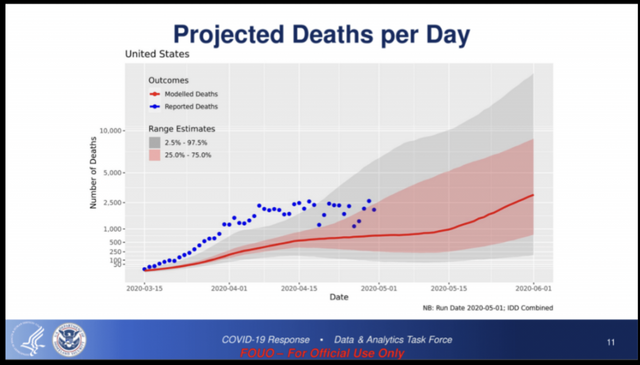
This is, in fact, a vast underestimate. The president’s remarks were followed Monday by the publication by the New York Times of an internal Centers for Disease Control and Prevention (CDC) and Department of Health and Human Services (HHS) report that projects that there will be 200,000 new cases per day by the end of this month, and by June 1 an expected 3,000 daily deaths.
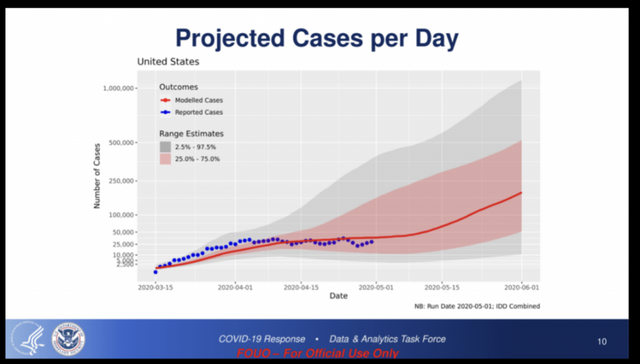
This would push the death toll into the hundreds of thousands, as the report shows that actual daily deaths have consistently outpaced government projections. At that rate, more than a quarter million people would be dead by the end of the summer, and more than a million within a year.
The CDC figures make clear that the Trump administration’s guidelines, released in mid-April, marked the abandonment of any official effort to contain the pandemic. As the World Socialist Web Site warned on April 17, the White House and the ruling class were seeking to “normalize death on a massive scale, in which outbreaks of COVID-19 are seen as the cost of doing business.”
As the death toll mounts, the Trump administration’s internal calculations are being released in dribs and drabs. At the end of March, when the US death toll had just surpassed 4,000 deaths, Trump declared that a total of 100,000 deaths would be “a good job” by his administration. Today, the official death toll has surpassed 70,000 and is still climbing at an average pace of more than 1,750 per day.
However, even this is a significant undercount of deaths that have resulted from COVID-19 infections and the stress which has been put on health systems by the pandemic. Excess deaths, those on top of the average number of weekly deaths, exceed reported deaths by as much as two times in many states. On top of this, Florida and Tennessee, two states that have already moved to reopen, are actively suppressing their official death tolls.
It must be stated again: The White House is deliberately and consciously implementing measures that it knows will lead to tens of thousands of more deaths. There is a sociopathic character to these policies, but they follow a ruthless class logic. The gangster in the White House expresses the demands of the financial oligarchy, which controls the entire political system.
The pandemic gave the ruling elite the pretext to carry out policies that otherwise would have come under extreme scrutiny and been met with popular hostility. Without the crisis caused by COVID-19, it would be difficult to justify a $10 trillion handout to the rich—unanimously supported by the entire political establishment, Democrat and Republican.
With the bailout secured, it is, as far as the ruling class is concerned, time to get back to the business of extracting surplus value from the working class, regardless of how many will die.
There are only two concerns that the ruling class has in implementing this policy.
First, there is the problem of how to get workers back to work under unsafe conditions. The response here is economic blackmail and impoverishment. Millions of workers who have been thrown out of work overnight will never see an unemployment payment. With many states now lifting all restrictions on business operations, workers will be forced back to work under the threat of being cut off from all aid if they refuse to do so.
Second is the problem of legal responsibility on the part of companies for the death of their workers. Trump set the agenda last month by using the Defense Production Act to order slaughterhouses, a center of the outbreak with thousands of workers already infected and dozens of dead, to remain open and to indemnify the corporations from being sued for any worker deaths.
On Monday, Senate Majority leader Mitch McConnell told Fox News Radio that any future bailout package should indemnify all employers. “We have brave health care workers battling the virus, entrepreneurs who will reopen their economy, all of whom deserve, in my view, strong protections from the opportunistic lawsuits… arguing that somehow the decision they made with regard to reopening adversely affected the health of someone else.”
With companies being freed of any obligation to the lives of their employees, the strategy of the ruling class now is to withhold as much information about the growing number of infections and deaths, to give the impression that it is safe to return to work and to normal life even as the coronavirus rampages its way through communities across the country.
Workers will and must reject the false choice being put forwarded by the ruling elite—starve or risk death from COVID-19. This “choice” is premised on the capitalist system is inviolable and that the interests of the corporate-financial oligarchy will dictate the response to the pandemic.
The development of opposition in the working class requires the formation of independent rank-and-file safety committees in every workplace and factory to ensure safe working conditions and fight for the closure of all non-essential production. The organization and operation of the workplaces cannot be left in the hands of the capitalists, whose only interest is in producing profits!
The effort of the working class to fight for life over profit, for a scientific and rational response to the pandemic that mobilizes all social resources to combat the coronavirus, will bring workers into an ever more direct and open conflict not only with the Trump administration, but with the corporate and financial oligarchy that is dictating policy—and the capitalist system upon which its wealth and power rests.

4 May 2020

Only the Poor Starve: Hunger in the Time of Covid-19

Graham Peebles

In addition to the global health crisis and the coming worldwide economic collapse, Covid-19 is fueling a humanitarian crisis. The World Food Program (WFP) warns that, “millions of civilians living in conflict-scarred nations, including many women and children, face being pushed to the brink of starvation, with the spectre of famine a very real and dangerous possibility.” The WFP’s view that the biggest impact of the pandemic will not by caused by the virus directly, but the hunger that the flows from it, is in line with other concerned groups.
A recent statement from the WFP warned that “unless swift action is taken”, by the end of the year we “will see more than a quarter of a billion people suffering acute hunger…in low and middle-income countries.” This is made up of 135 million already facing food shortages, plus an estimated 130 million people (it could well be more), as a result of Covid-19 and would take the total number of people who go to bed hungry every night to around a billion.
On top of the ‘130 million’ there are the tens of millions of casual workers who can only eat if they work. “Lockdowns and global economic recession have already decimated their nest eggs,” says Dr. Arif Husain, chief economist at WFP, “it only takes one more shock – like Covid-19 – to push them over the edge.”
Countries dependent on food imports and the export of oil are particularly at risk of increased levels of hunger, as well as communities that rely on remittance income from overseas, and tourism. In addition there is the uncertainty around foreign aid as donor countries face the prospect of recession. Those in greatest danger are in 10 countries affected by conflict, economic crisis and climate change – all of which are interconnected. The 2020 Global Report on Food Crises highlights Yemen (where two deaths from Covid-19 have already been reported), the Democratic Republic of the Congo (DRC), Afghanistan, Venezuela, Ethiopia, and South Sudan, Sudan, Syria, Nigeria and Haiti. Drought and the worst locust infestation for decades (triggered by climate change) have already caused food shortages in South Asia and the Horn of Africa, where according to the Food and Agriculture Organization of the United Nations, 12 million people are living under the frightening shadow of food insecurity.
Unless we prepare and act now – “to secure access, avoid funding shortfalls and disruptions to trade,” the WFP statement state, “we could be facing multiple famines of biblical proportions within a short few months.”
If the virus takes hold in locations where war is raging, in countries which have weak health care systems, the UN has warned that it would be impossible to limit the impact and/or deliver much needed humanitarian supplies, including food. In an attempt to safeguard these countries the UN Secretary general António Guterres has called for a global ceasefire. While some 70 member states, regional partners, non-state actors, civil society networks and organizations,” have so far endorsed his plea, “there was”, he said, “still a distance between declarations and deeds in many countries.”
If a ‘Pandemic of Hunger’ is to be avoided, in addition to peace and humanitarian access, supply chains, which have been disrupted, must remain open and fluid, allowing food to be transported easily. And, as WFP makes clear, states must not introduce export bans or import duties, which would lead to price rises.
These are urgent steps that must be taken to meet the immediate threat. But these measures will not feed the hundreds of millions suffering from chronic hunger. The primary cause of hunger in our world is not conflict or access to food, it is poverty – there is nowhere in the world where the rich go hungry. To banish hunger for good, lasting fundamental change must be introduced. Systemic change and behavioral change, and the two are inextricably connected.
A perfect storm
Even before Covid-19 the head of the WFP forecast “2020 would be facing the worst humanitarian crisis since World War II.” He cites wars in Syria and Yemen; the crisis in South Sudan, Burkino Faso and the Central Sahel region in Africa, where UNICEF says, “4.3 million children are now in need of humanitarian assistance,” the economic crisis in Lebanon, as well as countries like Ethiopia, the DRC and Sudan. The list, he says, ‘goes on…we’re already facing a perfect storm.’
The ‘perfect storm’ is an extreme consequence of a series of interconnected causes; many, if not all of which flow from the all-pervasive socio-economic order and the divisive values and attitudes that are promoted. Crystallized as it is, the system is a construct of the consciousness of the past. It is not of the now or the time we are moving into, nevertheless it dominates all life. Like many of our structures and forms it needs to change, many know this and Covid-19 is highlighting the need for change and presenting an opportunity. It is acting as a mirror, an agency of revelation, bringing issues into focus and pouring fuel on already simmering fires, insisting we attend. With businesses closed large numbers of people are being forced to slow down, to stop consuming, stop travelling. A space has opened up in which to reflect and examine how we live, individually as well as collectively.
A range of festering issues, known but either ignored or enflamed, are being brought to the surface; interrelated crises that have been percolating for decades demanding attention and a new approach. The man-made environmental crisis, which is the pressing issue of the age, and the outdated economic structure, inadequate or non-existent public services, the crisis of wealth/income and power inequality and social injustice among a number of other pressing social wounds.
After the pandemic has retreated and lockdowns are released the world economy is, by all predictions set to crash. The IMF estimate The Great Lockdown, as they are calling it, will result in the “worst recession since the Great Depression, and far worse than the Global Financial Crisis.” But as the head of the body, Kristalina Georgieva admitsit could be worse, they don’t know. If the coming crash is met, not with desperation and despair, but with creative imagination and compassion, it may, indeed could, bring about widespread liberation, allowing for a new and just, long overdue, reorganization of the socio-economic and political spheres.
The Age of Reason
Consistent with the new time we are moving into, a shift in collective consciousness is taking place among certain large numbers of people all over the world. To accommodate this shift, this new awareness that is slowly emerging, new ways of thinking, new institutions and structures are badly needed, including crucially a radically overhauled socio-economic system. A flexible evolving model anchored in certain Principles of Goodness: Unity, sharing and justice.
This common-sense trinity is interdependent and encourages values of cooperation and understanding, responsibility and tolerance. By the expression of one quality the other is strengthened, reinforced, expanded. Key is unity, the recognition that all of life is interconnected, whole, that humanity is one and that all have the same and equal rights. That we all have a responsibility to one another and the natural world and our actions should proceed from a position of awareness. Any new system must have sharing at its core. Sharing would end for good the abomination of men women and children dying of starvation – with or without a pandemic –, or living stunted crippled lives due to malnutrition in a world overflowing with food. Acknowledging what each nation has to offer the world at large (natural resource, including food and water, knowledge and skills, etc.) and what it lacks, what it needs from others. And thirdly, Justice, – social and environmental justice –, under the doctrine of the present order there is neither. The system is inherently unjust and cruel, benefiting these that have, punishing and abusing those that are vulnerable and have not. The natural environment – forests, rivers, oceans, habitat, all are sacrificed or exploited for profit. All need to be protected, nurtured, and allowed to heal, as does humanity.
Through the introduction of sharing as the primary organizing principle underlying the socio-economic order and animating widespread change, trust would be created, relationships built, divisions eroded, allowing for peace to come into being. Peace and freedom are perennial ideals held within the hearts of mankind. Sharing, unity and justice are the means of entry into a world in which they become not just hopes and unrealized dreams, but vibrant qualities animating all modes of living.

Rural America Needs a Real COVID-19 Response

Gloria Oladipo

As the COVID-19 pandemic spreads, many rural communities are in a uniquely difficult position.
According to Kaiser Health News, nearly 80 percent of rural America is categorized as a “medical desert,” meaning the nearest hospital is more than 60 minutes away. These hospitals are also much harder pressed to come up with ventilators and personal protective equipment for practitioners — and not to mention COVID-19 tests, which are in short supply everywhere.
Health care in rural America was in crisis well before the outbreak, with higher uninsurance rates in the countryside limiting access to care and financially undermining health facilities. Despite legislation giving financial relief to some hospitals, over 350 rural hospitals remain at high risk of closing.
Rural communities are at risk of severe outbreaks for other reasons as well.
For one, many rural communities lack reliable broadband connections. With so much COVID-19 information being transmitted via the internet, some rural residents may miss out on key updates.
Rural residents are also typically older, putting them at higher risk of dying from COVID-19. And they disproportionately lack access to healthy food and other necessities, which have become only more scarce in the pandemic.
Given the various risk factors associated with rural communities, a coronavirus outbreak in rural communities would be catastrophic. However, some government officials have not shown urgency.
For one, despite warnings from the Centers for Disease Control and Prevention (CDC) on a potential “second wave” of COVID-19 infections, some governments are easing social distancing mandates. For example, Georgia Governor Brian Kemp is allowing non-essential businesses to reopen.
Meanwhile, the federal response to COVID-19 has utterly failed. In addition to failing to expand severely limited U.S. testing supplies, the White House has not kept its promises to provide more protective equipment or control misinformation.
Indeed, it’s been issuing a steady stream of its own misinformation, prompting warnings from health officials that no, you should not inject bleach to treat coronavirus. A direct consequence of Trump’s carelessness has been a steady increase of emergency room visits and poison control calls for bleach ingestion.
Rural communities cannot afford to be neglected during the COVID-19 pandemic. Governments at all levels must coordinate their efforts to educate, protect, and care for rural residents during this uncertain time.
In addition to continuing and strengthening local social distancing orders, local governments must continue making resources — like food, shelter, and medical supplies — accessible and free. Accurate information on COVID-19 must also be made accessible, especially for rural residents without an internet connection.
In addition to government help for rural hospitals, temporary and affordable clinics should be created in high-risk areas with limited hospitals. Nationally, testing and protective equipment such as masks and gloves should be readily available regardless of one’s location.
The response to COVD-19 will be a true test in capability, resilience, and crisis-planning for all those in positions of power. The neglect of rural communities during this pandemic is yet another way this nation’s COVID-19 response continues to fail.

The Anatomy of a Failing University

David Schultz

American universities are failing. They are private or public schools. They could be religiously-affiliated or not. They could be in the east, west, north, or south of the United States.  They traditionally emphasized liberal arts. They are facing an enrollment and budget crunch for several years, seeing that the declining number of eighteen-year-olds in the coming years poses an existential threat. It has a modest endowment. It is not an elite school. It is a school like the one that many professors teach at.  It was failing before Covid-19. It may not be around in five years. With COVID-19, it may be around even less than that.
Years ago, I argued that higher education had a failed business plan, one that planted the seeds of its own destruction. It was a plan following the failures of K-12.  Now the reality of the failed business plan is imminent .
The reasons for failing are many.
For years it relied on the same demographic of white students to recruit, except that demographic is disappearing.
For years it raised tuition at percentages that far outstripped the cost of living and increases in median household incomes, and now many students cannot afford to go to college.
For years it raised tuition to convince people that the more expensive it was the better a school it was.  Except the school did not invest the money in academic programs.
For years it played the U.S. News & World Report college rankings game.  Except all the other schools played too and all it accomplished was elegant dorms and rising tuition.
For years it spent increasing amounts of money on lavish meals and events to recruit students.  Except all the other schools did the same.
For years it encouraged students to borrow, except now with student loan debt at nearly $2 trillion they are tapped out.
For years  it chased adult Baby Boomer learners who wanted additional credentials or thought they had a novel in them.  But this demographic is gone.
For years  it jumped on the bandwagon to create pricey graduate programs such as MBAs to subsidize the liberal arts school.  Except this balloon busted.
It adopted a corporate, private-sector orientated model for governance, creating high-salaried vice-presidents for every task or problem it encountered.  Except when the financial crunch hit it opted to lay off or reduce faculty and cut back on programs that generated revenue instead of trimming back middle and senior management.  It also then hired a new vice-president or a consultant to manage the finances.
When enrollment and retention dipped it hired a new vice-president instead of new recruiters or admissions staff.
It reduced the percentage of tenured or tenure-track faculty and replaced them with part time contingents. Except it found that the latter, no matter how well meaning, do not have the same time  to provide all the advising and other services full time faculty do.
It expanded sports programs as a way to attract attention and recruit students.  Except few sports programs provide a positive return on investment.
It experimented with on-line degree completion programs.  Except it did so at the same time everyone else did across the country and therefore it faced a new group of schools competing for the same students.
It lowered admissions standards to maintain enrollment but could not then figure out why the retention rates went down.
It cut requirements such as foreign languages, music, or the arts to make it easier for students to get in and graduate into jobs.  Except in doing so it undermined its mission as a liberal arts institution and the reason why students should go to it and not a community college.
It made it easier for high school students to enter with advanced placement credits.  Except it then realized that these students could graduate early and therefore did not pay as much in tuition.
As its competitors added certain programs it duplicated them as opposed to defining what it was good at and focusing on it.
As the job market changed it developed new programs to chase the trends.  Except the new trend was always one step ahead of the school.
It jumped on buzz words and slogans such as high impact learning or stackable to sell itself, yet it did little to really change course offerings or programs.
It invested heavily in learning technology letting it drive pedagogy, instead of vice versa.
It talked about the reality of a coming new student demographics, but it did little to change its marketing strategy or services to support them.
Its administrators and university presidents froze faculty salaries or cut their benefits to make money, trustees gave them bonuses for doing that and then wondered why professors were dispirited  and disillusioned.
It hired presidents who promised big change but kicked the real tough choices down the road to avoid taking responsibility for what might happen.
It said that we have to be more career-focused like community colleges, except it forgot that  an expensive four-year school cannot price compete with a two-year school.
With Covid-19, it is facing an existential threat that has accelerated the problems it has faced for years.
Now the trustees, administrators, and faculty sit around in meetings and wonder why the university is failing.  Perhaps they need to hire an expensive consultant to figure it out.

Policy exigencies for good food, work, housing and health

Dharmendra Kumar

The COVID-19 virus has global spread. The whole world is dealing with the monumental crisis. Urban centres have turned into ghost towns. The pandemic has brought to the fore policy loopholes and failures. People all over the world are looking for surviving through the lockdown. Basics of food, shelter and health are historically underlined. Work has seized. The realization of no work meaning no food is intense. In absence of work, millions are queuing for food. Countries after countries, absence of work have led to shelter insecurity for tenants. Payment of rent is driving concern for people cutting across income brackets. Developed countries are paying rent for tenants who can’t pay to landlords. Air-bed and breakfast (Airbnb) has been taken over to house homeless. Everywhere we are witnessing stronger public support for greater public investment in the public health system.
Migrant workers of urban India feels stranded and is looking for food, cash and repatriation. Citizens of United States are losing jobs and income and facing difficulties in accessing unemployment and stimulus money. Several federal stimulus programs have been rolled out with concern that big business is ripping off small business programs. In Italy people on rent are not able to pay rent as income has fast disappeared with shut down of its economic powerhouses of tourism and eateries. Paying rent is also a concern in Canada. British Columbia province is paying 500 Canadian dollars to landlords if tenants can’t pay rent. Canada expects 4 million Canadians to apply for emergency job loss funding. Fifty three per cent of Canadians live paycheque to paycheque. The welfare system of England is under lot of pressure. It has banned eviction for three months and setting up legal protocol for landlords and tenants to negotiate rent repayment. Homeless are housed in hostels and hotels. Under furlough scheme, 80% salary is being paid to workers. Scotland has gone an extra mile and has banned eviction for six months. Airbnb has been repossessed for homeless people.  Ireland has also banned eviction for three months and rent increases have been suspended. Welfare payment is universalised at 200 per person per week and 350 per week sick payment. France too has banned eviction for three months. Special allowance of 150 euros for every poor family is provisioned. Six per cent of people in France have no more revenue at all. 135 Euros are fined for being outside. In Liberia, costs on internet and cell calls have increased. Lack of electricity during the lockdown is a major concern. Government of Liberia has sanctioned 4 million to Liberia Electricity Corporation for free power in four counties out of fifteen. Only a small population is benefiting from free electricity during the lockdown. In Kenya its chaos and hunger is a huge issue. Same is the case in Peru. Honduras is only sending food to hot spots like the areas around San Pedro Sula and Cortez. The Czech republic has quarantined all citizens and eviction ban has been extended for the whole quarantine period. The Czech govt is paying those who must stay at home with children. Small businesses are given 20 Euros everyday. In Cameroon water and electricity supply is a big concern.
With crisis comes an opportunity. An opportunity needs to be seized. We can come out stronger from the present crisis if we learn the right lessons and correct our policy framework to make the world more inclusive, equitable and sustainable. The crisis is demanding to look at basics. We need to think afresh. Globalization is on the table in new avatar. Solutions can be locally available across the globe. The virus has globalized us in many ways and alerts to the sinking ship of present socio-economic life. But, it’s never too late. Let’s start with the basic first of provisioning good food, secured fair job, decent housing and modern public health for all. It all must be good. Good for all; all humans, non-humans and the nature.

Bolivia vs Venezuela: COVID-19 response reveals true nature of governments

Federico Fuentes

Government responses to the COVID-19 pandemic have put into sharp relief their true nature. This is perhaps no more evident than when we compare Bolivia and Venezuela.
Despite having been installed as “interim” president after a coup last November, Jeanine Anez is presented in the media as leading Bolivia’s “transition back to democracy”. On the other hand, Venezuelan president Nicolas Maduro is regularly described as a “tyrant” or “dictator” presiding over an “authoritarian regime”.
Yet, when we compare how these governments have responded to COVID-19, it is clear these labels bear little resemblance to reality.
Bolivia
In Bolivia, the government was quite slow to react to the pandemic and, when it finally acted, did so in an incoherent manner.
Eight days after the first cases were detected on March 10 the government closed the country’s borders and initiated a nightly curfew from 5pm–6am. But the curfew only served to raise the number of people on the streets at certain times of the day, thereby worsening the probability of contagion.
The government then shifted to a complete lockdown on March 22, imposed under threat of large fines (up to $450) and jail time (up to 10 years) for those who did not comply. Police and military were granted special powers to ensure compliance.
By April 11, almost 10,000 people had been arrested for violating lockdown restrictions. In comparison, Bolivia had only carried out 4800 COVID-19 tests by April 23.
In terms of alleviating the economic impacts of the lockdown, the government did not issue its first social security payments until mid-April. The government has also said it will subsidise basic utilities and provide companies with loans to cover wage bills.
In the midst of the pandemic, health minister Anibal Cruz resigned on April 8, but not before rejecting Cuba’s offer to help the country fight the virus. Hundreds of Cuban doctors were expelled from Bolivia shortly after Anez assumed power.
Cruz later revealed that modelling indicated Bolivia was facing the prospect of 3840 deaths from COVID-19 within 4 months. He was replaced by Marcel Navajas, who said expanding testing was not a priority, despite World Health Organization recommendations stating it is vital to any strategy to contain the virus.
Bolivia has also been extremely slow to allow hundreds of its citizens stranded in Chile to return home. After initially announcing on March 30 that 150 Bolivians would be allowed in, the government backtracked and said the border would remain closed.
Almost a week later, the first 480 Bolivians were finally allowed to cross, with a further 430 given permission on April 21. Hundreds more continue to wait their turn.
The government, however, has not wasted time in using the crisis to crack down on its main political rival, the Movement Towards Socialism (MAS), accusing it of seeking to break the lockdown to distribute food and other supplies to those who need it.
It also postponed the May 3 general elections. The most recent polling showed MAS candidate Luis Arce as the clear frontrunner (leading by about 15%), with Anez in third place.
Despite supposedly heading an “interim” government, installed with the sole purpose of convening new elections, Anez has used the lockdown — during which protests are banned — to overturn previous MAS government policies. These include lifting the ban on tin concentrate exports; allowing the state public works company to contract work without going to tender; and eliminating certain agricultural tariffs.
The economic minister has also flagged ramping up the use of genetically modified organisms in agriculture, tax relief for big business and increased foreign investment in natural resource extraction, as part of its “recovery” plan. All without any constitutional or popular mandate.
As of April 23, Bolivia had detected 672 cases and reported 40 deaths from COVID-19.
Venezuela
The situation in Venezuela is starkly different.
Unlike Bolivia, Venezuela was much quicker to move, contacting China early to obtain details about how it dealt with the pandemic. On the basis of this information, it obtained a huge number of COVID-19 testing units and personal protective equipment for health workers.
Today, it leads the region in terms of testing, having carried out more than 350,000 tests. Due to this testing regime, it has only detected 288 cases and registered just 10 deaths, despite having a population two-and-a-half times larger than Bolivia.
Rather than focus on punitive measures, the Maduro government has prioritised policies to alleviate the social and economic impacts of the nationwide lockdown that began on March 17. Among the measures it has taken are a 100% wage guarantee for all workers, a moratorium on rent and loan repayments and social security payments for a range of sectors, including informal sector workers.
Importantly, the lockdown has not meant a complete halt to the circulation of people. Instead, doctors, together with local community activists, have been going door-to-door to seek out potential cases of COVID-19. They have been aided by the government’s online Homeland Platform system, through which people can notify authorities if they have any symptoms.
The same system has also been used to gauge citizens’ opinions on certain measures. For example, a poll was taken in mid-April to see if parents wanted schools to complete the schooling year via distance education and, if so, what would be the most appropriate mechanism to use (internet, radio, dropping off books with exercises).
Community activists have mobilised to distribute copies of a government-issued book (also available online) containing 101 measures to prevent the spread of COVID-19. The book is made up of written testimonies from residents of Wuhan recounting how they dealt with the outbreak.
Venezuela, which has experienced a wave of mass emigration in recent years due to the country’s economic situation, had received more than 20,000 returning citizens from neighbouring Colombia and Brazil by April 24. Approximately 600–650 more citizens are crossing the border each day, where they are tested and quarantined.
Given the discriminatory policies of many countries that have left migrants without protection, hundreds more Venezuelans have been flown back from Europe and the United States, in many cases on specially chartered flights organised by the government.
Venezuela has been able to pursue its people-first policy in spite of the fact that its health system has been devastated by extensive trade and financial sanctions imposed by the United States and European nations. Reports estimated the death toll from the impact of the sanctions was more than 40,000 in 2018 alone. Others claim the tally is now more than 100,000.
Because Venezuela represents an alternative to the profit-driven capitalist system, the US has chosen the COVID-19 crisis as a time to ramp up its attacks on the Maduro government.
Media outlets, rather than continuing to distort information, should be actively questioning why the US, amid a global pandemic, is supporting a repressive regime in Bolivia that is proving inept at dealing with COVID-19, while it tightens a sanctions regime that is putting lives at risk in Venezuela.

Libya’s War Heading Towards More Uncertainty

Naveed Qazi

April 2020 marks one year since Khalifa Haftar launched an offensive towards Tripoli to expel its Government of National Accord (GNA). Seen as the next Gaddafi, by many, it was believed that he launched the campaign last year in desperation, as not doing so could have brought his political and military demise.
The offensive left more than thousand fighters dead on both sides, and forced more than one hundred twenty thousand people flee their homes to safer areas, according to World Health Organisation.
As of now, conditional ceasefire seems a distant dream. It was demonstrated by Haftar’s refusal to sign a Russia-Turkey mediated ceasefire document, during his visit to Moscow on 13 January, 2020. There was also a failure in two rounds of talks in Geneva, when United Nations organised a joint LNA-GNA military commission.
In the war, neither of the participants have been able to gain sizeable territories. Although, no major battles are going on right now, intermittent fighting has continued without any gains from either side. What one side loses in one week, it is likely to regain in the next, and vice versa. It has been the essence of this Libyan war until now.
Desperate to stay in power since the last twelve months, GNA has signed a security accord in Ankara, on 27th November 2019, where Turkey committed itself to supply the government with weapons and fighters. President Tayyib Erdogan had sent Syrian mercenaries alongside Turkish advisors to increase the GNA defenses. Turkey is also known to have atleast two drone command centres at Miatiqa Airport, east of the capital, and in Misrata, which have been attacked by LNA air force and foreign supplied drones.
There is also Russian involvement in the nine-year-old conflict. While Moscow is denying its role, it does recognise the presence of mercenaries from Russia’s Wagner Group, a secret security company, who are helping Haftar’s forces, although Libyan National Army says that it only deploys Libyan fighters. More than one thousand Russian mercenaries are said to be operating in Libya, according to U.S and Western officials. For Russia, Libya is also part of a strategy to extend Russian influence across the Middle East and Africa. With their expert snipers, high tech guns, and combat discipline, the Russians have inflicted a heavy toll on the pro-GNA militias.
In the absence of strong U.S. diplomacy and policies, Russia and Turkey appear well balanced to exploit the security and diplomatic vacuum, and control the fate of Libya, as they have done in Syria.
There is also interest of Italy and some other European nations in Libya’s civil war, although it is mainly driven by the Middle East’s latest divide, pitting the United Arab Emirates, Egypt and Saudi Arabia (who support Haftar) against Turkey and Qatar (who support GNA).
The US has officially supported the Tripoli government without making any real commitments in the past. But, the official line has been blurred after President Donald Trump praised Haftar in a telephonic call: when this happened, there were large protests in Tripoli as a reaction.
One of the U.N. experts’ report also said that there is presence of Chadian and Sudanese fighters in Libya, which has become more marked, since 2019 and that they represent a direct threat to the country’s security and stability.
The interest of foreign nations, in the war, is with total disregard for UN resolution 2510, which calls all countries to refrain from sending any weapons to the North African country.
On a political front, nothing much is happening. Ghassan Salame, UN envoy to Libya, has resigned, and it has further complicated the war crises.
U.N. arms embargo is already in tatters, raising the peril of more civilian causalities. There are refugees who are now fleeing violence, spilling across borders and attempting dangerous sea journeys to Europe.
According to an Oped by Sudarsan Raghavan, “As the war has intensified, so has hate speech, disinformation and fake news as both sides seek to use propaganda as a weapon. It is dividing tribes and communities and fracturing efforts at reconciliation.”
When it comes to Haftar’s strength, there have been reports where it is believed that Haftar’s has lack of human resources, as evidenced by the transfer of six hundred police officers from Benghazi to the front lines on September 10, 2019.  In the east, there is also some factional bickering between LNA units. After violently kidnapping Libyan MP Serham Sergawi, the whole act made Haftar a repressive figure.
The behaviour of his troops in the south has inflamed ethnic tensions, with the Tebu militias forcing the Haftar aligned Ahali to abandon Murzuq. The localised conflict has led to the displacement of sixty percent of town’s civilians and their families. UAE sponsored mediation between the Tebu and Haftar’s force is reported to have been collapsed, too.
Although, Haftar has means to recover in this war. His armed strength mostly comes from Gulf patrons, who also provide him an ideological cover. Political Islam also has played a role in Haftar’s military success and domestic appeal. Madakhali Salafism, a branch of Salafi Islam, named after Saudi theologian Rabee Al Madkhali, is cited as a critical ideology for Haftar. In April 2020, Madkhali, a prominent court sheikh of Saudi monarchy, released a voice recording calling upon Salafists in Libya to merge around Khalifa Haftar in his fight against the GNA.
The GNA also relies on Salafist militias, whose loyalty has been rewarded with vast security powers. For example, the Special Deterrence Force, headed by Abdul Rauf Kara, control the entrances to Tripoli and Mitiga International Airport, as militarised version of the late Saudi religious police, focused primarily on enforcing religious customs and morality. However, it has been accused, alongside other Tripoli based militias, of turning into criminal networks straddling business, politics and administration. Haitham Al Tajouri’s Tripoli Revolutionary Brigades (TRB) have also done extortion of central bank employees, kidnapping of government ministers, and done abuses at private prisons controlled by its forces.
Haftar’s forces have been no better than their adversaries. According to a report by the Global Initiative Against Transnational Crime (GIATC), the LNA have taken over the lucrative local economy for their own benefit through affiliated businessmen, extortion of bank employees and public servants, and sponsorship of militias engaged in the smuggling of migrants and oil products.  The GIATC report also points out systematic smuggling of refined oil products by LNA affiliates and political figures in east Libya, reflecting that Haftar has accumulated enough power for action through Libya’s oil, by controlling significant installations in the south and east, even if his forces were defeated and forced to retreat from Tripoli.
Infact, Haftar, who once lived in exile in the US for more than a decade, and served the CIA, allowed loyalists to shut down oil production in January 2020, as he came under pressure to agree to a diplomatic deal to end the war.

Women bear the brunt of humanitarian disasters, including COVID-19

Shobha Shukla

The United Nations (UN) data estimates that 168 million people worldwide will need assistance in 2020 to deal with humanitarian crises, including natural disasters, extreme climate events, conflicts and infectious disease outbreaks. 25% of these will be women and girls of reproductive age. And they are the ones who are disproportionately affected during any humanitarian disaster – from being more likely to die from pregnancy and childbirth related complications, to facing increased risks of unintended pregnancies, unsafe abortions, sexually transmitted infections, as well as sexual and gender-based violence.
“60% of the preventable maternal deaths and 53% under five deaths take place in conflict and natural disaster settings, as life-saving family planning interventions are too often deprioritised in a crisis situation,” said Aditi Ghosh, Deputy Director of Humanitarian Programme, at International Planned Parenthood Federation (IPPF), who was a keynote speaker at the 7th #APCRSHR10 Dialogues, co-hosted by the 10th Asia Pacific Conference on Reproductive and Sexual Health and Rights (APCRSHR10) and CNS.
Health services for women remain crucial even in a crisis
Aditi cites the real life example of Amelia, who was 7 months pregnant when an earthquake hit Indonesia’s Sulawesi island in 2018. Amelia had to literally run for her life (during that advanced stage of pregnancy) to safer grounds where she gave early birth. This life threatening experience shattered her. She was desperate to get some contraceptive to prevent another pregnancy. This was a daunting task as all the family planning clinics had either been damaged or were closed, and she was living in a displacement camp high up on a hill. But luck was on her side. She was able to receive an injectable contraceptive from Indonesian Planned Parenthood Association (IPPA), which had launched a humanitarian response through mobile health clinics and had started providing family planning services, operating from tents located near the displacement camps. Over the course of this response, IPPA provided more than 15,000 contraceptives and reached out to more than 20,000 people. This is just one example of why sexual and reproductive health services are so important in a crisis situation.
And yet, too often these services are overlooked and underfunded in emergency situations. In any humanitarian crisis – food, water, and shelter take top priority, with very little focus on women’s reproductive health needs. We seem to forget that 4% of any disaster affected population will be pregnant and 15% of them will experience pregnancy related complications. So women’s sexual and reproductive health needs do not suddenly stop or diminish during an emergency – in fact they become greater! Family planning is one of the most lifesaving, and cost effective interventions for women and girls. However there remains an overwhelming gap in an emergency response due to lack of prioritization and funding. Consequently many women and girls are forced to contend with unmet needs for family planning, unplanned pregnancies, in addition to the trauma of conflicts, disaster and displacement, rues Aditi.
Double whammy of COVID-19 in disaster settings
As it is, Asia Pacific is a very disaster-prone region and faces a daunting spectrum of natural hazards. Lack of access to healthcare and social welfare services further exacerbate the situation. Infectious diseases, like coronavirus disease (COVID-19), are harder to control during humanitarian crises, especially in congested camp settings. With all human and financial resources directed towards managing COVID-19, it has been a double whammy for the women. Essential reproductive health services needed by them have got deprioritized. Due to the lockdown, many family planning clinics and outreach services have closed down, seriously affecting access to regular contraception and other sexual and reproductive health services.
A recent research paper by Guttmacher Institute paints a very grim picture. It estimates that even a modest decline of 10% in reproductive healthcare (use of short and long acting reversible contraceptives) due to COVID-19 would have disastrous implications for the lives of women and their new borns. It would result in an additional 49 million women with an unmet need for modern contraceptives, an additional 15 million more unintended pregnancies, 168,000 more new born deaths, 28,000 more maternal deaths and 3 million more unsafe abortions over the course of one year.
According to Aditi, “Disasters exacerbate pre-existing gender-based discrimination and inequalities and block access for women and girls to basic services and rights, livelihood, and decision making in cases of gender based violence. COVID-19 has escalated these existing inequalities for women and girls living in disaster settings, along with discrimination of the already marginalized populations, displaced persons, refugees and migrants. With a near closure of informal workplaces, families are resorting to negative coping strategies to bring in money. This can (and has) lead to sexual exploitation of women who are forced into sex work in order to provide for the families. This is particularly prevalent in refugee settings where there is little opportunity to find paid work. Moreover, women and girls in abusive relationships are now confined in their homes with their abusers and more exposed to gender-based violence, with little or no recourse to seek support.”
Zahra Fathi, Executive Director of Family Health Association Iran said that “unfortunately, the wide outbreak of COVID-19 in Iran has affected our performance. All the educational and training workshop, as well as seminars have been cancelled and the number of people who want to seek sexual and reproductive health services from our centres has sharply decreased. Two of our centres are closed and four of them are providing services to the people through the outreach team. Currently, we mostly provide services which are related to prevention of coronavirus. One of our centres, in collaboration with the Ministry of Health, provides online screening of COVID-19 through hotlines and a website.”
The additional complexities arising out of any new disaster in the current times is like adding the proverbial last straw. The recent category-5 cyclone Harold that hit the Pacific islands of Vanuatu and Tonga in early April 2020 during the lockdown period, brought in a spate of newer problems. It damaged houses and buildings and destroyed crops, impacting the shelter, food security, nutrition, and health of the people. In such cases, disaster response mechanisms have to be refocused to respond quickly.
Aditi makes a case for the IPPF humanitarian model, that works in coordination and partnership with several humanitarian agencies, across the entire disaster management cycle – from prevention and preparedness to response and recovery. It connects humanitarian action with long term equitable, sustainable development goals, aiming to bridge the divide between humanitarian response and development. Its ‘Minimum Initial Service Package for reproductive health’ is a set of life-saving activities to be implemented at the onset of every humanitarian crisis and can mean the difference between life and death for people affected by disasters.
Governments will have to ensure that lifesaving sexual and reproductive health services are an integral part of national and provincial disaster management plans and that women, girls, young people and other vulnerable people have access to them in humanitarian crises or public health emergency situations. Aditi hopes that this pandemic will prompt governments to increase investments in healthcare and make it inclusive and accessible for all through innovative approaches, included digital health, self-care and community based services.
Anisur Rahman Khan, a returnee Bangladeshi migrant, and Director (Migration), Awaj Foundation, shared that the government in Bangladesh has allocated incentives for different sectors due to the impact of COVID-19 but not for migrants. Despite migrants and foreign remittances contribute significantly to the economy, people are being left out during this crisis.
Shadow pandemic of domestic violence during COVID-19
Sanna Johnson, Regional Vice President for Asia at International Rescue Committee (IRC), said the Asia Pacific region is struck by conflicts and emergencies constantly. IRC initiated since mid-January 2020 efforts to ensure all its staff of over 6000 in Asia and the Pacific is acutely aware of and practising all evidence-based COVID-19 prevention standards, including personal protective equipments for those who need it. Then we had to adjust IRC health programmes spanning from those which are providing safe abortion to other sexual and reproductive health services, or those doing outreach or helping with referral collaboration with partners, so that not only the staff but all those who are seeking care from these centres are protected from COVID-19. “We have a shadow pandemic as we see acutely increased numbers of domestic violence” said Sanna Johnson, highlighting women and girls are more at risk of sexual and gender based violence during humanitarian crises.
Older people are at greater risk of discrimination
Deepak Malik, Regional Programme Manager, Disaster Risk Reduction and Humanitarian Response, HelpAge International, underlined that the COVID-19 pandemic is causing greater suffering for older people globally. Beyond its immediate health impact, the pandemic is putting older people at greater risk of poverty, discrimination and isolation. But older people were facing severe brunt of emergency situations before COVID-19 too. “In the last two years alone, HelpAge has responded to 23 emergencies in the Asia Pacific, including in Myanmar, Indonesia, the Philippines, India, Pakistan, Bangladesh, Nepal and Sri Lanka. It is now known that older persons (especially those aged over 80) face a much higher risk of severe outcomes of COVID-19 (including death) than the general population, as do those with underlying health conditions. An early study from China’s National Health Commission suggested that about 80% of people who died from the virus in China were over the age of 60, and 75% had pre-existing conditions. In many countries, more than half of older people are affected by multi-morbidity, and the prevalence of multi-morbidity rises sharply with age and with backgrounds of poverty. This puts them at great risk in the current crisis.” It is therefore critically important for national and local governments and humanitarian agencies to provide adequate and timely care for older persons, without increasing their risks of contracting the coronavirus.
And last, but not the least, the COVID-19 response must be gender responsive and inclusive, recognizing the needs and rights of women and girls and vulnerable populations, including the elderly, people with disabilities, refugees and migrants.

Tourism collapse threatens Pacific islands with deepening poverty

John Braddock

The collapse of global tourism due to the COVID-19 pandemic could plunge masses of people into poverty in small island states across the Pacific, according to a new report by the International Labour Organisation (ILO). Thousands of jobs in countries such as Fiji, Samoa and Tonga are dependent on visitor numbers, which have fallen to zero.
The report follows a half-yearly forecast by the International Monetary Fund last month, which slashed global growth projections and predicted a slump unparalleled since the Great Depression of the 1930s. Gross domestic product (GDP) per head is expected to fall globally by 4.2 percent in 2020.
The ILO warns that almost half the global workforce—1.6 billion people—is in “immediate danger” of having their livelihoods destroyed by the economic crisis triggered by COVID-19. Of the total global working population of 3.3 billion, about 2 billion work in the “informal economy,” often on short-term contracts or self-employment, and have already suffered a 60 percent collapse in their wages in the first month of the crisis.
The crash will have devastating and long-lasting impacts on Pacific economies. Thousands of jobs have been lost, with resorts and hotels, and even some airports, closing. Fiji, Palau, Samoa, Vanuatu, Tonga and the Cook Islands are all heavily dependent on tourism.
The ANZ Bank estimates Fiji, where tourism directly employs 150,000 people, will lose about a quarter of all jobs in the country, while Vanuatu will suffer the loss of 40 percent of jobs. In the Cook Islands, tourism makes up 70 percent of the country’s gross domestic product. According to the Asian Development Bank (ADB), a three-month interruption in travel and trade will mean the Pacific economies contract this year, with Tonga forecast for zero growth.
Workers with previously stable incomes are sliding into poverty. In many Asian and Pacific countries, more than three in four tourism jobs are informal, with few if any social protections if they become unemployed. ILO director general Guy Rider noted that the economic and social effects of the pandemic discriminate above all “against those who are at the bottom end of the world of work, those who don’t have protection, those who don’t have resources and the basics of what we would call the essentials of a normal life.”
Even before the pandemic hit, the Pacific economies were extremely fragile due to a legacy of colonialism, poverty and underdevelopment. They are also particularly vulnerable to natural disasters, like last month’s tropical cyclone Harold that cut a devastating swathe through the region.
The World Bank reported in April that in resource-dependent countries, such as Papua New Guinea, plummeting oil and gas prices are likely to see a collapse of government revenue, with a looming recession. “It is something unlike anything we have seen,” the bank’s Pacific economist David Gould said: “It is not the global financial crisis ... it is not a huge cyclone ... it is really quite unique and quite historic in its impact.”
Australian National University academic Stephen Howes told the Sydney Morning Herald on March 31 that the shutting down of global trade will result in crises of food, water and medicine in the short term, and unemployment, poverty and “unrest” in the longer term. The Solomon Islands imports 70 percent of its rice from Vietnam, which has stopped trading, while Vanuatu relies on imports for more than 90 percent of its food supply. These “vulnerabilities” are in the process of turning into “acute crises” across the South Pacific, Howes warned.
The number of new COVID-19 cases in the region slowed last week, with 259 reported, an increase from 239 on the previous week. The US territory of Guam remains the hardest hit, with a total of 144 registered infections and five deaths. The aircraft carrier USS Theodore Roosevelt, which docked in Guam after coronavirus was detected on the ship has had 777 of its crew tested positive.
COVID-19 could rapidly reach epidemic status in the region’s largest country, Papua New Guinea (PNG), which has a population of nine million. So far there have been eight cases detected and no deaths. Cases have been reported in four provinces, and the original source of infection is unknown in two places, sparking fears that there may be widespread undetected community transmission.
PNG, which has just 3,000 hospital beds and is already running low on critical supplies required for testing, is not set up to cope if the outbreak worsens. Soldiers were recently dispatched to conduct contact tracing in Western Province, where 152 samples were collected, including those of 10 police officers who were sent to the area without PPE.
In line with the “back-to-work” offensive by governments around the world, some restrictions imposed during the PNG government’s initial State of Emergency have been lifted, including the reopening of schools and resumption of public transport. Restaurants and places of worship have re-opened, with minimal protective measures in place.
Fiji has reported seven active cases of COVID-19 and 18 infections. Again, some restrictions on movement and gatherings have been relaxed, including allowing gatherings of up to 20 people. A curfew remains in place, as does a ban on sporting events.
Fiji Prime Minister Frank Bainimarama, a former military coup leader, has used the pandemic to tighten his government’s rule in the face of sharp austerity measures. In a recent Fiji Sun op-ed a senior military officer, Brigadier-General Jone Kalouniwai, declared that the COVID-19 emergency gave the country’s leaders “good reasons to stifle criticism of their policies by curtailing freedom of speech and freedom of the press.” The fight against COVID-19, he warned, was “likely to end up violating the individual rights and rule of law that are at the heart of any liberal society.”
According to New Zealand journalist David Robie, many governments in the Pacific as well as elsewhere are imposing tough controls under cover of fighting the coronavirus pandemic to strengthen “creeping authoritarianism.” The moves are no doubt in preparation for growing social unrest.
In the Asia Pacific Report, Robie cited PNG, where the Joint Task Force National Operations Centre last week announced that there will be no more media briefings on how the government is handling the coronavirus pandemic.
On March 26, some 150 troops were dispatched to guard the massive Porgera gold mine in Enga province after the PNG government refused to extend the mining lease of Chinese Canadian joint venture Barrick Niugini Limited. Opposition leader Belden Namah accused recently installed Prime Minister James Marape of using the COVID-19 State of Emergency to justify the “unconstitutional” deployment at the commercial venture.
Concerns have also been raised about Vanuatu, where the government declared it illegal for media outlets to publish reports on coronavirus without government approval, citing the need to prevent the spread of “misinformation” about the disease.