6 May 2020

Mapping Militarism 2020

David Swanson

A new collection of maps found here displays what militarism looks like in the world. Here’s a brief guide to using and understanding them.
Across the top are 10 drop-down menus on these topics: Wars, Weapons, U.S. Weapons, Money, Nukes, Chemical and Biological, U.S. Military, Air Strikes, Law, and Promotes Peace and Security.
Some of the topics only include one map, others multiple maps. The one with the most has eight maps. When you click on the name of a map in a drop-down menu, you’ll see that map displayed. If the map contains data for multiple years, you can see previous years by changing the date at the bottom. You can even make it scroll forward through the years like a short video. You can select a particular country from a list or on the map. You can zoom in or out. You can click on the color key to display only the countries in a particular range of data (such as those with the highest spending on wars or suffering the highest number of air strikes). You can print any map or get a direct link to any map set to any date and other settings.
Each map has a year as part of its name. While the maps have all just been updated for 2020, the latest available data for some of them is from 2019 or an earlier year. The dates on the maps correspond to the years the data is from. None of the maps reflect any changes already brought about by or predicted or hoped for as a result of the coronavirus pandemic.
Here’s a bit of information about each topic that has been mapped.
Wars. This section includes three maps: Troops in AfghanistanWars PresentDrone Strikes.
The first map displays the number of troops from each nation that are taking part in the war on Afghanistan according to NATO. A number of these nations have declared their support for a global ceasefire, but without withdrawing their troops. Over the years, however, some nations have withdrawn their troops. Scroll the map back through time to see nations that used to be in this war but no longer are.
The second map highlights the nations where wars have caused 1,000 or more deaths in the past year according to data from the Uppsala Conflict Data Program displayed at Wikipedia. Go to that link to find smaller wars as well. Scroll this map back through time to see where wars were in previous years. This map changes considerably from year to year, but the wars are always in the global south, mostly concentrated in North Africa and the Middle East, usually in areas rich in fossil fuels, and never in any of the nations that produce and export most of the weapons for the wars (see weapons maps below).
The third map displays data gathered by the Bureau of Investigative Journalism from Afghanistan, Pakistan, Somalia, and Yemen on U.S. drone “strikes.” Unlike all the other maps, this data is cumulative. That is to say, the figure of 13,072 drone strikes on Afghanistan for 2020 is the total number over the past several years. But, notice that the total by 2019 was 5,888. This means that drone strikes on Afghanistan in the past year have exceeded those of all previous years combined. We also see a major increase in Somalia. In contrast, since the number for Pakistan is unchanged from 2019 to 2020, there have been no drone strikes recorded there in the past year. The reason the data for this map does not come from the U.S. government which surely knows it, is that the U.S. government does not provide such data to the public; this data has to be obtained by journalists working in the nations where people are being blown up.
Weapons. This topic contains eight maps. The source for the data in them is the U.S. State Department, which relies on data from the World Bank and the United Nations Statistical Division. The disadvantage with this source is any lack of trust with it, but the advantage is that the incredibly damning information cannot be questioned by the primary guilty party, since it provided the data itself. The latest data, new in 2020, is from 2017. About the eight maps:
Weapons Exported. This map provides the billions of U.S. dollars worth of weapons exported in 2017 from each country. The United States so dominates the field that it made sense to include the next map displaying percentages. Note that exports under $50 million are recorded as $0 because not provided by the State Department, so some of the nations listed at $0 are actually above that yet dealing in small change relative to the big weapons dealers of the world.
Weapons Exported as Percentage. This map shows what percentage of total global weapons exports was exported by each country. The United States was 78.5%. No other nation even reached 5%.
Weapons Exported to the Poorest Countries. This map provides the billions of U.S. dollars worth of weapons exported from each nation to the poorest quintile of nations on earth.
Weapons Exported to Poorest Countries as Percentage. The United States covers 43%, China 24%, Russia 19%.
Weapons Exported to the Least Democratic Countries. This map provides the billions of U.S. dollars worth of weapons exported to the least democratic quintile of nations on earth. Remember that this is data developed by the U.S. government and published without shame. (See also maps below on oppressive governments’ militaries armed, trained, and funded by the United States.)
Weapons Exported to Least Democratic Countries as Percentage. The United States accounts for 66%, the UK 11%, Russia 11%, China 9%, Germany 2%.
Weapons Exported to Middle East. This violent region produces very few weapons itself.
Weapons Exported to Middle East as Percentage. The United States accounts for 70%, the UK 11%, China 4%, Russia 3%, Germany 3%, France 2%, Italy 2%.
U.S. Weapons. This topic includes four maps that help us see just where the weapons of the world’s dominant weapons dealer go.
U.S. Weapons Imported 2015-2019. This map simply colors in the nations that have imported any weapons, whether a small or large amount, from the United States during these years. The source of this data is the Stockholm International Peace Research Institute (SIPRI), where you can look for more detail. Notice that most of the world is covered. But note that this data does not include exports to anything that isn’t a nation, such as NATO or rebels trying to overthrow the government of Syria.
The next three maps draw on research done for a recent book and documented in detail in this article. They are:
Almost all oppressive governments have the support of the U.S. government.
Money. This critical topic includes only one map but adds new data to it for each year from 2015 to 2019.
Spending in Millions of 2018 U.S. Dollars. This map shows the millions of dollars spent by each nation on militarism in each year. The data is all in constant 2018 dollars and exchange rates. The data all comes from SIPRI, which provides data up through 2019, whereas the U.S. State Department provides similar data only up through 2017. To compare that State Department data go here. The $718,689,000,000 figure for 2019 U.S. military spending that SIPRI provides falls far short of the $1,250,000,000,000 that the U.S. government is actually spending on militarism when all agencies and departments are included, yet the maps still show a striking contrast between U.S. spending and that by all other nations. One explanation for why the U.S. government seems so incapable of addressing the coronavirus threat while generally being credited with very professionally holding off the Russian, Iranian, Chinese, and North Korean menaces may be that the latter are imaginary. Russian military spending, which went down two of the past three years, is 8.9% of U.S. military spending. Iranian is at 1.3%. China is at 37%. Data is unavailable on North Korea, but its spending is a small fraction of that by the U.S. Meanwhile, Venezuela, as of 2017 (the most recent year with data), was at 0.001% of U.S. spending that year. As SIPRI has noted, global military spending increased significantly in 2019. Thus far in 2020 that trend seems to be continuing. Military spending by NATO members, led by Germany with the largest increase, has been up in recent years, following public badgering by U.S. President Donald Trump to spend more.
Nukes. This topic includes only one map, with data from 2014 to 2020. The source of the data is the Federation of American Scientists. Here’s the map:
Number of Nuclear Warheads. This map shows numbers of nuclear weapons possessed by each nation to the extent known. This number is one critical measure, but it is important to bear in mind that many of these weapons are vastly larger than were nuclear weapons of the past, while others are smaller and terrifyingly described by the U.S. government as “more usable.” The Federation of American Scientists notes: “The number of nuclear weapons in the world has declined significantly since the Cold War: down from a peak of approximately 70,300 in 1986 to an estimated 13,410 in early-2020. Government officials often portray that accomplishment as a result of current or recent arms control agreements, but the overwhelming portion of the reduction happened in the 1990s. Some also compare today’s numbers with that of the 1950s, but that is like comparing apples and oranges; today’s forces are vastly more capable. The pace of reduction has slowed significantly compared with the 1990s. Instead of planning for nuclear disarmament, the nuclear-armed states appear to plan to retain large arsenals for the indefinite future, are adding new nuclear weapons, and are increasing the role that such weapons play in their national strategies.”
Chemical and Biological. This topic contains only one map with data from 2014 to 2020:
Chemical and/or Biological Weapons Possessed. This map simply colors in the nations most likely (there are many uncertainties and dueling allegations) to possess any chemical or biological weapons. Here is a source. As pointed out in a recent article, the coronavirus may not have come from a lab but certainly exposes the danger posed to humanity by the work being done in labs.
U.S. Military. This topic includes four maps that help us visualize the militarism of the world’s leading militarist:
U.S. Bases Present. This map provides the number of U.S. bases in each nation on earth. The data comes from a new source this year, which may account for some of the variation between the 2020 data and the 2019 data that can be displayed on the map. The source is a List of U.S. Bases Abroad, compiled by David Vine. It is important to go to that source to understand details and uncertainties, and to find bases on tiny islands and other places too small to show up on the maps. This is very much a work in progress. The information is not provided by, and some believe not even fully known by anyone in, the U.S. government. If you have information to add, please contact us.
U.S. Troops Present. This map uses U.S. military data to display the number of U.S. troops openly admitted to being “permanently” based in each nation of the globe. This does not include troops taking part in wars or actions not labeled wars. Missing are “special” forces as well as the largely Navy personnel in Armed Forces Europe and Armed Forces Pacific. Missing is the CIA. Not counted are mercenaries and contractors.  Not displayable on the map are 8,471 troops listed by the U.S. military at the link above as being in “unknown” locations. We have added the 8,000 figure for Afghanistan from the map on troops in Afghanistan above, as well as 5,800 for Iraq and 5,800 for Syria based on this report.
NATO Membership. This map simply colors in the nations that are NATO members according to NATO. Not included are non-member partners.
U.S. Wars and Interventions Since 1945. It’s revealing to look at a map of all the places that the U.S. military has gone to fight at least once since 1945. For more detail go here.
Air Strikes. This topic includes only one map to display data on a handful of nations for which the U.S. military provides reports on its air strikes.
U.S. and Allies Air Strikes. The data is not cumulative. The number provided for a given year and country is the number of air strikes in that year alone. But the data does not distinguish between Iraq and Syria, treating the bombing of both nations as part of a single operation. So, the data for both of those nations is listed in both of them — which should not be interpreted to double the number of strikes. These numbers, in the thousands, require some imagination to understand as each indicating a horrific bombing. It may aid the imagination to picture the same number of “air strikes” in one’s own part of the world.
Law. This topic includes three maps indicating particular steps taken by some nations to uphold the rule of law:
Promotes Peace and Security. This topic adds three additional maps indicating further particular steps some nations have taken toward peace and security, or — indeed — survival:
Residents Have Signed World BEYOND War’s Declaration of Peace. It’s almost every nation now. You can read or sign it here.
Additional steps toward peace could easily be mapped. Let us know what you’d most like to see added in 2021! We’ve dropped the Good Country Index ranking, as that index no longer includes any ranking clearly about acting for peace and against war. We also find the Global Peace Index to be off-topic as it lumps peace in with numerous other factors, resulting in the worst warmongers scoring relatively well. In place of a numerical ranking, we offer the above collection of maps.

Coronavirus Disaster: A Lesson for both India and Pakistan

Mir Suhail

While the number of reported cases of the new coronavirus in India and Pakistan remains in the low thousands, but concerns are growing about the capacity of healthcare system to deal with the potential threat in both countries.
In both countries, it seems to be a major test for the Narendra Modi led government and power less PM of Pakistan, Imran Khan. Lack of hospitals, missing doctors, ill-equipped health professionals, and paucity of funds have dogged the health sector of both countries for decades now.
Around 1.7 billion people live in India, Pakistan and Bangladesh, a study by Lancet about healthcare systems has ranked all three countries close to the bottom. They also rank at the bottom for infant and neonatal mortality. The Mortality rates among children act as a representation of the level of social development as they show the level of nutrition, parents’ education, and access to health services.
Everyone knows that health is a human right and is essential to development. Good health improves learning, worker productivity, and income. As such, health contributes to economic growth, but in Asia all these essentials are missing. The major reason behind all this is that, both India and Pakistan is growing day by day in terms of population, but the governments spending on public health in both countries is low. For many in these countries, personal health expenses are a major cause of poverty.
Look at the “Make in India” in defence initiative, which the BJP mentioned prominently in its manifesto all the times, needs to be anchored firmly around the private sector.
One strong promise the BJP made before elections was that it will speed up purchases of outstanding equipment and weapons needed by the forces. The Balakot operations and the retaliatory strike by Pakistan the next day bring out focus on a few urgent needs that cannot wait.
The Rafale fighter jets in India, and F-16 aircrafts in Pakistan — the air force of both countries is of the firm belief that the foreign made fighter jets will be able to perform wonders by killing human lives.
Other systems needed by both countries to keep the air strikes option open to act against each other are – guns, tanks and missile. Look at the millions of Pakistanis who voted in favor of Imran Khan, It would be an understatement to say that the promised emergence of Naya Pakistan has failed to actualize. In fact the dream for Naya Pakistan has turned into a nightmare for all those who believed in the unrealistic and utopian ideas of Imran Khan about making Pakistan a vibrant and prosperous nation with rotten healthcare system. The tragedy is that both leaders still believe in false narratives and fanciful make beliefs.
What haunts more is the population density of both India and Pakistan. Wouldn’t millions of poor people living together make it an easily transmissible disease? Consider the slums where hundreds of millions live and work. Implementing strict lockdown in such places is not only difficult, but impossible. A massive, aged citizenry will also make social distancing impossible. India have around 100 million people over the age of 60. It might work for the urban middle class but will not work for urban poor or the rural poor because most of them work in areas that are not suitable for such measures.
As of now, travel restrictions, lockdowns, hotel closures and cancellations of cultural events, businesses, fairs and conferences have already led to irrevocable revenue losses in all affected sectors and are starting to eat away at the resources of many firms. Insolvency risks have ballooned.
One lasting lesson from the COVID-19 outbreak is that, no one can reliably predict future, because too much depends on what is unknowable, how long the outbreak lasts, how many countries it afflicts, and the extent to which a coordinated, concerted, fast-track policy response is mobilized. But what we do know is that the outbreak arrived at a weak point for the economy, when global growth was beginning to pick up from its lowest rate since the 2009 financial crisis.
In the coming weeks, all countries—even those without a single coronavirus patient—will need to take concrete policy steps to protect their people and limit harm to their economies.
Governments in both India and Pakistan should avoid spending huge budgets on defense which would exacerbate disruptions and amplify already elevated levels of uncertainty in both countries. Even more important, both countries should come on a single table to discuss the long pending issues, and instead of hurling bombs at each other, both should work together to support increased production and ensure that resources flow freely through the borders to where they are most needed.
Whatever happens, the pandemic will be a reminder to both India and Pakistan’s governments that they have long-neglected health care infrastructure, especially for their lower-income populations. This public health crisis will also be an economic crisis.

Surviving a ‘shadow’ pandemic: domestic abuse in the time of Corona

Girija Godbole

How many of you can even imagine living 24×7 under the same roof as your abuser with the constant fear of what he (in rare cases she) might do next to hurt you?  How would it feel when coughing results in merciless beating or throwing you out of the house on suspicion of COVID symptoms or your partner constantly meting out verbal abuses for no reason or starving you or not letting you use the toilet? Home isolation, however crucial to the fight against the pandemic, is giving still more power to the abuser. It has also shattered support networks, making it far more difficult for victims to get help or escape.
Across the world, a surge in incidents of domestic violence are being reported since the lock down. From Brazil to Germany, Italy to China, activists and survivors are already seeing an steep rise in abuse (Graham- Harrison et al., 2020). In India the National Commission for Women (NCW), which receives complaints of domestic violence from across the country, has recorded more than twofold rise in gender-based violence in the lockdown period (The Economic Times, 17/4/2020). UN Women Executive Director Phumzile Mlambo-Nguka has called rise in violence against women and girls a ‘shadow’ pandemic (UN women.org, 6/4/2020).
Several studies indicate a positive relationship between exposure to extreme events and rates of interpersonal violence (Jeltsen, 2020). During such events, domestic violence often increases as as the perpetrators have more access to their families and can get away easily as support services break down. There may not be physical violence in every abusive relationship, but other common modes of abuse include isolation from friends, family; constant surveillance; strict rules for behaviour; and restrictions on access to basic necessities as food, and sanitary facilities (ibid.). Though isolation is one of the effective ways to contain the current epidemic it may also be a deadly trap for the victims of domestic abuse. Over 92000 SOS calls to The Childline India helpline asking for protection from abuse may be a grim indication that not just women but children are also trapped with their abusers at home. (The Economic Times, 8/4/2020). Swarna Rajagopalan, (personal communication, April 7, 2020) the director of Chennai based Prajnya Trust, warns that incest, rape and child sexual abuse are also likely to be on the rise.
According to Mukund Kirdat (personal communication, 8/4/2020), founding member of a feminist men’s group Purush Uvach in Pune, within our highly patriarchal society, men are often trapped in their mardangi (machismo). Under normal circumstances they get enough opportunities to display it, however during this unprecedented scenario of a lockdown, they may be struggling to cope. Also losing their ‘traditional’ role of breadwinner poses a clear and imminent danger for some of them – especially those employed in the unorganised sector – and women and children seem to be the easy target to vent out these fears and frustrations. Sarubai Waghmare, (personal communication, April 16, 2020) an active member of Kagad Kach Patra Kashtari Panchayat- a waste pickers’ union, reiterates this by her firsthand observation of the families living in her informal settlement in Pune. “When a hungry child asks their mother for food, and she in turn asks her husband to buy some, he  resorts to violence as he is now out of work and is ashamed for not being able to provide for his family.” Sangita Thosar, (personal communication, April 16, 2020) Assistant Professor at the Centre for Women’s Studies at Tata Institute of Social Sciences, Mumbai remarks that the absence of domestic help, especially in the middle classes, has increased the workload for women. If they ask the men to help out, sometimes the male ego gets hurt and the result may be mental or physical abuse.
 Impacts and extent of domestic violence:
Research suggests that the influence of abuse can persist long after the violence has stopped. The more severe the abuse, the greater its impact on a person’s physical and mental health, and the impact over time of different types and multiple episodes of abuse appears to be cumulative (Heise and Garcia, 2002).
Global estimates published by WHO indicate that about 1 in 3 (35%) women worldwide have experienced either physical and/or sexual intimate partner violence or non-partner sexual violence in their lifetime (WHO,2017). In India where men are perceived to be socially superior and tend to have the right to assert power over women, it is not surprising that cultural norms permitting the use of physical violence as an acceptable way to resolve conflict in a relationship are still prevalent. A culture of silence surrounding domestic violence means that women seldom speak about it unless it reaches unbearable limits. One of the myths about domestic violence is that it is greater among poorer sections. However in reality even rich and middle-class women are not spared from it. The National Family Health Survey (NFHS-4, 2015-16) indicates that 30 percent women in India in the age group of 15-49 have experienced physical violence since the age of 15. About 31 percent of married women have experienced physical, sexual or emotional violence by their spouses.
After a sustained campaign by women’s groups for two decades, the Protection of Women from Domestic Violence Act was finally enacted in 2005.This Act defines domestic violence in line with international law to include physical, emotional/verbal, sexual, and economic violence (Agnes, 2019). Provisions under this Act such as helplines, shelters and legal assistance for battered women are miserably inadequate even at the best of times and it is extremely difficult for women to speak up openly even under the most supportive conditions. With the sudden lockdown, when women find themselves isolated and vulnerable their options to seek help seem virtually none (Deshpande, 2020).
According to Rekha Sharma, the chairperson National Commission for Women, women are not approaching the police because they think that if they take the husband away, the in-laws may torture her. Also they fear that their husband will torture them more once out of the police station and she cannot even move out. With the lockdown the earlier option of going to parents’ is not available. Reaching out to the police is also difficult due to the lockdown (The Economic Times, 8/4/2020).
Curbing domestic violence during lockdown
In view of this surge in cases of domestic violence, António Guterres Secretary General of the United Nations has appealed to all governments to make the prevention and redress of violence against women a key part of their national response plans for COVID-19 and to increase investment in online services and civil society organizations and declare shelters as essential services (UN News, 6/4/2020).
As the abuse cases soared during the first week of lockdown the French government announced that they would pay for hotel rooms for victims of domestic violence and open pop-up counselling centres. In Spain the victims are told to head to drugstores to seek help and say codeword “mask 19” if they cannot talk openly. A prosecutor in Trento, Italy, has ruled that in situations of domestic violence the abuser must leave the family home and not the victim (Graham- Harrison et al., 2020).
The response of the Indian government has been dismal so far. Many women’s organisations have demanded that reaching women in distress needs to be classified as an “essential service.” The administration and law enforcement agencies need to recognise the gravity of the problem and sympathise with women. So far none of the Prime Minister’s addresses to nation or press briefings have raised the issue of domestic violence. Preeti Karmarkar (personal communication, April 9, 2020) of Pune based Nari Samta Manch suggests that the government should add the safety of women to their messages in announcements on the pandemic. Exceptions are full page advertisement by Uttar Pradesh Police Department ‘Suppress corona, not your voice’ (Bose, 2020) and an announcement by Rachakonda Police Commissionerate in Hyderabad that all cases of domestic violence will be taken up at first priority (personal communication, April 16, 2020).
According to Rajgopalan (personal communication, April 7, 2020), creating good, safe shelters and improving helpline services is crucial. At a more individual level, Kirdat (personal communication, April 8, 2020) of Purush Uvach, appeals to men to break their ‘traditional’ image and to get physically involved in household chores which may also help them to channel the anxiety of future uncertainties and fight the temptation to resort to violence at the slightest provocation. In Sarubai’s (personal communication, April 16, 2020) opinion, assured free supply of food grains or reasonable monetary assistance by the State to the needy families who have lost their source of income will ease the burden and help in reducing the violence.
Well-funded and robust support services for domestic violence survivors, including psychological care and economic resources, are crucial. However the interventions cannot be limited only to dealing with abuse. The causes of gender-based and sexual violence must be disrupted by fighting the patriarchal value framework. As has been discussed lock down may escalate already existing incidence of violence, it may also result in new incidences. But we must also remember that such extreme scenarios sometimes lead to reconciliation and rediscovering relationships too.

Mired in debt, Sri Lankan government vows to avoid default

Saman Gunadasa

As international rating agencies highlight the rapid deterioration of Sri Lanka’s precarious debt situation as a result of the COVID-19 pandemic, the government has vowed to impose the austerity measures demanded by the financial markets in order to avoid a default.
P.B. Jayasundara, the secretary to the president, told the DailyFT last week: “Our commitment is Sri Lanka will under no circumstances dishonour debt obligations and investors’ trust in our financial system…We certainly don’t want to be an Argentina.”
It is significant that Jayasundara compared Sri Lanka with Argentina, which defaulted on its foreign loans last year. Argentina’s government last week cut wages by 25 percent and further slashed subsidies under the impact of the coronavirus crisis.
Since early March, 30 billion rupees has been withdrawn from the bond market. The collapse of the Colombo stock market from March 6 to 20 wiped out 355 billion rupees. Since then the market has been closed.
According to a Central Bank report issued on April 29, Sri Lanka’s foreign debt is more than $US55 billion. Global ratings agencies such as Fitch and Moody’s have delivered dire warnings.
Moody’s cited capital outflows, the devaluation of the rupee and low reserves in the face of large external debt service payments. It said the country has “very weak debt affordability.” It expected “Sri Lanka’s debt burden to rise to nearly 100 percent of GDP (gross domestic product).”
Morgan Stanley, a global investment bank, rated the sovereign bonds of crisis-ridden Pakistan and Ghana as better than Sri Lanka’s, making it more challenging for government borrowings.
Similarly, on April 24, Fitch Ratings downgraded Sri Lanka’s sovereign rating from B to B-, predicting the “economic shock from COVID-19 would further erode rising public and external debt sustainability.” Analysts warned that the printing of more money by the Central Bank could further downgrade the index.
Fitch added that it was difficult for Sri Lanka to raise funds from international financial markets to repay debt and the country had to look for alternative sources. This difficulty was evident recently. When the country offered $60 million worth of bonds last week, only $28 million was raised.
In the remaining months of this year, the government will have to pay $3.2 billion for loans and interest, followed by $13.8 billion for debt service from 2021 to 2023.
Foreign currency outflows from mid-February to early April totalled $363 million as investors withdrew investments in bonds. Due to the pressure mounted by these withdrawals, the Sri Lankan rupee has devalued 6 percent against the US dollar since early March.
Fitch expects Sri Lanka’s GDP to shrink by 1 percent in 2020 and the budget deficit to rise to 9.3 percent of GDP. This is almost three times the deficit target of 3.5 percent set by the International Monetary Fund (IMF).
Last week the Economist ranked Sri Lanka as the most stressed economy in South Asia and one of the worst in the world, placing it near the bottom, at 61, on its list of 66 “emerging economies” in “financial distress.”
The government is desperately trying to use its strategic ties to borrow money. It sought $400 million from India and $1.5 billion from China in currency swaps, as well as a loan from the Asian Development Bank and an IMF loan of about $800 million under a new Rapid Credit Facility.
The IMF has withheld the final installment of the $1.5 billion loan it released in 2016, which was conditional on harsh austerity measures. Any new package will have more strings, including the slashing of subsidies and the “restructuring” of the economy with the privatisation of government entities.
In a virtual meeting of the so-called Non-Aligned Movement on May 4, President Gotabhaya Rajapakse renewed his appeal for the debt relief. “Developing countries are facing an unprecedented economic and debt crisis,” he said, and “the need for debt relief and financial stimulus for these countries must be duly recognised.”
Because of the worst global slump since the Great Depression of the 1930s, exports from South Asian countries to consumer markets in Western countries have declined drastically.
Big business and the government are translating this crisis into a massive attack on jobs, wages and all hard-won workers’ rights, including the eight-hour working day, leave entitlements, pension funds, and overtime and incentive payments.
Rajapakse is issuing directive after directive on how state and private sector workers should be employed as businesses are re-opened. However, his plans to lift the curfew and resume work in Western Province, including the Colombo district, had to be postponed due to a surge of COVID-19 cases, nearing 800 infected patients.
The government has now decided to begin recalling limited numbers of workers in the province from next Monday, while retaining the curfew. According to Rajapakse’s latest directive on Monday, companies can decide how many employees to recall, allowing them to impose drastic job cuts.
Indicating the harsh attacks being prepared against workers, the National Exporters Chamber (NEC) wrote to Skills Development, Employment and Labour Relations Minister Dinesh Gunawardena proposing various measures, such as “the exporters to use only the required number of workers and pay wages on a piece rate system or terms agreed with the employee.”
This amounts to summarily laying off unwanted permanent and casual employees and converting the whole workforce to contract workers. The NEC also urged the minister to permit work on Sundays and public holidays without proper compensation and to suspend pension fund deposits for six months. Several companies are already implementing such measures.
The NEC warned that if these measures were not permitted, mass layoffs could trigger workers’ protests that could lead to a “catastrophic outcome which will be a severe setback to the country.”
On Rajapakse’s orders, the Central Bank has so far pumped 240 billion rupees into commercial banks. The biggest chunk of this is being used to save big business. Small and medium businesses complain that they have received no relief from the government.
At the same time, the government continues to impose the burden of crisis on workers and the poor, with the start of a new round of lifting price controls on essentials. The price of dhal, which was 65 rupees a kilogram, skyrocketed by about 150 percent. Canned fish and sugar prices went up by about 100 percent and 20 percent respectively.
The government and the capitalist class are fully aware that the ruthless attacks on jobs, wages and living conditions are likely to trigger a wave of class struggles. Rajapakse is preparing dictatorial measures and last week mobilised large numbers of troops in Colombo and throughout the country.

Teachers, parents and students defy order to reopen schools in Chile

Mauricio Saavedra

Many thousands of parents, students, educators, and childcare workers have opposed the Chilean government’s push for face-to-face teaching during an expected peak of the coronavirus pandemic. The push by the ultra-right government of President Sebastian Piñera is in response to the deepening economic crisis and demands from the financial and corporate elite for immediate implementation of return-to-work measures irrespective of the health consequences. Education Minister Raul Figueroa and Health Minister Jaime Mañalich have spearheaded the back-to-work drive.
In a deceitful diatribe last month, Mañalich said he had opposed the closure of schools from the outset because it put children in harm’s way. “We never wanted, we never shared as a health ministry the idea of closing the schools, never. And the evidence we now have accumulated shows that this was indeed a serious mistake, which left children without vaccination, without education, without food, without protection,” he claimed.
This was nothing but a malicious attempt to browbeat parents to send their children back to school. The fact is that the entire administration has responded to the pandemic with criminal negligence and brazen lies, seeking from the beginning to downplay the dangers posed by the novel coronavirus. Mañalich first argued that the virus would mutate into something like the regular flu. In early April, he falsely claimed that the number of infections had plateaued and Chile had reached its first peak. Today he is issuing COVID-19 immunity cards insisting that once infected, recovered patients cannot be reinfected, in complete disregard of the World Health Organization’s warning to avoid categorical assertions on the as yet unknown impact of the virus.
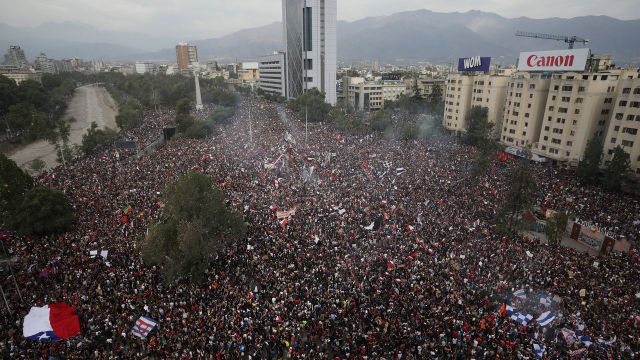
People gather during an anti-government protest in Santiago, Chile, in October (AP Photo Rodrigo/Abd)
The public hospitals continue to be starved of critical equipment, PPE and personnel, while it has been revealed that some private hospitals have accepted no COVID-19 patients. New mechanical respiratory ventilators that the minister claimed were purchased in January have dwindled in the course of three months from 1,000, to 600 to 400 to 72 when they finally arrived last week.
As for Mañalich’s claims of concern, to date the majority of the country’s children have not been immunized for influenza because the health departments nationally ran out of vaccine earlier in April, while the hampers the government promised would feed every child per indigent family have proven to be as elusive as the ventilators.
Figueroa, contradicting Mañalich’s feigned alarm, issued his own malicious comment: “I’m constantly hearing from parents who feel that going back to school means putting their children at extreme risk. We know better, because children are not a risk factor for the virus.”
But the Health Ministry’s own partial and deficient figures reveal that well over 1,000 children and adolescents have contracted the virus and, moreover, are able to infect those mainly affected in Chile, 20- to 60-year olds, who combined make up 76.6 percent of the total confirmed cases, which since March 3 has rapidly ascended to 22,016 as of Tuesday. This “working age” group comprises 57 percent of those requiring hospitalization, including ICU care. The breakdown of the 275 people who have died is not available. Nor is it the actual figure of deceased, because as Mañalich himself explained, he counts as recovered “people who have reached 14 days since the diagnosis or who have unfortunately died.” Such is the contempt for human life!
Teachers, students and parents have issued intense criticisms of Figueroa’s and Mañalich’s incendiary statements. Secondary student coordinating assembly leader Isidora Godoy said that secondary students would not return to classes while the number of infections continue to rise, explaining that the municipal schools “don’t have the minimal health measures. Winter is coming and we find classrooms that leak, dirty bathrooms,” among other things.
Silvia Silva, head of childcare workers, insisted that “from day one we made a categorical call to [childcare] workers not to show up at their workplaces. We have been insistent…that neither voluntary nor of any type of work will continue since our service is tremendously sensitive.”
Luciana Cortés, a teacher in the Commune of Pedro Aguirre Cerda, and one of many who have voiced their opposition online, said, “We believe that today the government has not provided the necessary conditions to sanitize our schools. … I call on education workers, assistants, parents, students and teachers, to say that on the 27th or when the government wants to start teaching, we will not return to class.”
Online classes were initiated in March, but as with every other aspect of social life, it has revealed how stratified Chilean society is: 44 percent of households do not have a fixed Internet connection, 170 communes of the country, representing over 77,000 people, have no Internet access, and only 30 percent of the population have adequate access to the Internet. A television channel was launched to provide educational resources.
Five-hundred teachers were laid off at the end of last year, and hundreds more were dismissed before the beginning of first term by Socialist, Stalinist-Communist, pseudo-left and right-wing mayors alike. It is part of the massive job destruction that continues unimpeded. Four-hundred-thousand workers were made redundant between February and March, many of whom received no compensation for years of service. Following the enactment of a law permitting employers to furlough workers due to the pandemic, another 56,986 companies took advantage of the new law affecting 800,000 jobs in the second week of April.
Moves are now afoot to slash salaries, including those of education workers whose income start at a meager US$900 per month for a 44-hour shift, with rent taking more than half their earnings at an average of US$580.
Evelyn Matthei, the particularly repugnant Providencia mayor from the ultra-right Union Democratica Independiente (UDI), who appears on TV ad nauseam, declared, “The question is, are we going to be able to continue paying [teachers], because I want to tell you that I am not making it to the end of the year in the municipality, I am cutting everyone’s salary, everyone.”
A general’s daughter, she succinctly summarized the Chilean ruling class’s attitude towards the working class and the education of its children: “Let’s see, first of all, half the matter is useless. I was a teacher for a whole year, half of the subject spent in mathematics is pure rubbish, it will never be useful to them again in their lives, why do children have to learn to make logarithms, has anyone ever used logarithms?”
The coronavirus has exposed a profound crisis in every social area. While the conditions of everyday life were always precarious, today they are becoming unbearable. The Chilean state does not guarantee the right to health, education, social services, housing, financial security, pensions or any other social necessity because it has all been placed in the hands of major domestic and transnational corporations and conglomerates.
The population at large has been left to fend for itself under the auspices of the “free market.” The results can be seen in the latest indices on social inequality: the richest 1 percent in Chile concentrates in its hands 33 percent of the national income; 70 percent of workers earn less than US$660 per month, 70 percent of retirees receive a pension of less than US$330, 11.5 million people are in debt, and 4.7 million are in arrears.
Where the state has intervened, it’s been to transfer the public wealth to the banking and corporate elite. Aside from beefing up the repressive institutions, one of the first measures Piñera implemented in response to the pandemic was a US$12 billion package, consisting largely of the capitalization of the State Bank to increase liquidity and implementing tax exemptions in which the greatest beneficiaries were large and medium-sized companies. Further measures were announced in the second week of April to ostensibly guarantee liquidity to SMEs in the form of zero-interest loans guaranteed by the state, but in which again large companies took the lion’s share.
With regards to the more than 1.2 million recently laid off, the support system that Piñera enacted with the approval of Congress, the so-called “severance insurance,” rests on the unemployed accessing funds they were forced to accumulate in individual accounts while employed, with a negligible contribution from the state. As for the 2.6 million-strong informal sector of street vendors and super-exploited laborers without contracts, virtually no assistance has been forthcoming. A much-vaunted stimulus package to assist this precarious sector hardest hit by quarantining measures and social distancing policies, consisted of a one-off payment of US$60, enough to continue starving in shantytowns or on the streets as the coronavirus reaches its peak this winter.
It is significant therefore that students, teachers, lecturers, education and childcare staff, and other sections of working class across Chile rebuffed the Education Ministry’s orders to reopen the schools this past April 27. The impasse demonstrates that the entire political establishment is devoid of legitimacy in the eyes of millions and its every decision is perceived with extreme hostility and deep suspicion. With regard to opening schools, the government was obliged to do a volte face, but it is still pushing for a return to onsite work.
The response also reveals that the unprecedented mass demonstrations that erupted in October of last year have since evolved and include ever-wider sections of the working class, not only in the form of strikes and rallies, but in local actions and initiatives that aim to protect the safety of communities from the spread of the coronavirus. In fact, demonstrations continue to break out throughout the country under quarantine and curfews enforced by the notorious Carabinero police and the military.
May 1 saw the Carabineros carry out the violent arrests of protesters, beating and rounding up leaders of the CUT union federation, human rights lawyers and members of both the domestic and international media, including CNN Chile, Prensa Latina, and Telesur. In an earlier incident that recalled the worst days of the military dictatorship, two Carabineros driving an unmarked vehicle opened fire on an April 27 demonstration in the Santiago neighborhood of La Florida, wounding 10.
As social tensions mount, there is growing opposition to the official Chilean left made up of the Socialist Party, the Stalinist Communist Party (PCCh) and their pseudo-left satellites, who in their positions as mayors, deputies, senators and union leaders have been instrumental in imposing government policies.
One teacher, Raúl Núñez Browton, raised sharp criticisms of the teachers’ union which “had not taken into account the rank and file at all.” Issues such as the reduction of classroom sizes, the government’s refusal to pay retired teachers their entitlements for two years running and the “historical debt” owed to teachers who were persecuted under the 17-year military dictatorship, the lack of tenure, and the precariousness of contracted labor—none of these pressing issues had been dealt with by the union leadership.
“We also have to remember that so many mayors like Recoleta’s [PCCh mayor] and many others that are now playing the good guys, these mayors are the ones who have blacklisted and persecuted teachers…their parties such as the PS, the PCCh voted against workers with the [furlough] law that clearly favored big business.”

Canada: Form rank-and-file committees to oppose COVID-19 back-to-work drive

Roger Jordan & Keith Jones

Starting this week, large numbers of businesses in Quebec and Ontario, Canada’s two most populous provinces, have begun to recall tens and soon hundreds of thousands of workers to their jobs, even though the novel coronavirus pandemic continues to rage.
Quebec—which is the epicentre of the pandemic in Canada with more than half of the national total of 62,000 confirmed COVID-19 cases and 2,398 of the 4,036 deaths—is also rushing to reopen elementary schools and daycares in stages over the coming two weeks. This is so it can force working parents back on the job.
The back-to-work drive is being spearheaded by Canada’s hard-right premiers, Francois Legault in Quebec and Doug Ford in Ontario. They are defying the recommendations of the World Health Organization (WHO) and other medical experts, so as to relaunch the process of profit extraction from workers’ labour.
Quebec's top health officer, even as he promoted the province’s back-to-work plan as necessary for economic “health,” was forced to admit that it is a “risky bet” that will cost lives.
At the beginning of last week, Premier Ford declared that there would have to be 14 days of declining infections in Ontario before lockdown restrictions could be safely lifted. However, emboldened by Quebec’s rapid reopening and no doubt under pressure from his big-business backers, he promptly did a volte-face and announced a plan to allow the construction industry and several other sectors to open on Monday.
The ostensibly “progressive” federal Liberal government is playing a critical role in implementing this precipitous return to work, which prioritizes capitalist profit over the lives of workers and their families. With the support of the unions, Prime Minister Justin Trudeau is using hollow demagogy about Canadians standing together and helping each other to cover up the predatory actions of the ruling elite. With consummate cynicism, Trudeau asserted last week, “Restarting our economy will be gradual and careful, and will be guided by science.” Yet he has green-lighted the provinces’ “reopening” decisions, even though they run roughshod over his own government’s guidelines for restarting the economy.
The capitalist elite’s drive for a premature reopening of nonessential businesses is deeply unpopular. In a recent poll, 90 percent of Canadians said lockdown measures should remain in place until a vaccine is available, or the health care system has been sufficiently strengthened, through a major injection of resources, to cope with a surge of COVID-19 cases. But anger and outrage are inadequate to stop the precipitous back-to-work drive. What is required is the independent political mobilization of the working class to fight for policies that prioritize the saving of human lives and protecting working people from the pandemic’s economic fallout, not corporate profit and investor returns.
Absent the independent intervention of the working class, workers face a ruinous choice between risking their health and lives by returning to work, or being driven into destitution, and ultimately hunger and homelessness.
Big business, its media mouthpieces, and the Conservative official opposition are already complaining that the makeshift programs the Trudeau government has set up to provide temporary relief to the more than 8 million workers who have lost their jobs—the Canada Emergency Response Benefit (CERB) and the recently adopted Canada Emergency Student Benefit (CESB)—are too generous. Both Conservative leader Andrew Scheer and Manitoba Tory Premier Brian Pallister have denounced the CERB, with Pallister, whose government is in the process of laying off thousands of public sector workers, declaring that he is “fighting against a federal program” that is “paying people to stay out of the workforce.”
The C.D. Howe Institute, arguably the country’s best-connected business think tank, published a report last week that demanded the CERB be cut back because it acts as a “disincentive to work.” National Post columnist John Ivison complained that the $2,000 a month CERB, which does not even cover the cost of renting a one-bedroom apartment in Toronto and Vancouver, is a “lavish handout” that risks turning workers into “welfare slackers.”
To force workers back on the job under unsafe conditions, governments and employers intend to threaten them with the loss of the CERB and all entitlement to Employment Insurance. This task will be made all the easier given the Trudeau government’s underfunding of the CERB program, which has reportedly paid out more than 60 percent of its meagre $35 billion budget less than two months after its creation.
Quebec’s Labour Minister Jean Boulet has repeatedly said that workers who fail to return to work when ordered by their employer will lose their government benefits. Asked at his Monday press conference what he thinks of Boulet’s remarks, Premier Legault endorsed them.
Throughout the pandemic, the focus of the Trudeau government, like the Trump administration and Europe’s governments, has been on safeguarding the wealth and investments of the rich and super-rich. Either directly, or through the Bank of Canada, the Canada Mortgage and Housing Corporation, and other state institutions, the Liberals have injected more than $650 billion into the financial markets, banks and big business. Workers, meanwhile, have been given rations-style relief. Similarly, the Liberal government has committed only a pittance—less than $4 billion—to strengthening Canada’s health care system, which has been ravaged by decades of cuts, and to seeking a vaccine or other treatment for COVID-19.
The ruling elite views the inevitable surge in cases and deaths that will result from a premature return to work as a price worth paying to boost corporate profit. Blurting out what government and business leaders across the country are saying in private, Premier Legault declared April 23 that “herd immunity ... is the best way out of the current pandemic.”
All experts agree that pursuing a policy of “herd immunity” will result in the deaths of tens, or more likely, hundreds of thousands of Canadians.
Workers should reject the implicit claim that lies behind the reckless drive to reopen the economy—that there is not enough money to support them through the pandemic. The $650 billion that has been turned over to the banks and financial markets would be sufficient to provide every one of Canada’s 37 million residents with a cheque for $17,500.
The New Democrats and trade unions are intimately involved in the attempt to swindle and bully workers back to their jobs in the midst of a pandemic. The Canadian Labour Congress (CLC) played a leading role in designing the CERB, as part of what it touts as a “collaborative front” with government and business. And both the NDP and unions have joined in the conspiracy of silence over the vast sums that have been turned over to the banks, business, and investors—sums that are claims on value extracted from the working class and that in the future will be invoked in justifying a new and even deeper round of austerity measures.
Events at the Cargill meatpacking plant in High River, Alberta show just how far the union bureaucracy is willing to go in defending its collaboration with the bosses and state. The plant has recorded over 900 infections and one death, with seven workers remaining in hospital. However, the United Food and Commercial Workers (UFCW) opposed job action to prevent the reopening of the plant this Monday, joining management and Alberta’s United Conservative Party government in condemning a strike to protect workers’ lives as “illegal.”
Workers have already shown their determination to fight the ruling class’s criminal return-to-work policy. Lockdowns and social distancing measures were only adopted after a wave of strikes and protests across North America in March, including by Fiat-Chrysler workers at the 6,000-strong Windsor, Ontario, assembly plant. Strikes by delivery workers, transit workers, and medical staff in the US and internationally for personal protective equipment and other safety measures mark a direct challenge to the corporate elite’s policy of placing profits before workers’ lives.
Working people must reject all efforts by the ruling class to bully them back to work amid a raging pandemic. They must intervene with their own independent program to protect lives and working people’s livelihoods—a program that begins with social needs, not what the capitalists claim they can afford. This program should include the rollout of mass testing, contact tracing, and quarantining to contain the virus; the shutting down of all nonessential industries with full pay for all workers affected; the provision of masks, gloves, and other personal protective equipment to medical staff and other essential workers; and the investment of billions in the health care system to provide the best possible care to those infected by the virus.
To fight for these demands, workers must create committees of action in their workplaces and neighbourhoods, independent of and in opposition to the trade unions and NDP, which for decades have suppressed the class struggle and are now aiding the ruling elite in dragooning workers back on the job.
None of these demands can be achieved under capitalism. The financial oligarchy that constitutes the core of the ruling class and to whom the politicians are beholden deems all money spent on workers’ livelihoods and social services to be a drain on its profits. Workers must wage a political struggle in alliance with their class brothers and sisters internationally to bring to power workers’ governments committed to socialist policies, so that society’s abundant resources can be redeployed to protect human life and workers’ livelihoods, rather than augmenting private profit and death.

Pandemic exposes inherent flaws in capitalist food production

Alex Findijs

Weeks have passed since the United States Department of Agriculture (USDA) announced plans to purchase excess food from farmers to distribute to food banks and charities to meet the growing need for food among workers and to prevent food waste. Yet, millions of pounds of food are still being destroyed or left to rot in the fields while millions of American workers are suffering from growing food insecurity as the economic impacts of the coronavirus pandemic have driven unemployment to levels not seen since the Great Depression of the 1930s. The New York Mission Society estimates that one-third of food banks across the country have already closed due to a lack of funding and supplies.
Devastating reports of farmers forced to cull livestock or destroy fresh food continue to emerge on a daily basis. Images of farmers destroying tomatoes, thousands of pounds of milk being dumped into drains, and piles of ripe fruits and vegetables being buried back into the soil are shocking workers around the country and the world as many struggle to put food on the table.
The scale of food waste taking place in the US
Due to inadequate reporting and tracking, no one knows for sure how much food has been wasted. However, anecdotal and piecemeal reporting gives a glimpse into the staggering level of waste.
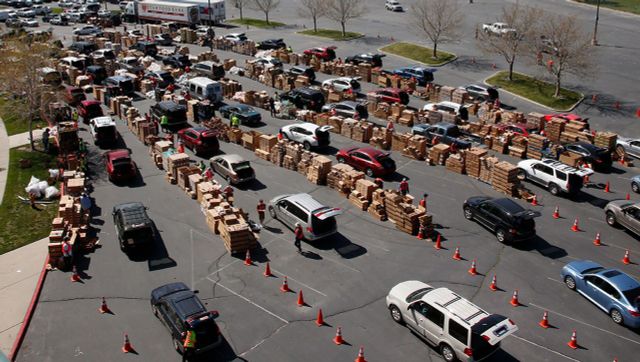
Cars line up for food at the Utah Food Bank's mobile food pantry at the Maverik Center Friday, April 24, 2020, in West Valley City, Utah. (AP Photo/Rick Bowmer)
The nation’s largest dairy cooperative, Dairy Farmers of America, estimates that farmers are dumping as many as 3.7 million gallons of milk each day. The New York Times reported last week that a single chicken processor is smashing 750,000 eggs a week. To put this figure in perspective, the number of eggs being destroyed at this single factory in a single week amounts to the yearly average intake of eggs for 2,595 Americans.
Perhaps the most chilling reports of food waste have come from poultry and livestock farmers who have begun culling their own herds. Hog farmer Al van Beek in Iowa told Reuters that he was recently forced to abort 7,500 pig fetuses because he did not have the room to house more animals. The decision troubled him deeply. The overcrowding is a result of lack of demand, which is in turn a result of the closure of multiple meat packing plants after thousands of workers have contracted COVID-19.
Some companies that breed piglets have even resorted to giving them away for free because demand has essentially disappeared.
Overall, the processing of hogs has fallen by a third and cattle by 10 percent compared to the usual output. Hogs are raised in cramped, temperature-controlled facilities and fed grain to hasten fattening. If they are not harvested in a timely manner, they grow too large to support themselves and can break their own legs trying to stand. Iowa Governor Kim Reynolds said she expected national pork culling to reach 700,000 hogs a week at the height of the crisis.
The financial impact of the pandemic on farmers will be devastating and for some insurmountable, if no substantial help is provided from the federal government. Hog farmers nationwide will lose an estimated $5 billion, or $37 per head, for the rest of the year due to pandemic disruptions, according to the industry group National Pork Producers Council.
Capitalism, food production, and the COVID-19 pandemic
The implosion of the animal product industry is a direct result of the monopolization of livestock production and the negligent government policies that support it.
Consider the following: Roughly 90 percent of all broiler chickens are produced under contract with just three large corporations, and 57 percent of hogs are owned and slaughtered by just four companies. Farmers are forced to follow the instructions of their contractors (one of these giant corporations) or risk retribution and/or even be forced to shut down. Since the decisions of these corporations are primarily directed by the need to make profit, there are no serious considerations or motivation to implement rational solutions under the conditions of the current pandemic.
The results are devastating. Minnesota farmers Kerry and Barb Mergen had to watch as their contractor, Daybreak Foods, sent a team with carbon dioxide tanks to euthanize their 61,000 egg-laying hens. One onion farmer told the New York Times that he has begun burying tens of thousands of pounds of onions and leaving them to decompose in trenches because he cannot afford to distribute them without financial help.
Such needless waste is the result of system that is built around the need to guarantee profits and increase stock values. Meanwhile, the number of severely food-insecure people around the world is expected to rise to 265 million by the United Nations and 36 countries are at risk of famine.
A significant factor in this destructive system has been the development of Confined Animal Feeding Operations (CAFOs). These CAFOs are large facilities with temperature-controlled environments, making it so that pigs can be fattened quicker and production can be concentrated spatially.
CAFOs have destroyed independent producers by securing grain subsidies from the state for decades, making it possible for CAFOs to out-compete and conquer the market.
These policies resulted in higher profits for corporations but can hardly be considered a positive development in production. A study published by the Union of Concerned Scientists in 2008 details how CAFOs were only made economically viable through government intervention. It also determined that alternative methods of production would be just as productive without the additional financial and environmental costs. The study estimates that CAFOs add an additional $5 billion in costs through externalities.
CAFOs are also notorious for causing environmental damage. Improper animal waste disposal by multiple large operations has been found to have contaminated the soil and ground water of neighboring communities.
The meat industry has become increasingly reliant upon the “just-in-time” mechanics of production. This means that animals are moved through facilities at a pace that requires the least amount of storage capacity in order to lower costs.
Under a rationally planned socialist economic system, it would be quite easy for this type of mechanics, and the science underlying it, to be implemented and utilized in a safe, humane and environmentally prudent capacity. At the very least, every effort would be made to redirect excess meat to the hundreds of food banks across the country that are in severe need of fresh food. However, under capitalism, a system driven primarily by the need to make a profit, this powerful technology is horribly misused and underutilized.
As thousands of animals are culled, all because it is not profitable to do otherwise, millions in the US face hunger. What is required to prevent such waste is a complete restructuring of food industries to ensure that food can reach those in need while workers are protected from infection. The capitalist ruling class and state have shown themselves to be unwilling and unable to take any such action.
Much of this carnage was avoidable. Meat packaging workers could have been provided with protective equipment at the onset of the crisis. Creative and scientifically informed changes could have been made at processing centers in order to adhere to social distancing and keep workers safe. Instead, no preparations were made to prevent the waste or protect the workers. Now, the companies and the Trump administration are colluding to force meat processing workers back to work with virtually no substantial protection while the companies will be released from any legal liability for workers who get sick and die.
On top of this negligent response, the White House is considering altering minimum wage laws for workers with migrant visas. This change would result in a decline in farm worker wages by about $2-$5 dollars an hour. In North Carolina, for example, this change would result in an hourly wage of $4 an hour for farm workers.

British government bailout for big business: An act of robbery

Richard Tyler

In English folklore, Robin Hood stole from the rich and gave to the poor. In its economic response to the coronavirus pandemic, the UK’s Conservative government is robbing the poor to line the pockets of the already fabulously rich.
According to figures from the Office for National Statistics (ONS), the cost to the public purse of the various measures introduced by the Johnson government will amount to at least £110 billion over the next year. These comprise:
* £49 billion or more in wage subsidies paid to companies who furlough workers, most of whom only receive 80 percent of their usual pay.
* £16 billion for additional day-to-day spending on public services.
* £15 billion in grants to small firms.
* £10 billion for a similar scheme covering the self-employed.
* £13 billion business rate (local tax) holiday.
* £7 billion additional benefits’ spending as a result of the pandemic.
These sums are dwarfed by the £645 billion in quantitative easing (QE) announced in March, more than half again of the £1 trillion in QE measures between 2009 and 2020—that was funded through a decade of austerity. To put such inconceivable figures in perspective, the QE measures would equate to giving every UK inhabitant (66 million people) approximately £12,000.
But the money is not going to working class and increasingly precarious middle-class households. Like the 2008/9 bailout, it is being extracted from their incomes, benefits and social services for generations to come to prop up the profits of the super-rich.
As the lockdown began to bite, thousands of workplaces shut and staff were sent home. Millions faced uncertainty, not knowing if they would be able to meet their weekly and monthly bills. To a media fanfare, a government scheme was introduced to support the wages of furloughed workers. However, it was limited to providing just 80 percent of their previous wage, up to an individual monthly cap of £2,500. For millions of workers on minimum and low wages, or struggling under debts, the 80 percent limit severely compromised already stretched family budgets.
According to the Resolution Foundation, an independent think-tank focused on improving the living standards of those on low-to-middle incomes, “70 percent of households have experienced falls in income,” leading to 23 percent having to use savings to cover living costs and 13 percent now struggling to pay bills.
Almost a third of the national workforce has been furloughed. And jobs in those parts of the economy hardest hit by the lockdown, such as the hospitality and retail sectors, are among the lowest paid.
In accommodation and food services, over half of firms have furloughed staff and 40 percent have cut hours for those still working. In arts, entertainment and recreation, the respective figures are 23 and 38 percent. However, these figures themselves underplay the seriousness of the situation as they are only based on responses from firms that continue to operate. For firms that have temporarily ceased operations completely, like many pubs and restaurants, the rate of furloughing is substantially higher, at almost 80 percent.
The situation is even worse for those who were already unemployed or lost their jobs as a result of the pandemic. By the end of March, there had been almost half a million new welfare claims as the unemployment rate pushed up to 5.3 percent, reaching its highest level since September 2015. More than 2 million new Universal Credit (UC) claims had been made by the end of April, with at least 25,000 claims being made every day. These newly unemployed faced days struggling to make an online application for UC welfare benefits, as the computer system was overwhelmed, and phone lines jammed.
The punitive UC system introduced under the 2010-15 Conservative-Liberal Democrat coalition represented a major onslaught on already decimated provisions for the poorest sections of society. According to the Institute for Fiscal Studies, the lowest-income 10 percent of the population loses the most from UC, seeing an almost 2 percent fall in their income. On average, 17 percent of those forced to claim UC will see an annual loss of £1,000 in their income.
Millions more will soon be in the same position. Tory Chancellor of the Exchequer Rishi Sunak said yesterday that the payments made to workers under the furlough scheme are “unsustainable”.
When payments stop, a study by the Institute for Social and Economic Research indicates up to 6.5 million jobs, a quarter of the total, could be lost as a result of the lockdown. The study assumes a contraction of GDP of 20 percent would produce a loss of 75 percent of jobs in accommodation and food services, followed by a halving of employment in services and retail, with the wholesale, retail and repair of motor vehicles (47 percent) and transport (44 percent) close behind. In absolute terms, the researchers estimate the job losses could approach two million in the auto industry and its related elements and be almost 1.5 million in accommodation and food services.
The real beneficiaries of the government’s unprecedented spending are the corporations. When it comes to big business, government largesse truly knows no bounds, with Sunak promising to spend “whatever it takes”. While the FTSE 100 index of leading companies plummeted at the beginning of March, losing over 2,000 points, since the injection of vast sums of public money into the private sector, the index has already regained 1,000 points.
Some of the industries to benefit from government handouts include:
* Rail: The government has effectively renationalised the rail franchise system, taking over all losses estimated at several billion pounds for the next six months as train travel has nosedived. Footfall at some of the busiest railway stations has fallen by 90 percent.
* Bus: Private operators have been promised hundreds of millions to offset falling passenger numbers.
* Air travel: Virgin Airlines boss and multi-billionaire Richard Branson is seeking £500 million and has had aerospace manufacturers Rolls-Royce and Airbus lobbying government on his behalf, —fearful that they will lose out on lucrative contracts. Virgin announced more than 3,000 job cuts yesterday. Budget airline EasyJet has furloughed 7,500 workers and received £600 million in virtually interest-free loans backed by the government—even as it paid out a £174 million dividend to shareholders in March.
* Steel: Britain’s largest steelmakers, Tata, is seeking hundreds of millions in bailout funds as orders from shuttered car plants and construction sites fell away.
* The media: As newspaper sales continue to fall and advertising revenue dries up, the government stepped in to fund a three-month propaganda blitz, paying for official advertising on a massive scale. Reach, which publishes the Daily Mirror, Daily Express and Daily Star and hundreds of other regional titles furloughed almost 1,000 of its 4,700 employees and cut the pay of its entire workforce by 10 percent.
The Bank of England, which oversees quantitative easing, has introduced a “COVID-19 Corporate Financing Facility (CCFF)”, under which it will buy up short-term debt from large companies, improving their balance sheets. The scheme, which is delivered through commercial lenders, is guaranteed by the Bank of England, and will operate for at least 12 months.
These virtually limitless resources are being used to underwrite the profits of a tiny minority of society.
According to a High Pay Centre report last month, 18 corporations listed on the FTSE-100 share index took advantage of the furlough scheme. These firms paid £12 billion in dividends to shareholders between 2015 and 2019. From the FTSE 250 index, 26 percent of firms are helping themselves with furlough funds.
A few companies have made much play of the fact they have cut CEO remuneration and that of other exorbitantly paid executives. However, as the High Pay Centre points out, only 13 percent of firms that have done so have also cut bonuses or other long-term “incentive” payments—which in most cases comprise the largest component of executive pay awards. In any case, even a moderate cut in salary still leaves plenty when the median annual pay of a FTSE 100 CEO runs at £3.5 million.
Some of Britain’s wealthiest families could even see their inheritance tax bills slashed, as they can claim a rebate if the value of their share portfolios falls. The proposal by church leaders that companies using tax havens to offshore their profits, and so avoid taxation, should be barred from receiving public funds was roundly rejected by the chancellor.
Private equity firms, who trade in the misery of millions through their slash and burn approach, have built up an estimated cash pile of $2.5 trillion. Under the bailouts, they too can fully access the social wealth of generations of workers now being handed over by the Johnson government.

UK coronavirus death rate at record high in Europe as fatalities pass 32,000

Robert Stevens

The UK’s coronavirus death toll is now the highest in Europe, according to the Office for National Statistics (ONS).
By Tuesday morning, the death toll in Italy—which was previously the highest in Europe to date—reached 29,315, according to data compiled by Johns Hopkins University. Just hours later, the ONS announced total COVID-19 deaths in the UK had reached 32,313—making Britain the first European country to exceed the horrific milestone of 30,000 deaths.
The ONS figures are based on deaths where COVID-19 is mentioned on the death certificate. In contrast, the Conservative government manipulates its figures by only counting those cases where COVID-19 is recorded as the cause of death. However, the 693 new COVID-19 deaths announced yesterday by the government also brought the UK’s manipulated total to the highest in Europe at 29,427.
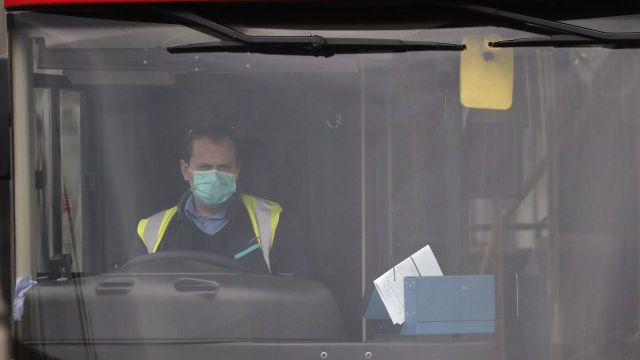
A London bus driver wears a mask to try and protect him from the coronavirus as he drives on his route in London (AP Photo/Frank Augstein)
Thousands of new coronavirus cases continue to be reported every day in Britain, with another 4,406 yesterday and a total of 194,990. This is under conditions in which only a tiny fraction of the population, including around 10 million “essential” workers, have been tested. The UK has tested just 20,385 people per 1 million of the population—a lower rate than the United States, Spain, Italy, Germany, Belgium, Portugal, Russia and Canada.
According to the ONS analysis, COVID-19 was mentioned on 29,648 death certificates in England and Wales by May 2, with the remaining deaths registered in Scotland and Northern Ireland that mention COVID-19 bringing the UK total to 32,313. The ONS revealed that 7,713 of the deaths in England and Wales occurred outside hospitals. These included 5,890 in care homes (up from just over 3,000 the previous week), 1,306 in private homes, 301 in hospices, 105 in other communal establishments, and 111 elsewhere.
The ONS report stand in stark contrast to the figures handed out for months by Downing Street in its daily press briefings.
On April 24, the government reported a total of 19,506 deaths, but yesterday’s ONS figure was is 42 percent higher than the number released by the Department of Health on that day. At that stage, the Johnson government was only counting deaths related to coronavirus of those who passed away in hospital.
The Daily Mail cited the assessment of a former ONS health analyst, Jamie Jenkins, who estimates that the numbers of “excess deaths”, i.e. those above the statistical average for the time of year, meaning that the coronavirus death toll was more than 45,000.
Last week, a Financial Times assessment of ONS data available at that point, estimated a death toll of at least 47,000. The paper reported that it drew this conclusion based on a figure of “almost 30,000 excess deaths by mid-April across the UK…” The FT noted that “Much of the increase in deaths has been recorded in care homes”, with the coronavirus appearing “to be killing more than twice the number of people recorded in daily figures from hospitals.” By April 17, 7,316 deaths were recorded in care homes, compared with an average of 2,154 for that week over the past five years.
Yesterday, based on the new ONS data, the FT upgraded its estimated UK death toll from the virus to 53,800. It also cited yesterday’s comments of David Spiegelhalter, professor of public understanding of risk at Cambridge university: “I can be confident now . . . that there are more Covid deaths happening outside hospitals than in hospital.”
Despite the UK approaching the highest number of deaths in Europe, newspaper headlines in the right-wing media Tuesday morning trumpeted Tory government’s propaganda that the UK was past the peak of the virus and on a “downward slope”—to justify the Tories back-to-work agenda.
The Daily Mail front page read, “Glimmer of hope as death toll falls”, Sky News led with the almost identical headline, “Coronavirus: Glimmer of hope as total number of UK deaths decline from peak, new figures suggest”. It noted a “slight” fall “in the total number of deaths registered in England and Wales in the week ending April 24—driven by a decrease in the number of hospital deaths.”
Sky focussed on a small fall in deaths compared to the previous week. The broadcaster reported that the seven days to April 24, “saw the first decrease in the weekly total number of registered deaths since March 20. The number of deaths registered in the week to April 24 was 354 less compared with the previous week.”
Despite all such attempts to conceal the real number of fatalities, the true facts are emerging in the UK and in every country. On Monday, it was reported that Italy’s mortality rate due to COVID-19 was far higher than that officially acknowledged by the government—which does not include deaths where COVID-19 was the suspected cause.
According to research issued by the Italian statistics bureau ISTAT—based on monitoring 86 percent of the population from February 21, when the first COVID-19 deaths occurred, until March 31—nationwide fatalities were up 49 percent, compared with the average of the previous five years. The country saw 25,354 “excess deaths”; while the Civil Protection Agency registered COVID-19 as the official cause for 13,710, around 11,600 deaths were unaccounted for.