12 May 2020

World Health Organization warns premature return to work risks resurgence of pandemic

Benjamin Mateus

World Health Organization Director-General Tedros Adhanom Ghebreyesus reiterated his warnings Monday that a premature return to work without adequate measures to contain the COVID-19 pandemic risks a resurgence fo the disease.
Tedros emphasized that before governments begin opening businesses, they must ask if the epidemic is under control, if the national health care infrastructure can cope with new resurgences, and if the public health surveillance measures in place are sufficiently robust to trace, isolate, treat and track at a community level across the nation. One should ask first if the nation’s testing capacity is of a sufficient magnitude before even considering these criteria.
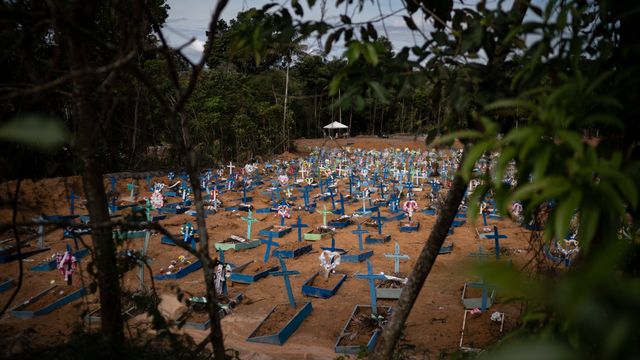
Graves of people who died in the past 30 days fill a new section of the Nossa Senhora Aparecida cemetery, amid the new coronavirus pandemic in Manaus, Brazil, Monday, May 11, 2020. The new section was opened last month to cope with a sudden surge in deaths. (AP Photo/Felipe Dana)
With only 15 states in some form of a lockdown or stay-at-home restrictions, the US continues to woefully lack sufficient testing capacity regardless of the president’s repeated but empty bluster. In actuality, the situation has devolved into absurdity as local communities and states compete against each other as well as with large private vendors and the federal government to procure the necessary material. This only exacerbates the existing shortages that befuddle local government and health officials tasked with opening their towns and small cities while facing sudden new outbreaks in nursing homes or local factories and workplaces. The economic devastation doubly ravages these communities, exacerbating social tensions as workers are forced to pit their safety against financial hardship.
The United States has only recently attained capacity of 300,000 tests per day. The need for higher capacity is due to the criminal delay in not having scaled testing ability in January and February when ample time was available to mobilize the country’s vast resources. Because the pandemic has more deeply insinuated itself into the social fabric of the country, more testing is required to identify and map its spread. The assertions about being ahead of South Korea are moot precisely because South Korea brought the outbreak in their country under considerable control very quickly.
According to the Rockefeller Foundation, to safely reopen the country’s economy, the US needs to dramatically expand testing capacity close to 30 million per week, more than 10 times the present capacity. On a per capita basis, the US is at 29,321 tests per million population, on par with the UK, but behind Canada, Germany, Italy, Spain and Russia.
“The US is not yet administering enough coronavirus tests each week to adequately monitor the entire US workforce or rapidly detect recurrent COVID-19 outbreaks,” the foundation wrote. “Such outbreaks can be expected for the foreseeable future, given the low level of population immunity as well as the virus’s contagiousness and wide geographic dispersion. The location and size of recurrent outbreaks are difficult to predict. Close monitoring of the medically vulnerable, institutionalized, poor and imprisoned is vital.”
Dr. Maria Van Kerkhove, the technical lead for the COVID-19 pandemic at the WHO, explained that there had been several seroprevalence (level of a pathogen in a population measured through blood tests) studies in review from varied regions throughout Asia, Europe and the US. To their surprise, she remarked that these antibody tests indicate the prevalence of disease remains low, in the range of 1 to 10 percent in the population. In response to a reporter’s query on herd immunity, Dr. Kerkhove responded that though the exact prevalence for COVID-19 required is not known, it would have to be much higher than present levels.
Dr. Michael Ryan, the WHO’s emergencies chief, put it quite succinctly, saying, “Promoting herd immunity can lead to very brutal arithmetic which does not put people and life and suffering at the center of that equation. Seroprevalence studies also show that the proportion of people with significant clinical illness is actually a higher proportion of all those who have been infected because the number of people infected in the total population is lower than we expected.”
He explained that the virus is still very much rooted deeply in every nation’s community as events in South Korea and Wuhan, China, indelibly demonstrated. The present moment is a second chance to rapidly implement the necessary infrastructure in preparation for local community outbreaks. “Shutting your eyes and trying to drive through this blind is about as silly an equation as I have seen,” he said, “and I’m really concerned that certain countries are setting themselves up for some really blind driving through the next several months.”
Despite the appalling statistics, with over 80,000 fatalities and over 1 million active COVID-19 cases in the US, senior White House officials over the weekend pressed state governors to hurry steps toward restarting commerce. At Monday’s press briefing, the fascistic Trump simply blurted out, “I want the country opened.”
Yesterday, hundreds of thousands of Michigan workers headed to their employment as part of Governor Gretchen Whitmer’s plan to restart Michigan’s economy despite continued new cases of more than 400 per day. The test run will be a model for the rest of the United States’ manufacturing base. The week is being devoted to recalibrating and inspecting equipment proceeding in a measured approach. American Axle brought back one shift at their Macomb County plant. Tents outside the facility were set up to take temperatures and provide masks and protective equipment. This was made into a press event to lull workers back and influence their hearts and minds.
Governor J.B. Pritzker of Illinois has indicated that science and data will guide his decisions. However, he is allowing more businesses to open in a limited sense and moving to create geographic regions across the state that will function independently. Golf courses and state parks have opened. Governor Gavin Newsom in California noted that 70 percent of businesses could reopen with some form of restrictions in place, though a few counties in hard-hit parts of the Bay Area would remain in lockdown.
In concert, several European and Asian countries, devastated by the pandemic, are moving to relax social and commercial activities. France is permitting teachers to return to primary school and some shops and salons to open again. Outside of Madrid and Barcelona, Spain is allowing small gatherings and bars and restaurants to open that have outdoor spaces. In the Netherlands, primary schools and hairdressers will reopen, and noncontact sports will be permitted outdoors. Shanghai Disneyland has opened its gates.
Even Russia, whose case rates are second only to the United States, has boasted about its low fatality rates. This week, Putin ordered the end of a nationwide “nonworking period.” Though he acknowledged the pandemic had not been conquered, he was leaving it to regional governors to decide if and when restrictions would be lifted in their territories. Recent evidence, however, suggests that the number of fatalities due to COVID-19 has been intentionally under-counted, and the calculated estimates indicate the fatality rate due to COVID-19 is approximately three times higher.
The hypocrisy that all is well has been highlighted best in recent developments at the White House. Last week President Trump’s valet and Vice President Mike Pence’s press secretary, Katie Miller, as well a secret service agent, tested positive for COVID-19. Director of the Centers for Disease Prevention and Control, Robert Redfield, Dr. Anthony Fauci, and Stephen Hahn, the commissioner of the Food and Drug Administration, have taken precautions to go into quarantine. At Monday’s White House briefing, Trump admitted the order for all officials to wear face masks (except himself) came from him.
In a poignantly dramatic but abrupt end to the White House press brief, CBS News reporter Weijia Jiang asked the president, “Why does that matter [doing better than any other country in testing]? Why is this a global competition to you if every day Americans are still losing their lives and we’re still seeing more cases every day?”
Trump replied that “she should ask China why so many were losing their lives everywhere in the world.” Ms. Jiang, who was born in Xiamen, China, and moved to the US with her family at the age of two, redirected, “Sir, why are you saying that to me, specifically?” Trump then countered by saying he would “say that to anyone who asks a nasty question.” CNN’s Kaitlin Collins came to her defense when Trump asked for another question but waved her off. “You pointed to me,” Collins said. “Can I ask a question?” Furious, Trump called off the news conference and stormed away.

The killing of Ahmaud Arbery

Joseph Kishore

The release last week of dashcam footage showing the killing of 25-year-old Ahmaud Arbery in Brunswick, Georgia on February 23 has sparked outrage over the murder and the attempted coverup by local authorities.
Months after the killing, the two individuals involved—Gregory McMichael, 64, and his son, Travis McMichael, 34—were finally arrested on Thursday. Gregory McMichael is a former police officer and public investigator.
The video shows that the unarmed Arbery, who had been out for a run through the Satilla Shores neighborhood just outside Brunswick, was killed in a confrontation with Travis McMichael, who was armed with a shotgun. The elder McMichael looked on from the bed of his pickup truck, armed with a pistol. Arbery bled to death in the street after being shot twice by Travis McMichael.
For weeks, there were no charges and no arrests. The killers gave statements to the police and were allowed to return home. Arbery’s mother, Wanda Cooper, related that she had been told by investigators that her son had been involved in a burglary and was shot by the homeowner—a blatant lie.
The killing of Aubery recalls the 2012 shooting of black Florida teenager Trayvon Martin. As was the case with Martin’s killer, George Zimmerman, the McMichaels have close ties to local state police agencies. Gregory McMichael was a Glynn County police officer in the 1980s and had just retired after 20 years as an investigator for the Brunswick Judicial Circuit District Attorney.
This led Brunswick District Attorney Jackie Johnson to recuse herself from the case. She handed the case over to Ware County District Attorney Gregory Barnell, who advised police that there was “insufficient probable cause” to arrest the McMichaels.
Until the publication of the video, the Glynn County Police Department and prosecutors sought to whitewash the killing as justified under Georgia’s reactionary “stand-your-ground” law. They concluded that the McMichaels acted in “self-defense” while attempting to carry out a citizen’s arrest.
Following the release of the video, Democratic politicians have intervened with statements focused entirely on the racial component of the murder. Arbery was black, and the McMichaels are white. On Thursday, former Vice President Joe Biden, the Democrats’ presumptive presidential candidate, called the killing of Arbery part of a “rising pandemic of hate.” Vermont Senator Bernie Sanders declared last week that Arbery would be alive “if he were white.”
Family members and individuals organizing protests, however, have rejected efforts to pigeonhole the killing and coverup as primarily a racial issue.
The New York Times, in an article published Monday (“In Ahmaud Arbery’s Hometown, Pain, Anger and Pride in a Shared Racial History”) notes: “Most people recognize that race could have factored into the confrontation and shooting of Mr. Arbery or in the way his case was handled by the authorities. Activists also note that the Glynn County Police Department had a history of recurring allegations of police officials shielding officers accused of wrongdoing.”
“It’s not a black-or-white situation,” Mr. Arbery’s aunt, Thea Brooks, told the Times. “It’s an everybody situation.”
Significantly, the region around Brunswick has a history of opposition to segregation and racist violence. Both whites and blacks have participated in the demonstrations demanding that the killers be arrested. “Nobody would expect something like this to happen in this community,” Robert Griffin, an 82-year-old resident of Brunswick told the Times. “It shocked everybody, including the majority of whites.”
Griffin and others point to the long and sordid record of the local police in the southern Georgia region around Brunswick of covering up misconduct and violence by police officers.
This is the reality of life in the United States. Every year, more than 1,000 people are killed by police, who are protected by the state and the courts. According to killedbypolice.net, so far this year more than 350 people have been killed by police (not including Arbery, as McMichaels was retired). While a disproportionate number of those killed are black, the largest share is white.
Under conditions of mounting social unrest and class conflict, the police are a critical component of the apparatus of state repression to be directed against the entire working class.
Racism exists, and it plays a role in incidents like the killing of Arbery. The most reactionary and backward sections of the population, including in and around the police forces, are encouraged by the present occupant of the White House.
The Trump administration has elevated far-right and fascistic individuals into the highest levels of the state and has systematically promoted racism against immigrants. As part of the drive to force a return to work amidst the expanding coronavirus pandemic, the administration has hailed far-right militia members and other fascistic organizations that have held demonstrations in state capitals to demand an end to social distancing measures.
This is an international phenomenon. In the effort to divert social tensions and create the conditions for authoritarian forms of rule, the ruling elites are resurrecting all the political filth of the 20th century. In Germany and throughout Europe, anti-Semitic violence is on the rise, as the far-right and fascistic parties have been legitimized and elevated into state power.
To the extent that racism plays a role, however, it is entirely subordinated to the fundamental class divide. Racism and national chauvinism, along with the racialist politics of the Democratic Party, are used as instruments of class rule, to divert social tensions and block the development of a united movement of the entire working class.
The vast majority of workers, black and white, are outraged by the murder of Arbery and its cover-up. They correctly see it as emblematic of a society in which the lives of workers are treated as dispensable, in which individuals connected to the state can kill and will be protected.
It is impossible to understand the killing of Ahmaud Arbery, and the cover-up that followed it, outside of this broader social and political reality. It is, fundamentally, a product of capitalism.

11 May 2020

War That Has Divided Yemen

Naveed Qazi 

As Southern Transitional Council has declared self rule in the southeast part of the country, a north – south regional divide once again has come to the forefront. Now, it seems likely that there will be new conflicts emerging, not only within warring sections in the country, but also involving Saudi Arabia, United Arab Emirates and Iran, signaling a proxy war.
The division between the two supposed allies is another facet of the Yemen’s complicated civil war: on one side there are the separatists, strong in and around Aden, and on the other are forces loyal to former President Abed Rabbo Mansour Hadi. Both have fought together in the Saudi-led coalition’s war against Yemen’s Shiite Houthi rebels, particularly in northern Yemen.
The move was condemned by United Nation recognised government of President Abd Rabbuh Mansur Hadi. Saudi Arabia has called the move as an ‘escalatory action’. It has urged the STC to return to the terms of the Riyadh agreement signed in November 2019. That deal had called for both factions to remove heavy military artillery from Yemeni cities under their command, and form a unity government that included equal representation. But, that deal was not implemented as the war continued, and massive floods struck Aden.
However, several local and security authorities in the provinces of Hadramout, Abyan, Shabwa, al-Mahra and the remote island of Socotra dismissed the move as a ‘clear and definite coup’. Some of these provinces made their own statements condemning it.
Also, as of now, the war against the Houthis is held up because of recent ceasefire announcement by Saudi Arabia. But, another conflict that is between Hadi government (backed by Saudi Arabia) and Southern separatists (backed by UAE) is certain to gain an impetus in coming time. Infact, in August 2019, both of these factions clashed when STC took control of Aden.
Currently, Yemen is split between political, tribal and regional lines: it has been five years since the north and south remain divided. So, the self-rule declaration is only a step further for all practical purposes. It will give the STC the administrative privileges for areas they control.
In history, northern and southern Yemen became united in 1990. While northern Yemen traced backed its origins to Shiite Imamate of Zaydi dynasty, under patronage of Imam Yahya, southern Yemen was ruled briefly by Ottomans and Abbasids. In 19th century, the British colonised the southern Yemen peninsula, so that they could service ships enroute to India.
The unification, particularly for southerners, has left them with unaddressed grievances, in the new central government, and distribution of resources. These grievances largely embodied briefly in 1994 secessionist civil war, when southern separatists were beaten, and in the rise of Hirak movement, calling for independence, in 2007.
In the south, time and again, there have been complaints over food shortages and a sharp depreciation of the currency, and a lack of funds to pay public sector employees, thereby igniting public sentiment.
In the conflict, It has been noted that the STC backers often fly the flag of former Communist south Yemen, and have pushed to break apart the country into two, like it was between 1967 to 1990.
A divided Yemen, where there is an on and off war, between the northern and southern Yemen, will be become a safe haven for militant Salafi groups like Al Qaeda in the Arabian Peninsula (AQAP). This will be catastrophic, as Yemen has an important geostrategic position, along one of the world’s important trade routes.
The new declaration has also threatened efforts to revive talks between Yemeni government and Houthi rebels. It will only promote instability: now, much more political mantle will be required to revive political negotiations between government and Houthi rebels. It has made even more complicated situation for the UN special envoy for the region. Infact, Martin Griffins, the UN envoy, calls the move as ‘concerning’.
The separatists have accused Saudi Arabia of corruption and mismanagement. It also believes Hadi government to be dishonest, and accuse them of not being loyal to their duties, thereby refusing to pay salaries to public sector employees. In the past, the Saudis intervened in the civil war, in March 2015, against the Houthis, who have been in control of Saana, since 2014, and control most big cities and towns. For five years, Riyadh has been lending its air power in an attempt to reinstate Hadi government to power across the country. Although, due to friction within its own ranks in the forces, in handling the war in Yemen, it is believed that Saudis might end the war, if Houthis compromise. There have been some back channel talks with the rebels, but Houthis largely have seen it as a ploy.
The UAE, which has withdrawn its forces from Yemen over past twelve months, still retains control over commercial ports across the south. By supporting southern Yemeni separatists, the UAE also ensures that the Saudi-backed Islah party, the transnational Muslim Brotherhood’s branch in Yemen, won’t grow too powerful. The UAE, infact, opposes Brotherhood allies and partners throughout the Middle East.
While Saudi Arabia and United Arab Emirates both loathe Iran’s anticipated long presence on their borders, the sub strategy employed by the United Arab Emirates is to recreate a Southern Yemen State.
According to a report in the Guardian: ‘the foreign minister of the UN-recognised Yemen government, Mohammed al-Hadrami, condemned the STC’s move as a resumption of its armed insurgency … and an announcement of its rejection and complete withdrawal from the Riyadh agreement.’
In Brussels, European Commission spokesman Peter Stano told press reporters that the EU has taken note of the developments in southern Yemen, which he said undermine the Riyadh agreement, a key to de-escalation.
As many as hundred thousand people have been killed in the past five years. Another million or so have been either displaced or pushed to the brink of famine and starvation. Neighbouring Muslim countries such as Egypt, Iran, Saudi Arabia, and the UAE have lot to answer. And the so-called alliance of forty Muslim countries: they have not been able to end the political stalemate, and the ravaging war.

COVID-19: Welcome to the World of New Age Geopolitics

Mir Sajad

But, after all, shadows themselves are born of light. And only he who has experienced dawn and dusk, war and peace, ascent and decline, only he has truly livedStefan Zweig —The World of Yesterday, 1941
2020 is turning out to be one of the most challenging years since the end of the Second World War.  A coming disruption for Pankaj Mishra, a ‘portal’ in Arundhati Roy’s radical description, ‘figment of neoliberal capitalism’ for Noam Chomsky in his unique expository stance and ‘Medical Katrina’ for Mike Davis, the coronavirus has evinced the global discussion from the leading public intellectuals to confined individuals as how this overnight nerve-racking catastrophe stalled the world and froze the living spaces to a pause mode. We have seen the problems being magnifying as coronavirus pandemic has, among other things, exposed the vulnerabilities of political structures worldwide. Today, states are battling a threat against an invisible enemy that is rising exponentially and putting most of their citizens at risk.  There are geostrategic and geopolitical implications of this spread in the wake of ‘containing’ the impact of this virus thus impregnating a thought of how the nature of global order would be shaping up given the ‘progressive’ trend of this pandemic
Before the pandemic had its mark on the global scene there was a spectre of weakening role of international institutions and the spate of regressing markers of democracy across the regimens of global politics. Europe was struggling with existing crisis, Middle East crisis, new age theatrics of absurd governance from Trump to Bolsanaro and downward spiral of US global leadership. This viral disaster has magnified the impacts of the existing fragilities in the kaleidoscopic geopolitical and geo-economic spheres concurrently
Geopolitical Signatures to Sphere of Influences
Developing countries have been faring worse in this fight with already intrinsic governance issues and relatively frail architecture of public institutions, where people defied the lockdown orders as they live in precarious conditions. African Union report suggests that pandemic puts nearly 10 million jobs on the Continent at risk of ‘destruction’ while as  in Sub-Saharan Arica World Bank report predicts first recession in nearly 25 years. After the cold war we are first time watching the geopolitical lexicon taking a departure from the oft-spoken bi-polar binary with middle powers rising to the spectacle of global politics with entrance of China and other regional powers.  As more countries are getting effected we would see transformation of geopolitical order not necessarily the bipolar or 2.5 world order with regional powers binding in  but there would be increasing fragmentation. With  countries vying for having Wallerstein’s “hegemonic cycles” in their side Coronavirus  opens up some new matrices to be paired/multiplied to their “respective power spaces” .We have seen Russian aircrafts aiding Italy in the form of ‘medical relief’ with Russian military planes emblazoned  a message of “From Russia with Love”, Serbian President kissing Chinese flag on account of the aid received from the China .Turkey too joining the bandwagon of showing their presence of  flag sending its support to Balkan, Arab and Asian Countries. These examples of soft power dimension have always been in the dictionary of geopolitics popularized by United States and the irony is that America has been absent in the same geopolitical antics. China and Russia put up a great deal of strategizing endeavours on systematically expanding their geopolitical swath and their ‘sphere of influence’ on governments across the world. Europe is their top priority because it is the industrial and commercial base of Pax Americana. Today, U.S. policymakers should recognize that if the United States does not rise to this occasion , the coronavirus pandemic could mark another “Suez moment”  like the one  in 1956 when United Kingdom  saw its end  in  global supremacy  because of that  ‘intervention’ (misadventure) on  Suez canal
Spectre is Haunting Europe
Europe facing a defining moment in history, the perception  that European Union  has always been at the forefront in crisis situations was this time  missing as the same ideals have taken a massive hit with this pandemic upping the ante on the integrationist fabric of European Union . EU split in the latest Eurozone meeting  was apparent  with the north-south fissures (structural imbalances) looming large as  more political power moving to Brussels in fiscal dimensions  as Berlin needs to recognise that a Europe-financed restoration will come through Germany, the only European country with enough capital to marshal such a restructuring design. . The result would be further erosion in the confidence of European Union as the pandemic has raised fears of a new euro crisis and its waning identity got further deep   as the examples of Spain and Italy unfolded the weakening cooperation and support for these countries when right at the outset European borders were shut.
China, USA and the Structure of New Global Hegemony
China has capitalised on the widening America’s fault-lines, while making many of its strengths temporarily irrelevant. The world’s most powerful military machine is not much use against a virus when American economic and political systems are both reeling. But a lack of universal healthcare coverage is suddenly a threat not just to the poor but to the whole of US society. Paul Krugman, the Nobel Laureate economist and columnist, recently argued that American democracy itself is in peril given state of domestic affairs in the country
China, however, seems resolved on signifying some of the values with which the West has generally been seen: solidarity and cooperation. China’s decision to send medical equipment and staff to Europe to fight the coronavirus was not only an act of esprit de corps, but a geopolitical exercise: the country has been extending a support mechanism to a West that is facing serious problems. This is not mere altruism; it is a rallying for China’s will to play the role of rising hegemon and make the most of on the growing vacuum left by the US. This argument about US decline has in fact, been ringing on for decades.  It could even be the beginning in the end of American primacy with the cries for de-westernisation and de-globalisation getting louder and strong. With the safety and health of their citizens at stake, countries may try to block exports or hold critical supplies, even if doing so hurts their allies and neighbours. Such a retreat from de-territorialisation would make generosity a powerful instrument of influence for states that can afford it. There is an anticipatory risk that is hovering over the US currency losing the world’s confidence but the pattern seems a pointless given the fact hyped alternatives to the dollar still fare worse like the gold, bitcoin having major drawbacks.
Middle East Conflict, Oil Crisis and Viral Suffering
The coronavirus has hit the Middle East and North Africa at a time when the region is already fraught with manifold problems, scarred by a series of prolonged conflicts, sectarian crisis, economic stresses, displacement/suffering and widespread political unrest .There is increasing China-Russia pivot in Eurasia and for that Iran is a conduit for each Eurasian giant’s broader strategic schema in the Middle East. Beijing and Moscow have a unique prospect to reorient both Iran and its regional adversaries towards the China–Russia Eurasian architecture as security architecture of Persian Gulf is now in flux.  With the recent historic OPEC deal between Saudi Arabia and Russia ended the deadlock in price war over fall in petroleum prices and the decrease in demand owing to the lockdown across the world. This event can largely set the stage for new dimensions of events in the Middle East now onwards as we recently saw a symbolic truce gesture by Saudi Arabia in Yemen.   For nations having reliance on oil coupled with the price collapse and the coronavirus pandemic has given rise to the new fears of poverty and geopolitical tensions uncertainty from Iraq to Saudi Arabia.
The  current pandemic can make or break the existing geopolitical and geo-economic order with ‘actors’ vying for the strategic gains over the fleeting state of countries around the world. Whatever power equations would emerge post-coronavirus spectre, one thing is certain world would never be the same.

Disasters of Neoliberalism and Hindutva Fascism in India

Bhabani Shankar Nayak

Neoliberalism as an ideology emerged in central Europe during early 20th century in opposition to socialism as an alternative to imperial, colonial and capitalist plunder, war and economic crisis. The Department of Economics at the University of Chicago shaped neoliberalism as a strategy to shift the power from workers to the owners of capital by weakening the state and expanding the ideals of free market. These strategies were converted into economic policies and projects to undermine the power of labour by marginalising it both in economic and social terms. Neoliberalism today has become a political and economic project of capitalist classes to pursue their economic interests with the help of ruling classes. Such a project encompasses all spheres of social, economic political, cultural and religious lives of people.
The postcolonial economic and development planning helped neoliberalism to integrate itself slowly within Indian context. From 1980s onwards, neoliberal economic policies were pursued as a strategy of economic growth which helped global, national and local capitalist classes. Such a strategy helped to consolidate capitalist classes and marginalised the masses in India. In the beginning, Hindutva politics used to support nationalistic economic policies and opposed to neoliberal economic policies as part of its populist and so-called nationalist narrative. But from 1990s onward, neoliberalism consolidated its base in India. The national and regional mainstream political parties in India continue to articulate economic interests of the capitalist classes by pursuing neoliberalism as a project of economic growth and development.
The neoliberal economic policies pursued by the Indian National Congress has helped to create the conditions for the growth and consolidation of Hindutva fascists in Indian politics. Hindutva fascists helped the capitalist classes to consolidate their base in India. The undisputed neoliberal economic paradigm is redrawing the nature of relationship between politics, society, state and individuals as citizens in India. In such a context, the state has abandoned its own citizens and becoming a security state to protect the interests of the capitalist classes. The citizens are suffering under hunger, homelessness, unemployment, illiteracy, illness, and hopelessness. The social and economic alienation produces political distrust and historic opportunities for the growth and consolidation of Hindutva politics in India. The abject condition of alienation produced by neoliberalism becomes life and blood of right-wing religious politics of Hindutva forces in India.
Hindutva politics plays two roles in India. It is in government led by Narendra Modi who pursues all economic policies to uphold interests of the global, national and regional capitalist classes. In one hand, Hindutva politics is constitutive part of neoliberal project. On the other hand, it articulates the anger against neoliberalism and its political establishment. It looks like Hindutva politics has a contradictory relationship with neoliberalism. But in reality, the first role is an integral and organic relationship between Hindutva politics and neoliberalism. The second role is part of the half-hearted populist narrative to capture the state power by electoral means to pursue the first role. Therefore, Hindutva forces consolidate neoliberalism and neoliberalism consolidates Hindutva forces position in society, politics and economy.  There is no contradiction between Hindutva politics and neoliberal economic policies in India.
The forward march of neoliberal Hindutva politics is in its way to establish Hindutva fascism in India by converting India’ secular state into a Hindu state. In the process of establishing this dream project of the RSS, the Modi government is destroying institutions established by liberal, democratic and constitutional traditions in India. It is not an anarchy of Hindutva politics but a systematic shock doctrine to achieve their goal to establish a theocratic Hindu state. Neoliberalism and theocratic politics move together as twins. It serves each other’s purpose. The theocratic political culture of Hindutva is established by the RSS which produces prejudice and hate. Such a culture diverts people’s attention from real issues of their lives and livelihoods.  The diversionary tactics of Modi government helps both the capitalist classes and fascist RSS to implement their agenda.
There are fundamental similarities between fascism in Europe and Hindutva fascism in India.  The growing street violence, lynching and killing of Muslims, Dalits, Communists, prejudice against religious minorities, capturing state power by electoral means and infiltration of RSS into judiciary, universities, army, media, police and bureaucracy are some of the similarities between European fascism in early 20th century and Hindutva fascism in India today. There is much resonant here. European fascism took a decade to evolve during 1930s but Hindutva fascism is institutionalised and internalised nearly for a century in India since 1920s. Hindutva fascism is not only populist but also popular beyond the cow belt of Hindi heartland. It has expanded its support base from landed elites and business communities to rural areas of India. The neoliberal economic policies marked the difference between European fascism and Hindutva fascism in India. The all-out onslaught on labour laws and labour movements are common features between neoliberalism and Modi led Hindutva fascist government in India.
Neoliberalism and Hindutva fascism is grounded on the twin idea of spreading fear and insecurities, which helps in the re-emergence of different reactionary religious and regional fault lines in the society. This helps Hindutva fascists to consolidate their power by using security infrastructure in the name of unity and integrity of India and Indian nationalism.  Hindutva fascists are also committed to neoliberalism ideology as an economic policy strategy. Neoliberal and Hindutva fascist forces are suspicious of democracy. Both consider the ideals of debate, disagreements and dissents as existential threats. Therefore, there is diminishing support for democratic culture, individual dignity, human rights and individual liberty. Such developments are integral part of neoliberal political and economic culture concomitant with the interests of the Hindutva fascist forces in India.
The disaster that is unfolding in India today is a product of arrange cum love marriage between Hindutva politics and neoliberal economic policies. Such an alliance produces deaths and destitutions.  Any search for alternatives in India depends on united struggle against Hindutva and neoliberalism. It is a common battle that can pave the path towards sustainable alternatives. The only option is to struggle continuously for alternatives by fighting against neoliberalism and Hindutva.

Sahel’s Desert War

Naveed Qazi

The black flag of the Islamic State is flying on the frontlines of Sahel, on the southern bounds of the Sahara. It has been over seven years since international forces of France, United Nations, United States, and G5 Sahel Joint Force have tried to stop the Jihadism spreading. So far they have failed in their efforts, as the allies are divided by language, culture and experience.
As Britain has also to step up its political, military and humanitarian involvement in Sahel, spending over four hundred fifty million pounds in the last five years, it is widely believed that Sahel has eclipsed the Middle East, as a new battleground for Islamic extremism.
Despite repeated French airstrikes, jihadist groups claiming allegiance to Al-Qaeda and Islamic State, such as Nusrat al-Islam, Ansar ul Islam Burkina Faso, and Islamic State in the Greater Sahara (ISGS) have expanded their influence beyond the borders of northern Mali. They have taken the bloody war to central Mali, conducted massacres in churches and villages in neighbouring Burkina Faso, and also taken their war in the desert of Niger.
A coalition of al-Qaeda loyalists called JNIM has as many as two thousand fighters in West Africa, according to a U.S report.  The Islamic State in the Greater Sahara, is also thought to be recruiting combatants in northeastern Mali.
According to ACLED, a charity that monitors death tolls, around five thousand three hundred thirty six people were killed across five countries of the Sahel including Mali, Burkina Faso, Niger, Chad and Mauritania in 2019. Around thousand people have died in 2020 until now.
Many commentators, such as Annadif Mohammed Saleh, UN secretary general’s special representative to Mali, believe that if this war continues, it will engulf even stable states on West Africa’s Gulf of Guinea coastline. General Dag Anderson, who commands US Special Forces in Africa, further ascertains that if jihadists continue to strengthen their hold on the region, they could easily use it as a launch pad to launch extremist attacks in the West.
The spreading conflict has already forced more than one million people to flee, and more than ten thousand west Africans have died. That’s why Europe sees the chaos in the Sahel as a major factor, in pushing thousands of people to seek refuge in Europe, a trend that has influenced far right wing political parties there.
Today, Mali, Burkina Faso, and Niger remain predominant hotspots in Sahel. In recent years, jihadists have attacked villages, police barracks, and hotels where Westerners stay. Places such as Northern Mali, have plunged into a blend of jihadist groups and Tuareg rebels since 2012. The Malian army has been unable to regain control of the area, even with French intervention.
The French embassy in Burkina Faso was also attacked in 2018. Then, in an orgy of violence, in July 2019, Burkina Faso saw its infrastructure, and economic centres, such as crops and bridges targeted that isolated the local populations. These attacks were inspired by violence happened in Mali.  One of the militant groups had established control of a gold mine, and criminal networks, allowing them to expand their influence over key economic corridors. The strategy also enabled them to tax local civilians, much as the Islamic State did in Iraq and Syria, when it took over vast swaths of those countries in 2014. After that, they targeted military bases, forcing security forces to flee, and executed local leaders.
People seen as banding together with the French are targeted for death. For example, a Malian farmer recently interviewed on French television was killed after he spoke out against jihadists.
Activists in Niger have been calling for action against attacks by armed groups in the Sahel region. Recently, there had been a deadliest attack on Niger’s army, in the village of Inates on an army camp, leaving seventy-one soldiers dead. On the other hand, Mauritanian government is also trying to counter violent extremism at its roots, creating de-radicalisation programs and building trust with local populations by providing basic services.
The United States, as of now, is considering removing many of its troops from western Africa, and closing a new air base in Niger that the Americans had built at the cost of one hundred ten million American dollars. United States, right now, wants to focus on China and Russia, leaving the fight to the French, who now have a pivotal presence in the region. As of now, about four thousand four hundred American troops are based in East Africa, where the U.S. military advises African forces fighting al-Shabab.
Lawmakers such as Republican Senator Jim Inhofe of Oklahoma, have spoken out against the potential exit, urging that such a move would further aggravate the security situation in this region of West Africa, where deep religious and ethnic divisions, climate change, poverty, and vast ungoverned spaces provide an ideal breeding ground for extremism.
At the present moment in time, France’s military mission faces growing criticism as an imperialistic enterprise, and has sparked protests in Africa. It is also because French military campaign has likely worsened relations between ethnic groups and communities. In the early stages, French forces were successful in driving jihadists out of towns, they had occupied, and the French were celebrated as saviors. The intervention was very popular, but now it is turning sour, and resentment against them is clearly out there.
France is also trying to recruit new allies; Estonia and the Czech Republic have already signed up to send troops, while talks are continuing with Sweden, Finland and Norway. At the same time, French commanders interviewed in Mali and Niger have said that they are concerned about the annual loss of forty five million American dollars worth of transportation, air refueling and drones that the U.S. contributes to the French mission, which costs one billion American dollars annually. French military commanders are also of an opinion that ISGS could easily be defeated by European and African armies, as they do not hold any territory, and have no long roots in local communities. They want to keep the armed groups on the run, so they cannot settle in with the local population.
With regards to locals, they are too terrified in sharing information about the armed groups, as they fear to be executed. But, as of now, battle has taken a toll on everyone, as tens of soldiers get killed after a major attack, every now and then. It is because due to long, standing ethnic and tribal ties, leaders from al Qaeda and the Islamic State cooperate wisely, enabling more sophisticated attacks.
According to an Oped by Ruth Maclean in the New York Times: ‘the armed groups have enjoyed such success largely because they have exploited deep anger against the state governments, which many in the region say they see as hostile, self-interested and corrupt. Their militaries are often accused of feeding these grievances, by committing grave human rights abuses against the population.’
The armed groups are thriving owing to a combination of weak state authority, an abundance of firearms, and the steady erosion of local dispute resolution mechanisms. The military strategy, however, of backing armed proxies like Self Defense Group and Imrad Tuareg and Allies (GATIA) or Movement for the Salvation of Azawad in the Mali-Niger border area is also stirring up inter-communal conflict.
One cannot also generalise easily about why many Africans join jihadist groups. Some are strictly local, having taken up arms to fight over farmland, or against corrupt local government. Some adopt the “jihadist” label only because they happen to be Muslim. Many young men who join such groups do so because they have been robbed by officials, or beaten up by police, or seen their friends humiliated in this way.
West African officials ascertain that the groups in the Sahel are thought to communicate with their counterparts in the Middle East, but evidence of fighters flowing into the region from Syria and Iraq is lacking.
Malian army believes that militia leaders are known to meet in forested hideouts, particularly near the tri-state border of Mali, Niger and Burkina Faso, to plan ambushes, share intelligence and exchange battle tips, including how to make roadside bombs.
In the recent past, after French sent troops to Mali, in early 2013, upon request of the Malian government, after an insurgency erupted in the poor, weapons and jihadists began pouring into Mali from Libya, which had fallen into civil war, after overthrow of Gaddafi. Initially, the French wanted to foster peace talks in an age-old conflict in Mali between Fulani herdsmen and Dogon farmers.
In 2014, France’s mission in the Sahel had changed too: it expanded its fight into Chad, Burkina Faso, Niger and Mauritania, places where French had a presence both as colonisers and post-colonial power. Critics say that France could be in the region for next thirty years, to ensure security, according to their perspective. But, it also hints about France’s desire to not lose control over former colonies, where it has lot of business interests. To the end, France is willing to support unpopular autocratic governments, and their armies even though they have been accused of human rights abuses, and deep corruption. By staying in the Sahel, France also wants to sharpen its military ambitions, and prevent spread of violence and instability into Algeria, a nation that has close ties to France. Alongside United Kingdom, France is Europe’s biggest military power, which also has involvement in the civil war in Libya and Syria.
Around the time of French expansion, Europeans also understood that Sahel had become a place where jihadists and criminal groups ran lucrative corridors trafficking humans, drugs and weapons, as people fled towards Europe.
Experts believe that Sahel needs peace negotiations that involve granting region’s autonomy. In Mali, the government and France need to consider giving the large Tuareg population autonomy within the Mali state. In 2012, Tuareg rebels rose up against Malian army and declared the region including the cities of Gao and Timbuktu independent; they subsequently dropped their claim to independence, and called on the Mali government to enter talks over autonomy.
Marie-Roger Biloa, an African columnist and television host based in France, said the French need to do more to equip and empower the national armies in the Sahel, as some Malian soldiers don’t even know what a compass is, don’t have weapons, and that commanders don’t even know the size of some units.
The worsening situation in the Sahel is also making it harder for development and humanitarian agencies to help the battered populations, and has also scared away investors.

Hundreds of Rohingya refugees stranded in Bay of Bengal

Rohantha De Silva

The Bangladesh government revealed on Friday that its navy rescued about 280 Rohingyas from the Bay of Bengal and dispatched them to an island where they have been subjected to COVID-19 quarantining. The news was released after about 40 people, including starving women and children, came ashore in Bangladesh on May 2.
The Washington Post reported on May 9 that there are still hundreds of refugees at sea on three or four boats somewhere between Bangladesh and Malaysia. The Malaysian and Bangladeshi governments are denying them entry, citing coronavirus concerns.
The Rohingyas were attempting to reach Malaysia in a bid to escape the appalling conditions they face in Bangladesh and in the hope of finding work as undocumented labourers. The refugees had to pay $US700 per head to traffickers, a huge sum for these poverty-stricken people, for the dangerous journey.
While it is not clear how many remain stranded on overcrowded boats in the Bay of Bengal, the media is reporting than somewhere between several dozen and 100 could have died in the sea.
Reuters wrote on May 3, “The survivors described hundreds of men, women, and children crammed on the boat, unable to move, squatting in rain and scorching sun until, as food and water ran out, they began to die of starvation, thirst and beatings, their bodies tossed overboard. Some wept as they spoke.”
Reminiscent of conditions on the old slave transport ships, the New York Times said that the “Rohingya women and children are packed together so tightly in the darkened hold that they can barely stretch out.”
The Awami League-led government in Bangladesh is determined to block the refugees from re-entering the country. Foreign Minister A.K. Abdul Momen, in response to Human Rights Watch (HRW) calls for Dhaka to provide the refugees with the necessary food, water, and health-care, told Al Jazeera late last month that the Rohingya people were not Bangladesh’s responsibility.
The plight of the Rohingyas stranded in the Bay of Bengal has become commonplace over the last few months. HRW reported that it has spoken to 10 families who said family members had disappeared after leaving refugee camps.
A mother from the Kutupalong camp explained, “One of my sons left the camp some two months ago. Around 20 days back, I got a phone call from my son to pay money to smugglers. We paid. But we have not heard anything since.”
The Rohingya are a persecuted Muslim community from north-western Burma (Myanmar) who have faced massacres, rape and the destruction of whole villages at the hands of the Burmese military and Buddhist supremacists.
Currently there are more than one million Rohingya refugees in Bangladesh, having fled Burma since August 2017 in the expectation that they would be sympathetically treated by the government of a Muslim majority country. These hopes were quickly dashed.
Despite widespread sympathy for the refugees by the Bangladeshi masses, Dhaka tried to block the refugees by using the military. The government of Prime Minister Sheik Hasina treats the refugees as an unbearable burden and wants to send hundreds of thousands to Bhasan Char, a cyclone-prone island in the Meghna River.
The government has built small concrete breeze-block rooms of 2m x 2.5m, with small barred windows on the remote silt island, which is only accessible by boat. Fearing they will be forced into the terrible conditions on this island, refugees have been trying to escape by boat to Malaysia since late last year.
Totally abandoned by the Hasina government, the Rohingya refugees in Bangladesh are desperate. As Mohammad Yusuf, a chief imam, explained, “I feel like crying, realising the situation of my brothers and sisters who are still floating in the deep sea.”
The already appalling situation facing the almost 900,000 Rohingyas refugees in Bangladesh’s Cox’s Bazar—the most densely overcrowded refugee camp in the world— is worsening as the coronavirus spreads through Bangladesh.
There are currently 14,657 officially confirmed virus cases in Bangladesh and 228 deaths. Although no one in the Cox’s Bazar camp has as yet been infected, 13 cases have been reported in the district and one near the camp. “A large-scale outbreak is highly likely” in the overcrowded camp, researchers at Johns Hopkins Bloomberg School of Public Health have warned.
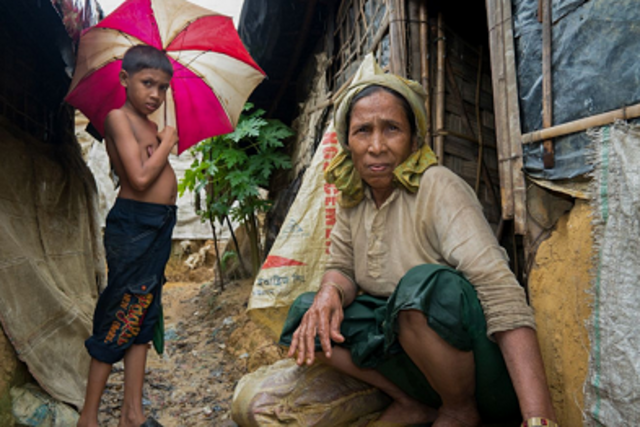
Mother and child in Cox’s Bazar refugee camp last January [Credit: John Hulme]
Canada’s Globe and Mail reported on May 4, that the camp is so densely packed that it is not uncommon for a family of seven or eight to live in a 110-square-foot room. Another report noted that Rohingyas are sleeping on muddy plastic sheets or paper in flimsy canvas and bamboo shelters. Water supply, sanitation, and sewage facilities are completely inadequate. Cholera, chickenpox and diphtheria infection have broken out in the camps since 2017.
“If anyone of us is infected by this virus, many refugees will die in a short time,” one refugee, Ro Ro Yassin Abdumonab, told reporters. With 40,000 people living in each square kilometre, a disaster is inevitable.
The UNHCR has established one isolation facility to treat 200 infected people and another to treat 50. It is also planning to have 10 beds with ventilators and intensive-care capacity. The Globe and Mail reported that it will take two weeks to complete but a UNHCR spokeswoman in Cox’s Bazar admitted that “it’s not much in the way of resources” and “very limited.”
Bangladesh’s government used the pandemic to impose a “complete lockdown” in Cox’s Bazar on April 9. The measure came on top of the already existing crackdown on the refugee camps, including tight curfews, the closure of shops run by refugees, the blocking of internet services and the confiscation of mobile phones.
It had already banned refugees from leaving the camps and warned employers not to hire them. Under various bogus pretexts, the government had previously banned more than 40 non-government organizations providing relief work for the refugees. This means that the Rohingya refugees are now totally dependent on the World Food Program and other charity for basic necessities.
The Rohingyas are neglected not just by the Bangladeshi ruling class but all major powers, who, despite their hypocritical promises to help these poverty-stricken stateless people, provide very little assistance and refuse to allow them to enter their countries, thus condemning hundreds to die at sea.

Japan’s PM exploits pandemic to push pro-war constitutional revisions

Ben McGrath

The Japanese government of Prime Minister Shinzo Abe is looking to exploit the COVID-19 pandemic to continue his drive to revise the country’s constitution to remove barriers to remilitarization and tear up democratic rights. On May 3, Constitution Day, Abe promoted this agenda in a speech to representatives of Nippon Kaigi, the right-wing extremist organization that is a major supporter of Japanese rearmament and militarism.
In his speech, Abe called for a debate in the National Diet, Japan’s parliament, on adding a clause to the constitution to give the Cabinet additional powers during a national emergency, changes that would restrict democratic rights. “We’re facing extremely critical challenges of deciding what roles the state and citizens should fulfil in the event of an emergency, how we should overcome national crises and how we should position these matters in the Constitution,” he declared.
A revised law approved this past March with the support of the two main opposition parties gives the government the power to declare a state of emergency for up to two years and includes the ability to enforce lockdowns and to close schools and public events. However, the ruling Liberal Democratic Party (LDP) argues that this law could be found unconstitutional, making the proposed revisions necessary. If passed, the government could use a state of emergency to shut down political meetings with which it disagrees, including anti-war rallies.
The proposal is not a response to the current pandemic, but a long-planned change. Abe stated that emergency powers were one of the four proposed changes the LDP had put forward in March 2018. The other major change involves revising Article 9, known as the pacifist clause, which bars Japan from fielding a military or participating in wars. Abe added Sunday that it was necessary to “put an end to the debate over the constitutionality of the Self-Defense Forces.” He has previously proposed a clause to Article 9 to explicitly recognize the SDF, the formal name of Japan’s military.
Abe and the ruling class chafe at the legal barrier Article 9 represents to Japan’s re-establishing itself as a major power in Asia, a goal Tokyo desires to pursue through military means if necessary. Though various “reinterpretations” over the decades have provided the Japanese ruling class with the loopholes to create and arm the SDF, Japan is still unable to fully project its military force in the region and other parts of the world as it desires.
Since the end of January, Tokyo has been using the SDF as part of its COVID-19 response, which Abe pointed to in his speech to claim that it is necessary to clarify the military’s legal status. The prime minister has regularly exploited past crises for the purpose of remilitarization, including using the Japanese hostage crises in Algeria and Syria in 2013 and 2015 respectively to loosen restrictions on the military.
The other proposed revisions include changing the Diet’s Upper House districts and a vague reference to free education—a cynical addition to try to win public support for the other, far more unpopular changes. The LDP previously proposed free education at the pre-school and university levels, but has backed off this proposal, an indication that it is little more than window dressing.
Abe had initially pledged in May 2017 during a similar speech to Nippon Kaigi, to which he and most of the members of his cabinet belong, to revise Article 9 of the constitution by this year. It is becoming increasing unlikely that this will take place, especially as the government deals with the COVID-19 pandemic. “We are afraid that it will be taken as a move to capitalize on the crisis,” a senior LDP official told the Asahi Shimbun.
The prime minister stated Sunday that, “I understand a path to the revision will be rocky, but I am determined to make it happen together with you”—an indication that he hopes to push through the changes before September 2021 when his term as LDP president, and therefore prime minister, is projected to end.
The proposed revisions to the government’s emergency powers and to Article 9 are attacks on democratic rights and push Japan further towards re-arming, which is particularly aimed at China and North Korea. Since it was enacted in 1947, Japan’s constitution, drafted by the US occupation force, has never been amended. Any changes now would serve as a precedent, making it easier to further erode democratic rights in the future as Tokyo plans highly unpopular wars of aggression.
While there is opposition in the Diet to Abe’s plans, this is not a genuine anti-war movement. The two main opposition parties, the Constitutional Democratic Party of Japan (CDP) and the Democratic Party for the People (DPP) supported the March emergency law. There is also support among the opposition, particularly in the DPP, for revising Article 9. Their differences with Abe and the LDP are a matter of tactics.
Yukio Edano, head of the CDP, went so far as to say that the current constitution already empowers the government to restrict people’s individual rights in the event of an emergency, under the concept of “public welfare.” Edano stated, “It is absolutely not true that necessary measures cannot be implemented under the rule of the current Constitution.”
DPP leader Yuichiro Tamaki did not express disagreement with constitutional revisions, but merely questioned the timing. “We can proceed (with talks on constitutional reform) in a calm environment after the coronavirus situation settles down,” he said, undoubtedly concerned that in the current “environment” of mass discontent over the government’s COVID-19 response, attempts to revise the constitution would be met with an outburst of social anger similar to or larger than the mass anti-war allies that took place in 2015.
Polls regularly show that more than half the population is opposed to the proposed constitutional changes. In a recent Asahi Shimbun poll, 57 percent of respondents stated that the government should handle crises without revising the constitution and 65 percent opposed changing Article 9.

Hundreds of COVID-19 infections in German meatpacking plants

Marianne Arens

The coronavirus pandemic is spreading rapidly in the meat processing industry. Recently, hundreds of workers in a slaughterhouse have become infected with COVID-19.
At Westfleisch in Coesfeld, North Rhine-Westphalia (NRW), 151 of a total of 1,200 employees have so far tested positive for COVID-19. Thirteen workers had to be taken to hospital immediately. The agreed-upon relaxation of the COVID-19 measures for the district was suspended yesterday until further notice.
The Westfleisch group of companies, based in Münster, is the third-largest meat processing conglomerate in Germany. In Oer-Erkenschwick, 33 of 1,250 workers at the Westfleisch plant have become infected. In Hamm, more than 1,000 workers of the same group have to be tested for the coronavirus. The two plants are also located in NRW.
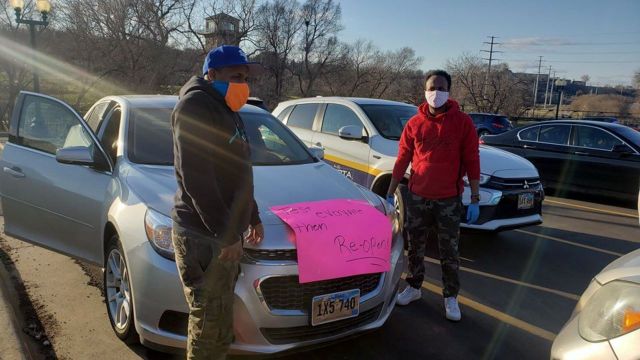
“Test all before you open” - US meat workers in Sioux Falls, South Dakota protest
Westfleisch in Coesfeld is now the third German slaughterhouse where many workers have been infected with the coronavirus. Previously, 300 slaughterhouse workers from Müller Fleisch in Birkenfeld near Pforzheim had been infected.
Ten days ago, two workers at slaughterhouse operator Vion in Bad Bramstedt (Schleswig-Holstein) were also infected with COVID-19, and by May 7, at least 109 workers had tested positive in the same slaughterhouse. The Vion Food Group is one of the largest slaughterhouse operators in Europe, with an annual turnover of over €5 billion.
The rapid spread of the coronavirus among abattoir workers is an international phenomenon. As the World Socialist Web Site reported, US slaughterhouses are currently hotspots of the pandemic. More than 6,500 workers in large meatpacking companies have already been infected. At least 25 meatpacking workers in the US have already died of COVID-19.
The Trump government has classified the meat industry as vital infrastructure and thus prevented its closure, although the operators do not provide workers with the necessary protective equipment, let alone sufficient testing facilities. Trump sees the slaughterhouses, where thousands of immigrant workers from Latin America slave away, as important examples to force all workers back to work.
There have already been several spontaneous strikes in the US against these infections. Dozens of workers at a Smithfield Foods pork plant in Crete, Nebraska, are demanding the closure of the plant after 48 workers there tested positive. In Kathleen, Georgia, and Sioux Falls, South Dakota, meat industry workers have also protested and spontaneously gone on strike for proper protection and sanitation measures.
Immigrants from Romania are the main workers in the German meatpacking industry They are hired through subcontractors networked throughout Europe and are among the most exploited low-wage workers. Although they work all year round in Germany, they are only given fixed-term contracts.
They are completely dependent on the subcontractors who broker them to the meat companies, like modern slaves. Officially, they receive the legal minimum wage of €9.35 gross, but large sums are deducted from this in brokers fees, accommodation, transport, laundry, tool costs, etc.
Since Romania became an EU member over 10 years ago, the German meat industry has benefited from such exploitative relations. After the fall of the Stalinist regimes 30 years ago, financially powerful investors have plundered eastern European industries and lands, leaving increasing unemployment, poverty and blatant social inequality for the population. Since then, many thousands of Romanian workers have been forced to look for employment in Germany.
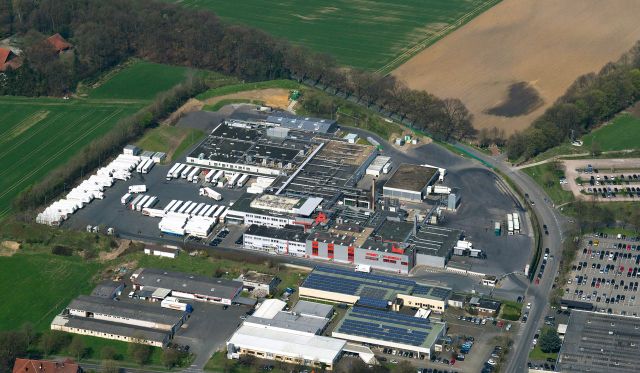
Factory premises of the Coesfeld meat centre of Westfleisch SCE (source: Wikimedia)
It is no coincidence that it is precisely these workers who are the victims of each new COVID-19 outbreak. The employee of an advice centre for south-east European butchers told broadcaster WDR that one of the main reasons the virus was spreading so quickly among the workers is because they are simply fatigued. “Many are very exhausted because they have to work long and hard,” the employee said. “They are housed in accommodation where there is no question of protection and safe distancing. These establishments must be closed immediately.”
In Germany, the establishment politicians have so far followed a special quarantine policy in agreement with the corporations. This consists essentially of isolating these cheap labourers from the rest of the population, while the factory continues to operate, if possible. Federal Minister of Agriculture Julia Klöckner (Christian Democratic Union, CDU) coined the term “de facto quarantine with simultaneous work opportunities” for this type of dangerous forced labour.
Similarly, certain nursing homes, prisons and above all the refugee accommodation and anchor centres have been sealed off. For these most oppressed layers, the decisive coronavirus measures—systematic testing, contact tracing, isolation—are essentially considered unnecessary.
This is taking its toll in Coesfeld, where total infections have increased dramatically throughout the entire district, which currently has the highest rate of new infections in NRW. Since Thursday, it has clearly exceeded the limit set by the federal and state governments’ for the loosening of measures to reduce the spread of COVID-19. This limit was set at 50 infected persons per 100,000 inhabitants, based on the recommendations of the public health body the Robert Koch Institute.
Initially, it was decided that production would continue at Westfleisch in Coesfeld. Despite the outbreak, the shortage of employees is not as serious as initially assumed, the company announced on Thursday.
However, this decision had been revised by Friday evening. Since most of the media are now reporting on the unchecked spread of the coronavirus in the slaughterhouses and residents are protesting, it has suddenly been announced that the slaughterhouse will be shut down after all. The authorities fear that continued operation of the slaughterhouse could lead to massive protests among the population and strikes by the workers.
In Baden-Württemberg, the state health office decided on April 24 that slaughterhouse operator Müller Fleisch in Birkenfeld had to continue operating, even though it was already clear that at least 230 workers had been infected. Since then, workers there have slaved away for 12 hours a day seven days a week to compensate for the staff losses, as one worker told the Pforzheimer Kurier .
In the case of harvest worker Nicolae Bahan in Bad Krozingen, who died of COVID-19 on April 11, it was not even considered necessary to interrupt the asparagus harvest for a day following his death. As is being done practically everywhere, quarantine there consisted only of isolating the workers from the rest of the population.
In Schleswig-Holstein, the Vion meat plant has only been shuttered for two weeks, beginning last Wednesday. Workers are in quarantine and are not allowed to leave their accommodation in a former barracks. Before that, management and local politicians had also vigorously resisted a shutdown. A district administrator wrote in his press release as late as Wednesday, “Again and again, I am asked why the district does not simply shut down the factory? The answer, ‘Legally we have no means of doing so, since food production is considered to be critical and the transmission of the virus through foodstuffs has not yet been shown.’”
The spread of coronavirus throughout the meat processing industry drastically illustrates the capitalist principle that the economic interests of the big corporations and banks take precedence over the life and health of the working class.