13 May 2020

Sri Lankan President “reopens economy” despite pandemic

W.A. Sunil

On Monday, despite the worsening coronavirus pandemic, Sri Lankan President Gotabhaya Rajapakse announced the government was “reopening the economy,” including in the Colombo and Gampaha districts, which health authorities have identified as high-risk areas.
State institutions and big businesses have been opened, with up to one-third of the workforce called back to work. The government had already allowed major exporting businesses to resume production about two weeks ago.
Heavily-armed military personnel have been stationed in trains, stations and bus stands to monitor workers’ movements. According to police spokesman Deputy Inspector General Ajith Rohana, 10,000 officers have been deployed in the Western province. State intelligence and police officers in civilian clothing have also been deployed.
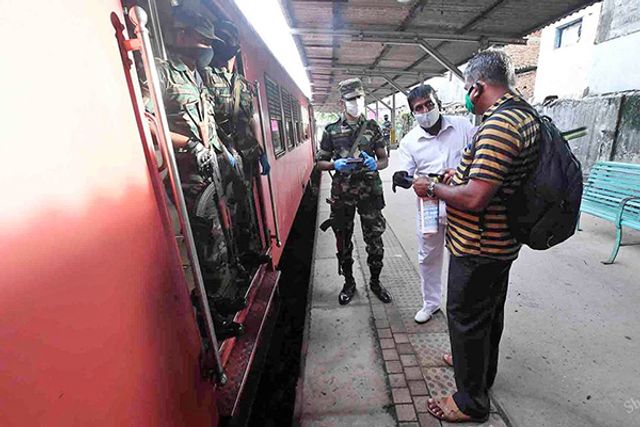
Soldiers checking a worker before he boards a train in Colombo
On April 20, President Rajapakse told the media he had instructed the secretary of defence, retired Major General Kamal Gunaratne, to prepare “wartime” measures in Colombo. On April 27, the government sent large numbers of soldiers to Colombo, where they have been stationed in 16 schools.
The pretext for these deployments is to ensure that the population adheres to “social distancing” and other healthcare guidelines. The real reason, however, is to suppress any resistance to the return to work while COVID-19 continues to spread.
In an indication of widespread opposition, many employees did not show up for work in Colombo and other cities on Monday. The government admitted that although they had arranged 47 trains only 10 were operated. About 2,800 people had reserved seats in advance but only 997 travelled. While 5,200 buses were ready in Colombo and other areas, only 3,200 operated, partly because drivers and conductors did not report for work and partly due to low passenger numbers.
In a statement on Monday, aimed at justifying the reopening of the economy, Rajapakse falsely claimed that “COVID-19 has now been brought under control to a satisfactory degree.”
In the same statement, the president said the government had to “maintain a balance between steps taken to prevent the spread of the disease on the one hand, and the restoration of normalcy on the other.”
The president made clear that Sri Lanka is following the lead of the imperialist countries, which have failed to control the pandemic and are reopening businesses at the risk of workers’ lives. “Even countries like Italy, Britain, France and the USA, which experienced tens of thousands of coronavirus-related deaths, have now commenced programs for the gradual restoration of normal life,” he said.
In recent weeks the number of infected in Sri Lanka has increased rapidly. Yesterday there were 889 cases, according to the President’s media division, up from 690 on May 1. Testing has deliberately been kept at a low level, so the real figures are undoubtedly higher.
Health authorities say they carried out just 36,000 tests during 52 days from March 18 to May 10. These figures are unreliable, however, as earlier, authorities reported 32,000 tests were done between February 18 and May 5.
The Rajapakse regime is ignoring the World Health Organization’s (WHO) warning that the premature reopening of economies will greatly endanger human lives. On Monday, WHO Director-General Tedros Adhanom Ghebreyesus emphasized that before governments reopen businesses, “they must ask if the epidemic is under control, if the national health care infrastructure can cope with new resurgences, and if the public health surveillance measures in place are sufficiently robust to trace, isolate, treat and track at a community level across the nation.”
Sri Lankan medical experts say that the PCR (Polymerase Chain Reaction) tests must be increased to at least 2,000-5,000 per day. They have warned that resuming normal work without controlling the virus creates the danger of a major outbreak.
The Rajapakse regime, however, is determined to revive the economy at the expense of workers’ health, living standards, and lives.
The president’s media statement noted that state and private sector employers have discretion to decide how many employees they call back. Big businesses have already cut jobs and wages, increased working hours beyond eight hours a day, and halted contributions to pension funds for six months.
Yesterday, Labour Minister Dinesh Gunawardena told the media that the trade unions had agreed that businesses could pay only half the monthly salary or 14,500 rupees ($US75) for those who were not immediately recalled for work.
Workers’ anger and resistance is growing. On Monday about 1,000 workers at Sumithra Garments in the southern town of Weeraketiya went on strike opposing a move to halve their wages.
At the Maradana railway hub in Colombo, in the locomotive section, only 15 workers had been called in on Monday. One worker told the WSWS that management had decided to call one third of the 180 workers for one week at a time on a rotating basis. Workers have to prepare their own meals. Overtime work, on which workers depend to boost their meagre monthly wage, has been cut.
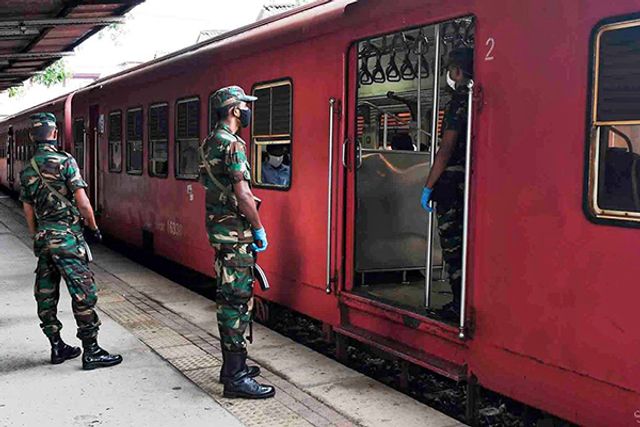
Soldiers patrolling a train station in Colombo
The opposition parties—the United National Party (UNP), Samagi Jana Balavegaya (SJB) Janatha Vimukthi Peramuna (JVP) and Tamil National Alliance (TNA)—support reopening the economy.
UNP leader Ranil Wickremesinghe said last week, “We are willing to help the government because this is not a time to play adversarial politics.”
On Monday last week the TNA leaders met with Rajapakse and made a similar pledge.
The entire corporate media also supports the back-to-work drive. Divayina, for instance, wrote yesterday that people should learn to live with the “invisible enemy,” since no treatment will be found for at least two years.
Several trade unions, including the Free Trade Zones and General Services Employees Union and Ceylon Mercantile Union, wrote to the president urging him to meet with them. “We do accept factories have to be reopened to support the economy in its efforts to sustain the nation,” they declared.
Last week these unions joined others controlled by the JVP in a meeting with the labour minister and employers, where they agreed to pay cuts for workers in exchange for companies delaying layoffs. However, companies have already begun cutting jobs.
None of the unions, which act as agents of the state and big business, raised the severe health risks posed by a premature return to work.
But why should workers be forced to risk their lives to maintain the profits of big business?
The Socialist Equality Party (SEP) calls on workers to refuse to work until safe and healthy conditions can be guaranteed. All working class and poor families must be provided with an income to maintain a decent standard of living. Relief must be provided to small businesses, farmers and fishermen, whose earnings have collapsed.
The massive foreign debt must be repudiated instead of its burden being imposed on workers and the poor.
The realization of this program requires the abolition of the profit system and replacement of the Rajapakse government with a workers’ and peasants’ government, as part of the fight for international socialism.

UK: Exercise Cygnus leak confirms Tory government’s criminal inaction over pandemic threat

Richard Tyler

“Exercise Cygnus,” held over three days in October 2016, modelled the national and local responses to a serious influenza pandemic and identified critical failings leading to the overwhelming of the National Health Service (NHS). A government report on Cygnus produced in 2017 concluded, “Pandemic influenza is one of the most severe natural phenomena to affect the UK and the most severe civil emergency risk.”
The Conservative government did nothing in response and refused to publish the report on Exercise Cygnus. When questioned, Health Secretary Matt Hancock claimed officials had said “everything recommended was done.”
Anger at such brazen lies was such that Dr. Moosa Qureshi tried to bring judicial review proceedings against the government’s refusal to publish the findings of the Cygnus Exercise. Last Thursday, a version of the report was leaked to the Guardian which placed it online, confirming that the Johnson government is desperate to conceal its criminal lack of preparation for the outbreak of a pandemic.
Under the heading “Key Learning,” the report concludes, “[T]he UK’s preparedness and response, in terms of its plans, policies and capability, is currently not sufficient to cope with the extreme demands of a severe pandemic that will have a nation-wide impact across all sectors.”
Running to 57 pages, the report reveals the Tory government has been aware of the dangers millions in Britain would confront when faced with the outbreak of a deadly viral infection. The scenario which Exercise Cygnus imagined was based on the emergence of a virus in Thailand in June 2016, subsequently identified by the World Health Organisation as a Public Health Emergency of International Concern (PHEIC).
“During the exercise, participants considered their capacity and capability to operate at the peak of a pandemic affecting up to 50 percent of the UK’s population and which could cause between 200-400,000 excess deaths in the UK.”
This figure of “excess deaths,” i.e., the number of fatalities above the average for the same time of year, clearly underestimates the real level of mortality, given other assumptions made in the exercise. The Case Fatality Rate (CFR) of 1.5 percent was “adjusted from the worst-case scenario planning figure of 2.5 percent, to take account of the effect of antivirals,” the report states.
However, Exercise Cygnus was based on the disease being responsive to existing treatments such as oseltamivir (Tamiflu®) and zanamivir (Relenza®) and not on a novel virus like COVID-19, for which there is not yet any effective medication or vaccine.
One of the “scenario assumptions” was that most schools would remain open, envisaging that just 250 schools (1 percent) across England would decide to close. When it came to COVID-19, this supposition ran far of the reality, with most schools closed by the end of March because of public outrage over the Johnson government’s “herd immunity” policy of letting the virus run unchecked through the population. Now, the government is pressing for schools to begin reopening as part of its “back to work” agenda, despite the fears of parents and teachers about an eruption of COVID-19 cases incubated among school children and passed on to staff and parents.
Another critical area identified in the report is that of prisons. While praising the “excellent” relationship between Public Health England (PHE) and the National Offender Management Service (NOMS), “Exercise Cygnus did not test the tactical and operational responses to outbreaks in prisons,” which “should be considered as an area for development.”
No plan was developed about how to deal with the threat posed by a pandemic to those incarcerated. So far, 19 prisoners have died of COVID-19, with 362 prisoners testing positive in 74 prisons in England and Wales. Over 400 prison staff, employed at 67 prisons, were confirmed as having the virus last week.
The procurement and supply of personal protective equipment (PPE) was not examined comprehensively in the exercise. But the report recommended “opening up more distribution points” for PPE, and that consideration be given to developing “a whole system approach to the distribution of PPE to health and care staff.”
Clear guidance was needed to “define and communicate who will receive PPE from national stockpiles and which parts of the private and voluntary sectors are expected to make their own arrangements to safeguard their workers.”
Health and Safety issues “around an employer’s duty of care to staff in specific sectors (e.g., health care, prisons, poultry workers),” needed to be examined, “including provision of appropriate PPE where relevant.”
What has been exposed by the COVID-19 pandemic is that rather than building up supplies of such vital safety equipment, national stockpiles were run down and allowed to go out of date.
A BBC Panorama investigation showed that the government had failed to buy crucial protective equipment to cope with a pandemic, such that “there were no gowns, visors, swabs or body bags in the government’s pandemic stockpile when COVID-19 reached the UK.”
An issue that was completely absent in Exercise Cygnus was any examination of the role of testing in containing and eliminating new infections, since the scenario assumed the emergence of an influenza strain that could respond to treatment using existing medications. The lack of adequate testing and tracing procedures in the UK, and the application of the “herd immunity” policy for weeks, has meant the virus has been able to run rife.
A major assumption in Exercise Cygnus was that vital health resources would rapidly become overwhelmed, and that the euphemistically entitled “surge plan” would call for “an alternative model of care (population-based triage) to manage capacity and respond to the excessive demand for hospital places.”
The use of a triage approach means doctors being forced to decide which patients will and will not receive possibly life-saving treatment, with the report recognising this might well need to be extended “to services beyond critical care.”
The exercise also considered how to manage public reaction to the use of body bags and mass burials. Such “ethical dimensions surrounding a pandemic of this severity deserve further consideration,” is the report’s anodyne conclusion.
A critical area identified by Exercise Cygnus is that of social care, which the report correctly identifies as “currently under significant pressure during business as usual.” Additional pressure on the social care sector, “especially with a 20–40 percent absenteeism rate and with illness among vulnerable sections of society,” could be “very challenging.”
Following decades of privatisation and outsourcing in the care sector, it was “not possible to collate an accurate picture of social care capacity because much of that capacity lies with private providers,” the report found.
It is under such circumstances that government plans proposed to implement “reverse triage,” whereby sick individuals are released from hospital and sent back into the social care sector. The report notes that local responders “raised concerns about the expectation that the social care system would be able to provide the level of support needed” were the NHS to follow such a protocol.
Much worse has happened in the present COVID-19 pandemic and to devastating effect. With COVID-19 infected patients being sent out of hospitals to care homes, the disease has run rampant.
The Office for National Statistics now admits that deaths in care homes made up 10,000 of an overall UK death toll of 40,000. But this only counts those tested for the virus when this was not standard practice. The Financial Times estimates over 60,000 deaths and the Times 61,000—of which the FT says 19,900 are “excess deaths” in care homes.
Responding to the leak, Dr. Qureshi stated his belief that the full extent of the government’s cover-up is still not known. Qureshi wrote for example, “I welcome the Guardian’s investigation which has uncovered a version of the Cygnus Report. However, many questions remain unanswered about Exercise Cygnus.” He asked, “What precisely were the Report’s findings with regard to PPE and ventilator capacity, and how were these acted on? Why did the Government ignore clear early warning signs about care homes? How has implementation of the report’s recommendations been audited? Are there other similar classified reports for other public health threats?”

Failure to halt COVID-19 spread leads to mass deaths in Swedish elder care homes

Jordan Shilton

The refusal of Sweden’s Social Democrat/Green government to impose lockdown measures to prevent the spread of the coronavirus has won widespread praise in international media. Publications from USA Today to Britain’s Daily Telegraph and Germany’s Der Spiegel have hailed Sweden’s “unique” response to the crisis as an example of how to weigh economic interests against human life. Anders Tegnell, Sweden’s state epidemiologist, and other top health officials have been afforded extensive space to propagate what is in all essentials, their denials notwithstanding, a policy of herd immunity.
This is made especially clear in the horrific death toll recorded in Sweden’s elderly care homes. Of the more than 3,300 deaths reported to date, half have been care home residents; another quarter received care at home. These terrible numbers are underestimates, as Swedish official statistics only include cases where a positive coronavirus test has been confirmed by a lab.
With a population of just 10 million, Sweden’s death toll is more than three times the combined fatalities in Denmark, Finland, and Norway, which together have more than 16 million inhabitants.
The virus has run rampant in care homes above all due to inadequate protective equipment and the precarious nature of care-sector jobs. As a consequence of privatisation policies supported by the entire political establishment in Sweden since the 1990s, private providers have made vast sums out of elderly care, while staff lack job protection and adequate equipment. “They had paper napkins attached to rubber bands, that was their face masks,” a Swedish doctor told Germany’s Süddeutsche Zeitung about conditions in care homes.
Reports have emerged of care workers with symptoms continuing to work for fear of losing their jobs and their income. In Sörmland, a region whose care homes have seen major outbreaks, at least 20 percent of all staff in half of the homes are hourly employees or employed by a staffing agency, meaning they receive no pay if they stay at home. Authorities also failed to carry out mass testing of care workers to identify who was infected. Sweden has conducted just 14,700 tests per 1 million inhabitants, less than than Peru or Chile.
Strong evidence suggests that the authorities are refusing anyone over the age of 80 intensive care treatment in the Stockholm region, home to about half of all Sweden’s cases. According to German public broadcaster NDR, less than 1 percent of all coronavirus patients aged 80 or over—just 50 from over 5,200—received intensive care treatment.
By contrast, the same figure for patients in that age group in Germany was 12 percent, according to an analysis based on a smaller group of patients conducted by the Robert Koch Institute. Johnny Hellgren, head of Sweden’s Intensive Care Register, told NDR, “There may be more ethical discussions and more discussions about futility before a patient is admitted to intensive care in Sweden.”
Behind euphemisms about “ethical discussions,” the Swedish ruling class acts with callous disregard for human life. Public criticism is mounting, including from medical experts demanding more-rigorous confinement measures and more testing and contact tracing.
The Social Democrat/Green coalition has responded by promoting Swedish nationalism and collective responsibility. Prime Minister Stefan Löfven acknowledged that his government had not sufficiently protected the elderly, while unveiling a minuscule 2 billion kronor (around €189 million) in additional support for the elderly-care sector. This is a mere fraction of the hundreds of billions made available to large companies and the banks by state bailouts.
Social Affairs Minister Lena Hallengren, also a Social Democrat, added, “As a society, we bear joint responsibility for this sector not being better equipped. We paid too little attention to the workers, their working conditions, and the reputation of their profession.”
This is a pack of lies. The Swedish people are not collectively responsible for the disastrous response to the pandemic. On the contrary, the very high fatality rate in Sweden is due to the government’s refusal to impose a lockdown and carry out mass testing, as well as to policies of privatisation and attacks on workers pursued over the past two decades that have devastated health care, elderly care, and other key social services.
Unlike other European countries, Swedish authorities allowed most schools, all restaurants, bars, and clubs, and most businesses to remain open throughout the pandemic. Gatherings of up to 50 people are still permitted.
This allowed the virus to spread largely unchecked across a country whose health and social services were in no condition to deal with an upsurge in patients. From the 1994-2006 Social Democrat government, to Frederick Reinfeldt’s right-wing Alliance (2006-2014), and the Social Democrat Löfven’s period in office (2014-present), each government intensified the destruction of health care, social services and the welfare state, which at one time was among the most comprehensive in the world.
Löfven’s Social Democrats have played a crucial role in continuing to enforce austerity for working people and tax cuts and subsidies for the wealthy. After emerging as the largest party from the 2014 election, but without a parliamentary majority, the Social Democrats and Greens struck an unprecedented deal with the right-wing Alliance parties to stay in office.
The agreement with the Moderate, Centre, Liberal, and Christian Democrat parties committed the Social Democrats to implementing the Alliance’s 2015 budget and gave the four opposition parties a veto over subsequent spending. After the 2018 election, the Social Democrats and Greens concluded a more formal cooperative agreement with the Centre and Liberal parties to secure a parliamentary majority.
The embrace of the traditional right by Sweden’s Social Democrats was dressed up as a bold move to stop the rise of the far-right Sweden Democrats. In truth, however, it was part of a broader shift of social democratic parties and their trade union backers worldwide towards free-market policies and support for imperialist wars. Sweden joined in the bombardment of Libya in 2011, and integrated its armed forces into US-led NATO operations against Russia.
According to the Heritage Foundation, a right-wing US think-tank, Sweden takes first place in its global privatisation rankings. No other country privatised more public services between 1996 and 2012 than Sweden, the think-tank noted.
In addition to the elderly-care sector, privatisation initiatives led to an explosive growth in private hospitals and schools. Sweden’s education system increasingly funnels public funds to privately run educational institutions, a model that inspired David Cameron’s Tory government in Britain in its approach to privatising schools.
The brutal reality of Sweden’s approach to COVID-19 is that thousands of lives are being sacrificed to enrich a financial elite that has dramatically increased its wealth in recent years by destroying the very social services and workers’ protections now so glaringly lacking. Income inequality has risen in no other OECD country more quickly than Sweden since the 1990s.
Lisa Pelling of the Stockholm-based Arena Idé think tank wrote in 2019 of the impact of this on the top 10 percent of society: “Today, the Swedish face of inequality rests on a person whose everyday life is spent on what is in many ways a different planet. It is someone who no longer has to cook, wash the dishes or carry groceries—whose shirts are washed and ironed by paid (and tax-deductible) labour. The face of inequality is a person who can afford to take a mortgage on not just one home but a second one too, and who gets a tax rebate for having his or her often spacious dwellings cleaned and maintained. It is a person who—without having to pay a tuition fee—can send his or her kids to socially segregated schools, where well-prepared, motivated children are taught by the best-prepared teachers. It is a person who qualifies for private health insurance, which makes it possible to jump the queue for examinations and treatments—also at tax-funded clinics and hospitals.”
As the government fails to protect human lives, this growing social divide is fueling popular opposition to the entire political establishment. Despite efforts by media outlets to portray Sweden as united behind the government’s irresponsible refusal to order a lockdown to contain the spread of coronavirus, the reality is very different. A recent poll found that just 51 percent of respondents approve of the government’s handling of the pandemic—a figure that drops to 40 percent among those under 30 years of age.

With Brazil on course to become new COVID-19 epicenter, Bolsonaro escalates back-to-work campaign

Miguel Andrade

Amid growing evidence that Brazil is becoming a new coronavirus epicenter, fascistic President Jair Bolsonaro has escalated a pressure campaign to force local authorities to lift limited restraints imposed on economic activity to slow the spread of the pandemic.
According to official data, Brazil currently has close to 175,000 cases and over 12,000 deaths, with the number of infections growing 6.5 percent a day, as opposed to 3 percent in Italy during the same stage of the virus’s spread. According to official data, Brazil trails only the United States in the daily growth of the pandemic, even with all 26 of its states and the self-governing capital, Brasília, already in the second month of partial quarantines.
With the number of tests in Brazil at only 1,600 per million—as opposed to 28,000 per million in the US and similar numbers in other hard-hit countries—such figures have no credibility. The number of infected is likely higher than the 4.2 million estimated on May 8 by Imperial College London, with an unknown number of deaths. In Amazonas, the worst-hit state, where victims are being thrown into mass graves, Imperial College estimates that fully 10 percent of the population is already infected.
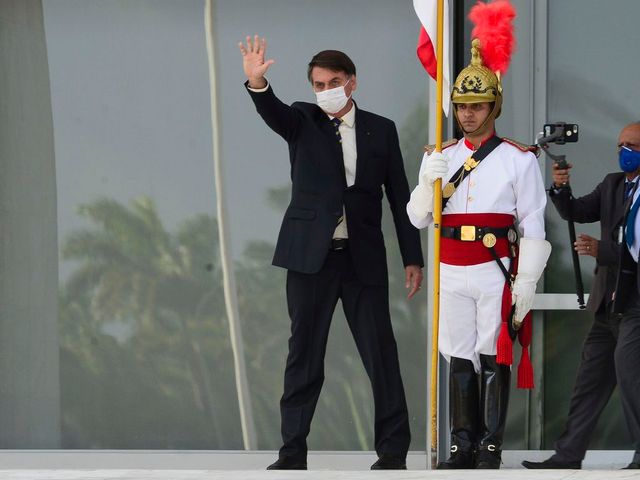
Bolsonaro addresses right-wing supporters from Planalto presidential palace (credit: Marcello Casal-Agência Brasil).
Nonetheless, yesterday the government sought to ramp up its pressure campaign against local administrations, which have made limited efforts to slow the pandemic’s spread through partial economic shutdowns. In a demagogic appeal to economically desperate small business owners, it further expanded its list of “essential activities” to include barber shops and hairdressers. The decree comes five days after a previous measure declaring all of industry and construction essential services. The decree, issued after a meeting with a handful of businessmen whom Bolsonaro portrayed as representing “45 percent of the Brazilian GDP,” provoked widespread opposition.
The declaration of industry and construction as “essential activities” was accompanied by a “march” by Bolsonaro and the assembled businessmen from the Planalto presidential palace to the Supreme Court (STF) in a bid to pressure justices to allow the Federal government to override state and city quarantines.
This political stunt was joined by the creation of a fascist encampment in front of the court building in support of the same goal. The leaders of the self-styled “300 of Brazil,” the uniformed group organizing the encampment, with financial support from pro-Bolsonaro business moguls, declared that their objective is to “Ukrainize” Brazil—a reference to the violent fascist-led 2014 putsch in the former Soviet Republic.
In Brazil and internationally, the ruling elite’s back-to-work campaign has been justified with the lie that a resumption of economic activity in capital-intensive sectors such as auto and oil production, not to mention the food industry that was never shut down, is safe due to stringent workplace regulations.
The meatpacking industry has become the focal point of the pandemic in many small towns, with more than half of their cases traced to the plants located there. The industry has also been one of the main vectors of the pandemic’s spread to the impoverished countryside. In the southern state of Rio Grande do Sul, a regional leader in animal derivatives production, the government estimates 16,000 meatpacking workers may have already contracted the coronavirus.
In the state-owned energy giant Petrobras, where operations, including remote offshore oil drilling, have continued, at least 800 workers have already been infected, and another 1,600 are known to have been exposed to the virus.
In Brazil, as in the rest of Latin America and other poor countries only beginning to be affected by the pandemic, infections among workers are further exposing the reactionary claims that only a minority of those infected—and generally only the elderly—have serious complications from COVID-19.
A quarter of the dead in Brazil have had no associated preconditions and are below the age of 60, while most of those in serious condition are younger than 50. Last week, deaths in the working class district of Brasilândia, in the country’s COVID-19 epicenter, São Paulo, were 10 times higher than those in wealthier districts. The criminal lack of testing hides a much worse situation in the rest of the country’s crowded working class areas, where chronic conditions such as diabetes, obesity and hypertension are prevalent among young workers.
Bolsonaro and his nominal opponents in the ruling elite are all preparing for mass working class opposition by building up far-right groups such as the “300 of Brazil,” already portrayed by one of the country’s leading papers, Estado de S. Paulo, as “Bolsonaro’s brownshirts.” Despite their tactical differences—exposed on the surface by the threat of an impeachment of Bolsonaro based on charges made by his former Justice Minister Sérgio Moro—the ruling class is united in its determination to force workers back into the factories.
None of the country’s governors, from former Bolsonaro allies such as João Doria to members of the Workers Party (PT) and other opposition parties in the Northeast, has imposed restrictions on the operations of industry or construction, despite their daily denunciations of Bolsonaro as a lunatic “unfit for office.”
In Congress, the Workers Party, Bolsonaro’s supposed chief political opponent, has jumped on the back-to-work bandwagon with a “reopening” bill presented by its former health minister, infectious disease specialist Alexandre Padilha. Padilha claims the bill will guarantee “the best practices” of countries that have reopened their economies, concealing the fact that in these countries—Germany and South Korea, for example—such protocols have led to a new surge in cases. A month ago the PT joined in the vote for the government’s massive quantitative easing program, amounting to 15 percent of the Brazilian GDP, while less than 5 percent of that amount was directed to provide poverty relief for the poorest 25 percent of the population.
With the mobilization of far-right forces attracting virtually no mass support, the ruling class is relying on the unions to both lie to workers about the safety of going back to work and poison public opinion with chauvinism and anti-Chinese appeals, portraying the reopening of factories as necessary to fight foreign competition and minimize job losses.
As the auto industry leads the way in reopening its factories—which in April produced a mere 1,800 vehicles out of its 400,000 monthly capacity—the unions have dispatched officials to factory gates to convince workers to trust safety measures and even promote the “opportunity” represented by the pandemic of reducing imports from China. The president of the largest Brazilian trade union federation, the Workers Party (PT)-controlled CUT, wrote that under the “war conditions” imposed by the pandemic, “the first problem is Brazil’s position in the global value chains,” which “deepens the vulnerability of our industry.”
At Embraer, the global leader in the production of medium-range planes, which recently had its merger plans with Boeing frustrated by the latter’s insolvency, union leaders hailed the fact that “jobs were being cut in the United States,” but not in Brazil.
In a May Day article in the leading Brazilian newspaper, Folha de S.Paulo, Ricardo Patah, the president of the second largest trade union federation, the UGT, described the murderous coronavirus pandemic as a “great opportunity for Brazil” to launch an “industrial reconversion” to produce medical equipment.
He advocated policies “to beat Chinese competition and avoid the humiliation” of being relegated to second place by the Chinese in the sale of medical equipment. He blamed China—rather than US imperialism and its trade war—for the global disarray in the provision of medical supplies. Amid Washington’s condemnations of China to distract public opinion from its own criminal incompetence in dealing with the pandemic, and the growing drumbeat for war, Patah is providing a “nationalist” cover for Brazil’s realignment with US imperialism—much like the pro-Nazi “nationalists” promoted by Bolsonaro and his right-wing big business supporters.
Brazilian workers, engaged in a growing strike wave against pay cuts and the attempt to force them to choose between dying from COVID-19 or starvation, can carry forward their struggle only by means of a conscious break from the straitjacket imposed by the ever-more right-wing unions and their political allies—above all the PT and its pseudo-left satellites.

German politicians and media laud right-wing demonstrations against coronavirus restrictions

Christoph Vandreier

A clear majority opposes the current lifting, in the interests of big business, of measures aimed at containing the coronavirus, which will result in the accelerated spread of the disease. The ruling elite is now mobilising the right-wing dregs of society in the so-called corona, or hygiene, demonstrations so as to intimidate the population and enforce their back-to-work campaign.
The protests against measures designed to contain the pandemic were initiated in several cities over recent weeks by right-wing and far-right groups or individuals. Thanks to disproportionate media coverage and supportive commentary, the protests managed to reach a high-point last weekend, with several thousand people taking part.
Even so, the number of participants remained small. Most cities only saw a few hundred people take to the streets. Placards and slogans called into question the threat posed by the coronavirus, opposed lockdown measures, and declared support for US President Donald Trump. Most participants displayed their ignorance by refusing to wear a face mask or take any notice of social distancing guidelines.
All demonstrations included participants from the far-right Alternative for Germany (AfD) and well-known local neo-Nazis, without this causing any complaints from other demonstrators. Alongside the black, red and gold flag of the Federal Republic, several black, white, and red flags of the German Reich were waved.
The character of the elements attracted to the demonstrations was underscored by the wild applause for the main speaker at the Stuttgart rally: the YouTuber Ken Jebsen, who is well-connected with the far-right milieu. Shortly before the demonstration, he stated in a video that the German government is controlled by the American billionaires Bill and Melinda Gates, who are trying to sell vaccines.
Then, at the demonstration, Jebsen proclaimed that 30 years after unification, Germany finally has to be grown-up and independent. In a reactionary brew of Nazi trivialisation, nationalism and retrograde ideas, he compared the struggle against the pandemic with the Nürnberg Race Laws adopted by the Nazis and claimed that viruses are part of creation that the human mind cannot come close to understanding.
Violent attacks took place in several cities. Reports from Munich stated that passers-by were verbally harassed and threatened because they were wearing masks. Right-wing extremist participants in an unregistered demonstration in Dortmund attacked a film crew from public broadcaster WDR. A sound technician for the public broadcaster ARD in Berlin was attacked on the sidelines of a demonstration in front of the Reichstag building, and his equipment was damaged.
In Aachen, participants in an unregistered coronavirus protest attacked protesters who were demonstrating for a more humane treatment of refugees. After the right-wing demonstrators shouted at them from close range while wearing no masks, the supporters of the Sea Bridge initiative felt compelled to end their protest prematurely.
These right-wing mobilisations in no way represent the concerns among working people. On the contrary, anger is growing among autoworkers, teachers and retail cashiers that they are being forced to return to unsafe working conditions. Nurses, bus drivers and rubbish collectors have complained about a lack of protective equipment and safety measures. Millions of workers face the threat of being laid off, and small and mid-sized businesses have been left out in the cold by the €600 billion handout to the major corporations and big banks.
To extract these vast sums from the working class, the ruling elite is pressing ahead aggressively with its policy of reopening the economy. Following the wide-ranging announcements on the easing of restrictions by the federal government over recent weeks, many states have allowed restaurants, sports facilities, museums and even massage and beauty parlours to reopen. Schools and kindergartens are on their way to resuming “normal service” and many factories are running at full capacity.
The restart of industry and lifting of restrictions has led to an increase in the reproduction rate of the virus. According to the Robert Koch Institute, it stood at 1.13 on Monday. Serious scientists have warned about the risks involved. Estimates suggest that a reproduction rate of 1.1 would mean Germany's health care system would be overwhelmed by October, whereas a rate of 1.2 would move the date forward to July.
The opposition among the population to these developments is strong. Every poll shows that a clear majority opposes the unrestrained policies pursued by the federal and state governments to ease restrictions. An overwhelming majority of 93 percent called for greater attention to be paid to scientific knowledge in policymaking. This is precisely why leading politicians and media outlets are embracing the so-called coronavirus demonstrations.
In Thuringia, where the demonstration was registered by a member of the Christian Democrats’ economic council with close ties to the far-right, the AfD was joined by the Free Democrats’ state leader Thomas Kemmerich, who earlier this year became the first Minister President to be elected with the backing of the AfD. Kemmerich made a show of wearing no mask and ignored social distancing guidelines.
Already on May 2, federal parliament president Wolfgang Schäuble applauded a demonstration in Offenburg, telling the Mittelbadische Presse that it was part of a process that would help the country look to the future. According to the police, the demonstration consisted of 200 people who were packed closely together and wearing no masks. This included a number of AfD politicians and figures from the far-right. Prior to that, Schäuble called into question the concept of human dignity contained in Germany’s Basic Law, effectively calling for human lives to be sacrificed for private profit.
The former editor of the financial daily Handelsblatt, Gabor Steingard, enthused on his daily Morning Briefing podcast that the period of “shocked silence” is over. “Civil society is waking up.” In Stuttgart, Berlin, Frankfurt, and Munich alone, he went on, “tens of thousands” participated in the demonstrations. This goes even further than the grossly inflated numbers of the organisers.
He then cited slogans like “Don't give Gates a chance” and “Get rid of the muzzle” to show that the demonstrators were in their majority neither right-wing extremists nor crazy. Instead, it was an “allergic reaction” to the restricting by the stroke of a pen of basic rights like “freedom to do business” and “the right to property.”
The daily Süddeutsche Zeitung also wants to use the demonstrations to push the policy of easing restrictions. “It isn’t just conspiracy theorists who are formulating their doubts about the measures adopted,” commented Jan Heidtmann on May 10. Some of the questions that need to be clarified include why “when it comes to childcare” we are listening to virologists and why it is always necessary to wear a mask on public transport.
The systematic promotion and embrace of the right-wing mobilisations by politicians and the media show that the ruling elite is prepared to do whatever it takes to intensify their brutal class policy.
However, this merely underscores that capitalism is incompatible with the needs of the vast majority. To combat the pandemic on a scientific basis and defend the health and social interests of the working class, a socialist offensive is required. The banks and major corporations must be expropriated and placed under the democratic control of the workers.

UK COVID-19 related deaths top 60,000, according to Financial Times

Robert Stevens

The true COVID-19 death toll in Britain is more than 60,000—almost double the figure claimed by the Johnson government—according to studies based on new data from the Office of National Statistics (ONS).
Yesterday, the government reported another 627 deaths in its daily briefing, taking official fatalities to 32,490. Its figures are compiled by the Department of Health and Social Care and only include deaths where a person has tested positive for COVID-19. Another 3,403 new coronavirus infections were reported, taking total infections to 226,463.
The Tories’ grossly manipulated official figures are still the highest in Europe and second only to the United States globally. But the ONS reported yesterday that in the week ending May 1, there had been 17,953 deaths recorded in England and Wales—8,012 higher than the average of the past five years for the same week. In the six weeks since the pandemic, 108,345 deaths were registered by the ONS for the two countries, 46,494 more than the five-year average. Of these 35,044 were registered as coronavirus deaths—several thousand higher than the government’s own figures.
The Financial Times, which has tracked “excess deaths” to draw up its own “conservative estimate,” reported that yesterday’s ONS data “represented the seventh consecutive week that deaths exceeded normal levels and once equivalent figures from Scotland and Northern Ireland were included, takes total mortality across the UK during the pandemic to 50,979.”
It concluded, “The FT model now estimates that slightly more than 60,000 more people will have died than normal from the start of the outbreak to May 11, based on the excess deaths to date and the latest daily figures from hospital deaths.”
The ONS figures substantiate evidence of the horrific number of deaths in care homes. In the week ending May 1, 6,409 deaths were registered from people in care homes. This is more than three times the normal rate of 2,019 death registrations in England and Wales’ care homes over the previous five years.
Since the beginning of the pandemic, the ONS has recorded 19,900 more deaths in care homes than normal for the time of year in England and Wales. The FT reports, “Evidence is growing that the virus became seeded among the most vulnerable and frail and elderly people in social care after hospitals discharged sick people into the care system without being tested for COVID-19 to build capacity in hospitals that was not then needed.”
The Times concluded that “the coronavirus death toll may already be 61,000 … up to 50 percent higher than official figures.” Its modelling is also based on the number of excess deaths reported to “take into account both direct coronavirus deaths and those who have died because of related reasons, including those who did not seek treatment for other conditions.” It concludes that modelling based on excess death figures is the most accurate and “show us that abnormally high numbers are dying due to the epidemic, whether directly or indirectly.”
The Times calculates that since the pandemic started to May 1 there were “50,976 excess deaths across the UK: 46,556 in England and Wales, 3,716 in Scotland and 704 in Northern Ireland.” Because it takes around four days to register death, “most of those deaths will have happened by April 27.”
Acknowledging that the exact number of deaths of COVID-19 outside hospitals is unknown, and based on the estimate “that between 40 and 60 percent of all COVID-19 deaths happen in hospitals,” the Times analysis “scaled the hospital data up so that it best fits the latest figures for the number of excess deaths.”
The newspaper reports, “[W]e have conservatively estimated the death toll for the last four days by assuming that it [the death toll in England and Wales] is roughly 60 percent of what it was a week ago. This process was repeated for Scotland and Northern Ireland, which gives us a total of 61,000 excess deaths in the UK.”
The Times noted that “Our model is also subject to regular revisions: yesterday [Monday] we estimated that today’s ONS release would show another 7,000 excess deaths, when in fact the total was 8,000.”
According to the Daily Mail, at least 45,550 have died in the UK directly from coronavirus, based on an estimated death rate from infection that could be as high as 1.73 percent. Professor Paul Hunter from the University of East Anglia believes that COVID-19 could cause up to 560,000 deaths in the UK if half of the population were infected.
The ONS figures were published as Chancellor Rishi Sunak announced that the UK’s furlough scheme would be extended until the end of October. The government will continue to pay 80 percent of the wages of at least 7 million workers (around a fifth of the entire workforce)—in a continuing boon to the corporations—up to a monthly cap of £2,500.
Extending the scheme for four months, Sunak announced that by November “we will have provided eight months of support to British people and businesses.” The Job Retention Scheme (JRS) is another subvention to big business that has already cost at least £14 billion a month. Sunak noted, “We have provided billions of pounds of cash grants, tax cuts and loans for over 1 million businesses, tens of billions of pounds of deferred taxes …” What he did not say was that many of the largest corporations, including more than a quarter of the FTSE 250 firms, are also wallowing in this government largesse.
Sunak made clear that the scheme will remain as it is only until the end of July but will be amended from August until the end of October to “provide greater flexibility to support the transition back to work.” From then, “We will ask employers to start sharing with the Government the cost of paying people’s salaries.”
The suggestion is that Sunak will then cut the government contribution towards furlough pay to 60 percent, while asking employers to stump up 20 percent out of their own pockets.
After wishing Sunak “a very happy birthday” in parliament, Scottish National Party Shadow Chancellor Alison Thewliss tweeted in response to Sunak’s announcement, “After July, it sounds like support under JRS will drop to 60 percent with businesses having to meet the 20 percent. This will be problematic for many businesses who are struggling to survive and building up debt.”
It is almost certain that business will refuse to make up the 20 percent shortfall.
Sunak said the government will work out the “technical details of implementing part-time furloughing” in the days ahead. This has long been insisted on by the Labour Party and trade unions, in their discussions with the government over how to enforce a “mass return to work.”
In her response, Labour Shadow Chancellor Anneliese Dodds said, “I welcome the flexibility mentioned. We have asked for that repeatedly; it applies in many other countries” and pleaded, “Will the chancellor work with me, trade unions, businesses, local authorities” on the scheme.
On behalf of the trade union bureaucracy, Len McCluskey retweeted a message from the Unite union backing the Tories and claiming that Johnson’s Thatcher-worshipping government could be relied on to protect workers in alliance with big business. It stated, “We’ll need to look at the detail when published but today’s announcement is a message again to employers that the government will stand behind them if they stand behind their workers. There should be no rush to redundancies.”
The Trades Union Congress said of Sunak’s measures, “Crucially, the chancellor answered TUC calls for greater flexibility in the scheme by announcing that, from August, organisations could have furloughed workers back part-time to restart their businesses.”

12 May 2020

Iraq Will be Hit Harder by Falling Oil Prices Than COVID-19 or ISIS

Patrick Cockburn

The shadowy figures of well-armed Isis gunmen can be seen making an attack in the plains of northern Iraq on an outpost held by paramilitary fighters loyal to the Iraqi government.
Some four of the latter are killed by a roadside bomb. Isis specialises in publicising its successful military actions online to show that it remains a force to be feared, despite the destruction of the so-called caliphate and the killing last year of its leader, Abu Bakr al-Baghdadi.
The appalling atrocities committed by Isis at the height of its power ensure that any sign that the movement is back in business creates a thrill of horror at home and abroad. But, while it is true that Isis has been launching an increased number of pin-prick guerrilla actions in Iraq and Syria in recent months, the effect of these can be exaggerated. The assaults are still very limited compared to what happened in the years leading up to Isis’s capture of Mosul in 2014, along with much of western Iraq and eastern Syria. Without the advantage of surprise this time around and with no military vacuum to fill, it is unlikely that Isis can resurrect itself.
This focus on Isis and coronavirus as the prime threats to Iraq diverts attention from an even greater danger that faces the country, as it does other Middle East oil exporters. In Iraq the threat is at its most acute because its 38 million people are only just emerging from 40 years of crisis and war.
Iraqis remain deeply divided and have the ill luck to live in a country that is the arena where the US and Iran have chosen to fight out their differences. It feels like a bygone era, but it was only in January that the US assassinated the Iranian general Qasem Soleimani with a drone at Baghdad airport and came close to war with Iran.
The problem for Iraq is simple but insoluble: it is running out of money as its oil revenues fall off a cliff, following the collapse in the oil price brought about by the cataclysmic economic impact of coronavirus. It derives 90 per cent of government revenues from the export of crude oil, but in April it earnt just $1.4bn when it needed $5bn to cover salaries, pensions and other state expenditure.
It cannot pay the 4.5 million people on the government payroll and another four million receiving a pension. This may not seem like exciting news compared to an uptick in Isis killings or the potential ravages of Covid-19, but it may prove more profoundly destabilising than either.
“The government has not paid pensions so far this month, though it keeps promising it will do so in a couple of days,” says Kamran Karadaghi, an Iraqi commentator and former presidential chief of staff. “They don’t have the cash.” Rumours are spreading in Baghdad that state salaries will be cut by 20 or 30 per cent. Immediate disaster can be fended of by borrowing and drawing down reserves, but there is a limit to how long these can replace lost oil revenues.
Iraq – and other oil exporters in the Middle East – will not get much sympathy internationally in a world suffering from lockdown and unprecedented economic turmoil. The future may be particularly bleak in Iraq, but the other oil states producers are under similar pressures. Indeed, the era of the super-rich oil producers that began with the great oil prices in the first half of the 1970s may be coming to an end.
The problem is that reliance on oil exports displaces most other forms of economic activity: everybody wants to work for the government because that is where the best jobs are. Private business becomes parasitic on a corrupt state to make money. Everything is imported and nothing is produced locally. A corrupt elite monopolises wealth and power.
Iraq has just acquired a new government headed by Mustafa al-Khadimi, a former intelligence chief who was a long-term opponent of Saddam Hussein, and who will now have to grapple with horrendous financial problems. One former Iraqi minister told me several years ago, that the only time he had seen an Iraqi cabinet really panic was not when Isis was battering at the gates of Baghdad, but when the price of oil had fallen more than usually sharply. This time around, the decline in the price is much worse than ever before from the point of view of the producers, and though the price has rallied from its nadir in April, there is little chance of its full recovery
Protests started in Baghdad in October last year when demonstrators demanded jobs, an end to corruption and better public services, such as electricity and water. At least 700 protesters were killed and 15,000 wounded. People did not believe they were getting a fair share of the economic cake then, and the cake is about to get considerably smaller.
The same anger is felt against predatory elites in resource-rich states from Angola to Saudi Arabia, but the elites are not alone in benefiting from the present system whereby anybody with the right connections – family, sect, ethnicity, political party – can get a job. Ministries become the cash cows of different interests. It would not take much for the protests to start again.
Isis is not the threat to Iraq that some imagine and a young population may not be vulnerable to coronavirus, but the knock-on effect of a prolonged drop in the price of oil brought about by the pandemic will be profoundly destabilising for the Middle East as a whole.

The Pandemic’s Catastrophic Hit to the Labor Market

Dean Baker

Temporary layoffs make up 78.3 percent of unemployment.
As expected, the April jobs report showed a catastrophic hit to the labor market stemming from the pandemic. The economy lost another 20,500,000 jobs in April after losing 870,000 jobs in March. This is an order of magnitude higher than any previous two-month decline on record. The unemployment rate jumped to 14.7 percent, up 11.2 percentage points from what had been a 50-year low of 3.5 percent in February. The employment-to-population (EPOP) ratio was down 9.8 percentage points over this period, as 25.4 million fewer people report being employed in April than in February.
There is some good news in this horrible picture, 78.3 percent of the unemployed are temporary layoffs, meaning they expect to get their old jobs back. That won’t always be the case, but this is much better than the opposite. In the same vein, people working part-time for economic reasons are up by 6.6 million since February. This means that many employers are keeping workers on with reduced hours rather than laying them off. Although, this doesn’t completely square with the fact that the average workweek is only down by 0.2 hours, less than 1.0 percent.
One item worth noting in this report is that unemployment has actually risen slightly more for whites since February than for blacks, with the unemployment rate for whites up 11.1 percentage points compared to 10.9 percentage points for blacks. This reverses the usual pattern in a downturn where black workers typically see much sharper rises in their unemployment rate, although this is probably not a positive story. In this pandemic, black workers are more likely to be classified as essential, which means they keep their jobs but are risking their health.
In the same vein, the unemployment rate for college grads has risen by only 6.5 percentage points since February compared to 13.7 percentage points for those with just a high school degree, and 15.5 percentage points for those without a high school degree. This reflects who is able to work from home in this crisis.
Job loss was spread across industries with every major sector seeing job declines that would be viewed as catastrophic in a more normal month. Most of the industries seeing sharpest hits are not surprises.
Restaurants lost 5,919,000 jobs since February, 48.1 percent of employment in the sector. Hotels lost 885,000 jobs, 42.3 percent of total employment. The airlines shed 139,000 jobs, 27.2 percent of total employment. Retail lost 2,152,000 jobs, 13.7 percent of employment in the sector. Interestingly, non-store retailers also lost jobs, with employment down by 6.1 percent since February. This presumably reflects safety considerations offsetting the effect of an increase in demand.
Health care saw another sharp drop in employment with jobs in the sector now down by 1,475 (8.9 percent) since February. This reflects a huge drop in elective procedures and check-ups. Employment in dentists’ offices is down 53.3 percent since February.
Manufacturing and construction have shed 1,364,000 (10.6 percent) and 1,008,000 (13.2 percent) jobs, respectively. Mining has lost 52,800 jobs, 8.0 percent of employment, but this figure is certain to increase if oil prices stay low.
On the other side, finance has lost just 265,000 jobs or 3.0 percent of employment. Waste services lost 13,000 jobs or 2.8 percent of employment. Workers in finance can work at home, workers in waste services are essential workers.
One perverse effect of this massive job loss was a huge jump in wages. The average hourly wage rose by 4.7 percent in April. This is due to both the disproportionate job loss in lower-paying sectors and also the shift within each sector as the higher paid workers are the ones most likely to keep their jobs. The average hourly wage in retail rose by 4.4 percent. In leisure and hospitality, it rose by 6.8 percent.
This is an unambiguously horrible report, but there is not much here that is surprising. The pandemic shut down large parts of the economy, so we knew that employment was taking a massive hit. The immediate economic problem is ensuring that people have the means to get through a period in which they will not be receiving a paycheck. The legislation passed by Congress does a reasonably good job, although the implementation has not been great.
The other big issue is how quickly we can get the economy moving forward. The good news here is the large percentage of workers who expect to be called back by their employer, but the steps by the government to contain the pandemic and support the recovery are less encouraging.

Social Media In COVID Times

Sehba Jamal

The world is going through very tough days and facing lots of difficulties due to the outbreak of coronavirus, which is also known as the COVID19 outbreak in china last December. Slowly or gradually, it reached the rest part of the world and kept the world under lockdown. In these tough days, the only social media is helping people around the globe, and it is the medium that helps in connecting people and updating each other. A driving force full of information social media playing an important in this situation. People are getting information with the help of social media about the symptoms of this disease and also getting help in knowing the ways through which they can protect themselves and their families from this deadly virus.
Social media have both pros and cons; this all depends on us how to use this medium in productive ways rather than harming society by promoting and sharing malicious and hateful content related to anything. Social media is a web 2.0 Interactive force that helps in flowing information to the people in a few seconds and provides lots of information to the people through their various social networking sites. Due to the outbreak of coronavirus, not only one city or state or a country but the entire world is under lockdown, which is spreading its wings to every part of the world and affecting people in large numbers.
The sudden outbreak of this pandemic force government to take the strict decision of nationwide lockdown. And during these tough days when you have nowhere to go, just stay at home, then there are only social media which is helping you and always ready to help you in any manner. From entertaining you to anything, social media contains lots of stuff inside it all needs you to explore and enjoy. Social media is one of the best medium to share news nowadays. Social media educated people about COVID19 and making them aware of it.
No doubt, social media is one of the essential and full of right and wrong information available on it. These days, when our country needs positivity and motivation, we have witnessed many wrong information that has been circulating all over social media related to anything. Many people shared and believed whatever the information they receive on their social networking sites. They shared that news or piece of information without checking its authenticity.
Being a responsible citizen we need to keep ourselves updated, and away from spreading wrong information especially when we are already living in the tensed situation, we all should act maturely by understanding the seriousness of the environment and help the country and to each people who are working hard in fighting with this deadly virus by not sharing any information which has no authenticity and helps them in maintaining peace and harmony in the country and our surroundings and keeping the people away from being a victim of false information or news.
Social media is not only for entertainment but also for helping those people who are doing work from home. It is also providing work to those people who are in need and also supporting vulnerable classes. Employees who are working from home as their companies asked them to do, and they are extending the hands of support to their companies without complaining.  There are many schools, colleges, and universities that started their online classes to complete the leftover syllabus of the students and helping them in their studies.
Today, we all are not in many ways but completely relay and dependent on social media for everything. Essential to non-essential items, everything is available online to keep people away from the social gathering and helping people in motivating people for social isolation and .social distance as it is the need of the situation. We all know social isolation or social distancing is the only solution to keeping ourselves safe and healthy. Social media keep us updated about the pandemic, which helps us in keeping ourselves motivating as staying at home is not only necessary but is very important to save lives and by doing this, we are extending our support to the government in fighting with this pandemic. Due to nationwide lockdown, social media is the only way that helps in connecting us with friends and family members who stuck and stranded at their places because this virus not locked us only but also stopped all the services, including transportation. So, for our social media is the only way that keeps us in connecting with them and also gives us a feeling of security in a real sense during this tough time that they all are safe and doing well.
Social media has always been essential and close to us since it comes into existence, but during corona, it becomes the life of people. Social media changes our perception, our way of interaction, and, most notably, our lifestyles. Covid19 made us completely digital because we can’t step outside of the house even in need, and that’s how directly or indirectly, choice, or by force, we have to live and deal with it.
We all know how social media is helping us in different ways so, we should also positively use this medium by spreading fruitful information, which allows people to get information who are unknown to this virus. And even by helping the people who have no money to eat and facing the worst days of their lives during this pandemic through various online sites and NGOs which are working for them, who are deliberately in need and are vulnerable. By observing the situation, we all should act and work collectively or sincerely for the welfare of the society, community, and for the nation rather than spreading false information to the people and making the situation tensed. Because, in the end, we all have to live and work together for the development of the country.

Coronavirus, Farmers and More

Sally Dugman

The same problem exists in the USA as in India and other countries. Farmers are dumping huge amounts of their produce back in the fields. A pig farmer in America is considering just killing off her pigs since they can’t go to a slaughterhouse and to markets. I saw about this farmer problem happening in various newsfeeds in MA, USA and the visual aspects were hard to watch as were the words from the farmers, themselves. Their anguish was strongly palpable.
The farmers who I know locally can drop off food to local grocery stores where it can be washed and packaged. Arrangements can be made.
Other farmers are leasing or selling large portions of their land so that solar panels can be put there. Yes, it’s ugly to see row after row of them taking up the landscape, but it’s financially viable given circumstances of people wanting ever more energy except for a minority of us.
We have no industrial farms in the state in which I live — not a single one. We are largely socialists here and support our small scale farmers of whom many have run their farms for generations.
So let’s kick the seven major agricultural companies in the world such as Cargill to the curbside. They only ruin life for the rest of us and pay minimum wages to workers while the owners reap tons of profits. My advise is to keep them out of your state and country as best as you can.
The land, especially the soil, is ruined by them and their caring for the common good is close to nonexistent. What else could be expected from such money grubbing machinations, the capitalists who want money for themselves at the expense of everyone else?
Meanwhile, people are rioting across the USA because they no longer like being cooped up due to the virus and the lines of cars for people getting free food from food banks is out of control and the food banks are, obviously, stressed out. Then I wonder about the way that our three MA food banks are doing under the strain.
Yes, we’re living in Crazyland worldwide. The madhouse could, though, get worse. Think of the Black Plague for example.
When many people want ever more power, control and money, what would anyone think would happen? What happens, too, when the balance of nature is superseded by humans ever creating more of themselves and using up resources gleaned from the natural world in the process?
So India is having the same dire problems regarding farmers, people on the verge of starvation and the supply chain between the two groups  — the farmers and those with food needed — according to Greenpeace India. What else could one expect since this problem exists across the world in these covid-19 times.
The problem is that all of these groups like Greenpeace India working to make the planet better for people, other species, the environment and the world  In general always want donor money. The fact is that I don’t have it since I never cared about having lots of money. In fact, my daughter and her husband handle my conservatively oriented money market accounts, but Wall Street took a financial hit and so did I.
So what am I to do?
Am I to donate and wind up in a homeless shelter or live in my old tent in the woods after not being able to pay housing costs? Let’s be realistic: I can help others in dire straights, but not through money donations. It’s that simple, although if you can, it can be a happy event.