16 May 2020

Australian governments exploit mass unemployment to coerce workers into unsafe workplaces

Mike Head

According to the vastly-understated official statistics released this week, unemployment and underemployment in Australia jumped to Great Depression levels last month. Employers and governments are using the COVID-19 pandemic to dramatically escalate an assault on full-time jobs that was already underway before this disaster.
The Australian Bureau of Statistics reported on Thursday that about 600,000 jobs were lost and hours worked fell 9.2 percent in April—the greatest and fastest loss of employment in post-World War II history.
The official jobless rate climbed a full percentage point to 6.2 percent, but that camouflaged the dire situation facing millions of workers. The data excludes anyone who worked an hour a week. If the North American method for calculating unemployment were adopted, the rate would be 11.7 percent, nearly double the 6.2 percent figure.
An estimated 490,000 persons dropped out of the labour force altogether last month because of the lack of jobs or because they were caring for family members. If they were still counted as actively looking for work, the official, under-stated jobless figure would be nearly half a million higher, at around 1.3 million.
More revealing is the record drop in working hours last month—163.9 million hours. The previous largest monthly decline was 36 million hours in 2007. The underemployment rate—people who have a job but want to work more hours—jumped to a record high, from 8.8 percent to 13.7 percent. That is the worst level since records began in the 1970s.
“Underutilisation,” which adds unemployment and underemployment together, reached a record 19.9 percent. Worst-affected are young workers, who are mostly in highly-casualised jobs in the “gig” economy. In the past month, employment of workers aged 15 to 24 years fell 11 percent—more than three times the decrease of 3.4 percent for those aged 25 to 54 years.
However, even these statistics hide the real impact because the government claims that more than six million employees are on the federal government’s JobKeeper wage subsidy scheme. Under this scheme, employers can reduce their wages to $750-a-week and cut their conditions. There is no guarantee that these jobs will continue once the subsidy ends in September.
Many family and other smaller businesses, in particular, have had great difficulties in accessing the JobKeeper scheme and are the most likely to go to the wall. Even if the rush to lift pandemic safety restrictions continues, large numbers of businesses will not reopen, including national chains and franchise networks.
Yesterday, denim chain G-Star Raw collapsed into voluntary administration, threatening another 200 jobs, adding to a long list of such retail bankruptcies, including Jeanswest, Bardot and Harris Scarfe.
Cynically, the federal Liberal-National government and its state and territory counterparts, the majority led by the Labor Party, seized on the jobless statistics to ramp up their demands that more workers go back into physical workplaces, even as these governments admit that COVID-19 infections will rise as a consequence.
“To get Australians back into work, that is the curve we are working on now,” Prime Minister Scott Morrison said at his media conference after yesterday’s latest national cabinet meeting of the federal, state and territory government leaders. “We are on the road back,” he declared, saying he was “so pleased” that the states and territories were moving to stage two of a three-stage “reopening” blueprint adopted by the national cabinet last week.
With the number of COVID-19 deaths in Australia passing 100 and the infections rising above 7,000, the dangerous “curve” of the still-spreading global pandemic clearly has not ended. Fresh clusters are still emerging in workplaces such as aged care facilities, McDonalds restaurants and meat works.
There are still about 1,000 active cases in Australia, with 50 people in hospital and 12 on ventilators. By government estimates, some 950,000 coronavirus tests have been conducted, accounting for less than 4 percent of the population. That is what the national cabinet calls a “COVID-19 safe economy.”
This “recovery plan” is driven by the financial elite’s demand for profits to be restored by getting workers fully back into production, not concern for lives or livelihoods.
On Thursday, Morrison feigned sympathy for working people who are being financially devastated. He opened a press conference by saying the jobless numbers were “very tough” and “terribly shocking.”
These are crocodile tears. The government is preparing to coerce people back to work by threatening to cut them off the JobSeeker unemployment benefits scheme. Employment Minister Michaelia Cash announced on Thursday that the requirement for people on JobSeeker to be actively seeking work, known as “mutual obligation,” will resume on June 1.
With pubs, restaurants and cafes reopening for 10 to 20 diners at a time in many parts of the country, Morrison yesterday hailed Michael Gunner, the Labor Party’s Northern Territory chief minister, for “pulling the first brew” of beer in a Darwin hotel on national television. Morrison’s celebration was reminiscent of his notorious urging of people to come to watch rugby league games in packed stadiums as late as March 13, just before the national cabinet belatedly imposed restrictions on large gatherings.
To boost the “return to work” drive, the Australian today published “Treasury analysis” it had obtained, claiming that: “More than 850,000 jobs are expected to be restored by step three of Australia’s recovery plan, when gatherings increase to 100 people, interstate travel reopens and flights to New Zealand and other Pacific countries can be considered as early as July.”
Such jobs will only be “restored” on radically transformed terms. Employers, backed by the trade unions, are aggressively exploiting the crisis to slash pay and conditions. Already, led by the Australian Council of Trade Unions, unions in the retail, hospitality and clerical industries have agreed, behind the backs of their members, to impose cuts to penalty pay rates and working hours.
Throughout the universities, the National Tertiary Education Union has offered employers wage cuts of up to 15 percent, as well as increased workloads and forced redundancies. In private schools, the Independent Education Union has agreed to pay cuts of up to 25 percent. The federal and state governments have announced pay freezes for public sector workers.
The national cabinet’s true priorities were further displayed yesterday when it announced a $48 million “Mental Health and Well-being Pandemic Plan.” About a third is for a publicity campaign and data collection, not frontline services. This is a tiny faction of the more than $325 billion allocated for economic “stimulus” packages, with the lion’s share going to big business and the banks. It is also a pittance compared to the need.
Former national mental health commissioner Professor Ian Hickie described the allocation as “small” and warned that Australia’s suicide rate would dramatically increase. He said fewer than half of the people who needed mental health care were currently receiving it.
Anticipating greater social unrest, yesterday’s national cabinet endorsed the Morrison government’s extension of its “human biosecurity emergency period” for three months from June 17 to September 17. These emergency powers permit rule by decree.

Canadian unions cement anti-worker corporatist alliance with government and big business

Roger Jordan & Keith Jones

The trade union bureaucracy has seized on the unprecedented health and socio-economic crisis triggered by the COVID-19 pandemic to deepen its already close partnership with the pro-war, pro-austerity Trudeau Liberal government and powerful sections of Canada’s corporate elite.
The unions, like their close allies in the New Democratic Party (NDP), have supported the massive bailout of the banks, other investors, and big business orchestrated by the Trudeau government and the Bank of Canada, while helping the ruling elite force workers who have lost their jobs onto ration-style temporary relief. Now, with the ruling class mounting a “back-to-work” campaign, seeking to reopen non-essential business and services in the midst of a raging pandemic, the unions are doing everything in their power to suppress worker resistance to returning to unsafe workplaces.
The unions’ corporatist anti-worker alliance with big business was epitomized by a joint statement from Canadian Labour Congress President Hassan Yussuff and Canadian Chamber of Commerce (CCC) head Perrin Beatty published in Monday’s Hill Times. Entitled “Canada needs a national task force on how best to reboot the economy,” it argued that a tripartite alliance between government, big business, and the unions is a critical mechanism for intensifying the exploitation of the working class and strengthening Canadian imperialism’s global position amid the deepest crisis of world capitalism since the Great Depression.
This statement is the outcome of weeks of close cooperation between the trade unions, the CCC and other leading business lobby groups. In early March, as COVID-19 cases surged in North America and stock markets suffered their biggest ever losses, Yussuff called for a “collaborative front” between employers and the unions. Behind the scenes, the CLC, Unifor, the Quebec Federation of Labour and the Confederation of National Trade Unions (CSN) held consultations with the government, Beatty and other business representatives on how to salvage Canadian big business and prevent the economic collapse from sparking massive social unrest.
This resulted in over $650 billion being funneled into the banks and big business so as to rescue the fortunes of the rich and super-rich. Workers who have lost their jobs or are unable to work due to the pandemic, meanwhile, are being provided just $2,000 per month through the temporary Canada Emergency Response Benefit (CERB).
Underscoring their role as the labour lieutenants of capital, the unions and NDP have sought to cover up the ruthless, naked class character of the government’s response to the economic collapse triggered by the pandemic. About the government’s bailout of the financial elite and on a scale that dwarfs even that engineered by the Harper Conservative government amid the 2008 global financial crisis, the unions and social-democratic NDP politicians have breathed not a word, helping to conceal the ruling class’s looting of the treasury. On the other hand, they have heaped praise on the CERB and the no strings-attached wage subsidy for employers and invoked them to laud the “progressive” Liberal government and its readiness to seek “common ground.”
A March 18 statement from the CLC, for example, enthused that the unions were “pleased” with the government’s measures “to help Canadian families.” The statement continued, “This financial aid package will help deliver money directly to the workers who need it most”.
The close to two months since have provided a devastating verdict on these demagogic and complacent claims. The corporate elite has seized on the unlimited government largesse extended it to initiate a massive assault on the working class through the imposition of lay-offs and stepped-up exploitation. The latest Statistics Canada figures show that 1.9 million workers lost their jobs in April, including over 600,000 in manufacturing and construction. Meanwhile, food bank use has skyrocketed as families struggle to make ends meet. Leading politicians now regularly threaten the withdrawal of the meagre CERB to bully workers on the verge of financial ruin back to work.
However, none of this interests the unions and their corporate allies. Once the public purse had been successfully raided, they switched gears to mounting a reckless “back-to-work” drive. Beginning in mid-April and culminating in this week’s Hill Times statement from Yussuff and Beatty, the union bureaucracy released a series of statements and documents, many of them co-authored with big business representatives, aimed at justifying and providing political cover for forcing workers to return to work.
Taken together, these statements systematically downplayed the risk posed by the pandemic, accepted without question the right of big business to risk workers’ lives for corporate profits, and advanced a reactionary Canadian nationalist narrative to claim that “we’re all in this together.”

The April 15 joint statement: the unions join hands with bankers and the Liberal government

On April 15, a joint statement was issued by federal Labour Minister Filomena Tassi, the CLC, Unifor, FTQ, CSN, the Bankers Association of Canada, and the Canadian Federation of Independent Business, among others. Its contents make clear that the unions’ first priority is to secure the profits and wealth of Canada’s ruling elite by smothering working class opposition.
As the pandemic continued to spread, with well over 1,000 cases and more than 100 deaths being reported on a daily basis throughout April, the well-paid union bureaucrats and their corporate cronies warned that it would be necessary to “remain flexible and adaptable in how we respond … above all, we must continue to work together.” Workers and bosses “share common goals,” continued the statement, including the need to “protect the health, safety, and well-being of Canadian workers and keep Canadian businesses ready to come roaring back and ensure the economy can recover by getting people back to work quickly and in a safe manner.”
That the blather about health and safety was little more than window dressing can be seen by the unions’ response to the mass outbreaks of COVID-19 at meat packing plants and to the state’s failure to ensure even frontline health care workers have the requisite Personal Protective Equipment (PPE)—a failure that has resulted in thousands of infections and a mounting toll of deaths.
At the Cargill meat packing plant in High River, Alberta, where over 900 workers were infected, the United Food and Commercial Workers (UFCW) union refused to organize any job action, even though the company, as it itself noted, flagrantly ignored safety precautions. Eager to prove the union’s reliability in enforcing contacts and upholding the big business-designed collective bargaining system, UFCW Canada Vice-President Thomas Hesse publicly denounced any suggestion Cargill meatpackers take strike action to protect their health and lives, because “A work stoppage would not be legal.”
While ensuring that workers are herded back into unsafe workplaces, the unions’ “collaborative front” with big business also entails submission to mass layoffs. Neither the trade unions nor their NDP parliamentary allies have done anything to organize resistance among 1,200 Toronto Transit Commission workers, 1,000 Resolute Forest Products workers in Quebec, 1,100 Calfrac Well Services workers across North America, 1,500 Translink transit workers in Vancouver, 1,500 employees of Halifax Regional Municipality or 1,000 Shaw Communications workers across Canada, to mention only some of the largest lay-offs announced over the past few weeks.

The May 8 CLC statement: the unions assist a reckless “reopening” of the economy

On May 8, the CLC released a document cynically entitled “Health and safety conditions for reopening sectors of the economy.” Its purpose is to provide the unions with political cover as they line up behind the drive of corporate Canada and its political hirelings to prioritize profit over human lives by reopening huge swathes of the economy without even ensuring elementary protective measures for workers and their families.
The statement lays out at great length detailed requirements for workplace safety and worker protection. A typical passage reads, “Before opening, employers must have in place a safety plan that keeps workers healthy and safe and ensures that workplaces don’t contribute to the spread of COVID-19 in the community. Specifically, employers must have an infection prevention and control plan, developed with the participation of workplace health and safety committees, or worker health and safety representatives. This plan must be in place before an employer is allowed to re-open. This plan must include a detailed health and safety response in the event of a workplace COVID-19 outbreak. Governments must have the capacity and commitment to enforcing occupational health and safety laws.”
This is all hot air, aimed at shoring up the unions’ rapidly diminishing credibility in the eyes of working people. The well-paid bureaucrats know full well that Canada’s federal and provincial labour boards invariably side with the corporate bosses. Out of more than 200 workplace safety complaints received by authorities in Ontario related to COVID-19, not a single one has been upheld.
The unions are working hand-in-glove with management to open huge plants where infection prevention is next to impossible, including the Detroit Three’s auto production facilities in Ontario. In Quebec, the Quebec Federation of Labour applauded the back-to-work drive spearheaded by the province’s right-wing populist premier, Francois Legault, as an “economic recovery plan.” This under conditions where Legault’s government has not even managed to supply PPE to all health care workers, and systematic COVID-19 testing is not being carried out at care facilities where dozens have died and scores of workers have fallen sick.
The unions’ callous indifference to this reality does not flow from ignorance, but is a deliberate policy aimed at corralling workers back to their jobs so the financial elite can begin raking in profits once again. As the CLC noted in its “Health and safety” document, forcing millions of workers back to work “is a monumental challenge in the era of COVID-19, but it is a challenge that we must meet.” At no point did the CLC bureaucrats even consider calling for a shutdown of all non-essential activities until the pandemic is contained, because to do so would require expropriating the wealth of the corporations and super-rich to support working people through the crisis.

The May 11 joint statement: Unions and bosses promote Canadian nationalism and an imperialist agenda

The latest statement issued under the joint byline of the CLC’s Yussuff and Beatty, a former Conservative cabinet minister and current president of the Chamber of Commerce, sums up the intimate collaboration that has taken place between the unions and corporate elite in recent months. It seeks to conceal the anti-worker character of this collaboration with reactionary Canadian nationalist appeals, while pledging the CLC’s support for Canadian imperialism as it seeks to uphold and advance its world position in the face of an unprecedented economic collapse and a surge in global commercial and geopolitical antagonisms.
The pandemic has “tied our wellbeing to one another like never before,” the statement begins, before adding, “Our fellow Canadians are relying on collective effort to overcome this crisis.”
Time and again, Canada’s trade unions have wrapped themselves in the Maple Leaf over the past four decades to ram through unpopular measures to boost the competitive position of Canadian capital on the world stage and attack wages and working conditions for workers. From the Canadian Auto Workers nationalist split in the mid-1980s from the UAW to the unions’ promotion of Trudeau and his Liberals as a “progressive” alternative to the Conservatives, claims that all Canadians are “in it together” and that Canadian capitalism is, or can be, a “kinder, gentler” alternative to the rapacious US dollar republic have served to disarm the working class in the face of a ruling class offensive on their jobs, wages and social and democratic rights.
Yussuff and Beatty make clear that driving workers back-to-work amid the pandemic is but the beginning of a massive new assault on the working class aimed at strengthening the competitive position of Canadian big business and its ability to assert its predatory interests on the world stage, through intrigue, aggression and war. “The pandemic will change how we live, how we work and how we use technology,” write the partners Yussuff and Beaty. “We will enter recovery with substantial new public and private debt. The reversal of decades of economic globalization and international supply chains will create challenges for a trading nation like ours. We will need to revisit policies on health care infrastructure, strategic reserves of key supplies, and ensuring domestic production facilities for critical medical equipment. Canada requires a process to discuss these transformational changes and to avoid stakeholders going off in different directions [emphasis added].”
Coming straight from the horse’s mouth, the message being sent to the ruling elite by the union bureaucracy could not be clearer. The formation of a long-term corporatist alliance, a “national economic task force,” will help tackle the “challenges for a trading nation” and other “transformational changes,” like how to reduce “substantial new public and private debt,” without “stakeholders going off in different directions”—i.e., without triggering an explosion of working class opposition to capitalist austerity and war.

Workers must build rank-and-file committees to assert their class interests and fight for socialism

The union bureaucracy’s intensification of its partnership with big business and government in response to the COVID-19 pandemic is a global phenomenon. In the US, the UAW, like Unifor, has plotted with the automakers to overcome worker resistance to a premature reopening of the plants. In Europe, the Trades Union Congress in Britain, and IG Metall and other major unions in Germany are assisting governments in herding workers back to unsafe workplaces and appealing on behalf of the major corporations for bailouts.
In Canada, as around the world, the unions have become ever more integrated with corporate management and the state over the past four decades. The development of this tripartite union-state-big business alliance against the working class has been driven by objective changes in the structure of world capitalism and the material interests of the labour bureaucracy, an upper-middle class layer that feeds on the crumbs capital rewards it for its services in policing the working class.
Based on an acceptance of capitalist private property, the unions have always been hostile to the struggle for socialism and traditionally sought to limit the activity of the working class to pressuring the bosses for better wages and working conditions. However, with the globalization of production in the 1980s, the unions and their social democratic allies in parties such as the NDP, the British Labour Party and German SPD junked their traditional national reformist programs, which had been based on the possibility of placing certain restraints in capital within the confines of a nationally regulated market.
Instead, they labour bureaucrats sought to defend their privileges by imposing wage and job cuts to attract investors and boost global corporate competitiveness, and by developing new sinecures though their burgeoning corporatist partnership with management and the state—including investment funds, of which in Canada, the QFL’s Solidarity Fund with its more than $9 billion in assets is the most notorious example.
As part of this sharp shift right, the NDP, as exemplified by the actions of the 1990-95 Ontario NDP government under Bob Rae, imposed brutal austerity on the working class whenever it came to power in the provinces.
The unions for their part, shaken by the mass working class upsurge against the Ontario Tory government of Mike Harris and it Thatcherite Common Sense Revolution, began in the late 1990s, to develop an intimate partnership with the Liberals.
Although this began at the provincial level in Ontario, where the union-backed McGuinty-Wynne Liberal governments imposed further austerity and tax cuts for big business and the rich from 2003-18, the unions went on to become a key pillar of Justin Trudeau’s federal Liberal government when it came to power in 2015.
Over the past five years, the unions have supported and helped implement many of Trudeau’s major initiatives, including the negotiation of the US/Mexico/Canada Agreement (USMCA) to replace NAFTA, and a massive rearmament program. USMCA is a crucial part of the Canadian ruling elite’s strategy of deepening its military-strategic partnership with US imperialism by consolidating a North American trade bloc under Washington’s leadership, which can be used to compete economically and militarily with Canadian imperialism’s global rivals, above all Russia and China.
Workers cannot reform the unions or reverse their integration with business and the state, either through a change of leadership or with “pressure” from below, as their pseudo-left hangers-on claim. As has been show time and again, the union bureaucrats will respond to working class pressure and rank-and-file initiative by throwing their arms even more tightly around the necks of their big business and government partners, and with deception and ruthlessness seek to supress strikes and smother popular opposition.
Workers can assert their class interests only through s political and organizational break with pro-capitalist unions. This requires the establishment of rank-and-file committees in factories and all other workplaces, independent of and in opposition to the unions, to fight for the immediate measures needed to staunch the pandemic and protect the livelihoods of working people. This program must include irreconcilable opposition to the efforts of the capitalist class to prioritize private profit over human life. It must contain demands for hundreds of billions to support the health care system, laid off workers, and small businesses. These funds can and must be obtained through the expropriation of big business and seizure of the hundreds of billions in government funds handed over to the banks and rich investors.
The realization of these urgently required measures is unthinkable unless the working class wages a frontal assault on the capitalist profit system and its private ownership of the means of production. Workers fighting to establish rank-and-file committees must therefore link their struggle for the measures urgently needed to contain the pandemic with the development of an independent working class political movement aimed at breaking the stranglehold of the financial oligarchy over society through the establishment of a workers’ government committed to socialist policies.

Budget shortfalls and planned cuts threaten higher education across the US

Alexander Fangmann

Colleges and universities across the US are announcing layoffs and eliminating programs in response to huge declines in state revenue, as well as financial pressures from dormitory refunds and other costs incurred as they moved classes online when the COVID-19 pandemic took hold in March. Still struggling from the budget cuts carried out in the wake of the Great Recession, some have already announced they will be shutting down completely.
While trillions have been handed over to the financial aristocracy, the provisions of the already-passed CARES Act and the Health and Economic Recovery Omnibus Emergency Solutions (HEROES) Act passed by Democrats in the House of Representatives yesterday make clear that the ruling class has no intention of providing a lifeline to struggling colleges and universities. Indeed, without a massive intervention to financially prop up the higher education sector, what has already been announced will only be a prelude to deeper, permanent attacks.
According to the Center on Budget and Policy Priorities (CBPP), states are expecting a $650 billion budget shortfall over the next three years as a result of declining tax revenues from the pandemic. A report from the State Higher Education Executive Officers Association shows that average state spending levels on higher education remain only two-thirds of what they were prior to the Great Recession. For many institutions, the looming cuts to state funding will simply be the final nail in the coffin.
The American Council on Education is predicting that enrollment at schools will drop by 15 percent nationwide, which would amount to a $23 billion decline in revenue. Additionally, international enrollment is expected to fall 25 percent. This will further hurt schools, as international students typically pay the full costs outright, making them more valuable from a budgetary perspective.
On Thursday, California Governor Gavin Newsom announced a revised state budget that would cut 10 percent from community colleges as well as the California State University and University of California systems in the coming fiscal year. Amounting to roughly $1.7 billion in spending, the announcement means the systems will not receive increased funding they had been previously promised and will have to make cuts despite seeing increased costs from technology and other purchases made necessary by the pandemic.
New Jersey froze $1 billion in spending due to budget pressures, including $113 million in higher education funding. Robert Kelchen, a professor at Seton Hall University, told Inside Higher Ed, “Unless there’s a massive influx of federal funds, I expect many states to give 20 to 30 percent cuts to state higher education budgets. State revenues as a whole are likely to trend down by at least 10 percent.”
Many of the universities facing imminent closure or announcing drastic cuts were facing financial issues before the COVID-19 pandemic. Besides making the financial pressures even more dire and foreclosing available options, the pandemic is also allowing school administrations to carry out actions that would have previously been politically difficult.
One of the deepest attacks so far has been at Missouri Western University (MWU), which announced it is laying off 31 non-tenured faculty members. Twenty more will be given terminal, one-year contracts. Altogether, this means a 25 percent reduction in the faculty ranks outright, while more will be offered early retirement. Programs being targeted for elimination include core subjects such as English, history, philosophy, political science, economics, sociology, Spanish, French and the arts. According to Inside Higher Ed, MWU overspent its budget by $11 million over past five years. At the time, administrators blamed declining state appropriations.
On May 11, Northwestern University said it is furloughing 250 staff members in order to shore up a $90 million budget shortfall. Northwestern also announced it was suspending contributions to employee retirement plans, leaving those to be funded entirely out of workers’ own pockets. Top college leaders including President Morton Shapiro would also take a token 20 percent cut in their obscene levels of pay, while deans will see a 10 percent pay cut. Northwestern was originally awarded $8.5 million of federal money, but turned it down after a public backlash directed against private universities with enormous endowments.
The message announcing the budget measures from Shapiro noted, “Even if we resume on-campus activity in the fall, as we hope to do by phases, we are likely to see a significant shortfall in the 2021 fiscal year as well, perhaps as great as or greater than what we are experiencing this year.”
Loyola University in Chicago has also announced that it has a budget gap of $50 million, and is furloughing staff. The college president’s pay will be reduced by 15 percent, 10 percent for vice presidents, 5 percent for deans and between 2.5 to 3 percent for other administrators. They also instituted a hiring freeze for staff positions except those deemed “essential,” and said they would be “slowing” faculty hires beyond the already glacial pace of academic hiring. Supplementary funds directed to faculty pay-raises would also be eliminated, as would planned salary increases scheduled for January 2021. Like other schools, they are also cutting by 50 percent the number of PhD students admitted to the university. The University of Chicago, with an $8.2 billion endowment, has not announced whether it will pursue the $6.2 million it was allocated.
The University of Chicago expects a $220 million revenue shortfall, part of which is the result of a downturn in revenue from its medical center and hospital. Many universities with medical schools rely on the revenue generated by their hospitals and clinics to shore up their budgets. Like other medical centers, they have seen their revenue decline as a result of the suspension and delays of elective procedures. The University of Chicago is also instituting a salary freeze, a freeze on staff hiring and a faculty hiring “slowdown.” They are also cutting spending on supplies, services and other “discretionary” spending by 10 percent.
Another major issue is revenue from dorms and meal plans, which many colleges rely on to balance their budget. Some colleges and universities are closing entirely due to the decline in revenues from these sources. MacMurray College, a private college in Jacksonville, Illinois, is closing after 174 years after a deal with a developer to buy back its dorms fell through when it became apparent that students might not be back in the fall semester.
Wells College in Aurora, New York, has also said if students cannot return for the fall, the college will have to shut down. President Jonathan Gibralter said, “A substantial amount of the College’s operating budget comes from room and board revenue, so without enough students participating in our residential life, the College cannot afford to reopen.”
Indeed, this consideration is likely part of the push on the part of the ruling class to reopen schools in the fall. At a Senate hearing on Tuesday, Dr. Anthony Fauci responded to a question from Republican Senator Lamar Alexander of Tennessee, who asked what Fauci would say to the chancellor of the University of Tennessee, Knoxville, “about how to persuade parents and students how to return to school in August?” Fauci pushed back, saying, “I would be very realistic with the chancellor and tell her that in this case, that the idea of having treatments available, or a vaccine, to facilitate the reentry of students into the fall term would be something of a bit of a bridge too far.”
The austerity enacted in the wake of the Great Recession led to layoffs and cuts of all kinds and resulted in larger class sizes. The fall in state-level support to higher education left many public colleges and universities public in name only and has contributed to increased inequality in higher education. Furthermore, the tuition hikes used to plug budget holes led to a corresponding explosion in the levels of student debt.
Many reports on cuts to higher education have placed hopes in the “relief” bill passed on Friday by House Democrats. The proposal, which even they acknowledge has no chance of passing the Senate or being signed by Trump, is itself entirely inadequate. It follows on the previously passed CARES Act, which included $14 billion for higher education, a drop in the bucket.
The so-called HEROES Act supposedly sets aside $90 billion as a “state fiscal stabilization fund” that would go to K-12 and higher education, with 30 percent, or $27 billion, slated for the latter. On top of that, $10.5 billion would be allocated to help with pandemic related costs and another $1.7 billion would be apportioned for historically black colleges and schools and other minority-serving institutions.
A struggle is necessary in order to protect college and university faculty and staff from layoffs, and to prevent higher education from being even more restricted to the wealthy. Educators and students should begin building rank-and-file committees, and establish International Youth and Students for Social Equality clubs at every campus, to organize and prepare to fight back against the impending cuts.

Prices for basic foods soar in the US as pandemic disrupts supply chains

Alex Findijs

Disruptions in global food supply chains have caused a shortage of many basic food products and a drastic increase in prices in the United States. The month of April saw the largest monthly increase in grocery prices since 1974, rising by 2.6 percent, according to the latest tally by the US Bureau of Labor Statistics reported Tuesday.
Data from the Department of Labor show price increases across the board. Shoppers paid 4.3 percent more in April for meats, poultry, fish and eggs. Fruits, vegetables and grain rose by 1.5 percent. This drastic increase in food prices comes as tens of millions of workers have lost their jobs or had their incomes slashed. The dire conditions facing workers has driven food insecurity to record highs, now affecting 1 in 5 households.
The on-going pandemic has caused sharp and drastic shifts in both supply and demand. Consumer demand for grocery store products saw a dramatic rise due to the closure of restaurants. Accordingly supply to restaurants has shut down in accordance with the stay at home orders.
The failure to readjust food distribution networks to make up for this shift in consumption patterns has had devastating results. Farmers have been forced to cull livestock, dump millions of gallons of milk and destroy fresh fruits and vegetables on a daily basis.
The US meat industry has been hit particularly hard. The slowdown in production and temporary closure of plants where hundreds of workers have been infected will translate to a mass culling of livestock as farmers struggle to find markets. An estimated 7 million pigs will have been euthanized from April through June alone, worth roughly $700 million.
Despite an executive order from the Trump administration ordering workers back to work at meat processing plants, production remains stunted. Both pork and beef production are down 35 percent from pre-pandemic output.
The giant corporations which own the meat packing plants have been ruthless in their drive to keep the plants open despite the lack of protections for workers. The multi-billion dollar transnational corporations are concerned above all with their bottom line. WH Group which owns meat packer Smithfield Inc., earned $1.374 billion in profit in 2019 alone a 32 percent increase from the previous year.
Over 5,000 meat packing workers have been infected with the virus so far and at least 20 have died. There is no doubt that these figures are a vast underestimation as meat packing workers are largely immigrants who avoid relying on health services out of fear of compromising their legal status. These brave workers and their families have continued to voice their opposition to working in unsafe conditions through protests, walkouts and sickouts.
With production slowed, meat prices are expected to rise by up to 20 percent according to reports from Business Insider. None of this inflation will go to compensating farmers for their losses as live animal prices plummet. The US government will not even allocate funds from its agricultural bailout to compensate farmers for culled livestock. Instead, the meatpackers, processors and retailers will reimburse themselves by passing higher costs onto workers.
Americans consume an average of more than 227 pounds of meat per capita each year, constituting about 17 percent of daily calories. According to the United States Department of Agriculture (USDA), annual food costs in the US average $2,641 per person. Of this, about $700 is spent on meat. Depending upon the stability of poultry prices, meat shortages could see an increase in food costs of four to five percent for the year.
For many of America’s poor, this is a cost that they cannot afford.
This is especially true for the more than 23 million Americans living in “food deserts.” Food deserts are urban areas in which a person without a car cannot reach a grocery store or food pantry with fresh produce within a one mile radius; for the 2.3 million people in rural food deserts it is a 10 mile radius. This number is likely a vast underestimate as the USDA considers convenience stores, which may only offer unhealthy packaged food, as grocery stores. The USDA provides an interactive map of food deserts throughout the United States.
For people living in food deserts there is no access to fresh food and a predominance of fast food chains, which serve mostly meat products. For the poorest Americans, access to fast food may be 2.5 times greater than in wealthier areas. As grocery stores go out of business, unable to compete with the cheap prices of these chains, poor Americans become increasingly reliant upon fast food to feed themselves and their families.
Of the 500,000 people in Chicago who live in food deserts, 400,000 live in areas with a predominance of fast food. In New York City 750,000 live in food deserts with three million having only sparse access to grocery stores.
The shortage of meat products is now reaching these fast food chains. Wendy’s is reporting that one in five of its restaurants have had to remove items from the menu and McDonald’s Canada has stated that it will begin importing beef due to a shortage in the country.
This means that the only consistently available source of food for millions of Americans will begin seeing shortages a well.
People living in food deserts are also more susceptible to COVID-19. Food deserts have been heavily linked with higher rates of obesity, heart disease and diabetes, all of which have been associated with an increased risk of death from COVID-19.
Working class people suffering these conditions, which have been created by the capitalist system, are in dire need of healthy food. Instead, the invisible hand of the market has determined it more prudent to destroy tens of millions of pounds of food rather than distribute it to those most in need.

Chile’s government deploys troops in the streets as coronavirus cases soar

Mauricio Saavedra

The government of Chile’s ultra-right President Sebastian Piñera has responded to the explosion of the pandemic and signs of growing popular resistance by fast tracking laws normalising the deployment of the military in the streets. No less than a dozen laws beefing up the repressive agencies of the state have been drafted by both the executive and Congress in the last six months. They are already being put to use as the coronavirus spreads rapidly in working class districts in Santiago and regional cities.
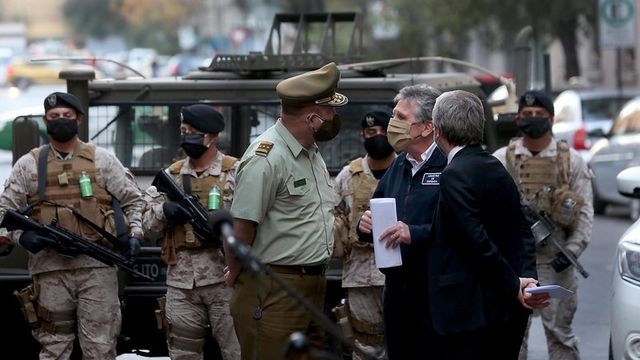
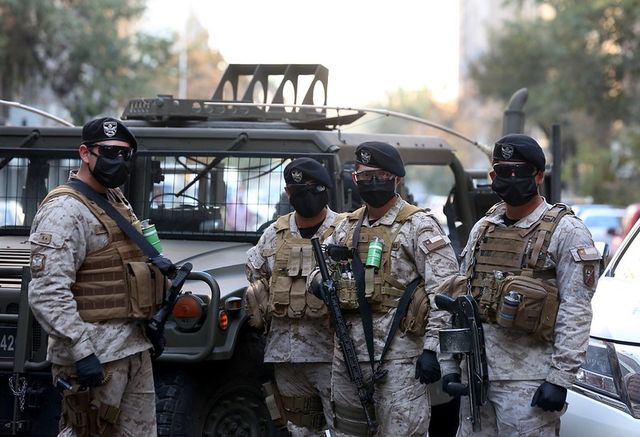
Special forces troops in Santiago’s streets
Today, Santiago’s entire Metropolitan Region of almost seven million is under quarantine, with more than 2,500 new cases being reported daily. The total number of confirmed infections has risen to roughly 40,000, and the number of deaths to close to 400. As elsewhere in Latin America and internationally, the real toll is vastly higher.
With the deadly virus hitting hardest in the most densely populated working class boroughs of Santiago, its spread is a damning indictment of the criminally negligent and reckless policies of the government, further inflaming anger towards the entire political establishment.
As of May 14, 14,000 members of the Armed Forces, the paramilitary Carabineros, the PDI police, along with detachments of the Army’s elite Lautaro Special Operations Brigade, or black berets, Air Force special forces, the Marines, as well as the Carabineros special forces, riot police and tactical units began patrolling the streets of metropolitan Santiago.
More than 74,450 military and police personnel have been dispatched across the country, and the military brass has been placed in charge of the 16 regional zones since Piñera declared a State of Catastrophe in March. To date, these patrols have detained 6,888 for violating curfew, 969 for committing crimes during the curfew and 1,255 for violating the total quarantine. In other words, with COVID-19 as a cover, the military is being used to suppress the working class.
Minister of Defence Alberto Espina, explained that the Metropolitan Region’s 52 mayors—including those from the Chilean Communist Party (PCCh), Chilean Socialist Party (PSCh), Frente Amplio as well as the right—will have officers assigned to them so they can contribute “suggestions and opinions” to improve the patrols of the military, who will be in charge.
Defence Minister Espina with troops in Santiago
“Among the actions that are being carried out is the safeguarding of critical infrastructure that includes more than 22 food and health distribution centres” in the Metropolitan Region that provide resources to the rest of the country, Espina said, adding what can only be characterised as a threat: “collaboration of the citizens is fundamental.
These actions were foreshadowed by a bill passed in the Senate allowing the president to call out the military to protect electricity, communications, transportation, hospitals, supplies etc., without having to declare a State of Exception, which requires congressional approval. The military will also be permitted to “protect” the branches of government or place these political institutions under military supervision.
On May 8, Francisco Chauan senator for the extreme right Renovacion Nacional presented in Congress a bill that will not just criminalise demonstrations, mass strikes and protests, but will allow the police and the military to carry out mass round-ups. They have borrowed this law from the German “Landfriedensbruch,” or “breach of peace” statute. It allows for the mass arrest of individuals present at “violent demonstrations” and carries prison sentences of up to three years.
“Our Chilean Criminal Code lacks a legal figure that would allow for the punishment of those who participate in a violent agglomeration if they are not caught directly committing a crime…” Chauan stated.
A week earlier, on April 28, Defence Minister Espina addressed the House Defence Committee—an 11-member committee that includes Guillermo Tellier (PCCh), and Jaime Toha (PSCh)—urging it to pass a bill giving far-reaching powers to military and police intelligence services. The bill was passed unanimously in January by the 43-member Senate, 16 of whom are from Nueva Mayoria (PSCh, PDC, PPD, PCCh), and one from Frente Amplio.
The danger of this bill cannot be overstated. A revamped intelligence system will be made up of the National Intelligence Agency, which includes the intelligence directorates of the Armed Forces, the Joint Chiefs of Staff, Carabineros, the investigative police, gendarmerie and customs. Internal Revenue Service and the Financial Analysis Unit will be involved in the provision of information.
This vast intelligence gathering operation, ostensibly created to deal with “drug trafficking, corruption, money laundering, child prostitution and paedophilia”, has all the powers that Latin American dictatorships and US imperialism have employed in the past against mass revolutionary struggles, as with Operation Condor in the 1970s and 80s.
The repressive legislation is the response of the bourgeoisie to the mass protests initially triggered by public transport fare hikes in October of last year that developed under the slogan of “it’s not 30 pesos, it’s 30 years” into demonstrations that brought millions into the streets against decades of privatization and transfer of wealth to the top that have led to obscene levels of social inequality.
Chile is undergoing a profound crisis of bourgeois rule. Historically reactionary, weak and venal, the ruling elite rested in the 20th Century on the services of the economic nationalist policies of the anti-Marxist Socialist Party (PSCh) and the Stalinist Communist Party (PCCh). These parties sought subordinate the working class to the capitalist state by sowing illusions in the myth of Chile’s parliamentary democratic tradition, as the bourgeoisie prepared to unleash mass repression in the bloody military coup of September 11, 1973.
Today the institutions of bourgeois rule lack all credibility. Support for the ultra-right government that came to power in 2018 oscillates between 5 and 20 percent. The legislature, however, has single digit approval, while the parties within it—the PCCh, the Greens, the PSCh, Frente Amplio, Christian Democrats, as well as the extreme right—have registered single digit support, according to polls taken at the height of the demonstrations. The judiciary is seen as merely a corrupt bastion of entrenched power.
The Chilean left is attempting to foist a new political trap on the working class with the purpose of channeling mass social unrest back into parliamentarism, while concealing the extremely ominous dictatorial measures being prepared under Piñera. The way forward, they say, is to hold a Constituent Assembly, as though drafting a new charter will change the nature of the capitalist state. Every single so-called left organization is promoting this perspective, not least the misnamed Workers Revolutionary Party (PTR) which is ideologically tied to the late Argentine Pabloite, Nahuel Moreno.
The bourgeoisie and its servants are using the coronavirus pandemic as a means of preparing for the next stage of the class struggle with mass arrests, mass torture and mass disappearances. That is a legacy etched in blood in the annals of capitalist Chile.

One dead and more than 600 Irish meat processing workers infected with coronavirus

Robert Stevens

More than 600 coronavirus infections have been reported at meat processing plants across Ireland. This week, the first worker employed at one of the plants to have died of COVID-19 was named. Lucianna Vivienne day Silva, aged 58, died at her home in Dungannon on May 3. Also known as Anoy Soriano, she was born in east Timor and worked for Irish conglomerate Moy Park.
Substantial numbers employed in the industry are foreign nationals, including many from eastern Europe. In some plants up to 70–90 percent of the workforce are migrants, many sharing the same cramped housing—providing opportunities for the disease to spread.
As of yesterday, there were 23,956 confirmed cases of COVID-19 in Ireland and 1,518 deaths. The country has one of the highest death ratios globally, with 305 per million population. In Northern Ireland, 4,317 people have tested positive, with 469 deaths.
Government figures reveal outbreaks at 12 meat processing plants in the Republic of Ireland, with 571 workers testing positive. According to the Siptu trade union, up to 15 workers in the Republic have been hospitalised by the illness.
What is happening in Ireland is a global phenomenon. US slaughterhouses are hotspots of the pandemic, with more than 6,500 workers in large meatpacking companies already infected. At least 25 meatpacking workers in the US have died of COVID-19. Hundreds of infections have been reported in Germany.
The Irish Republic and Northern Ireland are major centres of the industry. The agri-food sector is worth £12.3 billion and is the main domestic industry, employing more than 170,000 people. Meat products are exported to more than 180 countries. The Republic is Europe’s biggest beef exporter, selling 90 percent of its beef to the UK, France, Italy, Germany and other countries. One of Ireland’s largest firms, Dawn Meats, produces more than 400 million burgers a year for McDonald’s outlets in the UK and Europe.
Much of the industry is centred in the North’s Mid-Ulster region where Moy Park is located. This has one of the highest rates of infection in Northern Ireland.
Moy Park has 12 processing and manufacturing units in Northern Ireland, England, France and the Netherlands. It is one of the UK’s top 15 food companies, the largest private sector business in Northern Ireland and one of Europe’s leading poultry producers. The company supplies around a quarter of the total western European chicken parent market. It processes over 280 million birds per year and produces around 200,000 tons of prepared foods.
In 2017, Moy Park was acquired by the US-based Pilgrim’s Pride Corporation—owned by the JBS food processing giant—for €1.32 billion. Pilgrim’s is one of the largest chicken producers in the world, with over 40,000 employees and operations in the US, Mexico and Puerto Rico. It reported annual revenues of US$11.41 billion in 2019.
How rife coronavirus infections are in the industry can be seen in the number of plants—employing thousands of workers in close proximity—hit by outbreaks:
· Earlier this month 120 confirmed cases were reported at Rosderra’s plant in Roscrea, County Tipperary. According to a Sinn Fein representative, of 350 workers at the plant, up to 140 had to take time off sick. Rosderra is the largest pork processing company in Ireland.
  • This week it was revealed that 60 employees at Rosderra Meats’ Edenderry plant in County Offaly had tested positive for the virus.
  • Dawn Meats was forced to temporarily close its plant in Kilbeggan, Westmeath at the beginning of the month after four workers tested positive for coronavirus.
  • Kepak has 11 manufacturing plants across Ireland, employing 2,800 people and an annual turnover of about €950 million. It had cases confirmed at plants including Ballymahon, Athleague and Watergrasshill. The Watergrasshill plant is in Ireland’s second largest city, Cork, with 650 workers employed. Following what was described as a “mass testing” this week, sources told the local Echo newspaper there were a number of infections.
  • The Unite union said it had knowledge of seven cases of COVID-19 at Linden Foods. The firm employs around 1,100 workers at two sites in Dungannon.
Omagh Meats, owned by the Foyle Food Group Limited, employs 1,400 across the UK and Ireland. The Belfast Telegraph reported this week that the plant was subject to a Health and Safety Executive (HSENI) inspection. It appears that the authorities acted not as the result of the death of Anoy Soriano, but following a “high volume of complaints from concerned workers about Covid-19 prevention policies at Omagh Meats.” The company denied that 40 of its workforce had been laid low by the virus, but would not give a figure.
This week, Independent parliamentarian Denis Naughten said there were clusters of coronavirus infections within populations around processing plants, under conditions “where the levels of infection within the plants themselves is up on one third or, in some instances, half of the workforce.”
Throughout the pandemic, the meat processing conglomerates have only been concerned with shoring up their profits. Employees in the industry are considered “key workers,” but, like health workers and transport workers, have been left to work in deplorable and lethal conditions. The Irish Examiner reported yesterday, “Meat workers … told RTE’s Today Show  that sick workers had returned to factories, including those with temperatures, that no social distancing was practiced on production lines and that no protective equipment, such as masks, were made available until very recently.”
Fianna Fáil opposition leader Micheál Martin told the Dáil Thursday, “The situation with meat plants is gravely serious and it is not obvious that these clusters are being dealt with comprehensively. Without calling for the shutting down of the sector, it seems very surprising that the blanket testing of a facility is followed by no interruption of work until the results are returned.”
In March, workers at several plants protested to demand safe working conditions, including social distancing. Within hours of each other, around 1,000 workers protested at Moy Park’s Portadown facility and 80 employees at ABP Meats in Lurgan. One worker at Moy Park’s Dungannon operation—where Anoy Soriano worked—posted a photo on Twitter showing staff crammed into a crowded canteen. At ABP, the workers demanded social distancing and the deep cleaning of workstations previously used by workers who tested positive for COVID-19. ABP is owned by Larry Goodman, worth an estimated €2.45 billion.
As the pandemic took hold in Ireland, the Health and Safety Executive oversaw recommendations that plants supposedly must adhere to, in discussion with employers, trade unions and the Public Health Agency. Since then, the trade unions, in alliance with the political elite, have played a critical role in policing the working force, allowing unsafe plants to remain in operation.
This week, Siptu deputy general secretary Gerry McCormack commented, “What seems to have happened is that some employers really didn’t take this seriously. Some of them did. Some employers completely ignored the recommendations from the HSE on how to do physical distancing and put in proper processes to protect workers.”
Despite this admission, the union opposes forcing unsafe plants to close, with its latest proposals only the “urgent need for a taskforce involving all meat industry stakeholders to be set up by the Department of Agriculture, Food and the Marine.”
Unite has called for Moy Park’s Dungannon plant to close temporarily to allow the workforce to be tested.
Sinn Féin agriculture spokesman Brian Stanley commented of the horrific situation at Rosderra Irish Meats. “The worst scenario is in the case of the Roscrea [plant] where it’s had an outbreak of Covid. We want to keep the factories open. Weve been very, very clear about this. That factory, there are around 350 workers on the factory floor. There was up to 140 of those out sick throughout last week and 120 tested positive.”
In recognition at workers’ growing anger at the situation, Unite regional official Sean McKeever said this week, “In the face of total and continued inaction by Stormont Ministers on this crisis in the meatpacking sector, workers will have to organise to defend themselves.”
It is necessary for workers to organise themselves, including strikes to force the closure of all plants deemed unsafe. But they must carry out this struggle independently of the trade union bureaucracy.
Workers must establish rank-and-file factory and workplace committees to demand the closure of infected plants, full compensation for laid-off workers, and no return to work until these committees, working in conjunction with health care professionals, are satisfied that all workers have the necessary protective equipment, testing and environment to work safely.

Overwhelming opposition to reopening of UK schools amid worsening COVID-19 pandemic

Tania Kent & Harvey Thompson

Mass opposition is developing among teachers and parents to the Johnson government’s reopening of schools across the UK.
“Our Plan to Rebuild”, the UK government’s COVID-19 recovery strategy, published Monday, includes the phased return of schools starting with reception, year 1 and year 6 pupils (aged 4 to 5 years, 5 to 6 years and 10 to 11 years respectively) from June 1.
The closure of schools—begun belatedly in the UK on March 23—is a key measure recommended by medical experts internationally to reduce the infection and death rate from the coronavirus pandemic.
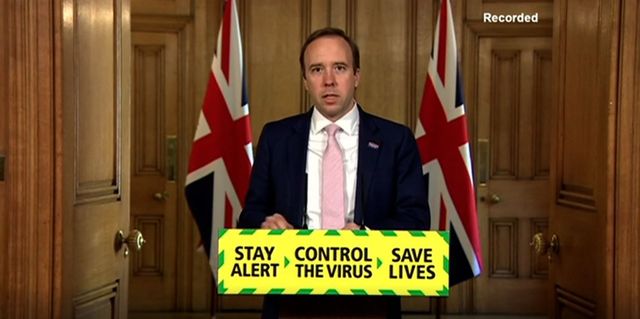
Health Minister Matt Hancock at yesterday’s media briefing
On Friday, Education Minister Gavin Williamson issued a statement in the Daily Mail calling on teachers to return to work “for the sake of all pupils.” Williamson repeated the government’s contested claims that “we are now past the peak of the virus,” claiming the phased reopening of schools was “based on the latest scientific advice.”
But yesterday, the head of the British Medical Association (BMA) Chaand Nagpaul warned, “Until we have got case numbers much lower, we should not consider reopening schools. … We cannot risk a second spike or take actions which would increase the spread of this virus, particularly as we see sustained rates of infection across the UK.”
The World Health Organisation’s top official in Europe, Dr Hans Kluge, warned of the risk of a second and more deadly wave of infection caused by the easing of lockdown restrictions. Kluge told the Telegraph yesterday, “People think lockdown is finished. Nothing has changed. The full disease control package has to be in place. That’s the key message.”
The Johnson government’s reopening of schools is the spearhead of its homicidal plans to restart the economy on behalf of the financial oligarchy. This cannot be achieved without transforming schools into little more than child-minding centres so that parents can be herded back into unsafe workplaces.
Yesterday, teacher unions, including the National Education Union (NEU) and National Association of Schoolmasters Union of Women Teachers (NASUWT) met with the government and leading members of its scientific advisory committee, SAGE—including Sir Chris Whitty, chief medical officer for England, and Sir Patrick Vallance, the government’s chief scientific adviser.
The talks were billed by the government as a means for unions to “reassure” their members that the phased reopening of schools was in line with scientific advice. But none of the questions posed by the unions were answered, including the impact on the reproduction rate of current measures to ease the lockdown and the role of children in spreading the virus.
Leora Cruddas, chief executive of the Confederation of School Trusts, who has declared schools must reopen on June 1, blurted out the real purpose of yesterday’s talks, saying they would be “crucial for building a consensus.”
The union’s response is duplicitous. Science has already established the immense dangers posed by any reopening of schools. Figures released yesterday by SAGE show the reproduction rate for COVID-19 has risen to a national average of 0.7–1.0. Anything above 1 means the virus will begin to grow exponentially. The latest figures are based on data obtained three weeks ago, i.e., before the Johnson government’s easing of lockdown restrictions announced last Sunday.
There is a mass outpouring of opposition to the Johnson government’s reopening of schools:
  • Nine in 10 teachers oppose the prime minister’s plan for primary schools to open from June 1, according to an NEU poll. Approximately 85 percent of respondents said they disagreed with the plans, while 92 percent said they would not feel safe with the proposed wider opening of schools. Of those with school-age children, 89 percent said they felt it would be “unsafe or very unsafe” to send their children back to school in current circumstances.
  • A survey by the GMB union found 96 percent of school support staff are worried that reopening schools too early will put children and their families at risk. Only 0.6 percent of respondents think it’s possible for young school children to socially distance in school. Meanwhile fewer than 12 percent of school support staff are confident adequate coronavirus testing will be available for staff.
  • More than 400,000 teachers have signed a petition by the NEU opposing the reopening of schools in the absence of safety measures including extensive testing, contact tracing and quarantine.
  • A petition started by parent Lucy Browne demanding the right to keep children at home if schools are reopened has received well over half a million signatures, spiking just hours after Johnson’s television broadcast on Sunday evening.
Yesterday’s announcement by Liverpool Mayor Jim Anderson that schools there will not reopen on June 1 reflects the depth of public sentiment. With new Public Health England figures showing the epicentre of infections has shifted from London to the North West of England and Yorkshire, Gateshead Council in Newcastle yesterday urged residents to ignore the Johnson government’s instructions on easing the lockdown and stay at home.
The push to reopen schools has been coupled with a vicious attack on teachers by Tory and Labour politicians and the media who have denounced calls for safety as “scare-mongering.” Thursday’s Daily Mail headline, “Let our teachers be heroes,” caused widespread public anger, with its implication that teachers opposed to ending the lockdown are cowards and traitors.
Yesterday, the BBC promoted the comments of social entrepreneur Steve Chalke from the Oasis Trust, which runs 35 primary schools in England. He described teacher opposition to reopening schools as “rather middle class,” stating, “The greatest risks for many of our children are being stuck in a council block, with no fresh air, no exercise, little or no nutritious food.”
Teachers are more than aware of these issues. They have spent the last decade fighting Tory austerity measures enforced by Labour-run councils which have created a £5.5 billion shortfall in school budgets and near bankruptcy for thousands of schools. More than 4.1 million children live in poverty—nine in every classroom of 30—with 1.6 million families relying on food banks.
On Thursday, the witch-hunt against teachers was joined by former Labour Education Minister David Blunkett who told BBC Radio 4 that teachers were “working against the interests of children.” His comments were welcomed by the Tory education minister.
Scientists have called for the country to more than halve its current daily infection rate before it is safe to open schools. Office for National Statistics data released this week has shown children were as likely to catch coronavirus as adults.
Azeem Majeed, a professor of primary care at Imperial College London said the data suggests that previous studies, based on hospital admissions, may have underestimated the rates of infection in children.
An Imperial College study found that school closures had reduced the death rate by between 2 and 4 percent, but the impact on peak intensive care unit bed demand is much higher—between 12 and 23 percent.
The science is clear but that is not the basis on which decisions are being taken. The safety and lives of teachers, students and their families means a political fight against the dictates of a ruthless financial oligarchy which is determined to reopen schools and force a return to work whatever the cost in human life.
Teachers can place no faith in the education unions, which have enforced decades of attacks under both Labour and Conservative governments. Independent rank-and-file committees must be formed in every school to lead decision-making on health and safety and to ensure that the lives of teachers and their students takes precedence over the drive for profit.