22 May 2020

Nearly 1.5 million health care workers laid off in pandemic-fueled jobs massacre

Gary Joad

Even as American deaths from COVID-19 exceed 90,000 and frontline health care workers are needed more than ever, hospitals and other medical facilities, guided by market forces, are closing or laying off large sections of their workforces.
The US Commerce Department reported at the end of April that health care spending by consumers had dropped by 18 percent during the first quarter of 2020. This is the largest drop since records began in 1959, contributing substantially to the annualized 4.8 percent decline in US gross domestic product. Morgan Stanley forecasts a breathtaking 37.9 percent decline in GDP during the second quarter.
In an interview published May 6 by Health Day News, Dr. David Shulkin, the former secretary of Veteran Affairs and former president and CEO of New York’s Beth Israel Medical Center, said the health care industry lost an estimated $500 billion in revenue during the first three months of the year, with the average hospital losing 40 to 50 percent of their revenues.
The lockdowns imposed in response to the COVID-19 pandemic have taken away some of hospitals’ biggest moneymakers, such as elective surgeries, diagnostic tests and other procedures. According to the Health Day News article, hospitals in Ohio lost $1.3 billion in one month, while hospitals in Virginia lost $600 million.
Rural hospitals, in particular, have been hard hit by the drops in revenue. Prior to the current financial crisis, 172 rural hospitals had closed since 2005, with 12 closures so far this year, according to the North Carolina Rural Health Research Program.
Moreover, patients have increasingly avoided hospital emergency rooms, fearing they could become infected by the virus, despite the dire nature of their illnesses or injuries requiring emergency treatment.
Despite the fact that hospitals have come nowhere near to providing enough personal protective equipment (PPE) to protect their workers, purchasing any additional PPE constitutes an additional financial strain. Due to the bidding wars incited by the White House, hospitals have been forced to spend up to 1,200 percent more for protective materials and ventilators than before the COVID-19 pandemic.
According to Shulkin, the federal stimulus programs passed so far will only cover about 35 percent of the revenues lost by the health care industry in the first three months of the year.
“The rest will need to come from hard decisions that hospitals are going to need to make,” Shulkin told Health Daily News.
The reopening of hospitals for elective surgeries and other procedures will bring in additional revenue, but this is not expected to last long, especially once the second wave of infections hits the US.
“If we see a second wave or resurgence of infections, we’re going to have to go right back to stopping some of those elective activities, and that’s going to hurt hospitals and health providers further,” said Shulkin.
In response, health providers have sought to cut costs, especially through the furloughing or laying off of workers. At least 200 hospitals have furloughed and cut their work forces, with many jobs done away with permanently.
For example, the Mayo Clinic, based in Rochester, Minnesota, announced a $1.4 billion pay cut to its 30,000-person workforce, with fewer hours and furloughs, after experiencing a $3 billion drop in revenue. Health Partners (HP) of Bloomington, Minnesota, which employs some 1,800 physicians in the Twin Cities region, furloughed 20 percent of its staff. Anticipating a loss of $160 million by the end of June, UK HealthCare, a series of hospitals associated with the University of Kentucky, recently placed 1,700 workers on “no-pay status,” allowing employees to exhaust vacation and sick pay before filing for unemployment.
According to the Bureau of Labor Statistics, 43,000 health care workers lost their jobs in March, while 1.4 million more lost their jobs in April. The majority were workers at dental practices, doctors' offices, and other small providers, but there was also a jobs massacre at hospitals overrun with COVID-19 patients.
In Detroit, Beaumont Health is laying off nearly 2,500 hospital workers, while Detroit Medical Center furloughed 480 employees. The Henry Ford Health System announced the furloughing of some 2,800 workers in its six hospitals located across the Detroit metro area.
Integris Health of Oklahoma, which operates 19 hospitals, completely closed a hospital in Oklahoma City, furloughed the employees and suspended contributions to their retirement funds.
The Medical University of South Carolina laid off 900 workers, while asking the remaining staff to accept a 15 to 20 percent cut in pay. Mercy Health of Ohio, citing revenue losses exceeding $100 million in a month, cut 700 jobs, while Essential Health of Minnesota has laid off 500 workers.
According to the Associated Press, two health systems in Virginia reported losses of $600 million in 30 days and furloughed 1,000 workers.
Tricia Newman, a representative from the Kaiser Family Foundation, told the Associated Press that the layoffs “may be in areas where there will be growth in the virus, which makes the layoffs particularly alarming, because hospitals are gearing up or should be gearing up even in places where coronavirus is not an emergency as it is in other parts of the country.”
The layoffs have included many nurse anesthetists, professionals skilled in intubation and ventilator management for the seriously ill COVID-19 victims needing care in an intensive care unit (ICU).
A contract ICU nurse in Oklahoma told ABC News that he was dismissed while he was donning his scrubs in the hospital’s dressing room. “It took me by surprise because we were super busy in the ICU trying to save lives,” he said.
Similarly, Michelle Sweeny, a nurse working for Atrius Health as a case manager in Plymouth, Massachusetts, was given only four hours’ notice that she had been furloughed, giving her a short period of time to notify her chronically ill patients that she would no longer be seeing them.
“It’s very devaluing, like a slap in the face,” she told National Public Radio. “I have never been unemployed my entire life.”
At University of Cincinnati Medical Center, Fae-Marie Donathan, a surgical ICU nurse, expected she would remain working when she was informed of her layoff. She told NPR that she took home about $1,100 every two weeks, but that her last net pay was $46.
In April, the Emergency Nurses Association (ENA) created a relief fund for nurses experiencing hardship from coronavirus layoffs. The assistance, however, is limited to a one-time individual relief grant of $599.
“It’s disheartening to see frontline health care workers being laid off and furloughed,” Dr. Jay Bhatt, a Chicago internist, told ABC News. “I’ve seen my colleagues and friends proud to be health care workers, on the frontlines of unemployment who are anxious about how this will impact themselves and their families.”

US unemployment claims approach 40 million since March

Niles Niemuth

The United States Department of Labor reported on Thursday that more than 2.4 million Americans applied for unemployment insurance last week, bringing the total number of new claims to 38.6 million since mid-March, when social distancing measures and statewide stay-at-home orders were first implemented in an effort to slow the spread of the coronavirus.
Even with the push by the Trump administration since then to reopen the economy and the easing of lockdown orders in all 50 states—despite a continued rise in COVID-19 infections and deaths—the US marked its ninth straight week in which more than 2 million workers filed for unemployment. While this is down from the peak at the end of March when 6.8 million applied for unemployment insurance, it still dwarfs the worst weeks of the Great Recession in 2008.
It is expected that the official unemployment rate for May, which is to be reported by the federal government in the first week of June, will approach 20 percent, up from 14.7 percent last month. This is a significant undercount, with millions of unemployed immigrants unable to apply for benefits, and many other workers who are not currently looking for work and therefore are not counted as unemployed.
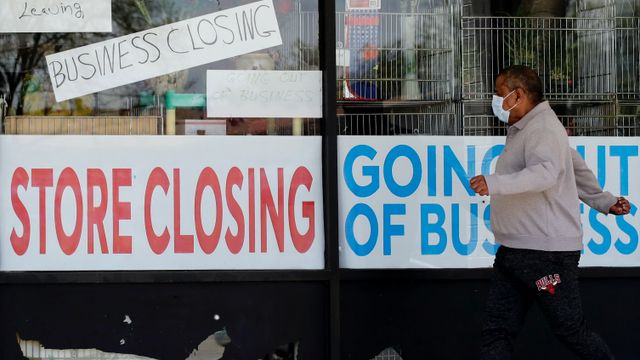
A man looks at signs of a closed store due to COVID-19 in Niles, Ill., Thursday, May 21, 2020. (AP Photo/Nam Y. Huh)
Fortune magazine estimates that real unemployment has already hit 22.5 percent, which is nearing the peak of unemployment reached during the Great Depression in 1933, when the rate rose above 25 percent. Millions more are expected to apply in the coming weeks, pushing the numbers beyond those seen during the country’s worst economic crisis.
But even these figures do not capture the extent of the crisis now unfolding across the country. Millions have been blocked for weeks from applying for unemployment compensation because of antiquated computer systems, and a significant share of those who have applied have been denied any payments. On top of this there are significant delays in processing applications in multiple states, including Indiana, Missouri, Wyoming and Hawaii. Meanwhile, Florida, which has some of the most stringent restrictions, has refused to extend its paltry three-month limit on payments for the few who manage to qualify.
Sparked by the pandemic, the greatest economic crisis since the 1930s is already having a devastating impact on the millions who have seen their jobs suddenly disappear, while millions more will see wages, benefits and hours dramatically curtailed whenever they are able to return to work. Optimistic projections that the US economy would quickly bounce back once stay-at-home orders were lifted are now becoming much gloomier.
A University of Chicago analysis from earlier this month projects that 42 percent of lost jobs will be permanently eliminated. At the current record number, this will mean a destruction of 16.2 million jobs, nearly double the number of jobs which were lost during the Great Recession just over a decade ago.
“I hate to say it, but this is going to take longer and look grimmer than we thought,” Nicholas Bloom, a Stanford University economist and one of the co-authors of the study, told the New York Times.
A survey by the Census Bureau carried out at the end of April and beginning of this month found that 47 percent of adults had lost employment since March 13 or had someone in their household do so, and 39 percent expected that they or someone else in the home would lose their job in the next month. Nearly 11 percent reported that they had not paid their rent or mortgage on time and more than 21 percent had slight or no confidence that they would do so next month.
With millions missing their rent or mortgage payments, tens of thousands of families will be thrown out on the street in the coming weeks and months, leading to a dramatic rise in homelessness even as the coronavirus continues to spread. While many states took steps in March to place a moratorium on evictions, and eviction notices were unable to be filed due to court closures, those measures are now expiring and courts are reopening.
The Oklahoma County Sheriff announced Tuesday via their Twitter page that the department would resume enforcing evictions on May 26. Nearly 300 eviction cases were filed in Oklahoma City between Monday and Tuesday. This process is being repeated in cities and counties across the country. Evictions are also set to resume in Texas next week, where many families were ineligible for aid due to the undocumented status of one or another parent. The CARES Act provision, which blocks evictions from properties with federally subsidized mortgages, expires on July 25; in Texas this only accounts for one-third of homes.
Meanwhile, another wave of layoffs and furloughs is expected by the Congressional Budget Office at the end of June, when the multi-billion-dollar Payment Protection Program (PPP) expires. Sold as a bailout which would help small businesses keep workers on their payroll in the course of necessary shutdowns, the PPP was in fact a boondoggle for large corporations, their subsidiaries and those with connections to the Trump administration. Many small business owners have not seen any aid, and many do not qualify for loan forgiveness.
Amid historic levels of social misery in the working class, times have never been better for those at the heights of society, with America’s billionaires adding $434 billion to their total net worth since state lockdowns began. Financial markets have soared, underwritten by $80 billion per day from the Federal Reserve.
Amazon CEO Jeff Bezos, who is rescinding a $2-an-hour hazard pay increase for his warehouse workers at the end of the month, led the pack, increasing his personal wealth by $34.6 billion since the onset of the pandemic. Facebook CEO Mark Zuckerberg was close behind, adding $25 billion to his fortune. Tesla CEO Elon Musk, who reopened his California auto plant in defiance of state regulators and with the support of President Trump, saw a 48 percent increase in his wealth to $36 billion in just eight weeks as the stock market rebounded from its collapse. All told, the nation’s 620 billionaires now control $3.382 trillion, a 15 percent increase in two months.

21 May 2020

Cora Weiss Fellowship for Young Women Peacebuilders 2020

Application Deadline: 15th July 2020

About the Award: Launched in 2015, the Fellowship aims to support the development of young women peacebuilders and ensure that more young people share Cora’s vision for sustainable peace and gender equality as strong and integral parts of our global culture. The Fellowship provides a young woman with the opportunities and platforms to elevate the concerns and priorities of women and girls in their country in global policy discussions at the United Nations Headquarters in New York City.

Type: Fellowship

Eligibility: To be eligible for the Cora Weiss Fellowship, applicants must meet the following criteria:
  1. Have a robust understanding of UN Security Council Resolution (UNSCR) 1325 on the Women, Peace, and Security Agenda; UNSCR 2250 on the Youth, Peace, and Security Agenda; the Convention on the Elimination of all Forms of Discrimination Against Women; the Sustaining Peace Resolutions; the Sustainable Development Goals; and related laws and policies;
  2. Have at least two years’ work experience in policy advocacy on women’s rights, human rights, peacebuilding, and other social justice issues, including the Security Council Resolutions on Women, Peace and Security, and related laws and policies;
  3. Have at least two years’ experience in program implementation in a women’s rights, human rights, or peacebuilding civil society organization in a developing country;
  4. Have a Bachelor’s degree in international relations, women’s or gender studies, or any of the social sciences;
  5. Have lived or worked in a developing or conflict-affected country for at least five years;
  6. Full proficiency in English. Since the fellowship will take place in New York, complete proficiency in the English language is a must. Proficiency in any other UN language is a plus.
There are no age restrictions for this Fellowship. However, the Fellowship is designed for candidates who are at early stages in their careers and represent the perspectives of youth in their country.

Selection Criteria: Applicants will be evaluated based on the following criteria:
  • Knowledge of UNSCR 1325 on Women, Peace, and Security and its supporting resolutions; UNSCR 2250 on the Youth, Peace, and Security; the Convention on the Elimination of All Forms of Discrimination Against Women; the Sustaining Peace Resolutions; the Sustainable Development Goals; and related laws and policies;
  • Ability to communicate effectively on Women, and Peace and Security and Youth, and Peace and Security issues, both orally and in writing. Very strong speaking and writing skills in English are required.
  • Experience in leading program implementation on women’s rights, peacebuilding, and other social justice issues in a civil society organization in a developing country;
  • Ability to use the skills and networking opportunities gained from this Fellowship in a similar undertaking, such as working with a civil society organization that advocates for women, peace and security, for at least 2 years after completion of the Fellowship;
  • Ability and willingness to relocate to New York City for one year; (Note: Please see below the considerations of the COVID-19 pandemic.)
  • Ability and willingness to travel to conflict-affected countries. (Note: Some of the countries where GNWP implements its work are still experiencing violent conflicts, are still impacted by the aftermath of conflict, or have high incidence of COVID-19). GNWP closely monitors the security and crisis situation in all the countries it works in to ensure that it is safe for its staff, and all its team members and partners to travel. The Cora Weiss Fellow will have to sign a contract agreeing to travel.)
Eligible Countries: Have lived or worked in a developing or conflict-affected country for at least five years

To be Taken at (Country): conflict-affected countries.

Number of Awards: Not specified

Value & Duration of Award: The successful applicant will have the opportunity to work with GNWP for one year in:
– Global advocacy in the UN to promote the implementation of the UN Security Council Resolutions (UNSCR) 1325 on Women and Peace and Security, UNSCR 2250 on Youth and Peace and Security, their supporting resolutions, and related laws and policies;
– Implementation of GNWP’s various programs including but not limited to Localization of UNSCR 1325, national action planning on WPS, and the Young Women Leaders for Peace; 
– Research and development of training and advocacy materials on WPS, YPS and humanitarian action; and
– Administrative support in all areas of GNWP operations.
The Fellowship year will commence in October 2020 and end in October 2021. GNWP will cover roundtrip airfare from the country of origin to New York and health insurance. It will also provide the Fellow with a stipend to cover room and board, local transportation, and other personal expenses for one year.
In light of the impact of the outbreak of novel Coronavirus (COVID-19) and the resulting global health emergency, this Fellowship may begin virtually between October to December 2020. GNWP will support the selected Fellow in purchasing reliable internet connection, access to a laptop, and a cellphone. GNWP Team closely monitors the global situation vis-à-vis the pandemic. The Team will liaise with the selected Fellow to determine the travel date to New York based on global health safety protocols.

How to Apply:
  • Completed application form in English. The application form is available here.
  • A cover letter of no more than 2 pages that explains why you are applying; and how you will use the learning and experience from the Fellowship to support advocacy on women’s rights, gender equality, peace and security in your county.
  • A writing sample of no less than 1,500 words which showcases policy-oriented or academic writing and/or research.   Two letters of reference.
  • Reference letters should include how long the writer has known the applicant and in what capacity, comments on the applicant’s potential to make an impact in the field of women, peace and security, and any relevant prior experience.
Applications may be sent to: fellowship.gnwp@gmail.com.
All required application materials should be complete and submitted together in one e-mail. Documents sent separately will not be reviewed and application will be considered incomplete.

Visit Award Webpage for Details

Lives Depend on Argentina’s Debt Talks

Mark Weisbrot

Argentina is currently engaged in intense negotiations with its creditors over at least $65 billion in government debt. The most important part of that negotiation, which can make or break Argentina’s economic recovery, is foreign currency debt. That is mostly in dollars, and mostly owned by foreigners.
Argentina’s 45 million residents, as well as hundreds of millions of people on this planet, have a large stake in the outcome of these negotiations. With vital foreign exchange earnings plummeting in the world recession, how much will be used for essential imports such as medicine or food, and how much to pay off debt?
If governments are forced to use scarce foreign currency to make unsustainable debt payments, they will not be able to afford the health care, testing, medical equipment, and even “social distancing” measures to contain the coronavirus pandemic. And if the austerity prolongs or deepens economic crises, the problems of dealing with the health crisis worsen.
These are the kinds of dire choices that sovereign debt negotiations could set the precedent for in the coming months.
The World Food Program projects that the number of people who will be on the brink of starvation this year will roughly double, from 135 million to 265 million. In 2020 and 2021, low-and middle-income countries’ payments on their public external debt alone will soar to between $2.6 trillion and $3.4 trillion. Argentina is among the many countries whose current debt burden is unsustainable. Some of the largest creditors rejected the government’s initial offer, but they would be foolish to force Argentina into default. This could happen on May 22 when a grace period for interest payments expires, or earlier if negotiations break down.
To its credit, the International Monetary Fund has recognized this reality since at least February, when it explained why it would not be possible for Argentina to use budget austerity to pay down the debt. A “meaningful contribution from private creditors” would be necessary to restore debt sustainability, the I.M.F. economists stated. In other words, private creditors — who own 41 percent of Argentina’s foreign currency debt — would have to get less than their bonds’ promised payments.
Recognizing the need for the recovery of an economy already in its third year of recession, the I.M.F. conducted a more detailed analysis of Argentina’s debt crisis in late March that proposed no spending cuts for the next four years. They concluded that the Argentine government could not afford to make any debt payments in foreign currency to private creditors from 2020 to 2024.
The I.M.F. analysis of what might be sustainable is thus similar to what the recently elected Argentine government of President Alberto Fernández is proposing.
Of course the I.M.F. has also emphasized that there is enormous uncertainty about the near future and downside risks, since so much of what happens to both the Argentine and the regional and world economy depends on the unpredictable course of the pandemic. Even in the United States, a high-income country whose central bank is currently printing trillions of dollars, the pandemic has led to losses of jobs and gross domestic product at levels not seen for more than 70 years.
The Argentina case clearly shows how important it is for governments to be able to achieve a sustainable debt settlement, and how dangerous it is to try and pay a debt burden that is unsustainable.
In fact, some of these dangers materialized in Argentina before the Covid-19 crisis and world recession struck: an I.M.F. loan agreement with the prior government for a record $57 billion in 2018 required tighter budget and monetary policies. The result was exorbitantly high interest rates, a sharp depreciation of the peso and high inflation as well as increasing foreign indebtedness, and the deep recession that continues to this day.
These kinds of avoidable downward spirals have happened in various countries when previous crises hit, as during the financial crisis and Great Recession between 2008 to 2009, the Asian financial crisis of 1997-1999, or Latin America in the 1980s, a period known as the lost decade. These tragic outcomes could be repeated now if unsustainable debt burdens are backed by deadly austerity. And the immediate threat to human life today is much greater, as the difference between governments taking the necessary steps to contain the coronavirus, and not doing so, is estimated at millions of lives.
Here in the United States, there is at least some attention to the injustices exacerbated by the Covid-19 depression: for example, much higher infection and death rates by race and income.
Yet vast structural inequalities at the international level are exacerbated even more than they are nationally by the pandemic, and international debt and finance are among the main vehicles through which this happens. But Argentina’s debt negotiations can take a better path.
Argentina has put forward a reasonable proposal for restructuring its foreign currency debt with private creditors. Its latest offer postpones debt payments for the next three years. It extends maturities and reduces interest rates going forward from an average of about 7 percent to 2.3 percent. There is a minimal reduction in principal.
Martín Guzmán, the Argentine economy minister, has said that the government is flexible in the combination of these measures, so long as the debt is sustainable.
Creditors should accept the reality that unsustainable debt burdens only lead to worse crises up the road. At this crucial moment in the global pandemic and recession, many lives may depend on this understanding.

How Germany’s Courts Might Destroy the Euro

Marshall Auerback

Germany’s highest court issued a ruling that could threaten the existence of the euro with a constitutional court decision that said the European Central Bank’s bond-buying operations exceeded the ECB’s legal remit, and violated German constitutional law. The U.S. equivalent of this would be a state Supreme Court limiting the ability of the U.S. Federal Reserve to conduct purchases or sales of Treasury securities.
Even more extraordinary, the court decreed that it could “ignore an earlier ruling of the European Court of Justice in favour of the ECB,”which, in the words of Martin Wolf of the Financial Times, is tantamount to “an act of judicial secession.” To extend the U.S. analogy, that would be akin to a state Supreme Court holding that it would not be bound by U.S. Supreme Court precedent.
Still, “judicial secession” might be too strong a characterization. The European Union has been an evolving structure since its inception and does not have an explicitly federal constitutional framework as a backstop that could quickly eradicate any ambiguity and nip the problem in the bud.
Here’s the problem: the euro is the official currency of 19 out of 27 EU member countries, and its users are governed by a federal monetary system roughly analogous to the U.S. Federal Reserve system. On the other hand, the euro and the ECB are parts of an intergovernmental union, not a real federal state. Europhiles have been hoping that the EU would just develop into the latter organically. The German court has just inconveniently reminded everybody what the true state of affairs is. The very absence of a corresponding federal political structure is what constitutes the longstanding Achilles heel of the entire single-currency union. It can’t just be wished into existence, or created via judicial improvisation.
However understandable, this legalistic approach poses considerable risks for Berlin. As the largest creditor nation in the eurozone and its largest economy, Germany has much to lose if it ends up being the party responsible for the breakup of the single-currency union. After all, if the creditor does not respect the rules of the organization (or family) of which it is part and on which it holds claims, why would the debtor be beholden to that arrangement?
A brief comparison of the two systems helps to illuminate the challenges ahead for the eurozone. The U.S. Federal Reserve consists of a network of 12 Federal Reserve Banks and 24 branches that together comprise a system that operates under the general oversight of the Washington-based U.S. Federal Reserve. The U.S. Fed (via its Federal Open Market Committee—FOMC) sets interest rate policy. The New York Federal Reserve branch is then authorized to buy and sell Treasury securities to the extent necessary to carry out the most recent FOMC monetary policy directive. If a New York-based court sought to limit that ability of the New York Fed to conduct bond-buying operations on behalf of the U.S. Federal Reserve, this would be immediately be shot down by the U.S. Supreme Court on the grounds of ultra vires, i.e., the state court would be said to be acting beyond its legal power or authority. These rules are clearly established, governed, and backed by decades of legal precedent and the existence of a clear corresponding federal structure (that is replicated in the courts system). So, of course, this hypothetical would never arise in the U.S. (short of another act of secession).
The eurozone is ostensibly governed by a similar monetary structure: Just as the U.S. Fed uses the New York Fed to conduct purchases/sales of U.S. Treasuries, the ECB uses the various national central banks (e.g., the Bundesbank for German bonds, Banque de France for French paper, etc.) to purchase European government bonds. As the strains on the system have intensified, so has the scope of the ECB’s purchases, along with corresponding questions about the legality of its expanding operations. So, for example, even though the Maastricht Treaty—the international agreement responsible for the creation of the European Union (EU)—contains an explicit “‘no bailout’ clause” on sovereign bond-buying activities, the ECB has elided this particular legal obstacle in the past, suggesting that these purchases did not constitute bailouts as such, but were simply measures to help enhance the ECB’s ability to conduct its legally mandated monetary policies.
Both the European Court of Justice (ECJ) and German court rulings in the past have previously gone along with the ECB’s justifications. But that all appears to have changed in light of the recent German constitutional court decision succinctly summarized in the Financial Times:
“The court in Karlsruhe ordered the German government and parliament to ensure the ECB provided a ‘proportionality assessment’ of its bond-buying to check that its ‘economic and fiscal policy effects’ did not outweigh other policy objectives.
“Finally, it told the Bundesbank, Germany’s central bank, to stop buying bonds and to draw up plans to sell the more than €500bn it has bought if the ECB failed to comply within three months.”
The principle of proportionality in this instance means that the content and form of the actions undertaken by the ECB shall not exceed what is necessary to achieve the objective of the EU treaties. If the ECB fails to satisfy the German court that its actions are consistent with this principle, then further asset purchases (i.e., sovereign bond-buying operations) are impermissible. And existing ECB bond holdings would have to be sold, which would likely create carnage in the European bond markets.
The issue has urgency today, given the backdrop of the COVID-19 virus. In March, the ECB established the €750 billion Pandemic Emergency Purchase Program (PEPP) in response to the mounting economic challenges caused by the pandemic. While it is highly likely that the ECJ will move soon to re-establish its legal primacy against the German court ruling, Ana Bobić and Mark Dawson, two leading Berlin-based legal scholars, have questioned whether the new PEPP in fact meets the legal criteria established in previous court ECJ court rulings, given the absence of any of the ECB’s earlier-imposed constraints on sovereign bond purchases (such as restrictions on future government spending in exchange for the ECB’s help). Given the dire state of economies such as Italy, any legal encumbrance that interferes with the ECB’s bond-buying activities creates the potential for an Italian or Spanish bankruptcy.
Hence, it is highly problematic that the ECB will be undertaking new purchases against a backdrop of maximum legal ambiguity. To sustain its bond-buying operations under the new program, it will need to secure the cooperation of the Bundesbank. But Germany’s own central bank will be faced with two competing claims, given that the nation’s leading constitutional court specifically mandated that the Bundesbank could not continue to participate in the ECB’s asset purchase programs, until the ECB complied with the requested “proportionality assessment” of the program. Against that, as Wolf notes, the Maastricht Treaty “states that ‘neither the ECB, nor a national central bank… shall seek or take instructions… from any government of a member state or from any other body.’”
Imagine the next time the ECB initiates bond purchases under the PEPP, and the German Bundesbank hypothetically refuses to undertake these purchases on the ECB’s behalf, citing its national constitutional court ruling. What happens then?
The ECB could well initiate the program without the cooperation of the Bundesbank, but the lack of cooperation of the latter would be tantamount to initiating divorce proceedings with the rest of the eurozone. You would have a monetary free-for-all. And with no “United States of Europe” Treasury standing behind the ECB, Germany, as the largest creditor nation, would presumably be saddled with a substantial amount of the liabilities of the eurozone debtor countries. The latter (Italy, Spain, Portugal, Greece) would be on very solid grounds to refuse repayment if the violator of the European Monetary Union is Germany itself. So in that sense, an Italian bankruptcy largely creates problems for Berlin, not Rome. One could argue that the German court decision actually gives the debtor nations a “get out of jail free” card.
It is probably unlikely to come to that. If nothing else, the European Union overall has proven itself remarkably adept at kicking the can down the road and resolving difficulties only at the last possible moment. One possible solution is something that I have suggested before, namely “annual distributions of funds to the national governments (credited to their accounts at the national central banks) on a per capita basis… [, which would] give the national governments the fiscal latitude to cope with the pandemic and engender long-term economic recovery.” As the funds would be distributed on a per capita basis, the courts might deem the actions consistent with the proportionality principle, especially if Bundesbank officials were to sign off on such a program.
In any case, these kinds of legal challenges aren’t going away any time soon. Each legal clarification is clearly designed to define the limits of the ECB’s actions, and provide less scope for the kind of ambiguities that have enabled the member states to defer difficult long-term decisions that will truly make or break the union. Germany, in particular, has persistently castigated other nations who have been serial violators of the EU rule book. But much like Shakespeare’s Shylock, who literally insisted on his “pound of flesh” as security for his loan to Antonio, Germany’s rigorous legalism could ultimately backfire if and when the tables are turned.
Longtime economic powerhouses like New York and California understand the value of being part of a larger political union and have willingly subsidized the rest of the U.S. for decades, even patriotically. Will Germany again overreach and squander its historic position of influence in the EU? Or will it accept some form of fiscal transfer union that ultimately consolidates its position and saves the euro, but likely puts Germany in a position of a perpetual net contributor to a broader, but more sustainable European Union? It has its recent domestic parallel to consider, when it absorbed and developed Eastern Germany after the Cold War. It all depends on what Germany ultimately imagines its role in the region to be, builder or breaker.

Slavery cannot be the Solution for Economic Development

Shahid Akhter

SARs Cov-2, the virus that has caused the lockdown of 1.3 billion human beings in India has also caused an unprecedented humanitarian crisis across the country. The International Labour Organization estimated in April that around 400 million workers were at risk of slipping into poverty due to sudden and unplanned stringent nationwide lockdown. However, a lockdown of such magnitude has caused ravage the millions of labours’ life at an unimaginable level. With that, it has also unfolded the bitter truth of the miserable plight and incompetency of the Central government in terms of administrating the whole situation.
The images of horror and inhumane sufferings of the migrant workers in the world’s 11th largest economy is the shameful and disgraceful blow to our civilized society. Their desperate attempt to return home made them walking down hundreds of miles away (with bags perched on their heads and children in their arms) on the stony railway track and streets in the hot sunlight. Not a single major mitigation measure is being taken by the Central government for them who have been serving this country with their sweat and blood for years and years, and today they are left with no work, no food, and no shelter or no transportation for an uncertain period. The lockdown has also proved that how hollow and merciless our cities are. How selfish and self-centered we the human being are. Today, we have crossed all the boundaries of inhumanity. Every mourn of a child, women and a desolate one walking on the streets with an empty stomach is nothing but murder to the morality of humankind.
In such a gruesome situation, the privileged among us are engaged in criticizing the migrant workers rather than questioning on the negligence and cruel nature of the Central government in terms of protecting the lives of migrant workers from death, hunger, and starvation.
Most importantly, it did not end there, amidst the persistent misery of migrant workers into the third spell of the nationwide lockdown, the accordance of approving ordinance by Uttar Pradesh, Madhya Pradesh, Gujarat and now Karnataka government for suspending all labour laws barring three for next three years remain an utter apathy that bordering on contempt. It is just a step of dehumanizing the poor. At the time when the migrants are fighting a tough battle of life and death, the government at the Centre has taken the strategy of letting its pliant state governments use this pandemic crisis as a shield for secluding labours from their rights of living a secured and dignified life by implementing such anti-people and anti-worker autocratic measures. Naturally, the burning question is: how could the erosion of labour rights be possible without parliamentary debate? And, is the Supreme Court in a position to uphold the government action as an unlawful invasion of civilian rights? Is this ordinance not against the eight essential core standards of the International Labour Organization which are mostly ensured liberty to the migrant workers to choose employment while recovering after any disaster?
Regardless of that, the dilution of labour laws is a gross violation of the fundamentals rights and the Directive principle of State Policy of the labour provided by the Indian constitution. The fundamental rights of the workers such as article 14, article 19, article 21, and article 23 are going to be violated. Similarly, the Directive Principles of State Policy that uphold certain specific rights under Part IV of the Constitution such as article 39 (a), article (39-A), article 41, article 42, and Article 43 are under endangered. Further, this move will not only violate the various Home Ministry directives and State ordinances in India’s own Constitution but also its international commitment.
Thus, the exemption of labour laws to stimulus economic and industrial development is just an attempt made to extremize the exploitation of daily wage workers. And, it will drive Indian companies to avoid hiring permanent employees and will create an open platform to enslave the labours. The heartless capitalists who refused to pay wages for March, not even paid for the days the labours had worked, are now seeking advantage of sucking remaining blood through diminishing their basic human rights.
Apparently, the government along with industry leaders acutely denied giving respect and dignity the labours deserve as fellow humans. And, they are always being treated as a resource to be fulfilled the endless desire of money-launderers and greedy politicians. In addition to that, many state governments on the request of the ruthless businessman have extended daily working hours from 8 to 12 without amending the Factories Act in a view to revitalize businesses and the economy from the impact of COVID-19.
Meanwhile, various organizations such as All-India Trade Union Congress, the All-India United Trade Union Centre, Bharatiya Mazdoor Sangh, etc. have raised concerns over the extension of working hours. Central trade unions in India said that it is an inhumane crime and violation of the Right to Freedom of Association (ILO Convention 87) and Right to Collective Bargaining (ILO Convention 98). But at the outset, it is not what organizations said about the stretching working hours, but as a human’s conscience, we need to make it understand that the workers are also human beings and they too have a life and family. On top of that, India is geographically located in Torrid Zone (23.5° north and 23.5° south of the equator) which is essentially representing a very hot and humid climate causing an unfavorable working condition. In these circumstances, 12 hours working will drive them into a state of ill health, fatigue, and exhaustion.
However, in this scenario when the country is an unprecedented state of emergency, the Central Government along with the State Government must release an adequate relief package on an urgent basis to prevent further deaths and inhumane-suffering of millions of migrant workers. Indeed, the Prime Minister has miserably failed to anticipate the severe consequences of sudden and unplanned nationwide lockdown. Further, it is also a fact that he has not taken any comprehensive mitigation measures for workers and left them in hostage. Some initiatives which have been taken are also facing challenges in implementing at the ground levels. It is also evident that there is a huge mismatch between the Centre and the State Governments in terms of administrating the situation. Thus, it is the utmost importance to establish a strong coordination and governance system at multi-stage levels to deal with this pandemic crisis escalated across the country.
Besides these, the exemption and dilution of labour laws cannot be the remedy to revitalize the industry and economy of the country. It is absolutely a violation and breakdown of fundamental rights of the labours ensured by the constitution. Again, the pandemic crisis cannot be used as an excuse to dehumanize and enslave the labours. The migrant labours are the most important element of our society and hence without their safety and well-being, the country cannot be glorified.

“Battle” Against COVID-19 In A Fragmented World, Has Ruined Billions Of Lives

Andre Vltchek

It is not only about physically surviving the pandemic. People miss people, and places, sometimes desperately. And they die, when separated.
We are bombarded by briefings and numbers. We are scared into submission by horrifying medical stories, by shocking images, and then, simultaneously, by predictions of economic and social downfall. Day and night, day and night.
But somehow, so often during this so-called coronavirus emergency, we tend to forget that people are people, not numbers, and that bare survival is far from everything.
*
For decades we were told: “You are living in a globalized world. Borders have become redundant”. Some reluctantly, others happily, accepted.
Rich Westerners invaded all corners of the world with their yachts, villas and third and fourth homes.
Poor Philippine and Indonesian maids and hotel employees have migrated to the Gulf, in search of decently paid jobs.
Interracial, intercontinental marriages and relationships became the norm.
By the end of 2019, hundreds of millions were living in several parts of the world, simultaneously. For different reasons, both rich and poor individuals. For some it became a lifestyle, for others bare necessity.
For better or worse, cultures were increasingly becoming intertwined. To many, the color of skin was increasingly irrelevant. At least to those few hundreds of millions, who have been living on this planet Earth, not just in Asia or Europe, Oceania, the Middle East, South or North America.
I have written a lot about this trend. Some of it was clearly positive, while I have been criticizing, decisively, many elements.
But it was the reality, and as many of us believed, an irreversible, permanent one.
Human beings were breaking up the chains of their past. Suddenly, they felt free to step out of their traditional cultures, religions, habits. They formed relations with human beings coming from other parts of the world. They were marrying people with thoroughly different cultures and backgrounds. They were moving to far away places. And not only young people. Often their parents, seduced by wanderlust, were deciding to retire thousands of miles away.
Men and women were doing research, in deep rainforests, some of them deciding to stay there, forever. Others were ruining these forests, becoming rich on shameless plunder.
So many stories, good and bad. So many reasons, wonderful and horrible, of globalized or internationalized life.
Then suddenly, the end. Full stop!
COVID-19, or call it novel coronavirus, has arrived.
It came from nowhere, its mortality rate low, that of the common flu, but remarkably contagious.
Abruptly, our world stopped.
Almost all proverbial liberties have been taken away from the people. So fast, and without plebiscites, referendums, debates. Police, drones, surveillance, have rapidly been employed against the citizens, virtually everywhere.
And then, almost from the start of the pandemic, the borders began closing down. Borders, which we used to be told, were there to stay open, forever.
And the international, or for some of us internationalist life, was suddenly arrested.
The changes were implemented so rapidly, that most of us had no time to react. We watched, helplessly, as frontiers were closed, airlines cancelled flights, and the movement of people came to an abrupt stop.
Across the border lines, disappearing beyond the horizon, were our families, or loved ones, our colleagues and comrades, as well as countries and cities for which we longed for.
*
There was nothing much we could do, because this brutal global lockdown was performed “for our own good”. We found ourselves sheltered in prison, ‘so we, and others, could survive’. Or that’s what we were told.
We have not been allowed to take risks, nor to dare. Our loved ones have not been allowed to dare, either.
We have all become soft, and so easy to manipulate.  All that talk about freedom and democracy has quickly been forgotten.
In just one or two months, our planet has become fragmented, as never before. Borders have been closed, even between the countries of Europe, Asia, Latin America, Africa, the Middle East.
Europeans, for instance, who were forced into great sacrifices in exchange for a borderless continent, were suddenly stuck with those existing sacrifices, but also with the re-erected frontiers.
With shocking speed, all the gains made by humanity – gains towards an open world – were annulled, liquidated.
I have to repeat: people were not asked. Nobody consulted them.
While several airlines began receiving billions of dollars in government subsidies, there has been no compensation for those hundreds of millions of people whose lives have been virtually ruined, reduced to near nothing by the travel bans, which have amounted to imprisoning multitudes in their current locations.
*
Right now, almost the entire South America is “out of reach”, and so is Asia. Foreigners cannot enter the United States. Actually, most of the countries have turned themselves into fortresses.
Imagine that you have relatives living in a different part of the world. Imagine that your spouse is there, somewhere, or your house, or important work which you love, passionately. Imagine that some neoliberal government is using COVID-19 lockdown to cover up the speeding-up of the destruction of its rainforests, as is happening right now in places such as Brazil and Indonesia. Imagine that such governments are dispossessing indigenous people, and you cannot continue your work, which is to expose crimes against humanity and nature.
Millions of people depend on your investigative work, but you cannot go. The borders are closed, planes are not flying. “It is all for your own good”. “It is all for the sake others”.
You may want to ask: “What about the good of those millions who are being robbed, impoverished, even killed by events unrelated, or just partially-related to the COVID-19? Do they have the right to live? Do they have the right to be protected, defended?”
But, not many are asking those questions! And if they do, the mass media is not paying attention.
The novel coronavirus, it appears, is now all that matters, at least to some, or to the majority. Or to the regime.
It is like those proverbial hospitals, which are letting people die from cancer and strokes, because their emergency rooms and beds are being used exclusively to treat COVID-19 patients.
There is something essentially and morally wrong with this approach. Something deeply wrong, philosophically and logically, too.
*
Do governments in, say, Europe, have the right to tell a husband whose wife is dying in Japan or Korea, that he cannot jump on a plane and go, in order to be with her?
Can a scientist be prevented from flying to a lab, on the other side of the world, if he or she is working on some urgent project that could improve life on our planet?
Can I be prevented from flying to Venezuela, where U.S. and Colombian mercenaries have just attempted yet another coup against a legitimate government?
Apparently, the answer is “Yes!”
It is the “new normal” yes.
Four or five months ago, it would all have been considered insane, unacceptable, even criminal.
But now, a flu pandemic, has suddenly created a new ‘morality’, as well as thoroughly new rules and norms for humanity.
And we do not have to look for important missions, or life and death situations, only.
There are hundreds of millions, perhaps billions of people, who are simply living on this beautiful planet of ours, not in just one particular country, and who cannot exist in any other way. Their culture is multiculturalism. I do not say that it is good or bad. It is simply a fact. Their health, even medical supplies, depend on this ‘lifestyle’, as well as their emotional well-being, and their work.
Without being able to travel, their personal relationships are falling apart, their houses and apartments are literally collapsing, and their life is losing its meaning.
Is anyone compiling statistics on how many human lives are being affected, or even ruined in this manner? The number is definitely staggering.
*
Caution, of course! Caution is essential. The coronavirus should not be taken lightly. But not the extreme approaches, which could, for decades to come, set back those countless positive gains that have been made by our civilization.
To travel, to explore; getting to know “the Other”, trying to understand, to live with each other as one humanity: this is one of the great advances made by humankind. Imperfect, sometimes hypocritical or half-hearted, but a great advance, nevertheless. Not globalization, but internationalism, when things are at their best.
We thought that we could take these advances for granted. We strongly believed that they couldn’t be removed from us.
We fought for the others, for the people of all nationalities and races, to be able to enjoy them, soon, too. We thought that we could win.
And now, all of a sudden, we have realized that everything was just a mirage.
One strike of a pen by some government official, and all our liberties can disappear, get cancelled. We get pushed into the corner, as if we were cattle, or kindergarten children.
True rights are only those rights that can never, under any circumstances, be taken away from us.
*
The most frightening is the absolutism, extremism with which the regulations have been introduced.
A state of siege, perhaps, but not outright incarceration.
Travel could have been made difficult, but still possible.
I will say it as an anecdote, but there is some truth in it: I have a combat gas mask, which I use when covering riots, uprisings and revolutions. It has a huge filter. There is no way that if I was wearing it, I could get infected, or infect other people on an airplane. If that is not enough, I would be willing to wear some plastic disposable suit, all the way from, say, South America to Asia, with transit points in Europe. It would be an extremely uncomfortable, but safe (for me and everybody) way of travel. And when in Asia, say Japan, I’d be happy to undergo a 14-day self-quarantine. And even pay some reasonable fee, for ‘causing bother’.
But if I really need to go, if it is a matter of life and death for me, there should be some draconic option for me and for millions like me.
But there isn’t! The borders of the entire Asia and of South America are closed, hermetically. Even the borders of the United States are sealed, despite the fact that it has the highest rate of infected people. Only citizens and green card holders can board the inbound planes.
And so, human lives continue being ruined, on a just recently unimaginable scale.
Nothing, absolutely nothing can be done, it appears. All of us are at the mercy of our regimes.
We had no idea, but now we know.
Even when these restrictions are lifted, nothing will ever be “normal”. People will be well aware of the fact that their lives can be shattered again, on any pretext, at any time.
*
If a cure, or prevention, are ten times, or even hundred times deadlier than the disease, then it is immoral to be applying them.
Also, it is essential to remember, that there are many different ways in which human beings can die. Some people could easily perish even if their lungs are intact, and hearts are beating. They could die from sorrow, from the absence of loved ones, or from the meaninglessness of life in confinement.
Today’s struggle, and combat should not be exclusively against COVID-19. The battle should be simply for life, for each and every human life, no matter what viruses, conditions or circumstances are endangering it.

Why are Pandemics Anti-Urban?

Madhura Sawant

The novel corona virus has infected more than 100,000 people in India. WHO has declared the virus to be pandemic. But pandemics have always been anti-urban. Coronavirus undermines the most basic notions of the urban life that is the idea of ‘public’. It undermines the idea of shared spaces- one shouldn’t be coming out in large numbers. One shouldn’t be accessing common spaces. There is a restriction on any form of social gathering.
Social distancing is definitely important and it will flatten the curve of coronavirus. But having said that we also need to discuss the social cost and pain of social distancing. National crisis often leads to depoliticization of politics and very few are willing to discuss the complexities of acts like social distancing.
The basic idea of social distancing is to avoid public spaces. But, one of the significant aspects of the urban life are its public spaces. Sociologists understand public spaces in the urban as a physical void that lets different histories and social processes unfold within their realms.  Public spaces are socially constructed. They aren’t passive or given, people actively create public spaces just as spaces create them. Different people consume these spaces differently based on the individual male, female, old, young, privileged, able-bodied etc. Thus, the idea of a public space in the urban has been rooted in our everyday experiences.
According to Sharon Zukin, New York based Urban Sociologist, public spaces are often carefully designed and constructed as it forms an important component of a city’s symbolic economy. Gardens, parks, maidans, public toilets, bus stands, railway platforms, malls, cafes, restaurants, cinema hall etc are the common public places in a city. Architect Michael Kimmelman in New York times says “social distancing, not only runs up against our fundamental desire to interact, but also against the way we have built our cities”. For instance-, you need to access the public transport to get to your work, you spend your leisurely time in parks and garden, you need to access the vegetable market to buy every day groceries. He further rightly asserts “for many urban systems to work properly, density is the goal, not the enemy”.
Many people assert that public spaces will be replaced by digitized spaces.  We have already started witnessing how technology and the digital interactions it provides are changing our basic notion of a space. According to Manuel Castells, Information technology has begun delinking the realm of human activity. Globally people seem on the verge of creating digitized public spaces. But If cities are built on the idea of shared spaces, which upholds the fundamental desire of community living, can then digitized public spaces be able to replace this? And if yes, to what extent? Similarly, spatial manifestations have taken place around certain cultural performances, experiences, histories etc, can digitized spaces capture these manifestations? Or will the digitized public spaces perpetuate a practice of ahistorical and acultural manifestation of spaces?
Informal settlements are very important aspect of the urban spaces. In the informal settlements a digitized public space remains a distant dream. Around 412 million people in India live in the slums in urban areas. The community outbreak of the coronavirus has begun in highly and densely populated cities in the country. With poor living conditions and a hand to mouth living, for a large section of the urban society social distancing and self-quarantine remains nothing but a myth.
Daily wage laborer, homeless people, and many such social groups can’t afford to lock down themselves. Also, where would they lock down themselves? on the streets? on the platforms? can they even claim a legit private space to lock down themselves? For millions in India the public spaces in cities have always been their homes.
In India the COVID-19 crisis may soon reach its maximum threshold. But the stark inequalities like the differential access to resources like healthcare have already started to become visible. The idea of social distancing seems to be working in the cities of countries like America and China but in the cities of countries like India it seems like a privilege, a luxury which only a few can afford.