P J James
Introduction
COVID-19 pandemic, its emergence, global spread and the crisis therefrom are inseparably linked up with the character of neoliberal accumulation today. As is widely recognised, its origins are rooted in profit-driven corporate capital’s unbridled plunder of nature and consequent invasion and intrusion in to wild life ecosystem leading to spill-over of viruses to humans and their subsequent mutations. That is, most of the zoonotic viruses and consequent highly infectious diseases coming up one by one during the neoliberal period are rooted in increasing disruptions in ecosystem and biodiversity. The entire health care system under capitalist-imperialist system being driven by profit motive, this pandemic has given rise not only to a health crisis but also to an unprecedented economic collapse given the globalised character of world today. Many concerned and well-meaning scholars, political scientists and economists the world over envisage the outcome of COVID-19 pandemic as more deadly and destructive than that of all previous crises including even world wars. In particular, while the world is celebrating the 75th year of the end of Second World War, COVID-19, with both US and UK under its highest death tolls, has exposed the political-economic and social bankruptcy of the Anglo-American led capitalist-imperialist system of more than two centuries. Many observations and hypotheses on this aspect based on the emerging trends are pouring in from various quarters.
Coming specifically to the political-economic situation, with GDP growth rates in US and Europe being in the negative territory and everything including production, trade and commerce, travel and tourism, etc. coming to a halt, world economy has entered in to a frozen state that is more dreadful than the Great Depression of 1930s prompting analysts to characterise the situation as an “Ice Age”. From a political economy perspective, COVID-19 has totally disrupted the foundations of globalised production, both its supply and demand chains. Initial estimates by Bretton Woods Institutions made in April indicate a contraction in global GDP by around $ 9 trillion (equal to the combined GDP of Germany and Japan) during 2020. However, according to latest IMF forecast, while the GDP of China, which could bring the pandemic under control and resume economic activities earlier, is set to grow by 1.2 percent, world GDP will be minus at around -6.0 percent with France, Germany, UK, US and Japan witnessing negative growth rates of -7.2, -7.0, -6.5, -5.9 and -5.2 respectively. On May 6 at Brussels, Paulo Gentiloni, EU Economic Affairs Commissioner has drawn a more damaging picture of the Eurozone economy with the growth rate reaching – 7.7 percent in 2020. According to more recent estimates, the GDP of Germany, Europe’s biggest economy, is expected to shrink by 6.3 percent in 2020 – the biggest contraction since 1949. And the case of the neocolonially dependent Afro-Asian-Latin American countries inhabited by world’s poorest, the situation is gruesome. An analysis in the third week of May by Goldman Sachs predicts a historic shrink of the Indian economy by 45 percent in the second quarter of 2020 and a 5 percent decline of its GDP during the financial year 2020-21, whereas India’s Reserve Bank puts the country’s growth rate in the negative territory in the current financial year.
The consequences of this economic pandemic including unemployment, poverty, deprivation, etc. among other things are turning out to be unimaginable and unmanageable within the imperialist system. According to ILO predictions, global unemployment will be 1500 million this year while the number of absolute poor who lack even the minimum income to have a meal is going to reach the staggering figure of 1000 million, 40 percent of them being Indians. It also envisages a dreadful situation of $3.4 trillion drop in working class incomes across the world. Interpreting the pandemic as a “child rights crisis”, UNICEF has warned that an additional 6000 children could die daily from preventable causes over the next six months (1.2 million deaths in 6 months) as COVID-19 weakens global health systems. On the other hand, global inequality today is the highest with 8 superrich corporate billionaires led by Bill Gates (Microsoft), Mark Zuckerberg (Facebook) and Jeff Bezos (Amazon) gobbling up as much wealth as that of the bottom 50 percent of world’s population. In the same vein, highlighting the destructive levels of inequality prevailing today, Oxfam Report (2020) estimates the total wealth of world’s 2153 billionaires as equal to 60 percent of the world people at the bottom. And neoliberal-corporatisation policies that continue unabated even during the pandemic are constantly channeling more wealth in to corporate coffers.
In this context, though concrete studies are yet to come, many trends in global political economy and international relations which were evident on the eve of the pandemic have become more pronounced and well-defined now. Obviously, while World War II ravaged the entire world including the economies of all other imperialist powers including Britain, it did provide an excellent opportunity for US imperialism whose war-damages were minimum to gain maximum out of the war. For, during World War II, the entire US economy had geared toward the most concentrated application of science and technology for war-oriented production ranging from agricultural and industrial products to weapons of mass destruction. As a result, together with the confluence of many other factors, when the war that wiped out 75 million people from earth came to a close, US accounted for almost half the GDP of the capitalist world together with three quarters of the total global gold reserves. It finally enabled US financial oligarchy and its think-tanks to devise the political-economic and military blueprint required for transforming US as the supreme arbiter of postwar neo-colonialism replacing Pax-Britannica with Pax-Americana.
Now the pandemic has become a historic turning point that exposed the bankruptcy of this pre-eminent role of US imperialism both in terms of the highest number of casualties and on account of its abject inability to take leadership role in a critical situation that brought the whole world to a standstill. It also laid bare the unbridgeable gap between the agenda of a tiny ruling elite leading neoliberal-corporatisation on the one hand and the interests of the working and oppressed majority of the world over on the other. At the same time, in view of the weakening of US, the situation is also witnessing a reduction in the power gap between the US and China, the latter so far exporting medical ‘aid’ to more than 80 Covid-battered countries including the US. However, in the absence of a well-defined global power leadership, the emerging post-pandemic situation points to a bipolar imperialist configuration led by China and US in the immediate future and towards a further weakening of the latter thereafter, a trend which is fully in conformity with the twenty-first century trends associated with the laws of motion of finance capital.
The Collapse of the ‘American Dream’
By the 1870s, the US had transformed as world’s leading economic power through the concentration and centralisation of production and growth of finance capital though Britain was still holding its “empire upon which the sun never set”. The formation of US Steel Corporation and Standard Oil as world’s first billion-dollar companies led respectively by Morgan and Rockefeller catapulted the US as the world leader in finance and manufacturing by the turn of the 20th century. Along with its industrial and financial superiority, surpassing Britain by this time, the US also became number one in world trade, capital export and as world’s creditor together with the concomitant political and military dimensions. As the most powerful capital exporting imperialist power and as world’s major creditor, dollar also became a major reserve currency along with pound sterling and WW II saw only its logical culmination when the former completely replaced the latter’s role as international vehicle currency and as one of the main instruments of US neo-colonial hegemony for seven-and-a-half decades. Now this position is being challenged, a process that started much before the pandemic.
On the eve of COVID-19 itself, i.e., by the end of 2019, based on Purchasing Power Parity (PPP), China with a GDP of $27.3 trillion had surpassed the US having a GDP of $21.44 trillion. While China’s trade volume was estimated at $4.43 trillion, that of US was $3.89 trillion, around 80 percent of the former. In 2000, 80 percent of the countries of the world was trading with US; today it is only 30 percent while China today has 60 percent of the countries of the world as trading partners. By the first quarter of 2020, the RCEP (Regional Comprehensive Economic Partnership — composed of 10 ASEAN countries plus China, Japan, Australia, New Zealand and South Korea) and Russia had become China’s largest trading partners comprising around 50 percent of its global trade. Of course, China’s capitalist transformation as cheap labour-based “workshop of the world” and its comparative advantage in global trade over the US following its integration with global market as world’s biggest exporter are all much-discussed topics. The recent US threat of cutting off Chinese supply chains including the reported move to shut out Huawei’s 5G out of US seems to be rhetorical only. For, the supply chains of almost 80 percent of US industries at present have direct or indirect links with China. In the sphere of medical supplies, the US dependence on China is even up to 90 percent, an aspect well-exposed in the context of COIVID-19.
In the sphere of capital export too, China with its specific neo-colonial interests has overtaken the US as is evident from the One Belt One Road (OBOR) initiative which in terms of its size and extent is larger than the erstwhile Marshall Plan (or European Recovery Program) of the US that acted as the driving force for postwar reconstruction of war-torn Europe. Envisaging a capital export worth $1 trillion that lasts till 2049 and spanning Asia, Europe, Africa and even Latin America, the OBOR aims at infrastructure build-up such as roads, ports, airports and so on in host countries along with the usual neo-colonial controls underlying such deals. At a time when Trump and his think-tanks were characterising the pandemic as “Chinese virus” and “Kung Flu”, Chinese export of 31 tons of much-needed medical equipment including ventilators, masks and protective units when Italy was at the zenith of the pandemic had been of immense help to it which was effectively reciprocated by Italy by signing the OBOR initiative characterising the same as a “train that Italy cannot afford to miss.”
A number of regional economic arrangements and trade agreements led by the US are either crumbling or weakening in the background of the relative decline of it in international affairs. In the context of the pandemic, several international groupings like G7 and G20 supposedly led by US are also in disarray. The collapse of the Tans-Pacific Partnership (TPP) is just another example. Even the US-led NATO is losing its cohesion and EU is planning its own independent European military arrangement. On the other hand, China after joining WTO by the turn of the 21st century is ingeniously working on many regional and international arrangements led by it or is coming to the leadership of many using its emerging political-economic clout. In fact WTO provisions also favour regional trade agreements as a “gateway” to internationalisation of capital and market. In this context, a best example is that of RCEP, one of history’s biggest Free Trade Agreements (FTAs) that came into being towards the close of 2019. Now, as the leading imperialist power in the grouping, China is in a position to dump its cheap products in RCEP that encompasses one-third of global GDP. Though at a different level, Chinese imperialist interest is predominant in Shanghai Cooperation Organisation (SCO), BRICS, etc. while the Asian Infrastructure Investment Bank (AIIB) led by it is a powerful entity several times bigger than ADB, the Asian economic arm of US. Chinese imperialism has even started emulating Rockefeller-Ford philanthropies as is evident from the prompt provision of a medical aid comprising 500000 test kits and 1000000 masks to Africa by the Alibaba-funded Chinese Charity.
Of particular relevance, however, is with regard to the collapse of the “oil empire” so assiduously built up by US imperialism since the turn of the 20th century. More than a century of US history comprising West Asian geopolitics led by it is interwoven with the specific role of oil right from the days of Rockefeller’s Standard Oil, erstwhile biggest international monopoly, as already mentioned. American finance capital from the very beginning has been maintaining its profit rates high by indulging in oil speculation. No doubt, the formation of OPEC in 1973 and the sudden four-fold increase in the price of oil at the zenith of the Cold War was a temporary setback for US imperialism. However, within a short time, the US succeeded in manipulating the dependent West Asian countries of OPEC by persuading them to hold their earnings in US banks in the form of “petrodollars”. This enabled US not only to revive dollar from the stagflation of the 1970s but also to boost the profits of US military-industrial complex on the other.
Obviously, this situation is altering at an alarming speed now. The days of “oil imperialism” are numbered. Contrary to previous predictions on oil as leading energy source lasting for another two-three decades are now called in to question. Research and economic application of non-polluting, alternative and non-conventional energies such as solar and wind are fast advancing. Biggest US and European hedge and pension funds that turned to oil speculation as a reliable source of profit in the aftermath of the 2008 global meltdown are in crisis as crude oil prices are secularly deteriorating. Following abrupt fall in demand in the context of the pandemic, during the third week of April 2020, the world for the first time witnessed the historic fall of crude price below zero in US futures market for oil. While the sustenance of oil producing countries is at stake, many financial oligarchs mainly in US whose principal source of neo-colonial plunder has been artificial hike in petroleum price and its speculation are in crisis. To be precise, the collapse of the “oil empire” will have far-reaching repercussions for US imperialism whose emergence and transformation as the biggest imperialist power has been intertwined with the history oil.
The whole set of institutional arrangements such as the UN system, the Bretton Woods institutions, global military alliances and world-wide military bases that framed the political, economic and military foundations of the US-led post-war neo-colonial phase of imperialism are also facing a relative decline in their striking power. Probably, this is more evident in the UN system together with its Functional and Regional Commissions and a number of Specialised Agencies such as ILO, WHO, FAO, UNICEF, UNESCO, etc. which the US tried to use as political-ideological tools in the neo-colonial-neoliberal offensive. With veto power in the Bretton Woods twins (IMF and World Bank) and the US hold over them is conspicuous, the same over UN institutions and agencies was often camouflaged and subtle either through intervening in the selection of their CEOs or manipulating the funds due to them.
However, in recent years, new trends are emerging. A best example is that of WHO which in this critical time of the pandemic has refused to toe the US line and of late has overtly displayed its affinity towards China, following US accusations of it being too China-friendly. In continuation of US flouting many crucial WHO guidelines regarding the pandemic, trump administration has suspended its UN-mandated $50 billion annual contribution to WHO. But this has led to a further isolation of US imperialism in international community and even the western US allies including EU and Germany in particular have vehemently disagreed with Trump and issued statements in support of WHO. At the same time, promptly taking advantage of the situation China came forward injecting an extra-$30 million in to the agency, a quantum jump from its pledged contribution of $ 20 million. This is not an isolated case. While China is very prompt and regular in accomplishing its payments to UN and its affiliated agencies, the US seems often refraining from commiting its mandated contributions. For instance, the existing US due to UN budget is $1165 million while its dues towards various UN peace-keeping tasks come to around $1332 million. In this situation, when even erstwhile allies of the US have openly expressed their displeasure over Trump’s handling of the UN and its agencies, China is tactically making use of the situation towards its global reach.
Of course, the US still remains as history’s mightiest military machine in terms of both the stock of weapons of mass destruction and the readiness to deploy it in accordance with its imperialist agenda. Hiroshima and Nagasaki had unequivocally proved that no ruling class on earth can ever surpass the criminality and terrorism unleashed by US imperialism. This characteristic of the US is not specifically connected with WW II or that of postwar neo-colonialism led by it. For, the whole trajectory of US ascendancy as the supreme imperialist power had always been filled with loot, plunder, horror and genocide. It perpetrated holocausts upon holocausts on defenceless and innocent people as documented in the extermination of Red Indians, slavery on African- Americans, mass genocides on people of Pacific Islands and in superimposing “imperialism without colonies” over Latin America before ascending as supreme arbiter in the postwar neo-colonial world order. During the postwar period too, with 800 military bases in 80 countries and a nuclear arsenal large enough to wipe out the world many times over, the geopolitical tensions, terror and wars, both cold and hot, imposed on world people by US imperialism have surpassed everything that preceded.
Even today, when US imperialism is confronting a historic downturn which is inherently connected with the laws of motion of capital and the specific form of neoliberal accumulation, its annual military expenditure (2019 estimates) with $732 billion comes to 38 percent of the world total. China with $261 billion comes second and India, US’ junior partner with $71 billion is third in the list. However, in view of the crumbling political and economic foundations of crisis-ridden US imperialism, its capacity to sustain this huge military expenditures and maintain its military hegemony is doubtful. Protectionist trade wars as well as geopolitical tensions in the Indo-Pacific between US and China have sharpened during this period. For the first time in history, a US Navy Destroyer in South China Sea was forced to retreat following Chinese military intervention. Of course, no one can deny the fact that with accumulated weapons of mass destruction and backed by huge military expenditure, the US still remains as the biggest war machine in the world. As history underscores a decaying empire will never go down from its dominant position without a fight. No doubt, the situation definitely calls for appropriate global level intervention on the part of progressive- democratic forces
Probably, the most crucial issue that accelerates the decline of US imperial reach is with regard to dollar itself. Omnipresence of the dollar that provided American finance capital an unparalleled opportunity for neo-colonial control has also been the most conspicuous expression of US hegemony. Being the only generally acceptable currency for international transactions, countries had to hold dollar as unit of account, medium of exchange and store of value. While other countries have to forego real resources for dollars, as the issuing country of dollar, the US could print any amount of dollar and purchase from or invest in any part of the world. US could finance its aid programs and military adventures out of the printing of dollar. Governments and central banks the world over were bound to keep their reserves in dollars and so on. However, obviously and logically, there is another side of the picture. That is, this dollar-denominated international arrangement has become an obstacle and at many times came in to conflict with the interests of other imperialist powers contending with US imperialism. Moreover, the underlying and badly needed symbiotic relationship between dollar as vehicle currency on the one hand, and US as world’s leading trader and capital exporter on the other, has already been broken—a repetition of what happened to pound sterling during the final decades of colonialism when Britain was still continuing as formal colonial leader. To be precise, today dollar continues as the international currency not based on the economic strength of US but only because of the absence an alternative arrangement.
It is in this context that imperialist China’s efforts to deal with US interference in international monetary transactions assume strategic political importance. China had already started using its currency Yuan along with local currencies in trade with its closest partners comprising almost half of the global trade volume. The transactions here are settled through the CIPS (Cross-Border Interbank Payments System bypassing the SWIFT (Society for Worldwide Interbank Financial Telecommunications headquartered in Belgium since 1973) network payment system that uses dollar as the medium of cross-border settlements and therefore alleged to have a partisan approach to US in sharing financial information. Along with this, China is in the process of launching a digital or crypto-currency called e-RMB (e-Renminbi) for circumventing the role of dollar in global transactions. The digital currency/cyber money developed with the involvement of Chinese digital giants like WeChat and Alipay has already become acceptable in many Chinese cities and is widely used for almost all transactions including salary payments. In the present international monetary system in which dollar is the numeraire, many countries are already fed up with US interference in their transactions. For such countries, the internationalisation of digital Yuan will be very attractive.
Revealingly, with the application of ‘digital intelligence’ through such technologies as blockchain, the Chinese digital currency is designed in such a manner as to accomplish total non-interference from the Chinese Central Bank and this is expected to strengthen the general acceptability of ‘Chinese digital Yuan’ among the international community. If the Chinese initiative becomes successful and digital Yuan starts functioning, it will erode the role of dollar as world’s main reserve currency. Parallel to this, China is also planning to divest its trillions worth of dollar-denominated foreign exchange through outright write-off of loans of its closest partners or purchase of foreign assets or as OBOR investments abroad. Meanwhile, as per reports, the US also is planning a counter-offensive by developing a digital dollar project. No doubt, as manifested in the assassinations of Saddam Hussein and Gadhafi, US imperialism will go to any extent to eliminate any threat attempting to replace the dollar with another viable international medium of exchange. The multi-faceted and concerted China-bashing and Sinophobia now unleashed by Trump administration is to be viewed in this perspective. However, according to latest information, France has successfully tested a digital euro, and similar experiments are going on in Japan, Canada and UK. No doubt, the outcome of such simultaneous emergence of Central Bank Digital Currencies (CBDCs) including their use in global interbank settlements will be nothing short of a “gunning for the dollar” from rival contending centres.
Pandemic as Catalyst towards “Digital Imperialism”?
This international situation forms the background to the emerging post-pandemic political-economic trends. When the COVID-19 battered world economy came to an abrupt halt, the only sphere that worked overtime was that of the internet and digitisation. To put it differently, in the absence of cross-border digital flows, the economic outcome of the pandemic would have been more horrific. That is, when COVID-19 disrupted everything and disconnected the world, it was the digital or cyberspace that kept the world moving. Of course, in the beginning of the pandemic itself, China with its advancements in robotisation, Artificial Intelligence (AI) and blockchain technologies succeeded in designing a suitable App to track and trace corona patients. In the course of the global virus-spread, several countries subsequently emulated it by devising their respective apps (Arogyasetu App in India is an example). Along with this many digital spheres including cashless payments and transactions also got a boost during the pandemic days.
Among the fast-emerging frontier technologies including robotisation, AI, medical and bio-technologies, probably, digitisation is today’s fastest-moving. Though emerged in 1990s, digital flows were practically non-existent till the close of the 20th century, while during the past two decades, digitisation has undergone an exponential growth. With just 100 gigabytes (GB) per second in 2002, world digital flows (Global Internet Protocol Traffic) rose to 2000 GB per second in 2007. The aftermath of 2008 global meltdown imparted a further boost to this process such that digital flows rose by more than 20 times during the past decade reaching 46000 GB per second by 2017. According to UNCTAD, it is expected to shoot up to 150700 GB by 2022. However, in view of the specific developments during the pandemic, the digital growth rate is likely to outstrip UNCTAD’s estimate made in 2019.
Today, US and China together account for around 75 percent of all patents related to digital/blockchain technologies and digital companies from both hold 90 percent of the market capitalisation value of the world’s digital platforms. As per a Mckinsey study, the value of China’s e-commerce transactions is larger than the value of those of France, Germany, Japan UK and US combined while as a percentage of GDP, China’s digital economy at about 30 percent is still below that of US. Digitally deliverable service exports now comprise more than half of total global service exports. Share of digital economy now ranging up to 16 percent in global GDP is a bigger contributor to GDP than the centuries-old transport sector comprising road, rail, shipping and air traffic. And every economic activity having a digital component today, digitisation has become inseparable from social life. That is, in addition to transmission of data or streams of information and ideas in their own right, digital flows have become essential for enabling the movement of tangible goods, services, finance.
Obviously, in the pandemic situation, digitisation has been unleashed as a strategic tool with governments and health officials in using digital interactions as a substitute for physical interactions. It enabled not only tracking and tracing patients but even for remote-location diagnoses by using new avenues of robotisation and in measuring body temperature, pulse rate and even oxygen levels through AI and for treatment through telemedicine. The pandemic time also witnessed an unprecedented transmission of valuable streams of information and data flows-enabled movement of goods, services and communication along with the use of video conferencing, remote or home-based work, and a host of online/mobile services. However, behind this apparent and open use of digital technologies by far-right and neo-fascist regimes, from a political economy perspective two aspects are of crucial significance – one, how digitisation is used as a political tool in the move towards a deep state and two, how it intensifies corporate accumulation through an unprecedented super-exploitation of the working class.
Regarding the first, polital use of the crises as an opportunity or excuse for circumventing the established democratic procedures is not all new with fascist regimes. As already noted, China could contain the initial virus-spread in Wuhan by developing appropriate phone apps by grasping the extent of infections through tracking, locating and quarantining corona patients. It was also made mandatory on the part of people to download it enabling the authorities to track their entire movements. Within a short while South Korea, Singapore, Israel and Italy followed by various neofascist regimes of Europe also evolved similar softwares/apps attached to mobile phones. Interestingly, such digital interventions aimed to help medical and health personnel are now effectively used by police and intelligence agencies which may later be used as coercive instruments for serving the fascist agenda of the far-right regimes against political opponents and struggling people. Many governments that developed such phone-based softwares in gross violation of people’s privacy for tracking their movements and involvements in the guise of the pandemic have hinted at the continuation them as a surveillance tool even in the post-COVID situation.
A best example is that of the Indian regime which has already declared that it will continue with the Arogyasetu App developed in the context of COVID-19. The Modi government which is systematic in its drive towards a deep state has now made this App mandatory for citizens to download it as an e-pass for travel across India. That is, those who lack the required smartphone capable of downloading the App will be denied the constitutional right of free movement as a citizen. Thus like the CAA and NRC, the Arogyasetu App also implies a disenfranchisement and outright denial of citizenship rights to 75 percent of Indians who lack smartphones. According to latest information, world’s leading digital giants Google and Apple are actively engaged in a mobile software updation enabling governments to develop appropriate Apps for a foolproof tracking of their citizens.
Secondly, along with this direct political use of digital software as an effective fascistic tool by neofascist regimes, the multi-dimensional economic repercussions arising from digitisation is far-reaching. The role of the internet in internationalisation of production and global corporatisation or financialisation with the advent of neoliberalism is a much discussed issue. However, unlike the 20th century, along with imparting new dimensions to financial speculation, it has also become possible by 21st century imperialism to instantly transform physical activities like manufacturing into fluid digital data that can be stored, retrieved and distributed globally. This has enabled profit-driven finance capitalists and corporate MNCs to bring about qualitative changes in both global production and international division of labour. The consequent reorganisation of production while leads to unprecedented wealth concentration in “Silicon Six” (Google, Facebook, Amazon, Netflix, Apple, Microsoft) and similarly placed Chinese companies like Alibaba and Tencent, the working class under new forms of surplus value extraction is going to be subjected to hitherto unknown levels of super-exploitation.
Corporate media has already started talking on how post-pandemic work-place is to be re-arranged. It is argued that many professions can be moved online avoiding face-to-face-meeting and travel; that daily commuters will be told to work from home through video-conferencing or video calls or via other online platforms and in self-isolation, that wages also can be made digital through mobile biometric payments and so on. Online shopping and e-commerce, cloud business and services are to get new booming and as a manifestation, the fortunes of Amazon like companies that already gained much from the Corona crisis are sky-rocketing. A pervasive digital culture pertaining to education and research and a flourishing of online courses are also in the offing. Even the film industry is planning to re-orient towards direct to home releases using online platforms like Amazon. This emerging trend in many social realms is likely to continue in the post-Covid situation without any let up.
As is obvious, in the guise this ‘digital culture’, corporate capital is unleashing a systematic disruption in the collective bargaining power of the workforce. That is, on account of the specific character of the service sector (that today comprises more than two-thirds of the global GDP) having relatively more white-collar professions, digitisation (with its emphasis on home-based work, etc.) has made it easy for capitalists to deal with employees on an individual or personal basis. Together with this, digitisation coupled with the new advancement in processing technologies that makes it possible to decentralise or decompose production into several stages has enabled corporate capital to devise a neoliberal version of the “putting out system” (pre-capitalist production system widespread in Western Europe in which merchant employers “put-out of materials to rural producers who worked in their homes) of transplanting ‘toxic’ and cheap labour-based stages of production to the dependent countries. This is speeding up a new division of labour in material production both at the global and regional levels leading to super-exploitation of workers and toiling masses through various arrangements for organising labour such as ‘flexible specialization’, outsourcing, assembly lines, etc. To be precise, through what is called ‘informalisation’ or ‘disorganisation’, of the workforce, “digital imperialism” is swiftly reinforcing its global reach ensuring the highest rate of profit at minimum cost mainly through pushing down wages using digital platforms and tools.
No doubt, while the capitalist-imperialist system is engaged in a global reorganisation in all spheres of life through digitisation, and when the international Left in general is weak, the poor and oppressed people are increasingly driven to the peripheries and are denied access to even means of life. That is, the so called “digital relations of production” have become a concrete expression of the class relations at the international and national levels. The “digital divide” (a term used to highlight the situation of vast majority of people in Afro- Asian-Latin American countries who lack internet- a 2017-18 Study on internet availability in India amidst Modi’s “digital India” hype found that only 27 percent of Indians have internet accessibility with wide variations across classes, gender and regions) or the “digital gap” between and within countries that is subsumed under the neoliberal-corporatisation and under existing property relations is leading to more and deprivation of the poor and widening of inequalities. To be precise, digitisation and robotisation that are being shaped by informal/unorganized, unpaid/underpaid and hence super-exploited workers and oppressed people are now becoming inexhaustible avenues of plunder and exploitation by finance capital today. At the same time, there is a concerted attempt in corporate media to manipulate political opinion and superimpose a culture of silence to disguise this biggest-ever extraction of surplus value by capital.
However, while acknowledging the due role of the rapid advances in digitisation, robotisation, AI, IoT (Internet of Things), and blockchain technologies, a closer analysis will make it amply clear that the centrality of production, commodity trade, military-industrial complexes, etc. are decisive and the determining force in society. At the same time, while there are no substitutes for material production and physical interactions among people, the relevance new technologies that enable imperialism to bring about a reorganisation of production cannot be glossed over. The consequent new division of labour superimposed on the working class and the possibility intensified surplus value extraction according to national and local specificities and many diversities today are resulting in an unprecedented growth in the ranks of unorganized or informal working class including refugees and migrants as the most “wretched” social class on earth today. It is the urgent task of the revolutionary left to have a concrete analysis of this globalised production process and growing accumulation of monopoly profits from super-exploitation of workers from a Marxist perspective. The problem is not that of new technologies, but of social relations or, as Stephen Hawking had said, the manner in which the gain from technological efficiency is appropriated by capitalists and how it is denied to the workers and broad masses of people. The most urgent political question and organisational task that the Left and democratic forces have to take up today centre around this crucial issue.
Conclusion
As outlined in the preceding observations, the emerging international situation is being shaped by a bipolar configuration between US and China in which the other imperialist powers will perform the role of third parties in consonance with their self-interest. Though US imperialism is much weaker, declining and relatively isolated, as history shows, declining empires will not go down peacefully. On the other hand, the ‘neoliberal virus’ has totally exposed the political-economic and social bankruptcy of capitalist-imperialist system as a whole. The pandemic has laid bare the diverging gap between interests of the billionaire financial elite indulging in terribly destructive plunder of nature and labour on one side, and the needs and sustenance of the working class and broad masses of people on the other. In this context, the likelihood of bureaucratic-capitalist led imperialist China with its specific neo-colonial methods of operation ascending to number one position in imperialist hierarchy leading to more intensified global scramble for markets, spheres of capital export and sources of raw materials will only result in a change in the form of neocolonial plunder while, in essence, the laws of motion of capital shall still be prevailing. That is, the crisis is systemic and is integrally linked up with the overall dominance of the imperialist financial relations over world people and a mere retreat of one imperialist power yielding space for another will not alter the loot and plunder that are going on. Of course, we cannot be oblivious of the extreme destruction that may emanate from the sharpening of inter-imperialist contradictions irrespective of whether the global set-up is bipolar or multipolar. And international Left and struggling forces must be prepared to effectively utilise the contradictions among the ruling classes both internationally and nationally.
Meanwhile, regardless of a probable shift in global power balance, the pandemic in all its details has clearly revealed that the continuation of the rotten and exhausted imperialist system itself will be threatening to the very sustenance of humankind. Since space for manoeuvre within the system is fast-depleting, scope of neo-Keynesian proposals seems to be very limited. What is required is a counter-offensive with a comprehensive political program from people-centred, bottom-up approach on the part of the Left and struggling forces to overthrow the more than three-century old capitalist-imperialist system that is reversing the hard-erned rights by people on the one hand, and at the same time rotting and becoming anachronistic on the other. Such an alternative shall be capable of effectively and appropriately coordinating both international solidarity national struggles against imperialism and its local chieftains. No doubt, until being thrown away, the system will keep linger on to the end putting heaviest burdens and untold miseries on the backs of humankind.
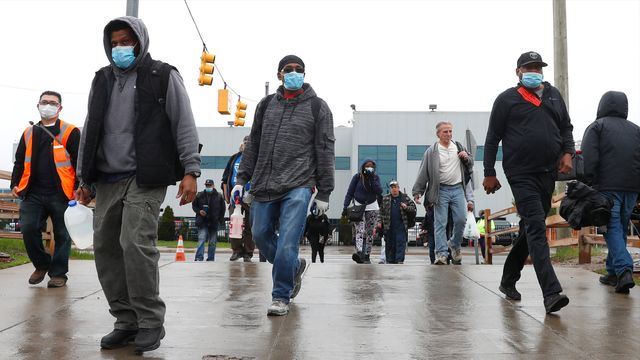 Auto workers leave the Fiat Chrysler Automobiles Warren Truck Plant after the first work shift, Monday, May 18, 2020, in Warren, Mich. (Image credit: AP Photo/Paul Sancya)