25 May 2020

The Next Death Wave from Coronavirus Will Be the Poor, Rural and White

Thom Hartmann

What do you call a crisis that kills a hundred thousand Americans? It all depends on who does the dying.
At first, it seemed like it was mostly white people infected and/or killed by the coronavirus.
As the scale of the coronavirus pandemic dawned on Americans during the month of March, most of the media attention was given to white people like Tom Hanks, while the danger of coronavirus to black people went largely underreported by American media. It was around this time when both the media and the White House decreed it a national emergency.
The early cases that made the news and caught everybody’s attention were mainly wealthy white people who’d traveled to the West Coast from Asia and the East Coast from Europe.
Trump’s official national emergency declaration came on March 11, and most of the country shut down or at least went partway toward that outcome. The economy crashed and millions of Americans were laid off, but saving lives was, after all, the number one consideration.
Trump put medical doctors on TV daily, the media was freaking out about refrigerated trucks carrying bodies away from New York hospitals, and doctors and nurses were our new national heroes.
And then came April 7, 2020.
I remember that week vividly; it was as if a light switch had been flipped, and I commented on it on the air at the time (and many times since).
April 7 was the day that America learned that the majority of the people who were dying from COVID-19 were either elderly, black or Hispanic. Not so many white guys, after all.
Exactly one month earlier, on March 7, Trump had played golf at his club in West Palm Beach, met with Brazilian strongman Jair Bolsonaro at Mar-a-Lago, and visited the CDC headquarters in Atlanta. Over the previous week, U.S. deaths had risen from single digits to more than 20.
During the following month, all hell broke loose in the United States and around the world. Italy and Spain were melting down, as was the U.S. economy; cases were exploding in New York. The nation was united in the hope that the disease could be stopped dead in its tracks.
Then came April 7, when the New York Times ran a front-page story with the headline: “Black Americans Face Alarming Rates of Coronavirus Infection in Some States.” Across the American media landscape, similar headlines appeared at other outlets, and the story was heavily reported on cable news and the network news that night.
American conservatives responded with a collective, “What the hell?!?”
Rush Limbaugh declared soon after that “with the coronavirus, I have been waiting for the racial component.” And here it was. “The coronavirus now hits African Americans harder—harder than illegal aliens, harder than women. It hits African Americans harder than anybody, disproportionate representation.”
Claiming that he knew this was coming as if he were some sort of a medical savant, Limbaugh said, “But now these—here’s Fauxcahontas, Cory Booker, Kamala Harris demanding the federal government release daily race and ethnicity data on coronavirus testing, patients, and their health outcomes. So they want a database to prove we are not caring enough about African Americans…”
It didn’t take a medical savant, of course. African Americans die disproportionately from everything, from heart disease to strokes to cancer to childbirth. It’s a symptom of a racially rigged economy and a health care system that only responds to money, which America has conspired to keep from African Americans for more than 400 years. Of course they’re going to die more frequently from coronavirus.
But the New York Times and the Washington Post simultaneously publishing front-page articles about that disparity with regard to COVID-19, both on April 7, echoed across the right-wing media landscape like a Fourth of July fireworks display.
Tucker Carlson, the only primetime Fox News host who’d previously expressed serious concerns about the death toll, changed his tune the same day, as documented by Media Matters for America.
Now, he said, “we can begin to consider how to improve the lives of the rest, the countless Americans who have been grievously hurt by this, by our response to this. How do we get 17 million of our most vulnerable citizens back to work? That’s our task.”
White people were out of work, and black people were most of the casualties, outside of the extremely elderly. And those white people need their jobs back!
Brit Hume joined Carlson’s show and, using his gravitas as a “real news guy,” intoned, “The disease turned out not to be quite as dangerous as we thought.”
Left unsaid was the issue of whom it was not “quite as dangerous” to, but Limbaugh listeners and Fox viewers are anything but unsophisticated when it comes to hearing dog-whistles on behalf of white supremacy.
More than 12,000 Americans had died from coronavirus by April 7, but once we knew that most of the non-elderly victims were black, things were suddenly very, very different. Now it was time to quit talking about people dying and start talking about white people getting back to work!
It took less than a week for Trump to get the memo, presumably through Fox and Stephen Miller. On April 12, he retweeted a call to fire Dr. Anthony Fauci and declared, in another tweet, that he had the sole authority to open the United States back up, and that he’d be announcing a specific plan to do just that “shortly.”
On April 13, the U.S. Chamber of Commerce published a policy paper titled “Implementing a National Return to Work Plan.”
Unspoken but big on the agenda of corporate America was the desire to get the states to rescind their stay-home-from-work orders so that companies could cut their unemployment tax losses.
When people file unemployment claims, those claims are ultimately paid for by the companies themselves, and with a high number of claims, a company will see a substantial future increase in their unemployment insurance premiums/taxes. If the “stay home” orders were repealed, workers could no longer, in most states, file for or keep receiving unemployment compensation.
On April 14, Freedomworks, the billionaire-founded and -funded group that animated the Tea Party against Obamacare a decade earlier, published an op-ed on their website calling for an “economic recovery” program including an end to the capital gains tax and a new law to “shield” businesses from lawsuits.
Three days after that, Freedomworks and the House Freedom Caucus issued a joint statement declaring that “it’s time to re-open the economy.”
Freedomworks published their “#ReopenAmerica Rally Planning Guide” encouraging conservatives to show up “[i]n-person” at their state capitols and governors’ mansions, and, for signage, to “Keep it short: ‘I’m essential,’ ‘Let me work,’ ‘Let Me Feed My Family’” and to “Keep them homemade.”
One of the first #OpenTheCountry rallies to get widespread national attention was April 18 in New Hampshire. Over the next several weeks, rallies had metastasized across the nation, from Oregon to ArizonaDelawareNorth CarolinaVirginiaIllinois and elsewhere.
One that drew particularly high levels of media attention, complete with swastikas, Confederate flags and assault rifles, was directed against the governor of Michigan, rising Democratic star Gretchen Whitmer.
When Rachel Maddow began reporting on meatpacking plants that had become epicenters of mass infection, the conservative Chief Justice of the Wisconsin Supreme Court pointed out that the virus flare wasn’t coming from the “regular folks” of the surrounding community. Although the majority of the meat plant workers were Hispanic and the majority of the surrounding communities were white, her defenders suggested it was just a slip of the tongue.
Nonetheless, the conservative meme was now well established.
About a third of the people the virus killed were old folks in nursing homes. Which, right-wing commentators said, could be a good thing for the economy because they’re just “useless eaters” who are spending our Medicaid and Social Security money and are on death’s door anyway.
For example, Texas’s Republican Lt. Governor Dan Patrick told Fox News, “Let’s get back to living… And those of us who are 70-plus, we’ll take care of ourselves.”
A conservative town commissioner in Antioch, California, noted that losing “many elderly [people]… would reduce burdens in our defunct Social Security System” and “free up housing.” He added, “We would lose a large portion of the people with immune and other health complications. I know it would be loved ones as well. But that would once again reduce our impact on medical, jobs, and housing.”
It came to Trump’s attention that the biggest outbreaks were happening in prisons and meatpacking plants, places with few white people (and the few whites in them were largely poor and thus seen as disposable). Trump’s response to this was to issue an executive order using the Defense Production Act (which he had hesitated to use to order the production of testing or PPE equipment) on April 28 to order the largely Hispanic and black workforce back into the slaughterhouses and meat processing plants.
African Americans were dying in our cities, Hispanics were dying in meatpacking plants, the elderly were dying in nursing homes.
But the death toll among white people, particularly affluent white people who were less likely to be obese, have hypertension or struggle with diabetes, was relatively low. And those who came through the infection were presumed to be immune to subsequent bouts, so we could issue them “COVID Passports” and give them hiring priority.
The only thing Republicans had overlooked in their master plan to help out the master race was the very real consequence of Reaganomics across the states of the former Confederacy.
Southern states had fought against any sort of state- or federally-funded health care plans since Reconstruction, claiming libertarian ideology while, in fact, their animus was directed at people of color.
Caught in those crosshairs, however, just as had been the case prior to the Civil War, were poor whites.
Many of the same political and economic factors that put African Americans at risk for the past two centuries were also used against poor whites.
In the 1930s when Huey Long was Louisiana’s senator and governor, he explicitly reached out to impoverished white people.
As the Encyclopedia Britannica notes, “Always the champion of poor whites, he effected a free-textbook law, launched a massive and very useful program of road and bridge building, expanded state university facilities, and erected a state hospital where free treatment for all was intended. He was opposed to excessive privileges for the rich, and he financed his improvements with increased inheritance and income taxes as well as a severance tax on oil…”
Long’s “every man a king” stump speech was particularly intolerable to Louisiana’s wealthy oligarchs, opening as it did with the line, “Is that a right of life, when the young children of this country are being reared into a sphere which is more owned by 12 men than it is by 120 million people?”
In 1935 Long was assassinated, and it wasn’t until 1965 that President Lyndon Johnson would try to get any aid to poor Southern whites with Medicaid and food stamps; that, too, was offensive to the conservative white political structure in the South.
As a result, poor whites in the South are likely to suffer from the diseases and lack of access to health care that make African Americans throughout the country so vulnerable to COVID-19.
And, over the past 40 years, Reaganism has encouraged the spread of deep white poverty from red state to red state. White obesity, diabetes and hypertension are, therefore, over-represented in poor rural areas as far away as Nebraska and Iowa.
Today, Trump, Fox and his followers think COVID-19 just kills the elderly, blacks and Hispanics—and they seem comfortable with the needless deaths of people they think are different from themselves.
As it spreads into rural white America, however, they’re about to learn otherwise.

Can Humanism Survive the Onslaught of Hate?

Ram Puniyani

Lately when India is undergoing the massive crisis of the Corona epidemic and the offshoots of its mishandling, we have also seen the pandemic being used to demonise a particular community in India. These hate mongers, operating through powerful medium of TV, and widespread social media which also has resorted to Fake news has intensified the Hate against religious minority. In this vast phenomenon, it seemed that all is lost as far as amity between people of different religions is concerned. Despite this broad generalisation one feels happy when one comes to know of few incidents where religious communities come forward to help each other.
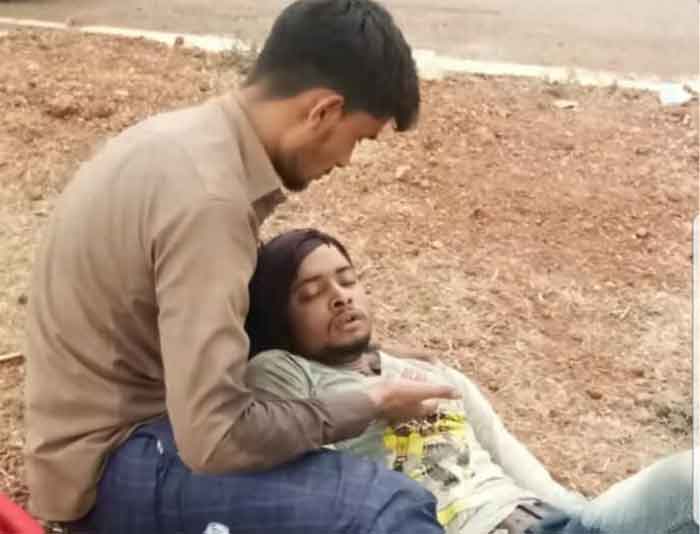
The most touching such incidence of amity came forward in the form of story of Amrit and Farooq. They were travelling in a truck from Surat to UP. On way Amrit, a worker, fell sick and most other travellers, asked him to leave the truck in the middle of the night. As he was offloaded, he was not alone. His friend Farooq, another worker, also came down with him. Farooq put the sick Amrit in his lap and cried for help which caught the attention of others and an ambulance landed up to take Amrit to hospital!
In another incidence one worker, who had a differently able child, took the bicycle of another person, leaving a touching letter of apology, saying that he was helpless as he has to travel with his children and there is no other means. Many a people reported it as a theft of the bicycle while the owner of the bicycle, Prabhu Dayal took it in a stride. The one who took away the bicycle was Mohammad Iqbal Khan. In Sewri Mumbai, Pandurang Ubale, a senior citizen died due to age related and other problems. Due to lock down his immediate relative’s could not organize the funeral. His Muslim neighbours came forward and did his last rites as per the Hindu customs. Similar cases are reported from Bangalore and Rajasthan. In TIhar jail, the Hindu inmates joined the Muslim in keeping the Roza (fasting). While mosque in Pune, (Azam Campus) and a Church in Manipur has been offered as a place for quarantine. In another lovely incident a Muslim girl takes shelter in a Hindu home and the host gets up early in morning to prepare and give her food for Sehri, a pre morning meal before Rosa begins.
One can go on and on. Surely what is reported must be a tip of the iceberg as many such incidents must be going on unnoticed and un reported. The feeling one was getting after the section of media jumped to communalise spread of Corona, coined words like Corona bomb, Corona jihad, one felt the efforts to break the mutual trust between Hindus and Muslims may succeed totally after all. The deeper inherent humanism of communities has ensured that despite the Hate being manufactured and propagated by communal forces for their political agenda, the centuries old amity and the fraternity promoted by freedom movement will sustain itself somewhere, though it is suffering deep wounds due to the religious nationalists.
India’s culture has been inherently syncretic, synthesising the diversity in various forms. The medieval period which is most demonized, and as many of the sectarian ideologues are presenting it as a period of suffering of Hindus, the fact is that it is during this period that Bhakti tradition flourished and literature in Indian languages progressed during this period. Even Persian, which was used in the court of kings interacted with Awadhi and produced the Urdu, which is an Indian language. It is in this period when the most popular story of Lord Ram was written by Goswami Tulsidas. Tulsidas himself in his autobiography Kavaitavali writes that he sleeps in a mosque. As far literature is concerned many outstanding Muslim poets wrote wonderful poetry in praise of Hindu Gods, one can remember Rahim and Raskhan’s brilliant outpourings in praise of Lord Shri Krishna.
The food habits, the dress habits and social life emerged with components from these two major religions. The sprinkling of Christianity in different aspects of Indian life is as much visible. It was the symbol of deep interaction of Hindus and Muslims that Muslims followed the Bhakti saints like Kabir and many a Hindus visit the Sufi Saint Dargahs (Shrines). This interactive element is vibrantly visible in Hindi films. Here one can see the outstanding devotional songs in praise of Hindu gods composed by Muslims. One of my favourite’s remains, ‘Man Tarpat hari Darshan ko Aaj’ (My soul is longing to see Hari). This song was written by Shakil Badayuni, composed by Naushad Ali and sung by Mohammad Rafi. The latter must have sung innumerable devotional songs.
Our freedom movement, despite the divisive role of British, the Muslim communalists and Hindu communalists, brought together people of all religions, in the struggle against colonial powers. Many a literary people painted the beautiful interaction of diverse communities. During freedom movement, and in the aftermath as communal violence flared up, the likes of Ganesh Shankar Vidyarthi, and towering above all Mahatma Gandhi tried to douse the fire of violence through exemplary efforts, efforts in which Muslims and Hindus both reciprocated despite the hate spread by the communal forces.
One recalls here the efforts of those friends, who laid down their lives to combat the fire of Hate. In Gujarat the names of Vasant Rao Hegiste and Rajab Ali will always be remembered as they laid down their lives, as a team, to restore sanity. This interaction is very deep and the present Government cannot tolerate the impact of Islamic-Muslim component in our culture. That’s precisely the reason that attempts are on to change the names of cities (Faizabad-Ayodhya, Mughal Sarai-Deen dayal Upadhyay etc)
The deeper interaction of communities is present in all facets of our society. The examples during Corona crisis have again brought to fore the fact that Indian culture is essentially a product of synthesis of different aspects of many religions prevalent here.

The Illusions of Bourgeois Democracy

Bhabani Shankar Nayak

Democracy is a product of struggles and sacrifices of the working classes. The October revolution, French revolution in Europe and anti-colonial struggles in Africa, Asia and Americas shaped democracy. The struggles for freedom, equality and justice, anti-capitalist struggles, and people’s movements against war and terrorism, social and political movements for livelihoods have helped to deepen democratic practices all over the world. The Coronavirus pandemic is taking its toll on the rotten and inefficient political, economic, and social systems. The human cost of the crisis makes present look gloomy and the future is inconceivable. The discontinuity with everyday lives and emergency measures create an illusion that normality will return to its own place and pace. These illusionary desires help the crisis ridden bourgeois democracy and capitalist state to survive, and continue to create havoc in the lives and livelihoods of the masses.
The decade long practice of neoliberal market led democracy eroded both the abilities of the states, governments, and democratic political traditions to deal with different forms of crisis. As a result, the relationship between state and citizens is deteriorating along with the democratic traditions.  The crisis is not only showing the cracks within different democracies but also questions the very foundation of bourgeois parliamentary democracy. Any attempt to return to business as usual in a post pandemic world will reproduce a dead end for the masses under capitalist democracy. It is not the spectre of communism, that is haunting the world today. It is the capitalist democracy that failed people with false promises of freedom, prosperity, empowerment and development. The rising tides of reactionary nationalism, populism of the conservative forces, and neoliberal economic policies are further weakening democracy.  These forces are also depoliticising the democratic processes of development and public policy making. The top down bureaucratic approach of the technocratic policy making is worsening the crisis within democracy.
The propaganda machines of the establishment hide all the failures and inefficiencies of bourgeois democracy and capitalist state. It gives an impression as if democracies and states have failed. So, the establishment today offers us an authoritarian alternative by killing the idea of citizenship, freedom and democracy; the greatest ideals, and achievements of 20th and 21st century.  The propaganda machines help in socialising the masses, and normalise authoritarian neoliberal forces as permanent rulers of the world to manage chaos, in which elites are secured by the state and the masses are left to suffer alone as individuals. The father of propaganda and modern advertisement; Edward Bernays summarised this process in his seminal book called “Propaganda”, which was published in 1928.
In the first two paragraphs of the chapter one of the “Propaganda”, Edward Bernays wrote that “the conscious and intelligent manipulation of the organized habits and opinions of the masses is an important element in democratic society. Those who manipulate this unseen mechanism of society constitute an invisible government which is the true ruling power of our country. We are governed, our minds are moulded, our tastes formed, our ideas suggested, largely by men we have never heard of. This is a logical result of the way in which our democratic society is organized. Vast numbers of human beings must cooperate in this manner if they are to live together as a smoothly functioning society. Our invisible governors are, in many cases, unaware of the identity of their fellow members in the inner cabinet. They govern us by their qualities of natural leadership, their ability to supply needed ideas and by their key position in the social structure. Whatever attitude one chooses to take toward this condition, it remains a fact that in almost every act of our daily lives, whether in the sphere of politics or business, in our social conduct or our ethical thinking, we are dominated by the relatively small number of persons—a trifling fraction of our hundred and twenty million—who understand the mental processes and social patterns of the masses. It is they who pull the wires which control the public mind, who harness old social forces and contrive new ways to bind and guide the world”. These prophetic words of Edward Bernays resonate with our everyday experiences with bourgeois democracies and responses of the capitalist states to the crisis in the world.
Such a crisis within democracy is a product of neoliberal politics and policies led and determined by the manipulative market forces. The rise of poverty, unemployment, hunger, homelessness, environmental disasters, and ill health are the products of the failures of bourgeois democracy and capitalist state. These disruptions to democracy can be a catalyst for exposing the limits and illusions of bourgeois democracy under capitalist system. It is important for the citizens to kill their false hopes on the failed democratic project of capitalism, which reduced democracy to voting and festivals of periodical elections. It is the time for reckoning within the opulence of miseries for the masses and island of prosperity for a small number of elites.
The unbrazen greed of the few billionaires have hijacked our democracy and state. It destroyed our hopes, fate and futures for the sake of their profit. These ultra-rich men are morally bankrupt and politically screwed to uphold the interests of the masses.  It is time for the majority of people to reclaim the political space, and transform the state that belong to the working class masses. History tells us that the capitalist classes always relied on crisis to maintain their hegemony over the masses. Crisis produces power for the capitalist classes by reducing the power and autonomy of the working classes. Therefore, poverty and unemployment are not crisis but opportunity for the ruling and non-ruling capitalist classes. Peace, prosperity, and employment create conditions of empowerment of the masses and threatens the power and positions of elites.
History is the witness to the power of working classes in shaping the democratic state and progressive society. All empires and dictatorships collapsed with the power of working class unity and struggles. Marx and Engels summarised it in The Communist Manifesto; “the history of all hitherto existing society is the history of class struggles”. These struggles can only create alternative conditions for real democracy, and shape our futures in which “the free development of each is the condition for the free development of all”. The market forces are not the friends of democracy, freedom, peace, prosperity, happiness, individual liberty and spirituality. The market forces represent the perverted form of these ideals that serves their purpose to domesticate the masses. Therefore, it is important to ensure that the principles of peace, prosperity, freedom and democracy are four pillars of all our future movements for justice and equality. There is no shortcut to progressive mass movements, which can change the course of history and fortify our democratic future. It can only be achieved through collective struggles based on our collective interests.

India’s Deadly Cytokine Storm

Satya Sagar

Two months after imposition of the most stringent and large-scale lockdown in the world, with the pandemic still undefeated, it is the Indian Republic that is looking more and more like a struggling COVID-19 patient.
It is running low on oxygen in its blood, several organs are already failing, costs of treatment shooting up and the country’s leadership looks utterly confused and in delirium.
For, what the Narendra Modi regime has set in motion, is a deadly ‘cytokine storm’, a phenomenon that turns the body’s immune system against itself. Through its incompetent and arrogant response to the COVID-19 crisis it has effectively turned all institutions meant to protect lives of citizens into their worst enemies.
The poorly planned and chaotically implemented lockdown, has not only failed to prevent a rapid rise in infections, it has laid waste the country’s economy and sparked a massive humanitarian crisis involving millions of desperate migrant workers. With no income, no food, water or even space to stay, the country’s laboring classes are dying by the dozens of heat, exhaustion, hunger or in various accidents – as they flee the cities.
Showing a pitifully poor grasp of Indian realities, the lockdown – an idea blindly copied from overseas  – completely failed to account for anyone in India’s vast informal economy, which employs over 80% of the country’s labour force. National planners also had no policy on how to deal with crowded urban slums, where millions of Indians live in conditions that make any kind of ‘social distancing’ impossible. The needs of much of the rural population, especially farmers unable to harvest their crops, lacking labour or transport, were completely ignored.
The Indian health bureaucracy, on its part, failed to take advantage of slowing down of COVID-19 infection rates – the only real rationale for the lockdown-  to carry out nationwide detection, isolation and treatment of those already infected. Nor did they ensure healthcare access to those with existing medical problems – like cancer, cardiac conditions or tuberculosis – the consequences of which will be evident in horrific excess mortality in the days to come.
The Indian Supreme Court – resembling a red-beaked, green bird in a golden cage these days –  failed to provide justice to Indian citizens subject to intense suffering, often life threatening, due to the harsh lockdown.  The worst case of institutional failure however has been the Indian police, strangely thrust into a front line role during a health emergency.  An unreformed colonial-era force, the police brutalized the poor at whim, confirming widespread suspicion of it being the most organized criminal force in the country.
There is a reason why this analogy of India’s current fate with that of a COVID-19 patient works quite well. It is simply because nations are not just dead territory but primarily living entities, just like any multi-cellular plant, animal or human being. This implies they are mortal and have a certain life expectancy – which in turn depends on a variety of factors including inherited genes, dietary and lifestyle habits, stress levels and health-seeking behavior.
To remain in good health nations need good nourishment in various forms – the breath of a vibrant democracy, the sunshine of public scrutiny and participation, the water of universal values like compassion, tolerance and humility.
On all these fronts, unfortunately the record of this patient called India, since independence in 1947, has been abysmal. In its infancy, some of India’s ailments could of course be attributed to its difficult, C-section birth, when much blood was lost and the child itself born quite deformed.
The real problem, however was, that as the country gained strength in its youth, it refused to share these gains equitably throughout the body of the nation, leading to an unhealthy concentration of power and resources among those already at the top of the traditional Indian caste order.  As a result, for the first five decades of its existence India grew to resemble someone afflicted by Kwashiorkor, a disease of severe malnourishment – with a swollen head and protruding belly but also weak legs and emaciated body.
And as it crossed the age of fifty the Indian Republic suddenly bloated up due to opening of the economy, which brought in a rich diet of foreign funds. Even this was never shared equally but with more crumbs going around, millions of poor and unemployed Indians flocked to the cities, lured by the dream of a decent livelihood (the same ones trudging back to the villages now).
The rising overall wealth was also not invested wisely in improving the lives of workers, farmers, youth or investments in health, education or even ensuring good nutrition and safe drinking water for everyone. Instead, the gluttonous the Indian elite – better dubbed the Feast India Company-  binged on national resources at the expense of poorer citizens and the nation’s future.
As a consequence, the Indian Republic, now in its early seventies, looks like a typical RWA[i] uncle of similar age – diabetic, hypertensive, with arthritic knees and severe pain in the lower back. Someone, who does not care much for his own physical well-being as his children are ‘well-settled abroad’ but will do a full throated ‘Bharat Mata ki Jai’ to confirm the body still belongs to him.
What is worse, this upper caste Hindu uncle has in recent times become completely addicted to the narcotic of communal hatred, often homemade but sometimes imported. He shoots the poison up his veins to distract attention from various bodily aches and shows homicidal impulses by abusing or threatening his neighbours, usually weaker or less privileged than him.
Well, with so many co-morbidities, if India were indeed a COVID-19 patient, any good doctor would by now have put it on a ventilator, while advising close relatives to pray hard. The prognosis for the patient’s survival or escaping with least damage to vital organs does not seem very good at the moment – especially as he is blabbering something about ‘self-reliance’, blissfully unaware of impending danger.
A lot depends on not just skills of health personnel involved but critically on the quality of the ventilator itself. Going by experience though, one can safely say, if the device was anything procured from the state of Gujarat, we should keep firewood for the funeral ready and prepare to chant  with great sorrow ‘Ram Nam Satya Hai’.

Russian court keeps historian of Stalinist massacres jailed amid COVID-19 outbreak

Clara Weiss

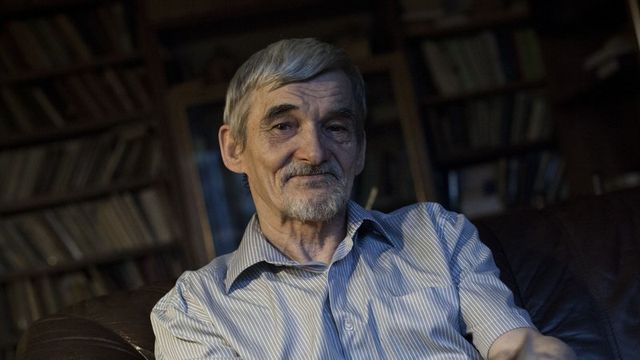
On Thursday, May 7, the Supreme Court of the Republic of Karelia in northwest Russia rejected an appeal and ruled in a closed hearing that Yuri Dmitriev, a well-known historian of the Stalinist massacres in Sandarmokh, Karelia, will remain in detention until at least June 25.
The detention seriously endangers the health and life of the 64-year-old Dmitriev as COVID-19 cases have exploded in Russia in recent days. The first cases of the virus have already been confirmed in the prison in Petrozavodsk where he is detained.
Yuri Dmitriev
Dmitriev is the victim of a blatant state frame-up, aimed at undermining and discrediting his work to uncover and locate the mass graves of Stalinist massacres in Karelia and identify their victims. In late 2016, he was charged with “child pornography,” a transparent attempt not only to frame him, but also to destroy him personally. The charges had to be dropped in 2018 for lack of evidence, but a court found him guilty of possessing parts of a firearm. Dmitriev was arrested again in mid-2018 for allegedly violating the rules of his release and then charged with sexual assault of a minor. He has been in prison since. The hearings in his case have proceeded with exclusion of the media.
Friends and family have warned that his life is in serious danger because of the coronavirus. Dmitriev is elderly, and his health has significantly deteriorated over the winter; he suffered a serious cold in February. A petition demanding his immediate release from jail has received over 11,000 signatures as of this writing. An open letter demanding his release, which was published on Wednesday, was signed by over 150 Russian intellectuals and artists, including director Alexander Sokurov, actress Chulpan Khamatova and writer Lyudmila Ulitskaya, as well as several members of the pro-US party Yabloko.
The director of the city museum in Medvezhyegorsk and head of the memorial at Sandarmokh, Sergey Koltyrin, who had closely worked with Dmitriev, was also charged with sexual assault of a minor and had been detained since 2018. Having been sentenced to nine years in prison, he died in early April in a prison hospital of an unspecified “serious illness.”
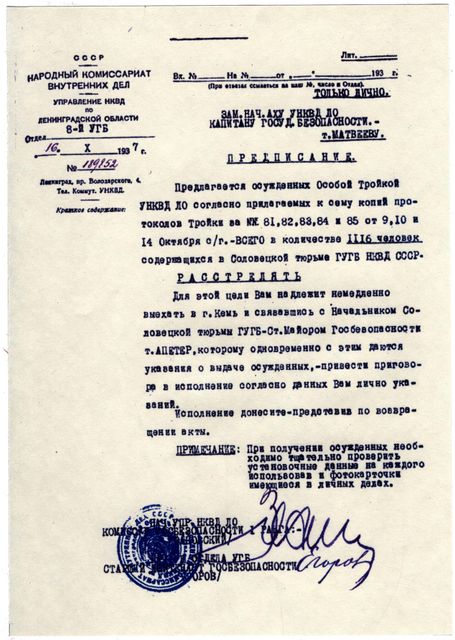
The NKVD order to Matveyev to shoot the Solovki prisoners
The state campaign against Dmitriev must be unequivocally rejected and his immediate release demanded. Behind the vicious campaign are the efforts of the Russian state and oligarchy, which originated in the Stalinist counter-revolution against the October revolution of 1917, to suppress all efforts to uncover the truth about the crimes of Stalinism.
Alongside the frame-up of Dmitriev, the former far-right minister of culture Vladimir Medinsky, has led a systematic effort to propagandize the historical lie that Sandarmokh is not the site of Stalinist crimes, but rather of Finnish executions of Soviet soldiers during World War II.
In reality, the shootings at Sandarmokh in 1937-1938 were among the largest massacres during the Great Terror, the Stalinist political genocide of hundreds of thousands of socialist workers, intellectuals and artists. In the Moscow Trials of 1936 and 1937, the most famous leaders of the October Revolution were put on trial and accused of sabotage and counter-revolutionary activities. The main defendant was Leon Trotsky, who had co-led the revolution with Vladimir Lenin. After Lenin’s death, Trotsky had formed the Left Opposition to fight against the nationalist betrayal of the revolution by the Stalinist bureaucracy. Trotsky managed to form the Fourth International in 1938 before his assassination in Mexico by a Stalinist agent in August 1940.
Though they were hounded, suppressed and imprisoned, Trotsky still had many supporters in the Soviet Union throughout the 1930s. Virtually all of them were murdered in the Great Terror, together with the leaders of the October Revolution and the vast majority of the old Bolshevik party. In many cases, their families were killed as well. As the Soviet writer Varlam Shalamov put it, the terror was directed against all those who had remembered “the wrong parts of Russian history”—above all the history of the revolution and the struggle of the Left Opposition.
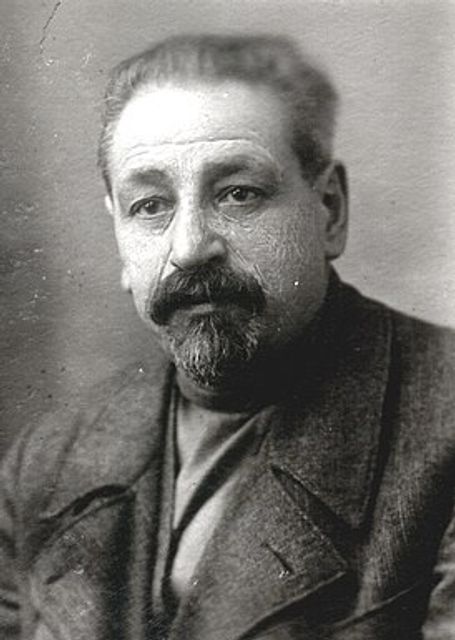
Grigory Shklovsky, an Old Bolshevik and member of the United Left Opposition
Sandarmokh, located north of Leningrad close to the Finnish border, was one of the biggest killing sites outside of Moscow. The largest single operation was the mass shooting of 1,111 political prisoners from the Solovki camp on the direct order of Nikolai Yezhov, the head of the Soviet secret police NKVD at the time. In the so-called “First Solovki stage,” the 1,111 prisoners were first deported to a prison that was designed for just 300 people in Medvezhyegorsk. Here, they were stripped naked and cruelly tortured.
Several died from the torture. The others were brought in groups to the Sandarmokh shooting sites 19 kilometers outside the village where pits had been dug for them. They were all executed in five days by firing squads that shot them from behind in the neck. In a macabre demonstration of the conscious counter-revolutionary character of the Stalinist terror, the killings were timed to coincide with the 20th anniversary of the October seizure of power by the Russian working class under Bolshevik leadership in 1917: they took place on October 27 and November 1-4, 1937.
Among those murdered in these massacres were hundreds of major intellectuals, scholars, politicians and artists, including hundreds of Ukraine’s leading intellectuals of the 1920s. According to one historian, “approximately half of those who were shot were simple workers from Petersburg [Leningrad].”
One of the largest groups shot in this operation were 248 political prisoners who had been sentenced to death for “counter-revolutionary Trotskyist terrorist activity, having retained their old counter-revolutionary positions, [and] seeking to resume counter-revolutionary work.”
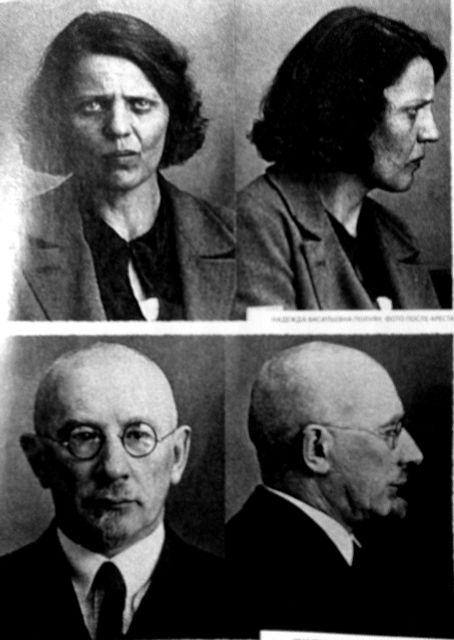
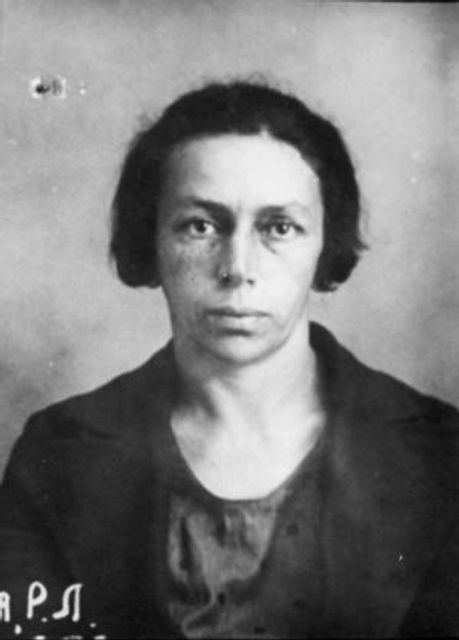
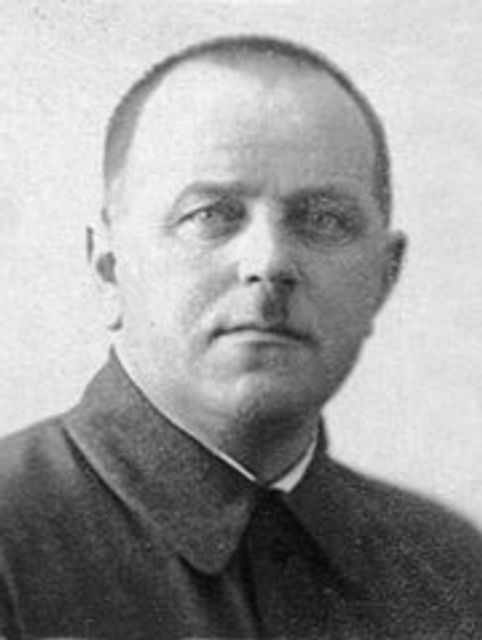
NKVD mug shots of Ivar Smilga and Nadezhda Smilga-Poluyan
Among them was Nadezhda Smilga-Poluyan, an Old Bolshevik and the wife of Ivar Smilga, who had been a close collaborator of Lenin in 1917 and leader of the Left Opposition in the 1920s; the Old Bolsheviks Grigory Shklovsky and Georgy Yakovenko, who had signed declarations of the Left Opposition in the 1920s; Revekka Shumskaya and Noi Vol’fson, party members since the first years of the Soviet Union who had earlier been expelled from the party and arrested for support of the opposition; and Martin Yakobson and Aleksandr Blaufel’d, Old Bolsheviks who had fought for socialism in Estonia since the revolution of 1905.
Other victims of the mass shootings in Sandarmokh included the famous Russian linguist Nikolay Durnovo, the pioneering Soviet meteorologist Alexei Vangengeim, Alexander Anissimov, a leading art historian and restorer, and many other writers, scholars, and scientists from various parts of the USSR and other countries. Overall, people from 60 different nationalities were shot at Sandarmokh. Several priests and former Tsarist officials were killed as well.
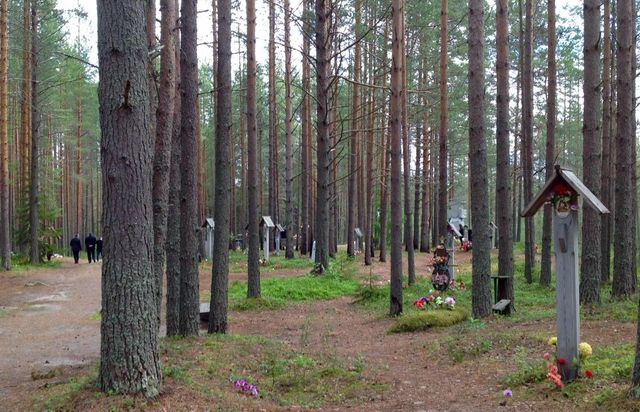
The NKVD documents about these mass shootings were not uncovered until the mid-1990s. A search expedition in 1997, in which Dmitriev participated, found 236 burial pits. Based on the documents, they established that between August 11, 1937, and December 24, 1938, well over 9,500 people must have been shot and buried there. The number has since been revised upward. Together with other historians, Dmitriev has published a list of names of those murdered in Sandarmokh and written several books on what happened there during the terror. Many memorials have since been set up at Sandarmokh.
Revekka Shumskaya
Dmitriev and his co-researchers also established the names of the leaders of the shooting squads and of the members of the “troikas,” extra-judicial courts of three which were set up to sign death sentences on behalf of the bureaucracy. At the height of the terror, a “troika” could hand down up to 200 death sentences a day, sometimes even more.
The most notorious butcher of Sandarmokh was Mikhail Matveyev, who led the shooting squads in the “Solovki operation.” After a brief arrest in 1938, Matveyev was put in charge of the NKVD internal prison system during the Nazi siege of Leningrad during World War II. Among those who died in the Leningrad prison at the time was the major Soviet poet Daniil Kharms, who miserably starved to death. Matveyev was awarded “the Order of Lenin” after the war—the highest decoration in the Soviet Union—and lived on a state pension until his death in 1971.
Matveyev’s fate was not the exception, but the rule. In fact, not a single hangman of the purges was ever tried, not before and not after the end of the USSR. The shootings that occurred as part of the “mass operations” of the NKVD during the terror were treated as a “state secret” throughout the Soviet period. The relatives of those who were killed in Sandarmokh were never told what had happened. The official note they received upon requests, from 1939 onward, was that their loved ones had been “sentenced to 10 years of prison [lishenie svobody] without the right to correspond.”
Mikhail Matveyev, leader of shooting squads at Sandarmokh
This policy was reconfirmed in 1955 by a special order even as the bureaucracy began to partially rehabilitate some of the victims of the terror, and shortly before the general secretary of the party, Nikita Khrushchev, was forced to acknowledge some of the worst crimes of Stalin in 1956. This policy did not change until the very final stages of the crisis of Stalinism in the late 1980s when the bureaucracy moved toward a full-scale restoration of capitalism.
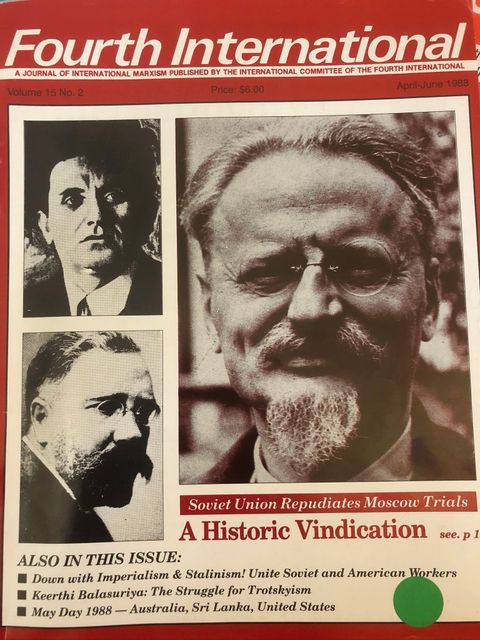
In June 1988, the Stalinist press acknowledged that Grigory Zinoviev, Lev Kamenev, Karl Radek and Yuri Pyatakov—leaders of the October revolution who had been among the main defendants of the Moscow Trials—had, in fact, been the victims of frame-ups. That same year, the restrictions on information about the shooting victims of Sandarmokh and similar massacres were partially lifted for relatives, and the first human remains were discovered in Sandarkmokh.
At the time, a vast amount of historical material about the terror was released in Soviet periodicals and newspapers. Much of this material would form a critical basis for the history of the Left Opposition by the Soviet sociologist Vadim Rogovin. However, decades of Stalinism had severely undermined the political consciousness of the Soviet and international working class, enabling the bureaucracy to resolve its staggering crisis in its own interests, destroying the Soviet Union and transforming itself into a new ruling oligarchy.
This counter-revolution has inevitably shaped and delayed the process of establishing the historical truth about the crimes of Stalinism. To this day, the sites of the NKVD shootings have officially remained a “state secret” and lists of all the shooting sites of the NKVD have never been released. Some historians assume that any such lists may have been destroyed already.
Cover of the Fourth International journal leading with the official rehabilitation of Kamenev and Zinoviev
Dmitriev carried on with the work in the 1990s. He worked directly for Ivan Chukhin, who had earlier headed the local Soviet interior ministry and in the 1990s became a parliamentary deputy in parliament for the party “The Choice of Russia,” which backed the “shock therapy” of Boris Yeltsin. Since Chukhin’s death in 1997, Dmitriev has worked with several other local historians and researchers. In 2014, Dmitriev and one of his closest co-workers endorsed the US-backed coup in Ukraine. In an interview in 2015, Dmitriev acknowledged that he was “a nationalist in the widest sense of the word.”
These political views, which reflect the substantial disorientation in sections of the intelligentsia, have no doubt influenced the focus of Dmitriev’s work. He has primarily worked on the victims of the so-called “national operations” of the NKVD. These operations targeted the Polish, Lithuanian, Latvian, Ukrainian, Finnish, German and other minorities, such as the local Karelian population. While thousands of communists from these countries were murdered as part of these operations, many thousands were also killed randomly, simply based on their surnames and baseless denunciations. In the wake of 1991, the revelation of the scale of these horrendous crimes by Stalinism could no doubt be exploited by right-wing nationalist and anti-Communist forces in the Baltics, Poland and Ukraine.
Meanwhile, the work to establish how many active and former Left Oppositionists and socialist opponents of Stalinism were murdered in Sandarmokh—which is central for a political understanding of the Great Terror—is still only in its early stages. The vast majority of the names and political biographies of the Left Oppositionists who were killed at Sandarmokh and elsewhere remain unknown. The same goes for many other leading revolutionaries who were killed in the terror.
The vicious vendetta by the Russian state against Dmitriev is driven by the fear that any revelation about the Stalinist counter-revolutionary terror, however limited in its political analysis, works to undercut the false equation of Stalinism with socialism, the major lie of the 20th century. The current pandemic, which has ruthlessly revealed the brutality of the capitalist system to billions of workers, acutely raising the specter of world socialist revolution, has only exacerbated this fear.
Memorials at Sandarmokh
The oligarchy is keenly aware of the growing interest in the October Revolution and the Left Opposition, and regards the suppression of this historical truth as essential to the survival of its own rule and capitalism as a whole. For years, a state-funded campaign has been underway to glorify Stalin and justify the terror as a legitimate and necessary measure to defend “the country” against external and internal enemies.
In 2017, the centenary year of the October revolution, the Kremlin funded a vile anti-Semitic propaganda mini-series defaming Leon Trotsky. In 2018, the discovery of volumes of documents by Left Oppositionists in the Verkhne-Uralsk political prison generated significant public interest. That same year, it emerged that Russian authorities had ordered the destruction of archival files of victims of the Great Terror.
For workers internationally, the defense of Dmitriev is a matter of principle. In its struggle for socialism, the international working class needs to know and understand the full truth about the crimes of Stalinism—above all the brutal repression of its socialist and Trotskyist opponents.

Australian government’s JobKeeper fraud starts to unravel

Mike Head

After nearly two months of falsely claiming that its COVID-19 JobKeeper wage subsidy scheme would “save six millions jobs,” the Liberal-National government finally admitted last Friday that less than half that total, 2.9 million workers, had received the $750-a-week payments.
As recently as Thursday, government officials had told a Senate committee that 6.5 million workers would be covered, almost exactly in line with the government’s original promise. Now more than three million have been left unaccounted for—most likely having been sacked, having had their hours and pay slashed, or been forced to drop out of the workforce.
The corporate media and the opposition Labor Party depicted the government’s admission as a miscalculation. It was labelled the biggest fiscal “blunder” of all time, slashing the scheme’s budget from $130 billion to $70 billion, seemingly overnight. This only serves to cover up the reality.
Writing in today’s Australian, Treasurer Josh Frydenberg made a revealing comment. He flatly defended the original false claims, boasting that JobKeeper had provided “a vital psychological boost” to the country.
From the start, as the WSWS warned, the government’s claims were always patent lies. JobKeeper, the government’s third massive business “rescue package,” was intended to disguise the true levels of mass unemployment triggered by the COVID-19 pandemic, shore up the financial elite and bolster the fragile and discredited Coalition government itself.
“Over the next six months, the government will pay much of the wages bills of big business, without any guarantee that any of the millions of jobs already wiped out will be restored,” the WSWS pointed out, opposing the fraudulent promotion of the scheme by the government, the media, the Labor Party and the trade unions.
At the same time, as only the WSWS explained, JobKeeper was a vehicle to allow employers to cut pay, working hours and other working conditions, fully enforced by the unions. Under changes to the Fair Work Act, quickly pushed through parliament with Labor’s help, employers could slash wages to $750 a week—all paid by the government—and force workers into new “duties” and “flexible” conditions.
JobKeeper formed a central platform of the de facto coalition government formed with Labor and the unions in order to impose on workers the greatest unemployment since the 1930s Great Depression. It was underpinned by the Australian Council of Trade Unions (ACTU), whose secretary Sally McManus pledged to give employers “everything they want,” in response to the pandemic.
Many unanswered questions remain about the supposed JobKeeper “miscalculation.” One thing is clear. None of the explanations offered by Prime Minister Scott Morrison’s government is any more credible than the original lies.
In a statement, issued jointly by the Treasury and the Australian Tax Office, the government blamed alleged reporting “errors” by about 1,000 of the nearly one million businesses that applied to use the scheme.
But the “most common error” was over 500 businesses with one eligible employee reporting a figure of 1,500. Even if that were true, it would account for some 750,000 over-estimates, not more than 3.5 million.
The government’s second explanation was just as specious. Treasurer Frydenberg said the record-breaking “costing error” was mainly due to a fall in coronavirus case numbers and social-distancing rules being relaxed earlier than expected, enabling business activity to resume. He even declared that this “error” was therefore “good news.”
That is doubly false. First, the scheme only requires employers to show a short-term reduction in their revenue, and permits them to keep receiving the wage subsidies for six months, so the escalating “return to work” drive by employers and governments makes no difference to the payouts.
Second, more fundamentally, the “good news” consists of ensuring that more than three million less workers receive payments than promised, even though 20 percent of the workforce is currently unemployed or under-employed, even on the understated official statistics.
The drop in JobKeeper numbers seems to have been achieved largely by making it virtually impossible for small businesses to obtain wage subsidies.
Many reports have appeared of small and family-owned enterprises, such as cafes and restaurants, being unable to survive for the two months it took for the wage subsidies to commence, or unable to keep on their casual workers, some of whom were previously paid less than $750 a week.
The accommodation and food sector is among the hardest hit by the coronavirus lockdown. Between March 14 and April 18, 33.4 percent of jobs in the industry were lost. An Australian Bureau of Statistics survey in late March found that 76 percent of businesses in the sector intended to claim the JobKeeper wage subsidy. By May 7, however, only 53.8 percent of hospitality businesses had enrolled in the scheme.
According to the government, 910,055 employers enrolled overall, but only 759,654 made claims that were processed. That is, about 150,400 businesses dropped out.
This gap is on top of the 2.5 million or more workers whom the government vindictively excluded from the scheme, including international students, workers on temporary visas, and casual employees who had not worked for their current employer for at least 12 months. Also excluded are university workers, local council employees and freelancers on short-term contracts, such as in the arts and entertainment fields.
Much remains deliberately hidden about the scheme, particularly the amounts being pocketed by big business. But there is ample evidence that they will receive the lion’s share of the subsidies, as the WSWS predicted.
While most employers enrolled in JobKeeper are small businesses with fewer than five employees, more than 1,580 are large companies with annual turnovers above $250 million. At least 949 have more than 500 employees. That latter group alone would be receiving at least half a million wage subsidies.
One example was reported in a Senate committee last Thursday. Mirvac, a profitable $8 billion property giant, is claiming JobKeeker subsidies via allegedly loss-making subsidiaries despite recording revenues of around $2 billion a year.
This is no doubt the tip of the iceberg. Other large companies, protected by the government, are refusing to provide any information about their subsidies.
Corporate rorting appears to be common. Citing tax consultants, the Australian Financial Review reported on May 19 that companies were “moving revenue around” and “delaying invoices” to qualify for JobKeeper payments.
A JobScammer web site, set up by the Victorian Trades Hall Council, has received more than 300 complaints from workers about JobKeeper. The complaints included bosses selectively excluding workers from the scheme, demanding casual and part-time staff work increased hours to “earn” the $750 payment, and demanding kickbacks from workers.
Having backed the pro-business scheme, Labor and the unions now suggest it be expanded, using the $60 billion “saved” to cover some of the workforce excluded from it. Both Morrison and Frydenberg have rejected these pleas out of hand, confirming the deliberate exclusion of millions of the most vulnerable workers.
Despite Labor’s hypocritical posturing, there is no real difference when it comes to cutting payments to workers, which may starve many into submitting to the intensifying “return to work” drive of governments, Coalition and Labor alike.
In fact, before the $60 billion “miscalculation” was unveiled, Labor leader Anthony Albanese had accused the government of over-spending on the program, because some casual workers might have received less than $750 a week before the scheme commenced. Labor also supports cutting back the $550-a-week JobSeeker unemployment payments, currently made to 1.6 million jobless workers, from September.
As well as coercing workers back into unsafe workplaces, for the sake of corporate profit, big business and the political establishment are pushing for radically reduced wages and working conditions on a permanent basis, and for government austerity measures to extract the cost of the hundreds of billions of dollars spent in an array of “rescue packages” to bail out the capitalist class.