29 May 2020

White House considers expelling Chinese graduate students and researchers

Shuvu Batta

On Thursday, based on reports given by US state officials, the New York Times broke news that the Trump administration plans to expel some three to five thousand Chinese graduate students and researchers. The same day, Republican Senators Tom Cotton and Marsha Blackburn introduced a bill in Congress that would ban all visas for Chinese nationals admitted for study in science and mathematics.
Officials acknowledged that the plans to expel these individuals are not based on any direct evidence of espionage or trade theft, but rather on “suspicions.” The suspicions are drawn out from the student or researcher’s prior history as a student in one of the many universities sponsored by the People’s Liberation Army(PLA) of China.
Beating the drums for war, Senator Cotton said last month: “If Chinese students want to come here and study Shakespeare and the Federalist Papers, that’s what they need to learn from America; they don’t need to learn quantum computing and artificial intelligence from America… those Chinese students, go back to China to compete for our jobs, to take our business, and ultimately to steal our property and design weapons and other devices that can be used against the American people.”
Cotton, alongside the rest of the US ruling class, is demonizing the whole of the 360,000 Chinese student population in the country, essentially branding them as agents of the Chinese State. They are trying to divert domestic social opposition against the state towards China, by using phrases such as “our property” and “our weapons” while 40 million people are unemployed, US billionaires gain over $400 billion in wealth, and cities begin to riot.
Universities have emerged as a critical battleground in this process. The plan to expel students follows recent attacks on scientists of Chinese descent in the country, who have been arrested on charges of “economic espionage.” Nine leading universities, including Harvard, Yale, and Georgetown are currently under investigation for connections to China’s “Thousand Talents Program,” a recruiting program for leading international experts in scientific research.
According to a study by the Australian Strategic Policy Institute, partially funded by the Australian Ministry of Defense, “since 2007, the PLA has sponsored more than 2,500 military scientists and engineers to study abroad and has developed relationships with researchers and institutions across the globe.” The collaboration is highest in the Five Eyes countries (military and intelligence alliance dominated by the US) and then Germany/Singapore. The study recommended that policymakers and officials put increased pressure on universities while building strong ties to the military apparatus, to secure research and protect against “economic espionage.”
Over the past few decades, China has managed to transform its military with many of the latest advances in science into a force capable of adequately resisting and even defeating the United States. According to leading Pentagon Official David Ochmanek, “In our games [computer simulations], when we fight Russia and China,” with blue representing the United States, “blue gets its ass handed to it.” The attack on Chinese scientists and students, in addition to diverting social tension, is also a crude attempt to block the development of China’s military as it stands in the way of US imperialism’s ambition to gain domination of the Asia-Pacific.
However, the US’s attacks against Chinese scientists and students risk undermining their own technological and scientific level.
According to the National Science Foundation, compared to 69 percent of Europeans, over 90 percent of Chinese STEM students have remained in the US after a decade. More Chinese scientists move to the United States than vice versa. An analysis by Jenny J. Lee and John P. Haupt of the University of Arizona found that if papers by Chinese coauthors were left out, the number of science and engineering publications by US-based scientists would have declined about 2 percent from 2014 to 2018.
In response to Thursday’s news, a Bloomberg Opinion piece asked the question “Although the vast majority of scientific articles by Chinese researchers are published in their own language, the best researchers publish in English. That makes their work easily accessible to Americans in their native tongue, an enormous advantage. Would the U.S. really be better off if its scientists had to learn Chinese?”
Since the start of 2020, despite growing military and trade tensions, collaboration between American and Chinese researchers has increased, primarily due to the outbreak of COVID-19. Researchers have exchanged crucial details about the virus, but the developing attacks on China will lead to a disintegration of such efforts and will ultimately undermine the development of a vaccine. Rather than international collaboration, US imperialism and its allies have instead escalated national divisions and rivalries.
Canada has moved forward with the extradition trial of a top executive of Huawei, a Chinese company that is leading the 5G industry. Australia has expanded the Australian Security Intelligence Organization, giving it the authority to interrogate those suspected of “espionage and politically motivated violence.” Under the direction of Washington, India has escalated border tensions with China, risking the outbreak of war. In opposition to China, the United Kingdom is considering extending visa rights to 300,000 Hong Kong residents, which follows the US announcement of increased anti-China sanctions.

Rise in deaths attributed to pneumonia suggests official US coronavirus death toll is grossly undercounted

Bryan Dyne & Benjamin Mateus

Data collected by the US Centers for Disease Control and Prevention (CDC) suggests that tens of thousands of deaths attributed to pneumonia were more likely caused by the coronavirus pandemic, and that the real death toll from COVID-19 is nearly 50 percent higher than the officially reported number of about 103,000.
According to provisional data from the CDC’s National Center for Health Statistics (NCHS), there were at least 63,752 deaths caused by the pandemic from the week ending April 4 through the week ending May 2, reflecting the sharp rise in cases in the United States beginning in mid-March. During that same period, there were 47,812 pneumonia deaths, which is 65 percent higher than normal, based on seasonal averages.
Assuming that these excess deaths were actually caused by the pandemic, either directly by the virus or by those who fell sick and were afraid to get treated at a hospital, this would bring the COVID-related mortality in April to 92,524. Extrapolating through May, this would bring the actual number of dead as a result of the coronavirus to just under 150,000.
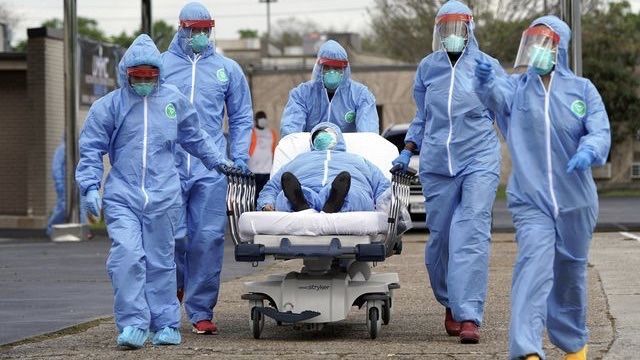
A person is taken on a stretcher into the United Memorial Medical Center in Houston, Texas after going through testing for COVID-19 (AP Photo/David J. Phillip)
And even these numbers are likely an underestimate. The CDC itself notes that mortality reporting is often behind by two months. Connecticut has not submitted its tally for pneumonia and influenza deaths since April 25, and North Carolina has not submitted such data since April 18. The most recent data collected, from the week ending on May 16, is at most 30.6 percent complete.
The likely higher numbers are corroborated by data from the website statista.com, which shows that from February to May 16, the number of COVID-19 deaths was 73,639, and that the number of pneumonia deaths was 89,555. Subtracting the seasonal average for pneumonia leaves 32,555 fatalities unaccounted for. Assuming again that these excess deaths were all caused by the pandemic, this brings the COVID-19 total during that period up to 106,194, an increase of 44 percent.
A review of this data also makes clear that the deadliness of the coronavirus dwarfs that of influenza. The data from statista shows 6,253 deaths from the flu, barely eight percent of the deaths from COVID-19. And even those, the site notes, also include “deaths with pneumonia or COVID-19 also listed as a cause of death.”
The unexplained sharp increase in pneumonia deaths is notable in many of the states that rushed to reopen as early as possible. In Colorado, which let its stay-at-home order expire on April 26, there are 919 coronavirus deaths recorded for April in the CDC’s provisional database and 762 fatalities from pneumonia, more than three times the seasonal average. If the excess deaths are counted as COVID-19, the state’s coronavirus mortality rate jumps by nearly 60 percent. Similarly for Mississippi, which loosened restrictions starting April 27, the real mortality rate is likely at least 49 percent higher.
The under-counting of COVID-19 deaths is being obfuscated by the CDC. There is a notable discrepancy between the pneumonia death count cited by the CDC and that cited by its NCHS unit, which is three times as high. The WSWS contacted the CDC to inquire about this discrepancy. The nurse responding on the phone admitted she was new and was unable to render much assistance, though she did agree there was a discrepancy. The call was then transferred to a manager who was also not able to explain the data. The call was transferred to the NCHS, then further transferred to the office of the director and a message was left on their answering machine requesting a callback. No callback came.
Even the 150,000 deaths calculated here could well be an undercount. Pneumonia may not be the only cause of death concealing the lethality of COVID-19, which is not just a respiratory disease, but attacks the lungs, heart, liver and brain. While the CDC does not have national data on heart disease for this year, state public health offices have published data which suggest that some cases of heart disease are ultimately derived from the pandemic.
In Michigan, for example, deaths from heart disease were up 20 percent in April from the total the previous year. Strokes, another potentially fatal symptom of the coronavirus, were up 18 percent from the previous year.
These issues are going to become more pronounced as the White House and state governors press for an even more rapid return to work. From the beginning, the chief concern of President Donald Trump and his cohorts in Washington has been to not spook the markets. The dangers of the pandemic have been downplayed since January, with Trump refusing to implement mass testing until well after the disease had achieved a beachhead in New York City and other areas of the country.
At the same time, the actual collection and reporting of the data itself has been muddled and suppressed. Last week, the employee in charge of Florida’s coronavirus database was fired after refusing to manipulate the data to justify Governor Ron DeSantis’ back-to-work order, an incident which has gone largely unreported in the national news. The CDC itself has come under fire for conflating nasal swab tests for the virus and antibody tests as both confirming the presence of coronavirus in a person, when the agency itself knows that these tests measure two different things, and that the latter test gives inaccurate results about half the time.
These are not coincidences. While no doubt some deaths caused by the coronavirus were mistakenly labeled as pneumonia or some other disease by an overworked coroner or medical examiner, workers should be suspicious that there is a concerted effort by the entire political establishment to manipulate data on the pandemic in order to facilitate its campaign to force the re-opening of factories, offices and plants while thousands are still dying of the coronavirus.

Mass anger erupts throughout the US in protests against police murder of George Floyd

Anthony Bertolt

Protests and demonstrations have erupted throughout the US in an explosive reaction to the police murder of George Floyd in Minneapolis, Minnesota.
In Minneapolis, thousands gathered on the same block where Floyd was killed and marched to the Minneapolis Third Police Precinct building. Multiple fires were burning Thursday, including at the Third Police Precinct, which remains on fire at the time of writing. The Minnesota National Guard announced late last night that 500 soldiers had been activated and were preparing to deploy.
Also late Thursday night, US President Donald Trump threatened to deploy the military against the demonstrators and shoot protesters. “I can’t stand back & watch this happen to a great American city, Minneapolis,” Trump tweeted. “Either the very weak Radical Left Mayor, Jacob Frey, get his act together and bring the City under control, or I will send in the National Guard & get the job done right.”
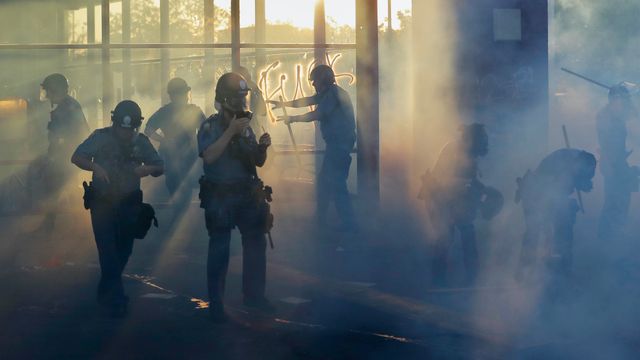
Police move through an area during demonstrations Thursday, May 28, 2020, in St. Paul, Minn. (AP Photo/Julio Cortez)
Trump called the protesters “THUGS” and said that he “just spoke to [Minnesota] Governor Tim Walz and told him that the Military is with him all the way. Any difficulty and we will assume control but, when the looting starts, the shooting starts.”
Demonstrations were also held in New York City, where 33 protestors were arrested after a scrum with police. Hundreds of people also participated in demonstrations in Columbus, Ohio; Albuquerque, New Mexico; Pensacola, Florida; Louisville, Kentucky; and Los Angeles, California. In Columbus, protesters attempted to break into the Ohio statehouse.
Several hundred gathered in downtown Louisville and marched through the streets to demand the arrest of the cops who killed Breonna Taylor in March. In Denver, Colorado, a protestor was hit by a car that forced its way through the crowd.
Floyd was murdered Monday after being seized by four Minneapolis cops who were responding to an alleged “forgery in progress.” As of Thursday, none of the cops involved in the murder had been arrested or charged.
Floyd repeatedly cried out for help, screaming “I can’t breathe” and “I’m gonna die,” as Derek Chauvin kneeled on his neck and Tou Thao helped keep the crowd from interfering.
At a Thursday afternoon press conference, Democratic Mayor Jacob Frey attempted to placate protesters and pleaded with them to “be better than we have been.” Minneapolis Police Chief Medaria Arrodondo joined in the plea to restore order in the city. “I know that there is currently a deficit of hope in our city… But I will not allow anyone to continue to increase that deficit by re-traumatizing those folks in our community,” he said.
Popular anger was further stoked Thursday by the comments of the prosecutor who has jurisdiction over the case, Hennepin County Attorney Mike Freeman. He told reporters that there is “other evidence that does not support a criminal charge… I will not rush to justice.”
Freeman is responsible for the decision to not bring charges against the officer who killed Jamar Clark in 2016, sparking days of protest, as well as the more than half-a-year delay in deciding to charge and arrest the officer who shot and killed Justine Damond in 2017.
The eruption of anger is not only over the killing of George Floyd. This is only the latest in an unending string of killing and brutalization. Every year, the police in the US kill 1,000 people in cities and states throughout the country, whether run by Democrats or Republicans.
To the outrage over police violence is added the explosive situation created by the response of the ruling class to the coronavirus pandemic. Trillions have been handed out to the rich, while tens of millions of workers are out of work and will not have a job to return to.
The Trump administration is seeking to utilize mass social distress to force a return to work that will lead to a sharp spike in COVID-19 cases and deaths. Already, more than 100,000 people have died from the coronavirus.
From the representatives of the ruling elite, there have been the usual hypocritical statements that follow every horrific police killing. Democratic presidential candidate Joe Biden, who was vice president under Barack Obama, declared that the killing of Floyd is “part of an ingrained systemic cycle of injustice that still exists in this country.” The Obama Justice Department repeatedly whitewashed police killings, refusing to bring federal charges against killer cops.
This is combined with the efforts of Democratic Party figures like Al Sharpton and Jesse Jackson to frame police violence as a product of racial conflict, as they did in speeches at the Minneapolis protest on Thursday.
There is no doubt that racism was involved the killing of Floyd and other incidents of horrific police violence. The most backward and fascistic layers are deliberately recruited into the police. The Trump administration in particular has encouraged unrestrained police violence with impunity.
However, the police are fundamentally an instrument of class rule. As social tensions reach a breaking point in the United States, the ruling class is turning ever more directly to the mobilization of its apparatus of repression.

American ruling class exploits the pandemic to escalate assault on jobs and wages

Jerry White

Another 2.1 million workers in the United States filed for unemployment benefits last week, according to the US Labor Department. This brings the total number of workers filing for jobless benefits to 40.8 million in the ten weeks since the pandemic led to the closure of much of the country’s economic activity in mid-March.
This number, which substantially understates the real scale of joblessness, is still a shocking 24.7 percent of the country’s labor force of 164.5 million people. Economists expect that May’s official unemployment rate, which will be released next Friday, will hit 20 percent, up from 14.7 percent in April.
Estimates of the real jobless rate exceed the historic record of 24.9 percent set in 1933 during the depths of the Great Depression. Millions of jobless workers are not counted in the official toll because they are undocumented immigrants, self-employed or so-called gig workers. Others not counted include those working part-time jobs and those who have given up looking for non-existent jobs. In addition, millions are not counted as unemployed because overwhelmed state agencies have not processed their claims, depriving them of any jobless benefits.
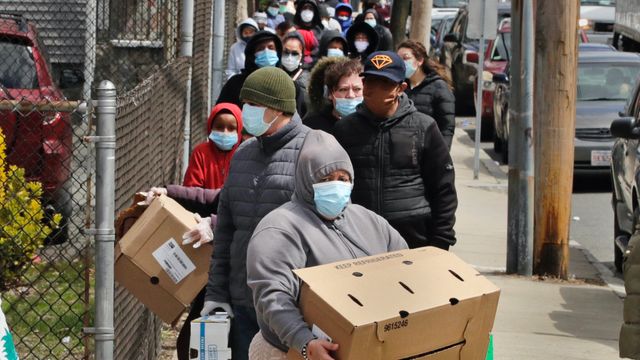
A woman carries a box of food away as hundreds others impacted by the COVID-19 virus outbreak wait in line at a Salvation Army center in Chelsea, Mass. (AP Photo/Charles Krupa)
Nevertheless, several states have staggering official jobless levels, including Washington (31.2 percent), Nevada (26.7), Florida (25.0), Hawaii (23.4), Michigan (23.1), California (20.6) and New York (19.9).
According to a University of Chicago report, 42 percent of the jobs that have been lost will never return. Major corporations are using the pandemic to accelerate restructuring plans drawn up long before the present crisis.
This week, Boeing announced it will cut 13,000 jobs, mostly in the US but also in Canada, Australia and New Zealand. American Airlines, which got a hefty portion of the $50 billion government bailout of the airlines, supposedly to retain employees, will slash 5,000 jobs, or 30 percent of its workforce.
This is part of a global trend. After receiving a multi-billion-dollar bailout from the French government, the Renault-Nissan auto alliance has released plans to close factories in France, Spain and other countries and slash more than 20,000 jobs. German auto supplier ZF Friedrichshafen plans to cut up to 15,000 jobs, or around 10 percent of its workforce, by 2025, with half the cuts in Germany.
After a decade of declining real incomes for workers, those returning to work are now facing the prospect of a new round of wage and benefit cuts. A Bloomberg News report cited the comments of Bruce Fallick, an economist at the Federal Reserve Bank of Cleveland, who said the circumstances of a public-health crisis probably make pay cuts more palatable to workers than they would normally be—at least initially.
Wage-cutting will hit every sector of workers, from nurses, grocery, delivery and other essential workers the corporate media has hailed as “heroes,” to office workers at Google, Facebook, Twitter, JPMorgan Chase, Walmart and other companies that are extending their work-from-home policies.
“Once people work from home, there will be an employment arbitrage,” Forbes recently noted, as companies “decide that a person working at home in Montana has the same skills as someone in Chicago, but will take a much lower salary. It will be hard for employees to negotiate for raises, as management will believe that they could easily find a replacement somewhere else within the United States or abroad.”
Meanwhile, corporations that have been handed billions of dollars by the federal government are proceeding to turn the bailout money over to their executives and investors.
In the name of “equal sacrifice,” major corporations have announced cuts to the base salaries of their chief executives. This is nothing but show, however. Base salaries account for only a tenth of the median pay of chief executives at the largest 500 US companies, with the bulk coming from stock awards.
Based on an examination of regulatory findings, Reuters found that scores of companies, including Uber, Delta Air Lines and Hilton hotels, had already made or were considering changes to pay plans to shield top executives from the economic fallout of the pandemic, even as profits plummeted and the companies slashed thousands of jobs.
Reuters reported that Sonic Automotive, which runs nearly 100 car dealerships, “changed its executive compensation plan from awarding stock based on performance to allowing executives to buy company stock, starting in 2021, at the depressed prices that shares hit on April 9 of this year. Their value has risen 67 percent since April 10, as a result of the stock market bubble produced by the Federal Reserve’s intervention and massive government stimulus spending. This has happened as sales fell about 40 percent year-on-year since the start of the pandemic, and the company furloughed or laid off 3,000 workers.”
Since the unanimous passage by the Democrats and Republicans of the CARES Act in late March, which authorized the US Treasury to spend trillions of dollars to take over the bad debts of banks and corporations, stocks have shot up by more than 35 percent. They are now just 10 percent below the record highs before the pandemic.
In the two months since Trump signed the CARES Act on March 27, the US death toll from COVID-19 has risen from 1,700 to over 103,000. Tens of millions have lost their jobs and are lining up for food assistance and face eviction as temporary moratoriums are lifted. During the same period, America’s billionaires have seen their net worth rise by $434 billion.
The ruling classes in every country are pursuing a homicidal policy of forcing workers back to unsafe workplaces even as the pandemic continues to spread, overwhelming new areas of the US and producing new nightmares in Mexico, Brazil, India and other countries. In every country, the capitalist governments are seeking to use economic pressure to force workers back, with Trump preparing to replace the $600 weekly supplement to unemployment benefits with a temporary $450 a week “back to work” bonus.
For the ruling class, workers are nothing more than “our human capital stock,” as Trump’s senior economic adviser Kevin Hassett said last week, to be herded back to work to produce the profits necessary to pay for the bailout of the rich.
But workers are not cattle. Prior to the pandemic, there was a major growth of social struggle and political radicalization of the working class in every country. In the US, the number of workers engaged in major strikes reached the highest levels in decades. The entire policy of the ruling class in response to the pandemic will produce a vast expansion of class conflict.
Workers must reject the false choice between their lives and their livelihoods. The fight against both the pandemic and the social catastrophe facing the working class is a fight against the financial oligarchy and the capitalist system. It is the fight for socialism.

28 May 2020

The Future of Forever War, American-Style

Danny Sjursen

Covid-19, an ongoing global human tragedy, may have at least one silver lining. It has led millions of people to question America’s most malignant policies at home and abroad.
Regarding Washington’s war policies abroad, there’s been speculation that the coronavirus might, in the end, put a dent in such conflicts, if not prove an unintended peacemaker — and with good reason, since a cash-flush Pentagon has proven impotent as a virus challenger. Meanwhile, it’s become ever more obvious that, had a fraction of “defense” spending been invested in chronically underfunded disease control agencies, this country’s response to the coronavirus crisis might have been so much better.
Curiously enough, though, despite President Trump’s periodic complaints about America’s “ridiculous endless wars,” his administration has proven remarkably unwilling to agree to even a modest rollback in U.S. imperial ambitions. In some theaters of operation — IraqIranVenezuela, and Somalia above all — Washington has even escalated its militarism in a fit of macabre, largely under-the-radar pandemic opportunism.
For all that, this is an obvious moment to reflect on whether America’s nearly two-decade-old “war on terror” (perhaps better thought of as a set of wars of terror) might actually end. Predictions are tricky matters. Nonetheless, the spread of Covid-19 has offered a rare opportunity to raise questions, challenge frameworks, and critically consider what “ending” war might even mean for this country.
In some sense, our post-9/11 wars have been gradually subsiding for some time now. Even though the total number of U.S. troops deployed to the Middle East has actually risen in the Trump years, those numbers pale when compared to the U.S. commitment at the height of the Iraq and Afghanistan wars. The number of American soldiers taking fire overseas has, in recent years, dropped to levels unthinkably low for those of us who entered the military around the time of the 9/11 attacks.
That said, in these years, even unwinnable, unnecessary wars have proven remarkably unendable. For evidence of this, look no further than that perennial war hawk Senator Lindsey Graham of South Carolina. Given the lack of success of the various campaigns run by U.S. Africa Command, or AFRICOM, across that continent and the Pentagon’s stated desire to once again pivot to great-power competition with China and Russia, just before the pandemic arrived on our shores Secretary of Defense Mark Esper announced plans for a modest troop drawdown in parts of Africa. Appalled by even such minor retrenchments, Graham, leading a bipartisan group of lawmakers, reportedly confronted Esper and threatened to make his “life hell,” should the secretary downsize U.S. forces there.
Less than two months later, AFRICOM declared a public-health emergency at the largest of this country’s African bases in Djibouti amid concerns that even far smaller, more spartan American facilities on that continent lacked the requisite medical equipment to fight the spreading virus. Whether the pandemic facilitates Esper’s contemplated reductions remains to be seen. (A mid-April AFRICOM press release offering reassurance that the “command’s partnership endures during Covid-19” doesn’t bode well for such a transformation.)
Still, the disease will surely have some effect. Just as quarantine and social-distancing measures have transformed people’s lives and work in the U.S., Washington’s war fighting will undoubtedly have to adapt, too. Minimally, expect the Pentagon to wage wars (largely hidden from public view) that require ever fewer of its troops to fight shoulder-to-shoulder with allies and fewer still to die doing so. Expect Washington to mandate and the Pentagon to practice what might increasingly be thought of as social-distancing-style warfare.
Soldiers will operate in ever smaller teams. Just as senior leaders constantly counseled us junior officers in the bad old days to “put an Iraqi face between you and the problem,” so today’s and tomorrow’s troopers will do their best to place drones or (less precious) proxy lives between themselves and enemies of any sort. Meanwhile, the already immense chasm between the American public and the wars being fought in its name is only likely to widen. What may emerge from these years is a version of war so unrecognizable that, while still unending, it may no longer pass for war in the classic sense.
To grasp how we’ve made it to a social-distancing version of war, it’s necessary to go back to the earlier part of this century, years before a pandemic like Covid-19 was on anyone’s radar screen.
American Wars Don’t End, They Evolve
When, as a young Army lieutenant and later captain, I joined what were then called “surges” in Iraq in 2006 and Afghanistan in 2011, conventional foot soldiers like me were the main game in town. The doctrine of counterinsurgency, or COIN, then ruled the Pentagon’s intellectual roost. The trick, so key commanders believed, was to flood the war zone with infantry brigades, securing the conflict’s “center of gravity“: the locals. Behind the scenes, Special Operations units were already taking on ever-larger roles. Nevertheless, there were ample “boots-on-the-ground” and relatively high casualties in conventional units like mine.
Times have changed. Full-scale invasions and long-term occupations, along with COIN as a war-on-terror cure-all, long ago fell out of favor. By Barack Obama’s second term, such unpopular and costly campaigns were passé. Even so, rather than rethink the efficacy of imperial interventionism, Washington simply substituted new methods masquerading as the latest strategy of success.
By the time Donald Trump delivered his “American carnage” inaugural address, the burdens of Washington war-making had flipped. When I served in Iraq and Afghanistan, about half of the Army’s 40-odd combat brigades were deployed in those two regional theaters at any given time. The remainder were training for their next rotations and already on the “patch chart” where each unit’s logo indicated its future scheduled deployment. This was the life on the conveyor belt of American war that a generation of soldiers like me lived. By January 2017, however, the number of conventional brigades deployed in the war on terror could be counted on one hand.
For instance, the Army’s most recent round of deployments, announced this April, included just six brigades. Of these, two were aviation units and, among the ground forces, one was headed for Europe, another for Kuwait. Only two ground combat brigades, in other words, were slated for Iraq, Syria, or Afghanistan and one of them was a reconstituted Security Force Assistance Brigade — essentially a skeleton crew of officers and noncommissioned officers meant to train and advise local troops. Meanwhile, the Pentagon’s Special Operations forces, which had by then crested above 70,000, a figure so large as to raise questions about how “special” they remained, stepped onto that conveyor belt. America’s commandos now bear most of the burden of forever-war deployments and (modest) casualties.
A Two-Tier War-Making System
When the virus struck, the Pentagon had long been developing a bifurcated military machine with two separate and largely discrete roles. The commandos — with key assists from drones, CIA paramilitaries, local proxies, and private security contractors — continued to fight the lingering war on terror. They were generally handling the lethal end of American war, calling in airstrikes, while training, advising, and sometimes even leading often abusive indigenous forces.
Conventional active-duty brigades — reduced to 32 — were largely given quite a different task: to prepare for a future revamped Cold War with Russia and, increasingly, China. That crew — infantry, armored brigades, and Navy carrier squadrons — had the “new,” purportedly vital mission of checking, containing, or challenging Moscow in Eastern Europe and Beijing in the South China Sea. Senior generals and admirals were comfortable with such Cold War-style tasks (most having been commissioned in the mid-1980s). However, viewed from Russia or China, such missions looked increasingly provocative as ever more American riflemen, tanks, and warships regularly deployed to former Soviet republics or, in the case of the Navy, to Western Pacific waters that abut China, making the risk of accidental escalation seem ever more conceivable.
Meanwhile, those shadowy special operators were directing the ongoing shooting wars and other conflicts, which, though given precious little attention in this country, seemed patently counterproductive, not to say unwinnable. For the Pentagon and military-industrial-complex profiteers, however, such unending brushfire conflicts, along with a new great power build-up, were the gift that just kept giving, a two-tiered modus operandi for endless war-funding.
Enter the coronavirus.
In Cold Blood
Thought of a certain way, American war will, in the future, increasingly be waged in cold blood. While Covid-19 spreads virally through respiratory droplets, the disease of endless war continues to be blood-borne (even if ever less of it is American blood), ensuring that the social-distancing-style combat of the future could become even more of an abstraction here.
In addition, the preferred post-pandemic warriors of that future may not be uniformed soldiers, special or otherwise, or necessarily American — or in some cases (think drones and future robotic weaponry) human. U.S. war fighting has already been increasingly privatized. Only recently, Erik Prince, the former CEO of the private military company Blackwater, an influential Trump ally as well as the brother of Secretary of Education Betsy DeVos, pitched the president on a far-fetched plan to privatize the whole Afghan War.
The Donald passed on the offer, but that it was even considered at such a high level suggests the role of private contractors and soldiers of fortune in future American war-making may be here to stay. In that sense, the recent fiasco of an armed raid led by former Green Berets-turned-mercenaries and aimed at the Venezuelan government of Nicolás Maduro may prove as much a foreboding glimpse of the future as it was a farce.
When uniformed U.S. service members are deemed necessary, the trend toward using just handfuls of them to run an increasingly proxy-war machine is likely to accelerate. Such teams will fit well with public-health guidelines limiting gatherings to 10 people. For instance, drone ground control stations, essentially mobile trailers, require only a pair of operators. Similarly, the military’s newest cyberwar branch (formed in 2015) may not be made up of the hackers of Donald Trump’s imagination (“somebody sitting on their bed that weighs 400 pounds”), but they, too, will work in tiny teams abroad, and at a great distance. Pushing those guidelines just a tad will be Army Special Forces A-Teams of 12 Green Berets each, which may prove to be core building blocks for a new American version of post-pandemic warfare.
Most disturbingly, American social-distancing ways of war will likely operate smoothly enough without suppressing terrorist groups any more successfully than the previous versions of forever war did, or solving local ethno-religious conflicts, or improving the lives of Africans or Arabs. Like their predecessors, future American wars in cold blood will fail, but with efficiency and, from the point of view of the military-industrial complex, lucratively.
Here, of course, is the deep and tragic paradox of it all. As the coronavirus should have reminded us, the true existential threats to the United States (and humanity) — disease pandemics, a potential nuclear Armageddon, and climate change — will be impervious to Washington’s usual military tools. No matter the number of warships, infantry and armored brigades, or commando teams, none of them will stand a chance against lethal viruses, rising tides, or nuclear fallout. As such, the Pentagon’s plethora of tanks, aircraft carriers (themselves petri-dishes for any virus around), and towers of cash (sorely needed elsewhere) will, in the future, be monuments to an era of American delusion.
A rational (or moral) system with any semblance of genuine legislative oversight or citizen input might respond to such conspicuous realities by rethinking the national security paradigm itself and bringing the war state to a screeching halt. Unfortunately, if America’s imperial past is any precedent, what lies ahead is the further evolution of twenty-first-century imperial war to the end of time.
Post-Pandemic War
Still, Covid-19 may prove the death knell of American war as classically imagined. Future combat, even if broadly directed from Washington, may be only vaguely “American.” Few uniformed citizens may take part in it and even fewer die from it.
During the prolonged endgame of wars that don’t really end, U.S. military fatalities will certainly continue to occur in occasional ones and twos — often in far-flung places where few Americans even realize their country is fighting (as with those four U.S. troops killed in an ambush in Niger in 2018 and the Army soldier and two private contractors killed in Kenya earlier this year). Such minuscule American losses will actually offer Washington more leeway to quietly ramp-up its drone attacks, air power, raiding, and killing, as has already happened in Somalia, with assumedly ever less oversight or attention at home. As in the Horn of Africa of late, the Pentagon won’t even have to bother to justify escalations in its war-making. Which raises a sort of “if a tree falls in the forest and no one is there…” conundrum: if the U.S. is killing brown folks around the world, but hardly anyone notices, is the country still at war?
Moving forward, policymakers and the public alike may treat war with the same degree of entitlement and abstraction as ordering items from Amazon (especially during a pandemic): Click a button, expect a package at the door posthaste, and pay scant thought to what that click-request set in motion or the sacrifice required to do the deed.
Only in war, one thing at least stays constant: lots of someones get killed. The American people may leave their wars to unrepresentative professional “volunteers” led by an unchecked imperial presidency that increasingly outsources them to machines, mercenaries, and local militias. One thing is, however, guaranteed: some poor souls will be at the other end of those bombsights and rifle barrels.
In contemporary battles, it’s already exceptionally rare that a uniformed American is on that receiving end. Almost midway through 2020, only eight U.S. service members have been killed by hostile fire in Iraq and Afghanistan combined. Yet many thousands of locals continue to die there. No one wants U.S. troops to die, but there’s something obscene — and morally troubling — about the staggering casualty disparity implicit in the developing twenty-first-century American way of war, the one that, in a Covid-19 world, is increasingly being fought in a socially-distanced way.
Taken to its not-unimaginable extreme, Americans should prepare themselves for a future in which their government kills and destroys on a global scale without a single service member dying in combat. After the pandemic, in other words, talk of “ending” this country’s forever wars may prove little more than an exercise in semantics.

World Bank Mission Billion Challenge “WURI West Africa Prize” 2020

Application Deadline: 14th August 2020

About the Award: The West Africa Unique Identification for Regional Integration and Inclusion (WURI) program facilitates access to services through foundational identification platforms for all persons in participating territories. The Mission Billion Challenge is hosted by the World Bank’s Identification for Development (ID4D) initiative. The WURI West Africa Prize is supported by ID4D, Rapid Social Response Program (RSR) and Disruptive Technologies for Development (DT4D).
The 2020 Mission Billion Challenge comes at a time of an unprecedented global crisis. The pandemic highlights the importance of platforms (such as foundational IDs, government to person (G2P) payments, and social registries) to quickly scale up or to introduce new social protection programs. Countries with such platforms have been able to efficiently deliver relief payments to informal workers, migrant workers, and other vulnerable populations who are difficult to identify and not commonly included in social safety nets. 

Type: Contest

Eligibility: The WURI West Africa Prize is seeking innovative solutions that facilitate cross border contributions to social insurance programs, such as pensions and savings accounts, by informal sector workers. More than 80 percent of workers in Sub Saharan Africa are in the informal sector, and nearly 90 percent of employed women are informal workers. 
Individuals and organizations with a strong passion for developing innovative solutions are encouraged to apply. Submitted solutions to the Challenge will be reviewed by experts in social protection platforms, digital identification and international development.

Number of Awards: Not specified

Value of Award:
  • The Challenge offers cash prizes totaling US$150,000 for the most promising ideas that help countries to include informal workers in shock-responsive social protection programs. 
  • Finalists will receive mentorship and support from Google Developers Experts and be invited to a high-level Mission Billion event to present their solutions to distinguished judges in October 2020.
How to Apply: To learn more about the Challenge, visit: solve.mit.edu/challenges or worldbank.org/missionbillion
  • It is important to go through all application requirements in the Award Webpage (see Link below) before applying.
Visit Award Webpage for Details

UNDP COVID-19 Detect & Protect Challenge 2020

Application Deadline: 30th June, 2020 at 12:00AM PT

About the Award: As COVID-19 has shown, challenge and crisis cross borders – impacting everywhere on Earth. However, innovation and ingenuity are not constrained by geography. The COVID-19 Detect and Protect Challenge is an opportunity to find and apply the best and brightest of humanity, wherever it may be found.
A panel of judges will review and select the top 10 open source solutions on a rolling basis through 2020. Winners will receive global recognition and variety of awards for their contribution to society and humankind. Using the UNDP’s vast global network and resources from all supporting partners, we’ll work with the winning creators on the best way to transfer the knowledge to those who need it most. 
This challenge has three priority actions:
  • Design replicable, low-cost tools to aid in coronavirus detection
  • Flatten the curve in communities with preventive solutions 
  • Reduce the disease’s impact on economies of these vulnerable areas
Type: Contest

Eligibility: You are eligible to enter if you meet the following requirements at thetime of entry:
  • You are at least 13 years of age
    If you are 12 years or younger, you must receive a legal guardian’s permission and have them complete Hackster’s contest permission formprior to submitting an entry into this contest. Send any questions to contests@hackster.io.
  • You are not involved in the execution or administration of this contest.
  • You are not an immediate family member or household member of a Hackster employee.
Submission requirements
To be eligible for judging, you must meet ALL of the following requirements unless otherwise stated:

General Requirements
  • You must be registered as a participant for this contest.
  • Your entry must be your own original work. Learn more about copyright and open-source guidelines.
  • Your entry cannot have been selected as a winner in any other Hackster contest.
  • Your team can be of any size.
  • Your project must be a/an easy-to-replicate, low-cost open-source solution to detect or protect Covid-19 in developing countries.
*By entering a submission to this contest on behalf of a team, you acknowledge that you are the designated representative authorized to act on behalf of your team. (See full rules below for details)

Project Documentation Requirements
  • Your project must include a project name, project description, cover image, bill of materials (BOM), full instructions, images, and relevant resource files (schematics, code, CAD).
  • Your project must be written in English.
  • Your project must be submitted by Jun 30, 2020 at 12:00 AM PT
Eligible Countries: All

Number of Awards: 10

Value of Award: Win up to $25,000 in prizes!
Winners will receive global recognition and variety of awards for their contribution to society and humankind. Using the UNDP’s vast global network and resources from all supporting partners, we’ll work with the winning creators on the best way to transfer the knowledge to those who need it most. 

How to Apply: JOIN THE CHALLENGE
  • It is important to go through all application requirements in the Award Webpage (see Link below) before applying.
Visit Award Webpage for Details

RNTC Fully-funded Media & Journalism Scholarships 2021/2022 for African & Developing Countries – The Netherlands

Application Deadline: 30th June 2020 16:00 CET.

Eligibility Subject Areas: As of today you can apply with a scholarship for the following courses:
  • Investigative journalism
  • Media campaigns
  • Producing media to counter radicalisation
  • Using media for development
About Scholarship: The RNTC Netherlands training centre provides training for media professionals from all over the world: from journalists and programme-makers to social activists and communications professionals from non-governmental organisations. Whether you are a journalist, a blogger or a media manager, there are courses to fit your needs.
The most commonly used scholarship for RNTC courses are the NFP and MSP (MENA) scholarships. NFP stands for Netherlands Fellowship Programmes (NFP), MSP stands for MENA (Middle East and North Africa) Scholarship Programme.

Type: Short courses

Selection Criteria: The scholarships will be awarded on academic and professional merit.

Eligibility: RNTC Netherland Fellowships are available for professional journalists, programme-makers, broadcast trainers and managers coming from the countries listed below (a combined NFP list and low-middle-income countries according to the World Bank criteria).

Scholarship Benefits: An NFP or MSP scholarship will cover the full cost of your travel and visa (if required), accommodation and meals, insurance, and the course fee. The NFP and the MSP scholarship programmes are funded by the Dutch Ministry of Foreign Affairs and administered by Nuffic, the Netherlands Organisation for International Cooperation in Higher Education.

Duration: scholarships are available for courses of two weeks or longer.

Eligible African Countries: Angola, Benin, Burkina Faso, Burundi, Cameroon, Cape Verde, Djibouti, DR Congo, Egypt, Ethiopia, Ghana, Guinea-Bissau, Ivory Coast, Kenya, Lesotho, Mali, Mauritania, Mongolia, Morocco, Mozambique, Namibia, Nigeria, Rwanda, Senegal, South Africa, Sudan, South Sudan, Swaziland, Tanzania, Uganda, Zambia, Zimbabwe

Other Countries: Afghanistan, Albania, Armenia, Autonomous Palestinian Territories, Bangladesh, Belize, Bhutan, Bolivia, Bosnia-Herzegovina, Brazil, Cambodia, Colombia, Costa Rica, Cuba, Ecuador, El Salvador, Eritrea, Fiji, Georgia, Guatemala, Guyana, Honduras, India, Indonesia, Iraq, Iran, Jordan, Kiribati, Kosovo, Laos, Macedonia, Marshall Islands, Micronesia, Moldova, Nepal, Nicaragua, Pakistan, Papua New Guinea, Peru, Philippines, Samoa, São Tomé and Principe, Solomon Islands, Sri Lanka, Suriname, Syria, Thailand, Timor-Leste, Tonga, Turkmenistan, Tuvalu, Ukraine, Uzbekistan, Vanuatu, Vietnam, Yemen

To be taken at (country): The Netherlands

How to Apply: If you want apply for a scholarship to cover the costs of the course, you need to apply to both RNTC (for your course application) and OKP (for a fellowship).
You can apply twice a year during an ‘application window’ to see if you are eligible for a OKP or MSP scholarship. There are many more applications than there are scholarships available. Therefore, it is important that you meet all of the RNTC criteria (see individual course pages) as well as the Nuffic criteria, which you can find at the bottom of this page. If you meet all the RNTC ánd Nuffic criteria, and you would like to apply, then please follow all the steps in our How to apply page.

Visit the Scholarship Webpage for details