9 Jun 2020

Economic Collapse and Unemployment Councils – Then and Now

W.T. Whitney Jr.

Hunger, homelessness, and evictions were features of the Great Depression in the United States. Jobs disappeared and working conditions deteriorated. Some “250,000 teenagers were on the road.” And how many others? By 1933 one third of farm families had lost their farms. Unemployment that year was 25 percent. The lives of working people were devastated.
The federal government’s New Deal led to political and social reforms. Now the U.S. government once more has a big economic crisis on its hands, this one associated with the COVID 19 pandemic. It’s providing mostly financial relief, with a lot going to big economic players.
During the Great Depression, people responded at the grassroots level too, particularly in urban neighborhoods. In the midst of another economic crisis, it makes sense that something similar happen again. This report is about a grassroots tool of 90 years ago and about its potential usefulness now. As will be seen, assaults on working people are harmful enough now to provide ample justification for possibly picking up that tool again.
In fact, workers and their families created their own means of rescue as the Great Depression took hold. Demanding food, housing, and jobs, they organized, agitated, and prodded politicians to provide relief and reform. They did so through the Unemployed Councils. New in early 1930 and organized by the Communist Party USA, the Councils took root in many cities.
They came into being step by step. In 1929 the Comintern decided that capitalist crisis manifesting as a worldwide economic depression required a “revolutionary offensive.” Responding, the CPUSA formed its Trade Union Unity League. That organization set up “Councils of Unemployed Workers.” According to a Party publication, “the tactical key to the present stage of class struggle is the fight against unemployment.”
At once the Unemployment Councils organized unemployment protests that swept across the country. March 6, 1930 was designated as “International Unemployment Day,” a day when one million demonstrators filled the streets of cities.
Thousands of police violently attacked more than 100,000 workers filling New York’s Union Square. Demonstrations continued over several months in many cities, as did police harassment. New recruits flooded the Unemployment Councils. March 6 became an annual occasion for repeat nationwide demonstrations.
The Unemployment Councils, functioning autonomously in urban neighborhoods, pressured local relief officials to assist individuals and families. They badgered utility companies to restore gas or electricity to non-paying households. The Councils organized rent strikes beginning in 1931. They recruited crowds that, having overwhelmed the police and local officials, allowed evicted tenants to return to their dwellings. Council activists besieging city offices demanded reduced rents and no more evictions.
The Unemployment Councils reached out to Black workers, even in southern cities. Actions of the Unemployment Councils helped provide impetus for New Deal reforms like unemployment insurance, protection of labor rights, and security for elderly Americans and children.
Hunger marches organized by the Unemployment Councils took place in various cities from 1931 on. The police killed five people marching in the “Ford Hunger March” in Dearborn, Michigan on March 7 1932; 60,000 people joined the funeral procession. At a national hunger march converging on Washington on December 7,1931, marchers demanded unemployment insurance and a “social insurance system to cover maternity care, illness, accidents, and old age.”
A year later even more marchers, mainly Communist Party members, descended on Washington for a repeat national hunger march. They called for jobs, relief measures, taxation of the wealthy, and an end to racial discrimination. Members of Congress met with march leaders. The Roosevelt administration would soon direct states to expand relief efforts and promote job programs.
The CPUSA set up “The Unemployment Council of the U.S.A.” in 1931 in part to deal with rapid turn-over of community activists affiliating with local Councils. The problem would remain. The national Council provided local Councils with guidance on national and international issues. Even so, individual Councils focused primarily on the hardships and needs of workers and their families, in their own neighborhoods.
The national organization in 1932 published a 20-page pamphlet titled: “Fighting Methods and Organization Forms of the Unemployed Councils: A Manual for Hunger Fighters.” The introduction begins:
“The Unemployed Councils base their program on a recognition of the fact that those who own and control the wealth and government are willing to allow millions to suffer hunger and want in order that their great wealth shall not be drawn upon for relief. We know that the living standards of employed and unemployed alike will be progressively reduced unless we organize and conduct united and militant resistance. We know that the amount and extent of relief which the ruling class can be compelled to provide depends upon the extent to which the unemployed and employed workers together organize and fight….”
The trajectory of the Councils changed. New Deal relief programs took effect, and the Communist Party, following the lead of the Comintern, turned to alliances with other progressive forces. This was the Popular Front. The Unemployment Councils gradually gave way to the Workers Alliance of America, formed by the CPUSA in 1936 and based in Washington. The Alliance welcomed Socialist Party unemployment groups and pacifist A.J. Muste’s Unemployment League. Its activities centered on lobbying for relief measures and worker protection.
Pandemic and sick economy
The Unemployment Councils were new and, within the context of that era, were extraordinary. They attended solely to the needs of workers. They were based in local communities. And they were a creature of the Communist Party. Their time may have come again.
One determining factor is the severity of the current economic collapse and its impact on the lives of working people. Indeed, this crisis looks like it’s going to hurt workers and their families as much as did the Great Depression. The assumption here is that the extraordinary nature of the present danger to working Americans must be appreciated in order to accept the idea that an extraordinary instrument of repair, the Unemployment Councils, is required once more.
Unemployment – As of early June, 42.6 million U.S. workers had filed unemployment claims. The official unemployment rate was 14.7 percent in April, 13.3 percent in May. In May the official rate for Black people was 16.8 percent and for Latinos, 17.6 percent. However, “a quirk in BLS methodology” (Bureau of Labor Statistics) misclassified people absent from work due to COVID 19. The actual unemployment rate in April was 23.6 percent. According to economist David Ruccio, the total of the underemployed plus the officially unemployed represents 31 percent of the U.S. labor force.
Significantly, ”39 percent of employed people in households making less than $40,000 lost their job or [had] been furloughed in March.” Official unemployment figures don’t include the chronically non-employed. The Brookings Institute reports that, in 2017, 15 percent of “American men between the ages of 25 and 54” were not working for a variety of reasons, imprisonment and others.
Housing Loss – That many workers can’t pay rent sets the stage for evictions. Signs of tenant resistance have cropped up. For instance, Rent Strike 2020 is a “disaster relief organization owned and controlled by regular working people.” It demands that states “freeze rent, mortgage and utility bill collection for 2 months, or face a rent strike.” According to the website westriketogether.org, 33 percent of residential tenants didn’t pay rent in May and almost 350,000 tenants have signed a rent-strike pledge.
Access to Health Care – Many of the newly unemployed have lost their employer-based healthcare insurance. They can’t pay for health care and soon will total 11 million working people. A crisis of access existed already. In 2018, no less than 30.1 million people under the age of 65 lacked health insurance. In 2019, 28 percent of adults with employer-based health insurance were underinsured.
Food is short – The Brookings Institute recently declared that, “By the end of April, more than one in five households in the United States, and two in five households with mothers with children 12 and under, were food insecure “ In April, “21.9 percent of households with nonelderly adults were food insecure”.
Dairy farmers are dumping milk. Hog and chicken farmers are killing their animals and growers are plowing crops into the ground. These are “scenes reminiscent of the Great Depression,” and, says the Guardian, “overproduction will sour the market.” This is a crisis of capitalism.
Racism – Non-white populations are vulnerable. They are generally sicker than white people from illnesses like diabetes, cardiovascular disease, asthma, HIV, morbid obesity, and kidney disease. That’s mostly because racial discrimination encourages low-quality health care, reduced access to care, and lack of preventative care. Racism forces a disproportionate number of non-white workers to live in places full of environmental toxins. The stress of living under racism may lead to or worsen physical illnesses.
These points of vulnerability translate into high risk, plainly evident as African Americans and Latinos people confront the COVID 19 virus. One report has it that “COVID-19 mortality rate [in May] for Black Americans is 2.4 times as high as the rate for Whites and 2.2 times as high as the rate for Asians and Latinos.” Latinos, 18 percent of the U.S. population, in April accounted for 25 percent of COVID 19 deaths. Death rates for Blacks and Latinos living in cities range from two to four times higher than white people living in cities.
At issue here is suffering caused by economic crisis. Resilience helps economically-abused victims survive, and resilience may be in short supply for a class of people hit exceptionally hard by the COVID 19 virus. Besides, most of these victims are members of the working class, and they are more likely than higher-income employees to have been working “in public-facing occupations” and to experience “inequitable distribution of scarce testing and hospital resources.”
Women are victims– According to one report, the “hardest hit [during the pandemic] will be the world’s women and girls and populations already impacted by racism and discrimination … Women are 70 percent of the global health workforce and the majority of social workers and caregivers.” They “deliver 70 percent of global caregiving hours.” The report does not mention that these multitudes of women doing necessary work belong overwhelmingly to the working class, in the United States and elsewhere.
The broad conclusion here is that the impact of this economic downturn has been and will be disastrous for working people, extraordinarily so. The usual governmental remedies seeking to balance worker and business interests won’t adequately serve the working class. Too often what is done ends up pitting the needs of workers against the needs, real and imagined, of those who lack for nothing. And guess who losses out!
The Unemployment Councils provided an extraordinary boost in their time to workers and their families. A return engagement is in order, in one form or another.
A peripheral concern must be attended to. The argument may be advanced that this economic crisis will be brief and so why go to all the trouble? No, it will not be brief.
U.S. delay in preventing spread of the virus allowed the pandemic to build. Lax social-distancing and irregular quarantine will ensure its prolongation. A comprehensive regimen of testing, tracing of contacts, and quarantine would have made all the difference, according to a medical expert.
The virus has charge of the U.S. economy, said Federal Reserve Chair Jerome Powell: “We are now experiencing a whole new level of uncertainty, as questions only the virus can answer complicate the outlook.” (NY Times, May 21)
Besides, an already flawed U.S. economy doesn’t rate a quick fix. It was already stumbling due to “stagflation” (inflationary tendencies co-existing with stagnant economic output), unpayable debt, and financialization. The latter signifies diminished productive capacity.
Correlations
This report on the potential usefulness now of Unemployment Councils is of an introductory nature. Even so, it does appear that the Councils have great potential to meet the needs of many working people in great trouble now in the United States – but not all of them.
The Councils’ usefulness would rest on conditions under which they would be applied. One would be that they deal with unemployment, lack of housing, and hunger. These are problems presenting both now and then in roughly similar fashion. Another would be that Councils of today pay heed to features characterizing their performances then. These included: attention to workers’ most pressing social and economic needs, rapid response, militancy, and long-term revolutionary goals. All were crucial to the Councils’ achievements.
Other problems of today don’t fit with interventions of the kind offered years ago by Unemployment Councils. These are: reduced access to healthcare, racial inequalities, and gender inequalities. They were as problematic then as they are now, but society and even worker organizations of that time either accepted the injustices they represented or weren’t prepared to engage with them.
Those still unmet needs do demand attention now and any version of renewed Unemployment Councils would have to accommodate them. The difficulties in doing so represent a threshold that revived Unemployment Councils would have to overcome. How that would happen without major revamping is unclear.
This inquiry is incomplete. The feasibility of bringing back Unemployment Councils hasn’t been dealt with. At first glance, the people-power needed for strengthening new Councils and for maintaining their working-class orientation looks to be missing. It was different earlier. Communist organizers drew upon enthusiasms left over from socialist and workers’ movements that had peaked two decades earlier. They took new encouragement from socialist revolution in Russia in 1917. But to know about any resulting advantage and much more, detailed exploration is required.
Worker-to-worker solidarity, the business of the Councils, never involved ideas of mutual aid often associated with anarchist or libertarian political movements. The Councils never embraced doctrinaire resistance to state authority, or self-reliance of local communities, or exclusively horizontal power relationships. This is another instance of investigation left for another day.

Saudi Arms Sales, the Ghost of a Reporter, and America’s Oil War in Yemen

Charlotte Dennett

The brutal killing of George Floyd by police, followed by the president’s calls for military intervention against protestors, are causing words like “dictatorship,” “authoritarianism,” and even “fascism” to become part of the national discourse. But the president has been dismantling constitutional safeguards for a long time, and the racism he and his administration have broadcast across the nation extends around the world, too.
In Iraq, where civilian populations have long suffered under the heel of American militarism, protesters applauded the demonstrations in American cities. In Yemen, now in its fifth year of a US-armed Saudi war that has decimated civilian populations, its desperately poor people are bracing for an onslaught of covid-19 due to cuts in UN assistance by Gulf countries allied with the US. But while this tragedy is going largely unnoticed, some key American lawmakers are trying to hold the Trump Administration — and Secretary of State Mike Pompeo in particular —accountable for mishandling the war in Yemen through illicit arms sales to Saudi Arabia.
A Congressional hearing on June 3rd focused on the abrupt firing last month of the man looking into the arms sales, the Inspector General charged with oversight of the State Department, including the secretary of state.
IG Steve Linick, who accused Pompeo of misconduct, has become the latest victim in a string of politically motivated firings of government watchdogs. If the president’s bunker mentality isn’t disturbing enough, a deeper look into this scandal shows how racism lies at the heart of Trump’s and Pompeo’s foreign policy. And how oil, most notably in the Middle East, and most particularly, in Yemen, is the driving force.
Trump’s Love Affair with Oil
Donald Trump, a mere real estate developer before becoming president, has not been shy about his love of the powerful oil industry, whether domestic or Middle Eastern. Defying Washington’s tradition of hiding the role of oil in foreign policy, he has embraced oil power exuberantly and unapologetically, as when he appointed Rex Tillerson, former CEO of Exxon-Mobil, as his first secretary of state shortly after taking office. Then last fall he scandalized the international community when he redeployed American troops to Eastern Syria to “secure our [sic] oil.” Most recently, his administration secretively doled out at least $113 million to oil companies in taxpayer-backed loans under the Paycheck Protection Program, intended for small businesses hurt by Covid-19.
Now Trump’s brazenness is backfiring against his most recent Secretary of State. Members of the House Foreign Affairs Committee and Senate Foreign Relations Committee investigating Linick’s firing last month want to know if it was an act of retaliation by Pompeo. The secretary has denied the charge, but his timing was certainly suspect.
As first reported by the Washington Post on May 16, Linick was wrapping up an investigation of Pompeo’s approval one year ago of unauthorized arms sales worth $8 billion to Saudi Arabia, defying the will of Congress. The weapons’ ultimate destination: the Saudis’ widely condemned war in Yemen, deemed the world’s greatest humanitarian crisis.
Linick briefed the State Department of his findings before issuing his report, which assuredly set off alarm bells in Pompeo’s office and plausibly resulted in Linick’s abrupt dismissal. The congressman who originally asked for the investigation, Representative Eliot Engel, Chair of the House Foreign Affairs Committee, told the Washington Post, “We don’t have the full picture yet but it’s troubling that Secretary Pompeo wanted Mr. Linick pushed out before this work could be completed.” In his testimony Wednesday, Linick said a top department official “bullied” him, pressuring him not to pursue his investigation into arms sales to Saudi Arabia. Democratic lawmakers, in a statement released after the testimony, urged the administration “to immediately comply with outstanding requests for additional witness interviews and documents.”
As with all things Middle East, it’s never easy to get the full picture right away. With oil riches gumming up so many human interactions, including war and pretexts for war, assassinations and regime changes, the path to the truth can be littered with lies. It took me decades of research and years of filtering that research into a book, for instance, to figure out what the Great Game for Oil had to do with the death of my father in a mysterious plane crash following his top-secret mission to Saudi Arabia.
Now, at least, I know where to look and how to look when questions loom. I  analogize this to peeling an onion, beginning with the most obvious question.
First peel: Why did Democrats and Republicans object to arms sales to Saudi Arabia last year?
The answer, in this case, can be boiled down to three words: cold blooded murder. The murder victim in this case was a Washington Post columnist and an exiled Saudi national named Jamal Khashoggi. Two months before his death in October, 2018, Khashoggi had written disparagingly about the Saudis’ disastrous war against Yemen, then in its third year. The war had become an acute international embarrassment, especially after Saudi coalition forces bombed a school bus on August 9, 2018 killing forty children and thirty-two nearby civilians. By August 19, CNN reported that the bomb used in the attack was a US-made, 227-kilogram laser guided bomb manufactured by Lockheed Martin.
News like this was not helpful to Saudi Arabia’s reigning crown prince, Mohammed bin Salman (nicknamed MSM), nor to his closest allies, Donald Trump and son-in-law Jared Kushner, who strived to turn Saudi Arabia into a mecca for international investment (think hotels and resorts along the Red Sea). Those ambitions crystallized a few months after the newly elected Trump took then Secretary of State Rex Tillerson on his first official trip overseas in March, 2017 — not (as is tradition) to visit any of our democratic allies, but to visit Saudi Arabia, one of the most oppressive regimes in the world. That trip was made memorable by images of Trump jubilantly dancing the sword dance with his white-robed royal hosts.
As I pointed out in The Crash of Flight 3804, they were dancing for joy after negotiating $350 billion in US aid, including the sale of $100 billion in US armaments to the kingdom. It was a nice quid pro quo: You have oil, we have arms. We can make a lot of money from US arms sales and hotel tourism. provided you modernize Saudi Arabia and institute some reforms like letting women drive. In return, we will help you win your unpopular war in Yemen.
But Jamal Khashoggi kept getting in the way with his Washington Postcolumns. ”Saudi Arabia must face the damage from the past three plus years of war in Yemen,” he wrote on September, 2018. “The conflict has soured the kingdom’s relations with the international community and harmed its reputation in the Islamic world.” But Khashoggi didn’t stop there. He singled out Donald Trump’s “good friend,” crown prince Mohammed bin Salman, for additional criticism: “The crown prince must bring an end to the violence,” he wrote, concluding with a fatal barb, “and restore the dignity of the birthplace of Islam.”
One month later, Khashoggi was brutally murdered, hacked to pieces in the Saudi embassy in Turkey by a bone saw wielded by the head of Saudi security forces. During the ensuing investigation President Trump kept prevaricating over holding MBS (now widely referred to as Mohammed Bone Saw) responsible for Khashoggi’s murder despite international cries for accountability and the CIA’s assessment that MBS was behind the killing. Trump repeatedly reminded Americans of the kingdom’s importance as a “strong ally,” especially as a counterweight to Iranian ambitions in the Middle East. Pompeo, pictured here with the Saudi king just days after the Khashoggi murder, agreed.
Trump simply attributed the murder to “rogue killers” while making no commitment to lessening arms sales to Saudi Arabia. The armaments industry was, after all, creating a lot of jobs, he argued. It didn’t matter that the death toll in Yemen was fast approaching 100,000 since the war began in 2015.
This was just too much for Congress. Democrats and Republicans alike insisted Saudi Arabia would have to be punished for the war in Yemen and the murder of its most ardent critic, who, after all, had written for the powerful Washington Post. In early April, 2019 both the House and the Senate passed the Yemen War Powers Act, a bipartisan bill aimed at stopping all US involvement — including arms sales — to Yemen. On April 19, President Trump vetoed the bill.
The following month he and Pompeo declared emergency powers in order to bypass Congress and deliver $8 billion worth of arms sales, mostly to Saudi Arabia and its wartime ally, the United Arab Emirates, in order to stop “the malign influence of Iran in the middle East.” Once again, members of Congress cried foul, questioning Trump’s legal justification for invoking emergency powers and reiterating their concerns about Saudi Arabia’s dismal human rights record and the murder of Jamal Khashoggi.
Apparently, Representative Eliot Engel never got over Trump’s act of impunity, and so he called upon the Inspector General to investigate.
Second peel: Is there an oil connection to the US-Saudi war in Yemen?
It stands to reason, since Saudi Arabia ignored widespread condemnation to pursue its war in Yemen at all costs. That term, “at all costs,” has been employed repeatedly through decades of endless wars in the Middle East, beginning when my father wrote in a memo to his superiors at the Office of Strategic Services (OSS) in 1944 that the oil of Saudi Arabia was so vitally important to US interests that it had to be protected “at all costs.” Protected, that is, by vast amounts of US military assistance to the Kingdom, which from 1950 to the present amounts to trillions of dollars.
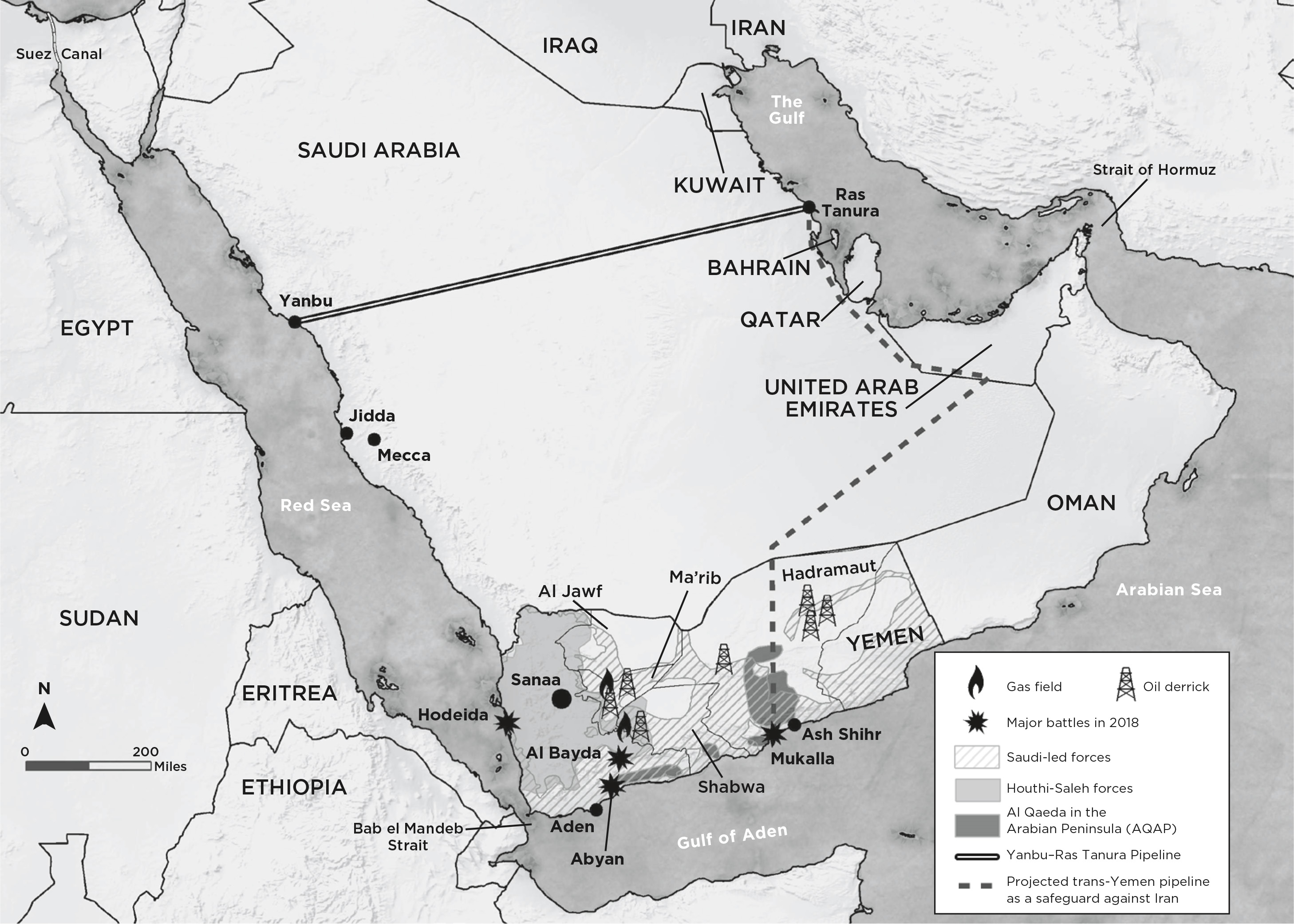
Fact is, Yemen is swimming in oil. Equally significant, the crown prince’s main concern has been “freedom of navigation for oil tankers carrying Saudi oil, whether they pass through the Strait of Hormuz, a narrow chokepoint at the bottom of the Persian/Arabian Gulf that separates eastern Saudi Arabia from Iran, or the Bab el Mandeb Strait on the western side of the Saudi peninsula. Problems arose in 2015, when Shiite-backed Houthi rebels gained control over much of northern Yemen, pushed out its corrupt pro-Western leader, and took control of Yemen’s capital. Next they began advancing on the oil-producing province of Ma’rib and beyond, toward the Bab el Mandeb Strait. To alleviate these worries, Saudi Arabia has embarked on building a pipeline–despite local protests — that will carry its oil straight to the southern Yemen port of Mukalla, on the Gulf of Aden, avoiding the two chokepoints.
The war in Yemen and the projected Saudi pipeline through Yemen, pictured in “The Crash of Flight 3804″.
At the same time, MSM made multiple trips to Washington seeking military aid, part of which would go toward protecting the pipeline.
Third peel: Did alleged threats from Iran warrant Trump’s declaration of emergency?
A series of attacks on oil tankers did, in fact, occur during the spring of 2019 that brought the world perilously close to another Middle Eastern war. The thing is, the identity of the perpetrators remains unresolved. Four oil tankers were damaged in early May, 2019, causing Pompeo to blame Iran, although “without citing specific evidence,” according to the Wall Street Journal. The Iranians vigorously denied the charges, and accused the US of trying to pull Iran into a war. Leaders around the world cautioned against war, including US allies. Pompeo accused Iran again of attacking two oil tankers in the Gulf of Oman in June, again providing no evidence.
Small wonder, with skepticism about Iran’s involvement mounting at home and abroad, that Pompeo’s claim of a national emergency, caused some members of Congress to see the emergency as phony.”
On September 14, 2019 another international crisis erupted when a series of drone and missile attacks hit Saudi oil facilities in Riyadh, causing significant damage and prompting a warning from President Trump that the US was “locked and loaded” in its readiness to respond. Pompeo declared the attacks an “act of war,” and tried to pull together a coalition at the UN to “deter” Iran. Once again, Iran denied responsibility, this time before the UN General Assembly, and challenged the US to provide evidence. Saner heads prevailed and war was narrowly averted.
But the attack on Saudi Arabia had one salutary effect: a surge in crude oil prices. Who benefited? One group in particular: US shale oil producers, who early on in Trump’s reign became overnight billionaires through heavy borrowing and financial mismanagement. Noted Bloomberg.com, “American shale producers, one of the worst-performing segments on the stock market this year, jumped Monday morning after an attack on a Saudi Arabia oil production facility over the weekend sent crude prices soaring.The spike in oil prices offers relief at a critical time for U.S. shale producers, which have seen investors flee after the sector largely failed to generate shareholder returns while rapidly growing output.”
Could this mean President Trump created a phony emergency and risked war with Iran to help his embattled friends (described in my previous blog) in the shale oil industry? So far, Pompeo has yet to turn over witnesses and documents. But if the truth ever comes out, it will surely confirm that protecting the riches of oil, “at all costs,” will trump protecting the rights of ordinary individuals here and abroad.

COVID-19 Will Devastate Indonesia Which Is Already Collapsing Under Brutal System

Andre Vltchek

In Jakarta, doctors are dying, while common people do not know which data to believe, anymore. It appears that even some government officials do not trust government statistics.
People in the slums are attacking ambulances, preventing patients infected with COVID-19 from being taken to hospitals. The novel coronavirus is a stigma. Tests are resisted, death certificates falsified. Social distancing, even basing norms of it, is ignored.
At the beginning of the pandemic, for weeks, the Indonesian government was pretending that there is no problem whatsoever, insisting that number of cases was zero, thanks to prayers and divine intervention.
While talking about God and prayers, the President was advising to drink traditional herbal medicine as prevention. Well, at least he was not pitching detergent or disinfectant, for oral consumption.
In February, after I finished filming in Borneo (Indonesian part of the third largest island on earth where it is called Kalimantan), my Garuda Indonesia flight from Pontianak to Jakarta was full of people coughing, apparently sick; very sick. While other countries in the region were already measuring temperature and introducing comprehensive measures to curtail the pandemic, Indonesia was shockingly but determinately doing absolutely nothing.
As always, in the fourth most populous country on Earth, there was no budget, no willingness, no enthusiasm, and zero know-how how to tackle the emergency.
It goes without saying that even without pandemic, the entire country is one huge health hazard. It has one of the lowest numbers of beds and doctors per thousand citizens, anywhere on Earth.
Since the 1965 U.S.-sponsored coup, Indonesia has been in turbo-capitalist mode, neglecting everything public, from sanitation to garbage collection, but especially education and health. “If it does not bring profits right away, then why to bother dealing with it”, could be the regime’s motto. Quite the opposite of what could be observed in two socialist super-stars: China and Vietnam.
After the last visit to Borneo, my guts were, for weeks, destroyed, and I experienced temporary near-blindness, as my eyes were attacked by some parasites.
While the present administration of President Joko Widodo (known in Indonesia by his nickname “Jokowi”) is getting ready to abandon Jakarta (which is overpopulated, unplanned, plundered of almost all green areas, full of misery and health-hazards) and move the capital to Kalimantan, at the cost of tens of billions of dollars, the medical facilities of the country are desperately inadequate, and on par with the poorest countries of sub-Saharan Africa.
*
Since March, my friends in Indonesia have written to me that there has been an absolutely unprecedented number of funerals, broadcasted by loudspeakers of local mosques.
Everybody knew someone, usually at least a few people, who either died from the COVID-19 or were suspected by relatives of dying from it.
An anonymous, man, 34 years old (a researcher/student, living in Jakarta), wrote to me:
“Here, people die for nothing. Our government treats human beings only as numbers, be it in connection with the presidential elections last year, or with the corona outbreak. People are angry and have lost their trust in the government. In dealing with the coronavirus outbreak, the central government interference only makes the situation worse. Our government has never felt guilty neither apologizes to its own people for incompetence in managing the country; for the 1965 genocide, the May 1998 riots, or now, for the mismanagement during the coronavirus disaster. One day, this will be all written in history books.”
Almost all disasters in Indonesia have an extremely devastating character. Tsunamis kill an unacceptably high number of people, because the early warning systems get stolen, but also due to lack of planning of coastal communities, as well as corruption. Earthquakes, volcano eruptions: all the same – no planning, no support for the poor. Lethargy, acceptance of fate, and sluggishness.
*
Fear of COVID-19 triggered at least some initiatives among Indonesian citizens.
Bloomberg reported on May 29, 2020:
“Indonesia’s spiraling coronavirus crisis has citizens taking matters into their own hands, with networks of volunteers compiling data that shows the death rate in the world’s fourth-most populous nation may be three times higher than what the government says.
Concern that the country’s low testing rate means virus deaths were going unrecorded spurred citizens, health workers and scientists to set up LaporCovid-19 and KawalCOVID19, two open-source data platforms that allow people around Indonesia to report suspected Covid-19 deaths via WhatsApp and Telegram.
More than 4,000 deaths among suspected Covid-19 patients since early March haven’t been included in the official numbers, according to data collected by the platforms. That’s on top of the government’s tally of 1,520 fatalities, which already gives Indonesia the highest virus death rate in Southeast Asia.”
But even the estimates of extra 4,000 deaths seem to be extremely low. Some experts believe that both the number of cases, as well as fatalities, might be 15 times higher than the official numbers. That would be in line with the estimates for Brazil, yet another country which is governed by the extreme right-wing regime.
In a stark departure from the common Western mass media rule of not criticizing submissive, anti-left, and pro-market Indonesia, several mainstream publications in North America and Europe decided not to remain silent. That itself is news. On May 28, 2020, The New York Times fired a detailed and very accurate report on the COVID-19 which has been devastating the archipelago:
“In an alarming glimpse at what could be runaway transmission, a random sampling of 11,555 people in Surabaya, the country’s second largest city, found last week that 10 percent of those tested had antibodies for the coronavirus. Yet the entire province of East Java, which includes Surabaya, had 4,313 officially confirmed cases as of Thursday.
“Massive infection has already happened,” said Dono Widiatmoko, a senior lecturer in health and social care at the University of Derby and a member of the Indonesian Public Health Association. “This means it’s too late.”
Yet even as the country’s caseload accelerates, the Indonesian government has said that national coronavirus restrictions, already a scattershot effort, must be relaxed to save the economy.”
Indonesian leaders collaborate, in the most embarrassing and servile way, with all U.S. administrations. Democrats or Republicans, it does not seem to matter. But the current President Joko Widodo (Jokowi), is doubling his back in front of President Trump and his market fundamentalism. It is done in the most embarrassing and, for Indonesia, a destructive manner.
That may be the reason why the “liberal” press in the United States, generally hostile to Mr. Trump and his allies, is now ready to provide objective reporting about the dire state of the collapsed Indonesian state, which includes misery in which more than half of the population has to live, tremendous environmental devastation, or the COVID-19 disaster.
The New York Times report continued:
“There is widespread concern among public health experts, however, that Indonesia’s health care system will break down if the coronavirus spreads as intensely as it did in the United States or Europe.
Worryingly, more than half of Covid-19 deaths in Indonesia were of people below age 60. In the United States, most deaths have been among the elderly. The relative youth of the victims in Indonesia, health experts say, hints at hospitals that are unable to provide the kind of lifesaving treatment offered in other countries.
And epidemiologists fear an even bigger surge in cases next month. Last week, in a country with the largest Muslim population in the world, millions of Indonesians gathered to pray and travel at the end of Ramadan, the Islamic holy month. In the capital, Jakarta, more than 465,000 vehicles left the capital during the holiday period, according to a toll operator.
While the Indonesian government announced some coronavirus travel restrictions in late April, they have not been enforced rigorously, critics say. Loopholes abound. Airport staff have complained about entire families, including children, flying under exemptions meant for business travelers.
Modeling by epidemiologists at the University of Indonesia forecasts that up to 200,000 Indonesians may require hospitalization for the virus because of Ramadan-related activity.”
“Indonesia’s testing rates are the worst among the 40 countries most affected by the virus — 967 per 1 million people, compared to 46,951 per 1 million people in the United States, as of Wednesday — Indonesians, especially those with asymptomatic or mild cases, are unknowingly spreading the virus, infectious disease experts warn.”
And then, predictable and correct punch:
“The disaster is still coming,” said Dr. Pandu Riono, an epidemiologist who led the University of Indonesia’s modeling effort. “Even after many months, we still have leaders who believe in miracles rather than science. We still have terrible policies.”
For weeks, Jokowi’s government lied about the number of cases. “Not to cause panic’, he ‘explained’ later. As mentioned earlier, the government was bragging that there were no infections, because of the “prayers”, and prayer is what was suggested by the Minister of Health, to avoid getting infected by the virus. It was also advised, by the President, that people drink traditional herbal drinks, and exercise, as prevention.
For months, at least until March, the Indonesian government had been lying to the world and its citizens. Or, as some put it mildly, the government “was in denial”. While neighboring countries, like Singapore and Malaysia, were combating virus since January, Indonesia was sweeping facts under the carpet until March. Hospitals in Java were overflowing with pneumonia cases, but as many experts now suggest, the bodies were buried and coronavirus tests discouraged.
Consequences are often grotesque. Truth comes in bizarre ways. A university professor recently wrote to me that her husband, government official and city planner, was told to return to his office. She elaborated:
“He went back to work but lasted there only for a couple of days. Several of his colleagues, in one single building, fell ill with COVID-19. So, it was back to work from home. The government really does not know what it is doing.”
*
Lying virtually about everything is a remarkable feature of the Indonesian regime. It lies about its past (whitewashing all about the 1965 fascist US-backed coup in which 2-3 million people were slaughtered), about its social collapse (much more than half of its citizens live in misery, but the government acknowledges only around 10%), even about the number of people who actually reside in the country. Ten years ago, I worked with the top U.N. statisticians who insisted that more than 300 million people were living in Indonesia, while the government claimed it was around 250 million at that time. Why? So, the most deprived people would not be scarring those lovely reports which have been glorifying extreme-capitalist country. And so that the budgets could easily disappear in deep corrupt pockets of government officials and corporate bosses, instead of feeding the poor.
Now, Jokowi’s government is ready to “open the country again”, in order to improve the economy. Pandemic will now, after Ramadan, most likely explode, but that does not seem to matter. Things can always be hushed, in a unique Indonesian way.
The Minister of Finance is already talking about the fight against poverty being pushed back, by many years. She is preparing people for upcoming suffering. That, while big Indonesian business is getting billions of dollars in bailouts and support.
She is an “expert”. She knows how the poor can get robbed efficiently. After all, Ms. Sri Mulyani Indrawati used to be Managing Director of the World Bank.
So far, despite social collapse (which goes so far unreported at home and abroad), environmental disasters, and on-going COVID-19 fiasco, one of the most heartless systems on Earth is surviving.
The logic is simple, but only if one is ready to see: If a country can deny the existence of over 50 millions of its citizens if it refuses to admit misery in which the majority of its people is forced to subsist if the ‘elites’ are allowed to steal endemically from the nation, then why wouldn’t regime just write-off tens of thousands of mainly poor people who are dying, undiagnosed and with hardly any help, from the COVID-19 or any other disease?
Indonesian blood-lettings are historically massive; millions of people, or at least tens of thousands at each time. Nobody remembers. Truth is never told. Communism and socialism are banned. Religions are obligatory. People are conditioned to accept their fate. Nothing new!

Australian government ending COVID-19 childcare scheme

Oscar Grenfell


The federal Liberal-National Coalition government announced yesterday the axing of childcare subsidies that were introduced in response to the coronavirus pandemic. The move will deepen a social crisis confronting working class families amid widespread job cuts, pay reductions and high costs of living.

Education Minister Dan Tehan told the media that the scheme, introduced by the government in early April, would end on July 12. Childcare workers also would be cut off JobKeeper, a multi-billion dollar program under which the government has paid a substantial portion of the wages’ bill of private businesses.

The removal of JobKeeper pay subsidies, originally promised for six months, paves the way for sackings and wage cuts.

As the WSWS noted when the government’s childcare subsidies were unveiled, they amounted to a $1.6 billion bailout for the private corporations that dominate the sector. They were aimed at ensuring the revenue of the lucrative industry, after enrollments plummeted when COVID-19 restrictions were introduced and hundreds of thousands of workers were stood-down or laid-off.

Under the program, the government provided cash handouts of up to 50 percent of pre-pandemic revenue to private childcare operators. This was given on the basis that the centres remain open throughout the pandemic and provide fee-free childcare.

In addition to boosting the fortunes of childcare businesses, the subsidy was aimed at ensuring that broad sections of the working class, especially in manufacturing, mining and construction, remained on the job despite the health risks associated with COVID-19.

Tehan’s abrupt announcement is part of a broader roll-back of limited relief measures that were introduced when the pandemic began, and that were always geared to the interests of big business.

The decision goes hand in hand with the rapid and premature overturning of pandemic safety measures by federal, state and territory governments, Labor and Liberal alike, including the resumption of face-to-face classroom teaching. It is a component of a pro-business offensive aimed at forcing workers back into their places of employment, despite the ongoing dangers of the coronavirus, to resume corporate profit-making.

At the same time, governments, corporations and the unions are coming together to implement further pro-business restructuring of the economy, aimed at slashing wages, increasing casual and precarious employment, and clearing the way for a continuous offensive against working conditions.

The end of the childcare subsidy will intensify the hardships facing working class families. A survey of 2,280 parents by advocacy group, The Parenthood, found that in more than 60 percent of households, one parent would be required to reduce their working hours because they could not afford full childcare fees.

Georgie Dent, a spokesperson for the group, said the “return to pre-COVID fees will put an enormous amount of pressure on the sector because services will not be able to function viably if up to a third of families have to take their children out.”

Dent pointed to the social impact, stating: “We also know that is going to be really devastating for the children themselves, because they will miss out on all the proven, long-term, quantifiable benefits that kids who access early education and care derive.”

This month, Goodstart Early Learning, the country’s largest provider, conducted a survey of 33,000 families enrolled in its 665 private childcare centres. It found that 54 percent had experienced a decline in household income since March. The average reduction was a staggering 41 percent.

Some 37 percent of families said they would be compelled to withdraw their children from childcare or reduce hours if the subsidies were removed. Around 45 percent said their income would not return to pre-pandemic levels prior to the then scheduled ending of the subsidy.

The wind-back of the measure will result in a further consolidation of the largely privatised sector. The largest businesses will be able to offset the impact of any reduction in demand. They will be aided by an additional $708 million in government funding, amounting to about 25 percent of pre-pandemic revenue. A number of smaller operators will likely go bust.

The withdrawal of JobKeeper is aimed at ensuring that the brunt of the sector’s crisis will be borne by its lowly-paid workforce.

Under the scheme the government paid up to 80 percent of an employee’s pre-pandemic wage, capped to $1,500 a fortnight. The identity of businesses that successfully signed up to the program is shrouded in secrecy, but it appears that they were primarily larger corporations.

Childcare workers have reported having their hours slashed, as companies sought to prevent paying anything on top of the $1,500. Now they confront the prospect of further pay cuts, lay-offs and cuts to conditions.


Childcare workers protest in Sydney over wages and conditions in 2018
Business commentators welcomed the government announcement. The Conversation’s Michelle Grattan wrote: “The removal of free childcare will be a big first test of the political reaction to the government winding back COVID emergency help.”

The federal Labor Party opposition cynically bemoaned the end of the subsidy, with senior ministers feigning concern over its impact on working families. Significantly, however, Labor’s childcare spokeswoman, Amanda Rishworth, condemned the move primarily because it could obstruct the corporate elite’s back-to-work campaign.

“This could well act as a handbrake on the economy,” Rishworth said. “If women and families are not able to access affordable childcare, how are they going to get back to work?”

Childcare is a massive social issue because successive governments, Labor and Liberal alike, have privatised the sector. The federal Labor government of Paul Keating began a pro-market overhaul in the 1990s. Before then, 85 percent of childcare services were provided on a not-for-profit basis. Now, almost 50 percent of the sector is in the hands of businesses.

This has resulted in some of the highest childcare costs in the world. A study by Household, Income and Labour Dynamics in Australia (HILDA) last year found that household childcare costs had increased by 145 percent since 2002. It reported that childcare costs account for a massive 27 percent of average household income.

UK: Virus infection rate increases as Johnson government continues ending lockdown

Robert Stevens

Boris Johnson’s government is pressing ahead with its homicidal plan to send millions of workers back to work, and school children back to school, ignoring mounting evidence that the first wave of the coronavirus pandemic is still infecting masses of people.
Last Monday, the government began the phased reopening of nurseries and primary schools and has instructed secondary schools to open on June 15.
By Friday, Public Health England reported that the critical “R” (reproduction) rate of the virus was at 1 or above in two of England’s nine regions. The regional breakdown was calculated in conjunction with Cambridge University’s MRC Biostatistics Unit.
In the north-west of England, R stands at 1.01. In the south-west it is at 1. If the R rate is at 1 or above, a virus will continue to spread through a population, while a value less than 1 indicates the virus is in decline.
The north-west region has a population of over 7 million people and contains the cities of Manchester and Liverpool. The south-west has a population of 5.6 million, and includes its eight cities: Salisbury, Bath, Wells, Bristol, Gloucester, Exeter, Plymouth, Truro and large towns including Plymouth, Swindon, Gloucester, Cheltenham, Exeter, Bournemouth, Poole and Christchurch.
Just as significant as the R value reaching the tipping point in two regions is the fact that the R value has risen to between 0.7 and 1 throughout England. In London, the capital and most populated area of the UK, the R value is almost at 1 (0.95). In the south-east of England as a whole—in which London is located—the R value was also recorded at almost 1 (0.97). All other regions are almost at 1, including East of England (0.94), Midlands (0.9) and North-east and Yorkshire (0.89).
The Office for National Statistics (ONS) data on the “R” value is out of date as soon as it is published due to the surveying required. The latest data only covers the last two weeks in May—ending on May 29. This will not take into account the movement of the R value since then , with many nursery and primary schools opened last week and increasing number of retail outlets allowed to open. From June 15, all non-essential shops will be allowed to open.
Since imposing a lockdown on March 23, Johnson and government ministers—along with Chief Medical Officer Sir Chris Whitty and Chief Scientific Adviser Sir Patrick Vallance—have proclaimed keeping the R rate below 1 as the precondition for ending the lockdown. Instead, ending the lockdown continues.
Monday saw the government proclaim that the R rate was below 1 in every region and in decline—based on test figures that massively underestimate the infection rate and figures for the weekend that are always low due to a lack of reporting.
Nothing the government is doing in abandoning the lockdown has any scientific basis. Generally, the Tories are citing a fall in the number of deaths and infections since their high point in April. But the dip is the product of the lockdown, which is estimated to have cut infections by over 80 percent, and that is now being abandoned.
The PHE/Cambridge team said there was “some evidence” that the R value “has risen in all regions” of England. The rise was “probably due to increasing mobility and mixing between households and in public and workplace settings,” after lockdown measures were eased.
Even after the high point of fatalities in April, hundreds of people have continued to die every day from COVID-19. In the first seven days of this month, another 1,608 people died. On June 2, there were 324 deaths; on June 3, 359; and on June 5, 357.
The UK has passed 40,000 COVID-19 deaths according to the government’s own manipulated figures. These deaths equate to almost 10 percent of all 407,000+ deaths officially recorded worldwide, despite the UK’s 67 million population making up just 0.87 percent of the global population.
Even this terrible toll is not the true picture. According to a new study based on ONS data by health care business consultancy LaingBuisson, by the end of June excess deaths from coronavirus are “likely to approach 59,000 across the entire English population, of which about 34,000 (57%) will have been care home residents.” These figures exclude deaths in Scotland, Wales and Northern Ireland.
Fatalities are likely much higher already. Modelling last week by the Times estimated that, up to June 2, there were 66,400 deaths.
According to the BBC, at least 12 members of the government’s Scientific Advisory Group for Emergencies (SAGE) have spoken out against relaxing the lockdown under conditions in which the R value is rising. Other scientists have opposed the government’s moves to prematurely end the lockdown, with some raising that the government was also too late in putting the lockdown.
But statements that raise widespread concern among workers are met with supreme indifference by the Tories.
Scientists have challenged the government’s daily figures regarding the number of new infections, generally reported in the low thousands. On Monday, the figure was recorded as 1,205, but the ONS Infection Survey suggested there were around 6,000 new infections just in England each day. Other estimates put the figure at around 8,000 a day.
Professor John Edmunds of the London School of Hygiene and Tropical Medicine and a SAGE member told the BBC’s Andrew Marr Show Sunday, “I wish we had gone into lockdown earlier. That has cost a lot of lives.”
Edmunds warned that the pandemic was now concentrated in “harder to control” areas such as hospitals and care homes, and these areas had to addressed in any strategy. The pandemic was “definitely not over,” he said. “There’s an awful long way to go. And if we relax, then this epidemic will come back very fast.”
The government is to reopen most of the economy this month in the firm knowledge that the infection rate will rise and many more people will die. The Times reported yesterday, “According to Sage papers, the government was advised last month that it is ‘likely’ that R will rise above 1 should non-essential businesses reopen.”
There could be no clearer demonstration that the government is imposing its herd immunity policy, which envisages a mass infection of tens of millions of people and mass deaths.
Despite knowing the terrible consequences of sending people back to work and children to school in the middle of a pandemic, the Labour Party and trade unions are collaborating fully in these crimes.
Commenting on the new R values, Labour’s mayor of Greater Manchester, Andy Burnham, stated only that it was “very worrying.” He told the Manchester Evening News, “It appears, I would say, that lockdown has been relaxed too early, given the fact that ‘track, test and trace’ is some way from being up and running,”
“I think it begs the question as to whether the advice is right to people in the North West,” he added. Yet like the rest of the Labour Party, Burnham proposed nothing by way of opposing the government’s plans.
No amount of pressure from scientists, certainly not the polite complaints of the Labourites, will even slow down the back-to-work drive. Opposition must be built in the working class, acting independently of the trade unions working openly with Johnson, and making their own appeal to scientists and public health experts for advice.

Johnson government falls in behind Washington’s economic war with China

Jean Shaoul

UK Prime Minister Boris Johnson has come out openly in support of the US against China over Hong Kong. He announced that Britain will open its doors to any of the 2.9 million Hong Kong citizens eligible for a British National Overseas passport if China imposes its national security law.
Writing for the Murdoch press Times newspaper June 3, Johnson said that his offer, which would require a change in Britain’s immigration rules, would allow anyone holding or eligible to hold these passports to come to the UK for a renewable period of 12 months, be allowed to work or study and thus potentially be eligible for citizenship. He described his offer—riddled with all sorts of loopholes—as extending “the hand of friendship” to the people in Britain’s former colony.
He forgot to say that this former colony, seized from China, has never benefited from Britain’s “friendship.” It was wrested from China in 1841 during Britain’s first two-year-long opium war, served as Britain’s commercial gateway to the country and became a byword for colonial domination, oppression and social misery.
In 1997, after the expiry of its 99 year “lease”—a term that denotes its feudal and exploitative relationship with the territory—the UK handed Hong Kong back to China under a 50-year form of semi-autonomy known as ‘one country, two systems” that perpetuated its citizens’ lack of democratic rights under British rule.
Johnson’s “offer”—coming from a man whose career has been built on fostering xenophobia and who made limiting immigration into Britain the centrepiece of his Brexit strategy, even increasing the visa fee for vital staff for a National Health Service which has more than 100,000 vacancies—is disgusting. It is a cynical and hypocritical public relations stunt aimed at demonstrating his craven support for US President Donald Trump, even though it means threatening the City of London’s profit base, the last prop of the British economy.
Johnson made this offer amid the Trump administration’s escalating anti-China campaign. This has included blaming Beijing for the global COVID-19 pandemic and US Secretary of State Mike Pompeo’s declaration that the “facts on the ground” showed that Hong Kong no longer had “a high degree of autonomy” from China.
The US is preparing to impose a raft of economic and trade sanctions that would damage Hong Kong’s position as a global financial hub, the third most important in the world, and its role as a springboard into mainland China due to its looser export controls and agreements on technology transfers, academic exchanges, taxation, currency exchange and sanctions. This economic assault on Hong Kong forms part of Washington’s broader efforts over the last 10 years to undermine China’s economic and strategic position and prepare for a possible war.
Pompeo’s announcement came in response to China’s declaration last month that its annual National People’s Congress (NPC) would pass a new national security law covering subversion, terrorism and foreign influence in Hong Kong. The legislation, if enacted, would override Hong Kong’s legislature, which had to abandon a similar law in 2003 in the face of mass demonstrations against its reactionary measures, led by pro-imperialist forces.
Trump upped the ante, saying in a bellicose speech that the US would respond “very powerfully” if the NPC passed the proposed legislation, while Assistant Secretary of State David Stilwell confirmed that the State Department was discussing what punitive action to take.
Washington’s assault on Hong Kong’s special economic status threatens to undermine Britain’s banking, financial services, fintech and commercial corporations, on whose speculative and parasitic activities the British economy has become ever more dependent and which are in turn heavily reliant on the Far East for the majority of their profits, not to say their viability.
More than 300 UK-based companies have regional headquarters or offices serving Hong Kong’s domestic market and the region, while the UK is the prime destination for Chinese foreign investment, which in the last five years has equaled the total in the previous 30 years.
Last week, Britain’s largest bank HSBC, which had once threatened to move its headquarters to Hong Kong and generates the bulk of its profits in Asia, announced that first-quarter profits had nearly halved as it set aside $3 billion in bad loan provisions due to the coronavirus pandemic. This comes just two months after it announced that it would shed 35,000 jobs worldwide to cut costs.
Johnson’s very public support for Washington has prompted a furious response from China’s foreign ministry, which warned Britain to “step back from the brink” and “abandon” its “cold war mentality.” It said, “Interfering in Hong Kong’s affairs” will “definitely backfire.” Both HSBC and Standard Chartered Bank have now distanced themselves from Johnson and declared their support for China’s national security legislation for Hong Kong, thereby driving a wedge between the City and the government and intensifying its political crisis.
Johnson’s “Get Brexit Done” game plan involved straddling two horses: seeking an ever-closer alignment with Washington’s economic and military agenda while at the same time pursuing bilateral trade deals with countries around the world, including China. He thought that a “Global Britain” approach would either compensate for the loss of trade with the European Union (EU), that accounts for nearly 50 percent of British exports, or enable him to force a trade deal with the EU on the strength of his alliance with Washington.
He had therefore been reluctant initially to alienate China and join the Trump administration’s economic war. However, Washington made it clear abstentionism was unacceptable.
Johnson then came under heavy pressure from right-wing forces in both the Conservative and Labour parties opposed to China’s growing economic power.
The Henry Jackson Society, a British foreign policy think tank closely aligned with neo-conservatives in the US, argued in a recent report, endorsed by former head of MI6 Sir Richard Dearlove, that the Five Eyes countries (US, Canada, Australia, New Zealand and the UK) should reduce their dependence on China for “strategic” goods that service critical national infrastructure. It called for Huawei, the Chinese telecoms manufacturer, to be designated as a high-risk vendor and barred from playing any part in the development of Britain’s 5G network.
Johnson has been forced to review the decision—made in January—to allow Huawei equipment a limited role in the project. A similar controversy has erupted over the plan to build the Sizewell C nuclear plant with China Nuclear Energy (CGN). Sizewell is the second of three nuclear plants that the Chinese government agreed to build in the UK under a 2015 deal signed with the Cameron government.
Pro-imperialist NGO Hong Kong Watch’s chief executive Johnny Patterson described Britain’s response as “limp, inane and could have been copied and pasted directly from their previous statements” and called for the government to coordinate a joint response of “like-minded” countries to China’s move.
Adding to the pressure on Johnson, seven former foreign secretaries, both Labour and Conservative, appealed to Foreign Secretary Dominic Raab for Britain to be more assertive over Hong Kong. Concerned that the response to China should not be left to Trump, and unwilling for Britain to sever its ties with the European powers from whom it is becoming increasingly isolated, they appealed to him to coordinate a European response to China.
While Trump has proposed a meeting in September of the G7 nations plus Australia, Korea, India and Russia, the European Union is at odds with the Trump administration over its handling of the conflict with China, which it views as contrary to its commercial and geostrategic interests. At an EU meeting last week, only Sweden supported Washington’s proposed sanctions.
In throwing in his lot with Washington, however reluctantly, over sanctions against Hong Kong and China, Johnson has intensified his government’s political crisis and isolation. His delusional fantasy of “Global Britain” has been exposed as a chimera. It has proved impossible for Britain to pursue its own international commercial interests without jeopardising its strategic relationship with the US, the world’s dominant military power that has, since the end of World War II, enabled London to “punch above its weight” on the world arena.