10 Jun 2020

Canadian government threatens fines and jail time to force workers back to work

Roger Jordan

Justin Trudeau’s Liberal government plans to make legislative changes to its Canada Emergency Response Benefit (CERB) in the coming days, so that it can use threats of onerous fines, criminal prosecution and jail time to force workers to return to work under unsafe conditions amid the COVID-19 pandemic.
The proposed changes underscore that the trade union- and New Democratic Party (NDP)-backed Liberal government is spearheading a homicidal back-to-work drive that prioritizes big business profit over workers’ lives and threatens to dramatically increase the numbers of coronavirus infections and deaths.
Millions of workers who have lost their jobs or are unable to work because of the pandemic are currently receiving the CERB, a makeshift program that has temporarily replaced the more restrictive Employment Insurance system. But with provincial governments across the country rushing for the past five weeks, with Trudeau’s assent, to rescind all lockdown restrictions, there has been a mounting chorus of complaints from big business, the Conservative opposition, Quebec’s CAQ government, and other right-wing forces that the “overly generous” CERB is a “disincentive” to work.
The proposed changes to the CERB, outlined in a draft bill circulated to the opposition parties last Saturday and leaked to the press Monday, are meant to threaten and bully workers into returning to work as soon as their employer and big business political hirelings in government pronounce it “safe.”
Under Bill C-17, CERB recipients who “fail to return to work when it is reasonable to do so and the employer makes a request for their return,” “fail to resume self-employment when it is reasonable to do so,” or “decline a reasonable job offer when they are able to work” will be liable to punitive fines. These could be as much as three times any CERB amount they are deemed to have improperly claimed.
The proposed legislation also outlines a series of new CERB “fraud” offenses punishable by fines of up to $5,000 and six-months in jail. These include “making false or misleading statements, failing to fully disclose all relevant income or receiving an income support payment for which a person is not eligible.”
The last of these is especially threatening, given that the bill stipulates that a worker who refuses to return to their job is ineligible for further CERB benefits. In effect, the government is seeking the legal power to imprison workers who attempt to use the CERB to prevent their employer from starving them back to work under unsafe conditions.
The Liberals’ bill will also change eligibility criteria for the CERB. As of July 5, recipients will apply for the benefit every two weeks rather than every four weeks. According to news reports, this alteration is aimed at making the program more “flexible,” including by helping employers take workers back on reduced hours. The government also wants to reduce the amount of money CERB recipients can earn before experiencing clawbacks to their benefits, from $1000 to $500 per month.
The draft bill underscores that the Trudeau Liberal government is intent on ratcheting up corporate Canada’s reckless back-to-work drive, which is proceeding apace even as total coronavirus infections approach 100,000 and deaths surpass 8,000; and that it stands ready to use the full force of the capitalist state, including the courts and prisons, to suppress worker opposition.
From the outset, the Liberal government’s overriding concern has been to protect the wealth and investments of the ruling elite. While over $650 billion was funneled into the coffers of the big banks and corporations with virtually no strings attached, the aid offered to the more than 7 million workers who lost their jobs and income has been meager and temporary.
The CERB pays recipients a mere $2,000 per month, a sum that fails to even cover the rent of a modest apartment in Toronto or Vancouver, and for a maximum of 16 weeks. For millions of workers who lost their jobs in March, the end of their 16 weeks of eligibility is fast approaching, with many facing the prospect of having no job to return to when their CERB payments expire in July.
Once the bailout of the financial oligarchy was concluded, the Liberal government, trade unions, federal opposition parties, and provincial governments began working in tandem to remove lockdown measures and reopen the economy. Trudeau’s Liberals, who never tire of touting their “progressive” credentials, have worked hand-in-glove with the hard-right premiers François Legault in Quebec and Doug Ford in Ontario to ease restrictions under conditions where virtually nothing has been done to strengthen Canada’s woefully underfunded health care system. In flagrant violation of World Health Organization recommendations, the “reopening” of the economy has proceeded without the implementation of systematic mass testing, contact-tracing, and quarantining programs.
Now, in the same week that Ford announced Ontario’s move to the next phase of reopening, the federal Liberals are establishing a punitive framework to bully workers back to their jobs under threat of destitution, bankruptcy and even imprisonment.
Needless to say, business has warmly applauded the brutal measures contained in the Liberals’ draft bill. Dan Kelly of the Canadian Federation of Independent Businesses demonstrated just how far removed the corporate elite is from the daily lives of working people, claiming, “While some workers are worried about returning to work for health-related reasons, many are happy to take the summer off if their income needs are taken care of through CERB.”
The reality is that the measures contained in Bill C-17 were dictated by the major corporations and banks. In the days leading up to the publication of the legislation, Trudeau held one-on-one discussions with the chief executives of Canada’s six major banks, as part of the government’s consultations with big business on its “economic recovery” plan.
If the Liberals and corporate Canada can pursue their back-to-work agenda so ruthlessly, it is because they know they enjoy the support of the New Democrats and trade unions. The unions and NDP have responded to the deepest crisis of global capitalism since the Great Depression of the 1930s by cementing their long-standing alliance with the Liberals, long the Canadian bourgeoisie’s preferred party of government. This is the political expression of the union bureaucrats and social-democrats’ intensified efforts to supress the class struggle, amid mounting working class anger over the criminal indifference of the ruling elite towards their working conditions and lives.
In March, Canadian Labour Congress head Hassan Yussuff initiated what he called a “collaborative front” between the unions and Canada’s employers’ organizations. This, above all, consisted in maintaining radio silence on the vast sums of money forked over to the financial oligarchy, while helping the Trudeau government design and promote its rations-style CERB. Now the unions are assisting the ruling class in its premature back-to-work drive.
As for the NDP, in late May it once again gave the minority Liberal government the votes it needed to proceed with its agenda. Touting a worthless commitment from Trudeau to ensure workers across Canada receive 10 days per year of paid sick leave—a proposal most provincial governments have already dismissed—Jagmeet Singh and his fellow social democrats voted for a Liberal motion to shut down regular sittings of parliament until September. As a result, the government will now be able to gut financial aid to workers with virtually no public or parliamentary debate.
Working people must oppose the Liberal government’s efforts to bully them back to their jobs with threats of fines and imprisonment. To do so, they must establish rank-and-file safety committees, independent of the pro-capitalist unions, in every workplace. The tasks of these committees should be to uncompromisingly fight for the safety interests of the workers, and oppose the demands of corporate management and governments alike to subordinate all health considerations to capitalist profit.
The fight against the pandemic is inseparably linked to workers’ struggle against the ruling class—the corporate and financial oligarchy—and its dictatorship over economic and political life. It is, therefore, a struggle against capitalism and for socialism, that is, for the restructuring of socioeconomic life under a workers’ government so that meeting social needs, not swelling investor profit, is the animating principle.

Russia’s ruling class nervous over spreading global protests

Andrea Peters

After nearly two weeks of silence, the Russian government issued its first official statements on the mass protest in the United States and major cities in the rest of the world, sparked by the brutal police murder of George Floyd. On Sunday, Ministry of Foreign Affairs Spokesperson Maria Zakharova declared, “They [the US and the European governments] have reaped what they have sown. Having sown chaos, they have gotten chaos.”
“All around the world they have promoted the possibility of destabilizing conditions, the possibility of playing on internal contradictions that naturally exist with any state and people,” Zakharova told the television station Russia 1.
Speaking to Komsomolskaya Pravda on Monday, Zakharova described the accusations—made most prominently on May 31 by former President Barak Obama’s National Security Adviser Susan Rice—that Russia was responsible for the crisis gripping Washington as “mythology.”
“To state, as have several representatives of the Democratic Party in the US that ‘behind the protests in the States stands the hand of the Russians, Russia and Kremlin,’ means to simply not respect your own people and not to understand what is happening. The only thing that links the current situation in the US with Russia is that Moscow has repeatedly pointed out to Washington the necessity of first of all minding one’s own internal politics before preaching to everyone else.”
The same day, the main state television channel, Perv y i Kanal, swapped out the credits that were supposed to roll at the conclusion of the film Brother 2 with scenes of looting and violence from the United States. The song “Goodbye America” by Nautilus Pompilius played simultaneously. The plot of the popular “cult classic” gangster movie, which was aired on official TV to mark the twentieth anniversary of its release in 2000, touches on racial and social tensions in the US.
The Kremlin’s seeming smugness over the political crisis in America seeks to mask extreme nervousness within the Russian ruling class over the mass protests sweeping the United States and expanding globally. The social moods driving these events also exist in Russia, where the coronavirus pandemic has infected hundreds of thousands, sent the economy into a tailspin, and wrecked the livelihoods of millions. Popular anger at the federal and regional authorities is rising, President Putin’s popularity rating is falling, and a mood of “exasperation, anxiety, and anger” is spreading, as a recent study highlighted in the business daily Kommersant noted.
Three percent of the Russian population controls 89 percent of the country’s financial assets. Ninety-eight Russian billionaires have more wealth than the combined savings of the entire population of 144.5 million people. Real incomes have been falling for years and are expected to further decline as an estimated five to six million workers are expected to find themselves jobless by the end of the year.
In an attempt to forestall the spread of protests to Russia and prevent a feeling of solidarity from emerging within the Russian working class, across the political spectrum the country’s media has sought to portray the demonstrations in the United States as little more than—as Alexei Poplavsky of Gazeta.ru put it—“disturbances, brigandage, and looting.” They have, according to reporter Rustem Safronov, who works for the Kremlin-funded Radio Sputnik, “started to take on a bad form,” becoming “pogroms.”
The news daily Lenta.ru featured an interview on June 4 with a one-time American policeman about “rioters” in the United States. The ex-marine and former member of Florida’s Palm Beach County police force insisted that the murdered George Floyd was indisputably engaged in a crime when detained. Supposedly the sequence of events that led to the man’s asphyxiation are hazy but indicate little more than an “excessive use of force.”
Combining outright lies with half-truths and stupidities, commentators have openly or implicitly endorsed President Donald Trump’s military-police crackdown against what they described as a sort of “black peril” emerging from below. Racist tropes and xenophobia abound.
Writing on Ekho Moskv y, Russia’s leading pro-Western liberal news outlet, economist Vladislav Inozemtsev blackguarded George Floyd as a convicted criminal “under the influence of drugs” when arrested. He lamented the deaths of white police officers and falsely claimed that the killing of a white person at the hands of the cops “has in 40 years never resulted in a single speech against police violence in the US.” He described the mass, interracial movement against state oppression exploding in the US as “a demonstration of power” that does “not serve to affirm racial equality, but the superiority of ethnic minorities over the majority.”
Writing in Gazeta.ru, owned by the billionaire oligarch Alexander Mamut, Georgi Bovt joined in. In a June 8 article entitled, “Do whites have to kneel before blacks?” Bovt argued that other minority groups in American history “faced conditions not worse than blacks,” but had seen their socio-economic status improve over decades. The social misery experienced by many African-Americans, he claimed, is their own fault. In a particularly nasty moment in the article, Bovt boasts that in Russia it is supposedly acceptable to refer to blacks by the derogatory term “negr,” which, as Bovt clearly knows, is especially ugly to the American ear because it sounds like the n-word.
Bovt’s colleague at Gazeta.ru, Poplavsky, insisted the crisis gripping the US was one of “political correctness.” Noting the opinions of a right-wing French commentator, the Russian journalist said that America was in the grips of “an aggressive ideology that has essentially declared oppressed minorities the builders of the future, in the manner of the proletariat for the Bolsheviks.” While Trump and the Republicans have responded with an admirably strong hand, the Democrats had done nothing and attempted to justify the violence in the streets, Poplavsky wrote.
While having a different political coloration, the racist attacks in the Russian press on the American protests echo the efforts of the Democratic Party and its adjuncts in the media to insist that the demonstrations against police violence are fundamentally a struggle of blacks for “black lives” against “white privilege.” In both instances, the interracial and multi-ethnic character of the social anger erupting across the United States and internationally is denied. In the Russian media it is smothered in bigotry and ugly tropes trading in racial superiority. In the American media, it is drowned in the claim that race, not class, is the dividing line of American society. The aim of both approaches is to block a unified struggle of the working masses against the universal source of their oppression—capitalism.
A notable feature of the present press coverage in Russia has been the relative lack of attention that has been given to the spread of the demonstrations in the United States to other countries, particularly European states. Like the racist denunciation of the protests in the US, this silence is aimed at suppressing the universality of the social grievances underlying the protests by workers and youth throughout the world against racism and police violence.

Youth protests and worker strikes show mounting social opposition in Brazil

Tomas Castanheira

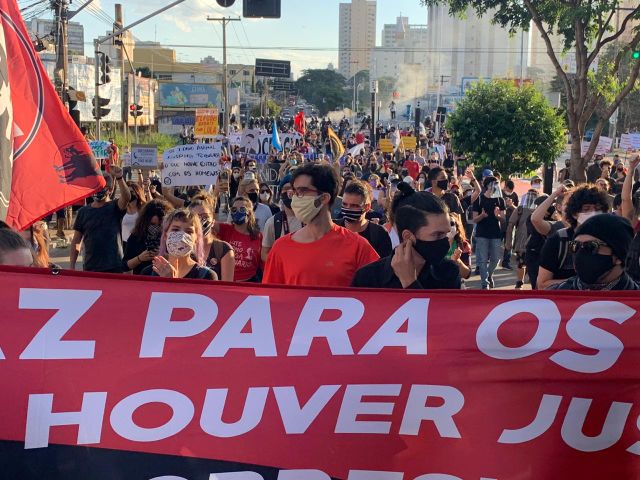
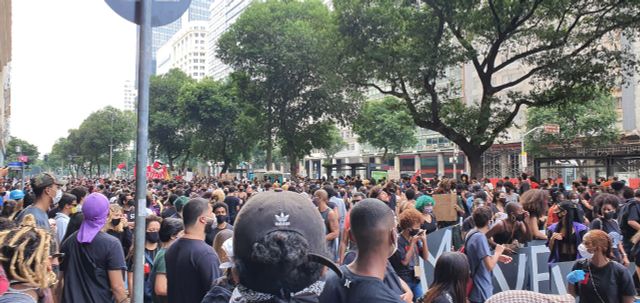
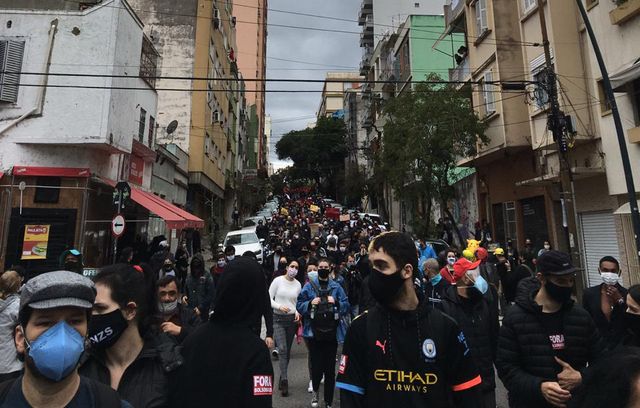
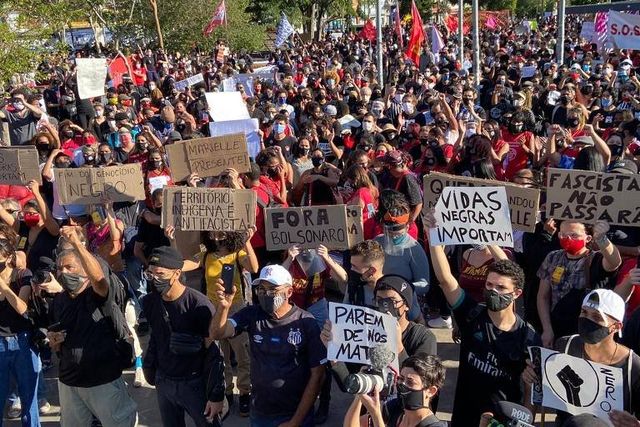
Brazil experienced a second weekend in a row of demonstrations against police violence, racism and the government of the fascistic President Jair Bolsonaro. Tens of thousands of people, mostly young, took to the streets in every region and practically every state in the country.
In São Paulo, Rio de Janeiro, Porto Alegre, Belo Horizonte and Brasília the demonstrations were attended by thousands of people. In other capitals and several smaller cities, protests occurred simultaneously and included hundreds of people.
Growing numbers of Brazilian youth and workers see their adherence to the international wave of protests driven by the police assassination of George Floyd as a political path to respond to the intolerable Bolsonaro administration.
Protest in São Paulo
The political establishment responded by brutally repressing these protests. Although they have not yet summoned the National Guard, as proposed by Bolsonaro, the governors of all the bourgeois parties have mobilized the police apparatus in a war-like crackdown against the demonstrators.
In São Paulo, Governor João Doria of the Brazilian Social Democratic Party (PSDB) deployed more than 4,000 military police officers, helicopters, four armored vehicles and a water cannon vehicle. The policemen conducted searches, forbade the demonstrators from carrying flags and alcohol, and arrested more than 30 people. They dispersed the protest by violently attacking it with tear gas grenades and rubber bullets and by beating defenseless people on the ground.
In Rio de Janeiro, the repression started when the demonstrators were still gathering, with police arresting about 40 people. In Belém do Pará, more than 100 people were arrested before the beginning of a demonstration, cynically accused of violating a social distancing decree. On the same day, shopping malls were reopened in the city, generating crowded lines at their doors.
The same happened in Fortaleza, capital of Ceará, a state ruled by Camilo Santana of the Workers Party (PT). The demonstrators were corralled by the police and prevented from starting the protest, and when they sat on the ground the police attacked them with tear gas and arrested seven people.
Protest in Goiânia, capital of Goiás
The PT governor took full responsibility for the arrests in an interview on the TV show “Roda Viva” on Tuesday night, and said he saw no “excess” in the police action. Santana reaffirmed that he will not allow demonstrations that break the quarantine, despite promoting the reopening of all activities in the state, one of the most affected by the coronavirus, with over 50,000 confirmed cases. On Monday, commerce and shopping malls were reopened in Fortaleza.
After Sunday, Bolsonaro spoke in front of the government palace in Brasília, saying that the demonstrations are the “major problem of the moment.” Feeding his conspiratorial propaganda that characterizes the protesters as “terrorists” who are “intrinsically linked to international extremism,” he referenced Vice President General Mourão, adding, “they are starting to pull up their sleeves” (i.e., show how dangerous they are).
Underlying these words, there is a dangerous drive toward openly dictatorial forms of rule. The political forces that claim to oppose Bolsonaro and his attacks on democracy are the same ones that are mobilizing the military-police apparatus.
The scale of the violence being mobilized by the state is a reflection of the awareness and fear of the Brazilian ruling class of the fragility of its social and political order. The threat felt by the bourgeoisie doesn’t come from the radicalism of “antifascist” demonstrators, adopted as scapegoats, but from the fact that these protests are intersecting with a growing social opposition within the working class masses.

The explosion of class struggle

Under conditions of media blackout, an explosive growth in strike and protest activity is taking place in the workplaces at an unprecedented scale and high levels of militancy. The Brazilian working class is expressing that their conditions of existence, aggravated by the coronavirus pandemic, have reached the breaking point.
Millions of workers are being pushed to working places in highly risky conditions. Factories, slaughterhouses, mining companies, hospitals and transport have registered several outbreaks of COVID-19. At the same time, millions more workers have lost their jobs and had their wages cut during the pandemic.
Last Monday, more than 3,000 workers went on a wildcat strike at Bridgestone’s Santo André plant, in the metropolitan region of São Paulo. The company is a US-based transnational and the world’s largest tire manufacturer. The workers rebelled against continuously worsening conditions and for three days stood by the machines refusing to operate them. They have had their wages cut for months and a coronavirus outbreak has already infected over 50 employees.
The Rubber Workers Union presented the situation as a dead-end. According to them, the only thing they could do was talk to the workers “to keep the peace inside the factory” and negotiate with the company a proposal to “alleviate” the economic despair of the workers. The strike was ended three days later, with the payment of a profit-sharing bonus. Wage cuts, deadly sanitary conditions and the danger of layoffs are maintained.
In bus companies across the country, drivers and ticket collectors have faced mass layoffs and pay and benefit cuts since the pandemic began. Since March, dozens and dozens of strikes in all regions of the country have broken out in response to these attacks.
Protest in Rio de Janeiro
In Teresina, Piauí, drivers and collectors who have been on strike for nearly a month against the layoffs of 400 colleagues and pay cuts are holding street demonstrations daily. In a protest in front of the City Palace last Friday, workers held handmade posters reading: “I don’t have anything to eat today, imagine tomorrow” and “Bus drivers lives matter.”
Another bus workers strike started last week in Vitória, capital of Espírito Santo. The city has been the stage of a series of militant strikes by workers of different bus companies over the past few months, with street demonstrations and blockades of avenues taking place. Once again, the strike has been prohibited by the court, with a threat of a daily fine of 30,000 reais (around US$6,000) to the union.
The workers ignored the judicial measure and went on strike anyway. According to the president of the drivers’ union: “We are now at the company’s door talking to the workers to convince them to comply with the judicial order [to stop the strike], but they are not complying with the union’s request. We try to convince them, but we can’t take them by the arm and force them to leave.”
In crowded hospitals across the country, health workers are responding, through a growing number of strikes and protests, to deadly mass contamination, which has already cost the lives of more than 150 nurses. In the last week alone, actions as these have been recorded in at least four different states. In addition to the demand for adequate protective equipment and hiring more professionals, there is a growing national movement, especially among nurses and auxiliaries, demanding better salaries.
This radical and growing activity of the working class marks a new stage of the international class struggle, in which the corporatist unions, upon which the ruling class has relied over the past decades, are losing their power to control the workers.

The struggle for a revolutionary leadership

On May 19, just over a week before the explosion of protests against the murder of George Floyd, the World Socialist Web Site wrote:
The Brazilian bourgeois state is imposing a normalization of death for the entire working class—whether through hunger, infection by the new deadly coronavirus, or the brutal murder by its military agents.
However, the working class is not a passive agent in this process. The growing mobilization of Brazilian workers in wildcat strikes against unsafe conditions in the workplaces and the revolt of residents of the poor neighborhoods against state violence are merging with a global movement of the working class that faces the same attacks by the ruling classes of all countries.
Developments are confirming this perspective. Demonstrations in opposition to the murders promoted by the state exploded simultaneously around the world. Millions of people took to the streets with a feeling that the social order in which they live is essentially unjust.
Protest in Porto Alegre, capital of Rio Grande do Sul
These events are reflections of objective conditions widespread among workers around the world, regardless of their nationality, race, ethnicity, or gender. In the name of the interests of a tiny corporate and financial elite, the lives of billions of workers are totally disposable.
In this weekend’s Brazilian protests, workers such as nurses and food delivery workers turned out en masse, with their uniforms and class political demands clearly recognizable. In the next stages of this struggle, the growing opposition of the working class, developing in workplaces around the globe, will emerge as a determining political factor with huge revolutionary implications.
The struggle for the common demands of the workers of the whole planet, for the socialist reorganization of economical life, should be fought as a global struggle through the leadership of the International Committee of the Fourth International (ICFI).

Forced disappearances of protesters against police violence in Guadalajara

Andrea Lobo

Last Friday, the state police in Jalisco, Mexico, carried out the forced disappearance of dozens of youth in the city of Guadalajara, in the context of demonstrations involving thousands and centered around the police killings last month of George Floyd in the United States and Giovanni López in Jalisco.
Men in plainclothes, some wearing bulletproof vests, descended from unmarked pickup trucks and even a fake bakery truck, armed with rifles, clubs, bats and stun guns, and intercepted, blindfolded and kidnapped groups of youth as they approached the demonstration against police violence in front of the attorney general’s office.
The Jalisco human rights ombudsman, Eduardo Sosa Márquez, told Aristegui Noticias Monday that his office received 35 complaints related to the repression, including “registered cases of forced disappearances against people who sought to protest peacefully, people passing by on their way home.”
He described the kidnappings: “The state deprives them of their liberty; denies having detained them; there is no official list of detainees; they took them and let them go 6, 7, 10 kilometers away, took away their belongings so that they couldn’t get back or contact their families.”
He claimed that all those reported missing are now accounted for, based on a few home visits and social media publications by those reported missing, family members and friends.
The operation and the complicit silence of the federal government of Andrés Manuel López Obrador are a violent threat against growing social opposition across Mexico. As demonstrated by the militant protests against police brutality in Mexico and internationally, class tensions are on a hair trigger due to extreme levels of social inequality and the criminal response of the governments to the COVID-19 pandemic, which has already overwhelmed hospitals and morgues and led to 12 million job losses in Mexico.
The incident has recalled the forced disappearance and killing of 43 teaching students of Ayotzinapa, who were kidnapped on their way to a protest in Mexico City against a regressive education reform in 2014, which involved the collaboration of local and federal police, the military, and a drug cartel.
The scale of the operation was much larger than that recognized by Sosa. One victim, David Mendoza, relates how “they had us in large pens and separate rooms, easily 6 of these and with 30 people in each of them. They constantly took people in and out, so what I saw was not the total of kidnapped people.” He added that there were at least 50 police officials there on top of those doing the rounds. The Guardian counted some 80 people from reports “held incommunicado” in the operation.
It has been established that they were held captive inside of the police precinct five km away.
According to social media publications and interviews by the victims, the kidnappers repeatedly announced that they would be “disappeared.” Mendoza cites the threat: “Look at what you did to your parents; now they’ll have to look to one body after the other to try to find you.” The protesters were constantly beaten up.
Police officials demanded that the detainees give them access to their cellphones, messaging and social media groups. Medicines were also among the belongings taken away.
One youth, Violeta, told Animal Político that police asked if they belonged to “any association, group or movement, or in coordination with anyone to attack them.” An independent journalist who was also kidnapped, Luis Antonio Maldonado, also described similar inquiries.
Once they were being gradually freed, the police threatened to “disappear” them for good if they saw them protesting again and that they would find their homes to check on them. One detainee described being given “ten seconds to run away” when dropped off, while reports on social media indicate that the officials used the confiscated cellphones to call contacts of the victims requesting their addresses.
While the kidnappings occurred on Friday, state authorities confirmed that they had arrested 26 demonstrators during the protests a day earlier. Police officials used beatings and tear gas against the demonstrators, while several were recorded inside the precinct on a cellphone crying out “we are going to kill them.”
On Saturday, hundreds marched peacefully across downtown Guadalajara to protest the police repression and demand the liberation of those kidnapped. Six demonstrators were arbitrarily arrested and were transferred near midnight on Monday to the Puente Grande maximum security prison without their lawyers or families having been informed. These protesters were freed as demonstrations grew on Tuesday morning.
On Sunday night, a peaceful demonstration in Torreón, Coahuila, against the killings of Giovanni López and George Floyd, was broken up by police, who arrested seven youth, including two minors who have been freed since.
The UN High Commissioner for Human Rights in Mexico denounced on Twitter the incidents in Jalisco. “Forced disappearances and the disappearance of individuals are crimes in MX [Mexico],” the agency declared.
Mexican president, Andrés Manuel López Obrador, has exploited the accusations by the Jalisco governor, Enrique Alfaro Ramírez that the ruling party Morena was behind the spontaneous demonstrations to justify the federal government’s neglect and effective sanctioning of the month-long cover-up by local authorities of the murder of Giovanni López, as well as the violence and kidnappings last week. “I don’t get involved in partisanship; I don’t have any intention of affecting the local authorities. … we have no interest in affecting the Jalisco government,” he said.
Alfaro has also suggested that the kidnappings were tied to organized crime and that the police defied his orders not to act violently. However, Alfaro himself is widely suspected of having facilitated the rise of the Jalisco New Generation Cartel into the largest in the country. The specialist and journalist Anabel Hernández confirmed documents in 2018 that both the US Treasury Department and Mexican Navy had carried out investigations into the ties between Alfaro and the Cartel.
López Obrador addressed the protests again on Tuesday, but continued to dismiss the disappearances in Tijuana, insisting that, “we are not repressive.” He then blamed demonstrators for “abuses,” “beating reporters,” “provoking, provoking and provoking,” though these were unsubstantiated by any facts.
The opposition to the measures by the Jalisco police among the ruling Morena party has been limited to the following flippant tweet by Martí Batres, the president of the Senate, on Saturday night: “By the way, speaking of basements: to which basements in Guadalajara did they take the missing youth yesterday?”
The international character of the protests against police brutality is an indication that workers and youth are being pushed by the logic of events to find firmer ground upon which to take a stand against social inequality and the increasingly dictatorial forms of rule used to protect the Mexican oligarchy and US imperialism.
Workers and youth must join forces with their class brothers and sisters in the United States and beyond. However, this struggle also requires the development of a new leadership in the working class under a socialist and internationalist program against capitalism, the source of inequality and police violence.

COVID-19 eruptions increasing in US meatpacking plants, logistics centers

Shannon Jones

Industrial and logistics centers in the United States continue to be major vectors for the spread of COVID-19, with the number of infections rising sharply in many areas of the country. This follows the abandonment by government officials from the Trump administration on down of any measures to contain the virus.
Meat processing facilities across the country remain COVID-19 hotspots. Industry executives are using Trump’s executive order declaring meatpacking plants an essential industry as a license to sicken and kill workers.
In the wake of Trump’s executive order, the number of cases at meatpacking plants has risen by 100 percent. As of Monday, there were reports of 20,400 infections at 216 plants in 33 states. At least 74 workers have died.
USA Today report found that that a number of counties where meat processing facilities are located experienced a doubling of their COVID-19 case count in the last two weeks.
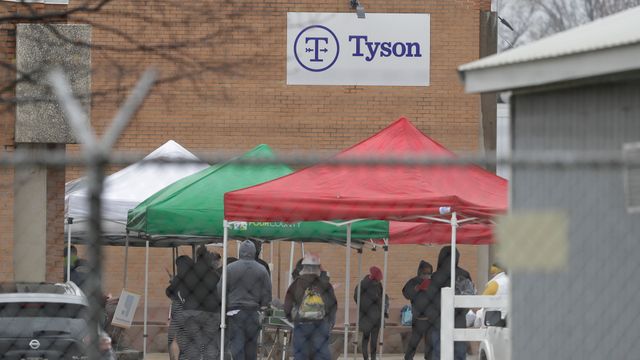
Tyson plant
The lack of any serious safety procedures at most facilities, and the refusal of many employers, with the collusion of the unions, to provide any transparency on infections and deaths raises the urgent need for the formation of rank-and-file safety committees at all work locations to take up the defense of workers’ health and lives. These committees would demand full income for laid off or sick employees, and enforce safety procedures in consultation with medical professionals.
One of the areas of the country with the most alarming spread of COVID-19 is Texas.
The weekly number of new cases has grown from 1,081 during the week ending May 24 to 1,527 over the past week, using a seven-day trailing average. The indications are that meatpacking plants and prisons are centers of COVID-19 infection in the state.
In the state of Iowa alone, some 3,000 meatpacking workers have tested positive for COVID-19, the most of any state.
According to one analysis, approximately 6,700 Tyson Foods workers in the US have contracted COVID-19. That is more than double the number for any other company. At the same time, Tyson Foods is reinstating its strict employee attendance policy, essentially forcing workers who are sick to come to work.
Kansas meatpacking plants have been heavily impacted. Plants in the state have been linked to at least 2,767 cases and 10 deaths. A classified Kansas public health document listed the Tyson Foods plant near Garden City as having had the largest outbreak in the state, with 571 cases and one death. A total of 503 cases and four deaths have been linked to the National Beef plant in Ford County.
On Tuesday, Tyson Foods reported new COVID-19 outbreaks at two Iowa plants.
It said 591 of 2,300 employees at its Storm Lake pork processing plant tested positive along with 224 out of 1,500 workers at its beef and pork processing plant in Council Bluffs.
COVID-19 is appearing in a growing number of rural areas largely bypassed in the initial outbreak. In Utah, officials with the Bear River Health Department in the northern part of the state confirmed a major outbreak at JBS Foods in Hyrum. Friday and Saturday saw about 200 new cases each day in Hyrum following a testing clinic at the JBS facility. Total cases in Utah are heading toward 14,000.
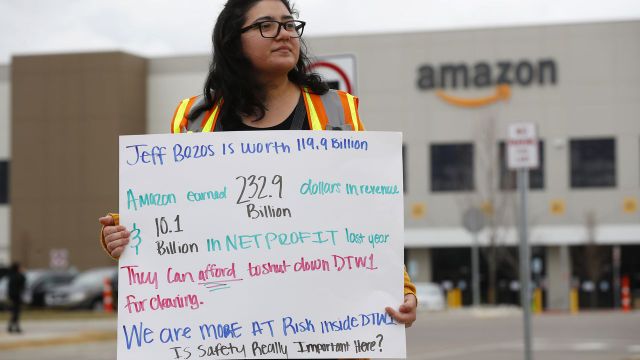
Chicago Amazon protest
So far, 287 workers have tested positive at the plant, which employs 1,400 and remains in partial operation. JBS has refused to close the facility, citing Trump’s executive order.
The Bear River Health Department has received reports that COVID-positive and sick employees are being told to report to work at the facility. Most of the workers at the plant are immigrants from Latin America, Asia and Africa and many are not fluent in English.
Health officials in Iowa report that Bridgestone America’s farm tire plant in Des Moines, which employs 1,000 workers, is continuing to operate despite at least 24 confirmed COVID-19 cases.
Also this week, two more confirmed cases were reported at General Motors’ Wentzville, Missouri plant. The report was the result of an anonymous tip to local media, as GM is generally not reporting on coronavirus cases at its plants.
Because of the nature of their work, logistics workers are also at high risk of COVID-19 infection. Two Amazon workers at a Charlotte facility tested positive for COVID-19. At least nine other Amazon workers at Charlotte area fulfillment centers have tested positive, according to the Charlotte Observer .
The Oregon Health Authority said it is looking into an outbreak of COVID-19 affecting five workers at Amazon’s fulfillment center in Salem.
The company, with the aide of the media, is suppressing reports of infections and deaths at its facilities. In May, the attorneys general of 13 states sent letters to Amazon and its subsidiary, Whole Foods, asking for the release of data on COVID-19 cases, including a workplace by workplace breakdown, and for the company to reinstate its earlier policy of unlimited time off.
In response, Amazon doubled down on its refusal to release figures, declaring in a statement that such data “isn’t particularly useful because it’s relative to the size of the building and then the overall community infection rate.”
Amazon’s multi-billionaire CEO Jeff Bezos has touted the company’s supposed concern for workers’ health, with company officials escorting reporters through a model plant in Washington state. Bezos, who has grown richer by tens of billions of dollars during the pandemic crisis, is now reportedly worth $150 billion.
An Amazon worker at a warehouse in Jeffersonville, Indiana, Jana Jumpp, and another Amazon worker in California have kept a tally of COVID cases at Amazon and Whole Foods based on independent sources. They report that as of Tuesday, 353 Whole Foods workers at 164 stores have tested positive and at least four Whole Foods employees have died, including a manager at a store in Pasadena.
As of last week, Jumpp had documented 1,079 cases of coronavirus among Amazon warehouse workers, and confirmed nine deaths. These numbers almost certainly understate the spread of the virus among Whole Foods and Amazon warehouse employees.
Three Amazon employees in New York have filed a lawsuit against the company, claiming that it has failed to follow guidelines set by the US Centers for Disease Control and Prevention. It asserts that the company has mounted only a “facade of compliance,” but has failed to adequately protect workers from the virus in a number of ways, including “sloppy contact tracing” and failure to provide adequate personal protective equipment.
Package delivery services FedEx and United Parcel Service have also refused to report COVID-19 cases. Last month in Kansas, a cluster of COVID-19 cases were traced to a FedEx distribution center in Olathe. FedEx confirmed that cases had been discovered at the facility, which employs about 200 people, but did not say how many.
A United Parcel Service facility in Tucson has been identified as the source of an outbreak, with 43 workers testing positive, according to a report issued by the local union.
Though not as widely reported as the situation in meatpacking, other types of food processing facilities have reported large numbers of COVID-19 cases.
A survey of news stories published between March 14 and June 8 found that almost 1,200 food processing workers at 60 plants had been infected, involving a wide range of companies including Kraft, Heinz, Birdseye and Campbell Soup. The most cases were reported at Steven Roberts Original Desserts in Aurora, Colorado, with 115. Ruiz Foods in Dinuba, California had 107, and Birds Eye in Darien, Wisconsin had 104.
On Sunday, Oregon health officials announced an outbreak at a Pacific Seafood processing plant in Newport, where 124 cases of coronavirus were confirmed, the largest single-day outbreak in Oregon to date. So far, the company has not released the names and addresses of infected employees, making contact tracing impossible. Local authorities say they have no legal means of forcing the company to cooperate.
The spread of the disease in industrial facilities is a tragedy not just for the workers who are exposed, but for their families and the broader community. The lack of any real oversight or control over workplace exposure means that workers are entirely at the mercy of profit-driven corporations determined to squeeze out every dime of profit at the least cost.
The abandonment by public officials at all levels of any effort to contain the COVID-19 pandemic makes it critical for workers to intervene to safeguard their health and the health of their loved ones. This cannot be entrusted to the pro-corporate unions. It requires the development of rank-and-file organizations of struggle in each workplace. The World Socialist Web Site encourages workers to contact us to discuss the establishment of these safety committees.

The paradox of the Wall Street surge

Nick Beams

Monday saw the emergence of what appears to be a striking paradox. On that day, the National Bureau of Economic Research declared the US to be in recession—an economic contraction that will turn out to be the steepest since the Great Depression—while Wall Street indexes returned to the levels they had reached at the start of the year.
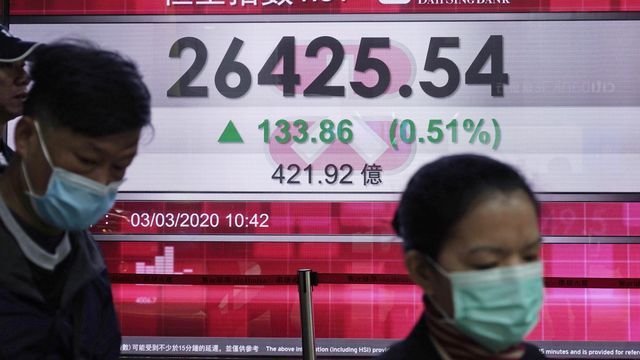
Since plummeting in mid-March, as financial markets in the US and internationally froze across the board, Wall Street has enjoyed a spectacular rise. The Dow has risen by 48 percent since March 23, the tech-heavy Nasdaq is up by 45 percent and is now 1,000 points higher than at the start of the year, and the S&P 500, having also risen 45 percent, is back to where it was before the COVID-19 pandemic struck.
The rise of the market, taking place in the midst of the greatest health crisis in a century, as the infection rate and death toll from the coronavirus continues to rise in the US and internationally, stands in stark contrast to the underlying real economy.
People walk past an electronic board showing Hong Kong share index outside a local bank in Hong Kong, Tuesday, March 3, 2020. (AP Photo/Kin Cheung)
Last week, the US Congressional Budget Office warned, contrary to claims by President Trump and others that the economy will come “roaring back,” that the on-going effects of the pandemic will last for at least a decade.
Estimates of the effect of the pandemic on the five largest European economies put the UK contraction at 14 percent, Spain at 11.6 percent, France at 10.3 percent, Italy at 9.2 percent and Germany at 6.1 percent. The World Bank has forecast that global GDP will contract by 5.2 percent this year.
Under these conditions, traditional metrics for determining stock prices, such as price-to-earnings ratios, have been cast aside, as shares in companies that are either recording losses, or cannot even provide a forward estimate of their revenue because of the pandemic, are continuing to rise.
What accounts for this speculative mania in the midst of death, the destruction of millions of jobs and the growing impoverishment of ever broader masses of the working population?
The answer is to be found in the response of the ruling class to the pandemic. From the outset, it treated COVID-19 not as a health crisis, to be dealt with by the application of scientifically based measures, but as a blow to profit accumulation, and acted accordingly.
The Trump administration, with the support of the entire political establishment, organized a more than $3 trillion bailout of the corporations under the CARES Act, while the Fed stepped in to inject trillions of dollars of free money into the financial markets.
Having already lifted its holdings of financial assets from $800 billion to more than $4 trillion in the wake of the global financial crisis of 2008, the Fed has now further increased its holdings to $7 trillion, with the expectation this will rise to $9 trillion. Fed Chairman Jerome Powell has made clear there is “no limit” to the US central bank's actions. The Fed now functions as the guarantor for financial markets across the board.
Its actions are being replicated around the world. According to a paper published by the Bank for International Settlements, the combined effect of measures by the world’s five major central banks means their balance sheets will grow to as much as 23 percent of GDP before the end of 2020, compared to a rise of 10 percent after the 2008 crisis, and will remain at these historically unprecedented levels indefinitely.
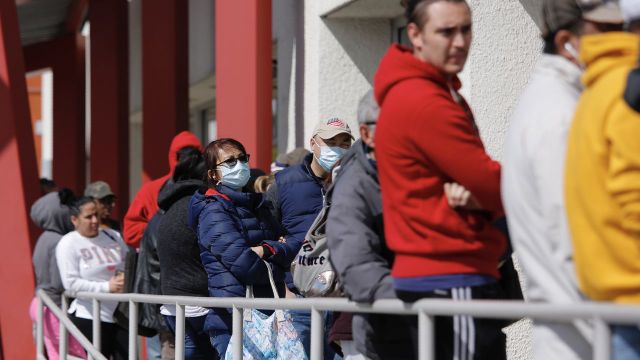
People wait in line for help with unemployment benefits at the One-Stop Career Center in Las Vegas (Credit: AP Photo/John Locher)
From the standpoint of the Wall Street finance houses and speculators, the pandemic has been a win-win situation. They have been emboldened by the homicidal return to work drive and the knowledge that they have the full backing of a political establishment that openly upholds the primacy of corporate revenues and profits over workers’ lives.
They also know that if there is any significant fall in the stock market, the Fed will intervene to make still more free money available.
In addition, they recognize that there are enormous gains to be made from the economic devastation. It provides the conditions where large corporations can gobble up firms that go under, thereby increasing the size and profits of those that survive.
At the same time, they can use the rise in unemployment levels to post-war records as a sledgehammer to drive down workers’ wages and conditions, as they restructure their operations, using new technologies to employ fewer workers at much reduced rates of pay.
In short, the ruling corporate and financial oligarchs are learning they can not only live with the coronavirus, but thrive and profit from it.
However, there are objective limits to the bacchanalia of speculation. The mountain of fictitious capital created by the injection of money with the press of a computer button does not in and of itself create real value. Financial assets, including inflated share portfolios, represent a claim on future value that has to be extracted from the labour of the working class.
This requires the intensification of the exploitation of the working class to unprecedented heights. The ruling classes, in the US and around the world, are making their preparations for the massive class confrontation this entails.
This is the underlying and motivating force behind the drive by the Trump administration for the establishment of a military-police dictatorship and the scrapping of constitutional norms. To use the words of Trump’s defense secretary, Mark Esper, the process of profit accumulation is the “battle space” that the capitalist state must forcefully “dominate.”
The eruption of protests against the police murder of George Floyd is a preview of even bigger class confrontations to come. The last words he uttered, “I can’t breathe,” have resonated throughout the US and internationally because they encapsulate the situation facing workers everywhere.
It is becoming increasingly impossible to “breathe,” that is, to live under the capitalist system, as the ruling classes seek to preserve their profit system by all means necessary, no matter what the cost.
The burning issue facing the working class is to consciously grasp the objective logic of the situation it now confronts and the nature of the struggle in which it is already engaged against a murderous and dictatorial ruling class.
The American Declaration of Independence invoked the inalienable right to life in the very first place. Today, the achievement of that right can be taken forward only through a conscious struggle for political power—the overthrow of the profit system and the establishment of a workers’ state as the first and most decisive step in the reconstruction of the economy on socialist foundations.

9 Jun 2020

The Descent of America

John Feffer

Complaints about American decline have been commonplace since at least the Vietnam War era.
In the late 1980s, declinism experienced an upsurge with the publication of The Rise and Fall of Great Powers, by Paul Kennedy, which warned of the dangers of imperial overstretch. Even America’s putative victory over the Soviet Union in the Cold War represented only a minor lull in the chatter about the erosion of U.S. status relative to other countries, particularly a rising China.
Closer to home, meanwhile, the grumbling over America’s crumbling usually spikes around the release of the American Society of Civil Engineers’ quadrennial infrastructure report card.
In 2017, the ASCE awarded America a D+ for the state of its roads, bridges, schools, parks, and public transportation. The grade was no surprise to many Americans. “This is an advanced economy?” people ask themselves as they wait for a broken-down bus, hit a pothole on the highway, turn away from the undrinkable water coming out of their taps, or drop their child at a school that’s just a few steps away from being condemned.
In U.S. schools, D is unsatisfactory but still officially passing. In terms of infrastructure, the United States teeters perilously on the edge of failure.
In the last few months, however, America has gone over the edge. The country has quickly, recklessly, impulsively entered the failure zone.
First, there’s the failure of leadership. The country has been ruled for the last three years by a corrupt, incompetent, would-be dictator who, when faced with a spate of crises, has proven spectacularly unfit for the job.
Second, there’s the failure to protect American lives. More than 100,000 people have died from the coronavirus, a level of death generally seen only in wartime.
Third, there’s the failure of the American dream. The economy has collapsed due to the coronavirus, and the unemployment rate has surged to nearly 20 percent.
Finally, there’s the chronic failure of American racism. In the last week, people have taken to the streets to protest the death of yet another African American at the hands of the police. On May 25, a police officer in Minneapolis handcuffed George Floyd on suspicion of forgery, pinned him to the ground, put a knee on his neck, and killed him. Floyd was one of over 7,500 people killed by the police since 2013.
Protestors are fed up with police profiling, targeting, and killing. But they are also outraged at the disproportionate impact of the pandemic and the economic collapse on people of color. The anger is entirely understandable. “I can’t breathe” applies to victims of police violence and the coronavirus both.
The protests themselves are a sign of hope, notwithstanding the over 60,000 National Guard that have poured onto the streets in 24 states.
Also hopeful are the expressions of solidarity during these protests. Cops in a number of cities have gotten down on one knee with protestors. Several mayors, like Atlanta’s Keisha Lance Bottoms, have spoken truth to the power of the president. Here in Washington, the owner of a restaurant burned by looters said, “Any kind of issue like this seems pretty minor. We have been through three months of being closed; we have seen 100,000 people die. I think the protests are great, and I think they are warranted.”
And yet, if you add up the economic, political, social, and medical deficits, it’s hard to imagine calling America an advanced industrialized nation at the moment. It is extraordinary to see such a rapid loss of status in real time, as opposed to a time-lapse animation of the rise and fall of some ancient civilization. “I’ve seen this kind of violence,” a former CIA analyst responsible for tracking developments in China and Southeast Asia told The Washington Post. “This is what autocrats do. This is what happens in countries before a collapse.”
The middle and upper classes may well be caught by surprise. But the current protests are a potent reminder that for a sizable portion of the American population, the country has never been advanced because they live in what Michael Harrington, nearly 60 years ago, called “the other America.”
Trump’s Racist Response
Donald Trump has always positioned himself as a law-and-order politician, even as his words and actions create disorder and violate laws.
He never possessed much if any empathy for victims of police violence. In response to George Floyd’s death, after a cursory expression of condolence, Trump quickly pivoted to deriding protesters, Democratic governors, “THUGS,” and the like. He promised that anyone who breached the White House fence would be met by “the most vicious dogs, and most ominous weapons.” He announced that he would declare the antifa movement a terrorist organization. He sounded like a minor-league dictator with his tweet that “when the looting starts, the shooting starts.”
Later, on a call with governors, he suggested that “if you don’t dominate, you’re wasting your time — they’re going to run over you, you’re going to look like a bunch of jerks.” He added, “You have to arrest people, and you have to try people, and they have to go jail for long periods of time.” Afterwards, in the Rose Garden, Trump said, “If a city or state refuses to take the actions necessary to defend the life and property of their residents, then I will deploy the United States military and quickly solve the problem for them.”
Despite Trump’s calls for law and order, the far right is actually cheering on the occasional violence of the protests because it feeds into their attempts to push the country into a race riot. Militia members, white extremists, and “boogaloo bois” want to take advantage of the coronavirus crisis to “accelerate” the demise of liberal, multicultural America. They’ve even showed up at the protests against police violence and promoted their own violent actions online.
Militant disruptions of otherwise peaceful demonstrations ultimately advance this far-right agenda. Such violence also advances Trump’s agenda.
Following his own version of accelerationism, the president has done everything within his power to destroy the country from within, using hateful language, implementing polarizing policies, and seeming to revel in the chaos that his administration has fostered. Declaring some version of martial law to contain the chaos he has helped to create — but in reality to promote more chaos and himself as the only person to address it — may be the only hope he has at this point of gaining a second term in office.
As Edward Luce writes in the Financial Times, “Trump makes little disguise of conjuring a pre-civil rights America where white males held uncontested sway.” Ultimately, though, it’s Trump himself who wants uncontested sway, and he thinks he can crowd-surf the unrest toward that goal.
America’s Racism Is a Foreign Policy Problem
There’s always been an element of racism to Donald Trump’s foreign policy.
From day one, for instance, Trump favored predominantly white countries in his immigration policy, instituting a Muslim travel ban and denigrating “shithole countries” when “we should have more people from places like Norway.” He told four U.S. congresswomen — three of them born in the United States — to “go back and help fix the totally broken and crime infested places from which they came.” He relishes blaming the coronavirus outbreak on “the Chinese,” knowing full well that his conspiracy theories feed into anti-Asian sentiment.
Of course, either money or nuclear weapons can turn a “shithole” country into a friend, with Trump cozying up to Kim Jong Un of North Korea and Mohammed bin Salman of Saudi Arabia. That’s always been Trump’s modus operandi: he is truly race-blind when it comes to the powerful.
Donald Trump didn’t suddenly introduce racism into U.S. foreign policy. As I wrote back in January 2018, “Trump was only putting into words an underlying principle of U.S. foreign policy. For decades, the United States has treated countries like ‘shitholes’ even if policymakers haven’t called them such, at least not in public.” Racism is reflected in U.S. budget priorities, in the minuscule size of foreign aid programs, in the pattern of U.S. interventions, in the racial composition of the U.S. Army’s “essential workers” (otherwise known as grunts), and even in the Pentagon’s militarization of domestic policing. Trump certainly didn’t create any of these dynamics, though he has often aggravated them.
Still, the current president’s elevation of racism is not simply rhetorical. There is method to his mania.
Trump is using racism as a tool to destroy whatever lingering commitment the United States has to liberal internationalism. The latter philosophy inspired Americans to help create the United Nations, launch the Peace Corps, administer foreign aid programs, and collaborate with other countries to fight global warming. This liberal internationalism has always had its defects, from paternalism to naivete. But it’s a damn sight better than the illiberal nationalism that Trump offers as an alternative.
Trump’s deployment of racism at home and abroad cuts the legs out from under liberal internationalism. No other country can take America’s human rights rhetoric seriously. No other country can accept America’s claim to impartiality as a broker of peace deals, climate deals, any deals. First put your own house in order, they will say.
Putting our own house in order has long been the motivation of U.S. social movements. Think of the civil rights movement, the LGBT rights movement, the Black Lives Matter movement. They have also inspired human rights movements devoted to home improvement in countries around the world. Even today, the U.S. protests against police violence have inspired nearly 15,000 people to demonstrate in Paris, 10,000 demonstrators in Amsterdam, tens of thousands in Auckland, thousands in London and Berlin and throughout Australia.
U.S. support of human rights abroad can and should be an extension of these social movements. That’s something that Trump’s racism at home and attacks on liberal internationalism abroad threaten as well.
“Let’s hope the demonstrations all over the world will help remind Washington that U.S. soft power is a unique asset, setting America apart from other great powers — from China, Russia, and even from Europe,” observes Wolfgang Ischinger, former German ambassador to the United States. “It would be tragic if the Trump administration turned a huge opportunity for the U.S. into a moral abdication.”
Unfortunately, Trump has his own ideas of how to put the American house in order up to and including burning the house down. The antidote to Trump’s racist nationalism is not less internationalism but more: rejoining the international bodies that Trump pulled out of, reentering the accords that Trump unsigned, patiently rebuilding U.S. engagement in the world on an equal basis.
Such a re-engagement has to go hand in hand with a difficult reckoning with America’s own racism, for the inequality perpetuated domestically mirrors the inequality maintained on a global scale.
Only in this way can America stop its descent and climb back into the community of nations.