14 Sept 2020

As Bloomberg pledges $100 million, Wall Street boosts Biden campaign

Patrick Martin

Billionaire Michael Bloomberg has pledged to spend at least $100 million to support the campaign of Democratic presidential candidate Joe Biden in Florida. This announcement Sunday is only the largest pledge of support from the financial oligarchy for the Democratic campaign.
Bloomberg aide Kevin Sheekey said the pledge of virtually unlimited financial backing to Biden in Florida, the most critical “battleground” state in the 2020 election, “will allow campaign resources and other Democratic resources to be used in other states, in particular the state of Pennsylvania.”
Florida has 29 electoral votes, the most of any closely contested state, following California with 55, overwhelmingly Democratic, and Texas with 38, leaning Republican. New York state, also with 29 electoral votes, is heavily Democratic.
Only once in the last 60 years—Bill Clinton in 1992—has a candidate won the presidency while losing Florida. The last Republican to lose Florida and still win the White House was Calvin Coolidge in 1924, when the state was lightly populated swampland.
Early voting begins in Florida September 24, and Bloomberg’s money will pay for massive campaign advertising on behalf of Biden, in both English and Spanish. Campaign officials said the funds would be devoted almost entirely to television and digital ads.
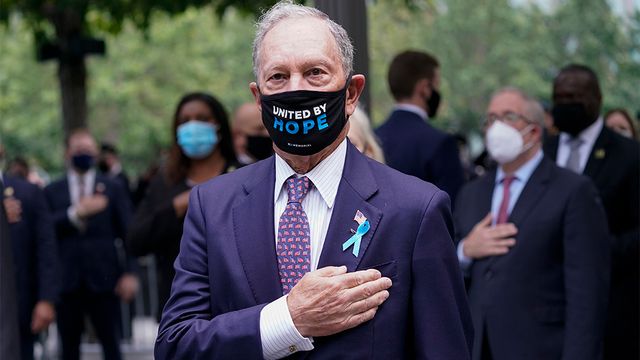
Former New York City Mayor Michael Bloomberg stands for the pledge of allegiance during a ceremony on Sept. 11, 2020, in New York. (AP Photo/Mary Altaffer)
Even before the Bloomberg commitment, the Biden campaign and supporting Democratic groups had outspent Trump and the Republicans by $42 million to $32 million. The flood of cash from the billionaire media mogul will give the Democrats a three- or four-to-one advantage over the final seven weeks of the campaign.
The efficacy of Bloomberg’s huge financial commitment is open to question. The media billionaire spent $1 billion (a mere one-fiftieth of his gargantuan personal fortune) on his own pursuit of the Democratic presidential nomination. He launched his campaign at a time when he believed Biden’s candidacy was near its demise, hoping that his money might forestall the nomination of Vermont Senator Bernie Sanders.
The sudden revival of Biden’s campaign with his victory in South Carolina in February and then in the Super Tuesday primaries on March 3 led Bloomberg to abandon his own efforts and endorse the former vice president, since their right-wing views on a range of topics, and particularly on foreign policy, were virtually identical.
Since then, Bloomberg has transferred $20 million from his abortive presidential campaign to the Democratic National Committee, as well as pumping in another $120 million to local, state and congressional campaigns, making him by far the largest single backer of the Democratic Party.
Florida is only the most glaring example of the general trend in the 2020 election, in which the financial oligarchy and Wall Street have indicated a distinct preference for Biden and backed it up with heavy financial commitments.
During August, the Biden campaign broke all records for fundraising in a single month, raking in $365 million, nearly double the previous record of $203 million set by the campaign of Barack Obama in September 2008, and more than Hillary Clinton and Trump combined to raise, in August 2016, $233 million. The Trump campaign also broke the Obama record, but its total of $210 million in August was far behind the pace set by the Democrats.
Approximately $205 million of the $365 million came through online donations, including 1.5 million new donors. This is more an indication of the widespread hostility to Trump among millions of working-class and middle-class people than any groundswell of support for Biden, who personifies the corrupt US political establishment, having spent 36 years in the Senate before his eight years as Obama’s vice president.
That means that $160 million—a near-record amount by itself—was raised through large donations from wealthy supporters of the Democratic Party. While Trump continues to rake in the lion’s share of support from industries such as oil and gas, mining and real estate, Biden has collected the bulk of financial backing from the banks, hedge funds and insurance industry.
Under rules set by the Federal Election Commission, a wealthy donor can now give as much as $830,600 to support a presidential candidate, routing much of the money through federal and state party committees rather than the candidate’s own campaign.
The result of the disparity in fundraising throughout the summer is that the Democratic presidential campaign has now caught up with and even surpassed Trump’s war chest. The Trump reelection campaign, despite raising an unprecedented $1.1 billion, has less cash on hand for the fall than the Biden campaign. According to press accounts, more than one-third of the money raised by the Trump campaign was used to pay the expenses of fundraising itself.
There were several reports last week that the Trump campaign was experiencing a “cash crunch,” and was unable to sustain advertising in all 15 of the so-called battleground states. Both the Washington Post and Bloomberg News reported that Trump campaign manager Bill Stepien has halted television advertising in Michigan and Pennsylvania at least temporarily, and that Biden was outspending Trump in nearly every closely contested state.
Stepien replaced Brad Parscale as campaign manager in July, at least in part because of concerns that Parscale had squandered Trump’s substantial initial fundraising advantage.
According to the media tracking firm Advertising Analytics, the Biden campaign spent $17 million in television and digital advertising in nine battleground states during the week of September 3, compared to $4 million by the Trump campaign.
The Clinton campaign outspent Trump by similar margins in 2016, but Trump campaign aides had boasted they would not face such a deficit in 2020. Trump has hinted he would seek to make up the difference from his personal fortune, but there has been no sign yet of any direct outlay by the billionaire to back his own campaign.


Israel becomes first country to impose second national COVID-19 lockdown

Jean Shaoul

On Sunday, Prime Minister Benjamin Netanyahu’s Likud-Blue and White coalition approved a full national lockdown to start on Friday morning, just before the Jewish New Year. It is the first government in the world to impose a second national lockdown.
The government put in place tight restrictions in early March. But in late April, as the infection rate began to fall, Netanyahu announced the phased reopening of schools, workplaces, restaurants, bars, clubs, swimming pools and hotels in the interest of corporate profits. He did so without putting in place any measures to guard against or deal with a second wave, despite recommendations from a team of experts, headed by Professor Eli Waxman from the Weizman Institute of Science.
His team recommended that the government reconsider its decision to restart the economy if the daily number of infections rose above 200, which the government ignored.
Within days of the government lifting restrictions on schools’ class sizes, there was a resurgence of the virus. In July, Siegal Sadetzki, Israel’s director of public health services, resigned, saying that insufficient safety precautions in schools, as well as large gatherings like weddings, had fueled a “significant portion” of second-wave infections.
Seven months into the crisis, it is still difficult to gain access to testing or get speedy results. After months of claiming it had a contact-tracing system in place, the health ministry handed over responsibility to the army which is now appealing for help from private companies and saying it will not be ready until November at the earliest.
Sunday’s decision came amid a soaring infection rate. Israel now tops the world rankings in the number of new COVID-19 cases per capita, with 157,000 confirmed cases—between 3,000 to 4,000 new cases are being recorded every day—and 1,136 deaths in a country of 9 million people. The vast majority of cases have occurred since May when Netanyahu famously told people that the lockdown was over, and people should “go out and have a good time.”
In the West Bank, 35,663 cases have been confirmed along with 214 deaths. This includes 8,550 cases in East Jerusalem, while the Hebron governorate has been the hardest hit. The Palestinian Authority has imposed lockdowns on badly-affected areas and a ban on public gatherings including weddings and graduation parties. In Gaza, 1,631 cases have been reported and 11 deaths. The first cases of community transmission were recorded on August 24, and since then the authorities have imposed a strict lockdown.
During the first phase of the lockdown, scheduled to last at least three weeks, people are not allowed to go more than 500 metres from their homes. Schools and non-essential workplaces, businesses and organisations will close. Restaurants will be open for delivery or takeout only and public transport will be reduced. Gatherings are limited to 10 people indoors and 20 people outdoors, severely limiting traditional family gatherings and religious services during the Jewish holy days.
These regulations are based on a new coronavirus law authorising the cabinet to issue restrictions, including limitations on the number of people at demonstrations and the distance between protesters that will curb the weekly anti-Netanyahu protests. The police are preparing to enforce the lockdown policy, even as voices from several groups have announced on social media they will not follow restrictions. Police plans permit the forceful dispersal of gatherings, including entering synagogues if necessary, with large numbers of officers from patrol, riot police and Border Police units.
Such are the political tensions within the ruling coalition over the government’s budget—now postponed until the end of November—that Sunday’s cabinet meeting was the first in a month.
The coronavirus cabinet committee had recommended a national lockdown—reportedly with the support of Netanyahu, Health Minister Yuli Edelstein and coronavirus coordinator Professor Ronni Gamzu—in large part because of warnings that the hospitals, underfunded for decades, would soon be overwhelmed by the rising number of patients. Yesterday, the Western Galilee Hospital in Nahariya became the first hospital to announce that it was unable to accept any more coronavirus patients.
Ten days ago, as the number of confirmed cases rose, the Netanyahu government ordered a week of overnight curfews and school closures to take effect from last Tuesday in 40 “red” areas with the highest infection rates. This was a capitulation to the religious ultra-Orthodox parties upon whom he is dependent, and effectively neutered Gamzu’s plans.
Gamzu had called for a full lockdown, including the closure of non-essential workplaces and schools, in the 40 worst affected towns and cities, predominantly religious and Arab, Bedouin and Druze communities. The mayors of four of the affected towns had warned Netanyahu that they would not cooperate with authorities if the lockdowns were imposed. The Health Ministry also announced that the 3,000 Hasidic pilgrims returning from Uman in the Ukraine after the Jewish New Year will not have to quarantine in isolation hotels but will be allowed to self-isolate at home.
Netanyahu, facing the prospect of years in jail if found guilty of fraud, bribery and breach of trust in three separate cases, will do anything to maintain his support base and keep himself in power while he manoeuvres to avoid conviction. This extends to provoking an all-out conflict with the judiciary, which he has accused of launching a “left-wing coup” to unseat him.
As infections continued to mount, around 120 doctors and scientists wrote an open letter urging the government not to impose a general lockdown, but instead adopt the “Swedish model” of herd immunity. Some were even invited to give evidence to the Knesset’s coronavirus committee. Another group of 150 doctors and scientists vehemently opposed them for encouraging widespread infection, but the open letter served the government’s objectives in challenging the scientific recommendations and questioning the acceptance of lockdowns.
The proposal for a second national lockdown met furious resistance from the ultra-Orthodox religious communities, businesses, and the Histadrut trade union federation. Some 85,500 businesses are expected to close this year, compared with 40,000 in a normal year. At least 21 percent of workers are unemployed, a figure set to increase. With businesses claiming that the lockdown would cost them $2 billion and threatening non-compliance, Netanyahu told his finance minister to come up with a new economic package to assist them, adding to the record high budget deficit that is nearly triple that of a year ago.
Yaakov Litzman, chairman of the United Torah Judaism party, the construction and housing minister and a Netanyahu ally, resigned from government in protest over the expected lockdown Sunday, saying that it would “prevent hundreds of thousands of Jews, of all sectors, from praying in synagogues.”
Even the timing of the lockdown was adjusted to meet Netanyahu’s demands. The postponement until Friday enables him to fly to Washington for Tuesday’s signing of the Israel-United Arab Emirates normalization agreement, now slated to include Bahrain as well, and to posture as a world statesman.
Both the Orthodox community, which has insisted on keeping its places of worship, schools and religious seminaries open, and Arab Israelis, who have held traditional large-scale wedding celebrations, have been blamed for the spread of the disease. But this is hardly surprising. Netanyahu has based his coalition on incitement against Israel’s Arab citizens and the cultivation of every form of backwardness among his own far-right and religious support base, guaranteeing the ultra-Orthodox rabbis autonomy to keep their schools free of a modern science-based curriculum.
The continued growth of religious ideology, like its counterparts in other countries, the cultivation of divisions between Israel’s diverse communities and the economic, social and healthcare crisis now engulfing Israel-Palestine are the price paid by the working class for the betrayals of their old political leaderships. This can only be overcome by the Israeli and Palestinian working class uniting with their class brothers and sisters throughout the Middle East on the basis of a conscious, revolutionary and socialist programme.

New cases of COVID-19 reach a one-day high of nearly 308,000 worldwide

Benjamin Mateus & Patrick Martin

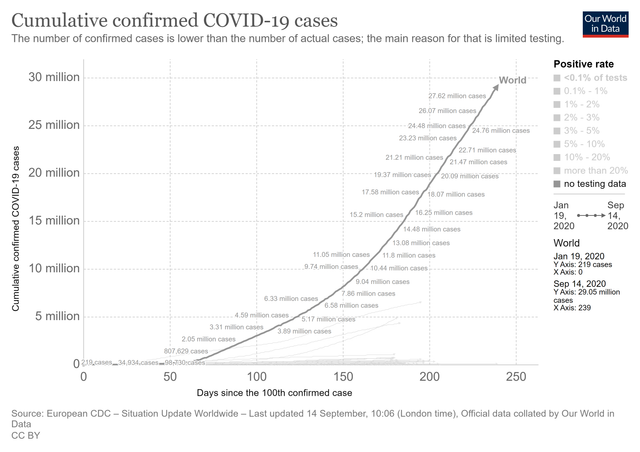
The World Health Organization (WHO) reported Monday a record one-day high of 307,930 new cases of COVID-19. According to all COVID-19 tracking dashboards, the globe is soon set to surpass 30 million infections. The United States, Brazil, and India have remained at the epicenter of the global pandemic for several weeks running, accounting for the majority of daily new cases.
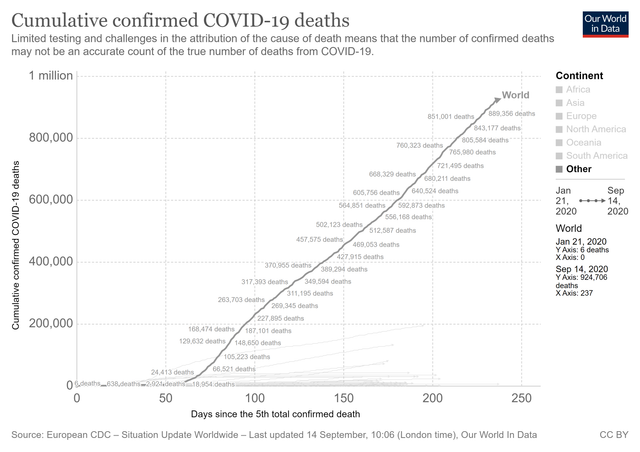
The Worldometer COVID-19 dashboard estimates there have been almost 930,000 deaths in little more than eight months since the first victim died on January 11 in Wuhan, a 61-year-old-man who was a regular customer at the now infamous wet market. The seven-day moving average of daily deaths has exceeded 5,000 since mid-July, meaning that in approximately two weeks, the total number of deaths worldwide will exceed one million.
Nurses and physicians on a COVID-19 unit in Texas [Credit: Miguel Gutierrez Jr.]
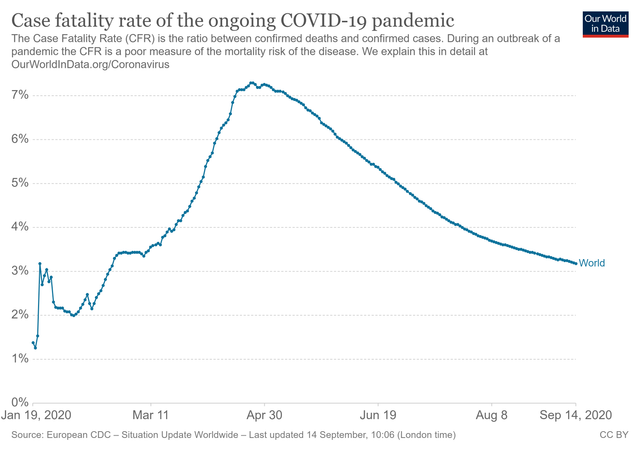
The crude global case fatality rate (total deaths divided by total cases) stands at an astounding 3.18 percent. However, this also doesn’t account for the excess deaths that have been consistently reported in almost every country, which would put the mortality much higher. There is no legitimate debate either over the deadliness of this contagion or the warnings of epidemiologists and other medical scientists that society’s resources must be fully mobilized to contain and suppress this pandemic.
The predictions for the next several months are dire. If the working classes of every nation do not resist the policy of herd immunity that the ruling classes have thoroughly implemented to ensure the economy is operating at full speed, it will only accelerate the toll in lives and health.
It is more than six months since President Trump admitted to Bob Woodward, the senior Washington Post reporter, after his conversation with Chinese President Xi Jinping, “This is deadly stuff. It’s also more deadly than … even your strenuous flu … this is five percent [case fatality rate] versus one percent and less than one percent.”
Global case fatality rate (Credit: Our World in Data)
As the WSWS noted, this conspiracy to hide the deadly nature of the pandemic involved Trump’s cabinet, the Democrats and Republicans in Congress, and the media establishment. It is obvious as well that China provided similar warnings to European leaders, whose deceptive rhetoric and malign actions are nearly identical with those of the United States.
The US is poised to surpass 200,000 deaths before the week's end, which, in raw numbers, exceeds the number of American deaths in World War I, the Korean War and Vietnam combined. By the end of this year, according to a conservative projection by the University of Washington, that figure could reach 410,000, the equivalent of total US combat deaths in World War II.
Despite these harrowing figures, Trump declares that the country has “turned the corner” on the pandemic, a remark that will find a place in history alongside “light at the end of the tunnel” during the Vietnam War, or George W. Bush’s boast of “Mission Accomplished,” three months into the US invasion and occupation of Iraq.
Cumulative global cases of COVID-19 (Credit: Our World in Data)
As for the Democrats, their presidential candidate hopes to profit politically from Trump’s colossal failure and obvious indifference. But Democratic governors are carrying out the same policies at the state level, promoting the reopening of factories and other workplaces, and the back-to-school campaign that has already touched off a new wave of illness and death.
And in Congress, both capitalist parties demonstrate their callousness toward the tens of millions who have been thrown out of work by the impact of the pandemic. Federal supplemental unemployment benefits expired on July 31 for 20 million workers, and neither the Democrats nor the Republicans have lifted a finger to assist them—after they moved heaven and earth to pass legislation that gave a $3 trillion bailout to the big corporations and banks.
The real concern of all sections of the political establishment is the mounting resistance among workers and youth to the policy of herd immunity, under which the majority of the population will be infected and millions will die or suffer major and potentially lifelong damage to their health. The focal point is now the struggle over the reopening of K-12 education and colleges, where strikes have broken out despite the effort of the unions to subordinate all actions of workers to the presidential campaign of Joe Biden and Kamala Harris.
Cumulative global deaths due to COVID-19 (Credit: Our World in Data)
While the Democrats rely on the unions to suppress the working class, the Trump administration is turning to the open use of force. Trump himself has hailed the police execution of Michael Reinoehl, a left-wing protester against police violence, and defended the ultra-right gunman who killed two Black Lives Matter protesters in Kenosha, Wisconsin. He has repeatedly threatened to invoke the Insurrection Act of 1807 and call out the military against political opponents.
In a further sign of the fascistic tendencies erupting from the Trump administration, a longtime political operative, Michael Caputo, recently installed as Assistant Secretary of Health and Human Services for Public Affairs, the top communications job in that department, claimed Sunday that there was a “resistance unit” of scientists inside the Centers for Disease Control and Prevention—the main federal disease-fighting organization—who were engaged in “sedition” against President Trump.
Caputo’s seemingly deranged remarks came in a video he hosted live on his personal Facebook page, reported by the New York Times and then confirmed by Caputo in an interview with the Washington Post. The diatribe was apparently set off by media criticism of Caputo’s role in doctoring reports by the CDC and HHS on the impact of the coronavirus pandemic to make Trump’s role look better.
A former Trump employee in various business ventures, Caputo had no background in health care when he was appointed in April, in the midst of the global pandemic, to oversee HHS communications about the public health crisis.
In the course of his video, Caputo claimed that the shooting of a right-wing counterdemonstrator in Portland, Oregon last month was a “drill” in preparation for widespread left-wing violence against Trump and his supporters. He predicted that Trump would win the election, that his Democratic opponent Joe Biden would not concede, and that “armed insurrection” would be prepared.
“And when Donald Trump refuses to stand down at the inauguration, the shooting will begin,” he said. “If you carry guns, buy ammunition, ladies and gentlemen, because it’s going to be hard to get.” He went on to say that he himself felt physically threatened, and that his “mental health has definitely failed.”
Even before he was appointed to the top public relations job at HHS, Caputo had tweeted, on March 11, “For the Democrat 2020 victory strategy to work, 100,000+ Americans have to die.” It was the reopening of the US economy, promoted by Trump and carried out at the urging of governors of both parties, that drove the death toll well above that number before the end of May.
The homicidal policy of the US ruling elite in the coronavirus pandemic and the emergence of fascistic tendencies within the Trump administration are interconnected phenomena.
American capitalism is plunging into the abyss, facing intractable social, economic and political crises for which no section of the ruling elite has any solution.
As the Socialist Equality Party declared in its recent statement on the COVID-19 crisis:
The fight against the pandemic is not primarily a medical question. As with every great problem confronting the working class—social inequality and poverty, war, environmental degradation and dictatorship—it is a political and revolutionary question, which raises the need for the working class to take power in its own hands, overthrow capitalism, and restructure all of society on the basis of social need.

Oil and the Pandemic

Conn Hallinan

During the reign of the Emperor Justinian I (527-565 AD), a mysterious plague spread out of the Nile Valley to Constantinople and finished off the Roman Empire. Appearing first in China and North India, the “Black Death” (Yersinia pestis) radiated throughout the Mediterranean and into Northern Europe. It may well have killed close to half the world’s population, some 50 million people.
Covid-19 is not the Black Death, but its impact may be civilizational, weakening the mighty, raising up the modest, and rearranging axes of power across the globe.
The Middle East is a case in point. Since the end of World War II, the wealth of the Persian Gulf monarchies—Saudi Arabia, the United Arab Emirates (UAE), Kuwait and Qatar—has overturned the traditional centers of power that dominated the region for millennia: Turkey, Egypt and Persia. While those civilizations were built on agriculture, industry and trade, the monarchs were fabulously wealthy simply because they sat on a sea of oil.
The monarchies—Saudi Arabia in particular—have used that wealth to overthrow governments, silence internal dissent, and sponsor a version of Islam that has spawned terrorists from the Caucasus to the Philippines.
And now they are in trouble.
The Saudi owned oil company, Aramco, just saw its quarterly earnings fall from $24.7 billion to $6.6 billion, a more than 73 percent drop from a year ago.
Not all the slump is due to the pandemic recession. Over the past eight years, Arab oil producers have seen their annual revenues decline from $1 trillion to $300 billion, reflecting a gradual shift away from hydrocarbons toward renewable energy. But Covid-19 has greatly accelerated that trend.
For countries like Saudi Arabia, this is an existential problem. The country has a growing population, much of it unemployed and young—some 70 percent of Saudis are under 30. So far, the royalty has kept a lid on things by handing out cash and make-work jobs, but the drop in revenues is making that more difficult. The Kingdom—as well as the UAE—has hefty financial reserves, but that money will not last forever.
In the Saudi case, a series of economic and political blunders have worsened the crisis.
Riyadh is locked into an expensive military stalemate in Yemen, while also trying to diversify the country’s economy. Crown Prince, Mohammed bin Salman, is pushing a $500 billion Red Sea mega project to build a new city, Neom, that will supposedly attract industry, technology and investment.
However, the plan has drawn little outside money, because investors are spooked by the Crown Prince’s aggressive foreign policy and the murder of journalist Jamal Khashoggi. The Saudis are borrowing up to $12 billion just to pay Aramco dividends of $75 billion a year.
The oil crisis has spread to Middle Eastern countries that rely on the monarchs for investments, aid and jobs for their young populations. Cairo sends some 2.5 million Egyptians to work in the Gulf states, and countries like Lebanon provide financial services and consumer goods.
Lebanon is now imploding, Egypt is piling up massive debts, and Iraq can’t pay its bills because oil is stuck at around $46 a barrel. Saudi Arabia needs a price of at least $95 a barrel to meet its budgetary needs—and to feed the appetites of its royals.
When the pandemic ends, oil prices will rise, but they are very unlikely to reach the levels they did in the early 2000s when they averaged $100 a barrel. Oil prices have been low ever since Saudi Arabia’s ill-conceived attempt to drive out smaller competitors and re-take its former market share.
In 2014, Riyadh deliberately drove down the price of oil to hurt smaller competitors and throttle expensive arctic drilling projects. But when China’s economy slowed, demand for oil fell, and the price has never recovered.
Of the top 10 oil producers in the world, five are in the Middle East: Saudi Arabia, Iraq, Iran, the UAE and Kuwait. All of them are in dire straits, although in Iran’s case this is exacerbated by US sanctions. With the exception of Iraq—where massive demonstrations have shaken the country’s leadership—most of those countries have been politically quiet. In the case of the monarchies, of course, it is hard to judge the level of dissatisfaction because they do not tolerate dissent.
But how long will the royals be able to keep the lid on?
“It is a transformation that has speeded up by the corona virus cataclysm,” says Middle East expert Patrick Cockburn, “and will radically change the politics of the Middle East.”
There is no region untouched by the current crisis. With the exception of the presidents of Brazil and the US, most world leaders have concluded that climate change is a reality and that hydocarbons are the major culprit. Even when the pandemic eases, oil use will continue to decline.
The virus has exposed the fault lines among the mighty. The United States has the largest economy in the world and is the greatest military power on the globe, and yet it simply collapsed in the face of Covid-19. With 4 percent of the world’s population the United States accounts for 22 percent of the pandemic’s fatalities.
And the US is not alone. The United Kingdom has more than 40,000 dead, and its economy has plummeted 9 percent. In contrast, Bangladesh, the world’s most crowded country, with twice Great Britain’s population, has around 4,000 deaths and its economy has contracted by only 1.9 percent.
“Covid-19 has blown away the myth about ‘First’ and ‘Third’ world competence,” says Steven Friedman, director of the Center for the Study of Democracy in Johannesburg.
Turkey, Vietnam, Cuba and Nigeria all have far better records fighting the virus than Great Britain and the European Union.
Partly this is because Europe’s population is older. While Europe’s average age in 43, Africa’s is 19. Younger people infected with corona virus generally have better outcomes than older people, but age doesn’t fully explain the differences.
While Turkey developed sophisticated tracking methods to monitor measles, and Nigeria did the same for Ebola, the US and United Kingdom were systematically starving or dismantling public health programs. Instead of stockpiling supplies to deal with a pandemic, Europe and the US relied on countries like China to quickly supply things like personal protection equipment on an “as needed” basis, because it was cheaper than producing their own or paying for storage and maintenance,
But “need” doesn’t work during a worldwide pandemic. China had its own health crisis to deal with. The lag time between the appearance of the virus and obtaining the tools to fight it is directly responsible for the wave of deaths among medical workers and first responders.
And while the Chinese economy has re-bounded—enough to tick the price of oil slightly upwards—the US, Great Britain and the EU are mired in what promises to be a painful recession.
The neo-liberal model of low taxes, privatization of public resources and reliance on the free market has demonstrated its incompetence in the face of a natural disaster. The relationship between wealth and favorable outcomes only works when that wealth is invested in the many, not the few.
The Plague of Justinian destroyed the Roman Empire. The pandemic is not likely to do that to the United States. But it has exposed the fault lines and structural weaknesses that wealth papers over—until something like Covid-19 comes along to shake the glitter off the system.

Multinationals and Oil Companies Are Imposing Their Greed on the People of Mozambique

Vijay Prashad

Three years ago, on October 5, 2017, fighters with the Al Sunnah wa Jama’ah (ASWJ) entered the town of Mocímboa da Praia in northern Mozambique. They attacked three police stations, and then withdrew. Since then, this group—which has since proclaimed its allegiance to the Islamic State—has continued its battle, including capturing the port of Mocímboa da Praia in August 2020.
Mozambique’s military has floundered. Under pressure from the International Monetary Fund, Mozambique’s government has cut the salaries of government employees, including the military. It now relies on private security companies hired by multinational corporations to do its fighting; this outsourcing of defense is permitted by the IMF and the wealthy creditors. That is why Mozambique’s Ministry of Interior has hired the South African Dyck Advisory Group (DAG), the Russian Wagner Group, and Erik Prince’s Frontier Services Group. Colonel Lionel Dyck, the head of the Dyck Group, recently told Hannes Wessels that “The Mozambican Defence Forces are unprepared and under-resourced.”
Dyck, Wagner, and Frontier Services Group are joined in northern Mozambique by a range of other mercenary security forces (such as Arkhê Risk Solutions and GardaWorld) hired by the French energy company Total and the U.S. energy company ExxonMobil. Both firms have interests in the gas fields in Area 1 and Area 4 of Mozambique’s Rovuma Basin, which increases the country’s natural gas reserves to 100 trillion cubic feet (third only to Nigeria and Algeria in Africa). These firms are to invest more than $55 billion in the extraction of natural gas and in the construction of liquefaction plants.
Total, the French firm, and Mozambique’s government signed a deal to create a joint force to provide security to these gas fields. Mozambique’s minister of mineral resources and energy—Max Tonela—said that this deal “reinforces security measures and efforts to create a safe operating environment for partners like Total.”
The narrative fed by Total, Mozambique’s government, and the private security firms is that the conflict in northern Mozambique is authored by the Islamists, and that all measures must be taken to thwart this three-year-old insurgency.
The Forgotten Cape
This area of northern Mozambique—Cabo Delgado—is known colloquially as the “forgotten cape” or Cabo Esquecido. A study of government statistics shows that the people of this part of Mozambique—where the anti-colonial war against the Portuguese broke out on September 25, 1964—experience all the traps of poverty: low income, high illiteracy, and low morale. Lack of opportunities alongside social aspirations led to the emergence of various forms of economic activity, including artisanal mining for rubies and trafficking of Afghan heroin toward South Africa. The arrival of Islamism simply provided another outlet for the deep frustrations of sections of the population.
It is called the “forgotten cape” because not much of Mozambique’s social wealth has come into the communities of the region; it is not forgotten by the oil and gas companies. These companies—and their predecessors such as Texas-based Anadarko—as well as the other large multinationals such as Montepuez Ruby Mining (owned by the UK-based Gemfields) have participated in the eviction of thousands of people from their homes and livelihoods. Given permission by the government in Maputo to settle the land to remove the rubies and the natural gas, these firms have returned little to the people of the north.
The Phantom of ISIS
There’s nothing like the appearance of Islamist groups that fly the flag of ISIS to allow Western firms to set aside their own role in the creation of poverty. Everything becomes about terrorism. In June 2019, two Mozambican scholars—Mohamad Yassine of the Higher Institute of International Relations (ISRI) and Saíde Habibe, who co-authored a 2019 study on Islamic radicalization in northern Mozambique—said that ISIS will not find fertile ground in northern Mozambique; this is largely because the Muslim population in that region is small. These so-called Islamists, Habibe said, are better known for their role in the illicit trades than in the creation of an Islamic State.
A French NGO—Les Amis de la Terre France—published a report in June 2020 that made the point that the insurgency “was built on a tangle of social, religious, and political tensions, exacerbated by the explosion of inequalities and human rights violations linked to gas projects.” The militarization of the conflict to protect the gas installations, the NGO argues, “contribute[s] to fuel the tensions.” Indeed, “Human rights violations are on the increase in [these] communities, caught between insurgents, private military and paramilitary forces, multinationals or their subcontractors.”
South Africa’s Institute for Security Studies published a report in October 2019 called “The Genesis of Insurgency in Northern Mozambique.” The institute is known to be quite hawkish when it comes to security issues. But reality is too difficult to avoid. This report cautions that “a lasting solution to the extremist violence in Cabo Delgado cannot be brought about by hard power and military might.” Social inequality is the main problem. The introduction of the energy firms, rather than bringing prosperity to the people, says the institute, “appears to have brought discontent.”
Interventions
Just off the coast of Mozambique is the island of Mayotte, which is a French possession with a French military base (and which is facing unrest). The governments of France and Mozambique are considering a maritime cooperation agreement, which could eventually allow direct French intervention to protect Total’s investments.
At a briefing on drug trafficking in Africa, U.S. Deputy Assistant Secretary of State Heather Merritt said that the issue of the heroin trade is very significant, and that the U.S. is willing to assist the government in Mozambique in any way.
South Africa’s intelligence chief Ayanda Diodlo has said that her government is “taking very, very seriously” the threat in northern Mozambique. South Africa is considering a military intervention, despite a warning from ISIS that it would open up a new front inside South Africa if this happens.
Such interventions—by France, the United States, and South Africa—will not solve the problem of northern Mozambique. But they will certainly provide a reason for Western countries to create a military foothold on the continent.
Meanwhile, for the people of Mocímboa da Praia, it would be business as usual.

Screwing with the Unemployment Statistics

Dave Lindorff

Something is screwy about unemployment numbers out of Washington.
In late July, just before the end of the supplemental $600 weekly checks for people collecting unemployment benefits, the New York Times reported that 30 million were receiving those checks.
That’s 30 million laid-off workers who qualified for unemployment benefits, which is not everyone who was laid off, since many people who get work for a wage don’t qualify for unemployment compensation.
For example, between mid-March and the end of the first week of May, according to US News, 33 million laid off workers applied for unemployment compensation benefits. At least three million of them were denied benefits for one reason or another. That of course doesn’t count the people who lost work but hadn’t worked enough weeks to qualify and who never even bothered to file. It also doesn’t count many “independent contractors” who were not being defined as employees by the companies paying them, which would include many people working as gardeners, roofers, carpenters, in nail salons and as cab drivers. But just for the hell of it, let’s just go with that 33 million number, and say that is the number of unemployed in the US.
Now recall that the US has a population of almost 330 million.
How many of those people are working age? We can define working age, for the sake of argument, as 18 to, say, 67. (I’m assuming that latter number, situated midway between 65, when people qualify for Medicare and often decided to retire, and 70, the age when a person can collect the maximum amount of Social Security benefits per month, will balance out.) Using Census Bureau data (which I tinkered with to get the number of 18 and 19 year-olds, as well as of 66-69 year olds), I come our with about 219 million. Now a lot of those people don’t get classified by the Bureau of Labor Statistics as part of the labor force either because they are full-time students, or have never worked (stay-at-home parents, for example, with no access to or funding for daycare, or those disabled and unable to work, or already retired), but again for the sake of argument, let’s just call them all workers.
Well, what percent of 219 million is 33 million? The answer is 15%. I’d say that means that the US has clearly got an unemployment rate of at least 15%. So what is the BLS saying the unemployment rate is? Well, in their unemployment report for July, The BLS was listing the jobless rate as being 10.2%. That figure is 50% lower than the percent of workers who are receiving unemployment benefits!
How can that be? It can’t. It’s just wrong.
Part of the problem is that the BLS, which maybe should be just called the BS, doesn’t consider someone to be unemployed and part of the labor force if they have not looked for work in more than a month. But of course, there are good reasons why someone who is able-bodied and who needs a job may not look for one. In an economy like this one, there simply may not be any jobs for certain people with certain skills. In certain parts of the country, if you’re not willing to move, you just have to wait for the economy to improve before you’ll be able to find a job. Take waiters. With restaurants closed or only able to operate at 25% or 50% capacity, there just aren’t as may jobs for waiters or other restaurant staff. That means people with those job backgrounds need to compete with people in other service sector jobs that are also probably not hiring. Under such circumstances looking for work is an exercise in futility.
At any rate, clearly the unemployment rate is at least to 15% just based on the number of people who had jobs and are now eligible for unemployment benefits (at least until those short-term programs run out). But it is actually worse than that because a more honest figure would include those who would like a job if they could find one, or who have a part-time job but used to have, and would like to have a full-time one. The BLS actually has that number. It’s called the U-6 unemployment figure. In July it was 18.3% But I suspect it must be higher, because all those 33 million people getting unemployment benefits are required by their state labor departments to be actively looking for a job, so they wouldn’t be in that category of worker included in the U-6 figure. That means unemployment or under-employment must really be well above 20% of the working population. I would guess that it’s probably close or equal to the 25% unemployment that the US reached during the depth of the Great Depression.
In any event, it’s clear that the government is not doing a good job of describing the current economic crisis facing the country and its people in this pandemic-induced depression. And the news media, which for the most point print the monthly and weekly BLS statistics on jobs and layoffs and total unemployment, after putting a positive spin on tiny optics in hiring or drops in the unemployment rate. How under those circumstances can the public and elected officials make appropriate decisions on economic policy, on who to vote for in November and on their own lives (whether to buy a house or a car, or to go to college or have a child, etc., for example).
When the country was in this type of dire situation situation back in 1936, the government, headed by Franklin D. Roosevelt, was creating public jobs to build roads and bridges, develop national parks, build electric networks and dams, was even funding artists, musicians, writers, orchestras, the production of plays, basically anything to get people back to work and earning a paycheck.
Now the government in Washington cannot even see its way clear to pass a bill to hand everyone adult a second $1200 check to help pay the rent or put food on the table.
One reason is that the depth of this crisis is being hidden from us.
The numbers prove it, but you have to do a little work to find them.

Can We Address That British Eugenics Scandal?

Justin Podur

British Prime Minister Boris Johnson has been known to have an interest in eugenics, but despite the persistence of support for this discredited idea over the years, eugenics is a scientific and moral failure.
In February, an adviser to Johnson resigned when some old racist posts he wrote in 2014 emerged. The contractor, Andrew Sabisky, called himself a “superforecaster” by trade and trafficked in theories of race and intelligence. Footage resurfaced of Boris Johnson talking about genetic inequality and IQ in 2013. Articles announce that “eugenics is back” every few years (20182016, or 1989), so it is probably the case that eugenics never left. With the political right in the ascendant in many parts of the world, it is inevitable that the pseudoscience of eugenics would be on the rise with it.
Some academics will also follow, as they have from the days when craniometry justified the British Empire. Richard Dawkins, a retired Oxford biologist active on Twitter where he was called a “tedious old racist” in 2018, tweeted in February what was likely a reaction to Sabisky’s eugenics scandal:
“It’s one thing to deplore eugenics on ideological, political, moral grounds. It’s quite another to conclude that it wouldn’t work in practice. Of course it would. It works for cows, horses, pigs, dogs & roses. Why on earth wouldn’t it work for humans? Facts ignore ideology.”
The comparison of human “races” to dog breeds is so pervasive that it should be answered comprehensively, and the tweet should be picked apart in detail. The comparison has nothing to do with science, as I will show, and should be abhorred by the scientifically minded.
Dawkins’ posture is one where he claims to want to distance himself from eugenics “on ideological, political, moral grounds,” while suggesting that the “facts” are in favor of eugenics. The “facts” in this trope aren’t a matter of argument and evidence but some kind of secret magic that only those with a strong stomach can handle. The less brave and bright resist the “facts” out of fear that they will clash with our “ideological, political” commitments. But as far as eugenics goes, there are no “facts”: eugenics has been an intellectually corrupted project from its inception in the 19th century. Eugenics comes to us from a time when the British Empire was plundering the world and its proponents went looking for evidence to prove racist conclusions they already believed. No one who understands science fears that racists will abuse eugenicist “facts.” As anthropologist Jonathan Marks writes in his book Is Science Racist?: “[T]here is no fear of potential abuse of knowledge. There is simply the collection and dissemination of intellectually corrupted information. That is the legacy of scientific racism.”
Like climate deniers who work in fields of science other than climate and make public statements to try to pretend there is no consensus on the topic, Dawkins used his authority as a retired biology lecturer to tweet claims outside his area of expertise. A scientific organization that has authority on the topic, the American Society of Human Genetics (ASHG), made the following three points in a 2018 statement:
+ “Genetics demonstrates that humans cannot be divided into biologically distinct subcategories”
+ “Genetics exposes the concept of ‘racial purity’ as scientifically meaningless”
+ “[T]he invocation of genetics to promote racist ideologies is one of many factors causing racism to persist”
Dawkins’ defenders might now argue that his tweet had nothing to do with racism and that it is just about eugenics. That the entire pseudoscientific history of eugenics, pervaded and corrupted with racism, is irrelevant to his claims about “practice” and “facts,” by reference to other species. Dawkins mentioned the breeding of “cows, horses, pigs, dogs & roses.” There are different flaws when each of these comparisons is put under the microscope.
Roses? Spraying fertilizer on roses helps them—does it help us? There is almost nothing that works for the plant Rosa gallicanae that also works for us, so that can be quickly dispensed with.
Cows and pigs are bred to be docile, to pack on as much edible meat as possible in a short amount of time, and ideally to go quietly to their deaths. Unless Dawkins envisions a cannibal future, cows and pigs are irrelevant to this analogy with humans. (It is worth mentioning that these are also two of the planet’s three most abused animal species—the chicken, of whom 69 billion were slaughtered in 2018 compared to 1.5 billion pigs and 302 million cows, wins this heart-rending competition.)
That leaves horses and dogs.
Horses were once our choice animal for transportation. Now that we use fossil fuels, most horses today are involved in what the Equine Heritage Institute calls “recreational horse use,” in which the horse is made to carry a person on its back and run fast for our entertainment.
With the other animals eliminated, Dawkins’ argument comes down to the comparison between humans and dogs. Dog breeding has been done for many thousands of years, and dogs have been bred for many jobs.
Does it “work”? Specifically, since the idea is if it works for dogs it could work for humans, does breeding work for the species being bred (dogs, or in Dawkins’ implicit proposal, humans)? Of course not. From the perspective of the dog, it is a nightmare.
A couple of popular internet memes sum up what thousands of years of dog breeding have achieved for the bred species. In one, a stunning photograph of a wolf is shown thinking: “Humans at a campfire… It’s cold and I’m starving, maybe I should ask for some scraps. What’s the worst that could happen?” Below, captioned “10,000 years later,” is a photo of a pug in a knitted hat made to look like a birthday cake. Similarly, photos of a wolf and a pug are used in another meme, where the photo of the wolf says “product of evolution,” and the photo of the pug says “product of intelligent design.”
This latter meme reveals the irony that Dawkins of all people should make the eugenicist claim that dog breeding “works.” In The God Delusion as well as much other work, Dawkins’ principal argument against the existence of God is that evolution can produce more complex forms of life (including human intelligence) than any divine intelligence could. Similarly, the artificial selection of dog breeding has—as the humorous memes demonstrate—propagated traits that are disadvantageous to dogs compared to what natural selection was able to do for the wolf.
The 2008 BBC documentary “Pedigree Dogs Exposed” investigated the UK’s Kennel Club and the breed standards that have led, by breeding exclusively for appearance, to a dog population with hundreds of genetic diseases. What is called “breeding” to achieve these traits is better called “inbreeding,” with brother-sister, mother-son, father-daughter, and father-granddaughter matings regularly made—there are no incest taboos, no health considerations, and no concern for genetic diseases made in awarding prizes at dog shows. Perfectly healthy puppies—like Rhodesian ridgeback puppies that don’t have the ridge, which actually brings with it additional health risks—are killed at birth to maintain the “purity” of the breed. Kennel Clubs and breeders were offended by comparisons of dog breeding to racism, but the shared history is beyond dispute. Kennel Clubs were founded in the late 19th century, after Carl Linnaeus, Comte de Buffon, and Arthur de Gobineau had laid the intellectual foundations of scientific racism, and there was the freest exchange of ideas between eugenicists and dog breeders. Also in the late 19th century, Canada’s first prime minister, Sir John A. Macdonald, whose statues have had travails in Montreal and Toronto leading to scolding and arrestssaid that “the Aryan races will not wholesomely amalgamate with the Africans or the Asiatics… the cross of those races, like the cross of the dog and the fox, is not successful.”
In “Pedigree Dogs Exposed,” the documentarians show old photos of breeds like German shepherds and bulldogs that had long legs and upright postures, contrasting them with the top dogs in those breeds today, whose legs get shorter and shorter as their mobility decreased. Those are the “show dogs.” But “working dogs” aren’t beyond question either. Bulldogs were bred, as the name indicates, for fighting with bulls for entertainment. Pit bulls, for fighting one another. Dobermans, for protecting a rent collector. Is this work that should be done? In reality, breeding dogs for these jobs was of dubious benefit to human society; trying to make the case that it was beneficial to the dogs, as a species, is preposterous. And if that is true for dogs bred solely for work, how much sadder is it for the pedigree dogs bred solely to meet circular aesthetic criteria (one breeder, asked about the morality of killing puppies who lack the ridge, responded: “Well, if it doesn’t have the ridge, it’s not a ridgeback, is it?”)?
Perhaps Dawkins envisions a well-funded eugenics department that could overcome incest taboos and ethics reviews, as well as the small matter of human reproductive freedom, to use inbreeding to create human breeds. But what most eugenicists are really interested in is not such a scientific project. They are interested in the idea of racial differences in intelligence.
But dog breeds provide no insight into how this aspect would work for humans either. Dogs, the outcome of artificial selection, have breeds that can be identified by their genotypes. A paper about the differences between dog breeds and human “races” that appeared in the journal Evolution: Education and Outreach in July 2019 stated that about 27 percent of dogs’ genetic variation could be explained by breed. Humans are the outcome of natural selection, and most genetic variation occurs within human groups. Classifications of humans by genotype don’t match up with what racists think of as the different human “races.” The closest science can get to the racist position is the trivial point that people who are close together geographically are (relatively) close together genetically. And even this regional variation can explain only 3.3-4.7 percent of human genetic variation, according to the paper.
It is this regional variation that is being exploited by mail-order genetics companies like 23andMe, which Marks calls “science-lite,” because its users accept the findings they like and reject the ones they don’t, which is probably the intended way to use the test. As for “race,” there is no such thing, except for racism, which is the unscientific belief that there are such things as distinct human “races.”
So, is dog breeding successful? Dog breeding has been disastrous for the dog as a species. Does dog breeding provide evidence that eugenics could work? The analogy between dog breeds and human “races” is broken.
If racists want to push eugenics, the rest of us should realize that they do so without the backing of science, which has moved on, leaving the detritus behind.