15 Sept 2020

Schools at epicentre of UK’s coronavirus explosion

Robert Stevens

COVID-19 is spreading out of control in Britain, with levels of infection not seen since May being recorded. Last Friday, Saturday and Sunday all saw above 3,300 cases daily. A further 2,621 cases and nine deaths were recorded on Monday, a normal “weekend-dip” in reports—followed by 3,105 cases and 27 deaths on Tuesday.
The virus is resurgent in workplaces, schools, and communities, with the R (reproduction) value rising last Friday to between 1.0 and 1.2. In London and the North West of England, R is between 1.1 and 1.3, higher than the UK’s other regions.
According to official figures, an average of 2,998 daily infections are being recorded daily—an amount that has nearly doubled in two weeks from the seven-day rolling average of 1,323 on August 31. The real numbers infected is far larger as many thousands of people are unable to get a test after showing symptoms.
Official deaths in Britain stand at 41,637. But this is sharply contradicted by Office for National Statistics figures published yesterday, showing that 57,528 fatalities with COVID-19 mentioned on the death certificate were registered in the UK up to September 4-6. Other authoritative assessments of the COVID-19 death toll, based on excess deaths, are over 65,000.
Such is the spread of coronavirus that Boris Johnson’s Conservative government, which adopted a strategy of herd immunity at the beginning of the pandemic, has been forced to impose new national restrictions. Its policy of “local lockdowns” were so porous they only contributed to the spread of the infection over wide areas of the country.
On Monday, social gatherings of more than six people were made illegal, as the “rule of six” came into force. This too will do little or nothing to stop the spread of the virus. The rule is not even being applied uniformly across the UK. In England, it applies indoors and outdoors and includes children; in Scotland indoors and outdoors and excludes children; in Wales indoors only and excludes children; and in Northern Ireland indoors only and includes children.
Tens of millions of workers, including all educators and pupils, will remain exposed to the virus, with the government stating that “education and work settings are unaffected” by the “rule of six.” True to their naked class bias, the Tories had to delay their announcement by several days while mulling over what to do with grouse shooting during the season. They determined that six people cannot mingle at a birthday or Christmas party and that two families of four stopping for a talk in the street would be illegal “mingling.” But parties of up to 30 people can don their flat caps, Barbour jackets, tweeds and wellies, and spend a costly day on the moors with their wealthy chums.
Under conditions where there is no mass testing in the UK, Prime Minister Boris Johnson declared in announcing the measures, “Workplaces could be opened up to all those who test negative that morning and allow them to behave in a way that was normal before COVID… Theatres and sports venues could test all audience members on the day and let in those with a negative result, all those who are not infectious.”
With the entire economy opened and the virus spreading like wildfire, he signed off with “Wash your hands, cover your face, and make space.”
The reopening of schools—nearly a month ago in Scotland and from September in the rest of the UK—with over 10 million pupils and 2 million school staff returning—is a central factor in the explosion of COVID-19 cases. This will be made much worse next week with 2 million students travelling all over the UK to university towns and cities to resume their courses.
Already, nearly 1,000 schools have been hit with infections and the number is shooting up exponentially.
The government is providing no national breakdown of infections in schools. The ToryFibs twitter group is providing a daily tally on school infections based on reports from school websites, news reports and National Health Service updates. By 5pm Monday evening it reported infections at 792 schools and just three hours later this had increased to 850 schools. By Tuesday morning it rose to 877 schools, and by Tuesday evening reached 913.
Among those in an infected household is Labour Party leader Sir Keir Starmer, whose two children have been at school throughout the pandemic. Starmer went into self-isolation on Monday as a “family member” showed symptoms of coronavirus. The SKWAWKBOX website reported that “Labour insiders” said that Starmer “is self-isolating because one of his children is showing coronavirus symptoms.”
Starmer played a central role in enforcing the unsafe reopening of schools, declaring last month in Parliament to Johnson, “I don’t just want all children back at school next month, I expect them back at school. No ifs, no buts, no equivocation.”
Starmer was insisting on a return to school as the government was lying about the spread of coronavirus in schools that were open. Amid a barrage of propaganda, Public Health England, in an August 23 statement, claimed “out of more than 1 million children attending pre-school and primary school in June, just 70 children were affected,” boasting that this represented a rate of 0.01 percent.
With up to a half of all COVID-19 deaths in the UK and over half in Scotland taking place in care homes, there are major concerns that the resurgence will take thousands of more lives among the elderly.
Last Friday, Stuart Miller, the director of adult social care delivery at the Department of Health and Social Care, wrote to all care providers, local authority chief executives and directors of adult social care, warning that there are the “first signs” of rising infections being “reflected in care homes” across Britain. The Sunday Times revealed that there have been outbreaks in at least 43 homes. This is likely a significant underestimation. In the week to last Friday, coronavirus outbreaks were confirmed at 12 care homes just in the city of Salford, with three residents dying.
Outbreaks in food processing factories continue. At the Aunt Bessie’s Yorkshire puddings and desserts factory in Hull, a worker is “seriously ill” after being infected and another has been sent home. Aunt Bessie’s admitted last week to a “small number” of infections among its 400 employees and has kept production running. However, on Monday a factory on the same Freightliner Road, Chaucer Foods, was forced to “temporarily suspend production” to test all staff.
Pubs are another major vector of the disease, with people supposedly under a local “lockdown” able to freely congregate for weeks at nearly 50,000 pubs nationally. The largest pub chain, Wetherspoons, admitted Monday that 66 staff have already tested positive for COVID-19 in 50 pubs since reopening.
The resurgence is brutally exposing government lies that it is operating a “state of the art” Test and Trace system. The Sunday Times reported leaked documents showing a backlog of 185,000 tests, with swabs being destroyed and the government requesting that labs in Germany and Italy carry out the necessary processing.
On Monday, it was revealed that for millions of people in England’s 10 outbreak hotspots, no walk-in, drive-in or postal coronavirus tests were available with the government testing web site reporting a message: “This service is currently very busy. More tests should be available later.” One of the hotpots is Bolton in the north west of England, with an infection rate of 122 cases for every 100,000 people. This is an infection rate almost 10 times higher than the rate that puts a country on the UK’s quarantine list.

The Moria catastrophe and the European Union’s war on refugees

Martin Kreickenbaum

On the Greek island of Lesbos, a human tragedy is playing out before the eyes of the world. The 13,000 refugees who have been left homeless and stranded on the island since the Moria camp burned down are being denied all assistance. They sleep in the open air on roads and have no access to drinking water or food. If they protest against this barbaric treatment, the police attack them with tear gas.
“The EU always talks about human rights, but they are treating us like rubbish,” Taheri, a youth who fled Afghanistan with his family, told Germany’s Der Spiegel.
The inhumane treatment and humiliation of these despairing people cannot simply be explained as the result of indifference to their fate. It is a product of a deliberate policy pursued by the European Union (EU) and its member states. Refugees are being intentionally mistreated to deter others from attempting to reach Europe. For this same reason, the EU allows thousands of migrants to drown in the Mediterranean each year.
The horrifying pictures from Lesbos expose the brutality of “Fortress Europe.” The worthlessness of the “European values” often invoked by Berlin, Paris, and Brussels to attack Russia and China, or wage war in defence of “human rights,” has been laid bare for all to see. The demands raised by the far-right Alternative for Germany (AfD), Lega and other fascistic organisations are being implemented by the EU.
Europe’s ruling circles will use the same ruthlessness they are currently displaying towards refugees to suppress anyone who challenges their wealth and power. Under conditions of the deepest economic crisis since the 1930s, they are preparing for bitter class battles. The defence of the refugees is therefore not merely an elementary humanitarian obligation. It is necessary to defend the democratic rights and social achievements of the entire working class.
Leading European politicians have openly admitted that they welcome the deterrent provided by the images from Lesbos. “We must now try to avoid sending out signals that could cause a chain reaction we could not control,” stated Austria’s foreign minister, Alexander Schallenberg, by way of justifying his government’s refusal to accept any refugees from Lesbos.
The German government argued along similar lines. Berlin has warned about a “pull effect,” insisted that a new camp must be built on Lesbos and concealed its inaction behind demands for a “European solution.” But they know full well that this will never come to pass, since the Hungarian, Polish and other far-right European governments firmly reject accepting any refugees.
The German government’s offer to accept between 100 and 150 children and an additional 1,500 refugees, most of whom are families, is a sham. Its aim is above all to contain the widespread outrage over what is happening on Lesbos. The government already promised to accept the children earlier this year. The same applies to families with children, whom the government are now allegedly “seeking.”

German responsibility

The reality is that the German government and its European partners bear chief responsibility for the misery and mass deaths on Europe’s external borders. German Interior Minister Horst Seehofer is supporting his party colleague, Greek Prime Minister Kyriakos Mitsotakis, who is doing all he can to make life a living hell for the refugees.
Mitsotakis has accused the refugees of setting fire to the camp themselves in order to be able to leave Lesbos. A Greek government spokesman declared, “They thought if they just set fire to Moria, they would be able to leave the island. We tell them bluntly: they can forget it.”
Even prior to the fire in Moria, life for the refugees was “hell on earth.” Jean Ziegler, the Swiss former UN special rapporteur for the right to food, described the conditions in February 2020 as follows: “Everything I have seen in the slums around the world pales in comparison to what I experienced in Moria. Human rights are being violated in the camp at every turn, total despair is all-pervasive. The malefactors in Brussels are allowing conditions of survival to develop in the hot spots that recall the deplorable concentration camps and hope in this way to drain the flood of refugees.”
The refugees are now literally left with nothing. They are forced to camp in the dirt without tents or blankets. The police fire tear gas at them. They are refusing to allow aid organisations to access the homeless refugees, who are desperately searching for food, and force volunteers to dispose of meals that have already been prepared for them.
This apocalyptic situation is impacting the refugees ever more severely. The aid organisation Mission Lifeline reported on Twitter of “children with severe injuries and helpless parents.” The Greek police fired “fist-sized metal objects full of tear gas at children.”
The Greek government has now begun constructing a new camp for the refugees at Kara Tepe, a former military training ground on Lesbos. However, only about 500 refugees have been accommodated there thus far. Many are terrified that they will experience the same inhumane treatment there as in Moria, and that they will be forced to spend the coming cold and wet winter in tents.
Surrounded by NATO barbed wire, the camp resembles a prison and conditions within are similar: curfews, inadequate medical services and the isolation of people who test positive for COVID-19. Even so, the threat of an uncontrolled spread of the coronavirus remains in Kara Tepe, just like in Moria. Seven of the first 300 refugees accepted into the camp have tested positive for COVID-19.

A product of the dirty deal with Turkey

The concept for the Moria camp was developed in Germany, and it was established and operated with the help of the EU. It is the direct product of the dirty deal negotiated by German Chancellor Angela Merkel with Turkey in 2016.
At the time, the EU obligated the Greek Syriza government to establish camps on Aegean Sea islands that were euphemistically referred to as “hot spots.” Their role was to capture, register and deport as soon as possible refugees who successfully made the sea crossing from Turkey to Greece. At the same time, the coastguard was significantly strengthened and NATO warships were sent to the eastern Mediterranean to deter refugees.
The agreement with Turkey intentionally violated the right of each person to have an individual review of their reasons for seeking asylum so as to facilitate the mass deportation of refugees. The German government and EU sent several liaison officials and employees of the EU border agency Frontex to Greece in order to swiftly process the asylum applications. Many of the rejections were so obviously unlawful that Greek judges subsequently overturned them.
At the same time, the EU refused to accept the same number of refugees from Turkey as had been deported, which was one of the conditions of the agreement. The agreement was thus reduced to the miserable core of Turkey blocking all refugees from reaching Greece and Greece refusing to allow any refugees to travel to other European countries.
The hot spots on the Aegean islands, which had originally only been intended for refugees to stay in for a week, were transformed into permanent internment camps in which living conditions became ever more life-threatening and inhumane. The number of internees grew. Already in 2018, the containers in Moria were no longer adequate to house everyone. In a neighbouring olive grove, wooden huts and tents were erected for the refugees. At that time, 6,000 refugees were living in a legal vacuum from which there was no escape.
The situation then worsened dramatically in Moria in late 2019. Around 30,000 refugees successfully reached Greece in dinghies during the autumn, and they were subsequently confined to the camps. By March 2020, around 20,000 people lived in and around Moria. Food and water became scarce and were rationed. Internees had to queue for hours to get a meal or go to the toilet. The power supply regularly collapsed, and the coronavirus pandemic was already threatening to erupt.
All experts clearly understood that the virus would spread among the camp internees uncontrolled once it emerged. But the Greek government did not respond by evacuating the camp. Instead, it reduced the number of active aid organisations and imposed strict curfews.
COVID-19 was then detected in one refugee in early September. The virus spread rapidly throughout the overcrowded camp. Shortly thereafter, 35 infections had been registered. The total curfew that was then imposed and the reduction of medical care to emergency ambulance services triggered unrest. Ultimately, a fire destroyed the entire camp.

EU toughens refugee policy

The German government and EU have responded to the self-made catastrophe in Moria by adopting an even harder line on refugee policy.
At a joint press conference on Friday, Interior Minister Horst Seehofer and EU Commission Vice President Margaritis Schinas presented the key points of the EU’s new refugee policy. According to them, refugee camps on Europe’s external borders should be funded and operated by the EU itself.
“Moria no longer exists,” said Schinas. “That’s why it is clear that the Greek authorities must quickly establish a new institution that is modern, that is a centre with all of the necessary facilities to identify and process asylum cases.”
This will see the accelerated implementation of plans presented by Seehofer to the EU last summer. They include extra-territorial internment camps on the external borders where legal proceedings and the Geneva Conventions for Refugees will be effectively suspended.
Instead of evacuating them, Seehofer is threatening the refugees with a Moria 2.0! The spiral of deterrence set into motion by the EU in its struggle against refugees is being pushed to a new stage. It can already be expected that in a relatively short period, the conditions in the newly established EU camps will be even worse than those in Moria.
The “common European solution” being sought by Berlin, Paris, Brussels and Rome is focused on intensifying the war on refugees and driving them out of Europe. There is no room for the millions of people fleeing war, hunger and poverty out of pure desperation.

Trump stages sham Mideast “peace” ceremony on White House lawn

Bill Van Auken

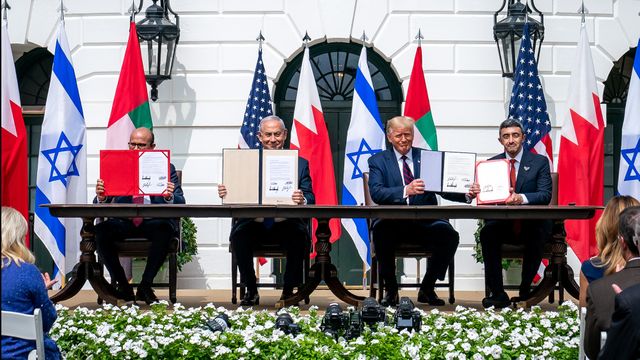
The signing of agreements between Israel and the Sunni Persian Gulf monarchies of the United Arab Emirates (UAE) and Bahrain on the White House South Lawn Tuesday was proclaimed by US President Donald Trump as the advent of “peace in the Middle East without blood all over the sand,” and universally hailed by the media as “historic.”
All of this inflated rhetoric is designed to conceal the reality that the sordid deals inked in Washington are only part of US efforts to solidify an anti-Iranian axis for a potentially world catastrophic war in the region.
The US-Israeli-Emirati-Bahraini signing ceremony was staged close to the anniversaries of two previous US-brokered “peace” deals: the September 17, 1978, Camp David accords signed by Egyptian President Anwar al-Sadat and Israeli Prime Minister Menachem Begin, and the Oslo Accords signed on the White House lawn by Palestine Liberation Organization (PLO) leader Yassir Arafat and Israeli Prime Minister Yitzhak Rabin on September 13, 1993.
President Donald J. Trump, Minister of Foreign Affairs of Bahrain Dr. Abdullatif bin Rashid Al-Zayani, Israeli Prime Minister Benjamin Netanyahu and Minister of Foreign Affairs for the United Arab Emirates Abdullah bin Zayed Al Nahyanisigns sign the Abraham Accords Tuesday, Sept. 15, 2020, on the South Lawn of the White House. (Official White House Photo by Tia Dufour)
The proximity of the anniversaries and Trump’s absurd preening and posturing Tuesday as the architect of the so-called “Abraham Accords” and a new era of peace in the Middle East recall nothing so much as Marx’s adage: the first time tragedy, the second time farce.
The 1978 deal initiated the process of “normalization” of relations between Israel and the Arab regimes, all of which assisted in the repression of the Palestinian movement and the annihilation of its leaders. With the 1993 accord, the PLO abandoned any pretense of a struggle for the liberation of Palestine, instead establishing the corrupt Palestinian Authority, whose principal purpose is policing the Palestinian population of the occupied territories in collaboration with Israel’s security forces.
The deals signed Tuesday—a treaty between Israel and the UAE and a “declaration” of intent between the Zionist state and Bahrain, which was dragged into the process at the last minute without any formal agreement negotiated—have nothing whatsoever to do with “peace.”
In the first place, there has never been a shot fired in anger between the Gulf sheikdoms and Israel. Rather, the deals formalize what were already existing and barely concealed commercial, governmental and military ties between the venal and dictatorial Sunni Arab monarchies and Tel Aviv.
Among the most ludicrous features of Tuesday’s ceremonies was the pretense that the Emirati and Bahraini foreign ministers—Sheikh Abdullah bin Zayed Al Nahyan, a member of the UAE’s ruling royal family, and Abdullatif bin Rashid Al Zayani, former head of Bahrain’s viciously repressive security forces—represent the aspirations and interests of the Arab masses.
When Sadat carried out his historic betrayal at Camp David, he did so as the head of state of the most populous country in the Middle East—now numbering over 100 million—and as the representative of a regime founded by Gamal Abdel Nasser, the icon of Arab nationalism, which had been at war with Israel virtually continuously for a quarter of a century.
Nahyan represents an Emirati royal family that rules over a territory in which barely 11 percent of the population are citizens, with nearly 90 percent comprised of foreign migrant workers, most of them poorly paid South Asians who are brutally exploited under the shadow of dictatorial visa rules allowing for their summary expulsion.
As for Zayani, he speaks for Bahrain’s Sunni monarchy, which rules over a country in which 70 percent of the population consists of disenfranchised, poor and brutally repressed Shia Bahrainis, with opponents of the regime subjected to arbitrary detention, torture and death.
In carrying out their US-brokered deals with Israel, the Emirati and Bahraini monarchies dispensed with the threadbare fiction that the Arab bourgeois regimes are defenders of the rights of the Palestinians against Israeli occupation and apartheid rule. This fiction was codified in the so-called Arab Peace Initiative launched by Saudi Arabia in 2002, which made recognition of Israel dependent upon Israeli withdrawal from the occupied territories, a “just settlement” of the Palestinian refugee problem and the establishment of a Palestinian state with East Jerusalem as its capital.
While the Arab League had endorsed this initiative, when the Palestinians introduced a resolution condemning the UAE deal reached last month with Tel Aviv, the body voted it down.
If the House of Saud has not joined with its brother monarchs in the UAE and Bahrain in a “peace” pilgrimage to the Trump White House it is because of fear that such a naked renunciation of its own initiative and embrace of Israel could fatally undermine its claim to legitimacy, both internally and in the wider Muslin world. Nonetheless, there is no doubt that Riyadh gave its blessing to Bahrain—which is heavily dependent upon Saudi support—for its deal with Israel, and that the Saudi regime is itself collaborating closely with Tel Aviv, despite the absence of formal relations.
Palestinians demonstrated in the West Bank and Gaza Tuesday in a “day of rage” against the sham “peace” deals in Washington. Shawan Jabarin, the general director of Palestinian human rights organization Al-Haq, said that the deals laid bare “what has been clear to Palestinians for decades: Israel’s illegal acts of annexation and apartheid will not deter those in power from the pursuit of their own interests, to the detriment, if not damnation, of justice, accountability and human rights in Palestine.”
For his part, Trump thuggishly bragged about cutting off US contributions to assistance programs for Palestinian refugees because “they didn’t say nice things about us,” and suggested that the deals with the UAE and Bahrain would escalate pressure upon the Palestinians to capitulate.
Netanyahu, like Trump, aimed to use the White House ceremony to boost his domestic image under conditions in which he faces trial on charges of fraud, bribery and breach of trust and is confronting growing domestic opposition amid soaring COVID-19 infection rates and an economic crisis that has left 21 percent of the workforce unemployed. He kept the language of the deal with the UAE secret until the signing, fearing that its verbiage about foreswearing annexation of swathes of the occupied West Bank and supporting a so-called “two-state solution,” would alienate his right-wing base.
Netanyahu has insisted that annexation remains “on the table.” When he and Trump were asked about the issue at a press appearance shortly before the signing ceremony, the US president replied, “We don’t want to talk about that now.”
The idea that the agreements signed on the White House lawn were a step toward peace in the Middle East is belied by the continuing war threats by the US-led anti-Iranian axis in the region.
Teheran warned Washington Tuesday against making a “strategic mistake” after Trump threatened Iran over unsubstantiated reports that it was preparing to exact revenge for the US drone assassination in January of Iranian general and senior leader Qassem Suleimani by assassinating the US ambassador to South Africa. South African authorities dismissed the reports as baseless.
Trump had threatened Monday that any Iranian attack would be met with retaliation “1,000 times greater in magnitude.”
The Iranian navy reported last week that it had driven off US warplanes that had attempted to approach an area where Iranian military exercises were being conducted in the strategic Strait of Hormuz.
Military tensions have continued to escalate since Trump abrogated the Iranian nuclear accord with the world’s major powers in 2018, imposing unilateral sanctions against the Iranian population that are tantamount to a state of war.
Aerial bombings in the US-backed and Saudi-led war in Yemen continue to claim lives, with nearly 200,000 killed in the past five years and some 10 million people brought to the brink of starvation. One of the byproducts of the “peace” deals is the anticipated sale to the UAE, one of the participants in the near-genocidal war against Yemen, of F-35 fighter jets and other advanced weaponry.
Meanwhile, Israel is continuing its own bombing raids against what it claims are Iranian-connected targets in Syria, while threatening to launch a new war against Hezbollah in Lebanon.
The chief impediment to peace in the Middle East is the protracted drive by US imperialism, under Democratic and Republican administrations alike, to assert its hegemony over the oil-rich region. Washington’s escalating campaign for regime change in Iran is aimed at denying the country’s resources and strategic position to China in preparation for “great power” conflict—i.e., a third world war.

West Coast fires and evacuations expected to fuel the spread of COVID-19

Kevin Martinez

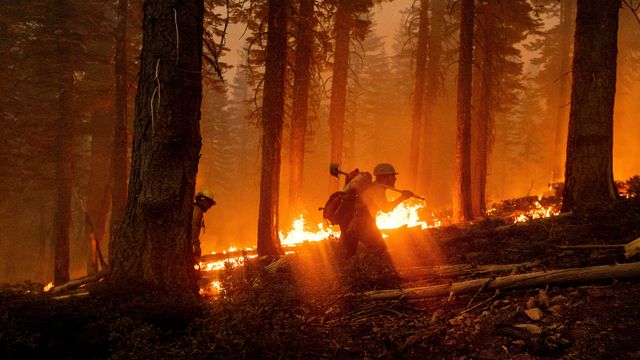
At least 87 fires are still burning in 11 states, according to the National Interagency Fire Center. In Oregon, at least 22 people are missing because of the wildfires, which have claimed 10 people in the state, including a 13-year-old and his grandmother. Officials fear more deaths will be confirmed in the coming days and have established a mobile medical examiner facility, essentially a mobile morgue, in Linn County east of Corvallis. A child was killed also in Washington state.
In California, at least 24 people have died in the wildfires. The North Complex Fire alone has taken 15 lives, destroyed 723 structures and burned more than 260,000 acres across four counties. It is only 39 percent contained.
Seven victims of the North Complex Fire have been identified by the Butte County Sheriff’s Office, ranging in age from 16 to 70.
Firefighter Cody Carter battles the North Complex Fire in Plumas National Forest, Calif., on Monday, Sept. 14, 2020. (AP Photo/Noah Berger)
The August Complex Fire, which started last month, has burned more than 755,000 acres across Mendocino and Humboldt counties and is only 39 percent contained.
The Creek Fire in Fresno County has now burned more than 220,000 acres and is 16 percent contained. The Dolan Fire, south of Big Sur, is only 40 percent contained and has burned almost 120,000 acres.
Across Oregon and Washington, 28 large fires have burned over 1.5 million acres. The Beachie Creek Fire, east of Salem, reported no new growth from the previous day as officials are cautiously optimistic that expected precipitation can help firefighting efforts.
Washington Governor Jay Inslee said that “virtually the entire state is covered by a cloud of smoke that’s unbelievably irritating, downright unhealthy and dangerous.” Many parts of the West Coast continue to have some of the worst air quality in the world, according to the air quality group IQAir. The fires are now so widespread that parts of the East Coast, including New York City and Washington, D.C., are now registering smoke from the infernos.
There are now nine major wildfires burning across Washington state, with the two largest, the Pearl Hill and Cold Springs fires, burning more than 412,500 acres, according to the Washington Department of Natural Resources.
As wildfires continue to spread throughout the Western United States, health officials are warning that COVID-19 will also infect evacuees at shelters and evacuations sites that are now dealing with two public health emergencies.
Because the physical ailments associated with smoke inhalation are so similar to the symptoms associated with the virus, there is a growing concern that hospitals may be inundated with people suffering from both. Even worse, those at risk of contracting COVID-19 at an emergency shelter may forgo evacuating at all.
Karl Kim, executive director of the National Disaster Preparedness Training Center, which trains first responders, told U.S. News and World Report, “People are scrambling right now to figure out how this affects the guidance and messaging and so forth.” He also said that the shelters’ relationship to public health is an “unusually important and under-researched topic.”
As families and groups evacuate from one location to another, it is becoming increasingly difficult to tell to what extent the group shelters are fueling the pandemic.
“Contact tracing is really critical during a pandemic, and just because there’s a wildfire, all of the needs associated with contact tracing don’t just go away,” Kim said. “I think it’s more complicated because of the urgent nature of the evacuation. We don’t have good systems for this; nonetheless, we need to do that tracking. That’s the ongoing public health challenge.”
Organizations like the American Red Cross are requiring evacuees to wear masks and stay six feet apart, but these rules are becoming increasingly difficult to enforce in disaster zones and crowded shelters.
The Oregon State Fairgrounds in the state capital Salem saw maskless groups of evacuees gather in the parking lot and barn over the weekend. Signs were posted outside the exposition center with health and safety guidelines regarding both the fires and the pandemic. Volunteers reminded everyone inside to wear masks.
Already some 6,300 people are in emergency Red Cross shelters and hotels but as many as 50,000 potential evacuees may join them before the fires are brought under control, according to Brad Kieserman, vice president of disaster operations and logistics for the American Red Cross.
Kieserman told the media that normally during an emergency shelter situation, community groups and charities gather evacuees into school gymnasiums and meeting halls and food is provided in buffet lines. The pandemic, however, has forced shelters to adopt new approaches that minimize the risk of disease transmission.
“Noncongregate shelters is a new pandemic thing,” Kieserman said, “The last thing we want to have happen is people to remain in the path of a wildfire or hurricane because they think it’s safer to do than risk a shelter.”
Red Cross teams are reported to be cleaning and disinfecting regularly as well as checking staffers and evacuees for any signs of sickness. Those who are infected are taken to special isolation centers, and if possible are sent to hotels instead of group shelters. Box lunches are being distributed in lieu of buffet lines.
Group shelters in Central California are reportedly using plastic pipes with clear shower curtains to separate people in evacuation centers while still allowing them to see outside from their isolated areas. According to the Red Cross, more than 1,200 people fleeing the Creek Fire are staying at 30 hotels, while the rest stay at group shelters.
In Oregon, officials have moved beyond hosting group shelters at the usual churches, schools, and community buildings to include malls, golf courses, and other businesses to accommodate those staying in their cars or recreational vehicles.

Who is on the University of Michigan Board of Regents?

Matthew Brennan

The University of Michigan graduate student worker strike is now in its second week. The nearly 1,200 Graduate Employee Organization (GEO) workers have since been joined by Residential Assistance Staff student workers across campus. They are courageously opposing the dangerous back-to-school conditions amid the deadly COVID-19 pandemic.
Among the demands of the striking student workers are calls for unconditional right to work remotely, financial support and flexibility for housing and childcare, increased and transparent COVID-19 testing plans based on public health models, and a demilitarization of the campus.
The strike has received overwhelming support across the campus and from students and workers around the country. As one of the most significant strikes against the back-to-work “re-opening” policy of the ruling elites and both major political parties in the US, it embodies the growing opposition of workers, students and youth around the world.
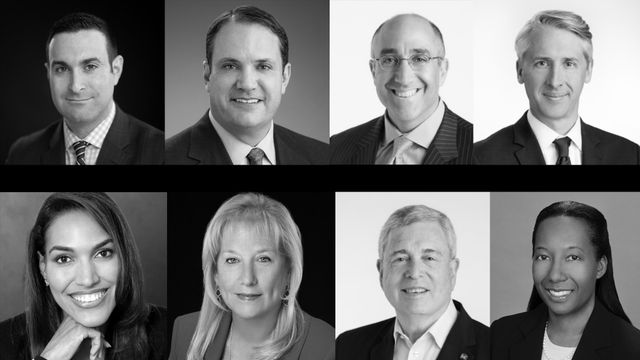
University of Michigan Regents (Image Credit: University of Michigan)
In the university administration, however, striking student workers face a hostile force, which has rejected their demands and is now threatening the strikers with a legal injunction and potential criminal penalties.
This is not a surprise since the governing body of the University of Michigan is a nexus of powerful political, military and corporate interests. Collectively the Board of Regents and Provost have worked in and for the last three US presidential administrations and Michigan governors. They constitute a small army of Wall Street, Pentagon, financial, real estate and health insurance interests. Six of the eight Board of Regents are also members of the Democratic Party.
The following is a brief profile of the leading board members and Provost Susan Collins.
Regent Chair, Denise Ilitch
Ilitch is a Democrat from the second richest family in Michigan, and President of Ilitch Enterprises, LLC. The Ilitch family owns Little Caesar Pizza Enterprises, the Detroit Red Wings, the Detroit Tigers and Olympia Entertainment, and is collectively worth at least $6 billion.
In the lead-up to the 2013 forced bankruptcy of the city of Detroit, the Ilitch family helped draw up plans to cut city jobs and pensions, and privatize city services. Both the Ilitch family and billionaire Quicken Loans founder Dan Gilbert used the forced bankruptcy to buy up huge swaths of land in the impoverished city at cut-rate prices.
The whole scenario was made possible through the anti-democratic emergency financial manager law. The Ilitch family received $260 million in state subsidies in the process in order to finance their $450 million dollar hockey stadium in Midtown—more than the $198 million cash deficit faced by the city of Detroit prior to the bankruptcy.
Regent Vice-Chairman , Jordan B. Acker
Acker, a lawyer, is a long-serving operative of the Democratic Party. In Michigan, he was the state’s Deputy Communications Director, before moving on to Washington DC, to work for the Obama Administration. In March 2011, he was appointed as an attorney-advisor to Secretary Janet Napolitano at the Department of Homeland Security (DHS).
Under Napolitano and Acker, the DHS created or expanded countless anti-democratic and deeply repressive initiatives and programs. These include a massive escalation of anti-immigration policies: the deportation of hundreds of thousands of immigrants, the militarization of the US-Mexico border, which has led to thousands of immigrant deaths in the Sonoran Desert, the right-wing police-immigration “Secure Communities” partnership program, the Nationwide Suspicious Activity Reporting Initiative (SAR), and oversaw an escalation of the murderous “war on drugs” military initiatives in Mexico and Central America.
Napolitano’s Homeland Security Department also participated in the Obama administration’s militarization of the police, funneling high-grade military weaponry from the wars in Iraq and Afghanistan to the streets of American cities.
Napolitano was rewarded for her efforts by being appointed President of University of California (UC) Board of Regents in 2013, while Acker headed back to Michigan. In April of 2020, Napolitano spearheaded an effort to break the four-month-long UC graduate student worker strike for better living conditions, threatening to fire striking students and deport immigrant students.
Regent Ron Weiser
Weiser is a two-time chairman of the Michigan Republican Party, and one of the richest individuals in the state of Michigan. He is currently making headlines because he is the owner of McKinley Properties, which manages over $1.9 billion in assets, including more than 17,371 apartments, mainly in Michigan and Florida.
Through McKinley, Weiser has at least 18 large apartment complexes near the University of Michigan and nearby Eastern Michigan University in Ypsilanti. These properties are overwhelmingly populated by undergraduates, graduate students, staff, faculty and service workers at the university. Were students not to return to campus for in-person classes, it would undoubtedly result in a major reduction in McKinley’s annual $500 million revenue.
Weiser was Ambassador to Slovakia under the George W Bush administration and was selected in 2016 to lead the Republican National Committee’s fundraising efforts for Donald Trump. He is one of the most prominent benefactors in the school’s history, having donated over $100 million to the University of Michigan. He has also established several research centers on campus including the Weiser Center for Emerging Democracies (WECD), which is heavily oriented to and anti-communist scholars in and around the US State Department.
Regent Katherine E. White
White is a Republican and law professor, who got her master’s degree in strategic studies from the US Army War College. She served in the Departments of Commerce and Agriculture in the Bush administration and is currently on the Old National Bancorp Corporate Board of Directors.
Most tellingly, she is a Brigadier General in the US Army National Guard currently serving as the Deputy Commander of the 46th Military Police Command in Lansing. This means that should the National Guard be called out at some point by Democratic Governor Gretchen Whitmer to suppress popular protest against police violence or the murderous back-to-school policy, it is very possible that White will be physically directing the suppression.
Regent Shauna Ryder Diggs
Diggs is a Democrat and physician. She also has ties to the health insurance industry as chair of the board on the Blue Cross Blue Shield of Michigan Foundation.
Regent s Paul Brown , Michael Behm, and Mark J. Bernstein
Brown is a Democrat with a career largely in venture capital, currently a managing partner of eLab Ventures. He served as Vice President of Capital Markets at the Michigan Economic Development Corporation (MEDC), under Democratic Governor Granholm and Republican Governor Snyder. The latter, who has since endorsed Joseph Biden, oversaw the poisoning of Flint and the criminal looting of Detroit during the 2013-14 bankruptcy.
Behm and Bernstein are both lawyers who are also in the Democratic Party.
Provost Susan Collins
Collins was previously Dean of the influential Ford School of Public Policy, before becoming Provost of the University of Michigan in January of 2020. She has a background as an Economics professor with the Brookings Institution and the International Monetary Fund (IMF). She currently sits as a member on the Board of Directors at the Federal Reserve Bank of Chicago.
Collins sent out a patronizing campus-wide letter to the graduate student workers at the end of last week, which made clear the university has no intention of ensuring the safety of the students. Two days later UM President Mark Schlissel announced the university would pursue an injunction against the striking student workers.
These individuals represent the combined interests of Wall Street, finance capital, the Pentagon, the CIA, real estate interests, the health care industry and other profit-mad elements that are the real driving force in the murderous back to school policy.
This policy is being carried out by both major political parties in the US but has a particularly pronounced role with the Democrats on campuses like University of Michigan.
These layers are terrified that the GEO strike will continue to galvanize other students and workers, not just in Ann Arbor but around the country to oppose the reckless back-to-school policy of the Trump administration, backed by the Democratic Party. University officials are hoping the American Federation of Teachers (AFT), the parent union of GEO, will be able to isolate and strangle the strike, and if that fails, they plan to use state repression.
To continue and expand the strike, workers and students throughout the university should establish a campus-wide strike committee to fight for the closure of campus for in-person learning, opposing reprisals and victimization by the university. But this cannot be resolved on the campus alone. The forces on the board of regents make it clear that the fight by the grad student instructors is a political struggle against the American ruling class, which can only be won by mobilizing the entire working class against the corporate and financial elite and both capitalist parties.

Acting US Homeland Security secretary refuses to appear before congressional committee

Jacob Crosse

In a further assertion by the Trump administration of quasi-dictatorial executive powers, the acting secretary of the Department of Homeland Security, Chad Wolf, notified the House Committee on Homeland Security on September 8 that he would not appear for testimony at a September 17 hearing on “Worldwide Threats to the Homeland.”
Wolf, along with the director of the Federal Bureau of Investigation, Christopher Wray, and the director of the National Counterterrorism Center, Chris Miller, were scheduled to testify at the annual hearing, which is meant to exemplify congressional oversight of the intelligence agencies. As of this writing, Wray and Miller are still set to testify.
On September 11, Representative Bennie Thompson (Democrat of Mississippi), the chairman of the committee, issued a subpoena for Wolf to testify at the September 17 hearing. In issuing the subpoena, Thompson included a statement that read: “From the coronavirus pandemic to the rise of right-wing extremism to ongoing election interference, there are urgent threats requiring our attention. Mr. Wolf’s refusal to testify—thereby evading congressional oversight at this critical time—is especially troubling given the serious matters facing the Department and the Nation.”
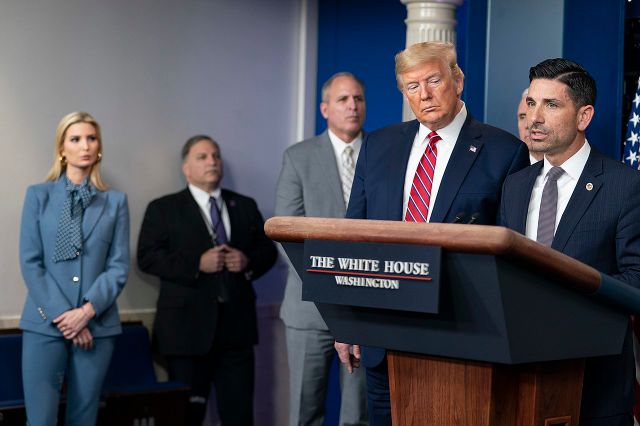
President Donald J. Trump listens as Acting Secretary of Homeland Security Chad F. Wolf delivers remarks at the White House Coronavirus Task Force coronavirus (COVID-19) update briefing Friday, March 20, 2020, in the James S. Brady Press Briefing Room of the White House. (Official White House Photo by Shealah Craighead)
Later that day, Wolf appeared as a guest on “Fox News with Brett Baier” and said he would not honor the subpoena.
Wolf has been serving as acting secretary of DHS since November 13, 2019. However, a Government Accountability Office (GAO) report from August found that Wolf and his deputy secretary, Ken Cuccinelli, were both part of an “invalid order of succession” and therefore not legally appointed to their positions.
Last Friday, a federal judge in Maryland, Paula Xinis, temporarily barred the enforcement of asylum restrictions Wolf put in place in August on the grounds that he was likely unlawfully serving as head of the DHS, the parent agency of Immigration and Customs Enforcement (ICE) and Customs and Border Protection (CBP).
Wolf has played a central role not only in the Trump administration’s vicious persecution of immigrants, but also in its fascistic attacks on demonstrators protesting against police violence, particularly in Portland, Oregon and Kenosha, Wisconsin.
In July, Wolf dispatched a militarized special operations unit of CBP known as BORTAC, or Border Patrol Tactical Unit, as part of a collection of federal police agencies under the DHS that essentially invaded Portland, in defiance of publicly stated opposition from the mayor and the governor.
Trump’s federal police and paramilitary forces occupied a federal courthouse that had become a focal point of protests and brutally attacked peaceful protester with CS tear gas, rubber bullets, pepper bombs, flash bang grenades and sonic weapons.
They carried out arbitrary beatings and arrests and deliberately sought to provoke a violent response from the demonstrators. This was the prelude to the Republican National Convention in August, during which Trump and other speakers portrayed the protests against police violence as mobs of rampaging anarchists and socialists looting, burning and terrorizing cities and wealthy suburbs.
Wolf oversaw the use of his uniformed thugs to kidnap people off the street, in the manner of Latin American police states, throw them into unmarked cars and secrete them in locations for hours of interrogation, all without charges or due process.
Similar tactics were employed in Kenosha last month following the police shooting of Jacob Blake. There, local police, backed by the National Guard and federal agents, coordinated with far-right vigilantes, leading to the fascist murder of two unarmed protesters.
The police-state operations culminated earlier this month in the targeted assassination of anti-fascist protester Michael Reinoehl in Portland by a task force led by US Marshals, one of the agencies under Wolf’s DHS.
In previous congressional testimony, Wolf has defended the kidnapping of protesters as a “common de-escalation tactic,” necessary to put down “mobs of lawless and violent anarchists,” who, in his telling, have been enabled by “local political leaders [who] refuse to restore order to protect their city.”
On September 9, House Intelligence Committee Chairman Adam Schiff (Democrat of California) announced that the committee would be looking into a complaint filed by whistleblower Brian Murphy, until recently the head of intelligence analysis at DHS, who accused Wolf, Cuccinelli and other Trump officials of pressuring him to alter intelligence reports to bolster Trump’s domestic and foreign policies.
The complaint alleged that Wolf and Cuccinelli instructed Murphy to modify domestic terrorism threat assessments to downplay the threat from white supremacists and exaggerate the supposed threat from left-wing groups like Antifa. It also alleged that Trump officials ordered him to “cease providing intelligence assessments on the threat of Russian interference in the United States and instead start reporting on interference activities by China and Iran.”
The Democrats and the bulk of the media have played up the allegations of pro-Russian interference and downplayed the claims of shielding far-right forces and demonizing left-wing opponents of the administration.
Wolf’s defiance of Congress is only the latest in a string of actions by the Trump White House asserting unlimited presidential powers and rejecting congressional oversight. In February 2019, Trump declared a “national emergency” at the US-Mexico border in order to override Congress and allocate $8 billion to build his border wall, in violation of the Constitution, which reserves to Congress the “power of the purse.” The Democrats not only offered no serious opposition, they eventually voted to provide funding for Trump’s war on immigrants.
In October of 2019, the White House declared that it would not cooperate in any way with the House impeachment inquiry, asserting essentially unchecked presidential powers. Once again, the Democrats capitulated. The eventual articles of impeachment made no mention of Trump’s unconstitutional power grabs and instead focused solely on his alleged cave-in to Russia in relation to Ukraine.

Nurse alleges forced sterilizations, medical malpractice at Georgia immigrant detention center

Niles Niemuth

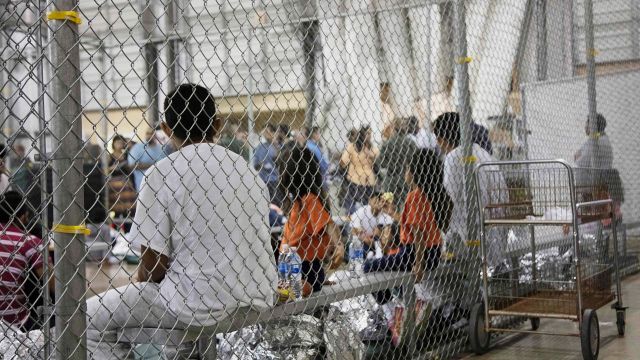
A whistleblower complaint filed on behalf of a nurse who worked at an Immigration and Customs Enforcement (ICE) detention center in southern Georgia until July alleges that a number of immigrant women detained there were subjected to sterilization through hysterectomies without their consent.
In the complaint, filed by the legal advocacy group Project South, the former nurse describes conditions at the center as akin to an “experimental concentration camp.”
The complaint also details the refusal of the center’s administrators to carry out COVID-19 testing or implement protective measures, putting detainees and employees throughout the country’s network of detention centers at risk of infection. It alleges that detainees who have spoken out about conditions at the facility have been placed in solitary confinement.
Detention facility in McAllen, Texas, Sunday, June 17, 2018 (Photo US Customs and Border Protection).
The chilling report provides further evidence of the sadistic abuse meted out by the Trump administration in its fascistic war on immigrants. At least 17 people have died so far this year in ICE custody from various causes, including COVID-19. Two guards at a facility in Louisiana died from coronavirus in April.
The target of the of the complaint, the Irwin County Detention Center (ICDC), which is operated by the private prison company LaSalle Corrections, was previously the subject of complaints raised by the American Civil Liberties Union in 2012. The ACLU urged that the facility be closed due to widespread abuse as well as its remote location. A 2017 Project South investigation found that ICDC was guilty of human rights abuses, violations of due process rights and unsanitary living conditions.
The nurse who lodged the latest complaint, Dawn Wooten, explained that detained women were sent to a doctor known as the “uterus collector” and that many did not have a full understanding of what was happening to them or why they were having the procedure. “When I met all these women who had had surgeries, I thought this was like an experimental concentration camp,” Wooten said. “It was like they’re experimenting with our bodies.”
While the extent of the sterilizations is unknown, a detained immigrant told Project South that she knew of five women who had hysterectomies while held at ICDC between October and December 2019.
“Everybody he sees has a hysterectomy—just about everybody,” Wooten said of the doctor who carried out the procedures at ICDC.
“He’s even taken out the wrong ovary on a young lady,” Wooten said. “She was supposed to get her left ovary removed because it had a cyst on the left ovary; he took out the right one. She was upset. She had to go back to take out the left and she wound up with a total hysterectomy. She still wanted children, so she has to go back home now and tell her husband that she can’t bear kids... she said she was not all the way out under anesthesia and heard him [the doctor] tell the nurse that he took the wrong ovary.”
Wooten also noted there is often an issue with obtaining consent, as medical staff rely on googling Spanish phrases or getting other detainees to interpret information about the medical procedure. “These immigrant women, I don’t think they really, totally, all the way understand this is what’s going to happen, depending on who explains it to them,” Wooten said.
One detainee who spoke to Project South reviewed her harrowing experience with a sterilization procedure that was stopped at the hospital only when an antibody test for COVID-19 came back positive and she was sent back to the detention center.
A doctor initially told her that she had to go to the hospital to have an ovarian cyst removed in a non-invasive procedure. However, on the day of the procedure, the officer who was transporting her told her that, in fact, she was about to have her womb removed in a hysterectomy. The procedure was scuttled by her positive coronavirus test.
After she had been sent back to ICDC, a nurse told her that she would need to have the procedure done because of heavy bleeding. The nurse then told her it was to correct a thick womb.
The woman explained that she had never been diagnosed with either, and the doctors had spoken of a totally different procedure. The nurse reportedly became angry and began shouting after the woman explained that she did not want a hysterectomy. Reflecting on her experience, the detainee said that it “felt like they were trying to mess with my body.”
The Project South report and Wooten’s testimony reviewed various forms of medical malpractice at the facility, including the withholding of medication for cancer and HIV. Even if inmates were severely ill, the medical unit would only supply them with ibuprofen and send them back to their cells.
Wooten reports that ICDC repeatedly ignored Centers for Disease Control and Prevention (CDC) guidelines on handling COVID-19 positive patients so as to prevent the spread of the virus.
A video of ICDC inmates pleading for protection which was posted online in April forced the administration to provide them with a single cloth or paper mask, but nothing since. The New York Times reported that detainees resorted to fashioning makeshift masks out of scraps of cloth or broken meal containers in an effort to protect themselves.
ICE reported in August that 41 detainees at the facility had tested positive for the coronavirus, but Wooten said the actual number was certainly higher, since ICDC was not actively testing inmates, denied tests to those who requested them, and was not reporting all its positive cases to ICE or the State Department. She also noted that detainees who were COVID-19 positive were still being transferred to other facilities or deported, and new arrivals were not being properly quarantined, ensuring that the virus would continue to spread. Employees who self-reported coronavirus symptoms were still made to work, and at least 13 officers at the facility have tested positive.
The horrors exposed by Wooten come amidst an escalating assault on the rights of immigrants in the lead-up to the Nov. 3 election, as Trumps works to build up his far-right base. On Monday, a federal appeals court panel approved the Trump administration’s termination of protected status for immigrants from El Salvador, Haiti, Nicaragua and Sudan, removing legal status for nearly 400,000 people, many of whom have lived in the US for decades and have children who are citizens. The 2–1 ruling by the US Court of Appeals for the Ninth Circuit opens the immigrants up to deportation if they do not leave the country voluntarily.

Bangladesh: Foreign Policy and Public Opinion on the Delhi-Dhaka Relationship

Shahab Enam Khan

Indian media analysis of Bangladesh-India relations tends to be hyperbolic, reductive, and misleading. Such coverage usually dilutes its complexity and sets an unrealistic bar for the relationship. What the Indian public remains deprived of as a result is a nuanced understanding of Bangladeshi policy and public opinion on key bilateral issues.
Political Factors
Bangladesh will never forget India’s contribution in its Liberation War of 1971. At the same time, we should remember that it was geostrategic compulsion that primarily motivated New Delhi’s participation. This history, which underlines the bulk of bilateral relations even today, has been overmined by India.
Ties soared significantly after the Awami League (AL) came to power in 2009, and Delhi continued supporting the Sheikh Hasina-led government through the 2013 and 2018 elections. As with every relationship, there have been successes and failures. The Prime Minister Narendra Modi government’s expediency in ratifying the long-pending Land Boundary Agreement in 2015 is certainly praiseworthy.
However, some political issues have emerged as serious irritants. India’s Citizenship Amendment Act (CAA) and Assam’s National Register of Citizens (NRC) have questioned the ‘eternal’ aspect of the bilateral relationship. Dhaka publicly acknowledged the CAA and NRC as India’s internal matters (although the prime minister’s office still expressed reservations). But critics have questioned whether the CAA is actually ‘internal’ to India when it calls out Bangladesh for minority persecution, tying the country with Pakistan and Afghanistan.
The then BJP president, now Home Minister, Mr Amit Shah’s 2018 comment comparing Bangladeshi migrants to “termites” did much perception damage in Bangladesh in this regard. Indian silence on the Rakhine issue and Bangladesh-Myanmar tensions, are included in this basket of political irritants.
SAARC remains hostage to the whims of India and Pakistan and New Delhi’s political inconsistency on regional cooperation. India has been an active party to SAARC, showed fluctuating responses to the Bay of Bengal Initiative for Multi-Sectoral Technical and Economic Cooperation (BIMSTEC), pushed rather flawed initiatives such as the Bangladesh-Bhutan-India-Nepal (BBIN) grouping, and excluded itself from the Bangladesh-China-India-Myanmar (BCIM) initiative. However, Prime Minister Modi’s attempt to revive SAARC during the early months of the COVID-19 pandemic shows that multilateralism is still relevant. 
Economy, Trade, and Connectivity
Bangladesh and India are natural markets for each other. Bilateral trade has grown steadily, making Bangladesh India’s largest trading partner in South Asia. Despite the potential, India’s exports to Bangladesh in 2018-19 was USD 9.21 billion, and imports clocked USD 1.04 billion. While lack of diversification in goods from Bangladesh is a significant reason for the trade imbalance, India’s non-tariff barriers and anti-dumping tariffs are also major impediments. The trade deficit is a key concern for Dhaka. In fact, Indian migrant workers remit USD 4 billion from Bangladesh.
Bangladesh has agreed to offer India transit and transshipment access to its ports. This was not met entirely positively by Bangladesh’s business community. In fact, Dhaka has gone to great lengths to facilitate New Delhi’s regional economic agenda. For instance, the government acquired 1,106 acres of land to set up three special economic zones (SEZs) exclusively for Indian investors. The Indian private sector however has been slow on investments.
Bangladesh’s interest in gaining access to the Nepalese energy market or facilitating investment in Bhutanese energy production have been stuck for a long time. India is the third country for transit in all these trade mechanisms. Efforts to set up a multimodal transport corridor linking Nepal and Bhutan have become complicated. Even joint attempts to build smoother connectivity between India and Bangladesh remain constrained.
In March 2020, for example, Bangladeshi railway officials claimed that the construction of the Khulna-Mongla Port Rail Line Project was being delayed due to slow approvals, and the sluggishness of the Indian Railway Construction Company (IRCON). The project’s financial progress is about 63 per cent, and physical development is approximately 61.90 per cent. The rail link project was sanctioned by a 2010 MoU, under which India extended a Line of Credit (LoC) worth USD 862 million to Bangladesh. However, in ten years, India has disbursed only USD 565.76 million, whereas Bangladesh’s infrastructure development requirement has grown to USD 320 billion. The slow disbursement has compelled Dhaka to find alternative sources for funding—not only from China, but also the US, UK, EU, World Bank, International Finance Corporation (IFC), etc.
Strategic Issues
While India and Bangladesh have had a fairly good mutual understanding on strategic issues, the boat has begun to rock.
Dhaka is concerned about India’s security collaboration with Myanmar, which poses a national security threat to Bangladesh. Delhi’s supply of an old Russian built Kilo-class submarine and other hardware to the Myanmar Navy in 2019, military assistance and training to the Tatmadaw, coupled with South Block’s abstentions and silence at UN platforms in condemning Rohingya persecution have raised eyebrows. The fact that China suggested a bilateral repatriation deal—albeit a fragile one—between Dhaka and Napyidaw perhaps made India’s passivity look even more glaring.
During his September 2017 visit to Myanmar, Prime Minister Modi termed the Rakhine crisis as “extremist violence,” and made no reference to Tatmadaw’s persecution of the Rohingya. Delhi’s silence and Beijing’s lack of proactiveness have compelled Dhaka to see both countries through the same realist prism. In this case, whoever offers better economic and political incentives will dictate the rules of business and bilateralism. 
There were some negative Indian media reactions to Bangladesh acquiring two submarines from China. In fact, according to sources, India had also been invited to supply a (trainer) submarine, but there was no positive response. Bangladesh’s Ming class submarines are designed for defensive postures to ensure strategic autonomy in the Bay of Bengal. Dhaka has had to go to international tribunals to delimit its maritime boundaries with India and Myanmar. It is logical therefore for Bangladesh’s armed forces to fortify its defences.
Bangladeshi public opinion is also concerned about recent incidents of communal violence in India, including the February riots in Delhi, and the arbitrary killing of Muslim individuals on suspicions of carrying or eating beef. These incidents have cross-border ramifications. Since Bangladesh is already hosting nearly a million Rohingya refugees on its soil, there is general anxiety about developments in India triggering another influx of persecuted individuals into its territory. With this comes the continued killing of Bangladeshi citizens along the border, despite India’s repeated claim of bringing the numbers down to zero.
Looking Ahead
These sticking points notwithstanding, there is much to look forward to in the India-Bangladesh relationship. For example, tourism alone is significant. In fact, Kolkata’s major shopping malls and high-end stores are reportedly deserted in the post-lockdown period in the absence of Bangladeshi buyers. A prosperous Bangladesh and benefits accrued from regional trade would not only be mutually beneficial, but also help stabilise post-COVID-19 growth. 
Bangladesh believes in multilateralism, and prioritises development. It requires cost-effective assistance to revive its health sector, urban governance and planning, and infrastructure development. To achieve these goals, support from friends and partners is crucial. India can facilitate change in these sectors, but there must be a clearer understanding of how the bilateral relationship is viewed in Bangladesh. The economic and social realities are not as same as in 1971 or 2009. Both countries must reach common ground on what their expectations of each other are.