17 Sept 2020

A Post-Coronavirus Economy Can No Longer Afford to Put the Pentagon First

Mandy Smithberger

The inadequate response of both the federal and state governments to the Covid-19 pandemic has had a devastating impact on the United States, creating what could only be called a national security crisis. More than 190,000 Americans are dead, approximately half of them people of color. Yelp data show that more than 132,000 businesses have already closed and census data suggest that, thanks to lost wages, nearly 17% of Americans with children can’t afford to feed them enough food.
In this same period, a number of defense contractors have been doing remarkably well. Lockheed Martin, the Pentagon’s top contractor, reported that, compared to 2019, its earnings are actually up — yes, up! The company’s success led the financial magazine Barron’s to call it a “pandemic star.” And those profits are only likely to grow, given the Trump administration’s recent approval of a 10-year deal to sell $62 billion worth of its F-16s to Taiwan.
And Lockheed Martin is far from the only such outfit. As Defense One reported, “It’s becoming abundantly clear that companies with heavy defense business have been able to endure the coronavirus pandemic much better” than, for instance, commercial aerospace firms. And so it was that, while other companies have cut or suspended dividends during the pandemic, Lockheed Martin, which had already raised its gift to shareholders in late 2019, continued to pay the same amount this March and September.
The spread of Covid-19 has created one of the most significant crises of our time, but it’s also provided far greater clarity about just how misplaced the priorities of Washington have been all these years. Americans — the Trump administration aside — are now trying to deal with the health impacts of the pandemic and struggling to figure out how to safely reopen schools. It’s none too soon, however, to start thinking as well about how best to rebuild a devastated economy and create new jobs to replace those that have been lost. In that process, one thing is crucial: resisting the calls — and count on it, they will come — to “rebuild” the war economy that had betrayed us long before the coronavirus arrived on our shores, leaving this country in a distinctly weakened state.
A New Budget Debate?
For the past decade, the budget “debate” in this country has largely been shaped by the Budget Control Act, which tried to save $1 trillion over those 10 years by placing nominal caps on both defense and non-defense spending. Notably, however, it exempted “war spending” that falls in what the Pentagon calls its Overseas Contingency Operations account. While some argued that caps on both defense and non-defense spending created parity, the Pentagon’s ability to use and abuse that war slush fund (on top of an already gigantic base budget) meant that the Pentagon still disproportionately benefited by tens of billions of dollars annually.
In 2021, the Budget Control Act expires. That means a Biden or Trump administration will have an enormous opportunity to significantly reshape federal spending. At the very least, that Pentagon off-budget slush fund, which creates waste and undermines planning, could be ended. In addition, there’s more reason than ever for Congress to reassess its philosophy of this century that the desires of the Pentagon invariably come first, particularly given the need to address the significant economic damage the still-raging pandemic is creating.
In rebuilding the economy, however, count on one thing: defense contractors will put every last lobbying dollar into an attempt to convince the public, Congress, and whatever administration is in power that their sector is the country’s major engine for creating jobs. As TomDispatch regular Bill Hartung has shown, however, a close examination of such job-creation claims rarely stands up to serious scrutiny. For example, the number of jobs created by recent arms sales to Saudi Arabia are now expected to be less than a tenth of those President Trump initially bragged about. As Hartung noted in February, that’s “well under .03% of the U.S. labor force of more than 164 million people.”
As it turns out, creating jobs through Pentagon spending is among the least effective ways to rebuild the economy. As experts at the University of Massachusetts and Brown University have both discovered, this country would get significantly more job-creation bang for the bucks it spends on weaponry by investing in rebuilding domestic infrastructure, combating climate change, or creating more alternative energy. And such investments would pay additional dividends by making our communities and small businesses stronger and more resilient.
Defense Contractors Campaigning for Bailouts
At the Project On Government Oversight where I work, I spend my days looking at the many ways the arms industry exerts disproportionate influence over what’s still called (however erroneously in this Covid-19 moment) “national security” and the foreign policy that goes with it, including this country’s forever wars. That work has included, for instance, exposing how a bevy of retired military officers advocated buying more than even the Pentagon requested of the most expensive weapons system in history, Lockheed Martin’s F-35 jet fighter, while failing to disclose that they also had significant personal financial interests in supporting that very program. My colleagues and I are also continually tracking the many officials who leave the Pentagon to go to work on the boards of or to lobby for arms makers or leave those companies and end up in the Pentagon and elsewhere in the national security state. That’s known, of course, as the military-industrial complex’s “revolving door.” And as President Trump recently noted, it helps ensure that those endless wars never end, while stoking an ever-increasing Pentagon budget. While his actions on behalf of the arms industry don’t back up his rhetoric, his diagnosis of the problem is largely on target.
And yet, as familiar as I am with the damage that the weapons industry has done to our country, I still find myself shocked at how a number of those companies have responded to the current crisis. Almost immediately, they began lobbying the Department of Defense to make their employees part of this country’s “essential critical infrastructure,” so that they could force them to return to work, pandemic or not. That decision drew a rare rebuke from the unions representing those workers, many of whom feared for their lives.
And mind you, only then did things become truly perverse. In the initial Covid-19 relief bill, Congress gave the Pentagon $1 billion to help respond to the pandemic. Such aid, as congressional representatives imagined it, would be used to purchase personal protective equipment for employees who still had to show up at work, especially since the Department of Defense’s own initial estimate was that the country would need to produce as many as 3.3 billion N95 masks in six months. The Pentagon, however, promptly gave those funds to defense contractors, including paying for such diverse “needs” as golf-course staffing, hypersonic missile development, and microelectronics, a Washington Post investigation found. House appropriators responded that money for defense contractors “was not the original intent of the funds.”
And now those defense contractors are asking for yet more bailouts. Earlier this summer, they successfully convinced the Senate to put $30 billion for the arms industry in its next coronavirus relief bill. As CQ Roll Call reported, the top beneficiaries of that spending spree would be the Pentagon’s two largest contractors: Lockheed Martin and Boeing.
The pandemic has certainly resulted in some delays and unexpected expenses for such companies, but the costs borne by the weapons industry pale compared to the devastation caused to so many businesses that have had to close permanently. Every sector of the economy is undoubtedly facing unexpected costs due to the pandemic, but apparently the Department of Defense, despite being by far the best-funded military on the planet, and its major contractors, among the richest and most successful corporations in America, have essentially claimed that they will be unable to respond to the crisis without further taxpayer help. The chair of the House Armed Services Committee and the lead Democrat for the Senate’s defense appropriations subcommittee recently pointed out that, even though contractors across the federal government are facing pandemic challenges, no other agency has asked for additional funds to cover the costs of the crisis. Instead, they have worked on drawing from their existing resources.
It’s laughable to suggest that the very department that already has by far the most resources on hand and is, of course, charged with leading the country’s response to unexpected threats can’t figure out how to adjust without further funding. But most defense contractors see no reason to adapt since they know that they can continue to count on Washington to bail them out.
Still, the defense industry has become impatient that Congress hasn’t already acquiesced to their demands. In July, executives at most of the major contractors sent a letter to the White House demanding more money. In it, they included a not-so-subtle threat of electoral consequences for the president and Senate Republicans in close races if such funds weren’t provided. Only one major contractor, Northrop Grumman, has stayed away from such highly public lobbying efforts because its CEO apparently had the common sense to recognize that her company was doing too well to demand more when so many others are desperate for money, particularly minority-owned businesses, many of which are likely to never come back.
On a Glide Path to Disaster?
There are signs, however, that someday such eternal winners in the congressional financial sweepstakes may finally be made accountable thanks to the pandemic. This summer, both the House and the Senate for the first time each considered an amendment to cut the Pentagon’s budget by 10%. Such efforts even received support from at least some moderates, including Senate Minority Leader Chuck Schumer (D-NY), although it went down to defeat in both houses of Congress. Although Democratic vice presidential candidate Senator Kamala Harris (D-CA) refused to support the specifics of the amendment, she did at least express her agreement with the principle of needing to curtail the Pentagon’s spending spree during this crisis. “As a member of the Senate Intelligence and Homeland Security Committees, I’m keenly aware of the global threats facing our country,” she said in a statement she released after the vote. “I unequivocally agree with the goal of reducing the defense budget and redirecting funding to communities in need.”
The first real test of whether this country will learn any of the right lessons about national security from this ongoing pandemic moment will undoubtedly come in next year’s budget debate when the question will be: Is everything finally going to be on the table? As I previously wrote at TomDispatch, giving the Pentagon trillions of dollars in these years in no way prepared this country for the actual national security crisis of our lives. In fact, even considering the Pentagon’s ridiculously outsized budget, prioritizing funding for unaffordable and unproven weapons systems over healthcare hurt its ability to keep the military and its labor force safe. No less significantly, continuing to prioritize the Pentagon over the needs of every other agency and Americans more generally keeps us on a glidepath to disaster.
A genuinely new discussion of budget priorities would mean, as a start, changing the very definition of “security” to include responding to the many risks we actually face when it comes to our safety: not just pandemics, but the already increasing toll of climate change, a crumbling infrastructure, and a government that continues to disproportionately benefit the wealthy and well-connected over everyone else.
At the simplest level, the “defense” side of the budget ledger should be made to reflect what we’re really spending now on what passes for national security. That means counting homeland security and veterans’ benefits, along with many other expenses that often get left out of the budget equation. When such expenses are indeed included, as Brown University’s Costs of War Project has discovered, the real price tag for America’s wars in the Greater Middle East alone came to more than $6.4 trillion by 2020. In other words, even to begin to have an honest debate about how America’s other needs are funded, there would have to be a far more accurate accounting of what actually has been spent in these years on “national security.”
Surprisingly enough, unlike Congress (or the Pentagon), the voting public already seems to grasp the need for change. The nonprofit think tank Data for Progress found that more than half of likely voters support cutting the Pentagon’s budget by 10% to pay for domestic priorities like fighting the coronavirus. A University of Maryland poll found bipartisan majorities opposed to cutting funding generally with two notable exceptions: Pentagon spending and agricultural subsidies.
Unfortunately, those in the national security establishment are generally not listening to what the American people want. Instead, they’re the captives of a defense industry that eternally hypes new Cold War-style competition with China and Russia, both through donations to Washington think tanks and politicians and that infamous revolving door.
In fact, the Trump administration is a military-industrial nightmare when it comes to that endlessly spinning entrance and exit. Both of his confirmed secretaries of defense and one acting secretary of defense came directly from major defense contractors, including the current one, former Raytheon lobbyist Mark Esper — and the Biden administration seems unlikely to be all that different. As the American Prospect reported recently, several members of his foreign policy team have already circumvented ethics rules that would restrict lobbying activities by becoming “strategic consultants” to the very defense firms aiming to win more Pentagon contracts. For example, Biden’s most likely secretary of defense, Michèle Flournoy, became a senior adviser to Boston Consulting Group and the first three years she was with that company, it increased its Pentagon contract earnings by a factor of 20.
So whoever wins in 2020, increased spending for the Pentagon, rather than real national security, lies in store. The people, it seems, have spoken. The question remains: will anyone in Washington listen to them?

New York City ruling elite warns Mayor de Blasio of “widespread anxiety”

Fred Mazelis

More than 150 leaders of New York City’s corporate and financial elite sent a letter to Mayor Bill de Blasio last Thursday insisting on ruthless measures to defend the interests of big business, amidst Depression-like conditions triggered by the COVID-19 pandemic.
The letter, issued by the Partnership for New York, was signed by a who’s who of the ruling elite, including, among others, the chairman and CEO of Goldman Sachs, the CEOs of Citigroup and Morgan Stanley, the managing partners of some of the city’s biggest law firms, and the bosses of real estate giants like Tishman Speyer.
Media reports suggested the letter to de Blasio reflects ongoing tensions between big business and the mayor. This is vastly exaggerated. When it comes to fundamental policies and actions, there is virtually no difference.
De Blasio first won office more than six years ago claiming that he would vanquish inequality. Far from fighting inequality, he has presided (as the WSWS explained in advance) over ever-widening gaps between the rich and poor, symbolized by such projects as Hudson Yards, on Manhattan’s Far West Side, alongside new records for homelessness that have been set every month.
The economic collapse in the course of the pandemic has the corporate and financial establishment worried, however. They are demanding an intensified back-to-work drive, and are concerned about whether the “progressive” mayor, whose second term in office concludes next year and who is limited to two terms by law, will be able to keep the lid on growing social discontent.
The business executives’ letter devotes about six words to unemployment and homelessness. Then it moves on to its main concern: “There is widespread anxiety over public safety, cleanliness and other quality of life issues that are contributing to deteriorating conditions. … We need to send a strong, consistent message that our employees, customers, clients and visitors will be coming back to a safe and healthy work environment. People will be slow to return unless their concerns about security and the livability of our communities are addressed quickly and with respect and fairness for our city’s diverse populations.”
Kathryn Wylde, the president of the group, who is regularly quoted in the big business media, told the New York Times, “Until the people come back, the streets aren’t safe. If the streets aren’t safe, the people don’t come back.”
The talk of “safe streets” is a million miles away from the concerns of the millions of workers who cannot pay their rent and are having difficulty buying food and meeting other expenses. The massive business district in midtown Manhattan is largely empty, with only about 10 percent of office workers returning to their offices. In fact, despite spikes in shootings in some areas, crime remains at its lowest level in decades.
It is not public safety that concerns most workers, but safety from the continuing threat of COVID-19, as well as the need for measures to alleviate poverty. Despite the relatively low current level of coronavirus infections, there are still about 500 positive test results reported daily in New York. Workers are not only concerned about conditions in their work locations, but also about commuting daily on crowded trains and buses.
The “widespread anxiety” of the ruling elite is totally different from the anxiety besetting the working class. Just days ago, National Public Radio reported on a survey it had conducted along with the Robert Wood Johnson Foundation and the T.H. Chan School of Public Health at Harvard, on the social and financial impact of the pandemic in the four largest cities of the US—New York, Los Angeles, Chicago and Houston.
Forty-six percent of households in these urban centers report serious financial pain in the wake of the coronavirus pandemic and the economic crisis. This figure rises to 54 percent of households with annual incomes of less than $100,000, and the numbers are higher among immigrants, Hispanic families and African Americans. The survey was taken during the period when $600 in additional weekly jobless benefits were still being received, so today it is even worse.
New York City faces a budget deficit of at least $9 billion, and the Metropolitan Transportation Authority is looking at a $16 billion shortfall, the consequence of the fact that ridership on the buses and subways remains only about 25 percent of its pre-pandemic level.
In the face of these huge gaps, the de Blasio administration is asking for permission from the State Financial Control Board, the agency set up during New York’s near-bankruptcy in 1975, to obtain long-term borrowing to plug the current deficit. New York Governor Andrew Cuomo has not been receptive to the request, and the Partnership for New York has made its opposition to further borrowing clear. “They think the problem is money,” said Ms. Wylde, referring to de Blasio and his advisers. “The problem is not money. The problem is uniting the city around a practical plan for recovery.”
This language is vague, but the message from big business can be summed up in the following terms: an accelerated back-to-work drive, despite the fact that it will guarantee a rising rate of COVID-19 infection and death; no new outlays to meet the needs of the unemployed and the homeless; and a law-and-order campaign in preparation for mass repression of working class resistance.
De Blasio’s record since he took office on New Year’s Day 2014 has demonstrated that, when it comes to fundamental class interests, there is not the slightest difference between him and Cuomo, or the signers of the latest letter from the Partnership for New York. In fact, his response to the letter from the business leaders was to offer his cooperation. “We need these leaders to join the fight to move the city forward,” he said.
The business leaders are also laying down the law for de Blasio’s successor. For 20 years before the current Democratic mayor’s first term began in 2014, the city was run quite openly by Wall Street, through Republican Rudy Giuliani, followed by multibillionaire Michael Bloomberg, who began his mayoralty as a Republican and ended it as a Democrat, though the party label made absolutely no difference.
The reference to “quality of life issues” in the letter to de Blasio is particularly significant, since it harks backs to the vicious law-and-order campaign under Giuliani, continued in slightly more “polite” form by Bloomberg. “Stop-and-frisk,” later ruled unconstitutional, was used to arrest hundreds of thousands, primarily minority youth, under Bloomberg. William Bratton, head of the police force under Giuliani and then for the first two years of the de Blasio administration, was closely associated with these policies. Now working in California, Bratton immediately spoke up in support of the business leaders’ warning about “quality of life” issues.
Over the past six months of the pandemic, the signers of the letter to de Blasio have all vastly increased their wealth, alongside the soaring stock market. They have no hesitation, however, in demanding further sacrifices from the working class. But they want to make sure that appearances are kept up. The Times reports that “Ms. Wylde said she waited to publish [the letter] until after Labor Day, in part because of concern among some members, who had spent months outside the city, that they would be criticized for weighing in on New York’s future from afar. ‘They felt it was unseemly to be writing from the Hamptons.’” What delicacy!
There is no essential difference between de Blasio and the business leaders. The massive borrowing called for by the mayor will run up the debt even more to the banks and bondholders, while doing little to prevent mass layoffs and service cutbacks. The only answer to the current crisis is the fight for a socialist program, including the expropriation of the financial parasites, to provide the resources to end the pandemic and to meet the urgent needs of the working class.

COVID-19 outbreaks force switch to online learning at New Jersey schools

Erik Schreiber & Robert Milkowski

Less than two weeks into the start of the school year, COVID-19 cases among educators and students have already forced the closure of several New Jersey schools. At least eight districts in the state have switched their entire district or individual schools from either full or partial in-person classes to fully remote instruction after faculty or students tested positive for the virus.
The school districts with identified outbreaks are spread throughout 5 of New Jersey’s 21 counties. Chatham High School in Middlesex County sent a letter to parents on September 11 announcing the switch to all-remote learning until September 29 due to an unspecified number of cases. In Washington Township in Gloucester County, three schools had outbreaks, forcing the district to cancel hybrid instruction plans for the next two weeks.
Cases were also reported in Howell, Little Silver, Pompton Lakes, Frankford Township, East Brunswick, and Woodcliff Lake, with each district temporarily switching all schools to remote instruction or simply those schools where outbreaks occurred.
Most of the school districts intend to resume in-person instruction following a 14-day waiting period. The reckless policy is fully backed by Democratic Governor Phil Murphy, who commented to WCBS Newsradio on Tuesday, “It looks like, so far, so good, in terms of how they’re reacting to the modest numbers that we’re seeing so far.”
Murphy played the leading role in pushing hundreds of school districts in New Jersey to re-open for in-person classes, despite grave dangers to students and educators. Educators and staff face shortages of personal protective equipment (PPE), difficulty maintaining social distancing, and outmoded heating, ventilation, and air conditioning (HVAC) systems.
As of last week, 388 school districts received state approval to proceed with the “hybrid” instructional model, which combines in-person and remote learning, while 69 districts were approved for fully in-person re-openings. State education authorities had not approved plans to limit COVID-19 exposure for an additional 87 districts, which were nonetheless allowed to re-open.
At some of New Jersey’s largest school districts that opted for fully online instruction, the resumption of remote classes has been plagued by a shortage of laptops and a lack of access to high-speed Internet. In Newark, where lessons will be online until mid-November, thousands of student laptops ordered in March have yet to arrive.
As is the case across the country, in many districts that are providing only remote instruction, teachers and other staff are still required to report to the school each day to give online lessons. At Thomas Edison Academy in Elizabeth, a custodian tested positive for coronavirus, prompting officials to close the school campus for just one day.
The chaotic and dangerous start comes after the New Jersey state government spent the summer cultivating uncertainty and anxiety among parents, teachers, and students by first delaying, then repeatedly revising, guidance for reopening schools during the pandemic. Districts were given no more than general recommendations and were advised to work out detailed plans for re-opening on their own.
Governor Murphy, a multimillionaire and former Goldman Sachs executive, initially sought to force all schools to provide in-person classes in the fall. Teachers’ opposition grew rapidly, raising the prospects of mass action, with the governor responding last month by allowing districts to opt for all-remote instruction. But this maneuver was only a partial retreat. Murphy’s stated goal remains the rapid re-opening of as many districts as possible with in-person instruction, in order to force parents back to work producing profits for Wall Street.
In addition, the governor made it difficult for districts to switch to remote instruction. At a recent press briefing, Murphy said, “Any resubmitted plans to begin the school year with all-remote learning must cite specific health and safety reasons for the…change, which district leaders must certify to, as well as a timeline to get to in-person instruction.” Moreover, county superintendents and the state Departments of Education and Health must review districts’ plans.
But the state did not release guidance about how school districts can submit their plans until August 29—less than two weeks before the official first day of school on September 8. Furthermore, the state required districts to respond within seven days of the first day of school “or as soon as practicable.” More than 190 districts announced that they would provide all-remote instruction. Among these districts are New Jersey’s largest cities, including Newark, Jersey City, Paterson, Elizabeth, and Edison.
In a report issued after New Jersey published its guidance, the New Jersey School Boards Association (NJSBA) estimated that the PPE, cleaning supplies, and custodial and nursing staff that districts need to re-open will cost approximately $700 million. As with every state in the US, New Jersey faces a looming budget crisis as a result of the economic devastation wrought by the pandemic, while support from the federal government has been totally insufficient.
While school districts are being starved for resources, the claim that there is no money to protect school workers and children is absurd. New Jersey is the second-wealthiest state in the country by median income, with one in 12 residents being millionaires and nine billionaires residing in the state.
The NJSBA warns that “school districts have moved forward with reopening plans designed to meet the needs of their students, but these efforts have come at a financial cost that could have negative consequences in other areas.”
These “negative consequences” were revealed in Toms River, where the school district voted unanimously to lay off 240 employees, including 90 bus drivers, 70 cafeteria and playground aides, 50 cafeteria workers, 25 bus attendants, and five mechanics. The financial effects of the pandemic are only one reason for the cuts, Superintendent David M. Healy told NJ.com, as Toms River has lost $5.2 million in state aid and endured several annual cuts in state funding. “We’ve lost millions and millions of dollars each year,” said Healy. These attacks on education have been carried out by a Democratic governor and a legislature controlled by the Democratic Party.
At least 20 teachers in Hammonton, located in southern New Jersey, requested to teach remotely because of concerns over their families’ health. But in late August, the district abruptly denied all of these requests and declared that teachers would have to report to school buildings every day, including on days when all instruction would be given online.
On the same day the district issued its denial, it increased the daily wage for substitute teachers from $100 to $225 in an attempt to prevent a teacher shortage. Because the district does not have enough custodians, it is paying bus drivers to clean the school buildings, likely without proper supplies or adequate training.
Miranda, a special education teacher in West Milford who previously taught in Paterson for 11 years, shared her experiences with the World Socialist Web Site. During the summer, the West Milford school board approved a plan that entailed half-day schedules on each day but Wednesday, which would be a day of virtual instruction and deep cleaning of the schools.
Miranda recently learned that not only would teachers be required to report to school on Wednesdays, but also that the deep cleaning had been dropped in favor of traditional cleaning. “I don’t understand why we were told that there was going to be this deep cleaning of these buildings,” she said, adding that she was mad about the change. “Is it going to be done after hours? There’s a lot of open questions here.”
The West Milford Education Association, a union that is part of the New Jersey Education Association, has not provided Miranda with any guidance. Instead, she received two questionnaires about her feelings about returning to school. “That was it. There was no, ‘Hey, nontenured teachers, this is what you should be doing. This is what you shouldn’t say,’” said Miranda. “My older cousin and my sister-in-law also work in the district, and they told me, since I’m nontenured, to say absolutely nothing because of the volatile way that the district treats nontenured teachers.”
Miranda’s students have behavioral disabilities and can be defiant or aggressive. They sometimes spit and they may have problems maintaining social distancing and wearing masks. Although Miranda was told that she would receive masks, face shields, goggles, and other PPE, she has not gotten this promise in writing. “I don’t know what’s going to happen if one of my students tests positive,” she said. “Do I have to quarantine? Am I using sick days? There’s no answers for that, and it’s infuriating.”
Earlier this year, the principal with whom Miranda worked in Paterson died of COVID-19. “He was a healthy ox,” she said, adding that she does not feel safe returning to school.
As long as the pandemic is uncontrolled, re-opening schools for any amount of in-person instruction will be unsafe in New Jersey and anywhere else. School superintendents, union leaders, and Democratic and Republican politicians alike are conspiring to force educators and students back into deadly conditions.

University of Wisconsin-Madison and La Crosse quarantine students after infections

Brian Green

After a reported surge in COVID-19 cases among the student body at the University of Wisconsin-Madison (UWM), the school administration ordered 2,230 students living on campus in the Witte and Sellery dorms into a two-week quarantine. A total of 1,800 students have now tested positive for COVID-19 at UWM.
The affected students were given the choice of returning home to live with their families or remain on campus and live in the crowded COVID-infested residence halls for the duration of the quarantine period. For the less privileged students, those with no other housing option, or for those who did not want to risk infecting their families, there was no other option but to quarantine on campus and risk COVID-19 infection.
The University of Wisconsin-La Crosse (UWL), which has a student body of around 10,500, is having a similar outbreak of COVID-19 cases. On the same day as the UWM quarantine orders, UWL also issued a “shelter in place.” Students living in the Coate residence hall are under restrictions after dozens of students tested positive for COVID-19.
With the sudden announcement at UWM, panic and uncertainty quickly set in as it was unclear to students how they would acquire basic necessities. Many of them rushed to the nearest grocery stores to stock up on supplies. Others resigned themselves to their predicament and took the time to take one last leisurely walk.
As the restrictions went into effect, students found they were only allowed to leave their dorm floors for scheduled food deliveries three times a day. These meals will cost students $4.99 apiece. The university is claiming students get a selection of many different entrées along with appropriate sides and a fountain drink. Students, however, are reporting that the meal is less than adequate. Sometimes consisting of only sandwiches on some days while on others breakfast was water and a banana or muffin.
Students have been voicing their dissatisfaction and confusion in interviews conducted by local news network WKOW 27. Freshman Grainne McDonagh, who lives in Sellery, spoke on how information and instructions are not clear. She said, “Because things aren’t in-person, it’s very ambiguous through email so we’re still trying to figure out what we can and can’t do exactly.” Another freshman, Isabel Burgos said, “We’re all kind of wondering what the next step after we get out of quarantine will be.”
In August, before the reopening, Chancellor Rebecca Blank and a group of top UWM leaders held a town hall to address questions about their plans for the campus community. Questions were prepared in advance so that the school could control the discussion and support the narrative that the reopening could be done safely.
Chancellor Blank argued for the importance of “some” on campus in-person instruction, and that the knowledge they had gained would allow them to do so. She claimed that outbreaks at other schools were due to lack of proper knowledge and adequate testing protocols.
However, despite their attempt to convince students otherwise, the meeting was simply a shameless promotion for reopening. Blank remarked, “nonetheless, being on campus does mean there will be interactions among students in the dorms in the residence places of students on and off campus.” She continued, “It lets people meet people from different countries and cultures. It lets them have some of those intense late-night discussions that are a very important part of exploring who you are and where you’re going as you’re in this phase of your life in college.”
While attempting to come off as a defender of a quality educational experience, Blank was in fact tacitly admitting that if campuses reopened an outbreak would occur.
Chancellor Blank made a callous and revealing statement in an interview with PBS Wisconsin on September 11 where Blank admitted knowing an outbreak would take place. “We knew that there would be some spikes. ... Students would come; there would be some partying. The amount of that rise was steeper and faster than we expected, and steeper than some of our fellow schools in the Big Ten.”
In essence, students, workers, faculty and the community are being subjected to an involuntary experiment in complete disregard for the protection of human life. To the administrators and the rest of the ruling elite, however, it is simply the cost the populace must bear for the sake of big business.
In a similar manner in a shared statement published in August by the leaders of La Crosse’s higher education institutions, including UWL, Viterbo University and Western Technical College school officials wrote, “We are prepared for the inevitability of COVID-19 cases on our campuses. As we have seen in recent months, no corner of our community is immune from the virus.” Looking to distance themselves from responsibility they continue, “Our campuses have developed testing and tracing protocols to help us pinpoint when and where cases arise, and take immediate action to prevent further spread. We have also secured isolation space, on and off campus, where infected students can safely recover. We implore everyone in our community to exercise caution. Heed the advice of health experts: Watch your distance, wear a face covering, wash your hands, and if you feel ill, stay home.”
The experience at UWM is not an isolated incident, but part of a global drive by the ruling class to abandon attempts to control the pandemic and return to “business as normal” no matter the cost to human life. The resumption of in-person classes is being done in defiance of warnings by health experts of the potential for a catastrophic resurgence of the virus.
Teachers, workers and students of Wisconsin’s education system must take a stand in defense of health and safety. There is a growing movement against the deadly reopenings. In Michigan, graduate student instructors are striking, while in Iowa, students are conducting a sickout and 4,000 service workers at the University of Illinois walked, out joining strikes by 800 nurses at a University of Illinois hospital in Chicago. This struggle must be expanded into a broader fight of the entire working class against a social and economic system, capitalism, which subordinates the needs of society to the accumulation of profit by and for the rich. This requires a political program that is independent from the pro corporate trade unions and the two big business political parties on the basis of a socialist program.

Surge in COVID-19 infections as in-person classes resume at many Illinois college campuses

Fabian Salgado

As with schools across the US, many Illinois college campuses have seen a spike in coronavirus infections since the decision by state authorities to permit in-person classes. While some universities in the state have switched to online learning or to an in-person/online hybrid model, others have brought students back onto campus and are holding regular classes.
Despite promises made to students and faculty that universities would open safely, the return to campus has resulted in massive outbreaks. Lack of administrative action and reports of poor and unsafe conditions, hasty student quarantines and general negligence have evoked a substantial backlash by students.
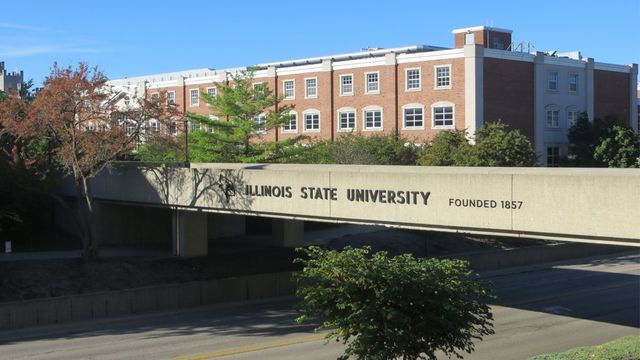
Illinois State University (Image credit: David Wilson)
The University of Illinois (U of I) at Champaign-Urbana, the largest university in the state with 48,000 students, opened August 24 with students on campus, but with classes being held through a hybrid model of both online and face-to-face. U of I even developed its own COVID-19 test. The test is saliva-based and is faster, easier to administer and far cheaper than standard tests.
Despite this, there has been a surge of COVID-19 cases among faculty and staff. More than 1,900 cases have been reported on campus, the vast majority among undergraduate students. Undergraduates have been urged to restrict their activities to essential ones only. This includes going out to buy groceries, attending religious events, seeking urgent medical help and receiving their twice-weekly COVID test. This temporary quarantine is set to last only until the 16th of this month. After that time, the plan is to resume normal functions, with the potential for a new outbreak.
Some Illinois colleges with later start dates are attempting to implement measures aimed at convincing students that a return to campus will be safe, without providing plans that could realistically provide a safe environment. For example, Northwestern University in Evanston, Illinois, which is set to begin classes September 24, is not admitting first- and second-year students on campus (with few exceptions) and is having them conduct all their classes online. But, third- and fourth-year students are being welcomed on campus and have the choice of taking classes in person, through a hybrid model, or completely online. Northwestern is also requiring students who plan to return to campus to get tested before arriving and regularly throughout the fall.
Yet, such caution is not the norm but the exception. At schools like Illinois State University in Normal, Illinois, with roughly 20,000 students, there have been 1,383 positive tests recorded so far. This amounts to over 5 percent of the student body. This despite the fact the school is holding all classes online except those it deems absolutely necessary be conducted in person.
No information is listed online about which classes necessitate face-to-face meeting and which do not. A student who spoke with the WSWS said classes like her metalwork and jewelry class were still meeting in person, and that she was aware of only about five classes in the art department that were still meeting. She also stated that the switch to mostly online classes came with little to no warning.
Students have reported that Illinois State is providing little guidance and withholding important information about COVID outbreaks. Sky, a student at Illinois State, told the WSWS about the total lack of communication between the university, the resident assistants and housing staff, and the students.
She said, “There is a quarantine room right next door, which we found out for ourselves when I got off the elevator after my shift and found university blankets, tp, and sheets stacked outside my neighbors’ door.” Sky went on to speak about the difficult position of the residential assistants who are threatened with losing their housing scholarship if the university determines they are to blame for an outbreak, “Our RAs and CAs [community advisors] are having a hard time communicating with all of us because they feel very out of the loop and are afraid to lose their jobs and housing right now. I reached out to my CA when I saw the blankets outside and she said she knew just about as much as me, which was very concerning.”
At a recent press conference, Illinois State President Larry Dietz was asked if he would have done anything differently regarding resumption of classes. In effect he said “no,” stating, “What we’ve had to do is be as nimble as we can, knowing what we know at the particular time, and I think we’ve done that.” He continued, “It’s difficult to do that with a large organization and turning some things on a dime.”
Temporary, bare minimum measures have been paired with focus on students’ “personal responsibility” to avoid COVID infection. A large party thrown by YouTube influencers, the “Nelk boys,” with the participation of Illinois State students made local news when the crowd of young people reportedly had to be dispersed by local law enforcement. Dietz used the incident to scapegoat students for the recent COVID outbreak, saying he would be collaborating with police to penalize students caught on video at the party.
Many schools, including Illinois State, U of I, and Northwestern, have emphasized the need for personal protective equipment (PPE) and social distancing in all their school re-opening plans. Yet even these measures fall short of what epidemiologists consider safe.
The decision to open schools is a blatant choice to put profit ahead of the lives of people. It’s clear that campuses should not be open. Without a scientific plan for a safe return, thousands will die, including many young people and students.
There is growing resistance to this homicidal policy. At the University of Michigan, graduate student instructors are continuing their strike against the school administration’s re-opening policy. The action has won broad support from students, RAs, faculty members, dining room workers, and local construction workers as well as workers internationally.
On Monday, nearly 4,000 clerical, maintenance, and other service workers walked out at the U of I at Chicago and medical centers in Chicago, Peoria, and Rockford after voting 94 percent in favor of strike action. The service workers joined 800 nurses who walked out of the U of I Hospital to protest under-staffing, unsafe conditions, and long work hours.

Strikes mount as COVID-19 breaks out in hundreds of Spanish schools

Alice Summers

Opposition is mounting to Spain’s homicidal back-to-school campaign, amid a massive resurgence of COVID-19. On Tuesday, Spain passed 600,000 total cases (603,167), just over a week after reaching 500,000. The same day, Spain recorded 156 new deaths, bringing the highly manipulated official death toll to over 30,000 (30,004). Analyses by major newspapers show the real death toll is at least 45,000.
Nevertheless, the Spanish government, headed by the social-democratic Socialist Party (PSOE) and “left-populist” Podemos, is proceeding with its politically-criminal school reopening plans, forcing teachers back to work and threatening to prosecute parents who do not send their children to school.
Madrid education workers began a 20-day strike against the PSOE-Podemos government’s back-to-school orders Friday. Called by the anarcho-syndicalist CNT-AIT (National Confederation of Labour-International Workers’ Association), this strike comes atop a two-day strike called in Madrid by the CCOO (Workers’ Commissions), UGT (General Union of Labour), CGT (General Confedaration of Labour) and STEM (Madrid Union of Education Workers) unions, scheduled for September 22-23.
Strike action has been threatened in the Balearic Islands, Andalucía, Aragón, Galicia, Murcia and the Basque Country, amid reports of coronavirus outbreaks in numerous schools across the country. More than 200 schools have registered coronavirus-related incidents in only the first week of term, before many of Spain’s regions had even reopened education centres.
Andalucía is the worst affected so far, reporting that at least 34 schools had seen coronavirus “incidents.” Several education centres there have already been forced to close after multiple infections among teachers and students. At least one school in the Andalucían city of Sevilla has already closed; in Málaga, four classes in two schools have had to quarantine. In Granada, two schools have had to postpone opening after reporting cases among teachers. In Córdoba, seven classes in two schools, and a further two infant education centres have also had to quarantine.
The Basque Country has been the next worst affected, reporting around 30 schools with COVID-19 incidents, four of these having to close and the rest to impose measures like partial quarantines. This is followed by Aragón, which has closed 24 classrooms in 21 schools; Castilla-La Mancha, with 20 schools in isolation; Madrid, with 26 classrooms isolated in 16 different schools; and La Rioja, with 14 education centres reporting positive cases and setting up quarantines.
In Catalonia, the school term has started with 253 teachers and 210 pupils in quarantine. Navarra has also reported that 286 pupils are already having to isolate.
The struggle of workers against this manifestly unsafe back-to-school campaign faces not only the hostility of the main bourgeois parties of state, but the collusion and spinelessness of the unions.
In Madrid, the CNT-AIT only called the 20-day strike after industrial action planned by the CGT, UGT, CCOO and STEM was delayed from the start to the end of September, so as to give right-wing regional president, Isabel Díaz Ayuso, time to implement her inadequate safety measures. Four days of strike action on 4, 8, 9 and 10 September were replaced with a two-day work stoppage planned for the end of the month.
Fearing that Madrid education workers’ opposition could erupt outside the unions’ control, the CNT-AIT announced work stoppages between 10 and 30 September. This announcement in itself only came after a recently-established “Teachers Assembly for an Indefinite Strike” criticised the planned two-day strike as “insufficient,” stating that it does not “reflect the concerns of the education community.”
Unions have refused to call out teachers and other workers across Spain in a unified struggle against the reopening of schools. They have limited action to sporadic and isolated one-day or short-term mobilisations, all on different days and in only some of Spain’s 17 regions, allowing workers to let off steam while doing nothing to prevent the reckless reopening.
In the Basque Country, education workers struck for one day, Tuesday, despite the regional government’s attempts to prevent walkouts by imposing minimum service requirements. Officially, 41.9 percent of education workers took part in the strike, while the unions claimed 65–70 percent participation.
Around 40,000 education workers in the Basque Country stopped work on Tuesday, with a further 10,000 subcontractors also joining the strike. The unions reported thousands of workers also took part in demonstrations across the region: 8,000 in Bilbao, 5,000 in Vitoria and 4,000 in Donostia.
On the same day, a mere 53 teachers took part in a strike in Andalucía, called by a new union, Teachers for Public [Education] (DxP), after the main unions delayed all action until 18 September, limiting it then to only a token one-day protest. The DxP strike is to last until 16 October. In a pre-emptive attempt to prevent industrial action, Andalucía’s regional government also imposed minimum service requirements.
A one-day strike in the Balearic Islands, called by the Balearic Workers’ Union (UOB), has been delayed from 14 to 29 September, with the union calling for the regional government to come to the negotiation table.
In Murcia, a one-day strike on 23 September has been called by the CCOO and STERM (Confederation of Teaching Trade Unions), while in Galicia, a one-day work stoppage was held on 10 September. A further strike is planned for 16 September in Galicia.
Turn-out in Galicia was only around 12 percent, as the regional government effectively illegalised the strike, imposing stringent minimum service requirements. The Galician High Court ruled that 100 percent of cleaning staff, kitchen staff, medical staff and educators must be present. It cynically justifying this draconian edict, referring to the coronavirus pandemic: “this may be excessive in a normal situation,” the High Court stated, but it is “reasonable and justified by the grave crisis that we are suffering through.”
The Union of Students has also called for pupils across Spain to stay away from classrooms on three days this week (16, 17 and 18 September).
Thousands of parents and students across the country have also joined protests against the unsafe reopening of educational centres, with many refusing to send their children to school.
In the southern city of Granada, in Andalucía, parents of around half the pupils enrolled at the Tierno Galván primary school refused to send in their children. Roughly 200 of the school’s 400 children were absent, as parents protested the lack of safety protocols and sufficient staffing.
Multiple other protests took place in Andalucía, with the “majority of students” at a school in Jaén staying away, according to 20minutos.
Speaking to El Periódico, Ángeles B., mother of two primary school children from Sevilla, denounced the unsafe reopening of schools in Andalucía, stating: “Children have to learn and socialise, but what do we put first, health or education? … We are in a pandemic, people are dying. I don’t understand why the Andalucían government hasn’t hired the teachers we need to have classes with fewer kids. … I’m not going to let them [the government] tell me that I am irresponsible for not sending my children to school.”
Many children in A Coruña, in the northern region of Galicia, were also kept home from school by their parents. Parents, teachers and children protested outside schools, carrying placards reading “My classroom isn’t safe,” “They need to protect us!” and “More ventilation, more security, safe education!,” among other slogans. Similar demonstrations took place across the country.

Students return to UK universities: Build campus safety committees!

Danny Knightley

Students are set to return to universities from Monday just as COVID-19 is spreading rapidly once again. What is described as “the UK’s biggest annual migration” involves hundreds of thousands travelling to campuses and shared accommodation, even as restrictions were reintroduced this week limiting private gatherings to just six people.
There has been a 43 percent increase in infections this week alone, driven by a huge spike in cases amongst 17-29 year olds—the same cohort that will be in and around campuses. The rate of infection among this age group is now more than double the national average and rising.
While many universities considered the possibility of transitioning entirely to online learning for this first term, most have committed to at least some face-to-face contact, on the grounds that campus living “is a key part of the university experience for many.” But a key part of the university experience is surviving it and not passing an aggressive virus onto one’s friends and loved ones.
To add insult to injury, the generation that is expected to return to colleges and universities is being blamed by the government and media for spreading COVID-19. Health Secretary Matt Hancock accused young people of ignoring social distancing rules, risking a second wave of the pandemic. “Don’t kill your gran by catching coronavirus and then passing it on,” he said, in particularly cynical and cruel remarks.
Rather than establishing mass testing to ensure the campuses are COVID-safe, the government has announced that testing will be restricted to essential workers due to shortages. Six months on the testing system is highly inadequate, with those unwell unable to get tests or being told to travel hundreds of miles. That it is collapsing now is entirely due to the reopening of schools, with infections spreading among teachers and pupils.
Campus reopenings will exacerbate this dire situation. Students from all over the country, who had previously been mixing in well-defined groups, are being thrown into close proximity with friends and strangers. This is particularly dangerous in COVID hotspots such as Manchester or Leicester, which will see 100,000 and 40,000 students arriving, respectively. These cities have already had some form of local lockdown, have come out of it or are about to go into one. Many other cities will inevitably follow.
It is urgent that students and educators take matters into their own hands and place no trust in the government, fake opposition parties or the university institutions. Campus safety committees must be built to ensure appropriate safety procedures are put in place to protect the health of students and staff, and fight for increased testing on campuses.
Blaming young people for the spread of the virus is a blatant attempt to conceal that the real policy of the Johnson government, Labour Party, Liberal Democrats and all the media is to allow the virus to spread—so-called “herd immunity.” This eugenics-style aim, combined with systemic greed, corruption, incompentence and stupidity, has already led to tens of thousands of deaths, and will cause many more.
The Conservatives and the Labour Party are united in their efforts to “reopen the economy,” driving workers back into unsafe workplaces, opening schools and now universities. For the last months, they have encouraged people to eat and drink out, go the gym and “return to normal,” even as the virus spreads. Young people constitute the majority of the workforce in the bars, pubs, retail, fitness and delivery services that have been pushed back into operation. If they are fortunate to still be working, they will be travelling from their accomodation and campuses to these workplaces
The Lancet warned earlier this summer that without an effective track and trace testing system, the reopening of schools would likely lead to a second wave of COVID-19. Given the higher level of autonomy and higher degree of movement among university students, this warning applies even more strongly to the return to campuses across the country.
The University and College Union (UCU) has said more than a million students moving around the country was “a recipe for disaster.” Yet it is not mobilising its members against this. Labour leader Sir Keir Starmer lamented the incorrect A-level results given to potential university students, but there is no statement yet by him or the National Union of Students in response to the murderous drive of the Johnson to get students back to university and paying their fees.
There is widespread opposition among students and teachers, who have raised concerns over the testing policies and alternate learning styles advanced by universities, with numerous petitions and protests demanding a return to online learning.
This opposition is echoed internationally, with graduate students at the University of Michigan in the US taking strike action to demand the shutdown of in-person learning amid the coronavirus pandemic. On September 10, they voted by more than 700 to 400 to reject a proposal from the university administration, which did not meet their main demands, to continue their strike to ensure safe studying conditions for students.
Students are struggling economically, in addition to the health dangers. Between March and July, unemployment rose by 62,000 to 1.2 million—a jobless rate of 4.1 percent. This is before the government jobs furlough ends in November. Young people are the hardest hit, with the number of unemployed 16-24 year olds rising by 76,000. As a result of economic uncertainty, the numbers enrolling for university have increased by 3.5 percent. Jo Grady, the leader of the UCU, has warned that higher numbers will make social distancing even harder.
Regardless of the precise learning styles adopted by universities, students are still expected to pay the same inflated fees of £9,250 for online learning and limited access to resources. As most work in events or in the service industry, young people have seen their employment opportunities vanish over the last six months. More and more students are struggling to support themselves, with one in five unable to pay their rent. Swansea University, for example, reports an average increase of 190 percent in applications for its hardship fund while Cardiff Metropolitan said it had seen a 125 percent increase.
The International Youth and Students for Social Equality (IYSSE), the student and youth movement of the Socialist Equality Party (SEP), is committed to opposing these conditions. The fight to defend health and safety against the unsafe reopening of schools, workplaces and universities requires the mobilisation of the working class against the Tory government, its Labour allies, and the capitalist system as a whole.
This Saturday, September 19, the SEP is hosting an online meeting for educators and students in support of those who stand against this murderous drive for a return to universities. We demand that the return of students to university is postponed until effective testing measures are put in place to reduce the risk of transmission among the student population and university staff. We demand an end to tuition fees, the full refund of fees already paid out for this year’s tuition, state funding of higher education for all, as a right, the cancelling of student debt, and the reintroduction of a living grant to cover accommodation and other essential expenses.

Australian police raids seized copies of Chinese diplomatic communications

Mike Head

More revelations are appearing that point to what lay behind last week’s sensationalised media reports that Chinese authorities had subjected two Australian journalists to midnight raids, forcing them to leave the country.
It is increasingly clear that this development was bound up with an escalating US-led offensive against China, in which both the Trump administration and the Australian government are taking extraordinarily provocative actions.
While Washington is taking unprecedented action to force the Chinese firm ByteDance to sell the video sharing app TikTok to an American company, Australia’s Liberal-National government is orchestrating matching moves against Beijing.
The Australian Broadcasting Corporation (ABC) reported yesterday that Australian police agencies have at least twice this year accessed the communications of Chinese diplomats, in violation of international law, triggering a sharp deterioration in relations between the two governments.
Such material is protected by the Vienna conventions on diplomatic and consular relations, which are also enshrined in Australian law. But communications involving Chinese officials were seized in operations targeting John Zhang, a Chinese-Australian citizen who was a part-time electorate officer for a New South Wales (NSW) state Labor Party MP, Shaoquett Moselmane.
In January, at Sydney International Airport, Australian Border Force (ABF) officers searched Zhang’s computers and phones when he, his wife and their daughter returned from lunar new year celebrations in China. According to Zhang, the officers read and copied email and phone exchanges with Chinese embassy and consular officials in Australia.
Zhang’s devices were again accessed in June when Australian Federal Police (AFP) and Australian Security Intelligence Organisation (ASIO) officers raided his home, company and the NSW Parliament.
In a blaze of publicity, Moselmane was also raided before dawn on June 26—accused by various media outlets of being a “Chinese agent.” Last week, Chinese authorities revealed that four Australian-based Chinese journalists were raided at the same time, and were told not to report the police operation. The journalists later left Australia.
As required by the ASIO Act, Attorney-General Christian Porter personally authorised the raids, exposing the involvement of Prime Minister Scott Morrison’s government at the highest levels.
The ABC reported it was told that Zhang’s computers and phones contained a long history of emails, messages and records of calls with Chinese diplomatic and consular officials and some of their family members. They included the most recent Sydney consul-general, Gu Xiaojie, and officials and families at the senior ambassadorial level in Canberra.
Zhang last month wrote to Porter, Foreign Minister Marise Payne and Home Affairs Minister Peter Dutton, complaining of the unlawful downloading of these communications from his laptops and phones.
These developments indicate the degree to which the Australian government and its security agencies, working closely with their US counterparts, are ratcheting up moves designed to inflame tensions with China.
This is the context of last week’s much-dramatised departure from China of the last two journalists there representing Australian media outlets—the ABC’s Bill Birtles and the Australian Financial Review’s Michael Smith. It seems to be the result of Australian government provocations.
The Australian Foreign Affairs Department, which would have known of the earlier secret operations against Zhang and the four Chinese journalists, had advised the pair to leave China. They were both booked on flights for the next day, when the Chinese authorities instructed them not to leave until they answered questions relating to a legal case.
The Australian embassy in Beijing then further intervened, hosting the two journalists in diplomatic residences for five days until a deal was worked out for them to speak to the Chinese police and then leave the country.
If the Chinese embassy had taken similar action in response to June’s raids on Chinese journalists, the corporate media would have been full of headlines accusing Beijing of blocking police and legal proceedings.
The latest revelations further underscore the sweeping scope of, and political agenda behind, the “foreign interference” laws jointly pushed through parliament in 2018 by the Liberal-National government and the opposition Labor Party, setting a global precedent hailed by the US political establishment.
The raids against Moselmane, Zhang and the Chinese journalists are seen as the first test of these laws, which the Australian government has been under US-linked pressure to put into practice.
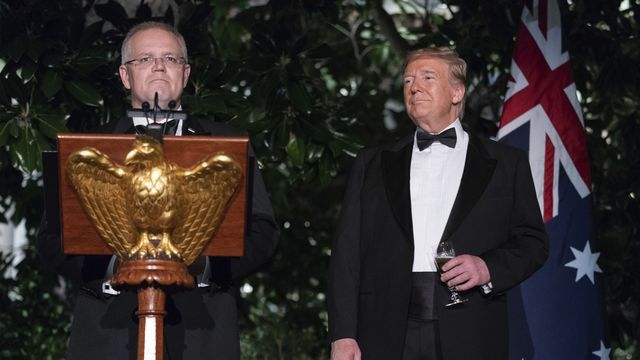
US President Trump listens to remarks by Australia PM Scott Morrison during a White House function in September, 2019. (Official White House photo by Shealah Craighead)
Search warrants seen by the ABC reportedly show that the AFP is investigating whether China’s Sydney Consul Sun Yantao worked “covertly” with Zhang to influence political opinion in Australia. That is an offence that carries up to 20 years’ imprisonment under the foreign interference legislation.
The allegedly “covert” discussions consist of a discussion group on WeChat, which reportedly mostly consisted of sharing articles, speeches, jokes and memes, and to organise social outings. WeChat is used by millions of people around the world.
As a prominent figure in the Chinese-Australian community, Zhang has been far from “covert.” He has made no secret of his relationships with China’s embassy in Canberra and its Sydney consulate, and has boasted in media articles of his ties with Australia’s political elite
One cited 2014 blog by Zhang indicates the type of “soft diplomacy” being practised by China, like every other country. Speaking of Moselmane, he wrote:
“Through these influential friends in Western society, China’s social and economic development is better understood and China's cultural values are better accepted.” Zhang expressed the hope that “the gap between East and West will gradually disappear.”
Instead, however, first under Obama and then Trump, Washington has intensified its military and economic confrontation, seeking to prevent China from ever challenging the hegemony over the Asia-Pacific and much of the globe established by the US through World War II.
No doubt, whatever activities the Chinese embassy conducts pale into insignificance compared to those of the US embassy. It has intervened to overturn at least two Australian governments—those of prime ministers Gough Whitlam in 1975 and Kevin Rudd in 2010—that were regarded as insufficiently reliable in implementing the US alliance.
The US embassy’s collaboration with “protected sources” in the Labor Party to oust Rudd was documented by leaked US cables published by WikiLeaks. Once Julia Gillard was installed as prime minister, she aligned the country completely behind the Obama administration’s anti-China “pivot to Asia.”
Moselmane and Zhang have been accused of making pro-China statements and of criticising the foreign interference laws as part of an anti-China witch hunt. To make such political views a crime is an outright assault on free speech.
Zhang has launched a High Court challenge, exposing the nebulous nature of the accusations hurled against him and charging the government and ASIO with violating the implied freedom of political communication in the Australian constitution.
Interviewed on national television last Sunday, Home Affairs Minister Dutton took the threat to freedom of speech further. He said any foreign journalists in the country who provided a “slanted view” of Australian affairs might come under similar scrutiny from the security agencies.
The initial targets of these police raids may be figures linked to China but they will not be the last. Already, media reports have described former foreign minister and NSW premier Bob Carr as a “mentor” of Moselmane. Even those in the political establishment, like Carr, can be victimised if they differ with the ferocity of the anti-China drive because it affects the lucrative profits that sections of the ruling class derive from iron ore and other exports to China.
Beyond that, anti-war opposition and political dissent can be criminalised, as part of a drive to whip up a poisonous wartime-like atmosphere. As the WSWS and the Socialist Equality Party have warned, the foreign interference laws contain sweeping offences, ranging from treason to breaching official secrecy and cooperating with a “foreign” organisation. These provisions could be used to outlaw opposing Australian involvement in a catastrophic US-led war against China.