9 Oct 2020

Class Warfare Intensifies as Labor Rights Violated Around the World

Pete Dolack


As bad as conditions have traditionally been for labor worldwide, 2020 has seen conditions deteriorate even more. As in past years, there is not a single country on Earth that fully protects workers’ rights. And although every country continues to violate labor rights, the extent of those violations grows, continuing a sad pattern of class warfare.

The International Trade Union Confederation has issued its annual Global Rights Index, and only 12 countries managed to be listed in the Index’s top ranking, the countries that are merely “sporadic” violators of rights. But those countries are hardly paradises (this is capitalism, after all). One of those dozen, the Netherlands, had no less than seven of its corporations listed among companies violating workers’ rights. Those were not necessarily isolated instances. The report said, “In the Netherlands, unions observed an increasing trend to shift from sectoral agreements to company agreements with the intent of minimising labour costs in return for employability. Companies often used the competitiveness and employability argument with their employees to incite them to accept lower conditions of work at the enterprise level. In addition, companies, including Ryanair, Transavia, Jumbo Supermarkets, Gall & Gall, Action and Lidl supermarkets, tended to circumvent collective bargaining with representative unions.”

If that represents the “best” of conditions for working people, the world is a mighty unfair place. Which it obviously is, given the ever more intense pressure bearing down on working people as the neoliberal era continues to make capitalism ever more miserable for those whose work produces the profits swelling the pockets of industrialists and financiers.

As in past years, the Global Rights Index report divides the world’s countries into five categories with increasing levels of rights violations. They are as follows:

1. Sporadic violations of rights: 12 countries including Germany, Ireland, Norway and Uruguay (green on map above).

2. Repeated violations of rights: 26 countries including Canada, France, Japan and New Zealand (yellow on map).

3. Regular violations of rights: 24 countries including Argentina, Australia, Britain and South Africa (light orange on map).

4. Systematic violations of rights: 41 countries including Chile, Mexico, Nigeria and the United States (dark orange on map).

5. No guarantee of rights: 32 countries including Brazil, China, Colombia and Turkey (red on map).

5+ No guarantee of rights due to breakdown of the rule of law: 9 countries including Libya and Syria (dark red on map).

Hypocritical finger-wagging

Consistent with past years of the Global Rights Index, the United States, which loves to hold itself up as an exemplar of democracy and civil rights, is among the lowest-ranking countries — the U.S. has consistently had a ranking of 4 for “systemic” violations. The International Trade Union Confederation, in supplemental materials discussing U.S. violations, noted that the National Labor Relations Board has made a series of anti-union rulings, including allowing retaliation against striking Wal-Mart workers, while U.S. law permits anti-union discrimination, restricts workers’ rights to form unions of their own choosing, and places severe barriers against union organizing.

The United Kingdom, second only to the U.S. in regular scolding of other countries, is ranked in the middle of the pack, same as a year ago. The report’s discussion of Britain reported “the number of people employed on a stand-by basis, ‘zero-hour contracts,’ at between 200,000 to 250,000 which demonstrates the prevalence of underemployment in the UK. Under these contracts employees have to be available for work but are not guaranteed a minimum number of hours. These contracts create income insecurity for workers and also undermine family life.” Additionally, the report noted multiple barriers to British union organizing.

Canada, although ranked higher than Britain or the U.S., is no paradise despite the image its governments like to project. The report noted that in Canada there are many categories of workers, ranging from domestics to professionals, barred from organizing, and there are severe legal restrictions limiting the right to strike.

Globally, the report states that violations of workers’ rights are at a seven-year high. Direct attacks on unions highlight the degradation:

“The trends by governments and employers to restrict the rights of workers through violations of collective bargaining and the right to strike, and excluding workers from unions, have been made worse in 2020 by an increase in the number of countries which impede the registration of unions — denying workers both representation and rights. … A new trend identified in 2020 shows a number of scandals over government surveillance of trade union leaders, in an attempt to instill fear and put pressure on independent unions and their members.”

The global pandemic has only made conditions worse:

“These threats to workers, our economies and democracy were endemic in workplaces and countries before the Covid-19 pandemic disrupted lives and livelihoods. In many countries, the existing repression of unions and the refusal of governments to respect rights and engage in social dialogue has exposed workers to illness and death and left countries unable to fight the pandemic effectively.”

Class warfare goes on and on and on

Some of the sobering statistics gathered by the International Trade Union Confederation tell a grim story:

* 85 percent of countries violated the right to strike.

* 80 percent of countries violated the right to collectively bargain.

* Workers were arrested and detained in 61 countries.

*  Workers experienced violence in 51 countries.

The Confederation, which describes itself as a coalition of “national trade union centres” encompassing 332 affiliated organizations in 163 countries and territories, determines its ratings by checking adherence to a list of 97 standards derived from International Labour Organization conventions. Those 97 standards pertain to civil liberties, the right to establish or join unions, trade union activities, the right to collective bargaining and the right to strike.

The Confederation’s report is one more illustration of the race to the bottom. The International Labour Organization estimates that more than 470 million people worldwide were unemployed, underemployed or “marginally attached to the workforce” in a report issued in January 2020, with 2 billion people (61 percent of the global workforce!) informally employed. That report was issued just before the Covid-19 pandemic took hold, triggering a dramatic economic crash that had been overdue, thanks to the instability of capitalism that regularly causes downturns. Inequality and lower pay are endemic around the world, and the costs of housing, because it is a capitalist commodity, rises far faster than incomes. The continual imposition of austerity on working people contrasts dramatically with the trillions of dollars thrown at financiers and industrialists since the pandemic began.

Capitalism promises nothing but more one-sided class warfare. We’re long past due to try something different.

Why America’s Economic War on China is Failing

Vijay Prashad & John Ross


U.S. President Donald Trump—supported by most of the U.S. establishment—deepened the U.S. government’s assault on the Chinese economy. The “trade war” seemed to play well with Trump’s political base, who somehow hoped that an economic attack on China would miraculously create economic prosperity for them. In 2018, Trump slapped tariffs on more than $200 billion worth of various Chinese goods. Then, Trump’s administration went after Chinese high-tech firms such as Huawei, ZTE, ByteDance (the owners of TikTok), and WeChat.

None of this has worked very well. Trump faces negative legal judgments about his “trade war,” and the U.S. economy slips into negative territory. It is not just Trump. Both the Republican Party and the Democratic Party are committed to a policy that will not cause China to surrender to U.S. ambitions. Whether or not the U.S. can backtrack from this policy orientation and begin a dialogue with China remains to be seen; doing so would be, of course, desirable.

Legal Setbacks

Legal challenges in the World Trade Organization (WTO) and in the U.S. District Court for the Northern District of California went against the Trump administration. This is a setback for the policy orientation of the U.S. government.

After Trump announced the tariffs against a wide range of Chinese imports, the Chinese government formally took up the matter through the WTO’s dispute mechanism. After considerable study, the WTO came back with a verdict. On September 15, 2020, a three-person WTO panel found that the U.S. had violated the provisions of the 1994 General Agreement on Tariffs and Trade (GATT), the treaty that established the WTO. This was a serious defeat for the United States; the Trump administration has 60 days to file an appeal.

The United States government does not like to lose. U.S. Trade Representative Robert Lighthizer released a statement condemning the ruling. “This panel report,” Lighthizer said, “confirms what the Trump administration has been saying for four years: The WTO is completely inadequate to stop China’s harmful technology practices.” The U.S. has paralyzed the WTO’s ability to hand down a final binding verdict, as the WTO’s appeals court is currently no longer functioning because of Washington’s refusal to accept new members for it.

In 1994, the U.S. pushed for the creation of the WTO, wrote many of its rules, and brought China into the WTO in 2001. Because the U.S. felt in command of the world, the WTO worked to advance its interests; now that China’s economy has grown in strength, the U.S. finds the rules of the WTO to be burdensome. Free trade is only useful to governments such as the U.S. when it is beneficial to its companies; the principle of free trade is otherwise easily rejected.

Even within the U.S., there is doubt about Trump’s policies. A judge signed an injunction to halt Trump’s attempt to prevent U.S. residents from using WeChat as a means to communicate with people in China. Pressure on TikTok may also dissipate after the U.S. elections.

Economic Divergence

A senior analyst at the Federal Reserve Bank of St. Louis says that the economic impact of the “chaotic” lockdown in the U.S. will create major disruptions for at least a generation. It is unlikely, he says, that the U.S. will be able to “recover easily.” When asked about China’s recovery, he said that so far things look much better. But any persistent reliance of China upon the U.S. market will have a negative impact on China’s growth.

China has essentially broken the chain of the COVID-19 infection, although the authorities remain vigilant for new outbreaks; in the U.S., it is hard to talk about a second wave since the first wave has not yet crested.

What this has meant is that as early as the second quarter of 2020, China’s gross domestic product (GDP) rose to 3.2 percent above the level a year previously; meanwhile, the GDP of the U.S. fell by 9 percent below last year’s level. China is already on the way to recovery, while the U.S. does not even know if the infection has peaked or not.

The U.S. and China publish somewhat different measures of industrial output, but the contrast is so striking that it leaves no doubt as to the relative trends. China publishes data for total value added by industrial enterprises, which in August 2020 was 5.6 percent higher than a year previously, whereas in contrast the U.S. industrial output for August 2020 was 7.7 percent lower than a year earlier. China’s level of industrial production was higher than a year previously, whereas the U.S.’s was far below it.

As a result of China’s much more dynamic economic recovery, China’s trade is recovering much more rapidly than that of the United States. This is clear for imports—which for other countries are their exports. In July, the last month for which there is data for both the U.S. and China, China’s imports had almost regained pre-pandemic levels—being only about 1 percent lower than a year previously. In contrast, U.S. imports were still about 11 percent below a year previously.

The result of these trends is that China will be the center of world economic recovery from the COVID-19 recession—while the U.S. will contribute almost nothing to it.

The latest global projections of the IMF indicate that in 2020-2021, China will account for the absolute majority, 51 percent, of world growth, and the U.S. for only 3 percent—and the latest IMF predictions for the U.S. indicates that this may be an exaggeration of its growth. Most of the other contributors to world growth according to the IMF analysis will be Asian economies who have strong trading relations with China—South Korea, Indonesia, the Philippines, Vietnam, and Malaysia.

To analyze the global situation, the impact of the COVID-19 crisis has a very dramatic impact on the pattern of development of the world economy as divided between developing and advanced economies. The data in the IMF’s projections show that by 2021 GDP in the advanced economies will still be 3.6 percent below its level in 2019 while in the developing economies it will be 2.7 percent above 2019. This is a major distribution of world economic growth in favor of developing economies and against advanced ones.

The April IMF estimates indicate that in 2020-2021 more than 95 percent of world economic growth will take place in developing economies—the data in the April IMF World Economic Outlook database means it projects that 51 percent of world growth will take place in China and 44 percent in other developing economies. Less than 5 percent of world economic growth will take place in advanced economies.

By attempting to reorient world trade away from China and to the United States, the U.S. is therefore attempting to lock other countries into subordination to its own very low growth instead of the much more rapidly growing economy of China. This is evidently strongly damaging for other countries’ economies.

The Case Against Social Media: Mass Misinformation in the Covid-19 Era

Anthony DiMaggio


Despite the rising salience of “fake news” in the U.S., propaganda, misinformation, and conspiracy theories are hardly new phenomena. In the 1950s, The historian Richard Hofstadter famously wrote in The Paranoid Style of American Politics about conspiratorial thinking in American history, including McCarthyism, ravings about water fluoridation, and wild tales about the Illuminati and Free Masons secretly dominating American politics and society.

Americans are now witnessing a new era of conspiracy mongering and fake news via the rise of the fringe “QAnon” movement, among a plethora of paranoid claims that Covid-19 is an elite-fueled hoax and that it was secretly created by powerful people working in the shadows.

Pew Research Center polling from September finds that nearly half of Americans – 47 percent – have read or heard about the QAnon conspiracy, which claims that the Democratic Party and media are secretly coordinating a cannibalistic satanic pedophilia ring, and that only Donald Trump and one of his allies embedded in the “deep state” stand in their way.

The best conspiracy theories are those that are completely unencumbered by facts or evidence. This reality holds for QAnon as well. Trump’s supposed ally in the depths of the “deep state” – Q – appears not to be government employee at all, and he does not even reside in the United States. Rather, Jim Watkins – who reportedly hosts the primary QAnon accounts on 8Chan, is a pig farmer living in Manila. And in a truly Orwellian twist, 8Chan itself reportedly serves as a venue for the dissemination of child pornography. Finally, President Trump, who is supposedly leading the effort to combat “deep state” pedophilia, has gone out of his way to identify with Ghislaine Maxwell, announcing that he “wish[ed] her well” after she was arrested and charged for participating in Jeffrey Epstein’s child sex trafficking ring.

Outside of QAnon, American political discourse on Covid-19 has also been infected with various false and conspiratorial claims. This misinformation is primarily fueled, not by mainstream media coverage, but by questionable actors operating in social media venues like Facebook, and Twitter, among other sources. I sought to drill to the core of the fake news phenomenon, to better understand precisely how this new social media ecosystem has contributed to the dumbing down of the nation on important political matters of the day.

To identify the effects of social media in disseminating misinformation, I examined two recent national polls by the Pew Research Center – from April and June 2020 – covering American media consumption, and as related to opinions of fake news, conspiratorial thinking, and the Covid-19 pandemic.

Through an original statistical regression analysis, I isolate the power of social media consumption in predicting consumption of, and beliefs about various forms of fake news. “Controlling” for other demographic factors, including respondents’ partisan identities, self-declared ideology, gender, age, education, race, and income, I am able to rule out other factors as potential influences on one’s likelihood of consuming and embracing fake news.

The concern with the noxious effects of social media began to intensify in the spring of this year when various fake news stories and conspiracies were first popularized in these venues. And there is good reason to be alarmed. My analysis of Pew’s April 2020 survey finds that consumption of social media – including FacebookTwitter, and “online forums”/“discussion groups” – is significantly linked not only to being increasingly exposed to fake news, but with struggling to distinguish between which news stories and information are real, and which are fabricated. Individuals who reported getting and posting their information and news on Covid-19 from these venues were more likely to say they had consumed fake news stories and conspiracies on Covid-19, including the claim that Vitamin C is an effective treatment against the virus, that 5G cell towers are secretly spreading Covid, and that “at-home treatments” are “effective” for combating “various serious cases of the Coronavirus.”

The problems didn’t stop with the fake news above. Social media users were also consistently more likely to fall victim to all types of fake news related to Covid-19. They were significantly more likely:

+ To admit that much of the “news and information” they had “seen or heard about the coronavirus” “seemed completely made up.”

+ To agree that they “initially” believed that “made-up news and information” on Covid-19 “was true before realizing it was made-up.”

+ To report that they had “stopped going to a specific source” of news or information because they “thought that they were putting out made-up stories and information about the coronavirus outbreak.”

+ To report that they lacked confidence in their ability “to check the accuracy of news and information about the coronavirus.”

+ To say that they found it “difficult to determine what is true and what is not” when it comes to “get[ting] news and information about the coronavirus outbreak.”

Unsurprisingly, considering their greater exposure to fake news and their increased struggles in identifying it, social media users were also significantly more likely to agree that “made-up news and information leaves Americans confused about the basic facts of the coronavirus outbreak.”

Recognizing the PR disaster of serving as a hotbed for Covid-19 fake news and conspiracy theories, Facebook and Twitter quickly announced that they were implementing efforts to crack down on false “news” and information on their platforms. Mark Zuckerberg announced in April that Facebook was committed to “help[ing] connect people with authoritative health information and experts and at the same time to limit the spread of misinformation” by directing “more than 2 billion people” to a “Covid information center” with “high-quality content” from health experts, while promising to “take down” false health information from Facebook users if it was perceived to “put people at risk,” and by working “with independent fact checkers” to expose “more than 4,000 articles” posted by Facebook users who were “spreading misinformation” via the use of “warning labels.” Similarly, Twitter announced in late-March that it would take down misinformation-based content concerning Covid-19 that downplayed the danger of the virus, that toted false cures, and falsely promised that mass contraction would help defeat the virus by promoting “herd immunity.”

Despite promises to crack down on Covid-19 fake news, misinformation continued to be associated with social media use in the months following Facebook’s and Twitter’s spring announcements. These venues cracked down on many of the most egregious conspiracies and misinformation, but available evidence also suggests that they continued to serve as delivery mechanisms for misinformation among a subset of users – Americans (and especially Republican Americans) who heavily rely on President Trump and social media for their information about Covid-19. My statistical examination of the Pew Research Center’s June 2020 national survey finds that social media consumption was still consistently linked with embracing Covid-19-related misinformation, after controlling for other factors, including respondents’ partisanship, ideology, race, gender, education, age, and income. More specifically, my analysis examines individuals who reported: 1. Getting “political and election news or information directly from…Donald Trump or his presidential campaign” via “email, social media, or [his] campaign website”; and 2. Those who reported relying on social media, including Twitter and Facebook, as “the most common way you get political and election news.”

These two groups are significantly different in their susceptibility to Covid-19 misinformation. Reflecting Twitter’s and Facebook’s crackdown on conspiratorial information and other fake news, primary reliance on these venues (question #1 above) was no longer associated with increased likelihood of embracing fake news conspiracies. But individuals (particularly Republicans) relying heavily on political and election news from Trump’s campaign and social media (question #2 above) were significantly more likely to embrace false information and conspiratorial thinking, along multiple dimensions. They were more likely to believe the baseless claim that the official Covid-19 death count (more than 100,000 by June) had been intentionally exaggerated, to have heard that “powerful people” had secretly and “intentionally planned the coronavirus outbreak,” to agree that this conspiracy theory was true, and to have watched the “Plandemic” conspiracy “documentary” claiming that Covid-19 was created and unleashed by a secret cabal of elites. This sub-group of Americans likely includes many of Trump’s tens of millions of Twitter followers, but also right-wing Americans who participate in all types of social media groups and closed right-wing echo chamber networks that are trafficking in Covid-19 related conspiracies.

Social media venues have also been at the vanguard of disseminating the QAnon conspiracy theory. As the Pew Research Center reports from its spring 2020 national survey, social media users – specifically those consuming RedditTwitter, and Youtube, were among the most likely to be exposed to QAnon conspiracy information, although exposure was much less on Facebook and Instagram. Traditional media consumers – those following the New York TimesNational Public Radio, and MSNBC – were also regularly exposed to the QAnon conspiracy. But the big difference between legacy media and social media in this instance is that the coverage in traditional media has been overwhelmingly negative, almost universally referring to QAnon as a fringe conspiracy theory, while social media venues have become prime culprits in disseminating pro-QAnon paranoia.

The crackdown on social media against misinformation has seemingly succeeded in limiting the volume of blatantly fraudulent content that is consumed by their patrons. But major problems persist – particularly in right-wing informational networks – when it comes to promoting and consuming conspiracy theory paranoia and fake news. Social media boosters will no doubt point to the crackdowns as evidence that these venues can be reformed and regulated to avoid the worst forms of misinformation that thrive online. But the reality remains that social media like Facebook have long enabled the proliferation of insulated echo chambers, since they amplify content that users “like,” click on, and comment on, by providing their consumers with more of that content, while allowing users to “block” or “unfriend” any individuals who challenge their preexisting views. This long-standing practice means that social media have become prime purveyors of propaganda, fake news, and conspiracy theories, even if their administrators do eventually censor the worst of this misinformation in the face of the negative PR that follows their tolerance of its dissemination.

One “solution” to dealing with the travesty of social media-induced misinformation is for Americans to gravitate in mass away from these venues as mediums for political “education” and engagement. Online echo chambers reinforce extreme political views, while providing their consumers with a sense of false confidence in their beliefs – one that is completely divorced from evidence or rational thinking in the case of the QAnon and Covid-19 conspiracies and fake news. The sooner Americans move away from relying on these venues, and toward engaging with real reporting and fact-checking venues, the better.

Rape, the Shadow Pandemic in the time of Covid-19

Zeenat Khan


What is wrong with some men that in the time of Covid-19 they are raping women of all ages? Rape, the most intimate of crimes is happening every day, everywhere in the world. Raping does not fall under behavioral or mental disorder, it is a criminal offense. Sadly, the incidents of rape did not stop while nations across the globe went under stay-at-home orders during the coronavirus pandemic. Experts fear cases may be getting even worse due to stress and isolation. Is pandemic triggering sexual aggression in men? Could lockdowns, social distancing, wearing a mask, nonstop handwashing, sanitizing and all the other associated uncertainty really be causing men to be aggressive? We all know that rape culture is a man problem. It is not the job of a woman to dismantle the existing culture pertaining to sexual assault and rape. How long do we need to buy into the established idea that testosterone is a real kick-starter for violence and it actually forces violence behavior in men? Getting raped is never a woman’s fault. Yet, society and many men blame the victim and revictimize those women who are victims of sexual abuse. Instead of revictimizing women who want justice in a court of law, men should own up and protest a system that puts importance on them over what a woman has to say in instances of rape and sexual assault. Avoiding victim blaming is really important so that a sexually assaulted woman does not internalize blame on herself. Not to mention the trauma she will go through throughout her life. By some estimates one out of four women will be the victim of a sexual assault in her lifetime. Why do men rape women? Psychologists believe a lack of empathy, narcissism, and intense feelings of hostility towards women are some of the reasons. Every year, hundreds and thousands of rapes are reported in my home country Bangladesh. In similar cultures around the world, patriarchy and dominance over women are often expressed through “dehumanization” where women are seen inferior and powerless to men. As a result, it becomes much easier for women to become the targets of men’s desire and aggression. In those societies rape stories are so common that a lot of the time it doesn’t even make into the newspapers. Yet some stories of rape and assault do stand out for being deeply disturbing because of the brutal nature of it. Other similar incidents just become yesterday’s news. Why are men raping women at an alarming rate now? Is it because the quarantine and stay-at-home efforts are dragging on too long? In the past evidence showed that sexual assaults increase during states of emergencies.

During this Covid-19 pandemic rape has taken center stage along with the novel coronavirus across Bangladesh’s many districts. In the last week of September alone three rapes have continued to gain momentum after they were vastly publicized in all types of social media platforms. The first one is a 37-year-old woman who was abducted, beaten and gang raped by a group of hoodlums in Noakhali (south-eastern Bangladesh). The gruesome act was videotaped while the woman begged and pleaded with them to let her go. Later it was uploaded on Facebook by them. These rapists were calculating and stalking her. They raped her before. The second victim is a newly-married woman who was raped while she was visiting a college campus in Sylhet (north-eastern BD) with her husband. A group of thugs spotted them and robbed them first, and then took the woman in a room of a student hostel, tied up the husband, and raped her in front of him. It was reported that the woman seemed to have fallen prey to the goons as they were motivated by impulse seeing her to be a beautiful woman. The third one is the rape of an underage indigenous girl inside a Catholic Church in Rajshahi (mid-western BD). She went missing after she went cutting grass for the cattle. Later it was established that the perpetrator is none other than Father Pradeep Gregory, parish priest of St. John Mary Vianney’s Church. 41-year-old Father Gregory had kept the girl in his church residence for three days. Later the girl’s family and locals rescued her. “The church authorities kept the girl with the nuns and told the family that she would be returned if they withdraw their police complaint. The church also offered to bear all expenses of the girl until she turns 18.” The Bishop of Rajshahi archdiocese told the media that he presumes someone is innocent until proven guilty. Father Pradeep is in police custody now.

The list can go on and on about the way how the perpetrators of such horrific crimes can influence the religious leaders, the local authorities, and law enforcement to cover up the criminality by flexing their muscles as some of them are often members of the student wing of the ruling party. With their political influence and back up, often rape cases never make it to the court. The lives of the women who are raped forever change. The victims every so often leave the area with their families to avoid further victimization and threats. It has happened time and again. With detachment their rapists get away by dehumanizing them.

Bangladesh’s Women and Child Repression (Prevention) Act 2000 classifies sexual intercourse with anyone below the age of 16 as rape even if it is consensual, with a maximum punishment of life imprisonment.

In the wake of protests over the growing number of rape incidents, the government is going to amend the Women and Children Repression Prevention Act, 2000, to make death sentence the highest punishment for committing rape.

Nationwide protest against the recent rape incidents flared up after the Facebook video tape of the Noakhali woman naked, bruised and crying for mercy went viral. The question remains why has the government and law enforcement failed to prepare for the uptick in sexual violence? At the time when they were assessing public health measures they should have taken into account that sexual aggressions and assaults will be on the rise. Since the beginning of Covid-19, a Beijing based NGO Equality reported seeing a sudden surge in calls to its helpline in February. Bangladesh’s fragile system along with the law enforcements’ unwillingness and inability in preventing sexual crime is the main reason as to why the country hasn’t been able to curve the violence on women. If the victim comes from a poor family, no one in the local thana pays attention to her plight. More often than not she is turned away before she can lodge a complaint and very often the officer in charge refuses to enter the complaint in the ledger book on behalf of the victim. A woman from a poor background does not know how to navigate the complicated legal system and the perpetrators do take advantage of her situation and remains free to rape others. The culprits simply do not take any kind of accountability for their crime.

It really enraged me that the civil society members and some prominent rights activists started to demand justice only after the Noakhali rape was sensationalized with the aid of a video footage of the actual rape. On any given day when you open a Bangladesh media site there will be at least one or two incidents of rape that had happened somewhere in Bangladesh. We do not hear any nationwide outcry about such cases of rape. Now the civil society along with everyone else is demanding justice for the victims, and for stricter enforcement of the current laws, and for the amendments of current laws. It is now a priority for the Law Minister as the instruction came from the Prime Minister herself. Bengalis live for drama and everything has to be measured with a melodramatic twist. While at it not many think about the victim’s right to privacy and the psychological stress and trauma that she is dealing with.

The Facebook post of the Noakhali woman getting assaulted was watched by thousands until a directive came from the higher-ups to take down the video. What kind of sick-minded men and women would actually want watch such a video? Evidently many had watched it and protested on their Facebook wall. Easy access to the internet largely contributes to such behavior. What does it say about the mental health of such people? Very early on, I had made a decision to stay away from social media platforms. I do not have any abnormal curiosity and perversion of watching another woman being tormented in a graphic rape video. Watching such a video reflects on the attitude of a larger society. Such a tendency in others to be voyeuristic witnesses to the misery that had fallen on another human being is simply appalling. But it is hard to avoid what is covered in the media. And the effect of such news is the same — simply horrific.

In many parts of Bangladesh, sexual assault forensic exams are not readily available in rural upazila (sub-units of a district) hospitals. Sometimes there is no rape kit to do a rape test. If the victim is lucky and her story is believable then she is sent to one of the One Stop Crisis Centers in the next town. During the Covid-19 time the very few forensic nurses who are working may not be available in those hospitals or crisis centers. Without collecting evidence of rape such cases will be difficult to prove later on and chances are without evidence such cases will be thrown out before a court hearing. Many forensic experts fear the novel coronavirus is preventing sexual assault victims from coming forward to seek medical care, report the crime, and have physical evidence collected. Without a rape kit it is not possible to collect DNA evidence from a victim’s body, clothes, and belongings. That test is crucial as that evidence is needed to enter the justice system. A rapist knows such things and that is why they are more active now than before as law enforcement people are busy with other pressing matters than pay attention to a poor rape victim who does not know how to navigate the system.

In the USA, national organizations like RAINN and NSVRC have scrambled to increase support they offer online and move their staffs to remote locations where their work can remain confidential, the more than 1,500 rape crisis centers across the country have faced a crisis of their own in responding to the coronavirus pandemic.

“Closed shelters, cancelled counselling services and diverted resources are also severely impacting a range of medical, psychological and legal services required to support rape survivors. And the fear of the virus spreading adds to barrier in accessing services. Survivors of sexual violence may be less willing to seek help because of perceived risks of contracting Covid-19, fearing infection and potentially transmitting the virus to their families.”

The Covid-19 cases is straining and overwhelming the health services, and it hasn’t been able to prioritize in addressing and training staff about violence against women during the ongoing crisis. As it is sexual violence is an under-reported crime and it has been pushed into the background because of the coronavirus. Even before, a sexual assault victim had to fight hard against the socio-cultural and institutional barriers in reporting the crime. A woman’s own defense team sometimes questions the validity of her account and the prosecution often sides with the perpetrator when the case gets to court.

Feminist author Gloria Steinem poses the real issue at the heart of the rape dilemma. “We have to stop talking about who gets raped and talk about who rapes. Somebody is doing these things. And we have to identify who they are.” Who is that somebody? Why do men rape women? Sherry Hamby, a research professor of psychology at the University of the South in the US state of Tennessee, told DW that “sexual assault is not about sexual gratification or sexual interest, but more about dominating people.” The hostile attitudes towards women support this idea. The rapists’ motives are varied and difficult to quantify. Sometimes there are common factors and other times there are not. Michael Kimmel is a sociologist at the State University of New York who has received international recognition for his work on men and masculinity. “Violent men often view their actions as revenge or retaliation. They say, women have power over me because they’re beautiful and sexual and I want them and they elicit that and I feel powerless,” he says. “Just listen for a minute to the way in which we describe women’s beauty and sexuality. We describe it as violence against us. She is a knock-out, a bomb-shell, dressed to kill, a femme fatale, stunning, ravishing. I mean all of these are words of violence against us. It’s like, wow, she knocked me out. So the violence then, or the aggression or the sexual violence is often a way to retaliate.”

In her book, Sex, Art and American Culture, Camille Paglia calls these “somber truths” women must accept. “Feminism keeps saying the sexes are the same,” she writes. “It keeps telling women they can do anything, go anywhere, say anything, and wear anything. No, they can’t. Women will always be in sexual danger.” She may be right, but that doesn’t necessarily make rape a woman’s responsibility.

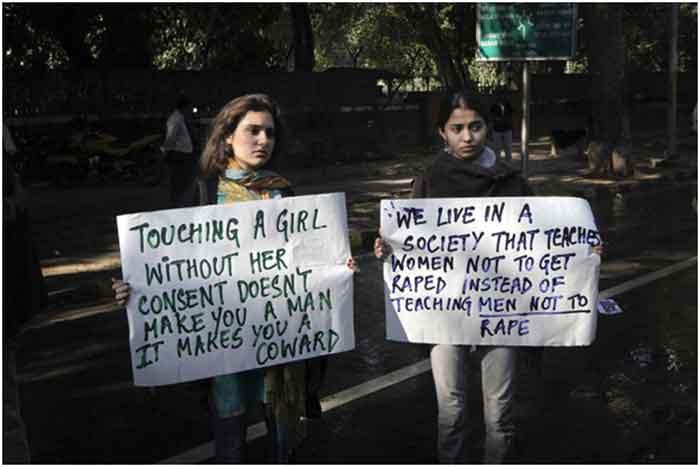
During the 2012 Nirbhaya gang rape case in Delhi I saw the above photo and the image of two young girls holding up two posters reminded me of the old saying, A picture is worth a thousand words.

When assaulted, there is a trivialization that leads to a culture of victim blaming. A young woman or an underage girl most definitely will have a hard time to accept such wrong as their own doing. People often say that the girl must have invited it with her revealing clothes or by her sensual nature et cetera. All this finger pointing at the victim frequently are done by the adults whose responsibility is to teach a young girl how to spot a predator or what to do in a compromising situation.

The media, biology and culture may be contributing factors, but the majority of men — those who are the product of the same biology, the same culture — don’t rape women. 

In June, a statement was released by the United Nations on International Day for the Elimination of sexual Violence in Conflict. It read, “Combatting impunity for sexual violence is central in deterring and preventing conflict-related sexual violence (CRSV) crimes. It is also essential component in redress for victims. Among many other aspects, COVID-19 is significantly and detrimentally impacting the rule of law, including by limiting the availability and capacity of law enforcement and judicial authorities to respond to CRSV. Moreover, the pandemic hinders the processing of reports of incidents of sexual violence and risks deprioritizing services needed by survivors, including in shelters, health care services, police, and justice sector services.”

Fast facts

Globally, even before the COVID-19 pandemic began, 1 in 3 women experienced physical or sexual violence mostly by an intimate partner

  • Emerging data shows an increase in calls to domestic violence helplines in many countries since the outbreak of COVID-19.
  • Sexual harassment and other forms of violence against women continue to occur on streets, in public spaces and online.
  • Survivors have limited information and awareness about available services and limited access to support services.
  • In some countries, resources and efforts have been diverted from violence against women response to immediate Covid-19 relief.

Zimbabwean teachers refuse to work as government reopens schools without COVID-19 protection

Stephan McCoy


Zimbabwe’s teachers are in their second week of strike action against the government’s back-to-school campaign being rammed through with minimal protections and over poverty level wages.

It follows a three-month strike by 16,000 nurses over a lack of personal protective equipment and low wages, betrayed by the Zimbabwe Nurses Association. The actions are part of a growing wave of opposition by teachers and health workers against the reckless and homicidal response of capitalist governments around the world to the coronavirus pandemic.

Teachers refused to resume teaching on September 28 when schools reopened for the first time since March for those students taking exams in December. Regular classes for all students were due to resume on October 5.

The reopening of schools is bound up with the government’s efforts to drive parents back to work and to start generating profits for multinational corporations and the national bourgeoisie.

Pupils attend a class at a school in Harare, Monday, Sept, 28, 2020. (AP Photo/Tsvangirayi Mukwazhi)

Schools have been starved of funds for years, with parents providing most of the funding after the introduction of user charges in the 1990s. Classroom conditions are abysmal. Tawanda Chikondo, a 29-year-old teacher, told Bloomberg, “Our school looks like something from a war film, because I doubt it’s been painted in 25 or 30 years. There are broken windows, crumbling walls and we don’t have water. This is Zimbabwe, can you imagine? Africa’s most-educated nation has to teach children under trees because the classrooms are squalid and unkempt.”

There is an acute shortage of schools, particularly in rural areas, with more than 2,000 extra schools needed. Teacher to pupil ratios range between 1:45 and 1:120 because of the shortage of teachers and classrooms available, making social distancing impossible.

Teachers and students lack the most basic safety measures. Limited hand sanitiser has been made available under conditions where even clean water is a scarce commodity, as Ministry of Primary and Secondary Education officials acknowledge.

Teachers are demanding that as frontline workers they should have regular testing, adequate personal protective equipment (PPE), and risk allowances before they are prepared to start work again.

The closing of schools has affected nearly 5 million children. Even before the onset of the pandemic, among the 4.6 million children of school age (3 to 12 years) at least 1.2 million (35 percent), were in need of emergency and specialized education services. Many children, reliant on the school system, lost access to food supplies and protection, while all but the most affluent 5 percent who go to the elite schools had no access to remote learning. Only 20 percent of primary schools and 40 percent of secondary schools have access to the internet, with the vast majority of children deprived of formal education during the past six months. Many children must work as street vendors or in the fields as well as going to school.

Teachers are paid an abysmal $45 per month after the government unilaterally cut their salaries in October 2018 as it switched to pegging their salaries to the local currency. They are demanding the government pay them at least $520 a month plus sector-specific allowances. Soaring inflation, which stands at around 800 percent, and a collapsed currency have destroyed workers’ living standards. Many teachers complain they are not even able to pay for their own children’s schooling, with reports of some teachers engaging in illegal mining and work as street vendors to make ends meet.

Teachers have rejected ZANU-PF President Emmerson Mnangagwa’s 40 percent cost of living adjustment and a $75 COVID-19 allowance extended to December, vowing to continue their strike.

Zimbabwe is facing an economic and social catastrophe. The currency has collapsed while the price of food, fuel and other basics has skyrocketed. At least 8.6 million people or 60 percent of the 15 million population are expected to be acutely food-insecure this year. In urban areas the number of food insecure people is expected to rise from 2.2 million people to 3 million people. The United Nations Office for the Coordination of Humanitarian Affairs (OCHA) has warned the country is likely to see a large increase in malnutrition as result of the pandemic.

Zimbabwe has recorded nearly 8,000 cases of coronavirus and 229 deaths amid a healthcare system that is haemorrhaging. According to Bloomberg, the government is attempting to stop doctors from leaving the country as medical professionals flee due to economic ruin and the woefully underfunded health care system.

The stock market is teetering on the brink of collapse as overseas investors have sold $52 million worth of stocks. Currency shortages had previously prevented a sell-off but following the government’s stimulus package the availability of foreign currency prompted an exit of capital.

According to Justice Matanda-Moyo of the Zimbabwe Anti-Corruption Commission (ZACC), the country has lost $3.2 billion “through tax evasion, smuggling, corruption, fraud, drug trafficking and money laundering.” Over the course of two decades Zimbabwe has lost more than $32 billion through illicit financial flows.

Political infighting over how to deal with the mounting social and economic crisis threatens to erupt into violent conflict. In June, the country’s top military generals pledged support for Mnangagwa, denying speculation of an imminent coup after the order to close Zimbabwe’s stock market by the Joint Operations Command (JOC) that includes top officials from the military, police and intelligence.

The hostility between Mnangagwa and his deputy Constantino Chiwenga has grown increasingly bitter. Chiwenga, a former general with strong support in the military, is viewed as Mnangagwa’s rival for the presidency despite having played a prominent role in the 2017 coup that ousted long time ruler Robert Mugabe and brought Mnangagwa to power.

According to Zimbabwe Independent, the struggle between Mnangagwa and Chiwenga has intensified following the reintroduction of District Coordinating Committees (DCCs) for organising elections within ZANU-PF, as the factions around Mnangagwa and Chiwenga battle for dominance within the party and the state.

The DCCs were disbanded in 2012 after the ZANU-PF alleged they were being used to fan the flames of factional warfare between Mnangagwa and then vice-president Joice Mujuru. Mnangagwa has reintroduced the DCCs to undermine Chiwenga after handing him the poisoned chalice of health minister—a manoeuvre which has largely failed as the healthcare workers’ unions have forced the nurses and doctors back to work as they negotiate with the government.

With the reintroduction of DCCs, Mnangagwa is hoping to thwart any opposition to his rule while providing a pseudo-democratic cover to his authoritarian measures.

A ZANU-PF politburo member told the Zimbabwe Independent, “There is commotion all over the country. People are burning the midnight oil plotting. The elections [within ZANU-PF] themselves are promising fireworks. There are widespread allegations of vote-buying and imposition of candidates by senior officials who want to assert control of the lower structures and it’s getting messy.”

Mnangagwa is attempting to direct social discontent outwards. According to Bloomberg, US Assistant Secretary of State for African Affairs Tibor Nagy and Zimbabwe Foreign Minister Sibusiso Moyo, another former general who played a prominent role in the coup that deposed Mugabe, have been in secret talks to help suppress a growing insurgency that has displaced over 300,000 people in neighbouring Mozambique.

The Islamist insurgency in Cabo Delgado, the northernmost and impoverished province of Mozambique where France’s Total and the US’s Exxon Mobil Corp are among those that have planned massive investments in the province’s off-shore gas fields, is rapidly becoming internationalised.

US imperialism, whose offer to help the Frelimo government has apparently been rebuffed, views Zimbabwe’s military as a battle-hardened subcontractor providing Washington with deniability for any criminality in suppressing the insurgency.

Zimbabwe’s ruling elite, for its part, doubtless sees this as another valuable looting operation. Mnangagwa became a billionaire via the illicit diamond trade that dominated Zimbabwe’s military interests in the Democratic Republic of Congo (DRC) during the suppression of rebel forces in that country, while Moyo headed the company that facilitated the illegal movement of diamonds, arms and other illicit goods in and out of the Congo.

One-day nationwide strike against South African ANC government

Jean Shaoul


Three and a half million workers belonging to South Africa’s four largest trade union federations held a one-day national strike on Wednesday.

Anger has been mounting over job losses, wage cuts and the rampant corruption of the African National Congress (ANC) government led by President Cyril Ramaphosa, the billionaire and former trade union leader. Ramaphosa, elected president in 2017 promising to end corruption, has overseen an unprecedented transfer of wealth from the working class to the top layers of society.

The strike affected sectors including schooling, transport, metal and steel companies and the automobile industry. There were motorcades, pickets and rallies across South Africa’s nine provinces. On Tuesday night, workers occupied the Limpopo legislature in Polokwane—Limpopo province is the second poorest province in the country.

On Wednesday, many businesses in the Johannesburg city centre closed as workers marched from COSATU House, singing and chanting through the city.

Protesters from the country's main four labour federations take part in a nationwide strike and protest in Cape Town, South Africa, Wednesday, Oct. 7, 2020. (AP Photo/Nardus Engelbrecht)

The mass walkout is part of a broader wave of struggles by workers in recent months that have seen repeated actions by healthcare workers, municipal workers, bus drivers, teachers and workers in meat processing plants, steel works and warehouses.

On Monday, rail workers began an indefinite strike at Gautrain, the 80km-long rapid transit rail system linking Johannesburg’s international airport with Pretoria. Mineworkers at three companies are to strike for pay increases to cope with rising food, rent and fuel prices and metalworkers are demanding an eight percent wage increase. Workers in the textile, power and transport sectors are also set to take strike action.

Wednesday’s general strike was called by the Congress of South African Trade Unions (COSATU) with 1.8 million members, the Federation of Unions of South Africa (Fedusa) with 560,000 members, the South African Federation of Unions (Saftu) with 800,000 members, and the National Council of Trade Unions (Nactu) with 400,000 members, against the ANC government’s repression of workers amid the raging coronavirus pandemic.

The ANC, since coming to power in 1994, has represented a corrupt layer of the black bourgeois and upper petty-bourgeois elite at the expense of the masses of workers and poor. The strike testifies to the explosive social and economic relations that characterise post-apartheid South Africa, the continent’s most industrialised country.

The pandemic has exacerbated South Africa’s already serious economic recession, particularly affecting mining—as demand and prices for the country’s minerals fell--and manufacturing. More than two million workers lost their jobs between April, when the lockdown that shut down all but essential services and industries took effect, and June. Some 30 percent were already unemployed before the pandemic, with a massive 50 percent of young people between the ages of 15-24 without work. According to Statistics South Africa, the expanded rate of unemployment is now 42 percent, which includes those who have given up looking for jobs.

GDP fell by a massive 16.4 percent, equivalent to an annualised rate of 51 percent, the sharpest decline since the Great Depression. GDP per capita has been declining for years as growth failed to keep pace with the increasing population while inequality soared. South Africa has one of the highest levels of income inequality in the world. The top 20 percent of the population take more than 68 percent of income. According to the International Monetary Fund (IMF), income per capita in Gauteng—the main economic province that includes Johannesburg and Pretoria—is almost twice that in mostly rural provinces like Limpopo and Eastern Cape.

The lockdown forced five to six million people (15 percent of adults), mainly manual workers, to leave the townships and go back to their home villages, putting pressure on their families. Many households ran out of money for food, doubling the rate prevailing in 2017. The government’s special grant, set up to help those without other forms of social security, had by early June paid just 600,000 of the 15 million eligible people.

The government’s budget deficit for 2020-21 has been revised upwards from an expected 6.8 percent of GDP to 15.7 percent, with more than a fifth of the budget going on servicing debt.

South Africa, a country of 59 million people, has recorded 686,891 COVID-19 cases and 17,408 deaths making it the worst affected country on the African continent. Most of the casualties occurred after the ANC government organised a return to work in a bid to stem the fall in corporate profits, calling off one of the strictest lockdowns in the world, enforced with extreme police brutality. On a per capita basis South Africa records more killings by the police than the US.

The government has presided over the deliberate looting of taxpayers’ money in a spate of corruption scandals, including in the state power utility Eskom and its suppliers that have led to severe outages, and among employers that fraudulently claimed Covid-19 relief funds without paying them out to their workers.

The latest politician to be caught in a corruption racket is ANC Secretary-General Ace Magashule, who is under investigation over millions of rands spent during his tenure as Free State Premier on the failed Estina dairy farm project that left farmers destitute.

Also at issue is the government’s refusal to honour its pledge to raise civil servants’ salaries in April, as promised in a 2018 three-year wage deal struck in 2018, claiming it is now unaffordable.

COSATU, the largest trade union federation and a government partner with the ANC alongside the South African Communist Party, has been adept at keeping its members in check. But along with the other three union federations, it was forced to call for a national walkout in the wake of the continuing crisis over the government’s response to the pandemic, increasing poverty, police brutality, worsening power cuts and the outcry over government corruption. Its hope is that the limited action, combined with a torrent of left-sounding rhetoric, will let off steam.

The federation’s concern is its own position vis a vis the ANC government. Speaking outside COSATU House in Johannesburg on Wednesday, COSATU’s Gauteng chairperson, Amos Monyela, indicated it would withdraw its electoral support for the ANC if it did not hold talks with the union. He said, “We are marching against the people we elected into power. We are saying we will indeed withhold our vote if we are not engaged in immediate discussions.”

Irvin Jim, the general secretary of the National Union of Metalworkers of South Africa (NUMSA) also objected to being sidelined, saying, “Employers did not waste the crisis imposed by Covid-19 and the lockdown, which they used to attack workers’ wages by unilaterally imposing wage cuts of between 20-25 per cent without consulting with the union.”

These scoundrels have done nothing to defend their members. They have functioned for decades as a prop for successive corrupt and utterly despised ANC governments as they isolated and sold out strikes they were unable to prevent from taking place.

Indonesian workers strike against new, pro-business legislation

Ben McGrath


Workers and young people are protesting this week across Indonesia against a bill rushed through parliament on October 5 that deepens the government’s attack on working conditions and the environment. The government and President Joko Widodo are portraying the so-called omnibus bill as a job creation measure. It includes approximately 1,200 amendments to 79 current laws.

With a final vote on the bill originally slated to take place Thursday, labor unions and NGOs including the Confederation of Indonesian Trade Unions (KSPI), the Congress Alliance of Indonesian Labor Unions (KASBI), and the Labor with the People Movement (Gebrak) organized three days of strikes and rallies, set to start on Tuesday in order to allow workers to blow off steam and prevent an explosion of social discontent. Workers are already angry at bearing the brunt of the economic crisis caused by the COVID-19 pandemic.

Police push back protesters during a rally in Jakarta, Indonesia, Thursday, Oct. 8, 2020. Thousands of enraged students and workers staged rallies across Indonesia on Thursday in opposition to a new law they say will cripple labor rights and harm the environment. (AP Photo/Tatan Syuflana)

When the bill was rushed through parliament on Monday, thousands of workers responded by demonstrating. Protesters attempted to rally in front of parliament’s House of Representatives in Jakarta, but the authorities prevented them from doing so, using the COVID-19 pandemic as a pretext for banning demonstrations. The police and military personnel blocked roads to stop workers and other demonstrators from reaching the capital. The police continued to block access to the city the next day.

The KSPI claimed at least 32 organizations representing some two million workers in industries like textiles, automotive, and pharmaceutical are taking part in the strikes. However, under the pretext of avoiding infection from COVID-19, workers have been isolated from one another with strikers kept at their individual job sites rather than attending larger rallies.

In addition, the government is cracking down on protests by spying on workers and students online, where much of the coordination for the strikes and rallies has taken place. The police have launched “cyber patrols” in order to spread lies, including about canceled strikes or by trying to paint the new law in a positive light.

None of this stopped thousands from taking part in strikes and protests in cities like Tangerang, just west of Jakarta and in Serang and Bandung, also on the island of Java. In the latter two cities, police used water cannons and tear gas on Tuesday to assault and disperse peaceful protesters. Police reportedly arrested at least 20 people accused of responding to police provocations by throwing rocks and fire crackers.

“The law will definitely affect the status of our employment,” said Anwar Sanusi, a member of the Indonesian Metal Workers’ Federation. The new law removes the three-year maximum length for contract workers, meaning these highly exploited workers could remain in precarious positions indefinitely at the discretion of employers. It also removes a requirement for the government to consider inflation when setting the minimum wage, meaning workers face a slashing of their real income.

Other measures include scrapping mandatory leave from workplaces including for childbirth, marriage, and bereavement. Overtime will also be increased by four hours a day and employers’ mandatory severance pay will be reduced from 32 times a worker’s monthly wage to 19 times.

Said Iqbal, the president of the KSPI, stated, “The omnibus law is an attack on the welfare of labor in Indonesia… we will continue the struggle.” However, after this week’s strikes, Said has stated the future struggle will be in the courts. In other words, workers are being told to entrust their futures to the same capitalist state that is carrying out the attacks in the first place.

The bill will also slash the corporate tax rate from 22 to 20 percent by 2022 as well as eliminate income taxes on domestic dividends. Other regulations are also being eased, including foreign companies’ participation in some sectors. The government will also set up a body to oversee land distribution.

On the environment, only businesses engaged in high-risk investments will be required to carry out an environment impact assessment prior to operations or to obtain a permit. The central government will take over some powers from local governments to hand out the permits.

The government claims the bill will attract foreign investment, which will create jobs and address the economic crisis facing the working class. In September, the government announced that 3.72 million people have lost their jobs as a result of the current pandemic. Indonesia has also entered a recession, with the economic growth in the second quarter falling 5.3 percent annually, the biggest fall since the Asian Financial Crisis in 1997–1998.

The office of the Coordinating Ministry for the Economy indicated last weekend that workers would continue to be forced to foot the bill for the crisis: “Investment costs in Indonesia are quite expensive and less competitive than neighboring countries… One of the reasons is the high standard of minimum wages in Indonesia compared to other countries and the high cost of severance pay in the event of a termination of employment.”

In addition to the economic impact, the social impact of the pandemic has been devastating. Indonesia has the second most COVID-19 infections in East Asia, behind only the Philippines. The government was slow to implement any measures during the initial outbreak. There are more than 315,000 confirmed infections, though the real total is likely far higher as testing lags far behind most of the world. More than 11,500 people have died, which is also certainly underinflated.

Given the volatile situation, there has been some pushback over the law from big business. A group of investors that include Robeco, Aviva Investors, and Sumitomo Mitsui Trust Asset Management sent a letter to the Indonesian government questioning the legislation. It stated: “While the proposed regulatory changes aim to increase foreign investment, they risk contravening international best practice standards intended to prevent unintended harmful consequences from business activities that could deter investors from Indonesian markets.”

Their real concerns were summed up in an October 6 article in the Diplomat, which complained that Jakarta was courting political upheaval: “Cutting back on worker protections is only likely to increase the precarity of a large swath of the Indonesian public, with possible unintended political consequences.”