13 Oct 2020

Afghanistan: 19 Years of War

Maya Evans


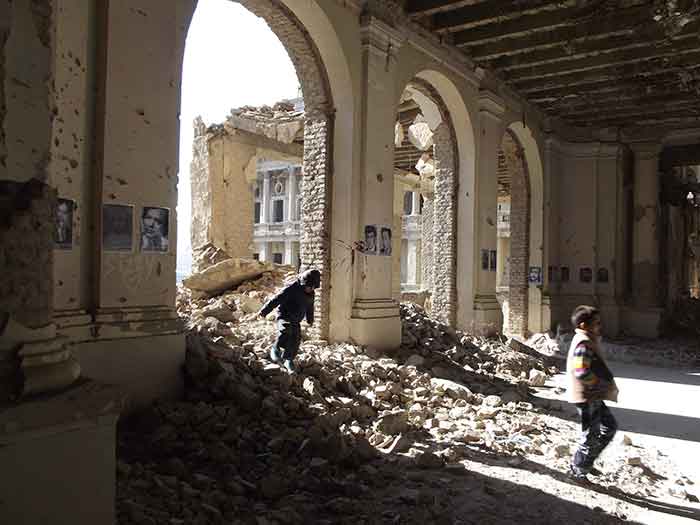
Afghan children play in the bombed out rubble of the Darul Aman Palace in Kabul, amidst a photo exhibition marking four decades of Afghans killed in war and oppression. Photo credit: Maya Evans

The NATO & US backed war on Afghanistan was launched 7th October 2001, just a month after 9/11, in what most thought would be a lightning war and a stepping stone onto the real focus, the Middle East. 19 years later and the US is still trying to extricate itself out of the longest war in its history, having failed in 2 of its three original aims: toppling the Taliban and liberating Afghan women. Perhaps the only target confidently met was the assassination of Osama Bin Laden in 2012, who was in fact hiding out in Pakistan. The overall cost of the war has been over 100,000 Afghan lives, and 3,502 NATO and US military fatalities. It has been calculated that the US has so far spent $822 billion on the war. While no up to date calculation exists for the UK, in 2013 it was thought to have been £37 billion.

Peace talks between the Taliban, Mujaheddin, Afghan Government and US have been slowly unfolding over the last 2 years. Mainly taking place in the city of Doha, Qatar, the talks consisted predominantly of older male leaders who have been trying to kill one another for the last 30 years. The Taliban almost certainly have the upper hand, as after 19 years of fighting 40 of the richest nations on the planet, they now control at least two thirds of the country’s population, claim to have an endless supply of suicide bombers, and have most recently managed to secure a controversial deal with the US for the release of 5,000 Taliban prisoners. All along the Taliban have been confident of the long game despite the US initial 2001 promise to defeat the Taliban.

Most ordinary Afghans hold out little hope for the peace talks, accusing the negotiators of being disingenuous. Kabul resident 21-year-old Naima says: “The negotiations are just a show. Afghans know those people have been involved in war for decades, that that they are now just making deals to give Afghanistan away. What the US says officially and what is done is different. If they want to wage war then they will, they are in control and they are not in the business of bringing peace.”

20-year-old Imsha, also living in Kabul, noted: “I don’t think the negotiations are for peace. We’ve had them in the past and they don’t lead to peace. One sign is that when negotiations are going on people are still being killed. If they’re serious about peace, then they should stop the killing.”

Civil society groups and young people have not been invited to the various rounds of talks in Doha, and on only one occasion was a delegation of women invited to put their case for maintaining the hard-earned rights gained over the last 19 years. Although women’s liberation was one of the three main justifications given by the US and NATO when invading Afghanistan in 2001, it is not one of the key negotiation issues for the peace agreement, instead the main concerns are around the Taliban never again hosting al Qaeda, a ceasefire, and an agreement between the Taliban and Afghan Government to share power. There is also the question as to whether the Taliban present at the peace talks in Doha represent all the various fractions of the Taliban both across Afghanistan and in Pakistan – many Afghans note they do not have the remit of all divisions, and on that basis, talks are automatically illegitimate.

So far, the Taliban have agreed to talk with the Afghan Government, a somewhat promising indication as previously the Taliban have refused to accept the legitimacy of the Afghan Government which, in their eyes, was  the illegitimate puppet Government of the US. Also, a ceasefire is one of the prerequisites of the peace deal, sadly there has been no such ceasefire during the talks with attacks on civilians and civil buildings being an almost everyday occurrence.

President Trump has made it clear that he wants to remove US troops from Afghanistan, though it is likely the US will want to maintain a foothold in the country by way of US military bases, and the mining rights being opened up to US corporations, as discussed by President Trump and Ghani in September 2017; at that point, Trump described US contracts as payment for propping up the Ghani Government. Afghanistan resources make it potentially one of the richest mining regions in the world. A joint study by The Pentagon and the United States Geological Survey in 2011 estimated $1 trillion of untapped minerals including gold, copper, uranium, cobalt and zinc. It is probably no coincidence that the US special peace envoy at the talks is Zalmay Khalilzad, former consultant for the RAND corporation, where he advised on the proposed trans-Afghanistan gas pipeline.

Although Trump wants to reduce the remaining 12,000 US troops down to 4,000 by the end of the year, it is unlikely the US will withdraw from their remaining 5 military bases still ensconced in the country; the advantage of having a foothold in a country which boarders its main rival China will be near impossible to relinquish. The main bargaining piece for the US is the threat to withdraw aid, as well as the potential to drop bombs – Trump has already shown willingness to go in hard and fast, dropping ‘the mother of all bombs’ on Nangahar in 2017, the biggest non-nuclear bomb ever dropped on a nation. For Trump, a single large bomb or intense carpet aerial bombing will be his probable course of action if talks fail to go his way, a tactic that would also shore up his presidential campaign which is being fought on the lines of a ‘cultural war’, whipping up racism mixed with white nationalism.

Despite the UN call for an international ceasefire during the Covid 19 lockdown, fighting has continued in Afghanistan. The disease is  known to have infected to date 39,693 and killed 1,472 people since the first confirmed case on the 27th February. Four decades of conflict have undermined a barely functioning health service, leaving the old especially vulnerable to the disease. After the virus first emerged in Afghanistan, the Taliban released a statement saying they considered the disease to be both a divine punishment for human wrongdoing and a divine test of human patience.

With 4 million people internally displaced, Covid 19 will undoubtably have a devastating impact on refugees in particular. Dire living conditions within camps make it almost impossible for internally displaced people to protect themselves, with impractical social distancing in a one room mud hut, normally home to at least 8 people, and hand washing a huge challenge. Drinking water and food are in scarce supply.

According to the UNHCR there are 2.5 million registered refugees from Afghanistan globally, making them the second biggest population of displaced peoples in the world,  yet it’s the official policy of many EU countries (Britain included) to forcibly deport Afghans back to Kabul, in the full knowledge that Afghanistan has been classified the “world’s least peaceful country”. In recent years forcible deportations from EU countries have tripled under the “Joint Way Forward” policy.  According to leaked documents, the EU were fully aware of the dangers for Afghan Asylum seekers. In 2018 UNAMA documented the highest ever recorded civilian deaths which included 11,000 casualties, 3,804 deaths and 7,189 injuries. The Afghan Government agreed with the EU to receive deportees out of fear that a lack of cooperation would lead to aid being cut.

This weekend is part of a national action to mark solidarity with refugees and migrants who are currently facing the hostile environment of harsh British policy and treatment. It comes within days of our Home Secretary Preti Patel having suggested we dump refugees and undocumented migrants trying to cross the channel on Ascension Island, to imprison people on disused ferries, to build “marine fences” across the channel, and to deploy water cannons to make huge waves to swamp their boats. Britain wholeheartedly committed to the war on Afghanistan in 2001, and now it dodges its international responsibilities to safeguard people fleeing for their lives. Britain should instead admit culpability for conditions forcing people to become displaced and pay reparations for the suffering its war has caused.

Boris Johnson at Sea: Coronavirus Confusion in the UK

Binoy Kampmark


The tide has been turning against UK Prime Minister Boris Johnson.  Oafishly, he has managed to convert that tide into a deluge of dissatisfaction assisted by the gravitational pull of singular incompetence.  Much of this is due to such errors of communication as committed last month, when he got into a tangle over new coronavirus restrictions in England’s northeast.

In responding to a question on these new regulations, the prime minister erred in stating that the rule-of-six limit on gatherings did not apply to people meeting outdoors.  “It is a six in a home or in hospitality but not six outside.”  The government’s official guidance stated something rather different.  “When meeting friends and family you do not live with (or have formed a support bubble with) you must not meet in a group of more than 6, indoors or outdoors.”  This would be “against the law and the police will have the powers to enforce these legal limits, including to issue fines (fixed penalty notices) of £200, doubling for further breaches up to a maximum of £6,400.”  Stiff consequences tend to follow from such misunderstandings.

Having fallen into his own trap, the prime minister had to concede his error.  “Apologies,” he tweeted, “I misspoke today.”  Having corrected himself on the regulations limiting such socialising both indoors and out, he tried to wave the much tattered flag of patriotic encouragement.  “This is vital to control the spread of coronavirus and keep everyone safe.  If you are in a high risk area, please continue to follow the guidelines from local authorities.”  But evidently be wary of what the prime minister tells you.

It was all part of a push combining sterner measures in attempting to control coronavirus transmission while keeping some semblance of economic normality.  “What we don’t want is to have to take even more severe measures as we go through Christmas,” warned Foreign Secretary Dominic Raab on LBC radio.  “And that’s why we need to take the proportional, targeted measures we are taking now.”  As a result, the laws and regulations have pleased no one and confused everyone.

Any balanced assessment would have to conclude that there is no uniform UK strategy on coping with coronavirus.  Within the sceptred isle are such figures as Scottish First Minister Nicola Sturgeon, who feel that Johnson has been all too timorous in dealing with the virus.  Her own scientific advisers had warned her that Johnson’s approach was inadequate in reducing the rate of transmission.  “I’ve made a judgment that we are again at a tipping point with COVID and I’m looking at data that alarms me, frankly.”  (The number of infections is currently hovering between a 15,000 to 20,000 cases a day.)

Members of Johnson’s own scientific advisory team tend to agree, feeling that the public health hammer needs to be brought to bear.  Professor John Edmunds of the London School of Hygiene and Tropical Medicine was distinctly disapproving of government policy on BBC radio.  “Overall, I don’t think the measures have gone anywhere near far enough.  In fact, I don’t even think the measures in Scotland have gone far enough.”

None of this was encouraging, even to a conservative magazine Johnson once edited.  Fraser Nelson, who now holds the reins at The Spectatorconceded that “Johnson’s overall COVID policy is now a mystery.”  Did he intend to “flatten the curve”?  Was he attempting “to eliminate COVID altogether?  We might think his strategy is inspired; we might think it insane – but need to know what it is.”  In Fraser’s view, the very man is an absentee, as is his government, “adrift, defined by its avoidable mistakes: COVID policy, Brexit party discipline…  In all these things there is a conspicuous – and baffling – lack of leadership.”

With his popularity suffering, Johnson’s reaction is one of blithe disregard, if not willful blindness.  His October 6 speech concluding the Conservative Party Conference promoted a charge of Light Brigade optimism.  He decried the “nonsense” that his own battle with COVID had “somehow robbed me of my mojo.”  It was “self-evident drivel,” even “seditious propaganda” from saboteurs wanting the government to fail.  He did concede to getting a fright, and being too fat; but he had found an inner, thinner hero.

He promised, instead of going back to the good old pre-COVID days in 2019, “to do better: to reform our system of government, to renew our infrastructure; to spread opportunity more widely and fairly and to create the conditions for a dynamic recovery that is led not by the state but by free enterprise.”  He promised 48 hospitals.  “Count them,” he dared critics sceptical of the government’s numeracy skills.  “That’s the eight already underway, and then 40 more between now and 2030.”

With waffly ambitiousness, he promised more teachers, more funding for education, more police, better resources to improve rusted skills.  There was even an aspirational moment of greening: that the UK would “become the world leader in low cost clean power generation – cheaper than coal, cheaper than gas”. Guilt free power generation, he called it.

Such a performance would have done little to inspire confidence even amongst the Tory faithful.  Ahead of the speech, Andrea Thorpe, Conservative Association chair in Kent, spoke of the prime minister’s “lost focus,” and frustration at those “insanely complicated rules which are creating acrimony and exasperation”.  Economic damage arising from the new coronavirus regulations, she feared, might exceed that of the virus.

The report cards of most nation states towards COVID-19 have been mixed, ranging from the modest to the terrifically horrible.  Initial star performers have tumbled into second waves of infection.  Lashings of dark eugenic theory have kept company with police truncheons and handcuffs backed by medical decree.  The United Kingdom, if it has anything to boast about, can point to the world’s fifth highest death toll and the worst contraction in GDP of any G7 nation.  But to all of this can also be added the steady, consistent confusions about regulations newly passed and newly misunderstood.  A very Boris outcome.

Colombia’s ex-president Uribe freed from house arrest to lead right-wing repression

Andrea Lobo


Colombia’s ex-president Álvaro Uribe was freed from house arrest Saturday, two months after the Supreme Court ordered his detention. Uribe is facing at least 60 open investigations regarding his ties to fascist paramilitary groups, corruption and drug trafficking.

The release was the result of pressure from the administration of President Iván Duque of the Democratic Center Party, which is led by Uribe, and from the White House.

On Saturday, US President Donald Trump celebrated Uribe’s release, calling him “a hero” and “ally of our Country in the fight against CASTRO-CHAVISMO.” As he incites fascist militias and far-right supporters to back his plans to overturn the US elections in November, Trump is hailing a figure responsible for countless massacres.

The Supreme Court had decided to detain Uribe over a case opened in 2018. It included evidence that Uribe bribed witnesses to lie about his role in founding and financing a faction of the United Self-Defense Forces of Colombia (AUC). The AUC is an umbrella paramilitary organization responsible for killing over 260,000 people, according to the Conflict and Memory Observatory, and stealing millions of hectares of land from peasants at the behest of agricultural and mining corporations, local landowners and drug cartels.

Uribe receiving US Medal of Freedom from George W. Bush in 2009

The Supreme Court had already called him to testify about three specific massacres in 1996 and 1997, involving AUC leaders allegedly bribed by Uribe to lie about his involvement. The charges considered against Uribe included crimes against humanity. Prosecutors were reportedly nearing an indictment that will put him on trial.

In August, Uribe resigned from the Senate. This compelled the Supreme Court to turn the case over to the regular courts under the Prosecutor’s Office, a procedure overseen by procedural judge Clara Ximena Salcedo.

Salcedo’s ruling Saturday invalidates the legal condition of flight risk and house arrest arrived at by the Supreme Court. What is more significant, however, is that it orders the Prosecutor’s Office to dismiss all other rulings and procedures agreed to so far and begin the probes from scratch under a different law.

Salcedo claimed that the ruling seeks to protect Uribe’s “presumption of innocence.” However, her explanation points to the real forces in the Duque administration behind the decision, indicating that it “grants the request presented by the defense, supported by the General Prosecutor’s Office and the representative from the Public Ministry.”

Uribe’s detention and release can only be understood in the context of the economic and political crisis gripping Colombia, which has been sharply intensified by the coronavirus pandemic.

Shortly before Uribe’s detention in August, the courts and Congress ruled against the deployment of US troops in Colombia, a ruling that was immediately dismissed by Duque and the Pentagon, with joint US-Colombian military exercises organized last month.

At the same time, Duque extended a miserable $43 monthly stipend for the poorest households in an effort to ease growing class tensions. However, the September 9 police killing of Javier Ordóñez in Bogotá, and a subsequent massacre of protesters by police firing live ammunition, tapped into the simmering anger at the underlying social and health crisis.

The mass protests against police repression, together with a series of strikes and protests against austerity that began on November 2019, have sharpened the class struggle in Colombia to levels not seen since the insurrectionary National Strike of 1977.

Asier Hernando, director of the charity Oxfam for Latin America, told Reuters this week that the pandemic crisis could create 52 million new poor and 40 million unemployed in the region, commenting: “This could break the social contract of the region and could lead to years of enormous social conflict.”

The UN Economic Commission for Latin America estimates that Colombia’s official poverty rate will rise from 29 to 34 percent. Meanwhile, the reopening of nonessential workplaces has increased the seven-day average of new COVID-19 cases by 30 percent in the last week. Colombia has more than 912,000 cases, the fifth highest in the world, while the number of COVID-19 deaths in the country has risen to 28,000.

Amid low commodity prices and the global economic downturn, pressures are growing on the ruling class to carry out further structural adjustments in the public sector—including to pay back a recent $17.2 billion loan from the IMF—as well as attacks on workers’ wages and benefits.

Moreover, US imperialism is responding to the crisis by escalating its confrontation with Chinese and Russian influence in the region. This includes pushing Colombia to assume a central role in efforts to overthrow the government of President Nicolas Maduro in Venezuela, including through potential military intervention.

Uribe, the real power behind Duque’s government, is seen by imperialism and the Colombian oligarchy as a crucial figure in mobilizing the state and right-wing paramilitary forces in order to break the resistance to these massively unpopular policies.

As the conservative Nuevo Siglo writes, “his return to the political stage has vast implications, since 17 months away from the elections and without the restraints of a parliamentarian, it’s expected that he’ll lead the Democratic Center more decisively.”

Under house arrest and threatened with imminent prosecution, Uribe could not actuate—and when necessary settle conflicting interests among—his networks in the military, the paramilitary groups, the financial sector, the landed oligarchy and, most centrally, in the White House.

Significantly, Uribe was the one invited by Trump to the United States after Duque’s election in 2018.

Washington’s backing for both Duque and Uribe, which is bipartisan, exposes US claims about “narco-terrorism” used to justify aggression against Venezuela. The same pretext has been invoked for massive US military aid for Colombia’s bloody counter-insurrectionary operations against guerrillas and peasants and the repression of workers and youth.

A declassified 1991 US Defense Intelligence Agency report on “the more important Colombian narco-traffickers” lists Uribe, a rancher and Senator at the time. It says that he “was linked to a business involved in narcotics activities in the US” and that he “has worked for the Medellín Cartel and is a close personal friend of [the cartel’s leader] Pablo Escobar Gaviria.”

It also gives the lie to alleged US concerns over “human rights.” Other US diplomatic cables released recently by the Trump administration confirm Uribe’s funding of paramilitary groups. Moreover, Uribe oversaw the “false-positive” murders and their cover-up between 2002 and 2008. Colombian troops killed thousands of innocent civilians in cold blood, claiming that they were guerrillas, in order to inflate body counts and to win promotions and benefits, as well as increased US military aid. Cables released by WikiLeaks confirmed that the Obama administration also had knowledge of this operation, which, according to one study, claimed the lives of 10,000 Colombians.

The Pentagon continued to give full backing to Uribe, applauding his “aggressive leadership,” while Congress has continued granting $1.2 billion in yearly assistance for the new Uribista government.

The attempts by the Trump administration to establish an authoritarian presidential dictatorship in the center of world imperialism is part of a global phenomenon. It can only be combatted by an international political movement of the working class against its source: the capitalist profit system.

Coronavirus infections threaten Germany’s hospitals with overload

Markus Salzmann


Experts warn that hospitals in Germany are reaching their limits of capacity due to the dramatic increase in coronavirus infections. While protective measures against the virus have been almost completely dismantled in recent months, the government has done nothing to prepare hospitals for the foreseeable increase in severe cases.

It was necessary to prepare for a wave of seriously ill patients, explained Susanne Herold, head of the Infectiology Department at Giessen University Hospital, at a joint press conference with Federal Health Minister Jens Spahn (Christian Democratic Union, CDU). This would push hospitals to the limits of their capacity, especially in big cities, she added.

Patient in intensive care unit (Photo: Frank C. Müller, Baden-Baden / CC-BY-SA 4.0)

On October 8, 487 COVID-19 patients were in intensive care in Germany, 237 of them requiring ventilation. One month earlier, on September 8, there were 230 cases, of which 130 were ventilated—an increase of 112 percent.

According to Herold, a further significant increase and associated bottlenecks can be expected in the coming weeks. On Saturday alone, the number of new infections rose by 4,721, exceeding 4,000 for the third day in a row. Chancellor Angela Merkel (CDU) had announced at the end of September that she expected 19,200 new infections per day by Christmas.

The rising number of infections inevitably leads to an increasing number of hospital admissions. Social Democratic Party (SPD) health expert Karl Lauterbach expects a death rate of at least 1 percent in the future—i.e., hundreds of deaths per day.

Speaking to the Rheinische Post, Christian Karagiannidis of the German Society for Internal Intensive Care and Emergency Medicine (DIIN) warned about too few intensive care beds, especially in large cities. “Significant capacity limitations” were already apparent, especially in Berlin. In the capital, 84 percent of intensive care beds were already occupied. Every day, the number of admissions to intensive care units is increasing, and it is likely that soon, not all patients will be able to get treatment in the area where they live, according to the physician.

The biggest problem is the lack of staff and completely overworked personnel. This had already become clear in the spring. In this context, the president of the Professional Association of German Anaesthetists, Götz Geldner, has warned of a lack of personnel in hospitals. “If there is a sharp increase in severe coronavirus cases, there will be bottlenecks in intensive care personnel,” he said.

Last year, 37 percent of intensive care beds in German hospitals had to be closed due to lack of staff. The German Hospital Federation had reported three years ago that 53 percent of hospitals were having problems filling intensive care positions. The reasons for this are catastrophic working conditions and poor wages.

Between 1991 and 2017, the number of hospital cases rose by almost 30 percent and the length of stay was halved, which means a greatly increased workload. The number of jobs in the nursing sector has remained almost unchanged over the same period.

Health expert Hartmut Reiners also commented in the Frankfurter Rundschau, “Capacities cannot be fully utilised because there is a lack of qualified nursing staff. Over the last 25 years, the federal states have halved their subsidies for inpatient care”.

Health Minister Spahn reacted to the warnings of the medical profession with his characteristic mixture of ignorance and downright lies. He repeated that hospitals in Germany were well prepared for higher case numbers because they had learned from the situation in the spring. At the same time, he made it clear once again that there would be no further lockdowns. Although the rising case numbers are due to the reopening of schools and businesses, Spahn blamed celebrations exclusively for this.

Hospitals in Germany are anything but well-equipped for the case numbers they are likely to see soon. Although the number of new infections has been rising for weeks, hospitals are keeping significantly fewer beds free for coronavirus patients than at the beginning of the pandemic.

The state government in Baden-Württemberg has decided that in future, only 10 percent of hospital beds will be reserved for COVID patients, instead of 35 percent. Even in Berlin, where the numbers are rising most rapidly, the figure is now only 10 percent, as in Lower Saxony. In other federal states, such as Bavaria or Hamburg, no intensive care beds need to be kept free for coronavirus patients, according to the authorities. Even following the latest figures, the Federal Ministry of Health sees no reason for the states to change these regulations.

Many hospitals are deliberately keeping the admission of COVID patients low, as this means high personnel and material costs with comparatively low revenues. Many hospitals have slipped deep into the red in recent months. According to the Hospital Report 2020 by management consultants Roland Berger, 57 percent of German hospitals expect a deficit for the current year. Despite the ongoing pandemic, several clinics have recently had to close, which further aggravates the supply situation.

As far as representatives of government and business are concerned, this situation is an opportunity to impose long-planned cuts. Last year, a study by the Bertelsmann Foundation demanded that the number of hospitals in Germany be halved.

Amid the pandemic, economic research institute RWI economist Boris Augurzky called for the nationwide closure of hospitals. He recently announced once again that numerous hospitals would run into massive financial difficulties from 2022 onwards. As the Ärztezeitung reports, he demanded the federal government reduce hospital costs. Augurzky predicted that a “phase of thriftiness” was approaching.

Under these miserable conditions, it is not surprising that hospitals and nursing homes will again become hotspots of the pandemic.

In Bad Saarow, Brandenburg, 46 people tested positive. In the clinic of the Helios Group, 25 employees and 21 patients were infected. At present, no admissions can be made at the clinic. Other patients could also be infected, and the infection chains can hardly be traced.

Cases also occurred again at the Ernst-von-Bergmann-Klinikum in Potsdam. Four employees from the clinical area and five employees from the service area have become infected. In March, more than 50 people in the clinic were infected with the coronavirus. The public prosecutor’s office in Potsdam has opened investigations on suspicion of negligent homicide and negligent bodily harm.

In a nursing home in Nuremberg, 28 people were infected this week. Of the 18 residents and 10 staff, at least one person has required intensive medical care. In a facility in Freudental, 24 of 29 residents and seven employees were infected. Further cases are reported almost daily from all over Germany.

According to the Robert Koch Institute, just over 10 percent (as of September) of all infected persons reported to date work in the fields of medicine and nursing; according to official figures, 64 of them have died so far. Further serious illnesses and the deaths of employees and patients are to be expected as a result of the policies of the federal and state governments.

New Jersey projected to face disproportionate growth in food insecurity

Erik Schreiber


New Jersey, the US state with the second-highest median income, is projected to experience a disproportionate growth in food insecurity because of the pandemic. The number of New Jersey residents facing food insecurity will increase by 56 percent this year, according to a report published by the Community Food Bank of New Jersey. If this prediction is confirmed, then the number of food-insecure residents will surpass 1.2 million, which represents a staggering 13.5 percent of the state’s population.

New Jersey’s projected increase in food insecurity will be 10 percentage points greater than that projected for the country overall, according to the report. It also will be 11 percentage points greater than the projected increases in Pennsylvania and New York and 15 percentage points greater than the projected increase in Delaware.

“In less than a year, COVID-19 is erasing nearly a decade of advancement towards food security in New Jersey and nationwide,” Carlos Rodriguez, president and CEO of the Community Food Bank of New Jersey, said in a press release. “It’s clear from the data presented in this report that no part of our state will be spared from the pandemic’s effects on hunger.”

Based on an analysis by Feeding America, a nonprofit network of food banks, the report provides further evidence of the complete inability of capitalism to protect workers from the health and economic effects of the pandemic. On the contrary, the Democrats and Republicans are pursuing a de facto herd immunity policy that will result in more infections and deaths.

The report defines food insecurity as “the lack of consistent access to adequate food to sustain an active, healthy life.” Research indicates that the rate of food insecurity depends on income, poverty, unemployment and homeownership. Unemployment generally is a leading indicator of food insecurity, and the report’s projections about food insecurity in New Jersey are based on the unprecedented increase in unemployment that has resulted from the pandemic. In August, the most recent month for which data are available, the official unemployment rate for New Jersey was 10.9 percent, compared with 8.4 percent for the nation. Both rates are doubtless vast underestimations.

New Jersey’s children will bear a disproportionate burden of food insecurity. The increase among the state’s children will be 75 percent, according to the report, which is 14 percentage points higher than the projected increase among the country’s children. For comparison, increases in neighboring states will range from 48 percent to 58 percent. An astounding 19.7 percent of children in New Jersey, or nearly one in five, will experience food insecurity this year, the report projects.

The rate of food insecurity varies among the state’s counties and tends to be higher in the poorer southern counties. Atlantic County, for example, is projected to have the highest rate: 18.2 percent. The next highest will be the southern counties of Cape May (17.9 percent) and Cumberland (17.7 percent).

Essex County is projected to have 137,830 food-insecure residents, the highest number of any county. This county encompasses Newark, East Orange and Irvington, which are some of New Jersey’s poorest cities. Hudson County, which encompasses the poor cities of Jersey City and Union City, is projected to have the second-highest number of food-insecure residents.

As at the state level, the county-level rates of child food insecurity are projected to be worse than the overall rates. Cape May County is projected to have the highest child food insecurity rate (an incredible 29.9 percent), followed by Atlantic County (29.7 percent) and Cumberland County (27.0 percent). But Essex County is projected to have the highest number of food insecure children: 44,790.

The pandemic has caused acute hardship for workers in the leisure, hospitality and service industries, who are especially vulnerable to food insecurity. Atlantic County, which is projected to have the highest rate of food insecurity among New Jersey’s counties, includes Atlantic City, which relies heavily on its casinos and hotels for revenue. During the height of the first wave of the pandemic in April, food lines stretched for as long as a mile in that county.

Atlantic City has long-standing economic problems. Partly because of new competition from casinos in Connecticut and the Philadelphia area, tourism began declining in Atlantic City decades ago. Since 1990, five of the city’s 15 casinos have closed, including four in 2014, causing a sharp decrease in tax revenues.

The state government seized upon this development as a pretext for a renewed, bipartisan assault on the working class. Despite voters’ opposition, Republican then-Governor Chris Christie, backed by a legislature controlled by the Democrats, began a state takeover of Atlantic City’s government in November 2016. The state assumed the right to overturn the city council’s decisions, eliminate city agencies and seize and sell assets. The takeover also gave overseers the ability to fire workers, break union contracts and restructure the city’s debt. Democratic Governor Phil Murphy, who campaigned on ending the takeover, announced in 2019 that he would leave it in place for its full five-year term, which ends in late 2021.

Although Atlantic County may experience it most acutely, food insecurity will affect the whole state to an unprecedented degree. During the Great Recession, New Jersey’s highest level of food insecurity was 12.3 percent, which is lower than the 13.5 percent projected for 2020. Food insecurity did not peak in the state until two years after the Great Recession of 2008 began, and it did not return to pre-recession levels until nearly a decade after the recession ended. Hence, the long food lines of the past spring likely were a mere foretaste of what is to come.

This social disaster is not the inevitable result of the pandemic, but the shameful product of a government and social system that, at the state and federal levels, subordinate human health and dignity to the interests of the corporate and financial oligarchy. Murphy, a multimillionaire and former leading executive at Goldman Sachs, represents the interests of finance capital—the same social layer of which President Donald Trump is particularly brutal and noxious expression.

Both the Democrats and Republicans, in Trenton and Washington alike, are united in insisting that big business be prioritized over the interests of the working class. Through its criminal response to the pandemic, letting the virus spread for the sake of an unscientific “herd immunity,” the ruling class has demonstrated that it has no right to exercise power. The working class must reorganize society along the lines of social need—including the need to contain and eradicate the pandemic—rather than private profit.

Poverty in Germany: Power cuts for 289,000 households

Elisabeth Zimmermann


Last year in Germany, 289,000 households had their power cut, at least temporarily, by suppliers due to unpaid electric bills. Hundreds of thousands had no lights, no warm water, could use neither stoves nor refrigerators, could not do laundry and had no access to radio, television or the internet.

In 2019, 4.75 million households received warnings that their electricity would be shut off, according to a report from the German Federal Networks Agency (Bundesnetzagentur) on energy markets. The number of warnings in 2018 was 4.9 million, resulting in 296,000 power cuts, 7,000 more than this year. In 2014 there were 350,000 power cuts, the most since 2011.

The modest reduction this year does not change the brutal impact on those affected by power cuts, who suffer extreme poverty. These are primarily the unemployed, workers in the low-pay-sector, Hartz IV (long-term unemployment) recipients, poor retirees, as well as youth and students without regular incomes.

Before a supplier can cut basic electricity coverage, the affected household must be at least 100 Euro behind in payments. Suppliers must provide a written warning. If no payments have been made or payment agreements reached to pay off the arrears, the electricity is cut off four weeks later.

The price of electricity for German consumers is very high compared to international standards, roughly twice as expensive as in Sweden or the Netherlands, for example. One kilowatt hour of basic supply costs about €0,32. These prices have doubled since the turn of the century due to increased taxes and fees associated with changes in energy policy. Numerous taxes and additional charges account for two-thirds of the price.

According to a 2017 study by the Center for European Economic Research (ZEW), recipients of Basic Security—like Hartz IV recipients—are most affected by power cuts. The reason is that the portion of the benefits intended for electricity costs do not cover the price. “While the cost of electricity climbed almost 40% between 2008 and 2018, the standard state power subsidy rose by only 27%,” according to the study.

The introduction of Hartz IV and the associated labor market reforms instituted by the SPD-Green administration of Gerhard Schröder in the early 2000s led to the creation of an enormous low-wage sector in Germany. From the start, the Hartz IV benefits were far too low to finance a humane existence, and so they have remained. A system of agency (Job Center) sanctions exist to reduce benefit eligibility, or, for many young people, to cancel benefits entirely.

In the case of a power cut, those who manage to pay the arrears are slapped with additional fines for the warnings as well as the reinstatement of service, putting additional demands on resources that already fail to suffice.

Since the beginning of the coronavirus pandemic in March of this year, some energy suppliers, such as Innogy and Eon, have voluntarily announced a temporary suspension of cut-offs. However it can be expected that the number of cut-offs will rise once these measures are lifted.

Hundreds of thousands of workers have already lost their jobs due to the economic consequences of the pandemic. Millions more are on reduced hours—and income—and fear for their jobs. Many companies and corporations are using the pandemic as a pretext to implement long-standing plans for reductions in jobs and benefits, carried through with the assistance of the unions.

The rise in poverty, which according to the Federal Statistics Office reached a new high of 15.9 percent—that is, 13 million people— last year, will continue. Youth and children living in poverty—one in five, and in many cities one in four—are particularly affected. This is confirmed by numerous studies.

Since the beginning of the pandemic, food banks have reported such an increase in need from young people, single parents and teens as well as many students, that they can barely meet the demand.

While ever-larger segments of the working class are threatened with poverty and existential need—in addition to the danger of a deadly COVID-19 infection—the wealth concentrated at the heights of society is increasing dramatically.

As reported by the Swiss bank UBS and the consulting firm PWC, the 2,200 richest people have increased their fortunes by 10.2 trillion dollars during a pandemic that has already killed a million people worldwide.

In Germany, the total wealth of dollar billionaires grew from 500 billion to 595 billion dollars from March 2019 to the end of July this year. The number of German billionaires rose from 114 to 119 individuals.

This obscene accumulation of wealth at the top of society is the result of intentional policies. In order to prop up the financial markets, banks, large corporations and the super-rich, the administrations of the US and Europe, along with European Central Bank and the German government, have passed “rescue packages” to the tune of trillions of dollars and euros.

But to support those in need and to fight the pandemic, there is supposedly no money. Instead, children are being sent to learn in unsafe schools and kindergartens and their parents forced into unsafe workplaces to generate the wealth that is handed over to the rich.

UK jobs cull continues as thousands more redundancies are announced

Margot Miller


Figures obtained through a Freedom of Information request by the BBC reveals that UK employers planned almost 500,000 redundancies through restructuring programmes from April to August inclusive.

Since lockdown began in March, hundreds of thousands of jobs have been lost, with many more expected by the end of the year, as the COVID-19 pandemic spirals out of control.

Official unemployment currently stands at just under 4 percent. The Bank of England expects a rise to 7.5 percent following the end of the furlough scheme. Other estimates warn that unemployment may treble to 15 percent.

The pandemic is having a devastating impact on lives and livelihoods, thanks to the disastrous policies of the Johnson led Conservative government. With support from the Labour Party opposition and trade unions, the government belatedly introduced a national lockdown then, with the bailout of financial markets secured, moved precipitously to reopen the economy before the virus was under control.

Worst hit on the jobs front are the aviation and retail sectors. Prominent high street stores such as Marks and Spencer, Debenhams, Boots and John Lewis have either shed jobs or closed some outlets, while others like Oasis and Warehouse have disappeared altogether.

Last week, Sky News reported 34,304 job losses in aviation, 33,304 in retail, 30,421, in hospitality, 24,461 in the wider economy, 9,600 in the energy sector and 8,968 in manufacturing including the auto industry.

Fashion chain Edinburgh Woollen Mill (EWM), owner of Peacocks and Jaeger, is the latest casualty to call in administrators—in the hope of finding a buyer for the ailing concern, which employs 24,000. The company opened its first shop in Edinburgh in 1970.

Without a buyer coming forward, this would be the biggest single loss of jobs so far since British Airways announced 12,000 redundancies in April. EWM Chief executive Steve Simpson said: "Like every retailer, we have found the past seven months extremely difficult.”

Retailers were hard hit by the initial national lockdown imposed on March 23 and then partial lockdowns implemented across swathes of the UK, which emptied the high streets. Even before the pandemic, stores like Debenhams were shutting their doors or restructuring, unable to compete with online retailers.

EWM has denied allegations it recently offset costs by refusing to pay Bangladeshi suppliers. While workers are threatened with their livelihoods, owner Phillip Day will be cushioned by his fortune of £1.2 billion.

The news that EWM were entering administration came just hours before Chancellor Rishi Sunak announced further measures to replace the government’s furlough scheme. The new Jobs Support Scheme anticipates the extension of lockdowns in the hospitality and leisure industry in regions of the UK where the virus is spiking dramatically—as in the north west, north east, parts of Yorkshire and the west Midlands.

When the furlough scheme—which subsidised 80 percent of the wages of workers furloughed during lockdown—ends October 31, unemployment is set to rise rapidly by between 1.8 million and six million—as employers lay off previously furloughed workers permanently. The new scheme will pay workers in pubs, restaurants, and other businesses just two thirds of their wages if they are instructed to close. Many workers in hospitality already exist on notoriously low wages, meaning the government’s scheme affords an unliveable pittance.

Many employers will refuse to pay the remaining third of workers’ wages under the new scheme or lay them off for good anyway. Indeed, this is already happening.

Manchester Airport Group (MAG) has announced it will lose 900 roles—465 in Manchester, 376 at its Stansted hub and 51 in the East Midlands. Shift pattern changes are also being proposed to save costs.

MAG said the cuts were necessary as the government furlough scheme was being replaced by the jobs support scheme providing a "much smaller contribution to meeting payroll costs" for the six months thereafter.

MAG said it was pessimistic about the prospect of the market, down 90 percent since March, returning to normal until 2023-24.

It also criticised the failure of the Tories airport testing system. The roll-out of airport testing promised by the government to reduce the 14-day quarantining of travelers entering the UK has yet to materialise.

In relation to the delay in testing at airports, a spokesperson for Virgin Atlantic warned that “every day counts” and that 500,000 jobs were at risk in the industry.

UK Hospitality chief executive Kate Nicholls told the Commons Treasury Committee that half a million redundancies were anticipated in the hospitality industry. She said the 10pm curfew on pubs and restaurants, coupled with poor support from central government and local lockdown restrictions, spelled the end for many businesses.

Theatres and the events industry are exempt from Sunak’s latest scheme.

According to a survey by planning platform Feast It, the events industry is braced for 400,000 job losses by the end of the year. Sixty-one percent of the 503 companies surveyed believed that by March 2021 they would be out of business. The industry is worth £70 billion.

Earlier this month, around 45,000 jobs losses at Cineworld were announced in the US and UK, as films like the latest in the James Bond series (guaranteed to draw in large crowds before the pandemic) have been put on hold. Odeon cinemas will open weekends only. As many workers in cinemas are on zero-hour contracts, they will not be eligible for any financial support. At the end of 2019, there were one million workers on zero-hour contracts.

The trade unions are stepping up their role in collaborating with the government and employers to carry out their diktats. Refusing to lift a finger in defence of jobs, head of the Broadcasting, Entertainment, Communications and Theatre Union (Bectu) Philippa Childs said, “It is our expectation that Cineworld will continue to fulfil its legal obligations with respect to its employees, retain as many as possible, and that those it has to let go will be done so on as positive terms as possible.”

The National Trust (NT) announced last week that 782 people had taken voluntary redundancy after consultation with the Prospect union and that it would impose a further 514 compulsory redundancies. It closed its houses, parks, gardens, and cafes at the start of lockdown. With 5.6 million members, the charity manages some of the UK’s key cultural heritage sites and places of natural beauty.

NT hopes to make annual savings of £41 million by decreasing travel and office costs, and advertising online. It has already decided to end or postpone projects worth £124 million and implemented a freeze on recruitment to reduce staffing costs.

As hundreds of jobs disappeared, Prospect’s Mike Clancy said, "The current plan, while devastating for those who are losing jobs they love, is a reasonable way to move forward, minimising job losses while hopefully safeguarding the National Trust's future."

Among other job losses are those at Greene King brewers who are to shed 800 jobs, while school trip specialist PGL will lose a quarter of its workforce, 670 jobs.

Youth are particularly hard hit by the shrinking jobs market. According to the Resolution Foundation think tank, employment among 18-29-year-olds is not expected to reach pre-pandemic levels for four years or more. This is particularly worrying for students, most of whom have to work during their courses to pay for extortionate accommodation fees and living expenses.

Percentage of young adults living with parents higher than during the Great Depression

Noah Ryan


The Pew Research Center last month published a study showing that a higher number of young adults are living with their parents than during the Great Depression of the 1930s.

According to the study, which is based on data from the US Census Bureau, 52 percent of young people ages 18-29 lived with their parents in July this year, nearly six months after the onset of the pandemic in the US. This figure is significantly higher than at the end of the Great Depression in 1940, when the percentage was 48 percent. Due to a lack of statistics covering the 1930s, there is no way to know the exact percentage of young people living at home during the depths of the Great Depression.

In July alone, the number of young adults living with their parents was 26.6 million, an increase of 2.6 million from February this year. Richard Fry, a researcher at Pew spoke on the findings to the Pittsburgh Gazette: “This would suggest some of the economic difficulties that young adults are experiencing [are] on the level and magnitude that we last saw in the 1930s.”

There is no doubt that the pandemic has taken an immense toll on youth economically.

As the pandemic began to rage throughout the US, and the country went into lockdown, millions of workers lost their jobs. Many had little or no savings. In fact, according to a report by Data for Progress, over half of people under the age of 45 reported that the $1,200 cash payment from the US federal government covered just a week or two of expenses, compared with a third of older adults.

By the end of May of this year, more than 7.7 million workers younger than 30 were unemployed in the US. Over 3 million dropped out of the labor force over the course of a single month, from mid-April to mid-May. The number of young people unemployed at the height of the lockdown amounted to nearly one in three young workers, the highest rate since the country started tracking unemployment by age in 1948. Those who were able to keep their jobs were mostly low-paid essential workers.

A PEW research survey on unemployment, released September 24, reveals that adults younger than 30 are more likely than those who are older to say they or someone else in their household has been laid off or taken a pay cut because of the outbreak: 54 percent of adults ages 18 to 29 reported that their household has had one or both of these experiences.

Millions of these young workers have not been able to find work since the initial wave of layoffs, forcing them to make tough decisions, including moving back in with their parents in order to make ends meet.

Furthermore, the number of young people ages 16-24 who are unemployed or not attending school has skyrocketed from 11 percent in February of this year to 28 percent just four months later in June. Young adults accounted for 1 in 10 of all people that have had to move or take multiple roommates in order to stay afloat financially during the pandemic.

The Pew report revealed that the number and share of young adults living with their parents grew across the board for all major racial and ethnic groups. Before the pandemic, young white adults were considerably less likely to live at home than their African American, Hispanic, and Asian counterparts.

Far from the racialist conception being promoted throughout the Democratic Party-leaning press that COVID-19 has disproportionately or even only affected minorities, the study notes that the racial gap in this group has been narrowed down due to the pandemic. In fact, young white workers accounted for 68 percent of the increase in the study. In July, 58 percent of Hispanics, 55 percent of black, 49 percent of white, and 51 percent of Asian young people lived at home. This is up from 55 percent, 50 percent, 42 percent, and 46 percent in February, respectively.

As staggering as these figures are, the study is likely undercounting the true number. The report does not include young adults living in dorms who, due to school closures, were forced to move back in with parents; undoubtedly a significant number.

The Pew research gives a glimpse of the immense social crisis unfolding among youth across the US. However, it also underscores the precarious situation that many youth were in even before the onset of the pandemic. Before the pandemic hit the US, the proportion of young people living at home was already high: in 2016 it was 40 percent.

This stands in contrast to the level of young adults at home in 1960, which was 29 percent and coincided with the Baby Boomer generation. Since then, the numbers have been steadily increasing.

According to a published study titled “The Emerging Millennial Wealth Gap,” from 2019, adults born in the 1980s and 1990s earn 20 percent less than the Baby Boomer generation. In addition to earning less, this generation of youth is shackled with more debt than any generation in history. According to the “Student Loan Hero” earlier this year, the total amount of student debt was $1.64 trillion.

In 2020, in the most “advanced” capitalist country in the world, young workers face a dire future. For youth, life under capitalism is characterized by staggering inequality, record joblessness, immense levels of debt, lack of health care, among many other social ills. The significant financial and emotional distress vastly exacerbated by the pandemic has led many young people to draw broader conclusions about the nature of society and about politics.

Students, youth and workers are looking for a way forward, towards a better future and a better world. They are increasingly identifying themselves as socialists and coming to understand that the problems they face are rooted in the capitalist system, which subordinates all aspects of life to private profit.

Irish government rejects medical experts as coronavirus infections spiral out of control

Dermot Byrne


Last week, Micheál Martin’s Irish coalition government, made up of Fine Gael, Fianna Fáil and the Green Party, introduced new COVID-19 restrictions. The Level 3 restrictions in the Republic of Ireland (RoI) prevent people travelling outside their county unless "absolutely necessary".

The policy was implemented suddenly. On October 6, Gardaí (police) set up 130 static checkpoints on motorways and other arterial routes around Dublin and throughout the country. Fines for travelling outside the county boundary have been introduced.

The rate of infection has been steadily growing. There have now been 42,528 confirmed infections and 1,826 deaths from the disease in the RoI. In Northern Ireland, 20,158 people have been infected, including 5,909 recorded over the past week, while 588 have died.

In the RoI, the National Public Health Emergency Team (NPHET), which is comprised of a broad range of medical experts and consultants, has warned that Ireland could experience up to 1,300 new Covid-19 cases per day by the end of October. On Saturday, new infections broke through the 1,000 mark with 1,011 cases recorded—followed by 877 cases and 3 deaths on Monday.

Fearing the situation was spiralling out of control, Tony Holohan, the chief medical officer on behalf of NPHET, issued a statement October 4 warning that the entire country should be moved to the most severe level of restrictions. These are outlined in the government's five-stage roadmap for fighting the disease. NPHET proposed that a return to the lockdown seen in March of this year should be implemented immediately with all non-essential businesses closed.

Since the first clusters of the virus spread in March, NPHET was promoted by both Taoiseach (Prime Minister) Micheál Martin and Tánaiste (Deputy Prime Minister) Leo Varadkar as the bedrock of the advice they would follow in trying to suppress the infection.

Martin's government rejected NPHET's advice for a full lockdown. Varadkar, speaking to RTE's Claire Byrne, denounced NPHET, cynically commenting, "While NPHET are experts in health, none of them would have faced being on the Pandemic Unemployment Payment" should Level 5 be introduced, and "none of them would have to tell somebody they were losing their job".

This is in line with the drive throughout Europe by the ruling class to force workers back to work and reopen schools and universities under conditions where everyone knows the virus is rapidly spreading.

Outbreaks among workers in Ireland's multi-billion-euro meat industry have escalated over the summer. These include O'Brien Fine Foods in County Kildare, where 80 workers tested positive, Kildare Chilling, where 150 were infected, and the Irish Dog Food factory, also in Kildare. Counties Laois, Offaly and Kildare were put under local lockdown for a fortnight, and access to the counties restricted to work, farm or medical reasons.

The Irish Central Statistics Office (CSO) issued figures in August indicating that almost half (46 percent) of new coronavirus infections and deaths were linked to a workplace outbreak, with the median age of new cases being under 40.

In response, the trade unions have deepened their collaboration with food industry management and joined forces to ensure that plants are kept operating to the greatest extent possible. The Services Industrial Professional and Technical Union (SIPTU) met with Meat Industry Ireland in August to agree, according to SIPTU organiser Carl Ennis, a "joint charter to deal with the nuances in the industry around COVID-19." Ennis's "nuances" amounted to intermittent testing of workers for infection, and minimal commitments on sick pay in return for ensuring plants were kept open.

SIPTU agreed this even while Ennis acknowledged the dire conditions facing workers, particularly East European employees in Ireland's food plants. He told the Irish Times that workers "remain petrified of contracting COVID-19 but feel that they must walk that tightrope every day and in many cases attend work, even if they are feeling unwell." Ennis continued "I have never seen an industry where workers are so reluctant to come out front and talk to the media or to union officials about their concerns and that is a scandal."

Given the role of the trade unions in Ireland, Britain and internationally in collaborating with employers in keeping plants open during a pandemic, and their role in assisting in employers attacks on jobs, wages and conditions going back decades, it is little wonder that the last organisations that super-exploited workers would turn to for assistance is the unions.

Irish Congress of Trade Unions general secretary Patricia King told an Oireachtas (parliament) committee that regular testing, provision of personal protective equipment, sick pay for self-isolation and some unannounced Health and Safety Authority (HSA) checks were all that was required. King took no steps to ensure those minimal measures were enforced, while it emerged that HSA tests were generally flagged to management in advance.

Testing in food plants was temporarily suspended in September, with the Health Service Executive citing capacity issues. During that month, Dawn Meats in Waterford reported a "significant" outbreak with 20 to 30 cases reported in the food processing plant. Dawn Meats continued to operate with the company merely stating that facilities "undergo weekend deep cleaning". Also in September, Sinn Féin deputy leader Pearse Doherty told the Dáil (lower house) that an unnamed factory logged 226 cases in July. Doherty added, "We understand that plant is in Cork, and that it was never closed down". Tánaiste Leo Varadkar denounced Doherty's claim as "paranoid fantasy".

Schools opened as scheduled the same month. Education Minister Stephen Donnelly insisted, "The advice from public health doctors is very clear on schools—they must reopen. There is a lot of evidence about the positive impact of schools on children’s development, mental health and education." Donnelly also authorised handouts to local business.

Before Fianna Fáil and Fine Gael, the two main bourgeois nationalist parties, formed their coalition on June 27 this year, Varadkar headed the Fine Gael government. His government pushed for a return to work across all sectors of the economy as far back as May. Varadkar insisted that the “government mission was to get business open again and get the economy humming.”

The resurgence of the virus, perceptible as early as July, has been devastating to the living standards and quality of life of workers. The drive of the super-rich to maximise profits and propagate the lie that “we are all in this together” has led to a further spread of the virus in workplaces and in communities. National hospital waiting lists numbers have reached over 819,000 up from a pre-virus figure of 700,000.

The resurgence is a direct result of the coalition’s elevation of the interests of big business and the wealthy ruling elite. This policy has been enforced by the trade unions, while NPHET advice is discarded when it threatens to interfere with profits.

Besides fear of the disease, public anger has intensified at the hypocrisy of the ruling elite. On August 20, the Irish Examiner reported a two-day event in which 81 guests made up of TDs (members of parliament), ex-TDs and senators wined and dined at a special golf dinner at the exclusive Station House Hotel in Clifden County Galway. The attendees breached their own restrictions allowing no more than 50 at a gathering. Others present included Supreme Court judge Séamus Woulfe, European Commissioner for Trade Phil Hogan and Minister for Agriculture and deputy leader of Fianna Fáil, Dara Calleary.

Workers in Ireland are faced with a government in a continual state of crisis whose policy is to let the markets function as smoothly possible and corporations to rack up super-profits while coronavirus infection runs riot. This is at the core of Varadkar's attack on NPHET and other health experts. The policy of Ireland’s ruling elite, as in the rest of Europe, is one of “herd immunity,” with the working class paying a bitter price.